On this page
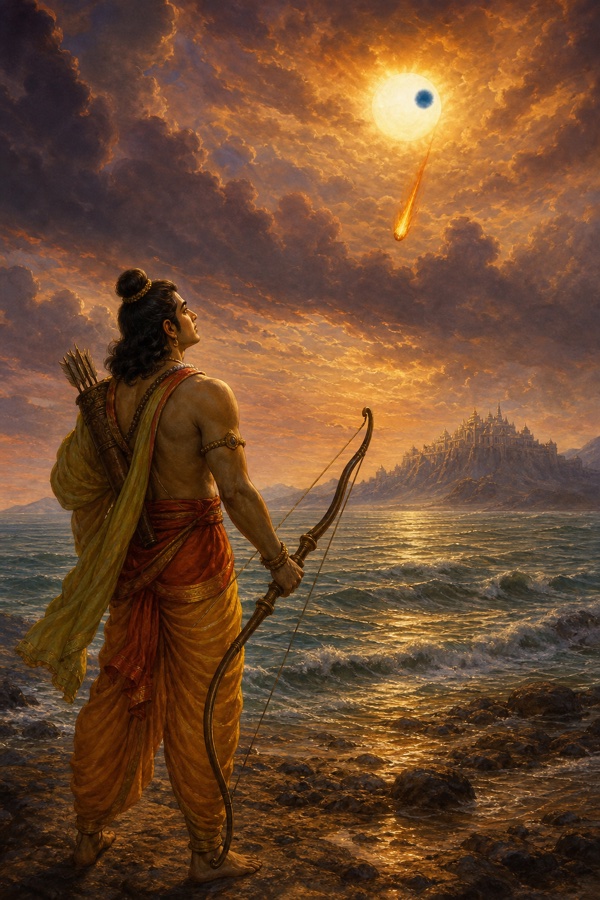
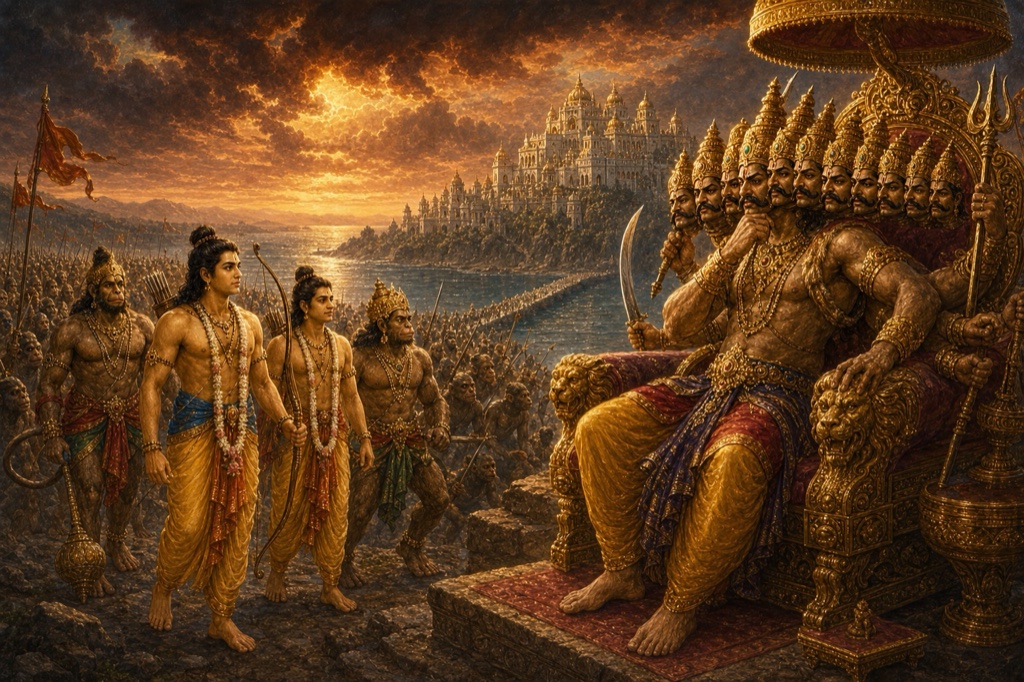
The sea was behind them. For months that water had been the one thing in the world Rama could not cross, and now it lay at his back, roofed over with the stones his monkeys had carried, and the far shore he had stared at for so long was under his feet. Raghava stood on the southern strand with his vast army about him, and the moment came to turn toward Lanka. As it came, his eyes caught signs in the sky and on the earth that a prince of his house is trained from boyhood to read, the way he is trained to read a bow. He drew Lakshmana to his chest and held him there, and then, still holding him, he told his brother what he saw. Winds blew fouled with dust. The ground shuddered under them; the peaks of the mountains trembled and tall trees came down. Clouds harsh as flesh-eating beasts, with cruel, grating voices, let fall a rain streaked with drops of blood. The evening light lay red as sandalwood paste and terrible to look at, and from the blazing sun a round mass of fire broke loose and fell. Beasts and birds of wretched and pitiful cry turned their faces toward the sun on every side and shrieked out fear. Even by night the moon shone without luster, ringed in a black and red halo, giving off a heat against its own nature, as if the hour of dissolution had already come. A small, dreary, copper-colored halo hung about the sun, and in a cloudless sky a blue stain lay upon its face. The stars, veiled in thick dust, seemed to foretell the ruin of all the world. Crows, hawks, and low vultures swooped down upon Lanka, and jackal-bitches howled their evil music, and the howling carried across the water to where the brothers stood.
“This is the warning of a great danger,” Rama said, and his voice carried to the captains nearest him. “It foretells the ruin of the world and the death of the finest heroes on both sides, bear and monkey and rakshasa alike. Soon, I think, this earth will lie under the rocks, the darts, and the swords that monkeys and rakshasas hurl at one another, and it will be thick with a mire of flesh and blood. So let us choose our ground where there is fresh water, forest, and trees heavy with fruit. Let us divide this multitude into battalions, draw it up in battle order, and keep our eyes open. Then, with all the monkeys around us, let us move today, without delay and at full speed, against Lanka, the city Ravana rules, the city no army has ever found easy to storm.”
With that he set out toward Lanka ahead of every one of them, the most celebrated archer of his age, the joy of his own people and the breaker of enemies in war, walking at the very front where an army looks for the man who leads it. Vibhishana and Sugriva went at his side, and behind them every famous monkey in that host surged forward, roaring for the destruction of the rakshasas who waited inside the walls to fight them. Raghava watched those powerful monkeys straining, every one of them laboring to please him, and something in him eased; he took a deep and quiet pleasure in their eagerness.
The army arrayed at Lanka’s gate, and Shuka’s return
King Sugriva drew the host up in battle order, and seen from above, that mass of heroes looked like a night of the autumn full moon, the moon at its center and bright stars crowded all around. Under the tread of that army, as broad and glorious as a sea, the earth itself shook, with fear and with the sheer speed of its coming. Then, from inside Lanka, the monkeys heard the kettledrums and the clay tomtoms begin, a deep din that raised the hair on the arms. The commanders of the monkey troops heard it with delight. They could not bear to be outsounded, and they roared back at a pitch higher still, until the rakshasas inside the city heard the monkey roar rolling over them like the thunder of overbearing clouds. Rama, the son of Dasharatha, looked up at Lanka dressed in flags and buntings of every color, and his mind went, aching, to Sita. Somewhere in there, he thought, is that lady with the eyes of a fawn, held by Ravana the way the star Rohini is held in the grip of the red planet Mars.
He drew a long, hot breath, turned to Lakshmana, and gave voice to what the hour demanded. “Look, Lakshmana,” he said. “Look at that lofty city of Lanka on the summit of the mountain. Vishvakarma, the architect of the gods, raised it as though he had shaped it straight out of his own mind, and it scrapes the sky. It came into being long ago, crowded with mansions seven stories high, and from here it looks like the sky banked with white clouds. Its groves are in blossom; they rival Chaitraratha, the pleasure garden of Kubera, the lord of wealth, and they send their fruit and flowers up to the royal palace and ring with the songs of every kind of bird. Watch how the sweet breeze stirs those clusters of trees again and again, where the birds are in their season, where the bees hide among the blossoms, where the cuckoos crowd together.”
Then Rama, the son of Dasharatha, drew Lakshmana aside and spoke to him privately, and he gave the order to divide the army camped around them, following the rule the scriptures of war lay down.
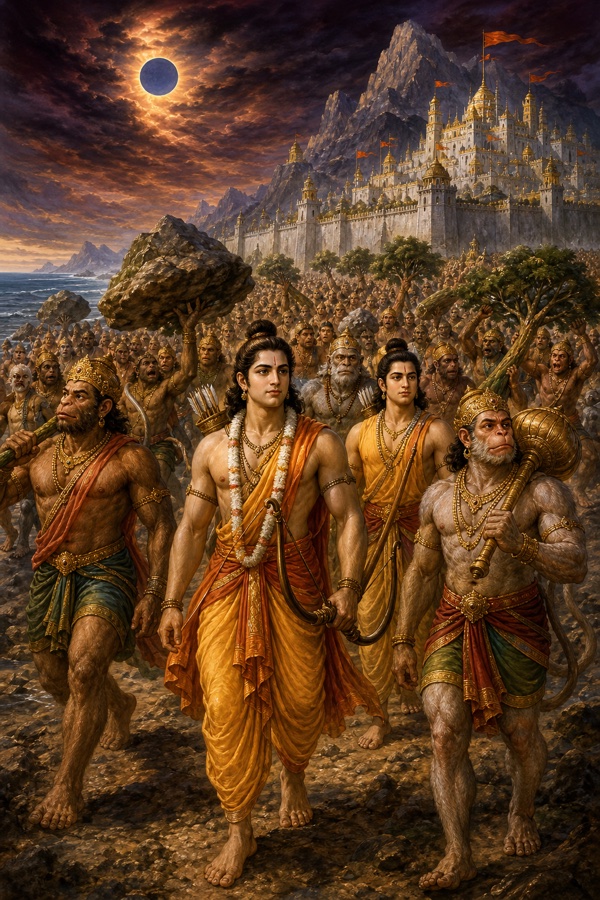
He set the monkey army in its places. Angada, whom no one had ever conquered, was to draw his own troops out of the mass and stand with Nila at the chest of the formation. Rishabha, ringed by a battalion of his own, would hold the right wing. Gandhamadana, hard to overpower and as agile as an elephant in rut, would stand at the head of the left flank. Rama himself, with Lakshmana, would keep watch at the head of the whole array, in front, where the first blows always fall. Jambavan, Sushena, and Vegadarshi, three shrewd leaders of the bears and the monkeys, would guard the belly of the formation, and Sugriva, king of the monkeys, would cover its hips and loins on every side, the way Varuna, wrapped in his glory, guards the western quarter of the earth. Arranged like that, in one immense body shielded by its great monkeys, the host looked like the heavens piled with banks of cloud. The monkeys snatched up mountain peaks and giant trees and came up to Lanka, the city they were burning to crush in battle, and every leader among them made the same silent vow: we will smash that Lanka to pieces, with the peaks of mountains if we have them and with our bare fists if we do not.
Then Rama, all his energy gathered in him, turned to Sugriva. “The troops are well marshaled,” he said. “Now let Shuka go.” Shuka was the envoy Ravana had sent out to Sugriva before the crossing; the monkeys had seized him in the air, beaten him, and held him prisoner ever since. At Rama’s word the strong king of the monkeys released him. Set loose at last, battered by the monkeys and badly frightened, Shuka made his way back to Ravana, the overlord of the rakshasas. He had been sent out to talk Sugriva out of a war, and all he had to show for it was a beating.
Ravana took one look at him and laughed until his sides shook. “What happened to those wings of yours?” he asked. “They are strapped down like a trussed bird’s. They look clipped. I hope you did not fall into the hands of those flighty monkeys.”
Shuka was still trembling when he answered. “I stood in the air above the northern shore of the sea and gave them your message faithfully, exactly as you told me, without a tremor in my voice, and I tried to soothe the monkeys with gentle words,” he said. “They had hardly caught sight of me before fury took them. They leapt up and seized me, and they began to beat me with their fists and tear out my feathers. The monkeys are furious and violent by nature, my lord. There is no bargaining with them. At that moment there was not even a chance to ask them why.”
Then he told what he had learned, because it was worse than the beating. “Rama, the one who killed Viradha and Kabandha and Khara, has come with Sugriva to rescue Sita, now that he knows where she is,” he said. “They have thrown a bridge across the sea and crossed the salt water, and Rama stands on our shore with his bow in his hand, counting the rakshasas as nothing. Bears and monkeys in their thousands upon thousands, huge as mountains, dark as clouds, cover the ground. No peace is possible between those two armies, your host and the army of Sugriva, any more than between the gods and the demons of old.”
“Before they reach the wall, choose, and choose quickly, between the only two courses left to you,” Shuka said. “Either give Sita back to him at once, or give him battle.”
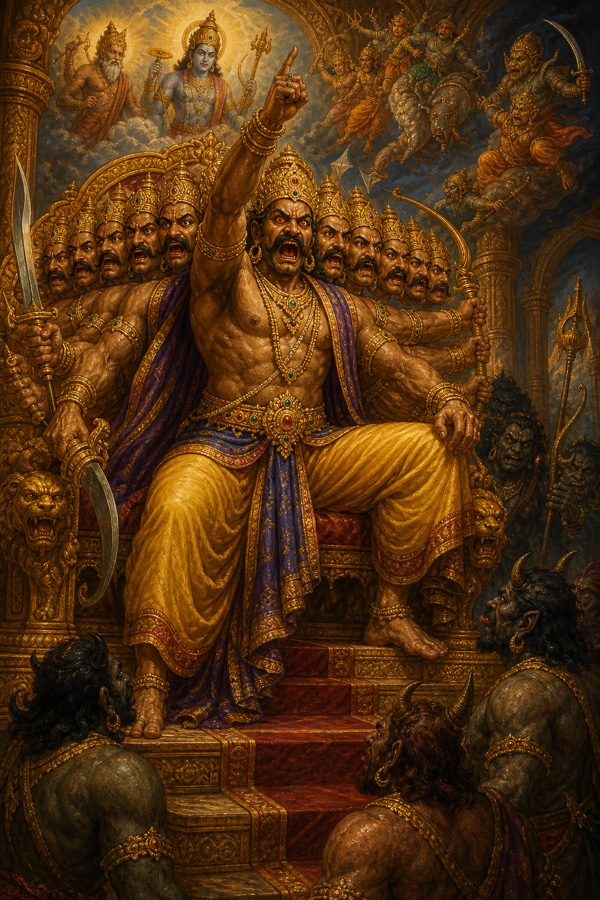
At those words Ravana’s eyes went red as blood, and he glared at the messenger as if his look alone could burn him where he stood. “I will not give Sita back,” he said. “Not if the gods and the gandharvas and the demons all made war on me together. Not for fear of every world there is.”
Then he boasted, and under the boast ran a real hunger. “When will my arrows fly at Rama the way bees drunk on spring rush at a tree in flower?” he said. “When will I burn him with the flaming shafts of my bow, his body pierced and smeared with blood, the way men drive a wild elephant with firebrands? With a vast army around me I will blot out that army of his the way the rising sun wipes every other light out of the sky. When I charge, I come on with the fury of the sea, and my strength is the strength of the wind. Rama does not know that, and that is the only reason he is looking for me. He has never seen on a battlefield the arrows that lie in my quiver like venomous snakes, and so he thinks he wants a fight.”
“He has never felt what I can do in battle,” Ravana went on. “He does not know my terrible vina, which is my bow. It is played with the heads of arrows. It sounds a low note in the twang of the string, a middle note in the cries of the wounded, and a high note in the whistle of the steel-tipped shafts. I will play it when I step out onto a vast stage, with the enemy ranks rolling toward me like a river in flood. In a great battle no one overcomes me: not Indra with his thousand eyes, not Varuna himself, not Yama, not Kubera.”
The spying of Shuka and Sarana, and Rama’s mercy
Rama, the son of the emperor Dasharatha, had crossed the sea with his army, and in Lanka the glorious Ravana sent for his two ministers, Shuka and Sarana. “The whole army of the monkeys has crossed a sea that no one crosses,” he told them, “and Rama has laid a bridge across it, a thing never done before in the history of the world. I would not have believed, under any circumstances, that the sea could be bridged. Still, I must know the size of that monkey army.” He had counted on the sea to do his fighting for him, and the sea had let him down.
“Go into the monkey army unseen,” he ordered them, “and learn its true size and its true strength. Find out who the leading monkeys are, which counselors Rama and Sugriva trust, who marches in the front line, who the heroes are. Find out how that bridge was thrown across the salt sea that carries King Sagara’s name, how those proud monkeys have pitched their camp, what Rama and the bold Lakshmana have resolved and what they are able to do, what weapons they carry, and who commands the whole host. Learn it exactly as it is, and come back fast.”
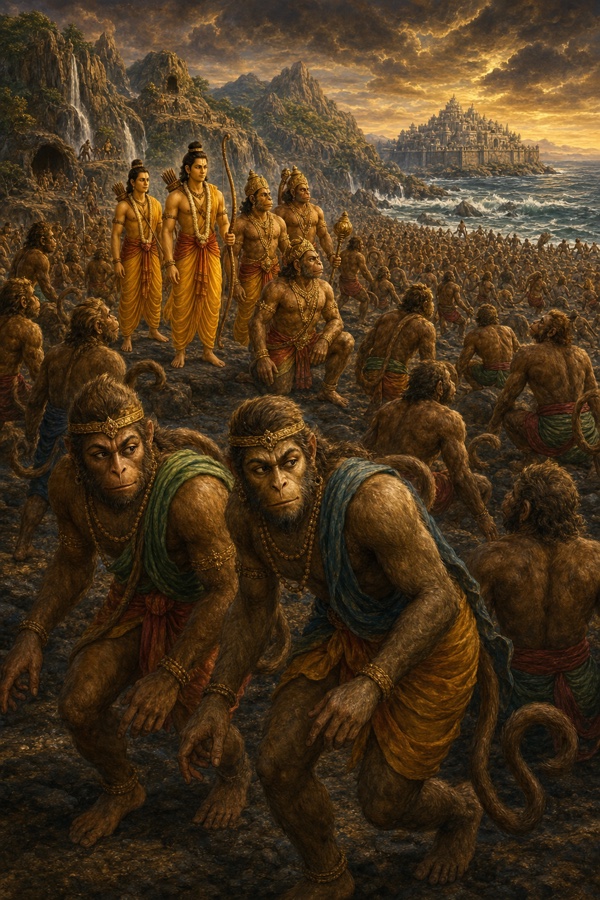
At his order the two rakshasa heroes took on the shapes of monkeys and slipped deep into the monkey ranks, and there they discovered that the thing they had been sent to count could not be counted. It could hardly even be imagined, and the sight of it raised the hair on their bodies. It covered the summits of the mountains, the ground around the waterfalls, the caves, the seashore, the woodlands, and the gardens. Part of it had already crossed the sea, part was crossing still, and part was gathering on the far shore to cross. The whole of it roared as it settled into camp. The two spies were still staring at that unshakable ocean of an army when Vibhishana, Ravana’s own brother, who had come over to Rama’s side and who could see through any disguise his people wore, recognized Shuka and Sarana under theirs, seized them, and dragged them before Rama.
“These are two of the ministers of Ravana, the ruler of the rakshasas,” Vibhishana said. “Shuka and Sarana. They have come from Lanka as spies.”
The two rakshasas looked up at Rama and gave up all hope of living. Shaking, they joined their palms. “Ravana sent us, good sir,” they said. “We came to learn everything there is to know about this army of yours.”
Rama, the son of Dasharatha, who wishes well to every living creature, laughed out loud. “If you have seen the whole army, and taken a good look at us as well, and your master’s errand is done, then go back whenever you like,” he said. “If anything is left that you have not examined, look at it again. Vibhishana will show you all of it a second time.” He had nothing to hide from Ravana, and he wanted Ravana to know it.
“And do not fear for your lives because you have been caught,” he told them. “You had laid down your weapons when you were taken, and you are envoys. Envoys are not put to death.”
Then he turned to the monkeys and had the two rakshasas set completely free, though they had come in disguise, as spies, and though men of that trade are forever at work sowing division in an enemy’s ranks.
He turned back to the two rakshasas. “When you reach the great city of Lanka, give Ravana my words, exactly as I say them,” he said. “Tell him this. The strength you trusted when you stole my Sita, show it now, as you please, with your troops and your kinsmen around you. Tomorrow at daybreak look at your city, its walls and its arched gates, and at the army of the rakshasas, and watch them destroyed by my arrows. Tomorrow at daybreak I will let my terrible anger loose on you and on your forces, the way Indra, who wields the thunderbolt, lets his anger loose upon the demons.”
The two spies cried “Victory to you!” to that lover of righteousness, and made their way back to Lanka, and there they told Ravana what they had seen. “Vibhishana seized us to be killed,” they said, “and Rama, whose mind is fixed on what is right and whose energy has no end, let us go.”
“Four of the finest men alive stand together in one place,” they warned him, “bold as the guardians of the four quarters of the world, masters of the bow, unyielding: the glorious Rama, son of Dasharatha, and Lakshmana, and Vibhishana, and Sugriva, who is Indra’s match in prowess. Those four could tear Lanka up by its foundations, walls and gates and all, and set it down somewhere else, with every monkey standing idle and watching. Rama alone, with the form he wears and the weapons he carries, could destroy this city single-handed while the other three looked on. With Rama and Lakshmana and Sugriva guarding it, that monkey army has become almost impossible to overcome, even for all the gods and demons together. Its gigantic warriors want to fight this very moment, and they welcome the chance. Let this quarrel go. Make peace with Rama, and give Sita, the princess of Mithila, back to the son of Dasharatha.”
From the palace roof, Sarana names the monkey chiefs
Sarana had spoken the truth, and spoken it without fear, and King Ravana answered him. “Even if the gods and the gandharvas and the demons all came at me together, I would not give Sita up, not for fear of the whole world,” he said. “The monkeys handled you roughly, my good fellow, and it frightened you, and so now you think it right to hand Sita back to Rama this very day. What enemy alive can really defeat me in war?”
With that unkind remark the glorious Ravana, overlord of the rakshasas, who had made whole peoples weep under his rule, climbed to the roof of his snow-white palace, as tall as many palmyra palms stacked one on another, to look at the monkey army with his own eyes. He gazed out over the sea and the mountains and the forests with the two spies beside him, and wherever he looked, the land was crowded with monkeys. That army had no edge he could find, and nothing he could see would stop it. Hot with anger, King Ravana turned to Sarana.
“Which of these monkeys are the leaders?” he asked. “Which are the brave ones, which have extraordinary strength, which march in the van, burning with zeal? Whose advice does Sugriva take? Who commands the commanders of the monkey hordes? How strong are these monkeys? Tell me everything.”
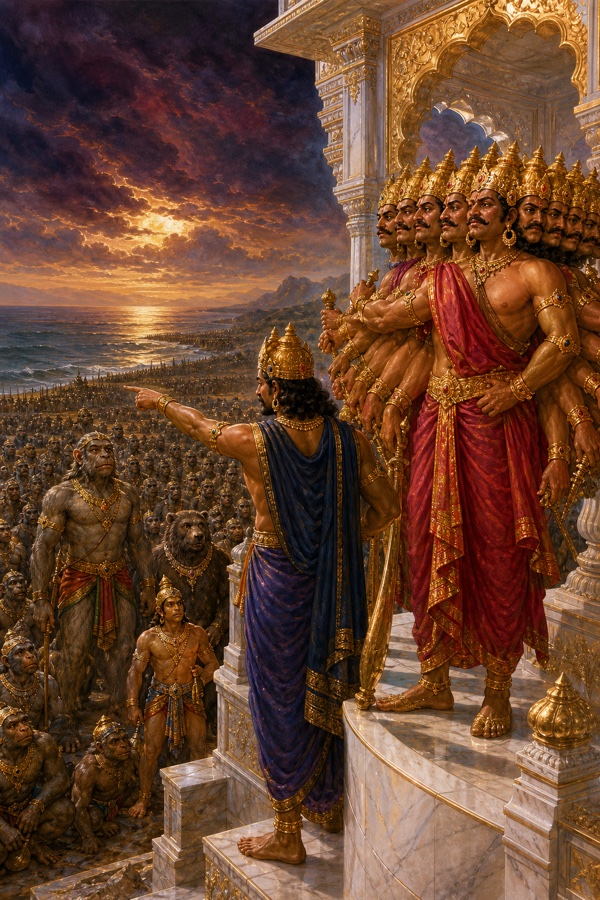
Sarana knew the chiefs of that army by sight, and he answered at once. “That monkey standing there roaring with his face toward Lanka, ringed by a hundred thousand commanders of monkey hordes, the one whose voice keeps striking all Lanka, its walls, its gates, its mountains, its groves and woodlands, is Nila, the brave commander of the hordes, posted at the head of the army of high-minded Sugriva, who rules all the monkeys,” he said. “The one who swings his arms as he walks, who stands facing Lanka and yawns again and again in his fury, who is as tall as a mountain peak and colored like the filaments of a lotus, who lashes his tail in his excitement until all ten directions ring with the sound of it, is the crown prince Angada, whom Sugriva installed. He is challenging you to single combat. He is a son worthy of his father Vali and the beloved of his uncle Sugriva, and he is as ready to spend his strength for Rama as Varuna is for Indra. That Hanuman, Raghava’s swift friend, ever found Sita at all was entirely Angada’s planning. That powerful monkey is marching forward now with many battalions of the best monkeys behind him, to crush you with his army.”
Then Sarana counted off the leaders one by one, giving each his mountain and his river the way a man names what he knows by heart. “Behind the son of Vali, with a large army around him, stands the bold Nala, who built the bridge, ready for battle,” he said. “Those terrible, angry champions among the monkeys, a thousand crore and eight lakhs of them, hard to withstand, who stiffen their limbs and roar like lions and like thunder, who spring up onto their feet and stretch in their fury, and those fierce monkeys of the sandalwood forest, all follow Nala, and he too means to crush Lanka with his army. The clever, agile, brave monkey Shveta, silver in color and known in all three worlds, runs to Sugriva, divides the army, cheers the troops, and goes back to his place. On the bank of the river Gomati there is a mountain clothed in every kind of tree, Sanrochana by name; here is Kumuda, a commander of monkey hordes, who roamed that lovely mountain and ruled his kingdom from it. The one who joyfully draws hundreds of thousands of monkeys after him, whose very long hairs, coppery and yellow and pale and white, hideous to look at, are flung about on his tail, is the fearless monkey Chanda, who longs for a fight and means to crush Lanka. The tawny one with the long mane, who looks like a lion and stares at Lanka so fixedly that you would think his glance could devour it, who lives on the Vindhya, the Krishnagiri, the Sahya, and the Sudarshana mountains, is Rambha, a commander of monkey hordes; one crore and thirty of the fiercest monkeys, savage and of terrible prowess, follow him as he marches to crush Lanka with their strength. Look at the one who flares his ears and yawns again and again, who has no fear of death and never trails behind an army, who shakes violently with anger and looks sideways, who lashes his tail and roars like a lion with all his power: he lives on the lovely Salveya mountain, and he is Sharabha, a commander of extraordinary might and wholly without fear. Under him serve forty lakh commanders of hordes, the Viharas, every one of them full of strength. The gigantic monkey who stands there filling the air like a cloud, in the midst of the monkey heroes the way Indra stands among the gods, whose roar like the roll of kettledrums you can hear at this very moment among the leaders hungry for battle, who lives on the splendid Pariyatra mountain, is Panasa, a commander no one has ever been able to stand against in combat; fifty lakh commanders of hordes, each with his own unit, wait on his word. The one who stands there like a second sea, lending beauty to the terrible army drawn up along the shore, bounding for joy, who is as big as the Dardura mountain and roams about drinking the water of the Vena, the first of rivers, is the commander Vinata, and sixty lakh monkeys make up the force at his command. Then there is Krodhana, under whom serve brave and powerful commanders of hordes with units of their own beneath them; he too challenges you to combat. And the glorious monkey who fattens his ochre-colored body for the sake of a war with you, who is proud of his strength and stands facing you in fury, who holds every other monkey in contempt, is Gavaya; seventy lakh monkeys wait on his word, and he too means to lay Lanka in ruins with his army.”
“These commanders of hordes are the greatest of all the generals out there, and there are too many of them to number,” Sarana said at the end. “They are terrible heroes, and each one of them has a separate unit under his own command.”
Sarana describes the remaining chiefs and the bear host
Sarana went on, and the sentence he opened with was the one a wiser king would have heard above all the numbers. “Since you are watching so closely, I will describe to you in detail the monkey generals who are ready to spend their courage for Rama and who do not care even for their own lives,” he said. “This monkey of terrible deeds goes by the name of Hara. The glossy hairs of his long tail, coppery, yellow, brown, and white, stand straight up and shine like the rays of the sun, and when he flings the tail about they drag along the ground behind him. Commanders of hordes in their hundreds and their thousands, holding trees over their heads and set on storming Lanka, follow close behind him at Sugriva’s order. And those warriors you see ranged over there like great dark clouds, black as collyrium, who never fail on a battlefield, who can no more be counted than the sands on the far shore of the sea, let alone named one by one, who came some from the mountains, some from the plains, some from the riverbanks: those are the bears, savage beyond measure, and they are coming toward you. Among them, that warrior with the dreadful eyes and the fearful face, ringed on every side by bears the way Parjanya, the god of rain, is ringed by his clouds, who lives on Rikshavan, the first of mountains, and drinks the water of the Narmada, is the overlord of all the bears and a commander of troops. His name is Dhumra.”
“There is a younger brother of Dhumra who looks just like him and is plainly the greater fighter of the two; look at him there, as tall as a mountain. That is Jambavan, a commander even over mighty generals, calm to his depths, devoted to his elders, and terrible in war,” Sarana said. “In the war between the gods and the demons the wise Jambavan gave Indra great help, and won many boons for it. His troops climb the heights of mountains; they are shaggy and full of immense energy, they range about in vast numbers, they are as fierce as demons and goblins, they hurl rocks as big as clouds, and they do not flinch when they look death in the face. That lord of monkeys, a commander of commanders, at whom every monkey stands gazing whether he is leaping in fury or standing still, is a commander of troops named Dambha, who with his army serves thousand-eyed Indra. The one who brushes with his flank, as he moves, a mountain a full yojana away, who can stretch his body up and seize a thing a yojana high, whose frame is bigger than that of any other four-footed creature, is called the grandfather of the monkeys, Sannadana by name; that wise monkey once fought Indra himself on a field of battle and was not beaten. The one who marches into combat with prowess equal to Indra’s own was fathered by the god of fire on a gandharva maiden, to help the gods in their war with the demons; this glorious and mighty monkey, a commander of troops named Krathana, who never boasts in war, takes his pleasure on Kailasa, the king of mountains, where the kinnaras throng and where Kubera, son of the sage Vishrava and your own half-brother, sits beneath the jambu tree. Thousands of crores of monkeys stand around him, and he too means to crush Lanka with his army. The one who thunders and tears up trees, who remembers the old feud between elephants and monkeys and roams the banks of the Ganga spreading terror among the herds, who lives in mountain caves and blocks the wild elephants’ path, is the famous general Pramathi, and no one finds him easy to stand against. You can see him there like a cloud driven by the wind, with a furious band of quick monkeys around him and the smoke-colored dust they kick up drifting in every direction. His home is sometimes Mount Ushirabija, on the bank of the Ganga where it comes down from the Himalaya, and sometimes Mount Mandara, the first of mountains, where that monkey lord takes his pleasure the way Indra does in heaven. Ten crore roaring monkeys, proud of their manhood and rich in the strength of their arms, follow him, and he alone leads them. And those terrible black-faced langurs, of extraordinary strength and a crore in number, who watched the bridge being built and now stand roaring in their eagerness to tear Lanka down, are gathered around the general Gavaksha, a langur himself.”
“The general Kesari, first among the leading monkeys, takes his pleasure on lovely Sumeru, the golden mountain, the finest of all mountains, where the trees bear fruit in every season and the bees never leave them,” Sarana said. “The sun circles it, keeping it always on his right, and it throws off a splendor like the sun’s own, so that every beast and bird that lives there looks golden. The great sages never leave its peaks, and its trees grant every wish and drip every kind of costly honey. Sixty thousand mountains stand there, every one of them a lovely mountain of gold, and in their midst Savarni-Meru, the greatest of them, stands out the way you stand out among all the rakshasas. On the last and northernmost of those sixty thousand mountains live monkeys who are brown, white, copper-faced, and yellow as honey, with pointed teeth and claws for weapons, four-fanged like lions and as dangerous to approach as tigers. They are all like fire, and like venomous snakes with flickering tongues. Their long tails stand up, and they look like elephants in rut. They are as huge as mountains and they thunder like great clouds, and with their round gray eyes they raise the most appalling uproar as they march. Every one of them stands there as though he would destroy your Lanka the moment he set eyes on it.”
“In their midst stands their bold commander, known far and wide on earth by the name of Shatabali, clever and hungry for victory, who worships the sun every day of his life,” Sarana said. “He too means to tear Lanka down with his army. Brave, powerful, and daring, he trusts his own courage, and that monkey would not hold his life back to please Rama. Besides these there are Gaja, Gavaksha, Gavaya, Nala, and the monkey Nila, each with ten crore warriors around him, and other leading monkeys from the Vindhya range, quick on their feet, too many to count. Every one of them has extraordinary strength, every one has a body like a great mountain, and every one could flatten the earth with all its mountains in a moment and scatter the pieces.” That was the report, and the king it was given to heard every number in it and missed the one thing that mattered: every one of those monkeys had come for one man’s wife, and would not spare his own life for him.
Shuka completes the account
Sarana fell silent, the whole army described, and Shuka took up the account where he had left it and spoke to the overlord of the rakshasas. “Those monkeys you see ranged over there like huge elephants in rut, like banyan trees on the banks of the Ganga, like sal trees on the Himalaya, are hard to stand against, mighty, and able to change their shape at will,” he said. “They look like daityas and danavas, the old enemies of heaven, and in war they fight with the prowess of the gods. They are Sugriva’s allies and they live in Kishkindha itself; gods and gandharvas fathered them. Those two standing over there, so alike they might be one creature, with the look of gods about them, are Mainda and Dvivida. No one is their equal in combat. With Brahma’s leave both of them have drunk the nectar of immortality, and the two of them also mean to tear Lanka down with their own strength.”
Shuka put the number of that monkey army at twenty-one thousand crore, a thousand shankus, and a hundred vrindas. Then he pointed to one monkey who stood like an elephant in rut, who in his anger could churn up the sea itself, the one who had already come all the way to Lanka once, hunting for Sita and for Ravana himself. “Look at this monkey,” he said. “You have seen him before. He has come back.”
“He is the eldest son of Kesari, and he is also known as the child of the wind-god, and his name is Hanuman; he is the one who leapt across the sea,” Shuka said. “This monkey lord can take any shape he likes. He is richly gifted with strength and with beauty, and nothing can stop him in his course, any more than you could stop the wind that never ceases to blow. When he was still a child he saw the sun rising, and he was hungry, and he made up his mind: I will eat the sun, because nothing else will satisfy this hunger. He sprang up into the sky, proud of his strength, so the story goes, and bounded three thousand yojanas. He could not reach the sun, which neither gods nor sages nor demons can reach, and he fell back onto the eastern mountain where the sun rises. When he struck the rock one of his jaws cracked a little, and it healed all the stronger for it, and from that jaw, the hanu, he came to be called Hanuman.”
“I know this monkey for what he is, through the monkeys who had dealings with me, and there are no words for his strength or his beauty or his glory,” Shuka said. “He means to destroy Lanka single-handed, by his own strength. How can you have forgotten already the monkey who set his own tail alight with the fire your glory had robbed of its luster, and carried that fire through every street of Lanka?”
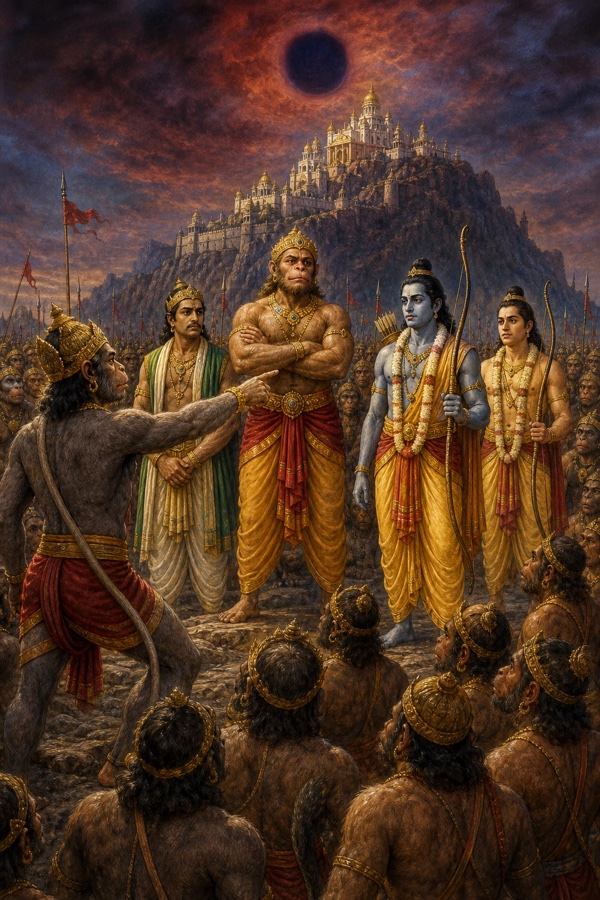
Then Shuka took the measure of the two brothers. “That bold prince standing close by, dark brown in color, with eyes like lotus petals, is a great chariot-warrior of the line of Ikshvaku, and the whole world knows his courage,” he said. “His virtue never wavers, and he never takes a step outside what is right. He knows the weapon over which Brahma presides, and he knows the Vedas, and among those who know the Vedas he is first. He can split the vault of heaven with his arrows and tear open the earth. His anger is the anger of Death and his prowess is Indra’s. His wife is Sita, the woman you carried off from Janasthana. That is Rama, and he is coming to make war on you.”
“The one standing on Rama’s right, radiant as refined gold, broad-chested, copper-eyed, with dark curling hair, is Lakshmana,” Shuka went on. “He lives for his elder brother’s pleasure and his elder brother’s cause. He is skilled in statecraft and in war and first among all who carry weapons. To Rama’s enemies he shows no mercy; he is hard to conquer, victorious, brave, and mighty. He has always been Rama’s right arm, the very breath of Rama’s life walking about outside his body. Where Rama is concerned he does not spare himself, and he too means to wipe out every rakshasa in this war. The one who keeps to Rama’s left, with a band of rakshasas around him, is King Vibhishana. The glorious Rama, that king of kings, has already anointed him sovereign of Lanka, and he is marching against you full of rage. And the one you see standing motionless as a rock in the center is Sugriva, lord of all the monkey chiefs, whose energy has no measure, who outshines the other monkeys in glory, fame, intelligence, strength, and lineage the way the Himalaya outshines every other mountain. He lives at his ease with the leading monkeys in Kishkindha, a cave among thick trees, hard to reach and walled in by mountains. Around his neck shines a chain of gold worked with a hundred lotuses, which gods and men alike covet, and in it Lakshmi, the goddess of fortune, has made her home. Rama gave him that chain, and Tara, and lasting rule over the monkeys, after Rama killed Vali.”
“The wise count a hundred thousand times a hundred as a crore, and a lakh of crores as a shanku,” Shuka said, and he climbed the ladder of names for his king one rung at a time: mahashanku, vrinda, mahavrinda, padma, mahapadma, kharva, mahakharva, samudra, ogha, mahaugha, each one a lakh of the one before it. “Counted that way, Sugriva has around him a thousand crore and a hundred shankus, a thousand mahashankus and a hundred vrindas, a thousand mahavrindas and a hundred padmas, a thousand mahapadmas and a hundred kharvas, a hundred samudras and a hundred mahaughas and a hundred crore mahaughas of monkey warriors, and the bold Vibhishana with his own ministers besides, and with all of that around him, mighty and full of courage, he is coming after you for war,” he said. “Look hard at this army ranged before you like a blazing planet, my king, and put out every effort you have now, so that the victory is yours and no defeat comes to you at the enemy’s hands.”
Ravana’s anger, and the sending of Shardula and the other spies
Ravana looked out at everything Shuka had pointed to: the monkey chieftains one by one, the great hero Lakshmana who was Rama’s right arm, his own brother Vibhishana standing at Rama’s side, the terrible Sugriva who ruled all the monkeys, the mighty Angada, son of Vali, who was himself a son of Indra, the brave Hanuman, Jambavan whom no one had ever conquered, Sushena, Kumuda, Nila, Nala the finest of the monkeys, Gaja, Gavaksha, Sharabha, Mainda, and Dvivida. Something in his heart shifted a little, and then rage poured over it and buried it. When the two spies had finished he turned on them where they stood with their heads bowed low, and his voice came out strangled with fury. They had told him the truth, and he could not forgive them for it.
“It does not become ministers who live on a ruler’s favor to speak unwelcome words in front of a king who holds the power to punish and to reward,” he said. “Was it right for you two to sing the praises of enemies who are marching here to make war on us, and to sing them now, of all times? Your teachers, your parents, and your elders were served for nothing, since the heart of statecraft, which you were meant to live by, never got into you. Or if it got in, you did not keep it; all you carry is a load of ignorance. With fools like you for ministers, it is pure luck that I still hold my throne at all.”
“Did the fear of death not touch you when you dared to say such insolent things to me, your ruler, whose tongue alone can hand you good or evil?” he demanded. “Trees in a forest may touch a fire and still stand. Men who do wrong never walk away untouched from a king’s punishment.”
“I ought to put these two wicked rakshasas to death for singing the enemy’s praises, and I would, if their past services had not cooled my anger,” he said. “Get out of my court for good, and never come before me again. I do not wish to kill you, because I remember what you have done for me. All the same, as far as I am concerned you are dead men, ungrateful, with no loyalty to me.” Shamed, the two of them looked at Ravana, wished him victory as custom required, and backed out of his presence.
“Bring me other spies, and quickly,” Ravana said to Mahodara, who stood close beside him. Mahodara had spies summoned at once. They came running at the royal command and stood before the king with their palms joined, calling down blessings on him and wishing him victory.
“Go from here and find out what Rama is planning, and what the men closest to him in his councils are planning, the ones bound to him by love,” Ravana told those trusted, brave, steady, fearless men. “Learn everything, and learn it thoroughly: how he goes to bed, how he wakes, what he means to do today. Then come back. When a wise king knows an enemy’s movements and strength through a spy, he throws that enemy back with very little effort once the fighting starts.”
“It shall be done,” the spies said. They put Shardula at their head, walked the circle of respect around Ravana, keeping him on their right, glad to be trusted with such work, and set out for the place where Rama was camped with Lakshmana. They came close to Mount Suvela in disguise, and there they saw Rama and Lakshmana with Sugriva and Vibhishana beside them, and they saw the army, and the sight of it emptied their heads of every thought. While they stood there staring, Vibhishana, whose mind was set on what is right and who knew his own people at a glance, found them out. The rakshasas were berated first, and then seized.
Vibhishana singled out only one of them by name. “This one, Shardula, is an evil man,” he said.
Even Shardula, though the monkeys were already beating him, Rama set free, and in his kindness he gave the other rakshasas their freedom too. Still, those fierce, swift-footed monkeys harried them all the way out, and they reached Lanka panting and half out of their senses. It was the second time Rama had let Ravana’s spies walk away alive.
They came before the ten-headed Ravana, those rakshasas who roamed outside the city as its eyes, and reported what they had found. “Rama’s army is camped near Mount Suvela,” they told him.
Shardula names the leading monkey chiefs
“Raghava has made his camp on Mount Suvela with an army nothing can shake,” the spies told Ravana, the sovereign of Lanka. When he heard from their own mouths that Rama had come with all his strength to the very door of Lanka, Ravana felt something small stir and unsettle inside him, and he turned to Shardula.
“Your color is wrong, and you look wretched,” he said. “I hope you did not fall into the hands of the enemy in his rage.”
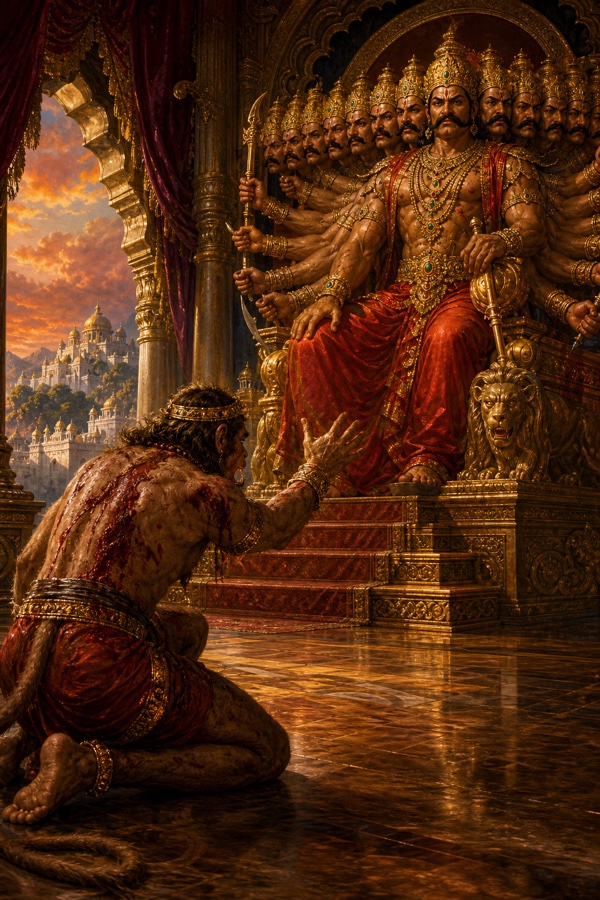
Shardula was still shaken, and his voice came out faint. “There is no spying on those monkey champions, my king,” he said. “They are bold and mighty, and Raghava protects them. There is no talking to them and no chance of asking a single question, because every way in is guarded by monkeys the size of mountains. I had barely slipped inside that army and begun to look around when the rakshasas who serve Vibhishana found me out and seized me, and they dragged me here and there at whatever pace they liked. The monkeys, furious, pounded me from every side with their knees, their fists, their teeth, and their palms, and paraded me through the whole army. After that I was hauled into Rama’s court, my limbs bleeding, my head spinning, my courage gone. They were still beating me, and I was begging for protection with my hands joined, when Rama himself, without warning, rescued me with the words, ‘Stop, stop!’”
“Rama has filled the wide sea with the rocks of mountains, and he stands at the very gate of Lanka, fully armed,” Shardula said. “He has drawn his army up in the shape of Garuda, the great eagle, and with monkeys ringing him on every side he set me free and is coming on against Lanka itself. Before he reaches the wall, do one thing or the other, and do it fast: give Sita back at once, or give him battle.”
Ravana, the overlord of the rakshasas, heard him out and turned it over in his mind, and then gave the answer he had given before, because it was the only answer in him. “Even if the gods and the gandharvas and the demons made war on me, I will not give Sita back under any circumstances, not for any danger from all the worlds,” he said. Then he went on. “You have gone through that army. Who are the bold monkeys in it? What kind of monkeys are these, my good fellow, that no one can get near them, and how strong are they? Whose sons are they, and whose grandsons? Tell me the plain truth. Once I know their strength and their weakness I will decide what to do. A man who goes looking for war must first take the measure of his own army and the enemy’s.”
Shardula, the ablest of the spies, laid out for him the births and the lineages of the chiefs. “First there is King Sugriva, son of Rikshraja, whom no one conquers easily in a fight,” he said. “Here is a son of Gadgada, known far and wide as Jambavan, and here is another son of Gadgada, Dhumra by name. Then there is Kesari, son of Brihaspati, the preceptor of Indra; it was his son Hanuman, alone, who brought that slaughter down on the rakshasas. Here is the bold Sushena, son of Dharma, whose mind is set on virtue, and here is the gentle monkey Dadhimukha, born of Soma, the moon. Here are Sumukha and Durmukha and the monkey Vegadarshi, who are surely Death himself, shaped into monkeys by Brahma. Here is Nila, the commander-in-chief, son of the god of fire, and here is the son of the wind-god, whom the world knows as Hanuman. The mighty young Angada, grandson of Indra through Vali, is hard to overpower. The mighty Mainda and Dvivida are both sons of the Ashvins, the twin physicians of the gods. Gaja, Gavaksha, Gavaya, Sharabha, and Gandhamadana, who rival Time and Death, are the five sons of Yama. And there are ten crore more monkeys like these, bold, warlike, glorious, sons of gods. The rest I cannot count.”
Then he took the measure of young Rama, the son of Dasharatha, built like a lion, who had killed Dushana and Khara and Trishira. No one on earth, he said, could match in prowess the Rama who had killed Viradha, and Kabandha, who had been a match for Death, and no human tongue could list his excellences, because every rakshasa who had been in Janasthana had died at Rama’s hand.
“Here too is Lakshmana, whose mind is set on virtue, who carries himself like the noblest of elephants, and within the range of whose arrows not even Indra would live,” Shardula said. “Here are Shveta and Jyotirmukha, born of the sun, and the monkey Hemakuta, son of Varuna. Nala, the finest of the monkeys, is the bold son of Vishvakarma, the architect of the gods, and here is the brave, headlong Durdhara, son of Vasu. And there is your own younger brother Vibhishana, a prince of the rakshasas, who has been promised the city of Lanka as Rama’s gift and is devoted to Rama’s good.”
“That is the whole monkey army camped near Mount Suvela, described to you at length, exactly as I found it,” he ended. “What remains to be done is now yours to decide.”
Ravana’s illusion, and the false head shown to Sita
The spies came back from Suvela to Lanka and told the king that the famous Rama was camped near the mountain with an army no enemy could move, and when Ravana heard it from their own mouths he was troubled, and sent for his ministers. “Let all my counselors come at once, and let them come with their wits about them,” he said. “The time has come for us to take counsel together.” They came at once, and he talked with them about what had to be done without delay, and then he sent them away and went deep into his own palace, and what he did next he did without his council. He took with him a rakshasa named Vidyujjihva, a mighty sorcerer whose whole art was illusion, and with him at his side he swept in state into the pleasure grove where Sita, the princess of Mithila, was held.
“The two of us will confound the daughter of Janaka with a conjuring trick,” he told Vidyujjihva. “Conjure up Raghava’s head, and a mighty bow with an arrow, and bring them to me when I call.”
“It shall be done,” Vidyujjihva said, and he showed Ravana the trick, deftly worked, and the king was pleased with him and rewarded him with a precious ornament.
Then Ravana, hungry for a sight of Sita, walked into the Ashoka grove. He found the princess there in her misery, a misery she had done nothing to deserve, sitting on the bare earth with her head bowed, lost in grief, her every thought on her husband, and hideous rakshasi guards watching her from close by. He came right up to her, announced his own name with great relish, and spoke to the daughter of Janaka with open insolence. He had come to show her something, and he could hardly wait.
“That husband of yours, Raghava, the killer of Khara, the man you leaned on every time I coaxed you and you turned me away with contempt, my fortunate lady, has been killed in battle,” he said. “Your roots are cut clean through, and your pride lies crushed under my hand. This misfortune, your husband’s death, leaves you no choice; you will become my wife of your own free will. Give up this stubborn resolve to spurn me, you foolish woman. What will you do with a dead husband? Be the queen over all my consorts, now that your one purpose, to be with him again, has come to nothing, you foolish woman of little virtue, who think yourself so wise.”
“Now listen, if you please, to how your husband was killed, a story as gruesome as the slaying of Vritra by Indra,” he said. “With the huge army Sugriva gathered for him all around him, Raghava reached the shore of the sea, so they say, to destroy me. As the sun went down, Rama and that great army made camp along the northern shore. At midnight, when the whole army lay sleeping soundly, worn out from the march, my spies went in first and looked it over.”
The account he gave was a lie from end to end, and every name in it was chosen to wound. “That army of Rama’s was destroyed in the night, on the very ground where he lay camped with Lakshmana, by my great army under Prahasta,” he said. “Scimitars, iron bars, discuses, javelins, staffs, sheaves of arrows, darts, gleaming maces studded with nails, sticks, iron clubs, lances, great discuses and pestles, raised and brought down again and again, the rakshasas hurled all of it at the monkeys. Rama was asleep, and the ferocious Prahasta, a skilled archer, cut off his head with a single stroke of a great sword. Then he sprang up and took Vibhishana captive almost as an afterthought, and Lakshmana was driven off with the monkey troops in every direction. Sugriva, the overlord of the monkeys, lies there with his neck broken. Hanuman’s lower jaw was smashed away, and the rakshasas killed him. Jambavan leapt up and was struck at the knees in the melee and hacked with many scimitars and brought down like a tree. The gigantic Mainda and Dvivida, the finest of the monkeys, famous for killing their enemies, have both been cut in two at the waist with a sword, and they lie there groaning and gasping in their own blood. Panasa lies on the ground panting, burst open like a ripe jackfruit. Darimukha lies in a ravine shot through with steel arrows; Kumuda, for all his energy, lies shrieking, brought down by arrows. Angada with his golden armlets lies fallen, pierced by many arrows, spitting blood on every side. Other monkeys were crushed in their sleep by elephants and by ranks of chariots, torn apart the way the wind tears clouds. Others fled in terror and were struck in the back as they ran, hunted by rakshasas the way lions hunt elephants. Some plunged into the sea, some took to the air, and the bears, doing what bears do, climbed trees. Many more famous monkeys were killed by the fierce-eyed rakshasas on the shore of the sea, among the rocks, and in the woods.”
“That is how your husband was destroyed with all his forces, by my army,” he said, “and his head, soaked in blood and caked with dust, has been brought here to prove his death to you.”
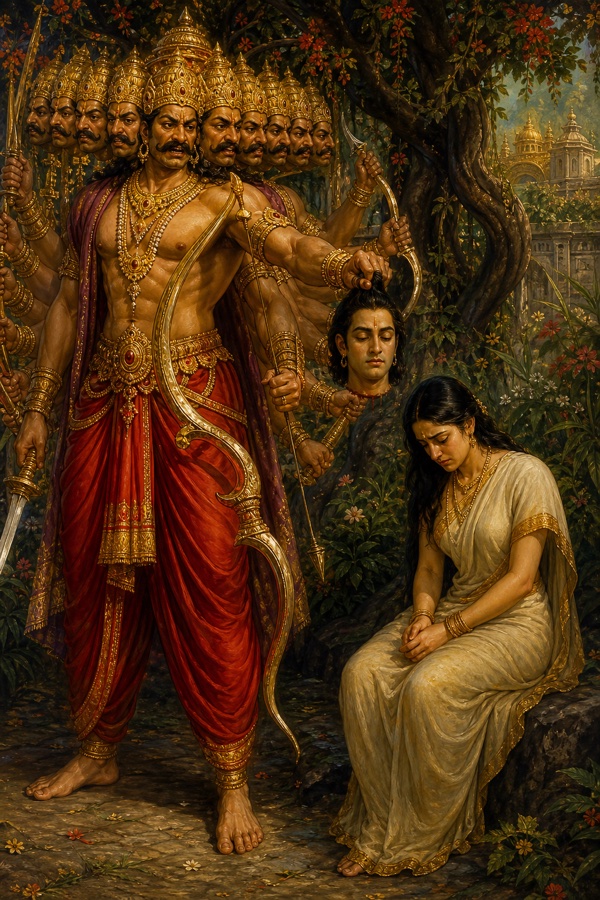
Then, where Sita could hear every word, he spoke to a rakshasi. “Bring before me, and treat him courteously, the rakshasa Vidyujjihva of the cruel deeds, who carried Raghava’s head off the battlefield with his own hands.” Vidyujjihva came, holding the head and a bow, bowed low in salute, and stood before the king. “Set the head of Dasharatha’s son down in front of Sita at once,” Ravana told the long-tongued rakshasa beside him. “Let the poor woman look plainly on what has become of her husband.” The rakshasa laid that head, so handsome to look at, at Sita’s side, and the instant he had done it he vanished.
Ravana flung the great shining bow down beside it. “This is Rama’s bow, famous in all three worlds,” he said. “This is your Rama’s bow, strung and ready, and Prahasta brought it here after he had dealt with that mortal in the night.” He threw the bow to the ground beside the head where Vidyujjihva had laid it, and turned to the glorious daughter of Janaka, king of Videha. “Now give in to my will.”
Sita’s lament, and Ravana’s ordering of war
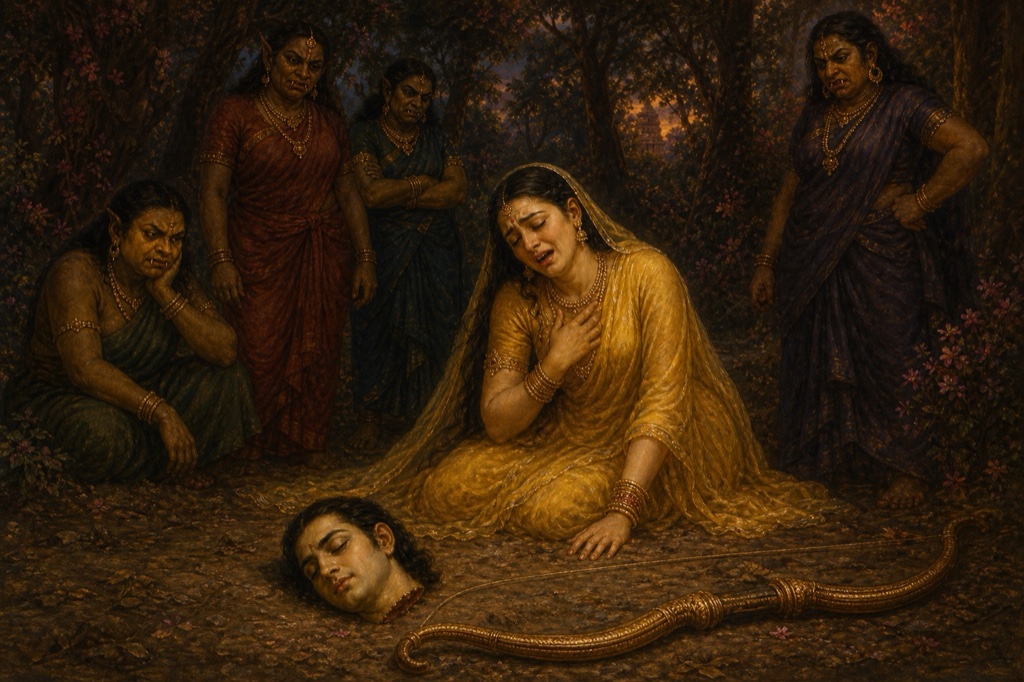
Sita looked at that head and at that fine bow. She remembered the alliance between Rama and Sugriva that Hanuman had told her about, and now, it seemed, the alliance had brought the monkeys nothing but slaughter at the hands of the rakshasas. She knew the eyes, the color of the skin, the face itself, so like her husband’s; she knew the hair and the brow and the splendid jewel that rode on the crown of the head, and by those marks she knew it was his. Grief broke over her, and crying out like a female osprey she began to reproach Kaikeyi, the queen whose boon had sent them all into the forest.
“Be satisfied now, Kaikeyi, now that you have what you wanted and the joy of his house is dead,” she cried. “You loved a quarrel, and you have torn the whole family up by its roots. What wrong did noble Rama ever do to you, Kaikeyi, that you dressed him in bark and sent him into the forest with me?”
She was shaking all over as she said it, and the young princess of Videha dropped flat to the ground like a plantain tree cut through at the root. After a while she came back to herself and gathered what heart she had, and sitting close beside the head, the woman with the wide eyes poured out her grief.
“I am lost, my prince of the mighty arms, you who kept your hero’s vow to carry out your father’s command to the last moment of your life,” she said. “I have seen how your life ended, and I am a widow. When a husband dies before his wife, people call it a calamity, and you, a man of noble conduct, have gone before me, a woman who kept her vows. You set out to rescue me, fallen into such misfortune, drowning in an ocean of grief, and the enemy has struck you down instead. Kausalya, my mother-in-law, who loved her child so, is torn from her son the way a cow is torn from the calf she loves. The astrologers promised you a long life, and their prophecy has proved false, because your life has been so short. Or perhaps, wise as you were, your caution failed you, and you fell into the enemy’s hands asleep. Surely it is Time alone, the cause of every creature’s birth, that brings every creature to its end. How did death take you unawares, you who knew the whole science of statecraft, who knew how to turn aside disaster and were so skilled at it?”
Sita spoke to the head as though it could hear her. “The cruel goddess of the night of destruction tore you away from me, my lotus-eyed one, held you close, and carried you off while you lay buried in sleep,” she said. “You have left me behind, a pitiful woman, and here you lie, my mighty-armed one, finest of men, holding the earth in your arms as though she were your beloved. Here lies your gold-trimmed bow, which I tended so carefully with sandal paste and garlands of flowers, which was so dear to me. Surely by now you are with your father in heaven, my father-in-law King Dasharatha, and with all the ancestors. What a grief that you are leaving behind the holy line of royal sages you were born into, you whose great deeds shine like lights in the sky. Why do you not look at me, my prince? Why do you not answer me, the girl you won as your wife and companion when you were hardly more than a boy yourself? Remember the solemn promise you made while you held my hand: I will walk in dharma with you. Take me, wretched as I am, into the other world with you. You brought me all the way from Ayodhya to Janasthana, the most resourceful of men; why have you gone from this world to the next and left even me behind? That body of yours, so lovely in its festive ornaments, which no one ever held but me, is surely being dragged this way and that by the flesh-eaters now. You worshiped the Lord with the Agnishtoma and the other great sacrifices, and paid the priests their generous fees; why will you not have even the sacred fire at your cremation? Kausalya, sunk in grief, will look eagerly for the three who went into exile and see only Lakshmana come home. When she asks him, he will have to tell her how the army of your ally Sugriva was wiped out in the night by the rakshasas, and how you died. When she learns that you were killed in your sleep and that I am held in a rakshasa’s house, her heart will break and she will not live through it. How strange that Rama, a sinless prince full of courage, crossed the sea for my sake, unworthy as I am, and then was killed without a fight, like a man who crosses an ocean and goes under in the hoofprint of a cow. I am the shame of my family, and Rama married me without knowing it; the wife has turned out to be the death of Rama, the son of a worthy father. Surely in some other life I stood in the way of a sacred gift, the gift of a girl in marriage, since I, the wife of a man who welcomed every guest, grieve like this, at my age, in this place.”
Then she turned to Ravana. “Kill me now, Ravana, and lay me on Rama’s body,” she said. “Bring a husband and his wife together again, and win the highest merit by it. Join my head to his head and my body to his body. I will follow my noble husband wherever he has gone.”
So the wide-eyed daughter of Janaka mourned, racked with agony, her eyes never leaving her husband’s head and his bow.
Sita was still weeping when a rakshasa who guarded the gate came up to his master Ravana where he stood, his palms joined. “Victory to you, my lord,” he said, and won a moment of the king’s good humor with it, and then he gave his news. “Prahasta, the commander-in-chief, has come with all the ministers and asks to see you. He sent me. He is eager to see you, my lord. There must be some urgent business. Be gracious, great and forgiving king, and see them.”
At that, ten-headed Ravana left the Ashoka grove to meet his counselors. He had learned by now what Rama could do. He went into the council chamber, and there, together with his counselors, he settled on a course of action and set it in motion. The moment he left the grove, the conjured head and that fine bow vanished into air, and Sita was left weeping over a patch of empty ground.
With those counselors of terrible prowess, Ravana, the ruler of the rakshasas, came to a firm decision about what was to be done against Rama, and he turned to the commanders of his troops, who wished him well and stood close at hand, and gave them the order the hour called for. “Muster the forces before me at once, with the kettledrums beating,” he said. “And tell no one the reason.”
“It shall be done,” the messengers answered. In a short while they had gathered a huge army without a word of explanation to any man in it, and they came back and reported to their war-hungry lord that the host stood ready.
Sarama’s reassurance to Sita
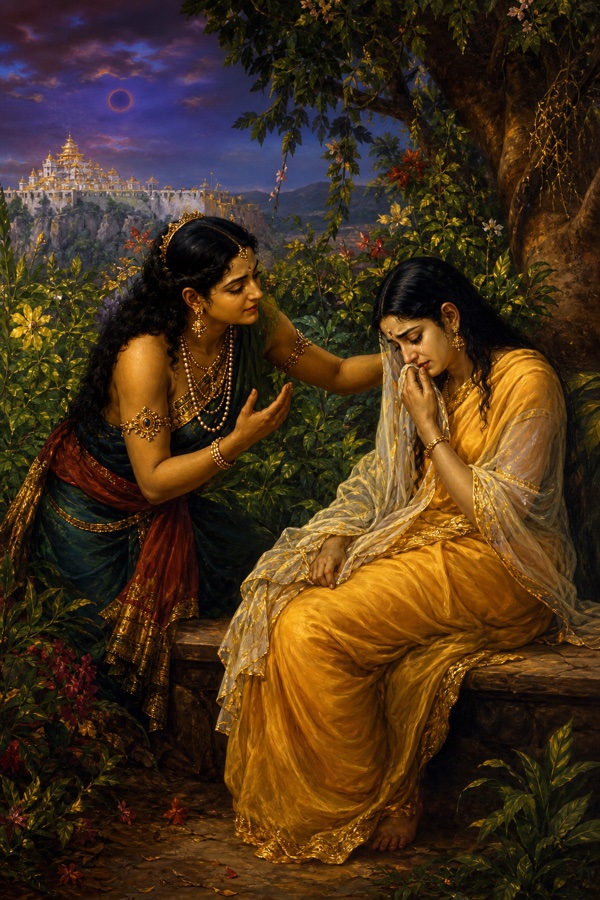
Seeing how Sita had been deceived, a rakshasi named Sarama came to her. She was Vibhishana’s wife, and she loved Sita. Ravana himself had set her to look after the princess, afraid that Sita might die of a grief too great to bear, and Sarama, compassionate and firm in her vows, had done that duty so tenderly that Sita, the prisoner in her keeping, had made a friend of her keeper. Now she found her friend dazed, as if she had just risen from rolling in the dust, soiled like a mare after a hard road. Sarama, whose every word was gentle, set about comforting the princess of the noble vows, whom Ravana had led so cruelly astray and left in such distress.
“Take heart again, Vaidehi, and let no anguish stay in your mind,” she said. “Everything Ravana said to you, and everything you said back, I heard. I hid in a lonely thicket for your sake, out of love for you, my wide-eyed lady, and I put away all fear of Ravana to do it. I am not afraid of him. And I went out and found out on the spot why the ruler of the rakshasas went storming out of here in such a state.”
“No one can kill Rama in his sleep, princess of Mithila. He knows his own self, and death itself cannot touch that lion among men,” Sarama said. “Nor could the monkeys who fight with trees be killed like that, because Rama guards them the way Indra guards the gods. I have seen Rama myself, with Lakshmana at his side. He has long, rounded arms, a broad chest, a body made of muscle; he is glorious and victorious, an archer the whole world knows, the destroyer of hostile armies and of his own enemies, full of fire and courage, his mind set on what is right. With his younger brother Lakshmana he can defend himself and everyone else besides. He comes of a noble line and knows statecraft, and his strength and his manhood are beyond imagining. He has not been killed.”
“What was done to you was a conjuring trick, worked by the cruel Ravana, a master of such tricks, twisted in his thinking and in his deeds, the enemy of every living thing,” she said. “Your grief is over for good. Every kind of good fortune is waiting for you now; prosperity will come to you, and something you will welcome is on its way. Listen. Rama has crossed the sea with the monkey army and reached its southern shore, and he is camped there. I have seen him with Lakshmana, guarded by the troops gathered round him on the seashore, his purpose all but won. The swift rakshasas Ravana sent out brought back that very news, that Raghava has crossed the sea, and that is why Ravana sits in council with all his ministers at this moment.”
She was still speaking to Sita when Sarama heard it: the terrible noise of an army straining every nerve for war. It came through the trees of the grove from every side at once.
The kettledrums were crashing under their sticks, and the gentle-voiced Sarama turned to Sita. “That is a fearful drum you hear, my timid lady, and its sound means they are making ready for war,” she said. “Listen to the deep crash of the drums, like rumbling clouds. They are decking out the elephants in rut and yoking horses to the chariots, and you can see horsemen with spears in their hands by the thousand. Warriors itching for a fight are running this way and that in their thousands; the main roads are choked with roaring troops of strange appearance, all speed and fury, the way the sea fills up with its rivers. Look at the sheen of polished weapons and shields and coats of mail, a glitter of every color, like the blaze of a fire eating a forest in summer. There is the rush of chariots and horses and elephants following Ravana’s lead, and the rakshasas thrilled with joy and eager to be off. Hear the ringing of the bells, the rattle of the chariots, the neighing of the horses, the blare of the trumpets. That is the bustle of rakshasas with their weapons raised, following the ruler of the rakshasas.”
“Good fortune is waiting for you, and it will end your grief; and a danger is waiting for the rakshasas that will make the hair stand up on their bodies,” she said. “Your husband Rama, with eyes like lotus petals, who has mastered his anger and whose prowess no one can measure, will defeat the notorious Ravana in battle and kill him, the way Indra defeated the daityas, and win you back. With Lakshmana beside him he will show his courage against the rakshasas the way Indra showed his against his enemies with Vishnu at his side, Vishnu who came down to earth as Indra’s younger brother.”
“When the enemy is dead I will soon see you, my good lady, seated on Rama’s lap, with Rama come at last and everything you longed for won,” Sarama went on. “When you are together again and he holds you in his arms, you will weep tears of joy on that broad chest of his, daughter of Janaka. Before long Rama in his strength will loosen the single braid you have worn all these months, which has grown down past your hips. You will look on his face like the full moon just risen, my godlike lady, and shed the tears of grief the way a snake sheds its old skin. When he has killed Ravana in battle, which will be soon, Rama, who deserves every happiness, will be happy with his beloved beside him and his desire fulfilled. Cherished by noble Rama, you will flourish the way the earth turns green with crops after a full downpour.”
“Turn to the sun now for refuge, who brings the day,” Sarama told her at the last, “who circles Meru, the first of mountains, wheeling as fast as a horse; he is the source of the joy and the suffering of every creature.”
Ravana’s resolve, which Sarama brings to Sita
So Sarama brought Sita back to life, Sita whom Ravana’s words had led astray and left in agony, the way the monsoon brings the parched earth back to life with rain. Then, wishing her friend well, knowing the right moment for everything and always smiling before she opened her lips, Sarama chose her moment and spoke.
“I can go to Rama, my dark-eyed lady, give him your message, tell him how you are, and come back without anyone seeing me,” she said. “When I travel through the sky, with nothing beneath me, neither the wind nor Garuda himself can keep pace with me.”
Sita answered her sweetly, softly, still bowed under the old grief. “You can rise to the heavens and go down to the world beneath the earth,” she said. “Hear from me the one thing I ask of you. If you mean to do what would please me, and if your mind is truly made up, then I want to know what Ravana is doing at this moment. Go to him, and tell me.”
“Ravana, who makes his enemies weep under his rule, is cruel, and his strength is the strength of his conjuring tricks, and that evil man has muddled my mind the way liquor muddles a man the moment he drinks it,” she said. “He has the most frightful rakshasis threaten me and sneer at me all day long, and he has me watched every day. I am never calm and always afraid, and my mind is never at rest; even here in the Ashoka grove, out of his sight, I shake with fear of him. If he is talking with his ministers about letting me go or keeping me, tell me everything they decide. That would be the greatest kindness you could do me.”
Sarama, gentle in every word, wiped the tears from Sita’s face. “If that is what you want, daughter of Janaka, I will go,” she said. “I will find out what the enemy has in mind and come straight back to you, princess of Mithila.”
With that she went to where the rakshasa king was and listened unseen to Ravana and his ministers. When she had heard the decision of that evil man and understood it, she hurried back to the lovely Ashoka grove, and there she found the daughter of Janaka waiting for her alone, like Lakshmi without her lotus. Sita threw her arms around Sarama, who never spoke to her except kindly, and with her own hands, most tenderly, gave her friend a seat.
“Sit here and rest,” she said, “and tell me, exactly and completely, what that cruel, evil-minded Ravana has decided.”
Sita was trembling as she asked, and Sarama told her everything that had passed between Ravana and his ministers. “Ravana, the ruler of the rakshasas, was given long advice in favor of letting you go, princess of Videha, by his own mother, Kaikasi, and by an old counselor who loves him dearly,” she said. “Let Sita, the princess of Mithila, be given back to Rama, they told him, and let him be received with honor. The astonishing thing he did in Janasthana, where he wiped out fourteen thousand rakshasas under Khara and Dushana, should have opened your eyes all by itself. And what mortal, they asked him, could leap across the sea, find Sita, and destroy rakshasas in combat, the way Hanuman did?”
“Yet for all that his old counselors and his own mother said to him, Ravana is no more willing to set you free than a miser is to loosen his grip on his gold,” she said. “He will not give you up until he gives up his life in battle. That is the resolve of that ruthless rakshasa, taken with his ministers.”
“His mind is fixed and steady on it, because the madness of a coming death is on him,” Sarama said. “Until he is broken in battle, with every rakshasa and himself destroyed, he will not let you go, not even out of fear. Rama will wipe Ravana out in combat with his sharp arrows, my dark-eyed lady, and take you home to Ayodhya.”
At that very moment the clamor of all the monkey troops rose together, mixed with the roll of kettledrums and the blast of conches, and the earth shook with it. When they heard that uproar from the monkey forces, Ravana’s servants inside Lanka felt the strength drain out of them, and a heaviness settled into every movement they made. Thanks to their ruler’s folly, they could see nothing good ahead.
Malyavan’s counsel to make peace
To the deep roll of kettledrums and the blare of conches, Rama of the mighty arms, who had taken hostile cities before, moved out against Lanka. The sound rolled up the slopes of Trikuta and over the walls, and it reached the council chamber where the rakshasa lords sat. Ravana, the ruler of the rakshasas, heard the uproar and sat silent a while, thinking, and then he looked around at his ministers. When he spoke, his voice filled the whole council chamber, the cruel lord of the rakshasas who had made the whole world tremble, and for once he reproached none of them.
“I have heard everything you have told me about Rama crossing the sea, about his courage, his strength, his manhood,” he said. “And I know you as well. You stand there mute, glancing at one another, now that you know what Rama can do; and I know you to be men who have never once failed on a field of battle.”
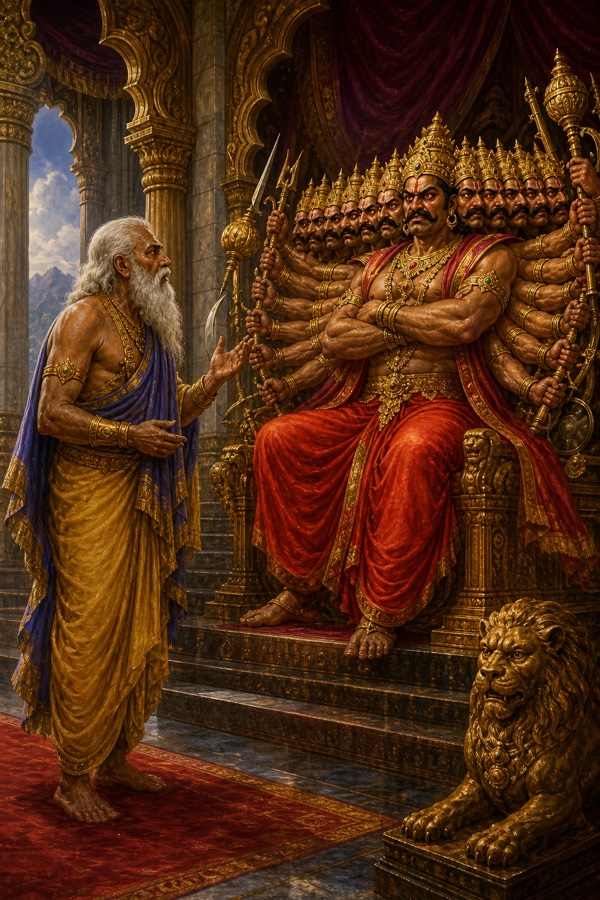
An old rakshasa rose to answer him: Malyavan, his mother’s father, a rakshasa of rare wisdom, old enough to say to this king what no one else in the hall would dare. “A monarch who has mastered the fourteen sciences and walks the path of prudence keeps his throne a long time, my king, and brings his enemies under his hand,” he said. “A ruler who makes peace or makes war as the moment demands, and strengthens his own side while he does it, holds great power. A ruler whose strength is waning should make peace, and so should one who is evenly matched with his enemy. He should never think lightly of an enemy, and he should go to war only when he is the stronger.”
“And so, Ravana, I am for an alliance with Rama,” he said. “Give Sita back to him, the woman for whose sake he has come against you. The sages of heaven and the gandharvas all wish him victory. Do not set yourself against him. Choose peace with him, as I do.”
Then Malyavan laid out the law that lies under every other law. “The glorious Brahma, grandfather of the universe, from whose ten mind-born sons, the Prajapatis, the whole world came, made only two orders of beings, the gods and the demons, and one order stands on virtue and the other on vice,” he said. “Virtue is the anchor of the noble immortals; unrighteousness is the anchor of the rakshasas and the asuras. In the age of truth, virtue outshines evil. In the age of strife, evil swallows virtue.”
“And you, roaming the worlds for conquest, struck virtue at its root and took evil to your heart, and that is why our enemies, who have embraced virtue and turned their backs on evil, are stronger than we are,” he said. “The python of evil, fattened on your mistakes, is about to swallow us whole. The virtue the gods practice is now fighting the gods’ battle for them, and it has taken the shape of these monkeys, every one of them born of a god.”
“You have tormented the sages, those seers who blaze like fire, because you live for the pleasures of the senses and do whatever you please,” he said. “Their power is as hard to overcome as a blazing fire. They have purified themselves through austerity and fixed their hearts on virtue. Those Brahmins worship the Lord with the great sacrifices, pour their offerings into the sacred fires with every rite in order, and chant the Vedas aloud. They subdue the rakshasas and then go on chanting, and when the rakshasas hear that chant they scatter in every direction like clouds in the hot season. The smoke that rises from the offerings of those fire-bright sages wraps all ten directions, and it drains the strength out of the rakshasas. The fierce austerities that steadfast sages practice in the holy places are a torment to the rakshasas.”
“You won a boon that no god, no demon, no yaksha could kill you,” Malyavan reminded him, “and now men, and monkeys, and bears, and langurs, full of strength, leading a vast army, unbending in courage, have come here and are thundering at your gate.”
Malyavan had one thing more to lay before him, and it was the thing he had seen with his own eyes. “I see omens of many kinds, countless and dreadful, that foretell every sort of evil, and in them I see the end of all the rakshasas,” he said. “Terrible clouds, frightening to look at, with a harsh crack of thunder in them, are drenching Lanka on every side with hot blood. Tears are falling from the eyes of the horses and the elephants; they are weeping. The quarters of the sky are fouled with dust and discolored, and they have lost their shine. Flesh-eating beasts and jackals and vultures shriek most horribly, and they come deep into Lanka and gather in the gardens. Black women with yellow teeth stand before us in our dreams, making ugly sounds, looting our houses and laughing aloud. Dogs eat the offerings set out in our houses for the gods and the other beings before the daily meal. Donkeys are being born of cows, and rats of mongooses. Cats mate with leopards, pigs with dogs, and kinnaras with rakshasas and with humans. White doves with red feet, driven by Time, wheel through the air, foretelling the destruction of the rakshasas. The mynas that live in our homes chatter and grapple with quarrelsome birds and drop to the ground beaten. Birds and beasts all cry out in pitiful voices with their faces to the sun. And a frightful, monstrous, blackish figure with a shaven head, Time himself, looks into every one of our houses, again and again. These omens, and others as dark, stand before us.”
“We believe Rama to be Vishnu, come among us in the shape of a man,” Malyavan said at the last. “That Rama of unbending courage, who built the most wonderful bridge across the deep, is no ordinary human. So make peace, Ravana, with Rama, that ruler of men. You know now what he has done, and you know the omens over Lanka. Think it through with a ripe mind, and do what will be good for the days to come.”
When he had given that sound advice and read the mind of the rakshasa overlord one more time, the mighty Malyavan, wisest of the counselors, looked at his grandson and said nothing more.
Ravana’s scorn for Malyavan, and the guarding of the gates
Ten-headed Ravana was already in the grip of Death, and his twisted mind could not bear the good advice Malyavan had given him. His brows drew together and his eyes rolled with anger, and he turned on the old rakshasa. The man was his own mother’s father, and he had said it in front of the whole court.
“This poisonous, harsh speech of yours, made as if it were for my good and all of it on the enemy’s side, has not reached my ears,” he said. “On what grounds do you call Rama powerful, a forlorn and wretched human, thrown out by his father, who has run to monkeys for protection and found shelter in a forest? And what do you find lacking in me, the ruler of the rakshasas, the terror of the gods, gifted with every kind of strength?”
“I suspect I have been told such harsh things either out of spite against me, a warrior of renown, or out of fondness for the enemy, or because the enemy put you up to saying them,” he said. “Without some push like that, what learned man who has grasped the truth of the scriptures would speak harshly to a mighty man still in power?”
“I carried Sita out of the forest, Sita who is like Lakshmi without her lotus,” Ravana said. “Why should I give her back out of fear of Raghava? Within a few days you will see Rama dead at my hands, along with Sugriva and Lakshmana, in the midst of crores of monkeys. In single combat even the gods do not dare stand against Ravana. Who, then, should Ravana be afraid of in a fight?”
Then he described his own nature, and it was the truest thing he said that day. “I would sooner break in two than bend before anyone,” he said. “That is the flaw I was born with, and nature is hard to overcome.”
“Suppose Rama has, by some fluke, thrown a bridge over the sea; what is there in that to frighten you?” he said. “Rama has crossed the sea with his army of monkeys, and he will not cross back alive. I give you my solemn word on it.”
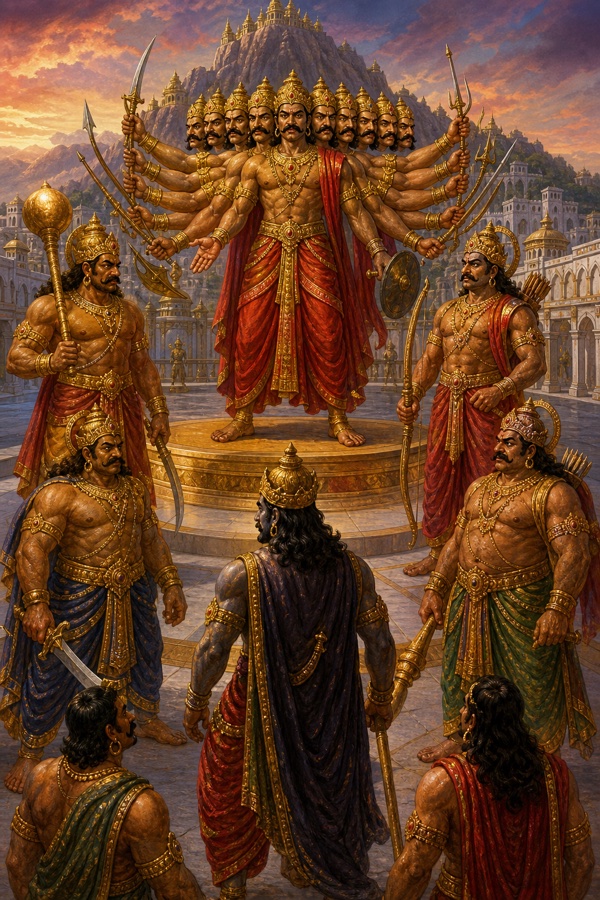
Malyavan saw that Ravana was set on war and took offense at every word, and he was ashamed, and he made no answer. He spoke the blessing of victory over the king that courtesy required, took his leave, and went home to his own house. Then Ravana talked things over with his ministers, thought a while, and set the defense of Lanka in order. He posted the rakshasa Prahasta at the eastern gate; Mahaparshva and Mahodara, two rakshasas of extraordinary vigor, at the southern gate; and at the western gate his eldest son, Indrajit, the great sorcerer, with many rakshasas around him. He placed Shuka and Sarana at the northern gate of the city and told his counselors that he would go there himself and take his own stand at that gate. At the central post he set the rakshasa Virupaksha, a fighter of enormous strength and prowess, with many other rakshasas. With Lanka arranged that way, Ravana, the first among the rakshasas, already in the hands of fate, felt as though his purpose were already achieved. He dismissed his counselors, who called out blessings of victory as they went, and he walked into his rich and spacious inner palace, the quarters of his women, as if the day’s work were done.
Vibhishana’s word on the gates, and Rama’s order of battle
Now that they stood in the enemy’s own country, the leaders gathered to take counsel: Rama and Sugriva, the kings of men and of monkeys; the famous Hanuman, son of the wind-god; Jambavan, king of the bears; the rakshasa Vibhishana; Angada, son of Vali; Lakshmana, son of Sumitra; the monkey Sharabha; Sushena with his kinsmen; Mainda and Dvivida, Gaja and Gavaksha, Kumuda and Nala and Panasa. Every one of them had come a long way for this, out of Kishkindha, south to the shore, across the sea on a bridge of stones, and now the city stood in front of them. And they said to one another what every one of them was thinking.
“There stands Lanka, guarded by Ravana, a city even the immortals could hardly take, with the demons and the nagas and the gandharvas fighting at their side, and Ravana, the overlord of the rakshasas, never leaves it,” they said. “Let us decide now what we must do to carry this mission through.”
While they were talking, Vibhishana, Ravana’s youngest brother, spoke up in polished words heavy with meaning. “My four ministers, Anala, Panasa, Sampati, and Pramati, went into the city of Lanka and have come back here,” he said. “They took the shapes of birds and flew deep into the enemy’s ranks, and they have come back after seeing with their own eyes every arrangement for Lanka’s defense. Hear from me, Rama, exactly as it is, every defense that evil Ravana has set up, just as my ministers described it.”
He told it exactly. “Prahasta, the commander-in-chief, has taken a division of the army to the eastern gate and holds it,” he said. “Mahaparshva and Mahodara, both of extraordinary vigor, hold the southern gate. At the western gate stands Indrajit, Ravana’s eldest son, ringed by many rakshasas with sharp-edged spears, swords, and bows, with darts and mallets in their hands, and by champions carrying weapons of every kind. At the northern gate, with many thousands of armed rakshasas, stands Ravana himself, shrewd in counsel and deeply shaken. At the central post stands Virupaksha, with a huge force armed with pikes and swords and bows, and other rakshasas with him. My ministers looked closely at every one of these garrisons, and then they came back fast.”
Then Vibhishana gave the count of the army. “Ravana has ten thousand elephants and ten thousand chariots; his horses number twenty thousand, and his rakshasa foot soldiers more than a crore,” he said. “Prahasta and the rest are all bold and mighty, cruel on the battlefield, and dear to Ravana, and each of those generals has a body of ten lakhs at his beck and call.” Then Vibhishana, strong of arm, brought the four ministers themselves before Rama and had them tell him in their own words everything they had seen of Lanka.
“Let this report bring you neither gloom nor anger,” he said to Rama, whose eyes were like lotus petals. “I have no wish to frighten you. I want to rouse your anger, because I know your courage could master the gods themselves. Draw this monkey army up in battle order as Ravana has drawn up his, and you will crush Ravana, ringed though he is by a huge army of all four arms, elephants, chariots, cavalry, and foot.”
“When Ravana marched against his own half-brother Kubera, sixty lakh rakshasas went out with him,” Vibhishana reminded Rama, “rakshasas who were his equals in prowess, vigor, energy, sheer courage, and steadiness in battle.”
When Vibhishana had finished, Raghava gave his orders for the attack. “Nila, that champion among monkeys, will make his way to the eastern gate with many monkeys around him and fight Prahasta,” he said. “Angada, son of Vali, with a large army around him, will bear down on Mahaparshva and Mahodara at the southern gate and drive them off. Hanuman, son of the wind-god, whose steadiness and strength no one can measure, will press against the western gate with many monkeys and force his way in. As for the northern gate, where Ravana himself is posted with his army, I will press on it with Lakshmana and force my own way in there, because I am set on destroying that small-minded lord of the rakshasas, who delights in oppressing the daityas and the danavas and the noble sages, who is armed with the power his boons gave him and roams the worlds tormenting every living thing.”
“And let the mighty Sugriva, king of the monkeys, and the powerful Jambavan, king of the bears, and Vibhishana here, Ravana’s youngest brother, take their stand at the central post,” he said.
Rama laid down a rule of recognition as well, and a fighting monkey needed one, since every rakshasa in Lanka could take whatever shape he pleased. “No monkey is to take human form on the battlefield, whatever happens,” he said. “In our ranks, let that be our mark in this war. The monkey shape alone will be the sign by which we know our own. Only seven of us will fight the enemy in human form: I am one; my younger brother Lakshmana, with all his energy, is the second; and of the other five, my friend Vibhishana in his own person is the fifth, besides his four ministers.” Against an enemy who could wear any face he liked, the monkeys would wear only their own.
When he had said this to Vibhishana for the success of the campaign, Rama looked up at the lovely slopes of Mount Suvela, and that wise and powerful prince made up his mind to climb it. Then, with his vast army spread over the whole land of that region and his heart set on the destruction of his enemies, noble Rama, as steady as he had ever been, marched on toward Lanka with a light in his face.
The climb up Suvela, and the sight of Lanka
His mind made up to climb Suvela, Rama, with Lakshmana following, spoke in a soft, warm voice to Sugriva and to Vibhishana, that loyal rakshasa who knew what was right, had long experience in counsel, and was learned in the sacred rites. “Let us all climb Suvela, this king of mountains streaked with a hundred minerals, and spend the night on it,” he said. “From the top we can look over Lanka, the home of that rakshasa Ravana, who in his evil mind carried off my wife, and carried her off to his own destruction, because that is where such a deed must end.”
“The moment his name is spoken, my anger rises against that vile rakshasa,” he said, “who never understood virtue, or decency, or what is owed to a family line, and who did that shameful thing at the urging of his mean rakshasa mind. Because of that low creature’s crime I am going to watch the destruction of all the rakshasas with my own eyes. When one man is caught in the noose of Death and commits a sin, his whole race perishes for the wrong that vile one did.”
Still speaking that way, full of anger against Ravana, Rama climbed Suvela of the lovely peaks to make camp there for the night. Lakshmana followed at his back, fully alert and eager to show what he could do, his bow raised and an arrow on the string, as he had followed him through every year of the exile. Behind them came Sugriva with his ministers, and Vibhishana, and Hanuman, Angada, Nila, Mainda and Dvivida, Gaja, Gavaksha, Gavaya, Sharabha, Gandhamadana, Panasa and Kumuda, Hara and the troop commander Rambha, Jambavan and Sushena, the shrewd Rishabha, Durmukha of the boundless energy, and the monkey Shatabali. These and many other famous, swift-footed monkeys, who moved with the speed of the wind and had ranged over hills all their lives, swarmed up Suvela in their hundreds and came to where Rama was. They had climbed it from every side in a short time, and from the top they saw the city, and it seemed to hang in the air. The leaders of the monkey troops saw a splendid Lanka, with the finest gates and a superb defensive wall, packed with rakshasas, and those monkey lords noticed something else: a second wall grown on top of the first, made of dark rakshasas standing in close rows along the ramparts to defend them.
The sight of those rakshasas, burning to fight, set every monkey shouting, and while Rama stood watching, a clamor of every kind went up and carried across the gap into the city. Then the sun, reddened by the evening twilight, sank below the horizon, and a night lit by the full moon came on. Vibhishana greeted Rama with joy and honored him, and with Lakshmana and his circle of troop commanders around him, the famous Rama spent that night at ease on the top of Suvela, in sight of the walls that held his wife.
The monkeys enter the groves, and Rama beholds Lanka
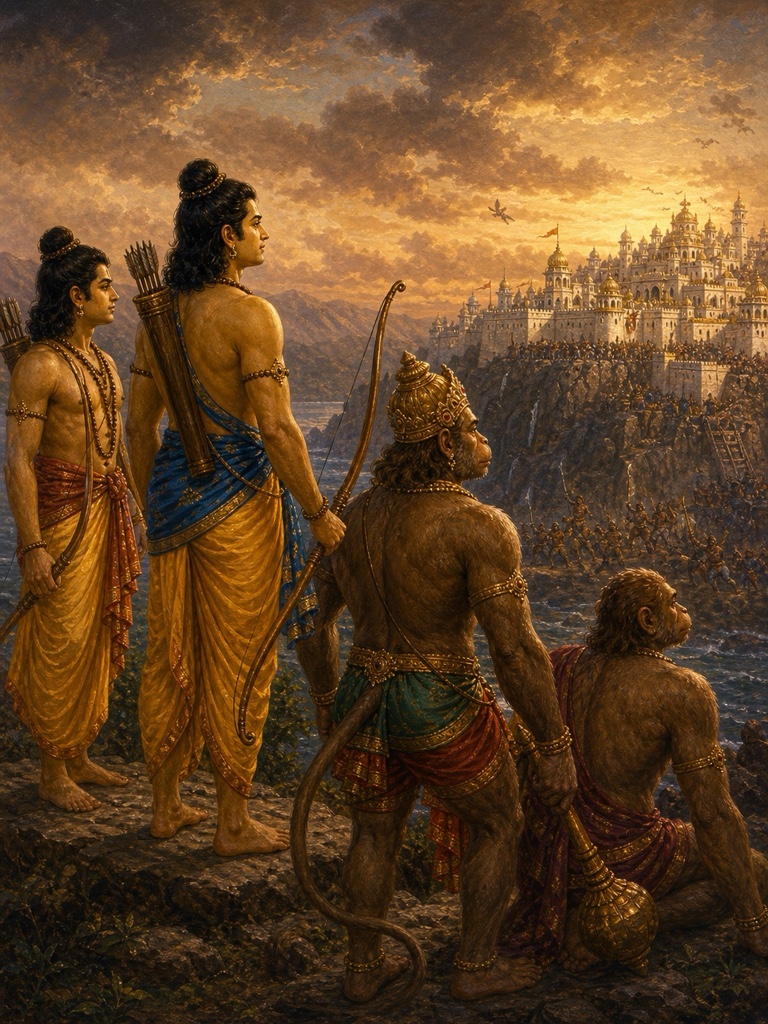
When the night on Suvela was over, the bold monkey generals looked out over the woods and groves of Lanka and stood amazed at what they saw. The gardens were level and free of every beast of prey, lovely, long, wide, and a delight to the eye. The monkeys had come to wreck this place, and it was beautiful. Thick with champak, ashoka, bakula, sal, and palmyra, covered with groves of tamala, ringed by rows of nagakesara, Lanka was charming on every side, like Amaravati, the city of Indra: green lawns and lovely avenues, and beautiful trees of every kind, hintala, arjuna, nipa, and saptaparna in full flower, tilaka, karnikara, and patala with their crowns loaded with blossom, twined with creepers, heavy with flowers of many kinds and dressed in tender red leaves. The trees of that city wore their fragrant flowers and fruit the way people wear their jewelry.
Lanka’s chief garden rivaled Chaitraratha, the garden of Kubera, and resembled Nandana, the garden of Indra. It was lovely and soothing to the mind, green in every season and humming with bees, bright with gallinules and lapwings and herons and dancing peacocks, and everywhere among its waterfalls you could hear the call of the cuckoo. Coming down from the mountaintop, the bold monkeys, who could take any shape they liked and were thrilled with joy, went into those groves and gardens, where the birds were always in their season and the bees came and went, where clusters of trees were crowded with cuckoos and loud with birdsong, and the music of the fork-tailed drongos and the cries of the ospreys, the chatter of the wagtails, and the calls of the cranes filled the air. As those monkeys of extraordinary energy went deeper into the garden, a breeze that had passed over the flowers blew across them, gentle as a breath, and for one morning an army on its way to a slaughter walked through a garden. Then, breaking away from the company of monkey heroes with Sugriva’s leave, other famous monkey leaders, the loudest roarers of them all, made for Lanka itself, dressed in its banners. They frightened the birds, unnerved the deer and the elephants, shook Lanka with their roars, and trampled the earth in their headlong rush, and the dust their feet threw up rose all at once. Startled by that roar, bears and lions, buffaloes, elephants, deer, and birds ran in panic in all ten directions.
There was a lofty peak of the Trikuta mountain that seemed to touch the sky, thick with flowers on every side and sparkling like gold. It ran a hundred yojanas, spotless and graceful to look at, smooth, splendid, and vast, hard for birds to reach and hard for a man to climb even in his imagination, let alone in fact; and on that peak stood Lanka, the city Ravana ruled. Ten yojanas wide and twenty long, the city was charming with its towering gates like white clouds and its walls of gold and silver. Rich with palaces and mansions seven stories high, Lanka looked like the sky at the end of summer, when the monsoon comes in and the clouds pile up. In that city stood a palace on a thousand pillars that looked like a peak of Mount Kailasa and seemed to scrape the sky. It was the palace of Ravana, king of the rakshasas, guarded at every hour by a hundred rakshasas in full armor, and it was the jewel of the city. Somewhere under those roofs, in a garden, a woman was sitting on the ground.
With the monkeys who had stayed beside him, the glorious Rama, Lakshmana’s elder brother, gazed at Ravana’s rich golden city, a delight to the mind, full of every resource, graced with pleasure hills bright with minerals and with gardens, loud with birds of every kind, roamed by deer of many sorts, rich in every kind of flower, and home to rakshasas of every class. Bold Rama was astonished to see that city crowded with huge mansions, looking like paradise itself. With his great army around him he took it in: full of jewels, rich in works of inventive genius, adorned with its great rows of palaces, and fitted with strong gates armed with huge war engines.
The sight of Ravana from Suvela’s peak, and Sugriva’s single combat
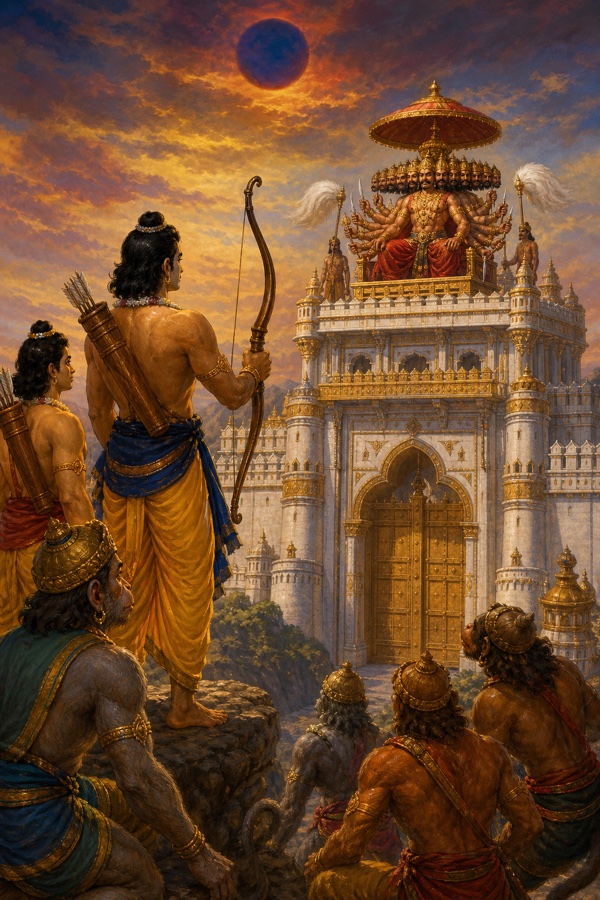
Then Rama, with Sugriva beside him and battalions of monkeys behind, climbed to the very top of Suvela, which ran two yojanas around. He stood there a while and looked out over all ten directions, and he saw Lanka, built by Vishvakarma, the architect of the gods, laid out beautifully on a lovely peak of Trikuta and graced with delightful groves. And then, on top of one of the city’s gates, he saw the man himself, the one he had never once laid eyes on, whose name he had carried since the day Sita was taken. He saw Ravana, the ruler of the rakshasas, whom no one approached without leave, fanned on both sides with white whisks, a victor’s parasol held over his head, smeared all over with red sandal paste and hung with scarlet ornaments, dark as a rain cloud, dressed in robes embroidered with gold, with the scars of Airavata’s tusks on his chest, Airavata the elephant who carries Indra himself, wrapped in a red outer garment the color of a hare’s blood, looking for all the world like a bank of cloud in the evening sky with the sunset on it.
The instant Sugriva saw Ravana, with the monkey chiefs and Raghava himself looking on, he was on his feet. No one had ordered anything. Rising from the mountaintop, carried by the force of his own anger, strong in courage and in body, he leapt across to the top of the gate where Ravana sat. He paused there a moment and looked Ravana over without a trace of fear, and treating that rakshasa as no more than a blade of grass, he spoke to him harshly. Down on the mountain, Rama had no time to call him back.
“Rakshasa, I am a friend and a servant of Rama, lord of the world,” he said. “You will not get away from me today, because the strength of that king of kings is in me.”
With that he sprang without warning and landed on Ravana, tore the wonderful crown from his head, and flung it to the ground. The crown of the king of Lanka lay in the dust, and the king of the monkeys stood over it.
Ravana saw Sugriva come at him with that speed and spoke. “You had a beautiful neck only as long as you stayed out of my sight,” he said. “Now that you have come where I can see you, you are going to lose it.”
With that Ravana rose from his seat, caught Sugriva in his arms, and hurled him to the ground; but the monkey bounced up like a ball, lifted Ravana in his own arms, and slammed him down in his turn. As they strained against each other their limbs ran first with sweat, and then their bodies were dyed red with blood as each tore at the other with his sharp nails, and when they stood motionless, locked together, they looked like a silk-cotton tree and a flame-of-the-forest grown into one trunk. The ruler of the rakshasas and the lord of the monkeys, both of enormous strength, fought a duel that neither could endure, with punches, slaps, blows of the forearm, and jabs of the fingers.
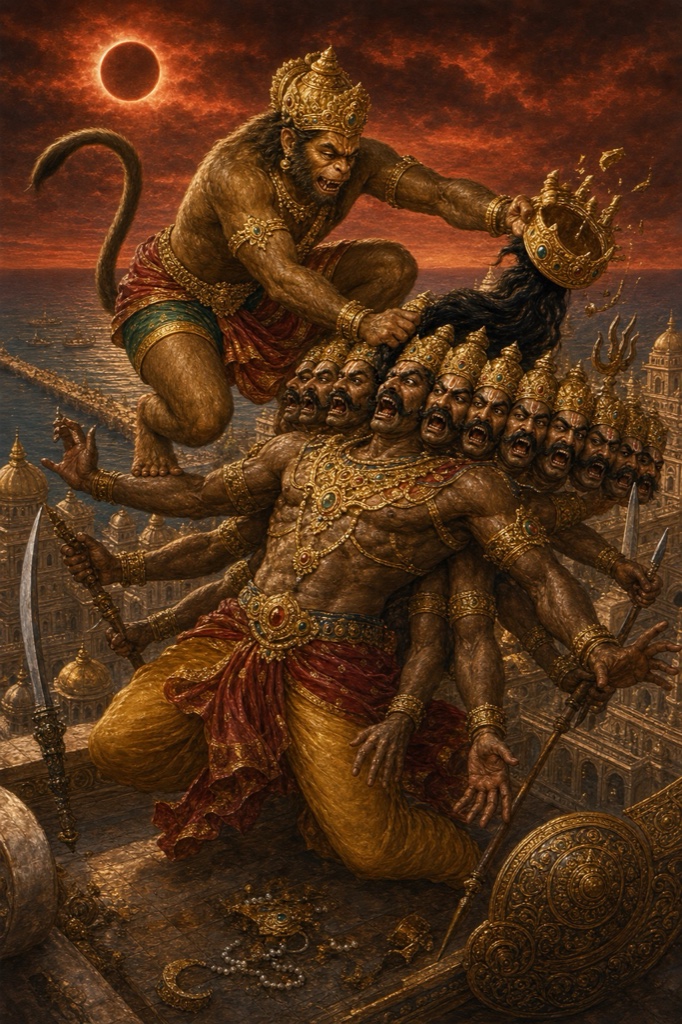
They wrestled hard for a long time in the middle of the flat roof of the gate, throwing each other up and forcing each other down again and again, both of them driven by a terrific fury, their feet gripping the stone the way a wrestler is taught to grip. Crushing each other, they toppled together into the gap between the wall and the moat, their bodies still clinging, and lay there a while on the ground, breathing hard, and then sprang to their feet again. Clasping each other to their chests again and again, the two champions, full of indignation, both trained wrestlers and both enormously strong, bound each other in the cords of their arms and began to move with skill, working every trick of the wrestler’s art. They hugged each other and tested each other’s strength through their hands, those two heroes, like a tiger and a lion just come into their fangs, or two young tuskers of a great elephant herd that have tried their strength on each other, and they hit the ground together at the same instant. Each tried to overpower the other and each scorned the other; full of the joy of battle, trained and mighty, they worked through the many holds of wrestling, and neither tired quickly, and the two armies watched their two kings wrestle in the dirt below the wall of Lanka. Fending each other off with their splendid arms, thick as the trunks of elephants, like two elephants in rut who have fought a long time, they wheeled fast in a circle to slip each other’s grip.
Coming at each other, each bent on the other’s death, they stood growling again and again like two cats over a scrap of food. Skilled in every art of combat, Sugriva, king of the monkeys, and Ravana moved deftly to attack each other. They traced many circles and took many stances; they moved in the crooked line that wrestlers call the ox’s water-track; they made every move forward and back, sideways and slantwise; they dodged each other’s blows by shifting ground and guarded against their own blows going wide; they circled the opponent when he stood still, darted at each other, moved slowly or leapt like frogs, stood face to face after a trial of strength, fell back, turned aside, rushed in low to seize the knees, ran in with a foot raised to kick, pressed their arms to their own chests to break a hold and stretched them out to take one. Then the rakshasa, finding he could not beat that terrible opponent by strength alone, moved to call up his magic. Sugriva, overlord of the monkeys, saw what he was about to do; and Sugriva, who now carried himself like a victor and had shaken off his fatigue, sprang into the air, and Ravana, outwitted by the king of the monkeys, stood where he was with nothing in his hands.
He had worn the lord of the rakshasas to exhaustion, and now Sugriva, son of the sun-god, lord of the monkey chiefs, who had won his name in many fights, crossed the wide sky and landed at Rama’s side in the midst of the monkey battalions. The deed done, the king of the monkeys, swift as the wind, rejoined his army in high delight, and the leaders of the monkey troops cheered him for it, and the hunger for battle rose in Rama, son of a king and first of the line of Raghu, as he watched him come. A monkey had gone down to the wall of Lanka alone, taken the king of the rakshasas by the crown, wrestled him to a standstill, and come home, and every monkey in that host had watched it happen.
Rama’s counsel on Sugriva’s daring, and the siege of Lanka
Rama saw the marks of the fight on Sugriva’s body and drew him into a close embrace, and then he spoke to him as one king speaks to another. “You did this reckless thing without a word of counsel with me,” he said. “Kings do not take such risks. You love a daring deed, my hero, and by this headlong act you put me, and this army, and Vibhishana standing here, in the gravest danger there is, and you put me through agony. Never do such a thing again, you who break your enemies.”
“If anything had happened to you, I would have been finished with Sita, and Bharata, and Lakshmana, and our youngest brother Shatrughna, and even with my own body, my friend,” he said. “I knew your courage, you who are the equal of mighty Indra and Varuna, and still, until you came back, I had firmly made up my mind: once I had destroyed Ravana in combat, with his sons and his army and his chariots and all, and anointed Vibhishana king of Lanka and set Bharata on the throne of Ayodhya, I would give up my own life, mighty monkey.”
“Bold son of Raghu’s line,” Sugriva answered, “I saw Ravana, the one who stole your wife, and I knew my own strength. How could I have left him alone?”
Rama praised the hero for that answer, and then he turned to Lakshmana, who stood there in all his beauty. “Let us choose ground where there is fresh water and forest heavy with fruit, divide this multitude into battalions, draw it up in battle order, and keep our guard,” he said. “I see a terrible danger close at hand. It foretells the ruin of the world, and the destruction of the finest heroes among the bears, the monkeys, and the rakshasas.”
Rama counted the omens off for his brother. “The winds are blowing hard and the earth is shaking; the mountain peaks are trembling, and the great elephants who hold up the earth at its four quarters are trumpeting,” he said. “Fierce, hostile clouds shaped like flesh-eating beasts, with a harsh sound in them, are cruelly letting fall rain mixed with drops of blood. The evening twilight has the color of red sandalwood and looks lurid, and this blazing mass of fire is falling from the sun. Wretched, dreadful, ill-omened beasts and birds are crying in pitiful voices with their faces to the sun, and fear is everywhere. Even at night the moon has lost her radiance and gives off heat against her own nature, and she is ringed by a black and red halo, as at the end of the world.”
“Lakshmana, a small, dreary, ill-omened crimson halo and a blue stain can be seen on the disk of the sun, and the stars are dim where they used to be bright,” he said. “All of it tells every living creature that the world is coming to an end. Crows and hawks and vultures are dropping to the ground, crying aloud, and the she-jackals are howling their evil howls. It looks as if this earth will soon lie under the rocks and darts and swords that monkeys and rakshasas hurl at each other, thick with a mire of flesh and blood. So let us go now, Lakshmana, with monkeys all around us, without delay and at full speed, against the city of Lanka, which Ravana rules and which no one storms easily.”
With those words to Lakshmana, heroic Rama came quickly down from the mountaintop, and once he was down, that righteous prince reviewed his own army, which no enemy could break. Then Raghava, who always knew the right moment, marshaled the monkey king’s huge army with Sugriva and ordered it forward at an auspicious hour for the work of war. With a large company around him and his bow in his hand, the strong-armed prince marched out in front at the chosen moment, his face toward the city of Lanka. Vibhishana and Sugriva, Hanuman, Jambavan king of the bears, Nala and Nila, and Lakshmana followed close behind him. Behind them, covering a vast stretch of land, came the huge army of bears and monkeys in Raghava’s wake. Monkeys as big as elephants, who could hold off any enemy, carried mountain peaks and full-grown trees by the hundred in their hands, and it looked as though the hills of that island were walking toward the city. Every face in that host was turned the same way.
In a short while the two brothers, Rama and Lakshmana, breakers of their enemies, reached Lanka, Ravana’s lovely city, hung with rows of flags, graced with gardens and groves, enclosed by a wonderful defensive wall, built up with high ramparts and archways, and for all those reasons fiercely hard to reach. That city, which even the gods would have found hard to attack, the monkeys now laid under siege at Rama’s command, each holding to his post as he closed in. Rama, with his younger brother Lakshmana and his bow in his hand, blocked the northern gate of Lanka, tall as a mountain peak, and from there he protected the whole besieging army as well. At that northern gate, where Ravana himself had taken his stand, bold Rama, son of the emperor Dasharatha, made his camp with Lakshmana at his side, close to the city Ravana guarded. No one but Rama could have protected the army that laid siege to that fearsome gate, which Ravana held the way Varuna holds the ocean, which terrible, well-armed rakshasas guarded on every side the way the danavas guard Patala, the lowest of the worlds below, and which struck terror into the faint-hearted. And there Rama saw, laid out in order and ready, weapons of every kind in their many sets, and armor set out for the fighters.
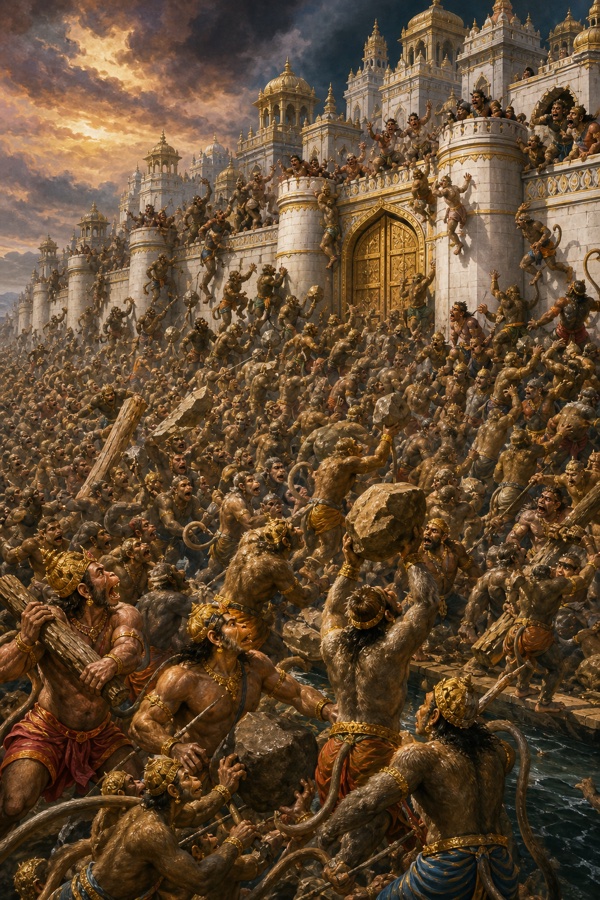
At the eastern gate bold Nila, commander-in-chief of the monkey forces, took up his post with Mainda and Dvivida. Angada, with all his strength, held the southern gate with Rishabha, Gavaksha, Gaja, and Gavaya. The mighty monkey Hanuman, joined by Pramathi and Praghasa and other heroes, blocked the western gate. Sugriva himself, with all the monkey chiefs who rivaled Garuda of the beautiful wings and the wind-god in speed, took up his post at the middle station between the northern and the western gates; and thirty-six crore monkeys, every one of them a famous general, bore down on the rakshasas who held that post and made camp where their king was. On Rama’s orders Lakshmana, with Vibhishana beside him, posted a crore of monkeys, or crores, at each gate, as the need demanded. Sushena, with Jambavan and a vast army behind him, took his post at the middle station at Rama’s back, not far from him. Holding trees and mountain peaks, those monkey champions with teeth as sharp as tigers’ stood waiting gladly for the clash.
Every one of them held his tail stiff and high in fury; every one of them had teeth and nails for weapons; their eyes were wild and strange, shot with blood, and their faces were twisted with anger. Some monkeys had the strength of ten elephants, some ten times that, and some the might of a thousand elephants. Some commanders of the monkey troops had the strength of an ogha of elephants, some a hundred times more, and some a strength no one could measure. The gathering of those monkey troops in that place, like a cloud of locusts, was a wonder to see. The air seemed full of monkeys bounding toward Lanka, and the land around Lanka was covered with those already posted beneath its walls, so that from the ramparts there was no direction left in which a rakshasa could look and see anything but an enemy. A hundred divisions of a hundred thousand bears and monkeys each marched to the four gates of Lanka to strengthen those already posted there, and others went out to fight on every side.
The monkeys surrounded the whole mountain on which Lanka was built, and a crore of them ranged around the city gathering word of the monkeys massed at the gates. Ringed on every side by mighty monkeys with uprooted trees in their hands, Lanka became hard for even the wind to get into. Besieged all at once by monkeys the color of clouds and the equal of Indra in prowess, the rakshasas could only stare. As the flood of that monkey army rolled up to Lanka, a roar went up from it on the summit of Mount Trikuta like the roar of the waters when an ocean breaks its shores, and at that uproar the whole of Lanka shook violently, with its walls and archways, its hills, its woods, and its forests. Guarded by Rama and Lakshmana and led by Sugriva, that army of monkeys had become almost impossible to attack, even for all the gods and demons together.
Angada goes as envoy to Ravana
With his army drawn up in battle order for the destruction of the rakshasas, Rama talked it over with his counselors at length, again and again, and came to a decision. He called to mind the duty of kings and the truth about the four means used against an enemy, one after another: conciliation, gifts, the sowing of dissension, and force, with force always last, to be used only when the other three are spent. One door was still open, and a king does not storm a city while a door stands open. In agreement with Vibhishana, eager to take the next step, he sent for Angada, the son of Vali.
“My good monkey, go over the walls into the city of Lanka,” he said. “Shake off fear and every flutter of the mind, and go to ten-headed Ravana, who has fallen from his good fortune, lost his right to rule, and been robbed of his wits by his own longing to die. Warn him for me, in these words.”
“Rakshasa, the hour of reckoning has come, the hour no one can turn aside, for the sins you committed in your ignorance and your pride against the sages and the gods, against the gandharvas and the nymphs of heaven, against the nagas and the yakshas and the kings of men. Rakshasa, the arrogance born of the boon Brahma gave you has broken to pieces. I am the one who will punish you; I hold the rod of punishment in my hand, and I have planted myself at the gates of Lanka, worn thin by grief since my wife was stolen. Rakshasa, if you stand firm in battle and give up your life fighting, you will reach the world of the gods, of the great sages, and of all the royal sages. Basest of rakshasas, show me now the strength you used to carry off Sita after you had tricked me away from her. If you do not come to me for protection and bring the princess of Mithila with you, I will rid this world of rakshasas with my sharp arrows.
“Vibhishana, the best of the rakshasas, whose mind is set on virtue, has come here with me, and that glorious rakshasa will surely win the throne of Lanka with no one to stand in his way. A sinner like you, with fools for helpers and no knowledge of your own self, cannot hold a throne built on wrong one moment longer. Rakshasa, find your nerve and put on your courage and meet me in battle; put out on the field by my arrows, you will be made clean. Creature of the night, once you come within my sight you will never go home alive, not if you fly through all three worlds in the shape of a bird. I give you this advice for your own good: perform your own funeral rites in advance, because there will be no rakshasa left in the world to perform them for you when you are gone; and look at Lanka now, for the last time, and look well, because your life is in my hands.”
With those words from Rama, who never tired of action, Angada, son of Tara, rose into the air and shot toward Lanka like fire itself, alone, as Hanuman had gone before him. Below, the whole monkey army watched him go, one bright figure crossing the walls of the city they had come to take. In a moment the glorious Angada had cleared the walls and reached Ravana’s palace, and there he saw Ravana sitting calmly among his ministers. He came down a short way from him, that champion among monkeys, his armlets of gold flashing, and stood there like a blazing fire. He told them who he was, and then he gave Ravana and his ministers the whole of Rama’s splendid message, taking nothing away and adding not one word of his own, which is the whole art of an envoy.
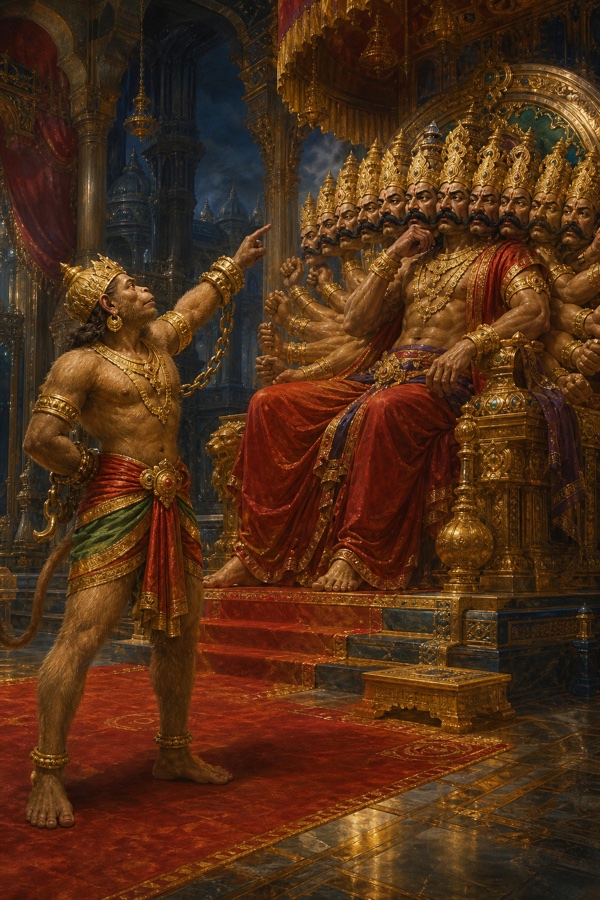
“I am the envoy of Rama, king of Kosala, who never tires of action,” Angada said. “Angada is my name, and I am the son of Vali. Perhaps you have heard of me. Raghava, who is the joy of his mother Kausalya, says this to you: Prove you are a man, ruthless rakshasa, and come out and fight me. I will destroy you, with your ministers and your sons and your relatives and your kinsmen, and all three worlds will be rid of their fear when you are dead. I will tear you out by the roots today, you enemy of gods and demons and yakshas, of gandharvas and nagas and rakshasas alike, you thorn in the side of the sages. And unless you bow to me and give Sita, the princess of Videha, back with honor, the royal fortune will pass to Vibhishana when you are dead.”
While Angada, that champion among the monkeys, was still speaking those harsh words, fury took hold of Ravana, lord of the rakshasa hordes. Carried away by it, he shouted the same command at his ministers again and again: seize this evil monkey, and kill him. Four terrible rakshasas heard the order and laid hold of Angada, who stood there as bright as a blazing fire. The steady and fearless son of Tara let himself be seized, on purpose, to show his strength before the whole rakshasa host. Then, with the four rakshasas clinging to his arms like so many birds, Angada sprang onto the roof of the palace, tall as a mountain, and the violence of his leap shook all four of them loose, and they fell to the ground while Ravana watched. He had ordered the monkey seized, and the monkey had let himself be seized, and the whole court had seen what came of it.
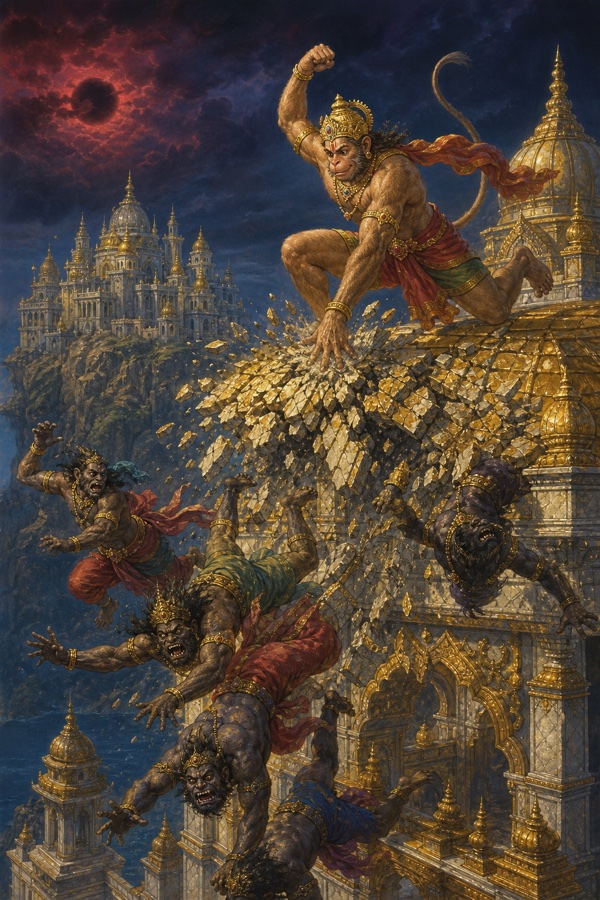
Then the glorious Angada, son of Vali, planted his feet on the top of the palace of the lord of the rakshasas, high as a mountain peak, and under his tread the top of the palace split apart, the way a peak of the Himalaya once split when the thunderbolt struck it, while the ten-headed monster stood staring. With the palace roof shattered, Angada shouted his own name, let out a terrible roar, and rose into the air, and leaving every rakshasa in pain and every monkey in delight, he came back to Rama in the midst of the monkeys. Ravana raged at that assault on his palace; and he saw his own destruction coming, and he gave himself up to sighing.
Meanwhile Rama, ringed by many monkeys roaring with joy, his whole mind on the destruction of his enemy, pressed on toward the war. The monkey Sushena, of enormous vigor and as big as a mountain peak, stood close to Lanka with many shape-changing monkeys around him; on Sugriva’s orders it was he who held all four gates of Lanka and patrolled every way into it, hard to overcome, moving among them the way the moon moves among the houses of the stars. Looking out at a hundred akshauhinis of those monkeys camped around Lanka, laying siege to it and stretching all the way to the sea, some of the rakshasas were struck with wonder, others with alarm, and others, remembering the joys of war, felt nothing at the prospect of a fight but joy. The whole space between the walls and the moat that circled them was full of monkeys, and the rakshasas looked out in dismay and saw their own walls turned, as it were, into monkeys. Overwhelmed by fear, they raised a cry of distress; and when that appalling uproar had begun, the soldiers of Ravana, ruler of the rakshasas, took up their mighty weapons and rushed out like the winds that rage at the end of the world.
Ravana’s council, and the opening of the first battle
Then the rakshasas went to Ravana’s palace in Lanka and gave him the news: Rama and the monkeys had laid siege to the city. They ran through streets that already shook with the noise outside the walls.
The news that monkeys had his city surrounded threw Ravana into a rage. He doubled the arrangements already made for the defense of the capital and climbed to the top of his palace. From there he saw Lanka, with its mountains and its woods and forests, ringed on every side by countless monkeys, every one of them eager to fight. He saw the ground all around Lanka gone brown with the monkeys gathered on it, and he fell to thinking how they could be wiped out. He thought for a long time, and then he steadied himself, and the notorious Ravana, his eyes wide, stared out at Rama and the monkey troops.
On the other side, full of joy, Rama pressed forward with his army and saw Lanka ringed on every side and guarded by rakshasas. The sight of Lanka dressed in its bright flags and buntings brought Sita suddenly to his mind, and the thought gnawed at him. Here, he said to himself, is the daughter of Janaka, with the eyes of a fawn, suffering for my sake, tormented by grief, wasted away, sleeping on the ground. Only the walls of this city stood between them now.
He thought of Vaidehi again and again, and of the rakshasis who tormented her so cruelly, and Rama, whose mind was set on what is right, at once ordered the monkeys to destroy the enemy.
At the command of Rama, who never tired of action, the monkeys surged forward, each struggling to get ahead of the next, and filled Lanka with shouts like the roar of lions. Every monkey general made the same vow: we will crush this Lanka with mountain peaks or with our fists alone. Lifting mountain peaks and huge rocks and tearing up trees of every kind, the commanders of the monkey troops stood ready to attack, and then, to win the thing Rama wanted most in the world, the monkey troops began to climb the walls of Lanka on every side while Ravana, ruler of the rakshasas, stood watching. Golden-hued, copper-faced, their lives given over to Rama’s cause, those monkeys fought with sal trees and mountain peaks for weapons and pushed on toward Lanka itself. With trees and mountaintops and their bare fists they smashed the tops of countless walls and archways. The moats, full of clear water, they set about filling with sand, mountaintops, grass, and logs.
“Victory to Rama, whose strength surpasses all! Victory to Lakshmana, whose energy has no equal! Victory to King Sugriva, whom Raghava guards on every side!” Shouting those words, the monkeys, every one of whom could change his shape at will, rushed roaring at the walls of Lanka. The leaders of the monkey troops scaled the walls with battalions of monkeys in their thousands, their crores, their hundreds of crores. They smashed the golden archways and razed to the ground the gates whose tops were like the peaks of Mount Kailasa, and, huge as elephants, they swarmed toward Lanka, springing on every side, leaping the walls, roaring all the while. Storming the walls, the monkey generals Virabahu and Subahu, and Nala and Panasa, took their positions on top of them, and the besieging army settled into its camps. With ten crore monkeys around him, all carrying themselves like conquerors, mighty Kumuda laid siege to the eastern gate from his station at the northeast, and the monkey Praghasa and strong-armed Panasa, with other monkeys around them, took up positions at his side in support. Reaching the southern gate from his station at the southeast, the bold and mighty monkey Shatabali, with twenty crore monkeys around him, laid siege to that gate. At the western gate, from his station at the southwest, Sushena, the mighty father of Tara, ringed by crores upon crores of monkeys, laid siege to that gate. Making his way to the northern gate with Lakshmana, son of Sumitra, from his station at the northwest, mighty Rama, with Sugriva, king of the monkeys, blockaded that gate.
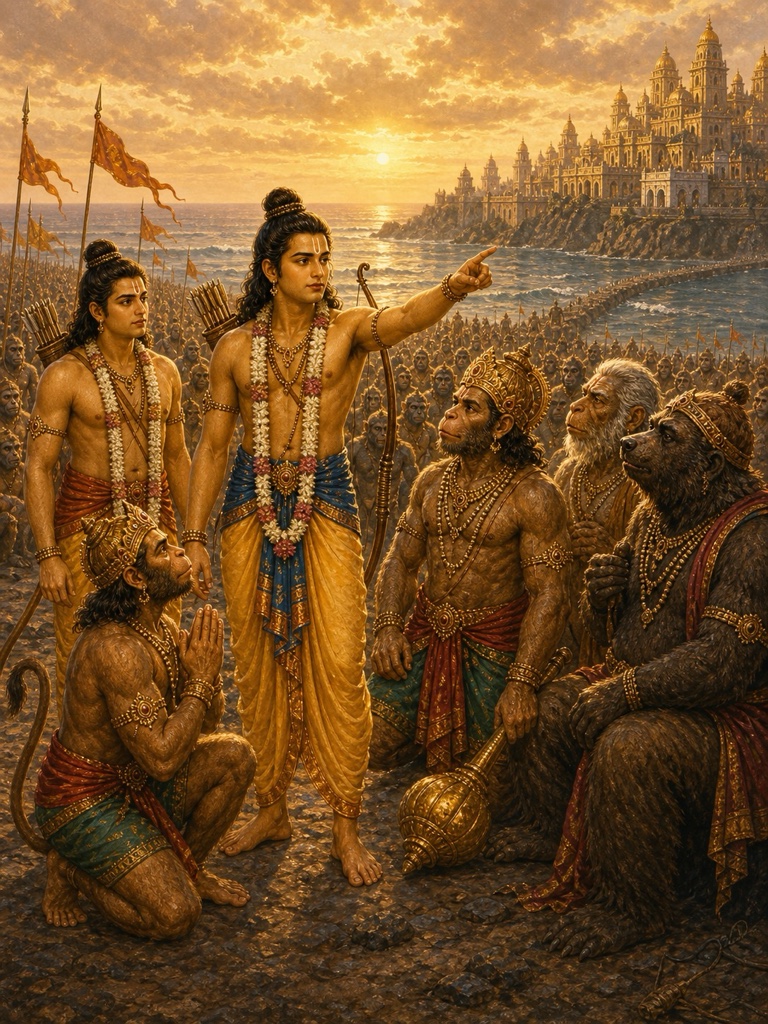
Gavaksha the langur, gigantic and grim to look at, full of enormous vigor, stood at Rama’s side with a crore of monkeys around him. Dhumra, brother of Jambavan king of the bears, a destroyer of his enemies and a fighter of rare courage, also took up his position at Rama’s side with a crore of bears of terrible fury. Clad in armor, with his watchful ministers beside him, Vibhishana of the great vigor stood with his mace in his hand where mighty Rama had taken his stand. Rushing about on every side, Gaja, Gavaksha, Gavaya, Sharabha, and Gandhamadana guarded the monkey army.
Then Ravana, ruler of the rakshasas, his mind gripped by anger at all this, ordered every one of his forces out at once. The instant the order left his lips, the rakshasas raised a sudden clamor, a terrible roar. Beaten with sticks of gold, the rakshasa kettledrums, their faces white as the moon, thundered on every side. Filled with the breath of the most hideous rakshasas, deep-voiced conches blared in their hundreds and thousands. With their gleaming dark limbs hung with jewels, the rakshasas, conches in their hands, shone like dark clouds armored in lightning, with rows of herons flying before them. Urged on by Ravana, the rakshasa troops rushed out in joy, like the waves of an ocean swollen by the clouds at the end of the world.
Then the monkey army roared on every side, a roar that filled the Malaya mountain, which is Trikuta, with all its great and small peaks and all its caves. The blare of the conches and the roll of the drums, the lion-roar of the monkeys, the trumpeting of the elephants, the neighing of the horses, the clatter of the chariot wheels, and the shouting of the rakshasas made earth and sky and sea ring together. And then a terrible battle began between the rakshasas and the monkeys, like the war between the gods and the demons in the old days. The war that had been coming since the day Sita was carried off through the sky had begun. Boasting of their own prowess, the rakshasas began to strike at all the monkeys with flaming maces, with javelins, pikes, and axes; and the gigantic monkeys, all speed and fury, struck the rakshasas back with trees and mountaintops and with their nails and teeth.
“Victory to King Sugriva!” went up the great war cry from the monkey ranks; and the rakshasas, shouting “Triumph, victory to our king!”, called out each his own name as he struck. From the walls the fierce rakshasas speared the monkeys on the ground below with bhindipalas and pikes; and the monkeys on the ground, bounding into the air in a rage, dragged the rakshasas down off the walls with their arms. That battle between rakshasas and monkeys was so tangled that no other fight could easily be compared with it, and it left a mire of flesh and blood behind it.
The single combats: hero against hero, and the fall of the demon chiefs
Seeing the strength of the enemy, a terrible fury burst out in the ranks of those gigantic monkeys and of the rakshasas, even as they fought. Mounted on horses and elephants in golden trappings, and on chariots bright as flames, in coats of mail that dazzled like the sun and took the breath away, the heroic rakshasas of terrible deeds rode out with other rakshasas around them, fighting for Ravana’s triumph and filling all ten directions with their clamor. The huge monkey army, which wanted Rama’s victory just as fiercely, rushed at that army of rakshasas of terrible deeds. Then the mass of it broke apart into single combats, rakshasa and monkey rushing at each other, each hero finding the one enemy who was his.
Indrajit, Ravana’s eldest son, of extraordinary energy, fought Angada, son of Vali, the way the demon Andhaka once fought three-eyed Shiva. Sampati, whom no one ever overcame easily in a fight, fought Prajangha, and the monkey Hanuman took on Jambumali. The furious Vibhishana, Ravana’s youngest brother, closed with the rakshasa Shatrughna, a fighter of fiery speed. The mighty Gaja fought steadily with the rakshasa Tapana, and Nila of the great energy with Nikumbha. Sugriva, king of the monkeys, closed with Praghasa, and the glorious Lakshmana grappled with Virupaksha. Agniketu, so hard to overcome, and the rakshasas Rashmiketu, Suptaghna, and Yajnakopa closed with Rama. Vajramushti grappled with Mainda and Ashaniprabha with Dvivida, two leaders of the monkeys against two of the most fearsome rakshasas. The bold rakshasa Pratapana, whom no one could hold back on a battlefield, fought steadily with Nala, who charged into every fight headlong. The great monkey Sushena, mighty son of Dharma, fought Vidyunmali. And other fierce monkeys, after fighting many rakshasas at once, threw themselves suddenly into single combats of their own.
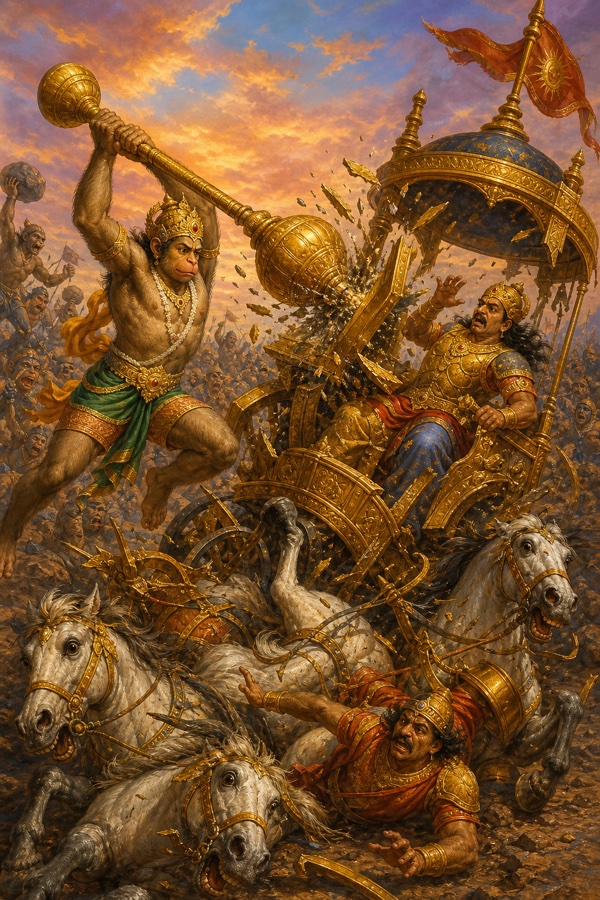
Then a fierce and bewildering battle raged between those heroic rakshasas and monkeys, each side fighting for its own army’s victory, and it made the hair stand on end. From the bodies of monkeys and rakshasas ran streams of blood, swift-flowing, with hair for duckweed, carrying dead bodies along like logs. Filled with rage, Indrajit struck the bold Angada, destroyer of enemy armies, with his mace, the way Indra strikes an enemy with the thunderbolt. Then the glorious, headlong Angada snatched that same mace out of the rakshasa’s hand and brought it down on Indrajit’s chariot, its frame bright with gold, and horses and charioteer and all went down together. Badly wounded by three arrows from Prajangha, Sampati killed Prajangha in his turn with an ashvakarna tree at the front of the battle. Standing in his chariot in a fury, Jambumali, a fighter of enormous strength, drove a javelin he kept in the chariot into Hanuman’s chest; and Hanuman, son of the wind-god, sprang onto that chariot and destroyed it in an instant, and the rakshasa with it, with a single blow of his palm.
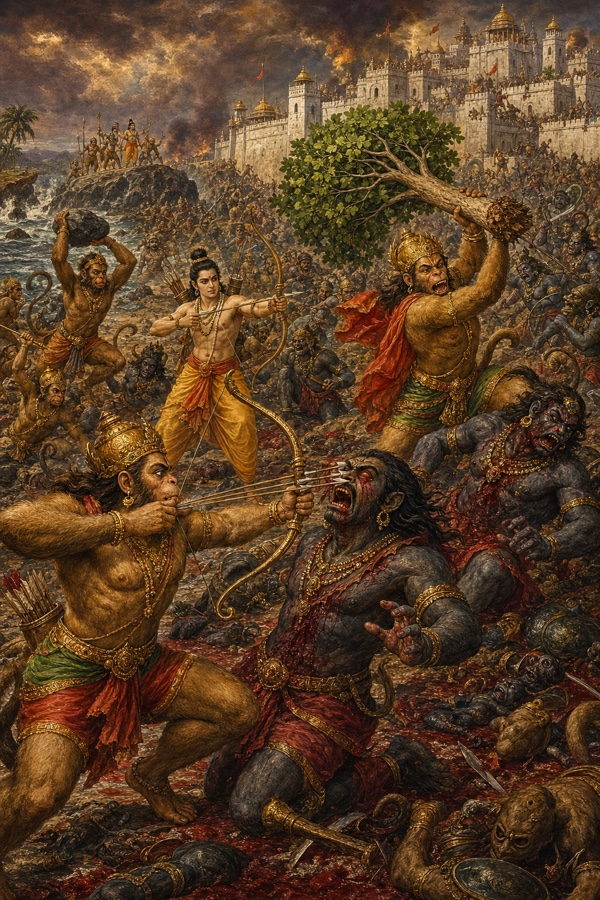
The notorious, fierce Pratapana rushed shrieking at Nala, and that quick-handed rakshasa tore Nala’s limbs with his pointed arrows; and Nala, in his turn, quickly gouged out both his eyes. Sugriva, overlord of the monkeys, swiftly killed Praghasa with a saptaparna tree, Praghasa who was devouring the monkey troops as if he meant to swallow the whole army. Lakshmana first buried Virupaksha, that rakshasa of fearful looks, under a hail of arrows, and then struck him down with a single shaft. Agniketu, so hard to overcome, and the rakshasa Rashmiketu, and Suptaghna and Yajnakopa tore at Rama with their arrows; and Rama, filled with rage on that field, cut off the heads of all four with four dreadful arrows bright as flames, faster than the words can tell it. Struck by Mainda’s fist, Vajramushti went down with his chariot and his horses, like a temple of the gods brought down. As the sun pierces a cloud with its rays, Nikumbha pierced Nila, who looked like a heap of collyrium, with his pointed arrows, and that nimble-handed rakshasa pierced him again with a hundred arrows and laughed out loud; and Nila, with a wheel of Nikumbha’s own chariot, cut off the head of Nikumbha and the head of his charioteer, the way Vishnu, protector of the universe, cuts off the heads of the demons who stand against him. Dvivida, whose blows landed as hard as the thunderbolt, hit Ashaniprabha with a mountain peak while all the rakshasas looked on; the notorious Ashaniprabha pierced that monkey chief, who fought with trees, with arrows that flashed like lightning; and Dvivida, mad with anger, his limbs torn by the arrows, struck Ashaniprabha down with a sal tree, chariot and horses and all.
Standing in his chariot, Vidyunmali struck Sushena with gold-inlaid arrows and roared again and again. When Sushena, the best of the monkeys, saw him up there, he knocked the chariot over in an instant with a huge mountain peak. Vidyunmali, quick on his feet, jumped down from the chariot and stood on the ground with a mace in his hand; and Sushena, that champion among monkeys, seized a huge rock and rushed at the rakshasa, shaking with anger. Vidyunmali struck Sushena on the chest with the mace as he came; Sushena took no notice of that terrible blow, and calmly brought the rock he held in both hands down on the rakshasa’s chest in the middle of that mighty battle. Struck by the rock, his chest crushed, Vidyunmali fell dead to the ground. In this way the bold creatures of the night were crushed in those single combats by those heroic monkeys, the way the demons of old were crushed by the gods who live in heaven.
The battlefield was a ghastly sight, strewn with strange spears and maces, with javelins and lances and arrows, with wrecked chariots, with dead horses and rutting elephants and monkeys and rakshasas, with wheels and axles and yokes broken and fallen to the ground, and packs of jackals prowled through it. In that tangled fight, like the war between the gods and the demons, the headless trunks of monkeys and rakshasas jerked here and there before they fell. Over that long day the monkeys had won every single combat that mattered; and the rakshasas, maddened by the smell of the blood the monkeys had drawn from them as they fell to the monkey champions, and longing now for the sun to set, threw themselves all at once into a stubborn fight again.
The night battle, and Indrajit binds Rama and Lakshmana in the serpent-noose
The monkeys and the rakshasas were still fighting when the sun sank below the horizon and night fell, the night that devours lives. Then the night battle broke out in full force between those fierce monkeys and rakshasas, whose hatred for each other ran deep and who all hungered for victory. In that terrible gloom a monkey would ask the shape in front of him, “Are you a rakshasa?” and a rakshasa would ask, “Are you a monkey?” and only then would they strike. “Strike!” “Tear him apart!” “Come on!” “Why are you running?” That was the din of voices all through the army of monkeys and rakshasas. In their golden armor the dark-bodied rakshasas could be seen clearly in that darkness, like great mountains whose forests glow with luminous herbs. It was a battle fought by ear and by touch, and a fighter who guessed wrong did not live to guess again.
In a darkness no eye could pierce, the rakshasas, swift and mad with anger, fell on the monkeys from every side and devoured them. The monkeys, terrible in their fury, sprang up in their turn and tore with their sharp teeth at the rakshasas’ horses in their golden trappings and at their banners, which looked like venomous snakes. The mighty monkeys threw the rakshasa army into confusion; blind with fury, they dragged down the elephants and their riders and the chariots hung with flags and pennants and tore them with their teeth. With arrows like venomous snakes Lakshmana and Rama killed the leading rakshasas, those they could see and those they could not. The dust of the earth, ground fine by the horses’ hooves and thrown up by the chariot wheels, filled the ears and eyes of the fighters. And while that terrible battle raged, raising the hair on every arm, streams of blood in dreadful volume flowed across the field.
Then a strange din rose up, of kettledrums, wooden tomtoms, and drums, mixed with the blare of conches and the rattle of wheels; and over the field rose a fearful wailing as well, wounded rakshasas groaning in pain and injured monkeys crying out. With the best of the monkeys lying wounded by javelins, pikes, and axes, and with rakshasas as huge as mountains, who could change their shapes at will, lying dead, the battleground of Lanka, strewn with weapons the way an altar is strewn with flowers, was churned into mud by the flowing blood until it was hard to recognize and hard to cross. Like the night at the end of the world, that fearful night, which destroyed monkeys and rakshasas alike, was hard for any living creature to survive.
Exulting in that dreadful darkness, the rakshasas then turned on Rama himself, all together, and poured a hail of arrows on him there on the battlefield. The noise of those roaring rakshasas as they rushed at Raghava in their fury was like the roar of all seven oceans at the final dissolution. In a single instant Rama, with six arrows like tongues of flame, struck down six of the leading rakshasas: Yajnashatru, so hard to overcome, Mahaparshva and Mahodara, the gigantic Vajradamshtra, and Shuka and Sarana, the two who had once stood in Rama’s camp as spies and been let go. Pierced to their vitals by his showers of arrows, those rakshasas slipped away from the battle, and so they kept their lives. In another instant the great chariot-warrior Rama lit up all the quarters and the spaces between them with his terrible arrows like tongues of flame. The other rakshasa champions who stood in front of him perished the way moths perish when they touch a flame. With his gold-feathered arrows raining down on every side, the night shone like an autumn night alight with fireflies.
With the roars of the rakshasas and the beat of their drums, the already grim night grew grimmer still, and the din swelled on every side until Mount Trikuta itself, honeycombed with caves, seemed to answer back, as if someone had called to it from the dark. The huge black-faced langurs, dark as the night they fought in, took the rakshasas in their arms, crushed the life out of them, and left the bodies for the jackals and the vultures. Angada, set on finishing the enemy where he stood, found Indrajit in that darkness, and in a single instant he wounded Ravana’s son, his driver, and his horses together. The chariot stopped. Its horses were dead and its driver was dead, and Indrajit, spent from the effort, stepped down from the wreck and vanished on the spot. One moment he was there, and the next there was only the empty chariot, and no one on that field saw where he went.
The gods watching from their sky-chariots, the seers with them, and Rama and Lakshmana on the ground all praised what the son of Vali had done. Every creature present knew what Indrajit was worth in war, and so the sight of that brave and dreadful warrior beaten by Angada gave all of them joy. The monkeys, with Sugriva and Vibhishana among them, cried “Well done, well done,” and sent up a roar of triumph that rolled across the dark field. It was the last glad sound they would make that night.
For Indrajit, beaten and shamed by Angada, had not gone far, and his rage had gone past all bounds. Too weak now to stand against Angada in the open, he had only made himself unseen, and the boon Brahma had granted him let him do exactly that. Senseless with fury, Ravana’s son began from his hiding to loose sharp arrows that flashed like lightning, and in his anger he drove them into Rama and Lakshmana, arrows that were serpents in the shape of shafts, until they were pierced in every limb. Wrapped in his sorcery, invisible to every creature on the field, that deceitful rakshasa baffled the two sons of Raghu and set about binding them in a net of arrows, and there was nothing anywhere for them to shoot back at. The monkeys saw it happen: the two greatest men alive, caught all at once by the furious rakshasa in a mesh of venomous snakes, and no bowman in sight.
When he could not conquer the two of them in his open form, that evil-minded one fell back on his conjuring, and by conjuring he bound the two princes.
The Raghava brothers bound in the arrow-net, and the monkeys’ despair
To hunt out where Indrajit had gone, Rama, whose strength that night seemed to have no end, chose ten monkey captains and sent them into the dark: the two sons of Sushena, the monkey lord Nila, Angada son of Vali, the swift Sharabha, Dvivida, Hanuman, Sanuprastha of enormous strength, Rishabha, and Rishabhaskandha. Glad to have something to do at last, they tore up great trees and sprang into the sky, and they searched all ten directions for him. But Indrajit knew the science of weapons as well as any archer alive. With arrows of tremendous speed, charged with the supreme missile that Brahma presides over, he stopped the rush of those swift monkeys in the air. Cut and torn by his steel-headed shafts, they could no more find him in that darkness than an eye can find the sun when clouds have covered it.
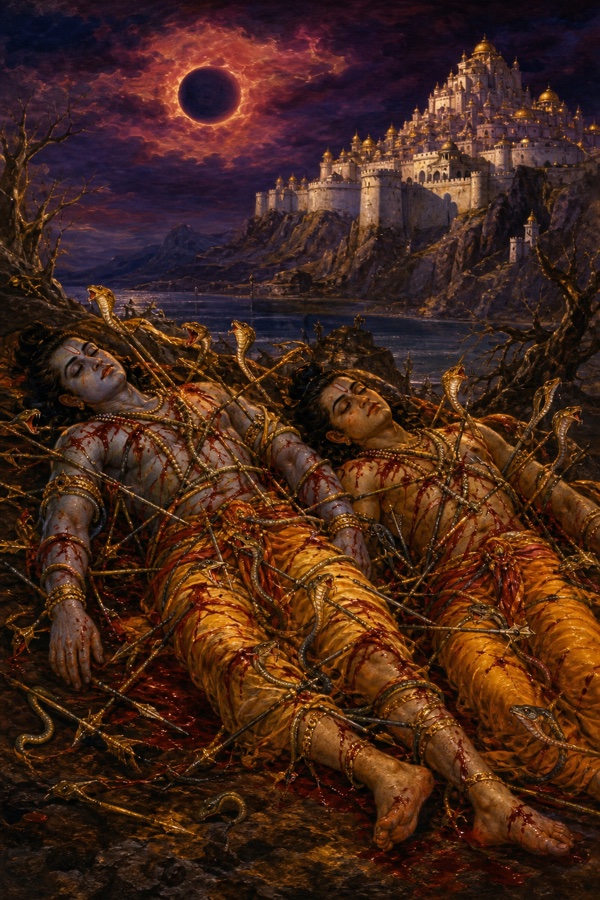
Then Indrajit, who held that field, turned back to the two he wanted. Again and again he drove into Rama and Lakshmana alone the arrows that cut through a body from side to side. The two brave princes were pierced by the furious rakshasa’s serpent-arrows until no part of either of them was left unpierced. Blood ran from every wound, and the two of them, streaming red from head to foot, looked like a pair of kimshuka trees in full flower.
Then Indrajit, the corners of his eyes gone red with rage, dark as a heap of collyrium, spoke to the brothers out of the empty air, and his voice seemed to come from everywhere at once. “While I fight unseen, not even Indra, the ruler of the gods, could find me, let alone come near me,” he said. “What are the two of you against that? My mind is seized with anger, and I send you both, the two sons of Raghu, caught in this net of buzzard-feathered arrows, to the house of Yama.”
So saying, he pierced the two righteous brothers with sharp arrows and roared in his exultation. Dark as a mass of collyrium, he bent his huge bow and loosed his grim arrows again into that great fight, and as each one found the vitals of Rama or of Lakshmana he roared again. Within the space of a breath the two of them, meshed in arrows at the very front of the battle, could not so much as lift their eyes. Pierced in every limb, bristling with the heads of arrows lodged in their flesh, the two princes shook the way the great banners raised for Indra shake when their cords are cut. Weak from the piercing of their vitals, the two great archers, sovereigns of the earth, fell to the ground. The whole war came down with them, the bridge, the crossing, the fourteen years. The monkeys had crossed a sea for these two men, and the two men were on the ground, and the thing that had put them there had not been seen by anybody.
On a hero’s bed, the bare ground of the battlefield, bathed in blood, their every limb caught in a mesh of serpents, the two heroes lay in torment. Not a finger’s breadth of their bodies was left unpierced; not one limb, down to the tips of the fingers, was left unwounded or unshaken by arrows. Struck down by that cruel rakshasa who could take any shape he pleased, the two princes ran blood the way two springs pour water. Rama fell first, pierced to the vitals by the shafts of that same Indrajit who long ago had beaten Indra himself and taken his name from the deed, and Indrajit had used everything he owned on him: the narachas with their even, rounded heads, the half-length ardhanarachas, the axe-headed bhallas, the anjalikas shaped like joined palms, the vatsadantas headed like a calf’s tooth, the simhadamshtras headed like a lion’s fang, the razor-edged kshuras, gold-feathered, polished, and falling as thick as dust. Rama lay on the hero’s bed, and his gold-plated bow, still strung, still bent at the ends and the middle, slipped from a hand too weak to keep its grip. Then Lakshmana, seeing the greatest of men fallen a bowshot from him, gave up hope even of his own life. His elder brother, whose eyes were like the petals of a lotus, who gave shelter to everyone who asked and delighted in battle, was lying on the ground, and Lakshmana began to grieve.
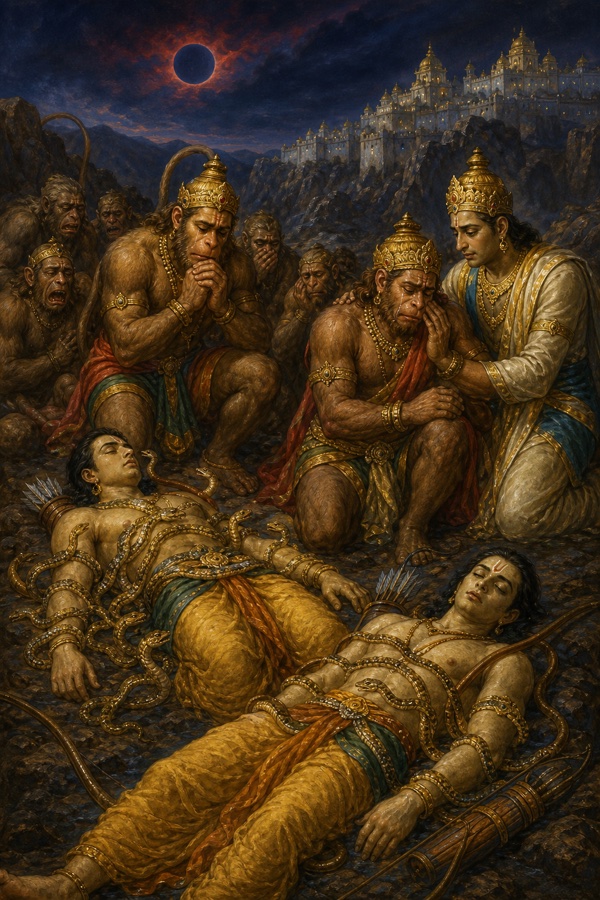
The monkeys who saw them there fell into an anguish past bearing, and, stricken with grief, they wept aloud with their eyes full of tears. Led by Hanuman, they ringed the two princes who lay bound in the noose of serpents on the hero’s bed, and they sank into the depths of despair, and they stood guard over two bodies that did not move. There was no enemy to charge, nothing to lift, and nowhere to carry them, and so an army of the strongest creatures alive stood in a circle in the dark and wept.
Vibhishana reassures Sugriva, and Indrajit returns in triumph
The ten monkeys who had gone hunting through the sky and over the earth for Indrajit came back empty-handed and found what was waiting for them: the two brothers, Rama and Lakshmana, covered from head to foot in arrows. Indrajit had already withdrawn, his work done, the way the rain-god draws back once he has finished raining, and Vibhishana came running to the spot with Sugriva beside him. Nila, Dvivida, Mainda, Sushena, Kumuda, and Angada, with Hanuman among them, stood there grieving for the two sons of Raghu, who lay on a bed of arrows without stirring, breathing faintly, soaked in blood, caught in a lattice of darts. The two of them sighed like a pair of snakes; now and then a limb moved feebly; the strength had drained out of them; blood ran in streams over every part of them; and they lay stretched on a hero’s couch like two golden standards brought down, ringed by their own generals, whose eyes were full of tears. The sight cut Vibhishana and every monkey there to the heart. Every one of those monkeys had left home for these two men, and had crossed an ocean on a road of stones to reach this place.
They searched the sky and every quarter, and they could not find Indrajit anywhere, because he was hidden inside the sorcery he had used through the whole fight. Vibhishana, though, had a sight of his own for hidden things, and with it he looked around and saw his nephew standing close by, wrapped in the boon Brahma had given him, unmatched in combat and unequaled in his deeds. Vibhishana, rich in energy, in glory, and in courage, saw the champion whom the boon hid from every other eye on that field.
Indrajit looked at the two princes lying on the field, and his delight spilled over. He shouted his feat aloud, to the joy of every rakshasa within hearing. “The two brothers, Rama and Lakshmana, who killed Dushana and Khara, strong as they were, are down under my arrows,” he said. “All the gods and all the demons together, with every company of seers to help them, could not free them from this net.”
“That notorious pest, the one gnawing at the very roots of us all, the one who kept my father awake through all three watches of the night, so eaten up with worry that he tossed and could not lie still on his bed, the one who kept the whole city of Lanka churning like a river in the rains, that pest I have finally rooted out,” he said. “Everything Rama and Lakshmana and all the monkeys ever did has come to nothing, like the clouds of autumn that promise rain and give none.”
When he had said as much to the rakshasas who stood watching, Ravana’s son turned on the famous monkey captains too, and struck at every one of them. He hit Nila, commander of the monkey forces, with nine fine arrows, and tormented Mainda and Dvivida with three apiece. He drove one arrow into Jambavan’s chest and loosed ten at swift Hanuman. Gavaksha and Sharabha, monkeys of boundless courage, he pierced with two arrows each, and then, moving with terrific speed, he pierced Gavaksha, lord of the langurs, and Angada son of Vali again with many more. With those great monkeys run through by arrows like tongues of flame, the mighty son of Ravana roared in triumph, and having wounded the monkeys with his volleys and filled them with fear, the long-armed rakshasa laughed from the bottom of his heart.
“Look, rakshasas,” he said. “Here lie the two brothers, bound together in my dreadful net of arrows, at the very front of the battle.”
The rakshasas who heard him, every one of them a fighter who fought by stealth, were astonished and delighted by the feat. They thundered like clouds, shouting at the top of their voices, and taking Rama for dead, they hailed Indrajit and worshiped him. Indrajit looked once more at Rama and Lakshmana lying motionless on the ground, without a breath that he could see, decided that the two brothers were dead, and, victorious and full of joy, rode into Lanka in state and filled every rakshasa in it with gladness.
Fear took hold of Sugriva as he looked at the bodies of Rama and Lakshmana, every limb and every joint of them riddled with arrows. He had brought this whole army across the sea on a promise, and the man he had made it to was lying on the ground. Vibhishana turned to the king of the monkeys, whose face was wet with tears, who stood shaken and stricken, his eyes wild with grief.
“Let go of fear, Sugriva, and hold back this flood of tears,” he said. “Battles are mostly like this. Victory is never certain. If our store of good fortune is not used up yet, these two noble princes of enormous strength will shake off their swoon and rise again. Pull yourself together, brave king of the monkeys, and help me pull myself together too, alone as I am. The fear of death does not haunt those who hold to truth and to dharma.”
With that Vibhishana dipped his hand in water and wiped Sugriva’s fine eyes clean. Then he scooped up water in his palm, blessed it with a sacred verse, and with his mind on what was right, bathed the monkey king’s eyes with it. When he had wiped the face of that wise king, he spoke to him the words the hour needed, and there was no confusion in them.
“This is no time for a faint heart, lord of the monkeys,” he said. “At a time like this, even too much feeling leads to ruin. So shake off this weakness, which defeats every purpose a man has, and think of the good of the troops whose leader is Rama. Or at the very least, let Rama be guarded for as long as his swoon lasts. The moment the two sons of Kakutstha come back to themselves, they will drive our fear away for good.”
“This blow is nothing to Rama, and Rama is not going to die,” he said. “Look at him. The glow of the body, which never stays with men whose time is up, has not left him.”
Vibhishana went on. “So take heart yourself, and steady your breath, while I go and put courage back into the ranks,” he said. “The monkeys are seized with panic, their eyes wide with fear, and they are passing the news of Rama’s swoon from ear to ear, and a whisper like that will empty a camp by morning. Let them see me moving through the army and cheering it, let them see the army glad again at my words, and they will drop this fear the way a man drops a garland he has already worn.”
Once he had steadied Sugriva, Vibhishana, who would one day rule the rakshasas, went out among the monkey army, which had begun to run, and steadied it in its turn. On the other side of the wall, Indrajit, that master of illusion, rode into the city of Lanka with all his troops and went to his father.
He came before Ravana, greeted him with joined palms, and gave him the news he had been waiting for. “Rama and Lakshmana are dead,” he said.
Ravana heard that his two enemies were down, and he sprang to his feet among the rakshasas and took his son in his arms. He breathed in the scent of the crown of his head, the way a father greets a son who has come home, and in his delight he asked to hear the whole of it: how the two princes had been stripped of all movement and all their glow, bound by arrows that were snakes.
Indrajit told him everything exactly as it had happened. Ravana listened to his son, a great chariot-warrior in his own right, and a rush of joy flooded through him; the fever of worry that Dasharatha’s son had lit in him went out, and he welcomed Indrajit with words brimming with the greatest gladness.
Sita is shown the battlefield from the Pushpaka
With Indrajit gone deep into Lanka and his purpose won, the leaders of the monkeys and the bears closed around Rama. Hanuman, Angada, Nila, Sushena, Kumuda, Nala, Gaja, Gavaksha, Sharabha, Gandhamadana, Jambavan, Rishabha, Skandha, Rambha, Shatabali, and Prithu drew their ranks up in battle order, took up trees, and guarded him on every side against whatever might come next. They watched every quarter, they looked sideways and they looked up, and whenever a blade of grass stirred in the dark they thought the rakshasas had come, because the last enemy had come out of nowhere and could do it again.
Inside the city, Ravana sent away the son who had conquered Indra, and then, still glowing with his joy, he summoned the rakshasis who kept watch over Sita. They came at his call, and Trijata came with them, and the overjoyed lord of the rakshasas gave them his orders. “Tell the princess of Videha that Indrajit has killed Rama and Lakshmana,” he said. “Put her in the sky-chariot Pushpaka and show her the two of them lying dead on the field.”
“That husband of hers, whose strength makes her so proud that she will not bend to me, has been killed at the front of the battle, and his younger brother with him,” he said. “Rid of fear now, free of her worrying, with every hope of seeing her husband gone, and dressed in all her jewels, Sita of Mithila will come and wait on me at last. Today she will see Rama in the hands of Death, with Lakshmana beside him, and when she comes back to the Ashoka grove she will find no other refuge anywhere, and with every hope gone the wide-eyed lady will come to me of her own accord.”
The rakshasis heard that evil king’s command, cried “It shall be done,” and went to where the Pushpaka stood. At Ravana’s order they brought the sky-chariot to the Ashoka grove, to the daughter of Mithila’s king, and there they found Sita already broken by the report of her husband’s death. They helped her up into the Pushpaka and, seating her in it with Trijata at her side, set off to show her Rama and Lakshmana. So Ravana had her flown out over Lanka, over a city hung with rows of flags and pennants, and in his joy he had it proclaimed in every street that Rama, son of Raghu’s line, and Lakshmana had been killed in battle by Indrajit. The city believed it.
Flying in the sky-chariot beside Trijata, Sita looked down and saw the vast monkey army as good as destroyed. She saw the flesh-eating rakshasas in high glee, and close beside Rama and Lakshmana she saw the monkeys standing stunned with grief. Then she saw the two heroes themselves, Lakshmana and Rama, lying senseless on the ground on a bed of arrows, their armor shattered and their bows thrown aside, every limb cut by darts, so thick with shafts that they were a thicket of arrows laid on the earth.
The two brave brothers, the greatest of men and heroes among heroes, with eyes like lotus petals, lay on the bed of arrows in that wretched state like the fire-god’s two sons, Shakha and Vishakha, asleep on a bed of reeds, and the sight of them tore a pitiful, helpless wail out of Sita. Seeing her husband and Lakshmana tossing in the dust, the dark-eyed daughter of Janaka, flawless in every limb, broke into sobs, and this time there was no illusion in it and no Sarama beside her to say so. She looked down on the two brothers, mighty as the sons of gods, and feared them dead, and wounded by tears and by grief, the sorrowing Sita spoke.
Sita’s lament, and Trijata’s steadying words
Seeing her husband and mighty Lakshmana struck down, Sita, already wasted by grief, mourned aloud, piteously and passionately, and what she reached for first was every promise anyone had ever made her. “The wise men who can read the lines of the body told me I would bear sons and never be a widow, and now that Rama is killed every one of them has turned out a liar today,” she said. “The wise men who told me I would be the crowned queen of a king who performs the great sacrifices and the long rites where many priests officiate have turned out liars today, now that Rama is killed. Those who foretold that I would be honored among the queens of brave kings and honored by my own husband have turned out liars today, now that Rama is killed. The Brahmins learned in the stars, who predicted in my own hearing that I would live happily with my husband, have turned out liars today, now that Rama is killed.”
Then Sita counted over the lucky marks of her own body, one by one, as if counting them could still change something. “Here on my soles are the marks of the lotus, the marks by which high-born women are anointed on the imperial throne beside their lords, the rulers of men,” she said. “I cannot find on my body any of the dark marks by which unlucky women come to widowhood. I see the good signs on my limbs, and I watch every one of them failing me. The lotus marks on a woman’s body, which the readers of signs call unfailing, are proving false in my case today, now that Rama is killed. My hair is fine and dark and even in length; my eyebrows do not meet; my calves are rounded and smooth; my teeth are close-set. My temples, my eyes, my hands, my feet, my ankles, and my thighs are matched and full; the fingers of my two hands are even and smooth, with rounded, well-shaped nails. My breasts are firm and full, my navel is deep and the skin around it rises, my sides and my bosom are softly rounded. My skin has the sheen of a polished gem and the down on it is soft. I touch the ground with twelve points, the ten toes and the two soles, and for all of this the readers of signs called me a woman blessed with fortune.”
“Those who read the marks of young girls said my hands and feet were rosy, with no gap between the fingers or the toes, with the barley-corn mark plain on them, and they said my gentle smile was a sign of good fortune too,” she said. “The Brahmins learned in the science of the stars declared that I would be anointed beside my husband on the imperial throne. All of it is false today.”
Sita mourned on. “They searched all Janasthana for me. They got word of where I was. They crossed a sea that nothing can disturb, and now the two sons of Raghu have been killed trying to get past the sorcery of Indrajit, a thing no deeper than the print of a cow’s hoof,” she said. “Surely Rama and Lakshmana knew the missiles of Varuna and of Fire, of Indra and of the Wind, and the missile of Brahma himself. Why, then, did they not use them at the end? My protectors, Rama and Lakshmana, who were Indra’s equals, have plainly been killed by Indrajit, who stayed invisible on the field by a conjuring trick.”
“Once an enemy came within Rama’s sight in a fight, he never went home alive, even if he moved as fast as thought,” she said. “And now Rama lies struck down on the field with his younger brother Lakshmana. No burden is too heavy for Time, who can do anything, and even Death is not hard for him to conquer.”
“I do not grieve so much for Rama, or for Lakshmana, the great chariot-warrior, or for myself, or even for my own mother, as I grieve for my unlucky mother-in-law Kausalya,” she said. “Her whole mind is fixed on one thought: when will she see Lakshmana come home to Ayodhya with Rama, the son of Raghu’s line, and with me, his vow of fourteen years in the forest kept?”
While she was still wailing, the rakshasi Trijata spoke to her. “Do not despair, my godlike lady. That lord of yours is alive,” she said. “I will give you strong and sound reasons, reasons you can weigh for yourself, for my belief that these two brothers, Rama and Lakshmana, are alive at this moment.”
Then she gave her reasons, and every one of them was something Sita could see from where she sat. “When the leader has been killed, the faces of the warriors on the field never flare with anger, and they never light up with joy,” she said. “If these two brothers were dead, princess of Videha, this sky-chariot Pushpaka, heavenly as it is, would never have agreed to carry you, a widow. An army whose brave leader is dead loses its fire and its will and drifts about the field like a boat that has lost its helmsman. Now look at this army of monkeys. It is calm and steady, and it is standing guard over Rama and Lakshmana, the two sons of Kakutstha, whom I have just told you, out of love, are alive. So take full comfort from the signs, which all point one way and all point toward joy, and believe the two sons of Kakutstha are living. I tell you this out of affection.”
Trijata went on. “Put away grief and sorrow and this false belief about Rama and Lakshmana, daughter of Janaka,” she said. “I have never told a lie in my life, and I never will. You have found your way into my heart by your sweet nature and your spotless conduct, which have made you a joy to me. These two princes cannot be conquered even by the gods and the demons together, with Indra at their head. It was from the look on the faces of the two brothers, and on the faces of the warriors guarding them, that I knew they were alive, and that is why I told you so.”
“See this great wonder for yourself, princess of Mithila. The glow of the body has not wholly left these two, even though they lie unconscious on the ground, struck down by arrows,” she said. “When a man’s span of life has run out and his breath has gone for good, a dreadful change comes over his face, and anyone who looks can see it. So know that they are alive. It is not possible that they are dead at this moment.”
Hearing her assurance, Sita of Mithila, who looked like a daughter of the gods, joined her palms and answered, “May it be so.” Then Trijata turned the Pushpaka around, swift as thought, and brought the grieving Sita back into Lanka. Sita stepped down from the sky-chariot with Trijata, and the rakshasis led her back into the Ashoka grove. She went deep into that pleasure ground of Ravana’s, planted with its many clusters of trees, and stared at it without seeing, and thought and thought about the two princes, and sank into the depths of despair, because hope offered by another is a thin thing to hold at night.
Rama, coming to, laments for Lakshmana
The two sons of the emperor Dasharatha lay bound in that dreadful net of arrows, drenched in blood, hissing like a pair of snakes with every breath, and all around them stood the great monkeys, Sugriva their king among them, sunk in grief. Then, in the middle of that circle, something moved. Bound in arrows as he was, by sheer toughness and the courage that was his nature, mighty Rama came back to consciousness. He turned his head, and the first thing he saw was his younger brother, tightly bound with arrows, bathed in blood, his face slack and fallen. The first man Rama thought of was Lakshmana. Stricken past bearing, he began to mourn aloud.
“What is the use to me of winning Sita back, or even of keeping my own life, when I see my younger brother Lakshmana lying beaten on the battlefield today?” Rama said. “Search this world of mortals and you might find a woman equal to Sita. A brother like Lakshmana, a helper and a fighter, you will not find anywhere. If Lakshmana, who made Sumitra glad she bore him, has gone back into the five elements, then I will give up my own life here, with the monkeys standing by to watch.”
“What in the world will I say to my mother Kausalya, and what to Kaikeyi?” he asked. “And what words will I find to comfort my mother Sumitra, robbed of her darling, sighing for one sight of her son, trembling and crying like a female osprey, if I come back to Ayodhya without Lakshmana? How will I tell Shatrughna and the glorious Bharata that I have come home without the brother who went into the forest with me? I will not be able to bear the blame my mother Sumitra will lay on me. So I will leave this body here where I lie, because I have no wish to go on living.”
Then Rama turned on himself. “Shame on me, a base soul of sinful deeds, because of whom Lakshmana lies fallen on a bed of arrows as though his life were already gone,” he said. He turned toward his brother. “Lakshmana, you always comforted me when I was low, and now, with your life all but gone, you cannot even speak to me in my distress. Brave as you are, you lie struck down with darts today on the very ground where you killed so many rakshasas this same day. Lying on this bed of arrows, bathed in blood, turned into a bundle of shafts, you look like the sun going down below the horizon, the arrows standing out of you like its countless rays and the blood from your wounds the red glow of its evening. Your vitals are pierced through and you cannot speak, and even so, without a word, the redness of your eyes tells me your pain.”
“This prince, clothed in such rare splendor, followed me when I went away to the woods, and so I will follow him now to the house of Yama. He loved his family and was devoted to me always, and he has come to this through the wrongdoing of my own unworthy self. I cannot remember one harsh or unwelcome word that brave Lakshmana ever spoke, even when he was sorely provoked. He could loose five hundred arrows at a single stretch, and in the art of the bow that made him greater than Kartavirya, who needed a thousand arms to do as much. He could tear apart the missiles of mighty Indra himself, he deserved a couch of great price to rest on, and he lies here struck down on the bare ground,” Rama said.
Then Rama began to send Sugriva away. “Sugriva, since I have not made Vibhishana king of the rakshasas, that empty boast of mine, that Vibhishana would sit on the throne of Lanka, will burn me forever. There is no doubt of it,” he said. “You must turn back from this place, and this very hour. Ravana will surely overpower you, Sugriva, once he knows you are without me. Put Angada at the head, and with your army and your whole following, with Nila and with Nala too, cross back over the sea.”
“You did a very great thing on this field of battle, a thing no one else could have done. I am content with Jambavan, king of the bears, and with Gavaksha, lord of the langurs. Angada, Mainda, and Dvivida fought bravely, and Kesari and Sampati fought a terrible fight. Gavaya, Gavaksha, Sharabha, and Gaja fought in my cause too, and so did other monkeys, throwing away their very lives for my sake. No human being can override destiny, Sugriva,” he said.
“Everything my dearest friend or ally could have done for me, you have done, Sugriva, faithful as you are in every duty,” he said. “You, and all of you, my finest monkey, have done all that an ally owes. You have my leave. Go now, all of you, wherever you wish.”
Every tawny-eyed monkey who heard him mourn let the tears fall from his eyes.
Just then Vibhishana, who had settled all the forces as he had promised, came hurrying with his mace in his hand to the place where Rama lay. The monkeys saw a figure dark as a heap of collyrium bearing down on Rama at speed, and took him for Indrajit, Ravana’s son, come back to finish the work, and every one of them ran from the one rakshasa who was on their side.
The coming of Garuda, and the loosing of Rama and Lakshmana
“Why is this army in such distress, like a ship caught in a whirlwind at sea?” asked Sugriva, king of the monkeys, a king of great energy and great strength, who had felt the panic run through the ranks before he saw its cause.
“Do you not see the two noble sons of the emperor Dasharatha, Rama and the great chariot-warrior Lakshmana, lying on a bed of arrows, covered with darts and bathed in blood?” Angada, son of Vali, answered him.
“I do not believe this stampede among the monkeys is about the binding of Rama and Lakshmana alone,” Sugriva said to Angada, his brother’s son, whom he had raised as his own. “There must be some fresh danger coming. Look at them. Their faces have fallen and their eyes are wild with terror, and they are throwing down their weapons and running in every direction. They feel no shame in front of one another. They do not look behind them. They shove one another out of the way and leap over a fallen comrade without stopping to pick him up.”
He was still speaking when the hero Vibhishana came up with his mace in his hand and greeted Sugriva and Rama with a blessing of victory. Sugriva looked at him, understood what had frightened his army, and turned to the noble Jambavan, king of the bears, who stood close by.
“Here is Vibhishana, come as he promised, and it is the sight of him that has our best monkeys running in terror, because they take him for Indrajit, Ravana’s son,” he said. “Quickly, rally the monkeys who have run off in every direction in their fright. Tell them it is Vibhishana who has come, and no Indrajit.”
At Sugriva’s command Jambavan, king of the bears, called the runaways back and put heart into them, and the monkeys, hearing Jambavan’s great voice and knowing Vibhishana at last, shook off their fear and came back to their places.
Vibhishana, whose mind was set on what was right, looked at the bodies of Rama and Lakshmana bristling with arrows, and the sight went through him. He dipped his hand in water and washed their eyes, and with his heart wrung by grief he wept and mourned.
“These two famous and powerful princes, full of energy and in love with battle, have been brought to this by rakshasas fighting by tricks,” he said. “They showed their courage openly, without guile, and my evil nephew, that unworthy son of his father, has cheated them with the crooked cunning that marks a rakshasa. Savagely pierced by arrows and bathed in blood, these two princes lie on the ground like a pair of porcupines.”
“These two, the finest of men, on whose courage I built my hope of the throne of Lanka, lie as though asleep, waiting only for their bodies to fall apart,” he said. “My hope of a throne is beaten. I am alive and as good as dead, and his son has handed the enemy Ravana the very thing he wanted, to keep Sita and never give her back.”
Sugriva, the vigorous king of the monkeys, took the grieving Vibhishana in his arms and steadied him with these words. “You will rule Lanka. There is no doubt of it, you who know what is right,” he said. “Ravana and his son Indrajit will not have their wish in this life. These two, Rama and Lakshmana, will shake off their swoon, and riding on Garuda they will destroy Ravana and his hordes on the field.”
When he had comforted the rakshasa this way, Sugriva turned to Sushena, his father-in-law, who stood at his side. “The moment the two of them come to, take the brothers, these breakers of their enemies, with a band of brave monkeys, and go to Kishkindha,” he said. “I will deal with Ravana and his sons and his kinsmen, and I will bring Sita back, the way Indra once won back his lost royal fortune from the hands of the demons.”
Sushena heard Sugriva’s command and answered with a memory from the oldest war of all, the great war of the gods and the demons, which he had witnessed himself. In that war the demons hid themselves by sorcery and wounded the gods again and again, skilled as the gods were at aiming and at arms. Then Brihaspati, the gods’ preceptor and priest, brought the gods who lay wounded, senseless, and even dead back to health and to life with prayers and remedies joined to the chanting of sacred verses. Those remedies still exist. Two great mountain herbs made by Brahma himself, the wonderful Sanjivakarani, which brings back life, and Vishalya, which heals a wound made by an arrow, grow on the two mountains Chandra and Drona on the shore of the Ocean of Milk, the ocean from which the nectar of immortality was churned, and the gods themselves set those mountains there. Monkeys like Sampati and Panasa know the herbs by sight, Sushena said; let them go for them at once, and let Hanuman, son of the wind, go with them.
Even as he spoke, a wind rose, and with it clouds and flashes of lightning. It whipped the sea until the water boiled, and the mountains themselves seemed to shake. The wind came from the beating of enormous wings. Under it the great trees of the whole island of Lanka were stripped of their branches and fell headlong into the salt sea; the huge serpents of the island cowered in terror, and every sea creature that had crawled up onto the shore slid quickly back into the water. And in the next instant every monkey on that field saw Garuda, son of Vinata, king of the birds and the mount of Vishnu, mighty beyond measure and blazing like a fire in the sky. The serpents that had bound Rama and Lakshmana in the shape of arrows saw him too, and strong as they were, they fled for good. The arrows drew themselves out of the two bodies and slithered away, and what had been an unbreakable weapon a moment before turned out to be a handful of frightened snakes.
Then Garuda of the beautiful wings touched the two sons of Kakutstha and wished them victory, and with both his hands he stroked their faces, which shone like the moon. At his touch the wounds closed and their bodies grew bright and smooth on the instant. Their majesty, their courage, their strength and splendor, their dash, their clear sight, their intelligence, and their memory all came back to them doubled. Garuda lifted the two princes, Indra’s equals, to their feet and embraced them both with joy, and Rama spoke to him.
“By your kindness we have found the cure and come through the great danger Indrajit raised against us, and we are strong again already,” Rama said. “My heart is as glad at meeting you as it would be at meeting my father Dasharatha or my grandfather Aja. But who are you, so richly gifted with beauty, wearing garlands from heaven and anointed with heavenly perfumes, in a pair of garments without a speck of dust on them, adorned with the jewels of the gods?”
Garuda, son of Vinata, king of the birds, full of energy and full of might, answered Rama, whose eyes were wide with joy, with a glad heart. “I am Garuda, your beloved friend, your own breath of life moving about outside your body, and I have come here to help you, son of Kakutstha,” he said. “Not the mightiest demons, not the strongest giants, not the gods themselves with the gandharvas and Indra of the hundred sacrifices at their head could have undone these terrible bonds that ruthless Indrajit wove with his arrows by sorcery. The snakes that held you were the sons of Kadru, sharp-fanged and full of poison, turned into arrows by that rakshasa’s magic.”
“You are lucky indeed, Rama of unfailing courage, you who know what is right, to have your younger brother Lakshmana, the destroyer of his enemies in battle, at your side,” he said. “I heard that the two of you had been bound by snakes, and for the sake of the friendship between us I flew here in one flight, out of my love for you. Now you are both free of that terrible bond. Stay on your guard from this moment on. Rakshasas by nature fight by treachery on the field, and the strength of brave souls with pure minds is that they have no guile. For that very reason, never trust the rakshasas on a battlefield. Rakshasas are always crooked.”
With that Garuda embraced Rama tenderly and asked his leave to go. “I wish to take my leave of you, Rama, my friend, son of Raghu’s line, you who know what is right and are kind even to your enemies, and I will go now at my ease,” he said. “And do not be curious about our friendship, or ask how it came to be. When your work on this field is finished, brave prince, you will come to know it.” He left it there, and Rama let him. “You will empty Lanka of every man in it but the very young and the very old with the waves of your arrows, and you will kill your enemy Ravana, and you will surely win Sita back.”
When he had said this in the midst of the monkeys and freed Rama from his pain, Garuda of the beautiful wings and the swift flight walked around him in reverence, keeping him on his right, embraced him once more, and rose into the sky with the speed of the wind. The monkeys watched until the brightness of him was gone.
Seeing Rama and Lakshmana whole and free of pain, the commanders of the monkey troops roared like lions and lashed their tails on the ground. They beat their kettledrums and their clay tomtoms, blew their conches in a flood of joy, and began to leap and caper as they had before. Other brave monkeys, who fought with trees, tore up trees of every kind and stood brandishing them, ready to fight, in their hundreds of thousands. With piercing cries that frightened the rakshasas, the monkey host, hungry for battle, pressed up to the gates of Lanka. A clamor rose among those commanders so appalling and so vast that it sounded like the most terrible thunder rumbling at midnight at the end of the hot season, and inside the city, where the victory was still being celebrated, they heard it, an army that should have had nothing left to shout about, shouting.
Ravana sends Dhumraksha, and the evil omens
Ravana, sitting among his rakshasas, heard it: the huge roar of those monkeys of tremendous energy, thundering back at the rakshasas on the walls. It was a deep sound, and a glad one, and gladness was the last thing he expected to hear from that side of the wall. He turned to his counselors.
“The way that vast uproar has gone up from those countless monkeys, like the thunder of rumbling clouds, makes one thing plain: their joy is great. There is no doubt of it. Their shouting has stirred up the salt sea itself,” he said. “Yet Rama and Lakshmana lie bound by sharp arrows. Why should there be an outcry like this? It makes me suspect that the two brothers have somehow been freed from their bonds. Find out at once why such rejoicing has broken out among these monkeys at an hour that should have belonged to grief.”
At his order the rakshasas standing near him, none of them eager for the errand, climbed the wall and looked out over the army in Sugriva’s keeping. They saw the two sons of Raghu, Rama and Lakshmana, on their feet and moving, freed from the most terrible bonds ever woven of arrows, and every rakshasa on the wall lost heart. Pale, frightened to the bone, those fierce rakshasas climbed down and went to Ravana, ruler of the rakshasas, and skilled as they were with words, they could find no way to soften it; with fallen faces they told him the whole of the unwelcome news, exactly as it was.
“The two brothers, Rama and Lakshmana, strong as two great elephants, whom Indrajit bound so tightly with his bonds of arrows that their very arms were pinned, have been seen on the field free of those bonds,” they said, “like a pair of elephants that have snapped their chains.”
At their report Ravana, mighty as he was, went pale, overwhelmed by anxiety and by grief, and he breathed like a snake. He spoke to himself. “If my enemies have broken free even from a binding of missiles, from those terrible, infallible arrows my son was given as a boon, which shone like the sun and were serpents in truth, with which Indrajit bound them tight in battle, then I see my whole army in danger,” he said. “Those darts of mine, bright as fire, which surely took the lives of my enemies in combat, have come to nothing.” His son’s masterwork had come undone, and the rakshasas on the wall had watched it happen.
With that, hissing like a snake in his fury, Ravana turned among the rakshasas to the one named Dhumraksha. “Go out at once with a huge army of rakshasas, you of the terrible courage, and destroy Rama and the monkeys with him,” he said.
At the command of that crafty king, Dhumraksha walked around him in reverence and left the palace without delay. As he came out through its gate he spoke to the commander of the army.
“Mobilize the army at once,” he said. “What use is delay to a man who is going to war?”
At Dhumraksha’s call the commander, with a large following at his back, quickly drew up a battalion as the king had ordered. The mighty rakshasas, terrible to look at, with girdles of bells fastened around their waists, gathered around Dhumraksha, roaring in their exultation, and the bells rang with every step they took.
With pikes and mallets in their hands, armed with maces, sharp-edged spears, iron cudgels and clubs, iron bars, slings for hurling stones, lances, nooses, and axes, the dreadful rakshasas went out thundering like clouds. Other rakshasa champions went out in armor, in chariots splendidly hung with flags and covered with a lattice of gold, on donkeys with heads of every description, on horses of extraordinary speed, and on elephants maddened with rut. Dhumraksha himself, whose voice was like the braying of a donkey, mounted a wondrous chariot drawn by donkeys with harness of gold and heads like wolves’ and lions’, and with his rakshasas around him he rode out laughing through the western gate, where Hanuman had taken his stand. The moment he moved, the omens came, and they came all at once, as if the sky had been waiting for him. Fierce birds appeared in the air to block the way of that dreadful rakshasa in his fine donkey chariot. A vulture of the most terrible look settled on top of his chariot, and carrion birds, fighting among themselves, perched on the point of his standard. A huge headless trunk, livid and wet with blood, fell to the ground in front of him, and, flung there by no one anyone could see, it lay there making jarring cries. The rain-god poured down blood. The earth shook. A contrary wind blew with a roar like thunder, and the quarters, wrapped in a mass of darkness, could no longer be told apart.
Dhumraksha looked at those terrible omens, which promised disaster to the rakshasas, and he was troubled, and the rakshasas marching in front of him fainted where they stood. Still he went on. Ringed by his many rakshasas, all eager for the fight, that mighty and fearsome general came out before his enemies, and there he saw the army he had been sent to destroy: monkeys past counting, an ocean at the hour of dissolution, and Rama’s arms guarding all of it.
Dhumraksha slain at Hanuman’s hands
The monkeys had been itching for a fight, and when they saw the rakshasa general Dhumraksha of the terrible prowess come out, they roared for joy. Then a wild, roaring battle broke out between monkeys and rakshasas, one side striking with terrible trees and the other with pikes and clubs. The rakshasas cut down the fierce monkeys on every side, and the monkeys flattened the rakshasas to the ground with their trees. In their fury the rakshasas kept shooting the monkeys through with pointed arrows, fearful to look at, fletched with buzzard feathers and flying straight to the mark. Split open by the rakshasas with terrible maces, sharp-edged spears, mallets of iron and of wood, fearsome iron bars, and tridents of every kind, the mighty monkeys, burning with the fire that outrage lit in them, fought on as though nothing on earth could touch them.
Their limbs torn by arrows and their bodies split by pikes, the monkey generals took up trees and rocks. Bounding forward with terrific speed, they crushed the brave rakshasas here and there, roaring the whole time and shouting out their own names, and that fight, waged with rocks of every kind and with trees thick with boughs, was a wonder to see. The monkeys had beaten fear itself, and some rakshasas were crushed beneath them; other rakshasas, drinkers of blood, now spat blood from their own mouths as the monkeys thrashed them. Some were ripped open at the side, some were beaten to pulp with trees, some were ground to powder with rocks, some were torn apart with teeth. Some rakshasas stood in agony beside broken standards, their swords knocked from their hands, their chariots smashed. Great elephants like mountains, and horses with their riders, lay crushed under the mountaintops the monkeys hurled, and covered the face of the earth. The fierce monkeys sprang again and again and raked the faces of the rakshasas with their nails, and the rakshasas, their faces fallen and their hair in disarray, fainted at the smell of blood and dropped to the ground. Other rakshasas of terrible prowess, wild with rage, came on with their bare palms, which struck as hard as adamant, and they too were crushed by the monkeys, who were faster and fiercer still, with fists and feet and teeth and trees.
Seeing his army run, Dhumraksha, a champion among the rakshasas, turned in anger on the war-loving monkeys and began to cut them to pieces. Some monkeys, torn by lances, spat blood; others, struck by wooden mallets, fell to the earth. Some were pounded with iron bars, some ripped open with javelins, and some, staggering, cut by sharp-edged spears, gave up their lives. Cut down by the rakshasas, some monkeys dropped to the ground streaming blood, and others, driven off the field by the furious rakshasas, got away. Some lay on their sides with their hearts torn open; others, slashed by tridents, spilled their entrails. That great fight grew to the most fearful size, monkeys and rakshasas mixed together in it, thick with weapons, thick with rocks and with trees. And out of it came a strange music: the twang of bowstrings sweet as vinas, the neighing of horses for the beat of wooden cymbals, and the trumpeting of elephants for the singing, so that the whole battle rang like a symphony.
Bow in hand at the front of the battle, Dhumraksha laughed as he shot and scattered the monkeys in every direction with showers of arrows. Hanuman, son of the wind-god, saw his own army harried and shaken by Dhumraksha, and his anger rose, and he picked up a huge rock and turned toward the rakshasa. His eyes twice as red with rage, Hanuman, whose strength was his father’s own, hurled that rock at Dhumraksha’s chariot. Dhumraksha saw it coming, snatched up his mace in a hurry, leapt down from the chariot, and planted himself firmly on the ground. The rock smashed the chariot, wheels, pole, horses, banner, and bow, and rolled on across the earth.
With the chariot shattered, Hanuman, born of the wind-god, set about wiping out the rakshasas with trees, trunk and boughs and all. Some lay bathed in blood with their heads smashed; others, crushed by the trees, fell flat on the earth. Having scattered the rakshasa army, Hanuman seized a mountaintop and rushed at Dhumraksha. Dhumraksha saw him coming, raised his mace, and charged him headlong with a roar, and in his rage he brought that mace, studded with a hundred spikes, down on Hanuman’s head. Hanuman took the blow, which came down with terrible force, and paid it no attention at all, and with the strength of the wind in his arm he flung the mountaintop full on Dhumraksha’s skull. Every limb of the rakshasa was shattered under it, and he fell headlong to the ground like a mountain broken into pieces. The rakshasas who had somehow survived saw Dhumraksha dead, and, beaten by the monkeys as they ran, they fled in terror back into Lanka. Hanuman had destroyed his enemies and set streams of blood flowing, and he was worn out with the killing, and when the monkeys crowded around him cheering, the great son of the wind-god knew joy.
Ravana sends Vajradamshtra, and the battle with Angada
Ravana, lord of the rakshasas, heard that Dhumraksha had been killed, and rage filled him, and he stood hissing like a snake. His first general had ridden out laughing, and he would not ride back. Then, drawing a long, burning breath, worked up with anger, he spoke to the ferocious Vajradamshtra, a rakshasa of enormous strength.
“Go, my champion,” he said. “Ride out with the rakshasas around you and destroy Rama, the son of Dasharatha, and Sugriva, and the monkeys with them.”
“It shall be done,” said Vajradamshtra, that rakshasa chief skilled in sorcery, and he set out at once with a great many troops and many generals around him. Elephants, horses, donkeys, and camels went with him. He kept his mind wholly on the work ahead, and the many generals around him, each marked by his banner and pennant, made a brave sight of his going. Hung with lovely armlets and a crown, and wearing a coat of mail, he set out quickly with his bow in his hand.
He walked around his brilliant chariot, keeping it on his right, a chariot hung with pennants and worked in pure gold, and then the general climbed into it. Foot soldiers of every kind marched out with weapons in their hands: double-edged swords, strange iron clubs, polished mallets and slings, bows, javelins and sharp-edged spears, swords and discuses and maces and sharp axes. Dressed in fine clothes, all those rakshasa champions made a splendid show. Fearless elephants went out with them as part of the rakshasa army, drunk with rut and like moving hills, ridden by mahouts skilled in war who carried iron clubs and goads in their hands. Horses of noble breed went out too, ridden by brave warriors of enormous strength. Bent on one purpose, that whole rakshasa army looked as splendid as thunderclouds shot with lightning in the rainy season, and Lanka still had a great many such armies left.
The rakshasas went out through the southern gate, where the monkey general Angada was posted, and evil omens appeared even as they filed through, the same omens that had ridden out with Dhumraksha. Dazzling meteors fell on every side out of a cloudless sky. Fearful she-jackals howled, spitting tongues of fire. Hideous beasts foretold the destruction of the rakshasas, and the warriors stumbled wretchedly as they pressed forward. The heroic Vajradamshtra, of enormous strength and eager for the fight, took a firm grip on himself in the face of all these omens and rode out anyway. The monkeys, who now carried themselves like victors, saw them coming fast, raised a tremendous shout, and filled the quarters with their uproar.
Then came a fierce clash of monkeys and rakshasas, both sides fearsome and terrible to look at, each bent on destroying the other. Full of fire, they rushed forward and fell to the earth with their trunks and necks cut through, every limb bathed in blood. Brave warriors with arms like iron bars, who never turned their backs on a battlefield, closed with one another and hurled weapons of every kind. A loud and fearful noise that pierced the heart, the noise of trees and rocks and weapons at their work, carried across the field; then came the clatter of chariot wheels, the fearful twang of bows, and the din of conches, kettledrums, and clay tomtoms. Some warriors threw down their weapons and began to wrestle. With palms and feet and fists, with trees and with knees, some rakshasas had their bodies smashed, and others were crushed under rocks by monkeys gone mad with the fight.
Vajradamshtra, striking the monkeys again and again with his arrows and spreading terror among them, rode the field the way Death rides it, noose in hand, when the world is to be destroyed. The mighty rakshasas, wild with anger, skilled in magic missiles and armed with weapons of every kind, began to tear the monkey ranks apart. Seeing it, Angada son of Vali, fearless, his anger doubled, set about wiping out all those rakshasas on the field like the fire at the end of the world. His eyes red with rage, bold Angada, Indra’s equal in courage, took up a tree and tore through those rakshasa hordes the way a lion tears through lesser beasts, and the rakshasas of terrible prowess, struck down by Angada, fell with their skulls smashed like trees that have been felled. Covered all over with chariots and bright ensigns, with horses, with the bodies of monkeys and of rakshasas, and with a river of blood, the earth was a fearful sight at that hour; strewn with necklaces and armlets, with clothing and with weapons, the battleground glittered like an autumn night. Under Angada’s charge that huge rakshasa army shook where it stood, the way a cloud shakes under the push of the wind.
Vajradamshtra slain at Angada’s hands
Vajradamshtra, the rakshasa of enormous strength, saw his army destroyed and saw what Angada could do, and anger took him. He drew his terrible bow, which flashed like Indra’s thunderbolt, and poured showers of arrows into the monkey ranks. The other leading rakshasas, famous and bold, sat firm in their chariots, armed with weapons of every kind, and fought steadily beside him. On the other side, the best of the monkeys, the bravest among them, gathered from every quarter and fought with rocks in their hands. In that famous battle the rakshasas hurled thousands of weapons at the monkey chiefs, and the monkeys, like elephants in rut, showered hillocks and trees and huge rocks on the rakshasas.
A furious struggle raged between those troops of monkeys and rakshasas, all of them brave, none of them willing to fall back. Some had their heads cut off; others were seen with their arms and feet lopped away; still others, their bodies mangled by weapons, lay bathed in blood. Monkeys and rakshasas lay stretched out on the ground together, food for the buzzards, the vultures, and the crows, ringed by packs of jackals, and neither the birds nor the jackals troubled to tell them apart. Headless trunks leapt up and terrified the faint-hearted. Rakshasas whose arms and hands and heads had been cut away, and rakshasas whose trunks had been hacked to pieces, lay on the face of the earth, and monkeys and rakshasas fell on it side by side. Under the blows of the monkey army the whole rakshasa army broke while Vajradamshtra stood and watched it happen. Seeing his rakshasas stricken with fear and struck down by the monkeys, the glorious Vajradamshtra, his eyes red with anger, went into the monkey army bow in hand, spreading terror, and tore them with his buzzard-feathered arrows that flew straight to the mark. He pierced seven, eight, nine, or five monkeys with a single shot, and the monkeys, their bodies hacked by his arrows, fled in terror to Angada for protection, the way every created thing flies to Brahma, the lord of creation.
Seeing his troops broken, Angada son of Vali looked toward Vajradamshtra, and Vajradamshtra was already looking at him in anger, and the two of them understood each other without a word. In their fury they strode across the field at each other like a lion and an elephant in rut. Vajradamshtra struck first, and hit Angada in his vital parts with a hundred thousand arrows like tongues of fire. Bathed in blood from head to foot, Angada, whose courage was terrible, hurled a tree at him, and the rakshasa, not in the least shaken, saw it coming and cut it to pieces in the air, and the pieces fell to the earth. Having seen what Vajradamshtra could do, Angada, best of the monkeys, broke off a huge crag and hurled that instead, and thundered as he threw. The bold rakshasa, still unshaken, saw it coming, leapt down from his chariot, and stood firm on the ground with his mace in his hand, and the crag flew on and shattered the chariot, wheels, pole, and horses. Then Angada seized another huge crag, one with trees still growing on it, and flung it down on Vajradamshtra’s head. The rakshasa spat blood and lost his senses altogether, and for a while he stayed like that, unconscious, breathing hard, his mace clasped to his chest.
When he came to himself he was in a towering rage, and he struck Angada, who stood his ground, on the chest with the mace. Then he threw the mace aside and began to fight right there with his fists, and monkey and rakshasa pounded each other. Worn out by the blows, spitting blood, those two warriors, each as bold as the gods who rule the planets Mars and Mercury, glowed as red as those planets. Angada, whose energy never failed, tore up a tree and stood with it in his hand, still hung with its flowers and its fruit. The rakshasa took up a shield of bull’s hide and a huge gleaming sword, hung with a cluster of tiny bells and drawn from a leather sheath. Then the monkey and the rakshasa began to circle each other in graceful turns, roaring, thirsting for victory, and they struck each other, and with the blood streaming from their wounds they looked as lovely as a pair of flame-of-the-forest trees in bloom. Fighting that way, they wore themselves out and sank to their knees on the earth, and for a moment the whole southern gate watched two spent fighters breathe. Then, in the space of a blink, Angada, an elephant among monkeys, rose up with his eyes burning like a snake struck with a stick, and with that spotless, keen-edged sword he cut off Vajradamshtra’s huge head. The rakshasa’s handsome head, bathed in blood, its eyes still rolling, fell to the ground and split in two. Two generals down.
Seeing Vajradamshtra dead, the rakshasas, wild with fear and panic, still struck by the monkeys as they ran, fled toward Lanka with woebegone faces, their heads hung a little in shame, wretched men. Honored in the midst of the monkey ranks, Angada son of Vali, glorious as Indra who wields the thunderbolt, rejoiced at having struck Vajradamshtra down, the way the thousand-eyed god rejoices among his gods.
Ravana sends Akampana, and the battle in the dark
Ravana heard that Vajradamshtra had been killed by Angada son of Vali, and he spoke to the commander of his army, who stood near him with joined palms. Two generals had gone out through the gates of Lanka, and two had died. “Put Akampana at their head, the master of every weapon and every missile, and let rakshasas of terrible prowess, rakshasas no one can overpower, go out at once,” he said. “He breaks his enemies and protects his own people; he commands armies in the field. He is the first of warriors, he always has my good at heart, and he loves a war. This rakshasa Akampana will conquer Rama and Lakshmana, the two sons of Kakutstha, and Sugriva with them, and with his enormous strength he will wipe out the other terrible monkeys as well. There is no doubt of it.”
The commander, a rakshasa of quick courage and enormous strength, took the king’s order and sent his army out to fight the monkeys. Urged on by him, the leading rakshasas, with their fearful eyes and hideous faces, rushed forward armed with weapons of every kind. Akampana climbed into his huge chariot, studded with jewels and pure gold. He had the color of a cloud and the bulk of a cloud, and his great voice was like thunder, and he went out ringed by dreadful rakshasas. In a great battle even the gods could not shake him, and from that he had his name, Akampana, the one who cannot be shaken, and among the rakshasas he shone like the sun. Yet even as he went out in his excitement, spoiling for a fight, the horses pulling his chariot suddenly lost heart, and his left eye twitched, war-lover though he was. The glow of his face dimmed and his voice choked in his throat. The day, which had been fair, clouded over, and a rough wind spoiled it, and every bird and beast cried out in harsh and fearful voices.
Paying no attention to these omens, Akampana, with shoulders built like a lion’s and the courage of a tiger, went out to the field. As he came out with his rakshasas an immense uproar went up, as if it would churn up the sea, and the vast monkey army was frightened by that clamor. Then a terrible struggle began between the monkeys and the rakshasas, trading blows with trees and rocks, each side having handed its life over to the cause of Rama or of Ravana. Every monkey and every rakshasa there was of tremendous strength and courage, and all of them were the size of hills, and the noise of those warriors, thundering to kill and bellowing at one another, carried across the whole field. Again and again a terrible cloud of smoky dust rose from under the feet of monkeys and rakshasas and wrapped all ten directions, and the fighters could no longer make out living beings on the field for the dust they raised on one another, pale as a length of silk shaken in the wind. Neither standard nor pennant, neither shield nor horse, neither weapon nor chariot could be seen through it. The terrific roar of warriors bellowing and rushing at one another sounded on every side, and no shapes could be seen. In that blindness the monkeys in their fury struck down monkeys, and the rakshasas killed rakshasas, and, destroying friend and foe alike, monkeys and rakshasas drenched the earth with blood and turned it into mire. The dust settled at last, wetted down with blood, and the earth lay covered with the dead.
With trees, javelins, maces, darts, rocks, iron bars, and iron clubs they struck one another hard and fast. The monkeys of terrible deeds, fighting with arms like iron bars, came at the rakshasas, who loomed like mountains, and the rakshasas, in a towering rage, carrying darts and iron clubs, cut the monkeys down with their most fearsome weapons. Akampana, commander of the rakshasa army, furious, urged on all those rakshasas of terrible prowess. The monkeys charged the rakshasas, snatched the weapons out of their hands by sheer courage, and mangled them with gigantic trees and huge rocks. Just then the bold monkeys Kumuda, Nala, Mainda, and Dvivida, burning with rage, showed a speed nothing could match. Those champions among the monkeys, brave beyond measure, wrought a terrible slaughter among the rakshasas at the very front of the enemy army with trees, and it seemed to cost them no more effort than a game, and again and again they crushed the rakshasas under weapons of every kind.
Akampana slain at Hanuman’s hands
Akampana watched that great feat of the leading monkeys, and a violent rage took him there on the field. Wild with anger, brandishing his fine bow, having seen what his enemies could do, he shouted to his charioteer.
“Drive my chariot there first, and nowhere else, to the place where those mighty monkeys are killing so many of the rakshasas,” he said. “Those monkeys are strong, and terrible in their anger, and they stand right in front of me with trees and crags for weapons. I want to destroy them, boasting of their warcraft as they are. You can see the whole rakshasa army crushed beneath them.”
Then Akampana, first among chariot-warriors, carried by his swift horses, struck at the monkeys from a distance with showers of arrows. The monkeys could not even hold their ground, let alone fight back; broken by Akampana’s darts, every one of them turned and ran before him. Hanuman saw his own kin being driven into the hands of Death by Akampana’s arrows, and he went toward Akampana. At the sight of that great monkey planted on the field, the bold monkey leaders, Kumuda and Nala and the rest, rallied again and gathered around him on every side, delighted, and with a powerful leader to shelter under, those fine monkeys found their strength again.
Akampana poured arrows on Hanuman, who stood under them like a mountain, as thick as mighty Indra’s rain, and Hanuman held firm under it the whole time. Ignoring the volleys of arrows striking his body, Hanuman set his mind on Akampana’s destruction. Laughing out loud, the son of the wind-god rushed at the rakshasa, and the earth seemed to shake beneath his feet; roaring, glowing with energy, his body grew as hard to overcome as a blazing fire. Finding himself without a weapon, Hanuman, that champion among monkeys, tore up a crag in his fury, lifted that huge rock in one hand, let out a yell, whirled it around his head, and rushed at the rakshasa chief Akampana the way Indra, breaker of citadels, rushed at the demon Namuchi long ago with the thunderbolt in his hand. Akampana saw the mountaintop raised over the field and cut it to pieces from a distance with mighty crescent-headed arrows. Hanuman watched the peak, cut apart in the air by the rakshasa’s arrows, fall in fragments, and he was beside himself with anger.
He went to an ashvakarna tree as tall as a great mountain and, seized by anger and violence, tore it up in a moment. He took that thick-trunked tree in a firm grip and brandished it with great delight, and then he ran, with tremendous speed, tearing up the earth with his feet, smashing the trees in his path by the force of his going. Hanuman struck down elephants with their mahouts, chariot-warriors with their chariots, and the rakshasas who fought on foot, and the rakshasas, seeing him raging with a tree in his hand, taking lives like Death himself, ran for their lives. Bold Akampana saw Hanuman rushing at him in that fury, the terror of the rakshasas, and for the first time he was shaken, and he roared. He pierced Hanuman with fourteen pointed arrows that tore the flesh. Riddled with steel arrows and sharp javelins, bold Hanuman looked like a mountain overgrown with trees, and that gigantic monkey shone like an ashoka tree in bloom, or like a fire without smoke.
Then Hanuman tore up another tree, and with a speed nothing could match he struck the rakshasa chief Akampana on the head with it. Struck by the tree in the hand of that great, furious monkey chief, the rakshasa Akampana fell down and died. The unshakable had been shaken out of the world, and the name that the gods themselves had failed to shake lasted exactly as long as it took a monkey to find a tree. Three generals down. Seeing the rakshasa chief lying dead on the ground, all the rakshasas shook like trees in an earthquake. Beaten, they threw down their weapons and ran in panic toward Lanka with the monkeys after them; hair loose, distraught, their pride humbled, their limbs running with the sweat of fear, they fled, and kept looking back over their shoulders as they ran. Trampling one another in their haste, they crowded back into Lanka in sheer terror, bewildered men.
When the rakshasas had gone back into Lanka, all the mighty monkeys gathered around Hanuman and paid him homage, and Hanuman, rich in goodness, honored each of them in return, with a friendly look, a word, or a gesture, as each deserved, because he had never in his life taken a victory for his own. Carrying themselves like victors, the monkeys shouted with all their might and began to drag off the rakshasas still alive on the field. Having met the rakshasas and killed them, that great monkey Hanuman, son of the wind-god, enjoyed the glory that belongs to a hero, the way Vishnu enjoyed it when he killed the great and terrible demons at the head of the battle line. At that hour the hosts of the gods, Rama himself, mighty Lakshmana, the monkeys with Sugriva at their head, and Vibhishana all honored the monkey Hanuman.
Ravana sends Prahasta, and the marching out of his army
Ravana heard of Akampana’s death, and rage took him, and with it something new: his face fell a little. He looked hard at his counselors. He thought for a while and took counsel with them, and then, in the forenoon, the overlord of the rakshasas went through the city of Lanka himself to inspect every fortified post. He found the city held by detachments of rakshasas, ringed with many defenses, hung with rows of flags and pennants. He saw it under siege. Three of his generals were dead, and the monkeys at the gates were louder than ever. And he turned to Prahasta, who was skilled in war and had stood by him even at the worst of times, and spoke.
“I see no way to save this city, hemmed in and hard pressed by the enemy, through anyone else’s fighting, you who are so skilled in war,” he said. “Only I, or Kumbhakarna, or you, my commander, or Indrajit, or Nikumbha can carry a burden like this. So take a force, take command of it, and go out quickly from this post to conquer, to the place where all the monkeys are gathered.”
“The moment you ride out, the monkey army will hear the rakshasa chiefs thundering, and it will be shaken in an instant and take to its heels,” he said. “The monkeys are flighty, undisciplined, and fickle. They will no more stand your roar than elephants can stand the roar of a lion. And when that army has fled, Rama, helpless and stripped of all support, will be taken prisoner by you, Prahasta, and Lakshmana, son of Sumitra, with him.”
“Better a death met in battle, with the outcome in doubt, than the easy death that comes on its own with no risk at all,” he said. “Now tell me whatever you yourself believe is to our advantage, whether I will like hearing it or not.”
At that command Prahasta, the commander, answered the king of the rakshasas the way Ushanas, preceptor of the demons, might have answered Bali, their king. “We discussed this question long ago with expert counselors, and when we weighed one another’s views a dispute arose among us, and we could not come to one mind,” he said. “It was my firm opinion that good would come to us only by giving Sita back, and that if we did not give her back, war was the only thing to expect. War has come upon us exactly as expected.” He said it, and then he set it down, because he had said it once before, when it would have mattered.
“For my part, you have always honored me, with gifts, with honors, and with kind words of every sort. How, then, could I fail to serve you now that the time for service has come?” he said. “I will not hold back my life, or my sons, or my wife, or my wealth at a time like this. You see me with your own eyes, ready to give my life for you in battle.”
When he had said this to his master Ravana, Prahasta turned to the troop leaders who stood before him and gave his orders. “Gather a huge army of rakshasas in front of me at once,” he said. “Let the flesh-eating birds gorge themselves today on the flesh of the monkeys my arrows will strike down on the field.”
At his command the army commanders, rakshasas of enormous strength, assembled a force beside Ravana’s palace, and in less than an hour Lanka was thronged with fierce and famous rakshasa champions, huge as elephants, armed with weapons of every kind. The rakshasas offered to the god of fire, who feeds on the oblation, and bowed to the Brahmins, and a fragrant breeze carrying the scent of ghee drifted among them. Overjoyed, they took up garlands of different shapes, blessed with sacred verses, and put on their gear of war. Then, at the sight of King Ravana, the rakshasas sprang up eagerly, bows in hand and armor on, and stood around Prahasta on every side.
This was the commander of all his armies, the man who had stood by Ravana even at the worst of times. Prahasta took leave of the king, had a kettledrum of dreadful voice beaten, and mounted his chariot. It stood ready with all its gear, stocked with every kind of weapon, drawn by horses of great speed and driven by a skilled charioteer who had them wholly in hand. It thundered like a mighty cloud and shone like the sun and the moon together; its banner bore the device of a serpent, and no one overpowered it easily; it was fenced with a wooden guard against collision, built of beautiful parts, covered with a net of gold, and it seemed to laugh in its own splendor. Seated in that chariot, with his orders from Ravana, Prahasta set out at once from Lanka with a large army around him. As the commander rode out, a roll of kettledrums like rumbling clouds, a blast of trumpets that seemed to fill the earth, and a blare of conches rang out together. Gigantic rakshasas of terrible looks marched ahead of him with fearful cries, and his four lieutenants, Narantaka, Kumbhahanu, Mahanada, and Samunnata, rode out around him. Ringed by that mighty force, already drawn up in battle order and as fearsome as a herd of elephants, he came out through the eastern gate; ringed by that flood of rakshasas as vast as the sea, Prahasta went out in his rage like Time, like Death, like Yama himself.
At the sound of the kettledrums beaten for his departure and the roar of the rakshasas, every creature in Lanka began to shriek in unnatural voices. Birds that live on flesh and blood rose into the air and circled the chariot the wrong way, leftward, the way one circles the dead. Fearful she-jackals howled, spitting tongues of fire. A meteor fell from the sky and a piercing wind blew. The planets, locked against one another, lost their brightness. Clouds braying like donkeys showered blood on the rakshasa’s chariot and drenched the men who marched in front of him. A croaking vulture perched on top of his standard, facing south, and clawed at both its sides, and with that it tore away all his good fortune. The whip slipped again and again from the hand of his charioteer, busy with the horses, as he entered the field. The rare and splendid glow that had clothed Prahasta when he set out went out in a moment, and his horses stumbled on level ground. The monkey army, carrying weapons of every kind, went forward to meet Prahasta in battle as he rode out, a man whose virtues and whose manhood everyone knew. A tremendous clamor rose from the monkeys as they tore up trees and seized heavy rocks. The yelling of the rakshasas and the roaring of the monkeys, both sides strong and swift, each bent on destroying the other and each challenging the other, filled the air, and both armies, the rakshasas and the forest-dwellers, rejoiced. Then Prahasta, his mind already twisted toward ruin, pressed on against Sugriva’s army to conquer it, and tried to force his way into that army, whose pace had grown and grown, the way a moth flies into a flame.
Prahasta slain at Nila’s hands
Out on the plain, Rama saw Prahasta come out ready for war, the dust of his army rolling ahead of him, and he smiled and turned to Vibhishana. “Who is this giant who comes with a huge army around him and such force in his advance?” he asked. “What are his strength and his courage like? Tell me about this powerful rakshasa, Vibhishana.”
“That is a rakshasa named Prahasta, the commander of Ravana’s army,” Vibhishana answered. “He has a third of the army the rakshasa king keeps in Lanka around him. He is powerful, he knows how to use the magic weapons, he is brave, and his prowess is famous far beyond this island.”
Then the huge monkey army saw the gigantic Prahasta of the terrible prowess come out roaring, ringed on every side by rakshasas, and an uproar ran through them, and they roared back at him. Swords, javelins, double-edged swords and pikes, arrows and mallets, maces, iron bars, sharp-edged spears, axes of many kinds, and bows of every sort flashed in the hands of the rakshasas as they rushed at the monkeys, hungry for victory. The monkeys, burning to fight, seized flowering trees, mountain peaks, and huge, towering rocks. Face to face, that vast host of monkeys and rakshasas showered stones and arrows on one another, and a great battle was joined.
In the course of it many rakshasas killed many monkey champions, and many monkeys killed many rakshasas. Some monkeys were cut down with pikes and others with discuses; some were smashed with iron bars and others hacked with axes. Some fell to the ground with the life and breath gone out of them; others, struck by volleys of arrows, had their hearts split to pieces. Some monkeys, cut in two by swords, fell writhing to the ground, and others were split open at the side by the brave rakshasas. On the other side whole crowds of rakshasas were crushed into the earth by the furious monkeys with trees and mountaintops, and struck again and again with palms that landed like thunderbolts and with fists, the rakshasas spat blood from their mouths, their teeth and their eyes smashed in. A tremendous din rose from monkeys and rakshasas alike, the cries of the wounded and the roaring of lions. Walking the path of heroes, their mouths twisted wide, the furious and hard-hearted monkeys and rakshasas fought on without fear.
Narantaka, Kumbhahanu, Mahanada, and Samunnata, Prahasta’s four lieutenants, set about cutting down the monkeys, and the monkeys took the four of them one by one. Narantaka, charging at speed and killing as he came, was struck down by Dvivida with a mountain peak. The monkey Durmukha sprang up with a giant tree in his hand and killed the quick-handed Samunnata. The vigorous Jambavan, in a towering rage, took a firm grip on a huge rock and hurled it against Mahanada’s chest. And the powerful Kumbhahanu closed with Tara, and Tara took his life with a huge tree.
Prahasta could not bear it. Standing in his chariot with his bow in his hand, he tore into the monkeys with dreadful slaughter. Enraged, drunk on the fighting, the rakshasa tormented the monkeys with an immense stream of arrows in that great battle. Strewn thick with heaps of the dead, monkeys and rakshasas together, the earth looked as if it were covered with fearful mountains; veiled in torrents of blood, it shone as if it were clothed all over with palasha trees in flower in the month of Vaishakha.
The battlefield had become a river. The heaps of the slain were its banks, the broken weapons the great trees standing along them, the torrents of blood its broad sheet of water; it was rushing toward the sea of Death. Livers and spleens were its deep mud, the scattered entrails its duckweed, the severed trunks and heads its fish, the fingers and scraps of limbs the grass along its edge; vultures were its swans and buzzards its cranes; fat spread over it like foam, and the groans of the wounded were its murmur, and no coward could cross it. The rakshasas and the monkey champions crossed it the way one crosses a river crowded with swans and cranes at the end of the monsoon, when the water has dropped and the fords are open; hard as it was, they swam it as easily as the leaders of an elephant herd cross a lotus pond dusted with pollen.
Then Nila, commander of the monkey army, saw Prahasta in his chariot, loosing volleys of arrows and destroying the monkeys with all his force, and he fell on the rakshasa army in his turn with a violence that scattered it the way a storm scatters a great bank of clouds across the sky. Prahasta saw Nila rushing at him to fight and drove at him alone, in his chariot bright as the sun, general against general. That master archer drew his bow to its full stretch and began to aim arrows at Nila; they reached him, went right through him, and drove on into the earth with tremendous speed, like snakes in a fury. Wounded by those pointed arrows like tongues of fire, the mighty and bold monkey tore up a tree and struck the charging Prahasta, whom hardly anyone could overpower. Struck by Nila, the furious rakshasa roared and rained showers of arrows on the commander of the monkeys. Nila could not stop the streams of arrows from that evil rakshasa, and so he took them with his eyes shut, the way a bull takes an autumn shower that comes on all at once; exactly like that he bore Prahasta’s volleys, hard to endure and impossible to meet, with his eyes closed. Then, provoked past bearing by that hail of arrows, Nila of the enormous strength struck down Prahasta’s horses with a huge sal tree.
His mind gripped by anger, Nila smashed the bow of that evil Prahasta with one violent stroke and roared again and again. Without a bow, Prahasta, the commander, took a firm grip on a fearsome mallet and leapt down from his chariot. The two commanders, full of fury, with a feud now sprung up between them, stood bathed in blood from head to foot like two elephants in rut; tearing at each other with their razor-sharp teeth, they looked like a lion and a tiger, and they fought like a lion and a tiger. Each of them had all but won already; neither would ever turn his back on a battlefield; and each of them hungered for the glory that had once fallen to Indra and to the demon Vritra. Then Prahasta, moving at his fastest, struck Nila on the forehead with the mallet, and blood began to run from it. Nila, his limbs covered in gore, took a firm grip on a huge tree and in his anger flung it against Prahasta’s chest.
Prahasta shrugged off the blow. He gripped an enormous mallet and rushed violently at the great monkey, and Nila, seeing the furious rakshasa come at him with terrible speed, wrenched up a mighty rock and flung it, fast, at the head of Prahasta, who had wanted this war and fought it out with a mallet on the field. Hurled by Nila, the best of the monkeys, that huge and terrible rock broke Prahasta’s head into many pieces. His life, his splendor, his strength, and his senses left him, and he fell headlong to the ground like a tree cut at the root. From his shattered head and from his body the blood poured out like a spring from a mountainside. With Prahasta destroyed by Nila, that huge and unshakable rakshasa army lost all heart and fell back to Lanka; with their commander killed, the troops could no more hold their ground than water can hold behind a broken dam. They marched to the palace of Ravana, lord of the rakshasas, all their effort gone, their commander dead, and worry struck them dumb, and, sunk in a burning ocean of grief, they were as good as senseless. And the victorious commander Nila, a monkey of enormous strength, went back to Rama and Lakshmana, was cheered for a deed well done, and knew a great joy.
Ravana himself comes to the field, and his first defeat by Rama
With Prahasta, commander of the rakshasa army, destroyed in his fight with Nila, the army of Ravana, armed with dreadful weapons and as furious as the sea, broke and fled. The survivors went to Ravana, overlord of the rakshasas. “The commander, Prahasta, has been killed by Nila, son of the fire-god,” they told him. Four generals had gone out, and now the greatest of them was dead.
At their report the lord of the rakshasas was swept away by anger. Grief for Prahasta, killed in battle, overwhelmed his mind, and tormented by rage, Ravana spoke to the leaders of his rakshasa troops the way Indra, king of the gods, might speak to the commanders of the armies of heaven.
“An enemy who has killed my commander, a man who could have wiped out the army of Indra, and killed his followers and his elephants with him, is no enemy to be taken lightly,” he said. “So I will go myself, without a second thought, onto that astonishing field, to destroy the enemy and to win our victory. Today I will burn up that monkey army with the streams of my arrows, and Rama and Lakshmana with it, the way a forest is burned by bright flames. Today I will soak the earth in the blood of the monkeys.”
With that the enemy of Indra mounted his splendid chariot, which shone like fire, yoked to a team of the finest horses and blazing with its frame of gold. Honored with the blare of conches and the beating of kettledrums, with the slapping of arms, with threatening shouts and lion roars and songs of praise, the greatest of the rakshasa chiefs went out. Ringed by flesh-eating rakshasas whose bodies were like mountains and like clouds and whose eyes blazed like fire, the overlord of the rakshasas shone like Rudra, lord of the immortals, ringed by his goblin hosts. Bursting out of the city of Lanka all at once, Ravana came before the fearsome monkey army, standing ready for battle with trees and rocks in their hands, roaring like an ocean and thundering like a bank of clouds, and every monkey on that field who had ever heard his name now saw the thing itself.
Rama looked at that raging rakshasa army; his arms had the strength and the smoothness of the king of serpents, the army stood at his back, and splendor was all about him. He spoke to Vibhishana, finest of all who carry weapons. “Whose command is this unshakable army under, with pennants and standards and canopies of every kind, armed with darts and swords and spikes, made up of fearless soldiers and of elephants as big as Mount Mahendra?” he asked.
Vibhishana, Indra’s equal in courage, named each of the leading rakshasas for Rama and told him the strength of every one. “That gigantic rakshasa, copper-faced as the rising sun, who comes riding an elephant and makes its head sway with his weight, is Akampana,” he said. “That famous rakshasa on the chariot, marked by a standard with a lion on it, brandishing a bow as splendid as Indra’s, who bares his fearful teeth and looks like an elephant, raised high by the boons Brahma gave him, is Indrajit. That archer over there, huge as the Vindhya, as the western mountain the sun goes down behind, as Mahendra, a superb chariot-warrior and a great champion, standing in a chariot and drawing a bow that has no equal in size, that one with the enormous body is Atikaya. That famous hero whose eyes are copper like the rising sun, who rides an elephant whose trumpeting rings like bells, and who roars in a harsh voice, brave beyond measure, is Mahodara. The one who comes on a horse hung with golden jewels of every kind, so that he shines like a mountain crowned with an evening cloud, holding up a dart that is all light, is Pishacha, and he is as fast as the thunderbolt. That one gripping a pointed pike that shines like lightning and outruns the thunderbolt, riding a great bull bright as the moon, is the famous Trishira. There comes Kumbha, with a body like a cloud and a broad, thick, shapely chest, under a standard bearing the sign of Vasuki, king of the serpents, stretching and brandishing his bow, fully ready. The one who comes gripping an iron club studded with gold and diamonds, radiant as fire and smoking too, set with sapphires, the central figure of this rakshasa army, is Nikumbha, a doer of prodigious and terrible deeds,” he said. “And the tall rakshasa shining over there in a chariot stocked with bows and swords and arrows, marked by a flag and blazing like fire, is Narantaka, who fights with the tops of mountains.”
“And there, ringed by ghosts of every hideous shape, with rolling eyes and the heads of tigers, camels, great elephants, deer, and horses, the way Rudra is ringed by his goblins, under a splendid white canopy like the moon with its slender ribs, stands the overlord of the rakshasas himself, who has humbled the pride even of the gods, brave beyond measure,” he said. “Wearing a crown, his face lit by swinging earrings, his terrible body as vast as the Himalaya and the Vindhya together, the one who humbled mighty Indra and Yama, the son of the sun, there shines Ravana, like the sun itself.”
Then Rama, the scourge of his enemies, spoke to Vibhishana. “Ah. What an extraordinary, shining glory Ravana, lord of the rakshasas, is clothed in,” he said. “Like the sun, he is hard to look at for the rays of light that pour from him. I cannot make out his shape for the brilliance wrapped around it. Not even the bodies of the heroes among the gods and the demons can shine the way the body of this rakshasa king shines. Every warrior on his side is the size of a mountain; all of them fight with the tops of mountains, and all of them carry fiery weapons. Ringed by his fiery ghosts of terrible appearance, this ruler of the rakshasas looks like Death himself surrounded by furious goblins of hideous shape.”
“By good luck this sinful man has come within range of my sight today,” he said. “Today I will give free rein to the anger that was born when he carried Sita away.”
With that, mighty Rama took up his bow, drew a fine arrow from his quiver, and stood ready, with Lakshmana at his side as he had always been.
Then the overlord of the rakshasas, brave beyond measure, spoke to the mighty rakshasas who had come out with him. “Stay at your posts at the main gates of the city and at the gates of the great houses on the main streets, fully confident and with no fear at all,” he said. “Once the monkeys learn that I have come out this way with you, they may take it for a weak spot, gather themselves, storm the city while it stands empty, hard as it is to take, and lay it waste all at once.”
When he had sent his counselors and the rakshasas who had come with him each to his assigned post, Ravana began to split the waters of that sea of monkeys the way a gigantic fish tears through the whole width of an ocean. Sugriva, king of the monkeys, saw the lord of the rakshasas bearing down all at once with a shining bow and arrows in his hands, and he tore up the huge peak of a mountain, its slopes thick with trees, and charged the king of the rakshasas, and hurled it at him. Ravana saw it hurtling toward him and cut it apart in the air with his gold-shafted arrows. When the peak with its full-grown trees had crashed to the ground in pieces, the lord of the rakshasa world fitted to his bow an arrow like a huge snake, an arrow like Death himself. It rivaled the wind in its fury, it blazed like a fire throwing off sparks, it matched mighty Indra’s thunderbolt for speed, and he loosed it in his rage to destroy Sugriva. It reached Sugriva, whose body shone like Indra’s thunderbolt, and pierced him in its flight the way the fierce javelin of Kartikeya, son of Shiva and commander of the army of heaven, once pierced the Krauncha mountain. Stunned by that arrow, the hero Sugriva fell groaning to the ground, and seeing him lying there senseless, the rakshasas on the field shouted for joy. The king who had wrestled Ravana to a standstill on the wall of Lanka lay at his feet.
Then Gavaksha, Gavaya, Sushena, Rishabha, Jyotirmukha, and Nala, monkeys of colossal size, tore up crags and rushed at the lord of the rakshasas. With hundreds of sharp-pointed arrows the rakshasa overlord made their blows useless, and he pierced those monkey chiefs with streams of arrows on lovely golden shafts. Pierced by the arrows of Ravana, the enemy of the gods, those huge monkey chiefs fell to the ground, and Ravana buried the whole fearsome monkey army under streams of arrows. Struck by Ravana, pierced by the darts of terror, those heroes fell shrieking, and, hard pressed by his arrows, the monkeys ran for refuge to Rama, who can shelter anyone. Rama, that noble prince, seized his splendid bow and stepped forward all at once; and Lakshmana came to him with joined palms and spoke words that were true.
“I am fully able to destroy this evil man, my noble brother, and I will surely wipe him out,” he said. “Give me leave to do it.”
“Go, Lakshmana, and fight with everything you have,” Rama said. “Ravana has extraordinary courage and shows wonderful skill in battle. When he is enraged, even all three worlds would find him hard to withstand. Look for his weak points and guard your own. Stay wide awake, and defend yourself with your eyes as well as with your bow.”
At Rama’s words Lakshmana, son of Sumitra, embraced him close, honored him, bowed to him, and went out to meet the rakshasas.
He saw Ravana, whose arms were like the trunks of elephants, with his dreadful, fiery bow raised, burying the monkeys under showers of arrows and tearing their bodies to pieces. Hanuman, son of the wind-god, brave beyond measure, saw it too, and, knocking the streams of arrows aside with rocks and whatever else came to hand, he charged Ravana. Coming right up to his chariot, raising his right arm in threat, the wise Hanuman spoke to him.
“You won a boon from Brahma that no god, no demon, no gandharva, no yaksha, and no rakshasa of your own kind could kill you,” Hanuman said. “From monkeys you have no such boon, and a monkey is your danger. This right hand of mine, raised as you see it, with its five branches of thumb and fingers, will drive out of your body the soul that has lived in it so long.”
Ravana of the terrible prowess heard the challenge, and his eyes flamed with anger. “Strike, then, at once, without fear, and win a fame that lasts,” he said. “And once I have taken the measure of your strength by it, I will destroy you, monkey.”
“Remember your son Aksha, and how I killed him,” Hanuman answered. It was the answer of a monkey who had already been inside Lanka once, alone, and had left one of Ravana’s sons dead behind him.
At that the powerful lord of the rakshasas struck the son of the wind-god on the chest with his open hand. Hanuman staggered under the slap, and staggered again, and then, finding his balance in a moment, that wise and vigorous monkey stood firm once more and, in his fury, struck the enemy of the gods with nothing but his palm. Under the blow of that great monkey, ten-headed Ravana shook like a mountain in an earthquake. Seeing Ravana struck so hard in battle, the seers, the monkeys, the siddhas, and the gods with the demons all raised a shout of joy.
Ravana got his breath back, and his spirits with it, and spoke. “Well struck, monkey,” he said. “Where courage is concerned, you are an enemy worth my praise.”
“Shame on my courage, Ravana, that you are still alive after it,” Hanuman answered. “Strike now, just once, you evil man. Why do you brag? Then my fist will send you to the house of Yama, the god who settles every account.”
Ravana’s anger blazed up at Hanuman’s threat. His eyes burning with rage, the powerful rakshasa clenched his right fist with all his strength and drove it with tremendous speed into the monkey’s chest. Struck on his broad chest, Hanuman staggered, and staggered again. Seeing Hanuman, strong as he was, dazed with pain for that moment, fiery ten-headed Ravana, a chariot-warrior of the highest rank and overlord of the rakshasas, swung his chariot away toward Nila and began to torment the commander of the monkeys with his dreaded arrows, snake-like and made to find an enemy’s vital parts. Nila, hard pressed by the streams of them, tore up a mountaintop with one hand and hurled it at the rakshasa overlord, and Ravana, full of energy, hit the mountaintop with seven razor-sharp arrows, and the crag fell to pieces.
“It is neither fair nor right to attack one man while you are fighting another,” Hanuman shouted at Ravana in anger, his strength back now and eager to fight again, as he watched him close with Nila.
Seeing his peak shattered, Nila, commander of the monkeys and destroyer of enemy champions, blazed with anger like the fire at the end of the world.
Nila began to hurl ashvakarna trees, sal trees, mango trees in full bloom, and trees of many other kinds in his fight with Ravana; Ravana, as they came near, cut them to pieces and covered Nila, son of the fire-god, with a fearsome hail of arrows. Rained on by arrows the way a huge mountain is rained on by a cloud, Nila made his body small and leapt onto the top of Ravana’s standard. Ravana looked up and saw the son of the fire-god perched on the point of his standard and blazed with fury, and Nila gave a shout. Then he was on the tip of the banner, and then on the end of the bow, and then on the peak of the crown, and Lakshmana and Hanuman and Rama too were struck with wonder to see the monkey at play up there. Ravana, astonished at the monkey’s quickness, called up the wonderful missile over which the fire-god presides. The monkeys, delighted to see Ravana baffled by Nila’s nimbleness and handed a reason to cheer, shouted with joy, and the monkeys’ clamor goaded Ravana, and his heart was thrown into a flurry, and for a moment he did not know what to do.
Then the rakshasa took up an arrow charged with the missile of the fire-god, looked at Nila perched on the tip of his standard, and spoke. “Monkey, you are quick, and you have a great gift for tricks besides,” he said. “Save your life, if you can. You may do any number of deeds of every kind worthy of yourself, and still the arrow I loose, charged with a magic missile, will part you from the life you guard so carefully.”
With that, long-armed Ravana charged an arrow with the missile and struck Nila, the commander, with it. Hit in the chest by that arrow, burning all over, Nila crashed to the earth all at once; and yet, by the greatness of his father the fire-god and by his own energy, he fell only to his knees, and his life was not taken from him. The fire that had made him could not unmake him.
Finding the monkey senseless, ten-headed Ravana, eager for battle, drove his chariot, whose rattle was like the rumble of clouds, toward Lakshmana. He came up to him, holding off everyone else, stood there in his glory, and twanged his bow.
“Lord of the rakshasas, fight me today,” Lakshmana said, unshaken, when he saw the rakshasa challenge him with that bowstring. “You have no more business fighting monkeys.”
At that challenge, with the terrible twang of Lakshmana’s bowstring still ringing in the air, the rakshasa king came close to the son of Sumitra and answered him in anger. “Luckily for me you have come within my sight, you whose end is near, you twisted fool,” he said. “Hard pressed by the streams of my arrows, you will go down to the world of the dead this very moment, son of Raghu’s line.”
“Men of real courage do not bluster, and you are blustering, you prince of sinners,” Lakshmana answered, not in the least surprised by the boast or by the sharp teeth bared behind it. “I know your courage, your strength, your greatness, and your prowess, lord of the rakshasas. I stand here firm, with arrows and bow in hand. Come on. What will you gain by bragging?”
At that challenge the rakshasa overlord, filled with rage, loosed seven arrows with beautiful plumes, and Lakshmana cut them to pieces with his own wonderful gold-shafted arrows, sharp-pointed and sharp-headed. Seeing his arrows cut down like great snakes whose coils have been hacked apart, the king of Lanka gave way to rage and loosed more sharp arrows, and Rama’s younger brother poured a piercing hail of arrows from his bow in return. He cut his enemy’s arrows apart with his own, the razor-edged kshura, the crescent-headed ardhachandra, the fine karni and the bhalla, and he was not shaken in the least. Finding all those streams of arrows useless too, the lord of the rakshasas, amazed at Lakshmana’s skill, began to loose pointed arrows all over again, and Lakshmana, mighty Indra’s equal, fitted to his bow sharp arrows with whetted points that flew with the terrible speed of lightning and shone like fire, and shot them to destroy the rakshasa overlord. Ravana cut those pointed arrows to pieces, and then struck Lakshmana in the forehead with a shaft as brilliant as the fire at the end of the world, a shaft that Brahma, the self-born creator, had given him. Hurt by that arrow, Lakshmana staggered, and his grip on his bow went slack; but he came back to his senses, with difficulty, and tore apart the bow of Indra’s enemy. Then Lakshmana, son of Dasharatha, struck the bowless Ravana with three sharp-pointed arrows, and the king, hurt by them, fainted, and came back to himself only with difficulty. A younger brother of the house of Raghu had brought the lord of Lanka to his knees with three arrows.
Struck with arrows and bathed in blood, his bow cut apart, his limbs spattered with fat, Ravana, enemy of the gods, whose own energy was fearsome, seized on the field a javelin, a shakti, that Brahma, the self-born creator, had given him. That guardian of the rakshasa kingdom hurled the flaming javelin at Lakshmana in his fury. It shone like a fire crowned with smoke, and on that field it was the terror of the monkeys. Lakshmana, Bharata’s younger brother, struck at the javelin as it flew at him with weapons and with arrows like flames, and still it drove into his broad chest. Gravely hurt by the javelin, that powerful hero of the Raghus lay on the ground burning with the pain of it, and as he was losing consciousness, the king of the rakshasas came up to him all at once and seized him violently in his arms. Ravana could lift the Himalaya, the Mandara, and the Meru with those arms; he could lift all three worlds, heaven and earth and the space between them, and the gods with them. He could not lift Lakshmana. Wounded between the breasts by a javelin that had once been Brahma’s, Lakshmana had called to mind that he was a part of Lord Vishnu beyond all thought, and for a moment the man on the ground was more than a man; and Ravana, that thorn in the side of the gods, straining with his arms around the son of Sumitra, the crusher of the pride of rakshasas, could not raise him from the earth.
Then Hanuman, son of the wind-god, filled with rage, charged Ravana and struck him in the chest with a fist that landed like a thunderbolt. Under that blow the lord of the rakshasas dropped to his knees on the floor of his chariot, swayed, and fell flat. Blood poured from his mouths, his eyes, and his ears; rolling over, he sank motionless into the back of his chariot, and he fainted, and did not know where he was. Seeing Ravana of the terrible prowess senseless on the field, the seers, the monkeys, the gods and the asuras shouted for joy. Then brave Hanuman took Lakshmana, wounded by Ravana, in his arms and carried him at once to Rama, and because of Hanuman’s love for him and his utter devotion, Lakshmana, whom no enemy could shift, was light in his arms, and the weight no rakshasa king could lift a monkey carried like a child. Strength had nothing to do with it. Ravana had come to that body as an enemy, and Hanuman had come to it as a servant, and the body knew the difference. The javelin left the son of Sumitra, who had been all but beaten in that battle, and went back to its own place in Ravana’s chariot. Ravana came back to consciousness in the thick of the great fight, and, full of energy still, took up sharp arrows and seized a large bow; and Lakshmana, destroyer of his enemies, remembering once more that he was a part of Vishnu beyond all thought, came back to his own senses, and his wounds healed over.
Seeing the huge monkey army struck down and its mightiest heroes fallen on the field, Rama went for Ravana himself. Hanuman came up to him at once.
“Fight this rakshasa from my shoulders,” he said, “the way Lord Vishnu tamed Madhu, the enemy of the gods, from the back of Garuda, his own mount.”
At that plea from the son of the wind-god, Rama climbed without delay onto the shoulders of the great monkey Hanuman, and from up there the lord of men saw Ravana standing in his chariot on the field. At the sight of him Rama, full of energy, rushed furiously at Ravana the way Vishnu once charged the demon Bali, son of Virochana, with his discus raised. He drew his bow until the string rang out as sharp and piercing as a clap of thunder, and in a deep voice he called to the lord of the rakshasas. For the first time in all those months, the two of them stood within a bowshot of each other.
“Stop. Stop where you are, you prince of rakshasas,” he said. “Where will you go for safety after the wrong you have done me? If you run for protection to Indra, to Yama, to the sun himself, to Brahma the self-born, to the god of fire, or to Shiva, or into all ten directions, you will not get out of my hands today, not even when you get there. The same Lakshmana whom you struck with a javelin today and left senseless with the hurt of it will come back to me, and now that you have come into my presence he will be the death of you, and of your sons and grandsons with you, on this field. It was this enemy of yours, I myself, who wiped out fourteen thousand rakshasas of the strangest looks, armed with the finest weapons, who had made Janasthana their home.”
Seized by violent anger at Rama’s words, and remembering all his old hatred, the mighty lord of the rakshasas shot at Hanuman, who was carrying Rama across that field at such speed, with flaming arrows like the tongues of the fire that devours the worlds at their dissolution, and wounded him badly. Hanuman, whose energy was his own from birth, only grew stronger as the rakshasa’s arrows struck him. Rama, though, saw Hanuman, the monkey who was carrying him on his own back, wounded by Ravana, and anger seized him, and he came at Ravana as the chariot advanced and tore it to pieces with the sharp heads of his arrows: wheels, horses, standard, canopy, the huge pennant, the charioteer, the ashani missiles, the pikes, and the swords, all of it. Then, with a shaft as bright as the thunderbolt and the lightning, he struck Ravana, enemy of Indra, with all his strength in his broad and handsome chest, the way mighty Indra strikes Mount Meru with the thunderbolt. That heroic king, who had never been shaken, or even stirred, by the impact of Indra’s thunderbolt or of lightning, staggered under Rama’s arrow in his agony and let his bow fall. Seeing him faint, noble Rama took up a flaming arrow with a crescent head, and with it, in one quick stroke, he shattered the crown of the rakshasa overlord, which had been as bright as the sun.
Then Rama spoke to the lord of the rakshasas, who now looked like a venomous snake with its poison drawn, like the sun with its rays put out, his splendor stripped from him and his glory gone, his crowns broken on his heads. “You have done a great and terrible deed today, and you have killed my finest champions,” he said. “I can see that it has worn you out completely, so I will not hand you over to Death with my arrows today. I know you stand there in agony from the long fight. So go, for now, king of the rakshasas. Go back into Lanka and rest a while. Then come out again, in a chariot and with a bow in your hand, and from your chariot you will see my strength.”
Spared with those words, that famous king, whose pride and joy had been crushed, whose bow had been cut to pieces, whose horses and charioteer had been killed, whose great crown had been shattered, and who was wounded all over with arrows, went back into Lanka in haste. When the lord of the rakshasas, enemy of gods and demons alike, had withdrawn that way, Rama, with Lakshmana beside him, walked the front of that vast field and drew the arrows out of the monkeys’ bodies with his own hands. And at the rout of that enemy of Indra, the gods, the guardians of the four quarters, the seas, the seers, the great serpents, and every creature of land and water rejoiced together. The king of Lanka had been sent home like a tired child, and the whole world had seen it.
The gist: Enraged by Prahasta’s death, Ravana comes to the field himself, fells Sugriva and Nila and many monkeys, trades blows with Hanuman, and brings Lakshmana down with the shakti of Brahma. Mounting Hanuman’s shoulders, Rama shatters Ravana’s chariot, bow, horses, driver, and crown; then, sparing the exhausted Ravana, he sends him back with the words “Rest, and come out again.” At Ravana’s first defeat all the worlds rejoice.
Source: Srimad Valmiki Ramayana, Yuddhakanda, Cantos 23 to 59. The Gita Press Hindi edition is the controlling witness. The Sanskrit e-text and an independent complete translation were used to verify names, sequence, and principal events. Where recensions differ, this retelling follows Gita Press.
Based on: Valmiki Ramayana (Gita Press, Gorakhpur)