On this page
Dawn had not yet broken over Ayodhya, and the city was already awake. Every street had been watered and swept in the dark. Buntings hung from the upper stories, sandal and aloe smoke drifted through the lanes, and at the gate of the king’s inner apartments the whole apparatus of a coronation stood ready in the half light: gold pitchers filled with water from the Ganga and the seas, a seat of udumbara wood, honey and curds and ghee, parched grain, darbha grass, eight maidens chosen for the rites of blessing, a bull elephant in rut, a white umbrella pale as the moon, a white bull with a gold chain on its hump. The astrologers had named the hour. Pushya, the day’s lucky star, would stand with the moon after sunrise, and Rama, the eldest of Dasharatha’s four sons and the one the city loved, would be anointed heir apparent. Inside those apartments, on the floor of Kaikeyi’s chamber, the king who had ordered all of it lay half conscious, and his youngest queen stood over him and named her price. Before that day was out, the prince the city had risen early to see crowned would set his face toward the Dandaka wilderness in the bark cloth of a hermit, with his wife and his brother beside him, and Ayodhya would learn what it was to weep.
Truth Invoked, and Kaikeyi’s Iron Will
Dasharatha, the king of Kosala and lord of the line of Ikshvaku, lay on the floor of the inner chamber, tossing like a man in fever. He could not stop seeing the thing that was coming: his eldest son sent away from him. Kaikeyi, the queen he loved best, looked down at him and did not soften. “You promised me a boon,” she said, “and now you lie on the floor as if you had committed some sin. You ought to hold to the code your forefathers kept. Men who know what is right call truth the highest dharma, and it is truth I stand on when I press you to your duty.”
Then she began to instruct him in truth, as if he were a boy who had never heard of it. There was King Shaibya, she said, ruler of the whole earth, who promised a hawk his own flesh, weight for weight, in exchange for the dove that had flown to him for shelter, and who gave the bird his body and won the highest of all destinies. There was the glorious King Alarka, who plucked out his own eyes without a tremor and handed them to a Brahmin who had mastered the Vedas and asked for them. There was the ocean itself, the lord of every river, which keeps its vow of truth and will not overstep its shore by a hand’s breadth even at the height of the flood tide. “Truth is Brahman, the one syllable Om,” she said. “Dharma is rooted in truth. The undying Vedas are truth and nothing else, and it is by truth that the Supreme is reached. If your mind is fixed on dharma, then hold to your truth and let my boon bear its fruit. You are a giver of boons. Give this one.”
And then she said the thing itself, plainly, and said it three times, because a demand spoken three times cannot afterward be called a misunderstanding. “For the sake of dharma, and because I ask it, send your eldest son Rama into exile this morning. I say it to you three times. If you do not keep this bargain with me, then I will lay down my life here in front of you, abandoned by you, and you will watch me do it.”
The king could not untie the cord his own promise had thrown around him. It held him the way Indra’s noose had once held Bali, when the lord of the gods sent his younger brother Vamana to strip the demon king of the three worlds. He struggled the way a bullock struggles when it has stumbled between the two wheels of the cart it is pulling. His face lost its color. He looked at Kaikeyi with eyes that could scarcely make her out, and he steadied himself by an effort that cost him almost everything, and he spoke. “Wicked woman. This hand of yours that I took beside the marriage fire, with the sacred verses being chanted over it, I give back to you. I disown it, and I disown your son Bharata, whom I fathered, together with you. The night is over. When people see the sun rise they will come to hurry me to Rama’s installation, and I will not be alive to be hurried. Let Rama offer the water for my dead spirit with these same things that were gathered to crown him. And if you go through with this, if you stop Rama’s crowning, then let no water be offered to my departed soul by you, and none by your son.”
He was not finished. “I have seen those people with joy written on their faces,” he said. “Today I will have to see them with the joy gone out of them and their heads hanging, and I cannot bear it.” While he was still speaking, the holy night, wearing its garland of moon and stars, slipped away to the west and the sky began to gray toward dawn. Kaikeyi had listened to every word, and her anger had only fed on them. She knew exactly how to speak. “Why do you say such things, words like poison, words like a disease? You ought to send for your son Rama now, and without working yourself into this fever. You will have done your duty by me on the day you have set my son Bharata on the throne, sent Rama to wander the woods, and rid me of every thorn that could ever prick me. Until then, nothing you say counts.”
She drove him the way a rider drives a fine horse with a sharp whip, again and again, and at last the king answered her. “I am bound by the cord of dharma,” he said. “My judgment is gone. I want to see my eldest son, my beloved Rama, the boy who does what is right. Bring him to me.” It was the same summons that was to have called Rama to his coronation that morning.
Sumantra Arrives, and the King Is Praised
By now the sun was up and the hour the astrologers had chosen had arrived, with the moon standing in Pushya. Vasistha, the family priest of the Ikshvakus and the most honored man in the kingdom, had come into the city with his pupils and every requisite of the ceremony, through streets watered and swept and hung with the finest buntings, past overjoyed crowds and stocked marketplaces and the smoke of sandal and aloe rising on every side, a city that morning to rival Amaravati, the capital of Indra. At the gate of the royal apartments the great sage met Sumantra, the charioteer and minister of Dasharatha, coming out. Sumantra was a man of many winters, born to the suta class of bards and drivers, a keeper of old stories, and a man the king trusted. “Tell the king at once that I am here,” Vasistha said. “Here are the gold pitchers of Ganga water and the water of the seas. Here is the udumbara seat for the consecration. Here are the seeds and the perfumes and the gems, the honey, curds, ghee and parched grain, the darbha grass and the flowers and the milk. Here are the eight maidens, the elephant in rut, the gold chariot with its four horses, the sword called Nistrimsha, the bow, the palanquin, the white umbrella like the moon, the pair of white chowries, the golden jug, the white bull with the hump and the gold chain, the lion with its four fangs, the fine horse, the throne with its two lions, the tiger skin, the kindling and the fire, the musicians, the courtesans in their ornaments, the teachers and Brahmins, the cows and the sacred beasts and birds, the foremost citizens, the merchants and their people, and many more who love the prince, and the kings, all waiting at the door to see Rama installed. Ask His Majesty to seize the moment, so that Rama may take the throne while the sun stands full risen and the moon is with Pushya.” Sumantra turned and went back in, singing the king’s praises as he went. The attendants at the door were the king’s own men and eager to please him, and they did not dare stop a man so senior in years and wisdom, who had leave to enter whenever he chose. He knew nothing of what had happened in that room. He took his stand near the king with his palms joined, as he had on a thousand mornings, and set out to wake him with the sweetest words he had. “As the ocean, glorious in the sunlight, is gladdened by the sunrise, gladden us with a glad heart and be glad yourself. At this same hour of dawn Matali, Indra’s charioteer, once sang the praises of Indra, and Indra went out and conquered every demon on the field, and so I sing to you now. As the Vedas, with grammar and archery and all the sciences that serve them, wake the self-born Brahma to the work of creation, so I wake you to your work today. As the sun and the moon rouse the good earth that carries all living things, so I rouse you. Rise, great king, dressed and adorned for a festival, shining in your own splendor like the sun rising from Mount Meru. May the Moon and the Sun, Shiva and Kubera, Varuna and Agni and Indra give you victory. Night, the goddess, is gone. All that you wanted done is done. Now get up, my king, and attend to what comes next. Everything for Rama’s installation as heir apparent is ready. The citizens, the country people, and the merchants are standing at the door with their palms joined. The mighty Vasistha himself is there with the Brahmins. Give the order for Rama’s crowning without delay.”
“Cattle wander off when there is no herdsman,” Sumantra went on. “An army comes apart without a general. A night loses its beauty without the moon, and cows give neither calves nor milk without a bull. A kingdom is the same when its king is nowhere to be seen.” Every word of it was meant as comfort, and every word cut. The king heard it and grief came over him again, worse than before. He looked up at the charioteer with eyes red from weeping for his son, this pious, glorious king whose joy had ended for good, and said, “With your praises at this hour you are cutting me open, Sumantra, and you are doing it again and again.”
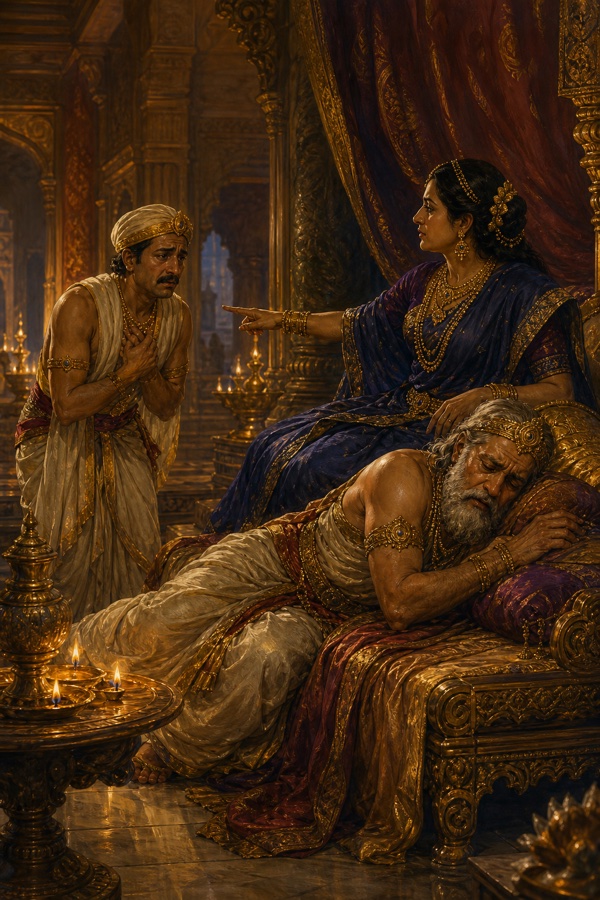
The words were pitiful and the king was plainly wretched, and Sumantra, with his palms still joined, backed away a few steps and stood off, saying nothing. When it was clear that the king was too far gone in misery to speak for himself, Kaikeyi answered for him, and she was well versed in the ways of state. “The king was awake all night for joy over Rama,” she said. “He is worn out with it and he has fallen asleep. So go quickly, charioteer, and bring the illustrious Prince Rama here. May all be well with you. There is nothing to think about.” Sumantra was an old servant, and old servants are not so easily moved. “How can I go,” he said, “without hearing the king’s own command?” At that the king himself spoke from the floor. “Sumantra, I want to see Rama. Bring the charming boy here, quickly.” Kaikeyi pressed him again to make haste.
Sumantra took the summons for what it seemed to be, a thing of good fortune, and his heart lifted. As he hurried out on the king’s order he reasoned it through: plainly the king was exhausted from the night’s exertions over the installation and reluctant to move, and was sending for Rama so that the boy could be crowned at once. Glad and burning to see the prince, he came out of the lovely inner apartments, which sat inside the vast city like a pool inside the sea, and found the main entrance packed on its outer side with citizens of every kind, come close to the door with their offerings of wealth in their hands. (Canto 14)
Sumantra Goes to Rama’s House
At the palace gate stood the Brahmins who had mastered the Vedas and been called to officiate, with the royal chaplains, Vasistha and Vamadeva and the rest, and with them the ministers, the commanders of the army, and the leading men of the merchant guilds, all of them delighted, all of them gathered in good order for the installation of Rama of Raghu’s line. A clear sun had risen. Pushya had appeared in the daytime sky with the moon, and the sun had entered Cancer, the same configuration of the heavens that had stood over Rama at the hour of his birth. Everything the foremost Brahmins had ordered was in place. Gold pitchers full of water. A wooden seat, adorned and blessed. A chariot upholstered entirely in a brilliant tiger skin. Water carried from the holy confluence of the Ganga and the Yamuna, and water from every other sacred river and pool and well and lake there was: from rivers like the Narmada, which rise in the east and run westward to the sea, from the streams that come down off the high mountains and flow across the plains, and from the rivers whose water runs white as milk, the Ganga at Varanasi, the Gandaki, the Son, flowing north or flowing south, and water from the seas on every side. Honey, curds, ghee, parched grain, blades of kusha grass, the flowers prescribed for the rite, milk, eight lovely maidens, a splendid elephant in rut, pitchers of gold and silver brimming with clean water and covered with the leaves of milk-sap trees, lotuses and water lilies floating in them, all of it shone. A pair of white chowries, bright as scattered moonlight and set with jewels, waited to fan Rama at his anointing. A white umbrella that looked like the orb of the moon and threw its radiance all around stood in front of everything else. A white bull was ready. A white horse stood ready, fully caparisoned.
There were musical instruments of every kind, and singers of praise, and bards. And there was no king. The Brahmins and the rest had assembled on the king’s own command, with everything a kingdom of the Ikshvakus gathers when it makes a prince its heir, and now they murmured to one another, “Who is going to announce us to the king? We cannot see him, and the sun is already up. Everything for the installation of the wise Rama is ready.” Sumantra, whom the king honored, came out among them while they were saying it, and spoke to them all and to the assembled kings. “I am on my way in haste to bring Rama, on His Majesty’s orders. You are worthy of honor even from the king, and far more so from Rama. I will go and ask after the king’s welfare on your behalf, and the reason he has not come out to you though he is awake.” He turned back into the inner apartments, whose doors were never closed to him, and stood a moment at the royal bedchamber, and then went close to the curtain and praised the king’s lineage and blessed him again. “May the Moon and the Sun, Shiva and Kubera, Varuna, Agni, and Indra grant you victory. The glorious night has passed and the blessed day has come. Wake, great king, and do what must be done next. The Brahmins, the commanders, and the merchants have come and are longing to see you. Wake, son of Raghu’s line.” The king knew the voice, and he answered from where he lay. “I told you to bring Rama. Why is my order being set aside? I am not asleep, whatever you think. Bring Rama here, quickly.” Sumantra bowed his head and went out, and the order was the most welcome thing he had heard all morning.
He came onto the royal road, decked with buntings and flags, glad and hurrying and looking about him, and everywhere along it he heard people talking joyfully of Rama and of the crowning. Then he saw Rama’s palace. It shone like Mount Kailasa and like Indra’s own house in heaven, its great doors barred, its facade set with hundreds of balconies and images of gold, its outer gateway made of gems and coral, bright as a cave on Mount Meru and dense with light as an autumn cloud. Enormous gems hung in wreaths of gold flowers. Pearls were everywhere. Sandal trees and aloes grew about it and it gave off a fragrance like the summit of Mount Dardura, where the sandalwood grows near the Malaya hills, and cranes and peacocks called in its gardens. Carved wolves and fine wooden figures caught the eye and held it. It stood there like the sun and the moon at once, the equal of Kubera’s palace, the image of Indra’s, full of birds, tall as a peak of Meru, and before it stood men with their palms joined and country people who had come with gifts for the crowning and left their carts and conveyances far behind, so that the approach was choked with them. Sumantra drove his four-horse chariot with its fender, the one the whole city loved to see, up to the gate, and at the sight of that wealthy house full of deer and peacocks his hair stood on end with joy. He passed in through its three gates, each of them decorated and tall as Kailasa, past the many good men waiting there who loved Rama and followed his mind, and heard on every side the happy talk of the servants preparing the installation and the blessings of the people on the heir apparent. He saw the elephant that carried Rama, tall as a mountain topped with a bank of cloud, in rut and beyond the control of any goad, the animal that could conquer any enemy and was therefore named Shatrunjaya. He saw the king’s own ministers, richly adorned, come on horseback and on elephants and in chariots, and he had them drawn aside into a corner, and then he entered the rich inner apartments of the palace, unchallenged by any porter, the way a crocodile slides into a sea full of jewels. (Canto 15)
Rama Sets Out in Royal State
The outermost gate had been crowded with people. The inner gate was another world: quiet, nearly empty, kept by young men with barbed lances and bows, earrings of burnished gold in their ears, single-minded, unfailing at their post, devoted to the master they served. Beyond them, at the door of the women’s apartments, sat aged men in ochre livery with staffs in their hands, richly turned out and wholly attentive, the keepers of the inner house. They all knew Sumantra, and they all sprang up from their seats in a flurry, eager to do the prince any service they could. Sumantra had a disciplined mind and a diplomat’s manners. “Please tell Prince Rama at once,” he said, “that Sumantra is waiting at the door.” They went in quickly, wanting to please the master, and gave the message to Rama, who was alone with his wife. Rama knew the charioteer for his father’s confidant, and to honor him he had him brought straight into the room where he sat with Sita.
Rama sat on a gold couch spread with a fine cover, richly adorned, his body anointed with sandal paste of the finest kind, holy and fragrant and as crimson as a boar’s blood, glowing like Kubera the lord of wealth; and beside him stood Sita with a chowrie in her hand, the way the moon stands with the star Chitra. He seemed to give off light. Sumantra knew every rule of decorum, and he greeted the prince like a humble petitioner, this giver of boons who blazed like the sun in his native glory, and then, seeing that cheerful face on the couch where the prince took his ease, he joined his palms and said, “Kausalya is blessed in her son. Your father wishes to see you, Rama, and Queen Kaikeyi is with him. Please go to him. Let there be no delay.”
Rama was delighted. He turned first to Sita, with the regard he always showed her, and thought the news through aloud. “The king and the queen have met together, my lady, and they are surely taking counsel about my installation. My mother Kaikeyi, the dark-eyed daughter of the king of the Kekayas, is clever, and she is the king’s favorite. She reads his mind and wants to please him, and she is obedient to him, and she has always been my well-wisher. She must be pressing the king on my behalf, and she must be glad. And what luck for me that the king, with his beloved queen beside him, has sent Sumantra as his messenger, the man who has always advanced my interests and accomplished what I wanted. A messenger of the same quality as the council that is sitting in there has come to me, and from that I know it: the king will make me heir apparent this very day. Well then. I will go at once and see the king. Stay here in comfort with your companions, and enjoy yourself.”
Sita, dark-eyed and honored by her husband, walked with him as far as the door, calling down blessings on him as they went. It was she who spoke of what lay beyond this day. “Once he has made you heir apparent, the king ought in time to consecrate you for the Rajasuya too, the sacrifice of an emperor, the way Brahma the maker of the worlds consecrated Indra, since his kingdom is full of learned Brahmins who know the rites. And when I see you consecrated for that sacrifice, rich in the austerities the rite demands, wearing the fine deerskin, living the chaste life, with the horn of an antelope in your hand, I want to serve you in that state. May Indra, who wields the thunderbolt, guard you on the east. May Yama, the lord of punishment, guard your south, Varuna, the lord of the waters, your west, and Kubera, the lord of riches, your north.” Rama took his leave of her. He went through the auspicious rites that a solemn occasion asks for, and then he came out of his palace with Sumantra beside him.
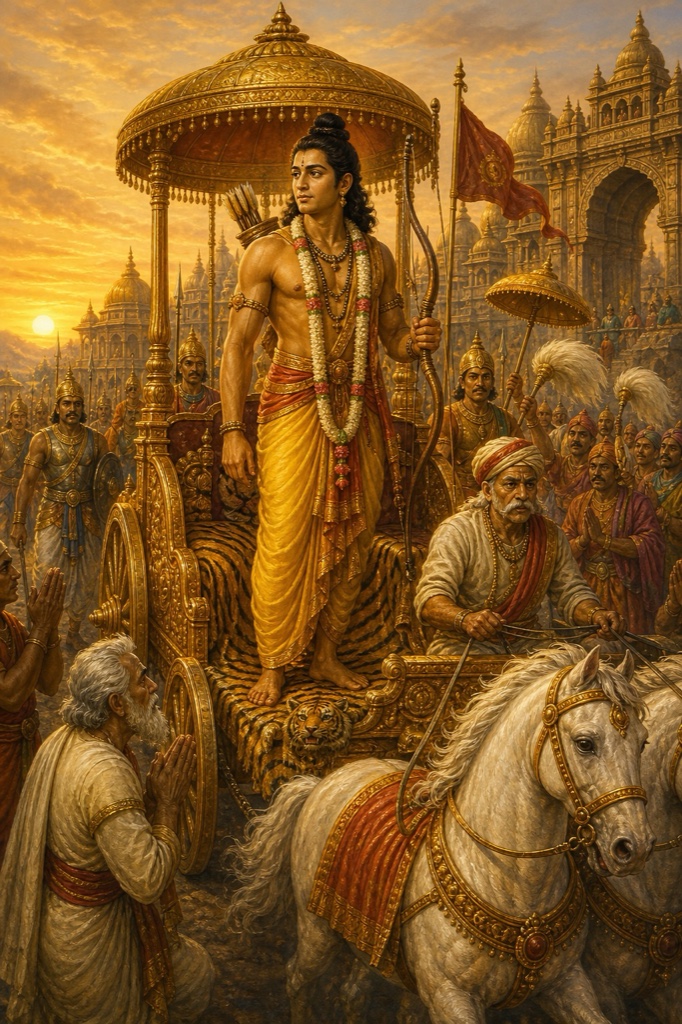
He came out the way a lion comes out of its mountain cave, and at the very first gate Lakshmana was waiting for him, bent low with his palms together. At the middle gate his friends and kinsmen had gathered, the ones who longed to see him and the ones who longed to see him crowned, and he met them all and spoke kindly to each. Then he mounted his chariot. It was a splendid thing, upholstered in tiger skin, so bright it seemed to be on fire, roomy, inlaid with gems and gold, dazzling as Mount Meru; it thundered like a storm cloud when it moved, and the horses that drew it were nearly the size of young elephants, so that Rama rode it as the thousand-eyed Indra rides his chariot behind his green horses. It rolled out of the palace like the moon coming out from behind a great cloud, and the quarters rang with its rattle. Lakshmana climbed up behind his brother with a wonderful chowrie in his hand and stood guard over him, a brother in every sense of the word. As the chariot passed through the gate an enormous shout of joy went up from the crowd on every side. Behind him came the best horses in the kingdom and elephants the size of hills, hundreds of them, thousands. In front of him marched mailed soldiers, their bodies daubed with sandal and aloe paste, each with a sword and a bow, and men who called down blessings on him as they walked. The road filled with music, with the words of the panegyrists, with the war cries of the fighting men, deep as the roaring of lions.
Women in their jewels stood at the windows of the mansions along the way and rained flowers down on Rama, the subduer of his enemies, until he rode under a steady fall of blossom, and women standing on the ground and on the rooftops called to him in the finest words they had. “Your mother Kausalya will rejoice today,” they said, “when she sees you installed on your father’s throne and the errand of your visit to him accomplished.” They looked at Sita too, in their minds, the beloved of Rama’s heart, and they held her the first of all married women. “Great austerity that lady must have practiced in her past lives,” they said to one another, “to have won union with Rama in this one, as Rohini won the moon.” Riding down the public road, Rama heard all of it, the sweet things the young women said from the tops of the houses and from the street.
He heard the visitors from the country talking about the house of Raghu, and he heard the citizens of Ayodhya, their faces shining, talking about him. “Here goes Rama, about to come into a great royal fortune by the king’s grace, and every wish of ours will be fulfilled now that he is to be our ruler. This is the best thing that could happen to us, that Rama will govern this whole realm for a long time to come. As long as he is lord over men, no one will ever have to face anything unwelcome, let alone suffering.” Ahead of him went the men whose trade was blessing, shouting victory, and the sutas who kept the chronicles, and the magadhas who recited the glories of the line, and eloquent eulogists praised him as he went, so that he drove like Kubera himself, with his horses neighing and the elephants swaying beside them. And Rama looked out at that clean, wide road, thronged with elephants in rut and with she-elephants, with chariots and horses, its crossings packed to the last inch with crowds, its shops heaped with jewels and every kind of goods for sale. (Canto 16)
Through Ayodhya’s Splendor to the Palace
From the chariot Rama took in the whole of Ayodhya, the friends and kin around him glad in every street: the buntings and the flags, the air thick with the incense of costly aloe wood, the crowds of every kind of person the kingdom held. He drove down the middle of the royal road, between white houses that stood like banked clouds, through drifting aloe smoke, and the road he drove was fit for the ruler of the gods in heaven, free of thieves and robbers, lined with shops that held heaps of the best sandalwood and aloe and other fragrant things, linen and silk, unpierced pearls, fine crystal. Flowers and every sort of thing to eat lay heaped along its edges, and its crossings were always adorned with curds and whole grain and the materials of the fire offering, with parched grain, incense of many kinds, sandal and aloe paste, flowers and perfumes, so that walking to a crossroads in Ayodhya was walking into a shrine.
His friends called blessings on him from every side, and he honored each of them as their standing deserved and went on. “Take the road your father walked,” they told him, “and your grandfather and your great-grandfather, the well-known road of righteousness, and when you are installed today, keep to it.” They said to one another, “When Rama is crowned we will all live more happily than we lived under his father Dasharatha, and under all his forefathers before him. If only we see Rama come out of the king’s palace today installed as heir apparent, we will have no use for pleasure of any sort, and none for any of the kinds of release. Nothing will ever be dearer to us than this, that Rama of boundless glory should be set on the throne.”
Rama heard the praise of himself and let it go by, unconcerned, and drove on. And yet no one could take his mind or his eyes off that finest of men even after he had passed. Whoever failed to see Rama that morning, and whomever Rama failed to notice, was despised in the eyes of everyone, and his own heart reproached him for it. That was the kind of hold he had on them. The prince showed compassion to people of all four orders and to those outside them, and he measured it to their years, and so they were devoted to him in thought, in word, and in deed. Crossroads, temples, the shrines of the village gods, the schools: each of these he kept to his right as he passed, the mark of respect a well-raised man pays without thinking.
Then the royal palace rose in front of him, its many attics massed like clouds and tall as the peak of Kailasa, its snow-white pleasure houses set with bunches of gems and lifting above the sky like the flying palaces of the gods, the finest house on earth, the equal of Indra’s. Rama, glowing with his own light, entered his father’s palace. He crossed the first three courts in the chariot, past their guard of bowmen, and walked the last two on foot. At the fifth he sent back everyone who had come with him, courteously, and went alone into the sacred inner apartments. Outside, the whole joyful crowd settled down to wait for him to come out again, the way the ocean waits for the moon to rise. (Canto 17)
The Sentence of Exile
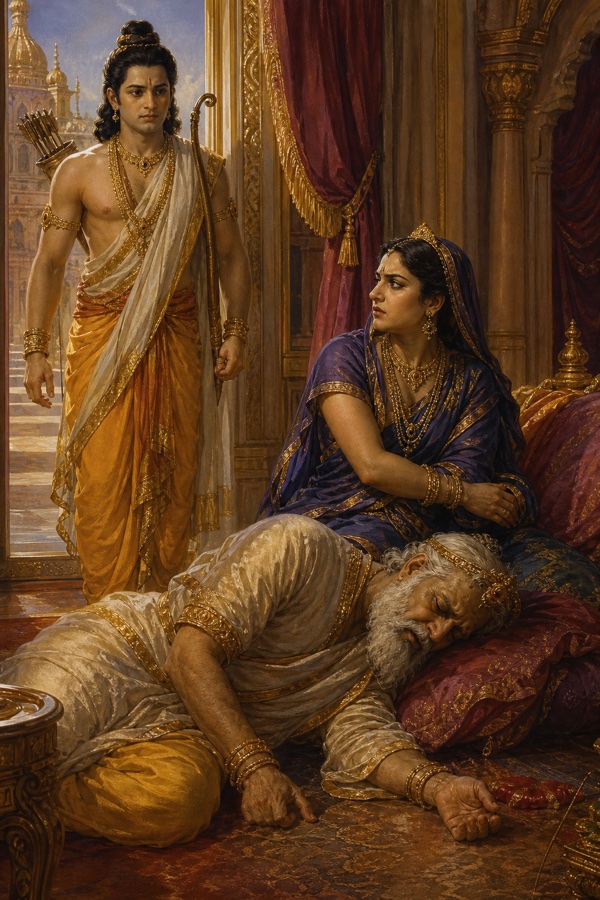
He found his father on a lovely couch with Kaikeyi beside him. The king was slumped, wretched, and his face looked as if something had dried it from within. Rama bowed first at his father’s feet, modestly, and then, with his mind fully composed, he laid himself at Kaikeyi’s. The king managed one word, “Rama,” and nothing more. His eyes were blind with tears. He could not look at his son and he could not speak to him. Rama had never in his life seen his father look like that, and fear went through him the way it goes through a man whose bare foot has come down on a snake. The king was wasted with grief. There was no joy left anywhere in him. He sighed, and his mind was plainly in torment, and to Rama he looked like a calm sea suddenly churned by waves, like the sun with an eclipse across it, like a sage who has told a lie. He tried to take in the size of the grief, and it was almost past imagining, and it stirred him as the ocean is stirred on the night of the full moon.
He was shrewd, and he loved his father’s welfare, and he began to reason. “On any other day my father would be glad to see me, even if he had been angry with me. Why does the sight of me hurt him today?” Then, distressed, his own face gone dark, he greeted Kaikeyi and put his questions to her alone. “I hope I have not offended my father without knowing it. Tell me why he is angry with me. You are the one who can make him kind to me again. He has always been fond of me. Why is he not cheerful? His face is down and he will not even speak to me, and he looks stricken. I hope no bodily illness and no anguish of mind is troubling him, though I know lasting happiness is hard to come by. I hope I have not wronged Prince Bharata, whose face it is a pleasure to see, or Shatrughna, who is so brave, or any of my mothers. If I cannot please the king, if I fail to do my father’s bidding and he is angry with me, I would not want to live another hour. How can a man not be devoted to his father, the living god he owes his very birth to? Or has some harsh word been said to him by you, in pride or in anger, that has stung him to the heart? What is this agitation in the king that I have never seen before? I am asking you, my lady, and I want the truth.”
Kaikeyi had put shame behind her, and her answer was bold and calculated to her own advantage. “The king is not angry, Rama, and no anguish troubles him. But there is something on his mind that he is not telling you, because he is afraid of hurting you. You are his darling, and the words will not come out of his mouth to tell you something you will not want to hear. What he has promised me, however, you must carry out. He honored me once by granting me a boon, and now he repents of it, the way any common man would, and he is trying to build a dam across a stream whose water has already run past. Truth is the root of dharma. Even the righteous know that. Take care that the king does not throw away his truth in his anger at me on your account. If you will undertake to do what the king says, whether it turns out good for you or evil, then I will tell you all of it. If what the king has said does not fall flat on you, I will speak. Otherwise, understand this: he is never going to open his lips to you himself.”
Rama was distressed, and he answered her there in front of the king. “Shame on me, that I should have to hear words like these, words that doubt my devotion to my father. You should not say such things to me. At my father’s bidding I would leap into fire. Commanded by him, who is my teacher, my father, my friend, and my king, all in one, I would swallow deadly poison and I would walk into the sea. So tell me what you have to say, my lady, whatever it is the king wants. I will do it, and I give you my word on it now. Rama does not speak twice.”
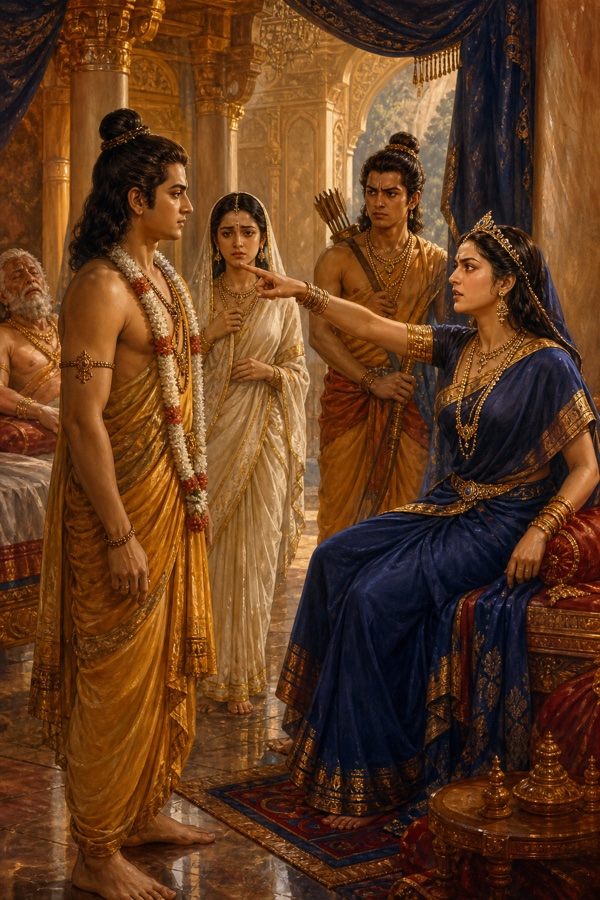
He had always spoken the truth, and he was guileless to the core, and it was to this man that the ignoble Kaikeyi now said the cruelest thing she had ever said. “Long ago, in the war between the gods and the demons, your father was hurt in a great battle. A shaft lodged in his body, and I brought him out, and afterward I drew it out of him myself, and for that he granted me two boons. Against those two boons, this very day, I have asked the king for the installation of Bharata, and for your departure to the Dandaka forest. If you want to prove your father true to his word, and prove yourself true to yours, then listen to me. Be faithful to what your father promised. He promised that you would go to the woods for nine years and five. Let Bharata be consecrated with everything the king gathered to consecrate you. Give up this installation, go and live in the forest of Dandaka, wear matted hair and the bark of trees, and stay there seven years and seven more. Let Bharata rule with a firm hand over this whole earth that Dasharatha owns, with all its jewels and all its horses and chariots. It is because he granted me these boons that the king is so full of pity for you now, and his face is withered with grief, and he cannot bring himself to look at you. Carry out the king’s pledge, Rama, delight of the Raghus. Vindicate his truth, which has never once failed, and get him out of this.”
Kaikeyi had spoken as harshly as a woman can speak, and Rama did not give way to grief at all. It was the king, for all his strength of mind, who was in agony, seared by the thought of the parting that was coming. The son heard his sentence calmly; the father who had passed it could not bear to hear it spoken. (Canto 18)
Rama Accepts, and Turns Toward His Mother
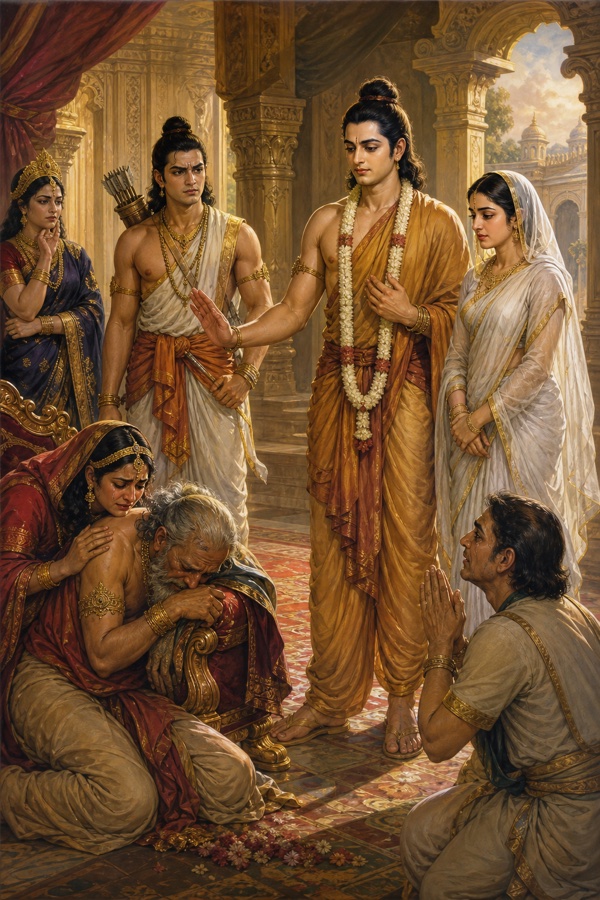
It was a message like death itself, and Rama heard it out and was not shaken. “So be it,” he said to Kaikeyi. “I will honor the king’s promise. I will put on matted hair and the bark of trees and go from Ayodhya into the forest and live there. Only I want to know one thing. Why does the king, who can punish any enemy and whom no one dares assail, no longer welcome me the way he used to? Do not be displeased with me for asking, my lady. I am going. Be pleased with me. When I am enjoined by the king, who is my friend and my teacher and my father in one, and who has always known how to value a service done him, what kindness would I hesitate to do? There is a single thing that galls me, and it is this: that His Majesty does not speak to me himself about Bharata’s installation. At a word from you I would joyfully hand Bharata the kingdom of Ayodhya and everything I own, and Sita my wife, and my life itself. How much more gladly will I give them at my father’s command, to please you and to keep the pledge he made you. So reassure the king. He is ashamed, and there is no need. But why is he weeping, so quietly, with his eyes fixed on the floor?”
“Let messengers ride out this very day on the swiftest horses, on the king’s orders, and bring Bharata back from his uncle’s house in the land of the Kekayas. As for me, here I go, and quickly, to the Dandaka forest, to live there fourteen years, and I will not question my father’s word.” The wicked Kaikeyi was overjoyed to hear it. She was sure of his going now, and she began to hurry him. “Let it be so. Riders will go on fast horses to bring Bharata home from his uncle’s. I do not think you should wait a moment longer, keen as you are to be off. You ought to leave for the forest at once. That the king does not tell you himself means very little; he is shy of asking his favorite son to give up the throne and leave the city. Put that scruple out of your mind. And understand that as long as you have not left this city, and left it in haste, your father will neither bathe nor eat.” The king drew a long, audible breath. “What a shame,” he said. “How it hurts.” And he fell senseless on the couch inlaid with gold. Rama lifted him up. Then, with Kaikeyi urging him to his face, he made haste toward the forest, the way a horse leaps when the whip comes down.
She had spoken like a woman without breeding, and the words were poignant, and Rama, who was a stranger to anguish, answered her once more. “I do not want to live in this world as a slave to gain, my lady. Know me for a man devoted to a spotless dharma, like the sages. Whatever my revered father wants, and whatever lies within my power, I have already done it, though it cost my life. There is no greater piety than serving one’s father and doing what he says. And so at your command, though my father has not commanded me himself, I will live fourteen years in the empty forest. You must see no good in me at all, princess of Kekaya, that you had to go to my father over a thing so small. You have more authority over me than he has. Bear with me while I take leave of my mother and win Sita’s consent, and then, this very day, I will go to the great forest of Dandaka. See to it that Bharata protects the kingdom against disorder at home and enemies abroad, and that he serves his aged father. That is the eternal dharma.”
His father heard him and could not answer. Grief had taken his speech, and he wept aloud, at the top of his voice. Rama bowed to his father’s feet, where the king lay unconscious, and to the feet of the ignoble Kaikeyi, and he walked around them both to the right, as one honors a shrine, and came out of the inner apartments, and at the gate he saw his friends waiting. Lakshmana, the joy of his mother Sumitra, came out at his heels with his eyes brimming and fury in every line of him. Rama went around the vessel that held the requisites of his consecration, to the right, without once letting his eyes rest on it, and moved slowly on, wanting only to be gone from that place.
The loss of a kingdom took nothing from his splendor, any more than the waning of the moon, so pleasing to the world, takes anything from the beauty of its cool rays. He was giving up the whole earth and going to live among trees, and no one could see a change in him, no more than one could see a change in a master yogi who has risen above pleasure and pain, heat and cold, and every other pair of opposites. He waved away the beautiful umbrella and the jeweled chowries. He sent home his own people, the chariot, and the citizens. He held down the pain he felt for the pain of everyone around him, took his senses in hand, and went into his mother’s apartments to tell her what she did not know. Not one of the handsome men around him, who were always watching him, noticed a change in the face of the glorious, truthful prince. He was a man of great arms and greater self-command, and he no more let go of the joy that was native to him than the autumn moon lets go of its brightness. He honored everyone he met with gentle speech, this man whose mind was given to what is right, and came into his mother’s presence, and Lakshmana, who had made himself Rama’s equal in every excellence and whose valor was vast, came in behind him, holding down the agony of the broken crowning and the exile. The house was full of joy. Everyone in it believed Rama was about to be crowned. Rama looked at all that happiness, and at the ruin of his own fortunes, and he let nothing show on his face, because he was afraid of what the news might do to the people he loved. (Canto 19)
Kausalya’s Lament
The moment Rama walked out of the inner apartments with his palms joined, a great wail broke from the women of the palace. “That same Rama who saw to every affair of this house without ever being asked, who was our refuge and our protector, goes into exile today. From the day he was born he has been as attentive to us as he is to his own mother Kausalya. He never got angry, even when he was spoken to harshly; he never said a word that could provoke anyone; he made peace with everyone who was angry with him. And today he goes. What a fool our king is, who is casting out Rama, the support of every living thing, and bringing ruin on the whole creation.” So all the queens cried out against their own husband and wailed aloud like cows torn from their calves. Their cry carried into the room where the king lay, and it was terrible to hear, and Dasharatha, already seared with grief for his son, hid himself under the bedclothes for sheer shame and misery.
Rama saw his own people plunged in grief and it hurt him deeply, and he drew a long breath, like an elephant, and held himself in, and went with his brother toward his mother’s apartments. At the entrance sat the aged chief of the doorkeepers, a man greatly honored, with many other porters standing about him, and the instant they saw Rama they all came to him and hailed the prince of Raghu’s line, the greatest of conquerors, with cries of victory. Inside the first gate he found, at the second, elderly Brahmins deep in the Vedas whom the king held in special honor, and he bowed to them. At the third gate were the women and girls and old men who guarded the door, and the women, overjoyed, congratulated the prince on his coming installation and ran in ahead of him to bring his mother the news that her son had come.
Kausalya had spent the whole night in religious observance, and at daybreak, wishing her son well, she had begun her worship of Vishnu. She was dressed in white silk, and her fasting had worn her thin. She had already performed the auspicious rites, and now, as Rama came in, the priests were pouring oblations into the sacred fire to the chant of the mantras, and she stood offering water to the deity. Rama saw everything laid ready for the worship of the gods: curds, whole grains of rice and ghee, balls of sweetmeat, the oblations for the fire, parched grain, white flowers, rice boiled in milk and sugar, rice cooked with sesame, sticks of sacrificial wood, brimming jars. She turned and saw her son, the delight of his mother, who had not come to her in a long time, and she went to him the way a mare runs to her foal. Rama clung to her, his arms about her neck, and she folded him in her own arms and bent and smelled the top of his head, the oldest tenderness a mother knows.
Then she spoke to him out of her love, and the words were sweet and wholesome at once, a rare combination in this world. “May you win the years and the fame of the great royal sages of old, of virtuous conduct and noble soul, and the dharma that befits your race. Go and see your father, Rama, the king who is true to his promise. That pious man is going to install you as heir apparent this very day.”
She invited him to eat, and he barely touched the seat she offered him. He opened the hollow of his joined palms a little, this prince who was modest by nature and bowed now by reverence and by the weight of what he carried, and he began to take his leave of his mother. “My lady, you surely do not know that a great calamity is upon us. What I have come to tell you will give you pain, and it will give as much to Sita and to Lakshmana. I am going to the Dandaka forest. What use have I for this jeweled seat? The time has come for me to sit on a mat of kusha grass. I am going to live fourteen years in the lonely forest, on roots and bulbs and fruit, as the ascetics live, and leave royal fare behind. The king is giving the office of heir apparent to Bharata, and he is sending me to Dandaka as a hermit. Six years and eight I will live in the empty woods, in the bark of wild trees, on what the forest gives.”
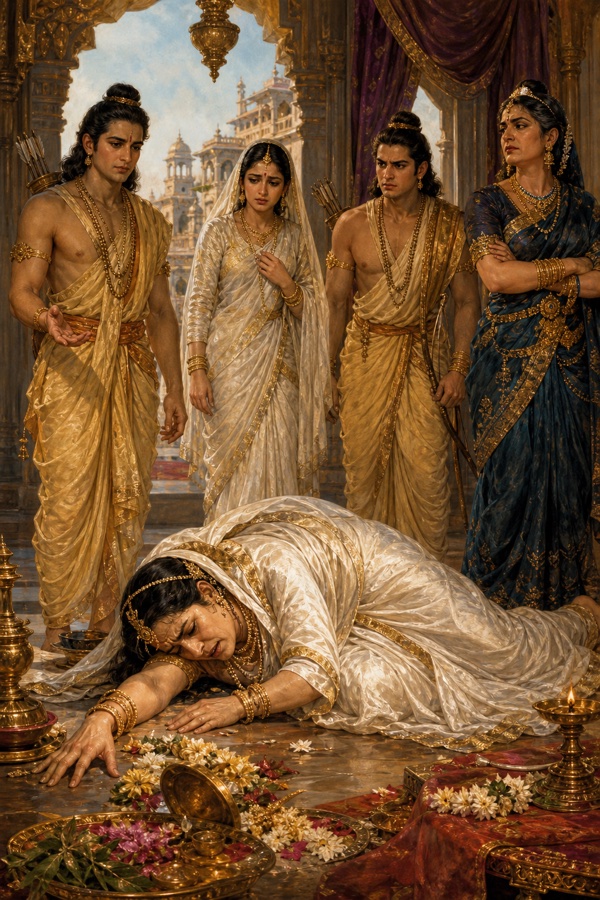
The news felled Kausalya. She dropped all at once, like the bough of a fir tree cut off by an axe in the forest, and lay unconscious on the floor like a goddess fallen out of heaven. She had never deserved a moment’s suffering, and she lay there like a banana tree that has gone down. Rama lifted her up. With his own hands he brushed the dust from her limbs, for she was covered in it like a mare that has been made to carry a heavy load and has rolled on the ground and struggled to her feet. And then, stricken, this queen who had been born for happiness, spoke to the son standing beside her, and Lakshmana heard every word.
“Rama, if you had never been born to me, the only grief I would ever have known was the grief of being childless, and that would have been the whole of it. A barren woman has one sorrow in her heart, that she has no child, and there is no other. But the agony of being parted from a son who is grown and married is worse than that, and it was never mine to know until today. From the day I married, no good fortune and no happiness ever came to me through my husband’s doing. I told myself that when my son was king I would have both in plenty. Now I am the senior queen, and in the state I am left in I will have to listen to my junior co-wives say things to me that will tear my heart. What could be more painful than that for a woman? And the grief and the lamentation that have fallen to me now have no end. Even with you at my side I was slighted. When you are gone, my child, I will be slighted past bearing, and then death is certain. My husband has never valued me. I have always been kept down. I have been treated on a level with Kaikeyi’s servants, or below them. Whoever serves me now, whoever so much as speaks kindly to me, will stop speaking to me the moment they see Bharata. Brought so low, how will I be able to look at Kaikeyi’s mouth, which is always angry and always saying something cruel?”
“Seventeen years I have counted since the day the sacred thread was tied on you and you were born a second time, and I spent every one of them hoping that my sorrows would end. I am old, and I cannot bear for long an agony like this, the contempt of my co-wives, which will have no end. How am I to drag out a wretched existence without the sight of your face, which has the light of the full moon in it? All the fasts, all the vigils and prayers to the gods, all the toil it cost me to raise you, I did it all for nothing, unlucky woman that I am. My heart must be very hard, that it does not split under this, any more than the bank of a great river like the Ganga splits when the new water of the monsoon washes over it. Surely there is no death for me, and no room in Yama’s house, since Death will not come and carry me off by force the way a lion carries off a crying doe. My heart is made of iron, that it does not break; my body is tormented and does not fly into pieces even when it falls on the ground; and death, it seems, does not come before its hour. And this is the worst of it: that my vows and my gifts and my self-denial have all come to nothing, and the austerity I practiced for the sake of a child has proved as fruitless as seed sown on barren ground. If a person worn thin by great suffering could die at will, before the appointed hour, I would go to the court of Yama this very day, like a cow whose calf has been taken. And if I cannot die, then what is life without you? A life with nothing in it, Rama, your face like the moon. I am feeble, and I will follow you to the forest anyway, the way a cow goes after its calf, out of pure longing.” She thought of the terrible thing that was coming to her through her son’s exile, and she looked at Rama, bound by his duty to his father, and she was unable to bear it, and she wept and wept, like a kinnara woman who has found her son in chains. (Canto 20)
Lakshmana’s Fury, and Rama’s Sense of Dharma
Lakshmana had stood through all of it, miserable, and now he spoke to Rama’s grieving mother in words that fit the hour. “Noble lady, it does not please me either that Rama should give up the royal fortune and go off to the forest because a woman told him to. The king has become perverse. He is senile and full of lust, a slave to his pleasures. What will a man like that not say when Kaikeyi is goading him? I see no offense of Rama’s against the king, and no vice in him, for which he should be driven out of the realm to live in the woods. There is no man in the world, not his deadliest enemy, not anyone he has beaten in battle, who could name a fault in Rama even behind his back. Who that cares for what is right would throw away, for no reason, a son who is the equal of the gods, guileless, disciplined, fond even of his enemies? And what son with any sense of statecraft would take seriously such a command from a king who has fallen back into his childhood?”
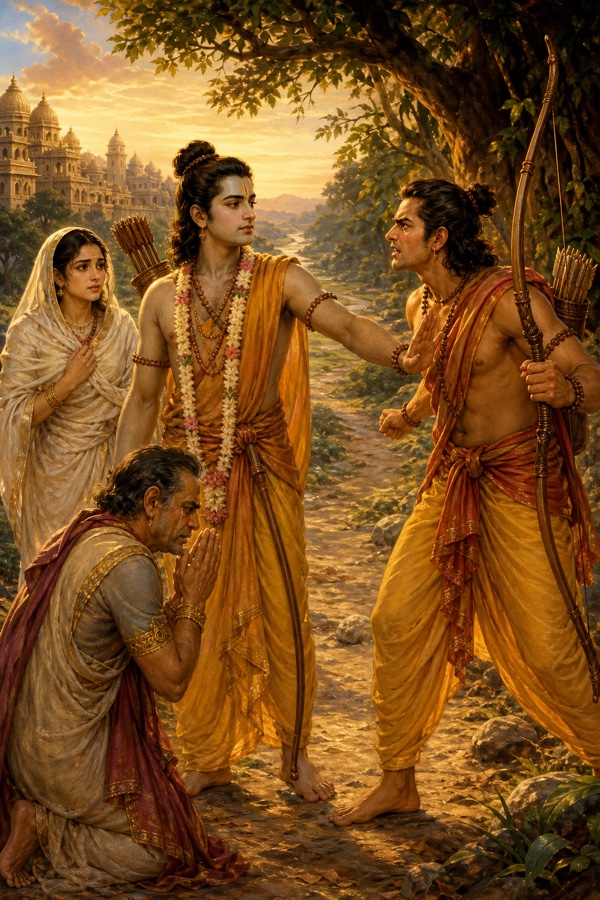
Then he turned to his brother, and his voice changed. “Before a single person learns that the king has decided to send you away, take the reins of this kingdom into your own hands, with my help, and install yourself. With me standing beside you, bow in hand, guarding you like death itself, who is going to show more valor than you? If Ayodhya stands against you, I will empty it of its people with my arrows. Whoever supports Bharata, whoever seeks his advantage, I will kill them all. The meek get nothing in this world except contempt. If our father, pleased with Kaikeyi and pushed by her, behaves like an enemy, then let him be made a prisoner, or let him be killed, without a scruple. Force has to be used even on a father or a teacher when he is drunk with pride, when he can no longer tell what should be done from what should not, when he has taken the evil road.”
“On what authority, on what grounds, does he mean to hand Kaikeyi’s son a kingdom that has come to you by right? What power does he have to give Bharata the royal fortune, and make an enemy of you, and of me?” To Kausalya he said, “Lady, I swear to you by my bow, and by every merit I have won through truth and charity and the worship of the gods, that I am devoted to my eldest brother from the core of my heart. If Rama walks into a blazing fire or into the forest, know that I have already walked in ahead of him. I am going to lift this grief off you by my own strength, the way the risen sun lifts the darkness. Let all these people watch my valor, and let Rama watch it. I will kill my father, that wretched old man with his mind fastened on Kaikeyi, gone back into childhood in his dotage, and contemptible.”
Kausalya wept when she heard him, and she turned on Rama with the whole of her grief. “Son, you have heard your brother. Now, if it pleases you, do what ought to be done next. You have heard the unjust command my co-wife gave you, and you ought not on any account to leave Ayodhya and leave me here stricken with grief. If you know dharma, and you want to practice it, then stay here and serve me, and you will be practicing the highest dharma there is. A son of Kashyapa stayed at home, disciplined, serving his mother, and by his great austerity he became a Prajapati, a lord of creation, in heaven. Your father deserves your reverence, and so do I, and by every measure of merit I deserve it more. I do not give you leave. You may not go from here to the forest. Once I am parted from you I have no use for life or for happiness. It would be better for me to eat grass with you than to live without you. If you go to the forest and leave me here in grief, I will sit down and fast until I die; I could not live in any case; and then, my son, you will go to the hell the whole world knows about, the way the Ocean, husband of the river goddesses, went to hell for the unrighteous act of tormenting his own mother, a sin like the killing of a Brahmin.”
His mother was wailing, and she was pitiable, and Rama answered her with words that kept faith with dharma. “I have not got it in me to overstep my father’s command. That is why I want to go to the forest. I bow my head to you and I beg your favor. The sage Kandu, a learned man who lived in the forest, killed a cow at his father’s command, though he knew it was a sin. In our own line, the sixty thousand sons of Sagara met a terrible death digging up the earth at their father’s word. Renuka was beheaded in the forest by her own son, Parashurama, the son of Jamadagni, with an axe, because his father told him to. These men and many others like them, godlike men, carried out their fathers’ orders without hesitating, and I too am going to do my father good. This is no new dharma I am setting up against you, no strange practice. I am walking the road my forefathers meant to walk and walked. What I am doing is the only thing on this earth that is worth doing, and nothing else. No one who does his father’s bidding is ever abandoned by dharma.”
Then Rama, who was the best of speakers and the best of bowmen, spoke to Lakshmana. “I know your love for me, Lakshmana, which nothing surpasses. I know your valor and your strength and your glory, which no one else could approach. It is because she does not grasp what truth and self-restraint mean to me that my mother is suffering an agony without equal, prince of noble marks. Dharma is supreme in this world. Truth is rooted in dharma. This command of my father’s rests on dharma, and so it is the highest thing there is. Once a man has given his word to his father, or his mother, or a Brahmin, if he stands on dharma he does not make that word a lie. I cannot go against this charge, brave brother. I was commanded by Kaikeyi according to the pledge my father gave her, and a man made as I am cannot flout it. So give up this unworthy thought of taking the throne by capturing the king or killing him, this idea that stands on nothing except the warrior’s pride in force. Take your stand on dharma. Do not be harsh. Follow the resolution I have made to carry out my father’s command.”
He had turned his brother from his purpose out of love. Now, with his palms joined and his head bowed, he spoke again to his mother. “Give me leave, my lady, to go from here to the forest. I bind you by an oath on my own life: perform the rites that will keep me safe on the road. When I have honored my vow I will come back from the forest to Ayodhya, as the royal sage Yayati, who had once fallen from heaven, went back up to it. Hold your grief inside your heart, mother. Do not sorrow. I will keep my father’s word and I will come home from the forest. You, and I, and Sita of Videha, and Lakshmana, and Sumitra, all of us must abide by what my father has ordered. That is the eternal law. Have the things gathered for the coronation taken away, keep the pain of it inside you, and let my resolve to live in the forest, which is a righteous resolve, be carried out.”
The submission was wholly in keeping with dharma, and it was patient, and it was brave, and his mother heard it and came back to herself like a dead woman coming back to life. She looked hard at Rama and said, “As your father is worthy of your reverence, so am I, my son, by the duty of raising you and by the love I have for you, and I do not give you leave. You must not leave me here in such grief and go. What is life to me without you in this world? What is the world to come, or the offerings the dead receive from their children, or the nectar the gods drink, if I have to go to those realms to get them? One hour of you beside me is worth more to me than the company of every living creature, or the rule of them all.”
Her wailing was piteous, and it did to Rama what torches do to a great elephant that has gone into a dark thicket and finds men with firebrands closing in on it to trap it: it made him blaze up with impatience to be gone. Holding fast to dharma, he spoke to his mother, who was nearly senseless, and to Lakshmana, who was in torment and beside himself, words of dharma that no one on earth except Rama could have spoken at that moment. “Lakshmana, I have always known your devotion and your prowess. It is because you do not fully read my mind that you and my mother between you are grinding me so painfully.”
“Dharma, wealth, and pleasure are counted in this world as the means of happiness, and all three follow in the train of dharma, the way an obedient wife brings a man merit by helping him in his duties, brings him joy by her love, and brings him prosperity by giving him sons. One should keep away from any pursuit in which all three have no place, and one should take up only that from which dharma follows; a man given to wealth without dharma is hateful, and a man addicted to pleasure against dharma is not praised either. When an aged father, who is also one’s teacher and one’s king, gives an order, whether he gives it out of anger or out of delight or out of desire, what man who is not cruel by nature would fail to carry it out as a sacred duty? And so I cannot rest until I have fulfilled this pledge of my father’s in full. He commands us both, my brother, Bharata and me alike. And he is the lady’s husband, her refuge and her means of happiness in this world and the next. While a husband like that is living, a king of dharma walking his own path of truth, how can the queen leave Ayodhya with me, as though she were some ordinary widow living on her son? So give me leave to go to the forest, my lady, and perform the rites for our welfare on the journey, so that when the term is done I may come back, as Yayati by his truthfulness climbed a second time into heaven. I am not able to throw away fame, which counts for more, for the sake of a bare kingdom with no dharma in it. Life is short, my lady. I will not take this paltry earth today through unrighteousness.”
So Rama set about pleasing his mother, and he gave Lakshmana a full and final lesson in what he understood dharma to be, and then, bent on the Dandaka forest as on a venture, he went around his mother in his mind, to the right, as one honors what is holy. (Canto 21)
Rama on Fate, and the Comforting of Lakshmana
Lakshmana was in pain past bearing, and he was indignant beyond it, and his eyes were stretched wide with rage like the eyes of an elephant in fury. Rama went to him, his beloved brother and well-wisher, and holding his own mind steady by main force, he spoke. “Curb your anger against our father and Kaikeyi, Lakshmana, and your grief over my exile. Take on a fortitude that has no equal. Put this affront out of your mind and take instead the highest joy a man can have, the joy of having helped his father keep his given word. Send back all the fine things that were gathered for my consecration, quickly, and with no interruption see to what needs to be done now, which is the preparation for a journey. Let the same zeal go into getting me ready for the forest that went into getting me ready for the throne. And see to it that our mother Kaikeyi, whose mind is in torment over my crowning, has no fear left in her that I might turn on her and refuse to leave. I cannot afford to ignore that fear in her mind, Lakshmana, even for an hour.”
“I do not remember ever having given the smallest offense to my mothers or to my father, in this life, knowingly or unknowingly. My father has always been truthful, true to his promises, truly brave, and afraid of the falsehood that brings ruin in the world to come; let him be freed of that fear in the world to come by my redeeming the promise he made to Kaikeyi. As long as this business of the installation is not wound up, the thought that his truth has not been made good will keep gnawing at his mind, and his agony is certain to hurt me too. So I want to be done with the ceremony and go from this city to the forest soon. Let Kaikeyi, who has what she wanted now that I am banished, install her son Bharata this very day with an untroubled mind. Only when I have gone to the forest in bark cloth and deerskin, with my hair matted on my head, will her heart be at rest.”
“Look to fate alone in my banishment, Lakshmana. It was fate that put this idea into Kaikeyi’s mind, working through the schemes of Manthara, and settled it there, and I ought not to offend fate by crossing its purpose, so I will go, and there will be no delay. Fate alone should be held responsible for sending me into exile and for taking back from me the sovereignty that had been offered. How could the resolve to persecute me by sending me away have entered the mind of Kaikeyi, who is my mother too, if fate had not prompted it? You know, gentle brother, that I never made any distinction among my mothers, and that she never made any between her own son and me. What else can I hold responsible for her galling the king with words so pungent that no one else could have said them, words to stop my crowning and drive me out, except fate? How else could a princess of gentle disposition and such rare qualities of head and heart have spoken like some uncouth woman, in front of her own husband, words meant to torment me?”
“What cannot be foreseen is fate, and no created being can set it aside; plainly it is by the will of fate that the unexpected has come down on me and on her both. What man can contend with destiny, of which there is no sign anywhere except the consequence of an act? Joy and sorrow, fear and anger, gain and loss, birth and death, and whatever else of that kind comes to a person, it is all the work of fate. Even sages of the fiercest austerity, driven by fate, throw off their strict observances and are led astray by lust and anger. When an undertaking has been begun, and all the materials for it have been gathered, and then something unforeseen sets it aside for no reason that anyone can see, that is fate’s doing and nothing else. Holding my mind steady with this true understanding, I feel no agony at all, though my consecration has been broken off.”
“So be rid of your agony too. Follow my line of thought, and have the proceedings of the installation stopped at once. With all these jars of sacred water that were brought together to consecrate me, Lakshmana, I will take the bath that opens my vow of asceticism. Or what have I to do, really, with this water and all the auspicious things that were gathered for a crowning? Water that I draw with my own hands will open my vow. And do not give way to remorse over the loss of fortune. It matters very little to me whether sovereignty falls to my lot or exile, and of the two, exile is the greater thing. Our youngest mother Kaikeyi is not to be suspected in any way of interrupting my crowning, Lakshmana, and neither is our father; both of them are in the hands of fate, and you know that fate has a power that never fails.” (Canto 22)
Lakshmana’s Rebuttal, and the Case for Human Effort
While Rama spoke, Lakshmana stood with his head bowed, pondering, swinging between despair at the breaking of the crowning and delight in his brother’s steadfastness. Then he knit his brows until a furrow stood between them and hissed like a great cobra in its hole. With that frown on it, his face was hard to look at, the face of a lion in fury. He shook his forearm the way an elephant shakes its trunk, threw his neck sideways and up, looked at his brother from the corner of his eye, and spoke.
“This great flurry has come over you at the wrong moment, out of fear of falling from your duty and a wish to quiet the doubts of the people. How can a man like you talk this way unless something has shaken him? You are the first of the kshatriyas, a bold warrior, and you go on glorifying fate, which is feeble, pitiable, and helpless. It amazes me that you have no suspicion at all of that wicked pair, Dasharatha and Kaikeyi. Do you not know that there are people in the world who are devoted to the mere appearance of dharma? If the two of them, who want to serve their own ends by fraud, had not intended from the very beginning to cast you off, the installation would never have been begun. And if the story of the boon granted by one and received by the other were true, it would have been granted before the preparations were ever taken in hand.”
“What has been begun is hateful to the people. I cannot bear the installation of anyone other than you. Forgive me my intolerance in this. Even the dharma is repellent to me by whose spell your mind, which was ready to accept the office of heir apparent, has been turned from it, and out of devotion to which you are losing your judgment. Your father is under Kaikeyi’s thumb and his pledge is unrighteous and shameful; how can you set about redeeming it when you have the power to put things right by action? This split was made by fraud, by a story about a boon, and you will not recognize it for what it is, and that is what grieves me; and this clinging to a false dharma is worthy of blame.”
“This yoking of yourself to dharma is condemned by everyone in Ayodhya. Those two follow nothing except their own pleasure, and they are your enemies for good, and they happen to bear the name of parents; who except you would fulfill their wish, even in thought? Grant that you believe their decision too was driven by fate. Even so it ought to be ignored. A decree of fate like that does not please me either. It is the coward and the weakling who trust in fate. The brave, who are sure of their own minds, never take shelter in it. A man who can beat back fate by his own effort does not lose heart when destiny wrecks his work.”
“Today people will see how strong fate is and how strong a man is. Today the difference between fate and human effort will be plain to everyone. Those who saw your crowning stopped by fate will see fate beaten today by my valor. Fate is charging like a runaway elephant, drunk on the fluid of its own rut, past any goad, and I will turn it back by sheer force. Not all the guardians of the worlds, not everything that lives in the three worlds together, can stop your consecration today, Rama; how then can our father? Those who agreed among themselves to send you into exile will themselves live in the forest for fourteen years. I will burn to nothing the hope of my father and of Kaikeyi that reaches, through the wrecking of your crowning, toward a kingdom for her son. For the man who sets himself against my strength, the power of fate will be a small help, and my fierce might a great torment.”
“Later, when you go to the forest at the end of thousands of years and hand the people to your sons to be protected like sons, they will rule after you without a break; that is the custom of the ancient royal sages, who recommend the forest for a king only when his people are safely in the keeping of his heirs. And if you do not want the kingdom for yourself, Rama, because you fear unrest in the state while the king wavers over giving up his throne and going to the woods, then have no misgiving on that score either. I promise you, brave brother, that I will guard you and your kingdom the way the coastline guards the sea and keeps it within bounds, and if I fail, let me never win the worlds that fall to heroes when they die. Let Vasistha and the others consecrate you with all these auspicious things. Be up and doing about it. I am enough, alone, to drive off any hostile king by force.”
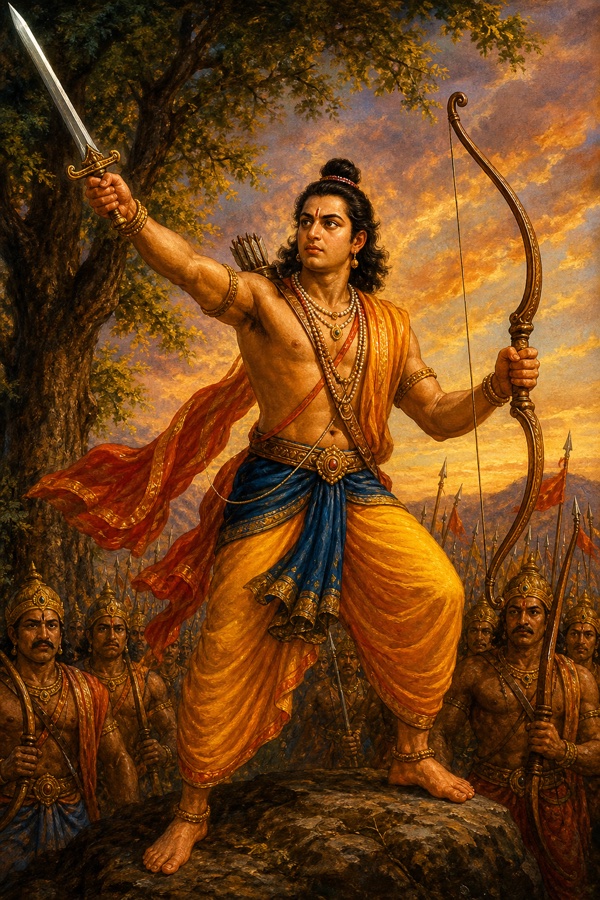
“These arms of mine were never meant to add to my looks. This bow is no ornament for my body. This sword was never meant to hang at my belt as a badge of honor, and these arrows were never meant to prop anything up. All four of them exist for one purpose, the crushing of an enemy. And whoever I judge to be my enemy, let him be Indra himself with the thunderbolt in his hand, I have no wish to leave him uncut by this raised sword, whose keen edge flickers like lightning. The ground will be so thick with the trunks of elephants and the heads of horses and the arms and thighs of chariot warriors, hewn off by my blade, that it will be hard to walk on. My enemies, cut down by the edge of it and bathed in their own blood, will drop to the earth like blazing fires, like storm clouds with the lightning in them. When I stand on the field with the iguana-skin guards bound on the fingers of my left hand against the bowstring, and my bow raised, what man will stay proud of his valor and dare to face me? Bringing down one warrior with many arrows and many with a single arrow, I will bury my shafts in the vitals of men, horses, and elephants. Today the power of my weapons will show itself, to prove the king powerless and to prove your sovereignty, my lord. These arms, which were made to be daubed with sandal paste and to wear armlets, to give away riches and to protect friends, will spend themselves today on stopping whoever is interrupting your consecration. Speak. Which enemy of yours is to lose his life today, and his name for being invincible, and his kin? Tell me what to do, so that the whole earth comes under your hand. I am your servant.”
Rama wiped the tears from his brother’s face, and comforted him, and comforted him again, and said, “Know me, gentle brother, to be firmly obedient to the command of my parents. That is the road the righteous have walked.” (Canto 23)
Kausalya’s Last Farewell
Kausalya saw that Rama was resolved on carrying out his father’s command, and her voice choked with tears, and she spoke to her pious son. “Ah, how is this boy, born of me and Dasharatha, who has never known sorrow and speaks kindly to every living thing, going to live on the grain gleaned from a market floor after the heaps have been sold? How is this Rama, whose very dependents and servants eat dainties, going to eat roots and fruit in the forest? Who will believe the story that Rama, the king’s own darling, rich in every excellence, is being sent into exile? And who will not be frightened when they hear it? Surely in a world where you, who are so lovely to look at, are going away to the forest, destiny alone is strong, and it rules everything.”
“And this fire of grief, my son, this huge fire that has no equal, which has its source in my mind and is fanned by the wind of your going, fed with the firewood of the anguish of weeping, nourished with oblations of the tears that well up as I weep, crowned with the thick smoke of brooding over your return at the end of fourteen years, and growing all the time as my breathing pumps it: it will waste me to nothing and burn me up, bereft of you, the way a forest fire burns off the dry wood and grass at the end of winter. Everyone knows how a milch cow follows its wandering calf. I will follow you the same way, my child, wherever you go.”
Rama heard his mother out, and she was deeply distressed, and he answered her. “Kaikeyi has betrayed the king, and once I have gone away to the forest, if you desert him too, he will surely not survive. For a woman to abandon her husband is sheer cruelty, and it is condemned above almost everything; you must not do it even in thought. As long as my father lives, the ruler of the world, serve him. That is the eternal dharma.” And Kausalya, who was benign to look at even then, was pleased with that, and said, “So be it,” to Rama, who did hard things as if they cost him nothing.
Rama went on, because he could see how much she was suffering. “My father’s command must be carried out by you as well as by me. He is the king, the one who supports us, the elder, the superior, the controller and master of us all. When I have spent nine years and five sporting in some great forest, with the greatest delight, I will come back and be at your beck and call again.” Kausalya loved her son past reason, and she was wretched, and her face was wet with tears. “Rama, I cannot bear to live among these co-wives. If you have made up your mind to go, out of deference to your father’s wish, then take me with you too, the way one takes a wild doe along.”
She was weeping, and now Rama wept too, and through his tears he spoke to her. “While a married woman is alive, her husband is her god and her lord. The king, our master, holds sway over you and over me today. With that wise king ruling the world, we are not masterless. And Bharata is pious, and he speaks kindly to every creature, and he is devoted to dharma always; he will serve you. Take care, and be vigilant, so that when I have gone the king does not suffer the least agony of grief for his son, and so that this cruel sorrow does not destroy him. Attend to the good of the aged king without ceasing, with your whole mind.”
“A woman who is noble, and devoted to sacred observances and fasts, and yet does not serve her husband, comes in the end to the destiny of a sinner. By service to her husband, on the other hand, even a woman who bows to no one else and turns away from the worship of the gods wins the highest heaven. Intent on what is pleasing and good to her husband, a married woman should serve him and him alone; that is the lasting duty laid on women in the Veda and in the remembered law. And when you pour the oblations into the fire, worship the gods and the famous Brahmins of noble vows with flowers and the rest, for my sake, my lady. Lead a regulated life, eat sparingly, give yourself to the service of your husband, and wait out the time longing for my return. In that way, when I have duly come back from the forest, you will have the highest thing you desire, if only the king, who upholds dharma above all men, keeps his life.”
Kausalya’s eyes were blinded with tears for the parting that was coming. “I cannot change your resolve to go, my son, my hero; you have made it deliberately, and destiny is hard to overrule. So go, my child, with an unwavering mind, and may good always be with you, my mighty son. I will be free of this affliction only when you have come back to Ayodhya. I will sleep soundly only when you return, my blessed son, with your purpose accomplished and your vow of fourteen years in the forest completed, and the debt to your father paid. The course of destiny in this world is always hard to see, Rama, and it is destiny that is driving you out over my protest. Go now, my strong-armed prince, and when you come back safe you will delight me with sweet and gentle words of comfort. Would that this were already the hour when I see you home from the forest, my child, in matted hair and bark cloth, turned around this very moment!” She saw with her penetrating mind that Rama was resolved on the forest, and she spoke words of blessing over him, and turned her mind to the rites that turn evil aside, the ones performed with the recitation of sacred texts. (Canto 24)
The Mother’s Rite of Benediction
Kausalya reasoned her way through the agony of the coming separation and got the better of it, and she sipped a little clean water, to wash away the impurity that shedding tears brings, and then she set about the rites for her son’s welfare, this high-minded mother of Rama. “Your departure cannot be stopped,” she said, “so go now, jewel of the Raghus, and follow in the footsteps of the righteous by redeeming your word, and come back quickly when your term is served. May the very dharma you keep, with love and with discipline, guard you on every side, my lion of Raghu’s line. May those you bow to at the crossroads and in the temples guard you in the forest along with the great sages. May the divine missiles that the wise Vishvamitra taught you guard you, who are always bright with your own excellences. Guarded by the service you have done your father and your mothers, and by your truthfulness, my strong-armed son, live long.”
“May the deities of the kindling sticks, of the kusha blades and the kusha rings worn at the sacrifice, of the altars, the temples, and the grounds the Brahmins choose for worship, and may the mountains, the trees, the bushes, the deep pools, the birds, the reptiles, and the lions all protect you, my son. May the Sadhyas and the Vishvedevas and the Maruts, with the great sages, bring you happiness. May the Ordainer and the Disposer bring it. May Pushan, Bhaga, and Aryaman, and all the guardians of the world with Indra at their head, and the gods of the six seasons, of the months and the years and the nights and the days and the hours, always work for your good. May the Veda and the remembered law and dharma itself protect you on every side, my son. May Lord Skanda, the younger son of Shiva, and the moon god with Brihaspati, the teacher of the gods, and the famous seven sages, and the sage Narada guard you all around. And may the Siddhas, and the four quarters with their lords, whom I have praised, protect you day after day in that forest you are going to live in.”
“May all the seven great mountains and the oceans and Varuna, the king of the waters; heaven, the earth, and the space between them; the air, with everything that moves and everything that stands still; all the lunar mansions and the sun and the planets with the gods who preside over them; the deities of day and night and of the two twilights: may all these protect you while you live in the forest. May the six seasons, and the extra months of the calendar, and the years that hold them, and the smallest measures of time, the kala and the kashtha, grant you happiness. May the gods and the demons too give you happiness always while you wander the great forest in a hermit’s dress, wise as you are. Let there be no fear for you, my dear son, from the ogres, from the cruel fiends, from anything that eats flesh. Let there be no monkeys, no scorpions, no gnats and mosquitoes, no reptiles and no insects in the dense forest where you make your home. Let the great elephants, the lions, the tigers, the bears, the beasts with tusks and the fierce horned buffaloes do you no harm, my son. And let the other savage man-eaters, of every species that lives, whom I have propitiated here, not kill you, my child. May your roads be lucky and your ventures succeed. May all the wealth of the forest be at your disposal, Rama. Go happily, my beloved son. May you be safe again and again from the beings of the air and the creatures of the earth, from all the gods, and from whoever is your enemy. May Shukra and Soma and Surya, Kubera and Yama, whom I have worshiped, guard you, Rama, while you dwell in the forest of Dandaka. May the gods of fire and wind and smoke, and the mantras that came from the mouths of the sages and that you will utter, protect you when you sip water and when you bathe, my son of Raghu’s line. May Brahma, the lord of all the worlds and the maker of all beings, and the sages, and every god I have not yet named, guard you while you live in the forest.”
With those words the illustrious, large-eyed Kausalya worshiped the hosts of the gods with flowers and perfumes and hymns that suited each of them. She had fire brought, and a noble Brahmin poured oblations into it with due ceremony for Rama’s welfare, and she, the finest of women, put into his hands the ghee, the white flowers, the sticks of sacrificial wood, and the mustard seed. When the priest had made the offerings for her son’s peace and health according to the ordinance, he laid out with the remnants an offering outside the fire ground for Indra and the other guardians of the directions. Then she gave the Brahmins honey, curds, whole grain, and ghee, and had them recite the prayers that keep a traveler safe in the forest, and she gave the leader of those Brahmins the fee he asked, and turned to Rama again.
“May the same good fortune be yours that came to thousand-eyed Indra, hailed by all the gods, when he destroyed Vritra. May the same blessing be on you that Vinata once called down on Garuda when he went to fetch the nectar. May the same blessing come to you that Aditi, the mother of the gods, gave Indra, the wielder of the thunderbolt, while he was cutting down the demons at the churning of the nectar. May the same good fortune attend you, Rama, that attended Vishnu of boundless glory when he took his three strides and measured the worlds. May the sages, the seven oceans, the seven islands of the earth, the four Vedas, the three worlds, and the four quarters give you blessings, my strong-armed son, the blessing of all blessings.”
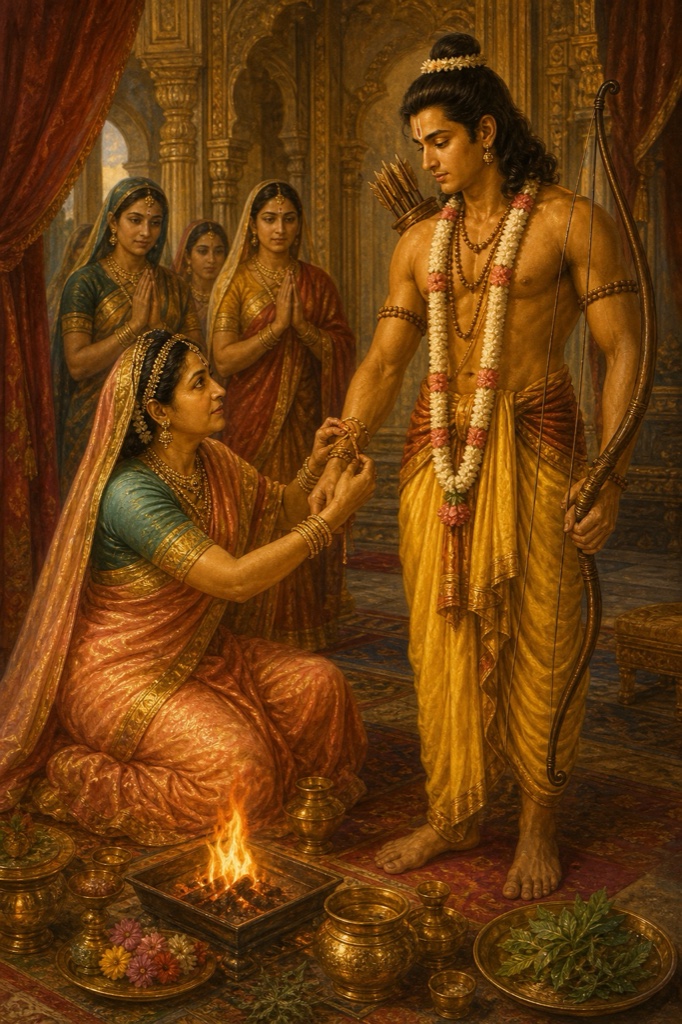
She fixed whole grains of rice on his forehead as a benediction, and daubed him with sandal paste of several kinds, and about his wrist, as an amulet, she bound the herb called Vishalyakarani, the herb that draws an arrow painlessly out of a body, whose power had been proved many times over, and she recited the sacred texts over it and murmured the mantras to make it stronger still. She spoke those mantras aloud like a woman overjoyed, because she would not let her son see his mother’s heart and lose his own courage; and so she said them mechanically, in a faltering voice, with her lips and not with her heart, while grief had all the rest of her. Then she bent and smelled his head and took him in her arms. “Go in comfort, Rama, with your purpose accomplished. I will see you come back to Ayodhya in sound health, with every object gained, at peace with everyone on the royal roads. With every thought of sorrow gone out of me and my face lit up with joy, I will see you return from the forest like the full moon coming up over the horizon. I will see you home from the forest, having kept your father’s word, and seated on the throne. Home from the forest in festal robes and festal ornaments, may you fulfill forever the wishes of my daughter-in-law. Go now, Rama. May the hosts of gods with Shiva at their head, whom I have worshiped, and the great sages, the multitudes of spirits, the celestial serpents, and the gods of the four quarters wish you well for a long time to come, when you have set out for the forest.”
When the rite of blessing was finished according to the rule, Kausalya, her eyes overflowing, walked around Rama to the right, and looked at him, and looked again, and embraced him. And Rama, circled by his mother, pressed her feet again and again in reverence, and, lit up by the splendor her benediction had laid on him, went on toward Sita’s apartments. Of all the farewells that day, this one he had not yet found words for. (Canto 25)
Sita’s Question
Rama had bowed to Kausalya and taken her blessing, and now, set on the most righteous of roads, he went toward the forest by way of his own house, and the royal road he walked was packed with people who wanted a look at him, and the very nearness of him lit it up, and the excellences in him stirred every heart he passed. Sita had heard nothing. She was a woman of austere vows, and she had spent the morning in them, and not one word of the broken crowning or the exile had reached her; in her heart there was only one thing, Rama’s installation as heir apparent, exactly as it had been when he left. She had finished her worship of the gods. She knew the duties of a princess and the code by which kings live, and she waited for her husband with a light heart.
Then Rama came into his house, which had been dressed for a festival and was full of overjoyed servants, and his head was bent a little, as if with shame. Sita sprang up from her seat. She was trembling before she reached him, because she could see that he was stricken, and that his mind was somewhere it did not want to be. When he looked at her he could no longer keep the grief inside him, righteous as he was, and it showed on his face. She saw the color gone out of him, and the sweat on him, and the effort it cost him to hold himself together, and she was seared with grief herself before she knew the cause. “My lord, what is this now? Today the blessed star Pushya, which Brihaspati rules, is in the ascendant, and the learned Brahmins say that is the hour for a crowning, when the moon stands in it. Then why are you so ill at ease? Why is your lovely face not shaded by the white umbrella with its hundred ribs, pale as sea foam? Why are they not fanning it with those two fine chowries, white as the moon and white as a swan?”
“Where are the minstrels and the bards and the eloquent panegyrists, who should be here in their joy, showering you with blessings and praise? Why have the Brahmins who know the Vedas not poured honey and curds and the water of holy places over your head, with due ceremony, after your full bath? Why are the king’s ministers and the chiefs of the guilds not decked in their ornaments and waiting to follow you in state, and the townsmen and the country people with them? Why is the finest chariot of all, the pleasure chariot with its four swift horses and its gold, not going ahead of you? Why is there no splendid elephant with every lucky mark on him, dark as a hill with a rain cloud sitting on it, walking in front of you on your way back? Why is there no servant marching before you with the auspicious seat, worked in gold, in his hands? When everything for your consecration stands ready, why is your face a color I have never seen on it, and why is there no joy in you at all?”
Rama Explains to Sita
She was wailing by the end of it, and Rama answered her plainly. “Sita, my revered father is sending me into exile in the forest. You were born into a noble house, you know what is right and you practice it, so hear how this has come to me today, in the order it happened. Long ago my father, King Dasharatha, who is true to his promises, granted my mother Kaikeyi two great boons. Today, when everything for my consecration had been made ready by the king’s own effort, she pressed him to make them good, and he was bound by his oath, and on the ground of dharma she brought him wholly under her hand. I must live in the forest of Dandaka for fourteen years. And my father has named Bharata heir apparent. So I have come to see you, on my way to the lonely forest.”
“Never praise me in front of Bharata, when he comes to pay his respects to you, or you will lose his goodwill. Men who have power and fortune cannot bear to hear other men praised. So never speak of my virtues before Bharata, and never exalt me even among your women friends. You will be able to live near him only by fitting your conduct to his. The king has given him the office of heir apparent once and for all; so keep him well pleased, Sita, all the more because he is going to be the king. I for my part am going to the forest this very day, to keep my father’s pledge. Stay firm, high-minded woman. When I have gone to the forest where the ascetics live, my blessed one, give yourself to sacred observances and fasts. Rise at dawn, worship the gods as the ordinance lays down, and then bow to King Dasharatha, my father. My mother Kausalya is old, and grief has worn her thin; she deserves your respect, so keep dharma foremost in your mind. My other mothers too deserve your greeting every day. All my mothers are equal in my eyes, in the affection and goodwill they bear me and in the care they took of me when I was small.”
“Bharata and Shatrughna are dearer to me than life. Look on them especially as your own brothers, or as your sons. Never give Bharata any offense at any time; he is now, as it were, the ruler of our country and the head of our family. Kings are well pleased when they are won by good conduct and served with unbroken effort, and enraged when they are not. Rulers cast off even the sons of their own bodies when those sons turn against them, and take up strangers as their own when strangers are friendly. So live here in Ayodhya under the king’s protection and in conformity with Bharata’s will, devoted to dharma, keeping the vows whose power never fails, my blessed one. I am going to the great forest, my darling. You must live here. Conduct yourself so that you offend no one. That is my counsel to you.” (Canto 26)
Sita’s Resolve
Sita had always deserved her husband’s kindness and had always spoken kindly to him, and now, for the first time, love made her angry. “Why do you give me advice like this, Rama, which makes me look so small, and which I can only laugh to hear? Greatest of men, what you have just said is unworthy of brave princes trained in the use of weapons and missiles; it is a disgrace to them, and it is not worth listening to. A father, my darling, a mother, a brother, a son, a daughter-in-law, each of them reaps what they have earned, enjoying the merits of their own past lives, each on their own account. A wife alone shares the fortune of her husband. And for that very reason the command your father and mother have given you is a command to me: I too am to live in the forest.”
“For a woman there is no refuge in her father, or her son, or her own body, or her mother, or her women friends, in this world or the next. Her husband alone is her refuge, always. If you set out this very day for the forest of Dandaka, which no one can penetrate, then I will walk ahead of you and crush the kusha blades and the thorns under my feet. Put jealousy and anger out of doors, the way one pours away the water left in the pot after drinking, and take me with you without fear; there is no sin in me that should stop you. For a woman, the shelter of her husband’s feet, in every circumstance, is better than the top of a palace, better than a flying palace, better than coursing through the heavens by the powers that yoga gives.”
“My mother and father taught me in a hundred ways how I should conduct myself toward you. I do not need to be instructed in it now. I will go with you into that forest that no one can penetrate, with no manservant to attend me, where the beasts of every kind run in herds and the tigers are many. I will care nothing for the sovereignty of the three worlds; I will keep my mind on the vow of serving my husband; and I will live in the forest as happily as I lived in my father’s house. Serving you every day, disciplined and chaste, I will sport with you in woods that smell of honey. You could support other men in the forest, men who are no kin to you; how much more easily me, your wedded wife, who depend on you for everything, Rama, you who honor everyone.”
“I am going with you to the forest today, and there is no doubt about it. I am set on it, and no one can turn me. I will live on fruit and roots from day to day, that is certain, and I will never be an annoyance to you while I live at your side. I will walk ahead of you, and I will eat only when you have finished eating. I want to see the mountains and the ponds and the lakes, and to be afraid of nothing anywhere, with you, my wise protector, beside me. I want to see, happily, with my hero beside me, the lotus ponds full of swans and waterfowl and thick with lotus, and to bathe in them every day, devoted to you, and to sport with you in the fullness of joy, my large-eyed lord. If I spent thousands of years with you, or a hundred thousand, I would never feel a moment’s sorrow. Without you, heaven itself would not be acceptable to me. If they offered me a place in heaven without you in it, Rama, my lord, I would take no pleasure in it at all.”
“I will go to the forest of Dandaka, the hardest of all to enter, full of game and of monkeys and elephants, and clinging to your feet alone, and esteemed by you, I will live there as though I were in my father’s house. Grant my prayer. Take me with you: I who am devoted to you and to no one else, whose mind is fastened on you, and who have made up my mind to die if I am parted from you. I will not be a burden to you.” Sita was fond of dharma, and she had said everything that could be said, and Rama, the best of men, still did not feel the least inclination to take her into the forest. To turn her from her resolve, he began to tell her, at length, what forest life is. (Canto 27)
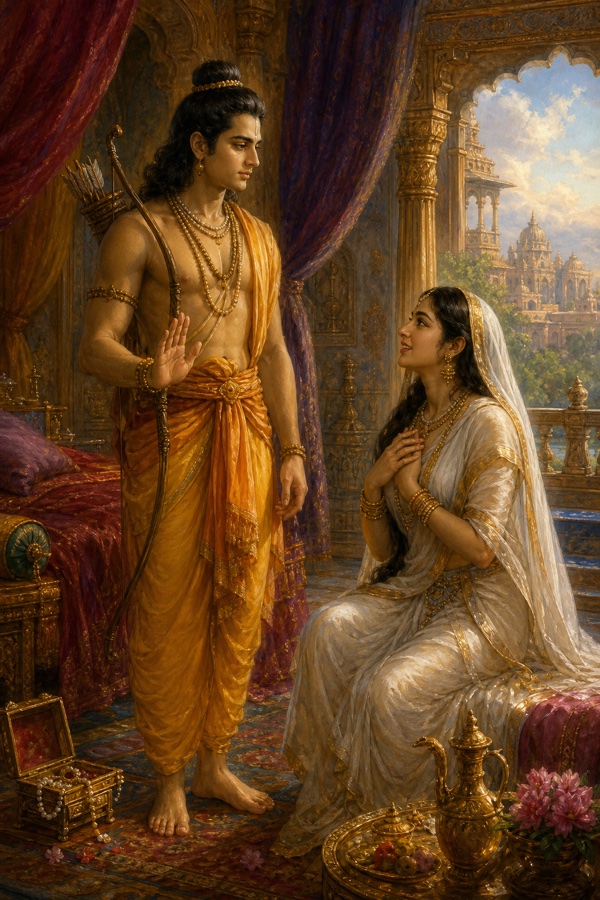
Rama Counts the Forest’s Thorns, and Sita’s Unshaken Heart
Rama loved dharma, and he knew exactly what the forest asks of the people who live in it, and he did not want that for Sita, who knew what was right and had just said it. Her eyes were dim with tears. He soothed her with gentle words, and then, meaning to turn her back, he said, “Sita, you were born into a great house, and you are devoted to dharma always. Practice dharma here, so that my mind can be at rest.”
Then he began to count off the perils of exile one by one. “You must do as I tell you, my fragile Sita. A dweller in the forest suffers many hardships; learn them from me. Give up this idea of living in the forest, once and for all. A dense forest is called a wilderness for good reason, and it is full of dangers. I am saying this for your welfare and for nothing else. There is no joy in a forest at any time. I know it, and I know it as a place of unending misery.”
“The lions roar from their caves in the hills, and the noise of the mountain streams makes it worse, and the sound is hard to bear. That is why a forest is misery. Wild beasts in rut sport fearlessly in that empty country, and when they see a human being they rush at him from every side. The rivers are full of crocodiles and thick with mud, and even elephants in rut cannot get across them. The paths have no water, and they are cruelly rough, choked with creepers and thorns and loud with the cries of jungle fowl. When a man has worn himself out hunting for fruit to eat, he lies down at night on a bed of dry leaves that fell of themselves.”
“Day and night, with the mind held in check, a man must quiet his hunger with the fruit that drops from the trees on its own; that is the forest. He must fast to the limit of his strength, and carry the weight of matted hair on his head, and wear the bark of trees. Every day he must worship the gods and the ancestors according to the ordinance, and honor the guest who arrives at his door without warning. Those who keep the rule must bathe three times a day, at the appointed hours, in the morning, at noon, and at evening. He must worship at an altar he has built with his own hands, with flowers he has gathered himself, in the way the sages laid down. And eating sparingly, forest dwellers must be content with whatever fruit the season happens to give them.”
“The wind there blows hard every day. Thick darkness hangs over everything. Hunger is savage all the time, and the dangers are great. Serpents of many kinds crawl along the trails in their pride, and snakes that live in the rivers, and wind along like rivers themselves, lie across the paths and block them. Moths, scorpions, worms, gadflies, and mosquitoes torment everyone without end, my frail one. Thorn trees stand everywhere, and kusha grass and kasha grass fling their sharp ends out on every side. A man’s body suffers in a hundred ways, and perils of every kind threaten him. Anger and greed must be given up entirely, the heart must be set on austerity, and one must not be afraid even of what deserves fear. That is the forest, and it is misery without a break.”
“So have done with this idea of going there. The forest is no safe place for you. The more I turn it over, the more clearly I see a forest full of evils.” Noble Rama had refused, and Sita did not accept his verdict. She was sorely hurt, and she answered him. (Canto 28)
Sita’s Answer: With You, the Forest Is Heaven
Sita was deeply attached to him, and his plea had distressed her, and she answered gently, with her face wet. “The disadvantages you have listed of a life in the forest, take them from me as so many blessings, because I am the first thing in your affections. The antelopes and the lions, the elephants and the tigers, the eight-legged sharabhas that are said to be stronger than lions, the yaks and the gayals and every other creature that roams the forest, will run away the moment they see your face, since they have never seen it before, and every creature is afraid of you.”
“By the command of your parents I must go with you too, since I am the half of yourself, and I cannot live apart from you. If I am separated from you, Rama, I will have to throw away my life here. And with you beside me, not even Indra, the ruler of the gods, could overpower me with all his might. You have shown me plainly enough yourself that a devoted wife cut off from her husband cannot go on living.”
“And there is this, my wise lord. Long ago, in my father’s house, I heard a prophecy that must come true, from Brahmins who know the stars: that I would have to live in the forest. I heard it from Brahmins who read the marks on the body, at home, and ever since I have cherished a longing for the forest life, my strong one. That prediction must be made good by me, and so I am going with you, my husband, my darling, and it cannot be any other way. I am certain you will let me follow you, and follow you I will. The hour of the prophecy has arrived. Let the Brahmins’ word prove true.”
“I know very well that there are sufferings of every kind in the forest. Those sufferings fall on men whose minds are not under their own command, and on no one else. While I was still a girl in my father’s house, a wandering holy woman who lived in perfect quiet foretold the same thing in my mother’s presence: that I would live in the forest. And here in this house, my lord, how many times have I asked you the favor of taking me to the forest for a while? A journey to the woods with you is something I have wanted for a very long time.”
“I am jubilant at the thought of going. May it be well with you, my prince of Raghu’s line. To serve you, my hero, while you live in the forest is a delight to me. Walking behind my husband to the forest in love and devotion, I will be washed clean of every fault, pure-hearted prince, because to a wife the husband is the highest god. If I stay united with you in the forest, our union will go on forever and be a blessing to us both in the world beyond. I have heard the holy Veda on this from the famous Brahmins: that a woman remains, in the other world too, the wife of the man to whom her parents gave her in this one, with water poured over their hands, according to their dharma.”
“That being so, what reason on earth can you have for refusing to take your own wife with you from this city, a wife so devoted to her husband and of such good conduct? You ought to take me, Rama: I am devoted and faithful, I am wretched at the thought of parting, I am the same in pleasure and in pain, and I share whatever joy and whatever sorrow are yours. And if you will not take me to the forest, afflicted as I am, then I will go to poison, or to fire, or to water, and end it.”
She begged him in every way she knew to let her come. And Rama, strong of arm, still would not agree to take her into a forest where she would have no friend. She had been turned away, and she fell to brooding, and the hot tears that dropped from her eyes seemed to be watering the ground. Love had roused a real anger in the princess of Videha, and she sat with it, and the self-possessed Rama, to draw her back from her purpose, set himself to soothe her in every way he could. (Canto 29)
Let No One Say “Rama Has No Valor”
Rama had consoled her, and Sita, the daughter of Janaka, the princess of Mithila, answered him one more time, to win his leave to live with him in the forest, and this time the thought of the parting had shaken her so badly that she taunted him. She said it out of love and out of pride, to the broad-chested prince, and it went into him like a barb. “When my father Janaka, the lord of the Videhas and the king of Mithila, got you for a son-in-law, did he understand that he was getting a woman in the shape of a man? It will be a pity for me if the people, in their ignorance, start telling the lie that ‘there is no real valor in Rama, for all that he blazes like the sun,’ because you would not take me. What have you done, that you are so cast down? Where does this fear come from, that makes you want to abandon me, who am devoted to you and to no one else?”
“Know that I am as obedient to your will as Savitri was devoted to the brave Satyavan, the son of King Dyumatsena. I would not look at any man except you even in my thoughts, as some other woman might who shames her family. I must go with you, my lord.”
“You married me before I was grown, and I have lived with you a long time, and I have been chaste; and now, like a man who lives off his wife, you propose to hand me over to other people of your own free will? The man you tell me to serve, the man for whose sake you are pushing me aside, be his obedient servant yourself, forever, sinless one. You may not go to the forest without me. Austerity, or the forest, or heaven, whichever it is to be, let it be with you.”
“Walking at your heels on the forest paths will tire me no more than strolling in a garden or lying asleep. The kusha and the kasha grass, the reeds and rushes and whatever thorny bushes lie in my way, while I am with you, will feel under my feet like a heap of cotton or a soft deerskin. When the storm wind throws its dust over me, my beloved, I will count it the finest sandal powder. And when I lie down on the turf among the trees with you beside me, will a bed spread with soft carpets be any softer than that?”
“Whatever you bring me with your own hands, a leaf, a root, a fruit, a little or a great deal, will taste like nectar to me. I will eat the flowers and fruits of the season, and I will not remember my mother, or my father, or my home. You need foresee nothing unwelcome from my going. No grief will come to you on my account there, and I will not be hard to feed. A dwelling shared with you is heaven to me, and any dwelling without you is hell. Know that this is the measure of my love, Rama, and take me to the forest with you.”
“And if you still will not take me to the forest, though I am not in the least afraid of it, then I will drink poison this very day, and I will never fall into the power of my enemies. Once you have abandoned me I could not go on living anyway, for the pain of it; better to die here in front of you. I cannot bear this grief for even an hour. How then, wretched as I am, could I bear it for ten years and four?”
She had wailed a long time, and piteously, and now she clung to her husband and cried out loud, worn out with grief. His homilies had pierced her the way poisoned arrows pierce a she-elephant, and the tears she had held back for so long came out of her the way fire comes out of wood that is rubbed against wood. Water clear as crystal, born of pure anguish, ran from her eyes as water runs from a pair of lotuses. Her face, with its great eyes, which shone like the full moon on a clear night, was scorched by those hot tears the way a lotus lifted out of the water withers in the heat. Sita was near fainting, and Rama gathered her in his arms and held her, and set out to make her wholly sure of him.
“My lady, I find no pleasure in heaven itself if it is bought with your pain. I have no fear of anything from any quarter, no more than Brahma the self-born has. It was only because I did not know the whole of your mind, my lovely one, that I did not approve your going to the forest, though I have the power to protect you there. Since you were plainly born to live with me in the forest, princess of Mithila, I can no more abandon you than a man who knows his own self can give up tenderness. I will follow the dharma that the virtuous forest dwellers followed in ages past, my lovely one, and you, follow me, as Suvarchala follows the sun. It is not that I could refuse to go, daughter of Janaka; my father’s given word, backed by his truth, carries me there. Obedience to one’s father and mother is dharma, and if I broke their command I could not bear to live. Our mother and father and teacher stand in front of us, and their orders can be heard with our own ears; a chosen god cannot be seen the way they can. Whoever slights the three of them, how is he to win that god’s favor by the old forms of worship? No worship on this earth is as holy as the service of those three, or as able to lift the great fear from a man, since by it the three worlds are propitiated and the three aims of life are won. That is why I seek to please them. Neither truth, nor gifts, nor honor paid to the deserving, nor sacrifices with rich fees does as much for a man’s happiness in the world to come as the service of his father and mother. Heaven, wealth, grain, learning, sons, comforts: nothing is hard to get for a man who follows the wishes of his elders. Great souls who give themselves to their parents win, when they die, the worlds of the gods and the gandharvas, the world of Brahma and other worlds, and Goloka itself. I want to do exactly what my father, who stands on the path of truth and dharma, tells me to do. That is the eternal law. And since you are fully resolved to follow me to the forest and live there, Sita, my resolve against taking you to Dandaka has gone weak.”
“You have my leave now, my timid one, faultless in every limb, with those bewitching eyes: come with me to the forest and be my partner in the austerities that fall to those who live there. Beloved Sita, the decision you have come to is in every way worthy of my house and of yours. Begin the tasks that go before a life in the woods, my lovely one. Without you, even heaven has no charm for me now. Give gems to the Brahmins and food to the mendicants who ask for it, and make haste. There is no time to lose.”
“Whatever costly ornaments and fine clothes there are, whatever lovely things for the household and things for our amusement, the couches and the carriages, mine and yours alike, and whatever is left over when the Brahmins have been satisfied: give it to your dependents of every rank.” Sita knew now that her going was acceptable to her husband, and she was overjoyed, and she set about giving at once, and without a moment’s hesitation. Reassured and glad in her heart, that illustrious, strong-minded woman turned over her husband’s words once more and began handing out riches and jewels to the virtuous. (Canto 30)
Lakshmana’s Plea: I Will Walk Ahead of You
Lakshmana had come with Rama from Kausalya’s apartments and had heard the whole of that exchange between his brother and Sita, and he could not bear the grief of the parting that was coming; his face was wet with tears. He pressed his eldest brother’s feet hard, and he spoke to the illustrious Sita and to Rama, who had taken up so great a vow. “If your mind is set on going to the forest, the forest of deer and elephants, then I will go with you, walking ahead with my bow in my hand. With me beside you, you will roam the lovely woods that ring on every side with birds and herds of deer. Without you I have no wish to climb to the world of the gods. I do not want deathlessness. I do not want the lordship of the worlds.”
Rama tried to hold him back with many soothing words, and Lakshmana, who was set on the forest, only spoke again. “You gave me leave to come once already. Why am I being forbidden now? I want to know for what reason I am refused when I long to go with you. There is a doubt in my mind, sinless brother: how was the permission given at the start and taken back now?” He stood in front of Rama with his palms joined, eager to walk ahead of him, and Rama, who was endowed with great splendor, answered his strong-minded brother. “You are full of love for me, Lakshmana, devoted to dharma, resolute, always firm on the right path the Vedas show. You are dear to me as life, you are amenable and obedient, and you are my friend and companion besides. You are worthy in every way to come with me.”
“And yet if you go with me today, Lakshmana, who is going to serve the glorious Kausalya, and who will serve Sumitra? Our father, that most glorious king, who used to rain blessings on his people the way the rain god rains on the earth, stands bound now in the cord of his own love. Kaikeyi, the daughter of King Ashvapati, once she has this kingdom, will not deal well with her grieving co-wives. And Bharata, once he holds the throne and stands by Kaikeyi, will not provide for Kausalya and Sumitra in their misery. So by your own effort, Lakshmana, or by winning the king’s goodwill, look after Kausalya here, who deserves the greatest respect, and accomplish this purpose of mine. By such service to our elders you will show your devotion to me, and an incomparable merit will be yours besides. Do this for my sake, delight of the Raghus. Our mother will have no happiness at all with both of us gone.”
Lakshmana knew how to speak, and he answered his brother, a master of speech himself, in the gentlest of words. “Your own moral radiance will see to it that the devout Bharata treats Kausalya and Sumitra with honor; there is no doubt of it, my brave brother. And if the fine kingdom he has won leads him astray, and out of perversity and pride he fails to protect his mothers, then I will put an end to that evil-minded, cruel man, and of all his supporters, and of the three worlds too if they take his side; on that there is no doubt either. And besides, Kausalya, who deserves the highest respect, whose own dependents have received thousands of villages in grant, can support a thousand men like me. She can maintain herself, and my mother, and men like me with ease. So make me your follower. There is no unrighteousness in it. I will have gained my object, and your purpose will be served as well. I will take my strung bow, with a spade and a basket on my back, and walk ahead of you and show you the way. Every day I will bring you wild roots and fruit, and whatever else the forest yields that is fit to be offered in the fire. You will sport with Sita on the mountain tops, and I will do everything for you, whether you are awake or asleep.”
Rama was greatly pleased with that. “Go then, Lakshmana, and take leave of all your kin. And the two divine bows, terrible to look at, which noble Varuna, the god of the waters, gave with his own hands to King Janaka at a great sacrifice of his; and the two impenetrable coats of mail; and the two quivers whose arrows never run out; and the two gold-mounted swords that flash spotless like the sun; all of them given to me by King Janaka as part of Sita’s dowry, lie stored with due honor at the house of our teacher Vasistha. Bring all those weapons, and come back quickly.” Lakshmana took leave of his near and dear ones, and went to Vasistha, the preceptor of the Ikshvakus, and now that he was sure of his place in the forest, he took up those excellent arms. They had been worshiped as divine things and were hung with garlands, and the son of Sumitra, proudest of princes, laid every one of them before Rama. Rama, who had brought his mind wholly under his command, said to him with love, “You are back within the hour, my gentle Lakshmana, exactly as I wished.”
“Now, with your help, I want to give away whatever wealth of my own there is: to the Brahmins who live in austerity, to those finest of Brahmins who are devoted to their teachers and live here in my house, and to all my dependents. Bring me quickly the most adorable Suyajna, the son of Vasistha and first among the Brahmins, and the other cultured Brahmins with him. When I have honored them all, I will set out for the forest.” (Canto 31)
Suyajna, Trijata, and the Giving Away of All Wealth
Lakshmana took his eldest brother’s command on his head, a command that pleased him and did the Brahmins good, and went at once to Suyajna’s house. He found the Brahmin in his fire sanctuary, bowed to him, and said, “My friend, come to the house of Rama, who is about to do a very hard thing, and see him do it with your own eyes.” Suyajna finished his midday fire worship and went with Lakshmana, and in no time they were inside Rama’s lovely house, which overflowed with wealth of every kind. Rama saw the Veda-knowing Brahmin come in, and he rose with Sita to receive him, his palms joined, as one welcomes a sacred flame that has been fed with oblations.
He honored Suyajna with fine gold armlets, beautiful earrings, gems strung on gold thread, upper-arm ornaments of the kind worn near the shoulder, bracelets, and many other choice things. Then, at Sita’s prompting, he said, “Your wife’s friend Sita wishes to give your wife a pearl necklace, a gold cord, and a girdle, gentle sage. Please carry them to her. And as she leaves for the forest today, your wife’s friend wants to give her painted armlets, with figures worked in the metal, and beautiful upper-arm bands as well. Sita means to send to your house, too, a couch set with many kinds of gems and spread with the finest coverlet. And the elephant named Shatrunjaya, which my maternal uncle gave me, I give to you, best of Brahmins, with a thousand gold coins.” Suyajna accepted it all, and he pronounced kindly blessings over Rama and Lakshmana and Sita.
Then Rama spoke to his dear brother Lakshmana, who stood beside him unperturbed and courteous of speech, as Brahma the creator might speak to Indra the ruler of the gods. “Summon the two foremost Brahmins, Agastya, born of the sage of that name, and Kaushika, born of Vishvamitra, and honor them with gems, Lakshmana, and then satisfy each of them with a thousand cows, with gold and silver, and with costly jewels, as a cloud satisfies the earth with rain. And the Brahmin who waits on Kausalya every day with his blessings, who is devoted to her, who teaches the students of the Taittiriya branch of the Veda and knows all the Vedas, and is worthy in every way: see that he is given a carriage, serving women, silken robes, and as much wealth as it takes to content him.”
“There is the venerable Chitraratha, the charioteer and minister who has served this house so long. Satisfy him with costly gems, with garments, with wealth, with animals of every kind, she-goats and buffaloes, and with a thousand cows. And there are the many religious students who carry the staff of celibacy and study the Katha and Kalapa recensions of the Vedas, so given to their studies that they practice no other austerity, honored even by the great for it, who never go out to beg and yet love a good meal: have them given eighty camels loaded with gems, a thousand bullocks carrying rice, and two hundred oxen for the plow. Add a thousand cows more, Lakshmana, for the Brahmins who keep the sacred fire, so that they may have milk and curds to flavor their food. And the great crowd of young celibates who wait on Kausalya, meaning to marry when their vow ends: give each of them a thousand cows, or gold coins, so that they can pay their teacher’s fee and meet the cost of the wedding. Honor all these Brahmins so liberally, Lakshmana, that our mother Kausalya rejoices to see what my gifts have done for the students who depend on her.”
Then Lakshmana, bold as a tiger, distributed all that wealth of Rama’s among the most learned of the Brahmins exactly as he had been told, like Kubera himself, the giver of riches. Rama gave each of his own dependents wealth enough to keep him for the whole term of the exile, and then he spoke to them as they stood there with the tears choking their throats. “Until I come back from the forest, keep this house of mine, and the house of Lakshmana, guarded, each of you in your turn. Let neither stand empty.” Then he told the treasurer, “Bring my wealth here.” His dependents brought it, all of it, and the heap they piled up before him was a splendid thing to look at, and Rama, with Lakshmana’s help, had it shared out among Brahmins, among the very young and the very old, and among the afflicted.
In those days, in the forest country near Ayodhya, there lived a Brahmin named Trijata, of the line of Garga, pale with privation, whose every means of living had failed him, so that he went about with an axe, a spade, and a plowshare and dug the ground for roots and bulbs. He was an old man, and his wife was still young, and she gathered up their small children and came to him and said, “A husband is a god to a woman, and it is no place of mine to give him orders. Even so, do what I say. Put down the axe and the spade and go to Rama, who knows his duty by the Brahmins, and you will surely come away with something.” Trijata wrapped himself in a torn cloth that barely covered him and set off on the track that led to Rama’s palace. In the glow of his spirit he was the equal of Bhrigu and Angiras, and in all that press of people no one stopped him, and he walked straight in as far as the fifth gate. He went up to Rama and said, “I am a poor man with many children, prince of great strength. Every way I had of living has failed, and I live in the forest now. Look at me.” Rama’s answer was half a joke. “I have not yet given away even a thousand of my cows. You shall have as many of them as you can cover by throwing your staff across them.” Trijata cinched his loincloth tight around his waist, and in a great state of excitement he whirled the staff and flung it with everything he had. It left his hand, flew clear across the Sarayu, and came down beside a bull in the middle of a herd of many thousands of cows grazing on the far side. Rama, whose heart was righteous, embraced him, and had every cow driven to Trijata’s hermitage from the place where the staff fell right back to the bank of the Sarayu, and he consoled the old Brahmin in every way. “Do not be angry with me; that was only my sport. I wanted to see this strength of yours, which is very hard to match, and that is why I asked it of you. If there is anything else you want, ask for it. I tell you the truth, and you need not hesitate: whatever wealth I have, I earned it for Brahmins, and by giving it to men like you in the proper way I win renown.” Trijata took the herd, and he and his wife were glad, and he blessed the noble prince with blessings that would swell his fame, his strength, his joy, and his ease.
And Rama, whose valor was complete, encouraged by such words of the highest regard, portioned out in no time the enormous wealth his righteous strength had earned him, among his kin, his friends, his servants, the Brahmins, and the poor who lived on alms. In all of Ayodhya that day there was no Brahmin, no kinsman, no dependent, and no beggar who had not been satisfied with honor and gifts and attention, each according to what he deserved. (Canto 32)
The City’s Lament on the Way to the Farewell
Rama and Sita had given the Brahmins their abundant wealth, and now the two sons of Raghu set out with her to see their father. Behind them two servants carried the weapons of the brothers, hung with wreaths and worshiped by Sita herself with sandal paste, and the weapons shone. The wealthy of the city climbed to the roofs of temples and mansions and to the tops of the seven-storied houses and looked down on them in despair. The streets were so packed that no one could get through them, and so people took to the high roofs to see Rama go by, and grieved as they watched. And when they saw him on foot, with his younger brother and with Sita, their minds gave way to sorrow, and they began to talk. These were the same streets that had been hung with flags that morning for his coronation.
“Look: the same Rama who once rode out with a whole army at his back, foot and horse and elephants and chariots, walks alone today with Sita, and only Lakshmana behind him. He has tasted the delights of sovereignty and he is a storehouse of every pleasure, and out of respect for dharma he will not let his father’s word become a lie. Even the people on the road can see Sita today, whom the beings that move in the air could never see before. Rain and heat and cold will soon take the color out of Sita, who is used to musk and pigments and paints her body every day with red sandal.”
“Surely some evil spirit has got into Dasharatha and is speaking through him today. No king in his right mind could send his dearest son into exile. It would be hard to banish even a worthless son; how much harder a son whose character alone has won him the whole world? Harmlessness, compassion, learning, a sweet disposition, mastery of the senses, and a quiet mind: those six excellences adorn Rama, the best of men. And so the people are in agony at the wrong being done him, the way the creatures of a pond suffer when the water sinks in summer. The whole world is wounded by the wound to this protector of the world, the way a tree with all its flowers and fruit is hurt by a blow to its root. This lustrous Rama, whose strength is dharma, is the root of the tree of humanity, and the rest of us are its flowers and fruit and leaves and branches. So let us do what Lakshmana is doing, and follow Rama the moment he leaves, with our wives and our kin. Let us give up our gardens and our fields and our houses for good and go after the righteous Rama, and share his joys and his sorrows.”
“Let Kaikeyi have the houses we leave behind, stripped of everything: their treasures dug up, their courtyards gone to ruin, their wealth and grain carried off, their dust lying thick, their household gods departed, mice running in and out of the holes, no water in them and no smoke, unswept, broken down as if hard times had come, littered with smashed pots, with no more offerings to the creatures or to the fire, no worship of the gods, no chanting of the texts, no prayers. Let the forest where Rama goes become a city, and let this city we abandon become a forest. Let the snakes leave their holes for fear of us, and the deer and the birds the mountain tops, and the elephants and the lions the woods; let them take the country we have left and give up the country we are going to. Let Kaikeyi, with her son and her kin, have the region where grass and meat and fruit are plentiful and the savage beasts and birds live. We will live in the forest with Rama, and we will be happy.” Rama heard all of it, everything that all those different people said, and his mind was not disturbed in the least.
He walked on toward Kaikeyi’s palace, where his father was still lingering, a palace that shone like a peak of Kailasa, and he walked with the strides of an elephant in rut. He entered the royal house through its guard of disciplined and fearless soldiers, and not far inside he saw Sumantra, standing disconsolate. Rama had seen the whole city grieving, and he looked untroubled, and he came on as if he were smiling, eager to see his father and to carry out his command in proper form. He caught sight of Sumantra before he reached the king, who wore a wretched look, and he paused to have himself announced. He had made up his mind to the forest in obedience to his father, and he said to the charioteer, “Please tell His Majesty that I have come.” (Canto 33)
Dasharatha Faints, and Rama Holds Firm
Rama, lotus-eyed, dark, great beyond compare, said to the charioteer, “Announce me to my father.” Sumantra went in at once and found the king heaving sigh after sigh, his senses fogged with agony, and to the charioteer he looked like the sun with an eclipse across it, like a fire smothered in ash, like a pond with the water gone out of it. He was wise, and he greeted the king first with the blessing that wishes him victory, and then, in a voice low and soft and sweet and unsteady with fear, he spoke to a man who could think of nothing except Rama. “Your son, the lion of your house, is standing at the door. He has given away all his wealth to the Brahmins and to his dependents. He has taken leave of all his kin, and now he wishes to see Your Majesty. Let Rama, whose prowess never fails, see you; may good come to you. He is about to go to the great forest. Look at the prince, ringed by every kingly virtue as the sun is ringed by its rays.”
The king was truthful, deep as the sea, and stainless as the sky, and he answered, “Sumantra, bring me all my wives who are here in the palace. I want to see Rama with my wives around me.” Sumantra went straight into the apartments of the other queens and said, “His Majesty summons you all. Please go to him without delay.” They knew their husband’s command, and they went, all of them, to Kaikeyi’s apartments: three hundred and fifty young women, steadfast in their vow of devotion to their husband, their eyes red with weeping for Rama, gathered around Kausalya, the senior queen, and walking slowly. The king saw his wives come in and said to the charioteer, “Now bring me my son.” Sumantra went out and came quickly back with Rama and Lakshmana and Sita of Mithila, and led them in to the king.
The king saw his son from a distance, coming toward him with his palms joined, and he rose from his seat at once, stricken, with the women rising around him. He ran to Rama. He did not reach him. Before he could, grief took his legs from under him and he fell senseless to the ground. Rama and Lakshmana, the great chariot warrior, rushed to him where he lay unconscious, and all through the palace a wail broke out from thousands of women’s throats, “Alas, alas, Rama!”, with the jangle of their ornaments mixed into it. The two princes lifted the king in their arms, weeping, and with Sita they laid him on the couch.
Within the hour the king came back to himself, and lay there drowned in an ocean of grief, and the tears ran from him, and Rama stood over him with his palms joined and spoke. “I take leave of you, great king; you are the master of us all. Look with favor on me as I set out for the forest of Dandaka. Give Lakshmana leave, and let Sita come with me too. I have forbidden them both, on many good grounds, and they will not stay behind. Put your grief aside and give leave to all three of us, Lakshmana, Sita, and me, the way Brahma, the lord of created beings, gave leave to his sons Sanaka and his three brothers when they went to the forest to practice austerity.”
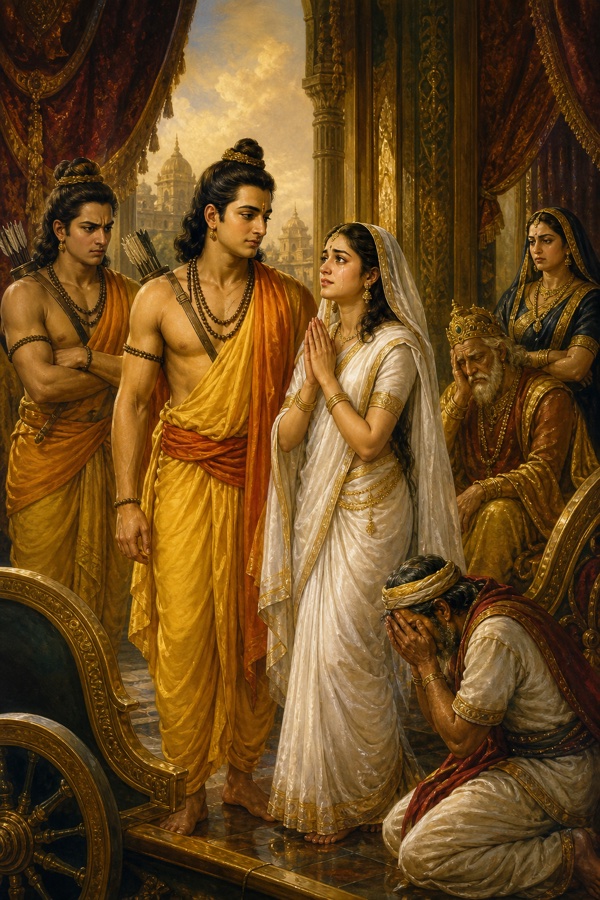
The king fixed his eyes on Rama, who was calmly waiting for permission to go and live in the woods, and he said, “Rama, Kaikeyi has robbed me of my senses with a boon I once granted her. Make me your prisoner, and be king of Ayodhya yourself, today.” Rama championed dharma above all men, and a master of speech, and he joined his palms and answered his father. “Be lord of the earth for another thousand years, my king. I am going to live in the forest. There is no wish for a kingdom in me. When I have passed nine years and five in the forest, and made your pledge good, I will hold your feet again.”
Kaikeyi had been at the king in private, urging him, and he was held fast in the fetters of his own truth, and he wept as he spoke to his beloved son. “Go then, my darling, with an untroubled mind, on a road that is blessed and safe and free of every fear, a road that will bring you happiness hereafter and prosperity here, and bring you back to Ayodhya. You are truthful by nature and your mind is given to dharma, delight of the Raghus, and your decision to live in the forest cannot be turned. Only do not go today, not on any account. Stay this one night with me, so that I can live in happiness on the sight of you for a single day. Look at your mother and at me, and stay the night, and tomorrow at first light, gratified with everything you desire, you can go.”
“Something that would be past the strength of any other man is being done by you, my dear son, since it is for my sake that you are going to the forest at all. But I swear it by my faith, Rama: your exile is not what I want. A woman who hid her purpose the way a fire hides under ashes has pushed me off my course. And how noble of you, that egged on by Kaikeyi, who has thrown away the custom of this house that the eldest son inherits, you set out to redeem a pledge that was extracted from me by fraud. It is no great wonder, my child, that you, my eldest in years and in virtue both, should want to free your father from the charge of falsehood.” Rama heard his afflicted father, and it distressed him, and with Lakshmana beside him he answered.
“Tomorrow, who will offer me the delicacies I might enjoy today? I would sooner be gone than have any of the pleasures you could give me. This earth, with the whole state of Kosala and its people, rich in wealth and grain, I give up; let it be handed to Bharata. My resolve to live in the forest will not shake today. The boon you gave Kaikeyi on the battlefield, giver of boons, let it be honored in full, every part of it, and stand true, ruler of the earth. I will carry out your command as it was spoken and live fourteen years in the forest with the ascetics. Do not object to it. Let the earth go to Bharata. I want no kingdom, and no comfort, and nothing that pleases the mind; what I want is to do as you order me. Let your sorrow go, and do not lie here bathed in tears; the ocean, the lord of the rivers, whom no one can assail, does not overstep its bounds. I have no wish for a throne, or for happiness, or for the earth, or for all these pleasures of the senses, or for heaven, or for life itself. I want you to be true and never false, best of men, and I swear it by my truth and by the merit of my past lives, and by you, here in your presence. Nor can I stay in this house for another instant, father. So hold this grief in, my lord; there is no going back on my word now. Mother Kaikeyi commanded me, ‘Go to the forest, son of Raghu’s line,’ and I answered, ‘I am going,’ and that pledge I must keep.”
“Do not pine for me, my lord. We are going to sport in a forest full of gentle deer and loud with every kind of bird. A father is called a god even among the gods, and so I will do my father’s bidding as I would a god’s. When fourteen years have gone by you will find me back here, best of kings; let this agony go. You are the one who ought to be comforting all these people with their faces full of tears. Why have you fallen into grief yourself, my lord? I give up the city of Ayodhya, and the state of Kosala, and the rest of the earth; let them go to Bharata, and let me obey your command and go to the forest and live there a long time. Let Bharata rule this earth that I have let go, with its mountain ranges and its cities and its groves, and let him keep it within the bounds of the dharma that is good for a king, without ever enjoying it or growing proud of it. Let the pledge you gave Kaikeyi come true, protector of men. My heart does not incline to the great pleasures of the senses that everyone covets, or to what is pleasing to the mind, as much as it inclines to carrying out your order, which the wise approve. Let your agony on my account vanish, sinless king. I would not accept an everlasting throne today, or all the delights the world runs after, or the whole earth, or Sita herself, if the price were a stain of falsehood on you, who are so anxious for me; let your word stand true. Living in the forest on fruit and roots, looking at the mountains and the rivers and the lakes, I will be happy the moment I walk in among those trees of every kind. Be at peace about it.” The king had fallen on evil days, and the burning and the agony were tearing at him, and he embraced his son and fell to the ground wholly senseless, and made no movement at all. Every queen in the room wept aloud, except that one, the king’s favorite. Sumantra wept and fainted. And the whole place was one cry of lamentation. (Canto 34)
Sumantra’s Rebuke, and Kaikeyi’s Hardness
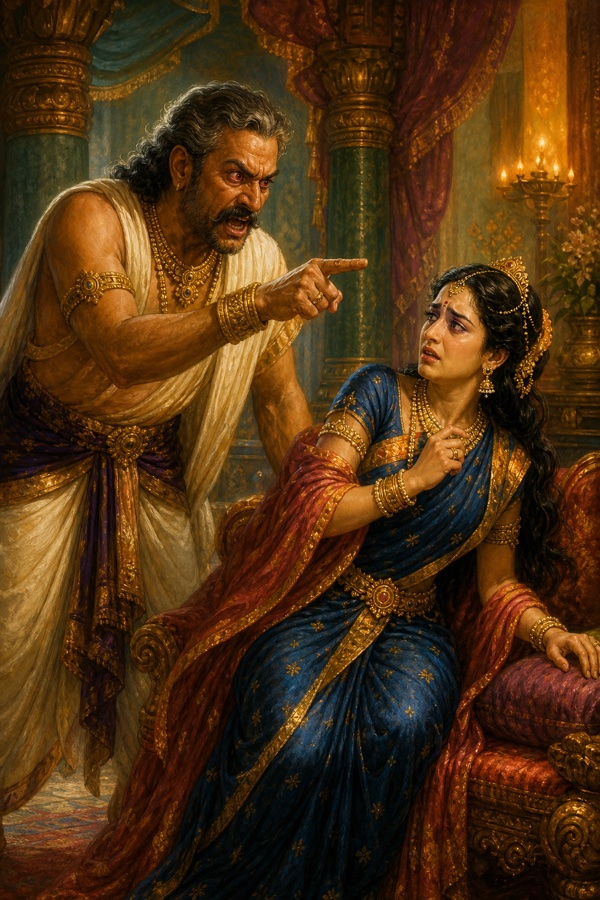
Then Sumantra, Dasharatha’s charioteer, struck his own head with his hands. He drew breath after breath, ground one hand into the other, gnashed his teeth, and his eyes went red with fury and his face lost its ordinary color. He was overwhelmed with anger and with a sudden, bitter pain, and he had read the king’s mind exactly, and he turned on Kaikeyi with words that were sharp as arrows and struck at her heart, words like peerless thunderbolts meant to break through every vital in her.
“There is nothing left on earth that you would shrink from, queen, you who have betrayed your own husband, King Dasharatha himself, the support of all that moves and all that stands still. I hold you the murderess of your husband, and in the end the destroyer of your whole line, because with what you are doing you torment a husband who is as unconquerable as great Indra, as unshakable as a mountain, and as impossible to trouble as the sea. Do not despise Dasharatha, your husband and your lord, the giver of boons. For a woman, the will of her husband outweighs ten million sons. When a king dies, his sons inherit his rights in order of their age, and you mean to break that ancient rule while the lord of the Ikshvakus is still alive.”
“Let your son Bharata be king, then, and rule the earth. We, for our part, will go wherever Rama goes. No Brahmin will consent to live in your kingdom. If you commit this outrage today, we will all take the road Rama takes. What joy do you expect from a throne, when every kinsman and every Brahmin and every decent person has deserted you for good? And that is the outrage you are bent on. I count it a wonder that the earth does not split open under you this instant, at conduct like yours, and that the burning rods of reproach the great Brahmin sages wield, terrible to see, do not strike you dead, set as you are on exiling Rama.”
“Who cuts down a mango with an axe and waters a neem? A neem does not turn sweet for the man who feeds it milk. Your nature, I think, is exactly your mother’s. The proverb everyone knows says it: honey does not drip from a neem.”
Sumantra reminded her of what everyone knew about her mother. A certain holy man with the power of granting boons had given her father, the king of the Kekayas, a most excellent gift: he could understand the speech of every living creature, and even the talk of birds and beasts was open to him. One night, lying in his bed, he heard some bird cry out, and he understood it, and he laughed and laughed. Kaikeyi’s mother flew into a rage. She would have seen him dead before she let it go. “I want to know why you are laughing,” she said, “gentle king.” The king told her, “If I tell you the reason, my death follows at once. There is no doubt about that.” Her answer was, “Live or die as you please. In any case, tell me. Then I will be sure you are never laughing at me.” The king of the Kekayas loved her, and so he took the whole matter, exactly as it stood, to the holy man who had given him the boon, and that kind man told him, “Let her die, or let her leave your house for her father’s. Do not tell her the secret, ruler of the earth.” The king heard him, and the answer eased his heart, and he sent Kaikeyi’s mother away without delay, and lived on in happiness, like Kubera. “And you are walking the same road,” Sumantra said. “You see evil everywhere, and out of pure delusion you are driving this king onto the wicked path. The old saying seems true to me: men take after their fathers and women after their mothers.”
He went on. “Do not be like that. Accept what the king says. Follow your husband’s will, and be a protector to these people. Do not let the wicked push you into forcing your husband, the protector of the world, the equal of Indra in splendor, onto an unrighteous course. The glorious, lotus-eyed King Dasharatha, who is free of all sin, would never belie the promise he made you, queen. So let Rama be installed, the eldest of his sons, generous, strong, given to righteous deeds, able to guard his own duty as a warrior and to guard the whole living creation with it. A great calumny will spread about you through the world if Rama leaves his father the king and goes to the forest. Let Rama protect his own kingdom, and be free of this fever. Of all the kings who could rule this best of cities, no one except Rama will be well disposed to you. And once Rama is installed as heir apparent, King Dasharatha, who wields the great bow, will remember what his forefathers did and go to the forest himself.” So Sumantra, with his palms joined, there in the king’s court, shook Kaikeyi again and again, with hard words and with kind ones. And the queen was neither shaken nor grieved, and no one could see the smallest change in the color of her face. (Canto 35)
The Example of Asamanja, and Siddhartha’s Counsel
Dasharatha, heir of Ikshvaku’s line, was pinned by the pledge he had given Kaikeyi, and he sighed deeply, with the tears standing in his eyes, and spoke to Sumantra again. “Charioteer, let a detachment of all four arms of the army, richly furnished with jewels, be made ready at once to go with Rama. Let courtesans who know how to talk, and merchants of great wealth who know how to spread a fine network of shops for provisions and everything else, add their luster to the prince’s column. And the wrestlers who depend on him, in whose bouts he takes such pleasure when he tests their strength against each other, put them in his service too, with generous gifts. Let the best weapons go with him, and courteous well-bred men, and bullock carts, and hunters who know the secrets of the forest. Hunting the deer and the elephants, drinking the wild honey, looking at one river after another, he will not miss his kingdom. Let my granary go with him, and my treasury, to the empty forest where he means to live. Offering sacrifices at the holy places, paying the priests their fees, meeting the sages, he will live happily in the forest. Bharata will guard Ayodhya. Let the glorious Rama be sent out with every comfort he could want.”
While the king was still speaking, fear took hold of Kaikeyi. Her mouth went dry and her voice caught in her throat. Dejected and dismayed, her face turned wholly toward the king, she said, “Bharata will not accept a kingdom stripped of its wealth, good sir, like wine with the spirit drawn off, flat and empty and not worth the tasting.” It was the most shameless thing she had said yet, and the king answered her in a rage. “You have loaded this burden onto me, you hostile, vulgar woman, and now, while I am carrying it, you goad me? Why did you not stop the thing at the outset, when you asked for your boons, if you meant Rama to go with nothing?” Kaikeyi, lovely to look at, heard the anger in his words and her own anger doubled. “In your own dynasty,” she said, “Sagara cast off his eldest son, the one they called Asamanja. Rama too should go like that, with nothing at all to depend on.” The king said one word, “Shame!” Everyone in the room was ashamed for him. She paid no attention at all.
There was an aged chief minister in that room, an upright man named Siddhartha, whom the king held in high regard, and it was he who answered her. “Asamanja used to catch hold of children playing in the street and throw them into the Sarayu, and the evil-minded boy took delight in it. The citizens saw that murderous sport and came to King Sagara in fury and said, ‘Either keep Asamanja and let us leave your city, or keep us and send him away, increaser of the realm.’ The king asked them, ‘What is the cause of this fear?’ And they answered, ‘In his folly he takes a joy beyond measure in throwing our little sons into the Sarayu while they play.’ The king heard his people and, to satisfy them, he gave up the son who was doing them harm. He set him quickly in a conveyance with his wife and his few belongings, and he ordered those in charge, ‘He is to be exiled for life.’ Asamanja took a basket and a spade and wandered in every direction, digging for roots and fruit, searching the mountain passes for somewhere to live, the way a man does who has done evil. That is how the righteous Sagara cast off Asamanja, and it was for the sins I have named. What sin has Rama committed, that he is being barred from the throne like this? We can find no fault in Rama. It would be as hard to find a stain on him as on the new moon. Or if you see some fault in him, queen, then name it, truly, here and now, and then let Rama be sent to the forest. To abandon a man who has done no wrong and keeps to the straight path breaks every rule of dharma; it would burn up the splendor of Indra himself. So there is no sense in your withholding the royal fortune from Rama. And guard yourself against what the people will say, lady with the lovely face.”
The king had heard Siddhartha out, and his voice had gone very thin, and grief was in every word of it as he spoke to Kaikeyi. “Do these wholesome words not please you, you living shape of sin? You have taken a road that leads to misery, and you cannot see what is good for me or for yourself. What you are doing lies far from the path of the righteous, and nothing good can come of it. This very day I will give up my kingdom and my comfort and my wealth and go after Rama to the forest, and every soul in Ayodhya will come with me. Rule the kingdom for a long time with Bharata, and enjoy it.” (Canto 36)
The Bark Garments, and Vasistha’s Anger
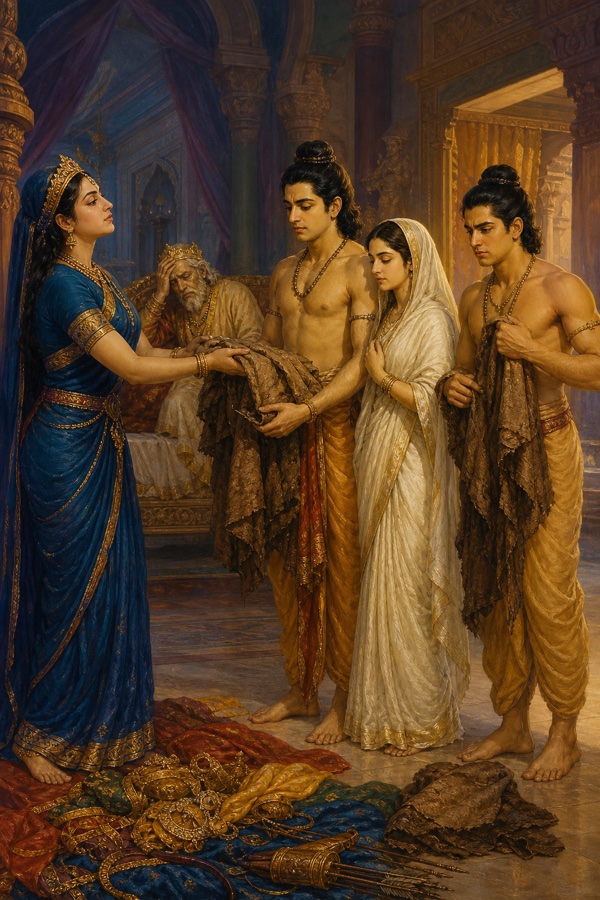
Rama had heard the chief minister, and he was an adept in courtesy, and he answered his father humbly. “What use is an army to me, my king, when I have given up every enjoyment, shaken off every attachment, and mean to live in the forest on what the forest gives? A man who has parted with a splendid elephant and then sets his heart on keeping the tether is a fool. What is a rope worth to someone who has let the elephant go? It is the same with me, jewel of the virtuous, lord of the world: what would I do with an army? I give it all up to Bharata, every part of it. Let the serving women of my mother Kaikeyi bring me bark garments, and nothing else, the dress of a man who lives in the forest.” And to the maids he said, “Go and bring me a spade and a basket too, for the fourteen years I am going to live in the woods.”
Then Kaikeyi herself brought the bark. She carried it to Rama and the others with her own hands, in front of that whole crowd, without a trace of shame, and said, “Put these on.” Rama took the two pieces of bark from her, one for the waist and one for the shoulders, threw off his garments of fine-spun cloth, and dressed himself as an ascetic. Lakshmana too, there where he stood, before his father’s eyes, laid aside his beautiful clothes and put on the two pieces of bark. Then Sita, in her silks, looked at the bark that was meant for her, and she was frightened by it the way a doe is frightened by a snare set in her path. She took the two pieces of kusha bark from Kaikeyi’s hand, deeply troubled and as if ashamed, this princess of Janaka’s house with every auspicious mark on her, who knew what was right and was herself an image of it, and with her eyes brimming she said to her husband, who was handsome as Chitraratha, the king of the gandharvas, “How do the ascetics who live in the forest put on the bark?” She had no skill in it at all, and she tried and tried and got it wrong each time. In the end she hung one piece around her neck and stood with the other in her hand, abashed. Then Rama, who upheld dharma above all men, came quickly to her and with his own hands tied the bark over her silk.
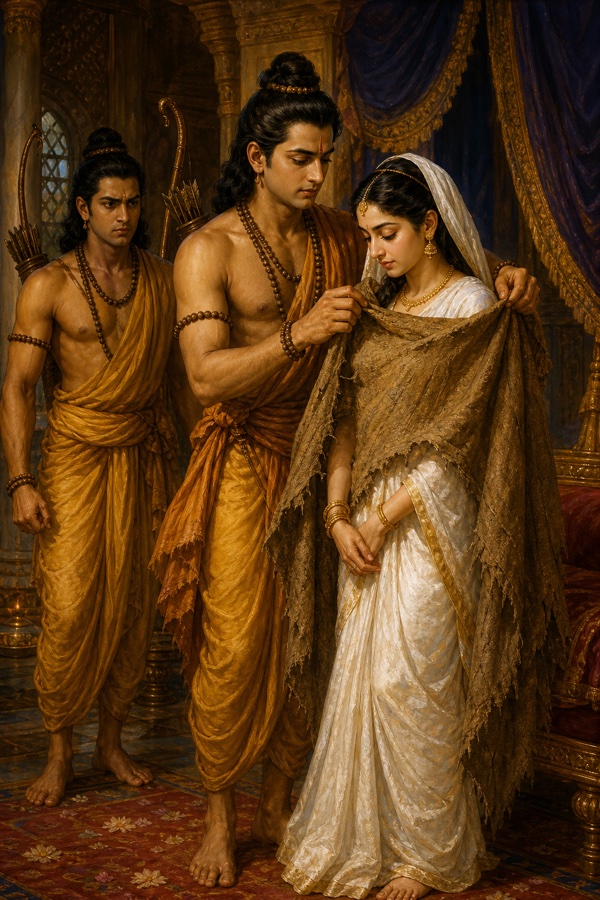
The women of the inner palace watched Rama fastening the bark on Sita, and the tears ran down their faces, and in their distress they cried out to Rama, who blazed with splendor. “Child, this high-minded princess was never commanded to live in the forest as you were. At least let the blessed sight of her go on rewarding us while you are away in the lonely woods at your father’s word, my lord. Go to the forest with Lakshmana alone for your companion, dear son. This lovely princess does not deserve to live in the forest like an ascetic. Grant us this one request, our darling: let Sita, so young and so beautiful, stay here in Ayodhya, since you yourself will not stay a moment longer, with dharma for your only companion.” Rama heard those loving pleas and went on tying the bark as Sita wished it, for her conduct had come to match his own.
When Sita took the bark, Vasistha, the king’s own preceptor, with tears in his eyes, stopped her, and turned on Kaikeyi. “Witless Kaikeyi, disgrace of your house, you have gone too far. You have cheated the king and still you will not keep within any bounds. Princess Sita shall not go to the forest, you woman without a shred of decency. She will sit on the throne that was offered to Rama. To every householder a wife is his own self, and as Rama’s other self, it is Sita who will rule the earth. If the princess of Videha goes to the forest with Rama, then all of us here will follow her, and this whole city will go too. The guards of the inner palace will go wherever Rama lives with his wife, and the whole state of Kosala with everything in it, and the city of Ayodhya with all its goods and chattels, will go after them. Bharata too, and Shatrughna with him, will put on bark and live in the woods and follow the way of their elder brother, Rama, in his forest life.”
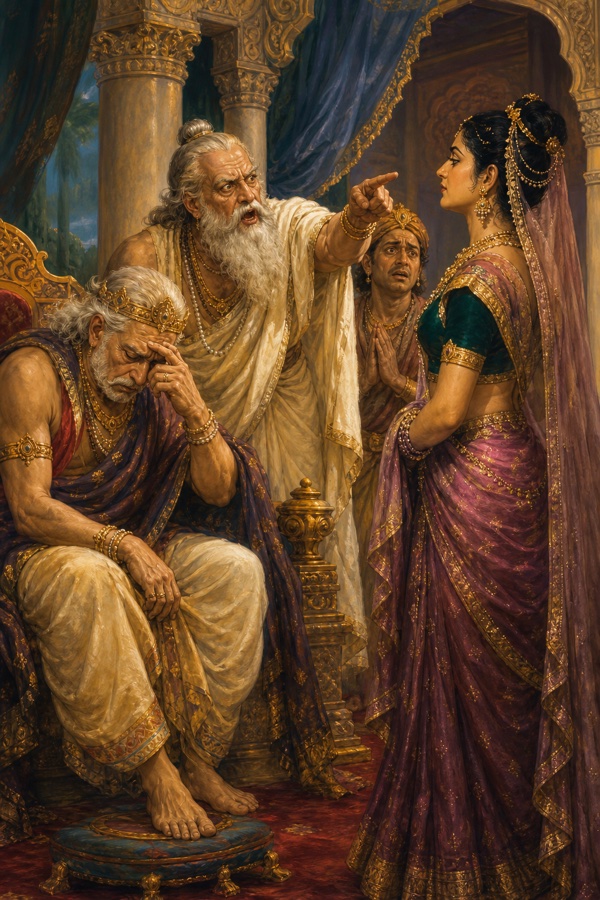
“And then you may rule alone, you vile woman bent on the people’s harm, over a desolate earth emptied of human beings, with nothing left on it except its trees. A state where Rama is not king will not survive; the forest where Rama makes his home will grow into a flourishing kingdom. Bharata will never rule an earth his father has not freely given him, and if he is truly the king’s son he will not even live under your roof as your son. Even if you leave the earth’s surface and soar into the sky, he will do nothing against the usage of his forefathers, which he knows. So all you have done for your son, whose welfare you covet, is an unfriendly act, because there is no one in the whole world who is not devoted to Rama. This very day, Kaikeyi, you will see the beasts and the snakes and the deer and the birds going off to the forest with Rama, and the trees themselves straining to follow him.”
“So take the bark off your daughter-in-law, queen, and give her fine jewels. The bark was never meant for her.” With those words Vasistha forbade Sita to wear it, and he went on. “What you asked for, princess of Kekaya, was the exile of Rama alone. So let Sita, who deserves to be adorned every day of her life, live in the forest with Rama richly adorned. Let the princess go fully provided, with the finest carriages and attendants, with garments of every kind and every useful thing, because when you asked for your boons you did not ask for her banishment.” The king’s preceptor, first among Brahmins, whose influence had no equal in that kingdom, said all this, and Sita, who wanted only to follow her husband’s ways, did not turn from her purpose in the least. (Canto 37)
Dasharatha Rebukes Kaikeyi, and Worries for the Mother
Sita stood there in bark like a woman with no one to protect her, though her protector stood at her side, and everyone present cried out, “Shame on you, Dasharatha, that you do not stop this!” The cry hurt the king past bearing, and it cut through whatever interest he still had in life, in dharma, and in his own good name. He drew a burning breath and spoke to his wife. “Kaikeyi, Sita does not deserve to go in a robe of kusha bark. My preceptor Vasistha speaks the truth: she is delicate, and young, and she has always been used to comfort, and she is not fit for the forest. What harm has this innocent daughter of Janaka, that greatest of kings, ever done to anyone, that she should stand here dazed among the people in a hermit’s bark like some poor woman of the woods? Let Janaka’s daughter take off the bark. No such pledge was ever given by me. Let the princess go to the forest as she pleases, with all her clothes and every jewel she owns. First a cruel promise was sworn by me, who no longer deserve to live; and on top of it you have begun this wrong of dressing Sita in bark, out of pure childishness, and it is going to consume me the way the bamboo’s flowering brings the bamboo down. Even supposing Rama had done you some harm, what harm did Sita of Videha ever do you, you vile woman? What injury could the daughter of Janaka do you, high-minded as she is, with her wide eyes like a doe’s and her gentle nature? Was it not enough for you, sinful woman, to send Rama into exile dressed as a hermit? What more do you hope to gain by these further sins, which will bring you nothing except suffering? When Rama came here about his installation and you gave him your command, I heard it and I held my tongue, queen; that much I let pass. Now you go far beyond it, and you are walking straight into hell, since you would have Sita of Mithila in bark as well.”
His father sat with his head bowed as he said it, and Rama, already on his way to the forest, spoke to him. “Pious king, this illustrious mother of mine, Kausalya, is old now, and generous by nature, and she never speaks a word against you. When I am gone she will be drowning in grief, she who has never known any suffering before, and you ought to show her all the more regard, giver of boons, so that, honored by you whom she reveres, and thinking of me, the poor lady may live on in your care and not fall to grieving for her son. Equal of great Indra, handle my mother, who is certain to pine for me, in such a way that while I am in the forest she does not waste away with grief and give up her life and go down to the house of Yama.” (Canto 38)
Kausalya’s Counsel, and the Waiting Chariot
The king heard Rama’s plea for his mother, and looked at his son standing there in a hermit’s dress, and lost his senses in the midst of his wives. Agony had him so completely that he could neither rest his eyes on Rama nor find a word to say to him. For the better part of an hour he lay as if dead, and when he stirred it was to lament, this strong-armed king, with nothing in his mind except Rama. “In some former life,” he said, “I must have torn many a calf from its mother, or done violence to living things, and that is why this calamity has come down on me. But the breath does not leave the body before its hour, and so death will not take me, though Kaikeyi torments me, and though I see my son standing in front of me bright as fire, in the robes of an ascetic, with his fine garments thrown off. And all these people are suffering for the sake of one woman, Kaikeyi, who has taken up this roguery and is straining every nerve to get what she wants.” He said the name “Rama” once, and then his throat closed with tears and he could say nothing more. It was an hour before he came to himself again, and then, with his eyes flooded, he turned to Sumantra. “Yoke the best horses to the pleasure chariot and come back quickly, and carry this blessed prince beyond the borders of this land. This, it seems, is what the scriptures mean when they speak of the reward of virtue in the virtuous: that a good and brave son should be sent to the forest by his own father and mother.”
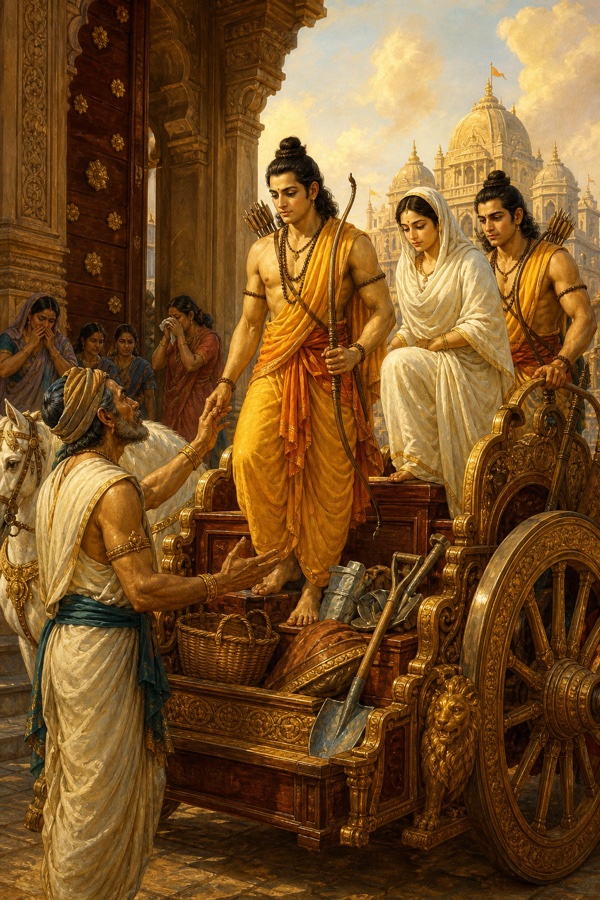
Sumantra was quick on his feet. He bowed to the king’s command, fitted the horses to a chariot hung with ornaments, and brought it back to the very spot where Rama stood ready to leave with Sita and Lakshmana; and with his palms joined he announced to the prince that the chariot was there, gold-worked, with the finest horses in its traces. Then the king, who knew what was owed at every place and hour and had no duplicity in him anywhere, summoned the officer of the treasury and gave him a decisive order. “Count all the years that Sita is to spend in exile, and bring for the princess of Videha, quickly, costly garments and grand ornaments enough for all of them.” The officer went to the treasury and brought the whole lot and laid it before Sita at once. And Sita, of that uncommon birth no womb had given her, ready to leave for the forest, adorned her fair-marked limbs with those marvelous jewels, and decked out like that she lit up the palace the way the rays of the rising sun light up a morning sky with no mist in it and no cloud.
Her mother-in-law Kausalya took her in her arms and bent and smelled her head, this daughter-in-law who had never once behaved unbecomingly, and spoke to her. “Women who have been adored all their lives by loving husbands, and who stop honoring a husband when he falls on evil days, are called wicked the whole world over. Women who have enjoyed every comfort, and who revile or desert their husbands the moment the smallest misfortune arrives, that is the way wicked women are. Wicked are the women who are false by nature and ruled by passion, whom no one can fathom, who are heartless and set on sin and estranged in a moment. Neither noble birth, nor kindness done to them, nor learning, nor gifts, nor the marriage bond itself can hold the hearts of women like that; their hearts are never still. For virtuous women, though, who are grounded in good conduct and in truth and in the teaching of their elders, and who keep within the bounds their families set them, the husband is the most sacred thing there is, and he stands above everything. My son Rama is being sent into the forest, and you must never slight him for it. With means or without, he is a god to you.”
Sita saw that the counsel was in keeping with dharma, which was the aim of her own life, and she stood facing her mother-in-law with her palms joined and answered her. “I will do everything your noble self has told me. I know how to conduct myself toward my husband, and I have heard it from my elders as well. Your noble self ought not to put me in the same class as wicked women. I can no more part from dharma than moonlight can part from the moon. A vina makes no music without its strings. A chariot goes nowhere without its wheels. And a wife without her husband finds no happiness though she has a hundred sons. A father gives a measured joy, and a brother a measured joy, and a son a measured joy; what woman would not worship the husband who gives joy without measure? I have learned from my elders both the special duties and the ordinary duties of a wife, noble lady, and I know that to a married woman her husband is a god. How could a woman like me slight her husband?” Kausalya, whose mind was pure, heard that answer, and it touched the strings of her heart, and the tears came all at once, tears of grief at the parting that was almost on her and tears of joy at the holiness in Sita.
Rama looked at his mother, the most honored of all his mothers, and with his palms joined, in the fullness of his righteous mind, he spoke to her. “Mother, do not look at my father with a face full of grief. The end of the exile will come sooner than you think. Nine years and five will slip past you while you sleep, and one morning you will find me back here, whole, with Sita and Lakshmana, and my friends and kin around me.” Then, having said to his mother everything that could be said, he looked at his three hundred and fifty stepmothers, and found them every one as stricken as his own mother, and with his palms joined he made them a submission that kept faith with dharma. “Whatever unkind word I may have spoken to any of you, or unkind thing I may have done, in all the years we have lived together, forgive it; I did it in ignorance. Now I take my leave of you all.” The royal ladies heard that calm and righteous speech with their minds unstrung by grief, and while Rama was still speaking a cry went up from the wives of Dasharatha like the wailing of female cranes. And the house of Dasharatha, which had rung until that morning with tabors and great drums and the instruments whose voice is the rumbling of clouds, was filled now with the extremity of anguish, shaken with wailing and lamentation, a house that had fallen on evil days. (Canto 39)
The gist: Kausalya counsels her daughter-in-law in the dharma of a faithful wife, and Sita takes it humbly; Rama begs forgiveness of all his mothers and takes his leave, and the palace that rang with drums that morning fills with wailing. The chariot stands yoked at the door.
Source: Srimad Valmiki Ramayana, Ayodhyakanda, Cantos 14 to 56; this first part follows Cantos 14 to 39. The Gita Press Hindi edition is the controlling witness. The Sanskrit e-text and an independent complete translation were used to verify names, sequence, and principal events. Where recensions differ, this retelling follows Gita Press.
Basis: Valmiki Ramayana (Gita Press, Gorakhpur)