On this page
Rama sat on the throne of Ayodhya and the night was thinning when he told Lakshmana the story of Yayati. King Yayati, the son of Nahusha, had been struck with untimely old age by the curse of Ushanas, whom men also call Shukracharya. He begged his eldest son, Yadu, to take on the burden of that old age for a while, so that he himself might taste his pleasures a little longer. Yadu refused. The youngest son, Puru, folded his hands and said, “We are blessed and favored, and we stand under your command,” and took his father’s age onto his own body without asking what it would cost him. That was the tale on Rama’s lips when the east reddened, as if someone had draped a cloth stained with the juice of crushed flowers across the sky, and the stars grew thin. He had been talking through the whole night, and the brother listening to him had never once suggested sleep.
Yayati’s Exchange of Youth, and the Crowning of Puru
The old age that Yayati handed to Puru as a trust, a thing left in his keeping, Puru accepted gladly, and though he wore it he still shone with his own light. Yayati, his youth restored to him, then performed thousands of sacrifices and ruled the earth for many thousands of years. When a long span had passed he said to Puru, “My son, give me back that old age which I placed in you as a trust. I will take it up again; do not be grieved. I am pleased with your obedience, and in my pleasure I appoint you ruler over the people.” The son who had given away his youth without a question got the kingdom, and the giving away had never been for the kingdom.
In this same turning of events Yayati cursed Yadu. The angry king said to that son of Devayani, “You were born of me in the shape of a Kshatriya, yet you are a demon at heart. You have shown contempt for me, your father and your teacher, so you will father cruel Rakshasas and Yatudhanas, foul-going creatures. Your line will not stand within the lunar race.” And so Yadu, cast out of the royal house, went on to beget thousands of Yatudhanas in the trackless forest called Krauncavana. Having honored Puru with the consecration, Yayati entered the forest life of the vanaprastha, and after a great age he reached his chosen goal and went to heaven. Puru ruled with great righteousness from the famed city of Pratishthana, in the kingdom of Kashi.
When he had told the whole account, Rama spoke the thing that had been sitting under every story he had told that night. “We will give audience to all who come to us with some errand, so that the fault which fell upon King Nrga does not fall upon us.” And as Rama said it, the same dawn came down before him, and there were already men standing at his gate.
The Cry of the Sages on the Yamuna’s Bank
The spring night, neither cold nor warm, passed in this talk between Rama and Lakshmana. In the clean morning, after his dawn rites, Rama went toward the place where he received his people, and he went to it as a man goes to a vow he made in the dark. There the charioteer Sumantra came and said that some ascetics stood waiting at the door. He told him that the great seers who lived on the bank of the Yamuna, with Chyavana the son of Bhrigu at their head, were begging for an audience. Rama at once gave the order that the Brahmins led by Bhargava be shown in.
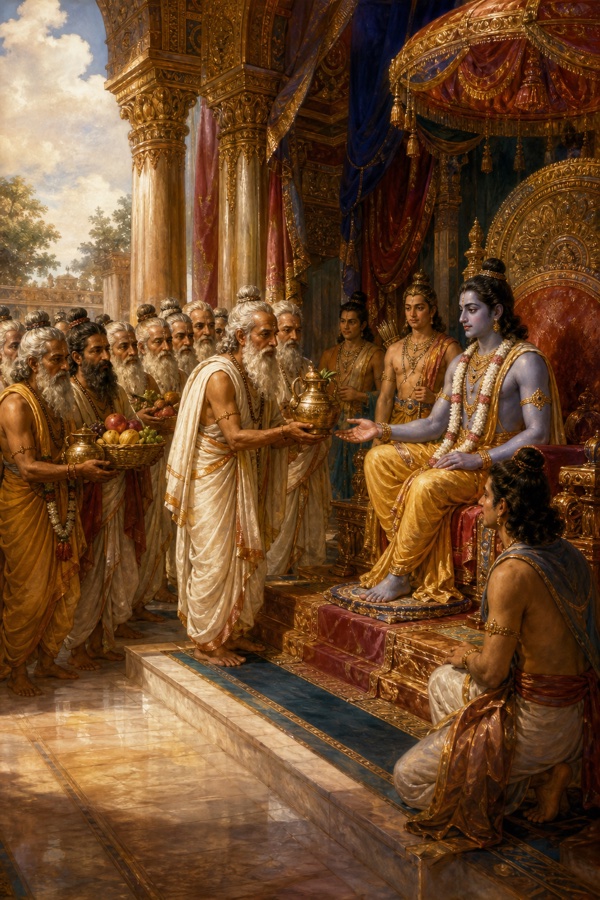
More than a hundred ascetics, each bright with his own austerity, came into the palace. Those Brahmins carried full pitchers, sanctified with water drawn from every sacred ford, and fruit and roots, and they offered them to Rama; men who owned nothing but water and roots, bringing gifts to a king. He accepted all of it warmly and said to the great sages, “What is the errand that brings you? What may I do for you with all my attention bent to it? I am under the command of the great seers. This whole kingdom, our very life, and whatever lives in our heart, all of it belongs to the Brahmins. I tell you the truth.”
A great murmur of approval went up at his words. The seers took their places on the beautiful seats of gold. With folded hands Rama asked what fear had driven them all this way. The seers said, “This speech becomes you alone on this earth and no other. Many mighty kings, weighing the burden of a task, have shrunk from making a promise. You, out of your respect for Brahmins, gave your word without a second thought. Surely, then, you will lift us seers out of a great fear.” They had come from king to king for years and learned to hear the pause where a promise should be, and here there had been no pause.
Madhu’s Trident, and the Terror of Lavanasura
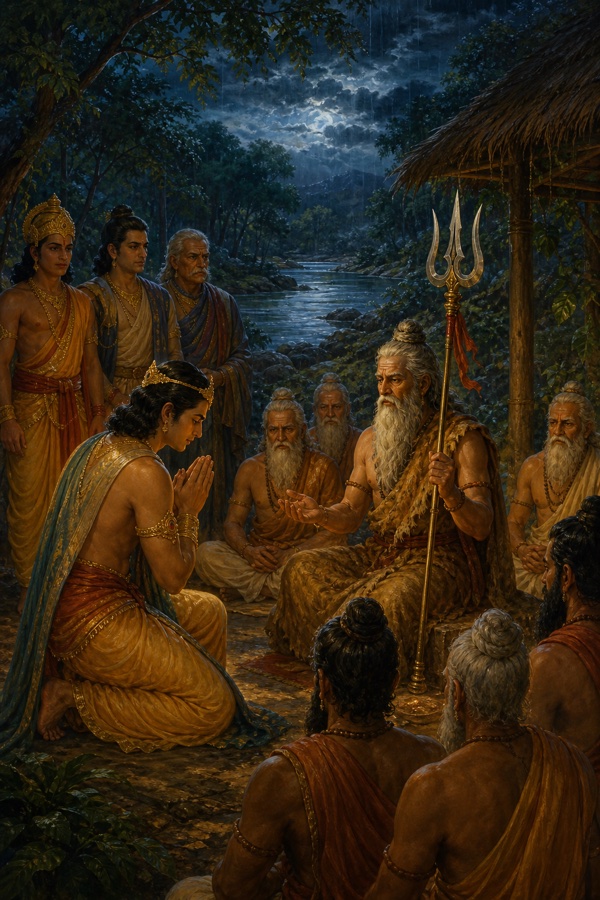
Chyavana Bhargava named the root of the fear. In the ancient Kritayuga there was a mighty Asura of the Daitya clan named Madhu, the eldest son of Lola, a respecter of Brahmins, a giver of shelter, steady in mind; whatever came after him, the line did not begin badly. Because Madhu honored the gods, Rudra, the great god, was pleased and gave him a wondrous boon. Mahadeva drew from his own trident a trident of enormous power and dazzling force, gave it to Madhu, and said, “So long as you do not set yourself against the Brahmins and the gods, this trident stays yours; otherwise it will perish. Whoever fearlessly challenges you to battle, this trident will burn him to ashes and return to your hand.”
Madhu bowed to Mahadeva and prayed that this unequaled trident might remain in his line forever. Mahadeva said, “That cannot be. But the word I have spoken in my pleasure will not go void, so this trident will belong to one son of yours. As long as it stays in his hand, he will be one whom no creature can kill.” Hold that phrase; the whole of what follows turns on those seven words. Madhu built himself a blazing mansion. His dear wife was Kumbhinasi, the daughter of Vishvavasu, born of Anala. Her son was Lavana, wicked and given to sin from his very childhood. Seeing so ill-mannered a son, Madhu was filled with grief, but he said nothing. He left this world and entered the abode of Varuna, the sea, after handing to Lavana both the trident and the power of the boon; a good father who saw exactly what his son was and armed him anyway.
By the power of that trident and by his own black heart, Lavana went on tormenting all three worlds, and the ascetics most of all. The seers said, “Such, Kakutstha, is Lavana’s power, and such is that trident. We asked many kings for protection before, and found no protector. Now, having heard that Ravana has been slain along with his army and his mounts, we know of no king on this earth but you to be our shield. Protect those whom Lavana torments. You are able to lift away this fear, you whose valor never fails.”
The Choosing of Shatrughna
With folded hands Rama asked the seers, “What does Lavana eat, what are his ways, and where does he live?” The seers told him that his food was every living being, and ascetics above all. His conduct was cruel at every moment, and his home was in Madhuvana. He killed thousands of lions, tigers, deer, birds, and men and made his daily meal of them, and like Death itself he opened his mouth wide and devoured all creatures. Rama said, “I will have that Rakshasa killed. Let your fear be lifted.” It was a sentence long enough, and he had not asked a single question about the trident yet.
Then he asked his brothers which hero would kill Lavana, whether the task should go to Bharata or to Shatrughna. Bharata at once said, “I will kill him. Give the task to me.” Hearing Bharata’s steady, valiant words, Shatrughna rose from his golden seat, bowed to the king, and said, “Bharata, the middle one among us, has already done his part. In your absence he slept on a bed of sorrow at Nandigrama, eating only fruit and roots, wearing matted hair and bark, and he bore long suffering. Let Bharata not be put to hardship again while I live.” The two of them were competing for the right to walk toward a creature that ate its way through armies.
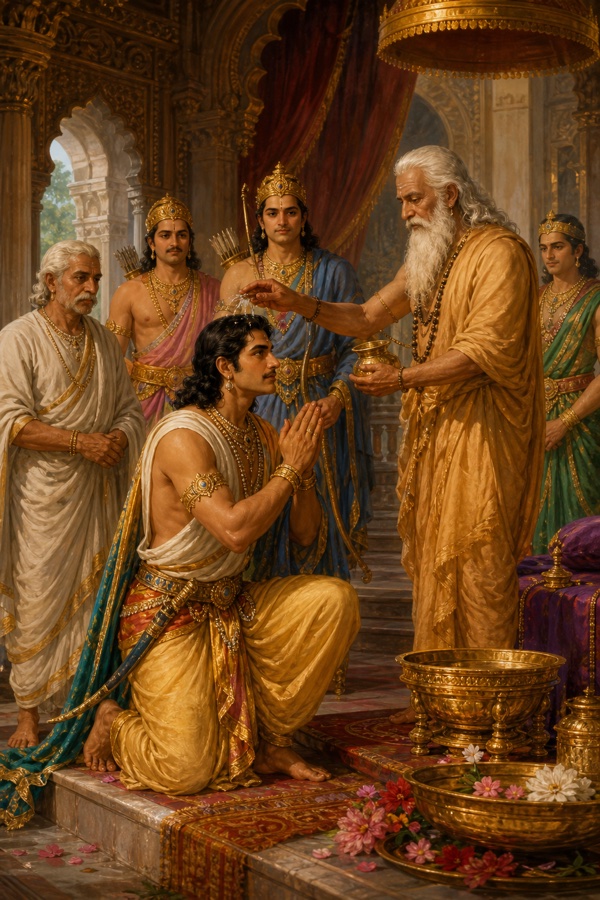
Rama was pleased and said, “Let it be so, Kakutstha. I will consecrate you over the kingdom of Madhu’s holy city. You are brave, learned, and able to found a city. A man who tears out a royal line and yet sets up no king in its place goes to hell. So kill Lavana, whose heart is set on sin, and rule that kingdom by dharma. Make no answer to my word. Accept this consecration with the sacred chants of the Brahmins led by Vasishtha.” He had done the same thing with Lanka, and he did it here: he would not pull down a house without leaving someone in it.
Shatrughna’s Consecration, and the Divine Arrow
At this Shatrughna grew deeply ashamed and spoke slowly. “Kakutstha, I see something against dharma in this. How is a younger brother consecrated while the elders yet live? And yet your command must be obeyed. I have heard from you, and from the sacred texts, that once my middle brother had taken his vow I should have said nothing. I spoke the ill word, that I would kill Lavana in battle, and this is the fruit of that misspoken thing. When an elder has spoken, a younger should give no answer. I will not answer a second time. Whatever share of wrong is mine in this, take it away from me.” He was being handed a kingdom and asking to be forgiven for it.
These words satisfied Rama, and he told Bharata and Lakshmana to bring the things for the consecration. The chief priest Vasishtha, the townsmen, the officiating priests, and the ministers were summoned. The queen mothers Kausalya, Sumitra, and Kaikeyi performed the rites of blessing in the palace. The great seers of the Yamuna bank felt that with Shatrughna’s consecration Lavana was as good as slain. The consecrated Shatrughna shone like the sun, just as in ancient days the gods with Indra had consecrated Skanda, who is Kartikeya.
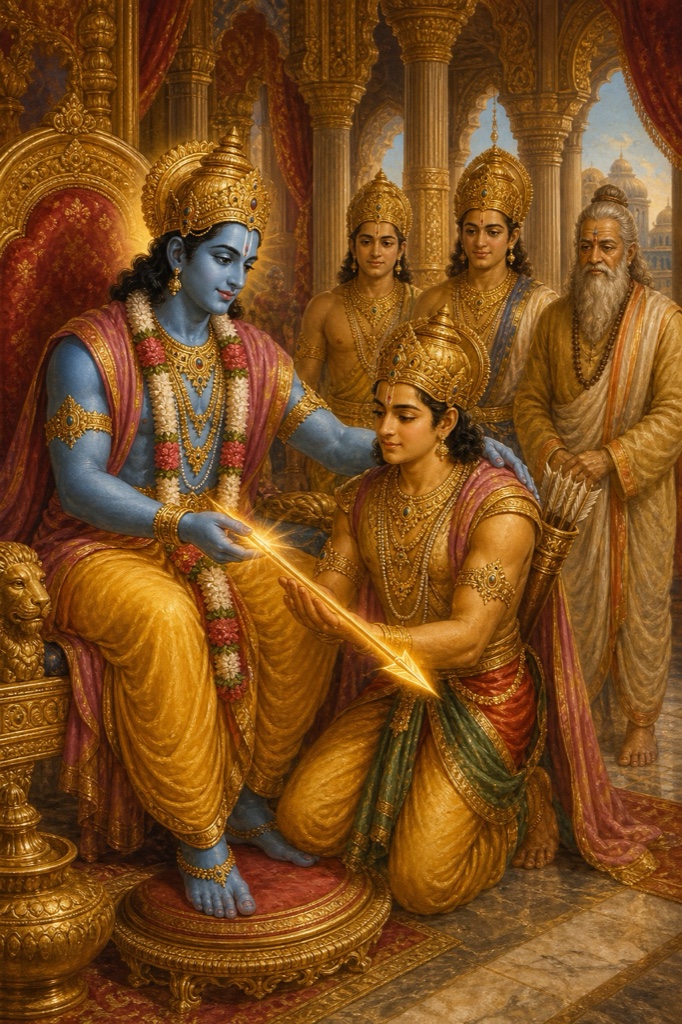
Rama seated Shatrughna in his lap and said in a gentle voice, “Take this unfailing divine arrow. With it you will kill Lavana. This arrow was made when Vishnu lay asleep in the great ocean, whom gods and Asuras alike could not so much as see. In his wrath, to destroy the two black-hearted ones, Madhu and Kaitabha, and after their killing to make the three worlds, Vishnu loosed this very arrow. Even when I killed Ravana I did not use it, for it would have brought a vast destruction of other creatures too.” He had fought the greatest war of the age with this in his quiver and left it there, and he was giving it to his youngest brother now.
Rama laid out the plan of it, and the plan was the whole gift. “He keeps the trident at home and roams the four quarters to bring back his food. When someone challenges him wanting battle, he takes the trident in hand and burns the enemy to ash. So stand at the eastern gate without the trident anywhere near you, armed, and when he has not yet been able to enter his mansion, then challenge him to battle. Only then can you kill that Rakshasa. Otherwise he cannot be killed. What the blessed blue-throated Shiva has done is not to be undone.”
The Army Marches, Shatrughna Alone
Rama praised Kakutstha again and again and then said, “Let four thousand horses, two thousand chariots, and a hundred fine elephants go with you, and the players and dancers as well. Take a hundred thousand gold coins, and with wealth and mounts in plenty, march toward Madhura. Keep the army pleased and content with kind words, and not puffed up. In the hour of battle neither wealth serves you, nor wife, nor kinsmen. What serves is the body of servants who have been kept happy.” He had learned that on a shore in the south, from an army of forest creatures who had no reason to die for him and did it anyway.
“So send this great army, full of glad men, ahead of you, and go alone, bow in hand, to Madhuvana, in such a way that Lavana the son of Madhu never learns of your campaign against him. There is no other way to his death. Whoever attacks him head-on is killed. When the summer has passed and the rains have come, then kill him, for that is the hour of doom for this evil-minded creature. Let your soldiers march with the great seers at their head, so that while summer still lasts they may cross the water of the Ganga, the daughter of Jahnu. Halt the army on the riverbank, and then take up only your bow and go on ahead alone.”
Having received Rama’s command, Shatrughna called the leaders of the army, fixed their camping places, and told them to halt in good fellowship, hindering no one. Then he bowed to Kausalya, Sumitra, and Kaikeyi, walked around Rama in reverence, bent at the feet of Lakshmana, Bharata, and the chief priest Vasishtha, and again walked around Rama before he set out. Having sent the army of elephants and horses ahead, Shatrughna himself stayed a month at Rama’s side, and then he too went on his way, and he would not stand in that hall again for twelve years.
Valmiki’s Ashram, and the Tale of Kalmashapada
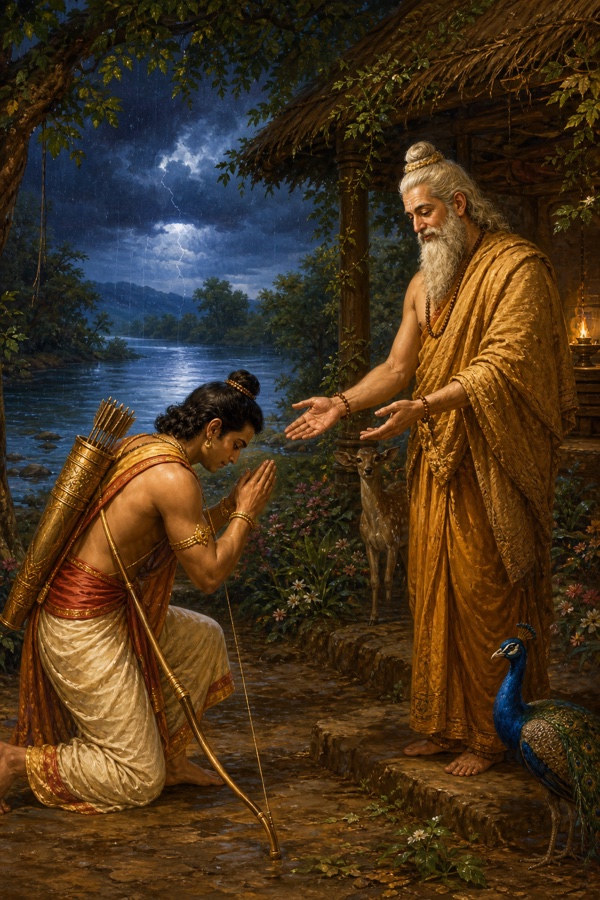
Having sent off the army and lingered a month on the road, Shatrughna pressed on swiftly and alone. After two nights on the way he reached the holy hermitage of Valmiki, a most excellent place to stay. He bowed to Valmiki folded his hands, and said, “I have come on my master’s errand and wish to rest here; at dawn I will go on to the west, the quarter of Varuna.” Valmiki was pleased and said, “You are welcome. This hermitage belongs to the Raghus themselves. Accept without hesitation a seat, water for your feet, and the guest offering.” Shatrughna ate a meal of fruit and roots and was deeply content, and did not know that somewhere in that hermitage, a few huts away, his brother’s wife was that night in labor.
After the meal Shatrughna noticed the gear of a sacrifice off to the east of the hermitage and asked whose sacrificial ground it was. Valmiki told the story. “Among your forebears there was a king called Sudasa, and his son was named Virasaha, valiant and deeply righteous, and known as Saudasa. In his boyhood Saudasa went out hunting and saw two Rakshasas who had taken the shape of tigers and were devouring thousands of deer, and still were not satisfied. Seeing the forest emptied of game, the angry Saudasa killed one Rakshasa with an arrow. The other, his companion, in his grief said, ‘You have killed my blameless friend, so, wretch, I will take my revenge on you.’ Saying this, he vanished on the spot, and waited a whole reign to come back.”
“In the course of time Virasaha, who was also called Mitrasaha, became king of Ayodhya. He performed a great horse-sacrifice, the Ashvamedha, near this hermitage, and Vasishtha took part in it. The great sacrifice ran on for many years and was as rich as a sacrifice of the gods. At its close, remembering the old enmity, that same Rakshasa took the form of Vasishtha and told the king that flesh-food was to be brought at once, and that there was to be no hesitating in the matter. Hearing this word from the Rakshasa who wore the Brahmin’s shape, the king ordered the cooks to prepare quickly a savory offering-meal for his teacher Vasishtha, so that he would be pleased. He was obeying his guru, and it was the obedience that trapped him.”
“At the king’s order the cook was thrown into confusion, and to him the same Rakshasa came, now in a cook’s guise, and brought human flesh, which he handed to the king. The king, together with his wife Madayanti, served that meal to Vasishtha. When Vasishtha knew it was human flesh, in great anger he said, ‘For your wish to give me such a meal, the very same meal will become yours.’ Then Saudasa, enraged, took water in his hand to curse Vasishtha in return, but his wife stopped him, saying that Vasishtha was their revered, godlike priest, and must not be cursed back. The righteous king sprinkled that anger-filled water on his own feet instead. By this his two feet turned dark and mottled in color, and from then on he was famous by the name Kalmashapada, the one with spotted feet; a man who took a curse he had already loaded and poured it out on himself.”
“The king, with his wife, fell again and again at Vasishtha’s feet and told the whole truth, that this was the work of the Rakshasa in Brahmin’s shape. Vasishtha said, ‘The word I spoke in anger cannot go void, but I grant you a boon: this curse will end in twelve years, and by my grace you will not remember the past.’ So the king bore the curse, and afterward regained his kingdom and protected his people. This is that sacrificial ground of Kalmashapada, about which you asked.” Hearing this, Shatrughna bowed to the great sage and entered the leaf-hut.
The Birth of Lava and Kusha
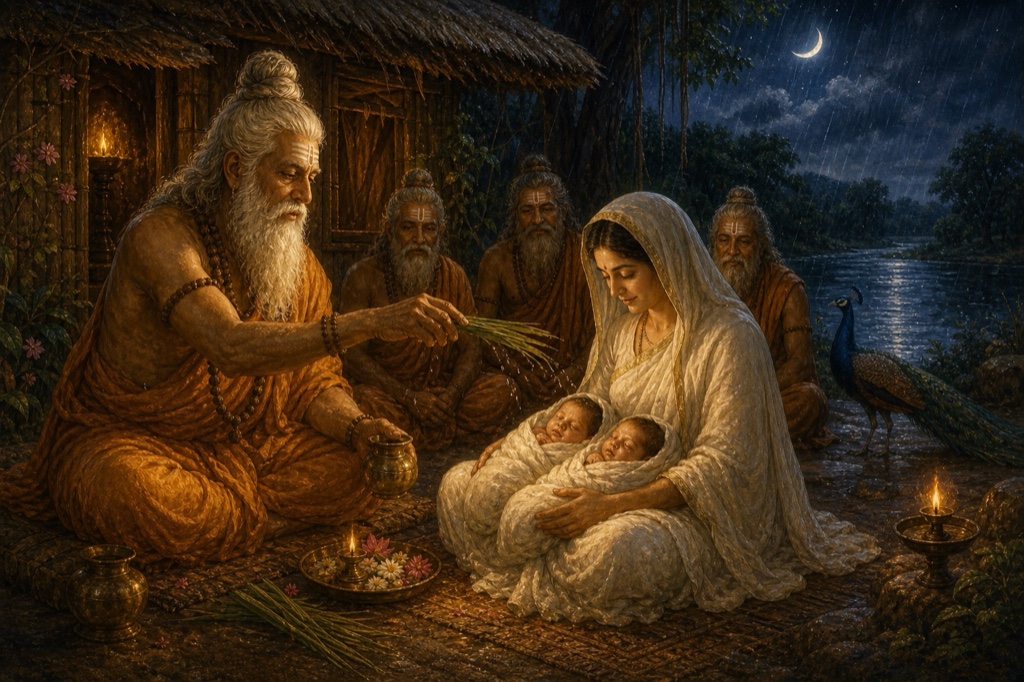
On the very night that Shatrughna entered the leaf-hut, Sita gave birth to two sons. At midnight the young ashram boys brought Valmiki the glad news of Sita’s happy delivery and prayed, “Rama’s wife has borne two sons. Make the rite of protection that drives off harmful spirits.” Hearing this, the great sage came there and saw the two boys, mighty and glowing like new moons, like sons of the gods. In his joy he made the rite that destroys Rakshasas. The heirs of Ayodhya had been born in a hut in a forest, and their father did not know they existed.
Valmiki took up a fistful of kusha grass and lava, its lower and tender part, and with kusha blades hallowed by mantras he completed the rite of protection for both. He said, “Of these two, the one born first shall be cleansed with kusha blades made holy by chants, so his name shall be Kusha. The one born later shall be cleansed with lava by the elder women, so he shall be known as Lava. In this way these twins, Kusha and Lava, will be famous by the names I have given them.” They were named for two handfuls of grass, and one day the whole world would know both names. The elder women of the ashram took the protective rite from the sage’s hand and, with careful attention, watched over the two.
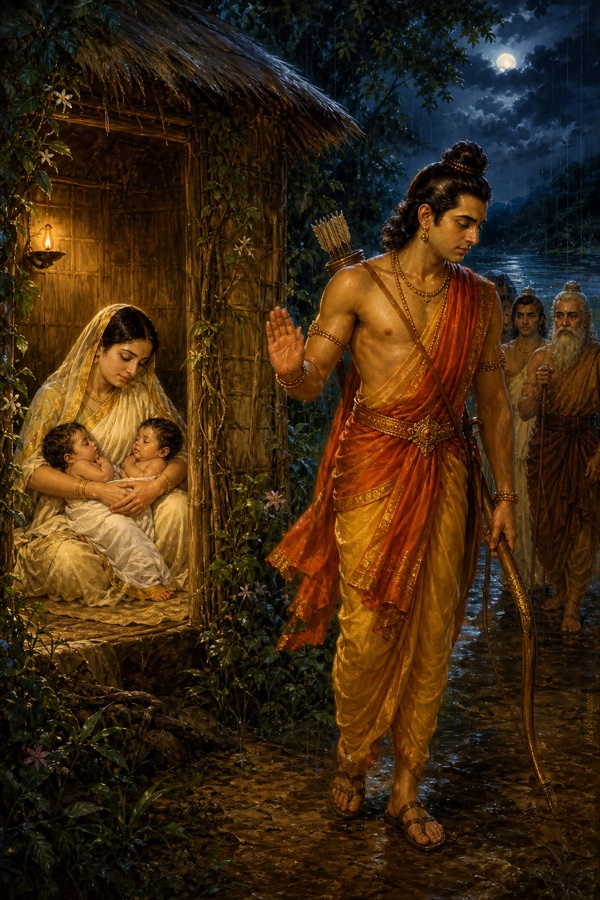
Just then, while the elder women were performing the rite with the chanting of the lineage and names, and there was talk of the happy delivery of Rama and Sita’s sons, Shatrughna at midnight heard this most welcome news. He went to the leaf-hut and said, “Mother, by the grace of God you have two sons.” He said it to his brother’s exiled wife, in a forest, in the dark, and then he said nothing more about it to anyone for twelve years. That rainy night of the month of Shravana passed swiftly for Shatrughna. At dawn, after his morning rites, he took leave of the sage with folded hands and went on toward the west.
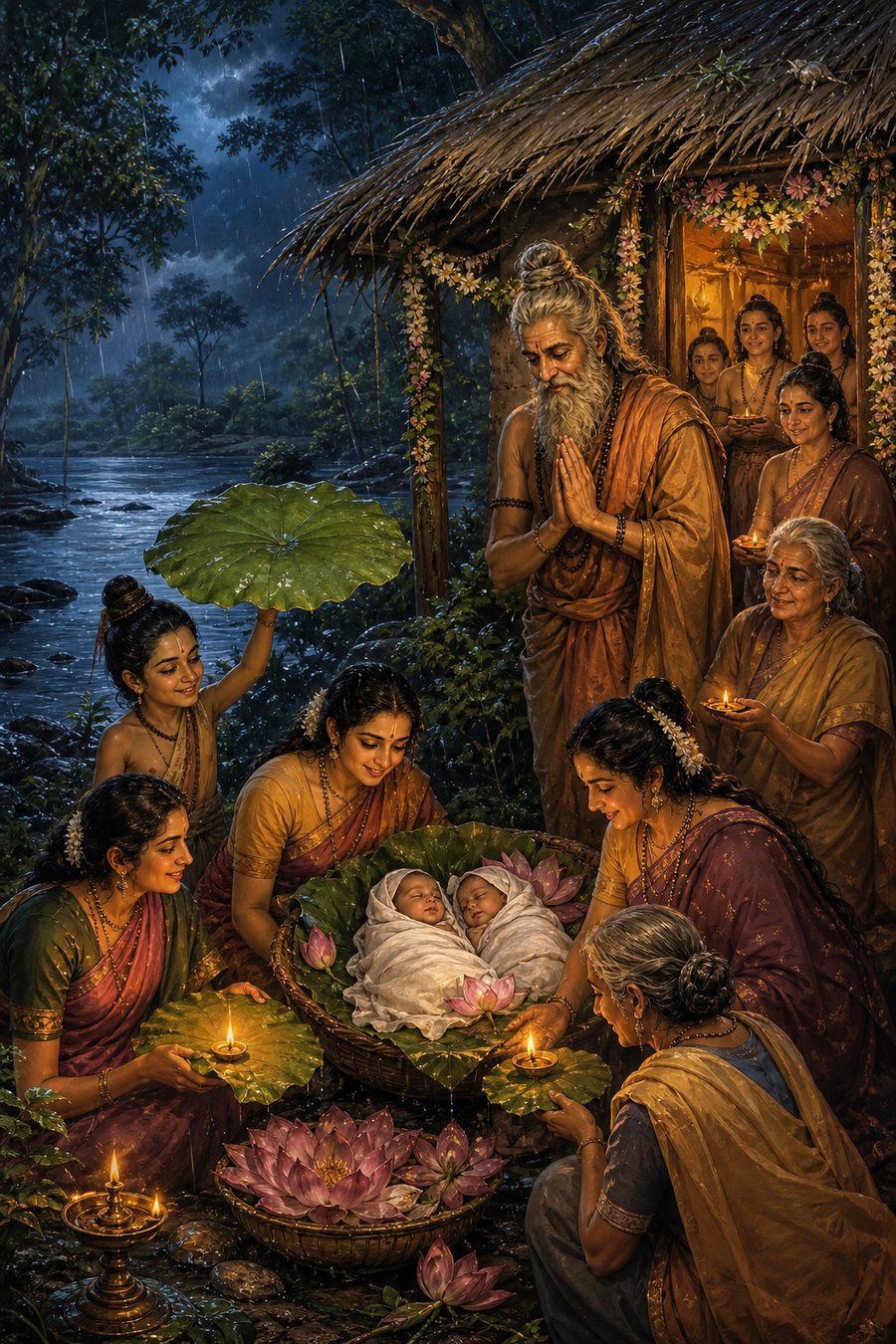
Reaching the bank of the Yamuna after seven nights on the road, Shatrughna halted at the hermitage of seers of holy fame. There, with the sages led by Bhargava, he shared in tales fitting the occasion, and in the company of Chyavana and other sages bright as gold he passed the night hearing many stories of dharma.
Chyavana’s Warning, and the Tale of Mandhata
When night came, Shatrughna asked Chyavana about the strength of Lavana and the power of the trident, for he had his brother’s plan in his hand and wanted to know what it was he was avoiding. “Brahmin, who before this were destroyed by this trident when they came to single combat with Lavana?” Chyavana answered, “Of Lavana’s countless deeds, hear the one that befell Mandhata, the founding king of the Ikshvaku line. In ancient days there was in Ayodhya the son of Yuvanashva, Mandhata, famed through the three worlds. Having brought the whole earth under his rule, he set himself to conquer the world of the gods.”
“At Mandhata’s effort to conquer the world of the gods, a sharp fear seized Indra and the great gods. Indra, knowing his intent, said soothingly, ‘you are not yet even a complete king in the world of mortals, and you already want the kingdom of the gods without having subdued the earth. If the whole earth is truly under your sway, then rule the kingdom of the gods too, with your servants, army, and mounts.’ Mandhata asked, ‘Indra, where is my rule over the earth obstructed?’ The thousand-eyed Indra said, ‘in Madhuvana the Rakshasa Lavana, the son of Madhu, does not obey your command.’”
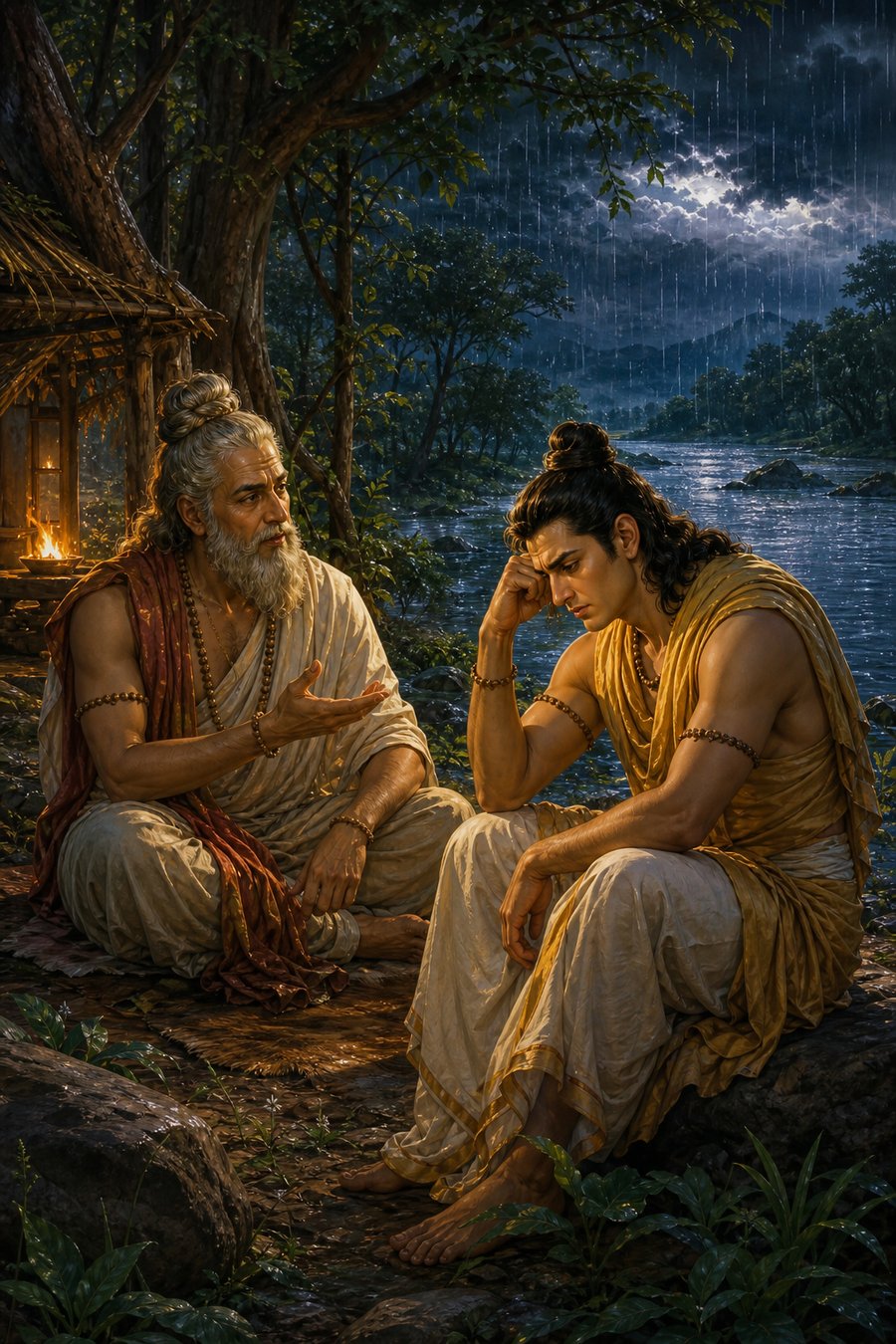
“Shamed by these harsh, unwelcome words, the king lowered his face and could say nothing. He took his leave of Indra, returned to this world, and came with army and mounts to bring Lavana under his sway. He sent a messenger to demand battle, and the messenger spoke many unwelcome words; Lavana swallowed that messenger while he was still speaking. Angered by the messenger’s delay, the king rained arrows on the Rakshasa from every side. Then the Rakshasa laughed, took the trident in his hand, and, to kill Mandhata along with his followers, loosed that supreme weapon. The blazing trident burned the king to ash with his army and mounts, and then returned to Lavana’s hand.”
“Thus that great king was slain with his army and his mounts; the power of the trident is beyond measure and beyond compare. Tomorrow at dawn you will surely kill Lavana, when he goes out for his food without the trident; then your victory is certain. By this, good will come to the worlds. Mandhata was destroyed by his own effort, because he closed with the trident-bearing Lavana head-on.” A world-conqueror had died of one detail of timing, and Shatrughna had been given that detail before he left home.
The Wait at the Gate, and the Bitter Words
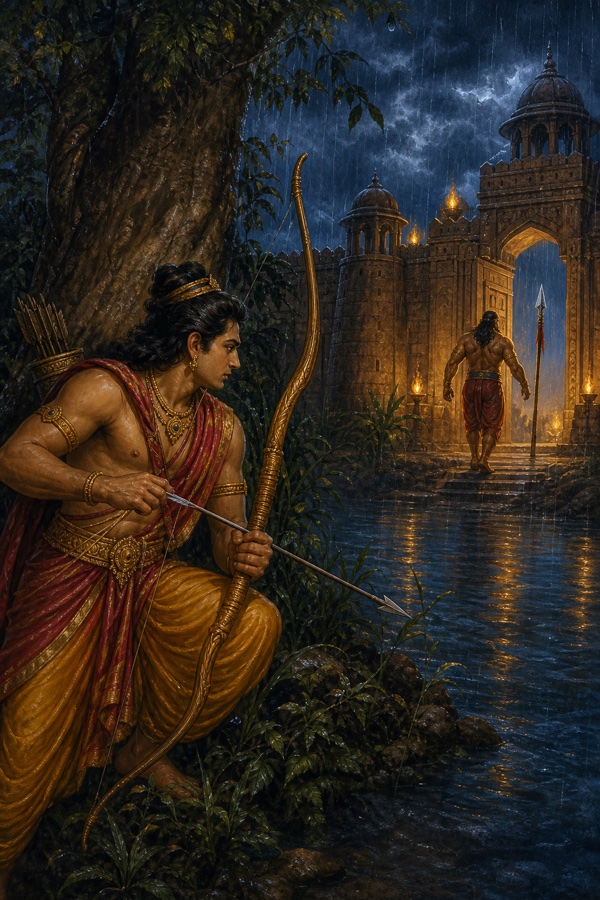
Talking with Chyavana and the other sages, who wished him a fortunate victory, Shatrughna’s night passed quickly. In the clear morning the Rakshasa went out of the city wanting to bring back his food, and left the trident in the house, as he had left it every morning of his life. In the meantime Shatrughna crossed the river Yamuna, bow in hand, and stood at the gate of Madhupura. At midday Lavana returned, loaded with the weight of many thousands of creatures.
Seeing Shatrughna standing armed at the gate, the Rakshasa said, “What will you do with this weapon? Thousands of armed men like you I have swallowed in my anger, basest of men. Death has come near you. My meal is not yet full, and you have come into my mouth of your own accord.” As the Rakshasa said this and laughed again and again, Shatrughna wept with rage. Fiery rays broke from every limb of his body.
In great anger Shatrughna said to that night-ranger, “I want single combat with you. I am the son of Dasharatha, the brother of Rama, Shatrughna by name, and I have come wishing your death. Give me, a man hungry for battle, this duel. You are the enemy of all creatures; while I live you shall not leave alive.” Lavana said, as if laughing, “By my good luck you have come within my reach. Ravana, the brother of my mother’s sister, Rama killed for the sake of a woman. The ruin of Ravana’s whole line, and the slighting of your people above all, I had forgiven it all. But now every one born or yet to be born, and you too, basest of men, will be blown away by me like a wisp of straw.”
Lavana said, “You want battle, so I will give you battle. Wait one moment while I fetch my weapon, the trident.” There it was, the one sentence Rama had spent a whole audience preparing him for. At once Shatrughna answered, “Where will you go while I am alive? A man of discipline does not let go an enemy who has come to him of his own accord. One who, with a wavering mind, gives a foe the chance to slip away is killed like a slow-witted coward. So look well upon this world of the living; I will send you to the world of Yama with my sharp arrows, enemy of the three worlds and of the house of Raghu.”
The Duel, and the Death of Lavana
These words made Lavana furious, and he cried, “Wait.” Rubbing one hand against the other, gnashing his teeth, he challenged the prince again and again, and he did it standing in the open, with the only thing that could have saved him lying indoors. To the dreadful Lavana, Shatrughna said, “When you conquered others, Shatrughna was not yet born. Today, struck by my arrow, go to the house of Yama. May the seers and Brahmins see you dead in battle today, as the gods saw Ravana. When you fall, there will be peace in the city and the countryside.”
Then Lavana laughed, uprooted a great tree, and hurled it at Shatrughna’s chest, but Shatrughna cut it into a hundred pieces with his arrows. Seeing his effort wasted, the strong Rakshasa uprooted many more trees and threw them, and the brilliant Shatrughna cut them down one by one with three or four arrows apiece. Shatrughna rained arrows on the Rakshasa, but the Rakshasa was not troubled. Then Lavana lifted a tree and struck Shatrughna on the head so hard that his limbs went slack and he fell in a swoon. When the hero fell, a great cry of grief rose among the seers, the hosts of the gods, the Gandharvas, and the Apsaras.
Taking Shatrughna for dead, the Rakshasa did not go to his mansion, though the chance was his, nor go to take up the trident; thinking him dead, he simply carried in his load of food. He had the door open, the weapon inside, and an unconscious enemy on the ground, and he walked past all three because he could not imagine losing. In one moment Shatrughna came back to his senses, and, honored by the seers, he took up his weapon again and stood at the gate of Madhupura. Then he took that divine, unfailing, supreme arrow, blazing with brilliance, filling the ten quarters, its head like the thunderbolt, its speed like the thunderbolt, like the peaks Meru and Mandara, undefeated in every battle, terrible to the lords of the Danavas and the Asuras. Seeing that arrow, bright as the fire of the world’s ending, all creatures were struck with fear.
The gods, Asuras, Gandharvas, sages, and Apsaras, the whole world in its unease, came to Brahma, the great grandfather. They asked, “Lord, has the ruin of the worlds come, or the ending of the age? We have never seen or heard such a thing.” Brahma, the grandfather of the worlds, said in a sweet voice, “Hear me, all you gods. This arrow Shatrughna has taken up for the slaying of Lavana. It is the eternal, radiant arrow of the ancient god Vishnu, maker of the worlds. With this Vishnu once destroyed the two sons of Diti, Madhu and Kaitabha. Vishnu alone knows this radiant arrow. It is the ancient form of that Vishnu. Go from here and watch the slaying of the great Rakshasa Lavana by Shatrughna, Rama’s younger brother.”
The gods came to the place where Shatrughna and Lavana were fighting. Seeing the sky filled with gods, Shatrughna roared like a lion and challenged Lavana again. Full of rage, Lavana came to the fight. Shatrughna drew his bow to his ear and loosed that great arrow at the broad chest of Lavana. The arrow tore his chest open and entered the nether world, then, honored by the gods, quickly returned to Shatrughna. Pierced by Shatrughna’s arrow, the night-ranger Lavana fell suddenly to the ground like a mountain struck by the thunderbolt. When Lavana was slain, the great divine trident too, before the eyes of all the gods, returned into the keeping of Rudra, and the boon Shiva had given a good Asura in the first age was finally closed.
Having felled with a single arrow this terror of all three worlds, the supreme archer Shatrughna shone like the thousand-rayed sun driving away the dark. Gods, seers, Nagas, and all the Apsaras praised the fearless victory of Dasharatha’s son, and the world, laying aside its fear, grew calm as a serpent brought to rest.
The Founding of Madhupuri, and the Wish to See Rama
When Lavana was slain, the gods, with Indra and Agni at their head, said to the well-pleased Shatrughna in a sweet voice, “By good fortune your victory has come and the Rakshasa is dead; ask a boon. We have all come wishing your victory, and our coming will not be fruitless.” With folded hands Shatrughna answered, and asked for a thing with no use to himself in it at all: “Let this lovely, god-made city of Madhupuri, Madhura, soon become a thriving capital. That is my highest boon.” The gods were pleased and said, “So be it; this beautiful city will surely be famous as Shurasena, filled with an army of heroes.” Saying this, the gods returned to heaven.
Shatrughna sent for the army from the bank of the Ganga. Hearing of Lavana’s death, that army came swiftly, and Shatrughna began the founding of the city in the month of Shravana. That radiant city, shaped like a half-moon, shining on the bank of the Yamuna, was settled in twelve years. The kingdom of the Shurasenas was established without fear; the fields filled with grain, Indra sent rain in season, and under the shelter of Shatrughna’s arm the men of valor stayed free of disease. Graced with fine mansions, crossroads, and market lanes, holding all four Varnas, full of many trades, the city prospered. The white mansion that Lavana had built before, Shatrughna adorned still more; with pleasure-grounds, gardens, and ornaments both human and divine, the city shone. The house the man-eater had built became the palace of a city where nobody was afraid.
Seeing that city, like the city of the immortals, graced with merchants come from many lands and with goods of every kind for sale, Shatrughna, grown rich in purpose, was deeply pleased. In the twelfth year, having settled Madhura, the thought rose in his mind that now he would look upon the feet of Rama. Shatrughna, who carried forward the Raghu line, resolved to see the feet of the lord of the Raghus. He had a kingdom, and it had taken twelve years, and what he wanted was to stand in front of his brother.
The Song of Rama’s Story at Valmiki’s Ashram
In the twelfth year Shatrughna wished to go to Rama’s Ayodhya with a few attendants and a small force. Sending the ministers and army chiefs back, he set out on a fine horse, with a hundred chariots. Halting at seven or eight stages on the road, Shatrughna reached Valmiki’s hermitage and stayed there. Bowing at the sage’s feet, he received water for his feet, the guest offering, and hospitality; and it was the same hermitage, and the two boys born the night he last slept here were twelve years old now.
The sage told Shatrughna thousands of sweet tales of many kinds, and, praising the killing of Lavana, said, “In killing Lavana you have done a most difficult thing. Many powerful kings were slain, with their armies and mounts, in battle with Lavana, but you killed that sinner as if in play, and by your splendor the world’s fear was calmed. The terrible killing of Ravana Rama accomplished with great effort; this great deed you have done as if without effort. My heart too is filled with the deepest affection, Shatrughna; I will smell the crown of your head, for that is the highest reach of tenderness.” Saying this, Valmiki gave hospitality to Shatrughna and his attendants.
After the meal, Shatrughna heard the story of Rama’s deeds sung, filled with the sweetness of fine song, joined to the melody of the lute, rich with the play of the three vocal registers, set to rhythm, composed in Sanskrit, and made by the rules of the art. He heard Rama’s past deeds sung in order; the words were true, and told in the very sequence in which they had happened. Hearing it, Shatrughna filled his eyes with tears, went almost senseless, and lay in a swoon for a moment, drawing deep breath after deep breath.
Hearing that song, in which things seemed to happen as if in the present, the king’s soldiers too fell silent, faces downcast and forlorn, and said, “This is a wonder.” They spoke among themselves, “What is this, where are we, is this a dream we are seeing? What we saw with our own eyes before, we are seeing and hearing again in this hermitage. Are we hearing this fine song-work in a dream?” In great amazement they said to Shatrughna, “Please ask the noble sage Valmiki who composed this.” Shatrughna said to the wondering soldiers, “I cannot ask Valmiki in this way; there are many marvels in this sage’s hermitage, and it is not right to question a great sage out of mere curiosity.” Saying this and bowing to the great sage, Shatrughna returned to his lodging, and his courtesy cost Ayodhya another twelve years of not knowing.
The Reunion with Rama in Ayodhya
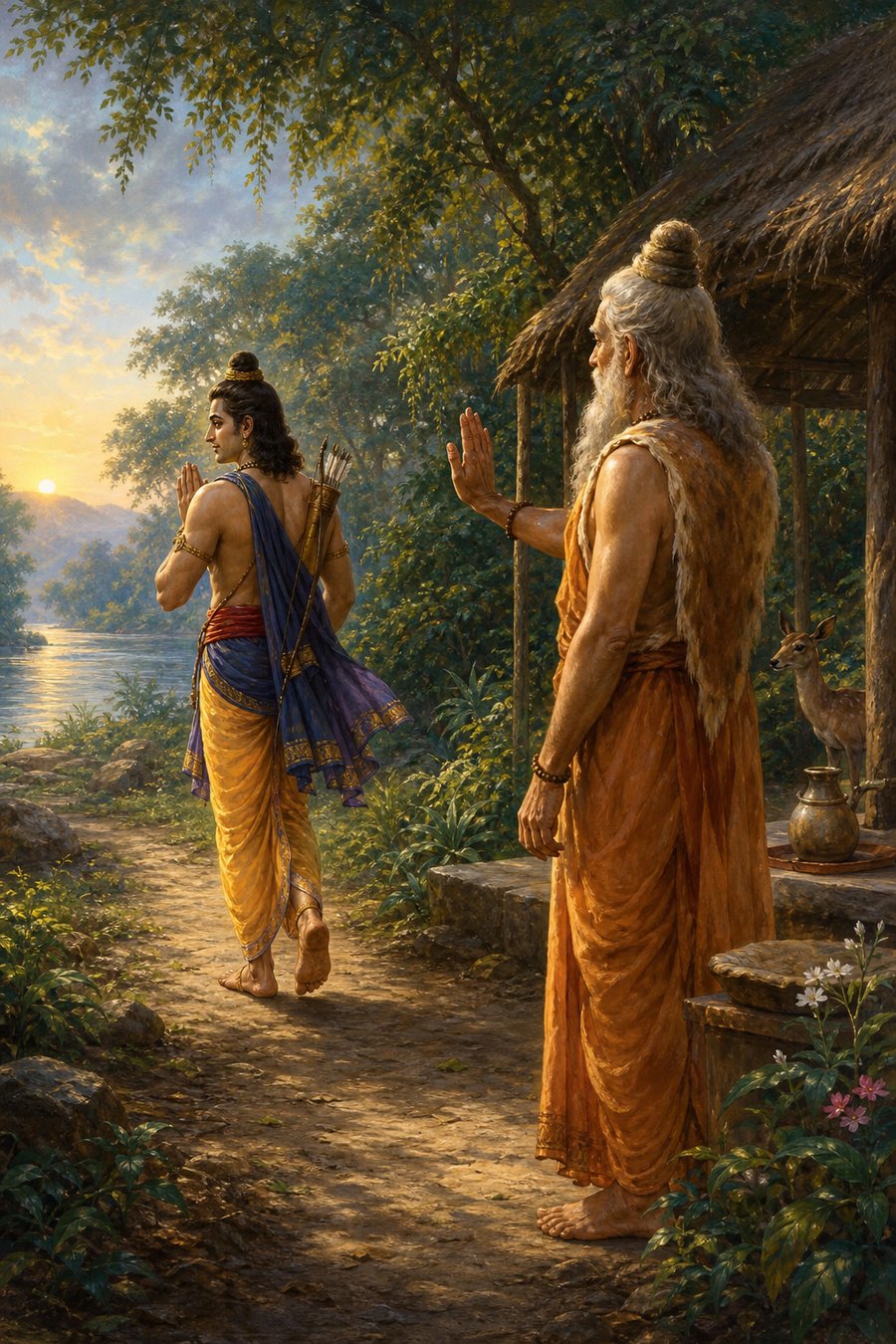
Sleep did not come to Shatrughna as he lay there; he kept turning over in his mind Rama’s matchless, meaning-laden song. Hearing that sweet sound joined to the lute’s melody, the night passed. At dawn, after his morning rites, Shatrughna folded his hands and said to Valmiki, “I wish to see Rama; I ask your leave, and the leave of these seers firm in their vows.” Valmiki embraced Shatrughna and let him go, and let him go without saying one word about who was living in his hermitage. Bowing to the sage, mounting his gleaming chariot, Shatrughna, eager to see Rama, reached Ayodhya swiftly.
Entering the lovely city, Shatrughna went to the palace where the shining Rama was. Seeing Rama seated among his ministers, his face like the full moon, like the thousand-eyed Indra seated among the gods, he bowed to Rama, who blazed with splendor, folded his hands, and said to Rama, “All that you commanded I have done; Lavana is killed and his city is settled. These twelve years I have spent without you, Rama; now I have no heart to live parted from you. Have mercy on me, Kakutstha; like a motherless calf, I cannot stay far away for long.”
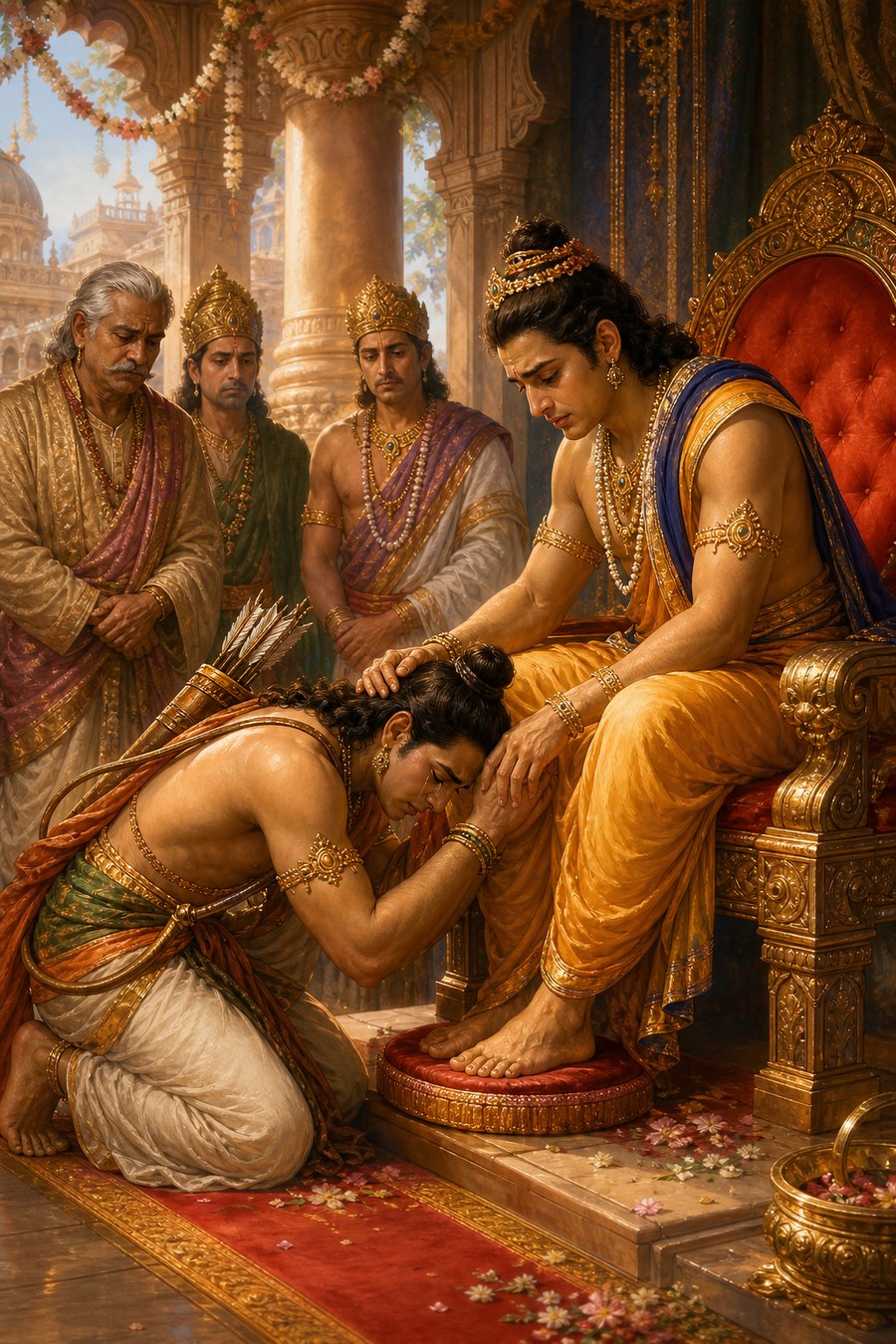
Rama embraced him and said, “Do not grieve; this is not the way of a Kshatriya. Even living apart from his kingdom, a king does not lose heart; by the dharma of the warrior he must protect his people. From time to time come to Ayodhya and see me and go also to your city Madhura. You are dearer to me than my own life, of that there is no doubt; but the guarding of a kingdom is a duty that cannot be set aside. So, Kakutstha, stay with me seven nights, and then go to Madhura with your servants, army, and mounts.” Hearing this righteous word, so pleasing to his heart, Shatrughna said in a low voice, “So be it.” He was being told what Rama told everyone, himself first: the duty stands where a man would rather not.
By Rama’s command Shatrughna spent seven nights there and then made ready to leave. Taking leave of Rama, and of Bharata and Lakshmana, he mounted his fine chariot. Lakshmana and Bharata followed him a long way on foot, and Shatrughna went on swiftly toward Madhupuri.
The Brahmin’s Lament, and the Dead Child
Having sent Shatrughna off, Rama, with his two brothers, ruled his kingdom by dharma and lived happy and content. Some days later an old Brahmin of Ayodhya came to the palace gate carrying the dead body of his son. Filled with love and grief, weeping, crying “My son, my son” again and again, he lamented, “Alas, my son, what evil deed did I do in a former birth that I should see my only son dead? Not yet come to his youth, a child of only five thousand days, he has met an untimely end, and this is the cause of my sorrow. In a few days I and his mother too will die in our grief for him. I do not recall ever speaking a falsehood, nor doing violence, nor sinning against any creature.” He had searched his whole life for the cause and found nothing in it, and so he had come to look for the cause in the king.
“By what evil deed did my son go to the world of Vaivasvata Yama without ever performing the rites for his elders, the last offerings for us? Such an untimely, unripe, ghastly death I have never seen or heard of. Untimely death does not happen at all in Rama’s kingdom. Surely Rama must have some great sin, by which children are dying in his kingdom. In other kingdoms children have no fear of death. King, bring this death-taken child back to life, or I with my wife will give up my breath at the palace gate like an orphan, and you, Rama, may live happy with the sin of a Brahmin’s death upon you.”
“King, until now we lived in happiness in your kingdom. But now the kingdom of the Ikshvakus has been left as if orphaned, where a child is dying. A people not rightly protected perish from the faults of the king; in the kingdom of an unrighteous king, people die untimely. When wrongful acts are done in city and country and no protection is given from them, then such a doom, wrought by time, comes. This is plainly a fault of the king, and by it this killing of a child has happened in city and country.” In this way, reproaching the king again and again with many words, the sorrow-scorched Brahmin went on embracing his dead son. It was the second time the voice of the people had come to Rama’s gate carrying a charge, and the first time had cost him his wife.
Narada’s Teaching on the Dharma of the Ages
Hearing that pitiful lament of the Brahmin with pain and sorrow, Rama, scorched with grief, called his ministers, Vasishtha, Vamadeva, his brothers, and the citizens. Eight Brahmins, together with Vasishtha, came in and said to the godlike king, “May you prosper.” These were Markandeya, Maudgalya, Vamadeva, Kashyapa, Katyayana, Jabali, Gautama, and Narada. The ministers and townsmen took their fitting seats. With folded hands Rama told the great seers that this Brahmin stood blocking the palace gate. Hearing the grieving king’s words, Narada spoke in an auspicious voice before the seers.
“Hear, king, how this child’s death came untimely, and do what should be done. In the ancient Kritayuga only Brahmins were ascetics; in that age non-Brahmins never performed austerities. That age burned with the splendor of the Brahman, was free of ignorance, and all who were born were long-lived and far-seeing. Then came the Tretayuga, in which men of mortal frame were born, and in it the Kshatriyas were born endowed with austerity. In the merit of their former birth and in austerity the men of the Kritayuga were higher; in Treta the Brahmins and Kshatriyas became equal in power.”
“In Treta the order of the four Varnas was agreed upon. But here itself unrighteousness set down one foot, and after this, dharma would go on decreasing step by step. What for the elders had been Rajasic labor, such as tillage, was reckoned low and not to be commended; that same act took root firmly on earth in Treta as one foot of unrighteousness. By that one foot of falsehood, the lifespan of creatures was fixed and limited. Once that falsehood was set in place, people devoted to truth and dharma went on doing only auspicious deeds.”
“In Treta only Brahmins and Kshatriyas performed austerity; the rest did service. To the Vaishya and the Shudra fell the dharma of service; the Shudra above all served all the Varnas. In the meantime unrighteousness and falsehood grew, and there was decline once more. Then unrighteousness set its second foot upon the earth, and by this the third age was counted, the Dvapara. In Dvapara unrighteousness and falsehood grew. In this age austerity entered the Vaishyas; thus through three ages austerity entered three Varnas in turn. In these ages the Shudra had no right to austerity. In the coming Kaliyuga, austerity will be performed in the Shudra birth.”
“Even in Dvapara, austerity by a Shudra is held to be the highest unrighteousness; so now, in this Treta, surely in some frontier region of your kingdom some misguided Shudra is performing great austerity, and from that this killing of a child has come. One who does unrighteousness or a forbidden act in a king’s kingdom and dwells in his city destroys the very root of the kingdom’s prosperity, and that king too soon goes to hell, of this there is no doubt. A king receives a sixth part of the fruit of his people’s study, austerity, and good deeds; then why should he who enjoys the sixth part not protect his people? So search out your kingdom; wherever an evil deed is seen, take pains there. By doing this, dharma and long life will grow among men, and this child’s life too will return.”
The Search on the Pushpaka, and the Sighting of the Ascetic
Hearing Narada’s nectar-like words, Rama came to a joy beyond measure and said to Lakshmana, “Faithful in your vows, go and reassure that brahmana; have the child’s body placed in a tub of oil. With the finest and most fragrant oils and perfumes, so arrange it that the child’s body does not waste, does not warp, and its limbs do not come apart.” He was giving orders to keep a dead boy whole because he meant to give him back. Having given Lakshmana this order, Kakutstha called Pushpaka to mind, “Come.”
Understanding the summons, Pushpaka, adorned with gold, came to Rama in a moment and, bowing low, said, “I am here, your obedient servant.” Hearing Pushpaka’s fine words, Rama bowed to the great seers and mounted the flying chariot. Taking bow, quiver, and a bright-gleaming sword, and leaving both Lakshmana and Bharata in the city, he went seeking unrighteousness this way and that, into the green of the western quarter, and then reached the northern quarter, walled by the Himalayas. Seeing not the least evil deed there, he covered the whole eastern quarter too, which was of the purest conduct, spotless as the face of a mirror. Three quarters of the world, and nothing; one quarter left.
Then Rama, son of a royal seer, turned toward the south. On the northern flank of the Shaivala mountain he saw a great lake. In that lake, hanging head downward and performing great austerity, Rama saw an ascetic. Coming near that ascetic at his supreme austerity, the king said, “You are blessed. Firm in valor, aged with austerity, to which Varna do you belong? I ask out of curiosity; I am Rama. What is your desire, the winning of heaven or some other end, for which you perform this austerity that is hard for others? I wish to hear the purpose for which you have practiced it. May it be well with you; are you a Brahmin, or a Kshatriya hard to conquer, or the third Varna, a Vaishya, or a Shudra? Tell me the truth.”
Thus asked by the king, the down-faced ascetic began to tell Rama his birth and the reason for his austerity, and there the canto leaves them, a king with a sword on his shoulder and a man hanging head downward in the water, about to answer the question.
The gist: Rama rides Kubera’s Pushpaka through all the quarters himself, seeking the unrighteousness Narada named. In north, east, and west he finds nothing at all. In the south, in a lake on the flank of the Shaivala mountain, he finds an ascetic hanging head downward in the water. Rama asks him his Varna and the purpose of his austerity, and the canto closes with the man beginning to answer.
Source: Srimad Valmiki Ramayana, Uttarakanda, Cantos 58 to 75. The Gita Press Hindi edition is the controlling witness. The Sanskrit e-text and an independent complete translation were used to verify names, sequence, and principal events. Where recensions differ, this retelling follows Gita Press.
Basis: Valmiki Ramayana (Gita Press, Gorakhpur)