On this page
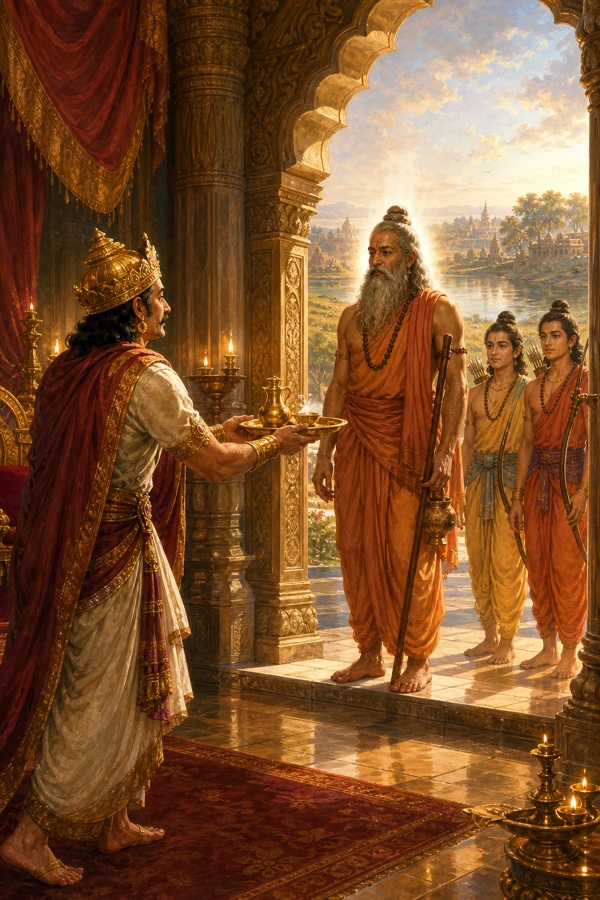
Dasharatha had just finished speaking. His reply to the sage had run long and generous, the way a king’s welcome runs when a guest of Vishvamitra’s stature walks unannounced through the palace gate: whatever you have come for is yours, name it and it is done. Vishvamitra listened to the end, and as the last words settled over the court the hair rose along his arms. Everyone in that hall knew who he was, a king by birth who had made himself a brahmarshi through austerities so fierce that Brahma himself at last named him a brahmarshi, and everyone knew that when such a man asks for something, the asking has weight. What he asks for now is a boy. Follow the request through its twelve cantos and it carries you to the morning a young prince of Ayodhya pulls his bowstring in earnest for the first time and a demoness the size of a hill comes down onto the earth, and from there to the sixth night of a fire-rite that no demon manages to break.
Vishvamitra’s Request
Vishvamitra said, “What you have said is worthy of you and of no one else on this earth. You come of a great line, and Vasishtha himself, the seer who has guided your house for generations, is the one who taught you. So make the resolve. Grant the wish that stands foremost in my heart, the one I am about to put into words, and let your promise prove true.
“I stand consecrated for a sacrifice.” The word carried its full weight into the hall. A man under consecration has bound himself to the rite with vows; he cannot walk away from it, and he cannot spend on anger what has been set aside for the fire. “Two rakshasas, night-roaming demons who feed on human flesh and put on any shape they please, have made a habit of breaking it, together with their followers. Each time the rite drew toward its close, when most of the offerings had already gone into the fire, these two, Maricha and Subahu, both strong and both well schooled in the methods of war, poured a torrent of flesh and blood down out of the empty sky and fouled the altar. My vow was broken in the very hour of its completion. I came away from that place with nothing to show for my labor and no heart left in me. And I could not answer them. The rite itself forbids it. No curse may be spoken while it runs, whatever the provocation, and so I have had to swallow my anger and keep it swallowed, lord of the earth.
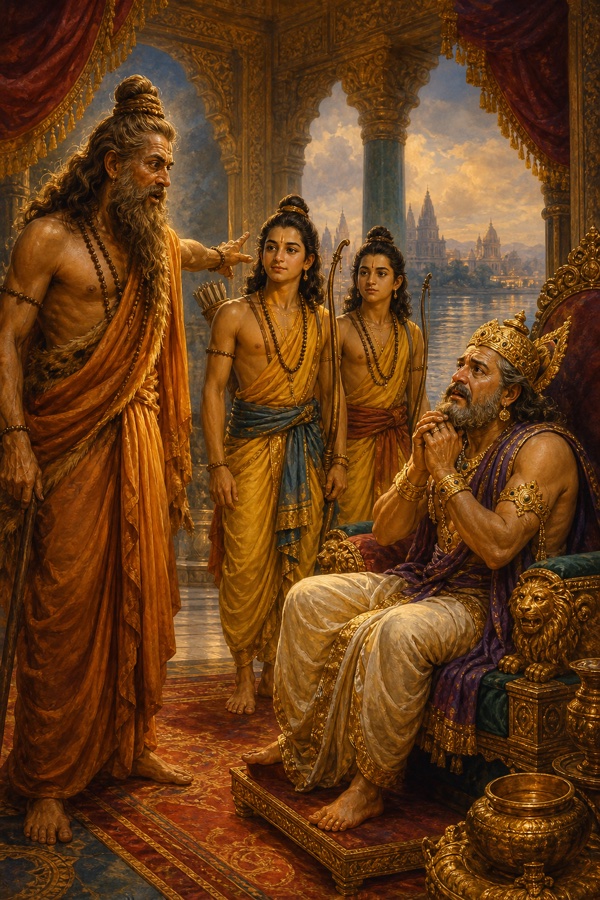
“So give me your eldest son. Give me Rama. He is a boy still, the side-locks of childhood hanging at his temples in the fashion of the day, and yet his valor is the true kind, the kind that does not fail. Guarded by me and carried by his own radiance, he is equal to the end of every demon that comes against him. I will give him gifts in return, many of them, and by them his name will be known across the three worlds; of that there is no doubt. The moment those two rakshasas stand face to face with Rama, they will find no ground under their feet.
“No other man can kill them. Drunk on their own strength, the pair of them are already caught in the noose of Death, and against Rama they are nothing. I know what he is. His valor is true, and it does not fail. Do not let a father’s love decide this, lord of the earth. I give you my word: count the two demons as dead.
“Vasishtha knows him for what he is, and so does every ascetic standing in this hall. If you want the merit of dharma and the highest fame a king can win on this earth, give Rama to me. Let him go with me once your counselors agree to it, with Vasishtha at their head. Hand me your beloved son, your lotus-eyed Rama, for ten days and nights, no more; he is grown now, past the age of clinging to his father. Let the season of my sacrifice not slip away, Raghava. Do not sink your mind in grief. May good come to you.” He had spoken what dharma and truth required of him, and having spoken it, Vishvamitra fell silent.
The request was righteous. Every man in that court could hear that it was, and it tore the king’s heart in two. He was an old king, and this son had come to him late, after a sacrifice for offspring and a lifetime of waiting, and now a sage was asking to walk him into a forest full of demons. Grief flooded Dasharatha. He shook where he sat, and then he fainted. When his senses came back he rose to his feet, and the fear of losing his eldest son pressed on him so hard that he slid from his seat and fell a second time, unconscious on the floor of his own court.
Dasharatha’s Refusal and Vishvamitra’s Wrath
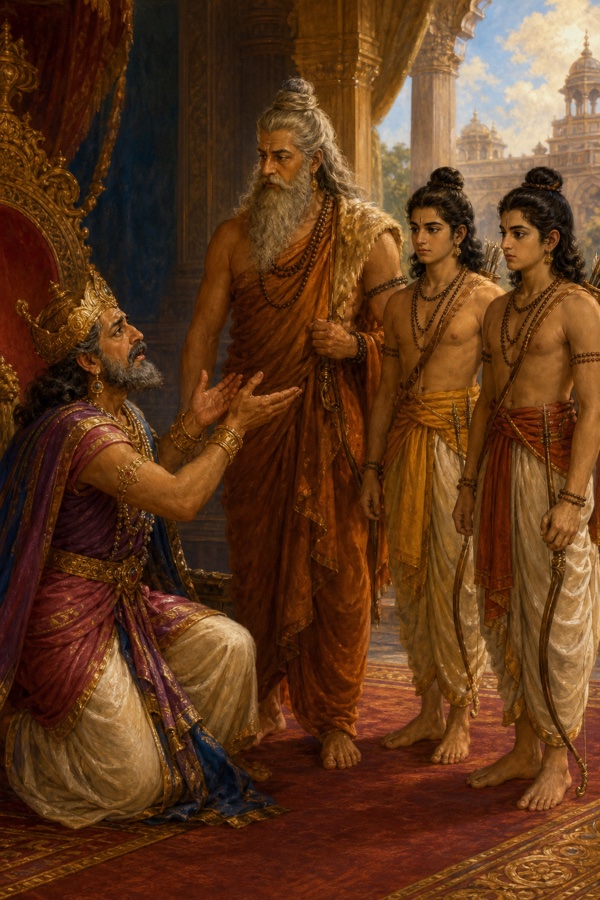
For the space of a muhurta, most of an hour, Dasharatha lay as if there were no life in him. Then he came back to himself, and the first words out of him were a father’s. “My Rama, my lotus-eyed boy, is not yet sixteen. I look at him and I cannot find in him the strength it takes to fight rakshasas.
“Here is my army, a full akshauhini, and I am its master and its commander. I will march with it and fight those night-roamers myself. Every one of these men is brave, every one is trained in weapons, and together they are fit to face a demon horde. But do not take Rama. I will guard your sacrifice with my own bow in my hands, in the front line of the battle, for as long as there is breath in me. With me standing guard your rite will go through to its end without a single obstruction; I will be there in person. So do not take Rama.
“Rama is a child. He has never learned the science of war. He cannot weigh an enemy’s strength against his weakness, he has no command of astras, the weapons that answer to mantras, and he has never stood in a battle. And these rakshasas fight by deceit and ambush, and against that kind of enemy he is no match. Parted from Rama I could not stay alive for the length of a muhurta. So do not take him. If you are set on taking him even so, then take me too, and my army with me, all four limbs of it.
“Sixty thousand years have gone by since I was born, Kaushika, and this boy was won at the far end of them, at a cost you know. I have four sons, and my whole heart is fastened on the eldest, the one in whom dharma stands foremost. Do not take Rama from me. And tell me, since you are asking me to send a child against them: how strong are these rakshasas? Whose sons are they? What are their names and what is their size, who protects them, and how are they to be answered, by Rama, by my army, or by me, when their whole way of fighting is treachery? Tell me all of it, and tell me where I should stand against them on the field.”
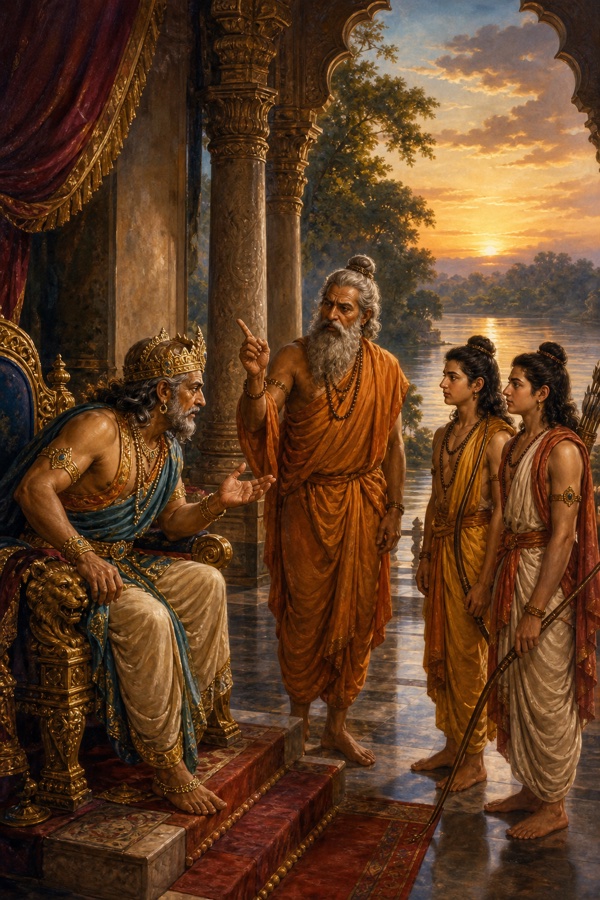
Vishvamitra answered him, and the answer began far above two demons at an altar. “There is a rakshasa named Ravana, born in the line of Pulastya, who was one of the nine sons Brahma made from his own mind at the beginning of creation and set over it as its lords. Brahma has given Ravana a boon: no one may bring about his death except a human being. Countless demons follow him, his strength and his prowess are past ordinary measure, and he torments all three worlds, heaven, earth, and the air between, to the last degree. His father is the sage Vishrava, Pulastya’s son, and he is the true half-brother of Kubera, the lord of wealth, who is Vishrava’s eldest. When a sacrifice is too small for Ravana to trouble with in person, when breaking it himself would be beneath his dignity, he sends these two mighty rakshasas, Maricha and Subahu, and it is at his word that they break the rite.”
At the name of Ravana the king’s last resistance broke into pieces. “I cannot stand against that one in battle. You know dharma; be merciful to me, whose luck has failed me in this, and to my young son, for you are a god to me, and a guru. Gods, danavas, gandharvas, the singers of heaven, yakshas, birds, and serpents cannot hold their ground against Ravana in a fight. How are men to do it? He takes the courage out of the brave when they face him. I cannot fight him, or the forces he commands, with my whole army at my back and my sons beside me. So I will not hand you my boy, who looks like a god and knows nothing of war. And if it is Maricha and Subahu who are breaking your sacrifice, the sons of Sunda and Upasunda, strong, well trained, Death itself when they stand on a battlefield, then I will go myself, with my kinsmen around me, and fight one of the two. If that will not serve, then with my kinsmen I ask your pardon for what I cannot do.”
It was the speech of a frightened man, and it wandered; it offered an army in one breath and took it back in the next. Vishvamitra, son of Gadhi, of the line of Kushika, heard it through to the end, and a heavy anger took hold of him. Feed a sacrificial fire with oblations and sprinkle it with ghee and it leaps. So the fire of the great seer’s anger leapt up, and in an instant it was blazing.
Vasishtha Intervenes
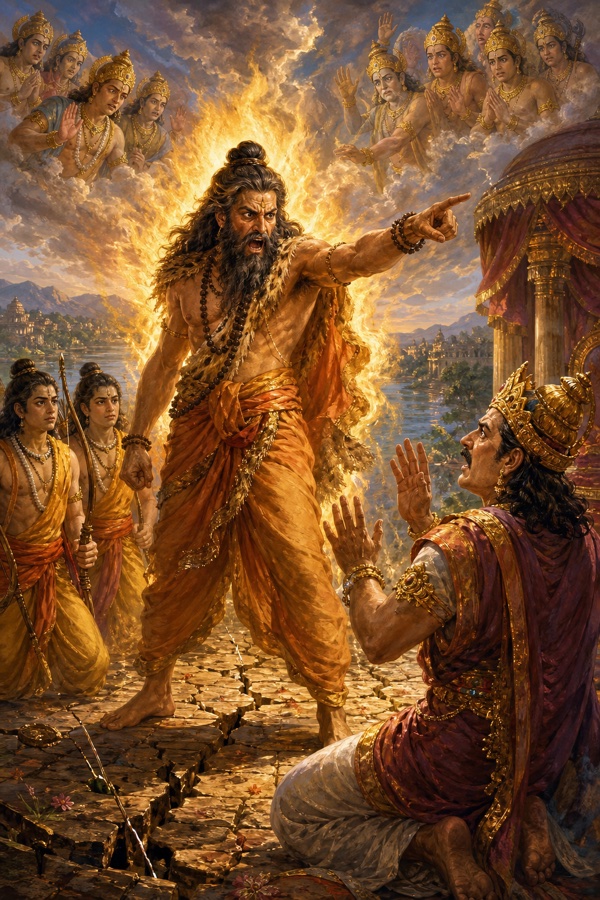
Vishvamitra had heard the king’s answer, every faltering syllable of it, and he had heard the love underneath it too. It made no difference. “You promised first. You promised to grant whatever I asked, and now you want to take the promise back. That is unworthy of the house of Raghu. A broken word does not belong in this line, and it will be the ruin of it. If you can bear that, I will go back the way I came, without Rama. Live in comfort here among your friends, Kakutstha, with your promise turned into a lie.”
When Vishvamitra is angry, the ground answers. The whole earth shook, and a great fear went through the minds of the gods. Vasishtha, the family guru of the Ikshvakus, firm in his vows, saw every world in alarm and turned to the king. “You were born in the house of Ikshvaku. You are dharma itself, walking about in a body. You are steadfast, your vows are excellent, and a man like that does not abandon dharma, and the dharma here is fidelity to your word. All three worlds know you as a soul given to dharma, Raghava. Stand on your own nature, which is truth, and do not take on the adharma of a broken promise. A man who declares in solemn words that he will do a thing and then fails to do it loses all the merit he has ever gathered, from ishta, the fire-rites up to and including the horse sacrifice, and from purta, the wells and tanks built for the good of the people. So send Rama with him.
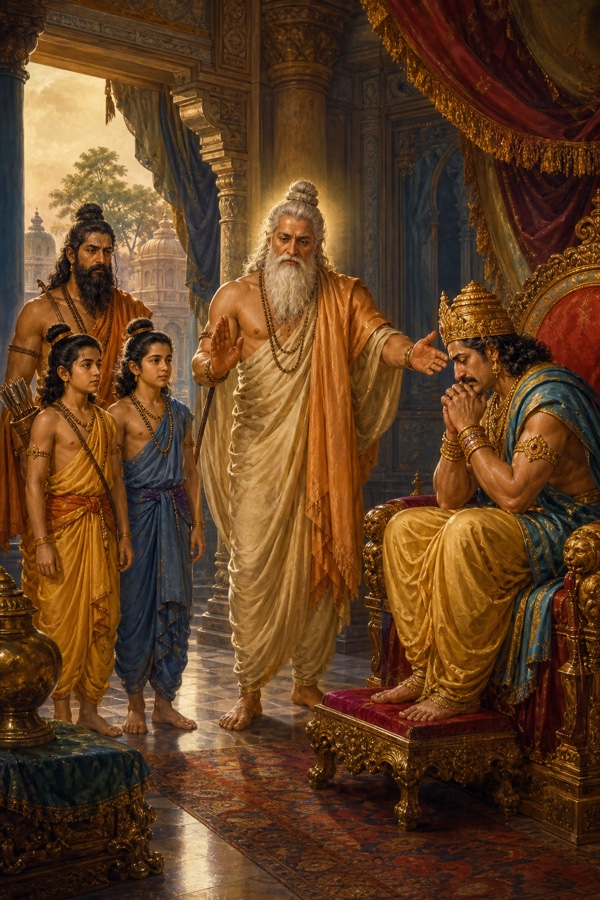
“Whether Rama has learned the use of weapons or not makes no difference. So long as Vishvamitra stands guard over him no rakshasa can overpower him, the way nectar once lay safe inside a ring of fire. Vishvamitra is dharma in a body. Among the strong he is the first. In learning he is above every man alive, and he is a great store of tapas. He knows weapons of every kind. In all three worlds, among everything that moves and everything that stands still, no other man knows him as he is, and no other creature ever will, no god, no rishi, none of the rakshasas, none of the foremost of the gandharvas and yakshas, no kinnara, no great serpent. I know him.
“Long ago the divine astras came into the world as the sons of Krishashva, a lord of created beings, born to him by two daughters of Daksha, Jaya and Suprabha. They were wholly righteous sons, and they were weapons: varied in form, strong past measure, full of light, and they brought victory to whoever employed them. Jaya, who had won a boon to this end, bore fifty sons without bodily form, of measureless glory, made for the destruction of the armies of the asuras. Suprabha bore fifty more, hard to overpower and hard even to assail, known together as the Samharas, the powers that destroy. A hundred blazing weapons, then, and other arms besides. Lord Shiva gave all of them to Vishvamitra in the days when Vishvamitra was still a king with a kingdom to rule.
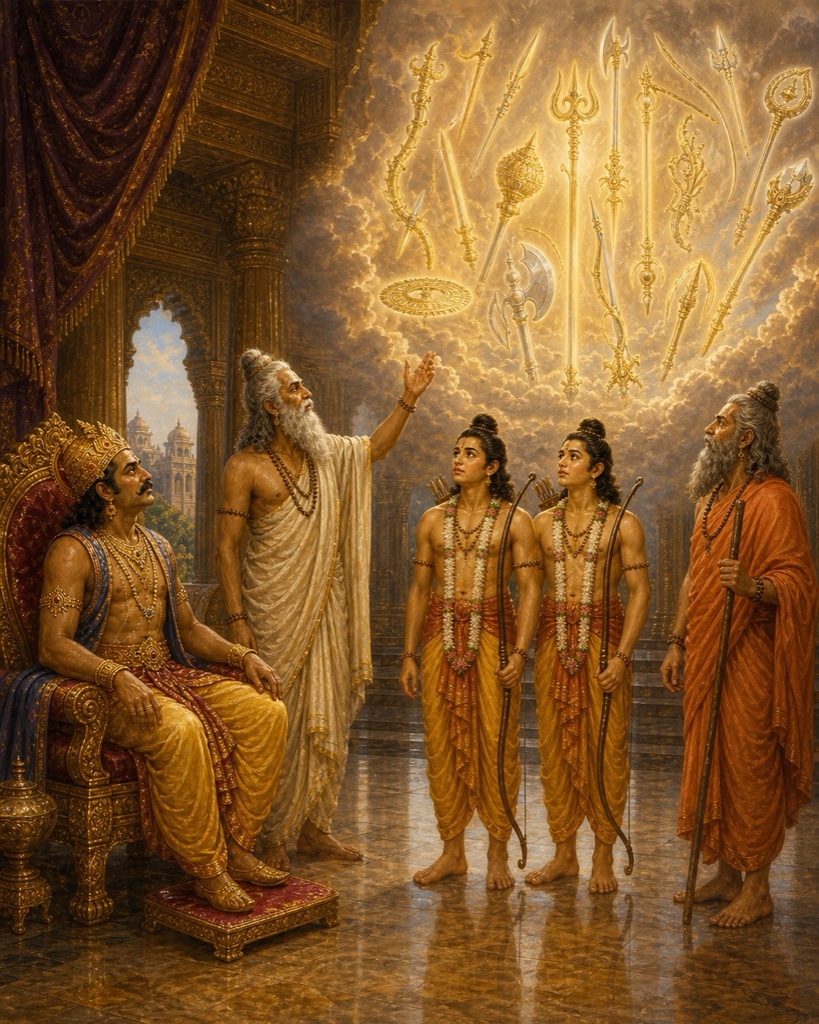
“The son of Gadhi knows every one of those weapons for exactly what it is, and he can bring new ones into being. Nothing in the past and nothing in the future is hidden from him; he knows all there is to know of dharma. That is the man who is asking for your son, a man of that might, that radiance, that fame, and you have no reason to doubt him when it comes to sending Rama at his side. He could punish the rakshasas himself. He has come to you and asked for Rama for one reason only, the good of your son.”
Vasishtha’s words did what fear and love could not. The king’s face cleared. Dasharatha, jewel of the Raghus, foremost of kings, whose fame ran across the earth, was glad again, and in his heart he consented to send Rama and gladden Vishvamitra.
The Departure and the Bala-Atibala Lore
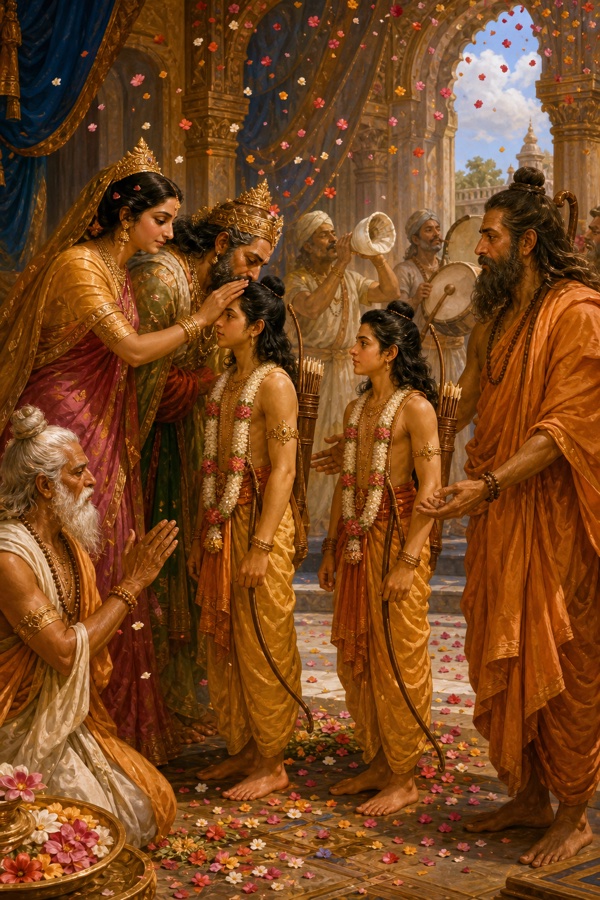
Vasishtha was still speaking when the king, his face bright now, sent for Rama himself, and for Lakshmana with him. He knew the two could not be separated; one brother had never gone anywhere the other did not follow. So the leave-taking was done as a royal house does such things. Queen Kausalya, Rama’s mother, blessed him. His father blessed him. Vasishtha, priest of the family, consecrated him with the Vedic verses that call down good fortune on a journey. Then Dasharatha bent and breathed in the scent of the crown of his son’s head, the oldest gesture of love a father in that country has, and with a heart full of gladness he placed Rama in Vishvamitra’s hands.
The city itself seemed to know what the moment was. As Rama set out beside Vishvamitra a breeze rose, soft on the skin and carrying no dust. Flowers came down out of the sky. Conches sounded across Ayodhya and the kettledrums answered them, and under both, faint and unmistakable, came the beat of the drums of the gods. Vishvamitra walked in front. Behind him came Rama, the side-locks at his temples, a bow in his hand, and behind Rama came Lakshmana, Sumitra’s son.
Each prince carried two quivers on his back and a bow in his hand, and the light they gave off seemed to reach all ten directions: the four quarters, the four corners between them, the sky above and the ground below. With the two quivers standing up past their shoulders like a second and a third head, each of them looked like a three-headed serpent walking. They wore jewels; they wore gloves of iguana skin laced over their fingers, the archer’s guard against the bowstring; each had a sword at his side. Their limbs were beautiful and they shone. They followed Vishvamitra the way the twin Ashvins, physicians to the gods, walk behind Brahma, and they lent him the grace that Skanda and Vishakha, the two boys born of the fire-god, lend to Shiva, whom no mind can measure.
They walked about twelve miles along the southern bank of the Sarayu, the river that runs past Ayodhya, and there Vishvamitra stopped and spoke in a sweet voice. “Rama, sip a little water. Let no time be lost. Receive from me, and Lakshmana with you, the chain of mantras called Bala and Atibala. Under their shelter you will feel no fatigue and no fever, and neither old age nor anything like it will ever mar your beauty. The rakshasas will not be able to overpower you even when you are asleep or off your guard, and no one on earth will equal the strength of your arms.
“So long as you keep reciting Bala and Atibala, no one in the three worlds will be your match, Rama. No one in the world will equal you in fortune, in valor, in wisdom, in the judgment of your mind, or in the answer you give when you are challenged. When these two lores are yours, no virtue of yours will have its equal anywhere, for Bala and Atibala are the mothers of all knowledge. Hunger and thirst dull a man’s mind and make him forget what he has learned; these two drive hunger and thirst away, and you will feel neither while you recite them. Keep them on your lips and your fame will spread across the whole earth. They are the daughters of Brahma, full of power, and I want to give them to you, Kakutstha, because you are the one fit to hold them. All these gifts are in you already; that is beyond doubt. In your hands, since you are austerity itself, they will grow many times over.”
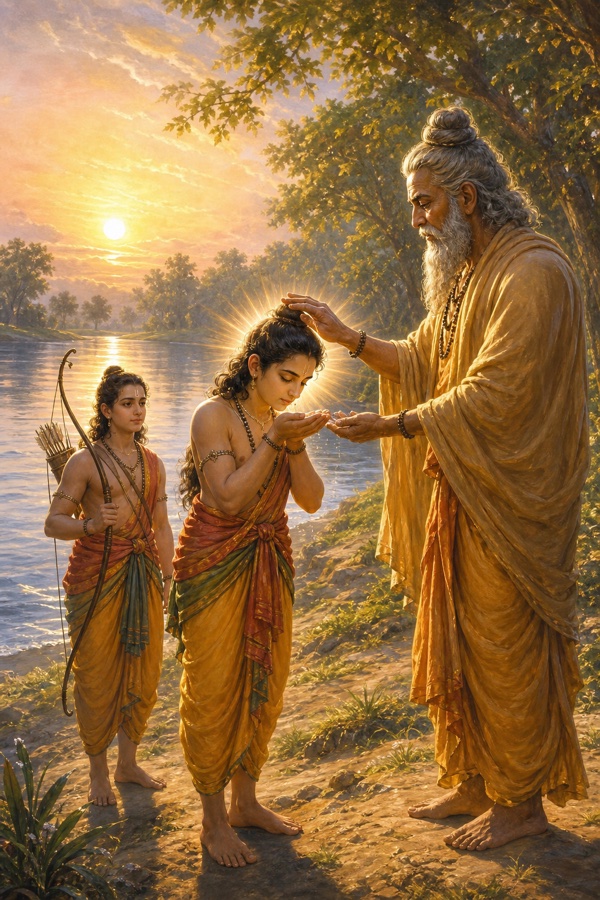
Rama sipped the water. Pure by his own nature, his face full of joy, he received the two lores from the pure-minded sage, and with them in him he shone like the sun of autumn casting its thousand rays. The two brothers did for Vishvamitra everything a pupil owes a teacher, the fetching and the serving and the attending, and the three of them spent the night at their ease on the bank of the Sarayu. Their bed was straw. A prince has never slept on straw, and the night should have been a hard one, and it was sweet, because Vishvamitra’s affection ran through every word he said to them and kept them warm on it.
The Ashram of Kama at the Ganga-Sarayu Confluence
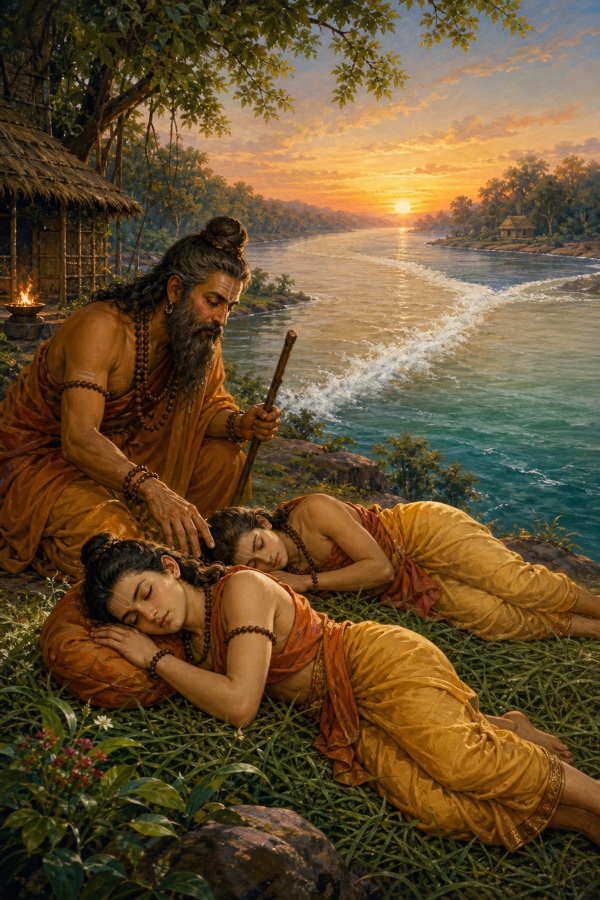
The night thinned toward dawn. The brothers lay on a bed of dry leaves and straw, and Vishvamitra, standing over them, spoke before the sun was up. “Kausalya is blessed in a son like you, Rama. The morning twilight has begun. Rise. The day’s duties are waiting: the meditation on the Deity, the rites that purify the body.”
The words were gentle, and the two heroes were on their feet at once. They bathed, they offered water to the sun as it came up, and they recited the Gayatri, the mantra of the dawn, and there is no holier thing a voice can say. The whole of the morning’s observance followed: the twilight prayer, the portion of the Veda a man owes the seers each day, the firewood gathered for the sacred fire. Then they bowed to Vishvamitra, rich in tapas, and stood before him, glad and ready to go on.
They moved on from the place where they had broken the journey, and before long the two princes came in sight of the Ganga, the divine river, the Tripathaga who runs on three roads, through heaven, across the earth, and down into the world below, near her blessed confluence with the Sarayu. On that ground stood hermitages, the holy retreat of rishis of purified heart, who had been at the highest austerities for many thousands of years. The sight delighted the brothers, and they asked Vishvamitra, “Whose holy hermitage is this? Who lives in it? We both want to hear, sir, and our curiosity is great.”
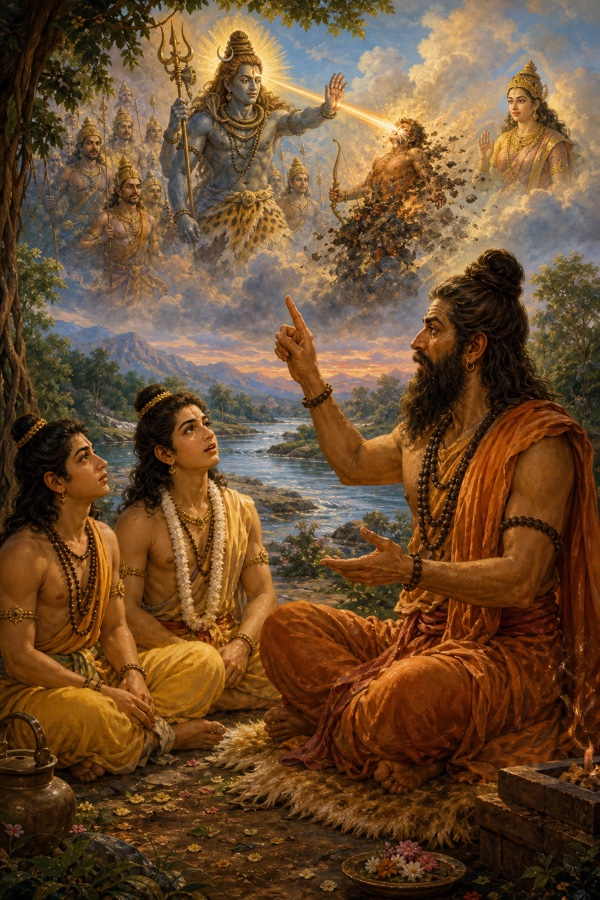
Vishvamitra laughed out loud, and told them. “Listen, Rama, to whose home this once was. Kandarpa, whom the wise call Kama, the god of love, had a living body once. In this very hermitage Lord Shiva, the ruler of the gods, sat in tapas, held steady by his vows, sunk in meditation and never rising out of it. Shiva had lately been married. He was going out, with the whole host of the forty-nine wind-gods around him, to meet Parvati, and Kama, the fool, was bold enough to loose his arrows of love at him. The Lord’s answer was a roar, a single sound, hum. Then Rudra looked at him with his third eye, Raghava, and every limb fell off the witless creature’s body. The fire of the Lord’s anger consumed them where they fell and they were gone. From that day Kama has been Ananga, the one without limbs, and the land where he shed his body has been called the country of Anga. So the tradition goes.
“This holy hermitage is the Lord’s. The sages here were his disciples in the old days, and so they are devoted to dharma, and there is no sin in them. Tonight we halt here, Rama, in a hermitage held between two sacred rivers, and tomorrow we cross the Ganga. Bathe first. When we have bathed and recited and poured our oblations into the fire, we will all go in, and the night we spend here will be a good one.”
They were still talking outside the hermitage when the sages inside knew they had come. Years of austerity had given those men a sight that reached far past the limits of the eye, and they felt the presence of the three at their gate and were thrilled with joy. They came out. They brought Vishvamitra water for his hands and feet and offered him everything a host offers, and then they did the same for Rama and Lakshmana. The guests gave courtesies back, and the sages regaled them with old tales. When the light went and day and night met, every rishi there, Vishvamitra and his two pupils among them, sat with a calm and collected mind and recited the Gayatri, each to the measure he was able.
So Vishvamitra and his two pupils passed the night in great comfort among the hermits of holy vows, on the ground that still carried Kama’s name. And Kaushika, whose mind was given to dharma, kept the two princes awake and rapt with story after story.
The Origin of the Sarayu and Tataka’s Forest
The dawn came clear. Their morning rites done, and Vishvamitra walking ahead of them, the two brothers came down to the bank of the Ganga. The great sages of the hermitage had a fine boat brought to the water and said to Vishvamitra, “Board the boat with the princes behind you. Cross, and go on at an auspicious hour; let no time be lost.” “So be it,” Vishvamitra said, and returned the seers’ farewell, and with the two brothers he began to cross the river as it ran toward the sea.
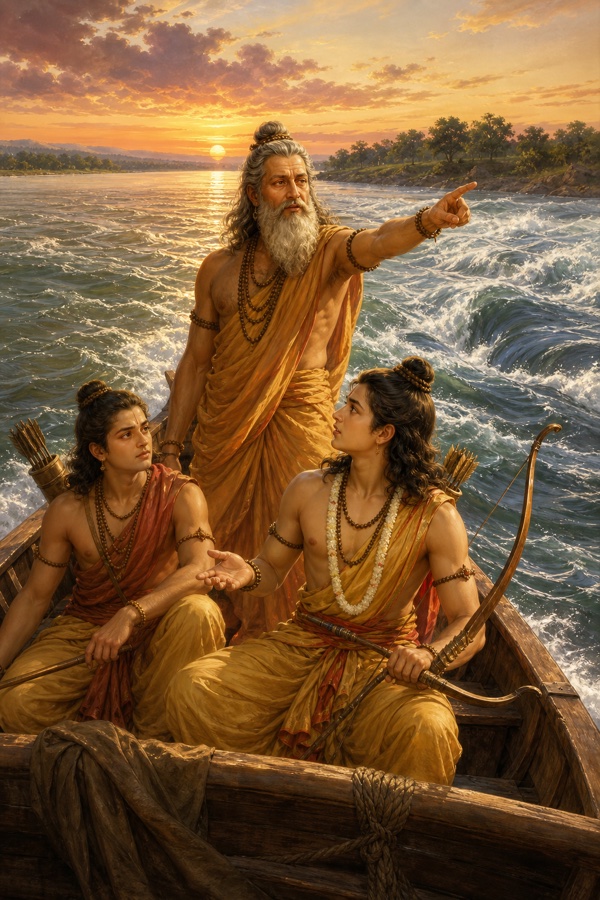
In midstream Rama heard a sound swelling out of the water, a tumult, wave striking wave and the noise of it growing. He wanted to know what made it, and he asked. Vishvamitra said, “On Mount Kailasa, Rama, there is a great lake that Brahma made with his mind, and so it is called Manasa, the mind-born. The Sarayu rises out of that lake. She is called Sarayu because she flows from a lake, and she is holy because the lake she flows from was shaped by Brahma. She rings Ayodhya on every side except the south. This sound that has no equal is the sound of her waters rushing to meet the Jahnavi, the Ganga, who bears that name because the sage Jahnu, when she flooded his sacrificial ground, drank her up entire and later let her out again through his ears. Bow to the two rivers where they meet, Rama, with a steady mind.”
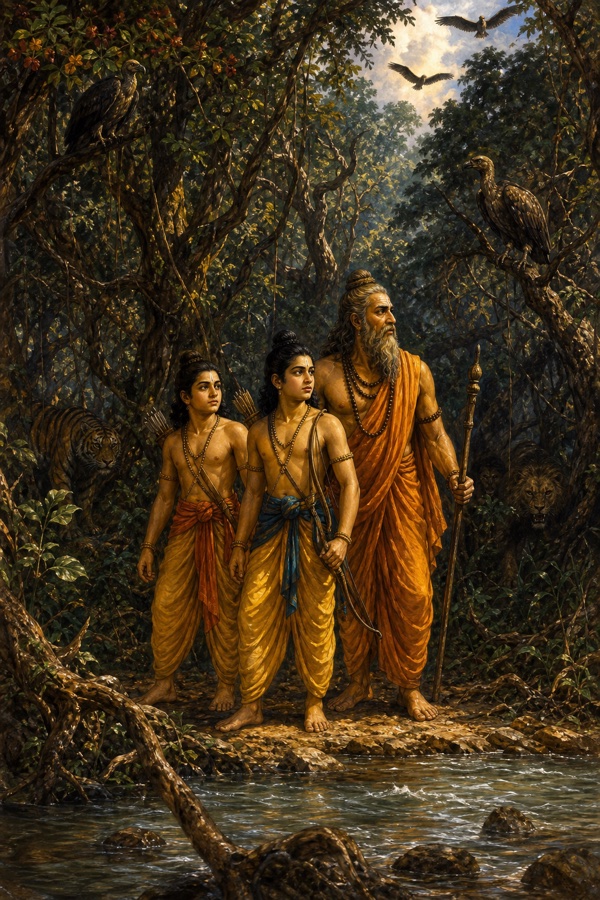
They bowed to the two rivers and stepped onto the southern bank of the Ganga, and the brothers, devout past the ordinary, pressed on at a quick pace. The country changed. A forest rose in front of them, grim and empty of people, and Rama of the house of Ikshvaku looked at it and asked, “How hard this forest is to enter. It swarms with crickets. It is full of beasts of prey, of hawks and vultures and birds whose cries are harsh. There are lions in it, and tigers, boars, elephants, and it is thick with dhava, with ashvakarna, with kakubha, which is the arjuna tree, with bilva and tinduka and patala and jujube. What is this fearful forest?” Vishvamitra answered him, “Hear, my child, whose forest this is. Long ago there were two prosperous kingdoms on this ground, brought into being by the labor of the gods, Malada and Karusha. In those ancient days Indra killed the demon Vritra in battle, and the sin of killing a Brahmin seized the thousand-eyed god, and with it came impurity and a hunger he could not shake off. The gods and the rishis rich in tapas bathed him with jars of Ganga water made holy by mantras and washed the stain away. The impurity and the hunger fell from Indra’s body onto this land. The gods rejoiced. Indra was clean again and his hunger gone, and glad of it he gave the two tracts a boon: ‘These stretches of ground that have taken my impurity, mala, and my hunger, karusha, will grow rich, and the world will know them as Malada and Karusha.’ The gods saw the honor he had done the land and cried ‘Well done, well done!’ in his praise.
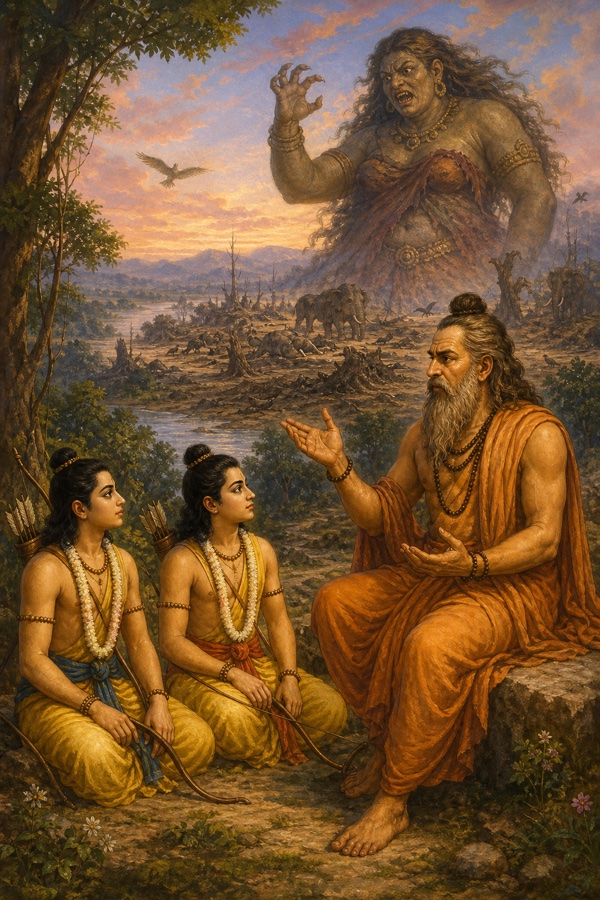
“For a long age those two realms, Malada and Karusha, stayed rich in wealth and grain. Then, some time after, a yakshini appeared here, a woman of the yaksha race who takes any shape she wishes and has carried the strength of a thousand elephants from the hour of her birth. Her name is Tataka. She is the wife of the wise Sunda, and her son is the rakshasa Maricha, who has the strength of Indra: round arms, a huge head, an enormous mouth, a colossal body. That demon is terrible to look at, and he is a constant terror to the people. And Tataka, who lives as a wicked woman lives, ravages these two realms of Malada and Karusha without pause, Raghava.
“She lives across a stretch of twelve miles and blocks the road, and that is exactly why we are going toward Tataka’s forest and nowhere else. Trust the strength of your own arms and put this wicked creature to death. Make this land free of thorns again, on my order. No one can set foot in this country now, holy as it is and beautiful as it is, because of that terrible yakshini, who has grown past bearing. Now you have all of it: why this forest looks the way it does, how the whole region was laid waste by the yaksha woman, and how she has never once turned from her vile work to this day.”
Tataka’s Birth and the Curse of Agastya
Rama heard the sage out, and what he asked next was asked gently. “Tataka is a yakshini, you say, which is to say a woman, and a woman is supposed to be the weaker creature. How does she carry the strength of a thousand elephants?”
Vishvamitra answered in a soft voice, gladdening both brothers as he spoke. “Listen, and you will know where her strength comes from. She was born a frail woman, and the might she carries was given to her by a boon. Long ago there was a great yaksha named Suketu, powerful, upright in his conduct, and childless. He performed a great austerity to please Brahma, and Brahma was pleased with him before the austerity had even run its course, and gave him a daughter. That daughter was Tataka. The grandsire of all creatures gave her the strength of a thousand elephants as well. A son he did not give; the glorious Brahma chose not to grant the yaksha that.
“She grew into her beauty and her youth, and while she was still growing into them, Suketu gave her as wife to Sunda, the son of Jambha, a demon and so a fit husband for a yaksha’s daughter, both races being of the demigods. After a time she bore him a son, Maricha, hard to overcome, who became a rakshasa, an eater of raw flesh, under a curse. It happened this way. Sunda was killed by the curse of the sage Agastya. Tataka, with her son beside her, set out to kill Agastya for it; in her rage she rushed at the sage to devour him. Agastya saw her coming. To Maricha he said, ‘Become a rakshasa.’ And to Tataka, in the fullness of his anger, he said, ‘Drop this lovely form of yours at once. Become a man-eating demoness, hideous, with a face twisted out of shape. Great yakshini that you are, let everything about you turn cruel.’
“The curse changed her, and the curse maddened her. In that shape and in that fury she goes on ravaging this holy ground that Agastya once walked and made pure. For the good of the cows and the Brahmins, Raghava, put an end to this yakshini, cruel, wicked, her strength turned to evil. No man in the three worlds except you would dare to kill a woman armed with a curse like hers.
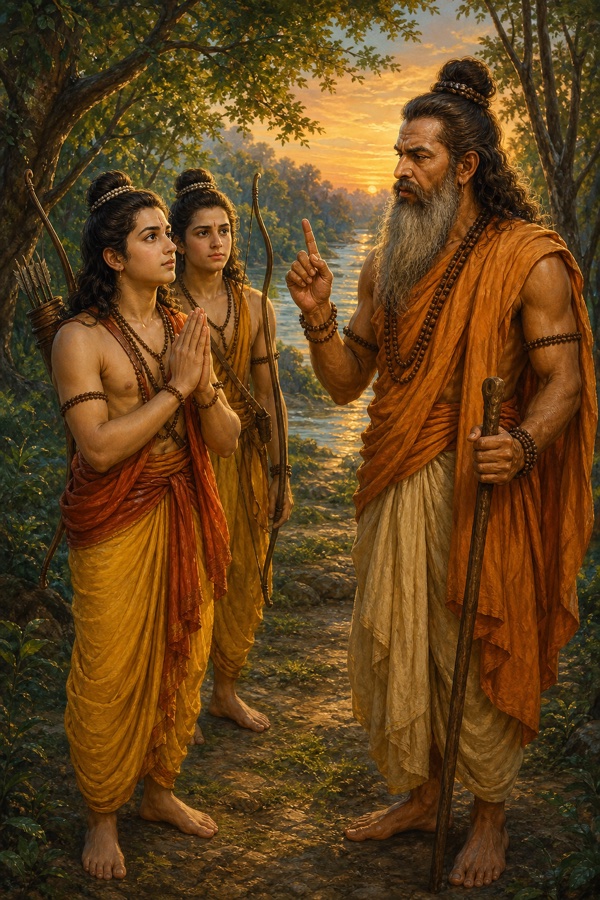
“And feel no revulsion at the killing of a woman. For the good of the four orders of society a kshatriya prince has to do deeds that are cruel and deeds that are gentle, both. To protect the people, the one whose duty it is to protect must at times do even what is sinful or wrong. That is the eternal dharma of those who carry the burden of rule. Kill her, Kakutstha. She is adharma in a body, and there is no dharma in her at all.
“Long ago Indra killed Manthara, the daughter of Virochana, who meant to destroy the earth. The wife of the sage Bhrigu, the mother of Shukracharya, the preceptor of the demons, was devoted to her husband and yet wanted a world with no Indra in it, and Lord Vishnu killed her. Kshatriya princes of the greatest souls have done the same to women given over to adharma, many times.
“So shake off all tenderness, and kill her, at my command, protector of men.”
The Slaying of Tataka
There was nothing cowardly in what the sage had said, and the prince who answered him was firm in his resolve. Rama folded his hands. “In Ayodhya, in front of the other elders, my father Dasharatha gave me an instruction, and this was it: ‘Whatever Vishvamitra commands, carry it out without a moment’s hesitation, because your father has told you to in his own words, and because a father’s word is to be respected.’ I cannot set that aside. I have heard my father’s charge and I have heard your order, and you are a man who speaks the Veda. So I will do this duty, the highest I have, and kill Tataka. There is no doubt in it. For the good of the cows and the Brahmins, for the good of this land, and for your own sake, whose radiance cannot be measured, I am ready to do what you command.”
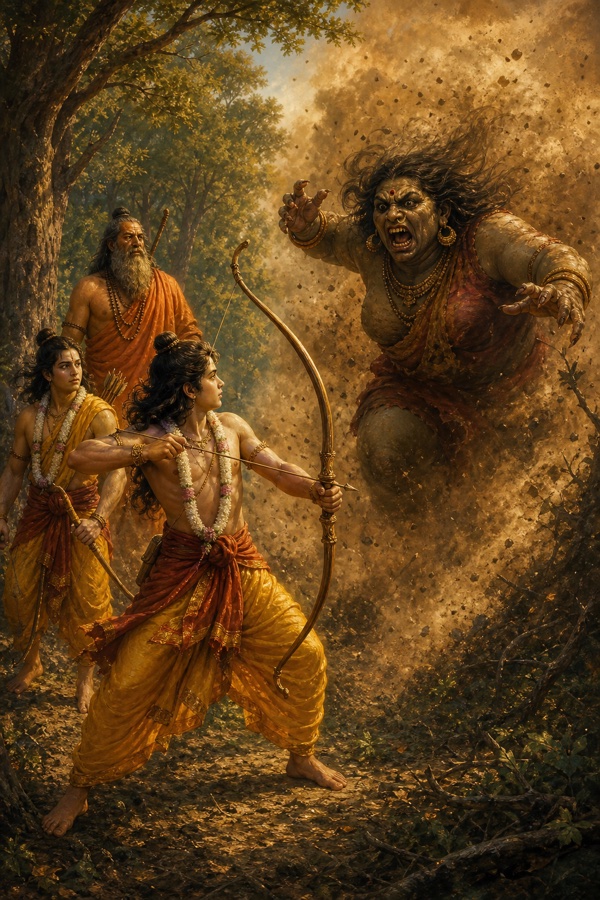
He closed his left fist around the middle of his bow. Then he pulled the string and let it go, and the twang cracked outward until the quarters of the sky rang with it. In the forest every creature that lived under Tataka’s rule froze in terror. Tataka herself was stunned by it for an instant; then rage took her, and she came running toward the place the sound had come from.
She came into view enraged, deformed, her face twisted, her body monstrous in its size. Rama looked at her and said to Lakshmana, “Look at her, Lakshmana. Look at the terrible body of this yakshini; a timid man’s heart would break at the sight of it alone. She is hard to subdue and she carries the power of maya, the art of illusion. Watch me send her running today with the tips of her ears and her nose cut away. My mind does not want to kill her. She is a woman, and her womanhood guards her. I mean to end her strength and her power to move by taking her hands and her feet, so that she can lay this country waste no more. That is my resolve.”
Rama was still speaking when Tataka, out of her mind with rage, lifted her arms and came at him roaring, straight for him. The Brahmin-sage Vishvamitra flung his own sound at her, hum, the sound of rebuke, and called out over it, “Good luck to the two Raghavas! Victory!” Tataka threw up dust. A cloud of it, huge, rolled over the brothers, and for the length of a muhurta they could see nothing. Then she reached for her maya, and rocks came down on the two of them out of the air, a rain of stone, and Rama’s anger rose.
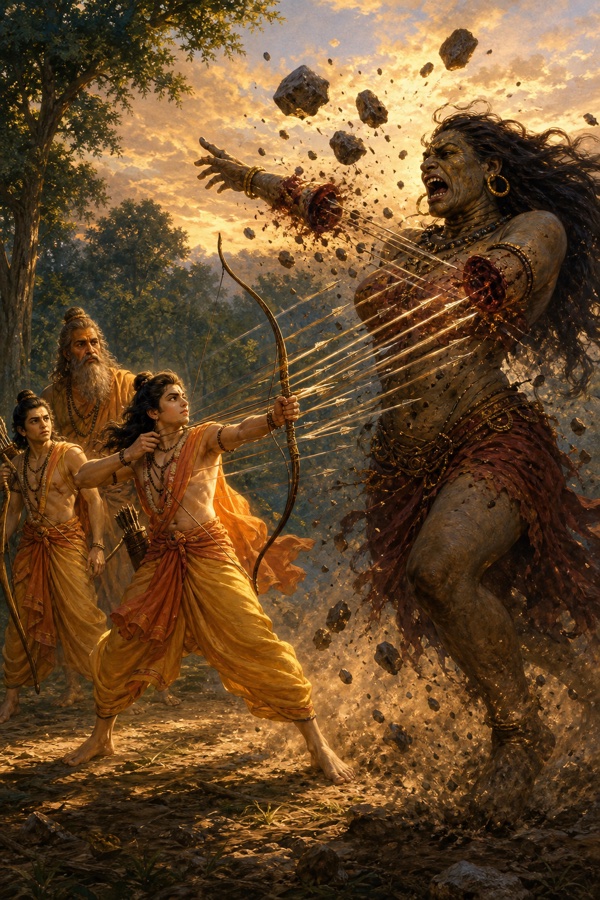
He answered the rain of rocks with a rain of arrows and broke it, and as she came on, running, he cut off her arms with his feathered shafts. She was roaring, exhausted, her arms gone, when Lakshmana, angry now, cut the ears from her head and the tip from her nose. The yakshini, who could take any shape she chose, took many. She bewildered the brothers with her maya and vanished out of sight, and from wherever she was she kept up her terrible rain of stone, roaming here and there through the forest.
Vishvamitra watched the two of them being buried under stones from every side. “Have done with your gentleness, Rama. This sinful yakshini of wicked conduct, this wrecker of sacrifices: kill her before she gathers more strength out of her maya. The twilight is close. At the twilight hour rakshasas are hard to overcome.”
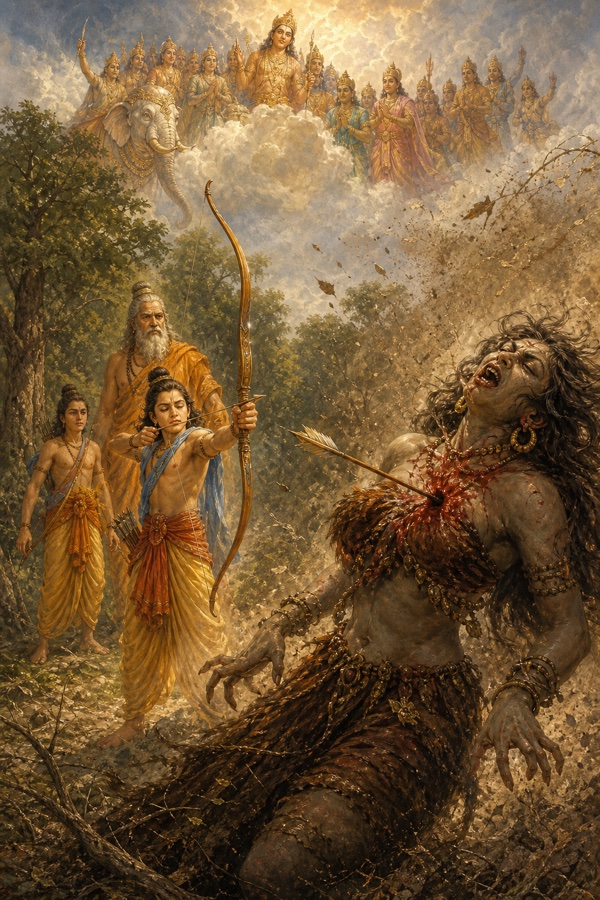
So charged, Rama showed what he could do with his ears alone, and pinned the stone-throwing yakshini down with arrows aimed at the sound of her. Caught in a net of shafts, still armed with her maya, she came roaring at Rama and Lakshmana one last time, with the speed of a thunderbolt hurled by Indra, and Rama put an arrow into her chest. She fell dead. Indra and the gods looked down on the terrible Tataka lying dead on the ground and praised Rama, Kakutstha: “Well done! Bravo!” And the thousand-eyed Indra, breaker of strongholds, delighted, said with all the gods to Vishvamitra: “May good come to you, Kaushika. Every host of the gods, Indra among them, is satisfied with this deed. Show Raghava your affection. Give him the knowledge of the weapons, the sons of Krishashva, that lord of created beings, weapons of unfailing prowess and of the great might that tapas earns. He is worthy of your favor and devoted to your service. A great work of the gods is going to be done through this prince.” Then the gods went back into the sky, praising Vishvamitra, and the twilight came down.
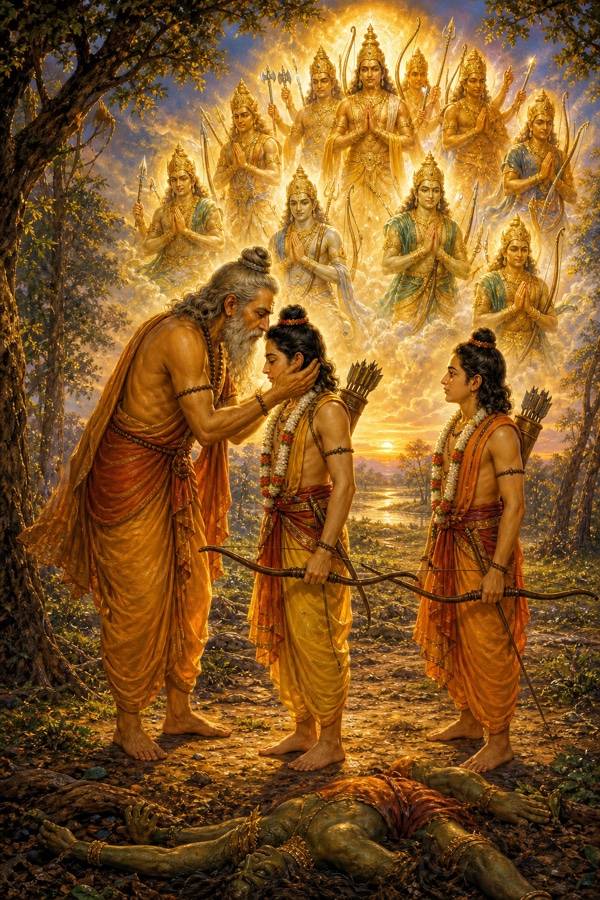
Tataka’s death had consoled the sage. He bent and breathed in the scent of the crown of Rama’s head, tenderly, as the boy’s father had done in Ayodhya, and said, “We spend the night here, Rama of the fine looks. At sunrise tomorrow we go on to my hermitage; you will have heard of it.” The son of Dasharatha, glad at heart, slept that night in the forest that had been Tataka’s, with gods and siddhas applauding him, and the sage woke him toward sunrise. And the forest itself had changed. On that very day, the instant its torment was lifted, the wood came out lovely, and it shone like Chaitraratha, the pleasure garden of Kubera in his capital, Alaka.
The Gift of the Divine Weapons
They had slept in the forest that had been Tataka’s, and in the morning Vishvamitra smiled and spoke to Rama in a sweet voice. “I am greatly pleased with you, prince of high renown, and may good fortune attend you. With the deepest affection I am going to give you the knowledge of all the weapons. With them you will bring under your control and defeat in battle every enemy you have on earth, and the hosts of the gods and the demons too, the gandharvas and the nagas among them.
“I give you all these divine weapons; may good come to you. The great Dandachakra, the discus of punishment; then the Dharmachakra, the Kalachakra, which is the discus of time, the Vishnuchakra, and the fierce Aindrachakra of Indra; the weapon that is the Vajra, the thunderbolt; the Shula of Shiva, his trident, the best of all the weapons he presides over; the weapon named Brahmashira, the head of Brahma; and the Aishika, which is loosed through a reed or a rush or a stalk of grass. I give you the weapon of Brahma, the Brahmastra, which no other weapon excels. I give you a pair of blessed maces, shining, named Modaki and Shikhari. I give you the noose of Dharma, the noose of Kala, and the fine noose-weapon of Varuna, who rules the waters. I give you the two ashanis, the thunderbolts, one dry and one wet.
“I give you the weapon of Shiva, who bears the bow Pinaka; the weapon of Narayana; the fiery Shikhara, the crest, beloved of Agni, the god of fire; the Vayavya, foremost of the weapons of the wind; the Hayashira of Hayagriva, who bears the head of a horse; and the weapon called Krauncha. I give you a pair of shaktis, the javelins, one presided over by Vishnu and one by Shiva. I give you the weapons the demons wield: Kankala, the dreadful Musala, Kapala, and Kinkini, all of them made to destroy rakshasas. I give you the great weapon of the Vidyadharas, the excellent sword named Nandana. I give you Mohana, beloved of the gandharvas, which stupefies an enemy; Prasvapana, which brings sleep; Prashamana, the gentle one, which calms an enemy’s anger; and Varshana, Shoshana, Santapana, and Vilapana, which in turn pour down rain, drink up moisture, loose a scorching heat, and make the enemy wail. I give you Madana, the formidable one, which intoxicates an enemy, beloved of Kandarpa, and Manava, beloved of the gandharvas.
“Receive the weapon of the pishachas, the fiends, named Mohana too, because it infatuates whoever it strikes; and Tamasa, the weapon of darkness; and the mighty Saumana; Samvarta, and the formidable Mausala; the weapon called Satya, the true; the great Mayamaya, which is made of illusion; the Tejahprabha of the sun, which takes the light out of an enemy; the Shishira of the moon, the cold one; the most formidable weapon of Tvashta, the architect of the gods; the dreadful weapon of Bhaga, one of the twelve sons of Aditi who preside over the sun in turn; and the Shiteshu of Manu. Take them now, mighty-armed son of Dasharatha, these powerful and supremely beneficent weapons that put on any form they will.”
The sage purified himself with water and sat facing east, and, glad in his heart, he gave Rama the string of mantras, one after another, that no other mantras in the world can match, the mantras that even the gods cannot hold whole in their memory, and he gave them to Lakshmana as well. And as Vishvamitra recited them under his breath, the weapons came. Every one of them, powers worthy of worship, stood before Rama in its shining, ethereal body. They were full of joy. They folded their hands to him and said, “Here we are, generous Raghava, your servants. Whatever you would have us do, we are ready to do it. May good come to you.” Rama, Kakutstha, accepted them with a glad mind as his own. He touched each of them with his hand, and he gave them one command: “Appear in my mind whenever I think of you.” Then he bowed to the great sage, his heart light, and made ready to go on.
The Withdrawal Lore and More Weapons
They were on the point of leaving the forest that had been Tataka’s. Rama, pure in his whole being, his face bright with what he had received, spoke to Vishvamitra as they walked. “Now that I hold the knowledge of invoking the weapons, even the gods cannot easily overpower me, lord. But there is a second knowledge. I wish to learn the mantras that call a weapon back once it has been loosed.”
Rama had barely finished asking. Vishvamitra, firm in his vows, a man of extraordinary steadiness and purity, taught him and Lakshmana the mantras of withdrawal there on the road. Then he went on. “Receive from me as well, Raghava, since you are the fit vessel for them, these other radiant weapons, sons of Krishashva too, that take any form at will: Satyavan and Satyakirti, Dhrishta and Rabhasa, Pratiharatara, Parangmukha and Avangmukha, Lakshya and Alakshya, Dridhanabha and Sunabha, Dashaksha and Shatavaktra, Dashashirsha and Shatodara, Padmanabha and Mahanabha, Dundunabha and Svanabha, Jyotish and Shakuna, Nairasya and Vimala, Yaugandhara and Vinidra, Daitya and Pramathana, Shuchibahu and Mahabahu, Nishkali and Virucha, Sarchimali and Dhritimali, Vrittiman and Ruchira, Pitrya and Saumanasa, Vidhuta and Makara, Paravira and Rati, Dhana and Dhanya, Kamarupa and Kamaruchi, Moha and Avarana, Jrimbhaka and Sarpanatha, Panthana and Varuna. All of these, Raghava. May good come to you.”
“Badham,” Rama said, so be it, and took them with a glad heart. They stood before him in their living bodies, ethereal, radiant, a delight to every eye that saw them. Some glowed like live coals. Some had the look of smoke. Some were as bright as the sun and the moon. All of them leaned forward with their hollowed palms pressed together, and in sweet voices they said, “Here we are. Tell us what we can do for you.” Raghava said, “Go now, as you please. When I call you to mind, appear there, and help me the instant I need you.” “So be it,” they said, and walked around him with their right sides toward him, the circling that honors a man, and went back the way they had come.
Rama knew them now, and knowing them, he walked on with the sage and spoke to him in his sweet, easy way. “What is that cluster of trees near the mountain, so dark and so dense that from here it looks like a bank of cloud? I am very curious. It is beautiful to look at. It takes the heart. It is full of deer and full of birds of every kind singing sweetly. From the look of the land I think we have come out of Tataka’s forest at last, the one that made the hair stand up on my arms. Whose hermitage is on that ground? And where is yours, the one those sinful, wicked, evil-minded Brahmin-killers keep raiding to break your sacrifice, where your rite is to be guarded and the rakshasas are to be killed by me? I want to hear all of it.”
The Story of Siddhashrama
Vishvamitra, whose glory had no measure, answered him. “In this very grove, mighty-armed Rama, Lord Vishnu, whom all the gods adore, the greatest of ascetics, lived for many thousands of years, for hundreds of turnings of the four ages, given over to tapas and to yoga, the discipline that holds the mind in one place. Here stands the former hermitage of Vamana, the divine dwarf, who is the Supreme Spirit itself. It is called Siddhashrama, the hermitage of accomplishment, because here Vishnu accomplished his end before he descended as Vamana.
“In those days King Bali, the son of Virochana and grandson of Prahlada, ruled Indra’s kingdom. He had beaten the gods, Indra at their head, and the forty-nine wind-gods with them, and his name was known through all three worlds. This mighty king of the demons began a great sacrifice, and to everyone who came to him with a request during it he gave whatever was asked, of whatever kind. The gods, with Agni the fire-god leading them, came to Vishnu in this hermitage while he sat in his austerity and said, ‘Bali, son of Virochana, has begun a great sacrifice. Let the purpose of the gods, who look to you, be accomplished before he brings it to its close. He gives every petitioner whatever he asks. So take on the semblance of a dwarf through your maya, the power that veils what you are, and act for the good of the gods.’ At that same time Kashyapa, radiant as fire, came to that place with his wife Aditi. He had just completed a vow that had run a thousand celestial years, and he praised Vishnu: ‘By my tapas I see the Supreme Person in you, who are tapas itself. I see the whole of creation, all that moves and all that stands, in your body. You are without beginning and beyond description. I take refuge in you.’ Vishnu, glad, told him to ask a boon, and Kashyapa, Marichi’s son, asked it: ‘Grant what Aditi asks, and the gods, and I. Be born as a son to me and to Aditi. Be Indra’s younger brother, and help the gods, who are grieving for their lost kingdom. By your presence this place will be known as Siddhashrama, and when your austerity is done, come and live in our house.’
“So Vishnu, whose glory is past all measure, took birth from Aditi’s womb, and in the form of Vamana, the dwarf, he went to Bali. He asked for as much ground as three of his strides would cover, and Bali gave it. And the Lord, who wanted all three worlds for the good of every creature in them, covered the three worlds in three strides of his all-pervading body, tamed Bali by his divine might, and gave the worlds back to Indra. He put all three under Indra’s lordship once more. That Lord walked this hermitage in the ancient days, and so it has the power to end the long weariness of birth and death. It is out of devotion to that same Vamana that I live here too.
“The rakshasas who wreck sacrifices raid this hermitage, and it is here that those wicked ones are to be killed by you. Now let us go on to Siddhashrama itself; nothing surpasses it. This hermitage is as much yours as it is mine, my child. It belonged to Vishnu first, and you are that Vishnu.”
With that, overjoyed, Vishvamitra took Rama and Lakshmana each by the hand and walked into the hermitage. He shone as he went, like the moon when the fog has cleared and the two stars of Punarvasu stand beside it. The sages of the hermitage saw him coming after his long absence with two distinguished guests, and one after another they sprang to their feet in a flurry and hurried to do him honor. They gave Vishvamitra the worship a man of his standing is owed, and then they turned to the two princes and offered them the hospitality of the place.
The princes rested for a while. Then the two of them, subduers of enemies both, came to Vishvamitra with folded hands. “God bless you. Enter the consecration for the sacrifice this very day, so that Siddhashrama becomes an abode of accomplishment and its name comes true, and so that your word, that the rakshasas are to be killed by me, comes true as well.” Vishvamitra heard them, and the great seer, master of his senses and of his mind, keeper of holy vows, went through the rite of consecration for the sacrifice he was about to perform. From that hour he was bound to it, and to silence.
The two boys slept that night with calm and settled minds. At dawn they rose, pure by their very nature, like Skanda and Vishakha, the two sons of Shiva. They bathed and cleansed themselves, offered prayer to the morning twilight, recited the Gayatri, foremost of mantras, by the rule, and then they greeted Vishvamitra. He sat at his ease. His oblations that morning had gone into the fire in his mind alone, for a man who has taken the consecration for a great sacrifice sets aside the daily offerings of milk and oil, and the rites of the new moon and the full, until the sacrifice is done.
Guarding the Sacrifice and the End of the Rakshasas
The princes knew what a time and a place called for, and they knew what words to use in it. They came to Vishvamitra, and they came with a soldier’s question. “Sir, we want to know the hour. At what moment will those two night-roamers, Maricha and Subahu, have to be guarded against? That moment must not slip past us unseen.” The sages gathered there heard the two Kakutsthas, restless to fight, and were delighted, and praised them.
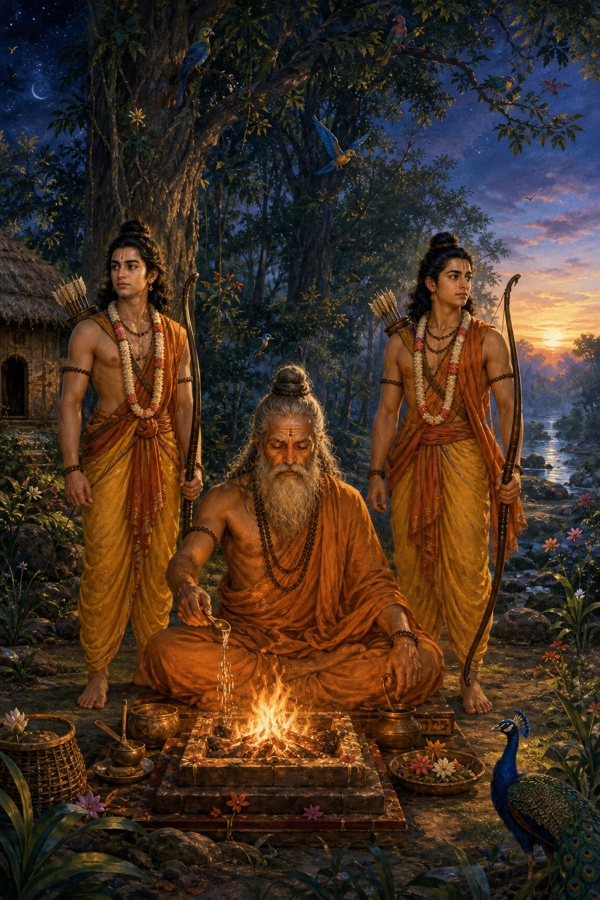
The sages answered on the seer’s behalf. “From this day, keep watch for six days and nights without a break, Raghavas. This sage has taken the consecration, and he will keep silence the whole time, as he is keeping it now.” The two famous princes did exactly that. For six days and nights they guarded the grove that austerity had made holy, and in all that time neither of them closed his eyes for a wink of sleep. Bows of the finest make in their hands, alert every hour, the two heroes stayed at Vishvamitra’s side and guarded him and guarded his sacrifice.
Five days went by. The sixth came, the day that matters most in a rite of this kind, the day on which the soma is pressed. Rama said to Lakshmana, “Be ready. Be watchful. It will be a fight.” He was restless with wanting it, and he had hardly spoken when the fire on the altar leapt up of its own accord, in front of the Brahma, the priest who oversees the whole rite, who was Vishvamitra himself, and in front of the other officiating priests. The altar was laid with kusha grass, with the chamasa and the sruk, with pieces of firewood and heaps of flowers for the worship, and ringed by the priests, and all at once it blazed, a warning that the rakshasas were coming.
The sacrifice went on by the rule, the sacred texts being chanted, and then the sky filled with a terrible roar. The way the monsoon clouds come over and close the sky in the season of rains, so Maricha and Subahu came down on the altar, spreading their maya as they came. They and their followers, all of them terrible to see, arrived above the rite and let fall a torrent of blood, of flesh, of pus, and worse. Rama saw the altar drenched in blood. He ran to it at once to find the cause, and he looked up and saw the rakshasas in the air.
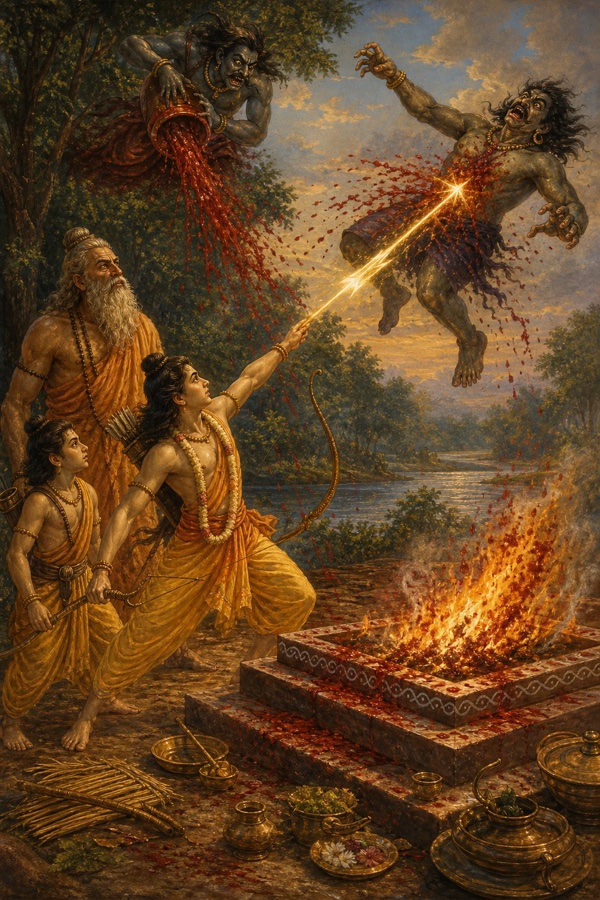
The two of them came plunging down at him. Rama, lotus-eyed, looked at Lakshmana and said, “Look at them, Lakshmana. Wicked rakshasas, eaters of raw flesh. I am going to scatter them with the Manavastra, the weapon of Svayambhuva Manu, the first of men, the way the wind scatters clouds; there is no doubt of it. I do not feel like killing them. They have some years still to live.” With that Rama, as quick as thought, set the Manavastra to his bow, that supremely radiant weapon of Manu’s, and in a great anger loosed it at Maricha’s chest.
The blow of that supreme weapon of Manu’s struck the demon full on and flung him a hundred yojanas, eight hundred miles, and dropped him in the middle of the ocean. Rama watched him go, reeling, senseless, carried on the force of the Shiteshu, the cold arrow of Manu, and said to Lakshmana, “Look at the power of Manu’s Shiteshu, Lakshmana, the weapon Manu himself presides over and proved. It has stunned him and carried him that far, and still it has not taken his life. Now for the rest of them: the merciless, the wicked, the workers of sin, the wreckers of sacrifices, the drinkers of blood. I am going to kill them.”
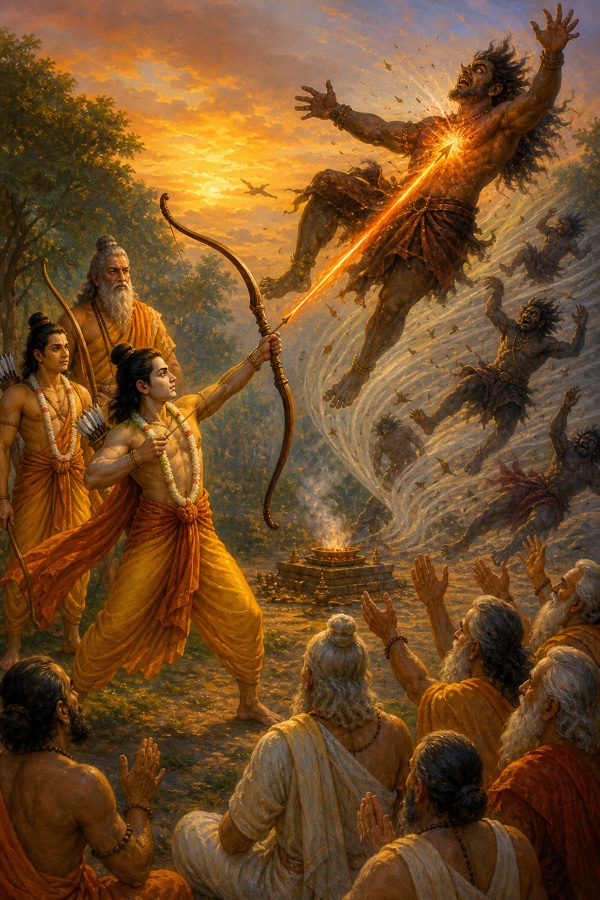
He said it and, as if to show what speed was, in the same motion he drew out the great Agneyastra, the weapon of fire, and loosed it at Subahu’s chest. It went through him. Subahu fell to the ground dead. Then Raghava took up the Vayavyastra, the weapon of the wind, and drove the remaining rakshasas away into the distance, and the sages shouted for joy. Every demon that had ever broken a sacrifice on that ground was gone, dead or scattered, and the rishis honored Rama in that holy retreat the way the gods honored Indra long ago after his victory over the asuras.
The sacrifice came to its close. The great sage Vishvamitra looked out at every quarter of the sky and found no trouble anywhere in it, and he spoke to Rama for the first time in six days. “My purpose is accomplished, mighty-armed hero of high renown. You have carried out your guru’s bidding. And the name of this Siddhashrama has been made true.” With that praise given, he offered the prayers of the evening twilight, and the two brothers offered them at his side.
The gist: After six sleepless nights of guard, Rama flings Maricha a hundred yojanas away with the Manavastra, kills Subahu with the Agneyastra, and Siddhashrama becomes in truth an abode of accomplishment, the sage’s promise made good.
Source: Srimad Valmiki Ramayana, Balakanda, Cantos 19 to 30. The Gita Press edition (Gorakhpur) is the controlling witness. The Sanskrit e-text and an independent complete translation were used to verify names, sequence, and principal events. Where recensions differ, this retelling follows Gita Press.
Based on the Valmiki Ramayana (Gita Press, Gorakhpur)