On this page
Ayodhya went to sleep one night as a city with a king and woke the next morning as a city waiting for one. Bharata and Shatrughna were far away in the country of the Kekayas, their mother’s people. Dasharatha, old now past the measure of ordinary men, had looked at the eldest of his four sons and settled a wish that had long been circling in his heart. With age heavy on his limbs and strange signs troubling the sky, he summoned the kings and ministers of his realm and told them that on the following morning, in the hour when the moon stood in the star Pushya, Rama would be consecrated prince regent. From that announcement a festival began, the kind in which an entire city loses its head at the mere thought of the crowning of a prince it loves.
Four sons, and the resolve in Dasharatha’s heart
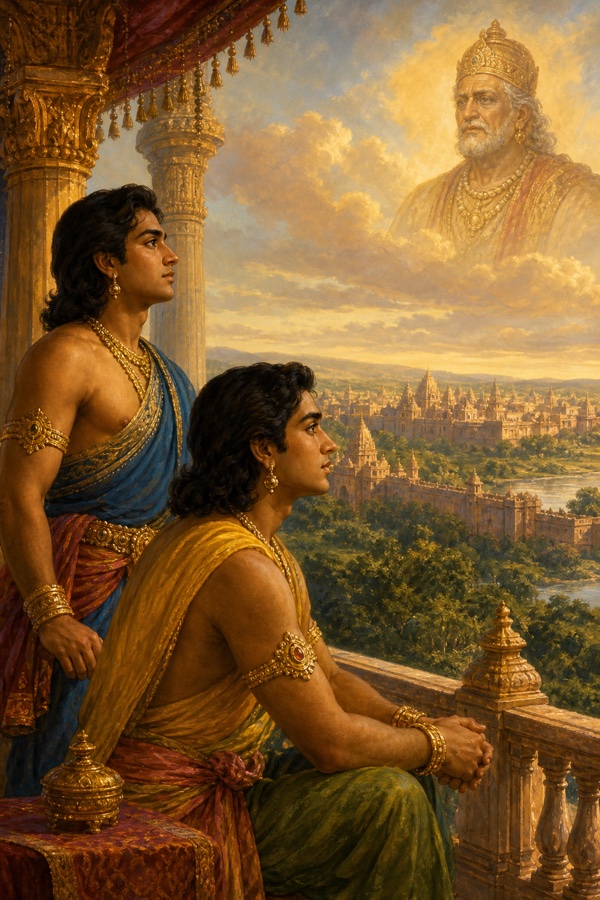
When Bharata had set out for the Kekaya country, the land of his mother’s people, Shatrughna would not be left behind. The youngest of the four brothers loved Bharata with a whole and uncomplicated heart, and so the two of them made the journey together. Their maternal uncle Yudhajit, a lord of horses, received them with every courtesy a royal house can offer and treated them with a father’s tenderness, and Bharata settled in there with his younger brother. There was nothing the two princes could want that was not put before them. Still, in the midst of every comfort, their thoughts kept turning back down the road to Ayodhya and to the aged king who was their father. And in Ayodhya the emperor, in all his splendor, found himself remembering those two absent sons, Bharata and Shatrughna, each of whom could stand comparison with Indra, the king of the gods, or with Varuna, who rules the waters.
All four were equally dear to him. He thought of them as four arms grown from his own body, and no father tells his right arm from his left in love. Yet among them it was Rama, radiant beyond the others, who gave the old man a joy that went past joy, and who stood above his brothers in every excellence as Brahma, the self-born creator, stands above all that he has made. There was a reason for that. The gods, harried by the arrogance of Ravana and pleading for his destruction, had gone to Vishnu, and the eternal Lord had consented to be born on the mortal earth as this prince. So Kausalya, his mother, shone with a son of measureless glory as Aditi had once shone with Indra, the wielder of the thunderbolt and first among the gods.
Rama was beautiful to look at, and brave, and he never went looking for a fault in anyone. As a son he had no equal on earth, and in character he was Dasharatha over again. His mind rested in a deep calm. He spoke first, and gently, before anyone had addressed him, and when someone answered him with harsh words he returned no harshness at all. A single kindness done to him once was enough to win his lasting gratitude, while a hundred injuries slid off him because he had made himself master of his own heart. Even in the hours that his training with the bow and the missile left free, he sought out only the company of good men who were older than he was in conduct, in learning, and in years.
He was clever and sweet of speech, the first to open a conversation and a pleasure to listen to, and for all the enormous strength in his arms he never once made a show of it. He never told a lie. He was learned, he honored his elders, and the people of Ayodhya loved him as he loved them, with a bond that ran in both directions. He was tender toward suffering, he had conquered his anger, he revered the Brahmins, he pitied the wretched, he knew what dharma asked of a man, he kept himself always in check, and he was clean within and without.
His mind was worthy of the house that bred it. He held the duty of a warrior, the kshatra-dharma, in the highest regard, and he prized with a lover’s fondness the heaven that such duty earns. Anything that brought no good he had no appetite for, and no talk that ran against dharma could hold his attention. In laying out an argument and answering its counter-argument he was the equal of Vachaspati, the lord of speech himself. Free of sickness, young, eloquent, well built, a knower of the right place and the right hour for every act, he was the one truly good man the world had yet produced who could measure the worth of any person who stood before him.
The home of all virtues, and the earth’s longing
Rama had studied all four Vedas exactly as they are meant to be studied, with every branch of learning that hangs from them, and he had carried through the vows that go with each science. With the bow, and with the missiles that are loosed by the power of a chanted spell, he had outstripped even his father, and Dasharatha was an archer without a rival. He understood the true nature of dharma, of artha, and of kama, the three aims that a full life must hold in balance. His memory was sharp and his sight penetrating. He was as capable in the daily business of the world as he was practiced in the rites the Vedas prescribe. He was modest. He kept his feelings to himself and his deliberations secret, and men gathered to him as followers because they trusted him. Neither his anger nor his pleasure ever missed its mark, and he knew the moment to open the treasury and the moment to keep it shut.
His devotion did not waver and his judgment did not tilt. He would not gather worthless men about him, and no coarse word left his mouth. Free of sloth and never careless, he saw the faults of his own people as clearly as the faults of strangers. He knew the sacred lore, he never forgot a service done to him, he could read what a man was thinking, and when he punished or when he rewarded he weighed each case by the rule of fairness. Born into a house that had always worked for the good of others, saintly, never downcast, plain-spoken and without guile, he had been schooled from every side by elderly Brahmins whose eyes were fixed on dharma and on the practical interests of a kingdom alike. He knew how to draw men of worth to his side and how to keep them, and where force was needed he knew that too. He understood the springs from which a treasury is filled without grinding the people who fill it, and he had mastered the art of spending, laid down in the shastras, that keeps a kingdom solvent.
He was at home in the many shastras and equally in the works composed in mixed speech, the plays in which Sanskrit and the tongues of the street share one stage. He tasted the pleasures of life while keeping dharma and artha intact, and he was never idle. He knew the arts that exist to give delight, singing and the playing of instruments and drawing, and he knew how to apportion the revenues of a state among its needs. He could mount and master an elephant or a horse. Among those who knew the science of the bow he stood first, and the atirathas, the warriors who can face a host of great chariot-fighters alone, esteemed him as one of their own. He knew how to break into an enemy’s fortress, how to press an attack home, and how to draw up an army in its battle formations. Gods and demons together, in the full heat of their rage, could not have beaten him in the field. He looked for no faults in others, he had conquered his temper, he was never puffed up, and he was never jealous.
No living creature could slight him and go unpunished, and even Time held no dominion over him. Bearing these highest of virtues, the son of Dasharatha was honored in Ayodhya and in all three worlds, the heaven above, the earth beneath, and the wide air between them. In forbearance and the graces that go with it he matched the Earth, in wisdom he matched Brihaspati, the teacher of the gods, and in valor he matched Indra, the husband of Shachi. As the sun blazes with its own rays, Rama shone with these qualities, beloved of every citizen of Ayodhya and the delight of his father. And the Earth herself, who is a goddess and who has known a great many kings, looked at this prince, whose might no one could subdue, who stood level with the guardians of the four quarters, and wanted him for her own protector.
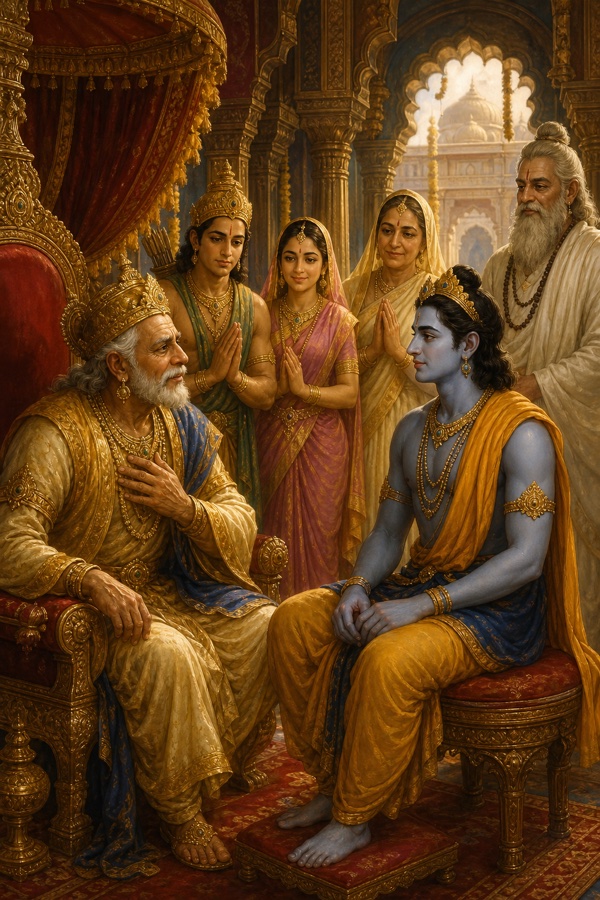
Dasharatha, the chastiser of his enemies, looked at his eldest son clothed in all this, and a question began to circle in his mind. “How can Rama be made king while I am still alive to see it? How can such a thing be brought about? When shall I watch my beloved son consecrated before my own eyes? This is the one wish that keeps turning in my heart, and there is no other. He has compassion for every creature that breathes, and he works for the good of all. He is dearer to the world than I am, dear as a rain cloud is to the parched fields. In valor he is the match of Yama and of Indra, in understanding the match of Brihaspati, in steadiness the match of a mountain, and in virtue he has gone beyond me. If I could see this son of mine ruling the whole earth while I am still here, in this ripe old age of mine, then I could go up to heaven with nothing left to want.”
He weighed it all. He looked once more at a Rama whom these virtues, so hard to find in other kings, and countless others beyond them, had set apart from every prince alive, and he took counsel with his ministers and made his decision. Rama would be consecrated prince regent. The shrewd old king did not hide from those ministers what was driving him. He spoke of the dreadful portents that had begun to show themselves in the heavens, in the air between heaven and earth, and on the ground, and of the age that was telling on his body. And he heard from the same men how the people loved Rama, whose face had the fullness of the full moon, so completely that the telling of it eased the dread those portents had planted in him.
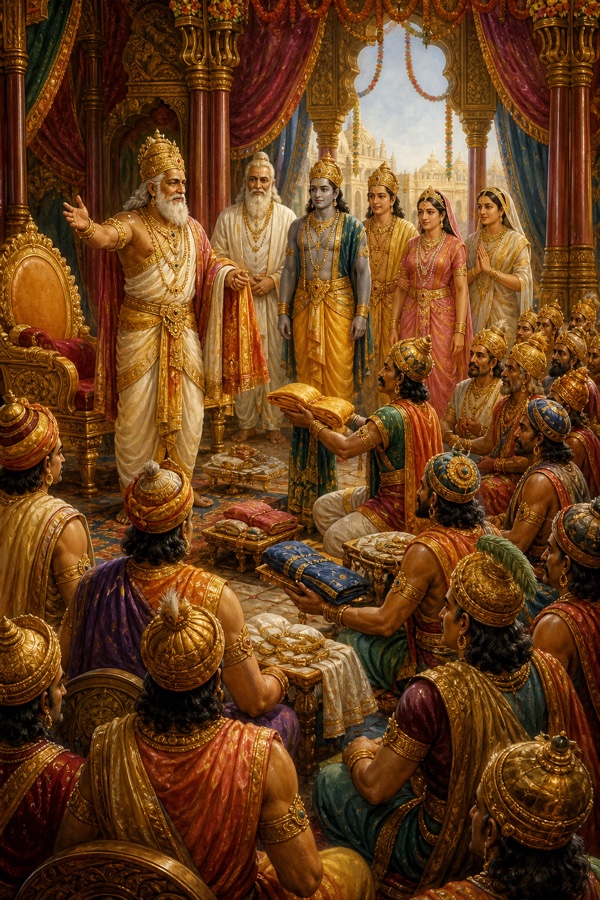
When the opportune moment came, the righteous king, thinking of his own good and the good of his people, and of their pleasure too, urged his ministers to move quickly. The lord of the earth summoned to his capital the leading citizens of many towns and the rulers of the different provinces of the realm. When they arrived he saw them lodged as their rank deserved and presented each with robes and ornaments, and then, decked in his own jewels, he looked out over them as Brahma, the lord of created beings, looks out over his offspring. In his haste he sent no invitation to the king of the Kekayas, Bharata’s grandfather, and none to Janaka, the lord of Mithila and Sita’s father, and he quieted himself with the thought that both would hear the happy news soon enough.
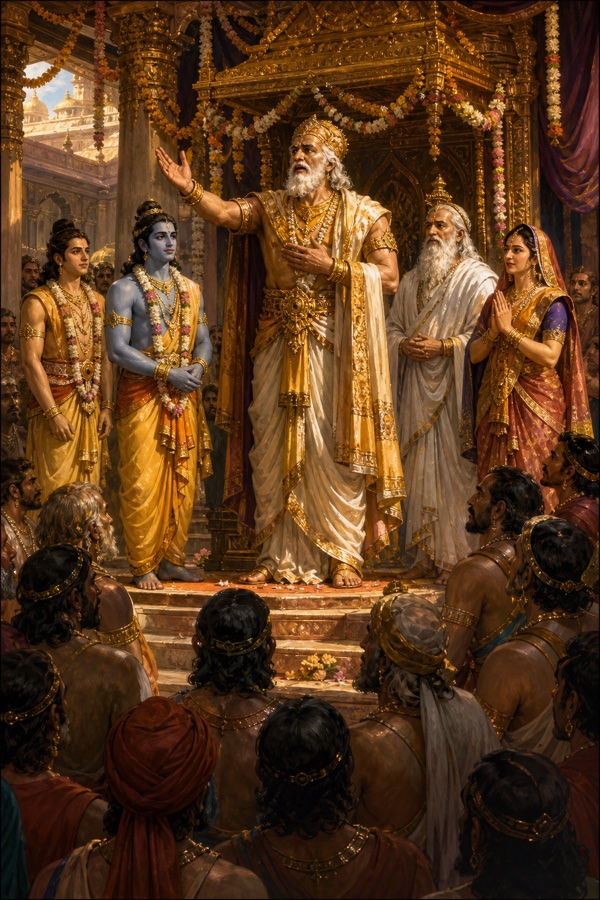
The moment the emperor, breaker of enemy cities, took his seat in the assembly he had called, the other kings, each honored in his own land, filed in after him and settled in disciplined silence onto the seats he had assigned, every face turned toward him. Ringed by those courteous kings whom he had received with such care, and by the leading men of Ayodhya and the provinces, all of them seated close so that no word of his would be lost, Dasharatha shone like Indra of the thousand eyes amid the gods; and a king, like Indra, has a thousand eyes, for every spy in his service is one of them.
Dasharatha’s announcement in the assembly, and the consent of all
Then Dasharatha turned to that whole assembly and spoke. His voice was deep and carried, rolling out over the hall like the boom of a kettledrum, like a thundercloud that has decided to speak, and yet it was pleasing, melodious, and marked with every sign by which men know a king’s voice from other voices. What he said was wholesome, it lifted the heart, and it left no room for misunderstanding. “You all know how this fine kingdom of mine was cherished, as a man cherishes his own son, by the great kings who sat here before me. I wish to endow this whole world, which the Ikshvaku kings ruled before me and which has earned its happiness, with a fortune of a rare kind: the rule of Rama. I too have walked the path my forefathers walked. I have guarded my people to the limit of my strength, and I have gone without sleep when their safety asked me to stay awake.
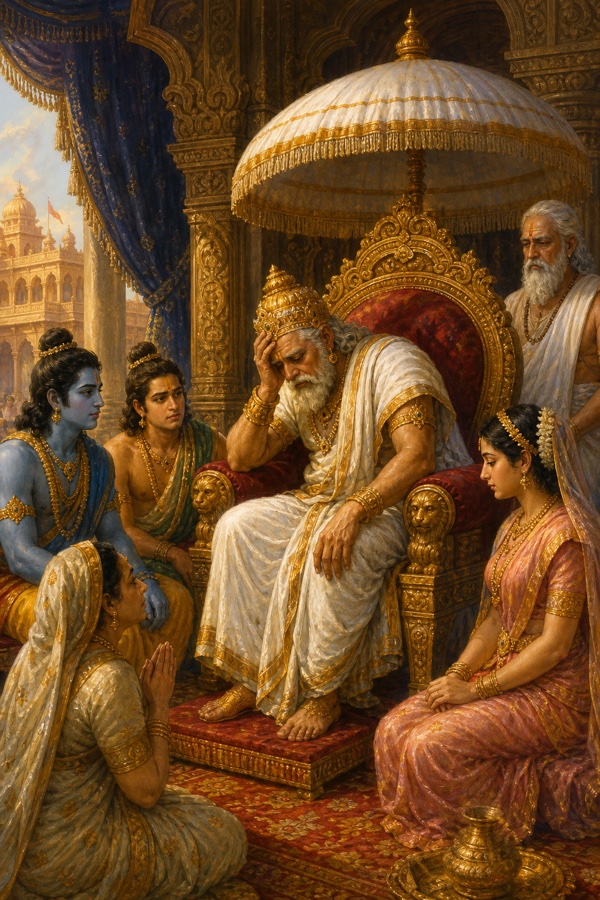
“In the shade of the white umbrella, laboring for the good of the whole world, this body of mine has worn thin. It has lived for thousands of years. It has run through span after span of a human life, a hundred years to each, and I want to give it rest at last. This heavy yoke of dharma, the burden of governing a people rightly, is a load that only the strength of kingship can bear, and it crushes any man who has not conquered his senses. I have carried it a long time, and I am tired. I would put my eldest son Rama in charge of the welfare of the people, and, with the consent of these jewels among Brahmins who sit nearest to me and hold my welfare closest, I would take my rest.
“My eldest son Rama has grown into my likeness in every quality. He is Indra’s match in valor, and he has taken enemy cities. Tomorrow morning, when the moon stands in Pushya, I mean to install as prince regent this jewel among men, the first of all who uphold dharma, who is as beautiful and as auspicious as that moon in that star. Rama, the elder brother of Lakshmana, a prince on whom fortune rests, is a lord worthy of you all. With him as its protector the three worlds themselves would be better governed than they are today. I shall lay this blessing on the earth at once, and when the burden of rule is settled on that son of mine, I shall be free of care.
“If this plan of mine seems to you to have a worthy end, and to have been well thought through, then give me your consent. Or tell me how else I ought to proceed. It is my own wish, and if it does not please you, let some other course be found that serves the common good. The judgment of a neutral mind, born from the clash of two opposing views, is a rare thing and worth more than any one man’s certainty.”
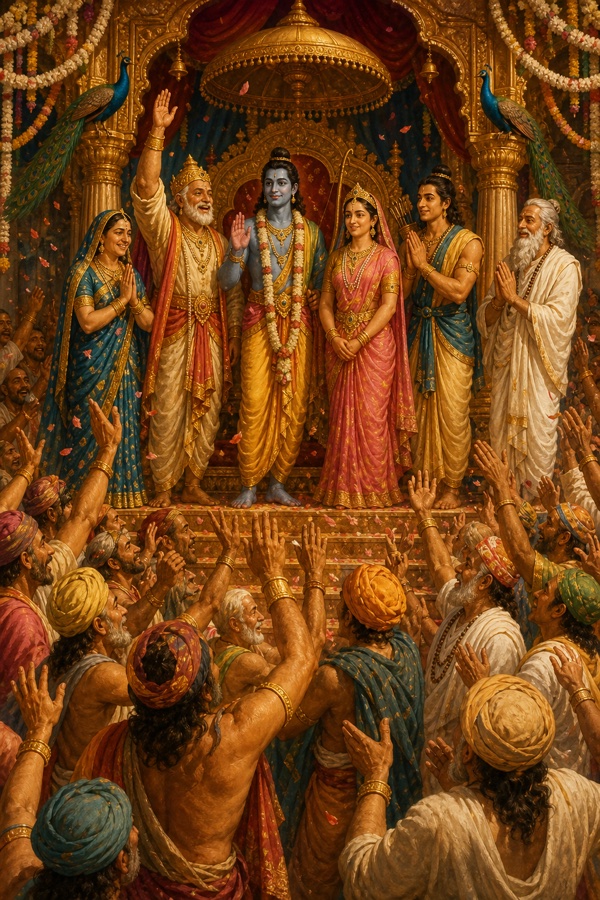
The kings answered before they had words. Delight ran through the hall the way it runs through peacocks when a great rain-laden cloud comes up and they spread their tails to greet it. Then a warm murmur of assent rose, quickened by joy, and swelled into a roar from the whole gathered crowd that seemed to make the ground shake. The Brahmins and the commanders of the army had read the emperor’s mind clearly, the mind of a man who understood dharma and the interests of his realm alike. They withdrew into conference with the citizens of Ayodhya and the people of the other territories, talked it through, came to one mind, and then, having understood in their hearts what the aged king wanted, they spoke.
“You have reigned for many thousands of years, lord of the earth, and you have grown old. Consecrate as prince regent your son Rama, who is fit to rule the earth. We long to see him, the mighty-armed hero of the Raghus, riding a great elephant with the royal umbrella held over his head.” The words were exactly the ones Dasharatha had hoped to hear. Still he answered as though he had not understood them, because he wanted their true feeling drawn out where everyone could see it. “When you hear my proposal, you at once want Raghava for your lord. That raises a doubt in me, and I ask you to answer it honestly. While I am ruling the earth by dharma, and doing it well, why is it that you wish to see Rama, with all his strength, in the office of prince regent?”
Then the great men of that assembly, speaking with the citizens of Ayodhya and the people of the provinces, gave their answer. “Protector of the people, many are the blessed qualities in your son Rama, and we will count out for you here the dear and gladdening virtues of that godlike, wise prince, that home of every excellence. Only listen. In the joy he gives to every creature he is like the moon. In forbearance he is like the earth. In wisdom he is like Brihaspati, and in valor like Indra himself. In his godlike virtues Rama, whose might never fails, is Indra’s equal, and he has outshone every scion of the Ikshvaku line. In all the world he is the one truly righteous man, truthful and given wholly to truth, and dharma itself, with prosperity walking behind it, seems to have stepped out of Rama in living form.
“He knows what is right and he keeps his word. He is amiable and free of the carping spirit, patient, comforting, courteous in speech, grateful, and master of his senses. He is gentle, steady in mind, always gracious, never a fault-finder, kind in his speech to every living thing, and truthful. He waits upon the learned, upon his elders, and upon the Brahmins, and from that service his matchless renown, his celebrity, and his splendor keep growing in the world. He is skilled in every missile of the gods, the demons, and men. He has completed the vows that go with the study of the sciences, he has learned the Vedas in due form with all six of their limbs, and on this earth he is the foremost master of the gandharva art, which is music. He was born of a blessed line, he is saintly, large-hearted, and vast in wisdom.
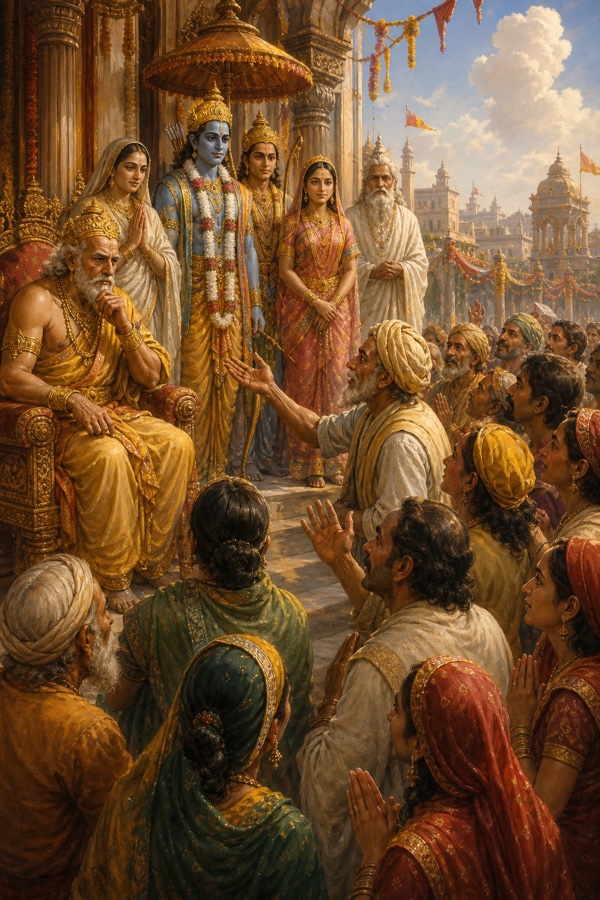
“The finest Brahmins, skilled in expounding dharma and in the handling of a treasury, have schooled him from every side. When he rides out with Lakshmana to fight for the sake of a village or a town, he never comes home without the victory. And when he returns from the field, on an elephant or in a chariot, he asks after the citizens of Ayodhya one by one, in their order of seniority, after their sons, their sacred fires, their wives, their servants, and their pupils, as tenderly as a father asking after the sons of his own body. He asks us Brahmins, ‘Do your pupils serve you as they should?’ He asks the Kshatriyas, ‘Do your bodyguards, in their armor, keep to their duty?’ That tiger among men is sore at heart when he finds anyone in trouble, and at every festival of theirs he rejoices like a father. He speaks the truth, he draws a mighty bow, he serves his elders, and he holds his senses in his hand.
“He opens every conversation with a smile. He has embraced dharma with his whole being. He carries good works through to their end, and he has no taste for argument pursued for the sake of quarreling; yet in the friendly give and take of reasoning that seeks the truth he is a debater of Brihaspati’s own rank. With his shapely brows and his large eyes touched with red at the corners, Rama looks like Vishnu himself walking about in the shape of a man.
“By his courage, his manliness, and his prowess Rama gives joy to the whole world, and though he labors without rest in guarding the people, desire never blinds his senses. He could govern the three worlds, let alone this earth. His frown and his favor are never wasted. He puts to death only the man the scriptures mark for death, and he never turns his anger on one who does not deserve to die; and the man who has pleased him he loads with wealth, glad to be doing it. Held firm by his self-command, loved by every creature, a delight to men, Rama shines with these virtues as the sun shines with its rays.
“Blessed with these virtues, unfailing in his might, the equal of the guardians of the worlds, Rama is the lord the Earth herself desires. Protector of the people, it is our good fortune that this son of yours has grown strong enough to do good to the whole world, and that, like Kashyapa the son of Marichi, he holds every virtue a son can hold. Among gods, demons, and men, among the gandharvas and the nagas, across the land of Kosala and in this best of cities, within the women’s quarters and outside them, in the towns and in the countryside beyond, everyone prays for Rama’s strength, his health, and his long life. At dawn, at dusk, and at noon, women old and young bow to the gods with a single mind for Rama’s sake. Let their prayer, by your grace, come true.
“We long to see this eldest son of yours, dark as the blue lotus and the destroyer of every enemy, seated in the office of prince regent. Your son labors for the good of the whole world, he is the likeness of Vishnu, the god of gods, and the noblest men seek him out. For our sake, quickly and with a glad heart, consecrate him as prince regent.”
Vasishtha’s instructions, and the father’s meeting with Rama
They had raised their joined palms to their foreheads, every man in the hall, the hollow of the hands shaped like a lotus bud, and the king answered that salutation with words that were fond and full of care. “Ah, I am filled with joy, and my good fortune has no equal, that all of you should want my eldest and best-loved son Rama in the office of prince regent.” Having honored them so, he turned, within the hearing of them all and of the people of Ayodhya and the countryside, to Vasishtha and Vamadeva and the other Brahmins. “This is Chaitra, the splendid and sacred month, when the woodlands stand dressed in blossom as if for a festival of their own. Let everything be made ready for Rama’s consecration as prince regent.”
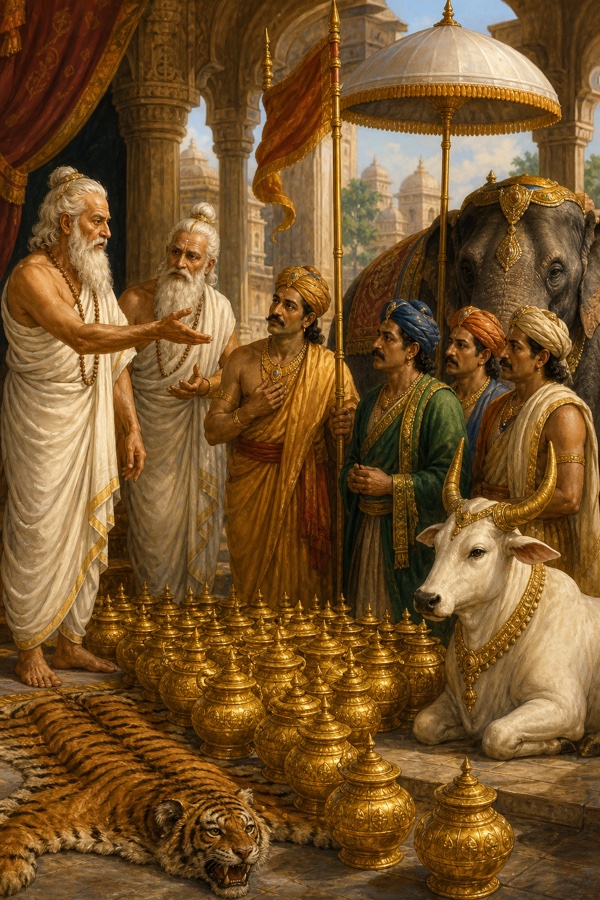
The king’s words had barely ended when a great shout went up from the crowd, and only as it slowly died away could he go on. He asked Vasishtha, that tiger among sages, to prescribe every rite the shastras require for the consecration of a prince regent, together with all that would be needed to perform them. To the ministers who stood before the king with folded palms, Sumantra among them, Vasishtha began to dictate. Gold and the other precious substances. The oblations that are offered to the gods, and every medicinal herb the ceremony calls for. White flowers, and parched grains of paddy. Honey, and clarified butter, each kept in its own vessel and never mixed. Cloth fresh from the loom that no one had yet worn. A chariot, and weapons of every kind. The army entire in its four limbs, horse and elephant and chariot and foot. An elephant marked with the auspicious signs. A pair of yak-tail whisks and a pair of fans. A banner, and a white umbrella. A hundred pitchers of gold that flash like fire. A bull with its horns sheathed in gold, and one whole tiger skin with the claws still on it. And whatever else, sandal paste and the rest, might be wanted. All of it, he said, was to be set out by morning at the royal fire-sanctuary.
“Let the gates of the inner palace and of the whole city be dressed with sandal paste and garlands, and with incense that carries off the sense of smell. Let fine rice cooked in milk and curds, enough to satisfy a hundred thousand Brahmins, be served tomorrow morning to the foremost of them with all respect, and ghee and curds and parched grain besides, and let the gifts that close such a feast be generous. As soon as the sun rises tomorrow the benedictory chant is to be sung, so let the Brahmins be invited and their seats made ready. Let pennants be strung everywhere, and let the royal road be sprinkled with water so that the traffic raises no dust. Let the dancers, men and women, in their finest ornaments, take their places in the second court of the palace and wait to be called. Let the images of the gods in the temples and at the crossroads be worshiped with flowers, each in its turn, and served with cooked rice and other food, and given gifts of money. And let brave men in armor, long swords at their sides, gloves of iguana hide on their hands, and clean uniforms on their backs, enter the great courtyard of the king in high spirits.” Having ordered all this, and having told the king what they had ordered, the two Brahmins, Vasishtha and Vamadeva, stayed where they sat and saw to whatever remained themselves. Then, with joy in their faces, they came before the lord of the world and told him that everything had been done as he had asked.
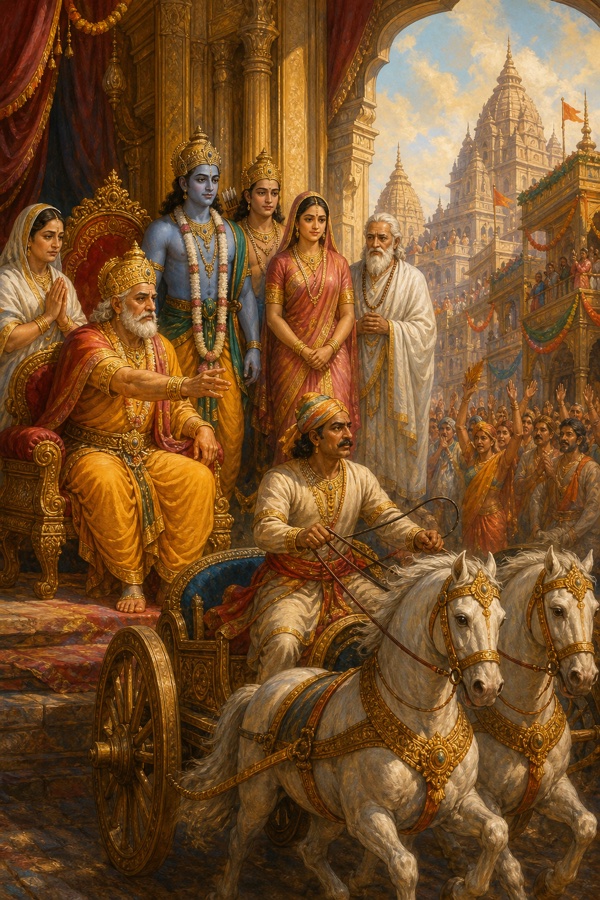
Then the radiant king turned to Sumantra. “Bring Rama, whose mind is disciplined, into my presence, and bring him quickly.” “So be it,” said Sumantra, and at the king’s command he seated Rama, the first of all chariot-warriors, in a chariot and drove him to the council hall. The kings of the four quarters, east and north and west and south, the Mlecchas and the Aryans, and the other rulers whose lands lay at the foot of the mountains and along the edges of the forests, were seated there at their ease, all of them attending upon the emperor as the gods attend upon Indra. And from his seat among them, like Indra among the storm-gods, Dasharatha watched his eldest son come toward him. Rama had the beauty of the king of the gandharvas. His prowess was known across the world. His arms were unusually long, his strength was great, and he walked with the rolling gait of an elephant in rut. His face was lovelier than the moon and a pleasure to look on, and by his beauty, his open-handedness, and his other virtues he drew the eyes and the hearts of men after him, refreshing the people as a cloud refreshes those the sun has scorched. Watching him approach, Dasharatha could not get his fill of looking.
Sumantra helped Raghava down from that fine chariot and, with his palms joined, walked at his heels all the way into his father’s presence. Rama climbed to the palace that stood white as the peak of Kailasa, went with joined palms to where his father sat, and lay down full length on the floor at his feet, in the full prostration a son owes his father, announcing his own name as he did so. Seeing his beloved son stretched out beside him with his palms pressed together, the king took him by those joined hands, drew him up, and clasped him to his chest. Then he showed him to a splendid seat that his servants had already made ready, inlaid with gems and gold. When Rama took it he lit it up with his own radiance, as the clear sun lights up Mount Meru at dawn, and the whole assembly, lit by him, shone as the autumn sky shines when the moon rises into it among the bright planets and the stars. The king looked at his son and was content, as a man is content who sees his own reflection, dressed in all his ornaments, in a mirror.
Then Dasharatha, first among fathers blessed with sons, spoke to the son who now sat easy before him, as the sage Kashyapa might have spoken to his own eldest, Indra, the king of the gods. “You were born of Kausalya, my seniormost wife, who is worthy of me in every way, and you are a son as worthy as she is. In virtue, Rama, you are the eldest too, and you are my beloved son. By your qualities you have won the hearts of all these people gathered here, and so tomorrow, when the moon stands in Pushya, take up the office of prince regent. Everyone who has looked at you has found you rich in every excellence, and found it in your very nature.
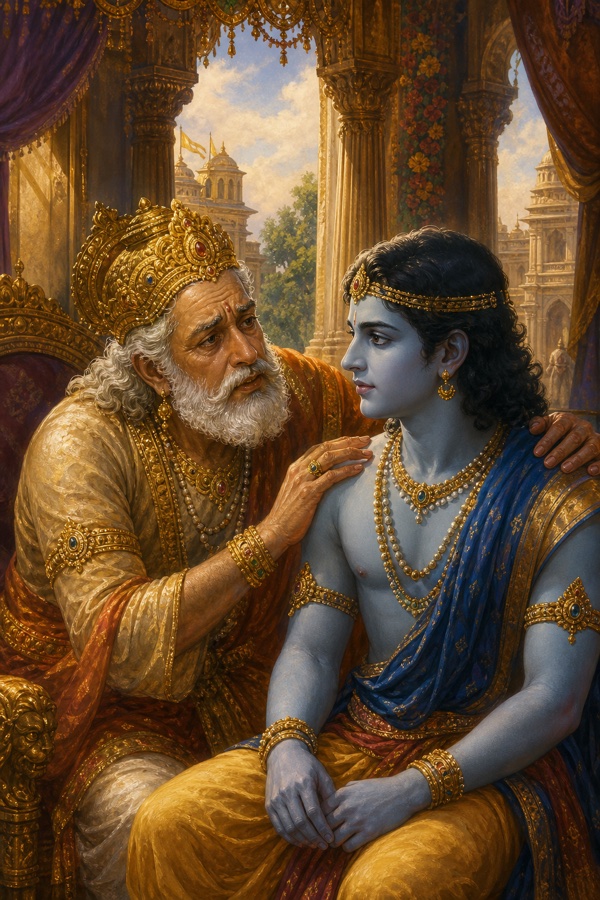
“You are made of merit already, my son, and still, out of love, I will give you a father’s counsel. Put on a humility even deeper than the one you wear, and keep your senses always under your hand. Cast off the vices that grow from desire and the vices that grow from anger. Rule by the unseen way and the open way both: by the spies who tell you what your people and your neighbors are thinking, and by going out among them yourself to hear their grievances with your own ears. Keep your ministers content, and the commanders of the army, and the guards of the city, and all the people. Lay by against the days to come great stores of everything useful, jewels and gold and silver, cloth and ornaments, and fill the granaries and the armories. When a king protects the earth with a fostering hand, and loves his subjects as his children, and is loved by them in return, his friends and allies rejoice as the gods rejoiced when they won the nectar of immortality. So discipline your mind, my son, and conduct yourself as I have said.”
Rama’s friends had heard every word, and they were off before the king had finished, running to Kausalya with the news, eager to do him a service. That finest of women gave gold and cows and jewels of many kinds to the ones who brought her the happy word. Then Rama bowed to the king, mounted his chariot, and rode home to his own shining house, saluted by crowds all along the way. The citizens who had heard the king’s announcement felt as a man feels who has been promised the very boon he wanted. They took their leave of the emperor, went home to their own houses, and worshiped the gods, so that nothing might come between Rama and his consecration.
The ominous dreams, and Rama summoned a second time
When the townsfolk had gone home, the king sat down with his counselors once more. Dasharatha knew the rules by which the time and place of a rite are fixed, and he settled it in his own mind: since Pushya would stand in the sky the very next day, the consecration of Rama, whose eyes were shaped like the petals of a lotus, must take place tomorrow and no later. Then he went into the inner apartments and told Sumantra, “Bring Rama here once more.” Sumantra bowed to the order and hurried back to Rama’s house to fetch him a second time.
The doorkeepers told Rama that Sumantra had come again. Rama had left his father with everything settled, and at the news a shadow of unease fell across him. He had the charioteer brought in at once. “Tell me plainly,” he said, “and hold nothing back. What is it that this second visit is meant to accomplish?” Sumantra gave him only what he had. “The emperor wishes to see you. You have heard what I was sent to say; whether you go to your father now or do otherwise is for you to decide.” Rama had no need to decide. He set off at once for the palace to see his father again.
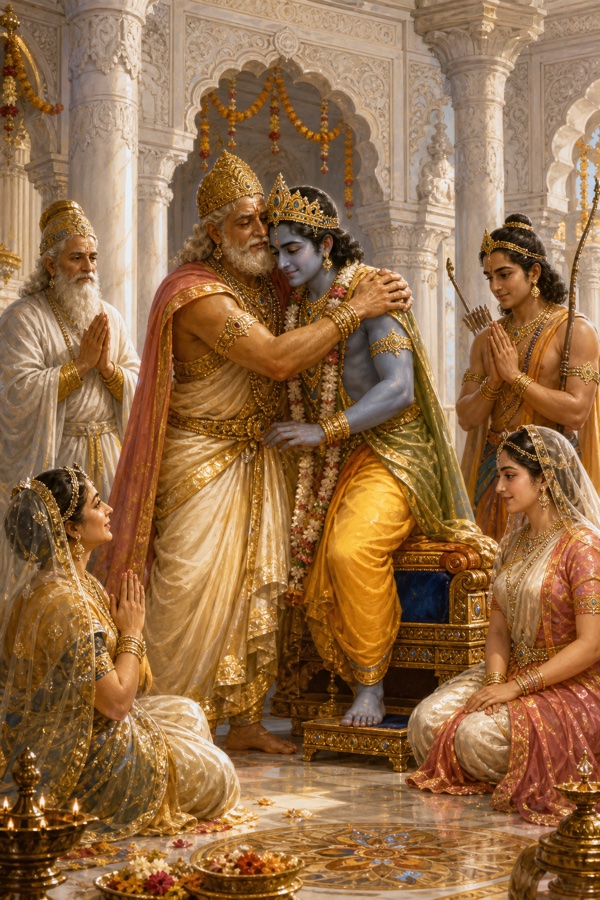
Hearing that Rama had arrived, Dasharatha, who had something most precious and most welcome to say, had him shown straight into his chamber. Rama saw his father from across the room the moment he stepped in, and went down with his palms joined. Even as he lay there the king raised him, pressed him hard against his chest, gave him a seat, and began to speak again. “Rama, I am old. I have lived a long life. I have enjoyed every pleasure I ever wanted, and I have worshiped God with hundreds of sacrifices, from the Jyotishtoma to the horse sacrifice, complete in every rite, with great gifts of grain and generous fees to the priests who performed them. A son of the kind I prayed for, a son without an equal on the earth today, has been born to me in you. I have given the gifts I wished to give and studied the Vedas and the rest. I have known, my brave one, every joy I set my heart on. Through my sacrifices I have paid my debt to the gods, through my study my debt to the seers, through my children my debt to the ancestors, through my gifts my debt to the Brahmins, and through my pleasures my debt to myself.
“Nothing now remains for me to do except to consecrate you as prince regent, and so I ask you to do for my sake what I am about to ask. All the people want you and no one else for their king, and so, my dear son, I will set you in that office. But these days, Raghava, I have been seeing evil dreams. Meteors fall out of a sky that has no cloud in it, in broad daylight, with thunder in them and a roar that shakes the air. The astrologers tell me that the star under which I was born is beset by cruel planets: the Sun, Mars, and Rahu, the shadow that swallows the moon. When signs like these appear, a king as a rule meets some terrible calamity and comes to his death.
“So, before someone’s contrary pleading can turn my mind, let yourself be consecrated, for the judgment of living men is a fickle thing. Today the moon has reached Punarvasu, the star that runs just ahead of Pushya, and tomorrow, the astrologers say, its conjunction with Pushya is certain. Be consecrated in that hour of Pushya. My own heart seems to be pushing me to hurry. Tomorrow, my son, I will set you in the office of prince regent without fail.
“For that reason, from this moment, keep a vow of restraint. Fast tonight with your wife, your mind and body held under control, and sleep on a mat of darbha grass with a slab of stone under your head for a pillow. Let your friends stand guard around you all night and keep their eyes open, for undertakings of this kind draw many obstacles to themselves. In my judgment your consecration is well timed only so long as Bharata is away from this city. Your brother Bharata keeps to the conduct of good men, he follows his elder, he is righteous, he is compassionate, and he has his senses in hand. Even so, the minds of men are inconstant; that is what I believe. And the mind of the righteous, wedded as it is to dharma, is content only when it has acted.”
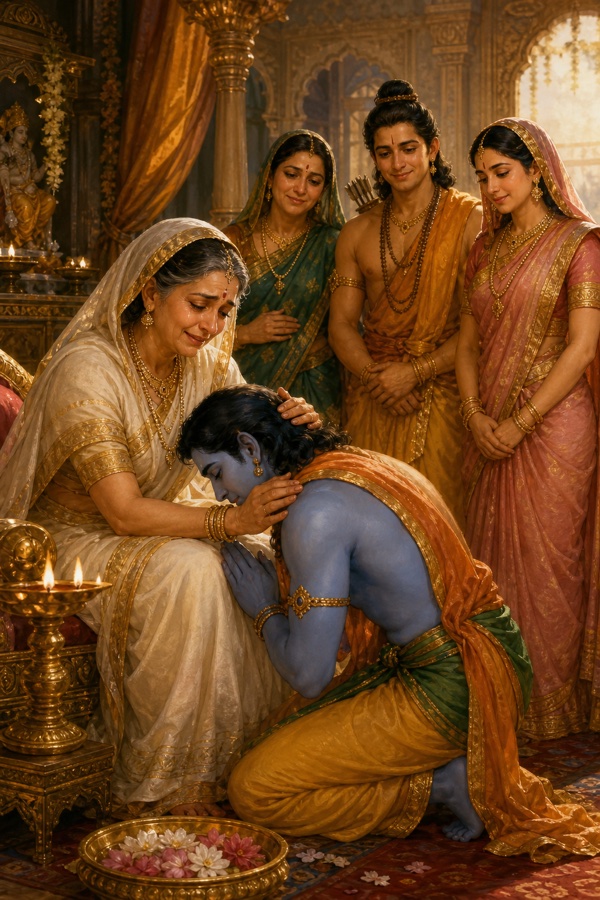
With that counsel, and with leave for the next day’s consecration given in two words, “Go now,” Rama bowed to his father and went home. He had the king’s order in his heart and he wanted Sita to hear it from him. He went to her rooms and she was not there. He came straight out again and turned toward his mother’s quarters in the women’s palace, and there, in the shrine, he found Kausalya in silken robes, given over wholly to the worship of her chosen deity, praying in silence for the royal fortune to come to Rama.
Kausalya’s blessing, and Rama’s love for Lakshmana
Kausalya sat at that hour with her eyes half closed. Sumitra was with her, and Sita, and Lakshmana, waiting on her. She had heard that her son was to be consecrated prince regent under Pushya, and she had answered the news by stilling her breath in the discipline of pranayama and fixing her mind on the Supreme Person, Narayana, to whom all men turn. Sumitra and her son Lakshmana had come the moment they heard of Rama’s welcome consecration, and Sita had been sent for. Rama came to his mother as she sat in that devotion, bowed to her, and, meaning to gladden her, spoke.
“Mother, my father has set me to the work of guarding the people, and so, by his order, I am to be consecrated tomorrow. Tonight Sita is to fast beside me. That is the rule my teachers lay down, Vasishtha and the others, and my father has commanded it as well. Whatever rites of blessing are proper before tomorrow’s consecration, have them performed today for me and for Sita.” Kausalya had wanted to hear this for a very long time. When she answered, tears of joy so thickened her voice that the words came out blurred.
“Child Rama, may you live long. May those who wish you harm be wiped away. Clothed in royal glory, bring joy to my kin and to Sumitra’s. My son, I am glad that I bore you under a kindly star, since by your virtues you have won the heart of your father Dasharatha. The austerities I bore, the fasts I kept, to please the lotus-eyed Vishnu, the Supreme Person, were borne for something after all. By their fruit the royal fortune of the house of Ikshvaku comes today to take shelter in you.”
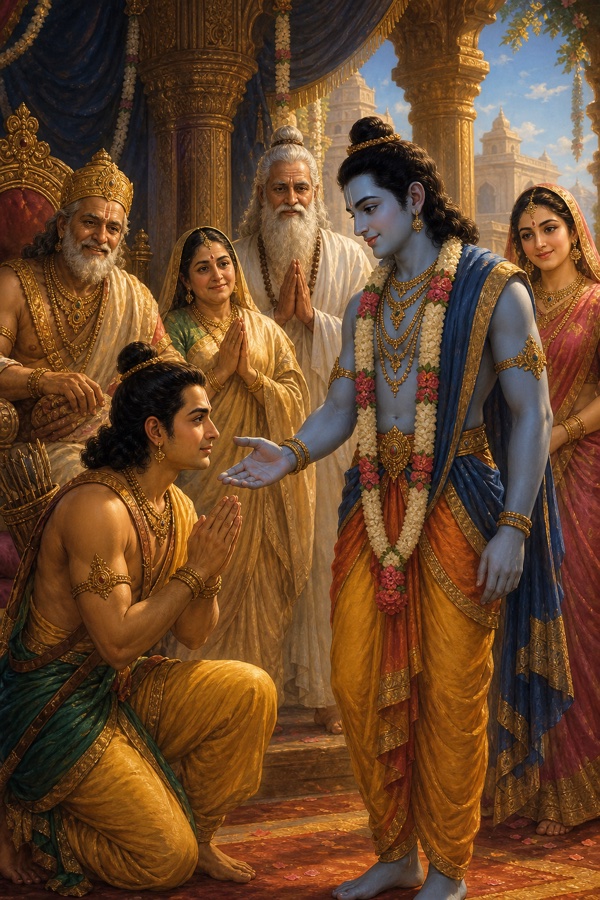
When his mother had finished, Rama turned to Lakshmana, who sat bent low in humility with his palms joined, and looked at him with something close to a smile. “Lakshmana, rule this earth with me. You are my second self, the life within my life, and this royal fortune has come to you as much as to me. Take the pleasures you want and the fruits of sovereignty. I want to live, and I want to rule, for your sake alone.” Then, having said that to Lakshmana, he bowed to both his mothers, Kausalya and Sumitra, took leave on Sita’s behalf as well as his own, and went back with her to his own house.
Vasishtha comes to Rama’s house, and the assembly is adjourned
Having given Rama his orders for the next day’s consecration, the king called for Vasishtha, the priest of his house, and said to him: “You are rich in austerity and firm in your vows. Go today and lead Rama of the line of Kakutstha, with his wife Sita, through the fast of this night, for the warding off of obstacles and for the winning of the kingdom.” “So be it,” said Vasishtha, the first of those who know the Vedas and a master of mantras, whose vows had never once been broken, and he mounted an excellent chariot of the kind a Brahmin may ride, its horses already yoked, and drove in person to Rama’s house, to lead that hero, who was himself a knower of mantras, into the vow of the fast.
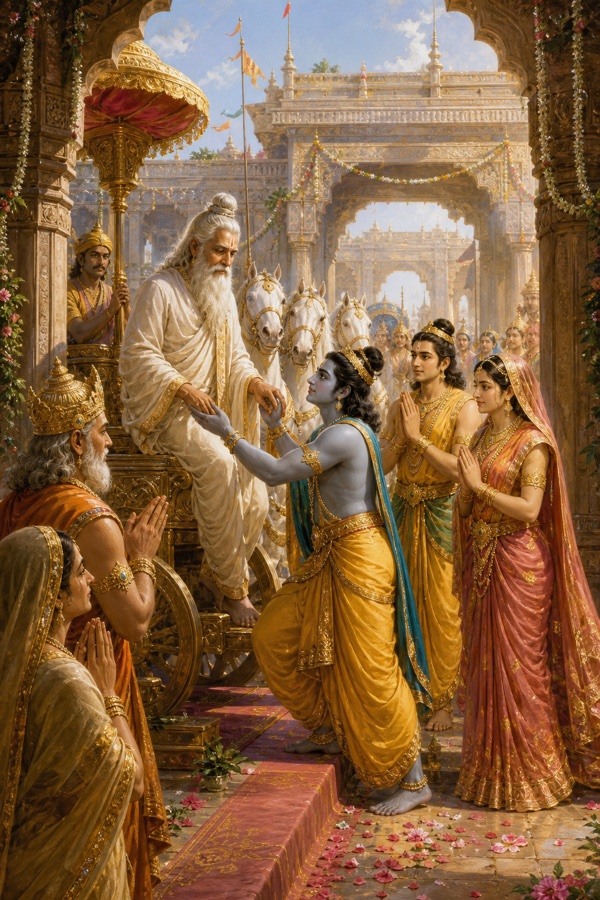
Rama’s house shone like a bank of white cloud packed solid. Vasishtha drove in through its three enclosures, one after another, without leaving his chariot. The moment Rama learned that the venerable sage was at his door he came hurrying out to honor him, went straight to the chariot, and with his own hand helped the old man down. Vasishtha looked at the prince bowed before him, asked after his welfare, praised him, and then, because Rama deserved kind words, gladdened him with these: “Your father is well pleased with you, Rama, and so tomorrow you will receive the kingdom. Keep the fast today, then, with Sita. Out of love your father Dasharatha will consecrate you as prince regent at dawn tomorrow, as Nahusha once consecrated his son Yayati.”
So saying, Vasishtha, holy and firm in his resolve, led Rama, with Sita beside him, into the vow of the fast, with the mantras the scriptures prescribe for such fasting. Rama worshiped him in due form, and the king’s preceptor took his leave of that scion of Kakutstha and left the house. Rama sat a while longer with the friends of his boyhood, who spoke to him kindly, received their homage, and then, taking his leave of them all, went into his inner apartments. Full of joyful men and women, Rama’s house at that hour looked like a lake alive with joyous birds and dressed in open lotuses.
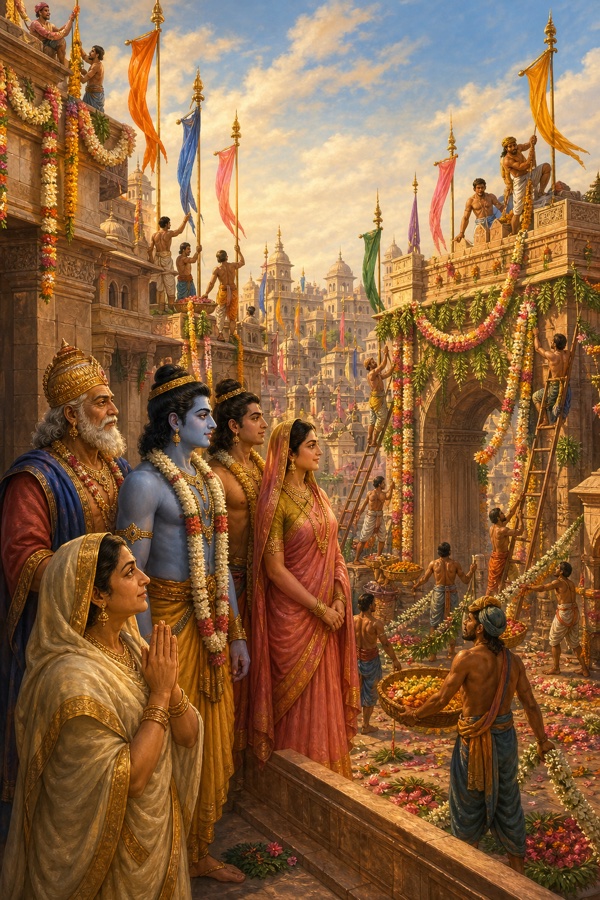
Vasishtha came out of that house, which rivaled the royal palace itself, and found the road swallowed by people. The great avenues of Ayodhya were so packed on every side with crowds surging this way and that, all of them wild with curiosity, that a man could barely walk. Wave met wave, and the glad roar of their collision filled the royal road with a noise like the roaring of the sea. That day every street in Ayodhya had been swept and sprinkled with scented water and hung with garlands of wildflowers, and tall flags flew from the rooftops.
Every soul in Ayodhya, the women and the children with them, was in a flurry, waiting for Rama’s consecration and longing for the sun to rise as though the sunrise itself were the prize. All of them were eager to see that grand festival of Ayodhya, an ornament to the people and a swelling of their joy. Parting the crowd before him as he went, Vasishtha drove slowly along the choked avenue to the royal house, climbed the palace that rose like the Himalaya with white cloud on its peaks, and came before Dasharatha as Brihaspati comes before Indra.
The king saw him coming and rose from his royal seat before the sage had reached it, and asked what he had been waiting to ask: had the thing he wanted been done, had Rama been reached and led through the vow? The seer answered that the task laid on him was accomplished. At once every counselor seated beside the king stood up together to honor the priest of the house. Then, with his preceptor’s leave, Dasharatha dismissed that great gathering of men and withdrew into the inner palace as a lion withdraws into a mountain cave. That lovely palace, crowded with young women in the finest robes and rivaling the mansion of great Indra, the king lit up with his own splendor as the moon lights up a sky thick with stars.
From the night of vows to the coronation dawn, and the rejoicing city
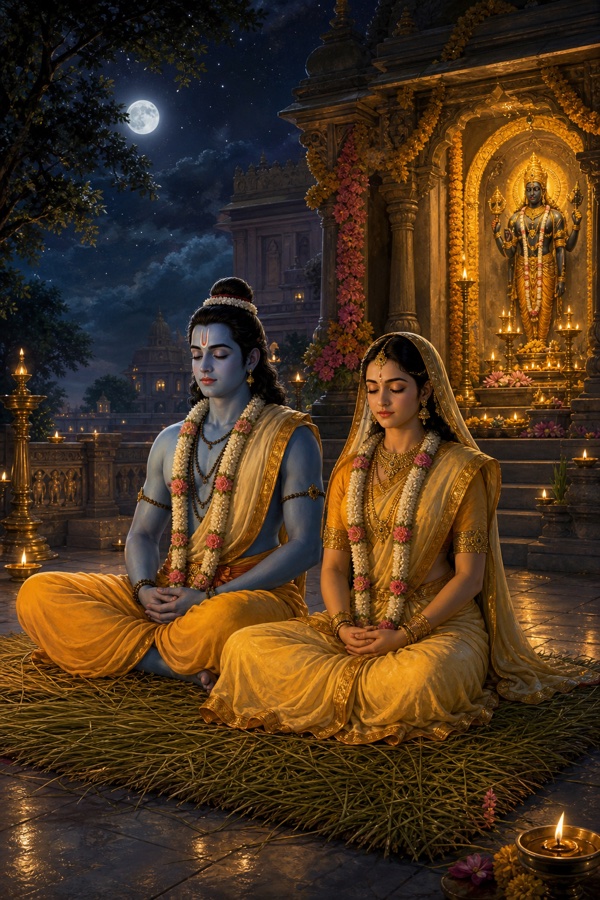
When the priest had gone, Rama bathed, and with his mind gathered to a single point he sat down beside Sita, his large-eyed wife, to the worship of Lord Narayana. He took up the vessel of clarified butter, his head bowed over it, and poured the oblation into the kindled fire with every rite observed, for the pleasure of Vishnu, the Supreme Deity. What remained of the offering he ate as consecrated food, praying for the good he sought. Then, saying nothing, with his mind held still, he lay down beside Sita on a mat of kusha grass that he had spread with his own hands in the hall of the splendid temple of Vishnu, and gave himself to the contemplation of the god Narayana.
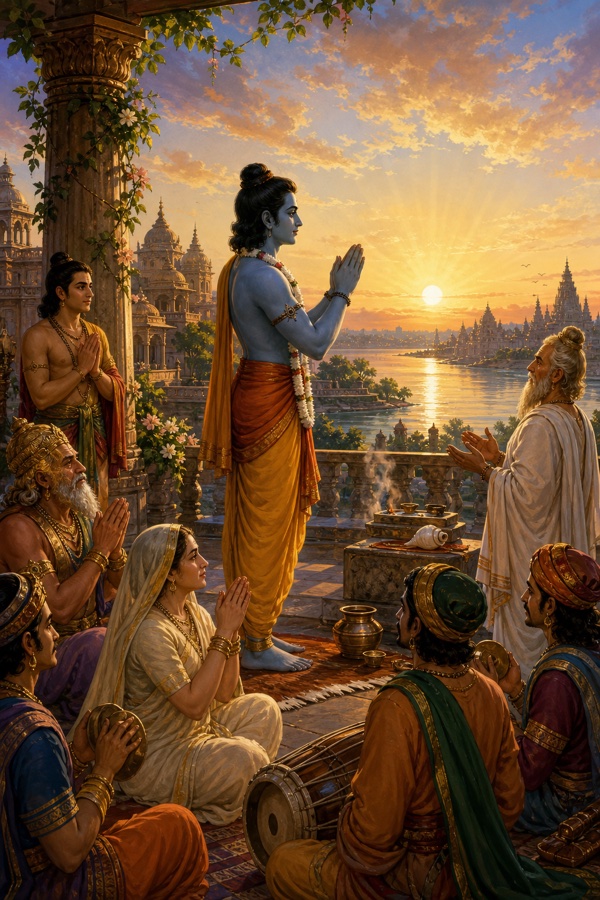
With one watch of the night still to run, three hours before the dark gave out, Rama woke, and had the hall where he had slept properly adorned. There, listening to the pleasant voices of the sutas, who recite the old stories, of the magadhas, who keep the genealogies of the house and sing them out on days like this one, and of the vandis, whose trade is praise, he sat down to the morning worship of the twilight and, with his mind wholly collected, repeated the Gayatri mantra. Dressed in spotless silk, he praised Vishnu, the slayer of the demon Madhu, and bowed his head to him, and then he had the Brahmins recite the mantras of blessing and the mantras that declare the day a holy day. Blended with the echo of the instruments, that deep, sweet chant of the Brahmins’ punyaha-vachana filled the whole of Ayodhya.
When the people of Ayodhya heard that Rama had fasted that day with Sita, they were beside themselves with joy. With the news of the consecration in their ears and the night visibly ending, the townsfolk set about dressing the city. On the temples, whose spires looked like mountain peaks under white cloud, at the crossroads and along the streets, on the sacrificial sheds and the upper rooms of the houses, on the merchants’ shops stocked with goods of every kind, on the rich and handsome houses of the householders, on every assembly hall, and on the tops of every tall tree, flags and pennants went up in orderly rows, high and beautiful.
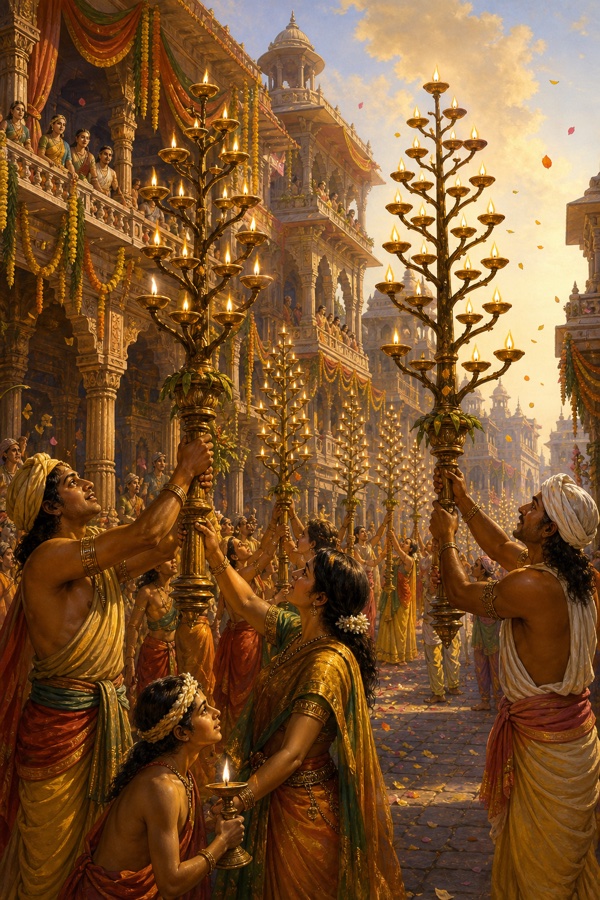
Then the people turned to the players. Troupes of actors gave their dialogues, dancers acted out the stories with their bodies, and the singers sang, and the music pleased the mind as much as the ear. At the crossroads and in the houses, wherever people met, they talked of one thing only, Rama’s consecration, now that it was nearly upon them. Even the children, playing in packs at the doorways of their houses, talked to one another of nothing except Rama’s consecration. For the day of the ceremony the townsfolk strewed the royal road with flowers and made it sweet with the smoke of incense. And because they expected that Rama, once consecrated, would ride in procession through the streets, and that night would have fallen by the time he did, they set up in every lane, to give light, lamp-posts shaped like trees, with a lamp burning on every branch.
Having dressed the city so, and gathering in bands at the crossroads and in the assembly halls scattered through it, all the people of Ayodhya, longing for Rama’s consecration, fell to praising King Dasharatha among themselves. “What a great-souled king this Dasharatha is, the delight of the house of Ikshvaku. He knows that he has grown old, and so he is setting Rama on the throne. We are fortunate beyond our deserving, all of us, that Rama, who has seen for himself what is noble in the world and what is base, will be our protector for years to come. He has no arrogance in him. He is learned, righteous, tender to his brothers, and Raghava loves us with the very love he bears them. Long live the righteous and blameless King Dasharatha, by whose grace we shall see Rama consecrated.”
These words of the townsfolk were overheard by others, the country people who had caught the news of the coming consecration and poured into Ayodhya from every direction to see it. Arriving from all sides, they flooded the city that was about to become Rama’s capital. The clamor that rose from those multitudes, moving here and there through the streets, sounded like the roar of the ocean when the full moon has whipped its tides to their height. And that city of Ayodhya, the rival of Indra’s Amaravati, loud with sound and crowded on every side with country folk who had come to look, came to resemble the waters of the great sea, teeming with every creature that lives in it.
The gist: Rama, with Sita, worships Narayana, makes his offering to the fire, and lies down on the bed of kusha grass. Waking before dawn, he says the twilight prayers and has the blessings chanted over him. Ayodhya, meanwhile, dresses itself in flags and flowers, lamp-posts and music, and the people of the city and the countryside, praising King Dasharatha, come surging in like the sea to wait for the consecration.
Source: Srimad Valmiki Ramayana, Ayodhyakanda, Cantos 1 to 6 (Gita Press, Gorakhpur). Where readings differ, the Gita Press text is followed.
Basis: Valmiki Ramayana (Gita Press, Gorakhpur)