Stay with natural breathing if controlling the breath feels uncomfortable. Stop for dizziness, anxiety, or breathlessness, and let breathing settle. Read the general guidance before practising.
Begin here
Natural Breath Awareness
Settle into your seat and notice the breath you already have.
Set up
Sit comfortably with your feet supported. Rest your hands on the thighs. Keep your eyes open or softly lowered.
How to practise
- Notice the next inhale and exhale without changing their depth or speed.
- Let the shoulders and jaw soften. You do not need to take a bigger breath.
- When attention wanders, gently return to the feeling of breathing.
- Finish by noticing your feet and the support of the chair.
Breath & pace
Stay for a few comfortable breaths. There is no target count and no breath hold.
Introductory attention practice for this guide.
Gentle practice
Alternate-Nostril Breathing
अनुलोम विलोम, anuloma viloma
Alternate airflow between the nostrils with Viṣṇu mudrā and no retention.
Set up
Sit upright and rest the left hand on the thigh. Form Viṣṇu mudrā (विष्णु मुद्रा, viṣṇu mudrā) with the right hand: fold the index and middle fingers inward, keep the ring and little fingers together, and use the thumb and the last two fingers at the nostrils.
How to practise
- Close the right nostril with the right thumb and inhale through the left.
- Close the left nostril with the joined ring and little fingers; release the thumb and exhale through the right.
- Inhale through the right; close it with the thumb, release the ring and little fingers, and exhale through the left.
- This completes one round. Keep the touch light and the breath quiet.
Breath & pace
Begin with 4 rounds at an even, comfortable count.
Modern teaching context: Swami Satyananda Saraswati, Asana Pranayama Mudra Bandha, Nadi Shodhana section. This version uses no retention.
Gentle practice
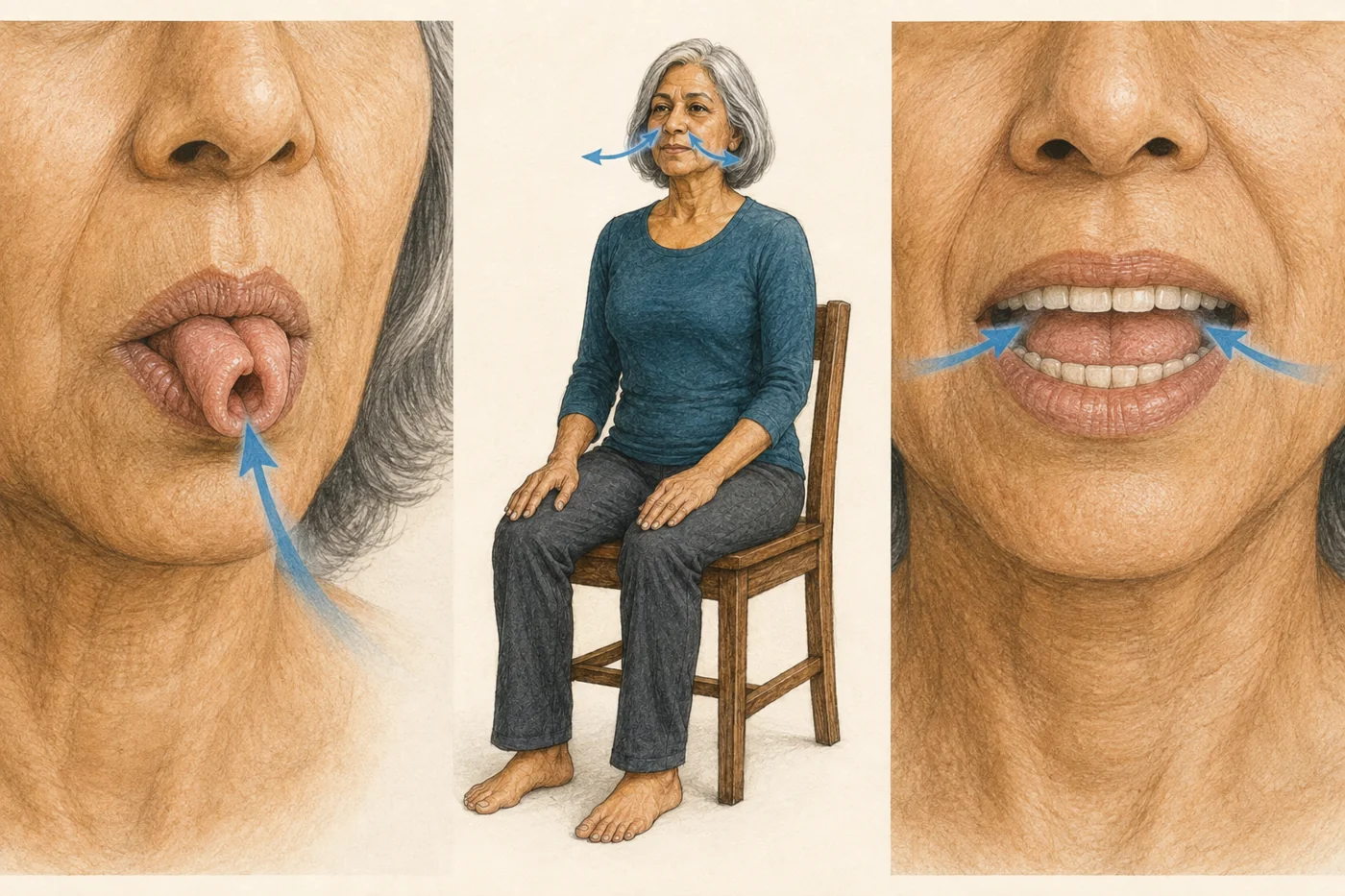
Cooling Breath
शीतली, śītalī
Draw air through a curled tongue, then exhale gently through the nose.

Set up
Sit tall with hands relaxed. Curl the sides of the tongue into a tube if that shape is naturally available.
How to practise
- Extend the curled tongue slightly through the lips.
- Inhale slowly through the tongue tube.
- Close the mouth and exhale gently through both nostrils.
- If the tongue does not roll, use Hissing breath (सीत्कारी, sītkārī): rest the tongue behind lightly parted teeth and inhale through the teeth.
Breath & pace
Begin with 4 rounds.
Historical context: Hatha Yoga Pradipika 2.54-58. This modern introductory version omits the retention described in traditional practice.
Learn with a teacher
Forceful practices need
individual guidance.
Kapalabhati and Bhastrika are included here as traditional context, not a beginner follow-along sequence. This edition does not prescribe rounds, speed, or duration for them.
NCCIH advises beginners to avoid forceful breathing. Read its yoga guidance.
Kapalabhati
कपालभाति · kapālabhāti
A cleansing practice commonly taught with brief active exhalations and passive inhalations. It differs from Bhastrika, where both phases are active.
Take care if you have hypertension, heart disease, hernia, pregnancy, recent abdominal surgery, glaucoma, dizziness, reflux aggravated by pressure, or pelvic-floor symptoms. Skip the practice unless your physician and instructor approve it.
Historical context: Hatha Yoga Pradipika 2.35 and Gheranda Samhita 1.55-60. The latter describes several forms, including water-based practices; these are not interchangeable instructions.
Bhastrika
भस्त्रिका · bhastrikā
A forceful breathing practice with active inhalations and exhalations, traditionally compared with a bellows. Learn the technique and any pacing in person from a qualified teacher.
Take care if you have hypertension, heart disease, hernia, pregnancy, recent abdominal surgery, glaucoma, panic symptoms, dizziness, or respiratory illness. Skip the practice unless your physician and instructor approve it.
Historical context: Hatha Yoga Pradipika 2.44 and 2.59-67. Traditional versions include elements beyond the beginner practices in this guide.
Sources & teaching context
Exercise guidance and traditional references serve different purposes. Traditional descriptions are not clinical evidence.
- Yoga: Effectiveness and Safety
NCCIH. General guidance on yoga, beginners, modifications, and safety.
- Hatha Yoga Pradipika
Svātmārāma; Pancham Sinh translation. Chapter 2, especially verses 35, 44, and 54-67. Online typeset translation; traditional context, not clinical evidence.
- Gheranda Samhita
SanskritDocuments transcription, 1.55-60. Describes several kapalabhati forms.
- Asana Pranayama Mudra Bandha
Swami Satyananda Saraswati, 4th revised edition, 2009. Nadi Shodhana section; publisher teaching context.