Practice the gesture
Give the hands a comfortable resting place, then turn your attention to the breath. Let the support do some of the work of holding the posture.
 Enlarge image
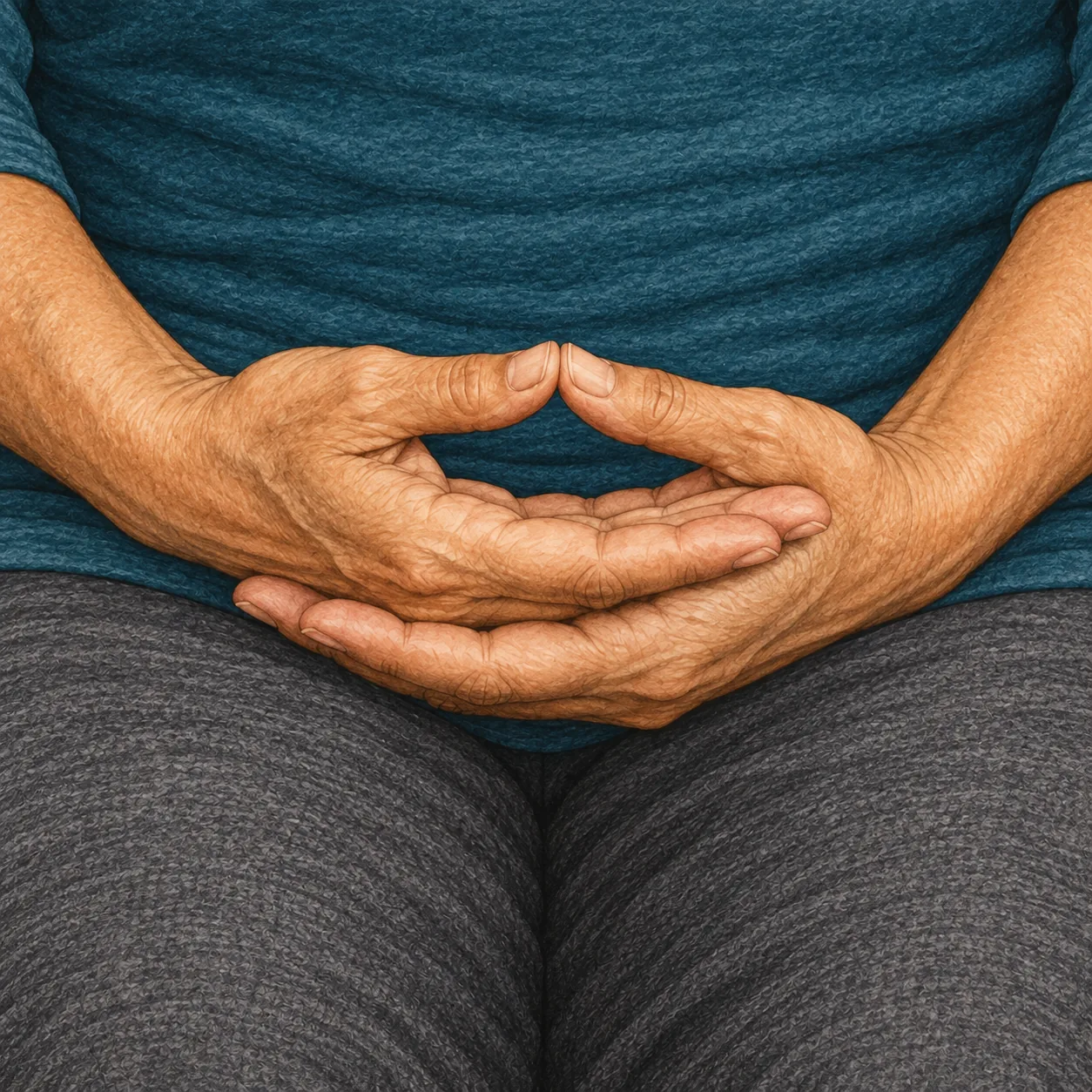
Dhyana: right hand above the left, with thumb tips meeting lightly.
Settle in
Sit on a chair or in a comfortable seated posture, with the back gently upright and the shoulders relaxed.
Place a cushion or folded cloth in your lap if the hands need support.
Place your hands
- Rest the left hand in your lap with its palm upward.
- Lay the back of the right hand in the left palm, keeping the right palm upward too.
- Allow the tips of the thumbs to touch lightly without pressing together.
- Let the hands settle on your lap or support, with the elbows comfortably near the body.
Breath and attention
Breathe normally and notice the air entering and leaving at the nostrils. If thoughts carry you away, return to the next breath.
What to notice
- Are the thumb tips lightly meeting or pushing against each other?
- Can the hands and shoulders give their weight to the support?
Finish gently
Separate the thumbs, open the hands gently, and rest them on your thighs. Let your attention return to the room.
Make it easier
Rest the hands separately on the thighs. If touching the thumbs is awkward, leave them in an easy position.
Take care
Avoid rounding the back to reach the lap. Raise the hand support instead, and change position if pain or numbness appears.
Sources and meaning
The practice uses the right hand over the left, supported by teaching instructions from the Lama Yeshe Wisdom Archive and Thanissaro Bhikkhu. Wildmind adds practical guidance on hand support and light thumb contact. The arrangement is also familiar in Buddhist art. Other traditions can reverse the hands or use the name Dhyana for another shape; ICYER, for example, describes a different finger arrangement under that name.
- Lama Yeshe Wisdom Archive: Meditation in Tibetan Buddhism · Seven-point posture, point 4; following breath-attention paragraph
- Thanissaro Bhikkhu: With Each & Every Breath · Part I, Getting Ready to Meditate: Your Posture; Benches & chairs
- Bodhipaksa, Wildmind: Meditation Posture, Hands · Hand support; Dhyana Mudra
- Smithsonian: The Art of Buddhism · Mudras, printed p. 10 (PDF p. 9)
- Harvard Art Museums: Seated Buddha Shakyamuni in Meditation · Object 204074
- Ananda Balayogi Bhavanani, ICYER: Basic Practice of Some Pranayamas · Mudras for pranayama, items 1 to 6, PDF pp. 2 to 3