On this page
Bhishma answers as the kings grow angry
The first arghya had singled Krishna out before an assembly of rulers who had come to acknowledge Yudhishthira’s imperial sovereignty. Bhishma had proposed honoring all the eligible guests, beginning with the foremost among them. That first place was now disputed. Shishupala had named fathers, teachers, priests, and kings whose standing he believed entitled them to precede Krishna. Yudhishthira hurried after Shishupala and spoke gently, trying to reconcile him. “What you have said is unworthy of you,” he told the king of Chedi. “It is deeply wrong and needlessly cruel. Do not insult Bhishma by saying he does not understand dharma. Look at the many kings older than you who approve of Krishna’s honor. Show the patience they have shown. Bhishma truly knows Krishna. You do not know him as well.” Bhishma’s response was firmer. “A man who rejects the honor given to Krishna, the most ancient being in the universe, deserves no gentle persuasion,” he said. “A Kshatriya who defeats another warrior, brings him under his power, and then releases him becomes the defeated man’s master. I see no king here who has escaped defeat by Krishna’s strength. His fame is stainless, and all 3 worlds should honor him. He has overcome innumerable Kshatriyas in battle. The boundless universe rests in him. That is why we have chosen him among the greatest and eldest. Shishupala, do not speak this way or let your understanding take this course. I have served many elders in wisdom and heard them speak of Krishna’s many honored qualities. I have repeatedly heard people recount everything he has accomplished since his birth. We honor Janardana, revered by the good and the source of every creature’s happiness, because of his fame, courage, and success. Caprice, kinship, and the hope of benefit did not determine our choice. We considered everyone here, even the youngest. After weighing the claims of many distinguished people, we judged Hari worthy of the first honor.”
Bhishma set out the grounds of his judgment. He had already described a victor who released a conquered warrior as that warrior’s master. His answer now joined that claim of military supremacy to another kind of authority, knowledge of the Vedas. The two claims drew on the distinct qualifications he assigned to warriors and Brahmins. “Among Brahmins, excellence in knowledge deserves precedence; among Kshatriyas, strength; among Vaishyas, wealth and possessions; among Shudras, age,” he said. “Govinda combines 2 claims: knowledge of the Vedas and their branches, and surpassing strength. Who else in the human world is distinguished in that way? Generosity, skill, Vedic learning, bravery, modesty, achievement, excellent judgment, humility, beauty, firmness, contentment, and prosperity all abide in Achyuta. Accept the honor given to him. As teacher, father, and guide, he deserves arghya and everyone’s reverence. Hrishikesha qualifies as sacrificial priest, guru, a worthy man to whom one might offer a daughter in marriage, a snataka who has completed his studies, a king, and a friend. We have honored him accordingly. Krishna is the universe’s origin and the being into whom it dissolves. Everything moving and unmoving has come from him. He is the unmanifest primal nature, the creator, eternal and beyond the knowledge of created beings. Intellect and the mind that receives sensation are established in him. So are the 5 elements, air, fire, water, space, and earth, and the 4 kinds of living beings: those born from eggs, from wombs, from impure dampness, and those that grow as plants. The sun, moon, stars, planets, and all the main and intermediate directions rest in Krishna. As Agnihotra leads the Vedic sacrifices, Gayatri the meters, the king humankind, the ocean the rivers, the moon the constellations, the sun all luminous bodies, Meru the mountains, and Garuda the birds, so Keshava is foremost in every world, including the celestial regions, for as long as the universe extends above, below, and around us. Shishupala is a child in understanding. He does not know Krishna and continually speaks of him this way. He will never see dharma as someone seeking great merit sees it. Who among the young, the old, and these illustrious rulers fails to regard Krishna as worthy of worship or to worship him? If Shishupala considers this honor undeserved, let him act as he thinks proper.”
When Bhishma stopped, Sahadeva spoke with deliberate gravity. “If any king here cannot bear that I have honored the dark-complexioned Keshava, slayer of Keshi and possessor of immeasurable power, I place this foot upon the heads of all such mighty men,” he declared. “Let whoever wishes to answer me do so. Let the discerning kings approve Krishna’s honor. As teacher, father, and guide, he deserves the arghya and the worship already offered.” Sahadeva displayed his foot in challenge. None of the proud, powerful, and discerning rulers answered. Flowers showered down upon his head, and a disembodied voice applauded him. Narada, wearing a black deerskin, then spoke among the countless assembled beings. Knowing the worlds, the past and future, and the answers to difficult questions of dharma, he made his position unmistakable. “Those who refuse to worship Krishna should be regarded as dead though they move,” he said. “They should never be addressed on any occasion.” Sahadeva continued the ceremony. Knowing the distinctions governing the honors due to Brahmins and Kshatriyas, he honored all who were entitled to receive worship and completed that part of the proceedings.
Shishupala’s anger intensified. Also known as Sunitha, the Chedi king turned toward the other rulers with eyes reddened like copper. “I am here to lead you,” he told them. “What are you waiting for? Let us form our battle lines against the Vrishnis and Pandavas assembled here.” He stirred them up and began consulting them about how to prevent the sacrifice from being completed. The invited monarchs gathered under his leadership looked angry, their faces pale. “We must act so that no one can say we agreed to Yudhishthira’s final rite or to Krishna’s worship,” they said. Confidence in their strength and the sting of the insult they believed they had suffered drove them to repeat that demand. Their anger overwhelmed their judgment. Friends tried to calm them, but their faces burned with the rage of lions driven away from their prey. Krishna understood the movement taking shape before him. The great sea of kings, with the countless troops under their command like its waves, was preparing for a violent surge.
The gist: Yudhishthira tried to calm Shishupala, while Bhishma defended Krishna’s precedence through his knowledge, achievements, and divine nature. Sahadeva challenged the objectors and finished the honors; Narada supported Krishna’s worship. Shishupala then urged the kings toward battle and a plan to obstruct the sacrifice.
Yudhishthira’s fear and the story of the swan
The angry gathering resembled a sea churned by the winds that blow at the dissolution of the universe. The kings had come as guests of Yudhishthira, and their troops gave force to the threats now passing among them. He was responsible for the gathering as its royal host and for the people of his kingdom as their ruler. Both responsibilities were at risk if the angry guests took up arms. Yudhishthira turned to Bhishma for counsel as Indra might turn to Brihaspati, the counselor of the gods. “This great ocean of kings is agitated with rage,” he said. “What should I do, Grandfather? How can I protect the sacrifice from interruption and my people from harm?” Bhishma told him to set aside his fear. “Can a dog kill a lion? I have already considered a course that will be beneficial and easy to carry out. These kings are like a pack of dogs barking around a sleeping lion. Krishna, the lion of the Vrishnis, is still at rest. Until he wakes, Shishupala makes these monarchs look like lions themselves. This foolish king of Chedi wants to take them all with him to Yama’s realm through Krishna, the soul of the universe. Vishnu intends to reclaim the portion of his own energy that lives in Shishupala. The judgment of this king and his supporters has therefore become distorted. That happens to those whom Krishna wishes to draw back into himself. Madhava creates and destroys all 4 kinds of living beings in the 3 worlds.” Hearing him, Shishupala answered with words harsh in meaning and sound.
“Old disgrace to your family, have you no shame in frightening these kings with false terrors?” he demanded. “You lead the Kurus and live in the third state, celibacy. Such counsel, so far from dharma, suits you. The Kurus following you are like a boat tied to another boat, or blind people following someone equally blind. You have hurt us again by reciting Krishna’s deeds, including the killing of Putana. Why does your tongue not split into 100 pieces as you praise him with such arrogance and ignorance? You claim superior knowledge. Why praise a cowherd whom even a simple man could criticize? If he killed a vulture as an infant, what is remarkable about it? What was remarkable about killing Ashva and Vrishabha, who had no skill in battle? He kicked over a cart, an inanimate piece of wood. What marvel do you find in that? He held up Govardhana, a hill like an anthill, for a week. What of it? Many have been astonished to hear you praise him for eating a great quantity of food while playing on a mountaintop. What about his killing Kamsa, whose food he had eaten? Surely that was a greater wrong. The virtuous teach that weapons must never be raised against women, cattle, Brahmins, those who have fed us, or those who have sheltered us. You seem to have discarded every one of those teachings. You describe Krishna as superior in wisdom and age as though I know nothing. If your word makes someone who has killed women and cattle worthy of worship, what becomes of that great moral rule? How does such a man deserve praise?”
Shishupala pressed the accusation against Bhishma’s judgment and conduct. Bhishma had appealed to the wisdom he had learned from elders and to his own assessment of Krishna’s qualities. Shishupala answered by attacking his fitness to give moral counsel. His accusations reached into the Kuru family’s marriages and succession, bringing those matters before the assembled kings. “You call Krishna foremost among the wise and lord of the universe, and he believes you. Those claims are false. A singer can repeat verses without their meaning affecting him. Every creature follows its own disposition, like the Bhulinga bird that warns against rashness while picking meat from a lion’s teeth. Your disposition is base. The Pandavas, who honor Krishna and let you guide them, seem sinful as well. You know dharma and have departed from the path of the good. Who claiming wisdom and virtue would behave as you have? If your understanding is so sound, why did you abduct the virtuous Amba after she had given her heart to another man? Your brother Vichitravirya learned her circumstances and refused to marry her, following the conduct of the virtuous. Another man fathered sons on your brother’s widow in your presence, according to the accepted practice. Where was your virtue? Your celibacy, whether it comes from ignorance or impotence, is fruitless. I see no good future for you. A man explaining dharma this way can hardly have served the elders. Worship, gifts, study, and sacrifices with lavish offerings to Brahmins do not equal even one-sixteenth of the merit obtained through a son. Countless vows and fasts lose their fruit for a childless man. You are old and childless and teach a false morality. Like the swan in the story, you will die at the hands of your own people. Learned people have told this story since ancient times. Listen to the full account.”
“An old swan once lived on the seacoast,” Shishupala said. “He continually spoke about virtue and instructed the other birds, though his conduct contradicted his words. ‘Practice righteousness and give up sin,’ he told them. The truthful birds heard him say it again and again. Out of their own devotion to virtue, the egg-laying creatures that ranged over the sea brought him food. They left their eggs in his care while they swam and dived in the water. The old swan attended to his own appetite and ate the eggs of the birds foolish enough to trust him. As their eggs diminished, one discerning bird grew suspicious. One day it witnessed what the swan was doing. Deeply distressed, it told the others. They watched until they had seen his behavior for themselves, then approached the hypocrite and killed him. Bhishma, your conduct resembles that swan’s. These kings may kill you in anger as those birds killed him. People familiar with the old accounts repeat a saying about the incident: ‘You who live by your wings preach virtue while desire fills your heart. Your sinful eating of the eggs violates your own words.’” Shishupala offered that story as an accusation and a threat, applying its condemned teacher’s fate directly to the Kuru elder.
The gist: Yudhishthira feared for the sacrifice and his subjects. Bhishma reassured him that Krishna could control the danger. Shishupala responded by belittling Krishna’s deeds and attacking Bhishma’s past decisions and celibacy. His story of a preaching swan that secretly ate other birds’ eggs accused Bhishma of hypocrisy and threatened him with a similar death.
Bhima’s anger and the promise of 100 pardons
Shishupala returned to Jarasandha’s death. “I hold that mighty king in the highest esteem,” he told Bhishma. “He refused to fight Krishna, saying, ‘He is a slave.’ Who could praise what Krishna, Bhima, and Arjuna did to bring about his death? Krishna entered by an improper gate disguised as a Brahmin and examined Jarasandha’s strength. When the king first offered him water for his feet, he made a show of virtue by denying that he was a Brahmin. Jarasandha invited the 3 of them to eat, and Krishna refused. If he is lord of the universe, as this fool claims, why should he not consider himself a Brahmin? What amazes me is that the Pandavas still regard you as honest while you lead them away from the path of the wise. Perhaps I should expect it from men who take their advice in everything from someone effeminate and bent with age.” Those words enraged Bhima. His naturally broad eyes, shaped like lotus leaves, widened further and reddened like copper. The kings saw 3 furrows appear across his forehead, like the Ganga’s 3 streams descending a mountain with 3 peaks. He ground his teeth. His face resembled Death at the end of an age, ready to swallow every living being.
As Bhima was about to spring forward, Bhishma caught him, like Mahadeva restraining Mahasena, the commander of the gods’ armies. The elder used various arguments to calm him. Bhima could not disobey his grandfather’s words, just as the ocean holds within its shores even when the rains swell its waters. Yet his anger repeatedly drove him to the point of leaping up again. Shishupala showed no fear. Confident in his own prowess, he paid Bhima as little attention as a lion gives a small creature’s rage. He laughed. “Let him go, Bhishma,” he said. “Let all these kings see him scorched by my strength like an insect in fire.” Bhishma then turned to Bhima and told him why the king of Chedi dared issue such a challenge. His explanation concerned a promise made while Shishupala was an infant, long before the quarrel over the first honor. It bound Krishna to the child’s mother and placed a stated limit on the offenses he would forgive.
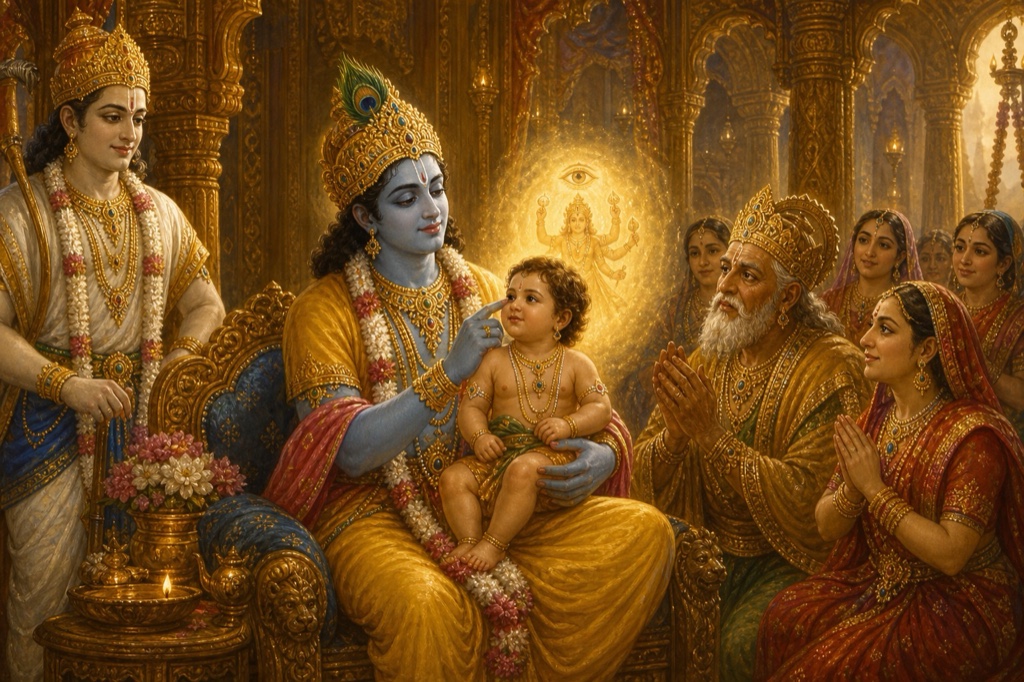
“Shishupala was born in the Chedi royal line with 3 eyes and 4 arms,” Bhishma began. “At birth he screamed and brayed like a donkey. His parents and relatives were frightened. Seeing those extraordinary signs, his father and mother decided to abandon him. Then a disembodied voice addressed the king and queen, their ministers, and their priest, all overcome with anxiety. ‘This son will be fortunate and very strong,’ it said. ‘You have nothing to fear from him. Raise him without anxiety. He will not die in childhood; his time has yet to come. The person who will kill him with weapons has also been born.’ His mother’s love made her anxious to know more. She joined her hands and bowed to the unseen speaker. ‘Whether you are a god or some other being, tell me one more thing,’ she asked. ‘Who will kill my son?’ The voice answered, ‘When you place him on a certain person’s lap, his extra arms will fall to the ground like a pair of 5-headed snakes. At the sight of that person, the third eye on his forehead will disappear. That person will be his killer.’ Kings from all over the earth heard about the child’s 3 eyes and 4 arms and the words of the invisible being. They came to Chedi to see him. The king honored each according to his standing and placed the child on their laps in turn. A thousand kings held him, one after another. The signs foretold by the voice did not appear.”
“The news also reached Dwarka,” Bhishma continued. “Sankarshana and Janardana, Balarama and Krishna, went to Chedi to visit their father’s sister, the Yadava woman who was its queen. The child was their first cousin. They greeted everyone according to rank, including the king and queen, asked after their welfare, and took their seats. After the 2 brothers had been honored, the queen gladly placed the child on Krishna’s lap with her own hands. Immediately, the extra arms fell away and the eye on the child’s forehead disappeared. The queen was filled with fear and anxiety. She begged Krishna for a boon. ‘I am afraid,’ she told him. ‘You reassure the afflicted and dispel everyone’s fear. Grant me a favor.’ Krishna answered, ‘Do not be afraid, Aunt. You know dharma, and you need have no fear of me. What boon should I give? What can I do for you? Whether I have the power or not, I will do as you ask.’ She said, ‘For my sake, you must forgive Shishupala’s offenses. That is the boon I want.’ Krishna replied, ‘Even when he deserves to be killed, I will forgive 100 offenses of his. Do not grieve.’ That is the promise this wicked-hearted ruler relies on, Bhima. Pride in the boon Govinda granted makes him challenge you to battle.”
The gist: Shishupala’s insults brought Bhima close to attacking him, but Bhishma restrained him. The elder explained the prophecy at Shishupala’s birth and the signs identifying Krishna as his future killer. At his aunt’s request, Krishna had promised to forgive 100 of her son’s offenses, even offenses deserving death.
The bird at the lion’s mouth
Bhishma continued speaking to Bhima. “Your strength does not diminish, yet Shishupala challenges you,” he said. “The impulse driving him comes from Krishna’s purpose. What king on earth would dare abuse me as this man has today, already in Death’s power? Shishupala is a portion of Hari’s energy, and the lord intends to draw that energy back into himself. That is why the king of Chedi roars so fiercely and disregards us all.” Shishupala could bear no more. He answered Bhishma in anger. “May our enemies possess the prowess of this Krishna you praise so often, rising from your seat like a hired singer,” he said. “If you take such pleasure in praising people, praise these kings. Praise Darada, the great ruler of Bahlika, who split the earth at his birth.”
“Praise Karna, ruler of Anga and Vanga,” Shishupala continued. “His strength equals Indra’s. He wields a great bow with powerful arms and possesses the celestial earrings with which he was born, together with armor shining like the rising sun. He defeated the formidable Jarasandha in wrestling and tore and wounded his body. Praise Drona and Ashvatthama, father and son, great warriors and eminent Brahmins. I believe either one, if angered, could destroy this earth with every moving and unmoving creature on it. I see no king who equals them in battle. Why do you refuse to praise them? Duryodhana, the mighty king of kings, has no equal on the earth encircled by its seas. Jayadratha is accomplished in weapons and immensely brave. Druma, teacher of the Kimpurushas, is renowned throughout the world for his prowess. Kripa, the aged son of Sharadvat, teaches the Bharata princes and possesses extraordinary energy. Why pass them over to praise Krishna? Why ignore Rukmi, a foremost archer and excellent king? Bhishmaka is here, and Dantavakra; Bhagadatta, known for his countless sacrificial stakes; Jayatsena of Magadha; Virata, Drupada, Shakuni, Brihadbala, Vinda and Anuvinda of Avanti, Pandya, Shveta, Uttama, and the prosperous Shankha. There is the proud Vrishasena, the powerful Ekalavya, and the great chariot warrior Kalinga. With all of them present, why praise Krishna? If you want to sing someone’s virtues, praise Shalya and the other rulers of the earth.”
The list answered Bhishma’s praise with competing claims to strength, learning, and royal standing. Shishupala had included Jarasandha among Karna’s past opponents; Jarasandha’s death at Bhima’s hands had already featured in his charges against Krishna. Now he returned to the accusation that Bhishma’s words exposed his ignorance. “What can I do if you have never listened to virtuous elders teaching dharma?” he asked. “Have you never heard that respectable people avoid both reproach and glorification, whether directed at themselves or at others? No one approves of your constant, devoted praise of an unworthy man. You would establish the entire universe in Kamsa’s servant and cowherd simply because you choose to. Perhaps your inclination conflicts with your true nature, like the Bhulinga bird I mentioned. Beyond the Himalayas lives that bird. It continually says, ‘Never act rashly.’ Yet it does not understand the rashness of its own behavior. While a lion is eating, this foolish bird picks pieces of flesh from between its teeth. The bird lives for as long as the lion permits. Bhishma, you talk like that bird. You remain alive only because these kings allow it. No one else acts as you do, against everyone’s judgment.” The image carried his threat plainly: Bhishma’s right to speak, and even his survival, supposedly rested on the patience of the men he had offended.
Bhishma answered within Shishupala’s hearing. “Indeed, I live at these kings’ pleasure,” he said. “I do not value them even as highly as a blade of straw.” Fury spread through the rulers. Some felt their hair rise; others began denouncing him. Men who carried powerful bows called out, “This old Bhishma is insufferably arrogant. He deserves no pardon. Kill him like an animal, or let us join together and burn him in a fire of grass and straw.” Bhishma addressed them directly. “Our speeches have no end,” he said. “Every word can be met with another word. Listen to what I say. Whether you kill me like an animal or burn me in grass and straw, I place my foot on all your heads. Govinda is here, undiminished in power. We have honored him. Whoever wants a swift death should challenge the dark-complexioned Madhava, bearer of the discus and mace. Let that man fall before him and enter into this god’s body.” Bhishma had made Krishna himself the answer to the challenge against the honor already given.
The gist: Bhishma attributed Shishupala’s defiance to Krishna’s intention to reclaim his own energy. Shishupala demanded praise for other rulers and threatened Bhishma through the example of a reckless bird feeding from a lion’s teeth. When kings called for Bhishma’s death, he challenged anyone seeking death to fight Krishna.
Shishupala’s death
Shishupala accepted the challenge Bhishma had offered. “Krishna, I challenge you,” he declared. “Come and fight. Today I will kill you and all the Pandavas. They disregarded the claims of these kings and honored you, who are no king. For that, they deserve to die with you. In their childishness, they treated a slave and a wretch, unworthy of worship, as someone entitled to it. I consider them deserving of death at my hands.” He stood roaring with anger. When he stopped, Krishna addressed all the kings in a quiet voice, with the Pandavas present. “This man is the son of a woman of the Satvata line, yet he is a determined enemy of our people,” he said. “We do not seek to injure him, and he continually seeks our harm. When he heard that we had gone to Pragjyotisha, he came and burned Dwarka, although he is my father’s sister’s son. While King Bhoja was taking his pleasure on Mount Raivataka, Shishupala attacked his attendants, killed many, and took many others to his own city in chains. To obstruct my father’s horse sacrifice, he stole the sacrificial horse that had been released under armed guard. When the wife of the innocent Babhru, Akrura, was traveling from Dwarka to the Sauvira country, he seized her against her will. Disguising himself as the king of Karusha, he also carried away the innocent Bhadra, princess of Vishala, who was to marry that king.”
Krishna’s account connected the quarrel in the hall with attacks on a city, a king’s attendants, a guarded sacrificial horse, and women traveling or awaiting marriage. He had addressed the assembled rulers as witnesses to the hostility displayed before them that day. He now explained why he had endured the earlier offenses. “For my aunt’s sake, I have patiently borne all these injuries,” he said. “It is fortunate that today’s events have taken place before all of you. You can see his hostility yourselves and learn what he has done in my absence. The excess of arrogance he has displayed before these kings makes him deserving of death at my hands. I can scarcely forgive his injuries today. Seeking a swift death, this fool wanted Rukmini. He failed to obtain her, as a Shudra is denied hearing the Vedas.” On hearing Krishna’s account, the assembled rulers began condemning Shishupala. The Chedi king laughed aloud. “Are you not ashamed to say in this assembly, before these kings, that I wanted your wife?” he asked. “What other man would announce before respectable people that his wife had been intended for someone else? Forgive me if you wish, or refuse to forgive me. Whether you are angry or friendly, what can you do to me?” His answer dismissed the warning contained in Krishna’s account and challenged him again in front of the gathering.
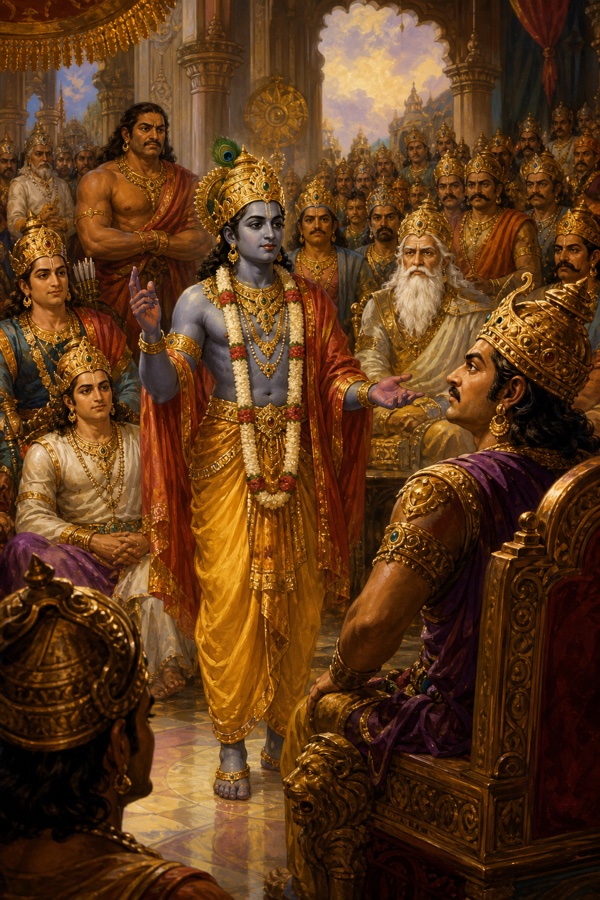
While Shishupala was still speaking, Krishna thought of his discus, the weapon that humbled the Asuras’ pride. It came into his hand. He then spoke loudly enough for the kings to hear. “Listen to why I have forgiven this man until now,” he said. “His mother asked me to pardon 100 offenses. That was the boon she requested, and that was what I granted. The number is now complete. I will kill him here before you.” Having said it, Krishna angrily struck off Shishupala’s head with the discus at once. The powerful king fell like a mountain cliff shattered by a thunderbolt. The assembled rulers saw a blazing energy emerge from his body, bright as the sun in the sky. That radiance honored Krishna and entered his body. The kings regarded the sight with wonder. Rain fell from a cloudless sky, thunderbolts crashed, and the earth shook. Some rulers sat through those inexpressible moments without saying a word, staring at Krishna. Some rubbed their palms with their forefingers in anger. Others, their judgment overwhelmed by rage, bit their lips. Some quietly praised Krishna; some grew more agitated; others tried to mediate. The great rishis praised Keshava with glad hearts and departed. The noble Brahmins and powerful kings present also rejoiced at his prowess and spoke in his praise.
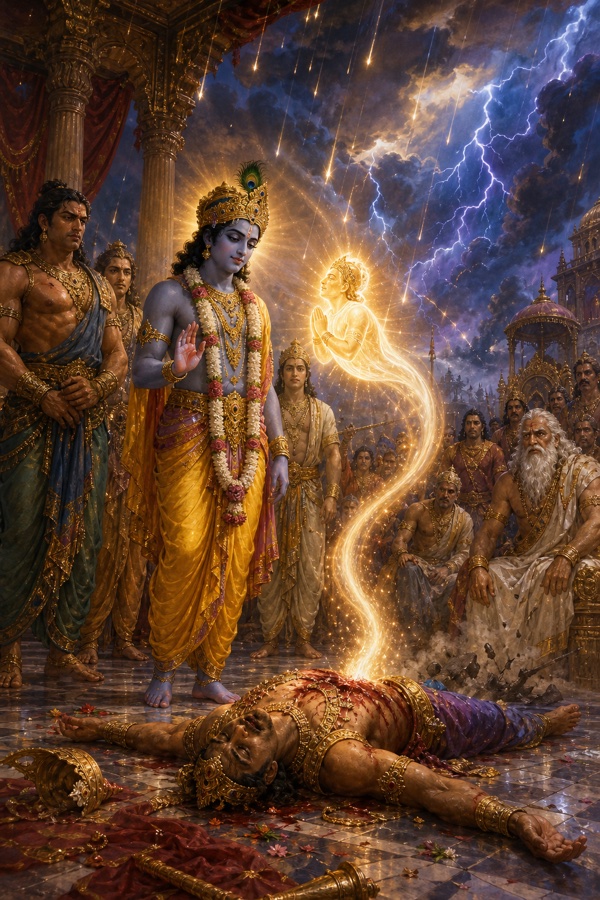
Yudhishthira gave his brothers an immediate order: the funeral rites for Shishupala, the brave son of Damaghosha, were to be carried out promptly and with proper respect. The Pandavas obeyed. Yudhishthira then joined the assembled kings in installing Shishupala’s son as ruler of Chedi. The son had come to the sacrifice with his father; he now received the throne in the presence of the other rulers. The slain king received the honors of his station, and his son received the sovereignty of the kingdom he had left behind.
The gist: Shishupala challenged Krishna and the Pandavas to battle. Krishna recounted his offenses and announced that the promised 100 pardons were exhausted. He killed Shishupala with the discus, and the king’s radiant energy entered him. Yudhishthira ordered respectful funeral rites and installed Shishupala’s son on the Chedi throne.
The sacrifice ends and Krishna departs
Yudhishthira’s sacrifice proceeded in prosperity and splendor, a sight that delighted the young men present. It had begun auspiciously, its obstacles were removed, and its supplies of wealth, grain, rice, and every kind of food were abundant. Krishna watched over it carefully. Armed with his Sharanga bow, discus, and mace, he guarded the undertaking until its completion. In due course, Yudhishthira finished the great rite and took the bath that marked its conclusion. The Kshatriya kings approached him afterward. “Good fortune has brought you success,” they said. “You have attained imperial sovereignty and spread the fame of your entire line. Through this act, descendant of Ajamidha, you have gained great religious merit. You have honored us as fully as we could wish. We now want to return to our kingdoms. Give us permission to leave.” Yudhishthira honored each according to his standing, then instructed his brothers to accompany them. “These kings came here of their own will,” he said. “They are taking leave of me and wish to return home. Escort them as far as the boundaries of our kingdom.”
The departures were arranged with care for the rank of each guest. The rulers had brought wealth and acknowledged Yudhishthira’s authority; before returning to their own kingdoms, they formally asked his leave. His relatives were to accompany them to the territorial boundary, extending the hospitality of the sacrifice through the journey out of his realm. Dhrishtadyumna went with Virata. Arjuna accompanied Yajnasena, the great chariot warrior Drupada. Bhima escorted Bhishma and Dhritarashtra. Sahadeva went with Drona and Ashvatthama, and Nakula accompanied Subala and his son. Draupadi’s sons, together with Subhadra’s son Abhimanyu, escorted the powerful kings of the mountain countries. Other leading Kshatriyas accompanied other rulers, and thousands of Brahmins departed after receiving their honors. When the kings and Brahmins had gone, Krishna asked Yudhishthira’s permission to return to Dwarka. “You have successfully performed the Rajasuya, the foremost of sacrifices,” he said. Yudhishthira credited him with the achievement. “Through your grace I completed it, Govinda,” he replied. “Through your grace the Kshatriya world accepted my sovereignty and came here bearing precious tribute. My heart finds no joy without you. How can I give you permission to leave? Yet you must return to Dwarka.” His reply acknowledged both the help that had made the sacrifice possible and his reluctance to lose Krishna’s company.
Krishna gladly went with Yudhishthira to Kunti. “Aunt, your sons have attained imperial sovereignty,” he told her. “They have obtained great wealth and fulfilled their purpose. Be happy in their success. With your permission, I wish to return to Dwarka.” He then took leave of Draupadi and Subhadra. Coming out of the inner apartments with Yudhishthira, he bathed, performed his daily worship, and had the Brahmins pronounce their blessings. Daruka arrived with a beautifully fashioned chariot whose body resembled the clouds. Seeing it before him with Garuda on its standard, Krishna walked reverently around it, climbed aboard, and set out for Dwaravati. Yudhishthira and his brothers followed him on foot. Krishna stopped the chariot briefly to give the king a final charge. “Protect your subjects with constant vigilance and patience,” he said. “Be the refuge and support of your relatives, as clouds sustain living beings, as a great spreading tree shelters birds, and as Indra supports the immortals.” Krishna and Yudhishthira spoke together, took leave of each other, and returned to their respective homes. Krishna went to Dwarka. Duryodhana and Shakuni, Subala’s son, remained in the celestial assembly hall.
The gist: Guarded by Krishna, the Rajasuya reached completion. Yudhishthira honored the departing guests and sent escorts with the kings. Krishna took leave of the family and urged Yudhishthira to protect his people vigilantly and support his relatives. Duryodhana and Shakuni stayed behind in the assembly hall.
Vyasa’s warning and the vow of 13 years
The difficult Rajasuya had been accomplished when Vyasa came before Yudhishthira with his disciples. The king rose immediately from among his brothers and honored the sage who was also his grandfather. He offered water for his feet and a seat. Vyasa settled onto a costly carpet worked with gold and asked Yudhishthira to sit as well. With the brothers gathered around him, he praised the king’s success. “Good fortune has increased your prosperity,” he said. “You have attained imperial sovereignty, a position difficult to obtain. Through you, the entire Kuru family has prospered. I have received due honor and now wish to take leave.” Yudhishthira bowed and touched his grandfather’s feet. Before Vyasa left, he needed an answer to a doubt he could not put aside. “Only you can resolve this for me,” he said. “Narada spoke of 3 kinds of portents arising from the Rajasuya, those of the celestial realm, those of the atmosphere, and those of the earth. Have their consequences ended with the death of the king of Chedi?” The sacrifice was complete, and Shishupala was dead. Yudhishthira wanted to know whether the danger Narada had described had also passed.
Vyasa answered with a warning that extended far beyond the completed rite. “For 13 years, those portents will produce grave consequences, ending in the destruction of the Kshatriyas,” he said. “In time, with you as the occasion, the assembled warriors of the world will be destroyed through Duryodhana’s wrongdoing and the strength of Bhima and Arjuna. Toward the end of this night, you will see a dream. Bhava will appear, blue-throated, destroyer of Tripura, always absorbed in meditation, with the bull as his emblem. He will be drinking from a human skull, fierce and terrible. The lord of living beings, god of gods and husband of Uma, also called Hara, Sharva, and Vrisha, will carry his trident and the bow Pinaka and wear an animal skin. You will see Shiva, tall and white like a cliff of Kailasa, seated on his bull. He will gaze without turning toward the south, the direction governed by the king of the ancestors. That is the dream you will have tonight. Do not grieve when you see it. No one can rise beyond the power of Time. I will now go toward Mount Kailasa. Govern the earth with vigilance and steadiness, bearing every hardship patiently.” The south was Yama’s direction, the realm of the lord of the dead whose assembly Narada had described. Vyasa’s warning placed Shiva’s gaze toward that quarter in a dream still to come. Having spoken, the dark-complexioned, island-born son of Parashara departed for Kailasa with his disciples, who followed the commands of the Vedas.
Yudhishthira remained troubled by grief and anxiety after his grandfather left. He kept returning to the prophecy. ‘What the rishi has said will certainly happen,’ he thought. ‘Who can turn fate aside by effort alone?’ He then addressed his brothers. “You heard what Vyasa told me. After hearing him, I have reached a firm decision. I should die if I am destined to become the cause of the destruction of all the Kshatriyas. If Time has determined that outcome, what reason is there for me to live?” Arjuna answered him. “Do not surrender to this terrible despair that destroys judgment. Gather your courage and do what will be beneficial.” Still thinking of Vyasa’s words, Yudhishthira formed a different resolution. “Listen to the vow I make from today,” he told them. “For 13 years, what other purpose should I live for? I will speak no harsh word to my brothers or to any king on earth. I will follow my relatives’ wishes and practice dharma in keeping with this vow. If I live that way and make no distinction between my own children and others, there will be no disagreement. Disagreement causes war in the world. By keeping war away and always doing what pleases others, I will avoid an evil reputation.” His proposed answer to the prophecy was a sustained refusal to let disagreement grow into conflict.
The other Pandavas, always eager to please their eldest brother, approved his words. Having made the pledge in the assembly with his brothers beside him, Yudhishthira honored his priests and the gods through the appropriate ceremonies. After the monarchs had departed, he completed the customary auspicious rites and entered his palace with his brothers and ministers. Duryodhana and Shakuni remained in the beautiful assembly hall.
The gist: Vyasa warned that the portents would culminate in the destruction of the Kshatriyas over 13 years and foretold a dream of Shiva that Yudhishthira would have that night. Grief overwhelmed the king until Arjuna urged him to act constructively. Yudhishthira then vowed to avoid harsh words and disagreement for 13 years.
Source: the Mahabharata of Krishna-Dwaipayana Vyasa, Sabha Parva. This chapter follows K. M. Ganguli, sections I-XLVI (1-46); the Gita Press Hindi edition numbers these chapters differently. Names, order, and events were checked against Ganguli’s complete translation. Dialogue and commentary are adapted, not a verbatim translation. About the sources.
Based on: The Mahabharata, Vyasa (Gita Press, Gorakhpur)
The same story elsewhere
- The Khandava fire and Maya’s rescue
The preceding chapter - The dice game
The next chapter