On this page
Indra’s hall, Pushkaramalini
When Narada had finished, Yudhishthira honored him and, with his permission, offered a brief answer to the many questions. “The principles of dharma and conduct you have set out are right and proper,” he said. “I observe them as well as my strength allows. The actions properly carried out by the kings of earlier times had sound reasons and worthy purposes, and brought fitting results. I wish to follow the righteous path of those rulers who had mastered themselves.” He received the instruction with reverence, then considered another question. Narada could travel at will through every world, moving as swiftly as thought and seeing what existed in the realms Brahma had created. With the sage seated comfortably beside him and the assembled kings listening, Yudhishthira asked whether he had ever seen a hall like this one, or anything finer. Narada smiled. “Among human beings, I have never seen or heard of an assembly hall of gems and precious stones equal to yours,” he replied gently. “I can describe the halls of Yama, lord of the departed; of wise Varuna; of Indra, king of the gods; and of Kubera, who dwells on Kailasa. I can also tell you of Brahma’s celestial hall, where every discomfort disappears. Their structures hold both divine and human designs, displaying all the forms that exist in the universe. Gods, ancestors, the Sadhyas, self-controlled ascetics who offer sacrifices, and peaceful sages continually engaged in Vedic rites with gifts for the Brahmins all honor them. If you would like to hear, I will describe these halls.”
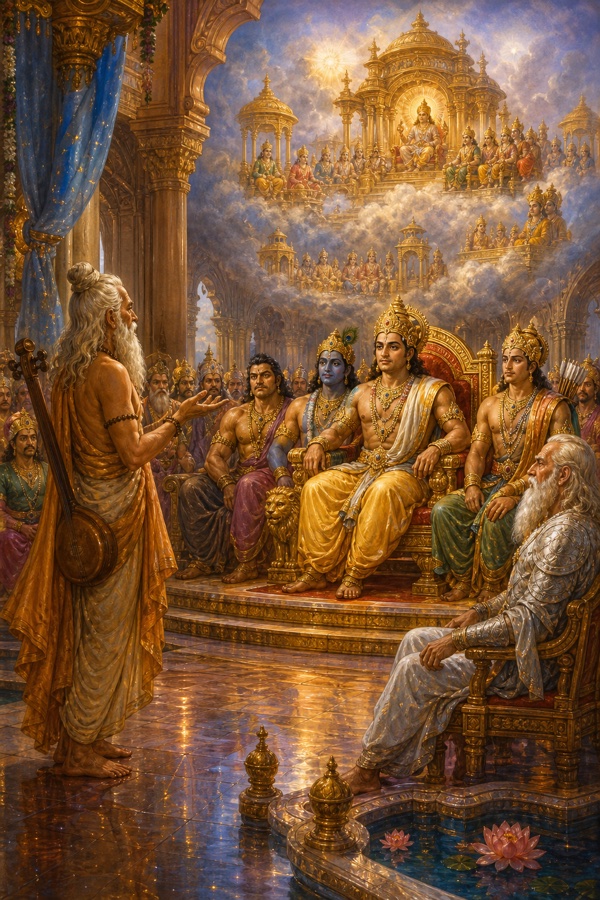
Yudhishthira joined his hands, together with his brothers and the foremost Brahmins seated around him. They wanted to know what each hall was made of, how large it was, and the measure of its length and width. Who attended the Grandsire Brahma? Who waited upon Indra, upon Yama the son of Vivasvat, and upon Varuna and Kubera? Their curiosity extended to the company gathered in each hall as well as the building itself. Yudhishthira’s own assembly had brought sages, kings, and celestial musicians together; he now wanted to hear who occupied the seats around each divine ruler. Narada told them to listen as he described the halls one by one. He began with Indra’s. “The king of the gods gained his hall through the merit of his own deeds and built it himself,” he said. “It shines like the sun and can travel wherever he wills. Its length is 150 yojanas, its width 100, and its height 5. Within those vast dimensions, the hall offers its company freedom from the burdens that wear down life. Old age loses its power to weaken those within it; grief, fatigue, and fear are driven away. Auspicious and fortunate, the hall is filled with rooms, seats, and celestial trees. There Indra sits on an excellent throne beside his beautiful and prosperous wife, Shachi. His form is too elusive to be captured fully in words. A crown rests on his head, bright armlets circle his upper arms, and he wears pure white robes with flower garlands of many colors. Beauty, fame, and glory stand beside him. The Maruts attend him daily, each living as a householder with his own family. The Siddhas, celestial sages, all the Sadhyas, the gods, and the radiant Maruts with golden garlands worship him in their divine forms and ornaments. The sages there have washed away their sins. They are pure, energetic, and bright as fire, free of sorrow and the heat of anxiety. They have all performed the Soma sacrifice, offering its sacred juice in the prescribed rite, and now pay honor to Indra.”
Narada named the sages in that company. “Parashara, Parvata, Savarni, Galava, Shankha, Likhita, Gaurshiras, Durvasa, Krodhana, Swena, and Dirghatamas are there. So are Pavitrapani, Savarni, Yajnavalkya, Bhaluki, Uddalaka, Shvetaketu, Tandya, Bhandayani, Havishmat, Garishta, and King Harishchandra. Hridya, Udarshandilya, Parasharya, Krishivala, Vataskandha, Vishakha, Vidhatas, Kala, Karaladanta, Tashtri, Vishvakarman, and Tumburu attend him. Some sages were born from women and others without women, while some live on air and some on fire. All worship the bearer of the thunderbolt. Sahadeva and Sunitha are present, together with the great ascetic Valmiki, truthful Shamika, the Prachetas who fulfill their promises, Medhatithi, Vamadeva, Pulastya, Pulaha, Kratu, Maruta, Marichi, and the austere Sthanu. Kakshivat, Gautama, Tarkhya, and the sage Vaishvanara sit in that company, as do Kalakavrikhiya, Asravya, Hiranmaya, Samvarta, Dehavya, the powerful Vishvaksena, Kanva, Katyayana, Gargya, and Kaushika. With them are the celestial waters and plants, faith, intelligence, the goddess of learning, wealth, dharma, and pleasure.”
The company extended through the powers of sky and sacrifice. The forces that brought rain, the fires that carried offerings, and the words spoken over those offerings all had their places around Indra. “Lightning, clouds heavy with rain, the winds, and all the resounding forces of heaven are there. The eastern direction attends, together with the 27 fires that carry sacrificial butter, Agni and Soma, Indra’s fire, Mitra, Savitri, Aryaman, Bhaga, the Vishvas, the Sadhyas, the teacher Brihaspati, and Shukra. Vishvavasu, Chitrasena, Sumanas, and Taruna are present. So are the sacrifices themselves, the gifts offered to Brahmins, the planets, the stars, and the mantras spoken during ritual. Apsaras and Gandharvas please Indra through different dances, instrumental music, singing, auspicious ceremonies, and displays of skill. He is the god of 100 sacrifices, the slayer of Vala and Vritra. Many more Brahmins, royal sages, and celestial sages come and go in divine chariots of different kinds, blazing like fire and adorned with flowers and ornaments. Brihaspati and Shukra are always there. The illustrious ascetics of firm vows, Bhrigu, and the 7 sages, equal in stature to Brahma, arrive and depart in chariots as beautiful as the moon’s, shining in them like the moon itself. This is Indra’s hall, called Pushkaramalini, which I have seen. Now listen to the account of Yama’s assembly.”
The gist: Yudhishthira asked Narada about halls finer than his own. Narada praised Maya’s work as unequaled among humans, then described Indra’s Pushkaramalini, where gods, sages, royal ascetics, and the powers of nature and sacrifice gather.
The assemblies of Yama and Varuna
Narada turned to the realm of Yama, Vivasvat’s son, who presided over the departed. “Vishvakarman built his assembly hall,” he told Yudhishthira. “Its extent is far greater than 100 yojanas. It shines like polished gold, with the brilliance of the sun, and supplies whatever anyone could desire. Its temperature is pleasant, free of excessive heat or cold. Grief has no place there, and neither do the weakness of age, hunger, thirst, wretchedness, distress, weariness, or evil feelings. Everything desired by gods or humans can be found within it. Sweet and juicy foods are abundant, including those that can be licked or sucked, together with delicious drinks. Flower garlands release wonderful fragrances, and the trees around the hall yield whatever fruit is wanted. Both cool and warm water are available, sweet and pleasant. Pure royal sages and Brahmin sages attend Yama cheerfully and offer him their worship.”
The company of kings reached across many generations and royal lines. Narada named Yayati, Nahusha, Puru, Mandhatri, Somaka, Nriga, the royal sage Trasadasyu, Kritavirya, and Shrutashravas. Arishtanemi, Siddha, Kritavega, Kriti, Nimi, Pratardana, Shivi, Matsya, Prithulaksha, Brihadratha, Vartta, Marutta, Kushika, Sankashya, Sankriti, Dhruva, Chaturashva, Sadashvormi, and Kartavirya were there. He continued with Bharata, Suratha, Sunitha, Nishatha, Nala, Divodasa, Sumanas, Ambarisha, Bhagiratha, Vyashva, Sadashva, Vadhrashva, Prithuvega, Prithushravas, Prishadashva, Vasumanas, Kshupa, Sumahabala, Vrishadgu, Vrishasena, Purukutsa, Dhvajin, and Rathin. Arshtishena, Dwilipa, Ushinara, Aushinari, Pundarika, Sharyati, Sharava, Shuchi, Anga, Rishta, Vena, Dushmanta, Srinjaya, Jaya, Bhangasuri, Sunitha, Nishada, Vahinara, Karandhama, Valhika, Sudyumna, and mighty Madhu attended Yama. So did Aila, the powerful king Marutta, Kapotaroman, Trinaka, Sahadeva, Arjuna, Vyashva, Shashva, Krishashva, and Shashabindu. Rama the son of Dasharatha was there with Lakshmana, followed in the account by Pratardana, Alarka, Kakshasena, Gaya, Gaurashva, Rama of Jamadagni’s line, Nabhaga, and Sagara. Narada named Bhuridyumna, Mahashva, Prithashva, Janaka, Vainya, Varishena, Purujit, Janamejaya, Brahmadatta, Trigarta, Uparichara, Indradyumna, Bhimajanu, Gauraprishtha, Nala, Gaya, Padma, Muchukunda, Bhuridyumna, Prasenajit, Arishtanemi, Sudyumna, Prithulashva, and Ashtaka. There were 100 kings of the Matsya line, 100 of the Nipa line, and 100 of the Haya line. Another 100 bore the name Dhritarashtra, 80 the name Janamejaya, 100 the name Brahmadatta, and 100 the name Iri. More than 200 were called Bhishma, and 100 were called Bhima. There were 100 Prativindhyas, 100 Nagas, 100 Hayas, 100 Palashas, and 100 bearing the names Kasha and Kusha. Narada then brought the company close to Yudhishthira’s own family. “Shantanu is there, and your father Pandu,” he said. “So are Usangava, Shataratha, Devaraja, Jayadratha, and the wise royal sage Vrishadharva with his ministers. A thousand more kings called Shashabindu have died after performing great horse sacrifices with generous gifts to Brahmins. These holy royal sages, accomplished in their deeds and learned in the teachings, worship Yama in his hall.”
“Agastya and Matanga are there, together with Time, Death, sacrificers, Siddhas, and many practitioners of Yoga,” Narada continued. “The ancestors include the classes called Agnishvattas, Phenapas, Ushmapas, Svadhavats, and Barhishads, together with other ancestors who possess embodied forms. The wheel of time and Agni, who carries the sacrificial butter, attend as well. Sinful human beings are present, and those who died at the winter solstice. Yama’s officers count the days allotted to every person and thing. The shimshapa and palasha trees, and the kasha and kusha grasses, appear in embodied form to worship the lord of justice. There are so many others that I cannot give all their names or deeds. The vast hall can travel wherever its owner wishes. Vishvakarman made it after long austerities, and its own radiance reveals its beauty. Renunciants of severe discipline, steadfast vows, and truthful speech visit continually. They are peaceful and pure, sanctified by their actions, with shining bodies and spotless robes. They wear bracelets, flower garlands of many colors, and earrings of polished gold. Their sacred deeds adorn them as the painted signs of their order adorn their bodies. Gandharvas and Apsaras fill the building with song, instrumental music, laughter, and dancing. Fine perfumes, sweet sounds, and garlands of celestial flowers add to its blessedness. Hundreds of thousands of virtuous people, beautiful as celestials and deeply wise, attend the lord of living beings. Such is the hall of the king of the ancestors. I will now describe Varuna’s assembly, also called Pushkaramalini.”
“Varuna’s hall is similar in size to Yama’s,” Narada said. “Vishvakarman built it within the waters. Its walls and arches are entirely white. Celestial trees fashioned from gems surround it and yield excellent fruits and flowers. Plants laden with blue, yellow, black, dark, white, and red blossoms form beautiful bowers. Within them, hundreds and thousands of colorful birds of different kinds continually sing. The air is pleasant, free of extremes of heat and cold. There are many rooms and seats in this white mansion. Varuna sits with his queen, wearing divine robes, ornaments, and jewels. The Adityas, adorned with celestial garlands, scents, and fragrant pastes, attend the lord of waters. The Nagas Vasuki, Takshaka, Airavana, Krishna, Lohita, Padma, Chitra, Kambala, Ashvatara, Dhritarashtra, Valahaka, Matimat, Kundadhara, Karkotaka, Dhananjaya, Panimat, mighty Kundaka, Prahlada, Mushikada, and Janamejaya worship him. Their hoods are spread, displaying auspicious markings and circles, and they are free of anxiety. Virochana’s son Bali attends, as does Naraka, who subdued the earth. Sanghrada, Viprachitti, the Kalakhanja Danavas, Suhanu, Durmukha, Shankha, Sumanas, Sumati, Ghatodara, Mahaparshva, Krathana, Pithara, Vishvarupa, Svarupa, Virupa, Mahashiras, Dashagriva, Bali, Meghavasas, Dashavara, Tittiva, Vitabhuta, Sanghrada, and Indratapana are there. These Daityas and Danavas wear earrings, flower garlands, crowns, and celestial clothes. They have received boons, possess great courage, enjoy immortality, and maintain good conduct and excellent vows as they worship Varuna, whose weapon is the noose.”
“The 4 oceans are there,” he continued, “with the rivers Bhagirathi, Kalindi, Vidisha, Venva, the swiftly flowing Narmada, Vipasha, Shatadru, Chandrabhaga, Saraswati, Iravati, Vitasta, Sindhu, and Devanadi. Godavari and Krishnavenva attend, together with Kaveri, a queen among rivers; Kimpuna, Vishalya, Vaitarani, Tritiya, Jeshthila, the great Shona, Charmanvati, Parnasha, Sarayu, Varavatya, and the river queen Langali. Karatoya, Atreyi, the red Mahanada, Laghanti, Gomati, Sandhya, and Trisrotasi are also present. These sacred rivers and places of pilgrimage, celebrated throughout the world, join other rivers, holy waters, lakes, wells, springs, and reservoirs of every size. All have taken visible form to honor Varuna. The directions of the sky, the earth, all mountains, and every kind of water animal worship him. Groups of Gandharvas and Apsaras sing his praises with voices and instruments. The beautiful mountains rich in gems converse pleasantly with one another in their embodied forms. Varuna’s chief minister, Sunabha, attends with his sons and grandsons, and a sacred body of water called Go is present in person as well. This is the assembly I saw during my travels. Now hear about Kubera’s hall.”
A key to reading this (shared names): Narada describes many kings who bear the same name. A name such as Bhima or Dhritarashtra in this company therefore does not, by itself, identify the living person who carries it in Yudhishthira’s story. Narada makes the family connection explicit when he names Shantanu and Yudhishthira’s father, Pandu. The names Krishna and Dhananjaya later occur within a list of Nagas.
The gist: Narada placed Shantanu and Pandu among the many royal sages in Yama’s hall. He then described Varuna’s underwater assembly, where Nagas, Daityas, Danavas, rivers, oceans, and mountains attend the lord of waters in visible form.
Kubera’s hall, and his friendship with Shiva
Narada described a hall that seemed suspended in the sky. Vaishravana, also called Kubera, ruled over treasures and the Yakshas who attended him. The hall he occupied had come into being through his own austerities, the sustained ascetic discipline from which he drew the power to build it. It measured 100 yojanas in length and 70 in width. With a radiance like the peaks of Kailasa, it dimmed even the brightness of the moon. Guhyakas supported it, and its lofty golden chambers gave the celestial structure extraordinary beauty. Divine perfumes filled it; countless precious stones brought changing colors to its surfaces. It resembled the peaks of a mass of white clouds floating through the air. The color of celestial gold lay across it like streaks of lightning. Within sat Kubera on a splendid seat bright as the sun, spread with divine carpets and furnished with a handsome footstool. His own appearance was pleasing, his robes excellent, his ornaments costly, and his earrings brilliant. A thousand wives surrounded him. Above that company rose the high golden chambers, while the Guhyakas bore the celestial mansion in the sky. Cool breezes murmured through forests of tall mandara trees and carried the fragrances of broad jasmine plantations, lotuses from the Alaka River, and the Nandana gardens. These scents and breezes continually delighted the king of the Yakshas. Gods and Gandharvas, surrounded by groups of Apsaras, joined their voices in songs of celestial sweetness.
Narada named Mishrakeshi, Rambha, Chitrasena, Shuchismita, Charunetra, Ghritachi, Menaka, Punjikasthala, Vishvachi, Sahajanya, Pramlocha, Urvashi, Ira, Varga, Sauraveyi, Samichi, Budbuda, and Lata. With another 1,000 Apsaras and Gandharvas skilled in music and dance, they attended the lord of treasures. Their singing, instruments, and dances constantly filled the building and made it delightful. Gandharvas called Kinnaras were there, along with others called Naras. The company also included Manibhadra, Dhanada, Shvetabhadra, Guhyaka, Kasheraka, Gandakandu, powerful Pradyota, Kustumburu, Pishacha, Gajakarna, Vishalaka, Varahakarna, Tamraushtha, Falakaksha, Falodaka, Hamsachuda, Shikhavarta, Vibhishana, Pushpanana, Pingalaka, Shonitoda, Pravalaka, Vrikshavashpaniketa, and Chiravasas. Hundreds and thousands of other Yakshas joined them in Kubera’s service. Lakshmi always remained there, as did Kubera’s son Nalakubera. “I go there often, and so do many others like me,” Narada told Yudhishthira. “Brahmin sages and celestial sages frequently visit. Many Rakshasas and Gandharvas beyond those I have named also worship the lord of wealth in that mansion.”
Shiva’s presence gave the assembly another great company of attendants. Narada described Uma’s husband, the 3-eyed Mahadeva, as lord of living beings, bearer of the trident and a fierce bow, and slayer of the Asura Bhaganetra. Cheerful and free of fatigue, he attended his friend Kubera with Parvati beside him. Hundreds and thousands of spirits followed. Some were dwarfs, some had frightening faces, some had bent backs, and some had blood-red eyes. Some cried out terribly, some fed on fat and flesh, and some were dreadful to look at. All carried weapons of different kinds and moved as swiftly as the wind. Hundreds of Gandharva chiefs came gladly in their own distinctive robes. Vishvavasu, Haha, Huhu, Tumburu, Parvata, Shailusha, the musician Chitrasena, and Chitraratha worshiped Kubera with countless other Gandharvas. Chakradharma, chief of the Vidyadharas, attended with his followers. Hundreds of Kinnaras were present, along with innumerable kings led by Bhagadatta; Druma, chief of the Kimpurushas; Mahendra, chief of the Rakshasas; and Gandhamadana, accompanied by many Yakshas, Gandharvas, and Rakshasas. The virtuous Vibhishana also offered worship to his elder brother Kubera.
The mountains stood in embodied form before the lord of treasures. Narada named Himavat, Paripatra, Vindhya, Kailasa, Mandara, Malaya, Durdura, Mahendra, Gandhamadana, Indrakila, Sunava, and the eastern and western mountains. Meru stood foremost among these and the many others that attended. Nandishvara and Mahakala were present, with spirits whose ears were shaped like arrows and whose mouths came to sharp points. Kaksha, Kuthimukha, Danti, and the great ascetic Vijaya joined them. Shiva’s mighty white bull gave its deep roar in that hall, where still more Rakshasas and Pishachas paid honor to Kubera. Narada explained how the friendship between Kubera and Shiva had begun. Kubera, of Pulastya’s line, had once worshiped the creator of the 3 worlds in every proper way. He would obtain permission before sitting beside Shiva among the god’s attendants. Then one day Shiva made him his friend. Kubera had approached the god through worship and had waited for permission to take a seat beside him. From that time onward, Mahadeva sat in the mansion of the lord of treasures, bringing Uma and his great company of attendants into his friend’s home. Shankha and Padma, foremost among the jewels of the 3 worlds, were also present in person, accompanied by all the jewels of the earth in their own embodied forms. “This is Kubera’s delightful assembly hall, which I have seen in the sky, able to move through it,” Narada said. “Now listen as I describe the hall of Brahma, the Grandsire.”
The gist: Kubera’s austerities produced a celestial hall attended by Yakshas, Gandharvas, Apsaras, mountains, and jewels in visible form. Narada also told how Kubera’s worship of Shiva became friendship, bringing Shiva and Parvati into the company of the lord of wealth.
Brahma’s hall, where creation gathered in person
For the last of the celestial halls, Narada could offer Yudhishthira no fixed shape and no dimensions. This was the assembly of Brahma, the Grandsire of created beings. “Listen to how I came to see it,” he said. “Long ago, in the Krita age, Aditya came down from heaven to the human world. He had already seen the hall of the Self-created Brahma. Now, in human form, he was happily traveling across the earth to see its sights. During that journey, the sun god told me about the Grandsire’s celestial assembly. It was beyond measurement, free of material substance, impossible to describe in terms of shape or form. Its splendor could fill every creature’s heart with joy. Hearing about it made me want to see it myself. I asked the lord of light what austerities I must undertake, what deeds I must perform, what sacred formulas or rites could bring me into that holy, sin-cleansing hall. The god with 1,000 rays answered, ‘Keep the Brahma vow for 1,000 years, with your mind absorbed in meditation.’ I went into the mountains of Himavat and began that great observance. When I had completed it, the powerful, stainless Surya, who never knew fatigue, took me with him to the Grandsire’s assembly. Even after seeing it, I cannot tell you that the building is this shape or that. Within a moment, its form changes into something else that words cannot convey. I had never seen anything like it. Those within it are always happy. The air is free of both cold and heat; hunger, thirst, and every discomfort disappear upon entering. It seems to be made of many kinds of brilliant gems, with no visible columns supporting it. It is eternal and never deteriorates. Its own radiance shines from countless celestial features, so bright that moon, sun, and fire seem surpassed. There in heaven, the hall blazes as if challenging the very maker of daylight. Brahma, the supreme deity and Grandsire of all creatures, remains there always, having created everything by himself through his creative maya.”
Around Brahma stood the Prajapatis, the great progenitors: Daksha, Prachetas, Pulaha, Marichi, the teacher Kashyapa, Bhrigu, Atri, Vashishtha, Gautama, Angiras, Pulastya, Kratu, Prahlada, and Kardama. Angirasa of the Atharvan Veda was there, along with the Valakhilya and Marichipa sages. Narada had seen Intelligence, Space, Knowledge, Air, Heat, Water, and Earth beside them. Sound, Touch, Form, Taste, and Scent also had their places. Nature, its modes, and the elemental and original causes of the world were present in that assembly. The principles through which the world took shape stood before its creator. The sages included mighty Agastya; Markandeya, rich in the power of austerity; Jamadagni; Bharadwaja; Samvarta; Chyavana; the exalted Durvasa; and the virtuous Rishyasringa. Sanatkumara, whose ascetic merit was great and whose teaching embraced every matter of yoga, was among them. So were Asita, Devala, Jaigishavya with his knowledge of truth, Rishabha, Ajatashatru, and the powerful Mani. The science of healing was there in person, complete with its 8 branches. The Moon attended with the stars and their conjunctions; Aditya came with all his rays. The Winds, the Sacrifices, the declarations of purpose that accompanied sacrifice, and the principles of life had embodied forms. These radiant beings, faithful to their observances, served Brahma with many more than Narada could name. Wealth, Dharma, Desire, Joy, Aversion, Austerity, and Tranquility stood together before the supreme deity. There were 20 communities of Gandharvas and Apsaras, together with 7 further communities, and all the Lokapalas who guarded the regions of the world. Shukra, Brihaspati, Budha, Angaraka also called Mangala, Shani, Rahu, and the other planets attended. The mantras of the Sama Veda and its special mantras were present, as were the rites of Harimat and Vasumat. Indra came with the Adityas. The 2 named forms of Agni, Agnisoma and Indragni, were there, with the Maruts, Vishvakarman, the Vasus, the Pitris, and every kind of sacrificial offering.
The sacred learning of the world had also taken visible form. The 4 Vedas, Rig, Sama, Yajur, and Atharva, attended with all the sciences, the branches of learning, histories, subsidiary studies, and the several branches of the Vedas. The planets, sacrifices, Soma, and all the gods were there. Savitri, also called Gayatri, was present with the 7 kinds of Speech. Understanding, Patience, Memory, Wisdom, Intelligence, Fame, and Forgiveness stood in the assembly. The chants of the Sama Veda, the science of hymns, and many kinds of verses and songs were embodied there. Commentaries appeared with the arguments they contained. Dramas, poems, stories, and brief explanatory glosses also served Brahma, with many other forms of knowledge. Time itself was present in its divisions. There were kshanas, lavas, and muhurtas, the shorter measures of time, as well as Day, Night, Fortnights, Months, the 6 Seasons, Years, and Yugas. The 4 kinds of days and nights belonging to humans, ancestors, gods, and Brahma were all there. So was the excellent Wheel of Time, eternal, indestructible, and free of decay, together with the Wheel of Virtue. Among the mothers of celestial beings, Narada named Aditi, Diti, Danu, Surasa, Vinata, Ira, Kalika, the goddess Surabhi, Sarama, Gautami, Pradha, and Kadru. Rudrani, Shri, Lakshmi, Bhadra, Shashthi, Earth, Ganga, Hri, Svaha, Kirti, the goddess Sura, Shachi, Pushti, Arundhati, Samvritti, Asha, Niyati, Srishti, and Rati also attended the creator, with many other goddesses. The Adityas, Vasus, Rudras, Maruts, Ashvins, Vishvadevas, Sadhyas, and Pitris swift as thought were in the Grandsire’s presence. Narada paused over those ancestral beings. “There are 7 classes of Pitris,” he told Yudhishthira. “Four have embodied forms, and 3 have none. The illustrious Vairajas, Agnishvattas, and Garhapatyas move through heaven. The Somapas, Ekashringas, Chaturvedas, and Kalas are continually worshiped among the 4 orders of human society. First satisfied by offerings of Soma juice, they in turn satisfy Soma. All these communities of ancestors attend the lord of creation and gladly worship his immeasurable power.”
Rakshasas, Pishachas, Danavas, Guhyakas, Nagas, birds, and animals of many kinds worshiped the Grandsire there. So did all the great beings that moved and those rooted in one place. Purandara, the chief of the gods also known as Indra, came continually, as did Varuna, Kubera, Yama, and Mahadeva with Uma. Mahasena, also called Kartikeya, adored Brahma in that hall. Narayana himself was present, together with the celestial sages and the sages known as Valakhilyas. “Everything born of a female, everything that came into being in another way, everything moving or unmoving that can be seen in the 3 worlds, I saw there,” Narada said. “I saw 80,000 sages who had preserved their generative power through celibacy, and 50,000 sages who had sons. The inhabitants of heaven go there whenever they wish to see the supreme deity. They worship with bowed heads, then return to their own homes. The Self-created Brahma, soul of the universe and Grandsire of all living things, has immeasurable intelligence and glory. His kindness extends equally to every creature. Gods, Daityas, Nagas, Brahmins, Yakshas, birds, Kaleyas, Gandharvas, Apsaras, and all the other great beings who come as guests receive the honor appropriate to them. He welcomes them with gracious words, gifts of wealth, and things that bring them pleasure. The delightful hall is always crowded with arrivals and departures. Every kind of power fills it. Brahmin sages worship there, and Brahma’s beautiful possessions give the whole celestial assembly its extraordinary splendor. Your hall has no equal in the human world, Yudhishthira. The hall of Brahma that I saw has no equal in any world. I have visited these assemblies in the regions of the gods, and your own is unquestionably the finest among human beings.”
The gist: After Narada kept a 1,000-year vow, Surya took him to Brahma’s assembly. Its changing form could never be measured or fixed in words. Gods, sages, ancestors, learning, time, and the elements of creation gathered there in person. Narada ended his account by affirming that Yudhishthira’s hall was the finest in the human world.
Pandu’s message, and the danger of the Rajasuya
One name in Narada’s account required an explanation. Yudhishthira had heard of whole companies of kings in Yama’s hall. In the assembly of Indra, Narada had singled out Harishchandra. “You have described these different courts to me,” Yudhishthira said. “Almost all the earth’s monarchs seem to be in Yama’s assembly. Most of the Nagas, the principal Daityas, the rivers, and the oceans are in Varuna’s. The Yakshas, Guhyakas, Rakshasas, Gandharvas, Apsaras, and the god who rides the bull attend the lord of treasures. You have placed all the great sages, the gods, and the branches of learning in the Grandsire’s hall. For Indra’s assembly, you named gods, Gandharvas, and many sages, yet only one royal sage, Harishchandra. What deed brought that king to a position equal to Indra’s own? What austerities did he practice, and what vows did he steadily keep? And how did you meet my father, the noble Pandu, who is now a guest in the realm of the ancestors? Did he give you any message? I am eager to hear everything. Please tell me.” Narada agreed to explain Harishchandra’s greatness. He had been a powerful emperor whom all the kings of the earth obeyed. Riding alone in a victorious chariot decorated with gold, he had brought the whole earth, with its 7 islands, under his authority through the power of his weapons. Once the land, its mountains, forests, and groves were subject to him, he prepared the great sacrifice called the Rajasuya. At his command, all the kings brought wealth for the ceremony. They also agreed to serve at the sacrifice, distributing food and gifts to the Brahmins who were fed there. The rulers who acknowledged Harishchandra’s command thus supplied the wealth of the ceremony and took part in the work of hosting it. Their service accompanied the rite through which his sovereignty over them would be formally established.
Harishchandra opened that accumulated wealth to those who came asking. The kings had brought their contributions; now the emperor gave freely from the riches assembled for the sacrifice. Anyone who asked him for wealth received 5 times the amount requested. At the close of the sacrifice, Brahmins who had come from many countries received great gifts of different kinds of wealth. Food and articles for their enjoyment were supplied as freely as they wished, and heaps of jewels were distributed among them. Satisfied with everything they had received, they declared Harishchandra superior to all other kings in power and renown. That was why he shone more brightly than thousands of monarchs. With the sacrifice completed, he was installed as sovereign of the earth and took his place in splendor upon his throne. Narada explained the reward beyond his earthly kingship. “Kings who perform the Rajasuya reach Indra’s realm and live happily in his company. Kings who give their lives on the battlefield without turning their backs also enter his mansion and find joy with him. Those who give up their bodies after severe austerities reach that same region and shine there for ages. Your father Pandu saw Harishchandra’s good fortune and marveled at it. When he learned that I was about to visit the human world, he bowed to me and entrusted me with words for you.” Pandu was in Yama’s realm, among the royal sages whom Narada had named. He had seen the happiness of Harishchandra in Indra’s company, and his request now reached across the separation between the departed father and the son ruling on earth.
Narada repeated it. “Pandu said, ‘Tell Yudhishthira that he can bring the whole earth under his authority, since all his brothers obey him. Once he has done that, let him begin the great Rajasuya sacrifice. He is my son. If he performs it, I may soon reach Indra’s realm as Harishchandra did, and spend countless years of uninterrupted happiness in that assembly.’ I promised him, ‘If I go to the human world, I will tell your son all of this.’ Now you have heard his words. Fulfill your father’s desire, Yudhishthira. If you perform that sacrifice, you will be able to reach the realm of the chief of the gods with your departed ancestors.” The promise embraced Yudhishthira and his departed ancestors. Then Narada set out the danger that came with the undertaking, extending from the sacrifice to the people the king was bound to protect. “Many obstacles attend this great sacrifice. A class of Rakshasas called Brahma Rakshasas works to disrupt sacrifices, and when the Rajasuya begins, they continually look for an opening. Its commencement can lead to a war that destroys the Kshatriyas and creates the conditions for the ruin of the entire earth. Even a small obstruction can draw the whole earth into disaster. Consider all of this and decide what will serve your good. Remain watchful and ready to protect all 4 orders of your people. May your prosperity grow, and may you live in happiness. Satisfy the Brahmins with gifts of wealth. I have now answered your questions in detail. With your permission, I will go to Dwarka, the city of the Dasharhas.” Vaishampayana told Janamejaya that Narada then departed with the sages who had accompanied him. After they had gone, Yudhishthira and his brothers began considering the Rajasuya, that foremost of sacrifices. Pandu’s wish called for conquest before the sacrifice, and Narada had asked Yudhishthira to consider the danger of war before deciding. The king and his brothers now had to weigh the undertaking with both the promised happiness of their father and the safety of the earth before them.
The gist: Harishchandra had conquered the earth, performed the Rajasuya, and gained a place in Indra’s assembly. Through Narada, Pandu asked Yudhishthira to undertake the same sacrifice, hoping to share that reward. Narada also warned that the undertaking could provoke a war disastrous for the Kshatriyas and the whole earth.
A kingdom ready for sacrifice, a king still weighing the cost
Yudhishthira began to sigh deeply. Narada’s account had left him absorbed in the Rajasuya, unable to find peace of mind. He had heard the glory of the ancient kings and felt certain that those who performed sacred sacrifices earned happy realms beyond death. The example of Harishchandra, the royal sage who had completed the great rite, gave his own wish a definite direction. He wanted to begin the preparations. Pandu’s message had given the great rite a place in his family’s hopes: the son’s sacrifice could bring his departed father into Indra’s company. Narada had also warned that the undertaking could draw the earth into a destructive war. Yudhishthira’s desire developed in the presence of that warning. In the assembly, he exchanged honors with his counselors and the others present, then opened the question for discussion. Much deliberation inclined him toward the sacrifice. Yet his concern for dharma brought him back to the people whose lives were entrusted to him. He considered what would benefit them all. Yudhishthira’s rule had always been marked by kindness without distinction. Free of anger and arrogance, he insisted that everyone receive what was due. The voices he heard in return blessed dharma. He gave people the assurance of a father, and no one in his kingdom harbored enmity toward him. That was why he was called Ajatashatru, the king with no enemy. He cared for everyone as a member of his family, while his brothers shared the work of governing. Bhima ruled justly. Arjuna, equally skilled with either hand, protected the people against outside enemies. The wise Sahadeva administered justice impartially. Nakula treated everyone with his natural humility. Under their care, the kingdom became free of disputes and fear, and people gave their attention to their own occupations. The brothers’ responsibilities reached from defense against an outside attack to the judgment given in a dispute within the kingdom. Under their care, people could turn to the work that sustained their households.
The rains supplied all the water people could want, and the country prospered. Moneylending, the supply of materials for sacrifice, cattle raising, cultivation, and trade all flourished under the king’s virtuous rule. There was no extortion. Even when a payment of rent had fallen due and remained unpaid, its collection was free of harshness. People had no fear of disease, fire, or death through poison and hostile incantations. No one heard of thieves, cheats, or royal favorites committing wrongs against the king or against one another. Rulers brought under his authority through the 6 courses of statecraft, including war and treaty, came to serve his interests and pay him honor. Merchants of different kinds brought the taxes assessed on their occupations. Even people devoted to pleasure, enjoying their luxuries to the full, contributed to the kingdom’s prosperity. Yudhishthira possessed every accomplishment and bore everything patiently. Wherever he established his rule, people from Brahmins to ordinary countryfolk became more attached to him than to their own parents. He now summoned his ministers and brothers and repeatedly asked them about the Rajasuya. The ministers answered together. “A king who already holds a kingdom seeks the powers of an emperor through this sacrifice. It gives him attributes like Varuna’s. Your friends believe you worthy of that imperial position, and they believe the time has come. The kingdom you already possess supplies the foundation for this undertaking, and your resources as a Kshatriya ruler have brought you to the point when you can undertake the rite in which sages of strict vows kindle 6 fires with mantras from the Sama Veda. When the sacrifice is complete and its patron is installed as emperor, he gains the fruits of all sacrifices, including the Agnihotra. That is why he is called the conqueror of all. You have the strength to perform it. We all obey you, and you will soon be able to complete it. Make the decision now, without further discussion.”
His friends and counselors urged him both separately and together. Their words were righteous, bold, welcome, and substantial, and Yudhishthira inwardly accepted them. He knew his own strength. Still, he returned to the question again and again. He consulted his brothers, the priests who officiated at sacrifice, his ministers, Dhaumya, Dvaipayana Vyasa, and the other learned men around him. “I want to perform this great sacrifice fit for an emperor,” he said. “How can that wish be fulfilled by my faith and my words alone?” The priests and sages assured him that his knowledge of moral duty made him worthy of the Rajasuya. His ministers and brothers strongly supported their answer. Yudhishthira continued to examine the undertaking with a controlled mind and the welfare of the world before him. He considered his strength and resources, the circumstances of place and time, and the balance between income and expenditure. The ceremony his counselors described required the means to carry it through. He had to account for those demands while holding the affairs of an entire kingdom in his charge. He understood that careful deliberation protected wise people from grief. The responsibility for the kingdom remained on his shoulders, and he decided that his own resolution could not be the sole reason for beginning the sacrifice. Krishna was the person best able to judge. Yudhishthira knew his immense power and regarded him as foremost among all beings, beyond birth yet born among humans through his own will. Thinking of Krishna’s divine deeds, he concluded that nothing was unknown to him, nothing lay beyond his ability to accomplish, and no burden exceeded his capacity to bear it. He sent a messenger to Dwarka with blessings and affectionate words appropriate from an older kinsman to a younger one. The man he trusted with this decision was also his cousin, and the summons carried the warmth of that family bond. The messenger traveled in a swift chariot into the country of the Yadavas and approached Krishna in the city where he lived.
When Krishna heard that Kunti’s son wished to see him, he wanted to visit his cousin as well. His swift horses carried him across many regions to Indraprastha, accompanied by Indrasena. He went directly to Yudhishthira, who received him with a father’s affection. Bhima welcomed him in the same way. Krishna then happily visited Kunti, his father’s sister. The twins honored him reverently, and he spoke cheerfully with Arjuna, his friend, who was overjoyed to see him. After Krishna had rested in a pleasant room and recovered from the journey, Yudhishthira approached him at a free moment and explained the matter of the Rajasuya. “I want to perform it,” he said. “But wanting to do so cannot make it happen. You know everything about the means required. Only someone for whom everything is possible, someone honored everywhere and sovereign over other kings, can accomplish this sacrifice. My friends and counselors have urged me to undertake it. Your words will guide me. Some advisers care for a person so much that they fail to see the difficulties. Others tell him only what will please him because they have interests of their own. Others recommend whatever benefits themselves. This is how people often give advice when a decision awaits. You are free of those motives. You have mastered desire and anger. Tell me what will do the greatest good for the world.” He had described the ways affection and personal advantage could shape an answer, even when an adviser spoke in favor of the king’s wish. Having heard his court’s encouragement, he placed the decision before Krishna and asked him to judge its consequences for the whole world.
The gist: Yudhishthira’s kingdom prospered under the brothers’ care, and his ministers, priests, and family supported the Rajasuya. He continued to weigh his resources and his people’s welfare, then summoned Krishna. He asked for advice free of affection’s blind spots and the personal interests that could distort a counselor’s judgment.
Source: the Mahabharata of Krishna-Dwaipayana Vyasa, Sabha Parva. This chapter follows K. M. Ganguli, sections I-XLVI (1-46); the Gita Press Hindi edition numbers these chapters differently. Names, order, and events were checked against Ganguli’s complete translation. Dialogue and commentary are adapted, not a verbatim translation. About the sources.
Based on: The Mahabharata, Vyasa (Gita Press, Gorakhpur)