On this page
The disguises end, and Jarasandha chooses his opponent
Jarasandha could recall no injury he had done these visitors. He told them he had searched his memory carefully and found none. “Why do you regard me as an enemy when I have harmed you in no way?” he asked. “Answer truthfully, as honest people should. An injury to a person’s happiness or dharma causes pain. A Kshatriya who harms an innocent person’s sources of happiness and dharma falls from prosperity and earns the fate of sinners, however great a warrior he may be and however well he knows the moral rules. The practices of the Kshatriyas are the finest among the honorable practices of the 3 worlds. Those who understand dharma praise them. I hold steadily to the conduct of my order and never harm those under my authority. Your accusation appears mistaken.” Krishna answered by naming the prisoners. “We have come against you at the command of the head of a royal family, a man who upholds his lineage’s honor. You have brought many of the world’s Kshatriyas here as captives. How can you consider yourself innocent after committing that wrong? How can a ruler treat other righteous kings unjustly? You are cruel to them and intend to offer them in sacrifice to Rudra. Your sin can touch us too, since we follow righteous conduct and have the power to protect it. Human beings are never seen slaughtered in sacrifice to the gods. Why do you seek to worship Shankara by killing people? You speak of members of your own order as animals fit for sacrifice. Who else would behave with such folly? Whatever a person does, in whatever circumstances, he receives the fruits of that act. We wish to help everyone in distress. For our family’s welfare, we have come to kill the man who would slaughter our relatives.”
Krishna challenged Jarasandha’s confidence that no other Kshatriya could equal him. “That is a grave error of judgment,” he said. “A noble warrior who remembers the dignity of his birth can fall in open combat and ascend to an eternal heaven without equal. Kshatriyas enter battle with heaven as their goal, just as those consecrated for sacrifice enter their rites, and they conquer the world. Vedic study, great renown, austerity, and death in battle all lead toward heaven. The first 3 may leave the outcome uncertain; death in battle assures it. Such a death is rich in merit and brings triumph like Indra’s. Through this, the god of 100 sacrifices gained his position, defeated the Asuras, and ruled the universe. What enemy could offer a more certain road to heaven than you, so proud of the excessive strength of your Magadha army? Do not dismiss other people. Courage exists in every man. Many may possess valor equal or superior to yours. Your reputation lasts only while those men remain unknown. We can withstand your power. That is why I speak as I do. Give up your sense of superiority and your pride before men who are your equals. Do not lead yourself, your children, your ministers, and your army into Yama’s realm. Damvodbhava, Kartavirya, Uttara, and Brihadratha were kings who perished with all their forces because they disregarded those greater than themselves. We want to release the kings you hold. We are certainly not Brahmins. I am Hrishikesha, also called Shauri, and these 2 warriors are the sons of Pandu. We challenge you, king of Magadha. Stand before us and fight. Free every captive ruler, or go to the realm of Yama.” Their identities were now declared, and the demand for the prisoners’ freedom had become an open challenge.
The rulers Krishna demanded back had been defeated in war and imprisoned for sacrifice. Jarasandha defended his power over them as the consequence of those victories, claiming the right to keep conquered kings as slaves. “I never imprison a king without first defeating him,” he said. “Who is held here who has not lost to me in war? A Kshatriya is said to have the duty of bringing others under his authority through prowess and then treating them as slaves. Remembering that duty, and having gathered these kings to offer them to the god, how could I release them now out of fear? I am ready to fight with an army against an army drawn up for battle, or alone against one of you, 2 of you, or all 3, together or separately.” Before the contest began, he ordered his son Sahadeva to be installed on the throne. The succession of Magadha was thus placed in his son’s hands as he prepared to face the visitors. On the eve of the contest, he thought of his 2 commanders, Kaushika and Chitrasena, whom people had respectfully called Hansa and Dimvaka. Krishna, steadfast in truth and control of his senses, remembered Brahma’s command. Jarasandha was destined to die in battle at Bhima’s hands; the act was not assigned to a descendant of Madhu. For that reason, Krishna had no wish to kill the king himself. He asked Jarasandha to make his choice. “Which of the 3 of us do you want to fight? Who should prepare to face you?” The ruler of Magadha chose Bhima.
The priest approached the king, who was eager for combat, with the yellow pigment obtained from the cow, garlands, and other auspicious materials. He also brought excellent medicines to restore consciousness and relieve pain. A respected Brahmin performed protective rites and spoke blessings for Jarasandha. Remembering the duty of a Kshatriya, the king dressed for the encounter, removed his crown, and secured his hair. He rose like an ocean breaking through its boundaries. “I will fight you,” he told Bhima. “It is better to be defeated by someone superior.” Then he rushed forward with tremendous force, like the Asura Vala charging the chief of the gods in ancient times. Krishna invoked the gods for his cousin Bhima and conferred with him. Bhima advanced in his own eagerness to fight. Both men had their bare arms as their only weapons. Gladly they engaged, each intent on overcoming the other. Bhima and Jarasandha now faced one another with their arms alone. Krishna had asked for a choice among the 3 visitors, and the king himself had selected the opponent whose strength Krishna intended to bring against him.
The gist: Krishna condemned the planned sacrifice of the captive kings and revealed the visitors’ identities. Jarasandha refused to release them and offered to fight in any arrangement they chose. After ordering his son’s installation, he selected Bhima as his opponent and prepared for unarmed combat.
The contest reaches its fourteenth night
Bhima and Jarasandha seized each other’s arms and tangled their legs, each trying to bring the other down. At intervals they slapped their arms against their sides, making the enclosure tremble with the sound. They caught each other by the neck, pulled and shoved with force, and pressed limb against limb. Their arms extended, drew close, rose, and dropped as each searched for a grip. Neck struck neck and forehead struck forehead, producing sparks like flashes of lightning. They locked each other in different holds, kicked with a force that reached the innermost nerves, and drove clenched fists into each other’s chests. Their bare arms were their weapons. Roaring like clouds, they caught and struck one another like maddened elephants fighting with their trunks. Each blow increased their anger. They dragged and pushed, glaring at one another like furious lions. They attacked limb with limb, caught their opponent around the waist, and hurled him away. Both were accomplished wrestlers. When they closed their arms around each other, each drew the other inward and applied crushing pressure.
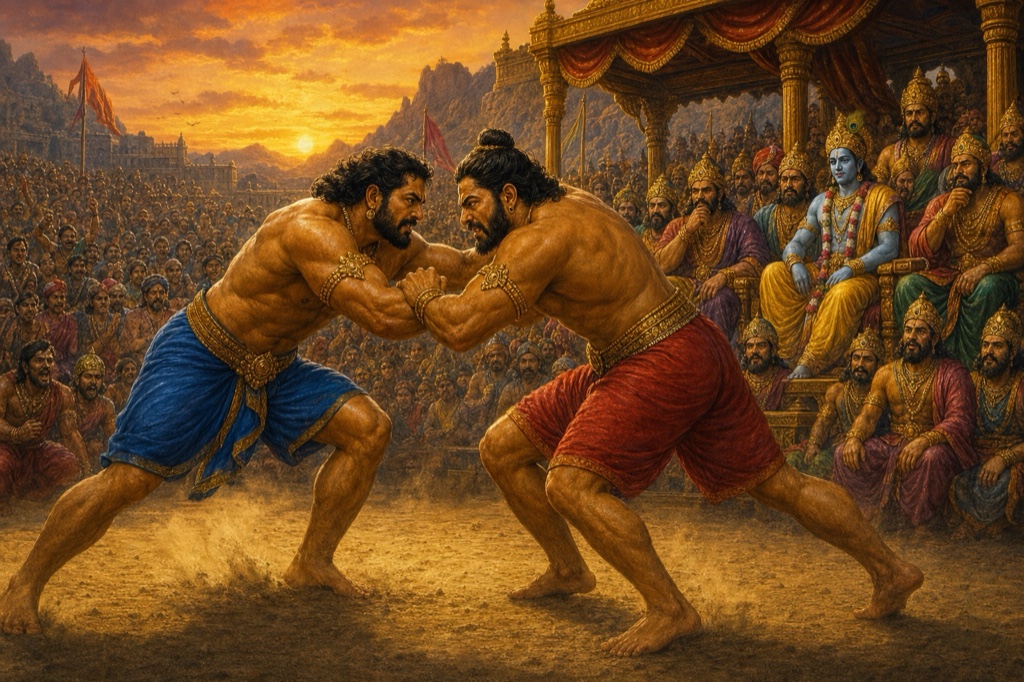
The holds changed as the contest continued. Both used the great wrestling maneuver called prishthabhanga, throwing the opponent face down and holding him against the ground for as long as possible. They also performed the techniques called sampurna-murchchha and purna-kumbha. At times, they twisted arms and other limbs as though twisting plant fibers into cords. They feinted toward one part of the body and drove their fists into another. Thousands of citizens came out to watch: Brahmins, Kshatriyas, Vaishyas, Shudras, women, and the aged. The gathering grew so dense that no space remained between bodies. The sounds of the wrestlers slapping their arms, catching each other by the neck to pull an opponent down, and seizing legs to dash a body against the ground rose like thunder or falling cliffs. Both men took great pleasure in the struggle, and neither relaxed his attention. Each watched for the smallest lapse that might offer an advantage. Sometimes the movements of their hands drove the crowd back. They resembled Vritra and Indra in their ancient encounter. Pulling forward, pressing backward, and suddenly jerking each other face down or sideways, they inflicted terrible punishment. They struck with their knees. They shouted stinging words at one another and hammered with their fists, the blows falling like masses of stone. Their shoulders were broad and their arms long; those arms struck like iron maces. Skill and strength kept answering one another through the repeated grips, throws, and blows.
The fight had begun on the first lunar day of Kartik, the month around October. Through the thirteenth lunar day, they fought without interruption or food, by night as well as by day. On the night of the fourteenth, the king of Magadha stopped from exhaustion. Krishna saw that he was tired and spoke to Bhima as though urging him on. “A tired enemy must not be pressed,” he said. “If you press him at such a time, he may even die. You should not put this king under greater strain. Fight him with your arms using only as much strength as he still has left.” Bhima understood Jarasandha’s condition and at once resolved to take his life. To defeat the man who had remained undefeated, he gathered all his strength and courage. “Krishna, this man is still in front of me with strength enough to fight, and he means to keep fighting,” he answered. “I will not spare him.” Krishna wanted him to complete Jarasandha’s destruction without delay. “Show him today the strength you have been fortunate enough to receive,” he told Bhima, “the power you inherited from your father, the wind god Maruta.”
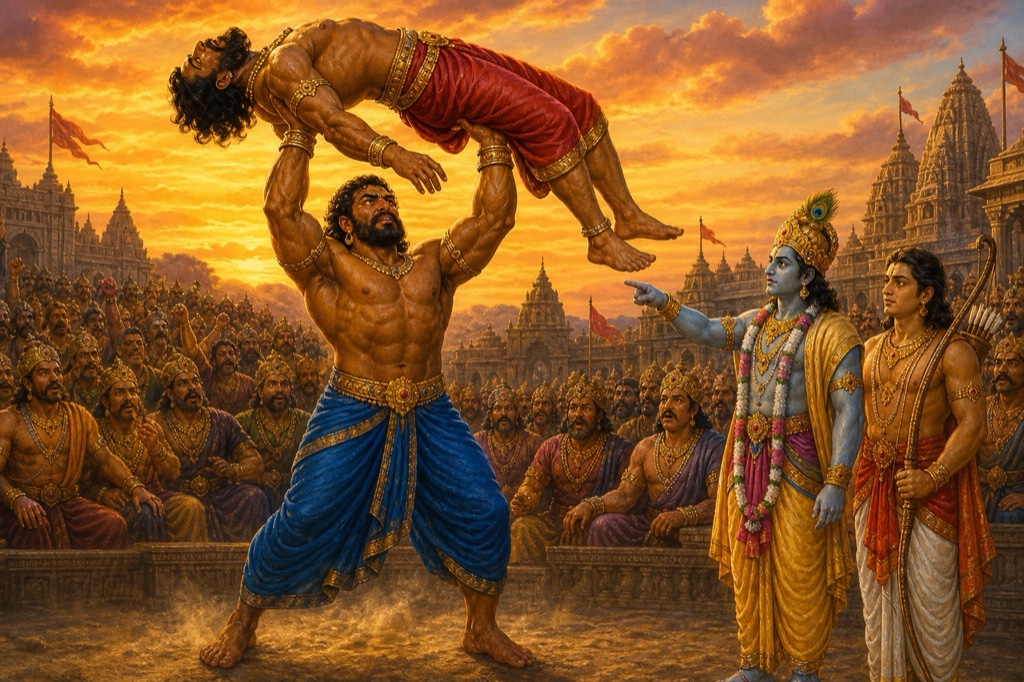
Bhima lifted the powerful Jarasandha into the air and began to whirl him overhead. He spun him a full 100 times. Then he pressed his knee against Jarasandha’s backbone and broke the king’s body in two. Having killed him, Bhima gave a terrible roar. It mingled with Jarasandha’s dying cry as his body broke across the knee, creating an uproar that terrified every living creature. The citizens of Magadha fell silent with fear. Many women gave birth prematurely. Hearing those cries, people thought that Himavat itself was collapsing or that the earth was splitting apart. The king’s lifeless body lay at the palace gate, looking like a sleeping man. Krishna, Bhima, and Arjuna left it there and went out of the city.
The gist: Bhima and Jarasandha wrestled from the first lunar day through the thirteenth without food or rest. On the fourteenth night, Jarasandha grew exhausted. Urged on by Krishna, Bhima whirled him 100 times and broke his body in two across his knee.
The captive kings go free
The captive kings were still within Jarasandha’s stronghold. Krishna had the dead ruler’s chariot prepared, its fine standard rising above it. He placed Bhima and Arjuna aboard, went into the stronghold, and released the imprisoned kings, their royal relatives. Freed from the terrible fate awaiting them, those rulers approached him with gifts of gems and jewels. Krishna emerged from Girivraja armed and unwounded, accompanied by the kings he had rescued. He drove the celestial chariot himself. Arjuna, the handsome warrior who could use his bow equally well with either hand and whom no earthly monarch could defeat, rode with the immensely strong Bhima. The chariot, itself invincible against kings, looked magnificent with the 3 together upon it. Its history reached back to the gods. Indra and Vishnu had ridden it in the war between gods and Asuras in which Taraka, Brihaspati’s wife, became the cause of immense slaughter. It shone like heated gold. Rows of little bells rang from it, and its wheels made a sound like clouds thundering. Always victorious, it destroyed the enemies against whom it was driven. In that same vehicle, Indra had once killed 99 Asuras. The 3 cousins were delighted to have obtained it. The people of Magadha watched in astonishment as Krishna and the 2 brothers rode in their dead king’s chariot, drawn by celestial horses with the speed of the wind.
The standard was a work of divine craftsmanship. No visible attachment connected it to the vehicle. Beautiful and bright as a rainbow, it could be seen from a yojana away. As Krishna came out, he thought of Garuda. At his master’s thought, Garuda arrived immediately, resembling a vast tree standing in a village and honored by everyone. The great, heavy-bodied bird who fed on serpents took his place on the chariot. Countless creatures on the standard held their mouths open and roared fiercely. Garuda’s presence made the vehicle still more dazzling, as difficult for living beings to look at as the midday sun with its 1,000 rays. Though the standard was visible to human eyes, it never struck a tree, and no weapon could damage it. Krishna drove out of Girivraja with the 2 sons of Pandu, the wheels sounding like thunder. King Vasu had received this chariot from Indra; it had passed from Vasu to Brihadratha and then, in time, to Jarasandha. Outside the city, Krishna stopped for a while on a level plain. The citizens hurried there with the Brahmins at their head and honored him according to the proper religious rites. The released kings also approached with reverence and praise. They had emerged from the mountain prison alive, and they addressed the man who had freed them.
“You have rescued us from the deep mire of grief into which Jarasandha had cast us,” they told Krishna. “With the strength of Bhima and Arjuna to assist you, you have performed an extraordinary act of virtue. Son of Devaki, Vishnu, we were wasting away in that terrible hill-fort. Through our good fortune, you saved us and gained remarkable renown. We bow to you. Tell us what we should do. However difficult the task, we will carry out your command as soon as you make it known.” Krishna reassured them and gave them a purpose for the service they offered. The expedition had come to release them as a necessary step toward Yudhishthira’s sacrifice. Now the freed rulers could give their help to the king who had sent it. “Yudhishthira wishes to perform the Rajasuya,” he said. “That ruler, always guided by dharma, seeks the imperial position. Now that you know this, help him in his undertaking.” The kings gladly agreed. They presented further gifts of jewels, and Krishna, moved by kindness toward them, accepted a portion. Jarasandha’s son Sahadeva then arrived with his relatives and the principal officers of state, his priest walking in front. The prince bowed low and honored Krishna with substantial gifts of gems and precious stones. He was afraid, and Krishna gave him every assurance. He accepted the valuable offerings and joyfully installed Sahadeva as sovereign of Magadha there and then. The prince received Krishna’s friendship and the respect and kindness of Bhima and Arjuna. With his position established, Jarasandha’s son returned to his father’s city. His priest, the leading officers, and his relatives had witnessed Krishna’s acceptance of him. The men who had defeated his father had now given him friendship and recognition as the new king.
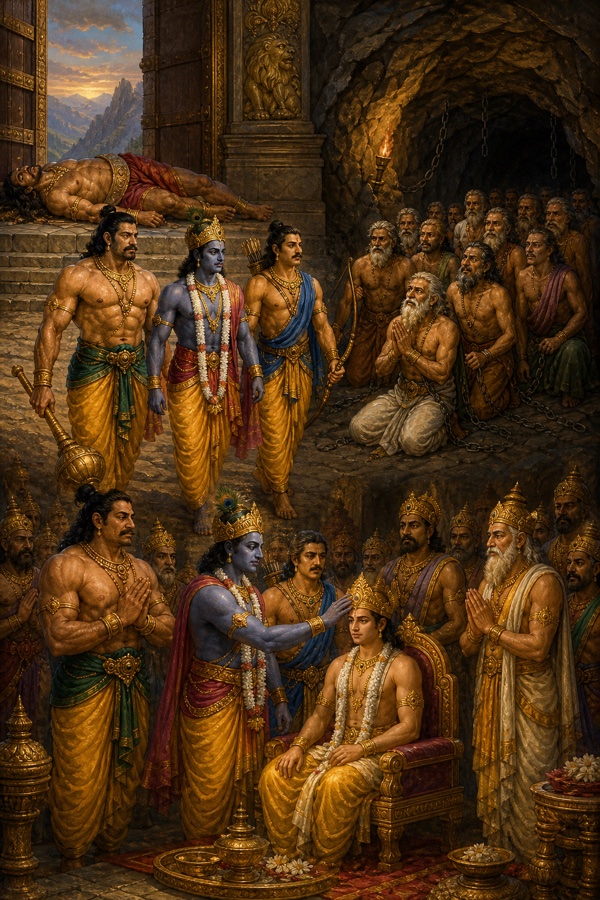
Krishna and the 2 Pandavas left Magadha carrying many jewels and returned to Indraprastha. Krishna went to Yudhishthira with the news. “Through good fortune, Bhima has killed the mighty Jarasandha,” he said. “Every king imprisoned at Girivraja has been freed. Through good fortune, Bhima and Arjuna are well and have come home unwounded.” Yudhishthira honored Krishna as he deserved and embraced his brothers with joy. The victory won through his brothers and Jarasandha’s death brought happiness and celebration to the family. With the other Pandavas, Yudhishthira visited the kings who had come to Indraprastha. He entertained and honored them according to their ages, then gave them leave to return home. Gladly they departed in excellent vehicles for their own countries. Through the Pandavas, Krishna had brought about the death of his enemy. He now took leave of Yudhishthira, Kunti, Draupadi, Subhadra, Bhima, Arjuna, Nakula, and Sahadeva. Yudhishthira gave him the celestial chariot, and he prepared to return to Dwarka in it. At the moment of departure, the Pandavas, led by Yudhishthira, walked around Krishna in reverence. Then he set out, the chariot swift as thought and the deep rumble of its wheels filling all 10 directions. He had won a great victory and dispelled the kings’ fear. That achievement enlarged the Pandavas’ fame. They continued their days bringing joy to Draupadi, while Yudhishthira faithfully performed the duties of protecting his people, carrying out what was proper in dharma, pleasure, and prosperity.
The gist: Krishna freed the captive rulers and secured their promise to help Yudhishthira’s Rajasuya. He reassured Jarasandha’s son Sahadeva and installed him as king of Magadha. After returning safely to Indraprastha with Bhima and Arjuna, he took the celestial chariot Yudhishthira gave him and departed for Dwarka.
Four campaigns, and a promise from Bhagadatta
The Pandavas had acquired the means for a much larger undertaking. Arjuna possessed an exceptional bow, 2 quivers whose arrows would never run out, and the celestial chariot and standard he had received for the battle at Khandava. Maya’s assembly hall now stood in their capital. With those achievements behind them, Arjuna brought Yudhishthira a proposal. “The bow, the weapons, the strength to use them, allies, territory, fame, and an army,” he said. “These are things a king desires and finds difficult to obtain. I have obtained them all. Now I believe we should increase our treasury. I want the kings of the earth to pay us tribute. On a sacred day of the lunar month, beneath a favorable constellation and at an auspicious hour, I wish to set out to conquer the direction ruled by the lord of wealth.” His proposed campaign would take him north, into the quarter belonging to Kubera. Yudhishthira answered with calm gravity. “Have the holy Brahmins pronounce their blessings, and then go. Bring grief to your enemies and joy to your friends. Victory will be yours, Arjuna. Your wishes will be fulfilled.” With that permission, Arjuna departed at the head of a large army. He rode the extraordinary chariot Agni had given him, the vehicle whose powers had already been proved in battle. Yudhishthira also gave Bhima and the twins an affectionate farewell. Each brother left with a great force of his own. Indra’s son Arjuna would bring the north under Pandava authority; Bhima would conquer the east by force; Sahadeva would campaign in the south; and Nakula, skilled in every weapon, would conquer the west. While his brothers carried out those enterprises, Yudhishthira remained in prosperous Khandavaprastha among his friends and relatives. The tribute Arjuna proposed to gather would enlarge the treasury of the king whose Rajasuya they were preparing.
Janamejaya wanted to hear how those distant victories had been won. “Tell me the full history of the conquest in every direction,” he asked Vaishampayana. “I cannot have enough of this great history of my ancestors.” The campaigns had taken place at the same time, Vaishampayana replied. He would begin with Dhananjaya, the name by which Arjuna was also known. Arjuna’s first victories were over the kings of the Kulinda country, whom he overcame through remarkable feats of courage. He brought the Kulindas, the Anartas, and the Kalakutas under his authority, then defeated King Sumandala and his troops. Sumandala subsequently helped him conquer the island of Shakala and King Prativindhya. Shakala was counted among the earth’s 7 islands, and it contained many kingdoms. Their rulers came against Arjuna at the head of their forces. The fighting was fierce. These were accomplished bowmen commanding their own armies, and Arjuna, who could fight with equal skill using either hand, defeated them all. He then joined their strength to his own. With those rulers now his allies, he advanced against Pragjyotisha. The force approaching that kingdom included men who had only recently fought against him. As each campaign ended, the relationships formed in its aftermath carried forward into the next.
Pragjyotisha’s king was Bhagadatta, and he had powerful support. Kirata and China troops fought on his side, together with many other warriors who lived along the seacoast. His encounter with Arjuna developed into a fierce and prolonged battle. For 8 continuous days Bhagadatta fought the son of Pandu. Arjuna remained tireless. At last, seeing that the fighting had failed to exhaust him, Bhagadatta smiled and spoke. “This energy is worthy of you, Arjuna. You are Indra’s son, a warrior who brings distinction to the battlefield. I am a friend of your father, and in battle I fall scarcely short of him. Yet I cannot stand against you in this fight. Tell me what you want me to do. Whatever you ask, I will accomplish.” Bhagadatta’s acknowledgment brought his friendship with Indra directly into the encounter. The young man he had been unable to overcome was the son of that friend. Arjuna answered him with the respect the relationship required. He began with Yudhishthira’s qualifications for the position he sought. “My brother Yudhishthira, the son of Dharma, understands the rules of righteous conduct,” he said. “He is devoted to truth, and he performs sacrifices at which generous gifts are given to the Brahmins. I want to see him attain imperial sovereignty. Pay tribute to him. You are my father’s friend, and you have been pleased with me. I cannot issue orders to you. Let the tribute be something you give gladly, of your own free will.” The demand for tribute thus reached Bhagadatta as a request from his friend’s son. Arjuna had proved his strength in battle and now asked the older king to give willingly. Bhagadatta accepted that request. “Yudhishthira is as dear to me as you are, son of Kunti,” he said. “I will do all this. Tell me what else I can do for you.” Arjuna asked for no further undertaking. “If you promise to do this,” he answered, “you have done everything I desire.” With Bhagadatta’s promise, the campaign had secured another ruler’s support for Yudhishthira’s imperial rite.
The gist: The 4 brothers departed in different directions to gather tribute for Yudhishthira. Arjuna’s northern campaign took him from the Kulinda country to Pragjyotisha. After 8 days of fighting, Bhagadatta acknowledged his strength. Arjuna honored the king’s friendship with Indra and secured his willing promise to pay tribute.
The northern kingdoms and the border of Harivarsha
With Bhagadatta’s allegiance secured, Arjuna continued north into the direction of Kubera, the lord of wealth. He conquered the mountain territories, the lands along their edges, and the surrounding hill country. Their rulers submitted and paid tribute. Arjuna also won their affection and joined them to his cause before advancing against Brihanta, king of Uluka. Drums, rattling chariot wheels, and the roar of elephants shook the earth as the army approached. Brihanta came quickly out of his city with all 4 divisions of his own force: chariots, elephants, cavalry, and infantry. The battle was terrible. Though a formidable mountain king, Brihanta could not withstand Arjuna’s strength. Recognizing that his opponent could not be resisted, he approached him with all his wealth. Arjuna left him in possession of his kingdom and made peace with him. Brihanta then accompanied the advance against Senabindu, whom Arjuna drove from his throne. The campaign brought Modapura, Vamadeva, Sudama, Susankula, and the northern Ulukas under Pandava authority, along with their kings and peoples. In accordance with Yudhishthira’s command, Arjuna directed the expeditions into those 5 territories from Senabindu’s capital. He had established quarters at Devaprastha with his army, and he remained there while his troops carried out the work. Then, surrounded by the kings and peoples he had brought under his control, he moved against Vishvagashva of the Puru line. He defeated the brave mountain warriors defending that ruler’s position, all accomplished fighters, and his troops occupied the town the Puru king protected. After overcoming the king and the robber communities of the mountains, Arjuna also subdued the 7 peoples known as the Utsava-sanketas.
The northern campaign continued through one kingdom after another. Arjuna defeated the warrior rulers of Kashmira and King Lohita with his 10 subordinate chiefs. The Trigartas, Darvas, Kokonadas, and various other Kshatriyas then advanced against him. He took the beautiful town of Abhisari and brought Rochamana, ruler of Uraga, under his authority. At Singhapura, a city well protected by a wide array of weapons, he pressed his attack with great strength. Leading his full army, he attacked Suhma and Sumala fiercely, then brought the notoriously difficult Bahlika people into submission. For the next encounter, he took a selected force and defeated the Daradas together with the Kambojas. His victories extended to the robber communities along the northeastern frontier and those living in the forests. He also subdued the allied Lohas, eastern Kambojas, and northern Rishikas. Against the Rishikas, the fighting was especially severe. Vaishampayana compared it to the ancient war between the gods and Asuras in which Taraka, Brihaspati’s wife, had become the cause of so much slaughter. When the Rishikas were defeated, their tribute included 8 horses the color of a parrot’s breast. Arjuna also obtained other exceptionally swift horses, colored like peacocks, that had been bred in the northern lands and elsewhere. Tribute from these kingdoms brought rare animals into his possession as well as wealth. At last, after conquering the Himalayas and the Nishkuta mountains, he reached the White Mountains and encamped on their slopes.
Beyond the White Mountains lay the land of the Kimpurushas, ruled by Drumaputra. Arjuna crossed into it and fought a battle in which many Kshatriya warriors were killed. The whole region came under his authority. Keeping his composure, he led his troops onward into Hataka, the country ruled by the Guhyakas. There he secured submission through conciliation. In that region he saw Lake Manasa and the other lakes and pools sacred to the rishis. Around the Hataka territories were lands governed by Gandharvas. Having reached Manasa, Arjuna conquered those neighboring regions and received many excellent horses as tribute, including the kinds called Tittiri, Kalmasha, and Manduka. His advance eventually brought him to northern Harivarsha. He wished to conquer it too. A group of frontier guards approached him, immense in body and possessed of extraordinary strength and energy. They were pleased to meet him, and their warning came with an offer of help. “Arjuna, you can never conquer this country,” they told him. “If you want what is good for you, turn back. A human being who enters this region will certainly perish. We are pleased with you, and your conquests have been sufficient. There is nothing here for you to see and conquer. The Northern Kurus live here. There can be no war in this country. Even if you enter, you will be unable to see anything. Human eyes cannot see what exists here. If there is something else you want, tell us, and we will do it for you.” Their words placed a boundary on his advance. He had crossed kingdoms and mountains with an army, but the country they guarded was closed to human entry, and its inhabitants lay beyond human sight.
Arjuna smiled as he answered them. “I want Yudhishthira, that wise and righteous king, to obtain imperial sovereignty,” he said. “If your country is closed to human beings, I will not enter it. Give something to Yudhishthira as tribute.” The guards accepted his request. They brought him many celestial garments and ornaments, silks of divine texture, and skins of celestial origin. Those gifts fulfilled his purpose at the border without taking him into the country the guards had described. Across the northern campaign he had fought innumerable battles against Kshatriya rulers and robber communities, overcome their leaders, and exacted tribute. Now the collected wealth could be brought home: gems and jewels of many kinds, the Tittiri and Kalmasha horses, those colored like a parrot’s wings, and others with the hues of a peacock. All those horses had the speed of the wind. Arjuna returned to the splendid city of Shakraprastha, his own capital also known as Indraprastha, surrounded by a great army with all 4 divisions. He presented Yudhishthira with the entire wealth of the expedition and all the animals he had brought. The treasury he had proposed to enlarge now received the tribute of the northern kingdoms. With that duty completed, Arjuna received the king’s permission to withdraw to the palace chambers and rest.
The gist: Arjuna gathered tribute throughout the northern mountains, leaving Brihanta on his throne and expelling Senabindu. Beyond the Himalayas he reached Hataka and the Gandharva territories. At the border of the Northern Kurus, he respected the restriction on human entry and accepted celestial tribute. He returned home and gave Yudhishthira everything the campaign had brought.
Bhima’s campaign in the east
While Arjuna campaigned in the north, Bhima was carrying Yudhishthira’s authority eastward. He had left with the king’s permission and a formidable army, fully supplied with elephants, horses, chariots, and weapons. It had the strength to crush hostile kingdoms. In the great country of the Panchalas, Bhima began by using various means to win their cooperation. He then quickly defeated the Gandakas and Videhas and brought the Dasharnas under his control. In Dasharna he encountered a king whose courage would change his place in the campaign. Sudharman fought Bhima fiercely with his bare arms. Bhima saw the strength of the man opposing him and appointed him chief commander of his own forces. With Sudharman now serving in the conquering army, Bhima continued east, the tread of the great host making the earth tremble. He defeated Rochamana, king of Ashvamedha, who faced him with all his troops. Bhima’s feats in that encounter were exceptionally fierce, and the eastern region came under his authority. He next entered the Pulinda country to the south and subdued Sukumara and King Sumitra. Yudhishthira’s command then took him toward Shishupala of Chedi. On hearing the purpose of Bhima’s approach, Shishupala came out of his city and received him respectfully. The 2 warriors, one of the Chedi line and one of the Kuru line, asked after each other’s welfare. Shishupala placed his kingdom at Bhima’s disposal. “What is the undertaking you have in mind?” he asked with a smile. Bhima explained Yudhishthira’s intentions. For 30 nights, Shishupala entertained him as his guest. Only after that stay did Bhima depart from Chedi with his troops and vehicles.
The next victories were over Shrenimat of Kumara and Brihadbala of Kosala. Bhima then defeated Dirghayajna, the powerful and virtuous ruler of Ayodhya, through further feats of great ferocity. Gopalakaksha, the northern Kosalas, and the king of the Mallas came under his authority. Reaching the damp country below the Himalayas, he quickly subdued the entire region. His route then took him through Bhallata and the neighboring Shuktiman mountain. At Kashi, he overcame Subahu, a king who never retreated from battle, and brought him fully under his control. He defeated Kratha, the great ruler of the lands around Suparshva, by force. He also conquered the Matsyas, the powerful Maladas, and Pashubhumi, a country free from fear and oppression. From there he subdued Madadhara, Mahidhara, and the Somadheyas, then turned north. The next territories to submit by force were Vatsabhumi and the lands of the Bharga king, the Nishada ruler, Manimat, and numerous other kings. Bhima overcame the southern Mallas and the Bhagavanta mountains quickly, with very little exertion. Policy alone secured the Sharmakas and Varmakas. He defeated Janaka, king of the Videhas, with comparative ease, and used deception to subdue the Shakas and the Mlechchha peoples of that region. From Videha, he sent expeditions against the 7 Kirata kings living around Mount Indra. He then defeated the Suhmas and Prasuhmas in battle and won them over to his side. With their support added to the campaign, he marched toward Magadha.
On the way he subdued the rulers Danda and Dandadhara. They accompanied him to Girivraja, the city in which he had killed Jarasandha and where Jarasandha’s son now reigned. This time Bhima secured submission through conciliation. The new king paid tribute, and Bhima continued with the rulers he had defeated toward Karna. His army, with its elephants, chariots, cavalry, and infantry, shook the earth as it moved. Bhima encountered Karna and overcame him, bringing that formidable warrior under his authority. He next defeated the powerful ruler of a mountain region. At Modagiri, a fierce encounter ended with Bhima killing its mighty king through the strength of his arms. Two more brave and powerful opponents followed: Vasudeva, king of Pundra, and Mahaujas, ruler of Kaushika-kachchha. Bhima defeated both in battle before attacking the king of Vanga. He overcame Samudrasena, King Chandrasena, and Tamralipta, then the king of the Karvatas, the ruler of the Suhmas, and the other kings along the seacoast. The Mlechchha communities also came under his control. From kingdom to kingdom, the victories brought tribute into the possession of the son of the wind god.
Bhima advanced toward Lohitya. In the marshy lands along the coast, he required the Mlechchha rulers to pay tribute in wealth and in the valuable goods of their countries. They supplied sandalwood and aloe wood, cloth and gems, pearls and blankets, gold and silver, and precious coral. Coins and jewels came in such abundance that their number was counted in hundreds of millions. The rulers poured this wealth upon Bhima like a dense downpour. Now Bhima brought its collected riches back to Indraprastha. He presented the whole of the wealth to Yudhishthira, fulfilling his part in preparing the eldest Pandava for the imperial sacrifice.
The gist: Bhima brought the eastern kingdoms under Yudhishthira’s authority through war, negotiation, and policy. He made Sudharman his commander, accepted Shishupala’s hospitality for 30 nights, and secured tribute peacefully from Magadha. After defeating Karna and other rulers, he reached the coastal lands and returned with immense wealth for Yudhishthira.
Source: the Mahabharata of Krishna-Dwaipayana Vyasa, Sabha Parva. This chapter follows K. M. Ganguli, sections I-XLVI (1-46); the Gita Press Hindi edition numbers these chapters differently. Names, order, and events were checked against Ganguli’s complete translation. Dialogue and commentary are adapted, not a verbatim translation. About the sources.
Based on: The Mahabharata, Vyasa (Gita Press, Gorakhpur)