On this page
Sahadeva reaches the city guarded by fire
Sahadeva’s southern expedition began with Yudhishthira’s affectionate farewell and the support of a great army. He first defeated the Shurasenas completely and brought the king of Matsya under his authority. Dantavakra, the powerful ruler of the Adhirajas, also fell before him. Sahadeva exacted tribute and restored him to his throne. He then subdued Sukumara and King Sumitra, followed by the other Matsyas and the Pataccharas. The Nishada country, the high hill of Goshringa, and King Shrenimat submitted soon afterward. From Navarashtra, which he also conquered, Sahadeva advanced toward Kuntibhoja. That king accepted his authority with great willingness. At the banks of the Charmanvati, however, he met resistance from the son of King Jamvaka, a prince whom Krishna had previously defeated in the course of an old hostility. The prince fought Sahadeva and lost. Continuing south, Sahadeva overcame the Shekas and the other Sheka communities, taking tribute, gems of various kinds, and wealth. He allied himself with the defeated peoples before marching toward the countries along the Narmada. There the 2 kings of Avanti, Vinda and Anuvinda, opposed him with a powerful army. Sahadeva, Madri’s son born through the twin Ashvin gods, defeated them and took substantial wealth in tribute. At Bhojakata, his fight with the city’s king lasted 2 full days. He overcame the formidable Bhishmaka, then defeated the king of Kosala, the ruler of the lands beside the Venwa River, the Kantarakas, and the kings of eastern Kosala.
The Natakeyas and Herambakas were defeated in battle. Sahadeva subdued Marudha and took Munjagrama by force. He overcame the powerful kings of the Nachinas and Arvukas, along with the other rulers of the forests in that region, and brought King Vatadhipa under his control. After defeating the Pulindas, he continued south. The king of Pandrya fought Nakula’s younger brother for an entire day before being defeated. Farther south, Sahadeva saw the celebrated caves of Kishkindha. In that region he met Mainda and Dvivida, the 2 monkey kings, and fought them for 7 days. They remained untired by the encounter. Pleased with Sahadeva, they cheerfully offered him tribute. “Take tribute from all of us and continue your journey,” they said. “May the undertaking of wise and righteous Yudhishthira be accomplished without obstruction.” Sahadeva accepted their gems and jewels and marched toward Mahishmati. There King Nila resisted him in a savage battle. The fighting brought immense bloodshed, and Sahadeva’s own life was in serious danger. Agni, the god of fire, was helping Nila. Across Sahadeva’s army, chariots, horses, elephants, and soldiers in their coats of armor all seemed to be burning. At that sight Sahadeva became deeply anxious. He could not decide what to do.
Janamejaya interrupted with a question. Sahadeva’s campaign served a sacrifice, and the sacrificial fire would receive the offerings intended for the gods. Why, then, had Agni become the enemy of a warrior working toward that very purpose? Vaishampayana answered with the history of Mahishmati. “It is said that while living there, Agni acquired the reputation of an adulterer,” he began. King Nila had an extraordinarily beautiful daughter who remained close to her father’s sacred fire and tended it. The fire would refuse to blaze up, however much others fanned it, until the gentle breath from her lips stirred it into flame. In the palace and throughout the homes of Nila’s subjects, people said that Agni wanted the princess as his bride. She accepted him herself. One day the god took the form of a Brahmin and was enjoying her company when the king discovered them. Nila, a ruler devoted to righteousness, ordered that the Brahmin be punished according to the law. Agni blazed up in anger. The king was astonished and bent his head to the ground. After some time, he bowed again and gave his daughter to Agni in his Brahmin form. The god, also called Vibhavasu, accepted the lovely princess and became gracious toward her father. He invited Nila to ask for a boon. The king asked that his troops should never be seized by panic in battle. From then onward, rulers who came to conquer Nila’s city in ignorance of its protection were consumed by Agni.
Vaishampayana continued with another consequence of the god’s presence in the city. From that time, he said, people elsewhere became reluctant to accept the women of Mahishmati as wives. Agni had granted them sexual freedom. They moved about as they wished, and each was free of confinement to a single husband. Its military protection remained equally formidable: kings from other countries left Mahishmati alone because they feared the fire god. Sahadeva had now brought his army against that protected kingdom. The ruler he faced possessed the assurance Agni had granted, and the god himself had entered the battle on his side. The campaign meant to help Yudhishthira perform a sacrifice had reached a city where the power of fire threatened to destroy the men advancing it.
The gist: Sahadeva subdued many southern kingdoms and fought Mainda and Dvivida for 7 days before accepting their willing tribute. At Mahishmati, Agni fought for King Nila and put Sahadeva’s army in danger. Vaishampayana explained the god’s relationship with Nila’s daughter and the protection he had promised the king.
Agni’s test and the tribute of the south
With his frightened troops surrounded by flame, Sahadeva stood as immovable as a mountain. He purified himself, touched water, and addressed the god whose fire both threatened the army and received the offerings of sacrifice. “I bow to you, whose path is marked by smoke,” he prayed. “All these efforts of mine are for you. You purify everything. You are the mouth through which the gods receive their offerings, and you are sacrifice itself. You are called Pavaka because you make all things pure, and Havyavahana because you carry the clarified butter poured into you. The Vedas arose to serve you, and therefore you are called Jataveda. Foremost among the gods, you bear the names Chitrabhanu, Anala, Vibhavasu, Hutashana, Jvalana, Shikhi, Vaishvanara, Pingesha, Plavanga, and Bhuritejas. Kumara, Kartikeya, had his origin in you. You are holy, and you are called Rudragarva and Hiranyakrit. Give me energy, Agni. May Vayu give me life, Earth give me nourishment and strength, and Water give me prosperity. You are the first cause of the waters, supremely pure, served by the Vedas, foremost among the gods and their mouth. Purify me through your truth. Rishis and Brahmins, gods and Asuras pour clarified butter into you every day in sacrifices performed according to the prescribed rules. As you reveal yourself in those rites, may the rays of your truth purify me. You carry smoke as your banner and possess the flames that cleanse all sins. Born of Vayu, you are always present in every living being. Purify me through the rays of your truth. Having cleansed myself with a willing heart, I offer this prayer to you. Grant me contentment and prosperity, knowledge and joy.” Vaishampayana added that a person who recited these invocations while pouring clarified butter into Agni would be blessed with lasting prosperity. With the inner self brought under control, that person would also be cleansed of every sin.
Sahadeva made one more appeal. “You carry the sacrificial offerings,” he told Agni. “You should allow this sacrifice to proceed unhindered.” Then he spread kusha grass on the earth and sat on it in front of his terrified, anxious troops, waiting for the approaching fire. Agni did not pass over his head. Like the ocean keeping within the boundaries of the land, the fire held its limit. The god approached Sahadeva quietly and reassured him. “Rise, Sahadeva,” he said. “Get up from that posture. I was testing you. I know your purpose and Yudhishthira’s as well. For as long as a descendant of King Nila’s line remains, I must protect this city. I will also fulfill your heart’s desire.” Sahadeva rose with a glad heart. He joined his hands, bowed his head, and worshipped the god who purified all beings. After Agni disappeared, Nila came to him. Acting on the god’s command, the king honored Sahadeva with the proper rites. Sahadeva accepted the honor and required him to pay tribute. Mahishmati could remain under Agni’s protection while acknowledging the authority for which the Pandava had come. With Nila’s submission secured, Sahadeva continued his victorious march south.
He brought the extraordinarily powerful king of Tripura under his control, then turned his army against the Paurava kingdom and defeated its ruler. It took great effort to subdue Akriti, king of Saurashtra and teacher of the Kaushikas. While staying in Saurashtra, Sahadeva sent an envoy to Rukmi of Bhishmaka’s line in the territory of Bhojakata. Rukmi possessed great wealth and intelligence and was a friend of Indra himself. Remembering their relationship with Krishna, the king and his son gladly accepted the Pandava’s authority. Sahadeva obtained jewels and wealth from Rukmi and continued south. He subdued Shurparaka, Talakata, and the Dandakas, then numerous Mlechchha kings living along the seacoast. His conquests also included the Nishadas, cannibal peoples, the Karnapravaranas, and the Kalamukhas, whom Vaishampayana described as descended from both human beings and Rakshasas. He took the whole of the Cole mountain region, Surabhipattana, the Copper Island, and Mount Ramaka. After bringing King Timingila under his authority, he conquered the forest people called the Kerakas, described in the account as men with a single leg. His messengers alone secured the submission of Sanjayanti and the lands of the Pashandas and Karahatakas, all of whom paid tribute. He also exacted tribute from the Pandyas and Dravidas, the Udrakeralas and Andhras, the Talavanas and Kalingas, and the Ushtrakarnikas. The beautiful city of Atavi and the city of the Yavanas came under his control as well.
On reaching the seashore, Sahadeva confidently sent messengers to Vibhishana, the grandson of Pulastya. That wise and distinguished ruler accepted Pandava authority willingly. He saw the undertaking as the work of Time. His response brought gifts of many kinds: gems and jewels, sandalwood and aloe wood, celestial ornaments, costly clothes, and valuable pearls. Sahadeva accepted everything and turned homeward. His campaign had obtained submission through both conciliation and war. The tribute secured through his envoys joined the wealth taken from kings he had met in battle. Sahadeva returned to his own city and laid the entire collection before his eldest brother. He considered his mission fulfilled and remained there in happiness.
The gist: Agni answered Sahadeva’s prayer, explained that he had been testing him, and reaffirmed his protection of Nila’s line. At the god’s command, Nila honored Sahadeva and paid tribute. The campaign continued through southern kingdoms and secured gifts from Vibhishana. Sahadeva returned with all the wealth for Yudhishthira.
Nakula’s victories in the west
Vaishampayana turned to the last of the 4 campaigns. Nakula had undertaken the conquest of the west, the direction Krishna had once brought under his control. He left Khandavaprastha surrounded by a large army. Warriors shouted and roared like lions, and the deep rattle of chariot wheels shook the earth. His first attack fell on the mountain country of Rohitaka. Dear to Kartikeya, commander of the gods’ armies, the region was beautiful and prosperous, rich in cattle, produce, and every kind of wealth. Its Mattamayuraka people fought Nakula fiercely. He then subdued the whole desert country, the abundant region of Shairishaka, and the land called Mahettha. A further severe encounter brought him against the royal sage Akrosha. Before leaving that part of the country, Nakula had conquered the Dasharnas, Shivis, Trigartas, Ambashthas, and Malavas, as well as the 5 communities of the Karnatas. The twice-born peoples called the Madhyamakeyas and Vatadhanas also submitted. His route then turned through a circuitous journey that brought the Mlechchha communities known as the Utsava-sanketas under his authority. These were among the lands whose submission Yudhishthira needed for the Rajasuya. The tribute would supply his treasury, while the rulers’ acknowledgment would establish his authority beyond his own kingdom.
Nakula next subdued the powerful Gramaniyas living beside the sea. Along the Sarasvati, he brought the Shudras and Abhiras under his control, together with the communities that lived by fishing and those that inhabited the mountains. He conquered the entire country named for its 5 rivers, the Amara mountains, the land of Uttarayotisha, the city of Divyakuta, and the Dvarapala people. Force brought the Ramathas, Harahunas, and various other kings of the west into submission. While remaining in that region, Nakula sent messengers to Krishna. Krishna and all the Yadavas accepted his authority. From there, Nakula went to Shakala, the city of the Madras. Its king, Shalya, was his maternal uncle, and affection for his nephew led him to accept Pandava sovereignty. Nakula received the hospitality to which that relationship entitled him. Shalya entertained him generously, and the warrior left his uncle’s kingdom with a large collection of gems and jewels. Among the submissions secured in the west, these had come through the bonds already linking the Pandavas with Krishna and with their mother Madri’s family.
Nakula then subdued the fierce Mlechchha peoples of the seacoast and the peoples called Palhavas, Kiratas, Yavanas, and Shakas. Having brought many rulers under his control and required tribute from them all, he retraced his route toward his own city. The quantity of treasure was immense. Even 10,000 camels struggled to carry it on their backs. Those loads contained the wealth gathered across the western expedition, including the jewels received from Shalya. Nakula returned to Indraprastha and presented the whole collection to Yudhishthira. His brothers had each brought home the proceeds of their own campaigns; the wealth of the west now joined the treasury as well. Nakula had completed the conquest of the direction presided over by Varuna, the quarter Krishna had previously subdued. The 4 expeditions had supplied the king with the tribute and resources his brothers had set out to obtain.
The gist: Nakula conquered western mountain, desert, river, and coastal territories. Krishna and the Yadavas accepted his authority, and his uncle Shalya welcomed him with affection and valuable gifts. He returned to Indraprastha with so much treasure that 10,000 camels could barely carry it, and gave it all to Yudhishthira.
The treasury opens for the Rajasuya
Yudhishthira’s subjects were occupied in their livelihoods, protected by a king who cherished truth and kept his enemies in check. Vaishampayana described the prosperity of that rule: taxes were equitable, the clouds brought as much rain as people wanted, and towns and cities flourished. Every activity prospered, especially cattle breeding, farming, and trade. Even thieves and cheats spoke truthfully among themselves, and the king’s favorites also refrained from lying. Drought, flood, epidemic, destructive fire, and premature death were absent during those days. Other rulers came to perform welcome services, honor Yudhishthira, or offer tribute they could afford. His treasury held enough honestly acquired wealth to remain unexhausted for 100 years. After examining the condition of his treasury and the extent of his possessions, Yudhishthira fixed his mind on performing the sacrifice. His friends and officers urged him to begin, speaking to him both individually and together. “The time for your sacrifice has come,” they said. “Make the arrangements without delay.” While they were discussing it, Krishna arrived. Vaishampayana named him as the ancient, all-knowing soul of the Vedas, whom the wise described as beyond sight; foremost among enduring beings, the origin of everything and the one into whom everything would dissolve; lord of the past, present, and future. As Keshava, slayer of Keshi, he protected the Vrishnis, dispelled their fear in danger, and destroyed their enemies. He had placed Vasudeva in command of the Yadava army and brought a great treasure for Yudhishthira. Surrounded by a powerful force, he entered the splendid city of Khandava to the sound of rattling chariot wheels. His gifts increased the Pandavas’ already immense store of jewels and deepened their enemies’ distress. His presence brought joy to the capital, like sunlight reaching a darkened region or a gentle breeze moving through still air.
Yudhishthira went forward gladly, received Krishna with honor, and asked about his welfare. When Krishna was comfortably seated, the king addressed him in the presence of Dhaumya, Dvaipayana Vyasa, the other sacrificial priests, and his 4 brothers. “It is because of you that the whole earth acknowledges my authority,” he said. “Through your grace, I have obtained this immense wealth. I want to devote it, according to the prescribed rites, to worthy Brahmins and to Agni, who carries the sacrificial offerings. Allow me to perform a sacrifice with you and my younger brothers. Govinda, take the consecration yourself and perform it. Through your sacrifice, I will be cleansed of sin. Or give me permission to receive the consecration with my brothers. With your approval, I can obtain the fruit of an excellent sacrifice.” Krishna praised Yudhishthira’s virtues and placed the undertaking in his hands. “You deserve imperial sovereignty,” he told him. “You should perform this great sacrifice. If you accomplish it and gain its fruit, we will all consider ourselves successful. I am always seeking your good. Carry out the sacrifice you desire, and assign me a duty in it too. I should obey all your commands.” For Yudhishthira, Krishna’s arrival already answered the wish underlying those preparations. “My resolve has borne fruit,” he replied. “Success is certain now that you have come as I hoped, Hrishikesha.” With Krishna’s approval, he and his brothers began gathering what the Rajasuya required.
Yudhishthira issued instructions to Sahadeva and the ministers. People were to be appointed immediately to procure every article specified by the Brahmins, together with the materials and auspicious requisites Dhaumya ordered. Each item had to be of the required kind and supplied in the proper sequence. Indrasena, Vishoka, and Puru, with Arjuna as Puru’s charioteer, were to gather food. They were also to obtain everything whose pleasing taste and fragrance would delight the Brahmins. As the king finished speaking, Sahadeva reported that the arrangements were complete. Dvaipayana chose eminent Brahmins for the priestly offices, men whose learning made them seem like the Vedas given human form. Satyavati’s son took the presiding office of Brahma himself. Sushaman of the Dhananjaya line was appointed to sing the Sama hymns. Yajnavalkya, devoted to Brahman, became the Adhvaryu, responsible for the performance of the ritual acts. Paila, son of Vasu, and Dhaumya became the Hotris. Their sons and disciples, equally well versed in the Vedas and their branches, filled the assisting priestly offices. Together they pronounced blessings, declared the purpose of the sacrifice, and consecrated the vast enclosure according to the prescribed rules. At their direction, builders and craftspeople raised numerous spacious, fragrant buildings resembling temples of the gods. Once the buildings were finished, Yudhishthira ordered his chief adviser Sahadeva to send swift messengers and invite everyone. Sahadeva’s instructions named all the groups to be brought: the Brahmins of the kingdom, the Kshatriya landholders, the Vaishyas, and the respected Shudras. The invitations were to extend throughout the kingdom.
The messengers lost no time. They carried out the order and returned with many guests, people known to the Pandavas and people they had never met. At the proper moment, the Brahmins consecrated Yudhishthira for the Rajasuya. Once that ceremony was complete, he entered the sacrificial enclosure looking like Dharma himself in a human body. Thousands of Brahmins surrounded him, together with his brothers, relatives, friends, counselors, and officers of state. Numerous Kshatriya kings had arrived from other countries. Learned Brahmins continued to come from many lands, skilled in every branch of knowledge and versed in the Vedas and their divisions. On Yudhishthira’s orders, thousands of craftspeople built separate residences for them and their attendants. The lodgings were stocked with food and clothes, and with the fruits and flowers of every season. Honored by the king, the Brahmins settled there, passing their time in conversation on many subjects and watching actors and dancers perform. Their cheerful talk and the sounds of people eating continued without interruption. Every day, calls to give and to eat could be heard throughout the gathering. Yudhishthira gave each Brahmin thousands of cattle, beds, gold coins, and young women. With that abundance, the Pandava’s sacrifice began on earth in a splendor compared to Indra’s sacrifice in heaven. Yudhishthira then sent Nakula to Hastinapura to bring Bhishma, Drona, Dhritarashtra, Vidura, Kripa, and the cousins who were well disposed toward him. The Kuru elders and relatives would join the kings already gathering around the consecrated ruler.
The gist: With his kingdom flourishing and his treasury full, Yudhishthira committed to the Rajasuya. Krishna approved and offered to serve. Priests were appointed, supplies and lodgings prepared, and invitations sent throughout the kingdom. Yudhishthira received the consecration and sent Nakula to bring the Kuru elders and relatives from Hastinapura.
The kings assemble and the duties are assigned
Nakula reached Hastinapura and formally invited Bhishma and Dhritarashtra. The Kuru elders accepted the ceremonial invitation gladly and came with their teacher at their head and Brahmins walking before them. Hundreds of other Kshatriya rulers heard of the sacrifice and arrived from different countries. They understood the nature of the rite and wanted to see Yudhishthira and the enclosure prepared for it. They brought costly jewels of many kinds. Among the arrivals were Dhritarashtra, Bhishma, Vidura, and all the Kaurava brothers led by Duryodhana; Subala, king of Gandhara, and the powerful Shakuni; Achala, Vrishaka, and Karna; Shalya and Bahlika; Somadatta, Bhuri of the Kuru line, Bhurishravas, and Shala. Ashvatthama, Kripa, Drona, and Jayadratha of Sindhu came, followed by Yajnasena, also known as Drupada, with his sons, and King Shalva. Bhagadatta of Pragjyotisha arrived with the Mlechchha communities of the marshy coastal lands. Many mountain kings attended, along with Brihadbala, Vasudeva of the Paundras, the kings of Vanga and Kalinga, Akarsha and Kuntala, and the rulers of the Malavas and Andhrakas. The Dravidas, Singhalas, and king of Kashmira came, as did Kuntibhoja, Gauravahana, and the other heroic rulers of Bahlika. Virata brought his 2 sons. The powerful Mavella and many more kings and princes came from their countries. Shishupala, formidable in battle, arrived with his son. The Vrishni contingent included Rama, Krishna’s brother Balarama, and Aniruddha, Kanka, Sarana, Gada, Pradyumna, Samba, Charudeshna, Ulmuka, Nishatha, and Angavaha. Innumerable other Vrishni chariot warriors accompanied them.
These rulers and many more from the middle country received residences at Yudhishthira’s command. Each lodging was supplied with a variety of foods and set among pools and tall trees. Yudhishthira honored the kings according to their standing before they withdrew to their assigned quarters. Their mansions rose white and high like the cliffs of Kailasa. Furnished with every comfort, they stood within strong, lofty, whitewashed walls. Gold latticework covered the windows, and strings of pearls adorned the interiors. The stairs were easy to climb, and costly carpets covered the floors. Flower garlands hung overhead, and fine aloe wood scented the rooms. White as swans or the moon, the buildings looked beautiful from a yojana away. Their doors and entrances followed a uniform arrangement and were wide enough for crowds to pass through. Built with various metals and decorated with precious objects, the residences resembled Himalayan peaks. After resting there, the kings went to see Yudhishthira among the officiating priests, engaged in sacrificial observances marked by generous gifts to the Brahmins. With monarchs, Brahmins, and great rishis assembled inside, the sacrificial hall looked like heaven filled with the gods.
Yudhishthira approached his grandfather and his teacher and honored them. He then spoke to Bhishma, Drona, Kripa, Ashvatthama, Duryodhana, and Vivimshati. “Help me with this sacrifice, all of you,” he said. “The great treasury here is yours. Consult one another and guide me as you think best.” Already consecrated for the rite, he assigned duties suited to each person. Duhshasana took charge of food and the other articles provided for the guests’ enjoyment. Ashvatthama was to attend to the Brahmins. Sanjaya was responsible for returning the honors offered by the kings. Bhishma and Drona oversaw the work, keeping track of what had been completed and what remained. Kripa supervised the diamonds, gold, pearls, and gems, together with the distribution of gifts to the Brahmins. Other leading men received similar responsibilities. Bahlika, Dhritarashtra, Somadatta, and Jayadratha, whom Nakula had brought, moved about enjoying themselves with the freedom of the sacrifice’s own hosts. Vidura, also called Kshatta and thoroughly versed in righteous conduct, managed disbursements. Duryodhana received the tribute the kings brought. Krishna chose his own service. The one whom Vaishampayana described as the center of all worlds, around whom every creature moved, undertook to wash the Brahmins’ feet, desiring the excellent fruit of that act.
No one coming to see Yudhishthira and his sacrificial hall brought a tribute of fewer than 1,000 units, whether reckoned by number, weight, or measure. Everyone honored the king with substantial gifts of jewels. Each monarch gave from his own wealth with the proud belief that his contribution would enable Yudhishthira to complete the sacrifice. Around them stood palaces built as though to endure forever, crowded with guards and warriors. Their roofs rose so high that they touched the celestial vehicles carrying gods to witness the rite. Those vehicles, the residences of the Brahmins, the gem-studded royal lodgings filled with wealth, and the crowds of splendidly adorned kings made the entire enclosure magnificent. Yudhishthira began the Rajasuya with its 6 fires and abundant gifts to Brahmins, appearing to rival Varuna himself in wealth. He satisfied the guests with valuable presents and everything they might desire. Rice and other foods were available in such abundance that every person in the immense gathering ate to satisfaction. The great rishis, skilled in the mantras and their correct pronunciation, pleased the gods with the Ida offering, clarified butter, the Homa, and the libations they poured. The Brahmins received sacrificial gifts, food, and great wealth. People of all the other social orders were satisfied as well and filled with joy. The tribute brought from many countries was now being distributed through the rites and the hospitality of the king who had received it.
The gist: The Kuru elders, kings from many countries, and Vrishni warriors gathered for the Rajasuya. Yudhishthira provided magnificent lodgings and assigned the practical duties among his relatives. Duryodhana received tribute, while Krishna chose to wash the Brahmins’ feet. The sacrifice proceeded with 6 fires, generous gifts, and food for everyone.
Narada remembers, and Krishna receives the first honor
On the last day of the sacrifice, when Yudhishthira was to be sprinkled with sacred water, the great Brahmin rishis entered the inner enclosure together with the invited kings. Narada held the foremost place among the sages. Seated at ease with the royal seers, they looked like the gods gathered with celestial rishis in Brahma’s hall. There was time for discussion, and the conversations moved through many subjects. One speaker asserted a position; another rejected it; a third insisted that the matter admitted no other conclusion. Some chose their arguments so skillfully that a weak position seemed strong and a strong one weak. Others fell upon an opponent’s reasoning like hawks diving at meat thrown into the air. Scholars familiar with the interpretation of religious texts, men of strict vows, and experts in commentaries and explanations talked together with pleasure. Filled with gods, Brahmins, and great rishis, the platform shone like a sky crowded with stars. At that moment, no Shudra stood near the platform, and no one there lacked the required vows. The inner gathering had its own restrictions, even as the larger sacrifice had welcomed the kingdom’s different communities.
Narada was delighted by the prosperity the sacrifice had brought Yudhishthira. Then the immense gathering of Kshatriya rulers drew him into thought. He remembered words heard long before in Brahma’s hall, words about portions of the gods taking birth on earth. He recognized the assembled rulers as those divine incarnations and turned his mind toward Krishna. Narayana, the creator of every being and foremost among the gods, had once commanded the celestials, ‘Be born on earth, kill one another, and return to heaven.’ To fulfill his own promise, the destroyer of the gods’ enemies had also been born among the Kshatriyas. Narada knew that the holy lord of the universe, Narayana, who was also called Shambhu, had given that command and entered the Yadu line. Born among the Andhaka-Vrishnis, he shone amid the gathering like the moon among the stars. The gods, including Indra, continually praised the strength of his arms; now he lived in the world in a human form. Narada understood what that meant for the kings before him. The self-born lord would himself remove this enormous assembly of powerful Kshatriyas from the earth. The sage knew Hari, Narayana, as the supreme being to whom all sacrifices were offered. Holding that knowledge, he sat in Yudhishthira’s gathering with awe. The prosperity delighted him, while his recollection reached forward to the destruction bound to the gods’ earthly births.
Bhishma then addressed Yudhishthira about the honors due to their guests. “Let the kings receive arghya according to what each deserves,” he said. “The teacher, the sacrificial priest, the relative, the snataka who has completed his studies, the friend, and the king: these are the 6 who are entitled to that offering of respect. The wise say that when one of them has lived with a person for a full year, that guest deserves to be honored with arghya. These kings have been staying with us for some time. Have the offerings prepared for each of them. Present the first to the greatest person among those here.” The request required Yudhishthira to distinguish one guest before the rest of the assembly. He turned the judgment over to the elder who had raised it. “Grandfather, whom do you consider the foremost?” he asked. “Tell me who should receive our first offering.” Bhishma considered the matter and judged Krishna to be supreme on earth. “As the sun stands among all shining things, so Krishna stands among us in energy, strength, and achievement,” he said. “He has filled this sacrificial hall with light and joy, as the sun brightens a darkened land or a breeze stirs a place of still air.” Acting on Bhishma’s direction, Sahadeva offered Krishna the first arghya, prepared with the finest ingredients and presented according to the rites. Krishna accepted it in the prescribed manner. Shishupala could not endure the sight. In the middle of the assembly, the powerful king of Chedi began reproaching Bhishma and Yudhishthira. Then he turned his condemnation upon Krishna, whose precedence they had publicly acknowledged.
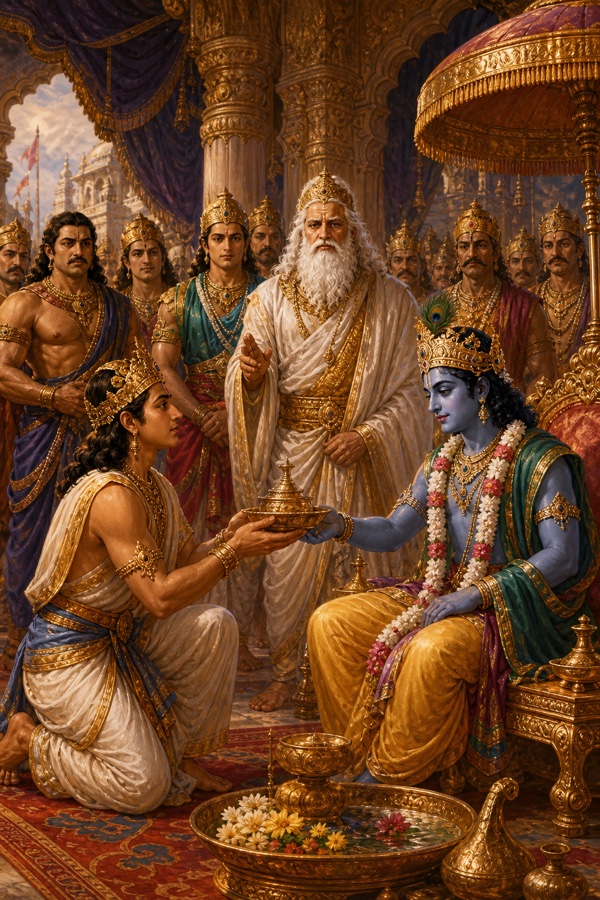
The gist: As the sages and kings assembled for the final rites, Narada remembered the divine purpose behind their earthly births. Bhishma named Krishna as the person most worthy of the first offering of honor. Sahadeva presented it, Krishna accepted it, and Shishupala began to protest.
Shishupala challenges the choice
Shishupala addressed Yudhishthira before the assembled rulers. “This Vrishni does not deserve a king’s honor in the presence of all these great monarchs,” he said. “For you to choose to honor Krishna in this way is unworthy of the Pandavas. You are children. You do not understand dharma, whose workings are subtle. Bhishma, the son of Ganga, has shown little understanding himself and has crossed its boundaries by advising you. Bhishma, when a man of your standing and knowledge acts for personal advantage, honest and wise people are entitled to condemn him. Krishna is not even a king. How could he accept precedence over these rulers, and how could you offer it? If age is your reason, Vasudeva is sitting here. How can the son be the eldest while his father is present? If you regard Krishna as your supporter and well-wisher, Drupada is here. What gives Madhava the first place ahead of him? Do you consider Krishna your teacher? Drona is present. How could you honor the Vrishni ahead of him? Do you consider him your sacrificial priest? The aged Dvaipayana is here. And Bhishma himself is here, Shantanu’s son, who cannot die until he chooses to. Why did Krishna receive the honor in his presence?” Shishupala tested the decision against the standing of the people already in the hall, naming one possible claimant after another.
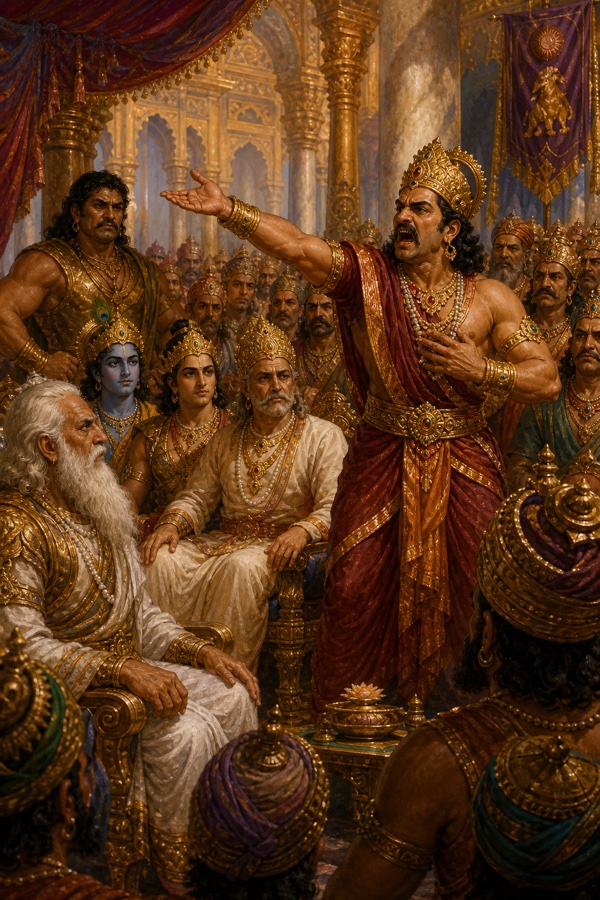
“The brave Ashvatthama is here, versed in every branch of knowledge,” he continued. “Duryodhana, foremost among kings, is here, together with Kripa, teacher of the Bharata princes. You have passed over Druma, teacher of the Kimpurushas. Why honor Krishna ahead of him? The invincible Bhishmaka is present, and the king of Pandya, marked by every auspicious sign, and Rukmi, Ekalavya, and Shalya of Madra. How could Krishna receive the first honor among them? Karna is here too. He boasts of his strength before kings, and he truly possesses immense power. He is the favorite disciple of the Brahmin son of Jamadagni, Parashurama, and has defeated monarchs in battle by his own strength alone. Why pass over him? Krishna is neither a sacrificial priest nor a teacher nor a king. The honor you have given him can only show that you expect some advantage. If you intended from the beginning to honor him first, why summon these kings here to be insulted? Fear did not make us pay tribute to Yudhishthira. We sought no gain, and persuasion did not bring us under his control. We gave tribute because he sought imperial sovereignty for the sake of dharma. Now he insults us. What purpose except insult could you have in offering arghya to Krishna, who bears none of the marks of royalty, in the midst of assembled monarchs?”
Shishupala turned those objections into accusations against the men responsible for the choice. “The son of Dharma has acquired his reputation for righteousness without deserving it,” he said. “Who would give such an improper honor to someone who has fallen away from virtue? This wretch of the Vrishni line brought about the death of the great King Jarasandha through wrongdoing. By offering him arghya today, Yudhishthira has abandoned dharma and displayed his own meanness. Madhava, if Kunti’s helpless sons were afraid and ready to behave dishonorably, you should have made them understand what claim you had to the first honor. Why did you accept an honor you did not deserve, even if those small-minded princes offered it? You delight in this unearned distinction like a dog licking up clarified butter it has found in a solitary place. The kings have suffered no insult here. The Kurus have brought humiliation on you yourself. A king’s honor bestowed on someone who is no king is like a wife given to an impotent man or a beautiful spectacle presented to a blind man. We have now seen what Yudhishthira is. We have seen what Bhishma is. And we have seen what Krishna is. All have shown themselves.” Having delivered those insults, Shishupala rose from his fine seat. Other kings went with him as he left the assembly. His challenge to one offering of honor had become a public rejection of the judgment behind it.
The gist: Shishupala called Krishna’s first honor an insult to the kings. He named other guests whose age, learning, priestly office, or royal standing he considered stronger claims. Accusing Bhishma and Yudhishthira of self-interest and abusing Krishna directly, he left the assembly with other rulers.
Source: the Mahabharata of Krishna-Dwaipayana Vyasa, Sabha Parva. This chapter follows K. M. Ganguli, sections I-XLVI (1-46); the Gita Press Hindi edition numbers these chapters differently. Names, order, and events were checked against Ganguli’s complete translation. Dialogue and commentary are adapted, not a verbatim translation. About the sources.
Based on: The Mahabharata, Vyasa (Gita Press, Gorakhpur)