On this page
The Rajasuya was over. It is the sacrifice by which a king declares himself lord over other kings, and Yudhishthira, eldest of the five sons of Pandu, had carried it through at his capital of Indraprastha, which men also called Khandavaprastha, while the rulers of the earth stood at his gate with their arms full of gems. When the rite ended, the guests went home. Two of them stayed. Duryodhana, eldest son of the blind king Dhritarashtra of Hastinapura and cousin to the five brothers, lingered in the assembly hall of the Pandavas with his mother’s brother Shakuni, the king of Gandhara, and day after day he walked its rooms. Maya had built that hall, an architect of the Asuras whom Arjuna once saved from a fire, and nothing like it stood in the city named for the elephant. What Duryodhana saw in that house, and what happened to him there, grew into a game of dice that broke the family of the Kurus. Long afterward King Janamejaya, born in the line of those same Pandavas, asked how the game had come about, the game that plunged his forefathers into such grief and became the cause of a world’s destruction. Which kings sat in that assembly, he wanted to know, and who among them approved, and who forbade it? Vaishampayana, the disciple of Vyasa, told him all of it, and he began with a man walking through a house that was too beautiful for him to bear.
Duryodhana’s stumbles in the hall of Maya, and the fire that smoldered within
Duryodhana took his time over the hall. With Shakuni beside him he went from chamber to chamber, slowly, studying designs that seemed to belong to the gods and that he had never once seen at home in Hastinapura. Maya had worked in crystal, and he had worked to deceive. One day, going his rounds, the prince came to a stretch of floor so clear and so still that he took it for a pool, and he gathered up his clothes to wade through it. It was floor. When he understood his mistake he wandered off through the house in misery. Some while later he came upon a real pool, its water as clear as the floor had been and set with lotuses whose petals were cut from crystal, and this time he took the water for solid ground. He walked straight in and fell into the water with all his clothes on.
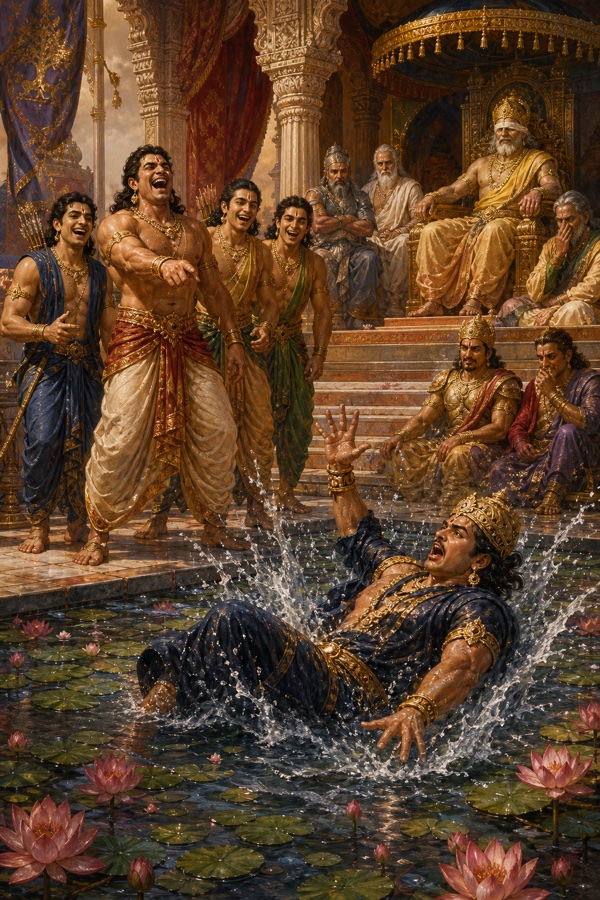
Bhima saw him go in. He was the second of the Pandava brothers and the strongest man among them, and he laughed out loud, and the servants of the palace laughed with him. At their king’s order they came quickly with dry clothes, fine ones, and handed them to the dripping guest. When Bhima looked at him again he laughed again, and now Arjuna was laughing too, and both of the twins, Nakula and Sahadeva. Duryodhana had not been raised to put up with insult, and he could not bear that laughter. He kept what he felt off his face. He would not so much as turn his eyes toward them. A little later he came to a strip of dry floor, took it for water, and lifted his clothes to cross it, and all of them laughed a third time.
The doors were worse. He walked at a door of crystal that was shut, taking it for an open way, and struck his head on it so hard that he stood there swaying with his brain reeling. He came to another crystal door that stood wide open, took it for a closed one, put out both hands to push it apart, and pitched forward onto the floor. He came to a third that was truly open, judged it shut, and turned away from it. He had watched a mountain of wealth pour into the Rajasuya, and he had been made a fool of by the house that held it, mistake after mistake. At last he asked leave of the Pandavas and set out for Hastinapura.
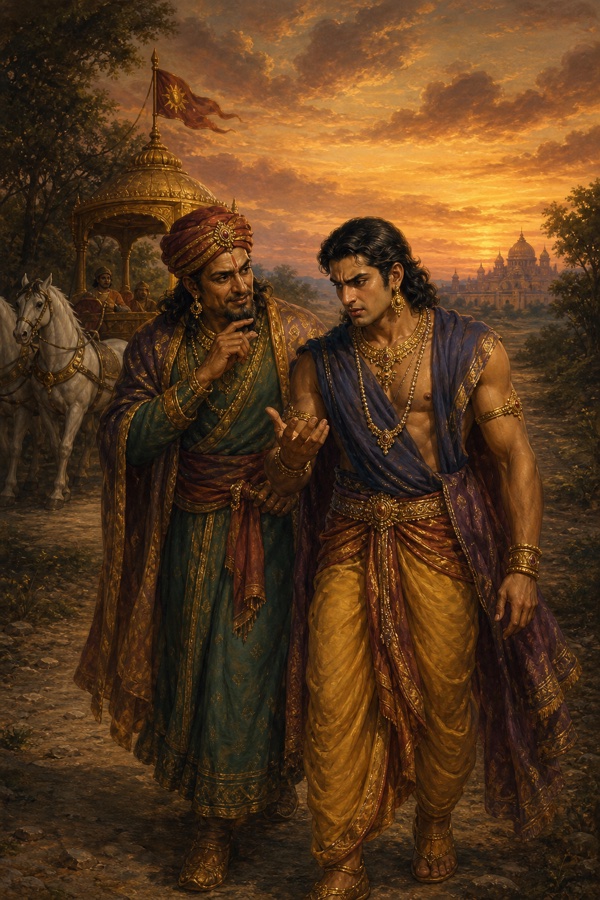
He carried the hall home with him. The whole way to his city he went over what he had seen and what he had suffered, and somewhere on that road his heart bent toward wrong. He had seen the sons of Pandu happy. He had seen every king on earth paying them homage and every person in their city, young and old, eager to do them some good. He thought about their splendor until the color left his face, and then he thought about nothing except that assembly hall and the fortune of Yudhishthira, which had no rival. Shakuni spoke to him several times and got no answer at all. At last the uncle, seeing how far away his nephew had gone, asked him straight out: “Duryodhana, why are you traveling like this?”
“Uncle,” Duryodhana said, “I have seen the whole earth pass under Yudhishthira’s rule because of what Arjuna’s weapons can do. I have seen the sacrifice of Kunti’s son, as grand as the sacrifice of Indra himself among the gods. I am full of jealousy. It burns day and night, and I am drying up like a shallow pond in the hot season. Krishna, the chief of the Satvatas, killed Shishupala, and there was no man who would take the dead king’s side. The fire of the Pandavas had scorched them all, and so they forgave it. Who would forgive such a thing otherwise? It was a wrong act and a grave one, and Krishna carried it off because Pandu’s son stands behind him. And then those kings came with wealth of every kind for the son of Kunti, like merchants paying their tax. When I look at that shining fortune my heart burns, and I know very well that jealousy does not become me.”
He was quiet for a while, turning it over, and when he spoke again to the king of Gandhara he spoke like a man with fire on his skin. “I will throw myself into a blazing fire, or swallow poison, or drown myself. I cannot live. What man with any strength in him can stand to watch his enemies prosper while he goes without? I watch it and I bear it, so what am I? Neither a woman nor anything other than a woman, neither a man nor anything other than a man. I cannot win such royal fortune alone, and I see no allies who could help me to it. That is why I think of dying. I tried to destroy him once, and he slipped through everything I did and grew like a lotus rising out of a pool. So I have come to believe that fate decides and effort is wasted. The sons of Dhritarashtra are dwindling and the sons of Kunti grow day by day. Their fortune, that hall of theirs, those servants laughing at me: it all burns in me. Uncle, know that I am sick with grief and jealousy, and tell Dhritarashtra so.”
The gist: In the hall that Maya built, crystal passes for water and water for crystal. Duryodhana lifts his clothes to wade across solid floor, falls into a real pool, and is beaten by three doors, while Bhima, Arjuna, the twins and the palace servants laugh at him. He leaves Indraprastha with that laughter and the wealth of the Rajasuya lodged in him together. On the road to Hastinapura he tells Shakuni that he cannot live with the sight of the Pandavas’ fortune, that he thinks of fire, poison and drowning, and he asks his uncle to carry the news of his misery to the king his father.
Shakuni’s counsel, and the winning over of Dhritarashtra
“You have no cause to be jealous of Yudhishthira,” Shakuni said. “The sons of Pandu are enjoying what their own good fortune has earned them. You made plan after plan to destroy them, more plans than anyone could count, and you put many of them to work, and each time those men walked out alive by sheer luck. They have won Draupadi for a wife. They have her father Drupada and his sons for allies, and Krishna too, who could help them take the whole world. They came into their father’s share of the kingdom, nobody kept it from them, and they have made it grow by their own energy. Why should that grieve you? Arjuna fed Agni, the god of fire, to his content, and for it he received the bow Gandiva, two quivers that never empty, and weapons made in heaven. With that bow and the strength of his own arms he has brought the kings of the earth under him. Why should that grieve you? He saved the Asura Maya from the flames, and Maya built him that hall, and at Maya’s command grim Rakshasas called Kinkaras hold it up. Why should that grieve you? You say you have no allies. That is untrue. Your brothers obey you. Drona the great bowman is yours, and his son, and Karna the son of Radha, and the great fighter Kripa, and I with my brothers, and King Saumadatti. Join with these and conquer the earth.” Duryodhana caught at that. With his uncle and with those very men, he said, he would crush the Pandavas if his uncle approved, and then the world would be his, every king in it, and that hall with all its wealth. Shakuni would not let him keep the thought. “Arjuna and Krishna, Bhima and Yudhishthira, Nakula and Sahadeva, Drupada and his sons: the gods themselves could not beat those men in battle. They are great chariot fighters, they carry the heaviest bows, they know their weapons and they love a fight. But I know how Yudhishthira himself can be beaten. Listen, and then do it.”
“Uncle,” Duryodhana said, “if there is a way to beat him that puts none of our friends and none of these great men in danger, tell me what it is.”
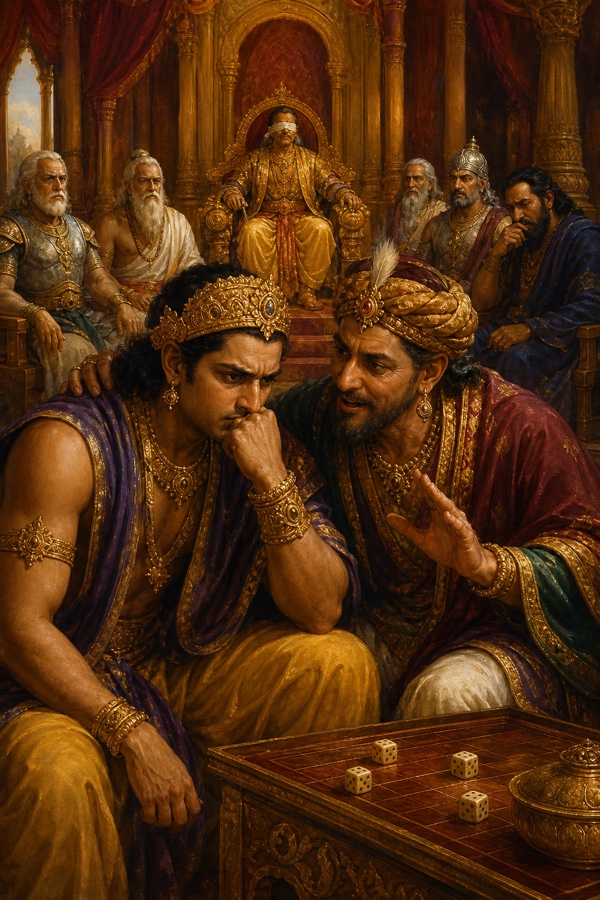
“The son of Kunti loves to play at dice,” Shakuni said, “and he does not know how to play. Ask that king to a game and he finds it very hard to say no. I am skilled at dice. I have no equal at it on earth, and none in the three worlds. So ask him to play. With the skill I have, I will win his kingdom and all that shining fortune of his, and I will win it for you. But lay the whole matter before the king your father first. Let Dhritarashtra give the command, and I will take everything Yudhishthira owns. There is no doubt of it.”
Duryodhana did not trust his own tongue with it. “You lay it before Dhritarashtra yourself, uncle, in the proper way, as it ought to be put to the head of the Kurus,” he said. “I will not be able to say it.”
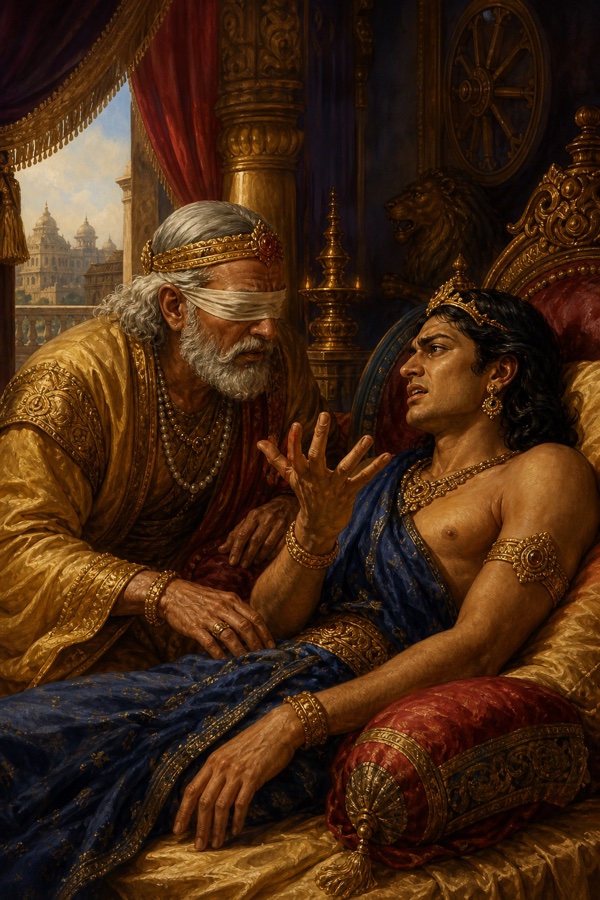
Shakuni had traveled beside his nephew all the way from the hall, and he knew exactly what Duryodhana wanted, and he wanted to please him. He went to Dhritarashtra and found the blind king seated on his throne. “King,” he said, “you should know that Duryodhana has lost his color. He has grown pale and thin. His spirits are low and worry is eating him. Why do you not inquire into it, and find out what grief your eldest son is carrying, a grief his enemy has put there?” The old king turned to his son. “Duryodhana, what has hurt you so badly? If it is something I may hear, tell me. Shakuni here says you have lost your color and grown pale and thin, and I cannot think what the cause could be. All this great wealth of mine is yours to command. Your brothers and all our kin never do one thing to displease you. You wear the best clothes. You eat the best food, cooked with meat. The best horses carry you. Costly beds, beautiful women, houses fitted out with fine things, every pleasant sport: all of it waits on a word from you, as it would for the gods. Then why, my proud son, do you grieve like a man who has nothing?”
“I eat and I dress like a wretch,” Duryodhana said, “and I pass my days the prey of a fierce jealousy. The man who deserves the name is the one who cannot stand his enemy’s pride and who beats that enemy and lives. Contentment destroys good fortune. So does pride, and so do compassion and fear, and a man ruled by those never reaches anything high. Since I saw what Yudhishthira has, nothing I own gives me pleasure. His fortune is far from here and I see it in front of me all the same, and that is why I am pale. Eighty-eight thousand Brahmins who have finished their studies and keep households live on him, and he has given each of them thirty slave girls. A thousand other Brahmins eat at his palace every day, the best food there is, off plates of gold. The king of Kamboja sent him deerskins past counting, black ones and dark ones and red ones, and blankets of the finest weave. She-elephants walk about inside his palace by the hundreds and thousands, and thirty thousand she-camels with them, because the kings of the earth brought them there as tribute. They brought jewels in heaps upon heaps. I have never seen or heard of such wealth as came to that sacrifice. Brahmins who live on his grants and are rich in cattle stood at his gate with tribute worth three thousand millions, carrying clarified butter in golden water pots, and the keepers would not let them in. The Ocean himself brought him, in vessels of white copper, the nectar that is born in his waters, which is far better than what flowers and plants yield for Indra. And when the sacrifice was done, Krishna took up a great conch and bathed Kunti’s son with sea water carried in a thousand jars of gold, every jar set with gems. I watched that, and the jealousy came on me like a fever. Those jars had been carried to the eastern ocean and the southern, and on men’s shoulders to the western. Nobody but the birds can reach the north, Father, and Arjuna went there and came back with a fortune in tribute. I will tell you one more thing. It was arranged that conches would sound together each time a hundred thousand Brahmins had been fed. I heard those conches almost without a pause, and the hair stood up on my body. Kings served food to Brahmins there like men of the merchant class. Indra does not own such fortune. Yama does not, nor Varuna, nor Kubera, the lord of the Guhyakas. I saw it in the hands of Pandu’s son, my heart burns, and I have no peace.”
A sub-tale: Duryodhana’s account of the tribute ran on, and it was the account of a man who had counted everything. Yudhishthira, treating him as a senior who was owed respect, had set him to receive the gems, and they came in such numbers that his hands grew tired of taking them, and men who had carried treasure across the world stood waiting until he could lift his arms again. He told his father who had come. The king of Kamboja gave skins and blankets of wool, of cat hair, and of the soft fur of burrowing animals, all worked with gold thread, and with them three hundred horses of the Tittiri and Kalmasha breeds whose noses curved like a parrot’s beak, three hundred camels, and as many she-asses. Shudra kings from the seacoast brought slender serving girls of the Karpasika country by the hundred thousand and skins of the ranku deer. Bhagadatta of Pragjyotisha arrived at the head of his Yavanas with horses as fast as the wind, could not get through the crowd, and went away leaving swords hilted in pure ivory and set with diamonds. Tribes with three eyes, tribes with one leg, cannibals, Nishadas and Romakas brought ten thousand black-necked asses bred on the coast of the Vankhu, and the one-legged men gave wild horses red as cochineal, white, rainbow-colored and the color of evening cloud. The Bahlikas brought ten thousand more asses that could run two hundred miles in a day, woolen blankets from the country of the Chinas, cloth of jute and cloth of thread that insects spin, sheepskins by the thousand, and long swords, scimitars, hatchets and battle-axes forged in the western countries. The peoples who live along the river Shailoda, between Meru and Mandara, in the shade of the kichaka bamboo, brought jars of the gold that ants dig out of the ground. The mountain tribes brought yak-tail fans, black and moon-white, honey from Himalayan flowers, and garlands from the land of the northern Kurus. The Kiratas came in their skins with loads of sandalwood and aloe, gold, perfumes, ten thousand serving girls of their own race, and beasts and birds of far countries. The kings of Chola and Pandya carried golden jars of sandal juice from the Malaya hills, sandalwood and aloe from the Dardura hills, bright gems and cloth worked with gold. The king of Simhala gave lapis lazuli, heaps of pearls and hundreds of coverings for elephants. One picture returned again and again as he spoke, and it was the gate. Most of these peoples, he said, stood outside it with their gifts in their arms, refused permission to enter, and Brahmin cattle keepers stood there with them, holding three hundred millions in tribute. The Vangas, the Kalingas, the Magadhas, the Tamraliptas and their neighbors were told by the gatekeepers, at the king’s command, that they might come in if they could wait and bring good tribute, and each of those kings then gave a thousand armored elephants with gold girdles and tusks like plow shafts. Chitraratha, king of the Gandharvas and friend of Indra, gave four hundred horses. Virata of Matsya gave two thousand elephants decked in gold. Drupada gave fourteen thousand serving girls, ten thousand serving men with their wives, and his whole kingdom, and Krishna gave fourteen thousand elephants to honor Arjuna. Only two peoples owed Yudhishthira no tribute at all: the Panchalas, who were kin by marriage, and the Andhakas and Vrishnis, who were friends. “When I saw the kings of the earth bring such gifts to my enemies,” Duryodhana said, “I wished for death.”
He had one scene left to tell, and it was the consecration, where kings had done the work of servants. King Bahlika brought a chariot plated with pure gold. Sudakshina yoked four white horses of the Kamboja breed to it, Sunitha fitted the lower pole, and the ruler of Chedi set up the flagstaff with his own hands. The king of the southern country stood ready with the coat of mail, the ruler of Magadha with the garlands and the headdress, Vasudana with an elephant sixty years old, the king of Matsya with the gold-cased side fittings of the chariot, Ekalavya with the shoes, the king of Avanti with the waters for the final bath, Chekitana with the quiver, the king of Kashi with the bow, and Shalya with a sword whose hilt and straps were worked in gold. The sages Dhaumya and Vyasa, with Narada and Devala the son of Asita, sprinkled the sacred water. Satyaki held the umbrella, Arjuna and Bhima fanned the king, and the twins held the yak-tail whisks. The Ocean himself carried in the great conch of Varuna, which the gods’ own craftsman Vishvakarma had made with a thousand nishkas of gold, and with it Krishna bathed Yudhishthira while Duryodhana looked on. “I fainted at the sight,” he said. “Then hundreds of conches from the northern sea were blown together, and the weaker kings fell down, and Dhrishtadyumna and Satyaki and the five sons of Pandu and Krishna, those eight, saw me in that state and laughed outright. A yoke tied by a blind man works loose, and so it is with us. The younger branch grows and the elder decays.” Dhritarashtra tried to talk him down. “You are my eldest son, born of my eldest wife. Do not be jealous of the Pandavas. A jealous man is never happy; he suffers the pains of death while he lives. Yudhishthira deceives no one. His wealth is equal to yours, your friends are his friends, and he bears you no jealousy at all. If what you covet is the honor of a great sacrifice, let the priests arrange for you the rite called Saptatantu, and the kings of the earth will gladly bring you wealth and gems and ornaments too. To covet what belongs to another is a mean thing, child. The sons of Pandu are your arms. Do not cut off your own arms. Their grandfathers are your grandfathers. Give gifts at your sacrifices, take every pleasure you like, enjoy your women, and be at peace.” Duryodhana answered with statecraft. A man with no judgment of his own, he said, can hear the scriptures all his life and know them as a ladle knows the taste of soup. Father and son were lashed together like two boats, and sons and allies alike were doomed under a ruler who put off to the future what had to be done today. Brihaspati himself had taught that the ways of kings are different from the ways of common men. For a Kshatriya, success is the only test, and whether the means are virtuous or sinful, there is no room for scruple in the duty of his own order. A weapon is anything, open or hidden, that brings an enemy down. Indra had given Namuchi his pledge and cut off his head in a time of peace. The earth swallows a peaceful king as a snake swallows frogs. A small enemy left to grow eats a man the way white ants at the root eat a tree. “Discontent is the root of prosperity,” he said, “so I mean to stay discontented. I will have that fortune of theirs, or I will lie dead on a battlefield. What is life to me, when the Pandavas grow every day and we do not?”
Then Shakuni said it plainly. “That fortune of Yudhishthira’s, the sight of which grieves you so, I will take from him for you. Have the son of Kunti summoned. A man who knows the dice can beat a man who does not and never take a scratch. I can tell how every throw will fall, and when to stake and when to hold back. Call him to a game or call him to a battle and he is sure to come, and I will beat him at throw after throw by cheating. Know this: the wager is my bow, the dice are my arrows, the marks on them are my bowstring, and the board is my chariot.” Duryodhana did not let a moment pass. “Shakuni is a master of the dice, King, and he stands ready to win the wealth of Pandu’s sons. Give him leave.” Dhritarashtra said that he followed the advice of his brother Vidura, his minister, in everything. Vidura saw far, he kept what was right before his eyes, and he would say what was good for both sides. Once he had consulted him, he would give his answer. Duryodhana cut across that at once. “Vidura works for the good of Pandu’s sons, and what he feels for us is something else. If you consult him he will make you give this up. And if you give it up, I will certainly kill myself. Then you can be happy with Vidura when I am dead. You will have the whole earth to enjoy. What do you need me for?” The old king tried once more. A quarrel with the strong had never seemed wise to him, he said. His son was calling a blessing the very thing that would drag war behind it, and once begun it would breed sharp swords and pointed arrows. Duryodhana had his answer ready: men of the most ancient times invented dice, nobody is struck by a weapon in it and nobody is destroyed, and the game would make the Pandavas his father’s equals where they now stood above him. Dhritarashtra gave way. “What you say does not please me,” he said. “Do what you like. You will repent it, because words so far from what is right bring no good afterward. Vidura foresaw this. The great calamity that takes the lives of the Kshatriyas is coming, as fate has decreed.” And having said so, he raised his voice and gave orders to his men. They were to build an assembly hall without losing a day, the most beautiful that could be made, to be called the palace of the crystal arches, with a thousand columns and a hundred gates, bright with gold and lapis lazuli, two miles long and two miles wide, with jewels set over all its walls, and they were to report to him when it was done.
The gist: Shakuni offers the one battle he is sure of winning: a game of dice against a king who loves the game, cannot play it and cannot refuse it. Dhritarashtra argues against his son, first by offering him a great sacrifice of his own and then by asking to consult Vidura, and he gives way when Duryodhana threatens to kill himself. He says aloud that the plan is wrong, that his son will repent it and that a calamity is coming, calls it fate, and orders the hall built.
Vidura’s warning, and the summoning of Yudhishthira
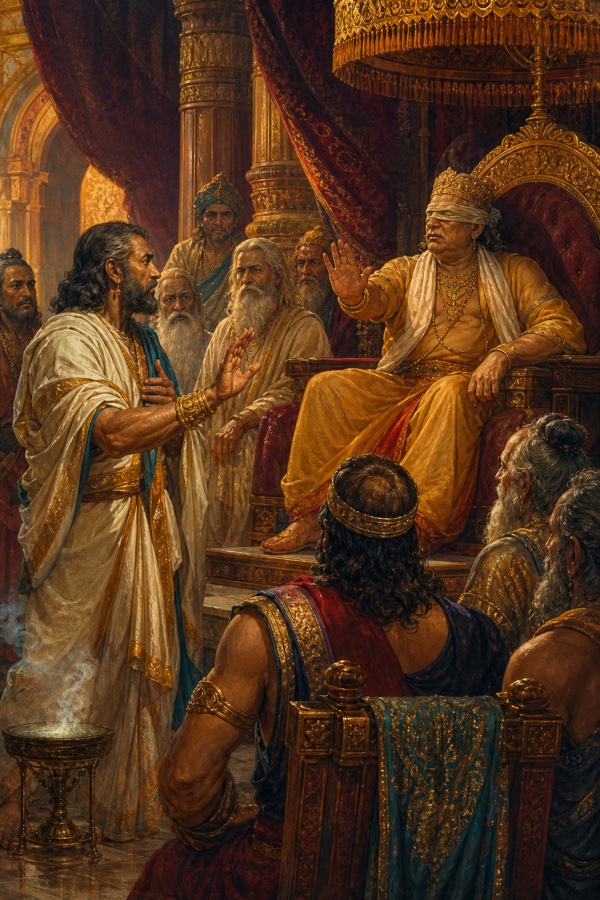
Having given the order to quiet his son, Dhritarashtra sent messengers for Vidura. Vidura was his younger brother and his minister, the man the court addressed as Kshatta, and the king had never in his life settled anything without asking him. This time was different. The king knew what gambling does, and it drew him all the same. Vidura needed nobody to explain the news to him. The moment he heard it he knew that Kali, the spirit of discord, was at the door and that the road to destruction was about to open, and he came quickly, bowed at his elder brother’s feet, and spoke. “I do not approve of what you have decided. Act so that no quarrel rises among your children over this gambling match.” Dhritarashtra answered, “Kshatta, if the gods are kind to us, no quarrel will ever rise among my sons. So let this friendly challenge at dice go forward, lucky or unlucky, good for us or bad. This is what fate has ordained, I have no doubt of it. And with me close by, and Drona, and Bhishma, and you, what evil could happen, even one that fate had planned? This is my decision, Vidura. Say nothing more to me. I hold fate supreme, and fate is bringing all of this.” Vidura heard him out and concluded that his family was doomed. In great sorrow he went to find Bhishma, the old grandsire of the house.
Vidura’s opinion stayed with the king all the same. He called Duryodhana to him once more, in private. “My son, have nothing to do with dice. Vidura speaks against it, and with his wisdom he will never give me advice that is bad for me. He knows, with all its secrets, the science that Brihaspati taught to Indra. What Uddhava is among the Vrishnis, Vidura is among the Kurus. Dice sows division, and division is the ruin of a kingdom. Give the idea up. You have had from us what a father and mother owe a son, your rank and your inheritance. You are educated, you were raised with love in your father’s house, you are the eldest of your brothers and you live in your own kingdom. You rule a great ancestral realm full of people and wealth, and you shine in it like Indra in heaven. What is at the root of this grief?” Duryodhana told him, and this time he told the part that shamed him. The Nipas, the Chitrakas, the Kukkuras, the Karaskaras and the Lauhajanghas were living in Yudhishthira’s palace like bondsmen. Maya had brought jewels from the lake called Bindu and laid a floor of crystal that looked like a lake, with lotuses on it, and when he drew up his clothes to cross it Bhima laughed at him as at a pauper who had lost his head at the sight of an enemy’s riches. “If I were able, I would kill Bhima for that without losing a moment. But if we tried to kill Bhima now, we would go the way of Shishupala. Then I took a real pool for crystal and fell into it, and Bhima and Arjuna laughed again, and Draupadi laughed with them, and her women. That hurts my heart more than I can say. The king’s servants brought me dry clothes at his order, and that is a grief to me too. Then I walked at a thing shaped exactly like a door, with no way through it, and struck my forehead on stone. The twins saw it from a distance and came and held me up in their arms, very concerned for me, and Sahadeva kept telling me, almost smiling, ‘This is the door, King. Go this way.’ And Bhima laughed out loud and said, ‘Son of Dhritarashtra, the door is here.’ I had never so much as heard the names of the gems I saw in that house. This is why my heart aches.” In the end the father, whom fate had robbed of his judgment, did what the son wanted. Thousands of skilled workmen raised the hall quickly, filled it with every kind of furnishing, and came to report that it stood finished, handsome, jeweled, and laid with many-colored carpets worked in gold. Then Dhritarashtra sent for Vidura, the chief of his ministers. “Go to Khandavaprastha and bring Prince Yudhishthira here without delay. Let him come with his brothers and look at this handsome hall of mine, with its countless gems and its costly beds and carpets, and let a friendly match at dice begin here.”
Vidura told him plainly that he did not approve. “Do not do this. I fear it will destroy our family. When your sons lose their unity they will quarrel, and I see that quarrel coming out of this match.” The king answered that if fate was not against them, no quarrel would trouble him, that the whole universe moves at the will of its Creator and under the hand of fate and is not free, and that Vidura was to go and bring Kunti’s son. So Vidura went, against his will, behind horses that were strong and fast and steady. He took the road to the Pandava capital, entered the city of Yudhishthira with Brahmins honoring him on every side, and came to a palace as rich as the house of Kubera, the god of wealth. Yudhishthira greeted him with reverence and asked after the old king and his sons, and then he looked at his uncle’s face. “Kshatta, your mind seems heavy. Do you come in peace and good health? Are Dhritarashtra’s sons obedient to their old father, I hope? Do the people accept his rule?” Vidura gave the message as it had been given to him. “The king and his sons are well and happy. He sits among his kin and reigns like Indra, and he is intent on his own advancement. He commands me to ask after your peace and prosperity, and to ask you to come to Hastinapura with your brothers, look at the hall he has newly built, and say whether it is the equal of your own. Come there, enjoy that house, and sit down to a friendly match at dice. The Kurus have gathered already, and we shall be glad to see you. You will also find there the gamblers and cheats the king has collected. That is what I came to say. Let the king’s command have your consent.” Yudhishthira saw where it led. “Kshatta, if we sit down to dice we may quarrel. What man who knows that would agree to gamble? Tell us what you think right. All of us follow your advice.” Vidura gave him the truth with the summons. “I know that gambling is the root of misery, and I tried to turn the king from it. He has sent me to you anyway. You know all of it now. You are a wise man. Do what is best.”
“Apart from Dhritarashtra’s sons,” Yudhishthira asked, “what other dishonest gamblers are waiting there to play? Tell us who they are, Vidura, the men against whom we will have to stake our possessions by the hundreds.” Vidura named them. “Shakuni, the king of Gandhara, a master of the dice, very quick with his hands and reckless in his stakes. Vivimshati. King Chitrasena. Satyavrata, Purumitra and Jaya. Those are the men.” Yudhishthira understood what the list meant. “Then the most desperate and terrible gamblers there are, men who always rely on deceit, have been gathered in that hall. But this whole universe moves at the will of its Maker, under the hand of fate, and it is not free. I have no wish to gamble because King Dhritarashtra orders it. A father always wants to do his son good. You are our master, Vidura; tell me what is proper. I am unwilling, and I will not play unless that wicked Shakuni challenges me in the assembly. If he does challenge me, I will never refuse. I settled that long ago, and it is my vow for life.”
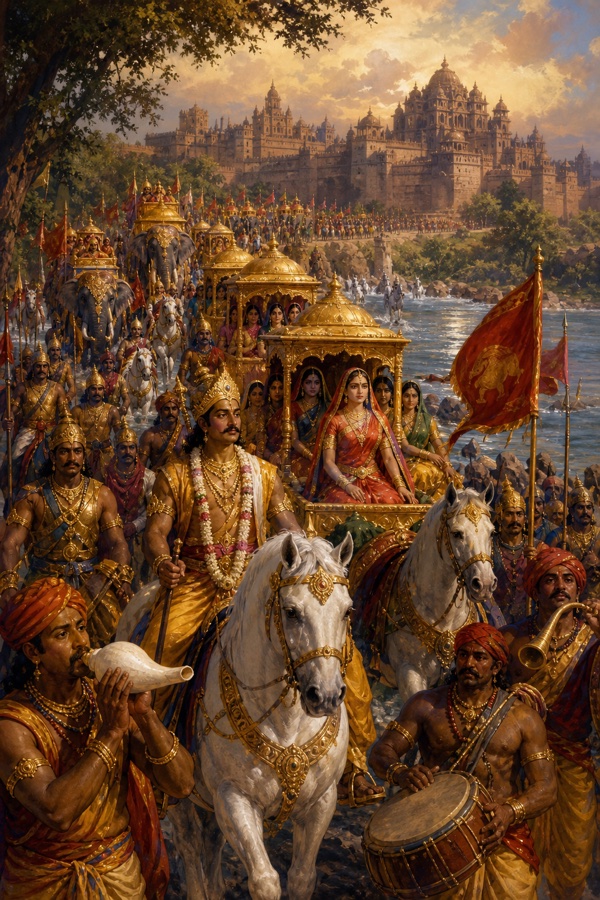
He gave orders that the journey be made ready at once, and the next day he set out for the capital of the Kurus with his kinsmen and attendants and with the women of his household, Draupadi among them. “Fate takes our reason from us as a bright light falling across the eyes takes our sight,” he said, “and a man goes where Providence pulls him, like something tied on a cord.” With those words he left with Vidura, and he did not weigh Dhritarashtra’s summons any further. He rode in royal robes on the chariot the king of Bahlika had given him, his brothers around him and Brahmins walking ahead, a king in his full splendor, called by his uncle and driven by what Time had already fixed. At Hastinapura he went to the palace of Dhritarashtra. He embraced Bhishma and Drona, Karna and Kripa and Drona’s son Ashvatthama, and each of them embraced him. He went to Somadatta, then to Duryodhana and Shalya and Shakuni and the other kings who had come before him, then to Duhshasana and all his brothers, then to Jayadratha, then to every one of the Kurus in turn. With his brothers around him he entered the apartment of the king, and there he saw Gandhari, the wife who had never once failed her blind husband, sitting among her daughters-in-law like the star Rohini among the stars. He greeted her and she blessed him. Then he stood before his old uncle, a king whose only eye was his wisdom, and Dhritarashtra drew him close and smelled the crown of his head, as a father does, and the heads of the four younger brothers after him. The Kurus were glad to see them. At the king’s word the Pandavas went to the rooms set apart for them, rooms furnished with gems, and the women of Dhritarashtra’s house came to call, led by his daughter Duhshala. The king’s daughters-in-law looked at Draupadi, at her blazing beauty and her good fortune, and went quiet with jealousy. The brothers talked with the ladies, took their daily exercise, and performed the rites of the day. They rubbed their bodies with fragrant sandal paste, gave gifts to Brahmins and received their blessings, ate the finest food, and went to bed with women singing them to sleep. They passed that night in pleasure. Bards woke them with music, they rose at dawn and went through the morning rites, and they walked into the new assembly hall, where the men who were ready to gamble saluted them.
The gist: Vidura tells the king twice that the match will divide his sons and destroy the family, and both times Dhritarashtra answers with fate and sends him to Khandavaprastha. Vidura delivers the invitation and with it the names of the men waiting to play: Shakuni, Vivimshati, Chitrasena, Satyavrata, Purumitra and Jaya. Yudhishthira calls them cheats, says he has no wish to gamble, and goes all the same, bound by a vow never to refuse a challenge. He spends one easy night as a guest in Hastinapura and walks into the hall at dawn.
The game begins, and Shakuni’s chant of “I have won”
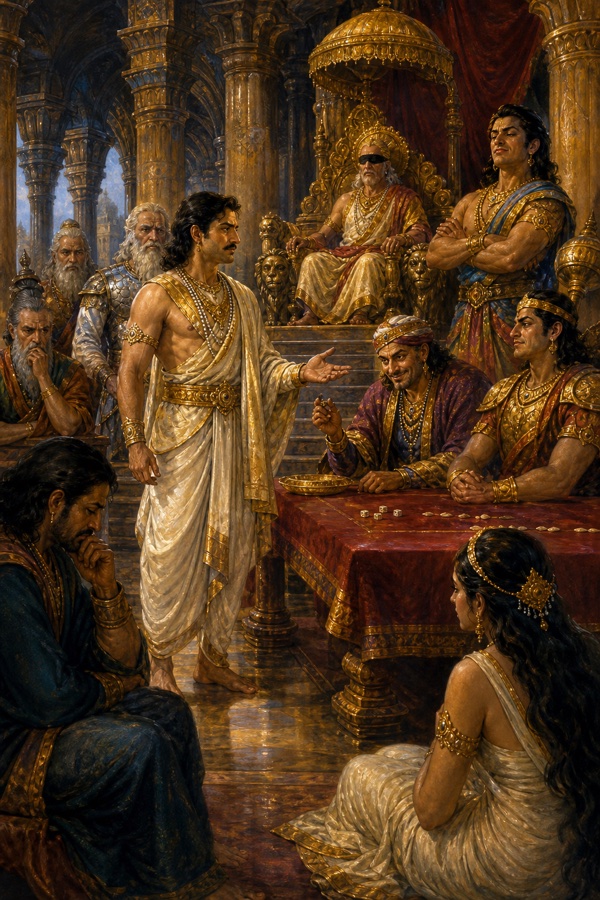
The sons of Pandu went around the hall first. They honored the kings who were owed honor, greeted the others according to their age, and sat down on clean seats spread with costly carpets. When they were settled and every king had taken his place, Shakuni spoke to Yudhishthira. “King, the assembly is full. Everyone has been waiting for you. Let the dice be thrown, Yudhishthira, and let the rules of play be fixed.” Yudhishthira did not reach for the dice. “Gambling by deceit is a sin,” he said. “There is no Kshatriya courage in it, and there is certainly nothing right in it. Why do you praise it so? Wise men do not admire the pride a gamester takes in crooked play. Shakuni, do not beat us by cheating, like some low wretch.”
Shakuni had an answer for that, and it came smoothly. “The player who knows the secrets of winning and losing, who can defeat the tricks of the man across from him, who is at home in every turn the game can take: that man truly knows the play, and he bears whatever comes in the course of it. What can hurt us is the stake, since a stake may be lost as well as won. That is why gambling is called a fault. So let us begin, King. Do not be afraid. Fix the stakes and do not delay.” Yudhishthira quoted a sage against him. “Devala, the son of Asita, who teaches us which acts lead to heaven and which to hell, has said that it is sinful to play deceitfully with a gamester. The best sport is a victory in battle, won without cunning or stratagem, and gambling is no such sport. Honorable men do not speak in the tongue of the Mleccha foreigners, and they do not practice deceit. Do not play desperately, Shakuni, and win from us the wealth with which we try, as far as we are able, to do the Brahmins good. Even an enemy should not be beaten by desperate stakes in crooked play. I want neither happiness nor wealth that comes by cunning.” Shakuni turned it around. A high-born man goes to meet another in a contest wanting to win, he said, and a learned man goes to debate another wanting to defeat him, and nobody calls those motives dishonest. A man skilled in weapons seeks out one less skilled, the strong man seeks out the weak, and the skilled player seeks out the unskilled, and the motive every time is victory. “If you think my motives dishonest, Yudhishthira, and if you are afraid, then give up the game.” That was the challenge, spoken in the assembly, and Yudhishthira had told Vidura what he would do if it came. “When I am summoned I do not withdraw. That is my settled vow. Fate is all-powerful, and all of us are in its hands. With whom in this assembly am I to play? Who here can match my stakes? Let the game begin.”
“I will supply the gems and the jewels and wealth of every kind,” Duryodhana said, “and my uncle Shakuni will play for me.” Yudhishthira saw the irregularity and named it. “For one man to gamble through the hand of another seems to me against the rule. You are a learned man and you will admit it. Still, if you are set on it, let the game begin.”
The kings took their seats in the hall with Dhritarashtra at their head. Bhishma the grandsire, Drona the teacher of the princes, Kripa and Vidura sat down behind him, and none of the four had any heart for what was coming. The rest, lion-necked and strong, settled singly and in pairs on raised seats of fine make and color, until the hall shone with them as heaven shines when the gods sit in council. Every one of them knew the Vedas and every one was brave. Then the friendly match began. Yudhishthira laid down his first stake. “King, here is a treasure of pearls of great price, taken from the ocean when it was churned long ago, beautiful, and set in pure gold. This is my stake. What will you set against it?” Duryodhana answered him. “I have many jewels and great wealth, and I am not vain about them. Win this stake if you can.” Shakuni, who knew the dice as no one else did, took them up and threw. “I have won,” he said to Yudhishthira. “You won that stake from me by unfair means,” Yudhishthira said. “Do not be so proud of it, Shakuni. Let us play for thousands upon thousands. I have in my treasury many fine jars, each holding a thousand nishkas of gold. I have gold that cannot be exhausted, and silver and other metals in plenty. That is what I stake.” Shakuni turned to the eldest of Pandu’s sons, the king who carried the Kuru line, and said it a second time. “I have won.”
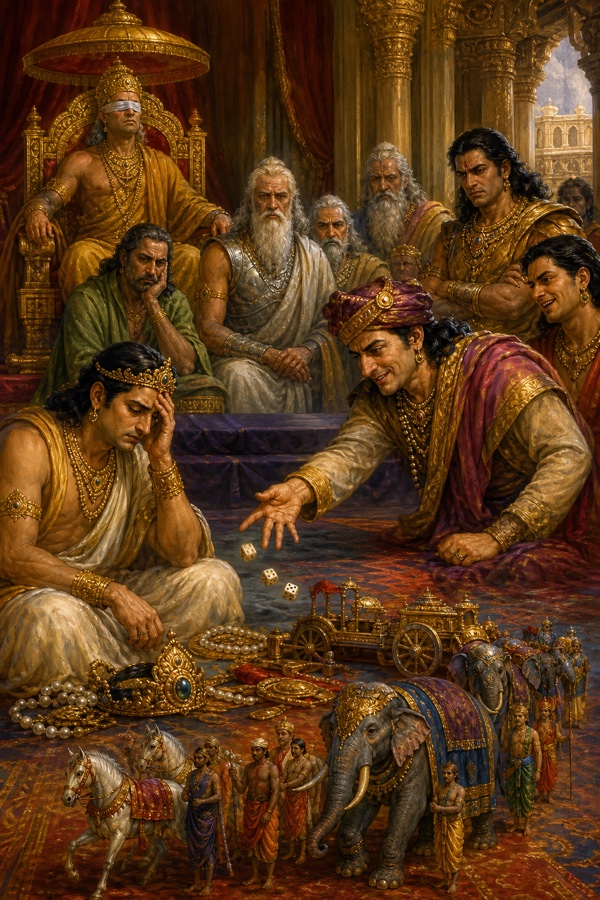
Then the stakes came one after another. Yudhishthira staked the royal chariot that had carried them to Hastinapura. It was worth a thousand chariots, he said, well proportioned and covered in tiger skin, with fine wheels and flagstaffs and strings of little bells, and it rolled with a noise like thunderclouds or the sea behind eight noble horses, white as moonbeams and famous through the kingdom, that no creature on the ground could escape. Shakuni had the dice ready and threw them by unfair means. “I have won.” Yudhishthira staked a hundred thousand serving girls, all of them young, with gold on their wrists and upper arms and nishkas at their throats, garlanded and richly dressed, rubbed with sandal paste, trained in the sixty-four arts and in dance and song above all, who at his word waited on the gods, on the Brahmin householders and on kings. “I have won.” He staked his serving men by the thousand, young men dressed always in silk, quick-witted and self-controlled, with rings in their ears, who served his guests night and day with plates and dishes in their hands. “I have won.” He staked a thousand elephants in musth, girdled and garlanded with gold, lotus marks on their temples and necks, their white tusks long and thick as plow shafts, fit to carry kings and steady under any noise of battle, huge enough to batter down the walls of enemy towns, the color of new rain clouds, and each with eight she-elephants of its own. Shakuni laughed. “I have won it.” He staked as many chariots as he had elephants, with golden poles and flagstaffs, well-trained horses, and fighters who each drew a thousand coins a month whether they fought or sat idle. “I have won it.” He staked the horses of the Tittiri, Kalmasha and Gandharva breeds, in all their ornaments, that the Gandharva Chitraratha had gladly given to Arjuna after Arjuna beat him in battle. “I have won.” He staked ten thousand chariots and wagons with the best draft animals yoked to them, and sixty thousand broad-chested fighters picked by the thousand from every order, brave men raised on milk and good rice. “I have won.” He staked four hundred nidhis, treasures sheathed in copper and iron, each one worth five draunikas of the purest and costliest leaf gold. Shakuni cast the dice by foul means and said it again. “I have won it.”
A key to reading this: There is no doubt about how these throws fall. Before the game Shakuni promised Duryodhana that he would beat Yudhishthira at every throw by deceiving him, and throw after throw is won by unfair or foul means. Yudhishthira says so himself after his first loss. He is fond of dice and has little skill at it, and across the board sits a man who claims no equal in the three worlds. Twice before the first throw he objected, first that deceitful play is a sin and then that one man may not properly gamble through another’s hand. He played because he had been challenged in the assembly, and he had vowed never to refuse a challenge.
Vidura’s warning at the dice, and Duryodhana’s rebuke
The game was still going, and it could end only in Yudhishthira’s ruin, when Vidura turned to Dhritarashtra. “King, hear what I have to say, though you will like it as little as a dying man likes his medicine. When this Duryodhana was born he cried out at once with the cry of a jackal, harsh and wrong, and everyone knew then that he had come to destroy the Bharata line. He will be the death of you all. A jackal is living in your house in the shape of Duryodhana, and in your folly you do not see it. Hear what the poet Shukra said. Men who gather honey in the mountains find what they came for and never notice that they are about to fall. They climb to dangerous heights with their minds fixed on the comb, and they drop to their deaths. Duryodhana is drunk on this game as those men are on honey. He is making enemies of great warriors, and he does not see the fall in front of him. You know that among the Bhojas a son unworthy of his people was cast off for the common good. The Andhakas, the Yadavas and the Bhojas joined together and abandoned Kamsa, and when Krishna killed him at the wish of the whole tribe, they lived in happiness for a hundred years. Give the same command. Let Arjuna kill this Duryodhana, and let the Kurus be glad and pass their days in peace. Sell a crow, King, and buy these peacocks, the Pandavas. Sell a jackal and buy these tigers. For the sake of a family, one member may be given up. For a village a family may be given up, for a province a village, and for the sake of his own soul a man may give up the whole earth. Shukra, who knows the thoughts of every creature, said exactly that to the great Asuras, to make them cast out Jambha in the hour he was born. They tell of a king who brought wild birds that spat gold to nest in his own house, and then killed them out of greed, and lost in one stroke what he had and what he would have had. Do not hound the Pandavas for the sake of profit as he did, or you will repent as he did. Be like a flower seller in a garden he loves, and take your flowers from the Pandavas day by day. Do not scorch them to the root like a burning wind that leaves black charcoal behind it. Do not go down to the house of Yama with your sons and your troops. Who can fight the sons of Pandu when they stand together? Could Indra, at the head of all the gods?”
“Gambling is the root of quarrels,” Vidura went on. “It divides men, and what comes of it is terrible. Duryodhana reaches for it and makes himself fierce enemies. The descendants of Pratipa and Shantanu, with their armies and their allies the Bahlikas, will be destroyed for his sins. In his drunkenness he drives luck and prosperity out of his own kingdom, like a maddened bull that breaks its own horns. A brave and learned man who ignores what he himself foresees and follows another man’s heart sinks into misery, like a man who puts to sea in a boat steered by a child. Duryodhana gambles with Pandu’s son, and you are delighted that he is winning. This is the kind of success that begets war, and war ends in the destruction of men. Listen, sons of Shantanu, descendants of Pratipa, all of you in this assembly of the Kauravas. Do not walk into the fire that has blazed up behind this wretch. When Yudhishthira, drunk with dice, gives way to his anger, and Bhima and Arjuna and the twins with him, who will be your refuge in that hour? King, you are yourself a mine of wealth. You can earn by other means as much as you hope to win by gambling. What do you gain by winning the great wealth of the Pandavas? Win the Pandavas themselves, and they will be worth more to you than everything they own. All of us know how Shakuni plays. This king from the hills knows many crooked ways with the dice. Let him go back where he came from. Do not make war on the sons of Pandu.”
Duryodhana turned on him. “Kshatta, you are always boasting of our enemies’ fame and running down the sons of Dhritarashtra. We know whom you really love, Vidura. You treat us as children. Your tongue and your mind give your heart away. We have nursed you like a serpent in our lap, and like a cat you wish harm to the hand that feeds you. The wise say there is no sin worse than injuring one’s master. How is it that you are not afraid of that sin? We have beaten our enemies and gained a great deal by it, so keep your harsh words to yourself. Go and sit at the feet of old men and learn. Guard the reputation you have, and stay out of other men’s business. Do not imagine that you are our chief. We do not ask you what is good for us. Stop provoking men who have already borne too much from you. There is one Controller and no second, and he controls even the child in its mother’s womb. He controls me. I act exactly as he directs, as water runs downhill. No one should give shelter to the friend of his enemies, or to a man who envies his own protector. So go wherever you please, Vidura. An unchaste wife leaves her husband in the end, however well she is treated.” Vidura spoke past him, to the blind king. “Tell us, as a witness would, what you think of men who cast off those who serve them for giving them advice. The hearts of kings are fickle. They grant protection first and strike with clubs at the last.” Then he answered the prince. “You think your own judgment ripe, and you think me a child. The child is the man who takes someone for a friend and afterward finds fault with him. A bad-hearted man can no more be brought to the right road than an unchaste wife in a well-born house. Advice suits this prince as a husband of sixty suits a young girl. King, if all you want to hear from now on is what pleases you, whatever you do, good or bad, then ask women, ask idiots, ask cripples. A sinful man who says pleasant things is easy to find. A man who will say what is unpleasant and wholesome is very rare, and so is the man who will listen to him. A king’s true ally says what is bitter and necessary and does not ask whether his master will like it. Drink what honest men drink and dishonest men refuse: humility, a medicine that is bitter, sharp, burning and foul, and that makes no one drunk. Drink it and be sober again. I have always wished Dhritarashtra and his sons wealth and fame. Whatever comes to you now, I bow to you. Let the Brahmins wish me well. And here is the lesson I press on you with care: a wise man never enrages snakes that carry venom in their very glance.”
The gist: In the middle of the game Vidura tells the king to give up one son for the sake of the family, as the Bhojas gave up Kamsa, and even to let Arjuna kill him. Sell the crow and buy the peacocks, he says, sell the jackal and buy the tigers; win the Pandavas themselves, who are worth more than their wealth, and send Shakuni home. Duryodhana answers that Vidura is a serpent nursed in the lap and a cat that wishes harm to its feeder, and tells him to go where he likes. Vidura bows to the king and warns him about snakes with venom in their eyes. The next voice in the hall is Shakuni’s, asking Yudhishthira what he has left.
Shakuni’s next question, and the stakes Yudhishthira laid down once his wealth was gone, open chapter 11.
Source: the Mahabharata of Krishna-Dwaipayana Vyasa, Sabha Parva, Dyuta sub-parva, Sections 46 to 63. The Sanskrit e-text, the Gita Press Hindi edition, and Kisari Mohan Ganguli’s complete English translation were used to verify names, sequence, and principal events. Where the recensions differ, this English retelling follows Ganguli, and the Hindi edition follows Gita Press.
Based on: the Mahabharata, Vedavyasa (K. M. Ganguli’s English translation; Gita Press, Gorakhpur)