On this page
Jarasandha’s power, and the flight from Mathura
Krishna agreed that Yudhishthira possessed every quality the Rajasuya required. Then he described the power standing in its way. Yudhishthira’s fitness for the rite had been accepted by his own counselors. The claim to rule over other kings would reach into the dominions of men already subject to Jarasandha, whose alliances Krishna now began to name. “You know these matters,” he said, “but there is something I must still tell you. The men now called Kshatriyas are inferior to the warrior rulers destroyed by Rama, the son of Jamadagni. You know the rules handed down among them through the generations, including the qualifications of a king who wishes to perform the Rajasuya. The great royal houses and the ordinary Kshatriyas alike claim descent from Aila or Ikshvaku. Each of those lines has divided into 100 dynasties. The descendants of Yayati and the Bhojas are numerous and accomplished, spread across the earth, and the other Kshatriyas honor their prosperity. Jarasandha has now overcome that prosperity and placed himself above all those kings by his power. From his position of sovereignty over the middle country, the region of Mathura, he resolved to divide us. The ruler who holds authority over all kings, and in whom the government of the whole world is concentrated, is the one who properly deserves the title of emperor. Shishupala has placed himself under Jarasandha’s protection and become commander in chief of his forces. Vakra, the mighty king of the Karushas, who can fight through powers of illusion, attends him like a disciple. The powerful Hansa and Dimvaka also sought his shelter. Dantavakra, Karusha, Karava, and Meghavahana serve him too. Bhagadatta, the king of the Yavanas, wears on his head a gem considered the most extraordinary on earth. He has subdued Muru and Naraka, possesses unlimited power, and governs the west like another Varuna. He is an old friend of your father. Even he has bowed to Jarasandha in words and, above all, in deeds. His heart remains bound to you by affection, and he cares for you as a father cares for his child. Your maternal uncle Purujit, the brave preserver of the Kunti line, rules in the west and south. He alone among these kings stands by you out of affection.”
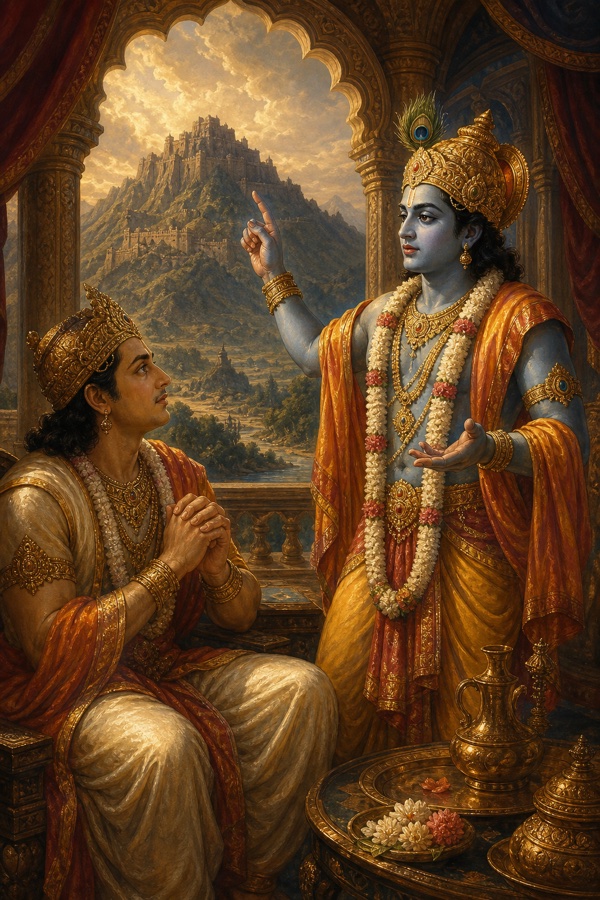
Krishna continued through Jarasandha’s supporters. “There is also that wicked man among the Chedis whom I did not kill earlier. He presents himself as a divine being and has become known as one. In his folly, he continually wears the emblems that distinguish me. He rules Vanga, Pundra, and the Kiratas, and is known as Paundraka and Vasudeva. He too has joined Jarasandha. Bhishmaka, the powerful Bhoja king and friend of Indra, rules a quarter of the world. Through his learning he conquered the Pandyas and the Kratha-Kaushikas; his brave brother Akriti was like Rama, the son of Jamadagni. Yet Bhishmaka has become the servant of the king of Magadha. We are his relatives and work every day to please him. We honor him greatly, while he disregards us and works against us. Without recognizing his own strength or the dignity of his lineage, he has taken shelter with Jarasandha, impressed by the blaze of his reputation. Fear of Jarasandha has driven all 18 Bhoja clans westward. The Shurasenas, Bhadrakaras, Bodhas, Shalyas, Pataccharas, Susthalas, Mukuttas, and Kulindas have also fled with the Kuntis. The kings of the Shalvayana people have gone with their brothers and followers into Kunti territory, as have the southern Panchalas and eastern Kosalas. The Matsyas and Sannyastapadas abandoned their northern lands in fear and fled south. All the Panchalas, alarmed by Jarasandha’s power, left their kingdom and scattered in different directions.” Jarasandha’s strength extended through commanders, dependent rulers, and marriage alliances. Entire peoples had moved away from their own territories before it. Krishna’s account carried the danger across the countries surrounding the Pandavas’ kingdom and into the history of his own people.
Krishna then told Yudhishthira how that pressure had fallen on his own family. “Some time ago, after persecuting the Yadavas, Kamsa married 2 of Jarasandha’s daughters. Their names were Asti and Prapti, and they were the sisters of Sahadeva, the prince of Magadha. Strengthened by this marriage alliance, Kamsa oppressed his relatives and gained ascendancy over them all, earning widespread condemnation. He began persecuting the elderly Bhoja kings as well, and they asked us to protect them from their own kinsman. I arranged the marriage of Ahuka’s beautiful daughter to Akrura. Then, with Sankarshana beside me, I helped my relatives: with Rama’s assistance, Kamsa and Sunaman were killed. The immediate danger ended with Kamsa’s death. His father-in-law Jarasandha then took up arms. We of the 18 younger branches of the Yadavas considered our position. Even if we kept striking with excellent weapons capable of killing our enemies, we concluded that we could accomplish nothing against him in 300 years. He had 2 friends, Hansa and Dimvaka, whose strength approached that of the immortals. Weapons could not kill either of them. United with those 2, Jarasandha seemed to me beyond the power of even the 3 worlds to defeat. The other kings shared that judgment. There was another king named Hansa. After a battle lasting 18 days, Rama, also called Baladeva, killed him. When Dimvaka heard people say that Hansa had been killed, he decided that he could not live without his companion. He threw himself into the Yamuna and died. Then the Hansa who had been Jarasandha’s ally heard that Dimvaka had killed himself. He too went to the Yamuna and leaped into its waters. When Jarasandha learned that both friends were dead, he returned to his kingdom, dispirited. We were happy to remain in Mathura. But Jarasandha’s daughter, the beautiful, lotus-eyed widow of Kamsa, was grieving for her husband. She went to her father and repeatedly urged him, ‘Kill the man who killed my husband.’ We remembered our earlier judgment of Jarasandha’s strength. Deeply discouraged, we left Mathura. We divided our considerable wealth into smaller portions that could be carried easily, and fled with our cousins and relatives. Having considered everything, we chose the west.”
In the west stood the pleasant city of Kushasthali, adorned by the mountains of Raivata. The Yadavas settled there and rebuilt its fort until, in Krishna’s description, even the gods could not penetrate it. From within those defenses, he said, even women could fight the enemy; the Yadava warriors were fully secure. They now lived in the city without fear. Looking at the inaccessible mountain and believing themselves beyond Jarasandha’s reach, the descendants of Madhu had become deeply happy. “We had strength and power, yet his oppression forced us to take shelter in the mountains of Gomanta, which extend for 3 yojanas,” Krishna said. “Within every yojana are 21 posts of armed men. At each yojana’s interval stand 100 gateways with arches, defended by courageous warriors. Innumerable Kshatriyas from the 18 younger branches of the Yadavas, invincible in war, guard those works. Our family contains 18,000 brothers and cousins. Ahuka has 100 sons, each almost the equal of a god in prowess. Charudeshna and his brother Chakradeva, Satyaki, myself, Rohini’s son Baladeva, my son Samba who matches me in battle, and Pradyumna are the 7 atirathas, foremost masters of fighting from a chariot. There are other great fighters whose names I will give you: Kritavarman, Anadhrishti, Shamika, Samitinjaya, Kanka, Shanku, and Kunti. Those 7 are maharathas, great chariot warriors. There are also the 2 sons of Andhakabhoja and the old king himself. All possess great energy and the force of a thunderbolt. These warriors, who chose the middle country, now live among the Vrishnis.” The number of warriors, the ranks of the commanders, and the strength of the new defenses made clear the resources Krishna’s family possessed. These were the same Yadavas who had divided their wealth into portable loads and taken the road west, after judging that continued battle at Mathura could bring them no success.
He returned to the decision before Yudhishthira. “You deserve to be emperor. Establish your sovereignty over all the Kshatriyas. My judgment is that you cannot perform the Rajasuya while the mighty Jarasandha lives. He has imprisoned many monarchs in his mountain stronghold, as a lion stores the bodies of great elephants in a mountain cave. Desiring to sacrifice 100 kings, he practiced fierce austerities in worship of the lord of Uma, the god of gods. Through that power he defeated the kings of the earth and gained the means to fulfill his sacrificial vow. By repeatedly defeating kings with their troops and bringing them into his city as prisoners, he has greatly increased the numbers gathered there. We too had to leave Mathura and flee to Dwarka because of him. If you wish to undertake the Rajasuya, work to free the kings he holds and bring about his death. Your undertaking cannot be completed while that obstacle remains. I advise this course as the necessary preparation for your sacrifice. You should act according to your own judgment. Consider the circumstances fully, examine their causes, and tell us what you believe should be done.” Krishna had affirmed Yudhishthira’s fitness for imperial rule. He had also placed before him the campaign that would have to precede the sacrifice and the captive rulers whose freedom depended on Jarasandha’s defeat.
A key to reading this (shared names): Asti and Prapti’s brother Sahadeva belongs to the royal family of Magadha; he is a different person from the Pandava. Krishna’s account also distinguishes 2 men named Hansa. Baladeva killed one, and the other died in the Yamuna after hearing of Dimvaka’s death. Rama and Sankarshana here are names for Krishna’s brother Balarama. The earlier reference to Rama, son of Jamadagni, concerns Parashurama.
The gist: Jarasandha commanded powerful allies and had driven entire peoples from their lands. Krishna described the Yadavas’ own flight from Mathura and the strong defenses of their new home. Before Yudhishthira could perform the Rajasuya, he would have to defeat Jarasandha and free the kings imprisoned for sacrifice.
The wish for peace, and the kings awaiting sacrifice
Yudhishthira had asked for judgment free of personal interest, and Krishna had answered with the obstacle that his wish for empire would have to overcome. He now told Krishna that no one else could have spoken with such insight or settled his doubts so completely. Kings in every province pursued their own interests, yet none had attained the difficult title of emperor. “Someone who understands the strength and courage of others does not praise himself,” he said. “The person deserving honor is the one who conducts himself well when he meets his enemies. Human desires are as extensive and varied as this wide earth with all its jewels. Experience is hard to gain without traveling far from home. In the same way, liberation requires conduct guided by principles higher than the ordinary range of our desires. I place peace of mind above everything here. My well-being can grow from it. If I undertake this sacrifice, I fear that I will lose the highest reward. Those born in our family hope that one of us will eventually become foremost among the Kshatriyas. Yet we too have been frightened by Jarasandha and his cruelty. I depend on the strength of your arms. If even you feared his power, how can I consider myself stronger than he is? I keep wondering whether you, Rama, Bhima, or Arjuna could kill him, and the thought weighs on me. What more can I say, Krishna? In everything, I regard you as my highest authority.” Bhima answered by setting their abilities beside one another: the counsel Krishna could give, the force of his own body, and Arjuna’s power to win. He spoke of how even a weaker ruler could defeat a stronger enemy through vigilance and strategy. “A king who makes no effort perishes like an anthill, and so does a weak king without resources who takes on a powerful enemy. But vigilance and sound strategy can enable a weak ruler to defeat a strong one and accomplish his wishes. Krishna has strategy. I have strength. Arjuna has victory. The 3 of us will bring about the death of the king of Magadha, just as the 3 sacrificial fires bring a sacrifice to completion.”
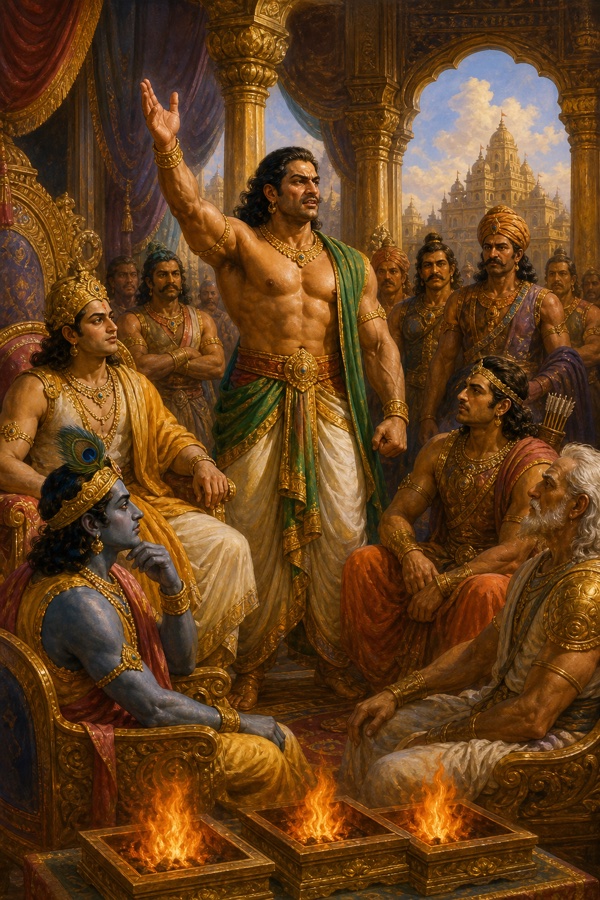
Krishna took up the question of what made an emperor. “An immature person pursues what he wants without considering what may happen afterward. An enemy who acts selfishly and without judgment earns no forgiveness merely because he lacks understanding. We have heard of 5 rulers in the Krita age who brought everyone under their authority and became emperors. Yauvanashvin did so by abolishing every tax; Bhagiratha by treating his subjects kindly; Kartavirya through the power of his austerities; Bharata through strength and courage; and Marutta through prosperity. You possess the full range of qualities: victory, protection of your people, virtue, prosperity, and strategy. Together they make you fit for the imperial position you seek. Jarasandha, the son of Brihadratha, is also a contender for it. A hundred royal dynasties have become unable to resist him, so his strength can give him the standing of an emperor. Kings who wear jewels honor him with gifts of jewels. He has been cruel from childhood and finds little satisfaction in such homage. Even after rising above them all, he continues to attack crowned rulers by force. There seems to be no king from whom he does not exact tribute. He has brought nearly 100 under his sway. How could any weak king approach him as an enemy? Those monarchs are confined in Shiva’s temple, dedicated for sacrifice like animals. Think of their suffering. A Kshatriya who dies in battle is always respected. Why should we not join together and face Jarasandha? He has already brought in 86 kings. He needs only 14 more to complete the hundred. Once he has them, he will begin his cruel act. Whoever stops him will gain great renown. Whoever defeats him will become emperor over all the Kshatriyas.”
Yudhishthira answered the proposal to send Krishna and his brothers against Jarasandha. He called Bhima and Arjuna his eyes, and Krishna his mind. His desire for the imperial title had brought him to a decision that could cost him the men on whom he depended. “How can I send you to Jarasandha out of a selfish desire to become emperor, trusting in courage alone?” he asked Krishna. “Bhima and Arjuna are my 2 eyes. You are my mind. How could I live deprived of my eyes and mind? Even Yama could not defeat Jarasandha’s vast and terribly courageous army. What could your courage accomplish against it? This undertaking could end badly and bring great harm. I think we should leave it alone. To withdraw seems the beneficial course. My heart is troubled today; the Rajasuya seems too difficult to accomplish.” Arjuna then spoke. He had received the great bow, the 2 inexhaustible quivers, the chariot with its banner, and the assembly hall. His argument began with the resources already in their hands. “I have gained a bow, weapons, arrows, power, allies, territory, fame, and strength,” he said. “These are difficult things to obtain, however much one wants them. Respected scholars praise noble ancestry when they gather together. Yet nothing equals strength, and nothing pleases me more than courage. Someone born into a family famous for valor earns little respect if he has none himself. A courageous person from a family without such a reputation is superior to him. The man who increases his fame and possessions by defeating his enemies fulfills the duties of a Kshatriya.”
Arjuna continued, “Courage can win against enemies even when other merits are absent. All the other merits accomplish little in someone who lacks it. With courage, every other quality exists in its beginning. Victory has 3 causes: focused attention, effort, and destiny. Yet a brave person who acts carelessly still does not deserve success. That is why powerful enemies sometimes die at their opponents’ hands. Weakness can lead to a diminished spirit, and strength can be overtaken by folly. A king seeking victory must guard against both sources of destruction. To kill Jarasandha for the sake of our sacrifice and rescue the kings he holds for a cruel purpose would be the highest work we could undertake. If we refuse the task, the world will always think us incapable. We have the ability. Why should you judge us as if we did not? Those who become sages seeking peace of soul readily obtain their yellow robes. Once we conquer this enemy, the imperial position will come to us just as readily. We will fight him.” Arjuna had named all 3 causes of victory, including destiny. His confidence in their strength went with the demand for attention and effort; his warning about the death of careless warriors applied even to men who were powerful. He pressed for the attempt with the captive kings’ freedom joined to the purpose of their sacrifice.
Krishna approved Arjuna’s resolve as fitting for a man of the Bharata line, especially a son of Kunti. “We do not know whether death will come to us in the night or the day,” he said. “Nor have we heard of anyone becoming immortal by avoiding combat. Our duty is to face enemies according to the prescribed principles, and that brings satisfaction to the heart. An undertaking supported by good strategy succeeds unless destiny obstructs it. When both sides use such means, one must gain ascendancy over the other; both cannot win, and both cannot lose. Bad strategy, lacking the established skills of warfare, ends in defeat or destruction. If the two sides are evenly matched, the outcome is uncertain, though they still cannot both win. Why should we not use sound strategy to reach the enemy himself and destroy him, as a river’s current uproots a tree? We can conceal our own weaknesses and strike through an opening in his defenses. Why should that fail? Intelligent policy advises against open battle with a vastly powerful enemy at the head of a well-ordered army. I agree with that judgment. We will earn no disgrace if we secretly enter his residence and accomplish our purpose by attacking him in person. Jarasandha alone enjoys undiminished glory, like the self dwelling in the heart of every creature. Yet I see his destruction before me. To protect our relatives, we will either kill him in battle or reach heaven after he kills us.” The course Krishna proposed would bring them directly to Jarasandha. Yudhishthira had pictured an encounter with the entire army; Krishna had now explained how strategy could determine the encounter they sought.
The gist: Yudhishthira feared losing the brothers he called his eyes and Krishna, whom he called his mind. Bhima and Arjuna argued that their combined abilities could free the captive kings. Jarasandha held 86 and needed 14 more for his sacrifice. Krishna proposed entering his residence secretly and confronting him in person, avoiding a battle against his assembled army.
Two unfinished births, and Jara’s gift
Yudhishthira wanted to understand the man whose defeat Krishna now proposed. “Who is Jarasandha?” he asked. “What power and courage does he possess? How has he come into conflict with you and survived, when an insect touching fire is burned?” Krishna answered with the story of his birth. He would explain Jarasandha’s strength and why they had spared him despite his repeated offenses. Brihadratha, the mighty king of Magadha, had commanded 3 akshauhinis, great army formations of chariots, elephants, cavalry, and infantry. Proud in battle, handsome, radiant, and immensely rich and powerful, he bore the marks of initiation into sacrifice and seemed like a second Indra. His glory was compared to the sun, his forgiveness to the earth, his anger to Yama’s, and his wealth to Kubera’s. Qualities inherited from a long line of ancestors extended across the earth like sunlight. He married the 2 twin daughters of the king of Kashi, both exceptionally beautiful. In private, he promised to love them equally and never prefer one over the other. The 2 queens suited him well, and he cherished them. With them he lived as happily as a great elephant with 2 female companions, or the embodied ocean between the embodied Ganga and Yamuna. Yet his youth passed in the enjoyment of his possessions, and no son was born to continue his line. Auspicious ceremonies, offerings into the sacred fire, and sacrifices undertaken for a child all failed to give him an heir. Then he learned that Chandakaushika, son of Kakshivat from the distinguished Gautama lineage, had paused in his austerities and come to the capital during his travels. The sage was sitting in the shade of a mango tree. Brihadratha went to him with both queens and honored him with jewels and costly gifts. Pleased by their worship, the sage, whose speech was always bound to truth, invited the king to ask for a boon. Brihadratha bowed with his wives. His voice caught with tears as he spoke of the hope he had lost. “I am about to leave my kingdom and practice austerities in the forest. I have no son, and I consider myself deeply unfortunate. What use have I for a kingdom, or even a boon?”
Chandakaushika gathered his senses under control and entered meditation beneath the same tree. A juicy mango fell into his lap. No parrot or other bird had touched it with its beak. The sage picked up the fruit and silently pronounced sacred mantras over it. He gave it to Brihadratha as the means of obtaining an incomparable child. “Return home,” he told the king. “Your wish has been fulfilled. Give up the plan to enter the forest.” Brihadratha worshiped the sage’s feet and went back to his palace. There he remembered the promise made to his wives. Both were to receive the same love; he gave the single fruit to them both. The queens divided it into 2 portions and ate them. Through the certainty and truth of the sage’s words, both women conceived, and the king was overjoyed to see them pregnant. When their time came, however, each gave birth to half a body. Each fragment had one eye, one arm, one leg, half a stomach, half a face, and half an anus. Both mothers trembled at what they saw. The sisters, helpless and distressed, consulted one another and sorrowfully abandoned the living fragments. Their 2 midwives carefully wrapped the bodies, carried them out through the back door of the women’s quarters, discarded them, and hurried back. The 2 living halves had passed through the palace’s back door, wrapped by the women who had attended the births.
A little later, a Rakshasa woman named Jara found the fragments at a crossroads. She lived on flesh and blood. Impelled by fate, she picked up the 2 halves and fitted them together so that they would be easier to carry away. The moment they joined, they became one sturdy, living child. Jara’s eyes widened. The baby’s body was so hard and powerful, like a thunderbolt, that she found herself unable to carry it away. The infant closed his copper-red fists, pushed them into his mouth, and gave a tremendous cry like the roar of rain-filled clouds. Alarmed by the sound, the people of the palace rushed out with the king. The disappointed, grieving queens also came at once to recover their child, their breasts full of milk. Jara saw the mothers’ condition, the king’s longing for a son, and the extraordinary strength of the infant. “I live in this king’s domain,” she thought. “He wants a child so much. I should not kill the baby of such a renowned and virtuous ruler.” She assumed a human form and held the child in her arms, like clouds surrounding the sun. “Brihadratha, this is your son,” she said. “I give him to you. Take him. Through the great Brahmin’s blessing, he was born of both your wives. The midwives threw him away, and I protected him.” The beautiful daughters of the king of Kashi received the baby and soon drenched him with streams of their milk. When Brihadratha learned what had happened, joy filled him. He turned to the Rakshasa woman, who stood before him in human form with a golden complexion. “Who are you, with your color like the filaments of a lotus, who gives me this child? You seem to be a goddess traveling wherever you please.”
Jara blessed the king and explained who she was. The Rakshasa woman who had brought back his child was already honored within his own home, in the painted image his household worshiped each day. “I am a Rakshasa woman named Jara, able to take any form I wish. I live happily in your house, where everyone worships me. Each day I move from one human home to another. Long ago, the Self-created made me and named me Grihadevi, the goddess of the household. I was given celestial beauty and placed in the world to destroy the Danavas. A household prospers when its people devotedly paint my likeness on its walls as a young woman surrounded by children. Otherwise, a home falls into decline and destruction. On the walls of your own house is an image of me among many children. There I receive daily worship with fragrances, flowers, incense, food, and other offerings for my enjoyment. Because you honor me in your home, I think every day of some good I might do for you in return. I happened to find the pieces of your son’s body. When I joined them, they became a living child. Your good fortune made this possible; I served as the instrument. I could swallow Mount Meru itself, so a baby would be easy to consume. But the worship I receive in your house has pleased me, and that is why I have given him to you.” After speaking, Jara disappeared on the spot. Brihadratha entered the palace with his son and arranged all the rites performed for an infant. He also ordered his people to celebrate a festival honoring the Rakshasa woman. When he named the child, he preserved the act that had made the baby whole: Jara had joined him, so he would be called Jarasandha. The prince of Magadha grew in size and strength like a fire fed with offerings of clarified butter. Day after day he increased like the waxing moon, bringing ever greater joy to his parents.
The gist: Brihadratha shared the sage Chandakaushika’s fruit equally between his wives. Each gave birth to half a child. Jara joined the abandoned, living halves, and a powerful infant took shape. In gratitude, the king honored her and named his son Jarasandha, the child joined by Jara.
The sage’s prediction, and the road to Magadha
Some time after Jarasandha’s birth, Chandakaushika returned to Magadha. Krishna described Brihadratha’s delighted reception of the sage. The king went out with his ministers, priest, wives, and son, offered water for washing his feet and face, and presented the ceremonial arghya. Then he offered the sage his entire kingdom together with the child. Chandakaushika accepted the honors with pleasure. “I already knew what had happened through spiritual insight,” he said. “Now hear what your son will become: his appearance, his excellence, his strength, and his courage. As his prosperity and power increase, he will certainly attain all these qualities. Other birds cannot match the speed of Garuda, Vinata’s son. In the same way, no other king will equal your son’s energy. Those who stand in his path will be destroyed. A current of water makes no impression on the rocky breast of a mountain; even weapons hurled by the gods will strike him without causing pain, as water strikes rock and leaves it unharmed. He will shine above every crowned ruler. As the sun dims the other lights of heaven, he will take away the splendor of other kings. Rulers powerful in armies, with countless vehicles and animals, will perish on approaching him as insects perish in fire. He will gather the increasing prosperity of all the kings as the ocean receives rivers swollen by the rains. Like the great earth, which bears every kind of produce and supports good things and bad, he will sustain all 4 orders of human society. All kings will live under his commands as embodied creatures depend upon the air they hold as dear as their own lives. This prince of Magadha, the mightiest man in the world, will see with his own eyes the god of gods, Rudra, also called Hara, the destroyer of Tripura.” The sage then dismissed Brihadratha so that he could attend to his own concerns. Back in his capital, the king assembled his friends and relatives and installed Jarasandha on the throne. A deep distaste for worldly pleasures came over him. After the installation, he retired with both wives to an ascetic retreat in the forest. Jarasandha, whose parents had now left royal life, used his strength to bring many kings under his authority.
Vaishampayana told Janamejaya that Brihadratha practiced austerities in the forest for a time and eventually ascended to heaven with his wives. Jarasandha received the blessings Kaushika had foretold and governed his kingdom with a father’s care. Later, when Krishna killed Kamsa, hostility arose between Krishna and the Magadha king. Krishna was then living in Mathura. From his own city of Girivraja, Jarasandha swung a mace 99 times and hurled it toward Mathura. It fell near that city, 99 yojanas from Girivraja. The citizens who witnessed its fall went to Krishna and reported what they had seen. The place beside Mathura where it landed was called Gadavasana. Jarasandha’s allies Hansa and Dimvaka, whose deaths had already been recounted, had been immune to death by weapons. They also understood statecraft and moral duty and ranked foremost among wise counselors. Together with Jarasandha, they had been considered more than a match for the 3 worlds. That was why the powerful Kukkura, Andhaka, and Vrishni clans had made a strategic decision to avoid war with him. The strength of that alliance had governed the Yadavas’ earlier decision. Krishna now returned from Jarasandha’s history to the present, when both allies were dead, and explained the opportunity their deaths had created. “Hansa and Dimvaka have fallen, and Kamsa has been killed with all his followers. The time has come to destroy Jarasandha. Even the gods and Asuras together could not defeat him in battle. I believe he should be overcome in a personal contest with bare arms. I have strategy, Bhima has strength, and Arjuna brings victory and will protect us both. Like the 3 fires that complete a sacrifice, we will bring about the death of Magadha’s ruler as preparation for the Rajasuya. When we approach him secretly, he will certainly fight one of us. His fear of disgrace, his desire for gain, and his pride in his strength will make him challenge Bhima. The contest will bring Bhima’s strength directly against his. Then Bhima will destroy him as death takes even a man swollen with pride. If you understand my heart and trust me, entrust Bhima and Arjuna to me now.”
Yudhishthira looked at Bhima and Arjuna standing there with cheerful faces. “Do not speak as though you need to ask that, Achyuta,” he replied. “You are the lord of the Pandavas. We depend upon you. What you say agrees with sound counsel. You never lead those whom prosperity has abandoned. Under your command, I already regard Jarasandha as dead, his prisoners as free, and my Rajasuya as complete. Act watchfully so that this undertaking succeeds. Without the 3 of you, I could not bear to live, any more than a grieving, sick man deprived of dharma, pleasure, and wealth. Arjuna cannot live without Krishna, and Krishna cannot live without Arjuna. Nothing in the world is beyond the power of those 2 to conquer. Bhima stands foremost among men of strength. With his great renown and the 2 of you beside him, what could he fail to accomplish? Properly led troops do excellent service. The wise call a force without a leader inert, so experienced commanders must always guide it. Wise people direct water toward low ground; fishermen also drain a pond through openings. In that way, a commander must find the openings and vulnerable points of an enemy. We will work toward our purpose under Govinda, whose knowledge of statecraft and reputation extend throughout the world. A person seeking success should put Krishna in the lead. Wisdom and strategy are his strength, and he understands both the method and the means. Let Arjuna follow him, and let Bhima follow Arjuna. Strategy, good fortune, and strength will bring success to a task requiring courage.” Yudhishthira had feared sending away the men he called his eyes and mind. Now, seeing his brothers ready and accepting Krishna’s plan, he entrusted all 3 to the undertaking, asking for the care that would bring them success.
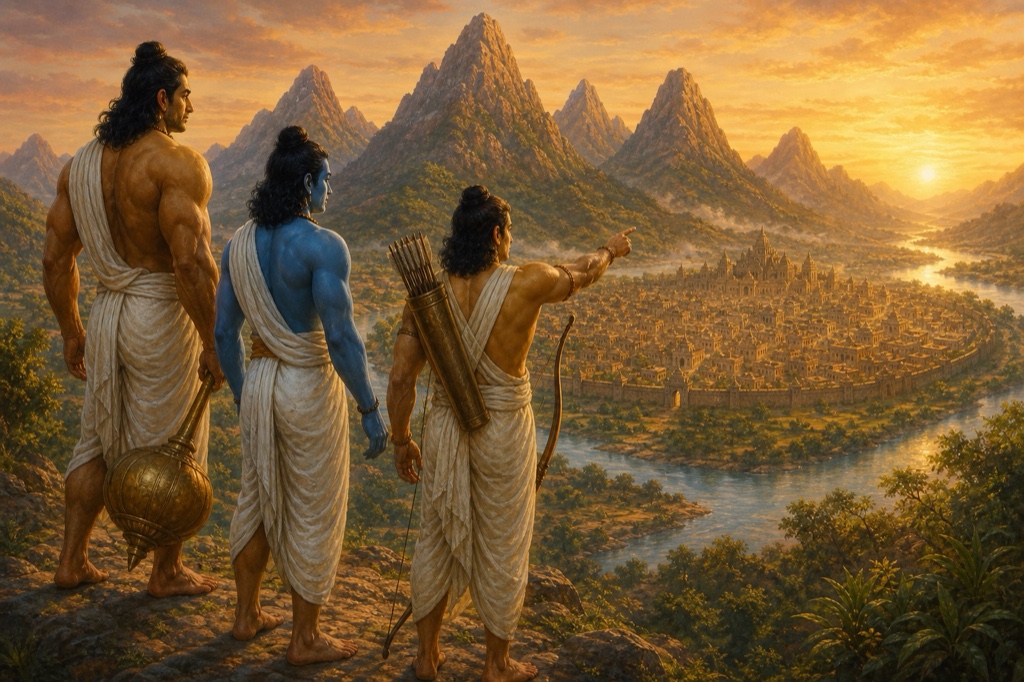
Krishna, Arjuna, and Bhima set out for Magadha dressed as snataka Brahmins, men who had completed their period of study and kept the observances belonging to that stage of life. Friends and relatives blessed them with auspicious words. Their bodies already shone with the brilliance of sun, moon, and fire; anger at the suffering of the captive kings, their royal relatives, made their appearance more radiant still. The people saw the undefeated pair, Krishna and Arjuna, setting out with Bhima at the front, all intent on the same task. They regarded Jarasandha as already slain. Krishna and Arjuna were described as masters directing the operations of the world and the acts through which beings pursued dharma, wealth, and pleasure. The 3 travelers left Kuru country, passed through Kuru-jangala, and reached a beautiful lake of lotuses. They crossed the hills of Kalakuta, then the Gandaki, the Sadanira also identified as the Karatoya, the Sharkaravarta, and other rivers rising in the same mountains. Beyond the lovely Sarayu lay eastern Kosala. They passed through that country to Mithila, crossed the Mala and Charmanvati, and then crossed the Ganga and the Sone as they continued east. At last they reached Magadha in the heart of Kushamba country. From the hills of Goratha they saw the city ahead of them, rich in cattle and wealth, with an unfailing supply of water and innumerable trees adding to its beauty. The journey had brought them within sight of the capital where they intended to confront its king.
The gist: Chandakaushika had foretold Jarasandha’s extraordinary power and supremacy over other kings. Krishna now judged that the death of his principal allies created an opportunity for a wrestling challenge. Yudhishthira entrusted the mission to Krishna, Bhima, and Arjuna, who traveled in the dress of snatakas to Magadha.
Into Girivraja, and the questions at midnight
From the hills, Krishna pointed out Magadha’s capital to Arjuna. Girivraja stood in its full beauty, rich in flocks and herds, supplied with water that never ran out. Fine mansions rose in well-ordered rows. The city was free of calamity, guarded by 5 great hills: Vaihara, Varaha, Vrishabha, Rishigiri, and the lovely Chaitya. Their high peaks were connected, and tall trees covered them with cool shade. Krishna described the hills as protectors acting together around the city. Fragrant lodhra forests concealed their slopes, the ends of the branches filled with flowers. “This is where Gautama, the sage of strict vows, fathered Kakshivat and other renowned sons with Aushinari, the daughter of Ushinara, a woman of the Shudra order,” he said. “The fact that Gautama’s descendants still live under an ordinary human line of kings shows his kindness toward rulers. Long ago, the powerful kings of Anga, Vanga, and other countries came to his retreat and spent their days there in happiness. Look at the beautiful pipal and lodhra woods beside his dwelling. The Nagas Arbuda and Shakravapin, fierce toward their enemies, once lived here, as did Svastika and the excellent Naga Manu. Manu himself decreed that Magadha should never suffer drought. Kaushika and Manimat have also favored this country. With such a delightful, impregnable city, Jarasandha is more intent than other kings on fulfilling his purposes. Today we will kill him and bring down his pride.”
Krishna and the 2 Pandavas approached Girivraja, where people of all 4 social orders were cheerful and well fed, and festivals were a constant part of life. At the gate, they turned toward the high Chaityaka peak. The family of Brihadratha and the citizens worshiped it, and all Magadha delighted in it. Perfumes and flower garlands were offered to this height, which stood beside the visitors’ route into Jarasandha’s capital. The 3 began piercing its heart with their arrows. There Brihadratha had once killed a man-eating creature named Rishabha and made 3 drums from its hide. He had placed them in his city, and a single beating kept their sound going for an entire month. At the place where those drums, covered with celestial flowers, gave their continuous sound, the visitors broke down the peak. Their act seemed to plant a foot on the head of the enemy they had come to kill. With their powerful arms, they attacked and shattered the huge, ancient height, long honored with perfumes and garlands, then entered the city gladly. Meanwhile, the learned Brahmins within Girivraja had seen many ominous signs and reported them to Jarasandha. His priest seated him on an elephant and circled him with burning torches. To avert the threatened evils, the king began a sacrifice, observing the appropriate vows and fasts. While these protective rites were being undertaken, the 3 men who had come to confront him were making their way through the capital.
They wore the appearance of Brahmins and had their bare arms as their only weapons. Along the public road, Krishna, Bhima, and Arjuna saw shops filled with foods, flower garlands, and all the different kinds and qualities of goods people might desire. The richness of the displays was extraordinary. They forcibly took garlands that the flower sellers had set out for sale. Dressed in robes of different colors, wearing the flowers and earrings, they entered Jarasandha’s residence like Himalayan lions looking toward cattle enclosures. Sandal paste covered their arms, which resembled the trunks of sala trees. The people of Magadha stared in wonder at these men with elephantlike strength, broad chests, and thick necks like tree trunks. The visitors passed through 3 gates crowded with people and approached the king proudly and cheerfully. Jarasandha rose at once to welcome them. He offered water for washing their feet, honey and the other ingredients of the ceremonial arghya, gifts of cattle, and the customary marks of respect. “You are welcome,” he said. Bhima and Arjuna gave no answer. Krishna explained their silence. “These 2 are observing a vow. They will remain silent until midnight. After that, they will speak with you.” Jarasandha lodged the guests in the sacrificial apartments and withdrew to his own rooms. He accepted the stated observance and left their conversation for the appointed hour.
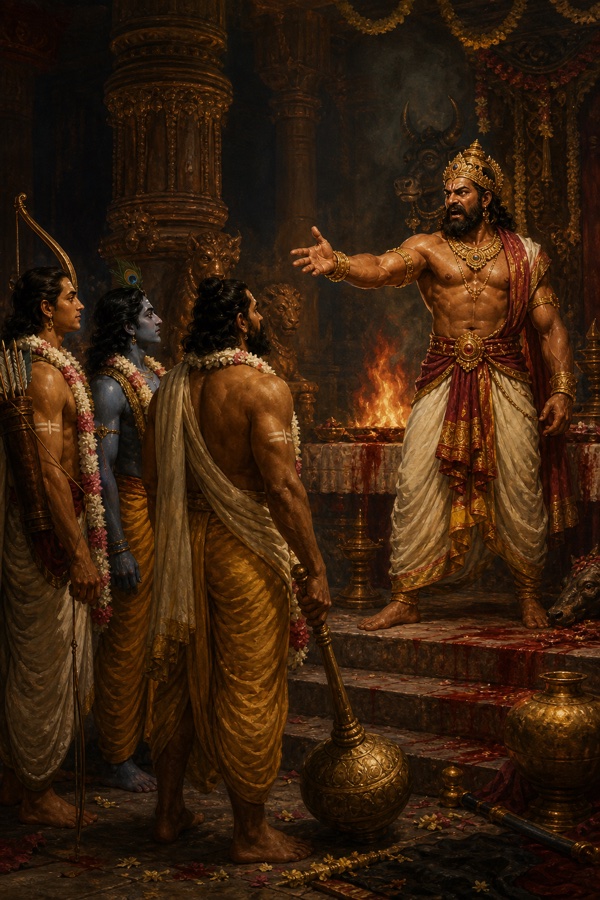
At midnight, the king returned to the sacrificial rooms where he had lodged them. The hour Krishna had named did not prevent an audience. His own vow was known throughout the world: whenever he heard that snataka Brahmins had arrived, he would immediately receive them, even in the middle of the night. The visitors’ unusual appearance astonished him, but he continued to treat them respectfully. They greeted him with a wish that he might attain deliverance without difficulty, then stood looking at one another. Jarasandha asked them to sit. Seated together, the 3 shone like the 3 fires of a great sacrifice. The king, firm in his commitment to truth, challenged their assumed identity. “I know that Brahmins observing the snataka vow do not wear garlands and fragrant pastes at improper times. Who are you, dressed in flowers, with the marks of bowstrings on your hands? Your colored robes, garlands, and perfumes are out of season. You present yourselves as Brahmins, yet you carry the energy of Kshatriyas. Tell me the truth. Truth gives dignity even to kings. Why did you break down Chaityaka and enter the city in disguise by an improper entrance, with no fear of the king’s anger? A Brahmin’s power resides in his speech. What you have done does not fit the order you claim. Tell me what you intend. Why come by such a route and refuse the honors I offer? What brought you to me?” Krishna answered in a calm, serious voice. “Know us as snataka Brahmins. Brahmins, Kshatriyas, and Vaishyas can all undertake the snataka observance. It has both general and particular rules. A Kshatriya who follows its special rules gains prosperity. Those who wear flowers also gain prosperity, which is why we have adorned ourselves with them. Kshatriyas display their power through their arms, and their speech is free of boasting. The creator has placed his own energy in a Kshatriya’s arms. If you wish to see it, you will see it today. The prescribed rule is to enter an enemy’s dwelling through an improper entrance and a friend’s through the proper one. We also keep an enduring vow: when we enter an enemy’s residence to accomplish our purpose, we refuse the honors he offers.” The water, honey, cattle, and other honors of the king’s welcome remained refused. Krishna had answered the question about that refusal by stating the rule he followed upon entering an enemy’s house.
The gist: Krishna, Bhima, and Arjuna broke the revered Chaityaka peak and entered Girivraja in the dress of Brahmins. At midnight, Jarasandha challenged their appearance, their warrior’s marks, and their refusal of his hospitality. Krishna told him that they had entered an enemy’s dwelling to accomplish a purpose.
Source: the Mahabharata of Krishna-Dwaipayana Vyasa, Sabha Parva. This chapter follows K. M. Ganguli, sections I-XLVI (1-46); the Gita Press Hindi edition numbers these chapters differently. Names, order, and events were checked against Ganguli’s complete translation. Dialogue and commentary are adapted, not a verbatim translation. About the sources.
Based on: The Mahabharata, Vyasa (Gita Press, Gorakhpur)