On this page
Maya’s gift, and Krishna’s departure
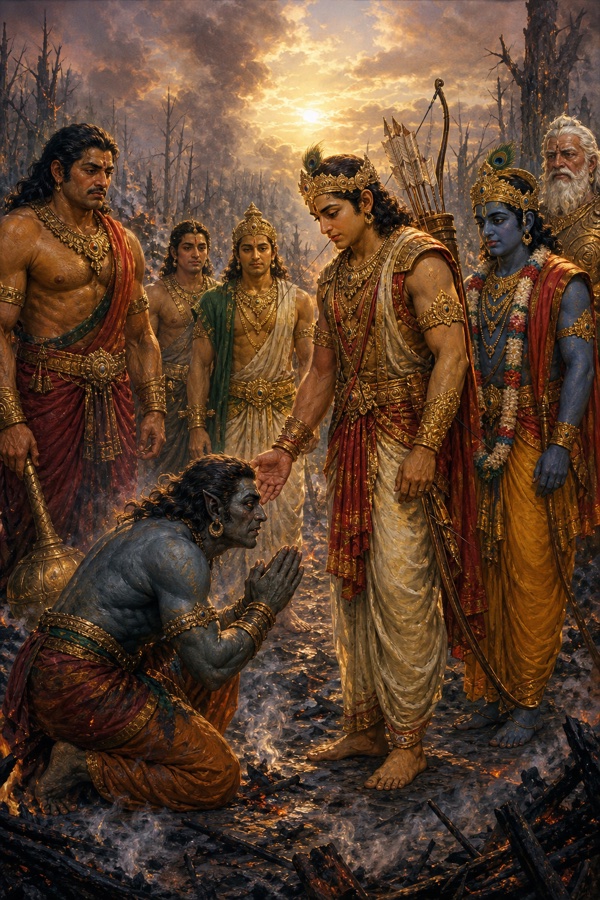
The invocation honored Narayana, Nara, the most exalted of men, and Saraswati, the goddess of learning, before the word Jaya, victory, opened the telling. Vaishampayana continued the story for King Janamejaya. Maya had survived the burning of Khandava, and he came before Arjuna with his hands joined. Krishna was there to hear him. Again and again, the Danava addressed the man who had saved his life, speaking with courtesy and gratitude. “Son of Kunti, you saved me from Krishna in his anger and from the fire that wanted to consume me. Tell me what I can do for you.” Arjuna answered with a generosity that left Maya free to go. “You have already done everything by making this offer. May you prosper. Go wherever you wish. Keep your goodwill toward me, as I am well disposed toward you and pleased with you.” Maya accepted the kindness in those words, yet his wish to repay the debt remained. He had a particular power to offer. “Your answer is worthy of you,” he said. “But I would gladly do something for you. I am a master craftsman, a Vishvakarma among the Danavas, with the creative skill of the gods’ own master builder. With the skill I possess, I want to make something for you.” “You count yourself saved from certain death,” Arjuna said. “Even if that is so, I cannot make you do anything for me. At the same time, I have no wish to frustrate your intention.” He turned Maya toward the man beside them. “Do something for Krishna. That will be sufficient repayment for anything I have done for you.”
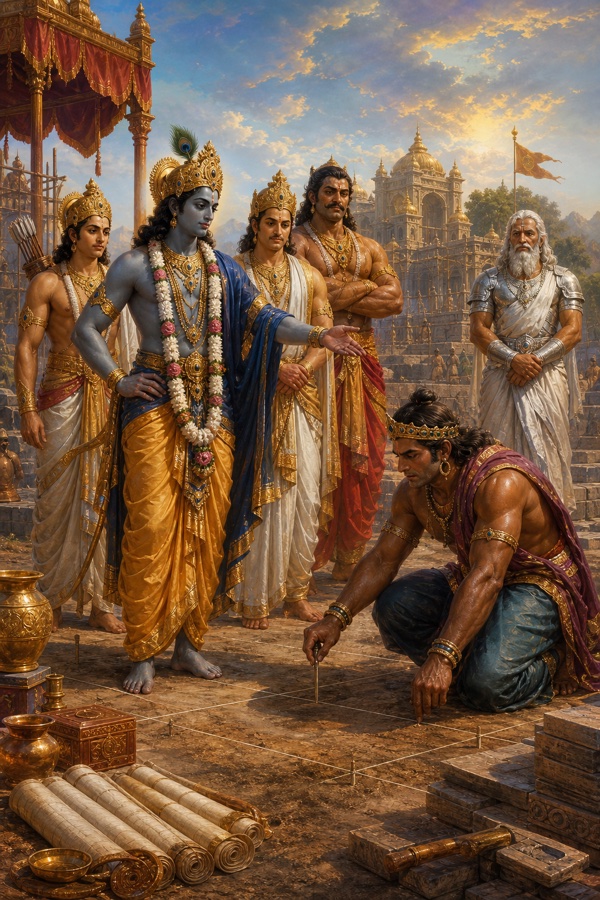
Urged by Maya to name a task, Krishna, the lord and creator of the universe, considered for a moment what he should ask. The gift Arjuna had declined for himself went to his elder brother. “Build a great assembly hall according to your own design, if you wish to benefit the just king,” he told the son of Diti. “You are foremost among craftsmen. Make a building that people of the human world could sit inside and examine carefully, yet still be unable to imitate. Let us see in it the designs of gods, Asuras, and human beings brought together.” Maya was delighted, and the hall he set about building for the son of Pandu would be a match for the palaces of the celestials. Krishna and Arjuna went to Yudhishthira, explained everything that had happened, and introduced the craftsman. The king received Maya with the respect his skill deserved, and Maya valued the honor. He told the sons of Pandu the history of the Danava king Vrishaparva. After resting for a while, he turned to the planning that would precede construction. The wishes of Krishna and the Pandavas governed the undertaking. On an auspicious day, Maya performed the rites that blessed the foundation. Thousands of Brahmins learned in sacred knowledge were fed sweetened milk and rice, and received rich gifts of many kinds. Then he measured the ground. The plot was a square, 5,000 cubits along each side, beautiful to look upon and suitable for a building that would give comfort through every season.
Krishna remained for some time at Khandavaprastha, surrounded by the affection and respect of Kunti’s sons. Eventually he wished to see his father and return to Dwarka. Before leaving, he saluted Yudhishthira and Kunti. Kunti was his father’s sister, and he bowed his head to her feet; she drew him into an embrace and smelled his head in an elder’s gesture of affection. He next approached his own sister, Subhadra, affectionately and with tears in his eyes. His words to her were brief, true, and full of care, so well chosen that she could find nothing to dispute in them. Subhadra bowed to him repeatedly and gave him the messages she wanted carried home to her father’s family. Krishna blessed his beautiful sister and took his leave. He also visited Draupadi and Dhaumya, the Pandavas’ priest, bowing to Dhaumya with the proper reverence and comforting Draupadi before asking her leave to go. Arjuna accompanied him back to the brothers. With all five around him, Krishna shone like Indra surrounded by the gods. Then Krishna, whose banner bore the figure of Garuda, began the rites that precede a journey. He bathed and put on his ornaments. Flowers, sacred words, bowed greetings, and fine perfumes accompanied his worship of the gods and the Brahmins. Leaving the inner rooms for the outer quarters, he presented the Brahmins with vessels filled with curd, fruit, and parched grain, and received their blessings. He gave them wealth as well and walked around them respectfully. His golden chariot waited, built for speed and marked by the figure of Garuda on its banner. A mace, a discus, a sword, the Sharnga bow, and other weapons were carried in it. The horses Shaivya and Sugriva were harnessed, and Krishna mounted at a favorable moment, under an auspicious conjunction of the moon and stars.
Yudhishthira climbed into the chariot after him. His affection for Krishna led him to ask the skilled charioteer Daruka to stand aside while he took the reins himself. Arjuna rode with them, circling Krishna in reverence and attending him with a white yak-tail fan whose handle was gold. Behind the chariot came Bhima, Nakula, and Sahadeva, together with priests and citizens. Krishna, followed by the brothers, resembled a teacher setting out with his favorite pupils. He spoke to Arjuna and held him in a close embrace, honored Yudhishthira and Bhima, and embraced the twins. The three older Pandavas embraced him in return; the two younger brothers bowed to him. They went with him for half a yojana, some two miles. There Krishna gently asked Yudhishthira to follow him no farther, bent down, and took the king’s feet in his hands. Yudhishthira at once raised him, smelled his head, and gave him leave to go with a word of farewell. Krishna fixed the time of his return in words that were proper. Even then, the Pandavas wished to go on beside him on foot, and he had difficulty persuading them to turn back. At last he continued toward his own city, like Indra returning to Amaravati. The brothers watched him for as long as he remained in sight. Their thoughts followed when their eyes could no longer find him. Looking at him had brought no sense of having had enough; even his disappearance left their attention fixed upon Govinda. Reluctantly, they gave up following and hurried home. Krishna’s swift chariot carried him toward Dwarka, with the warrior Satyaki following him. Daruka was again his charioteer, and the son of Devaki reached the city with a speed compared to Garuda’s flight.
Meanwhile Yudhishthira entered his capital with his brothers and friends around him, dismissed his relatives, his brothers, and his sons, and sought happiness in Draupadi’s company. In Dwarka, the leading Yadavas, with Ugrasena among them, welcomed Krishna with honor. He entered the city gladly and went to greet his parents, paying reverence to his elderly father and his renowned mother. He saluted his elder brother Baladeva and, his eyes like lotus petals, took his seat. Pradyumna, Samba, Nishatha, Charudeshna, Gada, Aniruddha, and Bhanu all received his embrace. After obtaining the permission of the elders, he withdrew to Rukmini’s apartments.
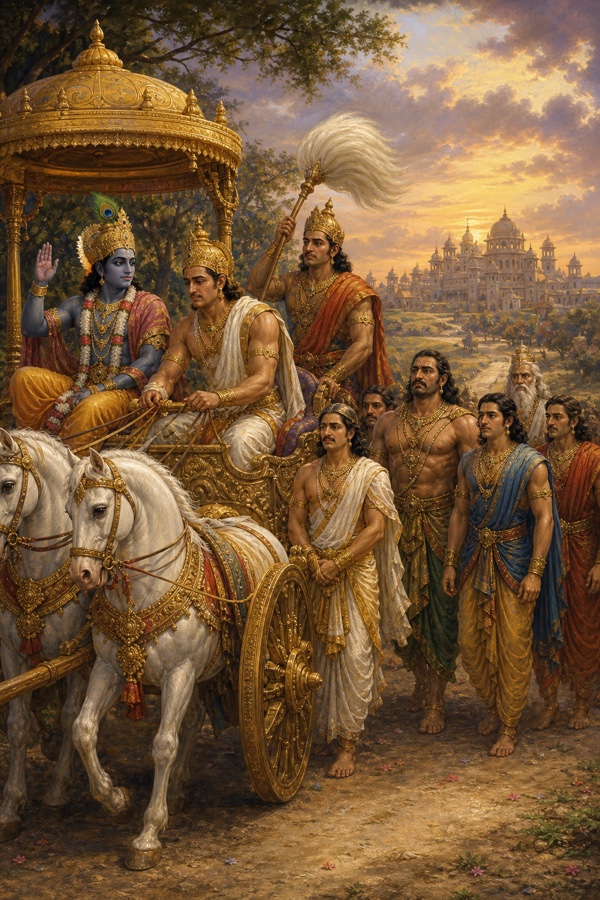
The gist: A Danava with his hands joined in the ashes of Khandava, asking what he can do for the man who spared him. Arjuna passes the gift to Krishna, and Krishna passes it to Yudhishthira as a hall that no human builder could copy. The king receives the Danava with the honor due to his craft and hears from him the history of Vrishaparva. The ground is measured, and Krishna goes home to Dwarka, with Yudhishthira himself holding the reins for the first two miles.
The treasures of Lake Vindu
Maya came to Arjuna for leave. “I go now with your permission, and I will come back soon. North of the Kailasa peak, near the mountains of Mainaka, while the Danavas were performing a sacrifice on the shore of Lake Vindu, I gathered a great store of beautiful materials, jewels and gems of many colors. They were placed in the house of Vrishaparva, who remained devoted to truth. If they are still there, I will bring them back. Then I can build the Pandavas’ delightful hall, adorned with every kind of gem and famous throughout the world. There is also, I think, a fierce mace that the Danava king left in that lake after he had killed all his enemies with it in battle. Heavy, strong, and set with knobs of gold, it can bear great weight and kill any enemy; its force equals that of a hundred thousand maces. It would suit Bhima as well as Gandiva suits you. And there is a large conch there called Devadatta, of tremendous sound, which came from Varuna, lord of the waters. I will certainly bring all these things to you.” With that promise, the craftsman set off toward the northeast.
North of Kailasa, among the Mainaka mountains, stood the huge jewel-covered peak called Hiranyashringa. Lake Vindu lay near it. Its shore had been the dwelling place of King Bhagiratha for many years while he sought the sight of the goddess Ganga, the river that would bear the name Bhagirathi through her association with him. Indra, too, had come to that shore and completed a hundred great sacrifices. Sacrificial posts made of jewels and altars of gold had been set up there for their beauty, although those materials were outside the prescriptions of the ritual, and through those sacrifices Shachi’s husband had attained success. Mahadeva, the eternal lord of living beings, had made his home there after creating the worlds, and thousands of spirits worshiped him with reverence. At the close of a thousand yugas, Nara, Narayana, Brahma, Yama, and Sthanu, the fifth of that company, performed their sacrifices there. Vasudeva had also sacrificed on that ground for long years, devoted to the establishment of righteousness, and thousands upon tens of thousands of sacrificial posts set up by Keshava stood there, adorned with garlands of gold, beside altars of great splendor. Maya reached the lake and recovered the mace, the conch, and the varied objects of crystal that had belonged to Vrishaparva. Yakshas and Rakshasas guarded the great treasure. He took possession of the whole store and carried it back for the Pandavas’ hall.
The building that rose from those gems and precious stones became celebrated throughout the three worlds. Maya fashioned it with a beauty that belonged to the heavens. He gave the mighty mace to Bhima and placed Devadatta in Arjuna’s hands, a conch whose voice made living creatures tremble. Golden columns supported the hall. Across its extent of 5,000 cubits, its magnificent form shone with a radiance compared to fire, the sun, and the moon. Even sunlight seemed diminished beside its brilliance. Celestial light and earthly light mingled over the structure until it looked as though it were burning. From a distance it rose into view like a mass of fresh clouds against the sky. Maya had made it spacious, delightful, and cool, using materials of extraordinary quality. Its walls and archways were golden, and varied pictures enriched it. The richness of the work was matched by the strength and precision of its construction. Its beauty surpassed even Sudharma, the assembly hall of the Dasharhas, and the mansion of Brahma. To protect it stood 8,000 Rakshasas called Kinkaras. They were huge and formidable, with immense strength, copper-red eyes, and ears shaped like arrows. Armed for battle and able to travel through the air, they guarded the hall Maya had made.
Within it lay a pool unlike any other. The lotus leaves were fashioned from dark gems, their stems from bright jewels, while other flowers had golden petals. Water birds of many kinds moved and played across it. Fully opened lotuses spread among fish and turtles with a golden hue. The water was clear enough to reveal a bottom free of mud. A flight of crystal steps descended from the bank to the water’s edge. Soft breezes passed over the surface and stirred the flowers. Slabs of costly marble, set with pearls, covered the banks, completing the array of gems around the pool. The crystal, pearls, and dark jeweled leaves stood around water so transparent that visiting kings could look directly at it and still misunderstand what lay before them. Many took the pool for solid ground and fell into it with their eyes open. Around the building, Maya planted tall trees of different kinds, with green leaves, cool shade, and flowers that remained in bloom. He created ornamental woods that continually released a delightful fragrance. More pools surrounded the mansion, adorned with swans, karandava water birds, and chakravaka ducks. Breezes carried the scent of the lotuses in the water and of the flowers growing on land, adding to the pleasure the Pandavas took in the place. The whole undertaking took fourteen months. When it was complete, Maya went to Yudhishthira and told him that his assembly hall was ready.
The gist: Maya asks leave and goes north for a hoard he hid in another age, to the lake where Bhagiratha waited for Ganga and Indra sacrificed a hundred times. He comes back with a mace for Bhima, a conch for Arjuna, and the gems of a hall that outshines Sudharma and the mansion of Brahma. The mace carries the force of a hundred thousand maces, and the conch came from Varuna.
The company in the new hall
Before Yudhishthira entered his new assembly hall, he fed 10,000 Brahmins. They had come from different countries, and the meal prepared for them was abundant. Milk and rice were enriched with clarified butter and honey; fruits and roots were served, along with pork and venison. There were dishes seasoned with sesame, vegetables called jivanti, rice mixed with ghee, and meat prepared in different ways. Foods that could be sucked and drinks of countless varieties completed the feast. The king presented fresh, unworn clothes and fine flower garlands, and gave each Brahmin 1,000 cows. They cried out as one, “What an auspicious day this is!” and the cry grew so loud that it seemed to reach heaven itself. Yudhishthira worshiped the gods with music of many kinds and with costly perfumes. When he entered the hall, athletes, mimes, prizefighters, bards, and singers of praise displayed their skills for him. He enjoyed the celebration with his brothers like Indra among the gods. The seats in Maya’s building filled with sages and rulers from many lands, gathered beside the sons of Pandu.
Among the sages were Asita, Devala, Satya, Sarpamali, and Mahashira; Arvavasu, Sumitra, Maitreya, Shunaka, Vali, Vaka, Dalvya, and Sthulashira. Krishna Dvaipayana Vyasa was there with Shuka, Sumanta, Jaimini, Paila, and his other disciples, and Vaishampayana, telling this to Janamejaya, counted himself among them. Tittiri and Yajnavalkya attended, as did Lomaharshana with his son, Apsuhomya, Dhaumya, Animandavya, and Kaushika. Damoshnisha, Traivali, Parnada, Varayanuka, Maunjayana, Vayubhaksha, Parasharya, and Sarika were present. So were Valivaka, Shilivaka, Satyapala, Kritashrama, Jatukarna, Shikhavat, Alamba, Parijataka, the exalted Parvata, and the great sage Markandeya. Pavitrapani, Savarna, Bhaluki, Galava, Janghabandhu, Raibhya, Kopavega, and Bhrigu joined them. The roll continued with Haribabhru, Kaundinya, Babhrumali, Sanatana, Kakshivat, Aushija, Nachiketa, and Gautama. Painga, Varaha, Shunaka, the austere Shandilya, Kukkura, Venujangha, Kalapa, and Katha were also among the guests. There were many more sages of the same character and learning. They knew the Vedas and the branches of knowledge that supported them, understood the demands of right conduct, and kept their senses and minds under control. Their lives were pure, and their sacred conversations gave Yudhishthira pleasure.
The rulers seated in the hall included the virtuous Munjaketu, Vivardhana, Sangramjit, Durmukha, powerful Ugrasena, Kakshasena, invincible Kshemaka, and Kamatha, king of Kamboja. Kampana attended too, a warrior whose name made the Yavanas tremble as the Kalakeya Asuras trembled before Indra’s thunderbolt. There were Jatasura, the king of the Madrakas, Kunti, Pulinda the Kirata ruler, the kings of Anga and Vanga, Pundaka, Pandrya, the king of Udhara, and Andhaka. Sumitra and the enemy-slaying Shaivya sat with Sumanas, a king of the Kiratas; Chanura, king of the Yavanas; Devarata, Bhoja, and Bhimaratha. Shrutayudha ruled Kalinga, and Jayasena ruled Magadha. Sukarman, Chekitana, the formidable Puru, Ketumata, Vasudana, Vaideha, and Kritakshana were also present. The company included Sudharman, Aniruddha, mighty Shrutayu, invincible Anuparaja, handsome Kramajit, Shishupala with his son, and the king of Karusha. The young Vrishni warriors, as beautiful as celestials and undefeated in battle, included Ahuka, Viprithu, Gada, Sarana, Akrura, Kritavarma, and Satyaka, the son of Shini. Bhishmaka, Ankriti, powerful Dyumatsena, the excellent Kaikeya bowmen, and Yajnasena of the Somaka line were there as well. Many other leading Kshatriyas joined them. These were men of wealth and military strength, well supplied with arms, who attended Yudhishthira in the hope of contributing to his happiness.
Other seats belonged to princes who wore deerskins while studying weapons under Arjuna. These strong young men came to attend the king as well. Among the Vrishni princes trained by Arjuna were Pradyumna, Rukmini’s son; Samba; Yuyudhana, Satyaka’s son; Sudharman, also a son of Satyaka; Aniruddha; and Shaivya. Many other kings waited on Yudhishthira there as well. Tumburu, Arjuna’s friend, was there, together with the Gandharva Chitrasena and his ministers. Other Gandharvas and Apsaras brought their skill in singing, instrumental music, and cadence. Kinnaras joined them, trained in musical measure and movement. Their voices followed the divine melodies with sweetness and precision, delighting the Pandavas and the sages in their seats. Around Yudhishthira sat men devoted to truth and firm in their vows, a company compared to the gods attending Brahma in heaven.
The gist: The hall is opened with a feast for ten thousand Brahmins and a thousand cows for each of them. Then the roll of who sat there: the sages first, with Vyasa and his disciples among them, the kings next, Arjuna’s pupils in their deerskins, and the Gandharvas who sang. Two names in the royal list, Shishupala and his son, will matter before this chapter ends. The hall is full before Narada walks into it.
Narada examines the king’s judgment
The Pandavas were seated with the leading Gandharvas when Narada arrived. The celestial sage, whom even the gods worshiped, had traveled through many worlds and brought an extraordinary range of knowledge into their hall. He knew the Vedas and Upanishads, histories and Puranas, and the events of ancient cycles of creation. Logic and the principles of right conduct were familiar ground to him, and so was the science of morals and politics. He had mastered the six supporting disciplines of sacred study: pronunciation, grammar, meter, the explanation of words, ritual practice, and astronomy. Texts that seemed to contradict one another could be reconciled through his understanding of their circumstances, and he knew how a general principle changed in its application to a particular case. Eloquent, determined, intelligent, and gifted with a powerful memory, he could distinguish the better course from the worse, draw an inference from evidence, and test each of the five parts of a formal argument. In a debate on dharma, wealth, pleasure, or liberation, he could give Brihaspati himself, the gods’ own counselor, a succession of well-grounded answers. A question could pass from one branch of knowledge to another without leaving Narada at a loss, and the universe above, below, and around him lay open to his vision. Master of both Sankhya and Yoga, he enjoyed stirring disputes between gods and Asuras in order to humble them. The six branches of military policy were his as well, treaties, war, expeditions, holding positions against an enemy, ambushes, and reserves, along with the art of reasoning about matters beyond direct observation. He loved war and music, and no branch of learning or field of action could turn him back. With Parijata, the intelligent Raivata, Saumya, and Sumukha accompanying him, the sage whose speed equaled thought entered the hall and rejoiced to see the Pandavas. He blessed Yudhishthira and wished him victory. The king immediately rose with his younger brothers, bowed, and welcomed him to a suitable seat. Cows, gems, and jewels formed part of the gifts, along with the customary arghya offering containing honey and its other ingredients. Yudhishthira’s wholehearted welcome pleased Narada. Honored by the Pandavas and the assembled sages, he spoke to the king on religion, wealth, pleasure, and liberation.
“Is the wealth you earn being spent on worthy purposes?” Narada asked. “Does your mind take pleasure in dharma? You enjoy the pleasures of life, I hope, without your mind sinking under their weight. Your ancestors governed good, indifferent, and bad subjects by a conduct that served both righteousness and prosperity; are you keeping to it? You never injure dharma for the sake of wealth, I trust, or both dharma and wealth for the sake of the pleasure that seduces so easily. You know how much depends on the right time, devoted as you are to the good of all: are righteousness, prosperity, pleasure, and liberation each given their hours in a day divided with judgment? With the six qualities of a king, skill in speech, readiness to supply the necessary means, intelligence in handling an enemy, memory, knowledge of moral conduct, and knowledge of politics, do you attend to the seven means available to a ruler: sowing division among opponents, punishment, conciliation, gifts, incantations, medicine, and magic? After a survey of your own strengths and weaknesses, do you examine the fourteen supports of your enemy’s power? These are his country, his forts, chariots, elephants, cavalry, and infantry, the principal officials of his state, his inner apartments and food supplies, his reckoning of troops and income, the religious works he follows, his state accounts and revenue, his wine shops and his hidden enemies. Having weighed your means against his and made peace with him, do you then attend to the eight occupations, agriculture and trade among them? Your seven principal officers, the governor of the fortress, the commander of the army, the chief judge, the commander of internal defenses, the chief priest, the chief physician, and the chief astrologer: none of them, I hope, has fallen under an enemy’s influence or grown idle on the wealth he has earned. They are all obedient to you, I hope.”
Narada went on. “Your counsels are never divulged, I hope, by your trusted agents in disguise, by yourself, or by your ministers. Do you find out what your friends, your enemies, and strangers are doing? Do you make peace and wage war each at its proper time, and stay neutral toward strangers and toward those who are neutral toward you? Have you made ministers of men like yourself, men of age and experience, restrained in their conduct, able to tell what should be done from what should be left alone, of pure descent, and devoted to you? The victories of kings come from good counsel. Is your kingdom protected by ministers learned in the authoritative teachings who keep their discussions private, so that your enemies cannot injure it? You have not become a slave to sleep? You wake at the proper hour? Knowing the pursuits that yield profit, do you think over in the last hours of the night what you should and should not do the next day? You settle nothing alone, I hope, and take counsel with no great crowd, and the measures you have resolved upon do not become known across the whole kingdom. When a measure promises great benefit and is easy to carry out, do you begin it promptly? Is anything allowed to obstruct it?”
“Do you keep the farmers always within your sight? They are not afraid to approach you? Are your measures carried out by men who are trusted, incorruptible, and experienced in practical affairs? People know, I hope, only the measures you have already accomplished and those partly done and awaiting completion, while the plans still under consideration, the ones you have not yet begun, stay private. Have experienced teachers who can explain the causes of things, learned in moral conduct and in every branch of knowledge, been appointed to instruct the princes and the chiefs of the army? Would you buy a single learned man at the price of a thousand ignorant ones? In a season of distress, it is the learned man who gives the greatest help.”
The gist: Narada arrives with the whole of learning behind him and sits down to question a king who has only just entered his own hall. Nothing is answered yet; the questions are the instruction, and the king takes them as such. They run from how Yudhishthira divides his hours to who his ministers are, who keeps his secrets, how he spends the last watch of the night, and whether a farmer can get near him.
Soldiers, strongholds, and those seeking shelter
Narada went on to the defenses of the kingdom. “Are your forts always stocked with treasure, food, weapons, water, engines, and the instruments that serve them, and with engineers and archers? Even a single minister who is intelligent, brave, master of his passions, and possessed of wisdom and judgment can bring the highest prosperity to a king or a king’s son. I ask you, then, whether there is even one such minister at your side. Do you seek to know everything about the eighteen principal centers of authority in your enemy’s kingdom and the fifteen in your own, through three spies set on each, all of them unknown to one another? Do you watch every one of your enemies with care and attention, and without his knowing it? Is the priest you honor humble, of pure descent, and of good name, free of jealousy and meanness? Has a well-behaved, intelligent, and guileless Brahmin, thoroughly versed in the ordinance, been engaged for your daily rites before the sacred fire, and does he remind you in good time when your offering is due? Can your astrologer read a man’s features, interpret omens, and counter the effects of disturbances in nature? Have respectable servants been given the respectable offices, indifferent men the indifferent ones, and low men the low? Are the ministers you have raised to high office guileless men whose families have kept good conduct for generations and whose abilities rise above the common run?”
From the walls he turned to the men inside them. “You do not oppress your people with cruel and severe punishment? Do your ministers govern the kingdom under your orders? Do they ever slight you, as sacrificial priests slight a man who has fallen and can sponsor no more sacrifices, or as wives slight husbands who are proud and unrestrained in their behavior? Is the commander of your forces sufficiently confident, brave, intelligent, patient, well conducted, of good birth, devoted to you, and competent? The chief officers of your army, the men skilled in every kind of warfare, forward, well behaved, and full of prowess: do you treat them with consideration and regard? Do the troops receive their sanctioned rations and pay at the appointed time? You do not oppress them by withholding either? You know that the misery caused by arrears of pay and irregular rations drives troops to mutiny, and that the learned call this one of the greatest of mischiefs. Are all the principal men of good family devoted to you, and ready to lay down their lives in battle for your sake with a cheerful heart? No single man of uncontrolled passions, I hope, is ever allowed to rule as he likes over several concerns of the army at once. When a servant has done a particular piece of work well by some special ability of his own, is he disappointed of a little more regard from you, and of an increase in his food and pay? You reward learning, humility, and skill in every kind of knowledge, I hope, with gifts of wealth and honor proportioned to their worth.”
Narada pressed on. “And the wives and children of the men who have given their lives for you, or suffered distress on your account: do you support them? Do you cherish with a father’s affection the enemy who comes to you out of fear, the one whose strength has failed, and the one who has sought your shelter after defeat in battle? Are you the same to all men, so that each can approach you without fear, as if you were his mother and father? When you hear that an enemy is in distress, do you weigh the three kinds of strength and march against him without losing time? When the time for an expedition comes, do you set out having considered the omens you have seen, the resolutions you have made, and the fact that the final victory rests on the twelve circles, reserves and ambushes among them, and pay given to the troops in advance? Do you give gems and jewels to the principal officers of the enemy according to their deserts, without the enemy’s knowledge? Do you seek to conquer your angry enemies, slaves to their passions, only after you have conquered your own soul and mastered your own senses? Before you march against them, do you make proper use of the four arts, conciliation, gifts, division, and force? Do you go out against your enemies having first strengthened your own kingdom, and having gone out, do you exert yourself to the utmost for victory, and having conquered, do you protect the conquered with care?”
“Your army is of four kinds, the regular troops, the allies, the hired soldiers, and the irregulars. Is each furnished with its eight components, chariots, elephants, horses, officers, infantry, camp followers, spies with a thorough knowledge of the country, and standards, and is each well trained by its senior officers before it is led against an enemy? You strike your enemies, I hope, without regard to their seasons of harvest and of famine. Your servants and agents, in your own kingdom and in the kingdoms of your enemies, continue, I hope, to look after their respective duties and to protect one another.” The questions then came home from the frontier to the king’s own person. “Trusted servants, I hope, have charge of the food you eat, the robes you wear, and the perfumes you use, and your treasury, granaries, stables, armories, and women’s quarters are all protected by servants devoted to you and always seeking your welfare. You protect yourself first, I hope, from your household and public servants, and then protect those servants from your relatives and from one another.”
The gist: The examination moves outward to the walls: forts, spies set three to a post and strangers to each other, the priest at the fire, the astrologer, the commander, and the soldiers whose unpaid wages the learned count among the gravest dangers. In the middle of it comes the one question that is about grief, the wives and children of the men who died for the king, and right after it the enemy who comes asking for shelter.
The people’s welfare, and the tests of justice
The sage turned to the treasury. “Do your servants ever speak to you in the forenoon about extravagant spending on drink, amusements, and women? Is your expenditure always covered by a fourth, a third, or a half of your income? Do you always cherish with food and wealth your relatives, your superiors, merchants, the aged, your other dependents, and the distressed? Do the accountants and clerks who look after your income and expenditure report both to you every day in the forenoon? You never dismiss without fault a servant who knows his work, is well liked, and is devoted to your welfare? Do you examine men well before you give superior, indifferent, and low men the offices they deserve? You employ no one in your business who is thievish or open to temptation, hostile, or a minor? You do not persecute your kingdom through thievish or covetous men, minors, or women? Are the farmers in your kingdom content? Have large tanks and lakes been built across the kingdom at proper distances, so that agriculture does not depend entirely on the showers of heaven? Do the cultivators lack either seed or food? Do you lend them seed grain with kindness, taking only one measure in interest for every hundred lent? Are the four occupations, agriculture, trade, cattle raising, and lending at interest, carried on by honest men? On these your people’s happiness depends. Do the five brave and wise officers set over the city, the fortress, the merchants, the farmers, and the punishment of criminals always benefit the kingdom by working in union with one another? For the protection of the city, have the villages been made like towns, and the hamlets and outskirts of villages like villages, and are they all under your supervision and authority? When thieves and robbers sack a town, do your police pursue them over the even and the uneven ground of the kingdom?”
Narada followed the king through the hours of his own day. “Do you comfort the women of your realm, and are they protected? You place no confidence in them, I hope, and disclose no secret before any of them. When news of a danger has reached you and you have reflected on it, do you then lie in your inner rooms enjoying every pleasant thing? Having slept through the second and third watches of the night, do you lie awake in the fourth thinking of dharma and profit? Do you rise from bed at the proper time, dress well, and show yourself to your people with ministers who know which moments are auspicious? Do men dressed in red, armed with swords and adorned with ornaments, stand at your side to guard your person? Do you behave like the god of justice himself toward those who deserve punishment and those who deserve honor, toward those you love and those you do not? Do you seek to cure bodily disease with medicine and fasting, and illness of the mind with the advice of the aged? The physicians who look after your health know all eight branches of treatment, I hope, and are devoted to you. Does it ever happen that greed, folly, or pride keeps you from deciding between the claimant and the defendant who have come before you? Do you deprive of their pensions, through greed or folly, the dependents who sought your shelter out of trust or love? Do the people of your realm, bought by your enemies, ever band together to raise disputes against you? Are the enemies who are weak always held down by strong troops, by counsel and troops together? Are all the principal chiefs of your realm devoted to you, and ready to lay down their lives at your command?”
He came to the Brahmins and the rites. “Do you honor Brahmins and wise men according to their merits in the various branches of learning? Such honor, I tell you, is of the highest benefit to you. Have you faith in the religion founded on the three Vedas and practiced by the men who went before you, and do you carefully follow the practices they followed? Are accomplished Brahmins entertained in your house and in your presence with nourishing, excellent food, and do they receive gifts of money when the feast is over? With your passions under control and your mind single, do you strive to perform the sacrifices called Vajapeya and Pundarika with their full complement of rites? Do you bow to your relatives and superiors, the aged, the gods, the ascetics, the Brahmins, and the tall banyan trees in the villages that are of such benefit to people? Do you ever cause grief or anger in anyone? Do priests capable of securing you auspicious fruits stand always at your side? Are your inclinations and practices such as I have described them, the kind that lengthen life and spread renown and always serve the cause of religion, pleasure, and profit? A king who conducts himself in this way never finds his kingdom distressed or afflicted; he subdues the whole earth and enjoys a high degree of happiness. No well-behaved, pure-souled, and respected man, I hope, is ever ruined and his life taken on a false charge of theft by ministers of yours who are ignorant of the teachings and act from greed. Your ministers never release a real thief out of covetousness, I hope, knowing him for what he is and having caught him with the goods on him; and they are never won over by bribes, nor do they wrongly decide the disputes that arise between the rich and the poor. Do you keep yourself free of the fourteen vices of kings: atheism, untruthfulness, anger, carelessness, procrastination, neglect of the wise, idleness, restlessness of mind, taking counsel with only one man, consulting men who do not understand the science of profit, abandoning a settled plan, divulging counsels, failing to complete beneficial projects, and undertaking everything without reflection? By these, even kings firmly seated on their thrones are ruined. Have your study of the Vedas, your wealth, your knowledge of the teachings, and your marriage borne fruit?”
When the sage had finished, Yudhishthira asked him to explain that last test. “How do the Vedas, wealth, a wife, and knowledge of the teachings bear fruit?” Narada answered, “The Vedas bear fruit when the person who has studied them performs the Agnihotra, making the prescribed offerings into the sacred fire, and carries out the other sacrifices. Wealth bears fruit when its possessor enjoys it and also gives it away. A wife bears fruit when she is helpful and bears children. Knowledge of the teachings bears fruit when it ends in humility and good conduct.” Having answered the king, he took up his questions again. “Do the officers of your government, who are paid from the taxes levied on the community, take only their just dues from the merchants who come to your territories from distant lands in the hope of gain? Are those merchants treated with consideration in your capital and your kingdom, and can they bring their goods in without being deceived by the false pretexts of buyers and of officers of the state? Do you always listen to the words of old men versed in economic doctrine, full of instruction in religion and wealth? Are gifts of honey and clarified butter made to the Brahmins for the increase of crops, of cattle, of fruits and flowers, and for the sake of righteousness? Do you give the artisans and artists you employ the materials for their work and their wages regularly, at intervals of no more than four months? Do you examine the work they have done, praise them before good men, and reward them after showing them proper respect? Do you follow the aphorisms of the sages in every concern, and especially in those that relate to elephants, horses, and chariots? Are the aphorisms on the science of arms, and those on the use of engines in war, so useful to towns and fortified places, studied at your court? Do you know all the secret incantations, and the secrets of the poisons that destroy enemies?”
His last questions were for the safety of the realm and for the people most in need of care. “Do you protect your kingdom from the fear of fire, of snakes and other creatures that destroy life, of disease, and of Rakshasas? Knowing every duty as you do, do you cherish like a father the blind, the dumb, the lame, the deformed, the friendless, and the ascetics who have no home? Have you banished these six evils: sleep, idleness, fear, anger, weakness of mind, and procrastination?” When Narada had finished, Yudhishthira bowed before him and honored his feet. Everything he had heard pleased him. “I will do everything you have directed,” he said, “for my understanding has grown under your advice.” He acted on it, and in time gained the whole earth girdled by her seas. Narada spoke once more. “A king who is employed in this way in protecting the four orders, Brahmins, Kshatriyas, Vaishyas, and Shudras, passes his days happily here and afterward reaches Indra’s heaven.”
A key to reading this (the loan rate): The rate here follows Gita Press’s reading of Sabha Parva 5.79: one for every hundred. Ganguli gives a different, ambiguous wording, “a fourth in excess of every measure by the hundred.” No monthly or yearly period is specified here.
The gist: Money first: what the clerks report each forenoon, what fraction of income the spending takes, the tanks that free the farmer from waiting on the rains, the seed loan at one in a hundred. Then the king’s own day and night, the physicians, the courts, and the fourteen vices. One exchange breaks the run of questions: Yudhishthira asks how the Vedas, wealth, a wife, and learning bear fruit, and Narada tells him before going on to the merchants and the artisans.
Source: the Mahabharata of Krishna-Dwaipayana Vyasa, Sabha Parva. This chapter follows K. M. Ganguli, sections I to XLVI; the Gita Press Hindi edition numbers these chapters differently. Names, order, and events were checked against Ganguli’s complete translation. Where the recensions differ, this English retelling follows Ganguli, and the Hindi edition follows Gita Press. Dialogue and commentary are adapted, not a verbatim translation. About the sources.
Based on: The Mahabharata, Vyasa (K. M. Ganguli’s English translation; Gita Press, Gorakhpur)