On this page
A Needle’s Point and Krishna’s Unpaid Debt
Dhritarashtra tried again to reach his son. Yudhishthira possessed the fighting energy of a Kshatriya, the warrior order to which their family belonged, together with the discipline of someone who had practiced restraint since childhood. The king’s foolish sons wanted to fight such a man while their father mourned the consequences. He asked Duryodhana to abandon the quarrel. War deserved no praise under any circumstances. Half the earth would provide enough for Duryodhana and everyone dependent on him; he could return the Pandavas’ rightful share and still maintain his own household and followers. The Kauravas themselves considered peace with those honorable brothers the just course. The army gathering around Duryodhana would become the means of his death. His folly kept him from seeing it. Dhritarashtra named the men who opposed the war: himself, Bahlika, Bhishma, Drona, Ashvatthama, Sanjaya, Somadatta, Shalya, Kripa, Satyavrata, Purumitra, and Bhurishravas. These were the very fighters upon whom the Kauravas would depend when the enemy struck. Their judgment should count with the prince who expected their protection. Duryodhana had failed to seek peace for himself; Karna, the malicious Duhshasana, and Shakuni, son of Subala, were drawing him into the conflict. Duryodhana answered by disclaiming dependence on his father’s party. His challenge to the Pandavas rested on none of them: neither Dhritarashtra nor Drona, Ashvatthama, Sanjaya, Vikarna, Kamboja, Kripa, Bahlika, Satyavrata, Purumitra, or Bhurishravas. He would accept responsibility for the war himself.
He and Karna, Duryodhana declared, would perform a sacrifice on the battlefield with Yudhishthira as its victim. He described the ceremony to his father, giving each object of warfare its place among the ritual implements. His chariot would serve as the altar. His sword would be the smaller ladle, his mace the larger one used to pour offerings. His armor would stand for the gathered spectators; his four horses would officiate as priests. The arrows would become the sacred kusha grass, and fame would supply the clarified butter poured into the sacrificial fire. He would furnish everything needed for this offering to Yama, lord of death, and return victorious after killing his enemies. Three men would accomplish it: Duryodhana himself, Karna, and his brother Duhshasana. Either he would kill the Pandavas and rule the earth, or they would kill him and possess it. “I can give up my life, my kingdom, my wealth, everything,” he told his father. “I cannot live beside the Pandavas. I will surrender no more land to them than the sharp point of a needle could cover.” Dhritarashtra announced that he now abandoned Duryodhana forever. He grieved for the kings who would follow this fool to Yama’s realm. The Pandavas would strike down their foremost commanders as tigers struck deer. Long-armed Yuyudhana, the warrior also called Satyaki, would crush and fling aside the Bharata army, leaving it as helpless as the woman in the king’s comparison. Yudhishthira already had sufficient strength; Satyaki of Shini’s line would increase it, scattering arrows across the field as a farmer scattered seed over cultivated ground.
Bhima would stand at the front of the fighting. His soldiers would take their positions fearlessly behind him, protected as though by a defensive wall. Dhritarashtra told his son what he would see when the armies met: elephants as massive as hills lying with broken tusks, crushed temples, and bloodied bodies, like mountains split apart and thrown down. Then fear of meeting Bhima would bring his father’s words back to him. Chariots, horses, and elephants would be consumed together, leaving the army like a tract of land over which a great fire had passed. Peace with the Pandavas could still avert that overwhelming disaster. Otherwise, the peace awaiting Duryodhana’s followers would be the stillness after Bhima’s mace had killed them. When the Kuru army lay flat like an uprooted forest, he would remember. Having spoken to the assembled rulers, Dhritarashtra turned to Sanjaya and asked to hear what Krishna and Arjuna had said. The envoy described entering their private apartments with his gaze lowered, hands joined, and senses held under control. This was a room into which even Arjuna’s son Abhimanyu and the younger Pandava twins could not come. Krishna and Arjuna were there with Draupadi and Satyabhama, Krishna’s wife. The two men had been drinking wine made from the mahua tree and were exhilarated by it. They wore flower garlands, fine clothes, and celestial ornaments. Their shared golden seat was set with many jewels and spread with coverings of different colors and textures. Krishna’s feet rested in Arjuna’s lap; Arjuna’s rested in the laps of Draupadi and Satyabhama.
Arjuna indicated a golden footstool for Sanjaya to sit on. The envoy touched it with his hand and seated himself on the floor. As Arjuna withdrew his feet from the footstool, Sanjaya saw auspicious markings on both soles, two long lines running from heel toward the great toe. The two youthful men seated together were dark in complexion, tall, and straight as sala trunks. The sight had filled Sanjaya with fear. They seemed to him like Indra and Vishnu sharing a seat. Duryodhana, trusting Drona, Bhishma, and Karna’s loud claims, failed to understand what the envoy had seen. Sanjaya had become certain at that moment that Yudhishthira’s purpose would succeed: these two men would act at his command. They received the envoy with food, drink, and the other courtesies of hospitality. Then, raising his joined hands to his head, he delivered Dhritarashtra’s message. Arjuna lifted Krishna’s foot from his lap with a hand scarred by the repeated slap of a bowstring and invited him to answer. Krishna sat upright, like Indra’s raised banner, his ornaments about him and his energy recalling that king of the gods. His words came gently, pleasantly, with each accent and emphasis in its proper place. Sanjaya remembered their precision and weight. They would be terrible for Dhritarashtra’s sons to hear. Krishna first instructed him to convey their respects to the elders and ask after the younger people’s welfare. Then he was to deliver the message to Dhritarashtra where Bhishma and Drona could also hear it.
The Kauravas should perform their sacrifices, Krishna said, give gifts to Brahmanas, and enjoy the company of their wives and sons while they could. Great danger was approaching. They should distribute wealth to worthy recipients, father children of whom they could be proud, and do whatever would please the people they loved. Yudhishthira was intent on victory. Krishna recalled Draupadi, who also bore the name Krishnaa, calling to him in tears while he was far away. “She cried, ‘Govinda! Govinda!’ That debt has grown with time, and I have still to repay it. You have made an enemy of Arjuna, who wields the invincible Gandiva, a bow with the energy of fire, and who has me beside him. Who would challenge him with me as his ally, even if that challenger were Indra himself, unless his allotted life had reached its end?” A person capable of defeating Arjuna could hold the earth up with both arms, burn every created thing in anger, and throw the gods down from heaven. Krishna could find no opponent equal to him among gods, Asuras, or human beings, among Yakshas, Gandharvas, or Nagas. His challenge extended through the supernatural peoples as well as the warriors gathered in the Kuru court. There was evidence the Kauravas knew for themselves. At Virata’s city, one fighter had faced their innumerable warriors. Arjuna alone had defeated them and sent them fleeing in every direction. Krishna named the qualities they had encountered there: strength, fighting prowess, energy, speed, dexterity, tireless effort, and patience. No other fighter combined them as Arjuna did. His words encouraged his companion, and his voice sounded like clouds charged with monsoon rain. Arjuna, the crowned warrior whose chariot carried white horses, heard Krishna and spoke to the same purpose. Sanjaya had returned with the resolve of both men.
The gist: Duryodhana refuses to return even a needle’s point of land. Dhritarashtra warns the assembled kings of destruction. Sanjaya recounts his private audience with Krishna and Arjuna, including Krishna’s warning that Draupadi’s appeal still leaves him a debt to repay.
Divine Allies and Duryodhana’s Claims
Dhritarashtra weighed Sanjaya’s report as carefully as he could. He still wanted his sons to win. Yet when he compared the advantages and weaknesses of the two armies, his judgment favored the Pandavas. They possessed human strength reinforced by divine power; the Kurus were much weaker. He told Duryodhana that the anxiety never left him. It had become as vivid as something he could see with his own eyes. Every creature loved its offspring and tried, within its power, to secure their happiness and welfare. The gods who had fathered the Pandavas would feel that attachment too. There was also the obligation created by a benefit received. Good people remembered kindness and wanted to repay their benefactors. Agni, the god of fire, would remember Arjuna’s help at Khandava and support him when the Kurus and Pandavas fought. Dharma and the other gods would answer their children’s call. To protect the brothers against Bhishma, Drona, and Kripa, their anger would acquire the force of a thunderbolt. Kunti’s sons already possessed formidable energy and mastery of weapons. Joined by celestial allies, those warriors would become so overwhelming that human opponents could scarcely bear to look at them. The king was asking his son to account for loyalties beyond the royal households that had sent troops to his camp.
Arjuna’s equipment furnished Dhritarashtra with another inventory of dangers. His bow was the irresistible, celestial Gandiva. Varuna had given him two great quivers that stayed full however many arrows he drew. The celestial monkey on his banner moved as freely as smoke, passing obstacles that would stop an ordinary standard. His chariot had no equal on the earth enclosed by its four seas. Men heard its wheels as the roar of clouds, a thunderous sound that terrified the enemy. The whole world recognized the energy of its warrior as superhuman, and the kings knew that he had defeated gods in battle. He could take up 500 arrows together and send them far away within the blink of an eye, too quickly for anyone watching to follow his movement. The king repeated that prodigious number as he measured the destruction one archer could inflict. Bhishma, Drona, Kripa, Ashvatthama, and Shalya of Madra all considered Arjuna unbeatable when prepared for battle, even against earthly rulers endowed with extraordinary power. Other impartial judges agreed with them. His strength of arm recalled Kartavirya; his prowess recalled Indra or Upendra, the divine Vishnu. Dhritarashtra already pictured this great bowman devastating the approaching battle. Concern for the Kurus occupied him through every day and kept him from sleeping at night. Destruction was near. If peace was the means of ending the quarrel, he wanted peace with Pandu’s sons. His considered judgment remained that they were the stronger side.
Duryodhana answered in anger. His father should put aside this fear of the Pandavas’ divine allies. The gods, he argued, had attained divinity through freedom from desire, greed, and hostility, together with indifference to worldly affairs. Vyasa, the sage also called Dwaipayana, had taught them that, as had the ascetic Narada and Rama, son of Jamadagni. Gods did not undertake actions from the desires, anger, greed, or envy that drove human beings. If Agni, Vayu, Dharma, Indra, or the twin Ashwins had concerned themselves with worldly wishes, how could the Pandavas ever have fallen into distress? The gods attended to matters proper to their own nature. Even if they yielded to desire and felt envy or lust, the order they themselves had established would prevent those impulses from prevailing. Duryodhana then advanced a far greater claim about his own abilities. If Agni blazed everywhere to consume all living things, he could extinguish that fire immediately with his incantations. His father should understand that the energy of the gods, great as it was, fell below his own. Should the earth split open or mountain peaks break apart, he could reunite them by the power of his formulas in full view of everyone. He presented these powers as reasons to discount the danger his father had described.
A terrible storm might arise, or stones might rain down with a deafening roar, threatening everything that moved and everything that stood still. Duryodhana said his compassion for living creatures would lead him to stop it, again before everyone’s eyes. He could make water solid enough for chariots and infantry to travel over it. He set the affairs of both gods and Asuras in motion. Wherever he went with his akshauhinis, the great combined divisions of the army, his horses traveled wherever he wished. Within his dominions, he continued, there were no dangerous snakes. His incantations protected the creatures living there against other frightening beings. The clouds supplied precisely as much rain as his subjects wanted, whenever they wanted it. All his subjects followed righteousness and escaped the calamities that could afflict the seasons. The Ashwins, Vayu, Agni, Indra accompanied by the Maruts, and Dharma would never dare to protect his enemies. He returned to the evidence of the brothers’ exile: had the gods possessed the ability to save them, the Pandavas could never have spent 13 years in such distress. No god, Gandharva, Asura, or Rakshasa could rescue someone who had incurred his displeasure. Whenever he intended to reward a friend or punish an enemy, he achieved the intended result. The prince offered the successful exercise of his own will as proof that his latest promise would also come true.
“Whenever I have said that something would happen, it has happened,” Duryodhana told his father. “That is why people know me as a man who speaks the truth. Everyone can testify to this greatness of mine; its fame has spread everywhere. I am telling you so that you understand. Praising oneself is a contemptible thing, and I have never done it before.” He promised that Dhritarashtra would hear of his victory over the Pandavas, the Matsyas, the Panchalas, and the Kekayas, together with Satyaki and Krishna himself. Rivers lost themselves when they entered the sea. In the same way, the Pandavas and all their followers would disappear when they came against him. His intelligence exceeded theirs. So did his energy, his fighting strength, his knowledge, and his resources. The command of weapons possessed by the grandsire Bhishma, by Drona and Kripa, and by Shalya and Shala was present in him as well. These were Duryodhana’s assurances to the father who had just compared the armies and found his own side wanting. He had answered the fear of divine intervention with a claim to power over fire, water, weather, and the earth itself. Having stated his confidence, he returned to Sanjaya. He wanted to learn what Yudhishthira, now preparing for war, was doing.
The gist: Dhritarashtra judges the Pandavas stronger because of their own abilities and the gods’ attachment to them. Duryodhana argues that the gods remain detached from worldly affairs, then claims extraordinary powers of his own and promises victory over the entire opposing alliance.
Karna Lays Down His Weapons
Dhritarashtra was about to ask about Arjuna when Karna spoke to Duryodhana, paying little attention to the king’s intention. He wanted to restore the confidence of the assembled Kurus. His assurance centered on the Brahma weapon he had obtained from Rama, the formidable teacher known as Parashurama. Karna had acquired that instruction by deception. When Rama discovered the lie, he had cursed his pupil: at the hour appointed for his death, Karna would forget how to use the weapon. Karna described the punishment as lenient beside the gravity of his offense. His teacher possessed enough fiery power to burn the whole earth together with its seas. Service and personal courage had won back the sage’s good will. “The weapon is still mine, and my time has not yet run out,” Karna told Duryodhana. “Leave the responsibility with me. With the sage’s favor, I will destroy the Panchalas, the Karushas, the Matsyas, and Kunti’s sons with their sons and grandsons in the blink of an eye. I will give you the many territories my weapons win.” Bhishma, Drona, and all the other kings could remain with Duryodhana. Karna would take the principal fighters of his own army and kill the Pandavas. The memory of the curse had become part of his argument for trusting him: he believed the fatal hour had yet to arrive.
Bhishma challenged him. The approach of death was already clouding Karna’s judgment. Did he fail to understand that the fall of their chief would bring down Dhritarashtra’s sons with him? Arjuna’s achievement at the burning of Khandava, with Krishna alone as his ally, should persuade Karna and his friends and relatives to restrain themselves. Even the weapon Indra had given him offered no security. Bhishma predicted that Krishna’s discus would shatter that divine dart and reduce it to ashes. The other weapon, the gleaming serpent-mouthed arrow Karna honored with flower garlands, would be struck by Arjuna’s arrows and perish together with its owner. Krishna protected Arjuna. Bhishma named him as the slayer of Bana and of Naraka, the earth’s son, and said he had killed enemies equal or superior to Karna in the thickest fighting. Karna accepted the praise of Krishna, declaring that the Vrishni leader was all Bhishma said and more. He then answered the insult to himself. “Let the grandsire hear what his harsh words have accomplished. I lay down my weapons. From now on he will see me in the court alone. He will see no fighting from me. When he has become still, the rulers of the earth will see my strength.” With that declaration, the great archer left the assembly and returned to his residence.
Bhishma laughed aloud among the Kurus. He asked Duryodhana to consider how faithfully the charioteer’s son had kept his promise. Karna had repeatedly pledged to kill enemy warriors by the thousands and tens of thousands while the kings of Avanti and Kalinga, Jayadratha, Chedidhvaja, and Bahlika simply watched. How would he discharge that obligation now? Bhishma called on Duryodhana to imagine Bhima arranging his divisions against the enemy formation and scattering heads by the thousands. Karna had forfeited his virtue and the merit of his austerities, Bhishma declared, at the moment he obtained the weapon by presenting himself to the blameless Rama as a Brahmana. Duryodhana answered with the equality of the two branches of the family. The Pandavas were human beings, born on earth like other men. Both sides possessed equal energy, courage, age, intelligence, knowledge of scripture and weapons, understanding of warfare, dexterity, and skill. How could Bhishma pronounce one side certain to win? Duryodhana again denied relying on the grandsire, Drona, Kripa, Bahlika, or the other kings. He, Karna, and Duhshasana would kill the five brothers with sharpened arrows. They would then celebrate great sacrifices, delighting Brahmanas with generous ritual fees and gifts of cattle, horses, and wealth. His troops would drag the Pandavas into their power as hunters dragged deer in a net or whirlpools drew in a boat without a crew. Faced by enemies supported by masses of chariots and elephants, the brothers would abandon their pride. Krishna would lose his pride with them.
Vidura responded by speaking about self-restraint. Elders whose understanding did not fail considered it deeply beneficial to human life, and especially a duty of a Brahmana. When restraint accompanied charity, austerity, knowledge, and study of the Vedas, it brought success, forgiveness, and the fruit of one’s gifts. It increased a person’s energy, freed that person from sin, and could lead to Brahman, the ultimate spiritual reality. People feared the unrestrained as they feared Rakshasas. Vidura said that the self-existent creator had established the Kshatriya order to hold such people in check. The warrior’s authority itself therefore carried an obligation to contain dangerous conduct. Restraint was an excellent vow in all four stages of life: the student’s training, household life, withdrawal, and renunciation. Vidura listed its visible signs. They were forgiveness, firmness of mind, freedom from violence, equal regard for all, truthful speech, simplicity, mastery of the senses, patience, gentle speech, modesty, steadiness, generosity, mildness, contentment, and faith. The restrained person gave up lust, greed, pride, anger, sleep, boasting, an inflated sense of personal importance, malice, and sorrow. Purity and freedom from crooked dealing and fraud distinguished that person. Someone free of greed, content with little, unmoved by things that stirred desire, and deep and steady as the ocean had achieved command over himself.
Good conduct, a kindly disposition, a contented heart, and knowledge of the self brought a wise person respect in this life and happiness beyond it. Vidura’s foremost human being possessed mature understanding, feared no other creature, and gave no creature reason to fear him. He sought everyone’s welfare. He became a friend to all and made no one unhappy. His gravity resembled the ocean’s, while the contentment born of understanding kept him calm and cheerful. People with that self-command shaped their conduct by the righteous lives of earlier generations and by good examples before their own eyes. Devoted to peace, they could live happily in the world. Vidura also described the person whose knowledge brought such contentment that he relinquished action. Holding the senses under control, he moved through the world while awaiting the inevitable hour and absorption into Brahman. A bird’s passage left no visible track in the sky; the path of the sage content through knowledge was equally difficult to perceive. Someone who left worldly life and entered sannyasa, the life of renunciation, in pursuit of liberation would reach bright and enduring realms. Vidura had answered the prince’s repeated promises of domination with a detailed account of governing oneself. His description gave the assembly a standard by which to judge the conduct it had just witnessed.
The gist: Karna lays down his weapons and leaves the court after Bhishma challenges him. Duryodhana continues to promise victory with Karna and Duhshasana. Vidura answers with the qualities of self-restraint and a life that gives other creatures no cause for fear.
The Birds in the Net and the Honey on the Cliff
Vidura told Dhritarashtra a story he had heard from elders. A birdcatcher spread his net on the ground, and two birds that lived together became trapped in it at the same time. They rose together, lifting the net between them, and carried it into the sky. The man who had laid the trap refused to despair. He ran beneath them, following the direction of their flight. An ascetic living in a nearby hermitage had finished his morning prayers when he saw the pursuit. A creature confined to the earth was chasing two creatures traveling through the air, still expecting to catch them. He called to the birdcatcher and asked how he hoped to accomplish anything so extraordinary. The man explained his patience. “While those two remain united, they can carry my net away. Where they quarrel, they will come into my power.” Before long, the pair began to fight. Their joint flight failed, and both birds fell to the ground. Even there, caught in the meshes that would bring their deaths, they continued to contend angrily with one another. The birdcatcher approached without their noticing and seized them both. Their ability to fly had carried them beyond his reach for as long as they worked together.
Relatives who quarreled over wealth delivered themselves to an enemy in the same way, Vidura said. Members of a family should eat together and talk together. They should share affection and attend lovingly to their elders. Such a family became as difficult to attack as a forest protected by lions. Those who acquired enormous wealth and continued to behave with narrow minds helped their enemies prosper. Vidura gave Dhritarashtra another image of the strength that kinship could preserve: charred pieces of wood smoldered separately, but when brought together they flared into flame. He then offered something he had seen himself. Dhritarashtra should hear it and choose what would serve his own welfare. Vidura had once traveled to Gandhamadana, the northern mountain, with hunters and Brahmanas who enjoyed discussing incantations and medicinal plants. The mountain looked like a great grove. Trees and many kinds of luminous healing herbs covered its sides. Siddhas, beings perfected through spiritual practice, and Gandharvas inhabited it. On an inaccessible precipice, the travelers saw a quantity of bright yellow honey, enough to fill a jar. It was a favorite drink of Kubera, the divine keeper of wealth. Snakes with deadly venom guarded it. The Brahmanas versed in incantations described its powers: a mortal who drank it would become immortal, a blind person would gain sight, and an old person would become young again.
The hunters saw the honey and wanted to obtain it. All of them died in that inaccessible mountain cavern among the snakes. Vidura applied what he had witnessed to the king’s son. Duryodhana wanted to possess the entire earth without a rival. Like those hunters, he saw the honey; folly prevented him from seeing the terrible fall. He wanted an encounter with Arjuna, yet Vidura could see no energy or fighting ability in him sufficient to bring him safely through it. Arjuna had conquered the earth with a single chariot. At Virata’s city, Bhishma, Drona, and the other commanders had stood at the heads of their forces and still been frightened and routed by him. Dhritarashtra should remember what happened there. Arjuna continued to forbear because he looked to the king and waited to learn what he would do. Once Drupada, the Matsya king Virata, and Arjuna became angry, they would leave none of the army standing, consuming it like flames driven by wind. Vidura asked Dhritarashtra to take Yudhishthira into his lap, the gesture of a senior kinsman receiving a younger one into affection and protection. A war between the two sides could never give both of them victory. The king still had the chance to welcome his nephew and preserve the family whose competing armies he had been comparing.
Dhritarashtra addressed Duryodhana again. His son was like an inexperienced traveler who mistook the wrong road for the right one. He wanted to strip the five sons of Pandu of their power, although they resembled the five subtle elements that sustained everything moving and motionless in the universe. He could never hope to defeat Yudhishthira, foremost among the virtuous, without the certain sacrifice of his own life. His resentment of Bhima resembled a tree defying a mighty storm. Bhima had no equal in human strength; in battle he was like Yama, lord of death. What sensible person would choose to fight Arjuna, who stood among wielders of weapons as Mount Meru stood among mountains? The bow Gandiva marked out a warrior at the summit of his art. Dhrishtadyumna, the Panchala prince, would drive arrows into his enemies with the force of Indra hurling the thunderbolt. Whom could such a fighter fail to overthrow? Satyaki, honored among the Andhakas and Vrishnis, constantly worked for the Pandavas’ welfare and would slaughter Duryodhana’s army. He was irresistible. And who would sensibly challenge Krishna, whose energy and power exceeded the three worlds? Dhritarashtra kept asking his son to consider the actual people his decision would bring against him. Each ally added another danger to the strength the five brothers already possessed.
The king described Arjuna’s place in Krishna’s affections through a balance with two pans. Put Krishna’s wives, his kinsmen and relatives, his own self, and the whole earth into one pan; Arjuna alone in the other would carry equal weight. The Vasudeva upon whom Arjuna relied could not be overcome. Wherever Krishna stood with an army, that army became irresistible. Duryodhana should listen to the people whose advice consistently sought his welfare. He should accept the aged Bhishma, son of Shantanu, as his guide, and attend to the counsel of his father, Drona, Kripa, Vikarna, and King Bahlika. These men understood righteousness and loved him as his father did. They deserved the same regard he owed Dhritarashtra himself. The king returned to the evidence of Virata’s city. After surrendering the cattle, Duryodhana had seen his entire force, including his own brothers, panic and flee. The extraordinary encounter of one fighter against so many had already tested the confidence now being expressed in the court. Arjuna had accomplished all of that alone. What could the Pandavas accomplish together? Dhritarashtra asked his son to reach out to them as brothers, take their hands, and provide for them with their share of the kingdom. The action he proposed would give substance to all the appeals for affection that had been made in the assembly.
The gist: Vidura uses the trapped birds and the deadly pursuit of honey to show the dangers of family quarrels and greed. Dhritarashtra asks Duryodhana to recognize the strength of the Pandavas and their allies, receive them as brothers, and share the kingdom.
After the Kings Leave
Dhritarashtra returned to the message Arjuna had given after Krishna spoke. He wanted to hear the part Sanjaya had yet to relate in full. The envoy recalled Arjuna speaking within Krishna’s hearing and naming the people gathered on the Kaurava side. The list began with their grandsire Bhishma, son of Shantanu, and continued with Dhritarashtra, Drona, Kripa, Karna, King Bahlika, Ashvatthama, Somadatta, and Shakuni, son of Subala. Arjuna went on to name Duhshasana, Shala, Purumitra, Vivinshati, Vikarna, Chitrasena, King Jayatsena, and Vinda and Anuvinda, the two rulers of Avanti. He included Durmukha of the Kuru family, the king of Sindhu, Duhsaha, Bhurishravas, Bhagadatta, and Jalasandha. All these men, together with the other rulers who had come to fight for the Kauravas, stood close to death. Duryodhana had assembled them to become offerings in the blazing fire of the Pandavas. Arjuna still directed Sanjaya to convey his respects and ask after each king’s welfare according to his rank. Then he was to speak before all of them to Duryodhana, whom Arjuna described as foremost among wrongdoers: angry, malicious, sinful, and consumed by greed. Sanjaya must make certain that the prince and his advisers heard the entire message. The acknowledgment due to senior relatives and fellow kings remained part of the instructions, even as Arjuna warned that those same men might die.
Arjuna glanced at Krishna before continuing. The envoy remembered his large eyes, red at the corners, and words that joined a concern for right conduct with practical consequences. Krishna’s measured statement expressed Arjuna’s own position. Sanjaya should tell the assembled kings that the two men spoke together on this question. Arjuna added an appeal of his own. The kings should act jointly to prevent offerings from being poured into the arrow-fed fire of war. In that great battlefield sacrifice, chariot wheels would provide the sound of the sacred formulas, and the bow that broke enemy ranks would become the ladle pouring the offerings. Yudhishthira was asking for his own share of the kingdom to be returned. If they refused, Arjuna would send them all, together with their cavalry, infantry, and elephants, into the unhappy regions of the dead. Sanjaya had taken leave of both men, bowing to Arjuna and to Krishna, whom he called the four-armed Hari. He had hurried back to deliver their grave message. Duryodhana gave his report little regard. Everyone else remained silent. The assembled kings rose and left the court.
After they had gone, Dhritarashtra sought a private answer from Sanjaya. His affection for his son had repeatedly drawn him into following Duryodhana’s advice, and he still wanted success for the kings who had joined their side. He asked the envoy to tell him the truth about their own army’s strengths and weaknesses. Sanjaya knew the Pandavas’ affairs closely: where did they surpass the Kurus, and where were they inferior? He understood the forces on both sides as well as questions of duty and advantage. Which army would perish when they fought? Sanjaya declined to answer in secret. An unwelcome judgment might make the king resent him. He asked Dhritarashtra to summon his father, the sage Vyasa, and his queen, Gandhari. Both understood right conduct, possessed keen perception, and could determine the truth. Their presence would help dispel any hostility the king might feel toward the messenger. Before them, Sanjaya would disclose everything about Krishna and Arjuna’s intentions. Dhritarashtra sent for them, and Vidura promptly brought them into the court. Vyasa, whose fuller name was Krishna Dwaipayana, understood what both his son and the envoy wanted. He told Sanjaya to satisfy Dhritarashtra’s inquiry and speak truthfully about everything he knew concerning Krishna and Arjuna.
Sanjaya began with their divine nature. Arjuna and Krishna were equal in that nature, he said, and had chosen their own births. Krishna’s radiant discus measured 5 cubits across, a cubit being a length taken from the forearm. The weapon could become large or small when its wielder hurled it at an enemy, taking whatever form he wished through the power of maya, divine illusion. Although its own brilliance made it manifest, the Kurus could not see it. Sanjaya offered that discus as the best foundation for judging the Pandavas’ strength. Krishna had overcome the formidable Naraka, Shambara, Kansa, and Shishupala, ruler of the Chedis, without effort, seemingly at play. His divine self stood above everything else. By willing it, he could bring the earth, the space between earth and heaven, and heaven itself under his command. Dhritarashtra had repeatedly asked for a comparison of the armies. Sanjaya gave him an image of a balance: put the whole universe into one pan and Krishna into the other, and Krishna would outweigh it. He could burn the universe to ashes at will. The combined universe had no power to do the same to him. Wherever truthfulness, virtue, modesty, and simplicity existed, Govinda was present. Wherever Krishna was present, success would follow.
Sanjaya described Krishna as the self of every creature, guiding earth, atmosphere, and heaven as though in play. He said that Krishna intended to destroy Dhritarashtra’s wicked sons, using the Pandavas as the means while the world remained bewildered by his illusion. Through his own spiritual power, Krishna kept three wheels turning without interruption: the wheel of Time, the wheel of the Universe, and the wheel of the Yuga. Time brought the months around again within the year. The universe passed through recurring creation, existence, and destruction. The third wheel carried the working of action onward into repeated births. These cycles belonged to the power Sanjaya was asking the king to reckon with. Krishna alone was lord of Time, Death, and the entire world of moving and motionless beings. Yet Hari, lord of all and a great ascetic, continued to undertake work like an ordinary laborer tilling a field. His maya bewildered living beings; those who had attained him escaped that deception. Sanjaya had requested witnesses before giving this account. In the presence of Vyasa and Gandhari, he had made the divine identity of the Pandavas’ ally central to his answer about their strength. The king’s question now required him to consider how much of Krishna he understood.
The gist: Arjuna’s final warning is followed by the departure of the assembled kings. Before answering Dhritarashtra privately, Sanjaya asks for Vyasa and Gandhari as witnesses. He then describes Krishna and Arjuna’s divine nature and Krishna’s decisive power on the Pandavas’ side.
Krishna’s Names and Dhritarashtra’s Longing
Dhritarashtra asked why Sanjaya could recognize Krishna as the supreme lord of the universe when he himself could not. The envoy answered directly. The king lacked that knowledge; Sanjaya’s knowledge had remained undiminished. A person enclosed in ignorance could not recognize Keshava. Through understanding, Sanjaya knew Krishna as the unity of the gross, the subtle, and the causal: the outwardly manifest world, its finer underlying reality, and the source from which it arose. Krishna created everything and was himself uncreated. Everything proceeded from him and returned to him. Dhritarashtra asked about the faith that made such understanding possible. Sanjaya said he had no attachment to the illusion of worldly pleasures. He avoided vows and actions rendered fruitless by a lack of inward purity and reliance on Krishna. Faith had purified his inner being, and scripture had enabled him to know Janardana. The king turned to his son. “Duryodhana, seek the protection of Janardana, whom we also call Hrishikesha. Sanjaya is one of our most trusted friends. Take refuge with Krishna.” Duryodhana refused. Even if Devaki’s divine son joined Arjuna and killed all humanity, he would never surrender himself to him. Dhritarashtra appealed to Gandhari. Her malicious son was determined to sink into misery, setting aside every elder’s advice through envy, wickedness, and vanity. Gandhari rebuked him for his greed and disregard of those older than himself. He was abandoning his father and mother, prosperity and life, increasing his enemies’ delight and inflicting deep grief on her. When Bhima struck him down and he lay in the dust, he would remember his father’s words.
Vyasa asked Dhritarashtra to listen. Krishna held the king dear, and Sanjaya, acting as his envoy, would guide him toward his welfare. Sanjaya understood the ancient, exalted Hrishikesha. Attending carefully to him could save Dhritarashtra from the great danger hanging over him. People driven by anger and elation became caught in many snares. Dissatisfaction with what they possessed, together with greed and desire, robbed them of judgment. Their own actions repeatedly delivered them to death, like blind people falling into pits while following a blind guide. The path taken by the wise led to Brahman; keeping it in view, the best people crossed beyond death and reached their goal. Dhritarashtra asked Sanjaya to describe that path without terror, through which he might attain Krishna and liberation. The envoy returned to control of the senses. An uncontrolled mind could never know Janardana, whose self-command was complete. Sacrifices performed while the senses remained ungoverned could not bring that knowledge. Spiritual illumination enabled a person to relinquish the objects that excited the senses. Both that illumination and freedom from harming others arose from true understanding. Dhritarashtra should devote all his strength to governing his senses, keep his intelligence faithful to knowledge, and hold his heart back from the temptations surrounding it. Learned Brahmanas identified this restraint with wisdom itself, the path by which understanding people reached their goal. In someone who had mastered the senses, scripture and the joy of absorption in yoga awakened the desire for spiritual knowledge.
Dhritarashtra wanted to hear more about the lotus-eyed Krishna. If he understood the meanings of Krishna’s names, perhaps he could attain the being they described. Sanjaya agreed to explain as many of the auspicious names as he knew. Keshava himself exceeded measurement and the power of language to describe him fully. Sanjaya began with Vasudeva: the name expressed his enfolding creatures in the veil of illusion, his glorious radiance, and his being the support and resting place of the gods. He was Vishnu because he pervaded everything. Madhava expressed the practices of a sage, concentration on truth, and absorption in yoga. Madhusudana recalled his killing of the Asura Madhu and his identity as the substance of the 24 objects of knowledge. Born in the Sattwata family, he was Krishna because, in Sanjaya’s explanation, the name joined krishi, existence, with na, eternal peace. Pundarikaksha joined pundarika, his high and enduring dwelling, with aksha, indestructibility. Janardana described the fear he struck into the hearts of the wicked. He was Sattwata because sattwa, the quality of clarity and goodness, never left him, and he never departed from it. Sanjaya explained Vrishabhekshana through vrishabha, the Vedas, and ikshana, the eye. The sacred texts were Krishna’s eyes, or they provided the eyes through which a seeker could see him. The names gave Dhritarashtra a succession of ways to contemplate the person Sanjaya had described.
Aja meant the unborn: Krishna had taken birth from no being in the ordinary manner. Damodara expressed his uncreated radiance, wholly his own, together with self-restraint and great splendor; in this respect, Sanjaya distinguished him from the gods. Hrishikesha joined hrishika, enduring happiness, with isha, the six divine attributes, conveying joy, happiness, and divinity. Mahabahu described him supporting earth and sky with his two arms. Adhokshaja meant that he never fell or deteriorated; Narayana named him as the refuge of all human beings. Sanjaya explained Purushottama through puru, the one who created and preserved, and sa, the one who destroyed: the name gathered creation, preservation, and destruction of the universe into a single being. He was Sarva because he knew all things. Krishna always existed in truth, truth always existed in him, and Govinda was the truth of truth itself; therefore he was Satya. Sanjaya returned to Vishnu, now connecting that name with prowess. Jishnu expressed success, Ananta eternity, and Govinda knowledge of speech in every form. Krishna made the unreal appear real and thereby bewildered living beings. Endowed with all these qualities, constant in righteousness, divine, strong-armed, and incapable of decay, he would come to prevent the slaughter of the Kurus. The explanation of his names had brought Sanjaya back to the purpose of the approaching visit. The man coming to the court would offer a chance to avert the deaths they had been discussing.
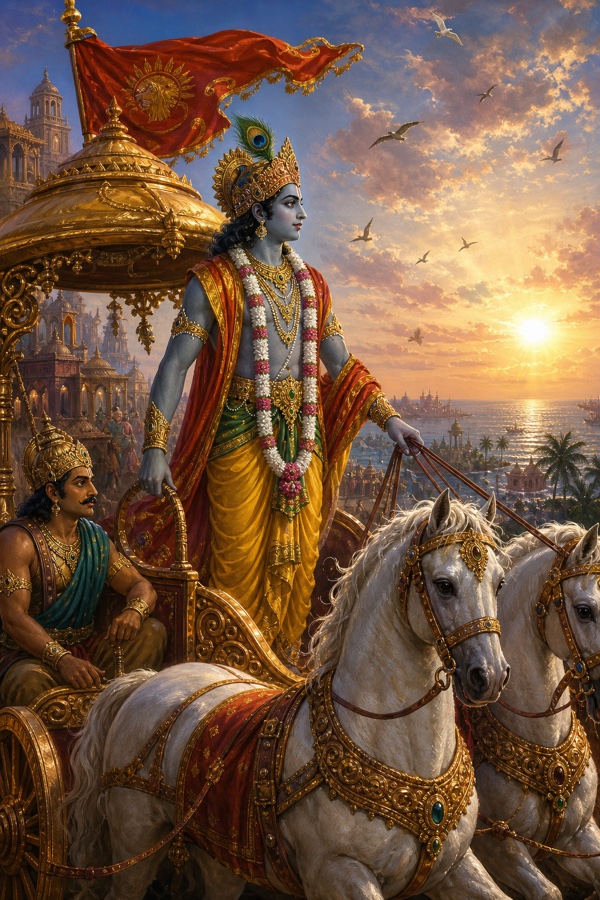
Dhritarashtra envied people who could see. They would behold Krishna before them, his beautiful body radiant enough to illuminate the principal directions and the spaces between them. They would hear words the Bharatas would receive with respect, words bringing good to the Srinjayas, welcome to those seeking prosperity, and free of fault. People destined for death would find those same words unacceptable. The king described Krishna as eternal, filled with great purposes and unequaled courage, the foremost leader of the Yadavas, a destroyer of enemies who frightened them and brought down their fame. The assembled Kauravas would see that revered Vrishni chief speaking kindly and winning the attention of everyone on Dhritarashtra’s side. “I will place myself in his hands,” the king said. The being he invoked was eternal, a sage who knew the self, an ocean of eloquence, readily attained by ascetics. He called him Arishta, the bird with beautiful wings; the destroyer of creatures and the refuge of the universe; the thousand-headed one who created and destroyed all things. He was ancient, without beginning, middle, or end, with achievements beyond number. He was the cause of the first seed, the unborn, eternity itself, highest among the high. Dhritarashtra named him as creator of the three worlds and the source of gods, Asuras, Nagas, and Rakshasas, foremost among learned people and rulers, and the younger brother of Indra. The king who had spent so long asking about the strength of opposing armies now spoke of the one he longed to receive. Krishna’s visit still lay ahead.
The gist: Sanjaya explains the faith, purity, and self-restraint through which he knows Krishna. Duryodhana refuses to seek Krishna’s protection, and Gandhari rebukes him. After hearing the meanings of Krishna’s names, Dhritarashtra longs for his arrival and says he will place himself in his hands.
Source: the Mahabharata of Krishna-Dwaipayana Vyasa, Udyoga Parva. This chapter follows K. M. Ganguli, sections I-LXXI (1-71); the Gita Press Hindi edition numbers these chapters differently. Names, order, and events were checked against Ganguli’s complete translation. Dialogue and commentary are adapted, not a verbatim translation. About the sources.
Based on: The Mahabharata, Vyasa (Gita Press, Gorakhpur)
The same story elsewhere
- Arjuna at Virata
The previous chapter - Krishna the Peace Envoy
The next chapter