On this page
Shalya’s story of Indra: the death of Tvashtri’s three-headed son, and the enemy who swallows the king of the gods
Yudhishthira wanted to hear what had happened. How had Indra, lord of the gods, and his queen come to endure such extraordinary misery? Shalya asked him to listen to an ancient account. Long ago Tvashtri, a lord of created beings, was practicing severe austerities. In his hostility toward Indra, he brought forth a son with 3 heads. The being shone with immense radiance and desired Indra’s seat. His faces resembled the sun, the moon, and fire. With one mouth he recited the Vedas, with another he drank wine, and with the third he looked upon the directions as though he would draw them all into himself. His nature was gentle, his senses controlled. He devoted himself to religious observance and austerities of terrible severity. Indra watched that strength accumulate. The ascetic’s courage, truthfulness, and concentrated power made him fear for his throne. He began considering how to turn him toward sensual pleasure and interrupt his discipline. If the 3-headed being continued to grow, Indra thought, he could absorb the entire universe. The ruler of heaven summoned the apsaras, the celestial women whose beauty he intended to use against the ascetic’s concentration. He ordered them to go quickly to Tvashtri’s son. They should wear alluring clothes and lovely necklaces, display their beautiful figures, and use the gestures and invitations of love to draw him fully into sensual enjoyment. “My heart is restless,” Indra told them. “Remove this dreadful danger hanging over me.” The women promised to do their utmost. They would go together to the being whose gaze seemed to scorch everything around him, try to bring him under their influence, and put an end to Indra’s fear.
The apsaras went to Tvashtri’s son. They displayed their beauty and tried many ways of attracting him. He saw them, yet desire failed to disturb him. His senses remained under control; in his gravity he resembled an ocean filled to its brim. When the women had exhausted their efforts, they returned to Indra with joined hands. The ascetic was beyond their power to unsettle, they said. Indra must now choose whatever course he considered appropriate. He honored and dismissed them, then sought another means of destroying the rival he feared. He settled upon the thunderbolt. A powerful man should never neglect a rising enemy, however insignificant that enemy might appear: that was the teaching upon which Indra fixed his resolve. He would strike that very day. In anger he hurled the weapon, blazing and terrible, at the 3-headed ascetic. The blow killed him. He fell like a summit breaking from a mountain. Even then Indra found no peace. The vast body lying on the ground still shone. Death had left its radiance so strong that it seemed to burn the god who looked upon it. The fallen heads appeared alive. Indra remained there, afraid of the brilliance of the being he had killed. A carpenter happened to come into the forest with an ax upon his shoulder and approached the place where the body lay. Indra saw a way to act upon the fear that had survived his own attack. He immediately ordered the man to cut off the heads.
The carpenter objected on 2 grounds. Those shoulders were too broad for his ax, and the act was one that righteous people would condemn. Indra told him to have no fear: at his command, the ax would become as effective as the thunderbolt. The man asked who was giving this order. Who had committed such a dreadful deed? He wanted the exact truth. Indra named himself as the chief of the gods and again demanded obedience. The carpenter challenged him openly. “How can you feel no shame for such an inhuman act? You have killed a sage’s son. How can you be unafraid of the sin of killing a Brahmana?” Indra answered that he would perform some severe religious observance afterward to cleanse the stain. He had killed a powerful enemy with his thunderbolt, he said, and he remained afraid even now. The carpenter must cut off the heads quickly. In return, Indra would give him a privilege at sacrifices: people would allot him the head of the sacrificial animal. The carpenter accepted the request and severed the 3 heads with his ax. Birds flew out of them. From the mouth that had recited the Vedas and drunk soma came partridges in rapid succession. From the mouth that had gazed at the directions as if drawing them in came quails. From the wine-drinking mouth emerged sparrows and hawks. With the heads severed, Indra’s immediate terror subsided. He returned to heaven in gladness, convinced that killing his enemy had achieved his purpose. The carpenter went home. Tvashtri had yet to learn what had been done to his son.
When the news reached Tvashtri, his eyes reddened with anger. He spoke of a son who had committed no offense, who had continually practiced austerities, who was compassionate and governed his senses and passions. Indra had killed him. Tvashtri declared that he would create Vritra to destroy the ruler of heaven. Let the worlds see his power, he said, and the strength contained in austerity; let their cruel, wicked-minded king see it too. He cleansed his mouth with water and made offerings into the fire. From that rite he brought forth the terrible Vritra. “You are destined to kill Indra,” he told him. “Grow through the strength of my austerities.” The asura grew upward toward the sky, radiant like the son of fire. Rising with the brilliance of a sun at the world’s destruction, he asked what he must do. Tvashtri’s answer was direct: kill Indra. Vritra went toward the celestial regions. There he and Indra met in a furious battle. Vritra seized the king who had performed 100 sacrifices, whirled him around, and thrust him into his mouth. Indra was swallowed. The senior gods were terrified. They created Jrimbhika to kill Vritra, and the asura yawned. His opened mouth gave Indra his opportunity. He contracted the parts of his body and escaped through it. Shalya says that from that time the yawn became attached to the living breath of beings throughout the 3 worlds. The gods rejoiced to see Indra emerge.
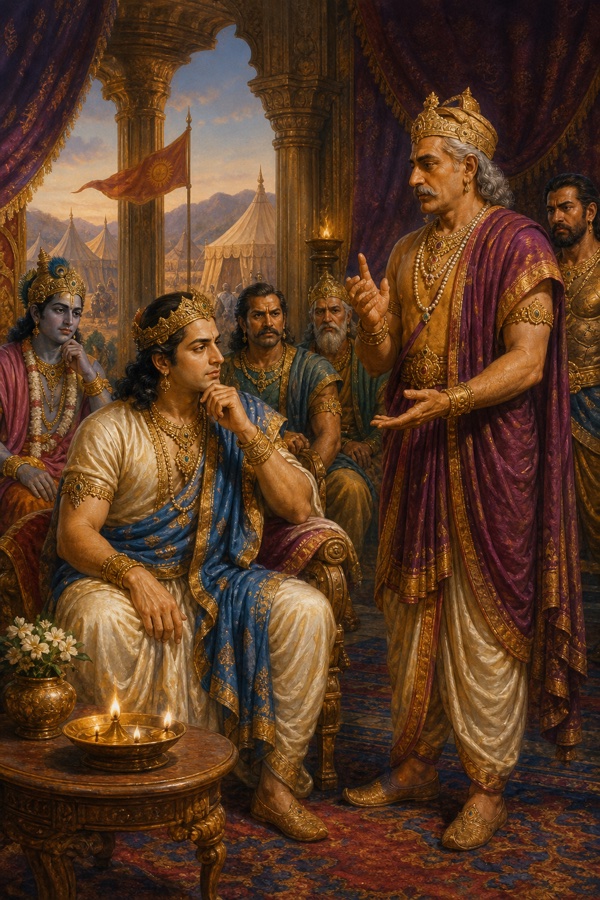
The escape brought him back into the fight. Indra and Vritra attacked one another again, and the combat continued for a long time. Vritra had his own great strength and the mighty force of Tvashtri’s austerities within him. He gained the advantage. Indra retreated. The gods’ joy at his escape gave way to distress as their chief withdrew before the being sent to kill him. Tvashtri’s power had overwhelmed them all. Indra joined them in consultation with the sages, and fear filled their deliberation about what to do next. They sat upon the summit of Mount Mandara, intent on finding a means to destroy Vritra. Their thoughts turned to Vishnu, the imperishable one.
A key to reading this (Indra’s fear): Tvashtri’s son seeks Indra’s position, and his austerities make that ambition threatening to the ruler of heaven. Indra remains afraid even after killing him. Tvashtri, who regards his son as innocent, creates Vritra to avenge the death.
The gist: Fearing for his throne, Indra kills Tvashtri’s ascetic son and persuades a carpenter to sever his 3 heads. Tvashtri creates Vritra in revenge. Vritra swallows Indra, who escapes when the gods cause his enemy to yawn. Renewed combat ends in Indra’s retreat, and the frightened gods and sages turn their thoughts to Vishnu.
Vritra’s Treaty and the Foam of the Sea: Indra Wins, Then Hides in Guilt
On Mount Mandara, Indra admitted how completely the struggle had turned against him. Vritra’s power had spread through the whole enduring universe, leaving the gods unable to find anyone equal to the task of resisting him. “I had the strength once,” Indra told them. “Now I have lost it. What can I do for you? I believe he is beyond our reach. His strength in battle cannot be measured. He could swallow all 3 worlds, with their gods, asuras, and human beings. Hear my decision. We must go to Vishnu and consult him about a means of killing this ruthless enemy.” Shalya continued his account for Yudhishthira: the gods went with the assembled rishis, the great sages, to seek Vishnu’s protection. Fear of Vritra drove their appeal. They recalled the deeds through which Vishnu had already sustained their rule: he had covered the 3 worlds in 3 steps, secured the amrita that sustained the gods, destroyed asuras in battle, bound the mighty asura Bali, and raised Indra to heaven’s throne. The ruler who now needed rescue owed that throne to him. “You are lord of the gods,” they said. “You pervade this entire universe. All beings bow to you. Give shelter to all of us, with Indra, for Vritra’s power has spread throughout the world.” Vishnu answered that their welfare was his concern. He would give them a plan by which Vritra could be destroyed. They were to take the rishis and the Gandharvas, the celestial beings who would accompany the mission, and approach Vritra with proposals for peace. “Use conciliation,” Vishnu instructed them. “Through this you will overcome him. My power will bring Indra victory. I will remain invisible and enter his thunderbolt, that greatest of weapons. Go with the sages and the Gandharvas. Arrange peace between Indra and Vritra without delay.” The divine help Indra sought now required a treaty with the enemy he meant to kill.
The gods and sages set out with Indra at their head. Vritra blazed before them with a radiance like the sun or moon. His energy seemed to burn through all 10 directions and engulf the 3 worlds. The sages approached him with words of reconciliation. “Your power fills the universe,” they said. “Yet you have been unable to overcome Indra. This fighting has continued for a long time, and every kind of being suffers from it: gods, asuras, and human beings alike. Let there be lasting friendship between you and Indra. You will live happily in his realm forever.” Vritra bowed his head to the sages. He had heard what they and the Gandharvas said; he asked them to hear his answer. “How can Indra and I make peace? How can two enemies become friends?” The sages urged him to trust the possibility of friendship between righteous people. A single meeting could establish it, they said, and such an opportunity should be welcomed. Whatever fate had determined would follow in its time. The present chance to gain a good person’s friendship should be preserved. Such friendship was a form of precious wealth: a wise friend could give sound counsel at the moment it was needed. The relationship brought lasting benefit, and a wise person should have no desire to kill someone righteous. They supported their appeal with an account of Indra’s character. Good people honored him; generous people found refuge in him. He was truthful, blameless, versed in right conduct, and clear in judgment. These were the sages’ assurances to the enemy he had just failed to defeat. “Let the friendship between you endure,” they told Vritra. “Place your faith in him. Let your heart hold to that trust.”
Vritra acknowledged the respect he owed sages endowed with such spiritual power. He would accept everything they asked if they fulfilled his own conditions completely. He stated the protection he required from Indra and from every other god: none could kill him with anything dry or wet, with stone or wood, with a weapon used at close quarters or a missile cast from a distance, during the day or during the night. Those were his terms for an enduring peace with Indra. The sages agreed. The settlement pleased Vritra greatly. Indra also welcomed it, while keeping his mind fixed on Vritra’s death. He spent the days that followed searching uneasily for an opening in the protection they had granted. Then, one evening at an ominous hour, he saw the enormous asura on the seashore. Indra recalled the exact terms. Twilight belonged fully to neither day nor night. Here stood the enemy who had taken everything from him; he must kill Vritra, even through deception, or his own fortunes would never recover. Remembering Vishnu, he saw a mass of sea foam as large as a hill. He examined it through the wording of the agreement. “This is neither dry nor wet,” he thought. “It is not a weapon. I will throw it at Vritra, and he will die.” Indra hurled the foam, mingled with his thunderbolt. Vishnu entered that foam and ended Vritra’s life. The power promised before the peace mission had reached its target through the very conditions that had persuaded Vritra to accept the treaty.
Darkness lifted from the directions of the world. A pleasant breeze began to blow, and living beings rejoiced. The gods praised Indra in hymns, joined by the Gandharvas, Yakshas, Rakshasas, great serpents, and sages. Indra received their salutations and answered with words of encouragement. He shared their happiness at the enemy’s death. Knowing his obligations, he worshiped Vishnu, whose intervention had made the victory possible. Then the burden of false dealing overwhelmed him. His joy gave way to profound sorrow. A second burden was already his: the killing of Tvashtri’s three-headed son had brought upon him the sin of brahmanicide, the slaying of a Brahmin. That was the ascetic whose death had driven Tvashtri to create Vritra in the first place. The new victory had completed the destruction of the father’s avenger; the guilt of the earlier killing remained. Oppressed by both wrongs, Indra withdrew to the farthest boundaries of the worlds. He lost his senses and awareness. His own sins overwhelmed him so completely that he could no longer be recognized. He hid in the water, like a snake writhing there. The lord of heaven had vanished, terrified by the burden of brahmanicide. Across the earth, the effects of his disappearance spread. The land looked devastated. Trees were lost, forests withered, rivers ceased to flow, and reservoirs emptied. Rain stopped falling, bringing distress to animals. The gods and the great sages grew frightened as disaster overtook a world without its king. In heaven they faced the question left by Indra’s absence: who would govern them now? No one wished to take the kingship of the gods. Shalya had carried his account beyond the defeat of the terrifying enemy. Indra’s own suffering, and the suffering that would reach his wife, still lay within the story Yudhishthira had asked him to tell.
A key to reading this (the two burdens): Indra is overcome by his deceit toward Vritra and by the earlier killing of Tvashtri’s three-headed son. The sages’ praise of his truthfulness belongs to their effort to secure Vritra’s trust. Indra’s subsequent search for a loophole exposes the danger in the assurances they gave.
The gist: Following Vishnu’s plan, the gods obtain a treaty that protects Vritra from specified means and times of death. Indra attacks with sea foam and his thunderbolt at twilight; Vishnu enters the foam and kills Vritra. Guilt then overwhelms Indra, who hides in water. As rain fails and the earth suffers, the gods seek someone willing to rule in his place.
Nahusha Takes Heaven’s Throne: Shachi Seeks Brihaspati’s Protection
With Indra gone, the sages and leading gods settled on Nahusha. He was a king of the earth, handsome, powerful, renowned, and devoted to righteous conduct. They went to him with the progenitors of humankind and asked him to become their ruler. Nahusha considered what the appointment would require. “I lack the strength to protect you,” he answered. “Your king must be powerful. Indra has always possessed that strength.” The gods, led by the sages, offered the power of their own austerities to support his rule. Each of them had fears; heaven needed a king to protect them. They gave him an extraordinary advantage. Any being who came within his sight would yield its power to him. A god, an asura, a Yaksha, a sage, an ancestral spirit, or a Gandharva: whatever the being, Nahusha would draw in its energy and grow stronger. “Accept the consecration,” they urged him. “Keep righteousness foremost as you govern the worlds. Protect the Brahmin sages and the gods in heaven.” Nahusha accepted the crown. At first he placed righteousness above everything as he ruled all the worlds. Then possession of heaven and the precious boon changed the direction of his desires. His mind turned toward sensual pleasure. Apsaras, the celestial nymphs, and other women of heavenly birth surrounded him. He enjoyed himself in the Nandana groves, on Kailasa, on the heights of Himavat, on Mandara and the White Mountain, Sahya, Mahendra, and Malaya, and beside the seas and rivers. Divine stories held his ear and heart. Music from many kinds of instruments and the sweetness of singing accompanied his pleasures. Vishvavasu and Narada attended him, with groups of apsaras, companies of Gandharvas, and the 6 seasons appearing in living form. Fragrant, refreshing breezes blew around the new king. Heaven’s ruler had acquired both the power to absorb the strength of those he saw and abundant occasions to indulge himself.
During these enjoyments, Nahusha caught sight of Shachi, Indra’s beloved queen. He asked his courtiers why she had failed to attend him. “I am king of the gods and ruler of the worlds,” he said. “Let Shachi come to my house at once.” Distressed by the command, Shachi went to Brihaspati, the gods’ teacher. She asked him to protect her from Nahusha and received refuge in his house. Her appeal called upon the promises Brihaspati had already made about her future. He had told her that she bore auspicious bodily marks, that she was dear to the divine king, faithful and devoted to her husband, and destined never to become a widow. “Let those words come true,” she pleaded. “You have never spoken in vain. What you said about me must be fulfilled.” Brihaspati reassured the frightened queen. Everything he had told her would prove true. She would see Indra again; the lord of the gods would soon return. “You have nothing to fear from Nahusha,” he promised. “I will soon reunite you with Indra.” News reached Nahusha that the queen had sought the protection of Brihaspati, the son of Angiras. Nahusha flew into a rage. The gods and sages tried to calm their new sovereign, whose anger frightened the worlds. Asuras, Gandharvas, Kinnaras, and great serpents all trembled, they told him. A ruler of his character should preserve his composure. Shachi was another man’s wife. They urged him to turn his thoughts away from the sin of violating that bond, restrain his anger, and protect his subjects in accordance with righteousness. The duty with which they had invested him still bound the king who now terrified them.
Nahusha’s desire had overpowered his judgment. He brushed aside their appeal and accused them of tolerating wrongdoing when Indra held the throne. “Indra violated Ahalya, the blameless wife of a sage, while her husband was alive,” he said. “Why did you fail to stop him? He committed many acts of cruelty, unrighteousness, and deceit. Why did you fail to prevent those? Let Shachi satisfy my desire. That will secure her lasting welfare, and it will preserve your safety as well.” The gods yielded. They promised to bring him Indra’s queen as he had commanded and begged him to put away his anger. Then they went with the sages to Brihaspati’s house. They acknowledged that Shachi had sought refuge there and that he had promised to protect her. Their request nevertheless was that he give her up to Nahusha. Speaking for gods, Gandharvas, and sages, they declared the radiant new king superior to Indra and proposed that Shachi choose him as her husband. The queen began to weep. Sobbing, she turned to the teacher whose word now stood between her and their demand. “I do not want Nahusha for my husband,” she said. “I have come to you for protection. Save me from this terrible danger.” Brihaspati answered with a firm refusal to abandon anyone who had sought his shelter. Shachi was virtuous and truthful; he would stand by her. He was a Brahmin who understood righteousness, respected truth, and knew the obligations imposed by sacred teaching. He would never commit the wrong they asked of him. He told the gods to leave, then recalled what Brahma had taught about surrendering a frightened person to an enemy.
The consequences in that teaching reached through a protector’s life, descendants, and ancestral bonds. Someone who handed over a terrified supplicant would find no protection in his own hour of need. His seed would fail to sprout at sowing time; rain would fail him in the rainy season. His undertakings would come to nothing. Bereft of judgment and strength, he would fall from heaven. The gods would refuse his offerings. His children would die before their time, and his ancestors would be caught in continual strife. The gods, led by Indra, would strike him with the thunderbolt. “Understand this,” Brihaspati told his visitors. “I will never surrender Shachi, known throughout the world as Indra’s beloved queen. Find a course that serves her welfare and mine. I will not give her up.” The gods and Gandharvas then asked their teacher to devise a workable policy. Brihaspati proposed that Shachi ask Nahusha for time to consider his offer. Delay would help the queen and those who wished to protect her. Time could produce many obstacles; as it advanced, circumstances could change. Nahusha’s strength and pride rested on the boon he had received. The gods welcomed Brihaspati’s counsel as a course that could benefit them all. Shachi herself still had to be persuaded to approach the king. Led by Agni, the god of fire, they spoke gently to her for the welfare of the worlds. She was sustaining the whole universe, they said, all that moved and all that stood still. She was faithful and true. They asked her to go to Nahusha and assured her that the corrupt ruler, consumed with desire for her, would soon fall. Indra would regain the sovereignty of the gods. Shachi understood the conclusion of their deliberations. To achieve her purpose, she went with modest reluctance to the fearsome new king. Nahusha saw her youth and beauty and was delighted. His desire clouded his judgment as the queen approached to ask for the time on which Brihaspati’s plan depended.
A key to reading this (the duty of refuge): Brihaspati treats his promise of protection as binding even when the gods ask him to surrender Shachi. Her refusal of Nahusha is explicit. The request for time gives Brihaspati a way to maintain that protection while allowing circumstances to change.
The gist: The gods crown Nahusha and empower him to absorb the strength of beings within his sight. He turns toward pleasure and demands Indra’s wife. Shachi seeks Brihaspati’s protection, and he refuses to surrender her under pressure from the gods. He proposes a delay, and she approaches Nahusha to ask for time.
Shachi Asks for Time: The Search for Indra Inside a Lotus
Nahusha addressed Shachi with praise of her smile, thighs, and fair complexion. He declared himself the Indra of all 3 worlds and asked her to accept him as her husband. The queen trembled with fear, like the stalk of a banana plant shaken by wind. She bowed her head to Brahma, joined her hands, and made her request to the terrifying king. “I ask for time,” she said. “We do not know what has become of Indra or where he is. Let me discover the truth about him. If I can find no news, I will come to you. I give you my word.” Nahusha was pleased with her answer. He granted the delay and told her to come after she had completed her inquiries. He expected her to remember the promise. Dismissed from his presence, Shachi returned to Brihaspati’s house. The gods, led by Agni, heard what had happened and considered how to help Indra. They went together to Vishnu. Their appeal described Indra as overwhelmed by the sin of killing a Brahmin. Vishnu was the first-born, ruler of the universe and their refuge; he had assumed his divine form to protect living beings. “When Vritra was killed through your power,” they said, “Indra was overcome by the sin of brahmanicide. Tell us how he can be set free.” Vishnu directed them toward a sacrifice. Indra should offer it to him, and he himself would purify the bearer of the thunderbolt. Once Indra had performed the sacred horse sacrifice, the ashvamedha, he would fearlessly recover the dignity of his office. Nahusha’s own evil deeds would bring about his destruction. For a time, the gods must remain patient and vigilant. They had obtained a promise of purification and eventual restoration; they still had to wait for the danger posed by the reigning king to pass.
Vishnu’s assurance was as welcome to them as amrita, the divine nectar. The gods went with Brihaspati and the sages to the place where Indra remained distressed by fear. There they performed a great horse sacrifice for his purification. Shalya told Yudhishthira that the rite could remove the sin of brahmanicide. He then described Indra distributing that sin among trees, rivers, mountains, the earth, and women. Having parted with the burden in this way, Indra recovered from his anguish and returned to himself. His purification did not remove the power granted to Nahusha. When he looked upon the new king, Indra trembled again. Every living being was cowed before that ruler, whom the sages’ boon had made unapproachable. Shachi’s husband disappeared once more. Invisible to other beings, he wandered while waiting for his opportunity. His renewed disappearance plunged the queen into grief. She prayed that any merit she had earned might preserve her marriage and fidelity. If she had ever given a gift, made an offering to the gods, or satisfied her spiritual teachers, if truth existed in her, let her devotion to her husband remain inviolate. She bowed to the goddess Night, pure and holy as she followed her course during the sun’s northward journey, the season called Uttarayana. With body and mind purified, Shachi worshiped Night and sought divine guidance. Calling upon the truth and faithfulness by which she had lived, she asked for the hidden place to be revealed. “Show me where the king of the gods is,” she prayed. “Let truth be confirmed through truth.” Her appeal reached the goddess of Divination, who could disclose what remained concealed.
The goddess appeared beside her. Young and beautiful, she stood before the queen, who welcomed her with respect and asked who she was. “I am Divination,” the goddess answered. “I have come to you because you are truthful. Your truth has made it possible for you to see me. You are devoted to your husband, disciplined in your conduct, and faithful in your religious observances. I will show you Indra, the slayer of Vritra. Follow me quickly. You will see the foremost of the gods.” The goddess led the way, and Shachi followed. They crossed heavenly groves and many mountains, then passed beyond Himavat to its northern side. Reaching a sea that extended for many yojanas, they came to a large island covered with trees and plants of many kinds. There Shachi saw a lake of heavenly beauty, alive with birds. It measured 800 miles in length and the same distance across. Thousands of fully opened lotuses in 5 colors covered its waters, with bees humming around them. In the center of the lake stood a great cluster of blossoms. At the heart of that cluster rose a large white lotus on a tall stalk. The goddess entered the stalk with Shachi. Within its fibers they found Indra. The king who had once confronted Vritra was lying there in an exceedingly small form, concealed inside the plant. Shachi also made herself minute when she saw him, and the goddess of Divination did the same.
Shachi praised her husband by recalling the famous deeds he had performed in earlier times. Indra, also called Purandara, answered the praise with questions. Why had she come? How had she discovered him? She told him what Nahusha had done. “You who have performed a hundred sacrifices,” she said, “hear what has happened. Nahusha has gained the sovereignty of the 3 worlds. He is powerful, proud, and corrupt. He has commanded me to come to him and has set a definite time. Unless you protect me, he will force me into his power. Fear of him has brought me here. Kill this terrible ruler. Show yourself again, destroyer of Daityas and Danavas. Take up your own strength and govern heaven.” The names Daitya and Danava recalled the hostile powers Indra had fought, and the hundred sacrifices recalled the achievements associated with his sovereignty. Shachi brought those deeds into her appeal to the husband she had found hiding in a lotus. The time Nahusha had granted her was limited. She had used it to find Indra and now asked him to protect her and reclaim his rule. The queen’s journey had brought the immediate threat in heaven into the small refuge where its former king waited.
A key to reading this (purification and fear): Shalya’s account distinguishes Indra’s release from guilt from his fear of Nahusha’s power. It places the distribution of sin among trees, rivers, mountains, earth, and women within the divine story of purification. Even after that rite, the boon protecting Nahusha drives Indra into hiding again.
The gist: Shachi wins time to discover Indra’s fate. At Vishnu’s direction, a horse sacrifice frees Indra from guilt, but he hides again in fear of Nahusha. Shachi’s prayer brings a divine guide, who leads her beyond Himavat to a lotus stalk. Finding Indra within its fibers, she asks him to protect her and return to heaven’s throne.
A Palanquin Carried by Sages: Shachi’s Request and Agni’s Search
Indra answered his wife’s appeal with a warning about the strength Nahusha had acquired. The time for a direct display of valor had yet to come. Nahusha was stronger than he was, supported by the merit of offerings the sages had made to the gods and the ancestral spirits. Indra would have to use strategy, and Shachi would have to carry it out. He instructed her to keep the plan secret from everyone. She was to meet Nahusha privately and ask him to visit her in a fine vehicle carried by rishis. If he came in that manner, she would be pleased and place herself at his disposal. Shachi agreed. Returning to Nahusha, she received an eager welcome. He smiled, praised her beauty, and asked what she wanted. She should accept him, he said; he was devoted to her and would fulfill her wishes. There was no need for embarrassment. She could trust him. He swore in the name of truth that he would do whatever she asked. The promise gave her the opening for Indra’s proposal. “I needed the time you granted me,” she said. “Afterward you will be my husband. I have a wish. Hear it, king of the gods, so that you may do what would please me. I ask this indulgence because of your love for me. Grant it, and I will be at your disposal.”
Shachi began with the vehicles Indra had used. Horses, elephants, and chariots had all carried her husband. She wanted Nahusha to possess an entirely new conveyance, one that even Vishnu, Rudra, the asuras, and the Rakshasas had never possessed. A group of highly revered sages should carry him together in a palanquin. That was the sight she wished to see. She urged him to recognize the unique power of his position. By his own strength he absorbed the energy of others when they looked at him. No being had the strength to stand before him. Nahusha delighted in the idea. He told her she had conceived a vehicle no one had ever heard of, and he liked it immensely. He was in her power. Any ruler who could make sages carry him must possess extraordinary strength. His answer expanded into a declaration of his own supremacy. He had practiced austerities; he was mighty; past, present, and future belonged to him. The universe would cease to exist if he became angry, for everything rested in him. Gods, asuras, Gandharvas, serpents, and Rakshasas together could never withstand his wrath. Any being upon whom he turned his gaze lost its energy to him. “I will certainly fulfill your request,” he said. “The 7 great sages and the other twice-born rishis will carry me. You will see my greatness and splendor.” Those twice-born ascetics had entered sacred learning through initiation and devoted their lives to its discipline. Nahusha had accepted their spiritual power as support for his rule; now he ordered such men to bear his weight. He dismissed Shachi and put ascetics devoted to austerities into the service of his celestial vehicle. Power and pride had made him capricious. Disregarding the honor owed to Brahmins, he compelled the sages to carry him.
Shachi went from Nahusha to Brihaspati. The remaining time was short, she told him. She appealed to his compassion and asked him to find Indra quickly. Brihaspati reassured her that Nahusha would retain power for very little longer. His disregard for righteousness and his employment of the great sages as bearers had already set his downfall in motion. Brihaspati would perform a sacrifice to bring about the wicked ruler’s destruction, and he would find Indra. Shachi had no need to fear. The teacher kindled a sacrificial fire according to the prescribed rites and placed the finest offerings in it to discover where the king of the gods was hidden. Having made the offerings, he spoke to the fire itself. “Find Indra.” Agni, the divine fire who consumed the offerings, assumed a wondrous female form of his own will and disappeared from that very place. He searched with the speed of thought. Mountains and forests, earth and sky all came within his search. In the time of a blink he returned to Brihaspati and reported that Indra was nowhere in the places he had examined. Water alone remained. Agni hesitated before that last domain. He habitually drew back from entering it, he said; it offered him no way in. What should he do for Brihaspati now?
The teacher directed him to enter the water. Agni answered that he could not: extinction awaited him there. He placed himself in Brihaspati’s hands and explained the limit he feared. Fire, he said, had arisen from water. The warrior order had arisen from the priestly order, and iron from stone. Each could exert a force that penetrated other things, yet that force failed against its own source. The comparison linked the element that threatened to quench him to two other relationships of origin and power. Iron could pierce many substances; its origin lay in stone. The warrior’s power stood in a corresponding relation to the Brahmin from whom, in Agni’s account, that order had arisen. For fire, water was the source in which its ordinary power ceased to operate. Agni had obeyed the summons, taken a new form, and crossed the world at the speed of thought. Brihaspati’s next command required him to enter the one place he believed would extinguish him. The search had reached the waters where Indra remained concealed, and Agni awaited the teacher’s answer.
A key to reading this (the source of Nahusha’s strength): The sages’ accumulated merit has made Nahusha too powerful for Indra to confront directly. Indra therefore has Shachi ask him to make sages carry his vehicle. Nahusha embraces the proposal as a display of supremacy; Brihaspati sees the same command as a transgression that will bring his rule down.
The gist: Following Indra’s secret instructions, Shachi asks Nahusha to approach in a vehicle carried by sages. He proudly agrees. With her deadline approaching, she asks Brihaspati to find Indra. He sends Agni to search, but the fire god fears entering the one place left unexplored: water.
Agni Finds Indra: The Gods Promise Help Against Nahusha
Brihaspati answered Agni’s fear with praise of the fire god’s universal power. Agni was the mouth of all the gods, carrying the offerings made in sacrifice to their divine recipients. Like a witness, he could enter the inner life of every creature. The inspired poets spoke of him as one and also as threefold. Without him, the universe would cease to exist. Brahmins who bowed to him could earn, through their good deeds, an enduring heavenly abode with their wives and children. He carried the sacred offering and was himself the finest offering. In the highest sacrificial rites, worshipers honored him with uninterrupted gifts. He had created the 3 worlds, and when their appointed time arrived he consumed them in a form that needed no kindling. Brihaspati called him the universe’s mother and its end. The wise identified him with cloud and lightning; his flames sustained living beings. All waters rested within him, together with the whole world. Nothing in the 3 worlds was unknown to the purifying fire. Brihaspati then returned to the relation of fire to water that had troubled Agni. Every being, he said, bore goodwill toward its progenitor. Agni should enter the waters without fear. The teacher would strengthen him with the eternal hymns of the Veda. Pleased by the praise, Agni spoke approvingly to Brihaspati and gave him a promise: “I will show you Indra. This is the truth.”
Agni entered the water. His search extended through seas and small ponds until he reached the lake where Indra had hidden. Searching among the lotus flowers, he found the king of the gods inside the fibers of a stalk. He quickly returned and told Brihaspati that Indra had taken refuge there in a minute form. The teacher went to the lake with gods, sages, and Gandharvas. Their appeal recalled the deeds by which Indra had once protected the worlds. Brihaspati named the powerful asuras he had killed: Namuchi, Shambara, and Vala. He urged the performer of a hundred sacrifices to recover his strength, destroy his enemies, and rise. Gods and sages had gathered before him. By killing asuras, Indra had delivered the worlds, and with sea foam empowered by Vishnu he had overcome Vritra. He was worthy of worship, the refuge of all creatures, without an equal. Living beings depended on him, and the greatness of the gods had been established through his actions. “Take up your strength,” Brihaspati urged him. “Save us all, and save the worlds.” As the praise continued, Indra grew little by little. He resumed his own form and recovered his strength. Then he addressed the teacher standing before him. What work remained for him to do? Tvashtri’s son was dead. So was Vritra, whose vast form had threatened the worlds. He had killed both enemies; he now asked why the gods still needed him.
Brihaspati answered that Nahusha, a human king, had obtained heaven’s throne through the power of the divine sages and was causing them great distress. Indra asked how Nahusha had reached so difficult a position, what austerities he had performed, and how much power he possessed. The teacher explained that Indra’s abandonment of the throne had left the gods frightened and in need of a ruler. Gods, ancestral spirits, sages, and leading Gandharvas had assembled and asked Nahusha to become their king and defend the universe. He had said he lacked the strength. They must fill him with their own power and the merit of their austerities. They had done so, making him terrifyingly strong. As sovereign of the 3 worlds, he had now put the great sages into harness and traveled from world to world carried by them. Brihaspati warned Indra to avoid the king’s sight. Poison came from Nahusha’s eyes, and he absorbed the energy of other beings. The gods were so afraid that they moved about concealed and avoided looking at him. While Brihaspati was speaking, 4 guardians of the worlds arrived: Kubera, Yama the son of Surya, the ancient god Soma, and Varuna. They congratulated Indra on the deaths of Tvashtri’s son and Vritra. With his enemies destroyed, they were glad to see him safe. The companions who had come to his hiding place now included these guardians, each able to aid his return if they could overcome their fear of Nahusha.
Indra welcomed them joyfully and observed the proper courtesies, intending to ask for their help. He told them that the fearsome Nahusha held the kingship of the gods and requested their assistance against him. They acknowledged the danger: Nahusha’s gaze was poisonous, and they were afraid. If Indra overthrew him, they asked to receive their allotted shares in sacrificial offerings. These were the offerings through which worshipers honored the gods in ritual. Their appeal joined the recovery of divine rule to recognition of their places within that worship. Indra agreed. The guardians before him, including the ruler of waters, Yama, and Kubera, would be consecrated along with him that very day. With all the gods helping, they would overthrow the enemy with the terrible gaze. Agni then made his own request. Give him a share of the offerings, he said, and he too would lend his aid. Indra promised him a portion in the great sacrifices: a single share would belong jointly to Indra and Agni. Shalya told Yudhishthira how Indra then settled the guardians’ respective authorities. Kubera received sovereignty over the Yakshas and all the wealth of the world. Yama received sovereignty over the ancestral spirits. Varuna received sovereignty over the waters. The ruler whom Agni had found reduced to a tiny form inside a lotus was once again making arrangements with the gods. Their help, their sacrificial shares, and their domains had been agreed upon. Nahusha’s power remained the obstacle they intended to remove together.
A key to reading this (offerings and authority): Brihaspati’s praise presents Agni as both the recipient of sacrifice and the carrier of offerings to other gods. Later in the scene, Agni secures a sacrificial share jointly with Indra. The assignments to Kubera, Yama, and Varuna place their divine domains within the same account of the gods’ agreement to help restore Indra.
The gist: Strengthened by Brihaspati’s assurance, Agni searches the waters and finds Indra inside a lotus stalk. The gods’ praise helps Indra resume his form and strength. He hears how Nahusha acquired power, then secures the guardians’ and Agni’s help by agreeing to their sacrificial shares and defining their respective domains.
Nahusha Falls and Indra Returns: Shalya Reassures Yudhishthira
Indra was still discussing the means of overthrowing Nahusha with the guardians and the other gods when the ascetic Agastya arrived. The sage honored him and announced welcome news. Indra had survived the destruction of Tvashtri’s son and Vritra, and Nahusha had now been hurled from heaven’s throne. Agastya was glad to see the king of the gods with all his enemies overcome. Indra welcomed the sage, asked whether his journey had been pleasant, and offered water for his feet and face, an arghya of formal welcome, and a cow. Once Agastya had received the honors and taken his seat, Indra asked him to recount Nahusha’s fall. Agastya described the pure-minded Brahmins and divine sages struggling under the king’s weight. Exhausted by the labor of carrying him, they had asked him a question about the authority of the Veda. Were the prescribed hymns recited while sprinkling cows authentic? Nahusha, his judgment darkened by tamas, had answered that they were not. The sages warned that his answer led him away from righteousness. Earlier great sages had affirmed the hymns’ authority. During this exchange, Nahusha put his foot on Agastya’s head. At once he lost his strength and handsome appearance. Fear and agitation seized the king who had made the sages carry him.
Agastya told Indra the sentence he had then pronounced. Nahusha had rejected faultless Vedic hymns recited by Brahmin sages. He had touched Agastya’s head with his foot. He had reduced great ascetics, unapproachable in their power and equal to Brahma, to the condition of animals bearing his weight. His radiance would therefore leave him; the merit of his good deeds was exhausted. He would fall headlong from heaven and roam the earth as an enormous snake for 10,000 years. When that period ended, he could return to heaven. That, Agastya said, was how Nahusha had been cast down. The tormentor of the Brahmins had been removed. He urged Indra to return, protect the worlds, control his senses, subdue his enemies, and receive the honor of the great sages. Joy spread among the gods and the companies of ascetics. The ancestral spirits, Yakshas, serpents, Rakshasas, Gandharvas, and groups of apsaras rejoiced with them. Shalya’s account extended that happiness to ponds, rivers, mountains, and seas. All welcomed Indra’s recovery and praised Agastya for bringing Nahusha down. The ruler whose gaze had terrified them would now travel the earth in a serpent’s body, under the term set by the curse.
Praised by Gandharvas and apsaras, Indra mounted Airavata, the king of elephants, whose form bore auspicious marks. Agni, Brihaspati, Yama, Varuna, and Kubera accompanied him. Gods, Gandharvas, and celestial nymphs surrounded him as he went through the 3 worlds. He was reunited with Shachi and resumed their protection with great happiness. The divine sage Angiras then came to Indra’s assembly and honored him with hymns of the Atharva tradition. Indra was pleased and granted him a boon: he would be known in the Atharva Veda as the rishi Atharvangiras and receive a share in sacrifices. Indra honored him and took his leave of him, then honored all the gods and the sages rich in the power of austerity. He governed his people joyfully and righteously. Shalya brought the story’s purpose back to Yudhishthira. Indra himself had suffered with his wife; even he had needed a period of concealment while awaiting the destruction of his enemies. Yudhishthira should take heart after the suffering he, Draupadi, and his brothers had endured in the forest. “You will recover your kingdom,” Shalya assured him, “as Indra recovered his after killing Vritra.” The return of the divine king offered the exiled human king an example of dignity regained after hardship.
Shalya continued with the example of Nahusha, whose hostility toward Brahmins and corrupt conduct had brought Agastya’s curse upon him. His power had been destroyed for an immense span of years. In the same way, Shalya predicted, Karna, Duryodhana, and the other ill-intentioned enemies would soon be destroyed. Yudhishthira would rule the whole earth to its surrounding sea with his brothers and Draupadi. He called the account of Indra’s victory equal to the Veda in sacred character. A king seeking victory should hear it, especially when his troops stood arranged for battle. That was why he was reciting it for Yudhishthira. Great-hearted people prospered when their achievements were praised. Duryodhana’s crimes, together with the power of Bhima and Arjuna, had brought the destruction of mighty warriors near. Shalya also described the blessings he associated with reading the account in faith. Such a reader would be cleansed of sin, reach a realm of bliss, and find happiness in this world and the next. He would have no fear of enemies, would never be left without a son, would be protected from danger, and would enjoy a long life. Victory would attend him everywhere; he would remain free of defeat. These were Shalya’s assurances as he offered the story to strengthen Yudhishthira before the approaching conflict. The tale had carried a threatened ruler through concealment, the protection of his wife, the downfall of a usurper, and the recovery of his throne.
Vaishampayana resumed the account of the human kings. Encouraged by Shalya, Yudhishthira honored the ruler of Madra in the proper manner. He then returned to the request that had preceded the story. “You will certainly become Karna’s charioteer,” he said. “When that happens, dampen his confidence by recounting Arjuna’s merits.” Shalya agreed. He would do exactly as Yudhishthira asked and perform any further service within his power. Then he took leave of Kunti’s sons and departed with his army for Duryodhana. His destination followed the promise he had made after accepting Duryodhana’s hospitality. His renewed pledge to Yudhishthira concerned what he would say from Karna’s chariot. Shalya’s consoling story had ended with Indra restored, and the meeting now ended with the practical undertaking that might affect Arjuna’s confrontation with Karna. The king of Madra went to join one army while carrying a promise to weaken the confidence of one of its foremost fighters.
A key to reading this (why Shalya tells the story): Shalya uses Indra’s suffering and recovery to encourage Yudhishthira after exile. The spiritual benefits promised to a faithful reader also belong to Shalya’s speech. The return to the main narrative ends with a specific military commitment: he will praise Arjuna to unsettle Karna while serving as Karna’s charioteer.
The gist: Agastya reports that Nahusha has been condemned to live as a snake for 10,000 years after abusing the sages and rejecting sacred hymns. Indra rejoins Shachi and resumes righteous rule. Shalya offers that recovery as encouragement to Yudhishthira, renews his promise to undermine Karna’s confidence, and leaves with his army for Duryodhana.
Seven and Eleven Akshauhinis: The Two Armies Assemble
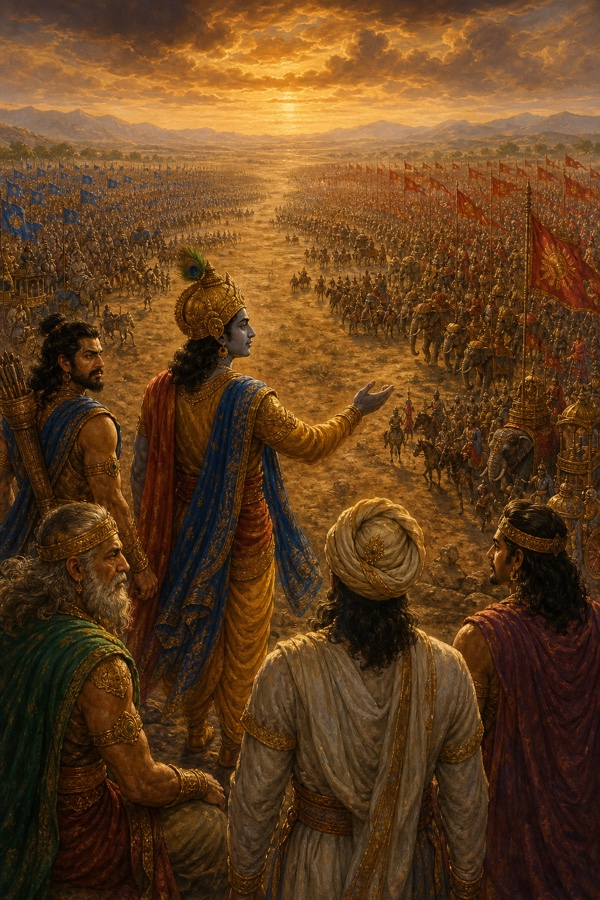
Yuyudhana, the great warrior of the Satvata line also known as Satyaki, came to Yudhishthira with a large army. It included the 4 arms of an Indian fighting force: infantry, cavalry, chariots, and elephants. His soldiers had come from many lands. They carried different weapons, and their martial appearance added to the splendor of the Pandava army. Battle-axes and missiles, spears and lances, mallets and clubs, staves and cords, spotless swords and daggers, and many kinds of arrows filled their ranks. All had been made to the finest quality. Vaishampayana compared the army to a mass of dark clouds lit by lightning: the soldiers formed the cloudlike body, and their weapons gave it its flashes of brilliance. Satyaki brought 1 akshauhini, a complete formation combining the different arms. Once it joined Yudhishthira’s gathering forces, it disappeared into the greater army as a small river loses its separate appearance when it enters the sea.
Dhrishtaketu, the powerful ruler of Chedi, brought another akshauhini to the sons of Pandu. Jayatsena, the king of Magadha, arrived with 1 akshauhini for Yudhishthira as well. The Pandya ruler, whose country lay near the sea, came with troops of several kinds. As these contingents gathered, the army presented an impressive sight, its soldiers well dressed and exceptionally strong. Drupada’s force included brave men from many countries and his own formidable sons. Virata, king of Matsya, came with the ruler of a mountain region. From the different directions, the Pandavas thus received a total of 7 akshauhinis. Banners of many forms rose above the assembled forces. The troops were eager to fight the Kurus, and their arrival delighted Yudhishthira and his brothers. The princes who had emerged from exile were now joined by the strength of allied kingdoms. Drupada and Virata, already central to their preparations, stood within a much wider gathering of rulers and fighting men.
Across the divide, Bhagadatta gladdened Duryodhana by supplying 1 akshauhini. His formidable ranks included large numbers of Chinas and Kiratas. Their golden appearance gave the army the beauty of a forest of flowering karnikara trees. Bhurishravas and Shalya each arrived with an akshauhini. Kritavarma, the son of Hridika, brought an akshauhini accompanied by Bhojas, Andhakas, and Kukuras. His powerful warriors wore garlands of many-colored flowers; they resembled playful elephants emerging from a wood. Jayadratha led men from Sindhu-Sauvira in such numbers that the hills seemed to tremble beneath their tread. His force, also 1 akshauhini, looked like a mass of clouds driven by wind. Sudakshina, ruler of Kamboja, brought an akshauhini with Yavanas and Shakas. His troops resembled a flight of locusts as they approached. When they joined the Kuru forces, they too were absorbed into the larger army and vanished within it. Each arrival added a distinct contingent, with its own origins and appearance, to the force assembling for Dhritarashtra’s son.
Nila, the king who lived in Mahishmati, came with powerful soldiers from the south bearing finely made weapons. The 2 rulers of Avanti brought a mighty force, each contributing a separate akshauhini. The 5 royal brothers of Kekaya hurried to Duryodhana with an akshauhini and pleased him with their arrival. From celebrated kings in other regions came 3 more large divisions of troops. Vaishampayana gave Duryodhana’s assembled strength as 11 akshauhinis, their many-shaped banners rising over men eager to fight Kunti’s sons. The 7 akshauhinis gathered for the Pandavas faced an opposing alliance whose stated total was 11. The distinction among the individual contingents remained important: some rulers’ contributions were counted separately, while others were described by their region, the character of their troops, or their place within a larger gathering. The resulting Kaurava host exceeded what Hastinapura could hold. There was no room in the city even for all the principal commanders of Duryodhana’s forces.
The army therefore occupied a broad expanse beyond the capital. It spread through the land of the 5 rivers and all of Kurujangala, through the wilderness of the Rohitaka forest, and into Ahichhatra and Kalakuta. Its camps filled the banks of the Ganga, Varana, Vatadhana, and the hill country along the Yamuna. This whole extensive region, rich in grain and wealth, was covered by the Kaurava army. The force had grown from successive arrivals into a military presence across many districts. It was in this arrangement that Drupada’s priest saw it. Sent by the king of Panchala to speak to the Kurus, he encountered the army already gathered around their capital and across the surrounding lands. The mission for which Drupada had chosen him now brought him into the presence of the power Duryodhana’s allies had assembled.
A key to reading this (the army totals): An akshauhini combines chariots, elephants, cavalry, and infantry. The account specifies the size of several allied contributions and then states the totals of 7 for the Pandavas and 11 for Duryodhana. It gives no separate number for every ally, and the 3 large divisions from other regions are not individually called akshauhinis.
The gist: Satyaki, Dhrishtaketu, Jayatsena, the Pandya ruler, Drupada, Virata, and other allies bring the Pandava force to 7 akshauhinis. Duryodhana’s allies assemble 11. Their host spreads far beyond Hastinapura into the surrounding regions, where Drupada’s envoy sees the army arranged.
Source: the Mahabharata of Krishna-Dwaipayana Vyasa, Udyoga Parva. This chapter follows K. M. Ganguli, sections I-LXXI (1-71); the Gita Press Hindi edition numbers these chapters differently. Names, order, and events were checked against Ganguli’s complete translation. Dialogue and commentary are adapted, not a verbatim translation. About the sources.
Based on: The Mahabharata, Vyasa (Gita Press, Gorakhpur)