On this page
Drupada’s Priest States the Claim: Bhishma Warns, and Karna Objects
Dhritarashtra received Drupada’s priest with honor, as did Bhishma and Vidura. The envoy first reported that the Pandavas were well and asked after the welfare of the Kurus. Then, before the assembled leaders of Duryodhana’s army, he set out the claim he had been sent to present. He began with the duties of kings. His listeners knew those enduring obligations, he said, but he would recall them as the basis for his appeal. Dhritarashtra and Pandu were sons of the same father. Each therefore had an equal claim upon the paternal inheritance. Dhritarashtra’s sons had received the property; why had Pandu’s sons been denied their share? The men in the hall knew the history. Dhritarashtra’s sons had taken possession of the inheritance and tried repeatedly to remove the Pandavas from their path, even through plots to kill them. The brothers had survived because their allotted span of life remained unfinished. Their enemies had been unable to send them to Yama, the lord of death. Later the Pandavas had established a kingdom through their own strength. Dhritarashtra’s sons, aided by Shakuni, the son of Subala, had taken that kingdom from them by deceit. The priest charged Dhritarashtra himself with approving the act, following his habitual conduct. The Pandavas had then been sent away for 13 years.
The envoy continued through the injuries that followed. The brothers were warriors, yet they and their wife had suffered many humiliations in the assembly hall. Their life in the forest had brought severe hardships. At Virata’s court, the righteous princes had endured sorrows the priest compared to the sufferings of wrongdoers reborn in lower forms of life. Even after these injuries, they wanted a peaceful settlement with their relatives. Duryodhana’s friends should compare the conduct of both sides and urge him to agree. The sons of Pandu had no eagerness to fight the Kurus. They wanted their own portion returned without bringing ruin upon the world. Any reason Duryodhana offered for choosing war would be inadequate, the priest declared, and the Pandavas held the greater strength. Yudhishthira had gathered 7 akshauhinis, all ready for battle and awaiting his command. Beyond the numbers stood men such as Satyaki, Bhimasena, and the powerful twins Nakula and Sahadeva, whom the envoy described as equal in might to a thousand akshauhinis. Duryodhana’s 11 divisions were matched by Arjuna alone. The priest used Arjuna’s names Dhananjaya and Kiritin as he insisted that the warrior exceeded the strength of the entire opposing host. Krishna, the radiant and keen-minded son of Vasudeva, possessed the same superiority. “Who would choose war,” he asked, “knowing the size of the force, Arjuna’s valor, and Krishna’s wisdom? Return what duty and the agreement require you to return. Let this opportunity remain open.” His appeal for settlement had become a warning about the power that would enforce the Pandavas’ claim.
Bhishma honored the envoy and responded. He welcomed the news that the Pandavas and Krishna were well, that allies had joined them, and that they remained inclined toward righteousness. He was glad that these descendants of Kuru sought peace with their cousins. Everything the priest had said was true, he acknowledged. The speech was exceptionally sharp, which Bhishma attributed to its speaker’s being a Brahmin. The Pandavas had certainly been harassed, both at the court and in the forest. By right they were entitled to their father’s property. Bhishma then spoke of Arjuna’s strength, weapons training, and stature as a chariot warrior. Who could withstand the son of Pritha in battle? Even Indra, wielder of the thunderbolt, could not; lesser bowmen had still less hope. Bhishma believed Arjuna could face all 3 worlds. Before he could finish, Karna angrily interrupted. Looking toward Duryodhana, he addressed the priest with an insolence that broke into the elder’s speech. The envoy’s account, Karna said, was known to every creature. Repeating it again and again served no purpose. Shakuni had won the dice game on Duryodhana’s behalf, and Yudhishthira had entered the forest under an agreed condition. Karna now accused him of disregarding that condition because he trusted in the support of Matsya and Panchala.
“Duryodhana will not yield even a foot of land to an appeal to his fears,” Karna told the envoy. If justice required it, he said, Duryodhana would surrender the entire earth to an enemy. To recover their ancestral throne, the Pandavas must first spend the specified period in the forest according to the agreement. Afterward they could live safely and securely as Duryodhana’s dependents. Karna warned them against foolishly taking an unrighteous course. If they nevertheless abandoned duty and chose war, they would remember his words when they met the Kuru warriors in battle. Bhishma answered him directly. What use was such talk? Radha’s son should remember the occasion when Arjuna had defeated 6 chariot warriors single-handedly. The warning referred to the confrontation at Virata, still fresh in the dispute over the Pandavas’ return. If the Kurus refused to act upon the priest’s proposal, Bhishma said, Arjuna would kill them all in battle. Karna’s assurance that the Kuru army would vindicate his words had received the elder’s reminder of a defeat that army’s champions had already suffered.
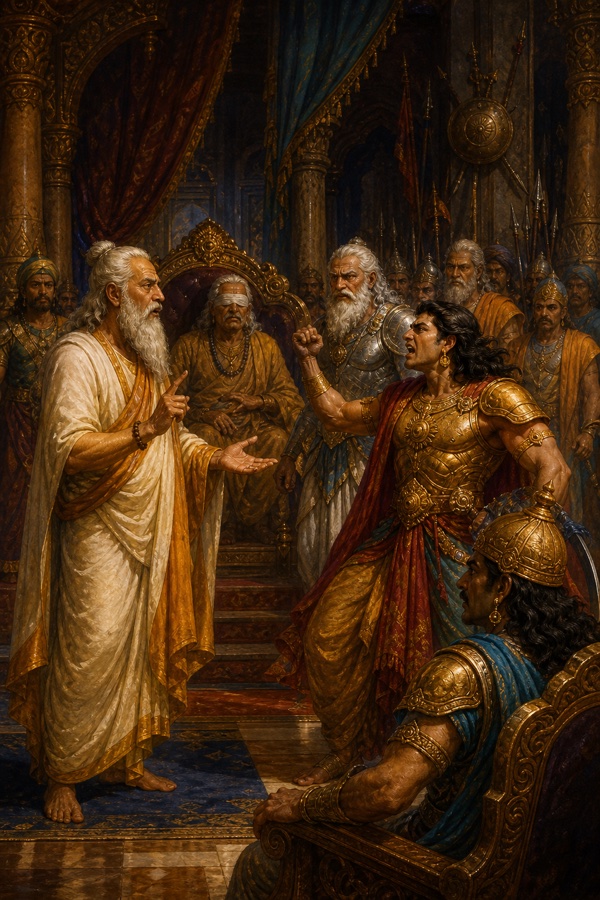
Dhritarashtra intervened. He appealed to Bhishma to be calm and rebuked Karna. What Bhishma, the son of Shantanu, had said was beneficial to the Kurus, the Pandavas, and the whole world. Dhritarashtra would deliberate and send Sanjaya to the sons of Pandu. The priest need not wait for that decision; he should return to Yudhishthira that very day. Dhritarashtra honored him and sent him back to the Pandavas. Then he summoned Sanjaya to the council hall. Drupada’s representative had stated the inheritance claim, recalled the injuries, and urged settlement before the assembled military leaders. Bhishma had supported the claim and warned of Arjuna’s power. Karna had challenged the completion of the exile agreement and demanded the Pandavas’ dependence on Duryodhana. Dhritarashtra had now chosen the man who would carry his own message. Sanjaya’s mission would take the discussion from the Kuru assembly back to the brothers whose rights and strength had divided it.
A key to reading this (the competing positions): The priest argues from equal inheritance, the seizure of the Pandavas’ kingdom, and their desire for peace. Bhishma supports him. Karna disputes the fulfillment of the exile conditions and proposes life under Duryodhana’s authority. His accusation expresses his position in the dispute over fulfillment of the exile agreement.
The gist: Drupada’s priest asks the Kurus to restore the Pandavas’ inheritance and avoid war. Bhishma agrees and warns of Arjuna’s strength. Karna invokes the dice agreement, and Bhishma reminds him of Arjuna’s defeat of 6 warriors. Dhritarashtra dismisses the priest with honor and summons Sanjaya to carry his response.
Dhritarashtra Sends Sanjaya: The Pandavas’ Strength and Yudhishthira’s Anger
Dhritarashtra told Sanjaya that the Pandavas had reportedly reached Upaplavya. He was to go there and ask after their welfare. To Yudhishthira, whom the king called Ajatashatru, he should express gladness that the years in the forest had ended and that he had reached such a city. To all the brothers he should convey concern for their well-being after an ordeal they had never deserved. Dhritarashtra believed their goodness would allow them to become reconciled to him quickly, despite the treachery they had suffered. He had never found them untruthful. They had won their prosperity through their own valor and remained dutiful toward him. Even when he scrutinized their conduct, he could find no fault to blame. They kept both duty and material welfare in view. Sensual desire, cold, hunger, and thirst failed to master them; they controlled sleep, laziness, anger, elation, and heedlessness. They treated others pleasantly and gave their wealth to friends when the occasion called for it. Their friendships retained their warmth over time because they honored and rewarded each person according to merit. In the line of Ajamidha, the ancestry shared by the Kuru family, only Duryodhana and Karna hated them. Dhritarashtra condemned his son as capricious and foolish and judged Karna’s disposition still worse. By depriving the Pandavas of friends and happiness, those two had only increased their determination. Duryodhana, energetic and raised amid indulgence, imagined that everything he had done was right. The belief that he could keep the living Pandavas from their lawful share was childish. Dhritarashtra considered it wise to give Yudhishthira his due before war began. Behind that king stood Arjuna, Krishna, Bhima, Satyaki, Madri’s twin sons, and the Srinjaya warriors.
Dhritarashtra turned to the men who made those allies so formidable. Arjuna, the wielder of Gandiva, could devastate the world alone from his chariot. The victorious Krishna, whom Dhritarashtra called the undefeated lord of the 3 worlds, could do the same. Who could stand before Arjuna’s volleys? His arrows roared like clouds and covered the directions like swarms of swiftly moving locusts. Alone on his chariot with Gandiva, he had conquered the northern regions and the Northern Kurus and brought away their wealth. He had incorporated the people of Dravida into his army. At Khandava, he had defeated the assembled gods with Indra among them and made an offering to Agni, increasing the Pandavas’ fame. Dhritarashtra then considered Bhima. No wielder of the mace equaled him; no one was more skilled at riding elephants. As a chariot warrior, people said he matched Arjuna. His arms held the strength of 10,000 elephants. Trained and active, he had been made a bitter enemy of Dhritarashtra’s sons and could swiftly consume them in his anger. Even Indra could not subdue that powerful warrior in battle. Nakula and Sahadeva were generous, strong, and quick of hand. Arjuna had trained them carefully. They would leave no enemy alive, like a pair of hawks descending upon large flocks of birds. Dhritarashtra admitted that his own crowded army would amount to nothing when it met them. Dhrishtadyumna would fight beside the brothers, so closely attached to them that he was counted as one of the Pandavas. The Somaka leader and his followers were reportedly ready to give their lives for their cause. With Krishna, foremost of the Vrishnis, leading Yudhishthira, who could withstand him?
The king continued through the allies whose names had reached him. Virata, the aged ruler of Matsya, supported Yudhishthira with his sons. The Pandavas had lived with him for a time and fulfilled his wishes. Dhritarashtra also described the 5 powerful Kekaya brothers as deposed rulers seeking restoration to their homeland’s throne. They now followed the sons of Pritha, ready for war with their great bows. Brave kings from across the earth had gathered out of affection for Yudhishthira; the reports described them as bold, worthy, and respectful. Warriors from mountains and inaccessible strongholds had joined them, along with men of high lineage and advanced years and many communities Dhritarashtra called Mlechchas, armed with varied weapons. Pandya had come as well. On the battlefield he was scarcely inferior to Indra, followed by countless courageous fighters, and devoted to the Pandavas with exceptional valor and energy. Satyaki had learned weapons from Drona, Arjuna, Krishna, Kripa, and Bhishma. Dhritarashtra had heard his prowess compared with that of Krishna’s son. His attachment to the Pandavas was profound. The assembled kings of Chedi and Karusha had also committed all their resources to the brothers. That alliance led Dhritarashtra to recall Shishupala, the Chedi king whom those rulers had once greatly honored. Shishupala had shone like the sun, admired as an unassailable fighter and the foremost bowman on earth. Krishna had killed him in a moment, disregarding the boldness of the assembled warrior kings. Turning his gaze upon Shishupala and striking him down, he had increased the honor of the Pandavas.
Dhritarashtra recalled how the king of Karusha had led the rulers who honored Shishupala. They had judged Krishna invincible as he sat on his chariot, drawn by Sugriva and his other horses, and abandoned the Chedi chief. They had scattered like small animals before a lion. Shishupala, who had audaciously sought a direct contest with Krishna, lay dead like a karnikara tree uprooted by a gale. “Sanjaya, son of Gavalgana,” Dhritarashtra said, “the reports of Krishna’s work for the Pandavas, and what I remember of his earlier deeds, leave me no peace. No enemy can withstand men led by that lion of the Vrishni line. My heart trembles at the news that Krishna and Arjuna sit together on one chariot.” He spoke of them as the two Krishnas. His son could preserve his welfare by refraining from war against them. Otherwise they would consume the Kuru line as Indra and Upendra consumed the hosts of Daityas. Dhritarashtra considered Arjuna equal to Indra and Krishna to be the eternal Vishnu himself. Yudhishthira, the son of Kunti and Pandu, was brave and righteous and avoided shameful conduct. Duryodhana had wronged a king of immense energy. Only Yudhishthira’s greatness of heart had kept him from burning Dhritarashtra’s sons in his anger. Of all the dangers the king had named, Yudhishthira’s wrath frightened him most. His fear of Arjuna, Bhima, Krishna, and the twins was surpassed by that fear. Yudhishthira’s austerities were powerful; he practiced brahmacharya, the disciplined restraint associated with sacred study and observance. His heart’s wishes would surely be fulfilled. When Dhritarashtra considered his anger and recognized how justified it was, he felt alarm.
He directed Sanjaya to leave quickly by chariot for the encampment of the king of Panchala. He was to speak as Dhritarashtra’s envoy, ask Yudhishthira about his welfare, and address him repeatedly with affection. He must also meet Krishna, the magnanimous leader among brave men, convey the king’s greetings, and tell him that Dhritarashtra desired peace with the sons of Pandu. Krishna’s wishes carried exceptional weight with Yudhishthira. There was nothing the eldest Pandava would refuse to do at his bidding, the king said. Learned and constantly devoted to their cause, Krishna was as dear to the brothers as their own lives. Sanjaya must ask after all the assembled Pandavas, the Srinjayas, Satyaki, Virata, and Draupadi’s 5 sons. Dhritarashtra also gave him discretion to speak beyond these greetings. Whatever he considered timely and beneficial to the Bharata line, he should say before the assembled kings. Every word must serve that purpose without giving offense or provoking war. The king had acknowledged the brothers’ conduct, condemned his son’s judgment, and called the return of Yudhishthira’s share wise. His instructions to Sanjaya ended with the manner and purpose of the embassy: affectionate speech, the welfare of the family, and the prevention of war.
A key to reading this (the king’s assessment): The military judgments and recollections here belong to Dhritarashtra’s speech to Sanjaya. He acknowledges the Pandavas’ right to their share and regards Yudhishthira’s anger as justified. His final instructions give the envoy room to speak for the family’s welfare while carefully avoiding words that could provoke war.
The gist: Dhritarashtra praises the Pandavas’ conduct and reviews the power of their warriors and allies. Krishna and Arjuna together terrify him, while Yudhishthira’s justified anger troubles him most. He sends Sanjaya to Upaplavya with greetings and a declaration that he wants peace, directing him to speak affectionately and protect the Bharata family from war.
Sanjaya Arrives at Upaplavya: Yudhishthira Asks What the Kurus Remember
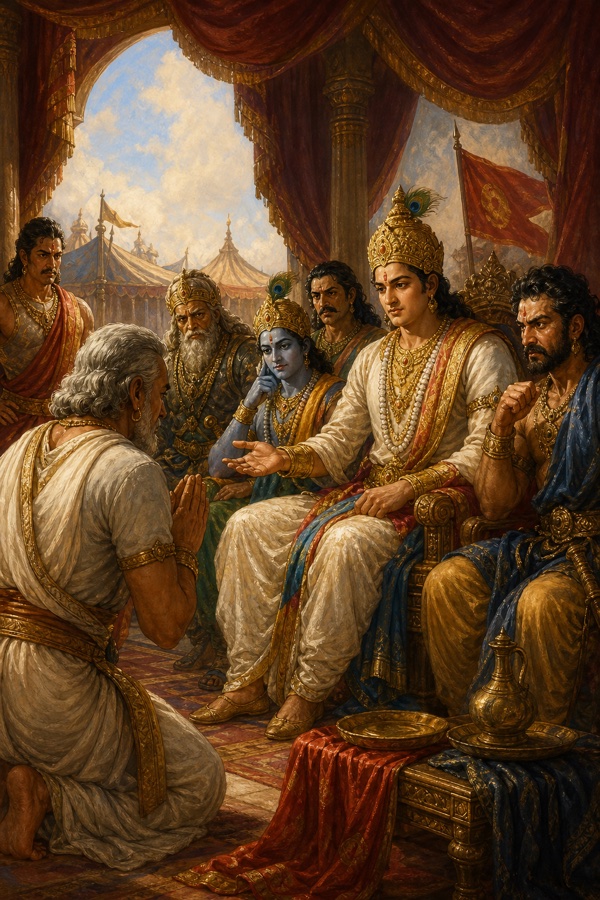
Sanjaya traveled to Upaplavya after receiving Dhritarashtra’s instructions. Approaching Yudhishthira, he first bowed and then delivered his greeting. He was the son of Gavalgana, a man of Suta lineage serving as the king’s messenger. He expressed his happiness at seeing Yudhishthira healthy, surrounded by friends, and almost the equal of Indra. Dhritarashtra, the aged and wise son of Ambika, had asked after his welfare. Sanjaya also asked whether Bhima, Arjuna, and Madri’s 2 sons were well. His inquiry extended to Draupadi, whom he called Krishnaa, the daughter of Drupada. She was truthful, powerful in spirit, and the wife of heroes. Were she and her sons well? She was the center of the brothers’ dearest happiness, the woman for whose welfare they continually prayed. Yudhishthira welcomed the envoy and asked whether his journey had been safe. He was glad to see him. He and his younger brothers were in excellent health. It had been a long time since he had received news of the aged Kuru king, and Sanjaya’s arrival made him feel almost as happy as if he had seen Dhritarashtra himself. He began asking about the people Sanjaya had left behind, naming the elders and warriors whose lives remained bound to his own family.
Was their grandfather Bhishma well? Did he retain his old habits and continue in the duties of his order, with the energy and wisdom for which he was known? Was Dhritarashtra, son of Vichitravirya, healthy with his sons? Was the learned king Bahlika, son of Pratipa, well? Yudhishthira asked about Somadatta, Bhurishravas, Satyasandha, Shala, Drona and his son, and the Brahmin Kripa. Were these great bowmen free from illness and receiving the honors they deserved? Their learning, intelligence, and mastery of weapons placed them among the foremost warriors, and all had attached themselves to the Kurus. Yudhishthira spoke warmly of Drona’s son: fortunate were the people in whose kingdom such a powerful, handsome, well-behaved archer lived. He asked after Yuyutsu, Dhritarashtra’s intelligent son by his Vaishya wife, and after Karna, whose advice the foolish Duryodhana followed. His questions then moved through the royal household. Were the elderly women, the mothers of the Bharata line, free from trouble? What of the girls who worked in the kitchens, the bondwomen, the daughters-in-law, the boys, the sisters and their sons, and the sons of the household’s daughters? His concern included those whose daily lives were spent in service as well as those who belonged to the ruling family.
Yudhishthira next asked about the Brahmins supported by the court. Did the king continue their former allowances? Had Duryodhana left intact the gifts Yudhishthira himself had made to them? Did Dhritarashtra and his sons respond patiently even when Brahmins behaved overbearingly? He hoped the family had continued to provide for them. In Yudhishthira’s account of royal duty, that provision was the direct road to heaven and a clear light given by the Creator to living beings. He warned that abandoning such forbearance would bring wholesale destruction upon the Kurus. Were the king and his son also providing for state officials? Were there hidden enemies passing as friends and plotting their ruin? Did anyone among the Kurus accuse the Pandavas of wrongdoing? Did Drona, his son, or Kripa speak of them as guilty? Did the Kuru people regard Dhritarashtra and his sons as protectors of their clan? The questions reached from maintenance and patronage to the court’s judgment of the absent brothers. Yudhishthira then asked whether the sight of marauders reminded the Kurus of Arjuna, who took the lead in battle. Did they remember the arrows from Gandiva, driven in a straight course through the air by the drawn string against his fingers, sounding like thunder? Yudhishthira had never seen anyone equal or superior to the warrior who could release 61 keen, sharpened, well-feathered shafts in a single movement of his hand.
Did they remember Bhima, whose swift attacks made an army drawn up for battle tremble like a reed bed shaken by an elephant in musth? Did they remember Sahadeva, who had conquered the Kalingas at Dantakura while shooting with both his left and right hands? And Nakula, dispatched in Sanjaya’s presence to conquer the Shibis and Trigartas, who had brought the western region under Yudhishthira’s authority? The names recalled service and conquest performed before the brothers’ exile. Yudhishthira followed them with a more personal debt. Did the Kurus remember their humiliation in Dvaitavana? Acting on bad advice, they had gone to the forest under the pretext of taking away their cattle. Their enemies had overpowered them, and Bhima and Arjuna had secured their release. Yudhishthira recalled the positions the brothers had held in the fighting: he had guarded Arjuna’s rear, and Bhima had guarded Madri’s sons. Arjuna had killed many of the opposing force and emerged unharmed from the press of battle. Did the Kurus remember that rescue? “A single good deed cannot secure happiness here, Sanjaya,” Yudhishthira said. “All our efforts have failed to win over Dhritarashtra’s son.” The welcome had carried his affection for the old king and his concern for the people of the Kuru household. His final questions asked whether that household retained any gratitude for what the brothers had done.
A key to reading this (the purpose of the questions): Yudhishthira asks about health, household welfare, patronage, and the support of state officials before turning to the Pandavas’ reputation and service. The Dvaitavana rescue is his recollection of a benefit conferred on the relatives now opposing him.
The gist: Sanjaya greets the Pandavas and asks after Draupadi and her sons. Yudhishthira welcomes him, inquires about the Kuru elders, warriors, household, and dependents, then recalls his brothers’ victories and their rescue of the Kurus in Dvaitavana. He ends with the pain of having failed to win Duryodhana’s goodwill.
Sanjaya Pleads for Peace: What Is Victory Worth After the Family Is Dead?
Sanjaya answered that the leading Kurus about whom Yudhishthira had asked were healthy and in good spirits. Around Duryodhana stood both righteous elders and sinful, ill-intentioned men. As for the grants to Brahmins, Duryodhana gave gifts even to enemies; Sanjaya considered it unlikely that he would withdraw those donations. He then challenged a custom of the warrior order. Kshatriyas followed a rule fit for butchers, he said, when they harmed people who bore them no ill will. Such conduct was wrong. If Dhritarashtra and his sons treated the righteous Pandavas with hostility, they would incur the sin of creating division within their own family. The old king disapproved of the injury done to them, Sanjaya said. It caused him deep sorrow. After consulting Brahmins, he had learned that provoking conflict among relatives was the greatest of sins. Sanjaya also assured Yudhishthira that the Kurus remembered the brothers’ strength. They remembered Yudhishthira’s deeds and Arjuna’s leadership in battle. They remembered Bhima with his mace when the sounds of conches and drums rose to their greatest pitch. They remembered Madri’s sons driving fearlessly in every direction, sending unceasing showers of arrows into the enemy ranks.
Sanjaya reflected that no one could know what the future held for a particular person. Yudhishthira possessed every virtue and had nevertheless endured almost unbearable suffering. His intelligence, the envoy believed, would enable him to recover what had been lost. The Pandavas, each as powerful as Indra, would never give up righteousness for pleasure. Sanjaya urged Yudhishthira to use that judgment to secure peace for Dhritarashtra’s sons, Pandu’s sons, the Srinjayas, and all the kings gathered there. He then asked him to listen carefully to what Dhritarashtra had said after consulting his sons and ministers. Yudhishthira invited him to speak before everyone. The Pandavas, Srinjayas, Krishna, Yuyudhana, and Virata were present. Sanjaya greeted Yudhishthira, Bhima, Arjuna, and the twins; Krishna of Shura’s line; Satyaki; the aged king of Panchala; and Dhrishtadyumna of Prishata’s line. His salutations gathered the leaders of the alliance into the audience for the formal message. He spoke, he told them, out of concern for the welfare of the Kurus.
Dhritarashtra had welcomed the prospect of peace so eagerly that he had hurried the preparation of Sanjaya’s chariot. The envoy hoped Yudhishthira, his brothers, sons, and relatives would receive that purpose favorably. He urged the sons of Pandu to choose peace. They were steadfast, gentle, honest, compassionate, and generous. Their noble birth and their reluctance to commit shameful acts made a base action unworthy of them. They understood what duty required, and the great army at their command placed immense consequences within their power. A sinful deed would stain their fair reputation like a drop of black eye cosmetic on white cloth. Who would knowingly undertake an act that slaughtered people everywhere, brought sin and hell upon its authors, and left victory and defeat with the same value? Sanjaya praised those who served their relatives’ welfare. The true sons, friends, and kinsmen of the Kuru family were those prepared to give their lives for its good. Life itself could be misused in wrongdoing; it could also be offered for the family’s protection. Suppose the Pandavas defeated and killed all their enemies in order to punish the Kurus. The life left to them afterward would be equivalent to death. Sanjaya asked what living could mean after all one’s relatives had been killed. He pressed the question upon men whose military strength he had just acknowledged: what kind of existence would their success leave behind?
The envoy then named the warriors protecting both sides. Krishna, Chekitana, and Satyaki aided the Pandavas, while Dhrishtadyumna’s arms guarded them. Even Indra with all the gods would find such an alliance impossible to defeat. The Kurus, in turn, were protected by Drona, Bhishma, Ashvatthama, Shalya, Kripa, and Karna, along with a host of warrior kings. Who could overcome them? Who could destroy the enormous army assembled by Duryodhana without suffering loss himself? Sanjaya could see no good outcome in either victory or defeat. He appealed again to the Pandavas’ sense of lineage and conduct, asking how the sons of Pritha could act unrighteously like the base, low-born people of his comparison. Then he offered his own supplication. He bowed before Krishna and the aged king of Panchala, Drupada, and sought their protection with joined hands so that the Kurus and the Srinjayas could both benefit. He trusted that Krishna and Arjuna would respect his words. Either man, if entreated, would be prepared to give his life. He was speaking for the success of his mission. Dhritarashtra and his counselor Bhishma desired a lasting peace between the two sides. Sanjaya’s formal appeal ended with that request, addressed to the leaders whose consent could avert the destruction he had described.
A key to reading this (the life left after victory): Sanjaya acknowledges the Pandavas’ strength and then names the powerful defenders of the opposing army. His argument concerns the losses a war within the family would inflict even upon its victors. Dhritarashtra’s remorse and the moral case against fighting are presented through his envoy’s appeal.
The gist: Sanjaya reports that the Kurus are well and says Dhritarashtra grieves over the wrong done to the Pandavas. Before the assembled allies, he urges peace, arguing that a victory purchased by the deaths of relatives would leave a ruined life. He bows before Krishna and Drupada and asks for a lasting settlement.
Yudhishthira’s Answer: Peace Requires the Return of Indraprastha
Yudhishthira asked Sanjaya what he had said to make the envoy fear that he wanted war. Peace was preferable. Given another means of obtaining what he sought, who would choose to fight? A person whose wishes could be fulfilled without effort would scarcely choose even a small exertion, he argued. War carried a far heavier burden. Who was so afflicted by the gods that he would willingly select it? The sons of Pritha desired happiness, but their conduct served righteousness and the welfare of the world. They wanted the happiness that came through rightful action. Someone who followed his senses in pursuit of pleasure and escape from pain could become entangled in actions whose substance was suffering. The craving for enjoyment exhausted the body; freedom from craving removed that source of distress. Yudhishthira compared desire to a fire fed with fresh fuel. Acquiring the desired object made the longing stronger, as clarified butter poured upon fire intensified its flame. He asked Sanjaya to compare Dhritarashtra’s abundant pleasures with the brothers’ possessions. Misfortune denied a person victory, music, garlands, fragrances, cooling scented ointments, and fine clothing. Had their fortunes been otherwise, the Pandavas would never have been driven away from the Kurus. Still, no one welcomed torment of the heart. For all the king’s prosperity, he now found himself in trouble and sought protection in the strength of others.
Yudhishthira called that dependence unwise. Let Dhritarashtra receive the treatment he had given others. A man who threw fire into a forest of thick undergrowth at midday in spring would have cause to grieve when the wind spread the blaze and he needed to escape. The king’s present distress had grown from his early acceptance of his son’s crooked and foolish advice. Duryodhana had treated Vidura’s words as the words of an enemy, though Vidura was his greatest well-wisher. Dhritarashtra had knowingly entered an unrighteous course to satisfy his sons. His attachment had made him disregard the wisest man among the Kurus: a learned, skillful speaker who acted justly and sincerely desired his welfare. Yudhishthira then described the son whose approval the king sought. Duryodhana demanded honor while remaining envious and angry. He violated the principles governing duty and the acquisition of wealth, used abusive language, and obeyed his anger. His mind was absorbed in sensual pleasures. He bore hostility toward many people, observed no restraint, and lived badly, with an implacable heart and corrupt judgment. For this son, Yudhishthira said, Dhritarashtra had deliberately abandoned both righteousness and happiness.
Even during the dice game, Yudhishthira had sensed that the Kurus were approaching destruction. Vidura had spoken wisely and well, and Dhritarashtra had given him no acknowledgment. Trouble had begun when the family disregarded that counsel. While Vidura’s judgment had guided them, their kingdom had prospered. Yudhishthira named the men now advising the covetous Duryodhana: Duhshasana, Shakuni the son of Subala, and Karna, the Suta’s son. He asked Sanjaya to consider the folly. Dhritarashtra had taken another’s throne, and the farseeing Vidura had been sent away. Under those conditions, Yudhishthira could see no path to prosperity for the Kurus and Srinjayas. The old king and his sons sought extensive, uncontested sovereignty over the whole world. That ambition prevented a complete peace. Dhritarashtra regarded everything already in his possession as his own. Karna imagined that Arjuna could be resisted once he took up his weapon in battle. Yudhishthira asked what help Karna had provided in the great battles that had already occurred. Karna, Drona, Bhishma, and the other Kurus knew that no archer equaled Arjuna. The assembled kings knew how Duryodhana had acquired his rule while that formidable opponent remained alive.
Duryodhana himself had gone to the battlefield and witnessed what Arjuna could do with a bow 4 cubits long as his weapon. Yet he persisted in believing that the sons of Pandu could be deprived of their own property. Dhritarashtra’s sons still lived, Yudhishthira said, because they had yet to hear the drawn Gandiva ring against them. Duryodhana imagined his purpose accomplished while the sight of an angry Bhima remained before him only as a possibility. As long as Bhima, Arjuna, the heroic Nakula, and the patient Sahadeva lived, even Indra would hesitate to rob the Pandavas of their sovereignty. The old king and his son nevertheless imagined that the family’s princes would survive the fiery anger of Pandu’s sons on the battlefield. Yudhishthira had begun by rejecting the desire for war. His account of the forces available to him made clear the consequence he foresaw if the dispossession continued. The brothers’ restraint had allowed their relatives to remain secure; he questioned the assumption that this security would survive a battle.
He returned to Sanjaya’s personal knowledge of what had happened between the two branches of the family. The envoy knew the misery the Pandavas had endured. He knew their dealings with the Kuru princes and the way they had behaved toward Duryodhana. Out of respect for Sanjaya, Yudhishthira was prepared to forgive them all. He wanted the relationship to continue and would seek peace as Sanjaya advised. He ended with the concrete request that accompanied that willingness. “Let Indraprastha be my kingdom,” he said. “Let Duryodhana give it to me.” The envoy’s appeal had asked him to consider the life left after a victory over relatives. Yudhishthira’s answer offered forgiveness and a continued family relationship, together with the restoration of the seat of his rule. Indraprastha was the place named in his proposal, the kingdom whose return would give substance to the peace Sanjaya sought.
A key to reading this (a specific peace proposal): Yudhishthira rejects the suggestion that he desires war and agrees to forgive the past out of respect for Sanjaya. His request for Indraprastha accompanies that offer. He identifies the rejection of Vidura’s counsel and Duryodhana’s expanding appetite for power as causes of the present danger.
The gist: Yudhishthira prefers peace and happiness gained through rightful conduct. He blames Dhritarashtra’s attachment to his son and neglect of Vidura’s advice for the crisis, then reminds Sanjaya of the Pandavas’ strength. He offers forgiveness and continued relations if Duryodhana restores Indraprastha.
Sanjaya Urges Renunciation: Yudhishthira Asks Krishna to Judge His Duty
Sanjaya answered Yudhishthira’s request for Indraprastha by pressing the case for giving up the struggle. The world knew his conduct to be righteous, and Sanjaya had seen the truth of that reputation. Human life passed quickly and could end in lasting disgrace. Yudhishthira should consider that danger before allowing himself to be destroyed. If the Kurus would surrender his share only after a war, Sanjaya believed he would fare better living on alms in the kingdom of the Andhakas and Vrishnis. Sovereignty won through such fighting would cost too much. Mortal existence was brief, unstable, continually exposed to suffering and blame. A good name had greater value. Desires fastened themselves to people and obstructed a virtuous life; a wise person would overcome them early and earn an unblemished reputation. The hunger for wealth acted like a fetter, injuring the virtue of those who pursued it. Increasing wants brought losses even in worldly affairs. Someone who placed righteousness first shone like the sun in its strength. Someone corrupt could possess the entire earth and still be ruined. Yudhishthira had studied the Vedas, practiced the discipline of sacred learning, performed sacrifices, and made gifts to Brahmins. He had also spent years pursuing pleasure while keeping the highest attainable state in mind. Excessive indulgence, without the discipline of meditation, made a person vulnerable to misery. When his money was gone, pleasure deserted him, while the habits of desire continued driving him toward the enjoyment he had lost. A person who abandoned self-restraint and righteousness for wrongdoing, without faith in a life beyond death, would face suffering after leaving the body.
Good and evil deeds survived their maker, Sanjaya continued. They traveled ahead into the next world; the person who had performed them followed their course. He praised Yudhishthira’s past deeds through an image of ritual generosity: fragrant, delicious food reverently offered to Brahmins at ceremonies accompanied by generous payments to the officiating priests. Those deeds had already prepared his future welfare and won the approval of righteous people. Action belonged to the period in which the body endured. After death, the time for doing that work was over. Sanjaya described the blessed realm earned by good deeds as free of death, aging, fear, hunger, thirst, and everything distressing to the mind. There one had nothing further to accomplish beyond enjoyment. With such a result already secured, Yudhishthira should avoid fresh action driven by desire. He should preserve truthfulness, self-control, straightforwardness, and compassion. He could perform the Rajasuya, the royal consecration sacrifice, and the Ashvamedha, the horse sacrifice; he must keep away from an act inherently sinful. If hatred now led the brothers to commit that act, their years of hardship in the forest for the sake of duty would have been wasted. They had relinquished an army already under their command. Krishna and Satyaki had been available then, as had Virata of Matsya with his golden chariot and his son among the fighting men. The kings previously conquered by the Pandavas would also have supported them. With immense resources, a feared army, and Krishna and Arjuna behind him, Yudhishthira could have defeated his leading enemies at the outset and broken Duryodhana’s pride.
Why, Sanjaya asked, had he allowed his enemies to grow stronger and his friends weaker? Why spend years in the forest, then seek battle after the right moment had passed? An unwise or unrighteous man might gain prosperity through fighting. A wise man who understood his obligations and acted against that understanding would leave the path of well-being. Yudhishthira’s judgment had never inclined toward unrighteousness; anger had never driven him into a sinful act. What reason could now make him contemplate action against the counsel of wisdom? Sanjaya described anger as a bitter medicine unrelated to the treatment of illness, something that afflicted the head, robbed a person of a good name, and bore the fruit of sin. Good people could swallow that bitterness and master it. He asked Yudhishthira to do so and abandon war. Forbearance promised him a greater benefit than pleasures bought at the cost of his relatives’ deaths. Sanjaya named those who would be killed: Bhishma, Drona and his son, Kripa, Somadatta’s son, Vikarna, Vivimshati, Karna, and Duryodhana. What happiness would their deaths bring? Even mastery of the earth to its surrounding sea would leave Yudhishthira subject to age and death, pleasure and pain, happiness and misery. If he wished to fight simply because his advisers wanted it, he should hand everything over to them and leave. He must remain on the path leading toward the divine realm. The envoy had carried his appeal as far as a proposal that Yudhishthira abandon his claim and live by charity.
Yudhishthira agreed that righteous action stood foremost among human undertakings. He asked Sanjaya to determine whether his own conduct was right or wrong before condemning it. Wrongdoing could take on the appearance of duty, while duty could appear wrong; at other times it appeared in its recognizable form. Learned people had to discriminate through reason. Although virtue and vice were enduring realities, conditions of distress could change their outward appearance. In ordinary circumstances, a person should follow the duties assigned to the social order of his birth. A crisis required a different consideration. Someone whose livelihood had entirely disappeared could seek another means of support in order to fulfill his rightful obligations. A person with adequate means who behaved as if destitute deserved blame; so did a destitute person who acted as though circumstances were normal. Yudhishthira pointed to the provision of expiation for Brahmins who, unwilling to destroy themselves, took up work ordinarily forbidden to them. The existence of that remedy showed that emergency conditions could permit actions outside an order’s usual rules. A person who maintained ordinary duties in ordinary times deserved respect, as did one who adapted them in distress. Abandoning those duties without necessity, or clinging to their ordinary form when necessity demanded a change, deserved censure. Those seeking to master the mind and know the self could undertake the practices prescribed for Brahmins. Those outside that order who were not seeking such knowledge should follow the duties of their own order, with the appropriate distinctions between ordinary life and emergency. His father, grandfather, and earlier ancestors had followed this path, Yudhishthira said. Even those who sought knowledge and withdrawal from action accepted that view as consistent with sacred tradition. He could see no other path.
He would seek no gain through unrighteous means: neither the wealth of the earth, nor that of the gods, nor realms beyond their reach, whether the region of Prajapati, heaven, or Brahma’s own abode. Krishna was present to judge the question before them. He was skillful, discerning, intelligent, experienced in serving Brahmins, and a counselor to many powerful kings. He sought the welfare of both sides. Let him say whether Yudhishthira deserved condemnation for dismissing the prospect of peace, and whether fighting would violate the duties of his warrior order. Yudhishthira named the people who followed Krishna’s counsel in overcoming enemies and supporting friends: Satyaki, the Chedis, Andhakas, Vrishnis, Bhojas, Kukuras, and Srinjayas. Under Ugrasena, the Vrishnis and Andhakas had flourished through Krishna’s leadership, becoming truthful, vigorous, powerful, and happy, comparable in spirit to Indra. Vabhru, king of Kashi, had gained the highest prosperity through having Krishna as his brother. Krishna, the fulfiller of wishes, showered blessings upon him as clouds refreshed living creatures after the hot season. Such was the man Yudhishthira trusted to distinguish the propriety of an action from its opposite. Krishna was dear to the brothers and preeminent among men. Yudhishthira never disregarded his words. The question now rested with the counselor whose concern, he insisted, extended to both camps: what did duty require in the actual circumstances confronting them?
A key to reading this (duty in a crisis): Sanjaya argues for restraint, forgiveness, and renunciation. Yudhishthira asks how the duties of a ruler apply when he has been deprived of his means of fulfilling them. His distinction between ordinary duty and emergency duty leads him to request Krishna’s judgment of their particular situation.
The gist: Sanjaya urges Yudhishthira to accept life on alms if recovering his kingdom requires war, and to master the anger that could destroy his relatives. Yudhishthira distinguishes ordinary obligations from duties under distress, rejects gain through wrongdoing, and asks Krishna whether fighting would violate his duty.
Krishna Answers: Action, a King’s Duty, and the Pandavas’ Inheritance
Krishna told Sanjaya that he wanted the sons of Pandu to survive, prosper, and attain their wishes. He also wished prosperity for Dhritarashtra and his many sons. He had always wanted peace to be acceptable to the old king and considered it right for the Pandavas as well. Yudhishthira had shown an unusually peaceful disposition throughout the dispute. With Dhritarashtra and his sons so covetous, however, hostility was bound to grow. Sanjaya could hardly claim greater knowledge of right and wrong than Krishna or Yudhishthira possessed. Why, then, was he reproaching a king who was active, attentive to his duties, and concerned from the beginning for his family’s welfare? Krishna acknowledged the different teachings advanced by Brahmins. Some held that one’s condition in the next world depended on action; others urged withdrawal from action and liberation through knowledge. He brought the question to the level of hunger. Knowing what could be eaten would leave a hungry person unsatisfied until he actually ate. Knowledge that helped bring action about bore fruit. The effect of action could be seen directly: someone thirsty drank, and his thirst subsided. That was an act with a demonstrable result. Krishna judged the words and deeds of anyone who dismissed the efficacy of action in favor of something else to be empty.
The gods themselves flourished through action. Wind blew through it. The tireless sun rose each day, maintaining day and night, and the moon traveled through months, fortnights, and its combinations with the constellations. Fire kindled and burned for human benefit. The ever-wakeful earth sustained its enormous burden. Rivers continually carried their waters to satisfy living creatures. Indra poured down rain, filling the heavens and directions with sound. To become foremost among the gods, he had practiced austerities in the disciplined manner of a Brahmin. He had relinquished pleasure and cherished duty, truth, self-control, forbearance, impartiality, and compassion. Through that sustained work he had attained the highest divine sovereignty. Brihaspati had likewise followed the Brahmin’s ascetic discipline with concentration and restraint, giving up pleasures and mastering his senses until he became the gods’ teacher. The constellations, Rudras, Adityas, Vasus, Yama, Kubera, Gandharvas, Yakshas, and apsaras had all reached their positions through action. The sages shone in the next world through study, austerity, and work together. Sanjaya knew that the best Brahmins, Kshatriyas, and Vaishyas followed this rule. Why was he applying his wisdom in the present manner on behalf of the Kuru princes? Yudhishthira studied the Vedas continually and wished to perform the Ashvamedha and Rajasuya. He also rode horses and elephants, wore armor, mounted a chariot, and took up the bow and other weapons. His study and sacrificial duties existed alongside the practical obligations of a warrior king.
If the Pandavas could find a course that spared the Kuru princes, Krishna said, they would adopt it. Their righteousness would be preserved, and the act would earn religious merit, even if they had to compel Bhima to show mercy. If, in carrying out the duties their ancestors had performed, unavoidable fate brought them death, their utmost effort to fulfill those duties would make such a death honorable. Sanjaya’s insistence on peace therefore required an answer to a specific question: what did sacred law require of a king when fighting became an issue? He must consider the duties assigned to the 4 social orders, hear the course the Pandavas intended to follow, and then offer praise or blame. Krishna set out the prescriptions. A Brahmin should study, sacrifice, give gifts, and visit the finest sacred places. He should teach, serve as priest for worthy people performing sacrifices, and accept gifts from people known to him. A Kshatriya should protect the people according to law, practice generosity diligently, perform sacrifices, study the whole Veda, marry, and lead a righteous household life. With a virtuous disposition and the practice of sacred virtues, he could attain the religion of the Supreme Being. A Vaishya should study and work to earn and accumulate wealth through trade, farming, and tending cattle. He should satisfy Brahmins and Kshatriyas, practice virtue and good works, and maintain a household. In the ancient rules Krishna recounted, a Shudra was to serve and obey Brahmins; study and sacrifice were forbidden to him. He should remain diligent and enterprising in work for his welfare. The king’s obligation encompassed all these people. He must protect them carefully and see that each fulfilled the duties assigned to that order.
Krishna then specified the restraints upon the king himself. He must avoid absorption in sensual pleasure and treat his subjects impartially, on an equal footing. Desires opposed to righteousness must never govern his decisions. If another person was more praiseworthy than the king, renowned and endowed with every virtue, the king should direct his subjects toward that person. A bad king would fail to understand this. Growing powerful and cruel, he would become a target of fate’s anger and cast covetous eyes upon others’ wealth. War followed such conduct. Weapons, armor, and bows had come into use for that purpose; Krishna attributed their invention to Indra, who devised them to kill plunderers. Putting robbers to death, in this account of royal duty, earned religious merit. The Kurus’ disregard of law and righteousness had already produced terrible evils. Dhritarashtra and his sons had taken what rightfully belonged to Yudhishthira, ignoring the immemorial obligations of kings, and the rest of the Kurus had followed them. A thief who stole in secret and a man who seized property openly by force both deserved condemnation. Krishna asked what distinguished Dhritarashtra’s sons from them. Greed made the ruling party call its own angry intentions righteous. The Pandavas’ share was fixed. Why should a fool seize it?
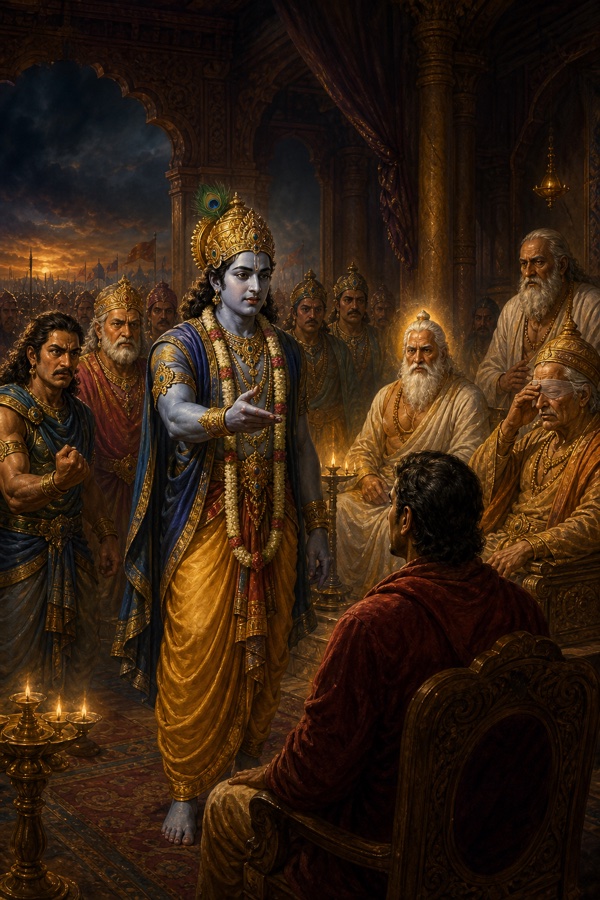
In those circumstances, Krishna said, even death in battle could be praiseworthy for their side. Their ancestral kingdom had a stronger claim upon them than sovereignty obtained as a gift from a stranger. Sanjaya should state these old principles before the Kurus and the kings Duryodhana had assembled. Krishna described those rulers as fools already caught in death’s grasp. He then asked the envoy to look again at the worst of their acts: their conduct in the assembly hall. The argument had moved from the necessity of action to the obligations of a ruler, and from those obligations to the particular property the Kuru princes had taken. Krishna now turned Sanjaya’s attention to the public wrongdoing that had accompanied the brothers’ dispossession, an event in which the court’s response could be judged through what its members had actually done.
A key to reading this (action and royal responsibility): Krishna defends the necessity of action before reciting the duties of the social orders in the account’s inherited framework. He then applies the ruler’s obligations of impartial protection and restraint to the seizure of the Pandavas’ property. The social prescriptions and the argument for punishing plunder belong to his speech.
The gist: Krishna wants both sides to prosper and rejects Sanjaya’s reproach of Yudhishthira. He argues that knowledge bears fruit through action and explains the duties of the social orders and their king. Taking the Pandavas’ fixed share violates those duties, he says, and Sanjaya must present that argument to the Kuru court.
Krishna Recalls the Assembly’s Abuse: A Peace Mission and the Forest’s Tigers
Krishna asked Sanjaya to remember what the Kurus had allowed in their assembly hall. Bhishma had stood at their head. Before the gathered elders and younger men, Drupada’s daughter, the beloved wife of the Pandavas, had been seized while she wept. Her life was pure, her conduct honorable, her reputation respected. Those present had failed to intervene. Had they prevented that outrage, Krishna said, he would have approved of Dhritarashtra’s conduct, and the old king’s sons would have benefited in the end. Duhshasana had dragged Draupadi into a public hall where the elders of her husbands’ family were seated. She had expected sympathy and found support from Vidura alone. The other kings had offered no word of protest. Krishna condemned their silence as folly. Vidura had opposed Duryodhana from a sense of duty, speaking words founded on righteousness. Sanjaya had offered no lesson in law or morality then. Now he had come to instruct Yudhishthira. Draupadi herself, whom Krishna called Krishnaa, had saved the situation in that hall. Like a vessel carrying people through the sea, she had rescued both herself and the Pandavas from the surrounding disaster.
Krishna recalled Karna’s words to her before those family elders. Karna had told her she had no refuge and should go as a bondwoman to Duryodhana’s house. Her husbands had been defeated and counted for nothing now. She should choose another husband for her affections. Krishna compared the speech to a verbal arrow: sharp, terrifying, destroying hope and striking the most vulnerable place. It had lodged deep in Arjuna’s heart. Duhshasana had added his own taunt when the Pandavas were about to put on garments of black deerskin. He had called them wretched eunuchs, ruined and condemned to a long period of misery. Shakuni, the king of Gandhara, had used a calculated provocation during the dice game: he had won Nakula, he told Yudhishthira; what remained? Yudhishthira should stake Draupadi. Sanjaya knew all these abusive words, Krishna reminded him. The envoy’s appeal to forgiveness had to be heard alongside the insults whose consequences the brothers still carried. Arjuna’s wound from Karna’s speech was part of that account, as were Draupadi’s isolation and Vidura’s solitary protest.
Krishna then expressed his wish to go personally to the Kurus and settle the difficult matter. If he could establish peace while preserving the Pandavas’ cause, he would accomplish a righteous act with far-reaching blessings. The Kurus would also be freed from the net of death closing around them. He hoped Duryodhana would listen when he spoke in person with wisdom, sound meaning, and concern founded upon duty, entirely free of cruelty. He hoped the Kuru court would receive him with due respect. If it failed to do so, Sanjaya should understand what would follow: the sons of Dhritarashtra, already scorched by their own wrongdoing, would be consumed by Arjuna and Bhima prepared for battle. They had spoken harshly when the Pandavas lost at dice. At the proper time, Bhima would remind Duryodhana of those words. Krishna’s proposed visit thus offered an opportunity to settle the dispute while there was still time. Its purpose included protection of the Pandavas’ interests, and his warning set out the consequences he foresaw if the opportunity failed.
He gave Sanjaya a pair of images to carry back. Duryodhana was a great tree of corrupt passions. Karna formed its trunk, Shakuni its branches, and Duhshasana its abundant flowers and fruit. Dhritarashtra was its root. Yudhishthira was a great tree of righteousness, with Arjuna as its trunk, Bhima as its branches, and Madri’s sons as its flowers and fruit. Its roots were Krishna himself, righteousness, and righteous people. The relationships within each alliance gave the tree its structure, from the support beneath it to the fruit it produced. Krishna then turned to the relationship between the branches of the Kuru family. Dhritarashtra and his sons were a forest; the Pandavas were its tigers. The forest must be preserved with its tigers, and the tigers must be allowed to remain within it. A tiger driven out of the woods could easily be killed. A forest emptied of tigers could easily be cut down. The tiger protected the forest, and the forest sheltered the tiger. Krishna added another comparison: Dhritarashtra’s sons were creepers, and the Pandavas were great sala trees. A climbing plant needed a substantial tree around which to grow.
The Pandavas were ready to serve Dhritarashtra, Krishna said, and they were ready for war. They had the strength to fight and were capable of subduing enemies, yet they remained at peace with their cousins. The old king must now decide what course was proper for him. Krishna instructed Sanjaya to convey the entire message faithfully. The description of wrongdoing, the offer to visit, the warning of battle, and the images of mutual shelter all belonged to what Dhritarashtra needed to hear. Krishna had placed the family’s dependence on its strongest members before a court that was seeking to exclude them from their inheritance. Sanjaya was to return with both the willingness to serve and the readiness to resist intact.
A key to reading this (the forest and its tigers): Krishna’s comparison makes protection reciprocal. The Pandavas need the family within which they belong, and the Kuru family needs their strength. His proposed mission seeks peace while preserving the Pandavas’ interests; their willingness to serve Dhritarashtra coexists with their readiness to fight.
The gist: Krishna recalls Draupadi’s humiliation, the court’s silence, and the insults spoken by Karna, Duhshasana, and Shakuni. He wishes to seek a settlement personally and warns of the result if it fails. Through the images of trees, creepers, a forest, and its tigers, he explains the family’s mutual dependence and tells Sanjaya to report everything faithfully.
Sanjaya Takes His Leave: Yudhishthira’s Messages of Concern
Sanjaya asked permission to depart. He wished Yudhishthira prosperity and hoped that the feelings in his own heart had carried him into no offensive speech. He also took leave of Krishna, Bhima, Arjuna, Madri’s son, Satyaki, and Chekitana. May peace and happiness remain with them; may all the kings look on him affectionately. Yudhishthira gave him leave and answered his concern with an assurance of trust. Sanjaya had never wished the Pandavas harm. Both sides knew the purity of his intentions among the people of the Kuru court. He was faithful in his office, gracious in speech, honorable in conduct, and well disposed toward the brothers. His judgment remained clear. Even harsh words could not provoke him into anger, and his own speech avoided cruelty, falsehood, bitterness, and the desire to wound. Yudhishthira knew his words carried moral weight and serious meaning. Of all the envoys who might come to the Pandavas, Sanjaya was dearest to them; Vidura was the other man they could receive with such confidence. They had once seen Sanjaya regularly. To Yudhishthira, he was a friend as dear as Arjuna. The exchange allowed the envoy to leave with the relationship between them openly affirmed, after the searching arguments he had heard and the difficult advice he had delivered.
Yudhishthira then entrusted him with greetings for the people back in the Kuru kingdom. Sanjaya was to visit the Brahmins whose discipline was study: men keeping the vows of brahmacharya, the celibate life of a student, learning the Vedas and supporting themselves through alms. He should greet the ascetics living in the forests and the elderly of other social groups, tell them Yudhishthira had remembered them, and ask about their welfare. Dhritarashtra’s priest, teachers, and ritual officiants should receive the same inquiry. Birth in a distinguished family was no requirement for inclusion. Elderly people of energy, good conduct, and strength, who remembered the Pandavas and practiced even a little righteousness according to their means, should first hear that Yudhishthira was well and then be asked how they fared. Merchants working within the kingdom and people occupying important offices of state also belonged among those whose news he wanted. He singled out Drona, the beloved teacher and counselor of the Pandavas, a man learned in duty, once a disciplined student of the Vedas, who had brought the science of weapons to renewed completeness and remained kindly disposed toward them. Drona’s son Ashvatthama was to receive an inquiry too. Yudhishthira described his learning, devotion to Vedic study and celibacy, and exceptional energy. He resembled a young Gandharva, one of the radiant celestial beings; he too had brought the knowledge of weapons to perfection. These were the qualities Yudhishthira asked the returning envoy to honor in the teacher and his son.
At Kripa’s residence, Sanjaya should bow repeatedly in Yudhishthira’s name and touch the teacher’s feet, performing the gesture of reverence on his behalf. Kripa, the son of Sharadvat, was a formidable chariot warrior and a leader among those who understood the self. Bhishma should likewise receive a greeting at his feet and hear that Yudhishthira was well. The grandfather of the Kuru family united courage, restraint from harming others, austerity, wisdom, good conduct, Vedic learning, excellence, and steadfastness. Dhritarashtra, the elderly blind king who led the Kurus, should be saluted for his learning and respect for the old. Yudhishthira next named the king’s eldest son, using the name Suyodhana. He described Duryodhana as wicked, ignorant, deceitful, and corrupt, now exercising power over the entire earth. Sanjaya should ask after him. He should also inquire after Duhshasana, Duryodhana’s younger brother, a powerful archer and a hero among the Kurus whose character followed his brother’s. Yudhishthira included their misconduct in his description of them while extending the family inquiry to both. He asked Sanjaya to salute the wise ruler of the Bahlikas, whose wish was for peace among the descendants of Bharata. Somadatta deserved reverence for his many good qualities, his judgment, and his merciful heart; affection for the Kurus led him to restrain his anger toward them. Somadatta’s son was worthy of the highest respect among their people. Yudhishthira called him a friend and a brother, an excellent archer and leading chariot warrior, worthy in every respect. His friends and counselors should be included when Sanjaya asked after him.
The younger members of the Kuru family each deserved a fitting word. They stood in the relationship of sons, grandsons, or brothers to the Pandavas, and Sanjaya should inquire after each in terms suited to that relationship. The kings gathered to fight against Yudhishthira should also hear from him. He named the Kekayas, Vasatis, Shalvakas, Ambashthas, and foremost Trigartas. There were brave men from the east, north, south, and west, and rulers from the mountain countries. Among them, all who lived honorably and were free of cruelty should receive his inquiries. The same message should reach the soldiers, the immense body of honorable men who fought from elephants, on horseback, from chariots, and on foot. Sanjaya should tell them that Yudhishthira was well and ask about their own welfare. He should remember the people who collected the king’s revenues, guarded his doors, commanded his troops, kept the accounts of income and expenditure, and constantly attended to the other important business of government. The greetings reached through the institutions of the kingdom, from rulers and commanders to the people whose everyday work sustained the court. Yudhishthira named their duties so that the envoy would carry his inquiry to them individually in their different stations.
He had special praise for Dhritarashtra’s son by his Vaishya wife. The young man belonged among the finest of the Kurus: he kept clear of wrongdoing, possessed broad understanding and every virtue, and had never felt any liking for this war. Sanjaya should ask how he was. He should ask after Chitrasena too. Yudhishthira described Chitrasena’s mastery of dice, his skill in handling them, and his tricks, which other players failed to detect. At the gaming board he was unbeatable; that reputation did not extend to the battlefield. The envoy was also to inquire after Shakuni, the king of Gandhara from the mountainous country. In deceitful gambling he had no equal. He fed Duryodhana’s pride, and his own understanding naturally inclined toward falsehood. Yudhishthira’s assessment of the men who had helped create the dispute remained explicit in the greetings he sent. The messages included people he revered, people he trusted, and people whose conduct he condemned. Each would learn that he was well, and each would be asked about his own condition. Sanjaya had been given the breadth of a royal and family inquiry to carry back with the arguments concerning the kingdom.
The gist: Yudhishthira gives Sanjaya leave with an assurance of affection and trust. He sends inquiries to students, ascetics, elders, teachers, relatives, rulers, soldiers, merchants, and officials throughout the Kuru kingdom. Duryodhana, Duhshasana, Chitrasena, and Shakuni receive greetings alongside his openly stated judgments of their conduct.
Messages for the Household, and an Offer to Settle for Five Villages
Yudhishthira asked Sanjaya to inquire after Karna, the son of Vikartana. Karna was ready to take his chariot into battle alone and defeat the Pandavas without assistance, although no one else dared attack them. Yudhishthira described him as unequaled in further deceiving people who were already deceived. Then he turned to Vidura. Sanjaya should ask after the man who remained devoted to the brothers, who had taught them and helped raise them, who stood to them as father, mother, and friend. Vidura’s understanding met no obstruction, his judgment reached far, and his counsel belonged among their most trusted resources. The elderly women of the household should receive Yudhishthira’s respects, together with the women known for their virtue and those whom the brothers regarded as mothers. Sanjaya should meet them assembled and first ask whether their living sons treated them with affection, consideration, and proper respect. Then he should tell them Yudhishthira and his sons were well. Women of the generation and family standing of the Pandavas’ wives should be asked whether they were protected, whether their good name remained unharmed, whether they lived carefully and blamelessly at home, and whether their conduct toward their fathers-in-law was kind, thoughtful, and worthy of praise. Yudhishthira urged them to maintain behavior that would win their husbands’ favor. Younger women who stood in the relationship of daughters-in-law, women of good families, good qualities, and children of their own, should all receive his affectionate greetings.
Sanjaya should embrace the daughters of the family and ask about their welfare for him. Yudhishthira wished them kind and agreeable husbands, and wished that they in turn would be agreeable to their husbands. May they have ornaments, clothing, perfume, and cleanliness; may they enjoy happiness and the pleasures of life; may their appearance be beautiful and their speech pleasant. His inquiry extended to all the women of the household, and then to its male and female servants, including those with curved spines and those who had difficulty walking. They should hear that he was well and be asked whether Duryodhana still treated them kindly and provided the comforts of life. He also remembered people with missing or impaired limbs, people with intellectual impairments, people of short stature whom Dhritarashtra supported with food and clothing out of compassion, the blind, the elderly, and those without the use of legs who moved with the help of their hands. Sanjaya should tell them Yudhishthira asked after them. They should be free of fear and discouragement despite lives so full of suffering. Yudhishthira attributed their condition to wrongdoing in previous lives; that was the explanation carried in his message. He promised to satisfy their needs with gifts of food and clothing when he had checked his enemies and brought joy to his friends. The envoy should remember those without a protector, the weak, people whose efforts to make a living came to nothing, the uneducated, and everyone in pitiable circumstances. People who had arrived from different regions seeking the protection of Dhritarashtra’s family also deserved an inquiry. Visitors who had come by choice or by invitation, and ambassadors arriving from every direction, should hear that Yudhishthira was well and be asked about their own welfare.
Yudhishthira acknowledged the strength of the warriors Duryodhana had gathered: there were none equal to them on earth. Righteousness, however, was eternal, and righteousness was the power on which he relied to overcome his enemies. Sanjaya should tell Duryodhana that the desire tormenting him, to rule the Kurus without a rival, was unreasonable and without justification. The Pandavas wished to avoid conduct that displeased him. He should restore Yudhishthira’s own Indraprastha or meet him in battle. Yudhishthira then spoke of the power of the Creator over every human being: righteous and unrighteous, young and old, weak and strong. By the Supreme Lord’s will, a child could receive knowledge and a learned person could become childish. If Dhritarashtra wanted to know the Pandavas’ strength, Sanjaya should consult freely with everyone present, establish the facts, and report everything truthfully. On reaching the Kurus, he should touch Dhritarashtra’s feet and ask about his welfare in the brothers’ name. Seated among the family, he should deliver their appeal: the sons of Pandu lived happily through the king’s power; his favor had given them a kingdom when they were young. Having granted them that kingdom, he should take care of them now, since indifference would lead to their destruction. Yudhishthira told Sanjaya that the whole realm was too much for one person’s exclusive possession. The king should hear that the brothers wished to live united with the family. He must take care to avoid defeat by enemies.
Sanjaya should bow again before Bhishma in Yudhishthira’s name. When the line of Shantanu had faced extinction, Bhishma had renewed it. The grandfather should now use his judgment to find a way for all his grandsons to live together in friendship. Vidura should be asked to counsel peace for Yudhishthira’s benefit. Duryodhana, seated among the Kurus, should receive repeated appeals despite his impatience. The brothers would quietly bear the insults he had inflicted on the innocent and helpless Draupadi before the assembly because they wished to spare Kuru lives. They had endured injuries before that outrage and after it, though they had the strength to avenge themselves. All the Kauravas knew this. They had borne exile in deerskins for the same reason. At Duryodhana’s command, Duhshasana had dragged Draupadi while disregarding Kunti; the brothers would forgive that too. Their rightful share of the kingdom still had to be restored. Duryodhana should turn his desire away from property belonging to others, and the family could be happy together in peace. The message placed forgiveness of the personal injuries beside a clear claim to the inheritance. Sanjaya had to carry both commitments to the court.
Yudhishthira offered a further concession. They wanted peace; one province of the empire would suffice. Let Duryodhana give them Kushasthala, Vrikasthala, Makandi, Varanavata, and any other place of his own choosing as the fifth. Even that would end the quarrel. For five brothers, let there be at least five villages. Yudhishthira asked Sanjaya to help establish peace between the cousins. Brothers should stand with brothers, fathers should reunite with sons, and the Panchalas should mingle with the Kurus in laughter. He wanted to see both peoples alive and well. They should make peace with joyful hearts. To Sanjaya, Yudhishthira added that he was equally capable of war and peace, prepared to acquire wealth and earn righteousness, ready for severity when required and for gentleness when appropriate. The envoy now had a precisely stated settlement to report: four places named by Yudhishthira, with the choice of a fifth left to Duryodhana. Earlier in the message, Yudhishthira had demanded the return of Indraprastha. Here he offered to end the dispute for these five villages, with the preservation of the family and its allies as his stated hope.
A key to reading this (the five villages): Yudhishthira names Kushasthala, Vrikasthala, Makandi, and Varanavata. Duryodhana may choose the fifth. Sanjaya carries this proposal as an explicit offer to end the quarrel, together with appeals to Dhritarashtra, Bhishma, and Vidura to preserve peace within the family.
The gist: Yudhishthira sends concern to the women, servants, dependents, vulnerable people, and visitors of the Kuru household. He appeals to the elders for unity and offers to forgive the insults suffered by the Pandavas and Draupadi. After demanding Indraprastha, he proposes settling the dispute for five villages, while affirming his readiness for either peace or war.
Sanjaya Returns to Hastinapura: A Stern Answer for Dhritarashtra
Vaishampayana said that Sanjaya departed for Hastinapura after the Pandavas had greeted him and given him leave. He had carried out the instructions Dhritarashtra entrusted to him. On reaching the city he went quickly to the entrance of the palace’s inner apartments. He asked the doorkeeper to tell the king that Sanjaya had just returned from the sons of Pandu. The message was urgent, but the king should be informed only if he was awake. Sanjaya wanted his arrival announced before he entered: he had something of great importance to communicate. The doorkeeper went inside, bowed, and reported that Sanjaya was waiting with a message from the Pandavas. What did the king wish him to do? Dhritarashtra told the porter to say that he was happy and well. Sanjaya should come in. He was always welcome; a man whose admission was never forbidden had no reason to remain outside. With that permission, Sanjaya entered the spacious room. Dhritarashtra, the son of Vichitravirya, sat on his throne under the protection of many wise, brave, and honorable men. Sanjaya approached with his hands joined, identified himself, and bowed. He had found the sons of Pandu, he reported. Yudhishthira sent his respects and asked whether the king was well, with his sons, grandsons, friends, counselors, and everyone who depended on him.
Dhritarashtra sent his blessing to Yudhishthira, whom he called Ajatashatru, and asked after him, his sons, brothers, and counselors. Sanjaya replied that he and his counselors were well. He wanted possession of what had once belonged to him. He sought both righteousness and material prosperity through conduct free of blame, with intelligence, extensive learning, foresight, and an excellent disposition. For Yudhishthira, avoiding harm stood even higher than righteousness, and righteousness higher than the accumulation of wealth. His mind turned toward happiness and toward actions that served life’s higher purposes. Sanjaya then offered his own assessment. Human beings moved like puppets drawn by strings, driven by a power outside themselves. The suffering of Yudhishthira made destiny seem stronger to him than human effort. The king’s conduct prompted a harsher judgment: his deeds were unworthy, deeply sinful, painful even to speak of, and certain to end in misery. A ruler acting this way could retain praise only while a capable enemy waited for his time. Like a snake shedding an old skin it could no longer keep, Yudhishthira had cast off sin and shone in his own excellence, leaving Dhritarashtra to bear the burden. The king should examine actions that violated righteousness, practical advantage, and the behavior of honorable people. He had acquired an evil reputation here and would face suffering in the next world. Following his son’s advice, he expected to enjoy property whose ownership was disputed while keeping the Pandavas away. The injustice was being spoken of everywhere. Such conduct was unworthy of a leading descendant of Bharata.
Sanjaya listed the qualities he associated with calamity: deficient judgment, low birth, cruelty, prolonged hostility, failure to stand firm in a warrior’s duties, lack of energy, and a bad disposition. His judgment about birth was part of the hierarchy expressed in his speech. Good fortune, he continued, gave people distinguished birth, strength, fame, learning in many subjects, comfort, mastery of the senses, and the ability to distinguish righteousness from wrongdoing when the two were entangled. Why should someone with excellent counselors, intelligence, the ability to distinguish right from wrong in a crisis, knowledge of religious observance, and the full use of his faculties commit acts of cruelty? The counselors devoted to Dhritarashtra’s business sat together with a fixed determination to deny the Pandavas their share. The circumstances they were creating made the destruction of the Kurus certain. If repeated offenses drove Yudhishthira to wish disaster on the king, the family would perish before its time. Dhritarashtra would bear the sin and the blame. Sanjaya returned to the force of divine will: Arjuna had left the earth, ascended to heaven, and received great honor there. What power could explain that except the will of the gods? To Sanjaya, it demonstrated the insignificance of individual effort. He presented that conclusion to the king as part of his argument about the forces shaping their fortunes.
He recalled the inquiry of King Bali, who had observed how qualities such as high birth and courage developed or failed to develop according to actions, and how people and their possessions passed through prosperity, adversity, stability, and instability. Seeking a first cause in the chain of actions extending through earlier lives, Bali had found no beginning. He therefore regarded the eternal Essence as the cause of everything. Sanjaya described the eye, ear, nose, touch, and tongue as the gateways of knowledge. With desire restrained, they could be satisfied of themselves; people should consequently govern their senses cheerfully and without resentment. He also acknowledged a different view. Others held that properly directed action must produce its intended result. A child came into being through the action of its parents and grew when suitably tended with food and drink. Human life included love and hatred, pleasure and pain, praise and blame. Honest behavior earned praise. Sanjaya blamed Dhritarashtra because the conflict among the descendants of Bharata had its root in him and would destroy innumerable lives. The discussion of destiny and action left the king facing that direct judgment of his choices.
Without a settlement, Sanjaya warned, Arjuna would consume the Kurus as a blazing fire consumed a heap of dry grass, and the fault would be Dhritarashtra’s. The king had yielded to a son who accepted no restraint. At the dice game, he had considered himself successful and failed to prevent the dispute; he should now look at the result of that weakness. By rejecting trustworthy advisers and accepting people who deserved no confidence, he had made himself unable to retain his great and prosperous empire. Sanjaya then asked permission to sleep. His rapid journey had left him worn out and deeply fatigued. In the morning, when the Kurus assembled in their council hall, they would hear Yudhishthira’s words. For the present, Dhritarashtra had received the news that his nephews were well and Sanjaya’s uncompromising account of his own responsibility. The detailed public delivery of the embassy’s answer would follow at the next gathering of the court.
The gist: Sanjaya returns to Hastinapura and reports that the Pandavas are well. He condemns Dhritarashtra’s choices, warns that withholding their inheritance will destroy the Kurus, and considers destiny, action, and control of the senses. Exhausted by the journey, he asks to rest before delivering Yudhishthira’s words to the assembled court the following morning.
Source: the Mahabharata of Krishna-Dwaipayana Vyasa, Udyoga Parva. This chapter follows K. M. Ganguli, sections I-LXXI (1-71); the Gita Press Hindi edition numbers these chapters differently. Names, order, and events were checked against Ganguli’s complete translation. Dialogue and commentary are adapted, not a verbatim translation. About the sources.
Based on: The Mahabharata, Vyasa (Gita Press, Gorakhpur)