On this page
Dhritarashtra Cannot Sleep: Vidura Describes Wisdom and Folly
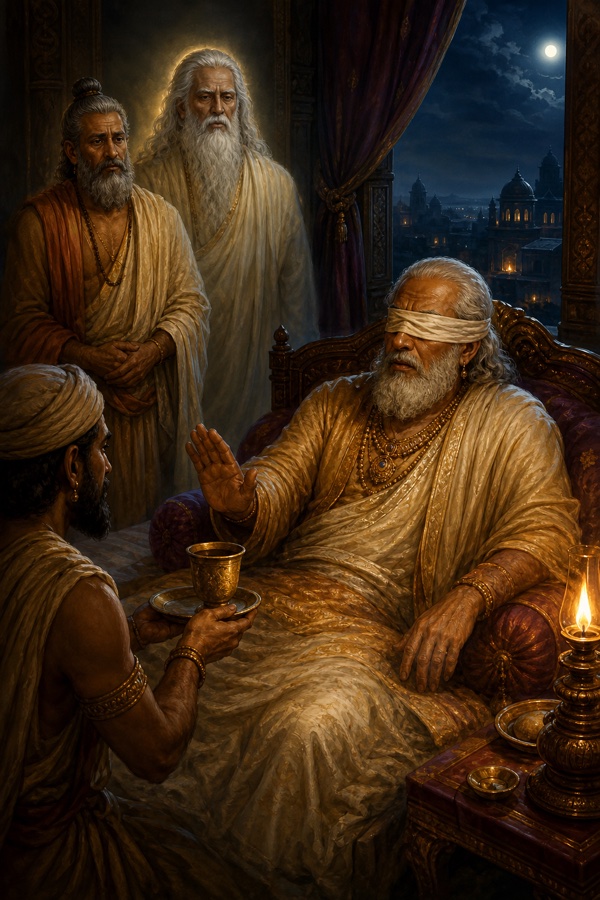
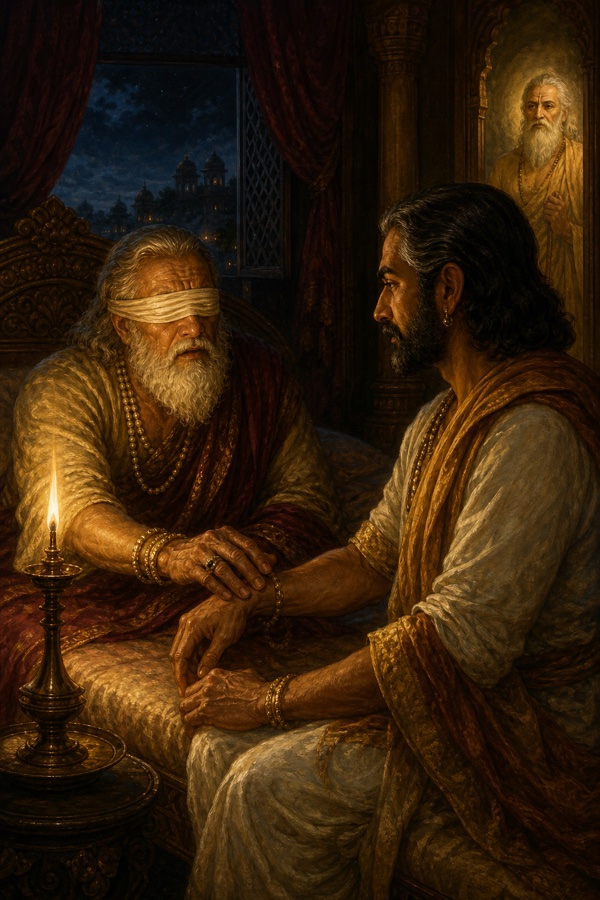
After Sanjaya left, Dhritarashtra sent his attendant to summon Vidura immediately. The messenger conveyed the king’s wish, and Vidura came to the palace and asked to have his arrival announced. The attendant reported that Vidura had obeyed the summons and wished to pay his respects at the king’s feet. Dhritarashtra gave permission for the wise, far-seeing counselor to enter. He was always willing and ready to see Vidura. The attendant went back with the invitation to the inner apartments. Vidura entered the chamber, where the king was absorbed in thought, and stood before him with joined hands. He had come as commanded; if there was work to do, the king should give his instructions. Dhritarashtra told him that Sanjaya had returned and gone away after rebuking him. In the morning the envoy would deliver Yudhishthira’s message before the court. The king had been unable to discover its contents that day. His body burned, and the burning kept him awake. He asked Vidura, who understood both righteousness and practical advantage, to tell him what would help a man in such a condition. Since Sanjaya’s return from the Pandavas he had known no peace. Anxiety over what the envoy would say had thrown all his senses into disorder.
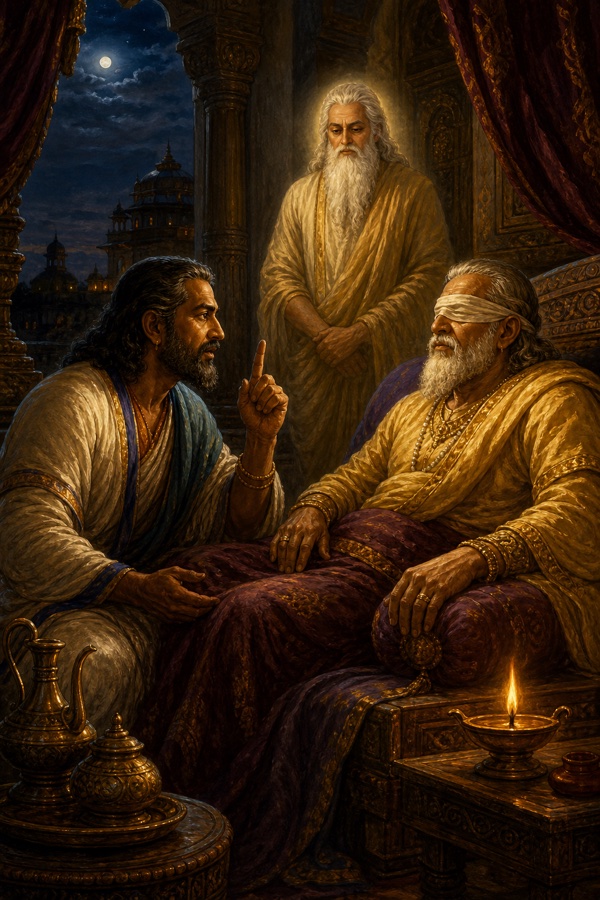
Vidura named the people sleep deserted: a thief, someone consumed by sexual desire, someone who had lost all his wealth, someone whose efforts had failed, and a weak person attacked by the strong. He hoped the king had suffered none of those grave misfortunes. He hoped Dhritarashtra’s distress came from no coveting of another person’s property. The king asked for words that would benefit him and carry the highest moral instruction. Among this family of royal sages, Vidura alone received the reverence of the wise. Vidura began with Yudhishthira. Endowed with every virtue, he deserved sovereignty over the three worlds. Dhritarashtra should have kept him close, yet had sent him into exile. The king’s qualities stood opposite to his nephew’s. Vidura also declared that Dhritarashtra’s blindness disqualified him from a share of the kingdom despite his virtue and knowledge of duty. That judgment belonged to the conception of royal eligibility expressed in his speech. Yudhishthira endured innumerable wrongs through harmlessness, kindness, righteousness, love of truth, energy, and his remembrance of the respect due to his uncle. How could Dhritarashtra expect prosperity after entrusting the empire’s management to Duryodhana, Shakuni the son of Subala, Karna, and Duhshasana?
Vidura described the person he considered wise. Self-knowledge, effort, patience, and steadiness in righteousness kept such a person aligned with life’s higher purposes. Wisdom showed in praiseworthy actions, rejection of blameworthy conduct, faith, and reverence. Anger, delight, pride, false modesty, bewilderment, and vanity failed to draw that person away from the proper goal. Intended actions and deliberations remained concealed from enemies; the work became known after its completion. Cold, heat, fear, attachment, prosperity, and adversity could not obstruct it. Judgment remained free from desire and followed righteousness and practical advantage, choosing purposes beneficial in this life and the next. Wise people made every effort their strength allowed, acted to the full extent of their ability, and dismissed nothing as too insignificant for attention. Vidura identified a leading sign of understanding: the ability to grasp something quickly while listening patiently, to pursue a purpose through considered judgment, and to refrain from speaking about other people’s business without being asked. The wise avoided chasing the unattainable, grieving over what was already lost, and allowing calamity to cloud their minds. Once they began a task, they worked until it was finished. They used their time carefully and kept themselves under control. Honest conduct gave them pleasure; they undertook work conducive to happiness and prosperity and treated good things with respect.
Honors did not make such a person exult, and slights did not bring grief. Vidura compared that steadiness to the untroubled water of a lake along the Ganga. A wise person understood the mortal nature of living creatures, the connections among actions, and the means available for accomplishing human purposes. Bold speech, the ability to converse across different subjects, knowledge of argument, insight, and the capacity to interpret books also belonged to wisdom. Study followed reason, reason remained informed by scripture, and good people always received their due respect. Vidura then described folly. Someone could be ignorant of scripture and still vain, poor and still proud, intent on a goal and willing to use dishonest means to reach it. Abandoning one’s own responsibilities to pursue another person’s business, and practicing deception to help a friend, were further signs. Foolish people desired what they should leave alone, abandoned legitimate desires, and bore malice toward the powerful. They treated enemies as friends, hated and injured their friends, and undertook wicked actions. They disclosed their plans, doubted everything, and spent a long time on work that should have required little. Each failing concerned a choice a person could make in the management of ordinary duties, relationships, or public affairs.
Vidura included religious and social obligations in the account. A fool neglected shraddha, the offerings made for departed ancestors, failed to worship the deities, and formed no friendships with noble-minded people. Entering uninvited, talking at length without a request, and trusting the untrustworthy marked a particularly poor character. A person guilty of wrongdoing who shifted blame onto others, or a powerless person who gave vent to anger, displayed extreme folly. So did someone who failed to assess his own strength, ignored righteousness and practical benefit, and wanted a difficult prize without adopting adequate means. Vidura condemned punishing the undeserving, paying homage to people without their knowledge, and waiting upon misers. He returned to a mark of wisdom that could survive success: a person might gain immense wealth and prosperity, or extensive learning, and still behave without arrogance. The question put to Dhritarashtra had begun with sleeplessness. Vidura’s answer had brought him through the conduct of a ruler and into the habits by which a person judged plans, treated others, and responded to his own good fortune.
The gist: Unable to sleep before Sanjaya’s report, Dhritarashtra summons Vidura. Vidura questions the king’s treatment of Yudhishthira and his choice of advisers, then describes wisdom and folly through practical, moral, and religious conduct. Patience, disciplined effort, sound judgment, discretion, and humility despite wealth or learning belong to wisdom.
Vidura’s Numbered Counsel: Forgiveness, Protection, and Care
Vidura asked who could be more heartless than a wealthy man who ate well and dressed finely while withholding a share of his wealth from his dependents. One person might commit a wrong from which many people benefited; in the end, guilt attached to the person who acted, while those enjoying the proceeds escaped. An archer’s arrow might fail to kill even one person. Intelligence directed toward evil could destroy an entire kingdom together with its king. Vidura set out a compact sequence of numbers: distinguish the two through the one, bring the three under control through the four, conquer the five, understand the six, abandon the seven, and be happy. He then returned to the danger of counsel. Poison killed one person, and a weapon one person; wicked advice could destroy the king, his people, and the whole realm. A person should avoid enjoying delicious food alone, deliberating alone over material interests, traveling alone, or remaining awake alone among sleeping companions. Vidura spoke of the Being who was one, without a second, whom Dhritarashtra had failed to understand: the very essence of Truth, a way to heaven, like a boat across the sea.
People found a single fault in someone who forgave: they mistook that person for weak. Vidura dismissed the objection because forgiveness possessed great power. It was a virtue of the weak and an adornment of the strong. It could subdue everything; what lay beyond its reach? What could a wicked person do to someone carrying the sword of forgiveness? Fire falling on ground without grass died away by itself. A person who refused to forgive became stained by many wrongs. Righteousness was the highest good, forgiveness the supreme peace, knowledge the greatest contentment, and benevolence the sole happiness. Vidura began arranging further counsel in pairs. The earth swallowed a king incapable of fighting and a Brahmin who never journeyed to sacred places, just as a snake swallowed creatures living in holes. Two actions earned renown: avoiding harsh speech and disregarding the wicked. Two kinds of people surrendered their own judgment: women who desired a man solely because other women desired him, and someone who worshiped another solely because other people did so. The desires of the poor and the anger of the powerless were like sharp thorns piercing the body. An inactive householder and a beggar absorbed in schemes failed to shine because their conduct conflicted with the lives they professed. A powerful person who forgave and a poor person who gave generously lived, in Vidura’s image, above heaven itself.
Wealth acquired honestly could be misused in two ways: by giving to the undeserving and withholding from the deserving. Vidura’s next condemnation was severe. He said that a rich man who gave nothing and a poor man who was proud should have weights tied tightly around their necks and be thrown into water. A mendicant accomplished in yoga and a warrior killed in open battle could pierce the sphere of the sun. People versed in the Vedas recognized means that were good, middling, or bad; people too fell into those three classes and should be assigned work suited to their capacities. Vidura stated a rule of ownership under which a wife, an enslaved person, and a son could hold no wealth independently: their earnings belonged to the person to whom they belonged. That was the social order articulated in his counsel. He named three acts that created great fear: stealing another person’s property, violating another person’s wife, and breaking with a friend. Desire, anger, and greed were three gates to hell that destroyed the self and should be abandoned. Three people should be protected even when danger was imminent: a follower, someone who sought refuge by declaring allegiance, and someone who had come into one’s home. Rescuing an enemy from distress carried the combined merit of three attainments: granting a boon, acquiring a kingdom, and obtaining a son.
The counsel moved into groups of four. However powerful a king might be, learned people advised him to avoid deliberating with the unintelligent, procrastinators, the lazy, and flatterers. Four kinds of people should find a place in the home of a prosperous householder: elderly blood relatives, people of distinguished birth who had fallen into adversity, poor friends, and sisters without children. When Indra, the chief of the gods, had asked Brihaspati, the divine counselor, about things that could come to fruition within a single day, Brihaspati had named four: the resolve of the gods, the understanding of intelligent people, the humility of the learned, and the destruction of the sinful. Four practices intended to remove fear could produce it when performed improperly: the Agnihotra, the prescribed offering into the sacred fire; a vow of silence; study; and sacrifice more generally. Vidura next named five fires to be served with reverence: father, mother, the actual sacred fire, the self, and the teacher. Service to another five brought fame in the world: the gods, departed ancestors, human beings, mendicants, and guests. Wherever a person went, five groups followed: friends, enemies, the indifferent, dependents, and people entitled to maintenance. Of the five senses, a single one left vulnerable could drain away all understanding, as water escaped through one hole in a leather vessel.
Someone seeking prosperity should avoid six faults: sleep, drowsiness, fear, anger, laziness, and procrastination. Vidura also named six people to leave as one would leave a boat breaking apart at sea: a teacher unable to explain scripture, a priest without learning, a king unable to protect, a wife whose words were disagreeable, a cowherd unwilling to go out to the fields, and a barber who wanted to abandon the village for the forest. Each description connected a person to an expected function, from teaching and protection to the daily work of the settlement. The comparison with the failing boat expressed the loss of support when that function failed. Vidura’s counsel joined praise of forgiveness, generosity, and protection with severe judgments about social roles, ownership, and household relationships. Dhritarashtra was hearing all of these as parts of the instruction he had requested, amid the danger created by the advice he had followed in his own court.
A key to reading this (the numbered sequence): Vidura first gives a compressed formula running from one through seven, then develops groups of counsel organized by number. The sequence is preserved here as he gives it. The later groups address the practical obligations of a ruler and householder, including the protection of people who depend on them.
The gist: Vidura warns against withholding from dependents and following destructive counsel, praises the power of forgiveness, and gives numbered teachings about gifts, refuge, advisers, household duties, religious observance, and the senses. His descriptions include the social hierarchies and severe judgments expressed in his address to Dhritarashtra.
Self-Control and Kingship: Vidura Urges the Return of the Rightful Share
Vidura named six qualities that should always be retained: truthfulness, charity, diligence, benevolence, forgiveness, and patience. Six things quickly suffered destruction through neglect: cattle, service, agriculture, a wife, learning, and the wealth of a Shudra. He described six ways people forgot those who had helped them. Students forgot their teachers after receiving an education; married people forgot their mothers; men whose desires were satisfied forgot women; people who had succeeded forgot their helpers; travelers who had crossed a river forgot the boat; and recovered patients forgot their physicians. Six conditions promoted happiness: health, freedom from debt, life at home, companionship with good people, a secure livelihood, and freedom from fear. Six kinds of people remained miserable: the envious, the malicious, the discontented, the quick-tempered, the constantly suspicious, and those dependent on another person’s fortunes. Vidura then named six sources of happiness: wealth, continuous health, a wife’s affection, her sweetness of speech, an obedient son, and learning that provided an income. The six always present in the heart were desire, anger, grief, confusion of understanding, pride, and vanity. Someone who mastered them gained command of the senses, avoided sin, and remained free of its resulting calamities. He described six groups that lived through the circumstances of six others: thieves through the carelessness of their victims, physicians through illness, women through men’s desire, priests through people who offered sacrifices, kings through people’s disputes, and the learned through the needs of the unlearned. These were the dependencies he placed before Dhritarashtra in his account of human conduct.
A king should abandon seven faults that could ruin even firmly established monarchs: indulgence in women, dice, hunting, drinking, harsh speech, excessive severity in punishment, and misuse of wealth. Eight immediate signs of approaching destruction concerned a person’s treatment of Brahmins: hatred of them, disputes with them, seizure of their possessions, killing them, pleasure in insulting them, distress at hearing them praised, forgetting them on ceremonial occasions, and spite when they asked for something. A wise person recognized these transgressions and avoided them. Vidura also described eight joys available in this life: meeting friends, receiving great wealth, embracing a son, sexual union, conversation with friends at a fitting time, advancement of people on one’s own side, obtaining something long anticipated, and respect in society. Eight qualities brought distinction: wisdom, high birth, self-restraint, learning, courage, moderation in speech, generosity according to one’s means, and gratitude. He offered the image of a house with nine doors, three pillars, and five witnesses, presided over by the self. The learned person who understood it was truly wise. He then told Dhritarashtra of ten people unable to recognize duty in their condition: the intoxicated, the inattentive, the mentally disturbed, the exhausted, the angry, the starving, the hasty, the greedy, the frightened, and the sexually obsessed. The wise should avoid their company.
Vidura recalled an old account concerning Sudhanvan and Prahlada, king of the Asuras, over Prahlada’s son. He continued with the conduct that gave a ruler authority. A king who abandoned desire and anger, placed wealth in worthy hands, exercised discrimination, cultivated learning, and acted promptly became a standard others respected. Prosperity attended the ruler who inspired trust, punished people whose guilt had been established, understood the proper measure of punishment, and knew when mercy was appropriate. A prudent person took even a weak enemy seriously, dealt with an enemy intelligently while watching for an opportunity, avoided seeking hostility with a stronger opponent, and showed courage at the right time. Someone who met calamity without being overwhelmed, gathered all his faculties for action, and bore suffering patiently became foremost among people and overcame his enemies. Happiness belonged to the person who avoided useless absence from home, friendship with wrongdoers, violation of another person’s wife, arrogance, theft, ingratitude, and drinking. Vidura praised the person who pursued the three human aims of righteousness, material prosperity, and pleasure without boastfulness, answered questions truthfully, refrained from quarrels even for friends, and kept anger in check when slighted.
Kindness to everyone, freedom from malice, restraint from starting disputes while weak, modest speech, and the willingness to let a quarrel pass earned praise everywhere. People loved someone who avoided a haughty appearance, refrained from praising himself while condemning others, and kept from speaking harshly when he lost composure. Good conduct included leaving old hostilities at rest, behaving with neither arrogance nor excessive self-abasement, and avoiding improper acts even in distress. A good-natured person did not become carried away by his own happiness, take pleasure in someone else’s misery, or regret a gift after giving it. Vidura commended the desire to learn the customs of different countries, the languages of different peoples, and the practices of different social groups. Such knowledge let a person understand distinctions of high and low and gain influence wherever he went, even among people already content. An intelligent person should relinquish pride, folly, insolence, sinful acts, disloyalty to the king, crooked conduct, hostility toward many people, and arguments with the drunk, the mentally disturbed, and the wicked. The gods themselves promoted the prosperity of someone who daily practiced self-restraint, purification, auspicious observances, worship, expiation, and the other rites recognized by the community.
Vidura also prescribed relationships according to standing: marriage with equals, conversation, dealings, and friendship with equals, and precedence for people of superior qualities. He opposed marriage with those he considered socially inferior. In his account, these choices made a learned person’s actions well considered and well applied. A person who distributed food among dependents before eating sparingly himself, worked much and slept little, and gave even to enemies who asked, possessed self-command and kept calamity at a distance. Well-guarded counsel, properly carried into action, with deeds never known to others as injurious, allowed a person to secure even the smallest object. Someone committed to sparing all creatures injury, truthful, gentle, generous, and pure in mind shone among his relatives like a clear and precious gem from an excellent mine. A person who felt shame over a fault known only to himself earned great honor. With a pure heart, boundless energy, and attention gathered inward, he shone like the sun. Vidura brought the counsel back to the children of Pandu. The king, consumed by a Brahmin’s curse, had received five sons in the forest, each like an Indra. Dhritarashtra, the son of Ambika, had raised those children and taught them everything. They obeyed his commands. He should return their just share of the kingdom, rejoice, and live happily with his own sons. By doing so, he would earn the confidence of both gods and human beings.
The gist: Vidura continues his numbered teachings on self-control, gratitude, happiness, destructive conduct, and good kingship. He calls for proven guilt and proportionate punishment, timely mercy, vigilance, and care for dependents. His counsel returns to a direct request: Dhritarashtra should restore the Pandavas’ rightful share and live in peace with his sons.
The Chariot of the Self and the Arrows of Speech: Vidura Warns the King
Dhritarashtra returned to his sleeplessness. What should a person do when anxiety burned through him and kept him awake? Vidura alone among them understood righteousness and practical advantage. The king wanted wise counsel, something beneficial to Yudhishthira and good for the Kurus. Fear of coming disaster made him look back at his own earlier guilt. He asked anxiously what was truly in Yudhishthira’s mind. Vidura replied that someone who wished to spare another person defeat should tell him the truth even without being asked, whether the words were welcome or unwelcome, pleasing or painful. He would speak for the good of the Kurus, offering advice consistent with duty. The king should give up any attachment to success achieved by unjust or improper means. An intelligent person should accept that an undertaking might fail despite fair and proper methods. Before acting, he should consider the capacity of the person doing the work, the nature of the work, and its purpose. Action depended on those conditions. Impulse alone was a poor beginning. A wise person decided to proceed or desist after examining his ability, the task itself, and the consequences of success.
A king who failed to understand the proper measure of territory, gain, loss, treasury, population, and punishment would soon lose his realm. Knowledge of those measures as set out in the treatises gave him the understanding of righteousness and advantage needed to retain it. Uncontrolled senses, directed toward their separate objects, affected the world as planets affected the stars. When the five senses mastered a person and drew him into their various pursuits, his calamities increased like the waxing moon. A ruler who tried to control his counselors before mastering himself, or conquer his enemies before controlling his counselors, eventually collapsed for lack of strength. Someone who first treated his own uncontrolled self as an enemy and subdued it could then gain mastery over counselors and opponents. Great prosperity attended command of the senses, control of the mind, the capacity to punish offenders, considered action, and patience. Vidura offered the king an image: the body was a chariot, the self within it the driver, and the senses its horses. Properly trained, those excellent horses carried a wise person pleasantly through life, allowing him to wake in peace. Unbroken horses beyond control brought an unskilled driver to destruction along the journey. The senses could carry a person into the same disaster.
Inexperience and uncontrolled desire confused good with evil and misery with happiness. Someone who abandoned righteousness and practical benefit to follow the senses soon lost prosperity, life, wealth, and wife. Ownership of riches offered no security when their owner could not govern his appetites. Vidura urged a person to know the self through the self, bringing mind, understanding, and senses under control. The self could become one’s friend or one’s enemy; self-conquest made it a friend. Desire and anger tore through wisdom like a large fish breaking a net woven from thin cords. Someone who sought the means of success with attention to both righteousness and advantage could obtain his aims and enjoy happiness. A person seeking victory over outside enemies while leaving the five inner, mind-born enemies unconquered was himself overcome. Vidura recalled the many ill-disposed kings whom hunger for territory and lack of self-command had ruined through their own actions. Association carried its own danger. Wet wood burned alongside dry wood; an innocent person constantly accompanying wrongdoers could receive punishment with them. Friendship with the sinful should be avoided. The five greedy enemies pursued five distinct objects, and ignorance of the need to control them exposed a person to calamity.
Vidura said that guilelessness, simplicity, purity, contentment, pleasant speech, self-restraint, truthfulness, and steadiness were absent from the wicked. Self-knowledge, firmness, patience, devotion to righteousness, the ability to keep counsel, and generosity were likewise absent from people of inferior character. Fools tried to injure the wise through false accusations and malicious speech. In Vidura’s account, they took the wise person’s sins onto themselves, leaving the target free of those sins and forgiven. He located the strength of the wicked in malice, the strength of kings in the law of punishment, that of the weak and of women in attentive service, and that of the virtuous in forgiveness. Command of speech was especially difficult. A long conversation filled with meaning and pleasure for its listeners was hard to sustain. Well-spoken words produced many benefits; badly spoken words caused harm. A forest struck with arrows or cut by axes could grow again. Vidura described a heart injured by cruel speech and condemnation as unable to recover. Arrows, shot, and barbed darts could be removed from a body. The dagger of speech lodged in the heart could never be extracted. Verbal arrows left the mouth and struck another person’s vital center, bringing pain through day and night. A learned person should refrain from shooting them.
When the gods ordained someone’s defeat, Vidura said, they deprived that person of judgment, and ignoble conduct followed. As understanding dimmed and destruction approached, wrong could settle firmly in the heart under the appearance of right. Hostility toward the Pandavas had already clouded the minds of Dhritarashtra’s sons, and the king failed to see it clearly. Yudhishthira possessed every auspicious quality, deserved sovereignty over the three worlds, and continued to obey his uncle’s commands. Dhritarashtra should let him rule the earth, excluding his own sons from that rule. Yudhishthira stood foremost among the king’s heirs. He had energy, wisdom, and knowledge of the truths of righteousness and advantage. Through kindness and sympathy, he had endured great suffering to preserve Dhritarashtra’s reputation. The king had asked what was in his nephew’s mind. Vidura had answered by examining the choices of a ruler, the force of uncontrolled desire, and the claims of the nephew who had borne those choices with patience.
The gist: Vidura counsels fair methods, careful judgment, and mastery of the self before command over ministers or enemies. The chariot and its horses illustrate control of the senses; verbal arrows illustrate the enduring harm of cruel speech. He warns that hostility has clouded the king’s sons and urges Dhritarashtra to place Yudhishthira on the throne.
Prahlada Tells the Truth: Virochana and Sudhanvan Wager Their Lives
Dhritarashtra asked Vidura to continue speaking about righteousness and practical advantage. His thirst for the counsel remained unsatisfied; he found the words compelling. Vidura compared bathing at every holy place with kindness toward every living creature. Their merit was equal, he said, and kindness might even surpass the pilgrimage. The king should show kindness to all his sons. It would bring him great fame in this world and heaven afterward. For as long as a person’s good deeds were spoken of on earth, that person continued to receive honor in heaven. Vidura introduced an old account concerning Virochana and Sudhanvan, both seeking the hand of Keshini. Unmatched in beauty and wishing for a good husband, Keshini had decided to choose him through a svayamvara, an assembly at which she would select her spouse. Virochana, a descendant of Diti and a leader among the Daityas, came hoping to obtain her. Keshini asked whether Brahmins or the descendants of Diti were superior, and why Sudhanvan should be denied a place on the couch. Virochana answered that his people sprang from Prajapati himself, stood at the head of all creatures, and unquestionably possessed the world. What standing did the gods or Brahmins have beside them? Keshini proposed that they remain in that pavilion. Sudhanvan would arrive the next morning, and she wanted to see the two together. Virochana agreed.
Night passed and the sun rose. Sudhanvan reached the place where Virochana waited with Keshini. Seeing the Brahmin arrive, she rose from her own seat and offered him a seat, water for his feet, and arghya, the formal offering of welcome. Virochana invited him to share his place. Sudhanvan touched the fine golden seat, acknowledging it, but refused to sit there as Virochana’s equal. Virochana told him that a wooden board, an animal skin, or a mat made of grass or straw would suit him. He had no right to sit on the same seat. Sudhanvan responded with a rule of precedence: father and son could sit together; so could Brahmins of the same age and equal learning, two Kshatriyas, two Vaishyas, or two Shudras. Others could not share a seat in that way. Virochana’s father had paid Sudhanvan respect while sitting below him. Virochana, he said, was a child raised amid every luxury and understood nothing. Virochana proposed putting all the Asuras’ gold, cattle, horses, and other wealth at stake and taking the question to someone qualified to judge it. Sudhanvan rejected a wager of possessions. They should stake their lives. Virochana asked where they could go under those terms; he would appear before neither gods nor human beings. Sudhanvan proposed Virochana’s own father. Prahlada would never lie, even for the sake of his son.
With the wager agreed, both men went angrily to Prahlada. He saw them approaching along the same road and compared them to two angry snakes. They had never been companions before. Had friendship now developed between Virochana and Sudhanvan? Virochana explained that there was no friendship. They had wagered their lives and would put a question to him. Prahlada must answer truthfully. The Asura king first ordered water, honey, and curds for Sudhanvan. The Brahmin deserved their worship, and a fat white cow was ready for him as well. Sudhanvan said that he had already received water, honey, and curds on his way there. He wanted an answer to his question: were Brahmins superior, or was Virochana? Prahlada faced the two men and spoke of his difficulty. Virochana was his only son, and Sudhanvan was present in person. How could he answer a question over which they had quarreled? Sudhanvan told him to give his son all the cattle and precious wealth he wished. On the matter in dispute he must declare the truth. Prahlada asked what suffering awaited a person who misused his tongue by answering such a question falsely.
Sudhanvan described several kinds of anguish. The liar suffered like an abandoned wife lying awake at night while her husband slept in the arms of another wife; like a person who had lost at dice; like someone bent beneath an unbearable burden of anxiety. Such a person would remain starving outside city gates barred against him. False testimony condemned him to continual encounters with enemies. Sudhanvan then measured the harm of lying by the object for which the lie was told. A lie concerning an animal cast five ascending generations of ancestors from heaven. For a cow, the number was ten. For a horse, it was a hundred; for a human being, a thousand. A falsehood concerning gold ruined members of the family already born and those still unborn. A falsehood for the sake of land ruined everything. Prahlada must therefore never lie for land. The warning moved from an individual’s torment to the fate of successive generations, with the widest destruction attached to a disputed possession of land. Prahlada had asked about the consequences before delivering a judgment in which his only son’s life was at stake.
He gave his answer. Angiras was superior to him, Prahlada told Virochana. Sudhanvan was superior to Virochana, and Sudhanvan’s mother superior to Virochana’s mother. Virochana had therefore lost. Under the terms of their wager, Sudhanvan now held authority over his life. Prahlada asked the victor to let his son live. Sudhanvan granted the request because Prahlada had chosen righteousness and resisted the temptation to speak falsely. He restored the beloved son to his father, with one condition: Virochana must wash Sudhanvan’s feet in Keshini’s presence. The public gesture would acknowledge the outcome of the contest that had begun over their places beside her. Vidura’s account left Dhritarashtra with the example of a father who had spoken truthfully when the decision endangered his only child. Prahlada’s judgment established his son’s defeat; the truth of that judgment then moved Sudhanvan to spare him.
A key to reading this (the seat and the wager): A shared seat represents an acknowledgment of equal standing in this dispute. Virochana and Sudhanvan turn that claim into a wager over their lives. Prahlada’s truthful judgment therefore has an immediate consequence for his son, whose life can be restored only by the victor’s decision.
The gist: At Keshini’s svayamvara, Virochana and Sudhanvan dispute their relative standing and wager their lives on Prahlada’s judgment. Prahlada tells the truth against his only son. In recognition of his integrity, Sudhanvan grants Virochana his life, requiring him to wash his feet before Keshini.
No Falsehood for Land: Vidura Examines Righteousness and Prosperity
Vidura applied Prahlada’s example directly to Dhritarashtra. The king should never tell a falsehood for the sake of land. Affection for his son must never drive him into a lie that would hasten the destruction of his children and counselors along with himself. The gods protected those they favored by giving them intelligence; they had no need to stand over people with clubs like herdsmen. Success in a person’s aims followed the attention given to righteousness and moral conduct. The Vedas could offer no rescue from sin to someone living through deceit and falsehood. At death they deserted such a person, like birds leaving the nest once their wings had grown. Vidura warned against drinking, quarrels, hostility toward large numbers of people, involvement in marital disputes, breaking the bond between husband and wife, internal dissension, disloyalty to the king, and every sinful course. He named seven people unfit to serve as witnesses: a palm reader, a thief who had become a merchant, a bird catcher, a physician, an enemy, a friend, and a minstrel. Four practices innocent in themselves became harmful when performed improperly out of pride: the Agnihotra fire offering, a vow of silence, study, and sacrifice.
He then listed people whose moral wrongdoing he ranked with the killing of a Brahmin. The list included someone who burned a dwelling, administered poison, arranged sexual misconduct, sold soma juice, made arrows, practiced astrology, injured friends, committed adultery, caused an abortion, violated a teacher’s marriage bed, or was a Brahmin addicted to drink. It continued with a harsh speaker, someone who reopened old wounds, an atheist, a reviler of the Vedas, a bribe taker, someone whose sacred-thread initiation had been delayed beyond the prescribed age, someone who secretly killed cattle, and someone who killed a person asking for protection. These were Vidura’s judgments, bringing occupations, religious status, sexual conduct, and acts of violence into the same severe classification. He moved on to the circumstances that tested character. Fire tested gold; deportment tested a person of high birth; conduct tested honesty. Panic tested courage, poverty tested self-restraint, and danger and calamity revealed friends and enemies. Age and infirmity destroyed beauty; ambitious hopes destroyed patience; death destroyed life; envy destroyed righteousness; anger destroyed prosperity; low company destroyed good conduct; desire destroyed modesty; pride destroyed everything. Prosperity began in good deeds, grew through activity, took deep root through skill, and became stable through self-command.
Eight qualities brought distinction to their possessor: wisdom, good lineage, self-control, knowledge of scripture, courage, freedom from excessive talk, giving according to one’s means, and gratitude. Vidura added that royal recognition could bring the brilliance of all these qualities together in a single person. When the king honored someone, his favor made them shine. Another eight things signaled heaven within human life. Four were inseparable from good people: sacrifice, generosity, study, and austerity. The good continually followed four others: self-restraint, truth, simplicity, and avoidance of harm to all creatures. Vidura gave a further group of eight as the paths of righteousness: sacrifice, study, charity, austerity, truth, forgiveness, mercy, and contentment. The first four could be practiced from pride; the last four belonged to the truly noble. An assembly required elders, and elders earned that standing by declaring what was right. Righteousness depended on truth, and truth was free of deceit. He named ten attributes of heavenly origin: truth, beauty, familiarity with scripture, knowledge, high birth, good conduct, strength, wealth, bravery, and the ability to converse on many subjects.
Wrongdoing brought harmful consequences, and virtuous conduct brought great happiness. A person should therefore resolve firmly to abandon sin. Repeated wrongdoing destroyed understanding; diminished understanding led to further wrongdoing. Repeated righteousness increased understanding, and the growth of understanding encouraged further righteous action. Through that practice, a virtuous person reached blessed regions. Envy, deep injury to others, cruelty, constant quarrels, and deceit quickly brought great misery. Someone free of envy, possessed of judgment, and continually doing good avoided such misery and shone everywhere. Learning wisdom from the wise made a person truly learned. Attention to both righteousness and practical advantage made happiness possible. Vidura urged preparation across the stages of time: work during the day so the night could be happy; work during eight months of the year so the rainy season could be happy; act in youth to secure a happy old age; act throughout this life to secure happiness afterward. The wise valued food that digested easily, a wife whose youth had passed, a victorious hero, and an ascetic whose efforts had succeeded. Wealth obtained unjustly failed to cover the gap it was meant to fill, while opening new gaps elsewhere.
A teacher governed people who already possessed self-command; a king governed wrongdoers; Yama, the son of Vivasvat and ruler over the dead, governed those who sinned in secret. Vidura said that the greatness of sages, rivers, riverbanks, and noble souls could not be fully determined. He added an equally sweeping claim about the unknowable cause of women’s wickedness, a judgment expressed within his speech. Devotion to honoring Brahmins, generosity, righteous behavior toward relatives, and noble conduct in a Kshatriya sustained lasting rule over the earth. Three kinds of people could always gather golden flowers from the ground: the brave, the learned, and those who knew how to protect others. Vidura ranked work accomplished through intelligence first and work accomplished through the arms second. Work using the thighs and labor carrying burdens on the head he placed lowest. Then he again challenged the king’s reliance on Duryodhana, Shakuni, the foolish Duhshasana, and Karna. How could Dhritarashtra hope for prosperity while leaving the kingdom in their care? The Pandavas possessed every virtue and depended on him as a father. He should trust them in turn as his sons.
The gist: Vidura warns Dhritarashtra against lying for land or yielding to partiality toward his son. He examines testimony, religious practice, wrongdoing, the qualities that sustain prosperity, and preparation for the future. He closes by questioning the king’s chosen advisers and urging him to trust the Pandavas as his own children.
Atreya’s Teaching and the Meaning of a Worthy Family
Vidura recalled an old conversation that placed even the gods in the position of listeners. The Sadhyas, a company of deities, had encountered Atri’s son while he traveled in the guise of a mendicant, living on what others gave him. The sage kept rigorous vows, but his appearance left them unable to identify him. They introduced themselves and acknowledged what they could discern: his knowledge of scripture seemed to have given him intelligence and command over himself. They asked him to speak generously, sharing the learning behind that composure. Atri’s son answered with what he had learned about loosening the knots of the heart. Tranquility, mastery over the passions, and faithful practice of righteousness could release those knots. With their help, a person should regard what was agreeable and what was disagreeable with the same concern given to one’s own self. He urged them to endure reproach without returning it. The pain borne in silence would consume the slanderer, he said, and the patient person would acquire the merit that the aggressor lost. His instructions reached beyond a single angry exchange: avoid slander, humiliation, insults, and quarrels with friends. Keep away from degrading company, arrogance, and ignoble conduct. Harsh speech, heated with anger, could burn the very places on which a human life depended: the vital organs, the bones, the heart. A person committed to virtue must keep that kind of speech from his own mouth.
Someone who drove verbal thorns into other people’s most vulnerable places carried hell on his tongue, the sage said. He became a source of suffering wherever his words reached. The person struck by those words would feel their force as sharply as an arrow, with the burning heat of fire or the sun. Even deeply wounded, the wise person should endure, remembering the transfer of merit from the aggressor. The company one kept also entered one’s character. Serve a good person or a wicked one, an ascetic or a thief, and that companion’s color would gradually become one’s own, as dye entered cloth immersed in it. The gods themselves desired the company of someone who could receive an insult and decline to retaliate. Having someone else return it would count as retaliation too. The same restraint applied to blows: neither strike back nor arrange for another to strike, and wish no injury upon the person who caused the hurt. The sage described speech through a series of choices. Silence came first. When speaking became necessary, speak truthfully. Make the truth agreeable to hear, and make agreeable speech consistent with righteousness. A person grew to resemble those he lived with, those he looked up to, and the person he wished to become. Whatever he relinquished ceased to bind him. Complete relinquishment brought freedom from even the smallest suffering. Such a person neither conquered others nor suffered conquest, neither injured nor opposed them. Praise and blame could no longer move him, and grief and elation lost their power over him.
Atri’s son then distinguished kinds of character. The finest person wished prosperity for everyone and never set his heart on another’s misery. Truthfulness, humility, and mastery of the passions accompanied that wish. A person of middling goodness refused to comfort someone with a lie, gave what he had promised, and kept watch over other people’s vulnerabilities. A bad person resisted control, exposed himself to danger, yielded readily to anger, failed to feel gratitude, could not become a true friend, and harbored wickedness in his heart. The sage also placed among the worst those who remained dissatisfied with every benefit another person offered, distrusted even themselves, and drove away their real friends. Someone seeking his own welfare should associate with the good, occasionally with people of indifferent character, and never with the wicked. Wicked people could certainly become wealthy. Strength, unremitting effort, intelligence, and courage might all serve their pursuit of possessions. They would still lack honorable fame and the conduct that made a family worthy of respect, even if their birth placed them within such a family. That distinction drew a question from Dhritarashtra. Gods admired high families. So did people who held steadily to both righteousness and worldly advantage, and those respected for learning. “What makes a family high, Vidura?” The king asked for the qualities behind a reputation that birth and wealth alone could never secure.
Vidura gave seven foundations: austerity, self-restraint, the Vedas, knowledge, sacrifice, pure marriages, and the giving of food. In his account, these observances sustained a high family when its members practiced them properly. Such people kept to the right course. Their dead ancestors were spared the pain of seeing their descendants do wrong. They embraced good conduct willingly, wanted to add to the unblemished name inherited from their forebears, and avoided falsehood of every kind. Vidura also named the ways a family could fall. Abandoning sacrifice, entering marriages he considered impure, neglecting the Vedas, and insulting Brahmanas brought decline. So did treating Brahmanas with contempt, speaking ill of them, and taking for oneself property that someone else had entrusted to the household. His account of family standing included religious observance and inherited social duties alongside obligations of honesty. Large numbers of relatives, accumulated wealth, and herds of cattle could never compensate for poor conduct. A household with little money could nevertheless win a great name through the way its members behaved. Wealth arrived and departed; manners and integrity required continual care. Lacking money alone did not make a person truly deficient. Losing the conduct that deserved respect did. Even full fields, cattle, and other livestock left a family without a claim to honor when its behavior failed.
Vidura expressed wishes for his own line. Let no member foster quarrels, serve a king as a minister, steal another person’s wealth, or provoke divisions within the family. Let no one practice deceit or falsehood. Let no one eat before the sages, gods, and guests had received what was due to them. He said that someone who killed Brahmanas, hated them, or obstructed and damaged agriculture did not deserve a place in their company. A household’s poverty, however, need never prevent all hospitality. Four things remained available in the homes of good people: straw to offer as a seat, ground on which a visitor could sit, water for washing feet and face, and words spoken kindly. Someone intent on welcoming a guest could have these ready and present them with respect. A worthy family also carried burdens that might defeat another. Vidura compared it to the syandana tree: a slender piece of its timber could bear a weight that thicker wood from other trees could not sustain. Families formed by good conduct acquired that kind of strength under the weight of care. The question had come from a king whose own family faced a burden large enough to break it apart.
The gist: Atri’s son teaches the Sadhyas patience under insult, care in choosing companions, and speech that is truthful, agreeable, and righteous. Asked what makes a family worthy, Vidura describes its conduct, observances, integrity, and hospitality, together with the actions that bring it into decline.
Trust Between Friends and the Strength of Trees Standing Together
Vidura asked the king to consider what made a friendship real. A person whose anger inspired fear, or whose company required fearful attendance, offered no secure friendship. A true friend could be trusted as a father could be trusted. Even someone with no connection by birth or blood could become a refuge and protector through the way he behaved. An unsteady heart, neglect of elders, and a restless disposition prevented that bond from forming. Success itself abandoned someone who could not govern his mind and remained enslaved to his senses, as swans abandoned a pool after its water dried up. A weak mind rushed into anger and became pleased again without sufficient cause, shifting like clouds. Vidura said that even carrion birds avoided the bodies of people who received help from friends and repaid it with ingratitude. Rich or poor, a person owed friends respect; their sincerity became clear when help was actually requested. He then described what sorrow did to the person who surrendered to it. Beauty, strength, and understanding diminished. Disease followed. The body withered, enemies took pleasure, and the object that grief sought came no closer. Human beings died and were born again, declined and grew, asked for help and were themselves asked, mourned and became the subjects of mourning. Happiness and misery, abundance and want, gain and loss, life and death all came in their turn. The self-controlled person must remain steady through them. The six senses never stayed still. Whichever gained dominance could drain understanding in proportion to its strength, as a hole drained water from a pot.
Dhritarashtra answered with an admission. “I deceived Yudhishthira. He is like a flame of fire, and he will surely destroy all my wicked sons in battle. Everything seems dangerous to me. My mind is full of anxiety. Tell me something that will take it away.” Vidura directed him toward knowledge, austerity, mastery of the senses, and the complete surrender of greed. Each had its work to do: self-knowledge dispelled fear, austerity won what was great and valuable, attendance upon one’s seniors brought learning, and self-restraint brought peace. People seeking liberation without the merit acquired through gifts or Vedic observances could pass through life free of anger and aversion, he said. Happiness arising from thoughtful study, from a battle fought in accordance with duty, and from rigorously practiced austerities increased at their completion. Estrangement from relatives carried a different consequence into daily life. Fine beds could give such people no sleep. Women offered no pleasure; the songs of bards and praise singers gave no satisfaction. Righteous conduct, happiness, and honor slipped beyond them. Peace lost its appeal, and advice meant for their benefit became unwelcome. They could neither acquire what they lacked nor hold on to what they possessed. Vidura foresaw destruction at the end of that course. He placed fear arising among relatives beside milk in cows and austerity among Brahmanas. He said that inconstancy could arise in women, just as fear could arise among kin.
Good relatives acting together acquired strength that each lacked alone. Many thin threads of the same length, gathered into a fabric, could bear the repeated passage of the weaving tool across them. Separated firebrands produced smoke; bring them together, and they flared into a powerful blaze. Vidura gave the king those images of mutual support, then warned against cruelty toward Brahmanas, women, relatives, and cattle. Those who oppressed them would fall as ripe fruit fell from its stalk. A solitary tree might be enormous, strong, and deeply rooted, yet a mighty wind could twist and shatter its trunk. Trees growing close together resisted even stronger winds because each supported the others. An isolated person could possess every virtue and still appear easy to conquer to an enemy. Relatives grew through mutual help like the stems of lotuses standing together in a lake. Vidura also identified lives that must be spared: Brahmanas, cattle, relatives, children, women, those whose food one had accepted, and those who surrendered and asked for protection. A meal received from someone created an obligation; so did another person’s appeal for refuge. The same king who feared what his relatives might do was being asked to consider the protection that relatives owed one another.
Vidura said that without wealth a person’s good qualities had no means of showing themselves. Health nevertheless kept the possibility of welfare alive. Someone overcome by illness was as good as dead, unable to taste the pleasures that possessions might otherwise provide. Anger brought another affliction, which Vidura described as a bitter, pungent, acrid, burning drink. Its consequences were painful, like a headache arising without physical disease, and the unwise could never digest it. Dhritarashtra should swallow that anger, contain it within himself, and obtain peace. People tormented by disease lost their liking for enjoyments and their desire to draw happiness from wealth. Sorrow filled them, and both happiness and the uses of wealth became inaccessible. Vidura then returned to the dice hall. When Draupadi had been won, he had told Dhritarashtra that honorable people avoided cheating at play. “Stop Duryodhana,” he had urged. The king had failed to act. Sound government joined strength with gentleness. Force that set itself against gentleness ceased to be true strength in Vidura’s account. Prosperity founded entirely on crooked dealing would be destroyed. Prosperity sustained by strength together with gentleness could pass intact to children and grandchildren. The family needed a policy capable of preserving what it held beyond the lifetime of its present ruler.
Dhritarashtra’s sons should therefore care for the Pandavas, and the Pandavas should care for them in return. Their friends could be shared, their enemies shared, and both branches could live together in happiness and prosperity. Vidura addressed the king as the refuge of the sons of Kuru. The whole lineage depended on him now. As a descendant of Ajamida, he had the responsibility to protect Pandu’s children after the suffering of their exile and to preserve his own name free of stain. He should make peace with those truthful brothers, keep enemies from discovering weaknesses in the family, and turn Duryodhana away from his destructive conduct. Dhritarashtra had asked for relief from anxiety after admitting that he had deceived Yudhishthira. Vidura had given him steps he could take: govern his own desires, restrain his son, and restore protection to the nephews whose anger he feared. The trees could still stand together if the king chose to preserve their common ground.
The gist: Vidura explains trust, gratitude, the damage caused by grief, and the strength relatives gain through mutual support. Dhritarashtra admits deceiving Yudhishthira. Vidura urges self-control, reconciliation with the Pandavas, and restraint of Duryodhana, joining strength with gentleness in the rule of the family.
Seventeen Futile Efforts, Six Threats to Life, and the Trust of Servants
Vidura told Dhritarashtra that Manu, the son of the Self-created, had described seventeen kinds of foolish people as striking empty air, trying to bend Indra’s misty bow in the sky, or attempting to catch the sun’s intangible rays. The first tried to control someone incapable of restraint; the second was satisfied with small gains; the third humbly courted enemies; the fourth tried to restrain women’s frailty; the fifth asked for gifts from someone who should never be asked; the sixth boasted of an achievement. The seventh, born into a high family, did something improper; the eighth, though weak, maintained hostility toward someone strong; the ninth addressed a person listening with contempt; the tenth desired the unattainable. The eleventh was a father-in-law who joked with his daughter-in-law; the twelfth boasted that his daughter-in-law had dispelled his fears; the thirteenth scattered his own seed in another person’s field; the fourteenth maligned his own wife; the fifteenth received something and denied remembering it. The sixteenth promised a gift at a holy place and boasted when asked at home to fulfill the promise; the seventeenth labored to establish a falsehood as truth. Yama’s messengers, carrying nooses, dragged such people to hell. Vidura said social policy permitted responding to another person according to that person’s conduct: deceit toward the deceitful and honesty toward the honest.
Vidura followed the catalogue with the forces that could destroy what a person possessed. Age wore away beauty. Patience brought an end to hope, death to life, and the practice of virtue to worldly enjoyments. Desire destroyed modesty, and bad company damaged good conduct. Anger consumed prosperity. Pride could destroy everything. Dhritarashtra asked about the span of life itself. The Vedas spoke of a hundred years allotted to a human being. Why did everyone fail to reach that full term? Vidura described six sharp swords cutting into the years: too much pride, too much speech, too much food, anger, the appetite for enjoyment, and division within one’s own people. Human conduct could shorten the life granted to a person. He then named acts whose guilt he placed alongside the killing of a Brahmana. Taking the wife of someone who had placed trust in the offender was one; violating a teacher’s marriage bed was another. His list also included a Brahmana marrying a Shudra woman or drinking wine. He condemned commanding Brahmanas, becoming their master, or seizing the land that maintained them, and killing someone who had yielded and asked for protection. These were the distinctions and obligations Vidura drew from the social and religious order he was describing. He said the Vedas required expiation after contact with people guilty of those acts. He also described the conduct leading to heaven: accept wise instruction, understand duty, give generously, and eat after dedicating food to the gods and departed ancestors. Add freedom from envy and the wish to injure, together with gratitude, truthfulness, humility, and learning.
Agreeable words were easy to find, Vidura continued. The difficulty lay with words that could heal while hurting the listener’s pride. Few people would speak them; few would listen when they were spoken. The counselor who kept righteousness before him and told his master an unwelcome truth added to the king’s strength. Pleasing the king could never be his sole measure of useful advice. Vidura set out a hierarchy of claims. A member could be sacrificed for a family, a family for a village, a village for a kingdom, and the whole earth for the self. Wealth should be guarded against future calamity. Through wealth, a person should protect his wives, and through both wealth and wives, protect himself. He returned to the danger of gambling. Since ancient times it had provoked quarrels; a wise person should avoid it even as amusement. “At the dice game, I told you this was wrong,” Vidura reminded Dhritarashtra. The words had tasted to the king like medicine to a sick man. Dhritarashtra now wanted to defeat the Pandavas, whom Vidura compared to peacocks with brilliantly colored plumage, while his own sons were crows. He had turned away from lions to shelter jackals. A time would come when he would grieve over that choice. Vidura had opposed the game before its consequences reached this point, and he was still asking the king to receive the advice he found painful.
The same question of trust governed a ruler’s dealings with those who served him. A master won confidence by refraining from venting his displeasure on devoted servants who worked zealously for his good. They would stay with him when trouble came. Confiscating their grants or stopping their wages to increase his own wealth would destroy that attachment. Even counselors who loved him could turn away once he took the means of livelihood and enjoyment from them, leaving him without their help in distress. A king should first examine the work he intended to undertake. Wages and allowances needed to be considered alongside his income and expenditure. With that provision made, he should form the alliances required for the work, because cooperation could make every undertaking possible. Vidura described an officer who deserved to be regarded as a second self. Such a person understood the king’s intention fully and carried out his duties eagerly. He had standing of his own, remained devoted to his master, and consistently told him what would serve his good. He also understood the extent of his own power and that of the opponents he might face. The ruler could entrust work to someone who combined prompt action with that judgment, confident that devotion included the courage to offer useful counsel.
A servant who ignored commands, refused assigned work, and habitually argued from pride in his own intelligence should be dismissed without delay. Vidura said learned people looked for eight qualities in a servant: freedom from pride, ability, promptness, kindness, cleanliness, incorruptibility, birth in a family free from disease, and weight in speech. He included the condition concerning family health among those requirements. The king needed people who could act competently and whose words deserved attention; those people in turn needed the livelihood and confidence that kept them attached to his service. Vidura had placed the failure to hear difficult advice beside the failure to sustain faithful servants. Both could cost a ruler the people working for his welfare.
The gist: Vidura recounts Manu’s seventeen futile behaviors and six faults that shorten life. He explains the value of unwelcome but beneficial counsel, recalls his warning against the dice game, and describes how fair pay, trust, competence, and loyalty sustain a ruler’s service.
Five Kinds of Strength and the Tigers of the Kuru Forest
Vidura continued with cautions about placing oneself within another person’s power. Even an announced visit gave no assurance of safety when entering an enemy’s house after dusk. A person should avoid lurking in someone else’s yard at night and avoid pursuing a woman the king might desire. Someone who kept bad company and consulted everyone he met called for another kind of care: challenging his decision openly or declaring disbelief would be unwise. Give a reason, Vidura advised, and send him away on a pretext. He named people with whom one should avoid lending and borrowing: an excessively merciful king, a sexually promiscuous woman, a royal servant, a son, a brother, a widow with an infant son, someone serving in an army, and a person who had suffered great losses. These were the cautions he placed around financial dealings. Eight qualities gave a person distinction: wisdom, high lineage, knowledge of scripture, self-restraint, courage, restraint in speech, giving within one’s means, and gratitude. One further endowment gathered the effect of these qualities together. When a king favored someone, that favor brought other advantages and held them in place. Vidura also named ten benefits of bathing: strength, beauty, clarity of voice, the ability to pronounce every sound, delicacy of touch, a fine scent, cleanliness, grace, delicacy of the limbs, and beautiful women. He announced six benefits from eating sparingly, then named health, long life, ease, healthy offspring, and freedom from the accusation of gluttony.
A household should refuse shelter to someone who habitually behaved improperly, ate excessively, or was hated by everyone. Vidura included the highly deceitful, the cruel, those without a sense of the proper time and place, and those who dressed indecently. Distress could also tempt a person to seek help from an unsuitable giver. Even in that condition, he advised against asking a miser, a slanderer, someone ignorant of scripture, a forest dweller, a cunning person, or someone who withheld respect from those deserving it. He added the cruel, the perpetually quarrelsome, and the ungrateful. Service carried its own hazards. Six kinds of people should never be served: an enemy, someone constantly in error, someone devoted to falsehood, someone without devotion to the gods, someone without affection, and someone convinced that he could do everything. The purpose a person pursued depended upon the means available; the means, in turn, had to fit that purpose. Both required consideration if the undertaking was to succeed. Vidura then described the proper withdrawal from household responsibilities. A father should have sons and establish them with provision for their independence. He should marry his daughters to suitable people. After completing those duties, he could retire to the forest and seek the life of a muni, directing himself toward a sage’s discipline. To gain the Supreme Being’s favor, a person should act for the good of all creatures together with his own happiness. That was the root of successful effort. With intelligence, energy, courage, strength, readiness, and perseverance, what reason had he to fear for his livelihood?
Vidura brought the argument back to Dhritarashtra’s own household. A break with the Pandavas would have consequences painful enough to sadden Indra and the other gods. First would come hostility among men who were all the king’s sons. Then came a life of continual anxiety, the loss of the Kurus’ good name, and the delight of their enemies. The anger of Bhishma, Drona, and Yudhishthira could consume the world like a great comet falling across the earth. Another future remained possible: Dhritarashtra’s hundred sons, Karna, and Pandu’s sons could together rule the entire land bounded by the seas. The king’s sons formed a forest, Vidura said, and the Pandavas were its tigers. “Do not destroy the forest with its tigers. Do not drive the tigers out. The forest shelters them, and they guard the forest.” Each survived through the other’s protection. Sinful people were eager to find faults and gave little attention to other people’s virtues. Anyone seeking lasting worldly advantage should practice righteousness from the beginning, because true advantage remained joined to heaven. A mind separated from sin and firmly established in virtue understood things in their natural state and in the conditions they acquired. Pursuing righteousness, advantage, and pleasure at their proper times brought all three together here and beyond this life. Prosperity came to the person who restrained both anger and elation and kept his judgment during calamity.
There were five kinds of strength, Vidura told the king. The power of the arms ranked lowest. The second was the acquisition of good counselors. Wealth came third; fourth came the strength of birth, inherited from fathers and grandfathers. Intelligence stood above them all because it could obtain the other forms of power. A person who provoked an enemy capable of terrible injury should take no comfort in the distance between them. Vidura warned against placing trust in women, kings, snakes, one’s own master, enemies, enjoyments, or the allotted length of life. Someone struck by the arrow of intelligence could find no physician or medicine to heal the injury. The formulas used in a fire offering, auspicious ceremonies, the mantras of the Atharva Veda, and remedies against poison would all be powerless. He also cautioned against disregarding snakes, fire, lions, and blood relatives. Each possessed strength that required respect. The discussion of intelligence had brought him again to the danger of underrating a power merely because its effect had not yet been felt.
Fire lay within wood without consuming it until someone kindled it. Once friction drew it out, that same fire could burn its containing wood, an entire forest, and much besides. People of high lineage could hold their energy in the same way. Their forgiveness left them quiet, showing none of the outward signs of anger, like the fire still hidden in timber. Vidura told Dhritarashtra that he and his sons had the nature of creepers, while the Pandavas were sala trees. A creeper required a great tree around which it could grow. He addressed the king as Ambika’s son and returned to the image of a forest, now with the Pandavas as its lions. Remove the lions, and the forest faced destruction. Destroy their shelter, and the lions faced destruction too. The king’s family needed the mutual protection Vidura kept placing before him.
The gist: Vidura continues his counsel on caution, transactions, companionship, and household duties. He names four consequences of a breach with the Pandavas and places intelligence highest among five kinds of strength. Images of a forest and its predators, fire hidden in wood, and creepers dependent on trees reinforce the need for mutual protection within the Kuru family.
Honoring Guests, Guarding Counsel, and Bearing the Kingdom’s Burden
Vidura said a young person’s heart rose when a venerable elder entered the house; by approaching and saluting the visitor, he recovered it. A disciplined host should first provide a seat and water for the guest’s feet, make the customary inquiries of welcome, then speak of his own affairs and offer food with proper regard for the circumstances. The wise considered a life wasted when a learned Brahmin refused a household’s water, honey, curds, or cattle because he feared being unable to make proper use of them, or because the giver was miserly and unwilling. Even guests considered unworthy of a water offering should be treated as dear: a physician, an arrow maker, someone who abandoned the celibate student’s vow before completing it, a thief, a crooked-minded person, a drinking Brahmin, someone who caused a miscarriage, a soldier, or a seller of the Vedas. Vidura forbade a Brahmin to sell salt, cooked food, curds, milk, honey, oil, clarified butter, sesame, meat, fruits, roots, greens, dyed clothes, perfumes of any kind, or treacle. A true yogi of the mendicant order remained above anger and grief, free of dependence on friendship and quarrels, indifferent to praise and blame, and withdrawn from attraction and aversion. A forest ascetic who lived on wild rice, roots, or greens, controlled himself, tended his sacred fire, and cared for guests stood foremost among his fellows.
Distance gave no safety after injuring an intelligent person whose reach could extend far enough to return the harm. A person should trust the trustworthy within limits and avoid trusting those who deserved none, since misplaced confidence could cut away one’s very roots. Vidura urged freedom from envy, protection of wives, payment of everyone’s due, and agreeable speech. A husband should speak pleasantly and sweetly to his wives while preserving his independence. Virtuous, blessed women who deserved reverence and adorned their homes embodied domestic prosperity and required particular protection. The father should oversee the inner apartments, the mother the kitchen, and someone trusted as oneself the cattle; agriculture deserved personal supervision. Servants should attend merchant guests, sons the Brahmin guests. Fire originated in water, Kshatriyas in Brahmins, and iron in stone. Each possessed power over other things that became neutralized on contact with its own source. Fire remained concealed in wood, just as good and forgiving people of high lineage could conceal their fiery energy without outward signs.
A king whose deliberations remained unknown to outsiders and intimates, while his spies discovered the plans of others, enjoyed lasting prosperity. Intended acts should remain unannounced; deeds concerning righteousness, advantage, and pleasure should become known after completion. A mountain summit, a palace terrace, or a wilderness bare of trees and plants provided places for secret deliberation. An unlearned friend and a learned friend without self-control were equally unfit to hold state secrets. Every prospective minister required careful examination because the king’s finances and confidential counsel depended on him. Vidura praised the king whose ministers learned of his actions only after they were done. Secrecy brought success. Blameworthy acts committed through ignorance could cost a person his life, while praiseworthy acts brought ease and their omission brought regret. A Brahmin without Vedic study was unfit to officiate at offerings for ancestors; a person ignorant of the six means of protecting a kingdom was unfit for political deliberations. A ruler who watched increase, decline, and surplus, understood the six means and himself, and maintained honored conduct could bring the earth under his authority. So could one whose anger and favor had real consequences, who personally supervised necessary work and controlled the treasury. The king should be satisfied with his name and the royal umbrella above him, sharing the kingdom’s wealth with those who served him. Brahmins understood Brahmins, husbands their wives, kings their ministers, and monarchs other monarchs.
Vidura said an enemy deserving death should never be set free once subdued. A weak person should court a stronger enemy even if that enemy deserved death, then kill him upon gaining sufficient strength, since leaving him alive allowed danger to arise. Anger toward gods, kings, Brahmins, elders, children, and the helpless required deliberate restraint. Avoiding the useless quarrels of fools brought fame and freedom from misery. People wanted no master whose favor gave no benefit and whose anger had no effect; Vidura compared this to women rejecting a eunuch as a husband. He said intelligence did not exist for acquiring wealth and idleness alone was no explanation for adversity; only the wise understood the reasons for differences in people’s conditions. Fools disregarded those eminent in age, conduct, knowledge, understanding, wealth, and lineage. Wicked disposition, lack of judgment, envy, sin, harsh speech, and anger quickly brought calamity. Honesty, gifts, respect for established social dealings, and controlled speech won influence over others. An active, grateful, intelligent, honest, and guileless person could acquire friends, counselors, and servants even with an empty treasury. Announcing seven forms of fuel for prosperity’s flame, Vidura named intelligence, tranquility, self-control, purity, absence of harsh words, and unwillingness to displease friends.
A person who withheld others’ due, was wicked, ungrateful, and shameless should be avoided. A guilty person who provoked an innocent one nearby could no more sleep peacefully than someone sharing a room with a snake. Those whose anger endangered property and the means of acquiring it should be appeased like gods. Vidura considered the outcome doubtful when work depended on women, careless people, people who had abandoned their caste duties, or the wicked. He compared those guided by a woman, a deceitful person, or a child to a stone raft sinking helplessly. Knowledge of the general principles of work earned a person recognition as learned even without expertise in a particular task, since particular tasks were subordinate to those principles. Praise from swindlers, performers, and women of ill repute made a person more dead than alive in his judgment. Finally, he returned to Dhritarashtra’s decision. The king had set aside the Pandavas, powerful archers of immeasurable energy, and placed the burden of a great empire on Duryodhana. He would soon see his swelling prosperity fall away, like Bali falling from the three worlds.
The gist: Vidura discusses hospitality, household responsibilities, limited trust, confidential deliberation, and the selection of ministers. He urges a ruler to distribute wealth, exercise restraint, and make his authority effective. Entrusting the empire to Duryodhana while passing over the Pandavas threatens Dhritarashtra’s prosperity.
Attachment to a Son and the Duty to Repair: Vidura Renews the Pandavas’ Claim
Dhritarashtra said human beings controlled neither prosperity nor adversity. Like wooden puppets moved by strings, they lived subject to destiny as the Creator had ordained. He asked Vidura to continue; he was listening carefully. Vidura replied that even Brihaspati could earn reproach and a charge of ignorance by speaking at the wrong time. People became agreeable through gifts, kind words, or the power of incantations and drugs; natural agreeableness endured of itself. Hatred prevented a person from recognizing honesty, intelligence, or wisdom in its object. Love assigned every good quality to someone, hatred every bad one. When Duryodhana was born, Vidura had urged the king to give up that one son and preserve the prosperity of his hundred sons. Keeping him would destroy them. An apparent gain leading to loss deserved no high value, while a loss that produced gain deserved recognition. A true loss generated further, greater losses. Some people gained eminence through qualities, others through wealth. Dhritarashtra should avoid the wealthy who lacked good qualities. The king accepted that wise people approved of Vidura’s words and that they served his future welfare. He still lacked the courage to abandon his son. Where righteousness stood, he added, victory stood as well.
Vidura described a virtuous, humble person as attentive even to the smallest suffering of living creatures. Habitual slanderers pursued quarrels and acts that hurt others. Receiving gifts from dangerous, inauspicious people brought sin, while giving to them carried danger. Quarrelsomeness, greed, shamelessness, deceit, and serious faults of that kind made companionship unworthy of pursuit. When the occasion that created a low person’s friendship ended, the friendship, benefit, and happiness ended with it. Slander of the former friend and efforts to cause loss followed. Such people could lose their own peace over even a small injury because they lacked self-command. Careful examination should lead the learned to avoid them from a distance. Helping poor, wretched, and helpless relatives brought children, livestock, and lasting prosperity. Anyone concerned for his own good should support his family. Dhritarashtra should seek the growth of his line through good conduct toward all its members. Even relatives without virtues deserved protection. The Pandavas, endowed with every virtue and humbly awaiting his favor, had a stronger claim. He should give those brave nephews a few villages for their maintenance and gain fame by doing so. As an elder, he must control his sons. Vidura asked to be understood as a well-wisher giving advice for his benefit.
Relatives should share happiness, food, conversation, and affection, keeping themselves free of quarrels. Righteous relatives rescued their people; unrighteous ones dragged them down. Fair treatment of the Pandavas would make Dhritarashtra unconquerable when surrounded by their strength. If one relative shrank before a prosperous kinsman like a deer facing an armed hunter, the prosperous man took the frightened person’s sins upon himself. The king would regret his present inaction when he heard of the deaths of the Pandavas or his own sons. Life was uncertain; an act certain to produce remorse should be avoided before it brought a person into the chamber of grief. People other than Bhargava, the author of the science of moral conduct, could act against righteousness, yet intelligent people retained an understanding of consequences. Dhritarashtra was an elder of the Kuru line. If Duryodhana had wronged the Pandavas, the king had a duty to undo those wrongs. Restoring them to their position would cleanse him of sin and earn him reverence even from people of disciplined lives. Acting after considering the consequences of wise counsel preserved a person’s reputation.
Instruction from the learned and skilled could remain incomplete because its recipient misunderstood it or failed to put an understood lesson into practice. A learned person who avoided actions leading to sin and misery continued to prosper. Someone foolishly persisting in a sinful course sank into deep mud. Vidura identified six routes through which confidential plans escaped: intoxication, sleep, neglect of spies planted by others, behavior revealing inward thoughts, trust in a wicked counselor, and unskilled envoys. Anyone seeking success and a lasting dynasty should close those routes. Their protection while pursuing righteousness, advantage, and pleasure raised a ruler above his enemies. Even Brihaspati’s intelligence could never replace scriptural knowledge and attendance upon elders in understanding or winning righteousness and advantage. An object cast into the sea was lost, as were words addressed to someone unwilling to listen, scripture given to someone without self-command, and clarified butter poured over the ashes of an extinguished fire. An intelligent person formed friendships with the wise after repeated examination through understanding, hearing, sight, and judgment. Humility removed disgrace; courage overcame failure; forgiveness conquered anger; auspicious rites removed signs of evil.
Lineage could be tested through a person’s pleasures, birthplace, house, behavior, food, and clothing. Even someone who had attained liberation might accept an available pleasure; the attraction was stronger for someone still bound by desire. A king should support a counselor who honored wisdom and possessed learning, virtue, a pleasing appearance, friends, agreeable speech, and a good heart. High or low birth made no difference to Vidura’s next comparison: someone who respected the rules of polite conduct, attended to righteousness, and maintained humility and modesty surpassed a hundred people of high birth. Friendship remained warm when hearts, private pursuits, pleasures, and attainments agreed. An ignorant, wicked person should be avoided like a pit hidden under grass; friendship with such a person could never last. Pride, ignorance, fierceness, rashness, and departure from righteousness were further reasons to refrain from friendship. Gratitude, virtue, truthfulness, generosity of spirit, devotion, self-control, dignity, and steadfast loyalty marked the person to seek as a friend.
The gist: Dhritarashtra admits that he cannot bring himself to abandon Duryodhana. Vidura urges him to repair the wrongs done to the Pandavas, grant them villages, and preserve the family. He also identifies destructive friendships, six ways confidential counsel escapes, and the qualities of trustworthy ministers and friends.
The Limits of Desire: Prosperity, Restraint, and Equal Treatment
Vidura compared complete separation of the senses from their objects to death itself. Excessive indulgence could ruin even the gods. Humility, love for all creatures, forgiveness, and respect for friends lengthened life. A person showed real strength by returning with firm resolve to a purpose that had failed and pursuing it through righteous means. Success belonged to someone who understood the remedies the future might require, stood firm in the present, and had considered from the beginning how an undertaking would end. What people pursued in speech, action, and thought drew them into its possession; they should therefore keep their attention on what served their good. Prosperity came through efforts toward good ends, understanding the time, place, and available means, knowledge of scripture, activity, straightforward conduct, and regular meetings with good people. Perseverance supported prosperity, gain, and well-being. Someone who continued without giving up in frustration could attain lasting happiness. For a powerful, energetic person, forgiveness was the most fitting and happiness-producing response at every time and place. A weak person should forgive under all circumstances; a strong person should do so out of righteousness. Someone who regarded success and failure alike would forgive naturally. Pleasure could be enjoyed fully when it caused no injury to righteousness or material well-being. Foolish surrender to the senses remained dangerous.
Prosperity would never settle with someone tormented by grief, committed to evil ways, denying the divine, idle, uncontrolled, or unwilling to exert himself. Yet Vidura recognized that badly directed minds could treat a humble, modest person as weak and persecute him. He also described prosperity as an unreliable presence. She seemed afraid to approach the excessively generous, those who gave without measure, the extraordinarily brave, practitioners of the most rigid vows, and people intensely proud of their wisdom. She settled with neither the supremely accomplished nor those entirely without accomplishment. Complete virtue and its complete absence both failed to attract her. Blind as a frenzied cow, she might stay with someone unremarkable. Vidura then named the results toward which several things tended. The Vedas bore fruit in ceremonies before the sacrificial fire; scriptural knowledge bore fruit in goodness of character and behavior. In his account of women, he named sexual enjoyment and children as the fruits of the relationship. Wealth bore fruit in enjoyment and charity. Money acquired through sin would yield no reward in the next world when spent on acts intended to secure such a reward. Its wrongful acquisition spoiled the intended result. Strength of mind, meanwhile, kept a person fearless in deserts, deep forests, inaccessible strongholds, dangers and alarms, and even before weapons raised to kill him.
Exertion, self-control, skill, care, steadiness, memory, and beginning an undertaking after mature thought formed the roots of prosperity. Ascetics drew strength from austerity; those who knew the Vedas drew strength from that knowledge. The wicked found strength in envy, the virtuous in forgiveness. Vidura listed eight things that did not break a vow: water, roots, fruit, milk, clarified butter, an action undertaken at a Brahmin’s wish, an action commanded by a teacher, and medicine. He condensed righteousness into a rule of conduct toward others: a person should never subject another to what he would find harmful himself. Other forms of righteousness, he said, could arise from individual whim. Anger should be overcome through forgiveness, wickedness through honesty, miserliness through generosity, and falsehood through truth. In his prescriptions about trust, Vidura included women among those he said should be distrusted, alongside swindlers, the idle, cowards, the fierce, people who boasted of their strength, thieves, the ungrateful, and those who denied the divine. Respectful greetings to superiors and service to elders enlarged four things: achievement, the length of life, reputation, and power. A person should avoid fastening his desire on an object obtainable only through terrible suffering, the sacrifice of righteousness, or submission to an enemy.
Vidura called four conditions pitiable: a person without knowledge, sexual union that produced no offspring, a kingdom’s people going without food, and a kingdom lacking a ruler. Roads brought pain and weakness to embodied creatures through the burden of travel; rain wore down hills and mountains. He assigned the absence of enjoyment as a source of women’s suffering and words sharp as arrows as a source of injury to the heart. His following comparison named what he called the impurities of different things: failure to study tainted the Vedas, absence of vows tainted Brahmins, the Vahlika people tainted the earth, and falsehood tainted a human being. In his judgment of women, curiosity was an impurity in a chaste woman and exile from home an impurity for women generally. He continued the image through metals: silver was the impurity of gold, tin of silver, lead of tin, and useless dross of lead. Sleep could never be conquered by continuing to lie down, women through desire, fire through fuel, or wine through further drinking. Each image returned to an appetite that its own indulgence failed to master.
A life was successful, Vidura said, when its owner won friends through gifts, enemies in battle, and his wife through food and drink. People with thousands managed to live; people with hundreds lived as well. Some means of supporting life could be found. Dhritarashtra should release his desire. All the rice, wheat, gold, animals, and women on earth could never satisfy even one person. Recognizing this, wise people felt no grief over lacking dominion over the entire world. Vidura brought the advice back to the two branches of the family whose future rested with the king. He again urged Dhritarashtra to treat the sons of Pandu and his own sons equally. The nephews were children of the royal house, and his conduct toward them should acknowledge that shared claim.
The gist: Vidura links restraint, perseverance, forgiveness, and reciprocal conduct to a good life. Prosperity remains unpredictable, and possession can never satisfy limitless desire. He asks Dhritarashtra to relinquish that desire and treat the Pandavas and his own sons equally.
Only Deeds Will Follow: Vidura’s Final Appeal
A good person honored by the good, free of pride and willing to work within the limits of his strength, could soon gain a lasting reputation. People of virtue, when pleased with someone, had the power to bring him happiness. Vidura compared someone who willingly abandoned even a great prize because its pursuit involved wrongdoing to a snake shedding its old skin. He could leave sorrow behind and live happily. Three offenses, Vidura said, each carried the weight of killing a Brahmin: a victory secured through falsehood, deceit toward the king, and intentions dishonestly represented to a teacher. Excessive envy, death, and boasting destroyed prosperity. Carelessness in serving a teacher, haste, and boasting were the three enemies of knowledge. For students, he named laziness, inattention, confusion, restlessness, gatherings that merely wasted time, haughtiness, pride, and greed as obstacles to learning. A student who wanted knowledge had to surrender the insistence on comfort and pleasure. Someone committed to pleasure would have to relinquish the pursuit of knowledge. Fire remained hungry however much fuel it received; the ocean could receive every river and still take more; death could consume all living beings and continue its work. Vidura placed a beautiful woman’s desire for men in the same account of appetites he considered insatiable. Hope destroyed patience, Yama destroyed growth, anger destroyed prosperity, miserliness destroyed reputation, and neglect destroyed cattle. One angry Brahmin could destroy an entire kingdom.
The king’s household should always contain goats, brass, silver, honey, medicines against poison, birds, Brahmins learned in the Vedas, elderly relatives, and people of high birth reduced to poverty. Vidura also cited Manu’s prescription for a home prepared to honor gods, Brahmins, and guests. It should hold goats, bulls, sandalwood, lyres, mirrors, honey, clarified butter, iron, copper, conch shells, a shalagrama stone sacred to Vishnu and described as containing gold, and gorochana, a bright yellow pigment. These were auspicious objects suited to worship and hospitality. From the household, Vidura turned to what he called the highest teaching, a sacred lesson capable of yielding immense benefit. Desire, fear, temptation, and even the need to preserve life could never justify abandoning righteousness. Righteousness endured. Pleasure and pain passed away. Life itself was everlasting, while each particular condition in which it appeared was temporary. Dhritarashtra should turn toward what endured and cultivate contentment, the greatest thing a person could acquire. Mighty, illustrious kings had governed lands rich in grain and wealth. The destroyer of all had taken those rulers too, leaving their kingdoms and their abundant means of pleasure behind.
Vidura asked the king to consider what became of a son raised with anxious care. When he died, people lifted him and carried him to the cremation ground. With disheveled hair and cries of grief, they placed his body on the funeral pyre as they would a piece of wood. Others enjoyed his wealth. Birds and fire consumed the elements of his body. Only two things accompanied him into the next world: the merit of his good deeds and the guilt of his sins. Relatives, friends, and sons left the body and retraced their steps, as birds abandoned a tree that no longer offered flowers or fruit. The dead person’s own actions followed him after those people had gone. Merit therefore had to be earned carefully, little by little, through righteous conduct. Above this world and below it lay regions of deep gloom, where the senses suffered terribly. Vidura wished Dhritarashtra to avoid every such place. Listening carefully and acting on the counsel would win him fame among human beings and remove his fear both here and hereafter. The deeds he chose would continue to matter after the kingdom and its possessions had passed into other hands.
The soul, Vidura said, could be understood as a river. Religious merit formed its sacred bathing places; truth was its water, self-restraint its banks, and kindness its waves. A righteous person purified himself by bathing in that river. The soul was sacred, and freedom from desire was the highest merit. Vidura offered another river image for life: the five senses supplied its water, desire and anger were its crocodiles and sharks, and repeated births formed its whirlpools. Dhritarashtra should make self-control his boat and cross. Friends distinguished by wisdom, virtue, learning, and age deserved honor and attentive care. A person who pleased them and sought their counsel about what he should and should not do would avoid going astray. Patience should govern sexual appetite and the stomach; the eyes should guide the hands and feet; the mind should govern the eyes and ears; conduct should govern the mind and speech. Vidura then set out the duties he assigned to the four social orders. A Brahmin who maintained ritual bathing, wore the sacred thread, studied the Vedas, avoided impure food, spoke truth, and acted in honor of his teacher would retain his place in Brahma’s realm. A Kshatriya, a member of the ruling and warrior order, should study the Vedas, pour offerings into the fire, perform sacrifices, and protect his subjects. Purified through taking up weapons to defend cattle and Brahmins, he would reach heaven upon dying in battle. A Vaishya should study the Vedas, distribute wealth at the proper times among Brahmins, Kshatriyas, and his dependents, and receive the sacred smoke of the three ritual fires. Heavenly happiness would follow him into the next world. A Shudra should honor Brahmins, Kshatriyas, and Vaishyas in their due order. By pleasing them, burning away his sins, and peacefully leaving his body, he too would attain the happiness of heaven.
Having described those duties, Vidura explained the purpose of his speech. Yudhishthira, Pandu’s son, was being kept from the responsibilities of the Kshatriya order. Dhritarashtra should restore him to a position in which he could discharge a king’s duties. His claim concerned the exercise of rule, the protection of subjects, and the work Vidura had just described. Dhritarashtra acknowledged the teaching. Vidura had always counseled him this way, and his own heart inclined toward the same course. He could feel that inclination toward the Pandavas while he listened. As soon as he came into Duryodhana’s company, however, his mind turned in another direction. No creature could avert destiny, the king said. Fate was certain to follow its course; individual effort was futile. The answer left his recognition of the right course beside his admission that he would lose hold of it when he returned to his son.
The gist: Vidura urges the king to hold to righteousness and contentment, remembering that a person’s deeds alone follow him after death. He asks that Yudhishthira be restored to the responsibilities of kingship. Dhritarashtra agrees with the counsel, admits that Duryodhana changes his mind, and again calls human effort powerless before fate.
Source: the Mahabharata of Krishna-Dwaipayana Vyasa, Udyoga Parva. This chapter follows K. M. Ganguli, sections I-LXXI (1-71); the Gita Press Hindi edition numbers these chapters differently. Names, order, and events were checked against Ganguli’s complete translation. Dialogue and commentary are adapted, not a verbatim translation. About the sources.
Based on: The Mahabharata, Vyasa (Gita Press, Gorakhpur)