On this page
Sanatsujata Arrives: The Question of Ignorance and Death
Dhritarashtra asked Vidura to continue if anything remained unsaid. He found the discourse compelling and was ready to listen. Vidura named another teacher: Sanatsujata, an ancient, immortal sage who lived in perpetual celibacy and declared that there was no death. That foremost intelligence could resolve every doubt in the king’s mind, including those he had never expressed. Dhritarashtra asked whether Vidura already knew what the sage would say. If he possessed that wisdom, he should speak it himself. Vidura explained the limit he observed. Born into the Shudra order, he would not venture beyond what he had already said. He regarded the celibate sage’s understanding as infinite. Someone born a Brahmin could expound the deepest mysteries without incurring the gods’ censure; that distinction was his reason for refraining. The king then asked how he could meet the ancient, immortal teacher while still in his present body. Vaishampayana, recounting the exchange, said that Vidura brought the sage of rigorous vows to mind. Knowing that Vidura was thinking of him, Sanatsujata appeared there. Vidura welcomed him according to the prescribed rites. After the sage had rested and taken his seat comfortably, Vidura placed the king’s unresolved doubt before him.
Vidura asked for a teaching that would carry Dhritarashtra beyond his sorrows and enable him to endure the conditions that troubled human life: gain and loss, the agreeable and disagreeable, old age and death, fear and jealousy, hunger and thirst, pride and prosperity, aversion, sleep, desire and anger, decline and increase. Dhritarashtra praised Vidura’s words and questioned Sanatsujata privately, seeking the highest knowledge. He had heard that the sage held death to be nonexistent. Yet the gods and the Asuras practiced austerities to escape it. Which account was true? Sanatsujata answered that both were true. Some held that particular acts could avert death; others said there was no death. Learned people understood death as a consequence of ignorance. The sage himself called ignorance death, and freedom from ignorance, knowledge, immortality. Ignorance had made the Asuras vulnerable to defeat and death. Freedom from it had brought the gods to the nature of Brahman, the supreme reality whose knowledge the sage would describe. Death possessed no discoverable shape that consumed creatures as a tiger did. The question required the king to examine the condition that made beings subject to it.
Some identified death with Yama, the ruler associated with the dead. Sanatsujata attributed that conception to the mind’s weakness. The pursuit of Brahman, or knowledge of the self, was immortality. Yama ruled in the realm of the departed ancestors, bringing happiness to the virtuous and suffering to the sinful. At his command, death appeared among people in the forms of anger, ignorance, and greed. Pride led them into unrighteous conduct and prevented them from realizing their true nature. With understanding obscured and passions directing them, they left their bodies and repeatedly entered hell. Their senses continued to follow them. That was why ignorance received the name death. People who acted for a reward left their bodies and went to heaven when the time came to enjoy the fruits of those actions. Such a passage still left them subject to death. Lacking knowledge of Brahman and remaining bound to earthly pleasures, embodied beings continued through the cycle of rebirth, moving upward, downward, and around. The mind’s inclination toward objects without enduring reality led the senses astray. A person continually absorbed in those objects remembered what occupied him and devoted himself to the pleasures immediately around him. The desire for enjoyment struck first; lust and anger followed. Together, those three carried the foolish toward death.
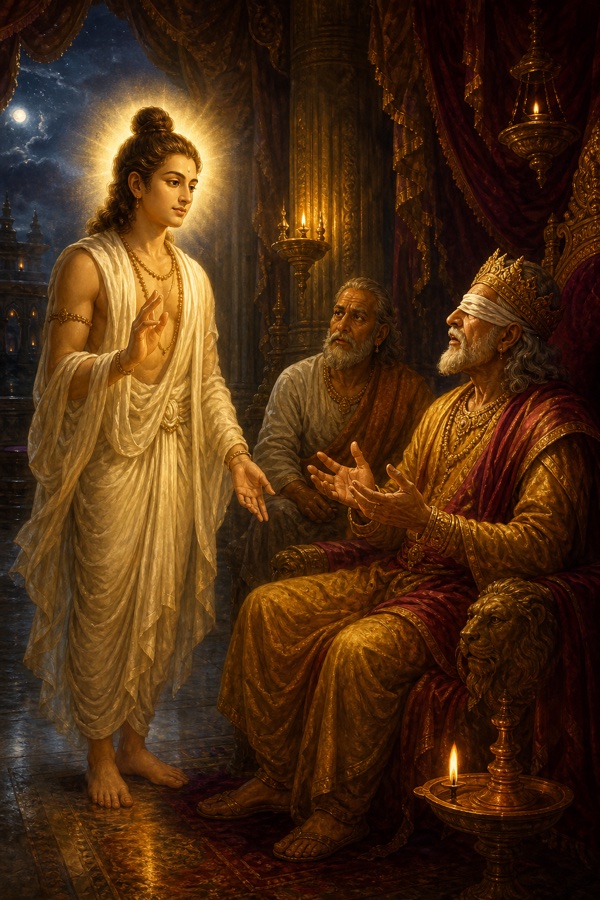
Self-mastery and restraint allowed a person to escape that course. Someone who brought himself under control without yielding to ambitious desire used knowledge of the self to recognize those impulses as worthless and overcome them. Ignorance in Yama’s shape could never consume a learned person who had mastered desire in that way. Following desire destroyed the follower along with what he desired. Renouncing it could drive away every kind of suffering. For creatures under its sway, desire was ignorance, darkness, and hell, because it robbed them of sound judgment. Sanatsujata compared them to drunk people stumbling along a road toward wheel ruts and holes. Deceptive pleasures drew them onward into destruction. What could death do to someone whose inward understanding desire had never confused or misled? To that person it had the terror of a tiger made of straw. To destroy desire as ignorance, even the smallest wish must cease to be cultivated or pursued. The sage brought the explanation directly to Dhritarashtra: the self within his body, entangled with anger and greed and filled with ignorance, was death. A person who understood how death arose and relied on knowledge would lose the fear of it. Death destroyed the body when the body fell under its power. Knowledge, in turn, destroyed death when death came under its power.
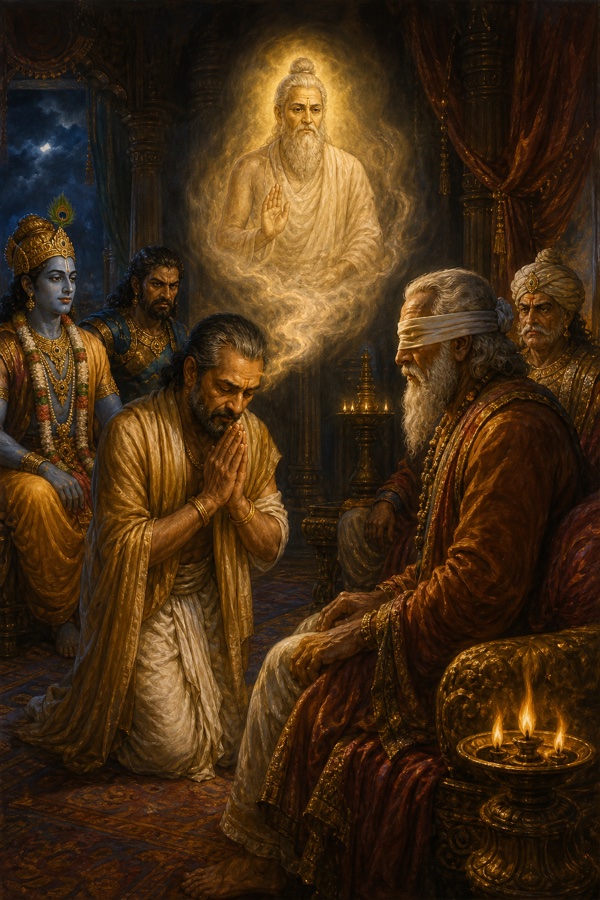
Dhritarashtra then asked about the promises of the Vedas. They declared that the sacred, enduring regions reached by the twice-born through prayer and sacrifice had the power to lead toward liberation. The twice-born were those admitted through initiation to Vedic learning and its religious duties. If the scriptures gave those acts such value, why should a learned person refrain from relying on them? Sanatsujata acknowledged the path. Someone without knowledge could reach those regions through the means the king described, and the Vedas indeed spoke of happiness and liberation there. Even someone who identified the material body as the self could attain liberation, the state of Brahman, immediately upon successfully renouncing desire. A seeker who continued to desire, however, had to follow the prescribed route of religious action and take care to remove the possibility of having to retrace it. The happiness earned by action lasted as long as its merit; when that merit ended, the need to act arose again. Permanent release required freedom from that return. In this discussion, liberation meant release from the obligation to be born and act again. The king’s question about ritual therefore concerned how a person could travel the path without being sent back over ground already crossed.
The gist: Sanatsujata appears when Vidura calls him to mind. Answering Dhritarashtra, he identifies ignorance with death and self-knowledge with immortality. The desire for enjoyment, lust, and anger sustain rebirth. Renunciation of desire brings liberation; the seeker following religious action must also overcome the necessity of returning to it.
Knowledge of Brahman and the Desire for Honor
Dhritarashtra asked what impelled the Unborn and Ancient One. If the Supreme had entered everything and thereby become the whole universe, what could action or happiness mean for a being entirely free of desire? Sanatsujata cautioned against treating the two differing conditions as completely identical. Creatures arose through the union of limiting conditions with that which, in its own nature, was free of conditions. That account preserved the supremacy of the Unborn and Ancient One. Human beings likewise originated through such a union. Everything that appeared was the everlasting Supreme Soul, and the universe arose through its transformations. The Vedas recognized this power of transformation; both the Vedas and other authorities supported the identity of the power with its possessor. The conditions in question were the limits under which a creature existed, including space and time. The king’s next question concerned the conduct of people within that world. Some practiced virtue, while others adopted the renunciation of action known as sannyasa yoga. Among those who continued to act, could virtue destroy wrongdoing, or could wrongdoing destroy virtue?
Sanatsujata answered that the fruits of virtue and of complete freedom from action both served liberation. Both were sure means toward it. The wise person achieved success through knowledge, in the stillness free of action that knowledge made possible. A person who continued to identify himself with the material body acquired merit through action and thereby moved toward liberation. Along the way he also incurred sin. He experienced the results of both virtue and wrongdoing, and both sets of results passed away. Heaven ended when the corresponding merit was exhausted; hell likewise ended for the person suffering the consequences of sin. Previous good and evil deeds then drew the person of action back into further action. With intelligence, however, he could destroy his sins through virtuous conduct. Virtue therefore had strength, and it made success possible for the person following the active path. Dhritarashtra asked to hear about the enduring regions said to be attainable by twice-born people through their virtuous acts. He wanted their relative order explained, along with other regions of a similar kind. He had no wish to hear about the acts toward which the mind naturally inclined even when those acts were forbidden or sinful. His question concerned the destinations earned through religious discipline.
Sanatsujata began with those who took pride in their practice of yoga as strong men took pride in their strength. After leaving this world, they shone in the region of Brahman. Others proudly applied their knowledge to sacrifices and the other rites prescribed by the Vedas. Those acts carried them beyond this world into the dwelling place of the gods. A further group regarded the Vedic rites as obligatory and their omission as sinful. They sought inward development and performed the ceremonies for righteousness itself, without aiming at a particular reward. Their continuing attachment to outward forms limited the esteem they deserved, though some respect remained due to them. The sage then described how a yogi should find support for his life. He should seek a place where food and drink suitable for a Brahmin were as plentiful as grass and reeds during the rains. A household with slender means should be spared the burden, and the yogi should also avoid tormenting himself with hunger and thirst. Even where keeping his spiritual distinction private exposed him to inconvenience or danger, the person who kept it private was superior to the one who announced it. A suitable giver of food was someone who felt no distress when another disclosed his own excellence and who always set aside the prescribed portions for Brahmins and guests before eating.
The sage used a severe comparison for yogis who advertised their spiritual superiority to secure a living. Like a dog harming itself by eating its own excrement, they consumed their own vomit. Wise people recognized as a Brahmin the person who lived among relatives yet wished his religious practice to remain unknown to them. Such a person was fit to know the Supreme Soul, free of limiting conditions and attributes, unchanging, one, and without duality. A Kshatriya who practiced in this way could also know the Supreme and perceive it within his own self. Sanatsujata called the person who treated the soul as an acting, feeling self a thief who robbed it of its true character, and asked what sins such a thief might not commit. The Brahmin seeking knowledge should be free of striving, refuse gifts, earn the regard of the righteous, and remain quiet. Even with knowledge of the Vedas, he should appear without that learning, keeping it from display. Those poor in earthly possessions yet rich in heavenly wealth and sacrifices became unconquerable and fearless; they deserved to be regarded as embodiments of Brahman. A person whose sacrifices enabled him to meet the gods themselves, the givers of desired rewards, still fell short of the knower of Brahman. The worshipper had to exert himself through his rites. The knower attained Brahman free of those exertions.
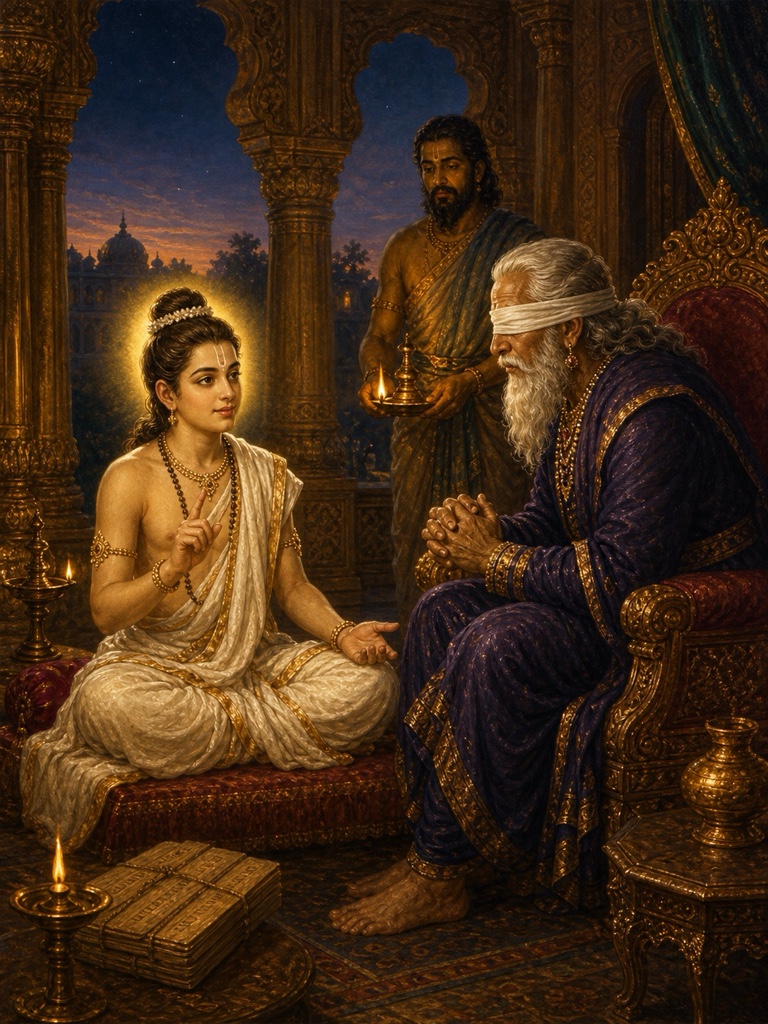
Real honor belonged to someone free of action whom the gods honored. The esteem of other people gave no secure reason to consider oneself honored, and its absence gave no reason for grief. People followed their own nature as readily as they opened and closed their eyelids. The learned knew how to offer respect; someone receiving it should remember the understanding from which it came. Fools inclined to sin and skilled in deception failed to honor those worthy of honor and often treated them with contempt. Worldly esteem and the ascetic discipline called mauna could never flourish together. This world belonged to those seeking its esteem; the other belonged to those devoted to ascetic practice. The happiness of worldly honor rested on worldly prosperity, which obstructed heavenly happiness. Heavenly prosperity, in turn, remained beyond anyone lacking true wisdom. The righteous described several gateways into that higher prosperity, all difficult to guard: truth, straightforwardness, modesty, self-control, purity of mind and conduct, and knowledge of the Vedas. Together, these six destroyed vanity and ignorance. The sage’s account left the king with disciplines that required continual inward care and with a warning against turning their practice into a means of winning public regard.
The gist: Sanatsujata explains creation through limiting conditions, the paths of action and knowledge, and the temporary rewards of virtue and wrongdoing. A yogi should obtain a living with care, keep spiritual practice free of self-advertisement, and release the desire for worldly honor. Six disciplines, from truth to Vedic knowledge, open the way to higher prosperity.
The Purity of Austerity: Knowledge, Conduct, and Inward Faults
Dhritarashtra asked what mauna was intended to accomplish. The word could refer to restraining speech or to meditation; which form did Sanatsujata approve? What was its true nature? Could a learned person reach stillness and moksha, release from the cycle of rebirth, through it, and how should it be practiced? The sage answered by returning to the Supreme Soul. Because neither the Vedas nor the mind could penetrate it fully, that Soul itself was called mauna. From it came both Om, the sacred Vedic syllable, and ordinary sounds; it was manifested as the Word. The king followed with a question about learning and guilt. If someone knew the Rig and Yajur Vedas, or knew the Sama Veda, did sin still stain him when he committed a sinful act? Sanatsujata answered plainly. None of those Vedas could rescue a person who had failed to restrain his senses from the consequences of wrongdoing. Sacred learning gave no shelter to someone who made his living through deception. At the end, the Vedas left such a person as newly fledged birds left their nest. Dhritarashtra asked why Brahmins held the mistaken belief that the Vedas always destroyed sin if the support of righteous conduct was also necessary.
Sanatsujata said the universe had arisen from the Supreme Soul through its association with conditions of name, form, and other attributes. The Vedas taught that origin and distinguished the Supreme from the universe appearing under those conditions. Austerities and sacrifices were prescribed as means toward the Supreme. Through them a learned person earned merit; merit destroyed sin, and knowledge illuminated his inner life. Knowledge then enabled him to attain the Supreme Soul. Someone whose desires still reached toward the four aims of life, righteousness, prosperity, pleasure, and liberation, carried his actions into the next world and enjoyed their fruits there. Those rewards eventually ended, sending him back to the world of action. Austerities practiced here by people who lacked self-mastery therefore produced rewards to be enjoyed elsewhere. For Brahmins engaged in austerity who had mastered themselves, these regions too could yield fruit. Dhritarashtra asked why austerities of the same kind might succeed in one instance and fail in another. The sage explained that austerity untainted by desire and other faults could secure liberation and was therefore successful. Vanity and the absence of true devotion made it unsuccessful. The king’s questions reached the root of the discipline through which the learned knew Brahman and attained immortality.
The king said the account of faultless austerity had made an eternal mystery known to him. He now wanted to understand austerity spoiled by faults. Sanatsujata began with twelve human failings: anger, lust, greed, ignorance of right and wrong, discontent, cruelty, malice, vanity, grief, attachment to pleasure, envy, and speaking ill of others. Any one could destroy a person by itself. Each waited for its opportunity as a hunter waited for a deer. He then described thirteen forms of wickedness in two groups. The first six were proclaiming one’s own superiority, desiring another man’s wife, humiliating others through excessive pride, being habitually angry, being fickle, and refusing to maintain people entitled to one’s support. Sinful people pursued those acts in defiance of the dangers they created both here and hereafter. The remaining seven were treating the satisfaction of lust as an aim of life, being excessively proud, regretting a gift after giving it, never spending money, tormenting subjects through hateful taxes, delighting in another person’s humiliation, and hating one’s own wives. The description moved from impulses within a person to the conduct through which dependents, subjects, and members of a household suffered.
Sanatsujata next set out twelve practices of a Brahmin: righteousness expressed in avoiding injury, truthful speech, self-restraint, austerity, delight in other people’s happiness, modesty, forbearance, love for others, sacrifices, gifts, perseverance, and knowledge of scripture. A person who acquired all twelve became capable of ruling the entire earth. Even possession of three, two, or a single one was a mark of heavenly prosperity. Liberation lay in self-restraint, renunciation, and knowledge of the self. Wise Brahmins held truth to be foremost in those qualities. Describing self-restraint as constituted by eighteen virtues, the sage named the faults from which a restrained person was free: violating or neglecting prescribed duties and prohibitions, falsehood, malice, lust, attachment to wealth, love of sensual pleasure, anger, grief, craving, greed, deceit, delight in another’s misery, envy, injury to others, regret, aversion to pious acts, forgetfulness of duty, slander, and vanity. Freedom from these was the condition the righteous recognized as self-control. Sanatsujata called the enumerated faults mada, pride or intoxication with oneself. Renunciation had six forms, and the conditions opposite to those six also belonged to mada. He thus described its faults as eighteen together with six. All six forms of renunciation deserved praise. The third was difficult to practice, yet through it a person could overcome all sorrow. Someone who accomplished it could pass beyond every pair of opposites encountered in the world.
The gist: Sanatsujata says Vedic learning cannot shelter an uncontrolled, deceitful person from sin. Austerity succeeds when desire and vanity leave it untainted. He identifies twelve human faults, thirteen forms of wickedness, twelve virtuous practices, and the faults opposed to self-restraint and renunciation.
Six Forms of Renunciation and the Ground of Truth
Sanatsujata explained the six commendable forms of renunciation. The first was freedom from elation when prosperity arrived. The second was giving up sacrifices, prayers, and pious acts. The third was renouncing desire, withdrawing from the world; through it a person was said to pass beyond description. This required abandoning the objects of enjoyment before enjoying them. Giving them up after taking pleasure in them to the point of satisfaction, after acquiring them, or after losing the appetite and capacity for enjoyment failed to accomplish that renunciation. The fourth was freedom from grief when an undertaking failed, even though the person undertaking it possessed every virtue and every kind of wealth. An unwelcome event should likewise bring no inward affliction. The fifth was refraining from asking even one’s sons, wives, and other deeply loved people for things. The sixth was giving to a deserving person who asked; such a gift always produced merit. These practices also brought knowledge of the self. The sage assigned eight qualities to that knowledge: truth, meditation, discernment between the knower and what was known, the ability to draw inferences, withdrawal from the world, refusal to take another person’s property, observance of the vows of brahmacharya, including sexual abstinence, and refusal to accept gifts. Each was part of the discipline through which a person could understand himself.
Mada, the pride opposed to dama or self-restraint, had faults already identified in scripture, and those faults had to be avoided. Having spoken about renunciation and self-knowledge, Sanatsujata reminded the king that the absence of self-knowledge carried eight faults corresponding to its eight virtues. They too had to be left behind. A person freed from the five senses, the mind, the past, and the future became happy. Dhritarashtra should direct his inner life toward truth, on which all worlds rested. Truth stood foremost in self-restraint, renunciation, and self-knowledge. The king should practice austerity while avoiding the faults the sage had described. The Ordainer had established truth as the vow of the righteous. Austerity purified of those faults and endowed with those virtues became a source of great prosperity. Sanatsujata had now given a brief account of the sacred, sin-destroying subject the king had asked about, a discipline capable of freeing a person from birth, death, and old age. Dhritarashtra then raised the question of how a real knower of Brahman could be recognized among the different accounts of the divine.
The Vedas, with the ancient narratives called Akhyana or Puranas counted as their fifth, declared the Supreme Soul to be the universe of moving and unmoving beings. Some people acknowledged four forms of godhead, others three, two, or one. Still others held Brahman alone to exist, with nothing possessing a separate existence. Which of these people truly knew Brahman? Sanatsujata replied that Brahman was one, truth itself. Ignorance of that one reality led people to conceive the godhead as many. Yet who had actually attained that truth? A person could consider himself wise without knowing the one thing worthy of knowledge and could occupy himself with study, charity, and sacrifice out of a desire for happiness. Those who had departed from truth formed aims suited to their condition and performed sacrifices in reliance on the Vedic passages promising their fulfillment. Some performed sacrifice inwardly through meditation, some through spoken prayer and recitation, and some through the physical completion of costly rites such as Yajishtoma. Someone who sought Brahman through truth could attain his purpose while remaining at home. When aims failed because self-knowledge was absent, vows such as silence, called dikshavrata, were appropriate. The sage explained diksha through the observance of vows. For people who already knew the self, truth remained the highest object of pursuit.
The fruits of knowledge were visible; austerity yielded its rewards hereafter. A Brahmin with extensive reading but without knowledge and austerity deserved to be called a great reader. Dhritarashtra should never assume that scriptural reading alone made someone a knower of Brahman. The person who stayed faithful to truth possessed that knowledge. The verses Atharvan had once recited before an assembly of great sages were known as Chhandas. Reading through the Vedas without knowing the being they disclosed failed to make a person a knower of Chhandas. Those sacred verses could themselves serve as the means to attain Brahman, without dependence on something external. Familiarity with the sacrificial procedures prescribed in the Vedas also fell short of understanding Chhandas. Righteous people had reached the object of Vedic knowledge by attending upon those who understood the Vedas. True comprehension was rare: perhaps no one had grasped their meaning, or perhaps a few had. The reader who had gone through the text could still lack knowledge of its object. Someone established in truth knew it. None of the faculties that encouraged a person to regard the body as the acting agent could supply this true understanding. The mind alone could never know the self and the non-self. Knowing the self also brought knowledge of what lay outside it; knowledge confined to the non-self left truth unknown. A person who knew the proofs knew what they sought to establish, yet the essential nature of that object lay beyond both the Vedas and those familiar with them. Even so, those who truly understood the Vedas reached knowledge of their object through them.
Sanatsujata gave the king an image for that guidance. To show someone the thin crescent on the first day of the moon’s bright fortnight, a person might point to a branch of a tree near its place in the sky. The Vedas similarly indicated the highest nature of the Supreme Soul. The sage recognized as a Brahmin someone who had resolved his own doubts, knew the self, and could explain the doubts of others. Searching east, south, west, north, in the intermediate directions, or across the horizontal expanse would never disclose what the soul was. Someone who identified the body with the self would find it only with great difficulty. A practitioner of yoga meditation could behold the Supreme beyond even the reach of Vedic conception. Dhritarashtra should bring all his senses and his mind under complete control and seek Brahman within his own soul. Meditation alone did not make a muni, a sage; living in the forest after withdrawing from society did not confer that standing either. Knowing one’s own nature made a person a muni, superior to all. Sanatsujata explained the term vaiyakarana, one possessing universal knowledge, through the capacity to expound every object. The discipline called vyakarana received its name from explaining things down to their root, Brahman. A person who saw every region as present before his eyes possessed universal knowledge. Someone established in truth who knew Brahman was a Brahmin and possessed that comprehensive understanding. A Kshatriya practicing these virtues could also behold Brahman. By ascending step by step along the course indicated in the Vedas, he too could reach that high condition. The sage assured the king that he spoke from certainty.
The gist: Sanatsujata describes six forms of renunciation and eight qualities of self-knowledge. Brahman is one; steadfast truth and knowledge of one’s own nature are required to attain it. The Vedas guide the seeker toward that realization. A Kshatriya can also reach it through these virtues and the successive stages of practice.
With the Teacher: Brahmacharya and the Nature of Brahman
Dhritarashtra praised Sanatsujata’s account of attaining Brahman and of the universe’s origin. He asked the sage to continue speaking in that way, about matters free of worldly desire and therefore rarely discussed among human beings. Sanatsujata cautioned that the Brahman the king was asking about with such delight could never be reached quickly. After the senses had been restrained and the will absorbed into the purified intellect, a condition entirely free of worldly thought followed. That was knowledge leading to Brahman, and it could be attained through brahmacharya, the disciplined life of study and restraint. Dhritarashtra asked how immortality belonged to this attainment. If knowledge already existed within the mind and brahmacharya discovered it, if it revealed itself during the search without the effort required by ordinary work, what connected that discovery with deathlessness? The sage replied that knowledge could be inherent in the mind and still remain unmanifest. Pure understanding and brahmacharya made it appear. Yogis who gained it left this world. It was always to be found with eminent teachers, and he would explain it. The king then asked what form of brahmacharya would make knowledge of Brahman accessible without excessive difficulty.
Sanatsujata described students living in their teacher’s household, earning his goodwill and friendship, and practicing the austerities of brahmacharya. They became embodiments of Brahman in this very world and united with the Supreme Soul when they left their bodies. Those who subdued all desires and remained righteous could separate the soul from the body as a blade of grass was drawn out from a clump. A mother and father brought the body into being. The new birth bestowed through a teacher’s instruction was sacred, immune to age, and immortal. Someone who taught Brahman, granted immortality, and clothed people in truth deserved to be regarded as both father and mother. His pupil should remember the benefit received and never injure him. The first stage of brahmacharya required regular, respectful greetings to the teacher, purity of body and mind, close attention, and devoted study. No act of service should be considered beneath the student, and anger should never be harbored. Acquiring knowledge while fulfilling the duties prescribed for one’s social order also belonged to that first stage. The second demanded devotion in thought, word, and action, with the student’s life and possessions committed to what pleased the teacher. The teacher’s wife and son should receive the same conduct as the teacher himself.
The third stage was gratitude understood and willingly held. The student should remember what the teacher had done, grasp its purpose, and recognize with happiness that this instruction had educated him and made him great. The fourth concerned the final gift, the dakshina due before leaving the student’s way of life for another. A wise pupil should make that payment before moving on, while avoiding even the inward claim of being a generous giver. Sanatsujata then described four contributions to the knowledge that brahmacharya sought: time brought the first, the teacher’s instruction the second, the student’s own understanding the third, and discussion the fourth. Learned people said twelve virtues constituted brahmacharya. Practices of yoga were its limbs, and perseverance in meditation its strength. The teacher’s help and comprehension of the Vedas’ meaning brought success. Whatever wealth a student earned during this discipline should go to the teacher, providing him with an honorable livelihood. The pupil should behave in the same way toward the teacher’s son. Established in brahmacharya, the student would prosper in every way, gain numerous children and a good name, receive wealth from people in every direction, and have others come to his own home to undertake the discipline.
Through brahmacharya of this kind the gods had attained their divinity, and blessed sages of great understanding had reached the region of Brahman. Gandharvas and Apsaras, the celestial musicians and dancers, had gained their beauty through it. Through it Surya, the sun, rose to make the day. Sanatsujata compared the happiness of those who completed the discipline and gained what they desired to the joy of someone finding the philosopher’s stone after searching for it. A person devoted to austerity who embraced brahmacharya completely and purified his body became truly wise. He became like a child free of corrupting passions and finally triumphed over death. Action, however pure, earned worlds that would pass away. Knowledge enabled its possessor to attain the everlasting Brahman. The sage declared knowledge the sole path to liberation. Dhritarashtra now asked about the Brahman a wise person perceived within his own soul. Was it white, red, black, blue, or purple? He wanted to know the true form and color of that eternal, all-pervading reality.
Sanatsujata answered that Brahman as perceived might appear white, red, black, brown, or brilliant. Yet nothing on earth, in the sky, or in the ocean’s waters resembled it. Its form appeared in none of the stars, lightning flashes, or clouds, and could never be seen in the atmosphere, the gods, the moon, or the sun. It could never be contained in the Rig, Yajur, Atharva, or pure Sama chants, in the Rathantara or Varhadratha chants, or in great sacrifices. Beyond the reach of a limited intellect and impossible to encompass, it absorbed even the universal destroyer after the dissolution of the universe. Sight could never seize it. It was as subtle as a razor’s edge and greater in bulk than mountains. Everything rested on it. It was unchanging, vast, delightful, present throughout the visible universe. All creatures had emerged from it and would return to it. Free of every duality, it appeared as the universe and pervaded everything. Learned people said that changes belonged to the language used to describe it; Brahman itself remained unchanged. Those who knew the reality in which the universe was established were free. The answer carried the king’s search for a visible color through the limits of sight, language, scripture, and ritual to the foundation of all of them.
The gist: Sanatsujata describes brahmacharya through life with a teacher, service, gratitude, the final gift, and sustained learning. Purified understanding reveals the knowledge already within. Brahman exceeds any color, visible form, or particular ritual; it supports everything, and knowing it brings liberation.
Pride, Friendship, and Restraint of the Mind
Sanatsujata named twelve grave faults capable of destroying human life: sorrow, anger, greed, lust, ignorance, laziness, malice, self-importance, an unending desire for gain, attachment, jealousy, and harmful speech. Each waited for a chance to seize a person. Under their influence people lost judgment and committed wrongs. Six further dispositions made the acquisition of wealth dangerous to ordinary courtesy: greed, fierceness, harsh speech, excessive talking, the nursing of anger, and boasting. People governed by those habits failed to treat others well when money came to them. The sage then described seven kinds of people with sinful habits: those who regarded sensual satisfaction as life’s purpose, those filled with self-conceit, those who boasted of a gift they had made, those who never spent, those weak in mind, those devoted to admiring themselves, and those who hated their own wives.
Against these failings, Sanatsujata set twelve practices of a Brahmin: righteousness, truth, austerity, self-restraint, contentment, modesty, renunciation, love for others, giving, knowledge of scripture, patience, and forgiveness. Someone who remained faithful to all twelve could govern the whole earth. Even possession of three, two, or one prevented a person from treating anything as so exclusively his that others were shut out of it. Liberation resided in self-restraint, renunciation, and knowledge. These characterized wise Brahmins who regarded Brahman as the highest attainable good. Speaking ill of others deserved no praise, whether the accusation was true or false; the sage assigned hell as the abode of those who did so. He then turned to mada, the pride that intoxicated a person with his own importance. There were eighteen faults of mada that he had yet to enumerate in this form. They were ill will toward others, obstructing virtuous acts, disparagement, false speech, lust, anger, dependence, speaking ill of others, searching out faults in order to report them, wasting wealth, quarreling, insolence, cruelty toward living beings, malice, ignorance, disregard for people deserving respect, loss of the ability to distinguish right from wrong, and a constant search for ways to injure others. The wise should resist mada because the conduct accompanying it was blameworthy.
Friendship had six signs. Friends rejoiced in each other’s prosperity and suffered at each other’s adversity. Third, when asked for something dear to him, even something it was improper to request, a true friend would give it. Fourth, the sage said, a righteous friend could surrender his prosperity, his beloved sons, and even his wife when asked. Fifth, someone who had given everything to a friend should continue to live on his own earnings, without moving into that friend’s house to be maintained. Sixth, a friend would never hesitate to sacrifice his own good for the other’s sake. These were the six demands Sanatsujata placed upon friendship in his instruction to the king. A wealthy person seeking those good qualities would become charitable and righteous and restrain his five senses from their objects. Restraint of the senses was itself austerity. As that restraint developed, it could win realms of happiness after death. Knowledge could produce its fulfillment here as well. Those who had fallen away from patience and were therefore unable to attain knowledge pursued austerity with a different aim: happiness in those higher regions hereafter. Their purpose directed the practice toward its promised reward.
Sanatsujata next described three ways of performing sacrifice. The yogi who could grasp Brahman, the underlying reality from which sacrifices themselves arose, could perform a sacrifice within the mind. Another person performed it through words, repeating the sacred utterances in japa; another carried it out through the prescribed actions. The sage also distinguished two kinds of knowledge of Brahman. Truth dwelt in a person who knew that reality with attributes, as something to which qualities could be assigned. It dwelt more completely in someone who knew Brahman free of attributes. “Listen now to something further,” he told the king. This high and celebrated philosophy should be passed on to disciples. Sanatsujata dismissed the other systems as a confusion of words. The whole universe, he declared, rested in this philosophy of yoga, and those who knew it were no longer subject to death.
However well a person performed an action, Sanatsujata continued, the performance alone could never bring him to Brahman. A man might pour the homa offerings into the consecrated fire and complete the sacrifices. If he lacked knowledge, all that work would still leave him unable to reach immortality, the freedom from death and rebirth the king had been asking about. Great happiness would also elude him at the end. The sage now gave the seeker a course to follow. He should withdraw his outward senses from the things that drew them and seek Brahman alone. He should give up outward work, then cease the inward striving that continued in the mind. Even as he practiced, he should watch his response to the people who judged him: praise should stir no elation, and blame no anger. The Vedas indicated successive steps along this course. By following them in his conduct, the seeker could attain Brahman here, during this life. “O Kshatriya,” Sanatsujata told Dhritarashtra, addressing him as a member of the warrior order, “this is all that I tell you.”
The gist: Sanatsujata examines faults, virtues, eighteen forms of pride, and six signs of friendship. Restraint of the senses constitutes austerity, while knowledge is necessary for attaining Brahman. The seeker must bring senses and mind under control and advance through the prescribed stages without elation at praise or anger at blame.
Fullness Within the Heart: Sanatsujata Concludes
Sanatsujata called the universe’s first seed Mahayasas. Free of limiting conditions, it was pure knowledge, blazing with light. It directed the senses and made the sun shine. Yogis beheld that eternal, divine reality with their inward vision. Through that seed, joy itself, Brahman became capable of creation and expanded. Entering luminous bodies, it gave them light and heat while drawing neither from anything else. It shone through its own power, and the bodies it illuminated stood in fear of it. Yogis beheld that eternal reality within. The physical body arose from five gross elements, themselves derived from five subtle elements, which in turn arose from the undivided substance of Brahman. Both the living individual soul and Ishvara, the supreme ruler, sustained the body in consciousness. During sleep and the universe’s dissolution, those two lost consciousness. Brahman, the sun of the sun, was never without it and upheld them both, along with earth and heaven. Yogis beheld that eternal reality within. The seed supported the two divine principles, earth, heaven, the directions, and the whole universe. The directions, rivers, and vast seas had all emerged from it. Again, the sage returned to the reality seen by yogis through inward vision.
The body was a chariot destined for destruction, while its actions endured. Its wheels were the deeds of past lives; its senses were the horses fastened to them. Through the field of consciousness, those horses carried a person of wisdom toward the uncreated, unchanging reality that yogis perceived. No comparison could display its form, and no eye could see it. Those who knew it through absorbed faculties, mind, and heart were freed from death. Yogis beheld that eternal reality within. The terrible stream of illusion, guarded by the gods, carried twelve fruits. People drank its water, saw the sweetness it held, and swam back and forth through it. That stream too flowed from the original seed. The individual soul, bound to journey back and forth, reflected and enjoyed only half the fruits of its acts in the other world. That individual soul was Ishvara, pervading the universe; Ishvara had ordained sacrifices. Yogis beheld that eternal reality within. Souls originally free of limiting conditions approached avidya, ignorance, pictured as a tree with golden leaves. They took on conditions and were born into different orders according to their tendencies. All those souls were united in the eternal reality seen by yogis. Conditions brought forth the complete universe from Brahman’s fullness and themselves arose in their fullness from that same source. When the conditions were removed, Brahman remained full. Yogis beheld that undiminished reality within.
The five elements came from the seed, and the power to govern them remained in it. Agni and Soma, the consumer and the consumed, arose from it; living organisms with their senses rested in it. Everything should be understood as originating there. The Vedas called that seed Tat, That, while its nature exceeded description. Yogis beheld that eternal reality within. Apana, one of the vital airs sustaining life, was absorbed into prana; prana into the will; the will into the intellect; and the intellect into the Supreme Soul. The sage described the Supreme as having four feet or states: waking, dreaming, deep sleep, and turiya, the fourth. Like a swan moving over the unfathomable ocean of worldly existence, it kept one foot hidden. For someone who perceived that hidden fourth state guiding the other three, death and liberation were equal. Yogis beheld that eternal reality within. Said to have the measure of a thumb, always full and distinct from the outward body, it moved to and fro through contact with the vital airs, will, intellect, and ten senses. That supreme ruler, worthy of hymns, capable of every act when associated with conditions, and the first cause of everything, appeared as knowledge in individual souls. Only the foolish failed to see it. Yogis beheld it within. Some people had mastered their minds and others had not, yet the Supreme Soul could be seen equally in all. It was equally present in the liberated and the unliberated. The liberated drew from that presence a thick stream of honey, the joy of knowing it more fully.
For someone passing through life with knowledge of the self and the non-self, whether the agnihotra fire offering had been performed mattered little. Sanatsujata warned the king against words of abject dependence, such as declaring himself another’s servant. Pure Knowledge was another name for the Supreme Soul, attained by those who had restrained their minds. Yogis beheld that eternal reality within. All living creatures entered its radiant fullness, and someone who knew that fullness attained liberation here. Whatever flew away on thousands of wings, even at the speed of thought, still had to return to the central spirit within the living body, where even the most distant things resided. Yogis beheld that eternal reality within. Its form was beyond eyesight; pure hearts could perceive it. Seeking the good of everyone, controlling the mind, and keeping the heart free from the hold of grief constituted that purity. Those who relinquished the world and all its cares became immortal. Yogis beheld that undying reality within. The sage also warned of people who concealed their faults like snakes hiding in holes. Following their teachers’ instructions or using conduct of their own, they presented an outwardly proper appearance that deceived people of little understanding and led them toward hell. Companionship with people of the opposite character could lead to the eternal reality the yogis perceived.
The liberated person understood that the temporary body could never subject him to its pleasure, grief, and other qualities. Birth and death no longer belonged to his condition. Brahman faced no opposing power, remained the same at every time and place, and supported both the real and the unreal; how, then, could liberation be claimed as a separate possession? He recognized himself as the origin and end of all causes and effects. Yogis beheld that eternal reality in the form of the self. Someone who knew Brahman and had become equal to it gained no additional glory from good deeds and suffered no defilement from bad ones. Different results of good and evil acts belonged to ordinary people. The knower was identical with amrita, deathlessness, the condition called kaivalya that virtue and vice could never affect. The mind should therefore be directed as the sage had described toward that essence of sweetness. Yogis beheld that eternal reality within. Slander caused the knower no grief, nor did the thought that he had failed to study the Vedas or perform his fire offering. Knowledge of Brahman quickly gave him the understanding attained by those who had mastered the mind. Seeing his own self in everything, he ceased to grieve; grief remained with those absorbed in the world’s other pursuits. Just as a well, a large reservoir, or a broad expanse of water could serve a person’s need for water, the purposes of the Vedas could all be fulfilled for someone who knew the soul. The radiant fullness dwelling in the heart, described as thumb-sized, remained beyond sight. Unborn, it moved, awake by day and night. Knowing it brought learning and joy. Sanatsujata voiced that universal self: “I am called mother and father. I am also the son. I am the soul of everything that has been and everything that will be. I am the aged grandfather, the father, and the son. You dwell within my soul, yet you are not mine, and I am not yours. The soul is the cause of my birth and of my bringing forth life. I am the warp and weft of the universe. The ground on which I rest is indestructible. Unborn, I move, awake by day and night. Knowing me makes a person learned and full of joy.” Finer than the finest, with a vision reaching into past and future, Brahman remained awake in every creature. Those who knew it knew the universal father dwelling in every living heart.
The gist: Sanatsujata describes the universe’s first seed, consciousness, limiting conditions, and the fullness within the heart. Yogis perceive the eternal reality inwardly. Purity of mind and self-knowledge free a person from birth, death, grief, and the binding results of action. The universal father dwells in every living being.
Source: the Mahabharata of Krishna-Dwaipayana Vyasa, Udyoga Parva. This chapter follows K. M. Ganguli, sections I-LXXI (1-71); the Gita Press Hindi edition numbers these chapters differently. Names, order, and events were checked against Ganguli’s complete translation. Dialogue and commentary are adapted, not a verbatim translation. About the sources.
Based on: The Mahabharata, Vyasa (Gita Press, Gorakhpur)