← Collection
MahabharataThe difficult ground of dharma

Mahabharata · Bhishma on the Bed of Arrows: the Law of Kings

On this page
The Mahabharata · Shanti Parva
Bhishma, on his bed of arrows, gives Yudhishthira the full teaching of the law of kings: the duty of a ruler, the science of the rod, the guarding of counsel, the treasury, and the dharma of protecting the people, with illustrative tales woven through.

About 507 min read · 86,055 words

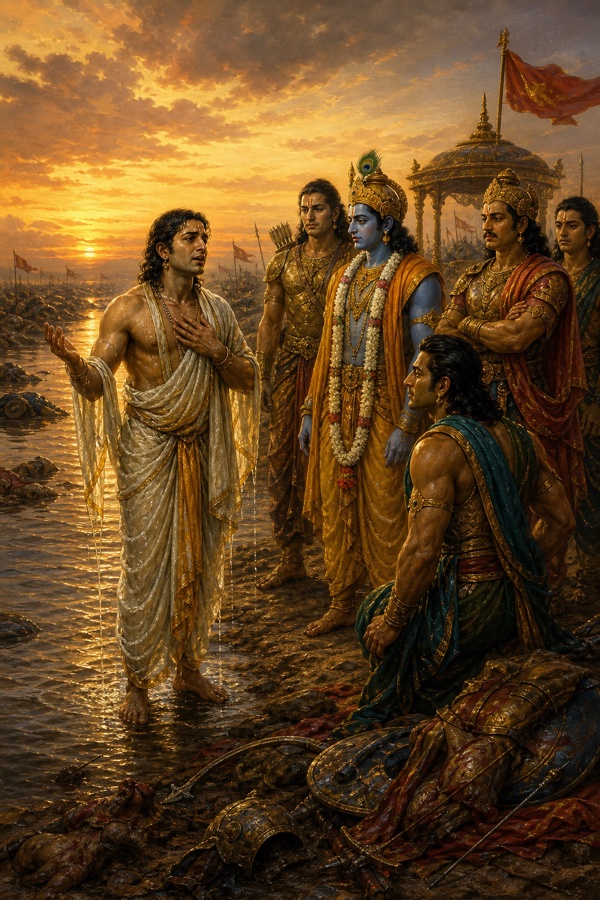
A stricken Yudhishthira wading out of the water at sunrise, his hand pressed to his chest; Krishna and his brothers stand around him.

The battle for Hastinapura was over, and the dust of Kurukshetra now lay caked with blood. The sons of Pandu, and Vidura, and Dhritarashtra, and all the women of the house of Bharata, poured out handfuls of water for their slain, and they resolved to pass the month of mourning outside the city on the sacred bank of the Ganga. When Yudhishthira had finished the water-rite, the offering of water to the dead, many sages rich in penance came to see the king. Among them was Vyasa, born on an island, and Narada, and the great rishis Devala, Devasthana, and Kanva, each with his best disciples. Thousands of Brahmanas consoled that king whose heart grief had split open. Then Narada, putting the island-born Vyasa forward, asked the son of Dharma, “Yudhishthira, by the strength of your arms and the grace of Madhava you have won the whole earth by right. It is your good fortune to have come out of this terrible war alive. You are a keeper of the Kshatriya law. Do you feel no joy? Even with this sovereignty won, does grief still gnaw at you?”

The king’s grief, and the secret of Karna

Yudhishthira answered, “Revered one, by the strength of Krishna’s arms, by the grace of the Brahmanas, by the valor of Bhima and Arjuna, I have won the whole earth. Yet one heavy grief sits always in my heart: that out of greed I brought about this frightful slaughter of my own kin. To win this victory I had Subhadra’s beloved son and the sons of Draupadi killed, and so it feels to me like defeat. What will Subhadra of the Vrishni line, my brother’s wife, now say to me? What will the people of Dwarka say when Madhava returns there and they hear it from him?”

Then Yudhishthira spoke the thing that had burned in him deepest of all. At the water-rite Kunti had named Karna aloud as the son of Surya. “Narada, that hero who held in him the strength of ten thousand elephants, who had no equal as a chariot-warrior in this world, who was proud and grave as a lion, that Karna was Kunti’s own son, our full brother born in secret. The one the world took for a suta’s child, the son of Radha, was in truth Kunti’s eldest and our own blood brother. In my hunger for the kingdom I had that very brother killed without knowing it. This burns my limbs like fire set to a heap of cotton.”

Yudhishthira went on. Once Pritha, Kunti, had gone to Karna herself and said, “You are my son.” But Karna had refused to do as she wished. “To desert Duryodhana in war,” he had said, “would be a thankless and pitiless act. If I made peace with Yudhishthira, people would say I did it out of fear of Arjuna.” Yet he had given his mother a promise: “Lady, your five sons will always remain. If Karna falls fighting Arjuna, your five will be the other four and Arjuna; and if Arjuna falls, they will be the four and myself.” Yudhishthira remembered how, in the assembly hall, while he suffered torment among Duryodhana’s wicked sons, his own anger would cool the instant he saw Karna’s feet, for they were like his mother Kunti’s feet. “Revered one, tell me all of it. Why did the earth swallow my brother’s chariot-wheel in the battle? Why was he cursed? You know both what has been and what will be.”

A key to reading this: The water-rite (udaka-kriya) is the funeral offering of sesame and water to the dead. A suta is the mixed order born of a Brahmana father and a Kshatriya mother, the caste of charioteers and bards; this is why Karna bore the insult of “suta’s son” his whole life. Pritha is another name for Kunti. A rathi is a great warrior who fights from a chariot.

Narada’s tale: the two curses of Karna

Narada said, “Mighty-armed one, you have spoken truly. In battle no one could stand before Karna and Arjuna. What I am about to tell you is unknown even to the gods.” Then he told the whole story. That radiant boy, born of Kunti’s womb while she was still a maiden, was reared in a suta’s house. He learned the science of weapons from Drona. Watching Bhima’s strength, Arjuna’s speed of hand, Yudhishthira’s judgment, and the modesty of the twins, he burned with envy, and while still young he became Duryodhana’s friend.

One day Karna went to Drona in private and said, “I wish to fight Arjuna. Teach me the Brahmastra, its mantras, and how to withdraw it.” But Drona, loving Arjuna and knowing Karna’s malice, answered, “The Brahmastra can be known only by a Brahmana who has kept every vow, or by a Kshatriya who has done severe penance, and by no one else.” So Karna went to Parashurama on Mount Mahendra and said, “I am a Brahmana of the line of Bhrigu.” By this lie he won honor, and Rama took him respectfully as a pupil. There Karna learned every weapon.

One day, wandering by the sea, Karna without meaning to killed a Brahmana’s homa-cow, a cow kept for the fire-rite. In remorse he confessed it and tried to please the Brahmana with cattle and wealth, but the Brahmana in anger cursed him: “The very enemy you always long to fight, while you fight him the earth will swallow your chariot-wheel, and in that instant your enemy will cut off your bewildered head, as heedlessly as you killed this cow.” However much Karna begged, the Brahmana would not take the curse back.

Some time later came the second curse. One day Parashurama, tired, lay down and slept with his head in Karna’s lap. Then a terrible worm, a thing that fed on flesh and blood, burrowed into Karna’s thigh and began to bore through it. Fearing to wake his teacher, Karna could neither throw it off nor kill it, and he bore that unbearable pain without stirring. When Karna’s blood touched Parashurama’s body, he woke. He saw that the worm, named Alarka, with eight legs and bristles sharp as needles, had died dissolving in the blood. A demon appeared in the sky and said that in a former life he had been an Asura named Damsa, who had carried off the wife of Bhrigu and been turned to a worm by a curse; now, by touching Rama, he was delivered.

Then Parashurama said to Karna in anger, “Fool. No Brahmana could bear such pain. Your endurance is a Kshatriya’s. Tell me the truth.” In fear of a curse Karna told it: “I am a suta, born of the mixing of Brahmana and Kshatriya, Radha’s son Karna. I practiced this deceit out of longing for weapons.” Parashurama, smiling but filled with anger, cursed him: “Because out of greed for weapons you lied, this Brahmastra will not come to your memory in the hour of your death, when you struggle with a warrior your equal.” Karna returned to Duryodhana and said, “I have mastered every weapon.”

A sub-tale: A teacher asleep in his lap, a worm boring into the thigh, and pain borne without a whimper. That very endurance betrayed Karna, for by it Parashurama saw that this was no Brahmana. Here is the cruel irony of the Mahabharata: Karna’s finest quality became the ground of his curse.

Karna’s glory, and the many causes of his fall

Narada told Karna’s glory. At the self-choice of the daughter of Chitrangada, king of the Kalingas, Duryodhana carried the girl off by force, and Karna alone defeated hundreds of enraged kings and guarded him. Jarasandha, king of Magadha, challenged Karna to single combat; in the wrestling, when Karna was about to tear apart the two halves that Jara had once joined, Jarasandha in delight made friends with him and gave him the city of Malini. Before this Karna had been only king of Anga; now he ruled over Champa as well.

Narada counted out all the causes of Karna’s fall: the Brahmana’s curse, Parashurama’s curse, the gift of his armor and earrings to Indra (which Indra asked for in the interest of the Pandavas), the trickery of Indra’s divine illusion, Bhishma’s ranking of him among the warriors as a mere half-rathi to belittle him, the sapping of his fire by Shalya’s bitter words, the policy of Vasudeva, and the divine weapons Arjuna received from Rudra, Indra, Yama, Varuna, Kubera, Drona, and Kripa. “Hemmed in by all of these, Arjuna of the Gandiva could kill Karna, the son of Vikartana, radiant as the sun. So your brother was beset by the curses and deceits of many. He has fallen in battle, and you should not grieve for him.”

A key to reading this: The ranking of rathas and atirathas is the grading of an army’s warriors by their strength; Bhishma insulted Karna by calling him a “half-rathi.” Vikartana is a name of the sun, so “son of Vikartana” means Karna, son of Surya.

When Narada fell silent, Yudhishthira sank into grief. Then Kunti, herself broken with sorrow, told him that she and the god Surya both, in dream and in waking, had told Karna to join his brothers, but that under the sway of fate he would not listen. Hearing this, Yudhishthira said through his tears, “You kept your counsel hidden, and so this great grief has come upon me.” And in his sorrow he laid a curse on all women, that from then on no woman would be able to keep a secret.

The gist: Before Bhishma’s teaching, the story begins with Yudhishthira’s guilt. The tale of Karna’s two curses and his many undoings shows that a great warrior does not fall by one error but by the meeting of many threads of fate. And the deepest wound of all: the price of victory was the blood of his own brother.

Yudhishthira declares he will renounce
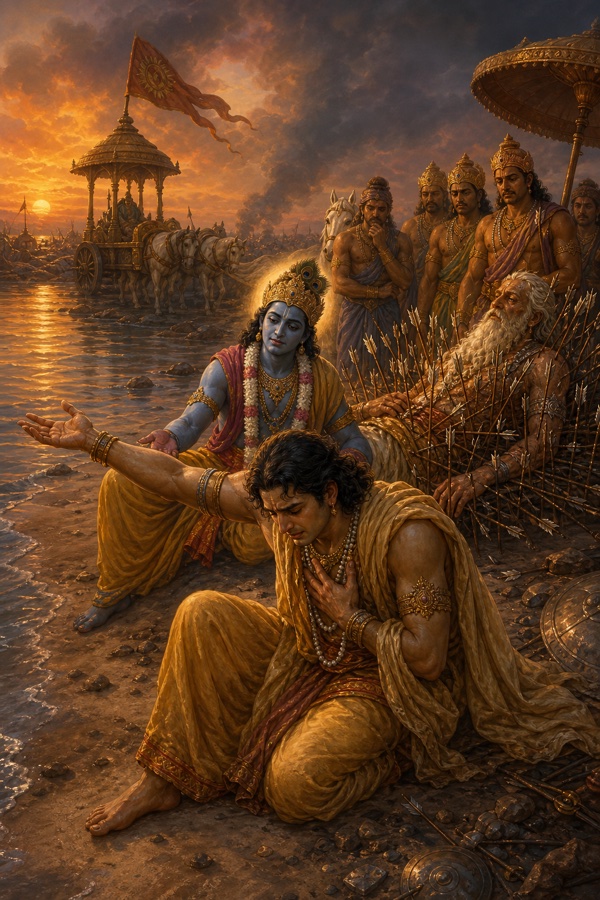
Krishna, seated on the bank, counseling the grief-struck Yudhishthira; behind them Bhishma lies on his bed of arrows and warriors stand by.

Burning with grief, Yudhishthira said to Arjuna, “Arjuna, if we had lived by begging in the cities of the Vrishnis and Andhakas, this cruel end of the slaughter of our own would not have come. A curse on the ways of the Kshatriya, on strength and valor, on the anger that brought this disaster. Blessed instead are forbearance, self-restraint, purity, renunciation, humility, harmlessness, and truth, which the sages of the forest keep. Like a pack of dogs fighting one another over a scrap of meat, we have brought this ruin on ourselves, and now even the scrap no longer pleases us.” Before his mother and his brothers Yudhishthira declared that he would leave the kingdom and go to the forest, that he would take a vow of silence and walk the path that knowledge points to, for one bound to the earth cannot gain the whole fruit of dharma. “Arjuna, you rule this quiet, thorn-free earth. I want neither kingdom nor enjoyment.”

Arjuna’s reply: the dharma of wealth and action

Arjuna, biting his lip yet smiling, spoke sharply. “King, it pains me to see you set on abandoning this prosperity after performing so great a deed. Has any eunuch or sluggard ever won a kingdom? Why give up the earth, won by keeping your own dharma, out of a fickle mind? If you go to the forest, in your absence the wicked will destroy the sacrifices, and that sin will cling to you.”

Arjuna sang the praise of wealth. “The dharma of a king rests wholly on wealth. Whoever has wealth has friends, has kin, is taken for learned and good. From wealth come dharma, pleasure, and heaven. As rivers come from a mountain, so acts of dharma come from wealth. Even the gods desire the ruin of their own kin, the Asuras; it was by mutual strife that they won heaven. The wealth a king takes from others becomes the means of his prosperity, as sons call their father’s wealth their own. This earth belonged first to Dilipa, Nahusha, Ambarisha, and Mandhata; now it is yours. So perform a great sacrifice with rich gifts. If you do not, all the sins of this kingdom will be yours. This is the eternal and auspicious road of the horse-sacrifice; leaving it, what road will you take?”

A key to reading this: The Rajasuya, Ashvamedha, and Sarvamedha are the great sacrifices of kings; in the horse-sacrifice, wherever the loosed horse wandered, that land was counted the king’s. The dakshina is the gift given to Brahmanas at the close of a sacrifice.

Yudhishthira paints the forest life, and Bhima answers

Yudhishthira drew the picture of his forest life in detail: he would live on fruit and root, wander among the deer, give no least pain to any creature, rise above the pairs of opposites, pleasure and pain, praise and blame, keep silent, and behave like a blind, deaf, senseless thing. “If one man cuts off my arm and another anoints the other arm with sandal paste, I will wish neither the first any harm nor the second any good. If I do not get even a needle’s tip of food, I will beg through seven houses.”

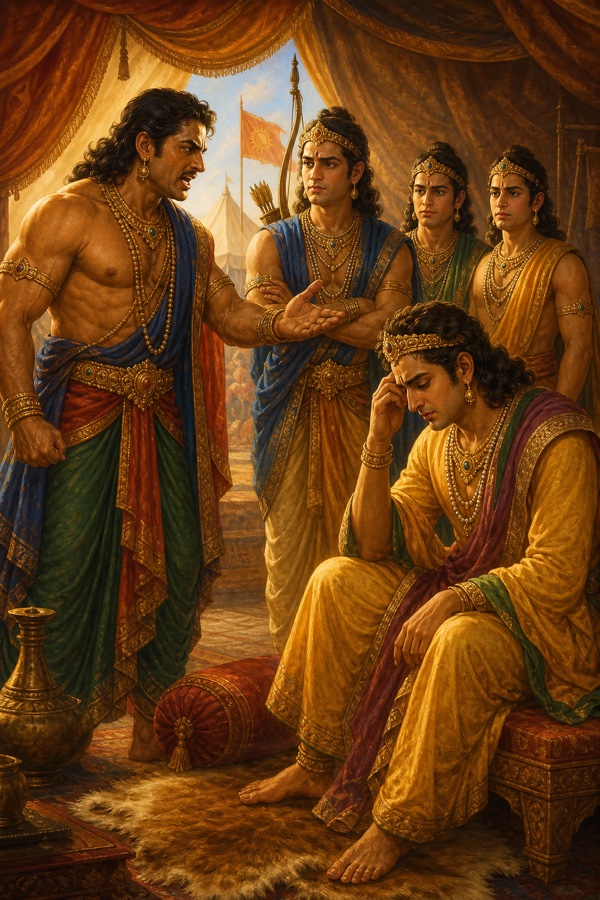
An angry Bhima reaching out to reason with Yudhishthira, who sits in the camp with bowed head; Arjuna, Nakula, and Sahadeva stand near.

Bhimasena spoke in anger. “King, as the mind of a foolish reciter is blinded to the truth by rote repetition of the Veda, so your mind has been blinded. If, after condemning the Kshatriya law, you meant only to live a life of sloth, then this slaughter of Dhritarashtra’s sons was for nothing. It is as if a man digging a well came back smeared in mud before he reached the water, or climbed a tall tree, found honey, and died before he could taste it. Strong, wise, and full of fire as we are, we obey your word like a eunuch. The scriptures counsel renunciation only for old or defeated kings in a time of calamity, not as the Kshatriya’s dharma. If renunciation alone brought perfection, then mountains and trees, which harm no one and are forever celibate, would be perfected first. A man must act; the inactive never attain perfection.”

Arjuna’s sub-tale: the golden bird and the young renouncers
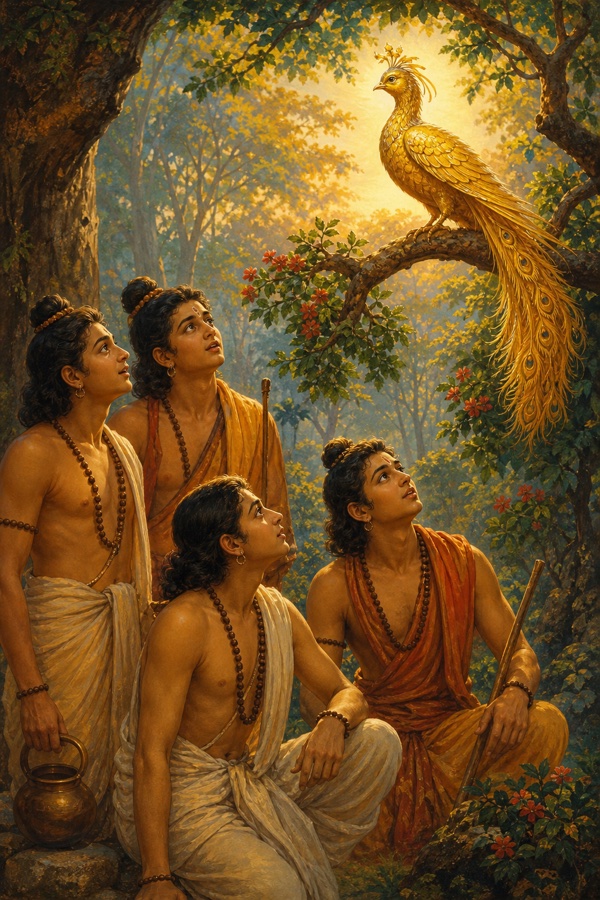
Beardless young brahmin ascetics in a forest gazing up in wonder at a luminous golden bird perched on a branch, dawn light filtering through trees.

Arjuna told an old story. Some high-born but dull-witted young Brahmanas, whose beards had not yet come, left home and father and brothers and went to the forest to live the life of celibate students. Indra took pity on them. Taking the shape of a golden bird, he said, “Those who eat the food left over from a sacrifice, the vighasa, do the hardest and holiest of deeds.” The young rishis said, “This bird is praising us, for we live on leavings.” But the bird said, “I am not praising you. You lie in filth, unclean, living on scraps like the wicked; you are not eaters of the sacrifice’s remnant.”

Then the bird, Indra, instructed them: among four-footed beasts the cow is best, among metals gold, among two-footed creatures the Brahmana. Every rite from birth to death is ordered by mantras. The householder’s life is the field of perfection. Those who condemn action leave the paths of the gods, the rishis, and Brahman, and walk a road the Veda forbids. Sacrifice, the study of the Veda, the offering of water to the ancestors, and service to one’s teacher are the sternest penances; by these the gods gained their greatness. “Take up the heavy burden of the householder’s dharma. Those who feed guests, gods, rishis, and kin, and then eat what is left, are the true eaters of the remnant, and they win a hard-won road.” Hearing this, the young men gave up renunciation and took up the householder’s life. “King, rule this thornless world with that same eternal wisdom.”

A key to reading this: Vighasa is the food left after guests, gods, and ancestors have been fed; to eat it was counted the householder’s merit. A vighasa-eater is a householder who first feeds everyone else and then eats himself.

The gist: This debate among the brothers is the doorway into the Mahabharata’s law of kings. The question is this: having won the war, should the king renounce or rule? Arjuna takes the side of wealth and action, Bhima the side of the Kshatriya law, and Indra’s tale sets the householder’s dharma above all four orders. The moral knot is knowing when renunciation is dharma and when it is flight.

Nakula and Sahadeva argue: who is the true renouncer

Nakula spoke, his coppery face set. “Even the gods depend on the fruits of action; even the ancestors are engaged in works. Know those to be atheists who spurn the Veda’s ordinance of action. The true renouncer is the one who, keeping self-restraint, gives his rightfully earned wealth in sacrifice to Brahmanas learned in the Veda. The one who leaps to a later stage of life, abandoning the very source of a householder’s joys, is a renouncer of darkness. When the four orders of life were weighed in a balance, the householder’s dharma set in one pan required the other three to be set in the other. The true renouncer is the one who lives the householder’s life as a duty, letting go of desire for its fruit, and not the one who leaves home for the forest yet cannot forget his desires even there. A king who does not save the people from robbers is Kali himself in the flesh. If we go to the forest without giving and protecting, we would ourselves be called the Kali of the royal order.”

Sahadeva made a subtler argument. “Perfection does not come from renouncing outward things alone; the attachment of the mind must be renounced too. ‘Mine,’ this word of two syllables, is death itself, and ‘not mine,’ this word of three, is eternal Brahman. The one who sees all beings as himself is freed from the great fear of destruction. King, you are my father, my protector, my brother, and my teacher too. Forgive these unfitting words of a grieving man, spoken only out of reverence for you.”

A sub-tale: This image of weighing the four orders of life in a balance is a subtle seed of the law of kings. Studentship, forest-retreat, and renunciation together only equal the weight of the householder’s dharma, because it is the householder who sustains gods, ancestors, guests, and all creatures. But Sahadeva turns it: the real renunciation is not outside, it lies in dropping the mind’s “mine.”

Draupadi’s sharp words: without the rod a Kshatriya is nothing
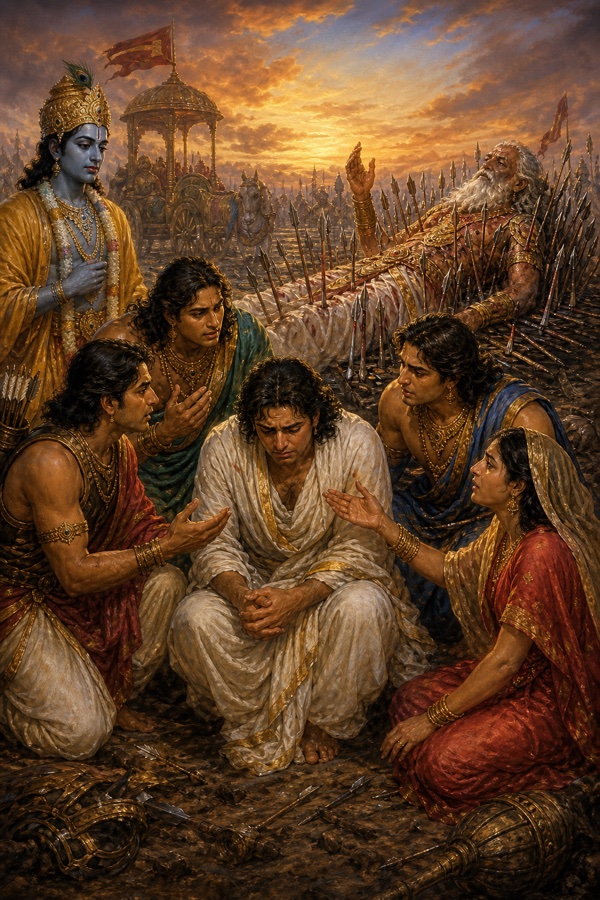
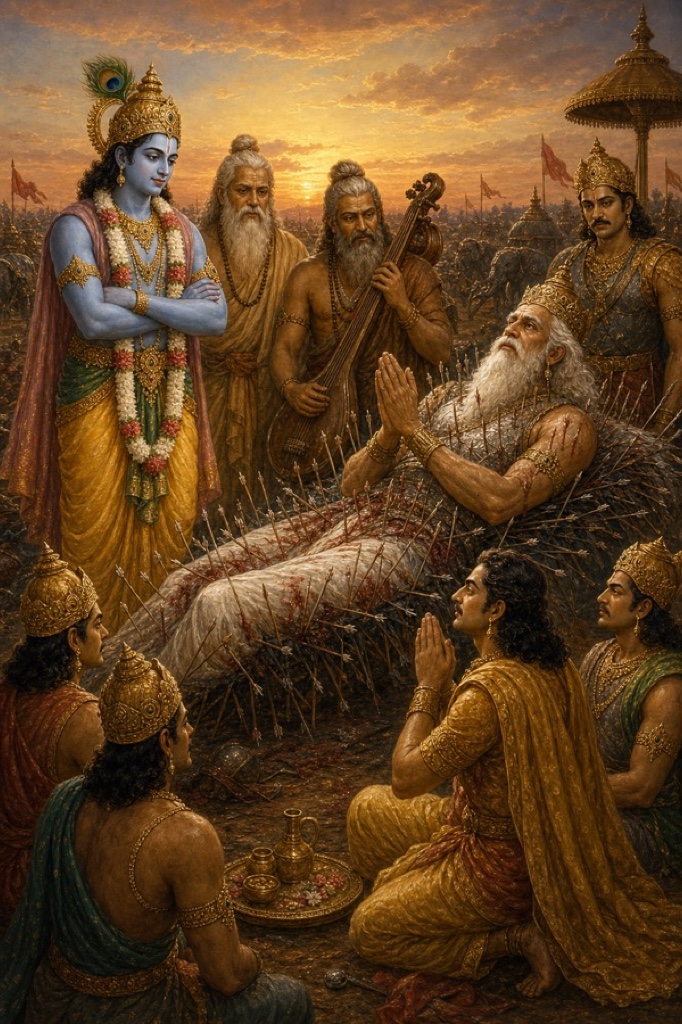
On the battlefield the brothers and Draupadi surround the grieving Yudhishthira and plead with him; behind them Krishna stands and Bhishma, on his bed of arrows, raises a hand.

When Yudhishthira kept silent, the large-eyed, beautiful Draupadi, who had always looked for his affection, said, “Partha, these brothers of yours wait with dried mouths like the chataka bird, and still you will not gladden them. By the lake of Dvaitavana, bearing the cold and wind and sun, it was you who told these brothers that once we had killed Duryodhana we would enjoy the earth that grants every wish and perform great sacrifices. Why then do you now sadden our hearts? A eunuch can neither enjoy wealth nor father children, as a fish cannot live in waterless mud. Without the rod a Kshatriya finds no splendor, cannot enjoy the earth, and his people know no ease. To crush the wicked, to cherish the good, and never to turn his back in battle, this is the king’s highest dharma.”

Draupadi reminded him that Yudhishthira had ruled vast tracts by force, Jambudvipa, Kraunchadvipa, Shakadvipa, and Bhadrashva; having done such matchless deeds, why was his mind still unsatisfied? She repeated her mother-in-law Kunti’s words, that Yudhishthira would always keep her in comfort. “Having killed thousands of mighty kings, you are now about to make that deed pointless through your own folly. When the eldest brother turns mad, all the rest must follow him. If these brothers were in their senses, they would bind you and all the faithless and take up the rule of the earth themselves. King, protect the people in dharma like the kings Mandhata and Ambarisha, perform sacrifices, fight your enemies, and give gifts to Brahmanas.”

A key to reading this: Danda is the royal rod, the punishing power of rule, the machinery of justice; here it means both “punishment by the sword” and “the rule of law.” Kali is the last and most fallen of the four ages, the emblem of sin and disorder in the flesh.

Arjuna expounds the science of the rod

After Draupadi’s words Arjuna gave a deep exposition of danda, the science of the rod. “It is the king who bears the rod who governs and guards all the people. When all others sleep, the rod stays awake; and so the wise have called the rod dharma itself, made visible. The rod guards dharma, wealth, and pleasure, all three. Some abandon sin out of fear of the king’s rod, some out of fear of Yama’s rod, some out of fear of the next world, and some out of fear of society. If there were no rod, the strong would swallow the weak, as in the water the big fish eats the small. The rod is called danda because it restrains the unruly, the dandya, and punishes the wicked.”

Arjuna set out how the rod differs by order: for the Brahmana punishment is by words alone, for the Kshatriya by giving away enough grain to keep him alive, for the Vaishya by fines and seizure of property, and for the Shudra there is no such prescribed rod. He said that no one can hold on to life without giving some pain to some creature: the mongoose eats the mouse, the cat the mongoose, the dog the cat, the leopard the dog. This world of moving and unmoving things is the food of living beings, and so the gods have ordained. Indra won his lordship by killing Vritra. “King, become what you were born to be. If there were no rod, the dog would lick the sacrificial butter and the crow would carry off the first offering. The rod is the root of all; on it rest both heaven and this world.”

Arjuna touched also the moral tangle of violence and non-violence: “No act is wholly meritorious, none wholly sinful. In every act both are mixed. There is no sin in killing with a weapon an enemy who has come against you with a weapon raised, for his own anger is what the attacker has stirred. The self cannot be slain; and if the self cannot be slain at all, how does one man kill another? As a man moves to a new house, so the living being takes on new bodies.”

The gist: This passage is the seed-thread of Bhishma’s law of kings. Danda, the royal power, is the axle on which the order of society turns. Without the rod comes the “law of the fishes,” where the big fish eats the small. But Arjuna does not leave it flat: he holds that every act carries both merit and sin mixed together, and the king’s dharma is never clean, always mingled.

Bhima calls for the war within, and Yudhishthira’s teaching on contentment

Bhima gathered his patience again and said, “King, there are two kinds of disease, of the body and of the mind, and each gives rise to the other. Cold, heat, and wind are the three qualities of the body, and their balance is health. Goodness, passion, and darkness are the three qualities of the mind, and their balance is the mind’s health. Grief is balanced by joy and joy by grief. You were never cast down in your griefs nor lifted up in your joys; why then, now in the time of joy, do you make yourself wretched with memory?” Bhima recalled Draupadi dragged into the hall, the exile, the outrages of Jatasura and Kichaka, and said, “Now before you stands a war like the one against Bhishma and Drona, but one to be fought with the mind alone, needing no arrows, no friend, no kin. If you give up your life without first conquering this enemy of the mind, you will take another body and have to fight these same enemies again. So today, this very day, set aside your care for the body and conquer the enemy within.”

Yudhishthira answered, “Bhima, it is out of discontent, worldly attachment, unrest, pride, and anxiety that you desire the kingdom. The king who rules this endless earth still has only one belly. Desires are not filled in a day, nor in many months, nor in a whole lifetime. Fire is fed and grows with fuel, and dies if it is not fed; so quiet the fire of the belly with a little food. Conquer the belly first, and then the earth is conquered.” He recalled the saying of Janaka: “My treasury is boundless, and yet nothing is mine. If all Mithila should burn to ash, nothing of mine burns.” “The one who has climbed to the roof of the house of knowledge looks down at those who grieve below as a man on a mountain-top looks at people in the plain. When one sees the many forms of beings as the various showing of a single essence, only then is he said to have reached Brahman.”

A key to reading this: The path of the ancestors and the path of the gods are two roads; those who do sacrificial works go by the path of the ancestors (the southern road), and those who seek liberation go by the path of the gods (the northern road). Janaka of Mithila is the royal sage, the model of one who stays in the world of rule yet remains unattached.

Arjuna’s sub-tale: King Janaka and his queen
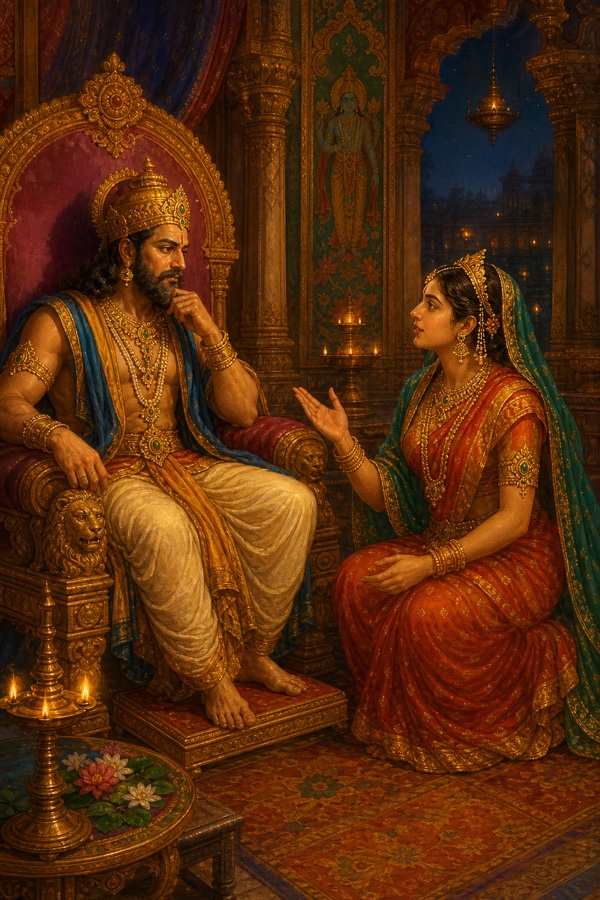
King Janaka of Videha in his palace conversing with his crowned queen who counsels him, ornate Mithila throne-chamber, lamplit evening.

Then Arjuna told another story, of Janaka, king of Videha, and his queen. Once Janaka gave up wealth, sons, wife, and even the sacred fire, shaved his head, became a mendicant, and resolved to live on the grains of barley he could glean from the cracks in the fields. Then his spirited queen, alone with him, unafraid, spoke to him angrily and with reason: “Why have you left a realm full of grain and wealth and taken to begging? With a handful of barley how will you satisfy guests, gods, rishis, and ancestors? You were the sustainer of thousands of Brahmanas learned in the three Vedas; will you now beg from those very men? Your mother is made childless, and I, a princess of Kosala, am made a widow. These helpless Kshatriyas depend on you for their fruit and merit; killing their hope, into what world will you go?”

The queen made a subtle argument: “If a kingdom and a handful of barley are equal to you, then why leave the kingdom at all? And if that handful of barley has become the object of your attachment, then your whole resolve to renounce has already fallen. No one becomes a renouncer merely by giving up property or living on alms. The one who is unattached within, though he may seem engaged without, who has broken every bond and sees friend and foe alike, he alone is free. Many who shave their heads and put on ochre are inwardly bound by many bonds and wander hunting after empty wealth. King, holding your senses in check, sustaining the true holy men, win the worlds of joy in the world to come. Who is more righteous than the one who keeps the sacred fire, performs sacrifices, and gives day and night?” Arjuna added, “Even a knower of truth like Janaka was once bewildered in this matter; do not you fall into delusion. It is by giving, by harmlessness, and by truthful speech that we shall win the worlds we desire.”

A sub-tale: The queen’s argument is a sharp turn of thought. She says that even the beggar’s handful of barley, if it becomes an attachment, is a heavier bond than a kingdom. The ochre robe of renunciation is worth something only when the inner “mine” has died; otherwise it is merely a means of filling the belly. This thought runs into Sahadeva’s “mine and not-mine.”

Yudhishthira takes the side of knowledge, and Devasthana answers

Yudhishthira said, “Arjuna, I know both the Veda and the knowledge of Brahman. The Veda teaches both action and the renunciation of action. Of the three, penance, renunciation, and the knowledge of Brahman, the second is higher than the first and the third than the second. You know the science of war, but you have not served the elders; you do not know the subtle sense of the scriptures. To hold wealth above all is an error. The righteous keep to penance and the study of the Veda. Those who, free of greed, hold back their worldly desires go by the northern road, the path of the gods, to the worlds of the renouncers.”

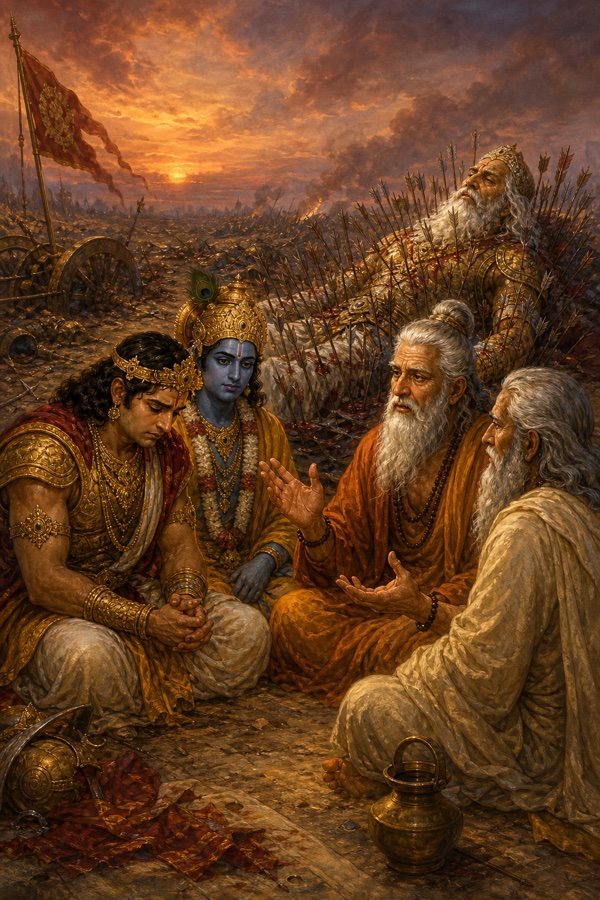
The sage Vyasa, seated on the battlefield, instructs Yudhishthira and Krishna; other aged rishis sit with them, and behind them Bhishma lies on his bed of arrows.

Then the great ascetic Devasthana spoke. “Ajatashatru, Phalguna, Arjuna, has said there is nothing higher than wealth, and I say the same. You have won the earth by dharma; do not throw it away without cause. The Veda sets out four orders of life; pass through them in order. For now, perform great sacrifices with rich gifts. The one who takes wealth and gives it to the unworthy while withholding it from the worthy earns the sin of killing an unborn child. To judge the worthy from the unworthy is not easy. The Creator made wealth for sacrifice, and man for the guarding of that wealth and for sacrifice. Indra, Mahadeva, Marutta, and Harishchandra all gained their greatness by sacrifices.”

Devasthana quoted the teaching on contentment that Brihaspati gave when Indra asked him for it: “Contentment is the highest heaven, contentment is the highest happiness. When a man draws in all his desires like a turtle drawing in its limbs, then the natural light of his soul shines out. When one neither fears any creature nor makes any creature fear, when he conquers liking and disliking, then he is called a seer of the self. Harmlessness, truthful speech, justice, compassion, self-restraint, the begetting of children, gentleness, modesty, and patience, these, said Manu, are the highest dharma. The Kshatriya who knows the law of kings, keeping self-restraint, curbing the wicked and cherishing the good, and at last handing the kingdom to his son and going to the forest, wins the best fruit in both worlds.”

A key to reading this: The four orders of life are studentship (brahmacharya), the householder, the forest-dweller (vanaprastha), and the renouncer (sannyasa); the ordinance is to live life in these stages in order. Killing an unborn child is, in the scriptures, a grave sin; a gift to the unworthy is called its equal.

The gist: Two currents clash here: Yudhishthira’s current of knowledge and renunciation, and the current of action and sacrifice held by Devasthana and Arjuna. Devasthana suggests the middle road, to live the four orders in turn, first the law of kings, then renunciation. The teaching on contentment is the key that loosens the tension: even within a kingdom, a turtle-like detachment is possible.

Vyasa’s teaching, and the rod-tale of Shankha and Likhita

When Yudhishthira stayed silent though Arjuna urged him again, the island-born Vyasa spoke. “Yudhishthira, Arjuna’s words are true. The highest dharma rests on the householder’s dharma. Gods, ancestors, guests, and servants all live on the householder. Take up the bundle of kingship handed down through your line, as a bull takes up its load. The chief dharma of the Kshatriya is to bear the rod; let strength stay always in the Kshatriya, and on strength rests the rod. Brihaspati sang this verse: ‘As a snake swallows a mouse, so the earth swallows the king who loves peace overmuch and the Brahmana too attached to his household.’ The royal sage Sudyumna, by bearing the rod alone, reached perfection like Daksha’s.”

When Yudhishthira asked, Vyasa told the tale of two ascetic brothers named Shankha and Likhita. On the bank of the Bahuda river each had his own beautiful hermitage. One day the younger, Likhita, came to the elder Shankha’s hermitage; Shankha was out. Likhita began to pluck and eat the ripe fruit of the hermitage without a thought. When Shankha returned he asked, “Where did you get this fruit?” Likhita said, laughing, “From this very hermitage.” Shankha said in anger, “You took it without its being given. That is theft. Go to King Sudyumna and say, ‘I have stolen; give me a thief’s punishment.’”

Likhita went to King Sudyumna and asked for a thief’s punishment. The king said, “If a king is able to punish, he is able to pardon too; you are made pure, so I forgive you, and ask a boon instead.” But Likhita asked for nothing else. So the king had both his hands cut off. Likhita bore the punishment and returned to his brother and said, “Now forgive this chastened wretch.” Shankha said, “I was never angry with you, nor did you wrong me; but your dharma had been injured, and by this I have raised you out of it. Now bathe in the Bahuda and offer water to the gods, the rishis, and the ancestors.” Likhita bathed and began the water-rite, and in the place of his severed hands two new hands sprouted like lotuses. Amazed, Likhita showed his brother. Shankha said, “This is the fruit of my penance; do not be astonished, the Creator is the cause. I did not first purify you because I am not your punisher; the king, by punishing, made pure himself, you, and the ancestors.” Vyasa said, “By this very act that king reached perfection like Daksha’s. The Kshatriya’s dharma is to bear the rod, not to shave his head.”

A sub-tale: The tale of Shankha and Likhita shows the harsh beauty of the law of kings. An elder brother sends his younger to receive the royal rod, and the king’s punishment is what purifies him of sin. Here the rod works as a means of cleansing rather than as an outburst of anger; and the sprouting of the severed hands is a sign that the one who accepts the rod of justice becomes whole again in the end.

Vyasa’s statecraft, and the story of Hayagriva

Vyasa gave the son of Kunti the threads of the law of kings. “King, the one who takes the sixth part in tax and yet does not guard the realm takes a quarter share of the realm’s sin. The king who, with a mind shaped by the scriptures, casting off desire and anger, treats all his people with a father’s fairness, earns no sin. Let the king crush his enemies by strength and policy; let him allow no sin in his realm and bring about the practice of dharma. Let him give special protection to the brave, the well-conducted, the learned, the Brahmanas versed in the Veda, and the wealthy. A wise king should not put his whole trust in any single man, however full of virtue. The king who does not protect the people, whose desires are unbridled, who is full of pride and malice, earns the ill fame of sin and cruelty. If his people, unprotected, are ground down by the strokes of the gods and by robbers, all that sin clings to the king.”

Vyasa told the story of the ancient king Hayagriva, who killed many enemies and at last, alone and without a helper, fell in battle to the death of a hero. Cut and torn by weapons, fighting on without fear, he gave up his life. Vyasa gave his battle the figure of a sacrifice: the bow was the sacrificial post, the bowstring the cord that binds the victim, the arrows the small offering-ladle, the sword the large one, the blood the clarified butter of the offering, the chariot the altar, and the fury of battle the fire; four fine horses were the four priests. In that sacrifice, offering his enemies as oblations and at the last pouring out his own life, Hayagriva, freed of sin, now takes his pleasure in the world of the gods. “He guarded the realm by policy and wisdom, ruled the earth without pride, and gave up his life in battle; and so he takes his joy in the world of the gods.”

A key to reading this: The sixth part is the tax the king took of the produce of the people in ancient India, and in return lay the duty of protection. The hota is the priest who recites the mantras and pours the offering in a sacrifice. To call war a sacrifice is to say that for the Kshatriya a just war is itself a rite, in which he offers up even his own life.

The teaching of Time: the story of Senajit

Yudhishthira said again that the wailing of the women gave his heart no peace. Then Vyasa, knower of yoga, gave a deep teaching on Time, on Kala. “No man gains anything by his own act, his sacrifice, or his worship; man gains all things from Time. The Creator made Time the means of gaining. From Time the wind blows, the clouds rain, the lakes are decked with lotuses, the trees flower. Without Time no one is born and no one dies; without Time the seed does not sprout.”

Vyasa told the story of King Senajit, who in his grief spoke this truth: “The unstoppable flood of Time touches all that is mortal. One man kills another, and is then killed by a third: this is the language of the world. In truth no one kills and no one is killed. At the loss of wealth, or the death of wife or son or father, a man cries ‘ah, what sorrow’ and sinks into that grief and swells it. King, why do you grieve like a fool? For those who are themselves fit to be grieved over, why grieve? In this world there is only sorrow, no happiness. Happiness turns in the end to sorrow, and is sometimes born of sorrow itself. The one who wants lasting happiness must let go of both. The one who grieves at another’s grief can never be happy. So let the calm-minded wise man neither swell with joy nor sink in sorrow.”

Vyasa gave the essence of the king’s sacrifice-dharma: “To stay engaged in battle is the king’s sacrifice; the keeping of the science of the rod is his yoga; and the gift of dakshina in sacrifice is his renunciation. Ruling the realm by wisdom and policy, casting off pride, performing sacrifice, and looking on all with compassion and fairness, the king after death takes his pleasure in the world of the gods.”

A key to reading this: Kala is not merely “time” but the power of destiny that is the root cause of all events; in the Gita, Krishna calls himself “Time.” Yoga here, in the context of the king, means skillful keeping of policy and steadiness of mind.

The gist: The teaching of Time is the philosophical answer to grief. If everything is under Time, then “I killed” or “I am the doer” is itself the delusion of ego. But note, Vyasa does not teach renunciation of action from this; he tells the king to do the law of kings free of desire, calling war, the rod, and giving the king’s sacrifice, yoga, and renunciation.

The faults of wealth, and Yudhishthira’s vow to fast to death

Yudhishthira told Arjuna that to hold wealth above all is an error; many perfected men reached the highest worlds by the study of the Veda and by penance alone. He counted the faults of wealth: “Wealth is not gained without harming others, and once gained it brings many afflictions. Out of greed for a little wealth a narrow-hearted man will cast off even the fear of remorse and go so far as to kill a Brahmana. The Creator made wealth for sacrifice; so let all wealth go to sacrifice and gift, not to the craving of enjoyment. Wealth has two faults: to give it to the unworthy, and to withhold it from the worthy.”

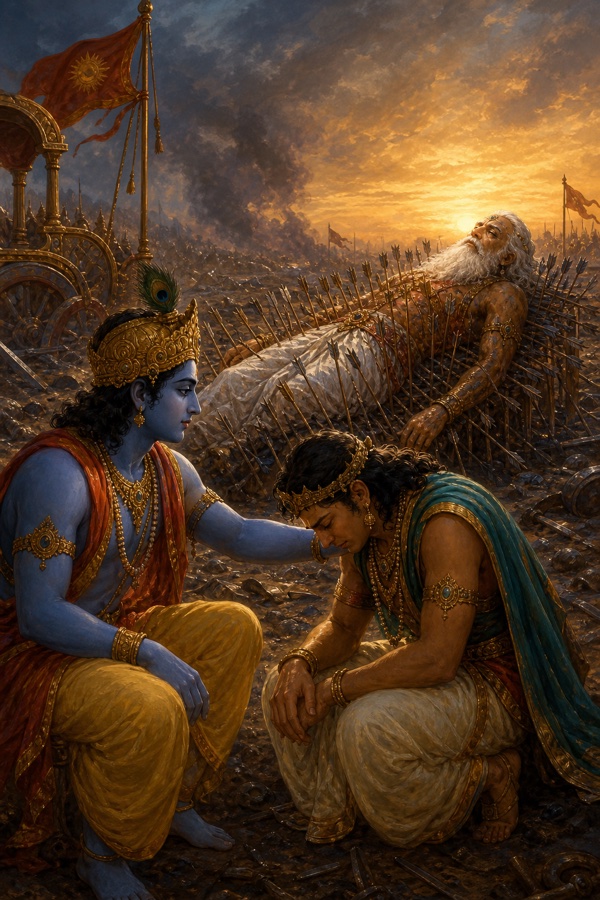
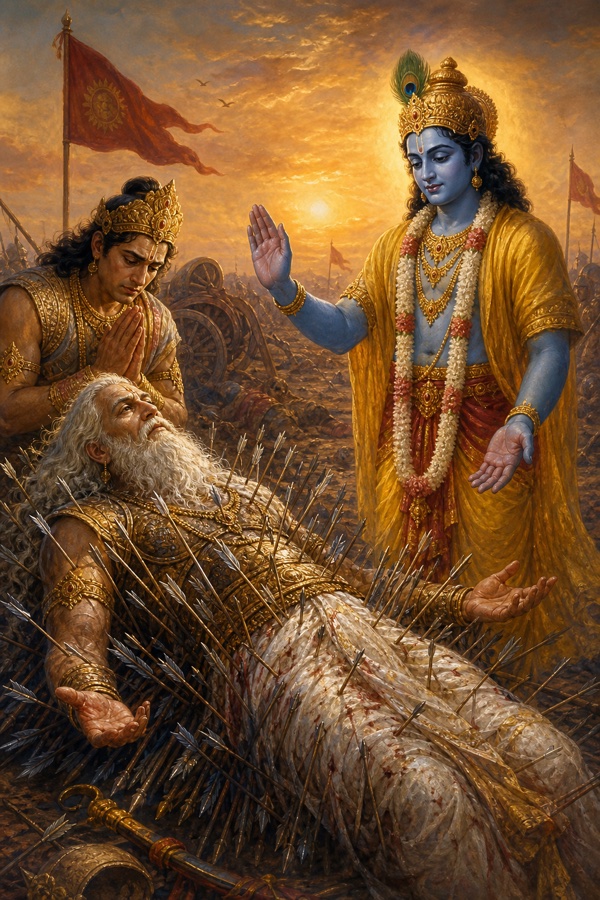
Krishna bending to touch the brow of the grief-drowned Yudhishthira; behind them Bhishma, on his bed of arrows, gazes toward the sky.

Then Yudhishthira reached the height of his grief. He remembered the killing of Abhimanyu, of Draupadi’s sons, of Dhrishtadyumna, Virata, Drupada, Vasushena (Karna), Dhrishtaketu, and more. He remembered Bhishma: “On whose breast and lap I played as a child, that very son of Ganga I had killed out of greed for a kingdom. Putting Shikhandin forward, Arjuna pierced him with arrows; I saw him lying on the earth soaked in blood.” He confessed too the half-truth he had told Drona. “The teacher asked whether his son lived; he trusted only me for the truth. I spoke the word ‘elephant’ under my breath and deceived him, saying Ashvatthama was slain, when it was an elephant of that name that had been killed. Having done so dreadful a deed, into what world shall I go?”

Overwhelmed with grief, Yudhishthira resolved on a fast to death: “I will sit on this seat, give up food and water, and dry up my own dear life. Give me, the killer of my teacher, leave to do this, so that I take no rebirth in any other womb.” Vyasa stopped him, saying, “This cannot be. All of this is destiny. As bubbles rise and burst on water, so all beings rise and fall. Union ends in parting, and life ends in death. You were made by the Creator for action; perfection comes only from action. You are not fit to turn away from action.”

A key to reading this: Praya (prayopavesana) is the vow of fasting to death, in which the seeker sits in one place, gives up food and water, and leaves the body. The Ashvatthama episode, Yudhishthira’s half-truth (an elephant was also named Ashvatthama), is a central point of the Mahabharata’s moral complexity; this one lie of the “truthful Yudhishthira” gnawed at him all his life.

The tale of Asma: destiny taught to Janaka

Vyasa told the tale of a learned Brahmana named Asma and his talk with Janaka, king of Videha. Janaka asked, “How should a man conduct himself at the times of gain or loss of kin and wealth?” Asma said, “The moment the body is formed, pleasure and pain are joined to it. In prosperity a man is filled with a threefold pride: ‘I am high-born, I can do what I will, I am no common man.’ Then, having squandered his forefathers’ wealth, when he grows poor he comes to think it right even to seize the wealth of others, and the king punishes him like a hunted beast.”

Asma gave a grave teaching on destiny: “Old age and death, like two wolves, devour all beings, strong and weak, small and great. Even the conqueror of the sea-girt earth cannot escape them. Whatever comes, joy or sorrow, is to be enjoyed or borne without gladness or grief, for there is no way to escape them. As scent, color, taste, and touch come by nature, so pleasure and pain come from what has been fixed beforehand. Even physicians fall ill; the strong grow weak; the rich grow poor. Strange is the way of Time.”

Asma drew the picture of life’s brevity: “As two pieces of driftwood meet on the great sea and then part, so beings meet and part. Mother, father, son, wife, thousands of ties are made; but whose in truth is who? As travelers meet at an inn, so is our meeting with our kin. ‘Where am I? Where shall I go? Who am I? Why have I come here? For whom should I grieve?’ Reflecting on these questions brings peace. No one can see heaven or hell; the scriptures are the eyes of the good. King, act according to the scriptures, beget children after studentship, perform sacrifices, and pay your debts to the ancestors, the gods, and men.” Hearing this, Janaka went home free of grief. Vyasa said, “Yudhishthira, cast off your grief and rise; you are the equal of Indra himself. Enjoy the earth won by the Kshatriya law.”

A key to reading this: Jara is old age; here it is called, with death, the “two wolves” that devour all. The three debts are, in the scriptures, the debt to the gods (paid by sacrifice), the debt to the rishis (paid by study of the Veda), and the debt to the ancestors (paid by offspring).

Krishna’s consolation, and the story of Srinjaya
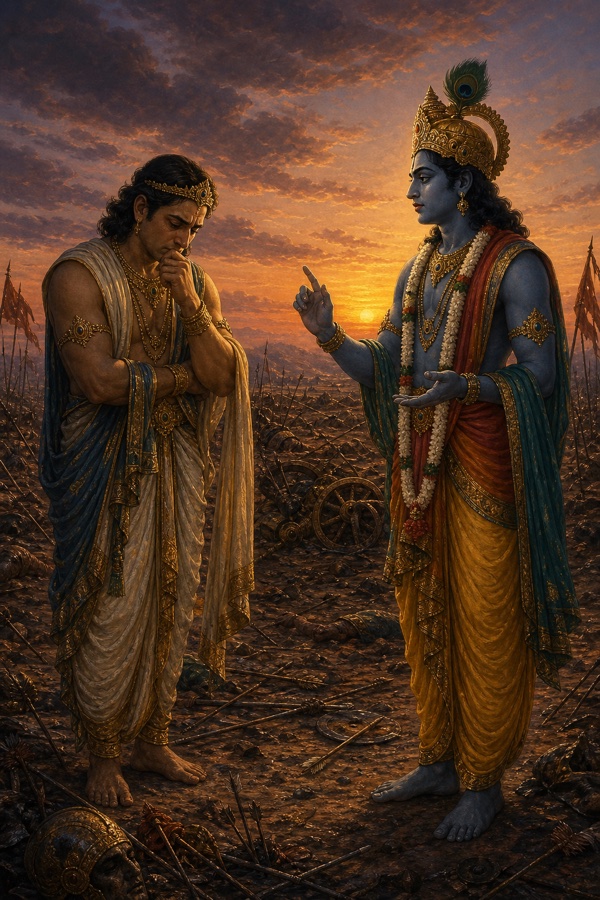
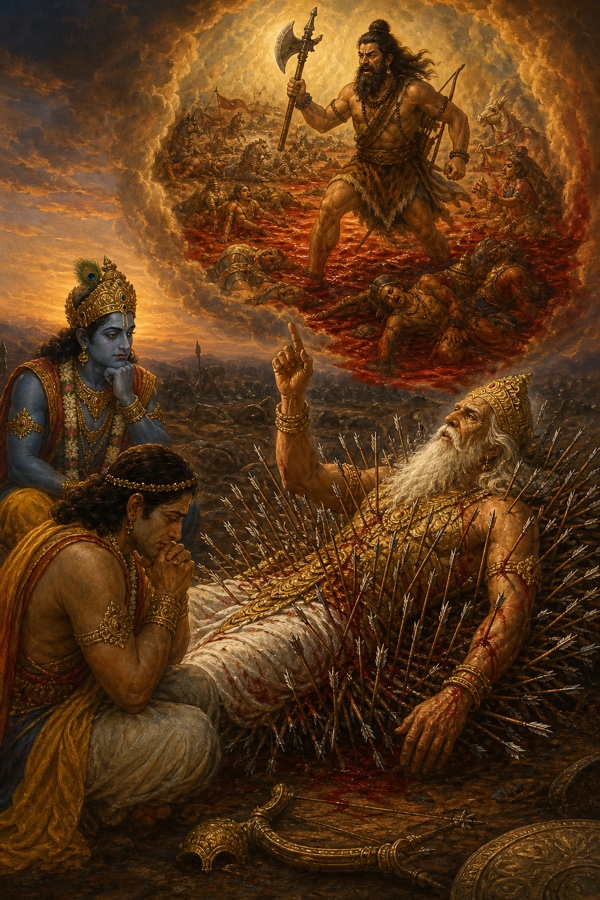
Krishna, on a battlefield strewn with arrows, raising a finger as he counsels the brooding Yudhishthira; a sunset sky behind them.

When Yudhishthira still kept silent, Arjuna said to Krishna, “Madhava, the son of Dharma is burning in grief for his kin; drive away his grief.” The lotus-eyed Govinda took the king’s hand, marked with sandal, firm as a marble pillar, and said, “Best of men, do not dry up your body with this grief. The heroes killed in this war cannot return; they are like a thing found in a dream that vanishes on waking. They all fought facing their enemies, none with a wound on his back, none killed while fleeing; and so they are all made pure by weapons and have reached the heroes’ end. Do not grieve for them.”

Krishna repeated the ancient teaching Narada gave to Srinjaya when he mourned his son. Narada had said, “Srinjaya, I, you, and all beings are mortal; what then is the cause of grief? I will tell you the greatness of the ancient royal sages; listen closely and cast off your grief.” Then Narada told out a long list of sixteen great kings, who were far greater than you and your son in dharma, knowledge, renunciation, and majesty, and who nonetheless became the food of death, and after each he repeated, “They too died, so do not grieve for your son.”

  • Marutta (son of Avikshit): at whose sacrifice all the vessels were of gold, and Shri herself appeared; who conquered even Indra.
  • Suhotra (son of Atithi): on whose realm Indra rained gold for a whole year; whose rivers carried golden turtles and crocodiles.
  • Brihadratha (king of Anga): who gave away a hundred thousand horses, a hundred thousand girls decked in gold, and tens of millions of bulls.
  • Shibi (son of Ushinara): who twirled the whole earth in his hand like a shield of hide.
  • Bharata (son of Dushyanta and Shakuntala): who performed a thousand horse-sacrifices and a hundred Rajasuyas; who gave Kanva countless horses and wealth.
  • Rama (son of Dasharatha): in whose realm there was no widow and no helpless soul; the clouds rained in season, every man lived a thousand years and had a thousand sons; he performed ten horse-sacrifices.
  • Bhagiratha (of the Ikshvaku line): who gave away ten hundred thousand girls decked in gold; on whose lap the Ganga sat and so was called Bhagirathi.
  • Dilipa: who gave the whole wealth-laden earth to Brahmanas; on whose golden post six thousand gods and gandharvas danced.
  • Mandhata (son of Yuvanashva): whom the Maruts drew from his father’s side, whom Indra suckled at his finger; who conquered the three worlds in a single day.
  • Yayati (son of Nahusha): who performed a thousand sacrifices and a hundred Vajapeyas; who at the last gave the kingdom to Puru and went to the forest.
  • Ambarisha (son of Nabhaga): at whose sacrifice kings who had themselves performed thousands of sacrifices became his servants.
  • Shashabindu (son of Chitrasena): who had a hundred thousand wives and ten hundred thousand sons, all gold-armored archers.
  • Gaya (son of Amurtarayas): who lived a hundred years on the remnants of sacrifice and won boons from the fire; who gave away cows as many as the grains of sand in the Ganga.
  • Rantideva (son of Sankriti): from the flowing skins of whose sacrificial beasts the river Charmanvati was formed; in whose house all the vessels were of gold.
  • Sagara (of the Ikshvaku line): who had sixty thousand sons; from the earth dug in his wrath was formed the sea, which was called Sagara after him.
  • Prithu (son of Vena): after whom the earth was called Prithvi; in whose reign the earth gave grain unplowed, every leaf held honey and every cow a pitcher of milk.

Narada finished the long list and asked, “Srinjaya, why are you silent? Have you not heard my words? If you have not heard them, then my teaching has gone in vain, like medicine given to a dying man.” Srinjaya said, “Narada, I am hearing your teaching, fragrant as a garland of flowers; by the mere sight of you I am freed of grief. Like the drinking of nectar, your words do not satisfy me. Lord, if you would be gracious, let my dead son live again and come to me.” Then Narada said, “I will restore to you that son of yours, Suvarnashthivin, whom Parvata gave; that son of golden luster will live a thousand years.”

A sub-tale: The story of Srinjaya is the Mahabharata’s famous list of sixteen kings. Krishna tells it to Yudhishthira so that, when even such great, righteous, and glorious royal sages became the food of death, there is no ground left for grief. The list is itself a teaching in the law of kings, for each king is remembered for his sacrifices, gifts, and protection of the people, not for strength or conquest.

The secret of Suvarnashthivin: the tale of Narada and Parvata

Yudhishthira asked, “How did Srinjaya’s son Suvarnashthivin, whose excrement was gold, come to be? Why did Parvata give Srinjaya that son? And when in those days men lived a thousand years, why did the child die still an infant?” Krishna said, “I will tell it as it happened. Narada and Parvata are two great rishis; Narada is the uncle and Parvata his sister’s son. The two came down from heaven to wander the earth, and made this pact: that whatever wish rose in the mind of one, good or bad, he would tell the other; and whoever failed to do so would be cursed.”

The two became guests of King Srinjaya, son of Sitya. The king set his beautiful daughter Sukumari to serve them. By her service and matchless beauty a tender love woke in Narada’s heart, and it grew like the moon of the bright fortnight. But out of shame Narada did not tell this to his nephew Parvata. Parvata, by his ascetic power and by signs, learned it all, and in the anger of a broken pact cursed Narada: “Sukumari will surely become your wife, but from the moment of the marriage she and everyone else will see you with an ape’s face.” The enraged Narada cursed him back: “Ascetic, celibate, and devoted to dharma as you are, you shall not go to heaven.”

Narada married Sukumari with due rites, but at the last marriage-mantra Sukumari saw him with an ape’s face. Even so, that faithful wife did not scorn her husband; she gave her whole love to him alone. Long after, in a lonely forest, Parvata asked Narada’s pardon and his leave to go to heaven. Each freed the other of his curse. Then Sukumari saw her husband in his divine, radiant form, and taking him for another man began to flee. Parvata told her, “This is your husband, that same shining rishi Narada; do not doubt it.” Reassured, Sukumari kept her patience. Parvata went to heaven and Narada to his own home. Krishna said, “That rishi Narada, who was himself a part of these events, is here present; when you ask him he will tell it all.” Then Yudhishthira asked Narada to tell the story of the birth of the child whose excrement was gold, and Narada began to tell the whole account.

A key to reading this: Suvarnashthivin means “the one whose excrement is gold”; this was the extraordinary mark of Srinjaya’s son, and it made him the target of robbers. Panigrahana is the marriage-rite, the groom taking the bride’s hand.

The gist: This early part of the Shanti Parva is in truth the prelude to the vast teaching of the law of kings. Yudhishthira’s guilt, the brothers’ and Draupadi’s defense of the rod, Vyasa’s vision of Time, and the story of Srinjaya, all together bring the king to this truth: that renunciation here would be mere flight, and that to rule while unattached, to sacrifice, and to protect the people is the highest dharma of the Kshatriya. This is the ground on which Bhishma, lying on his bed of arrows, will build his full teaching.

The end of Suvarnashthivin’s tale, and Narada’s own account

Narada completed with his own mouth the thread Krishna had begun: “King, the child whose excrement was gold I will restore to you. Suvarnashthivin, the one whose very spittle is gold, whom Parvata gave to Srinjaya and whose life had gone, will keep the luster of gold for a thousand years.”

Yudhishthira asked, “How did Srinjaya’s son become Suvarnashthivin? Why did Parvata give him that child? And why did he die? When in those days all men lived a thousand years, why did Srinjaya’s son die still a boy? Was he Suvarnashthivin only in name, or truly so? We wish to know all this.”

Krishna answered, “King, I will tell it as it happened. There are in the world two great rishis, Narada and Parvata. Narada is the uncle and Parvata the son of his sister. Glad at heart, and wishing to taste the flavor of ghee and rice, they left heaven in ancient times to wander the earth. Between them was this pact: that whatever wish, good or bad, rose in the mind of one would be told to the other, and whoever failed would earn the other’s curse. On this agreement they came to King Srinjaya, son of Sitya, and said, ‘For your good we will stay with you some days. Lord of earth, attend to all our needs with care.’ The king said ‘so be it’ and gave himself to serving them.”

“One day the king brought his very beautiful daughter before the rishis and said, ‘This daughter of mine will serve you both. Radiant as the pollen of the lotus, of beautiful limbs, virtuous and sweet of temper, she is called Sukumari.’ The rishis said ‘very good.’ The king said to his daughter, ‘Child, serve these two Brahmanas as you would the gods or your own father.’ The chaste princess, obeying her father, gave herself to their service. Her service and matchless beauty soon woke in Narada a tender love for her. That feeling grew in his heart like the moon of the bright fortnight. But filled with shame, Narada could not tell this burning love to his nephew Parvata.

“By his ascetic power and by signs Parvata understood it all. Filled with anger, he resolved to curse the love-sick Narada, and said, ‘You yourself made this pact with me, that whatever wish rose in either of us would be told to the other. You have broken it. You did not tell me that Sukumari’s beauty had pierced your heart. For this I will curse you. You are a celibate, my teacher, an ascetic and a Brahmana, and yet you broke the pact. Hear it: Sukumari will surely be your wife, but from the time of the marriage she and all people will see you in the form of an ape; your true form will be lost.’

“Hearing this, Narada in his own anger cursed his nephew: ‘Though you have penance, celibacy, truth, and restraint, and are ever absorbed in dharma, you shall not go to heaven.’ Like two mad elephants they burned each other with curses and then cooled. From then Parvata, honored for his radiance, wandered the earth, and Narada married Sukumari with due rites. But the princess saw Narada just as the curse had said; the moment the last word of the marriage-mantras was spoken, his face looked to her like an ape’s. Even so she did not scorn her husband, she gave him all her love, and she did not desire in her mind any other, of gods, sages, or yakshas, as her husband.

“One day, wandering, Parvata saw Narada in a lonely forest. Bowing, he said, ‘Lord, be gracious to me and give me leave to go to heaven.’ Seeing Parvata standing sad with folded hands, Narada, sad himself, said, ‘First you cursed me to become an ape. Then in anger I cursed you never to dwell in heaven. That was not fitting, for you are to me as a son.’ Each freed the other of his curse. Then, seeing her husband radiant with divine form and beauty, Sukumari, taking him for another, fled. Parvata called out, ‘This is your husband; do not doubt it. This is that same radiant rishi Narada, your lord dear as your own life; have no doubt.’ Reassured in many ways, and remembering the curse, the princess grew calm. Then Parvata went to heaven and Narada to his own home.”

Krishna went on, “The rishi who was himself the witness and the actor of these events, Narada, is here present. Best of men, when you ask him he will tell all.” Then Yudhishthira said to Narada, “Holy one, we wish to hear the story of the birth of the child whose excrement was gold.” Narada said, “It is as Keshava has said. I will tell the rest. My sister’s son Parvata and I came to stay with Srinjaya. When the rainy season had passed and it was time to leave, Parvata said, ‘This king has honored us greatly; consider what return we should make.’ I said, ‘Nephew, it rests on you; make the king happy with your boon.’

“Then Parvata called King Srinjaya and said, ‘King, we are greatly pleased with your service. Ask a boon in which there is no enmity with the gods and no destruction of men.’ Srinjaya said, ‘If you are pleased, then my purpose is fulfilled; this is my highest gain and the fulfillment of all my desires.’ Parvata pressed, ‘Ask the wish you have long kept in your heart.’ Then the king said, ‘I want a son who is brave, of great fire, firm in his vows, long-lived, and radiant as Indra, the king of the gods.’

“Parvata said, ‘This wish will be granted, but your son will not be long-lived, because you ask for a son greater even than the king of the gods. He will be known as Suvarnashthivin, of Indra’s luster; but guard him always from that god.’ Srinjaya begged, ‘Sage, by your penance make him long-lived.’ But out of favor to Indra, Parvata kept silent. Seeing the king dejected, I said, ‘King, remember me in trouble, and I will come. Do not grieve; even if he be dead, I will return your son to you alive.’ So saying, the two of us departed, and Srinjaya returned home.

“After a time the king had a radiant son, who grew like the great lotus of a lake and truly became Suvarnashthivin as his name declared. Word of it spread through the world. Indra, king of the gods, learned it too. Fearing dishonor, he summoned his thunderbolt in visible form and ordered it, ‘Take the shape of a tiger and kill this prince, or grown up he will humble me.’ From that day the thunderbolt began to look for a flaw, an opening of carelessness, in the boy.

“Srinjaya was joyful in his son. One day on the bank of the Bhagirathi (the Ganga) the boy, then five years old, was running here and there in play with his nurse; his prowess was that of a great elephant. Suddenly a powerful tiger fell upon him. Trembling, the boy dropped lifeless to the ground. The nurse cried aloud. By Indra’s illusion the tiger vanished on the spot. The king came running and saw his son bloodless, lying on the earth like the moon fallen from the sky. Taking the blood-smeared boy in his lap, he began to lament. The queens too came running in tears. In that state the king remembered me with a focused mind. I appeared, and told the grieving king the very stories that Krishna of the Yadus has told you. With Indra’s leave I brought the boy to life. What is bound in the ordinance comes to be, and not otherwise.

“After that Suvarnashthivin gladdened his mother and father, sat on the throne after his father’s ascent to heaven, and ruled eleven hundred years. He performed many great sacrifices, satisfied the gods and ancestors, begot many sons, and at the last reached the way of nature. So, king, cast off this grief, rise, take up the burden of your ancestral kingdom, and perform great sacrifices, that you may win the worlds you desire.”

A key to reading this (sandhi): “Sandhi” here does not come in its political sense; it is a private pact between two rishis (to tell each other every wish of the mind). The breaking of it becomes the seed of the curse. The Shanti Parva will later also use “sandhi” as one policy of peace and war in statecraft, so keep this double use of the word in mind.

The gist: Before Bhishma’s main teaching, Vyasa and Krishna tell illustrative tales to drive away Yudhishthira’s grief. The heart of the tale of Narada, Parvata, and Srinjaya’s son is this: “what is bound in the ordinance comes to be.” Both the killing of the son and his return are under destiny. The tale turns grief toward the larger question of action versus destiny, which Vyasa will open next.

Vyasa’s question: who is the doer, God, man, or Time?

To the grief-sunk, silent Yudhishthira the island-born Vyasa spoke again. “Lotus-eyed one, the protection of the people is the king’s dharma. Those who are ever mindful of duty hold dharma the highest. Walk the road of your forefathers. The Brahmana’s dharma is penance, the eternal ordinance of the Vedas. The Kshatriya is the guardian of all orders in their dharma. The one who out of greed oversteps the proper bounds, that offender against social order, whether servant, son, or holy man, is fit for punishment and even death. The king who does not do this earns sin. When dharma is being trampled and one does not guard it, he is himself an offender against dharma. The Kauravas were offenders against dharma; you killed them along with their followers. You have kept the dharma of your order. Why then, son of Pandu, this grief?”

Yudhishthira said, “Great ascetic, I have no doubt of your words. You know all of dharma and duty. But for the kingdom I have had many beings killed. Those acts, Brahmana, burn me, they reduce me to ash.”

Then Vyasa opened the deep question of action and destiny. “Bharata, is the doer God, or man? Is everything in the world the fruit of chance, or are the fruits we enjoy and endure the results of past acts? If a man does all his acts driven by God, then the fruit of those acts should cling to God. If a man fells a tree in the forest with an axe, the sin clings to the man, not the axe. And if you say the axe is only the instrument, then the fault should fall on the axe-maker, which is also not right. If it is not right that one man’s deed should bear fruit for another, then by that same justice do not lay all responsibility on God.

“Again, if man alone is the doer of all his good and evil acts, then there is no supreme controller at all, and then your own deed cannot bring an evil fruit upon you. No one can turn aside from destiny. And if destiny is the fruit of the acts of past lives, then no sin clings in this life, as the sin of felling a tree does not cling to the axe-maker. And if you hold that only chance works in the world, then such slaughter neither happened nor will happen.

“To judge good and evil, look to the scriptures. The scriptures say that kings should stand ready with the rod raised. My view is that good and evil acts turn here like a wheel, and men reap the fruit of their own doing. One sin is born of another. So, best of kings, keep clear of all evil acts, and do not fix your heart on grief. Keep the dharma of your order, even if it seem blameworthy. This self-destruction does not become you. Atonements, the prescribed acts of purification, are set out for sins; only the living, not the dying, can perform them. So perform those atonements without giving up your life, or you will have cause to repent in the world to come.”

A key to reading this (danda): “Danda” does not mean only “punishment.” It is that symbolic staff of royal power by which the king holds off anarchy, and the whole science of the rod (the order of justice) springs from this word. Vyasa sets it here as a scripture-sanctioned royal duty, so that Yudhishthira’s “killing” is seen not as private sin but as the law of kings.

The gist: By setting out four sides of the question of agency (God the doer, man the doer, past acts, chance), Vyasa shows that on no side does sin rest squarely on Yudhishthira; yet in the end he gives the practical road: stay alive and atone. This argument is central to the Mahabharata’s moral complexity, it neither calls the grief false nor acquits him entirely.

Time alone is the destroyer, and the example of the war of gods and demons

Yudhishthira opened his grief deeper. “Grandfather, sons, grandsons, brothers, ancestors, fathers-in-law, teachers, uncles, grandsires, many great Kshatriyas, relatives, friends, companions, nephews, and eminent men come from many lands, all have fallen. All of them I have had killed, alone, out of desire for a kingdom. Having had killed those hero-kings who drank the soma in sacrifices, what road shall I take? I burn to think how the earth is emptied of so many lion-like kings. And what will become of those women robbed of son, husband, and brother? Calling the Pandavas and Vrishnis pitiless murderers, they will fall to the ground in grief, give up their lives, and go to the house of Yama. We shall be smeared with the sin of killing women. Having killed kin and friends, we have done an unpardonable sin; we must fall headfirst into hell. So we will melt away our limbs with the sternest penance. Grandfather, tell me, what road of life shall I take?”

Vyasa reflected a moment and said, “King, remember the Kshatriya law and do not grieve. All those Kshatriyas fell in the keeping of their dharma. In the search for great wealth and fame, those men, all mortal, were destroyed by the power of Time. Neither you nor Bhima, Arjuna, Nakula, or Sahadeva is their slayer. It is Time that has taken their lives, by the great law of change. Time has no mother, no father, no one on whom it shows favor. It is the witness of the acts of all beings. This war was only the occasion that Time had appointed. It brings about the destruction of beings by beings; such is the manner of its unstoppable power.

“As the weapon forged by a smith or a carpenter is in the power of the wielder and moves at his motion, so this whole universe moves under the acts done in Time. Even when the births and deaths of beings seem to happen with no visible cause, both grief and joy are vain. If even so your mind will not rest, then perform atonement.

“It is heard that there was a war between the gods and the Asuras. The Asuras were the elder brothers, the gods the younger. Out of greed for prosperity, the terrible war ran on for thirty-two thousand years. Making the earth a single sheet of blood, the gods killed the Daityas and won heaven. Then some Brahmanas learned in the Veda, drunk with pride, began to fight on the side of the Danavas; they were known as the Shalavrikas, and they numbered eighty-eight thousand. All of them the gods killed. Those wicked ones who wish the ruin of dharma and the spread of sin are, like those crazed Daityas, fit to be killed. If by killing one man a family is saved, or by killing one family a whole realm, that slaughter is no crime. Sin sometimes takes the form of dharma, and dharma sometimes the form of sin; the learned know which is which.

“You have walked the very road that the gods themselves walked before you. Men like you do not go to hell. The one who sins knowingly, is not ashamed of it, and stays as he was, is called the great sinner; there is no atonement for his sin. But you were born in a high line; forced by the faults of others, unwilling, you did this deed, and having done it, you repent. For you the horse-sacrifice (that great rite in which the king looses a horse and so proves his dominion) is set out as atonement. Prepare it and be freed of sin. Indra too, with the help of the Maruts, conquered his enemies, performed a hundred sacrifices, was called the god of a hundred rites, and freed of sin won heaven and many worlds of joy.

“Go with your friends into the realms of those kings and set their brothers, sons, or grandsons on the thrones. Be gracious even to the unborn children in the womb, and gladden the people. Where there are no sons, give the throne to the daughters. So, reassuring the whole empire, perform the horse-sacrifice like Indra. Do not grieve for those Kshatriyas who fell, by the power of the destroyer, in the keeping of the dharma of their order. You have kept the Kshatriya law and won a thornless earth. Keep your own dharma, and then you will have joy in the world to come.”

A sub-tale: In the war of gods and demons, eighty-eight thousand Brahmana warriors named Shalavrikas fought on the side of the Danavas. Though learned in the Veda, drunk with pride and standing against dharma, they were killed by the gods. Vyasa brings this in to show that “the killing of a Brahmana is not always sin”; when any order too takes up weapons for unrighteousness, its killing can be in keeping with dharma. This is the same uncomfortable morality the Mahabharata will not smooth away.

The gist: Vyasa’s second thread: “Time alone is the doer.” The warriors are only the weapon in Time’s hand. Alongside it Vyasa gives a sharp maxim of policy, “if by killing one a family is saved, and by killing a family a realm, that killing is no crime,” and “sin sometimes takes the form of dharma.” The practical road of the horse-sacrifice and of giving the defeated kings’ line their thrones is set out here too.

Which acts call for atonement, and when those same acts are no sin

Yudhishthira asked, “Grandfather, doing which acts does a man become fit for atonement? And by which acts is he freed of sin?” Vyasa answered, “By leaving undone the prescribed act, by doing the forbidden act, and by acting with deceit, a man becomes fit for atonement.” Then he gave a long list of such acts, the celibate student who rises after sunrise or sleeps at sunset; the one whose younger brother marries before him, or who marries before his elder; the killer of a Brahmana; the slanderer of others; the one who will not give the Veda to the worthy, or gives it to the unworthy; the one who takes many lives; the seller of meat; the one who forsakes the sacred fire; the seller of the Veda; the killer of a teacher or a woman; the one who sets fire to a house; the one who lives by fraud; the one who acts against his teacher; and the breaker of a pact; all these are fit for the atonement of sin.

“Some more forbidden acts: to abandon one’s own dharma and take up another’s; to help in the sacrifice of the unworthy; to eat forbidden food; to abandon one who has come for refuge; to fail to sustain one’s dependents and servants; to sell salt or molasses; to kill birds and beasts; to turn away, though able, from a woman who begs; to omit the daily gift (a handful of grass to cows and the like); to withhold dakshina; to insult a Brahmana; all these are forbidden. The son who quarrels with his father, the one who defiles his teacher’s bed, the one who begets no child on his wedded wife, all are sinners.

“Now hear the circumstances in which, doing these same acts, a man is not stained with sin. If even a Brahmana learned in the Veda runs at you in battle with weapon raised to kill, you may take his life; doing so brings no guilt of Brahmana-slaying, for then the slayer’s anger goes against the anger of the attacker. This is sanctioned by the Veda-mantra. Wine drunk unknowingly, or drunk in a danger to life on the counsel of a righteous physician, is purified again by a fresh consecration. Union with a teacher’s wife at the teacher’s command does not stain the pupil; the rishi Uddalaka had his son Shvetaketu begotten by a pupil. The one who steals for his teacher in a time of crisis, if he takes nothing of it for himself, is not stained with sin. To save a life, to save another, for a teacher, to please a woman, or to bring about a marriage, an untruth may be spoken.

“If an elder brother has fallen or become a renouncer, the younger does no sin by marrying. Union at a woman’s asking is not against dharma. Let no one kill any beast except in sacrifice, or have it killed, for the Creator, in his own ordinance, made beasts fit for sacrifice and so showed them grace. To give to the unworthy in ignorance, or to fail through ignorance to give to the worthy, is no sin. A man does no sin by forsaking an unchaste wife; by this conduct the woman may be purified and the husband kept from fault. The one who truly knows the use of the soma-juice is not stained by selling it. There is no fault in dismissing an unfit servant. These are the acts by which a man is not stained with sin.”

A key to reading this (atonement): “Prayashchitta” is the prescribed act of purification by which a sin done is washed away, such as vow, penance, gift, pilgrimage, and sacrifice. The Mahabharata does not hold it like a mechanical penal code; it depends on place, time, and person, and so the “same act” is sin in one situation and not in another. This is a dharma sensitive to context rather than a moral relativism.

The gist: Vyasa first gives a list of sinful acts, then counts out the exceptions in which those very acts, done under set conditions (the killing of an attacking Brahmana, an untruth to save a life, the command of a teacher), are no sin. It keeps even uncomfortable episodes like Uddalaka and Shvetaketu without softening. The heart of it: the judgment of dharma is made by looking at context, not at a list.

The full range of atonements, and Manu’s teaching on pure and impure food

Vyasa set out the atonements in full. “By penance, religious acts, and gift a man may wash away sin, if he does not repeat it. To be purified of Brahmana-slaying, one should for twelve years eat one meal a day of alms alone, do all his own work, beg with a man’s skull in one hand and a bedstead-post in the other, keep celibacy, cast off malice, sleep on the ground, and proclaim his offense to the world. Or, on the counsel of those learned in scripture, give up his life willingly on the weapon of a man who lives by weapons; or leap headfirst three times into a blazing fire; or walk a hundred yojanas reciting the Veda; or give all his property to a Brahmana learned in the Veda; or protect cows and Brahmanas. Even the killer of a Brahmana is purified by the final bath at the close of a horse-sacrifice, so the Veda strongly ordains.

“By the gift of a hundred thousand cows, or by giving his life in battle for a Brahmana, a man is freed of Brahmana-slaying and all sins. The one who has drunk wine, if by way of atonement he drinks boiling wine, is purified in both worlds. By falling from a mountain-top, entering fire, or leaving the world and setting out on an endless journey, a man is freed of sin. A woman who lives a year of disciplined life is purified of all sins. The mental sins of women are washed away by their monthly courses as a metal vessel is scoured with ash.

“A Brahmana should earn and practice the highest dharma; a Kshatriya a quarter less than that, a Vaishya a quarter less than the Kshatriya, and a Shudra a quarter less than the Vaishya. By this proportion the weight or lightness of the sins of the four orders should be judged. Sins are of two kinds, done knowingly (grave, that is, heavy) and done unknowingly (light); both have their atonements. But except for the great sins (the most terrible sins), every sin has its atonement. These ordinances are for the believing and the faithful, not for atheists or for those full of pride and malice. So, king, you are free of sin, for you killed your enemies in the keeping of the law of kings, in the defense of your own life and your inheritance. Even so, if you count yourself a sinner, then atone, but do not give up your life in grief.”

Yudhishthira asked further, “Grandfather, which food is pure and which impure, which gift is praiseworthy, and who is worthy of a gift and who unworthy?” Vyasa said, “On this an old exchange is told, the talk of the rishis and the lord of creatures, Manu. In the Krita age the rishis of stern vows asked Manu, ‘What food should be eaten? Who is worthy of a gift? What gifts should be given? How should one study and do penance? Which acts should be done and which not?’ Manu answered, ‘Hear it. Silent prayer, oblation, fasting, self-knowledge, holy rivers, and lands settled by the pure, in places not forbidden, these are acts of purification. Some mountains too purify, and the wearing of gold, and bathing in water into which gems have been dipped. Pilgrimage and the eating of well-refined ghee purify quickly. The one who is proud is not called learned; if he wants long life, let him drink boiling water three nights, the atonement of pride.

“‘To take nothing not given, gift, study, penance, harmlessness, truth, freedom from anger, and the worship of the gods in sacrifice, these are the marks of dharma. But what is dharma can, according to place and time, become sin; and the taking of another’s wealth, untruth, harm, and killing can in a special situation become dharma. In the Vedic view dharma and sin are divided into karma and akarma: akarma (turning away from Vedic acts, the life of contemplation) leads toward liberation, and karma (the practice of Vedic acts) toward rebirth and death. In the worldly view evil acts give evil fruits and good acts good fruits. Acts that look evil but are done with a view to the gods, the scriptures, life, and livelihood bear good fruit.

“‘When a king in some situation sets down the rod (does not punish), let him fast one night. The priest who does not counsel the king to punish, let him fast three nights. The one who in grief tries to kill himself with a weapon, let him fast three nights. The one who abandons the dharma of his order, country, and family, and gives up even his own creed, has no atonement. When doubt arises about a duty, let what ten men learned in the Veda, or three who recite the Veda daily, say, be taken as the scripture’s command.

“‘A Brahmana should not eat bulls, earth, ants, the worms of filth, and poison. He should not eat scaleless fish, four-footed water-creatures other than the turtle (such as frogs), flesh-eating beasts with sharp long teeth, and birds such as the bhasa, the swan, the chakravaka, the crow, the vulture, the hawk, and the owl. He should not take the milk of a ewe, a she-ass, a she-camel, a cow that has just calved, a woman, or a doe. He should not take food cooked by a newly delivered woman, food cooked by an unknown person, or food mixed with meat and sesame that has not been offered to the gods. The food of a Kshatriya lessens one’s fire, the food of a Shudra dims the Brahmana’s luster, the food of the usurer is like dung, and the food of the harlot is forbidden. Let the householder Brahmana first satisfy the gods, the rishis, guests, the ancestors, and the household deities, and then eat; such a householder earns merit equal to a renouncer’s.

“‘Let no one give a gift for fame, out of fear, or to one who has helped him. Do not give to the singer, the dancer, the buffoon, the drunkard, the mad, the thief, the slanderer, the fool, the maimed, the dwarf, the wicked, or the low-born. Do not give to a Brahmana ignorant of the Veda; give only to the shrotriya, the one who knows the Veda. An unfit gift and an unfit taking harm both giver and taker; as the one who crosses the sea leaning on a stone sinks, so both sink. A wooden elephant or a leather deer is useless, and so is a Brahmana without the Veda; all three are only such in name. A gift given to such an unworthy one is fruitless. But it is fitting, out of compassion, to give to some poor, afflicted, or sick man, though one expects no spiritual merit from it. This was the teaching of Manu, which all should hear.’”

A key to reading this (karma and akarma): Manu here draws a line between “karma” (the practice of Vedic sacrificial acts) and “akarma” (turning away from those acts, the meditative life). By his account karma binds one in the wheel of rebirth, and akarma leads toward liberation. This is a view different from the Gita’s desireless action; do not mistake one for the other. The Shanti Parva holds many views side by side.

The gist: Vyasa counts out the elaborate atonements even for Brahmana-slaying (the twelve-year vow, the horse-sacrifice bath, the gift of cows, giving one’s life in battle), and gives the quarter-decreasing proportion of dharma for the four orders. Then, through the talk with Manu, the detailed rule of pure and impure food and worthy and unworthy gifts. The root truth: dharma is bound to place, time, and person, and a gift to the unworthy is fruitless.

Vyasa’s instruction: ask Bhishma himself, and the entry into Hastinapura

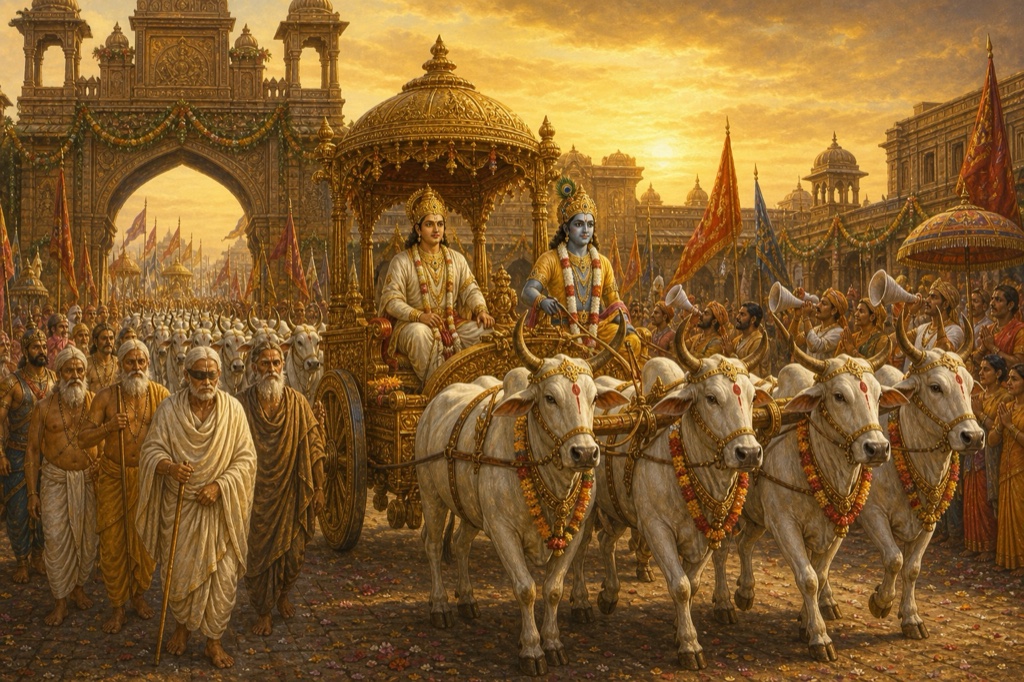
Yudhishthira said, “Holy one, I wish to hear in full the dharma of kings and of the four orders; how one should act in a time of distress; and how, walking the road of dharma, I may win the world. The practice of dharma and the discharge of a king’s duties always seem at odds; my mind grows bewildered trying to reconcile the two.”

Then Vyasa looked at Narada and said, “King, if you would hear dharma and policy in full, ask the aged grandsire of the Kurus, Bhishma. That son of Ganga knows all the dharmas and is all-knowing. From Brihaspati and others he learned the law of kings, from Ushanas (Shukra) the science of policy with its commentary, from Vasishtha and Chyavana of the Bhrigu line all the Vedas and their limbs, from Sanatkumara spiritual knowledge, from Markandeya the dharma of ascetics, and from Rama (Parashurama) and Indra all the weapons. Though born among men, his death is under his own will. There is nothing worth knowing that is unknown to him. Go to him before he gives up his life.”

Yudhishthira said, “Brahmana, having brought about the slaughter of my kin, I am the offender against all and the destroyer of the earth. And that same Bhishma, who always fought fairly, I had killed by a trick; with what face shall I go to ask him about dharma?”

Then Krishna reasoned with him again. “Such stubbornness of grief does not become you. Do what Vyasa has said. These Brahmanas and your brothers stand before you with pleading eyes, like men waiting for the clouds at summer’s end. The surviving kings and the people of the four orders are here. At the word of these Brahmanas, at Vyasa’s command, at the asking of well-wishers like us, and at Draupadi’s request, do what is dear to us and good for the world.”

Yudhishthira entering Hastinapura on a golden chariot yoked to white bulls; Krishna drives it, and townsfolk and rishis welcome him.

At these words the king rose from his seat for the good of the world. He set aside grief and care, calmed his mind, and resolved on what to do next. Putting Dhritarashtra forward, he set out to enter the city. Having worshiped the gods and thousands of Brahmanas, he mounted, like Soma, a new white chariot yoked to sixteen white bulls of auspicious marks and hallowed with Veda-mantras. Bhima took the reins; Arjuna held above him a white parasol, bright as a star-set white cloud; Nakula and Sahadeva waved the yak-tail whisks. The five brothers, decked in ornaments, looked like the five great elements. Behind them came Yuyutsu on a white chariot; Krishna with Satyaki on his golden chariot; Dhritarashtra with Gandhari on a litter borne by men, ahead of all; and the women of the Kuru house, Kunti and Draupadi, led by Vidura, on fine vehicles.

The city was adorned, with arches of flowers, countless banners, the fragrance of incense, scented powders and blossoms, water-filled jars at every door, and beautiful women standing in the finest places. The citizens surged out to welcome him. From the pavilions the women sang in soft voices the fame of the king and his brothers, and praised Draupadi too: “Princess of Panchala, you are blessed; your conduct and your vows have borne fruit.” So honored, Yudhishthira entered the royal palace of Hastinapura, worshiped the household deities, and gave gifts of gems, gold, cows, and cloth to the Brahmanas.

A key to reading this (rajadharma against dharma): Yudhishthira’s real crisis is this: “dharma” (morality) and “rajadharma” (the duty of rule) often collide, for the king must punish, wage war, and endure even trickery. All of the Shanti Parva’s teaching is an attempt to loosen this tension, and that is why Vyasa hands it over to Bhishma, who knows the meeting-point of the two.

The gist: Rather than take the burden of the teaching himself, Vyasa turns it toward Bhishma, who alone is the highest knower of both dharma and the law of kings and who has only a little time. Yudhishthira at first hesitates out of guilt at Bhishma’s death, but at Krishna’s reasoning he moves toward the throne and enters Hastinapura.

The deceit of the rakshasa Charvaka, and the coronation

When the Brahmanas had fallen silent, a rakshasa named Charvaka, a friend of Duryodhana in the guise of a Brahmana, with prayer-beads, a topknot, and a triple staff, stood up fearless as a renouncer among the thousands of Brahmanas. Wishing the Pandavas ill, without asking any Brahmana, he said to the king, “All these Brahmanas make me their spokesman and say: shame on you, you wicked, kin-slaying king. Having destroyed your kin and your elders, you should now give up your life.”

Hearing this, the Brahmanas grew agitated and raised an uproar. King Yudhishthira, mute with shame and anguish, said, “I bow to you all and beg you, be gracious to me. It is not fitting to curse me; I will soon give up my life.” Then the Brahmanas said aloud, “These are not our words. May it be well with you.” By their spiritual sight they saw through the speaker’s disguise and said, “This is the rakshasa Charvaka, Duryodhana’s friend, who has taken a renouncer’s guise. We said no such thing; let this anxiety of yours be gone.” Then, filled with wrath, the Brahmanas uttered the sound “hum,” and with that very sound reduced the sinful rakshasa to ash on the spot; scorched as by Indra’s thunderbolt, he fell like a tree with its sprouts.

Then Krishna opened the secret of it. “King, Brahmanas are always to be honored by me; they are the gods of the earth, poison in their speech and yet quickly pleased. In the Krita age this Charvaka did stern penance at Badari. When Brahma bade him ask a boon, he asked for safety from all creatures. Brahma granted it on the condition that he refrain from offending Brahmanas. Having won the boon, he began to torment the gods. The afflicted gods went to Brahma. Brahma said, ‘I have already devised the means of his death. There will be a king named Duryodhana, whose friend this one will become. In his affection he will insult Brahmanas, and the Brahmanas, strong in speech, will curse him to death in their anger.’ That same Charvaka now lies lifeless from the Brahmanas’ curse. So do not grieve; your kin have gone to heaven, fallen in the keeping of the Kshatriya law. Now attend to your duty, protect the people, and worship the Brahmanas.”

Free of grief, Yudhishthira sat on a golden seat facing east; Satyaki and Vasudeva before him, Bhima and Arjuna on either side, Kunti with Nakula and Sahadeva on a white ivory throne. Vidura, Dhaumya, Dhritarashtra, Yuyutsu, Sanjaya, and Gandhari sat in their places. At Krishna’s asking, the priest Dhaumya built an altar sloping to the east and north. Setting Yudhishthira with Draupadi, daughter of Drupada, on a seat covered with a tiger-skin called Sarvatobhadra, he poured offerings of ghee with mantras. Then a descendant of Dasharatha’s line (the line of Rama) lifted a sacred conch and poured the water of consecration on the king’s head; Dhritarashtra and the people did the same. The panava, the anaka, and the dundubhi drums sounded. The king gave a thousand nishkas (gold coins) to the thousand Brahmanas learned in the Veda who sang his praise, and was established on the throne of the great kingdom.

A sub-tale: Charvaka’s death was no accident. In the Krita age he won from Brahma the boon of safety from all creatures, but with one hidden condition, not to touch Brahmanas. Brahma had already built the machinery of his death: the friendship of Duryodhana, the insult to Brahmanas, and then the Brahmanas’ curse. It shows that in the Mahabharata even boons become traps; the boon of safety carries its own end within it.

The gist: The Charvaka episode is the last blow to Yudhishthira’s guilt, which the Brahmanas end at once with their “hum.” Krishna reveals the old ordinance of Brahma behind it. Then the coronation is performed with full rites, and Yudhishthira formally becomes emperor.

Yudhishthira’s first ordering of the realm, the funeral rites, and the praise of Krishna

After the consecration Yudhishthira, with folded hands, praised Krishna: “Krishna, by your grace, policy, strength, and wisdom I have won this ancestral kingdom. You are said to be the one supreme reality, the refuge of all who worship. You are the maker of the world, the soul of the world, and the one from whom this world arose. You are Vishnu, Jishnu, Hari, Krishna, and Vaikuntha.” With many names and forms Yudhishthira praised Krishna and pleased him, and Krishna gladdened him with sweet words.

The king dismissed the people. He made Bhima the heir-apparent; he gave Vidura the care of counsel and of the six requirements of the realm (peace, war, marching, sitting still, double-dealing, and seeking refuge with the strong); he made Sanjaya chief overseer of the treasury; he gave Nakula the accounts, food, and pay of the army and its management; he gave Arjuna the charge of resisting enemy forces and curbing the wicked; he gave Dhaumya the daily service of the gods and of the Brahmanas; and he kept Sahadeva always by his side, thinking that he would guard him. He ordered Vidura and Yuyutsu to attend with care to every wish of Dhritarashtra.

Then Yudhishthira had the funeral rites performed for every kinsman killed in the war. Dhritarashtra gave gifts for the world beyond for his sons. Yudhishthira with Draupadi gave wealth, gems, cows, and cloth to thousands of Brahmanas in the name of Drona, Karna, Dhrishtadyumna, Abhimanyu, Ghatotkacha, Virata, Drupada, and the five sons of Draupadi. He had the funeral rites performed even for those kings who had no kin or friend left. He built houses for the giving of food, water-stations, and tanks in their names. So, paying his debts and keeping clear of blame, the king ruled the people happily in dharma. He honored Dhritarashtra, Gandhari, Vidura, and all the Kuru elders as before, and by giving food, clothing, and shelter he protected the women who had lost husbands and sons in the war, the orphans, the blind, and the helpless.

With Dhritarashtra’s leave he gave his brothers the splendid palaces of Duryodhana, Duhshasana, Durmarshana, and Durmukha: to Bhima that of Duryodhana, to Arjuna that of Duhshasana, to Nakula that of Durmarshana, and to Sahadeva that of Durmukha. Krishna with Satyaki stayed in Arjuna’s house. In the morning all came, glad at heart, to Yudhishthira.

A key to reading this (the six requirements of the realm): The “shadgunya” are the six measures of policy: sandhi (peace), vigraha (war), yana (marching), asana (staying neutral), dvaidhibhava (a double policy), and samashraya (taking refuge with the strong). This is the practical frame of Bhishma’s coming teaching on the law of kings. In modern terms: the realm’s departments of foreign affairs, defense, treasury, intelligence, and administration.

The gist: The moment he takes the throne, Yudhishthira puts the law of kings into practice, assigning departments to his brothers, paying his debts with funeral rites and gifts, performing the rites even for the enemy’s dead, and sustaining the widows and orphans. Honoring Dhritarashtra as a father: this is the “living law of kings” before the teaching itself.

The secret of Krishna’s trance: Bhishma remembering him

On the next day Yudhishthira, with folded hands, asked Krishna, “One of boundless might, it is a wonder that you are sunk in a trance. Is all well in the three worlds? You have stilled the five life-breaths, drawn the senses into the mind, speech and mind into the intellect, and all the senses into the soul. You are like a lamp in a windless place, still as a rock. If this is no secret, be gracious and remove my doubt.”

Then Krishna, with a faint smile, brought his mind, intellect, and senses back to their ordinary state and said, “That best of men, Bhishma, who lies on his bed of arrows like a dying lamp, is remembering me; so my mind was fixed on him. He whose bowstring’s twang and clap of palms even Indra could not bear; who at the self-choice of the daughters of the king of Kashi conquered all the kings in a moment and carried off three princesses for his brother Vichitravirya; who fought Rama of the Bhrigu line (Parashurama) for twenty-three days on end and remained unconquered; whom the Ganga bore and Vasishtha made his pupil; who knows the four Vedas and their limbs and all the divine weapons; who knows past, future, and present, such a Bhishma, drawing in all his senses, took refuge in me, and so my heart was fixed on him.

“When that tiger among men goes to heaven by the strength of his deeds, the earth will be like the night of the new moon. So, Yudhishthira, go humbly to the son of Ganga and ask what you would know: about the four goals of life (dharma, wealth, pleasure, and liberation), about the sacrifices and rites of the four orders, about the four stages of life, and about the whole law of kings. When Bhishma goes, all his knowledge will go with him; and so I urge you.”

Yudhishthira said, his throat full of tears, “Madhava, the greatness of Bhishma is true, there is no doubt. If your heart is gracious, let us go to Bhishma with you at our head. When the sun turns north, Bhishma will leave this world. He is worthy of the sight of you, the first god and the great refuge of Brahman.” Then Krishna told Satyaki to yoke the chariot, and Daruka yoked the wind-swift horses Sugriva, Shaibya, and the rest to the chariot decked with gold and emerald and moonstone and sunstone gems, bearing the banner of Garuda.

A key to reading this (the northern course): The period when the sun turns northward is the “uttarayana,” held in the scriptures to be the auspicious time for leaving the body. Bhishma has the boon of death at will, so he does not die in the southern half-year; he waits for the northern. This gives his whole teaching a time-limit: knowledge only so long as he lives.

The gist: The cause of Krishna’s trance was that Bhishma was remembering him. By counting out Bhishma’s greatness (the victory at the self-choice, the fight with Parashurama, the knowledge of all scriptures), Krishna sends Yudhishthira to him, with the warning that knowledge itself will depart with Bhishma. Here the prelude to the parva of teaching is set.

The journey to Kurukshetra, and Parashurama’s twenty-one clearings of the Kshatriyas
Krishna and Yudhishthira crossing a battlefield strewn with corpses, bones, and vultures on a chariot drawn by white horses.

Krishna, Yudhishthira, and the Pandavas set out for Kurukshetra, which was covered with hair and marrow and bone, where hundreds of thousands of Kshatriyas had left their bodies. There were hills of the bones of elephants and horses, human skulls scattered like conches, and thousands of pyres; the whole expanse was like a pleasure-garden of the destroyer. On the way Krishna spoke of the might of the son of Jamadagni (Parashurama): “There, far off, are the five lakes of Rama, where Rama offered handfuls of Kshatriya blood to the ancestors; here he finished his work, clearing the earth of Kshatriyas twenty-one times.”

Yudhishthira raised a doubt: “When the very seed of the Kshatriyas was burned away, how did the Kshatriya line come alive again? Why did this slaughter happen, and how did the line grow again?” Then Krishna told the whole story. “From Jahnu came Rajas, from Rajas Balakashva, from him the righteous Kushika. Desiring a son, Kushika did stern penance, and Indra himself was born as his son Gadhi. Gadhi’s daughter Satyavati was married to Richika of the Bhrigu line. Richika cooked a hallowed charu (the sacrificial rice-and-milk) in two portions, one for his father-in-law Gadhi and one for his wife, and said, ‘This portion take yourself, that one your mother. Your mother’s son will be a hero, foremost among Kshatriyas, a slayer of Kshatriyas; your son will be a calm, ascetic, best of Brahmanas.’

“But the mother, unknowing, exchanged the two portions, giving hers to her daughter and taking her daughter’s for herself. So into Satyavati’s womb came a child with the fire of a Kshatriya-slayer. When Richika learned it, he said, ‘By the exchange of portions your son will be cruel of deed, and your brother a calm Brahmana.’ Satyavati begged, ‘Do not give me a cruel Brahmana-son.’ Richika said, ‘I did not wish it; it happened by the exchange of portions. This is the ordinance of fate.’ Then Satyavati prayed, ‘Let the son be calm, though the grandson be such.’ Richika granted it, and Satyavati bore the calm-natured Jamadagni, while her mother’s son Vishvamitra, though born in a Kshatriya line, became the equal of a Brahmana.

“From Jamadagni came the fierce-deeded Rama (Parashurama), who pleased Mahadeva on Gandhamadana and won the keen-edged axe. Meanwhile Arjuna (Kartavirya), son of Kritavirya, king of the Haihayas, by the grace of Dattatreya became a thousand-armed man, conquered the earth with its seven islands, and gave it away at a horse-sacrifice. Once, at the asking of Agni, he gave a gift by which Agni burned the deserted hermitage of Apava (Vasishtha). Apava cursed him, ‘You have burned my forests too, so Rama will cut off your thousand arms.’

“But Kartavirya’s proud sons, without his knowledge, seized the calf of Jamadagni’s homa-cow. Rama in anger cut off Arjuna’s arms and brought back the calf. Then Arjuna’s foolish sons, while Rama had gone to gather fuel and kusha grass, struck the head from Jamadagni’s body. In the flame of vengeance for his father’s death Rama took a vow to clear the earth of Kshatriyas and killed all of Kartavirya’s sons and grandsons; killing thousands of Haihayas, he made the earth muddy with blood, and then in compassion went to the forest.

Bhishma, from his bed of arrows, telling the story of Parashurama; in the sky a warrior with a battle-axe stands over a blood-soaked field.

“After some thousands of years Paravasu, son of Raibhya and grandson of Vishvamitra, taunted Rama with cowardice: ‘In fear of the Kshatriya heroes you fled to the mountains.’ Then Rama took up his weapon again and laid down hundreds of Kshatriya corpses. Those who survived grew again and became kings; Rama killed them too, sparing not even children. Some Kshatriya women were able to save their children. So, having cleared the earth of Kshatriyas twenty-one times, Rama at the close of a horse-sacrifice gave the earth as a gift to Kashyapa.

“Kashyapa, pointing with the sacrificial ladle, said, ‘Rama, now go to the shore of the southern sea; do not stay in my realm.’ Then the sea made for Rama, on its far shore, a land called Shurparaka. Kashyapa gave the earth to the Brahmanas and entered the forest. Then Shudras and Vaishyas began to act as they pleased; in the anarchy the strong tormented the weak, no one was master of his own property, and the frightened earth began to sink toward the nether world. Kashyapa held her up on his thigh (uru), and so the earth was called Urvi.

“The earth asked for a king to protect her, and told him that she had hidden away many Kshatriya children, born in the Haihaya line, the son of Vidutha reared among bears on Mount Rikshavan, the son of Saudasa saved by Parashara who by serving like a Shudra came to be called Sarvakarma, Shibi’s son Gopati reared among cows, Pratardana’s son Vatsa reared among calves, and Dadhivahana’s grandson Brihadratha saved by Gautama on the bank of the Ganga. Kashyapa found them all and made them kings by due rite, and the Kshatriya lines of today are the descendants of these.”

A sub-tale: The tale of Satyavati’s exchanged charu-portions is a rare example of the Mahabharata’s fate of lineage. By the swapping between mother and daughter of two hallowed food-portions charged with Brahmana-fire and Kshatriya-fire, the very nature of the lines was turned about: Vishvamitra, born in a Kshatriya line, became a rishi like a Brahmana, and Parashurama, born in a Brahmana line, became a fierce slayer of Kshatriyas. One unknowing error turns the character of generations.

A key to reading this (twenty-one times): To “clear the earth of Kshatriyas twenty-one times” does not mean the Kshatriyas were altogether wiped out; those who survived grew again, and Parashurama slew them again, twenty-one such rounds. The number is the emblem of Parashurama’s unbroken cycle of vengeance, and it shows that even the “destruction of an order” is never complete, the line is reborn from the seed saved by women and rishis.

The gist: Crossing the field of slaughter at Kurukshetra, Krishna tells the tale of Parashurama, the Vishvamitra and Parashurama born of the exchanged portions, the cutting of Kartavirya’s arms, the killing of Jamadagni, and the twenty-one clearings of the Kshatriyas. At the last, Kashyapa makes kings again of the hidden Kshatriya children, from whom the present lines descend. This cycle of destruction and rebirth sets the war’s grief in a larger frame.

At the bed of arrows: the talk of Krishna and Bhishma, and the boon of divine sight
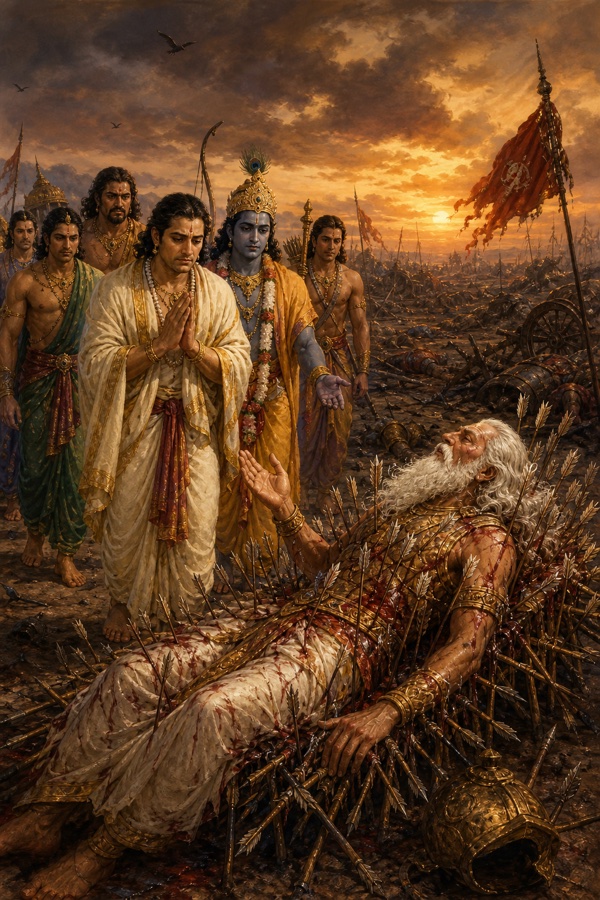
The Pandavas and Krishna approaching Bhishma on his bed of arrows; Bhishma lifts a hand to welcome the folded-palmed Yudhishthira.

Yudhishthira, marveling at the might of Parashurama, went on with Krishna to where the son of Ganga lay on his bed of arrows, on the sacred bank of the Oghavati river, surrounded by many rishis, bright as the evening sun. Seeing him from afar, all stepped down from their chariots, drew in their senses, and came near, and having bowed to Vyasa and the other rishis, sat down close to Bhishma.

Seeing Bhishma like a dying fire, Krishna said, with some pain in his heart, “Is your awareness clear as before? Is your intellect unclouded? Do the arrows’ pains not torment your limbs? You are able to teach even the gods about the birth and dissolution of beings. Past, future, and present are all known to you. By your father Shantanu’s boon your death is under your own control. Even a small needle in the body gives pain; how much more hundreds of arrows! Yet surely pain cannot touch you. Being fully able, you gave up the company of women; a man like you, firm in truth, penance, gift, sacrifice, the science of weapons, and the protection of those who seek refuge, a well-wisher of all beings, has been neither heard of nor seen. The Brahmanas call you the ninth of the Vasus, but by your qualities you have surpassed them all. You are able to remove the grief of the son of Pandu, for the four orders, the four stages of life, and all the scriptures of dharma dwell in your mind.”

Bhishma, on his bed of arrows, offering praise with folded hands; Krishna, Narada with his vina, other rishis, and the Pandavas gathered around.

Bhishma raised his head a little and with folded hands praised Krishna: “Divine Krishna, I bow to you. You are the beginning and the end of all worlds, their maker and destroyer. You are unconquerable, you are the soul of the universe, and the universe was born from you. You are beyond the five elements, beyond the three worlds. Your words have shown me your divine form; I see your eternal shape, your head filling the sky, your feet filling the earth, the directions your arms, the sun your eye. Your yellow-robed form is like a cloud lit by lightning. Lotus-eyed one, for me, your suppliant devotee, think what is for my good.”

Krishna said, “Bhishma, your devotion is great, and so I have shown you my divine form. To one who is not a devotee, or is faithless, or unrestrained, I do not show it. By your own penance you were able to see me. Those worlds are ready for you from which there is no return. There remain to you fifty-six days of life. Casting off the body, you will win the good fruit of your deeds. The fire-bright Vasu gods wait for you, unseen, on their chariots, until the moment when the sun enters the northern course. When you go, all knowledge will go with you; and so all these have come to hear the teaching of dharma from you. From Yudhishthira, whose learning grief has covered over, drive away his grief quickly by speaking the true words of dharma and yoga.”

Bhishma said, “Shiva, Narayana, hearing your words I am gladdened. But before you, what can I teach, when all the subjects of speech are already held in your speech? Whatever is done is done by your intelligence. My mind is greatly troubled by the arrows’ pain, my limbs are weak, my mind unclear, my strength failing, my life going; how shall I speak? Even Brihaspati would hesitate to speak before you. You are the giver of all ordinances; so for Yudhishthira’s good, do you yourself speak.”

Krishna raising his hand in blessing over Bhishma on his bed of arrows; behind him a prince bows with folded hands.

Krishna said, “Son of Ganga, for what you have said about the pain of your arrow-wounds, I give you this boon: discomfort, faintness, fever, pain, hunger, and thirst will not afflict you. Your awareness and memory will stay clear, your intellect will never fail. Free of passion and darkness, your mind will stay always in goodness, like the moon come out from a cloud. Whatever subject of dharma, wealth, or policy you turn your mind to, your intellect will enter into it. Gaining divine sight, you will see the four kinds of beings, and whatever subject you call to mind, as clearly as fish in clear water.”

Then Vyasa and the other rishis praised Krishna with the mantras of the Rig, Yajur, and Sama. In that place divine flowers of all seasons rained down, divine instruments sounded, apsaras sang, a fragrant wind blew, the directions grew clear, and beasts and birds moved about in peace. Then the sun sloped to the west. The rishis bowed to Janardana, Bhishma, and Yudhishthira, and taking their leave with “we will return tomorrow,” departed. Krishna and the Pandavas too circled Bhishma and returned to Hastinapura on their chariots.

A key to reading this (fifty-six days): Krishna tells Bhishma that fifty-six days of his life remain, that is, until the start of the northern course of the sun. This is the “clock” of the whole teaching of the Shanti and Anushasana parvas: in these very days Bhishma will give the full teaching of the law of kings, the law of distress, the law of liberation, and the law of gifts. Krishna’s boon (freedom from pain and clear memory) is what makes the teaching possible.

The gist: At the bed of arrows Krishna and Bhishma praise each other. Bhishma at first hesitates to teach, because of the arrows’ pain and Krishna’s all-knowingness, but Krishna makes him fit to speak by the boon of a pain-free, clear intellect and divine sight. This boon is the foundation of all the coming teaching on the law of kings.

Bhishma begins the law of kings: protection of the people, truth, and the balance of the rod

Yudhishthira sitting with folded hands beside the bed of arrows; Bhishma, finger raised, expounds the duties of kings while Krishna stands and listens.

The next day they came again and asked after Bhishma’s health. Narada said, “Now is the time to ask Bhishma about dharma, for the son of Ganga is about to give up his life like the sun going down.” Yet, though urged, the princes could not bring themselves to ask; they only looked at one another. Then Yudhishthira said to Krishna, “No one but the son of Devaki can put a question to the grandsire; you speak first.” Krishna asked after Bhishma’s health, and Bhishma said, “Krishna, by your grace, in a single day fever, faintness, weariness, and pain have all gone. Past, future, and present, all the dharmas of the Veda and Vedanta, the customs of country and caste and family, the four stages of life and statecraft, all lie before me like fruit held in the palm. But Janardana, why do you not yourself teach the son of Pandu?”

Krishna said, “Best of the Kurus, know that I am the source of fame and of all that is good; good and evil both come from me. But I have resolved to increase your fame, and so I have given you this divine intelligence. As long as the earth lasts, your fame will remain undimmed. Whatever you say to Yudhishthira will be held on earth as proof, like a word of the Veda. You are old, versed in the conduct sanctioned by scripture, a knower of the law of kings and of every science of dharma; from your birth no one has seen the least fault in you. So, being like a father, teach these men the high dharma. If you do not speak, you will earn a share of sin.”

Bhishma, lying on his bed of arrows, reaching out to grasp the arm of the folded-palmed Yudhishthira; Krishna and warriors stand behind.

Bhishma said, “I will teach dharma.” Then Krishna told him the cause of Yudhishthira’s hesitation: “They fear a curse and are ashamed to come near you, because they pierced with arrows a revered elder, teacher, and kinsman like you.” Bhishma said, “As the dharma of a Brahmana is gift, study, and penance, so the dharma of a Kshatriya is to give up the body in battle. A Kshatriya must kill, in an unjust war, even the elders, fathers, and kin who stand before him; this is his declared dharma. The Kshatriya who in battle kills even his teacher, if the teacher be sinful, greedy, and without vow and restraint, is a knower of dharma. Challenged, a Kshatriya must always fight, for Manu has said that a just war gives the Kshatriya both heaven and fame.” Then Yudhishthira, in deep humility, clasped Bhishma’s feet, and Bhishma reassured him with affection: “Do not fear, best of the Kurus, ask without doubt.”

Yudhishthira asked, “The knowers of dharma say the law of kings is the highest of all sciences; and to me too its burden seems very heavy. The law of kings is the refuge of the whole living world; even dharma, wealth, pleasure, and liberation depend on it. As the reins for a horse and the goad for an elephant, so the science of the law of kings is the rein that holds the world. If confusion enters the law of kings, anarchy spreads over the earth. So, grandfather, teach first the law of kings.”

Bhishma, on his bed of arrows, teaching with a raised finger; Yudhishthira weeps with folded hands, and Krishna and turbaned listeners sit nearby.

Bhishma said, “Bowing to dharma, to Krishna who is Brahman, and to the Brahmanas, I speak the eternal dharma. Yudhishthira, listen with a single mind. First, the king, wishing to please the people, should serve the gods and Brahmanas with humility; by this he pays his debt of dharma and wins the people’s honor. The king should always strive with effort, for without effort mere fate gives nothing. Of effort and fate I hold effort the higher, for fate is known only from the fruit of effort. If an undertaking fails, do not grieve; put twice the effort into that same undertaking. This is the king’s highest dharma.

“For the king’s success nothing is higher than truth. A truthful king is happy in both worlds; as the rishis’ wealth is truth, so trust in a king wakes only from truth. The king who is virtuous, well-conducted, restrained, humble, righteous, master of his senses, handsome, and not too given to curiosity never loses his fortune. By doing justice, and by keeping three things, hiding his own faults, knowing his enemy’s faults, and keeping his counsel secret, the king wins prosperity.

“If a king is too gentle, all despise him; if too harsh, the people are terrified. So keep both. Do not punish a Brahmana, for he is the highest being of the earth. Keep in mind Manu’s two verses: fire is born of water, the Kshatriya of the Brahmana, and iron of stone; these three exert their force on everything, but when they meet their own source their force is stilled. When iron strikes at stone, fire at water, or the Kshatriya at the Brahmana, all three grow weak. So Brahmanas are to be honored. But those Brahmanas who become obstacles to the three worlds are to be curbed by the strength of your arm.

“Hear the two verses of Ushanas (Shukracharya): a righteous Kshatriya may punish even a Brahmana learned in the Veda, if he runs to battle with weapon raised; doing so in the defense of dharma he does not become a sinner, for the attacker’s anger makes just the anger of the punisher. If a Brahmana is guilty of Brahmana-slaying, of defiling his teacher’s bed, of causing abortion, or of treason, his punishment should be banishment, not bodily punishment.

“Let the king not be forever forbearing, for a gentle king is counted as low as a spiritless elephant. The verse of Brihaspati is this: if a king is always forbearing, the base climb on him as a mahout climbs on an elephant’s head. So let the king be neither always gentle nor always harsh; let him be like the sun of spring, neither cold nor so hot that sweat breaks out.

“Let the king not fall into joking familiarity with his servants, for on growing too close, dependents begin to slight their master, reveal his secrets, ask unfit things, take even the master’s food, show anger, wish to dominate him; they block royal business with bribes and fraud, rot the realm with false accounts, and want to play with the king like a bird on a string. From a gentle, jesting king spring these and many more evils.

“Let the king always be ready for action; the one who is womanish and without effort is not to be praised. The verse of Ushanas: as a snake swallows mice, so the earth swallows two, the king who turns from war, and the Brahmana too attached to wife and sons. With those with whom peace is sanctioned by scripture, make peace, and with those with whom war is sanctioned, wage war. Whether a teacher or a friend, whoever bears enmity to your realm of seven limbs (king, minister, ally, treasury, realm, fort, and army) is to be killed.

“Let the king not covet another’s wealth, let him give what is due at the proper time, hold his anger in check, and pursue dharma, wealth, pleasure, and liberation with discernment. Let him always keep the counsel of these three (dharma, wealth, and pleasure) secret; the revealing of counsel is the king’s supreme ruin. Let the king do justice like Yama and gather wealth like Kubera. Let him feed the hungry and look after those who have had their fill. Let him be sweet of speech and speak with a smile. Let him serve the elders, cast off sloth, watch the conduct of the good, and, taking the wealth of the unrighteous, give it to the righteous.

“Let the king bind to his service brave, faithful, high-born, healthy, and well-behaved men. In the objects of enjoyment let there be no difference between king and servant; let the difference be only in the parasol and the power of command. The crooked, greedy king who suspects everyone and lays heavy taxes on the people is soon killed by his own servants and kin. But the righteous king who wins the hearts of the people, though beset by an enemy, does not sink, and having fallen, rises again. Manu’s two verses: cast off six as one casts off a leaky boat at sea, the teacher who stays silent, the priest without study, the king who does not protect, the wife who speaks harshly, the cowherd who wanders the village, and the barber eager to go to the forest.”

Bhishma held up the protection of the people as the essence of the law of kings. “Brihaspati holds no dharma higher than this. The means of protection, appointing spies and servants, giving them their share without pride, taking taxes with judgment, never taking anything without cause, choosing honest men, valor and skill, truth, the good of the people, sowing discord among enemies, repairing decayed buildings, watching the moment for punishment and fine, never abandoning the honest, sheltering the high-born, storing what is worth storing, keeping company with the wise, keeping the army always content, filling the treasury, not blindly trusting the city’s own guards, and casting off the wicked.

“Effort is the root of the law of kings. Brihaspati says: by effort the nectar was won, by effort the Asuras were killed, by effort Indra won the kingdom of heaven and earth; the hero of effort is higher than the hero of speech. A king without effort, though wise, is defeated by his enemies like a snake without venom. Let even a strong king not despise a weak enemy; a single spark can make a forest fire, and a single grain of poison can kill.

“The king should cover his secret counsel, his gathering of forces, and his plans with a cloak of guileless conduct. Let him act in dharma to keep the people in hand. A kingdom, dear to all like meat, is not guarded by plain-dealing alone; so let the king keep both plain-dealing and craft. From the danger borne in protecting the people the king earns great merit; such should be the king’s conduct.”

Krishna, seated by the bed of arrows, speaking with a gesture of his hand; Yudhishthira listens with folded hands, and Bhishma lies among the arrows.

Vyasa, Devasthana, Asma, Vasudeva, Kripa, Satyaki, and Sanjaya, glad at heart, cried “Excellent, excellent” and praised Bhishma. Then Yudhishthira, his eyes full of tears, touched Bhishma’s feet and said, “Grandfather, I will ask my doubts tomorrow, for today the sun, having drunk up the sap of all the earth, is about to set.” Then, bowing to all the rishis and to Bhishma, they bathed in the Drishadvati, offered water to the ancestors, said the evening prayers, and returned to Hastinapura.

A key to reading this (the seven-limbed realm): The “seven-limbed realm” (saptanga) is the root concept of ancient statecraft: the seven limbs of a realm, the master (king), the minister, the ally, the treasury, the realm (people), the fort, and the army (danda). Whoever strikes at any one of these, Bhishma holds to be killed, even a teacher. This shows that the law of kings stands above personal ties.

A key to reading this (the guarding of counsel): “Mantra” here is not a god-mantra but political secret counsel. Bhishma says again and again that the leaking of counsel is the king’s supreme ruin; so let the king, seeming plain, keep his plans hidden. This is the seed of the spy-craft and secrecy of the Kautilya tradition.

The gist: Bhishma’s teaching on the law of kings begins. The first thread: protection of the people is the king’s highest dharma; its means are service of gods and Brahmanas, tireless effort (higher than fate), truth, secrecy of counsel, and the balance of gentleness and harshness (like the sun of spring). Brahmanas are to be honored but punished when they attack; joking familiarity with servants is forbidden; both plain-dealing and craft are needed. Here the teaching pauses; the next day Yudhishthira will raise the question of the origin of the word “king” and of rule at the beginning of creation.

Yudhishthira weeping as he sits by Bhishma's bed of arrows; Krishna counsels him with a raised hand, and aged rishis sit all around.

Lying on his bed of arrows, holding back his life by his own will, the son of Ganga went on teaching the law of kings to Yudhishthira, king of dharma. Leaning on the sayings of Brihaspati, he strung together the endless duties of a king: to give charge to honest men, valor, skill in affairs, truth, the good of the people, laying fine and punishment at the fitting moment, never abandoning the good, giving livelihood and shelter to the high-born, storing what is worth storing, keeping company with the wise, keeping the soldiers always content, filling the treasury, not blindly trusting the guards of his own city, sowing discord in the enemy’s city, protecting friends who live in an enemy’s land, keeping a close watch even on his own servants, and pushing the wicked away. Bhishma said that effort is the root of the law of kings; by effort the nectar was won, the Asuras were killed, and Indra gained the kingdom of heaven and earth. The hero of effort is above the hero of speech; the heroes of speech worship the hero of effort. Even a wise king, if he is without effort, is defeated by his enemies like a snake without venom.

Bhishma went on that even a strong king should not despise a weak enemy, for a single spark can become a forest fire and a single grain of poison can take a life. A single enemy sitting within a fort can torment the whole country of a prosperous and mighty king. Let the king keep hidden, under a cloak of plain-dealing, his secret counsel, his gathering of forces, the crooked purpose of his heart, and the wrong acts he does or would do. Let him act in dharma to keep the people in hand, but let him also know that crooked-minded men cannot bear the burden of a great empire, and that the king who is only gentle does not reach that high place whose winning rests on toil. This earth, dear to all like meat, cannot be guarded by plain-dealing and straightness alone; so let the king take refuge in both plain-dealing and craft. If the king falls into danger while protecting the people, even then he earns great merit.

Hearing this, Vyasa, Devasthana, Asma, Vasudeva, Kripa, Satyaki, and Sanjaya cried out with beaming faces, “Excellent, excellent,” and praised Bhishma, best of men. Then Yudhishthira, with a sad heart and eyes wet with tears, touched Bhishma’s feet and said, grandfather, the matters in which I have doubt I will ask tomorrow, for today the sun, having drunk up the sap of all the earth, is about to set. Then Keshava, Kripa, Yudhishthira, and the rest bowed to the Brahmanas, circled the son of Ganga, and mounted their chariots. They bathed in the water of the Drishadvati, offered water to the ancestors, said the mantra-prayers and the evening worship, and entered Hastinapura.

A key to reading this (the whole passage): This entire episode of the law of kings is the Shanti Parva’s “rajadharma-anushasana,” the instruction in the duties of kings. After the war, holding back death by his own will and waiting for the northern course, Bhishma lies on his bed of arrows. In the teaching the moral complexity comes into the open: dharma and statecraft together, for the Mahabharata asks of the king not only straightness but the craft that protecting the people demands.

The gist: Bhishma gave a long list of the king’s duties, called effort the root of the law of kings, and said the king should take a balanced refuge in both plain-dealing and craft. As the day sloped down, the assembly broke up and all returned to Hastinapura.

Where the word “king” came from: the birth of rule at the beginning of creation

The next day, after their morning rites, the Pandavas and the Yadavas came again to Bhishma at Kurukshetra. Asking after his health and bowing to the rishis, they sat down around him. With folded hands Yudhishthira asked: best of the Bharatas, where on earth did the word “king” come from? He who has hands, arms, neck, intelligence, senses, pleasure and pain, bone and flesh and blood, breath and out-breath, and birth and death just as others have, who is in all the qualities of humanity like the rest, how does that one man rule over many wise and brave men? Why do all people seek his favor? Why, when one man is pleased, is the whole world pleased, and when he is sad, the whole world sad? This cannot be without some deep cause, for the whole world bends before one man as before a god.

Bhishma, from his bed of arrows, telling stories with a raised finger; visions of men and fishes fill the sky as Krishna and Yudhishthira listen.

Bhishma answered: king, listen closely to how, in the Satya age, kingship first began. In the beginning there was no kingdom, no king, no rod, and no one to wield the rod; all people protected one another in dharma. But after a time this task grew burdensome to them. Delusion took hold of their hearts, their judgment grew dim, and dharma began to wane. From delusion they became greedy; from greed woke the desire for things they did not have; from desire came anger; and from anger the line between the fit and the unfit act was erased. Enjoyment without bounds spread abroad, people said whatever they pleased, and the difference between the eatable and the uneatable, between dharma and its opposite, was lost. As this confusion spread, the Vedas vanished, and with the Vedas dharma too.

When the Vedas and dharma were lost, the gods grew afraid and went for refuge to Brahma. With folded hands they said: grandsire, from greed and delusion the eternal Vedas are afflicted in the world of men, and dharma is destroyed; men used to send offerings upward and we sent rain down, but with the holy rites stopped we shall now be in great danger. Devise some means by which your creation is not destroyed. Then the Self-born said: put away fear, I will think of the good of all.

Then Brahma composed, by his own intelligence, a great treatise of a hundred thousand chapters, in which were set out dharma, wealth, and pleasure, the group of three, and the fourth subject, liberation, as well. In it was a vast section on the science of the rod (the science of rule and punishment); the marks of ministers, spies, and envoys; the five measures of conciliation, gift, sowing discord, punishment, and disregard; the three kinds of peace; the three kinds of victory (won by dharma, by wealth, and by deceit); the group of five, counsel (secret royal deliberation), realm, fort, army, and treasury; and open and secret punishment, all in detail. In it were set out the nature of friend, enemy, and neutral, the arrays of an army, the ways of battle and retreat, the guarding of weapons, the growth, decline, and balance of the realm’s seven limbs, and every means of keeping men from straying off the road of dharma.

Bhishma said that, having composed the treatise, Brahma, pleased, told Indra and the other gods: for the good of the world and the founding of the group of three I have made this science, like butter churned from speech; leaning on the rod, it will guard the world. Since it is the rod (danda) that rules or restrains all, this science will be famous in the three worlds as the science of the rod (dandaniti). Then the large-eyed Uma-lord Shiva first studied it, and seeing the ever-shortening lives of men, abridged it. Shiva’s abridgment, of ten thousand chapters, was called Vaisalaksha. Indra received it and made of it a work of five thousand chapters called Vahudantaka; Brihaspati made of that a work of three thousand called Barhaspatya; and the teacher of yoga, Kavya (Shukracharya), reduced it to a thousand chapters. Watching the shortening of life and the general decline, the great rishis abridged this science in this way for the good of the world.

A key to reading this (concept, numbers): This gradual abridgment of the science of the rod is an imagined genealogy of the knowledge of statecraft: Brahma’s original of a hundred thousand chapters to Shiva’s ten thousand (Vaisalaksha) to Indra’s five thousand (Vahudantaka) to Brihaspati’s three thousand (Barhaspatya) to Shukracharya’s one thousand. In modern terms it is a figure for “knowledge grew shorter as life and capacity shrank,” as a vast code of law contracts over time into a compact rulebook.

Bhishma went on: the gods went to the lord of creatures, Vishnu, and prayed him to make one man fit to be set above the rest. Then Narayana, by mere will, brought forth from his own fire a son named Viraja; but his mind was set not on rule but on renunciation. Viraja’s son Kirtimat too was averse to enjoyment. Kirtimat’s son Kardama did stern penance. Kardama’s son Ananga was a protector of the people, righteous, and skilled in the science of the rod. Ananga’s son Atibala was clever in policy, but having won a vast empire he became the slave of his senses. Sunitha, the mind-born daughter of Mrityu (Death), was given to Atibala, and of her was born a son named Vena.

The unrighteousness of Vena and the rise of Prithu: the origin of the names “king” and “earth”

Radiant King Prithu rising newly-born from the body of the fallen tyrant Vena, sages anointing him as the earth, personified as a cow, yields its wealth before him.

Bhishma said that Vena, the slave of anger and malice, grew unrighteous toward all beings. Then the rishis, knowers of Brahman, killed him with mantra-charged blades of kusha grass. Reciting mantras, they churned Vena’s right thigh, and out of it came a man of small limbs, dark as a burnt coal, with red eyes and black hair. The rishis said to him, “Nishida” (sit here); from this came the Nishadas, the peoples who dwell in mountain and forest, and the thousands of Mlechchhas who dwell on the Vindhya. Then the rishis churned Vena’s right arm, and out of it came a radiant man like a second Indra, clad in armor, bearing bow and arrows and sword, skilled in the Vedas and their limbs and in the science of weapons. All the rules of the science of the rod, taking bodily form, came to that best of men.

The son of Vena, with folded hands, asked the rishis: with the keen and dharma-minded intelligence given to me, what shall I do? Whatever good work you name, I will do it without hesitation. Then the gods and rishis said: do fearlessly all the works in which dharma dwells; setting aside liking and disliking, look on all beings with an equal eye; keeping off desire, anger, greed, and partiality, punish with your own hand whoever strays from the road of dharma. Take this vow, that in mind, word, and deed you will always keep the dharma taught in the Veda, discharge fearlessly the duties enjoined by it with the help of the science of the rod, never act by your own whim, hold Brahmanas free from punishment, and guard the world from the confusion of the orders. The son of Vena answered that he would always worship the best of Brahmanas. The rishis said, “So be it.”

Then Shukra, the storehouse of Brahmic fire, became his priest, the Valakhilyas his ministers, the Sarasvatas his companions, and Garga his astrologer. The famous declaration of the Veda is that Prithu is the eighth from Vishnu. Two men named Suta and Magadha were born to be his bards; pleased, Prithu gave Suta the land by the sea and Magadha the country of Magadha.

Bhishma said that it is heard that the surface of the earth was once very uneven; the son of Vena, Prithu, leveled it. He pushed the rocks aside with the tip of his bow, and so the mountains grew larger. Then Vishnu, Indra and the gods, the rishis, the guardians of the worlds, and the Brahmanas gathered for Prithu’s consecration. The Earth in bodily form came to him bearing an offering of gems; the sea, Himavat, and Shakra gave undying wealth; Meru gave heaps of gold; and Kubera, borne on the shoulders of men, gave wealth fit to fulfill dharma, wealth, and pleasure. At the mere memory of the son of Vena, tens of millions of horses, chariots, elephants, and men came into being. In that time there was no old age, no famine, no disease, no disaster; under that king’s protection no one feared snake or thief or anyone. When he went toward the sea the water froze, the mountains gave way, and his banner nowhere caught. Like milk from a cow he milked from the earth seventeen kinds of grain, by which yakshas, rakshasas, nagas, and all beings were nourished.

Bhishma opened the secret of the names: because he gratified (ranjita) all the people, he was called Rajan (king); because he guarded the Brahmanas from their wounds (kshata), he was called Kshatriya; and because in his reign dharma became famous over the earth, she was called Prithvi. Vishnu himself, confirming his strength, said that no one would surpass him, and by the power of penance Vishnu entered that king’s body; and so the whole world, gods and men, began to worship Prithu. This is why a whole company goes at the command of one, because there is divinity in the king. From Vishnu’s forehead a golden lotus was born, and from it appeared the goddess Shri, who became the wife of Dharma; in Shri, Dharma begot Artha (wealth), and dharma, wealth, and Shri, all three, were established in kingship. When his merit wanes, a man descends from heaven and is born as a king skilled in the science of the rod; he is a portion of Vishnu, and so all obey the command of one.

A key to reading this (lineage, concept): The tale of Vena and Prithu is the origin-story of royal power. The wicked king Vena is killed by the rishis, and from the churning of his body come both the Nishadas (the remnant of unrighteousness) and Prithu (the ideal king). Here “Rajan” is tied to ranjana (gratifying the people), “Kshatriya” to kshata-trana (guarding from wounds), and “Prithvi” to Prithu. The derivation says that the justification of kingship lies not in enjoyment but in protection and gratifying.

The gist: In the Satya age dharma waned from delusion, so Brahma made the science of the rod, which was abridged step by step. From the killing of the wicked Vena and the churning of his body Prithu appeared, who gratified the people, leveled the earth, and gave the names “king,” “Kshatriya,” and “Prithvi.” The king holds a portion of Vishnu, and so is worthy of worship.

Bhishma on the dharma of the four orders and the Shudra’s right to sacrifice

Yudhishthira asked what the general and special dharmas of the four orders are, by what means realm and king grow, and from which treasuries, punishments, forts, friends, ministers, priests, and teachers a king should keep clear. Bhishma, bowing to dharma and to Krishna, said that the curbing of anger, truthful speech, justice, forgiveness, begetting children only on one’s wedded wife, purity of conduct, freedom from quarrel, plain-dealing, and the support of dependents, these nine dharmas are common to all four orders. Then he told the special dharmas of the Brahmana: self-restraint, study of the Veda, and endurance in penance. If a Brahmana engaged in his own dharma, learned and calm, gains wealth, let him marry and beget children, give gifts, and perform sacrifices; that wealth should be enjoyed only after sharing it among the worthy.

Of the Kshatriya Bhishma said: let him give but not beg, perform his own sacrifices but not officiate at another’s, study the Veda but not teach it, protect the people, and show valor in battle for the destruction of thieves and the wicked. The knowers of ancient scripture do not praise the Kshatriya who returns unwounded from battle; for him there is no higher dharma than the curbing of thieves. Let the Vaishya do gift, study, sacrifice, and the earning of wealth by fair means, and tend cattle like his own sons. Bhishma gave even the arithmetic of his livelihood: if he keeps six cows he may take the milk of one, if a hundred he may take a pair as his wage; if he trades with another’s wealth, a seventh of the profit is his.

Of the Shudra Bhishma said: the Creator made him for the service of the three orders, and in that service is his good. Let him serve the three in order of rank. Let the Shudra not gather too much wealth, for grown rich he would bring the higher orders under himself and so earn sin; but by the king’s leave, for a work of dharma, he may earn wealth. Let his master give funeral offerings for a childless Shudra, and sustain the weak and aged Shudras; let the Shudra not forsake his master even in crisis, and if the master’s wealth is destroyed, let him support him with all the more faithfulness.

Then Bhishma gave a deep turn: sacrifice is enjoined for the Shudra too, and not for the three orders alone. The Shudra cannot say the svaha, the svadha, or the Veda-mantras, so let him worship the gods with the small “cooking-sacrifices” (paka-yajnas) that need no Veda-vows, whose dakshina is called the “full vessel.” He reminded them that in ancient times a Shudra named Paijavana gave, by the Aindragni rite, a dakshina of a hundred thousand full vessels. In all sacrifices devotion is highest; devotion is a great deity that purifies all who sacrifice. The mental sacrifice is enjoined for all orders. It is not true that the gods and the great would not wish to share in even such a sacrifice of a Shudra; so the sacrifice that is devotion is enjoined for all orders. Whoever wishes to sacrifice, though he be a thief or a sinner or the worst of sinners, is held to be righteous; the rishis praise him.

A key to reading this (concept): This passage on the dharma of the orders does not smooth away the Mahabharata’s moral complexity: on one side it places harsh restrictions on the Shudra (bans on gathering wealth and on the Veda-mantras), and on the other it opens for him the door of sacrifice and devotion, and says the gods accept even the Shudra’s offering of devotion. The example of Paijavana holds this contradiction up to view. The text records the social structure of its age; we relay it as it stands, without softening.

The gist: Nine dharmas are common to all orders; then the separate dharmas of Brahmana, Kshatriya, Vaishya, and Shudra. Sacrifice is enjoined for all four orders, for the Shudra too in the form of the cooking-sacrifice and of devotion; and devotion is the highest of all sacrifices.

The four stages of life, and the supremacy of the Kshatriya dharma

Bhishma gave the names and dharmas of the four stages of life: the forest-dweller, the mendicant, the householder, and the student. Let the student, restrained, serve his teacher, recite the mantras, and wish even an enemy well. Let the householder study the Veda and do the enjoined works, beget children, unite with his wedded wife only and only in season, be moderate in eating, devoted to the gods, grateful, gentle and forgiving, and show hospitality to Brahmanas. Having discharged all the householder’s duties, let him go to the forest, with wife or without her, and take up the forest-dweller’s life, study the Aranyakas, and at last dissolve into the undying self. He told the word of the Narayana-song: by truth, plain-dealing, worship of guests, the winning of dharma and wealth, and the joy of one’s wedded wives, a man enjoys many pleasures in both this world and the next.

Yudhishthira asked which dharmas are good for men like us and dear to all. Bhishma said the four stages are for the Brahmana; the Kshatriya and the rest do not take them up. A Brahmana who engages in the works of a Kshatriya, Vaishya, or Shudra is blamed in this world and goes to hell in the next. As all footprints of beings are contained in the elephant’s footprint, so all the dharmas of the other orders are contained in the Kshatriya dharma. If the science of the rod were lost, the Vedas would be lost, and all the scriptures that teach men their dharmas.

Then Bhishma told an old history. When the Danavas grew and began to break all bounds, the mighty Mandhata became king of the earth. Wishing for the sight of Narayana, he performed a great sacrifice, and the Lord appeared in the form of Indra. The Vishnu in the shape of Indra asked why he sought the sight of Narayana, who is without beginning, middle, or end, whom neither he nor Brahma can see; let him ask another boon. Mandhata said that, setting aside all worldly desires, he wished to earn dharma and to know the highest road of the good; by the Kshatriya dharma he had won many worlds and much fame, but the higher dharmas that flow from the gods he did not know.

The Vishnu in Indra’s shape said that those who are not kings, however righteous, do not easily win the highest fruit of dharma. From the first god the law of kings flowed forth first, and the other dharmas after; the fruits of all those are perishable, but the law of kings is above them, for in it all dharmas are contained. In ancient times Vishnu himself, by the Kshatriya dharma, curbed his enemies and gave relief to the gods and rishis; had he not killed the Asuras, Brahmanas, Brahma, and all dharma would have been destroyed. To give up life in battle, compassion for all beings, knowledge of the world, the protection of men, the saving of the afflicted and the endangered, all this is in the Kshatriya dharma. Even the slaves of desire and anger do not sin openly for fear of the king, and the good, by that very power, are able to keep their dharmas; so the Kshatriya dharma is the most righteous.

Mandhata asked what the dharmas are of the peoples who live within the realms of Aryan kings, the Yavanas, Kiratas, Gandharas, Chinas, Shabaras, Barbaras, Shakas, Tusharas, Pulindas, Kambojas, and the rest, and how tribes that live by robbery may be brought to dharma. The Vishnu in Indra’s shape said that they should all serve their fathers and mothers, their teachers, the ascetics of the forest, and their king, sacrifice to the ancestors by the Veda-rite, dig wells, give water to thirsty travelers, and give beds and gifts to Brahmanas. Harmlessness, truth, the curbing of anger, the support of kin, purity, and peace, these are their dharmas; and let them perform even the cooking-sacrifices with rich gifts of grain and wealth.

A key to reading this (concept): “The Kshatriya dharma is supreme” is Bhishma’s central political principle, opened in the figure of the elephant’s footprint. Its logic is that without the rod and protection the other stages and dharmas of the orders cannot stand: sacrifice, study, and penance all depend on the king’s protection. The talk with Mandhata proves this from the mouth of Narayana, where Vishnu himself is shown killing the Asuras by the Kshatriya dharma.

The gist: The four stages are mainly for the Brahmana, and the Kshatriya dharma is supreme over all dharmas, because by it the others are guarded. In the talk with Mandhata the Vishnu in Indra’s shape confirms this principle and also gives dharmas for the border and robber tribes.

The fruits of the other stages that come to a king, and the realm’s first list of duties

Bhishma said that Narayana, in Indra’s shape, returned to his own abode after saying this. Then he told Yudhishthira the merit a king wins from the various stage-dharmas of others. The king who, free of desire and malice, ruling by the science of the rod, looks on all beings with an equal eye, wins the fruit of the mendicant’s stage; the one who, being wise, gives to the worthy at the fitting time and acts by scripture, wins the fruit of the householder’s stage; the one who, to the best of his power, saves kin and friends fallen into danger, wins the fruit of the forest-dweller’s stage. The one who duly protects all beings and his own realm wins the merit of that many sacrifices and reaches the fruit of renunciation. By daily mantra-recitation and worship of the gods he gains the householder’s fruit; by going into battle resolved to protect the realm, the forest-dweller’s; and by compassion to all beings and the giving up of cruelty, the fruit of all the stages.

Bhishma added that the king wins a quarter share of the merit of his people if he protects them rightly; and if he fails to protect them, he takes a share of the people’s sin. The sin of failing even one day to save the people from fear is such that the king suffers a thousand years in hell; and the merit of even one day’s protection in dharma is such that he enjoys ten thousand years in heaven. With the boat of the realm, whose wind is gift, whose ropes are the scriptures, whose helmsman’s strength is wisdom, and which floats by the power of dharma, the king crosses the ocean of the world with ease. By this one dharma of protection the king earns a hundred times the merit of the forest ascetics.

Then Yudhishthira asked the chief dharmas of the realm. Bhishma said the choosing and consecration of a king is the realm’s first duty. A realm without a king grows weak and is soon tormented by thieves; there dharma does not stay, and men devour one another. There is no state worse than anarchy. The Veda says that in the consecration of a king it is as if Indra himself were consecrated; so let one who seeks prosperity worship the king who is like Indra. If some strong king comes to annex a kingless country, let the people welcome him with honor; the cow that is easily milked suffers no pain, the tree that bends easily is not cut down; so it is wise to bend before the strong, for to bend before the strong is as if to bend before Indra.

Bhishma told the famous law of the fishes: if there is no king to wield the rod, the strong would devour the weak, as in the water the big fish eats the small. In ancient times, in the anarchy, men began to devour and destroy one another. Then some made this pact, that whoever spoke harshly, was violent, carried off another’s wife, or plundered another’s wealth, him they would cast out; but this brought no peace. Then, tormented, they went to Brahma and asked for a king. Brahma spoke to Manu, but Manu refused, saying, “I fear sinful acts, and to rule over men who are always false and crooked is very hard.”

Then the people of the earth said to Manu: fear not; the sin the people do will cling to them, not to you. We will give you a fiftieth of our cattle and gold and a tenth of our grain; we will give you the best of our daughters; heroes skilled in weapons, horses, and vehicles will follow behind you like the gods; and a quarter of the merit of the people will be yours. Manu, hearing this, set out with a great army; frightened by his fire, men took to their own dharmas, and Manu, wandering everywhere like a rain-cloud, stopped their evil deeds and set all to their duties.

A sub-tale: This tale of Manu’s acceptance of kingship is the ancient Indian form of the “social contract.” Manu first refuses, saying rule is sinful and hard; the people then promise him tax (a fiftieth of cattle, a tenth of grain), their best daughters, brave soldiers, and a quarter share of their merit. This exchange between king and people, tax and honor in return for protection, is the foundation of the law of kings. The law of the fishes (the big fish swallowing the small) is the logic of that contract: without the rod, society destroys itself.

The gist: A king wins the fruit of others’ stage-dharmas too; protection is his highest merit. The realm’s first duty is the consecration of a king, for in anarchy the law of the fishes spreads. Manu took up kingship only on the people’s contract and their promises.

Why the king is a god: the talk of Brihaspati and Vasumanas

Yudhishthira asked why the Brahmanas call the king a god. Bhishma answered with the ancient talk of Brihaspati and Vasumanas, king of Kosala. The wise Vasumanas, having humbly circled Brihaspati, asked from whom beings grow and by whom they are destroyed, and by whose worship they win lasting happiness. Brihaspati said that the king is the root of the dharma of all men; it is only from fear of the king that people do not devour one another. As, if sun and moon did not rise, all would sink in darkness, and as the fish of a shallow pool and the birds of a safe place move freely a while and at last fight and destroy one another, so without a king men are destroyed in darkness like a herd of cattle without a herdsman.

Brihaspati counted it out: if the king does not protect, the strong would seize the weak’s wealth and life; no one could say “this is mine”; wife, son, food, and property would not survive; men would insult or harm even aged parents, teachers, and guests; marriage and all bounds would break; farming and trade would scatter; the three Vedas would vanish; sacrifices would cease; society itself would not remain. It is by the king’s protection that men sleep fearless with open doors, that women decked in ornaments move about unguarded and unafraid, and that the three orders engage in sacrifice and learning.

Brihaspati said that let no one, thinking the king a man, despise him, for he is a high god in the form of a man. He takes five forms on five occasions: fire, when he burns up a cunning offender with his own splendor; Aditya (the sun), when through spies he watches the deeds of all and works the good of the world; Death (the destroyer), when in anger he destroys the wicked with their families; Yama, when he punishes the wicked and rewards the good; and Kubera, when he gives wealth to his servants and takes the wealth of offenders. Who would not worship the king, in whom the people dwell and by whose ruin the people are ruined? The king’s wealth is to be shunned even from afar; the one who seizes royal wealth is soon destroyed like a deer that has touched poison. Let the king honor the minister who is grateful, wise, generous, faithful, and master of his senses. The king is the heart of the people, their refuge, their glory, and their highest joy. By this teaching Vasumanas from then on protected his people.

A key to reading this (concept): The saying “the king is a god” is an institutional principle rather than devotion or flattery: the king represents five divine powers in five works (Fire the rod, Aditya the watching eye, Death the destroyer, Yama the judge, Kubera the treasury). It is a figure for the roles of kingship, not the worship of a person. The text also warns that the misuse of royal wealth is deadly as poison, so this divinity is bound to responsibility.

The gist: Brihaspati taught Vasumanas that without the king’s protection society would collapse; the king is a god in the form of a man, taking the five forms of Fire, Aditya, Death, Yama, and Kubera. This is why he is worthy of worship, but the misuse of royal wealth is deadly as poison.

Self-conquest, spies, treasury, and the seven limbs: the full policy of guarding the realm

Yudhishthira asked how a king should guard the realm, subdue the enemy, appoint spies, and win the trust of the four orders, of servants, wives, and sons. Bhishma said that the king should first conquer himself, then the enemy; the one who cannot conquer himself, how will he conquer the enemy? The conquest of the five senses is self-conquest. Let him keep soldiers in the fort, on the borders, in the city, in the gardens, and even in his own palace. Let him make his spies men who look foolish, blind, or deaf, who can bear hunger and thirst, who are tested and wise, and who do not know one another. Keeping spies also in shops, gardens, assemblies, holy places, and the houses of citizens, let him detect the enemy’s agents.

Bhishma gave the practical rules of policy: finding himself weak, let the king make peace with a stronger enemy; and even when strong, if there is gain in it, let him make peace quickly. In a time of crisis let him first kill the offenders he has overlooked and those the people have marked. The one who gives neither gain nor loss, or who cannot save himself from danger, is of no use to the king. When he marches, let him first provide for the guarding of his capital, and set out with a great army, glad at heart, without declaring his goal, against an enemy who is friendless, entangled in war elsewhere, or weaker than himself. Even when weak, let him not stay always under the strong; let him torment that enemy with weapon, fire, and poison, and by sowing discord among the enemy’s ministers and servants. Brihaspati’s view is that a wise king should avoid war for the sake of land, and enlarge his sway by conciliation, gift, and discord.

Bhishma set out the system of taxation: let the king take the sixth part of the people’s income as tax for the cost of protection, and take, by force if need be, more or less wealth from the ten kinds of offenders named in scripture for the sake of guarding the people against them. Let him look on the people as his children, but in justice show neither partiality nor pity; for the giving of judgment let him appoint worldly-wise men, for the realm rests on just justice. On mines, salt, grain, ferries, and the elephant-force let him appoint honest men. The ordinance of proper punishment is the king’s highest dharma; the king who does not do justice wins neither heaven nor fame.

For the guarding of forts Bhishma gave fine directions: let the king, tormented by the strong, take shelter in a fort; let him call the dwellers of the open country into the safe forts; let him fill the fort’s granaries, and where he cannot, burn them; let him cut the enemy’s fields and fruit; break the bridges of rivers; empty or poison the tanks. Except for the sacred chaitya-trees, let him cut the small trees and lop the branches of the great. Around the fort let there be ramparts, water-filled ditches, sharpened stakes, and crocodiles; at the gates, engines and the shataghni (the “hundred-killer” weapon). Let him plaster huts of thatch with mud, remove the grass in summer for fear of fire, have food cooked at night, and punish the one who kindles fire by day. Let him drive out of the city the beggar, the eunuch, the madman, and the mime. Let him store up weapons, medicine, oil, ghee, honey, charcoal, arrows, scribes, and many arms; and let him quickly bring under control whoever spreads fear, be he servant, minister, or a neighboring king.

Then Bhishma counted the seven limbs the king must guard: himself, the ministers, the treasury, the machinery of punishment, the ally, the realm, and the capital. Then he named the “shadgunya” (the six policies: peace, war, sowing discord, striking fear by gathering forces, the readiness of war and peace, and alliance); the “group of three of gathering” (decline, staying, and growth); and the high group of three, dharma, wealth, and pleasure. He sang the verse of Brihaspati: discharging all his duties, the king who guards the cities and the people wins the highest joy in heaven; what need of penance or sacrifice has the one who protects the people well?

A key to reading this (concept): The “saptanga” (the realm’s seven limbs) and the “shadgunya” (the six foreign policies) are the foundation-stones of ancient Indian statecraft, elaborated later in Kautilya’s Arthashastra. The seven limbs treat the realm as a living body: the self (king) the head, the minister the intellect, the treasury the blood, the machinery of punishment the arm, the ally, realm, and capital the rest. The six policies are the six choices in dealing with an enemy: peace, war, sowing discord, gathering strength, a divided stance, and taking refuge.

The gist: Let the king first conquer his senses, lay a net of spies, subdue the enemy by conciliation, gift, and discord, take the sixth part in tax, stay impartial in justice, make the fine preparations of fort and store, and guard the seven limbs, the six policies, and the group of three of dharma, wealth, and pleasure.

The science of the rod and the four ages: the thirty-six virtues

Yudhishthira asked about the mutual benefit of the rod, the king, and the people. Bhishma sang the greatness of the science of the rod: the rod binds all men to the dharma of their orders and is the source of ease and peace. Then he gave a deep principle: “Does the king make the age, or the age make the king?” Have no doubt of this; the truth is that the king makes the age. When the king rules holding fully and sternly to the science of the rod, then it is the Satya age: dharma alone stays, not its opposite; diseases fade, all are long-lived, wives are not widowed, and the earth gives grain unplowed.

When the king keeps three of the four parts of the science of the rod, the Treta comes: a quarter of unrighteousness spreads, and the earth gives grain when plowed. When he keeps half, it is the Dvapara, where half is unrighteousness and half the dependence on farming; and when he casts off the science of the rod altogether and torments the people by evil ways, it is the Kali age, where unrighteousness is full and dharma is lost, the Shudra lives by begging and the Brahmana by service, the mixing of the orders sets in, women are widowed, and men die untimely. The king is the cause of all four ages: if he makes the Satya age, eternal heaven; if he makes the Kali age, sunk in the people’s sins, he suffers countless years in hell. The right use of the science of the rod is the king’s highest merit, for the lives of beings rest on it.

Then Yudhishthira asked by what conduct a king easily wins good fruit here and in the world to come. Bhishma counted the “thirty-six virtues” that are joined with thirty-six others: let the king keep dharma free of anger and malice, not give up compassion, keep faith, earn wealth without oppression, enjoy pleasure without attachment, be brave without boasting, valorous without cruelty, keep off the wicked yet make friends, not fall into enmity with friends, not give to the unworthy, not punish without careful inquiry, not reveal his secret counsel, not praise himself, not take tax from the good, not trust the one who has harmed him, hold no grudge, guard his wedded wives, not indulge in women overmuch, eat only wholesome food, serve his elders truly, worship the gods without pride, seek fame but do nothing to earn ill fame, wait for the moment, turn no one away with empty words, not abandon after showing favor, not strike in ignorance, not grieve after killing an enemy, and not show anger without occasion. The king of these virtues wins many blessings on earth and great fruit in heaven. Hearing this, Yudhishthira, guarded by Bhima and the rest, worshiped the grandsire and began to rule by that teaching.

A key to reading this (concept): “The king makes the age” is the Shanti Parva’s boldest political statement. It makes the ages (Satya, Treta, Dvapara, Kali) not destiny or a cosmic clock but the result of the quality of rule: the more of the science of the rod the king keeps, the brighter or the more fallen the age. It lays responsibility fully on the king and denies fatalism.

The gist: The science of the rod binds all to their dharma; the king makes the age, the full keeping of the rod brings the Satya age and its full abandonment the Kali. By the thirty-six royal virtues the king wins fruit in this world and the next.

The dharma of the treasury: be the flower-picker, not the charcoal-burner

Yudhishthira asked how the king may protect the people without grief and without unrighteousness. Bhishma said let him worship Brahmanas who are firm in the Veda, of vows and virtue; when they come, let him rise with his priest and touch their feet, and by giving gifts have them speak a blessing. Let him take up truth, judgment, and discernment, and cast off desire and anger. The foolish king who pursues wealth without casting off desire and anger loses dharma, and in the end wealth too. Let him not set the greedy and the foolish to the works of wealth and pleasure.

On the treasury Bhishma’s word is telling: let the king fill the treasury with the sixth part of the produce, with fines from offenders, and with taxes taken from merchants and traders by the way of scripture, and so conduct himself that the people know no pain of want. Let him never wish to fill the treasury by unrighteousness or greed. As milk is not got by cutting the cow’s udder, so a realm tormented by unfit means gives the king no gain; and the one who tends the milch-cow gently keeps getting milk. Bhishma said plainly: king, follow the way of the flower-picker, not the charcoal-burner; that is, the one who picks flowers spares the plant and gets flowers again and again, but the one who makes charcoal burns the tree itself and destroys it at a single stroke.

Bhishma added that if the treasury runs dry from an attack on an enemy realm, let the king take wealth from all but the Brahmanas; even in great crisis, seeing a wealthy Brahmana, let his mind not waver; let him give the Brahmana wealth to the best of his power and console him. The sin of failing even one day to save the people from fear brings a thousand years of hell, and one day’s protection in dharma gives ten thousand years of heaven.

Then Yudhishthira raised a deep doubt: I want neither the joy of a kingdom nor the kingdom itself; I wanted it only for the merit to be won from it, but now it seems there is no merit in it; so I will go to the forest, live an ascetic’s life on fruit and root, and earn dharma. Bhishma answered: I know your soft and harmless nature, but a kingdom is not run by harmlessness alone. You are most righteous, compassionate, and gentle, but being without fire, men do not honor you much. Walk the road of your father and grandfather; a king should not take up the conduct you wish to take up. Your father Pandu asked for you courage, strength, and truth, and your mother Kunti generosity and high-mindedness. Gift, study, sacrifice, and the protection of the people, whether merit or sin, it is for these that you were born. The one who fails in bearing the burden laid on him does not lose his fame, but total inaction is a grave sin; even a good deed of little merit is better than total inaction.

The blood-stained Bhishma, on his bed of arrows, raising a hand as he speaks to the anxious Yudhishthira and Krishna who have come near.

Yudhishthira asked which acts give heaven and great fruit. Bhishma said that the one who gives even a moment’s safety to a frightened man is, among us all, the highest claimant of heaven; this is the plain truth. Best of the Kurus, become with a glad heart the king of the Kurus, win heaven, protect the good and destroy the wicked; let your friends and the good find in you the shelter that beings find in a cloud and birds in a great tree of sweet fruit.

A sub-tale: The figure of “the flower-picker against the charcoal-burner” is the heart of the treasury’s policy. The gardener picks flowers and keeps the plant alive, and so has flowers every season; the charcoal-burner burns the whole tree for a single gain, and then nothing is left. So too, the king who takes tax from the people by measure milks prosperity for a long time, and the one who wrings the people out of greed dries up the very source. The figure of cutting the cow’s udder says the same: over-milking kills its own nourishment.

The gist: Let the king fill the treasury with the sixth part and the means sanctioned by scripture, but not wring the people out of greed; let him be the flower-picker, not the charcoal-burner. Bhishma turned back Yudhishthira’s resolve to go to the forest with the word that to give safety to the frightened is the highest dharma, so let him rule.

Brahmana and Kshatriya: the choosing of a priest and their mutual dependence

Bhishma said that the one who protects the good and punishes the wicked, such a one let the king make his priest. On this there is the talk of Pururavas (son of Ila) and Matarishva (the Wind). Pururavas asked from where the Brahmana was born, and from where the other orders. Matarishva said the Brahmana was born from the mouth of Brahma, the Kshatriya from his two arms, the Vaishya from his two thighs, and, for the service of these three, the Shudra from his two feet. Pururavas asked to whom the earth rightly belongs. The Wind said that by birth and precedence everything in the world belongs to the Brahmana; as, in the absence of a husband, a woman accepts his younger brother, so, when the Brahmana refused it, the earth accepted his younger, the Kshatriya, as her lord.

The Wind added that a high-born, humble, and wise Brahmana shows the king the good road in everything; as long as the king, righteous and free of pride, wishes to hear the Brahmana’s teaching, he stays honored and famous. The king’s priest shares in the people’s merit; trusting such a king, the people become righteous and fearless, and the king wins a quarter share of their acts of dharma. On sacrifice rest gods, men, ancestors, gandharvas, snakes, and rakshasas, and sacrifice rests on the king; in a kingless country there is no sacrifice. The one who takes away the fear of the frightened wins great merit; in all three worlds there is no gift like the gift of life. The king is Indra, is Yama, is dharma; the king sustains all.

Bhishma deepened the same thread a third time with the talk of the son of Ila and Kashyapa. Ila asked: when the Brahmana forsakes the Kshatriya, or the Kshatriya the Brahmana, who is the better, and to whom should the other orders turn? Kashyapa said that when the two oppose each other, the realm is destroyed, thieves multiply, the calves of cattle do not thrive, the milk is not churned, and no sacrifices are performed. The Kshatriya is the cause of the Brahmana’s growth and the Brahmana of the Kshatriya’s; they guard each other, and by their union the people are happy.

Then Ila asked about Rudra, and Kashyapa said that Rudra dwells in the hearts of men; he destroys the body he dwells in and the bodies of others too. Ila objected that if the sinners’ sin brings punishment on both good and wicked, why should men do good at all? Kashyapa said that it is by keeping company with sinners that the sinless are punished, as green wood burns along with dry; so let the sinless not keep company with sinners. Ila said that earth, sun, wind, and water make no difference between good and wicked. Kashyapa answered that in this world it is so, but in the world to come the states of the righteous and the sinner differ greatly: the meritorious win worlds bright as honey and gold, where there is no death, no old age, no grief, and the sinner’s place is hell, where there is darkness and unending pain.

A key to reading this (concept): The mutual dependence of Brahmana and Kshatriya is a lasting thread of the law of kings: the strength of penance and mantra is in the Brahmana, the strength of arms in the Kshatriya; if used apart, neither can sustain the world. The text opens it with the images of fire and water, Kshatriya and Brahmana, iron and stone: as iron with stone, fire with water, so the Kshatriya who clashes with his source, the Brahmana, has his own power stilled.

The gist: Let the king first appoint a worthy Brahmana as priest and then have himself consecrated. In the talks of Pururavas and the Wind and of Ila and Kashyapa the mutual dependence of Brahmana and Kshatriya is taught: discord between them destroys the realm, and the rod, which is Rudra, touches the innocent along with the guilty.

Muchukunda and Kubera: a kingdom of one’s own arm against one given by a boon

King Muchukunda confronting the wealth-god Kubera, asserting the strength of his own arm over riches gained by boon, divine yaksha host behind Kubera.

Bhishma said that the growth of the realm rests on the king, and the growth of the king on his priest. That realm has true happiness where the Brahmana removes the people’s unseen fears by his power and the king their seen fears by the strength of his arm. On this there is the old history of Muchukunda and Vaishravana (Kubera). Having conquered the whole earth, Muchukunda went to Kubera, lord of Alaka, to test his strength. Kubera by the power of penance made a vast army of rakshasas, which ground down Muchukunda’s army. Seeing his army destroyed, Muchukunda reproached his learned priest Vasishtha. Then Vasishtha, by fierce penance, brought about the destruction of the rakshasas.

Kubera said to Muchukunda that many ancient kings stronger than he never marched on him even with their priests; they honored him as the giver of joy and sorrow. If you have strength of arm, show it; why so much pride in the strength of Brahmanas? The angry Muchukunda answered without pride or fear, with reason: the Self-born Brahma made Brahmana and Kshatriya from one and the same source; if they use their strength apart, they cannot sustain the world. Brahmanas have the strength of penance and mantra, and Kshatriyas the strength of arms; endowed with both strengths, kings protect the people, and this is what I am doing; why then do you reproach me?

Hearing this, Kubera said that without the command of the Self-born he gives no kingdom to anyone and takes none away; rule the boundless earth. But Muchukunda said that he did not want the enjoyment of a kingdom given by Kubera; he wanted to enjoy only the kingdom won by the strength of his own arm. Seeing Muchukunda’s fearlessness in the Kshatriya dharma, Kubera was amazed, and Muchukunda went on ruling the whole earth won by his own arm. Bhishma gave the essence: the king who rules setting the Brahmana before him and honoring him wins the whole earth and great fame; let the Brahmana always do the works of dharma and the Kshatriya always bear arms, and only then, together, are the two the true lords of the world.

The gist: In the episode of Muchukunda and Kubera the king declares that he wishes to enjoy not a kingdom given by Kubera’s boon but one won by his own arm; and at the same time the people are guarded by both the strength of the Brahmana and that of the Kshatriya. Self-reliant valor and the honoring of the Brahmana, both together.

The king of Kekaya and the rakshasa: the armor of a righteous realm

Yudhishthira asked whose wealth the king is master of, and how he should conduct himself. Bhishma said the Vedas declare that all wealth but the Brahmanas’, and even the wealth of Brahmanas fallen from their dharma, belongs to the king. In the realm where Brahmanas become thieves, the king is held the author of that sin; so righteous kings arrange for the support of Brahmanas. On this there is the history of the king of Kekaya and a rakshasa. The king of Kekaya, of stern vows and versed in the Veda, was living in the forest when a rakshasa seized him.

The king asked the rakshasa how he had gained power over him: in my realm there is no thief, no wrongdoer, no drunkard; there is no Brahmana who is unlearned, without vows, or who has not drunk the soma; all keep the sacred fire and perform sacrifices. My Kshatriyas are firm in their dharma, they give and never beg, they know truth and dharma, they protect Brahmanas and do not flee from battle. My Vaishyas live by farming, cow-keeping, and trade without fraud, and honor guests. My Shudras serve the three orders without malice. I sustain the helpless, the aged, the weak, the sick, and unprotected women. I do not destroy the ancient bounds of family and country; I honor ascetics and feast them with food. I do not eat without feeding others, I do not go to another’s wife, I do not wander alone. On my body there is not two fingers’ space without the scar of a weapon-wound; I always fight for dharma. How then could you master me?

The rakshasa said that since you are righteous in every state, king of Kekaya, go home; may it be well with you, I release you. Kings who protect cows, Brahmanas, and all the people have no fear of rakshasas, still less of sinners; those who set Brahmanas before them, and whose people keep the dharma of hospitality, win heaven. Bhishma gave the essence: so protect the Brahmanas; the Brahmanas you protect will protect you, and their blessings will surely descend upon the righteous king.

A sub-tale: The talk of the king of Kekaya with the rakshasa is the “armor-hymn” of a righteous realm. The king does not say his weapons will save him; he counts out the religious order of his realm, that every class is firm in its dharma, the helpless are protected, the bounds are unbroken, and he himself is covered in wounds for dharma. The rakshasa, powerless before this unseen armor, lets him go. The sign is that a well-ruled, righteous realm is the king’s true impenetrable protection.

The gist: All wealth but the Brahmanas’, and the wealth of fallen Brahmanas, belongs to the king. The king of Kekaya, counting out the record of his righteous realm, is freed from the rakshasa, showing that good rule and the protection of Brahmanas are the king’s impenetrable armor.

The law of distress: the Brahmana’s livelihood, and when the Kshatriya is unable

Yudhishthira asked whether in distress a Brahmana may take up a Vaishya’s livelihood. Bhishma said that having lost his living, if he cannot do the Kshatriya’s work, the Brahmana may live by farming and cow-keeping. Yudhishthira asked what he may then sell. Bhishma said that wine, salt, sesame, maned beasts, bulls, honey, meat, and cooked food a Brahmana should never sell; by selling them he goes to hell. To sell a goat is the sin of selling fire, a sheep the sin of selling water, a horse the sin of selling the sun, cooked food the sin of selling the earth, and a cow the sin of selling soma and sacrifice. “I give this, give me that in return,” such barter is lawful, but to take by force is sin; this is the ancient road of the rishis.

Then Yudhishthira raised a sharp question: when all the orders forsake their dharmas and take up arms against the king, and the king’s power fails, how does he become the protector of the people? Bhishma said that in such a time let all the orders, led by the Brahmanas, work their own good by gift, penance, sacrifice, peace, and restraint; let the Brahmanas, strong in the Veda, rise and, like gods, increase the king’s strength by the Vedic rites. When the king’s power is spent, the Brahmanas are his refuge. And when thieves break all bounds and go about plundering, then all the orders may take up arms; in this there is no sin.

Yudhishthira asked, if the Kshatriyas become the enemies of the Brahmanas, who will protect the Brahmanas and the Vedas? Bhishma said that by penance, celibacy, weapons, and strength, with craft or without craft, the Kshatriyas are to be brought under control. If a Kshatriya goes astray, especially against the Brahmanas, the Vedas themselves bring him under control. The Kshatriya was born of the Brahmana; as fire came from water, the Kshatriya from the Brahmana, and iron from stone, the fire of fire, of the Kshatriya, and of iron is irresistible, but when they strike at their own source their strength is stilled. Those who cast off the fear of death and fight for the Brahmanas, dharma, and their own protection win high worlds; on three occasions there is no sin for a Brahmana in taking up arms: for his own protection, to bring the other orders back to dharma, and to curb thieves. Bhishma said plainly that dharma and its opposite are defined by place and time; the friends of humanity have won high heaven even by cruel deeds, and righteous Kshatriyas have won a good end even by deeds that seemed sinful.

Yudhishthira put a last question: when thieves rise, the mixing of the orders spreads, and the Kshatriyas become unable, if some strong man not a Kshatriya, be he Brahmana, Vaishya, or Shudra, protects the people by wielding the rod in dharma, does he act rightly? Bhishma answered that whether he be a Shudra or of any other order, the one who becomes a boat in a boatless current, or a means where there is no means of crossing, is worthy of honor in every way. The one who removes the fear of others is always to be worshiped; the one who protects the people is to be loved and honored as a near kinsman. What use is a bull that bears no load, a cow that gives no milk, a barren woman? So too, what use is a king who does not protect? The one who always protects the good and curbs the wicked is fit to be king and to rule the world.

A key to reading this (the law of distress): “Apad-dharma” is the moral license that loosens the ordinary rules in a time of crisis. Here the Mahabharata’s realism is at its height: in ordinary times it binds the order-livelihoods strictly, but in distress it lets the Brahmana farm and trade, all the orders take up arms, and even a non-Kshatriya wield the rod to protect the people, saying that “dharma and its opposite are defined by place and time.” It does not hide moral relativity, it acknowledges it.

The gist: In distress a Brahmana may take up a Vaishya’s livelihood (with certain things forbidden to sell). When thieves rise, all the orders may take up arms; dharma and its opposite are set by place and time; and when the Kshatriya is unable, whoever protects the people is fit for the throne.

The qualities of a priest, the truth of the sacrificial fee, and penance above sacrifice

Yudhishthira asked the qualities of the priests appointed in sacrifice. Bhishma said they should be masters of the Sama-Veda and its meters and of the srauta rites, able to do the king’s works of good, faithful, sweet of speech, friends of one another, equal-eyed, without cruelty, truthful, free of usury, and plain-dealing. The one who is calm, free of pride, humble, generous, master of his senses, content, firm in truth, of vows, harmless, free of desire and malice, and wise, he is the best priest, fit for the seat of Brahma.

Then Yudhishthira raised a subtle doubt about the sacrificial fee: the Veda ordains the dakshina in sacrifice, but how much is to be given is not fixed; and even in inability that command seems terrible and blind to the sacrificer’s means. The Veda says one should sacrifice with devotion, but when the sacrificer is stained with untruth, what can devotion do? Bhishma answered that no merit comes from disregard of the Veda, from fraud, or from untruth. The dakshina is a limb of the sacrifice and nourishes the Vedas; a sacrifice without dakshina does not give release, but the dakshina of a single “full vessel” gives fruit equal to any rich fee, so let the three orders sacrifice. Let the sacrificer, the sacrifice, and the soma all three be well-conducted; the ill-conducted belongs neither to this world nor the next.

Bhishma gave at the last a high word: the Veda declares that penance is higher than sacrifice. What is penance? Harmlessness, truthful speech, doing good, and compassion, this, in the view of the wise, is penance, and not the mere drying of the body. Disregard of the Veda, disregard of the scriptures, and the breaking of bounds is self-destruction. For those who do the penance-sacrifice, union with Brahman is their sacrificial ladle, the heart is the ghee, and high knowledge their purifier. All crookedness is death, and all straightness is Brahman; this is the subject of knowledge, which the views of those who make arguments cannot shake.

A key to reading this (philosophical): “Penance is higher than sacrifice” and “penance is harmlessness, truth, and compassion, not the wasting of the body” carries Bhishma’s law of kings above ritual to a moral ground. While accepting the value of outer rite and dakshina, the text says the true penance is inner straightness and compassion for beings; “all crookedness is death, all straightness is Brahman” is the summary line of this passage.

The gist: Let the priest be a knower of scripture, firm in truth, and free of pride. The dakshina is a needed limb of the sacrifice, but a single full vessel gives the full fruit; and above all these is penance, which means harmlessness, truth, and compassion, not the mere mortifying of the body.

Ministers, trust, and the dharma of one’s own kin: the talk of Vasudeva and Narada

Yudhishthira asked how the king should choose a minister and whom to trust and whom not. Bhishma said the king has four kinds of friends: one with a shared purpose, one devoted to him, one related by birth, and one won by gift and favor; a fifth is the righteous man who takes no one side but the side of dharma. Of these the devoted and the kin are best, but in works he must do with his own hand the king should look on all four with a suspicious eye. Let the king not be careless in guarding his friends; neither full trust nor full distrust is fitting, for full trust is untimely death and full distrust is worse than death. Let him set one man to one task, not two or three, for they oppose one another.

Bhishma warned that the king should fear his own kin as he fears death, for as a vassal cannot bear his lord’s prosperity, so kin cannot bear the prosperity of kin; yet the man without kin is not happy either, for enemies easily crush the kinless. So there are both merits and faults in kin; honor them in word and deed, never torment them, and while distrusting them within, behave outwardly as if in full trust. The one who does so turns even his enemies into friends.

On this Bhishma told the talk of Vasudeva and the divine rishi Narada. Krishna said that neither a foolish, unlettered friend nor a fickle-minded learned friend is fit to know secret counsel. I do not fawn slavishly on the prosperity-praises of my kin; I give away half of what is mine and forgive their bitter words, but those bitter words grind my heart daily like the churning of the fire-sticks. There is strength in Sankarshana, gentleness in Gada, and Pradyumna surpasses even me in beauty, and yet I am helpless. Ahuka and Akrura pull me in opposite directions; to have them both is pain, and to have neither is pain too; I am like the mother of two brothers gambling against each other, who wishes both to win. Tell me what is for the good of me and of my kin both.

Narada said that this, Krishna, is an inner calamity, born of your own acts. You have given away the wealth and kingdom you won to Babhru and Ugrasena, and it cannot now be taken back like food that has been vomited, and the attempt to take it would bring inner strife and great slaughter. So wield not a weapon of iron but one soft yet heart-piercing, by which the bitter tongues of kin may be mended. At Krishna’s asking, Narada opened that weapon: the gift of food to the best of one’s power, forgiveness, plain-dealing, gentleness, and the honoring of the worthy, this is the weapon without iron. By soft words turn aside the anger of kin, soften their minds and their tongues. From discord the Bhojas and the Vrishni line would be destroyed; you are the best of them, so act that the line is not wiped out. The Yadavas, Kukuras, Bhojas, Andhakas, and Vrishnis all rest on you.

Then Bhishma gave a second measure: let the king always guard the one who works for his good. If some man, paid or unpaid, comes and tells that a minister is devouring the treasury, let the king hear him in private and guard him from that minister, for embezzling ministers wish to kill such an informer.

A sub-tale: The “weapon without iron” is a rare figure that Narada gives. Krishna is tormented by the bitter tongues of his own Vrishni kin and the factions of Ahuka and Akrura; Narada says this wound is healed by a soft weapon, the gift of food, forgiveness, plain-dealing, gentleness, and honor, which pierces every heart though it draws no blood. It is a rare passage that sets forbearance and generosity in the place of force in politics, where Krishna himself openly admits his helplessness.

The gist: The king has four or five kinds of friends; neither full trust nor full distrust is fitting. Kin cannot bear one another’s prosperity, and yet they are needed. Narada counsels Krishna the “weapon without iron,” gift, forgiveness, and gentleness, and Bhishma gives the dharma of guarding the informer of an embezzling minister.

Kalakavrikshiya and Kshemadarshin: the caged crow and the corrupt officials

The sage Kalakavrikshiya standing before King Kshemadarshi in court, carrying a caged crow as a pointed emblem of corrupt officials.

Bhishma told the episode of the sage Kalakavrikshiya and Kshemadarshin, king of Kosala. When King Kshemadarshin sat on the throne, the sage began to wander the realm carrying a crow in a cage, telling everyone, “Learn the science of the crow; this crow tells me past, present, and future.” Proclaiming this, and gathering many people, he learned the misdeeds of all the officials of the realm. Then, going to the royal court, he named minister after minister and official after official and said, “My crow says that so-and-so committed such an embezzlement in such a place, and that these men know he plundered the treasury; my crow never lies; prove it now or call it false.”

Shamed and exposed, all the officials joined together and, while the sage slept at night, pierced the caged crow with an arrow. In the morning, seeing the dead crow, the sage went to Kshemadarshin and said, king, I seek your refuge; you are lord of life and wealth. Counting you a friend, moved by devotion, I have come to warn you that your wealth is being plundered. The king gave leave: speak without hesitation, I am not blind to my own good.

Then the sage spoke the words of Yama: the service of a king is very painful; a bond with a king is like a bond with a venomous snake. The servant fears the king at every moment, for the king is master of all lives and wealth. As before a blazing fire, so before the king should one sit, ready every instant to give up his life. When the king is pleased he rains prosperity like a god; when angry he burns to the root like fire. The sage went on: this realm of yours is like a river full of crocodiles, a trackless forest wrapped in darkness, over which an all-destroying net is spread; your ministers are like the parasite-grass that grows on a great tree, which covers it and in the end, when the forest catches fire, burns it along with itself. These are your own nurslings, but they plot against you and destroy your prosperity; stop them and reform them. My crow was killed doing your work; and in this deadly realm I now live in dread like a man in a room with a snake. I came only to test whether the king is master of his senses, whether his servants are under his control, and whether he loves the people. The king said, stay in my palace; I will always honor you, and those who hate you will not stay with me.

A sub-tale: The “caged crow” is a clever device for exposing corruption. The sage Kalakavrikshiya does not make himself the source of the information but stages a “fortune-telling crow” to set the officials’ misdeeds before everyone, so that the blame falls on the crow and he stays safe. But the corrupt officials kill the crow by night, showing that the informer’s life is always in danger. The episode proves in story-form the earlier word of Bhishma about guarding the informer of an embezzling minister.

The gist: The sage Kalakavrikshiya, on the pretext of a “future-telling crow,” exposed King Kshemadarshin’s corrupt officials; the officials killed the crow. The sage warned the king, calling the ministers parasite-grass, that the service of a king is like a snake’s poison and corrupt kin devour the realm from within. The king gave the sage shelter and honor.

Lying on his bed of arrows, resting on the points of the shafts, Bhishma held back his life, and Yudhishthira went on setting question after question. The grandsire’s speech did not stop, as if he wished to pour into Yudhishthira’s heart, in these last days, the law of kings gathered over a whole lifetime. The last story running was of the king of Kosala and the sage Kakavrikshiya, in which the sage warned the king against the deceit of his own servants. Let us first hear the rest of that story, and then Bhishma opens out the full range of ministers, forts, treasury, the protection of the people, righteous war, and policy toward enemies.

The rest of the sage Kakavrikshiya’s teaching: to serve near a king is to live near a venomous snake

In the morning the sage came to King Kshemadarshin and said, king, we seek your refuge. You are all-powerful, master of every man’s life and wealth. If you permit, we will say what is for your good. We count you a friend, and grieving for you, moved by our devotion, we have come with our whole heart to serve you. Your wealth is being plundered, and heedless of the plunderers we have come to tell you. As a driver urges on a fine horse, so we have come to rouse you. The king answered, Brahmana, we will hear your every word, for we are not blind to our own good. Say whatever you wish, and we will surely keep your counsel.

The sage said, knowing the merits and faults of your servants and the danger that may come to you at their hands, moved by devotion, we have come to lay all before you. The ancient teachers have already told what curses fall on those who serve others. The lives of those who serve a king are most sorrowful and full of pain. The one bound to kings is bound as if to snakes of keen venom. Kings have many friends and many enemies too, and the servant of a king must fear them all. And at every instant there is fear of the king himself. In doing the king’s work not the least carelessness is forgivable. Such carelessness can anger the king, and that anger can bring the servant total ruin. Having well learned conduct, a man should sit before the king as before a blazing fire. He should serve with his life on his palm, for the king is all-powerful and like a snake of keen venom. One should always fear to speak harsh words before the king, to sit in a sad or unmannerly posture, to wait disrespectfully, or to walk with an insolent air. When the king is pleased he rains prosperity like a god, and when angry he burns to the root like a blazing fire. This is the word of Yama, and its truth is seen in the ways of the world.

A key to reading this (the law of kings): The law of kings means the king’s own special dharma, the body of duties bound to statecraft, justice, the rod, the treasury, and the protection of the people. It differs from the ordinary householder’s dharma, for on the king rests the weight of thousands of lives. The whole ground of Bhishma’s Shanti Parva teaching is this, that the king’s every decision carries the fortune of the whole nation and is never merely his private act.

The sage went on, this crow of mine was killed doing your work. Even so I lay no blame on you, for those who killed it are no friends of yours. Know who your friends are and who your enemies. Do every work yourself; do not hand your judgment to others. All those who sit in your court are seizers of wealth. They do not wish the good of your people. I have taken on their enmity. Joining with the servants near you, they wish to destroy you and seize the realm. By some unforeseen turns their plans have not yet succeeded. All this I have seen with a sight made clear by penance. With the help of that one crow I crossed this realm of yours, which is like a river full of alligators, sharks, and crocodiles. By that bird I came out of this realm of yours, which is like an unpassable Himalayan valley, thick with fallen trunks, scattered rocks, thorny thickets, and beasts of prey like lions and tigers.

The sage said, the learned say that a place made trackless by darkness is crossed by a lamp, and a bottomless river by a boat. But into this maze of the affairs of a realm there is no way of entering or crossing. Your realm is a trackless forest wrapped in darkness. You, who are its master, cannot trust it, so how can I? Here good and evil are seen with the same eye. The doer of dharma here meets death, and the unrighteous goes about fearless. In justice the unrighteous should be killed, never the righteous. Here it is like the river called Sita, in which boats sink. You are like a pit filled with venomous snakes, like a river of sweet water with steep banks and thorny thickets hard to reach, like a swan caught among dogs, vultures, and jackals. Your ministers are like the parasite-grasses that draw sap from a great tree and thrive, and in the end cover it and burn it up when the forest catches fire. You reared them, and they, plotting against you, destroy your prosperity. Stop them and reform them.

The sage gave his name: I am your friend, the sage Kakavrikshiya. I stand always firm on truth. Your father counted me a friend with affection. When in your father’s reign this realm fell into danger, I set aside every other work and did many penances that the danger might pass. It is out of love for you that I say this, so that you may not again fall into the fault of trusting the unworthy. You have won the realm without toil. Weigh its good and its ill. Hearing this, the king of Kosala appointed a minister of the Kshatriya order and made that best of Brahmanas, Kakavrikshiya, his priest. After these changes the king of Kosala conquered the whole earth and won great fame. The sage performed many splendid sacrifices for him, and by his good counsel the king won the whole earth.

The gist: The heart of the Kakavrikshiya tale is that a king should test the honesty of his own courtiers and officers, should not hand his judgment to others, and should punish guilty servants not all at once but in order, one by one, weakening each, so that they do not band together and turn on him.

What ministers, generals, envoys, and councillors should be

Yudhishthira asked, grandfather, with what marks should the king’s lawmakers, generals, councillors, army officers, and ministers be endowed? Bhishma said, those who are modest, restrained, truthful, guileless, and have the courage to say what is fitting, let them be your lawmakers. Those who stay always near you, are very brave, of the Brahmana order, deeply learned, pleased with you, and firm in every work, let them be your war-ministers in a time of crisis. The one who is high-born, who repays your honor with his whole strength, and who never forsakes you in joy, sorrow, illness, or death, make him a councillor. Those born in high families, born within your own realm, wise, of fair form and color, learned, of dignified conduct, and devoted to you, make army officers.

Bhishma said, low-born, greedy, cruel, and shameless men will fawn on you only while their hands are wet, that is, while they keep getting something. Those of good family and conduct who can read sign and gesture, who are not merciless, who understand the demand of place and time, and who in every work seek their master’s good, make ministers. When the question is which of two sides to take, do not for the sake of one abandon many. But when that one man, by many virtues, outweighs many, then for that one abandon the many. The marks of excellence are these: valor, zeal in works that give fame, and the keeping of good bounds. High birth, purity of blood, forgiveness, cleverness, purity of soul, courage, gratitude, and truth, son of Pritha, are the marks of excellence and virtue.

A key to reading this (the guarding of counsel): “Mantra” does not mean only a magical word; here it means secret counsel, the king’s political plan and deliberation. The guarding of counsel means keeping these secret deliberations hidden from the enemy. Bhishma explains it with the figure of the turtle: as a turtle draws its limbs into its shell, so let the ministers keep their secret counsel hidden.

Bhishma said, let the self-restrained, wise king who seeks prosperity weigh the merits and faults of his ministers with care. Let his ministers be connected with his trusted friends, born in high families and within his own realm, unfallen, unstained by faults like adultery, well-tested, of good families, learned, holding these posts by inheritance from their forefathers, and adorned with humility. Let the king appoint five such men to look after affairs, whose minds are free of pride, whose natures are fair, who have fire, patience, forgiveness, purity, loyalty, firmness, and courage, whose merits and faults have been tested, who are of ripe years, able to bear a burden, and free of guile. Let the number of ministers be no fewer than three.

Bhishma said, let the king never trust the minister who is not devoted to him, and let him not reveal his secret counsel before such a one. Such a wicked minister, joining with the other ministers, can destroy his master as fire, helped by the wind, enters the hollows of a tree and burns its inmost core. Sometimes in anger the king may put a servant out of his post or speak harsh words to him, and later restore him. Such treatment only the servant of a true and devoted heart can bear. With the one of wicked heart, though he be loyal, wise, and full of virtues, let the king never take counsel. The one who has joined with enemies and neglects the good of the people, know for an enemy. From the one whose father was unjustly banished by a royal order, or whose property was confiscated for a small offense, take no counsel, though he be later honored and given a livelihood.

Bhishma said, the one endowed with intellect, wisdom, and learning, born within the realm, pure and righteous, who knows the natures of both friend and enemy, and who is the king’s friend as if a second self, he alone is fit for counsel. The one who is truthful, humble, sweet of speech, a hereditary servant, content and honored, who hates wickedness and the wicked, who knows policy and the demand of the moment, and is courageous, he alone is fit for counsel. The root of the realm is in the ministers’ counsel of policy, and its growth is from there too. Let the ministers work so that enemies cannot find the king’s faults. Let the king, making spies his eyes, learn the conduct and intents of enemy, friend, and neutral. Where the king takes counsel, let there be no dwarf, hunchback, weakling, lame or blind man, no fool, no woman, and no eunuch. Let nothing stir before or behind, above or below, or on the sides. On a boat, or in some open place free of grass and thickets, from which the ground all around is clear, let the king take counsel at the fitting time, keeping clear of faults of speech and gesture.

A key to reading this (the seven marks of an envoy): The envoy is the royal representative who carries one king’s message to another. Bhishma says the king should never kill an envoy in any circumstance; the king who does so falls into hell with all his ministers. The envoy should have seven marks: high birth, good family, eloquence, cleverness, sweet speech, faithfulness in delivering the message just as it was given, and a keen memory.

The gist: The king’s machinery is only as strong as his ministers. High birth, tested loyalty, learning, and the guarding of secrecy are the tests of choice. But Bhishma gives the last thread: let the king put his full trust in no one, not even his own son. Distrust is the supreme secret of statecraft.

Brihaspati and Indra: the one virtue of sweet speech

Bhishma said, Yudhishthira, on this the old talk between Brihaspati and Shakra is told. Indra asked, sage, what is that one work which, done with care, makes a man dear to all beings and wins great fame? Brihaspati answered, Shakra, sweetness of speech is the one virtue by whose practice a man becomes dear to all beings. It is the one thing that gives all beings joy. The one who speaks not a word and whose face is always knit in a frown becomes the object of all men’s hatred, only because he does not speak sweet words. But the one who, seeing another, first himself, with a smile, addresses him, wins the goodwill of all.

Brihaspati said, even a gift given without sweet words does not please the taker, as rice without a curry does not please. But even the taking of men’s wealth, if done with sweet words, wins the goodwill of the very man robbed. So the king who would even punish should speak sweet words. Sweetness of speech never fails in its purpose and gives pain to no heart. There is no equal to the man of good deeds and sweet speech. Bhishma added, at his priest’s teaching Indra acted accordingly. Son of Kunti, do you too practice this virtue.

The gist: In politics, along with strength and the rod, sweetness of speech is an unfailing means. Without any loss, it wins even an enemy over to one’s side.

The forming of the council of ministers, and the dharma of justice and the rod

Yudhishthira asked, king, by what course does the king who protects the people win great good and lasting fame? Bhishma said, the king of pure soul, intent on the protection of the people, acting in dharma, earns merit and fame in both this world and the next. Yudhishthira said, that all the virtues you have named should be found in one man seems to me hard. Bhishma praised him, Yudhishthira, you are of great intelligence, and you say rightly. A man endowed with all virtues is very rare. Even so I will tell how ministers should be appointed.

Bhishma said, four Brahmanas, knowers of the Veda, endowed with dignity, graduates of pure conduct; eight Kshatriyas of bodily strength, able to wield weapons; twenty-one Vaishyas, all wealthy; three Shudras, each humble, of pure conduct, and diligent in his daily work; and one man of the suta order, versed in the Puranas and the eight chief virtues, let these be your ministers. Let each of them be fifty years of age, dignified, free of envy, knowers of the shruti and the smriti, humble, impartial, able to decide at once between disputants, and free of greed and of the seven terrible vices. Let the king take counsel with these eight chief ministers and be their head. Then let the decisions be proclaimed in the realm for the people’s knowledge.

A key to reading this (the science of the rod): The science of the rod is the science that fixes the relation of crime to punishment, that is, the system of justice and rule. Bhishma’s root rule is that punishment should match the measure of the crime, not be arbitrary. The foolish king who punishes arbitrarily earns ill fame in this world and falls into hell in the next.

Bhishma said, never seize a thing left with you in trust, nor make your own a thing whose ownership two men dispute. Such conduct pollutes justice, and then sin torments you and your realm too, and the people grow frightened like small birds seeing a hawk. The root of the realm is in dharma. The minister or prince who, sitting on the seat of justice, does unrighteousness, and the officials who do injustice for their own gain, all sink into hell along with the king. The king is the protector of those oppressed by the strong and left without help. In a dispute let judgment rest on the proof of witnesses. If one side has no witness and is helpless, let the king apply his best judgment to that case.

Bhishma said, let the king punish offenders by the measure of their crime. Let him punish the wealthy with fines and confiscation, and the poor with imprisonment. Those who are utterly depraved let him punish even in body. Let him cherish the good with sweet words and gifts of wealth. The one who would kill the king let him put to death by various means. The arsonist, the thief, and the adulterer who brings about the mixing of the orders deserve the same. The king who punishes rightly by the science of the rod earns no sin but eternal merit. Let one man’s crime not be punished in another. Let a man be held guilty or innocent only after due weighing of the code of crime. Let the king in no circumstance kill an envoy.

The gist: Let the council of ministers be chosen from all four orders, but let the king keep the weight of decision on his own head. The life of justice is that punishment match the crime, rest on evidence, and never fall on the innocent. Arbitrary punishment is itself a sin.

The king’s capital and the building of forts

Yudhishthira asked, in what kind of city should a king live, grandfather? Should he choose one already built or have one specially built? Bhishma said, Bharata, the king should settle his city with an eye to six kinds of forts, filled with every kind of wealth and useful thing. The six forts are the water-fort, the earth-fort, the hill-fort, the man-fort, the mud-fort, and the forest-fort. Let the king, with his ministers and an army of full loyalty, live in a city guarded by such a fort, one stored with rice and weapons, girded by unbreakable walls and a ditch, filled with elephants, horses, and chariots, where learned and skilled men dwell, whose people are well-conducted and skilled in trade, adorned with open squares and rows of shops, at peace and without fear, humming with music and song, whose houses are large, where the Veda-mantras are chanted, where festivals are held, and where the gods are worshiped daily.

Bhishma said, living there, let the king busy himself with filling the treasury, increasing the army, gaining friends, and setting up courts of justice. Let him stop every vice and evil in his cities and provinces. Let him gather every kind of provision and carefully fill his arsenals. Let him increase the store of rice and other grain, and make his counsel firm with wisdom. Let him increase the store of fuel, iron, chaff, charcoal, timber, horn, bone, bamboo, marrow, oil and ghee, fat, honey, medicines, hemp, resin, rice, weapons, arrows, hide, sinew for bowstrings, and ropes of munja grass. Let him increase the tanks and wells with abundant water and guard the trees of sap. Let him keep with honor and respect the teachers of the various sciences, the officiating priests and family priests, the strong archers, the architects, the astrologers and physicians, and every man of intellect, restraint, cleverness, courage, learning, high birth, and fire.

Bhishma said, let the king honor the righteous and punish the unrighteous. With firm resolve let him set each order to its duty. Let him, through spies, rightly learn the outer conduct and the inner mind of the dwellers of city and province, and take the fitting measures. Let the king himself watch over his spies, his counsels, his treasury, and his machinery of punishment, for all rests on these. Making spies his eyes, let him know the works and intents of enemy, friend, and neutral. Let him always sustain and protect the helpless, the orphan, the aged, and widows. Let him honor ascetics and give them, at the fitting time, cloth, vessels, and food. Whenever a crisis comes, let the king trust some ascetic, for even robbers trust such a man. From his own realm let the king choose one ascetic for his friendship, from the enemy’s realm one, from among the forest-dwellers one, and from the tributary realms one, and give them honor and livelihood. If ever calamity falls on the king and he asks for protection, these stern ascetics give him what he wishes.

A key to reading this (the six forts): In the ancient scriptures the fort, the fortified place of defense, is said to be of six kinds. The water-fort is girded by water, the earth-fort by hard ground like open desert, the hill-fort by mountain height, the forest-fort by dense jungle, the mud-fort by high mud walls, and the man-fort by ranks of brave soldiers. The king should choose a city with the fort that suits him.

The gist: Let the capital be filled with provisions, weapons, an army, and well-conducted people, and guarded by a strong fort. The king’s work is far more than enjoyment: the constant watch over the treasury, the spies, the machinery of punishment, and the honoring of ascetics.

The strengthening of the realm and the policy of taxes: the figure of the cow and the calf

Yudhishthira asked, how should the realm be strengthened and how protected? Bhishma said, listen with care. For every village let a headman be chosen. Over ten villages let there be a superintendent. Over two superintendents let there be an officer with twenty villages under him. Over him let officers be set with a hundred villages under them, and over these officers with a thousand villages. Let the village headman know the character and the faults to be corrected of every man in his village, and report all to the officer of ten villages. Let that one inform the officer of twenty, and he the officer of a hundred.

Bhishma said, let the headman have a right over the produce and property of the village. Let each headman give his share for the support of the lord of ten villages, and he for the lord of twenty. Let the lord of a hundred villages get from the king full honor and, for his support, a large village rich in grain. Let the lord of a thousand villages get a small town, whose produce he may enjoy and whose war and inner works he manages. Over the administration of these officers and their mutual dealings let some stern and firm minister be set. As a fearsome planet moves above all the stars below, so let this highest officer move above all his subordinates. Let such officers protect the people from those of murderous nature, from wrongdoers, from seizers of others’ wealth, and from the crafty.

Bhishma said, keeping account of buying and selling, the state of the roads, food and clothing, and the goods and profit of merchants, let the king lay taxes on them. Knowing the amount of production, the income and outlay of producers, and the state of the crafts, let him take tax from the artisans by their craft. Yudhishthira, let the king take even high taxes, but never such taxes as would leave the people strengthless. Let no tax be laid without weighing the produce and the labor, for no one produces or labors without sufficient reason. Let the king take taxes with judgment, so that he and the producer both share in the value of the thing. Let him not, out of his own greed, undermine his own and others’ foundation. Let him always keep clear of the works that would make him the object of the people’s hatred.

A sub-tale: Bhishma opens the policy of taxes with the figure of the cow and the calf. The wise king milks his realm with the discretion of a calf. If the calf is allowed to drink milk, it grows strong and bears heavy loads. But if the cow is over-milked, the calf grows thin and is of no use to the master. So too, if the realm is squeezed too hard, the people can do no great work. The king who is gracious in taxing the people and content with what comes easily wins, in the end, many great fruits. Then the whole realm becomes his treasury, and what was his treasury becomes his bedchamber.

Bhishma said, if the dwellers of cities and provinces are poor, let the king show them compassion. Punishing the robbers of the outer regions, let him protect the village folk and keep them happy. Then the people, sharing in the king’s joy and sorrow, are greatly pleased with him. In a time of crisis let the king ask the people for wealth by making plain the danger, and say, a calamity has arisen here, a great danger from the works of an enemy. It is hoped that this danger will pass, for like a swollen bamboo the enemy will soon be destroyed. Many of my enemies, joining with many robbers, wish to put our realm in difficulty, but they will destroy themselves. Seeing this terrible danger, I ask your wealth only to gather the means of your own protection. When the danger passes, what I take I will return. But what enemies take by force they will never return, but will destroy even your kinsmen and wives.

Bhishma said, the king who understands the demand of the moment gathers taxes from the people through his agents by such sweet and respectful words. With the repair of forts, the cost of royal administration, and the fear of foreign attack set before them, making them understand the need to give them a means of living in safety and peace, let the king lay tax on the Vaishyas. If the king neglects the Vaishyas, they leave the realm and go to the forests. So let the king deal gently with the Vaishyas, give them a sense of safety, and always act so that their productive power grows. It is the Vaishyas who increase the strength of the realm, better farming, and increase trade. Let the wise king always keep them content and lay light taxes on them.

The gist: The realm is strengthened by a graded system from village to lord of a thousand villages. The supreme rule of taxation is restraint, do not milk the cow so hard that the calf grows thin. The king who squeezes the people cuts his own root in the end, and gentleness toward the Vaishyas is the source of the realm’s prosperity.

When there is craving for still more wealth: the figure of the bee, the leech, and the mouse

Yudhishthira asked, grandfather, if the king, though he has great wealth, wants still more, how should he act? Bhishma said, the king who seeks merit should busy himself with the good of the people and protect them by place, time, and his own intellect and strength. Let the king milk his realm like the bee, which takes a little honey from each plant. Let him act like the cowherd who draws milk without piercing the cow’s udder and without starving the calf. In the matter of tax let him act like the leech, which draws blood gently. Let him act like the tigress that lifts her cubs by touching them with her teeth but does not pierce them. Let him act like the mouse, which, though its teeth are sharp, gnaws the feet of sleeping beasts so that they do not even feel it.

Bhishma said, from a growing people let a little be taken, and the demand raised by degrees until it reaches the fitting measure. Let the king increase the burden on his people by degrees, as one increases the load on a calf little by little. With care and gentleness he can at last put the rein on them. These means I tell are the proper means of statecraft, not the way of deceit. Wine-shops, harlots, procurers, actors, gamblers and keepers of gambling-houses, and such others who spread disorder in the realm, let all be stopped. Living in the realm, these torment and harm the higher class of the people.

A sub-tale: Bhishma recalls that in ancient times Manu himself ordained that when there is no crisis, no one should beg from another. If all men lived by begging and gave up labor, the world would surely come to an end. The king alone can stop this. The king who does not keep his people from sin himself suffers a quarter share of the people’s sins, so says the Veda. Because the king wins a quarter of the people’s merit, so too of their sin. Therefore let him surely keep the sinful people in check.

Bhishma said, those who do not live by begging may beg in a time of crisis. Let the king, keeping dharma, give to them out of compassion, not out of fear. In your realm let there be neither beggar nor robber. Let farming, cattle-keeping, trade, and such works be done by many men on the principle of the division of labor. If, because of thieves and oppressive officials, the farmer, herdsman, or trader feels unsafe, the king earns ill fame. Let the king honor the wealthy of his people and say to them, work with me to increase the good of the people. In every realm the wealthy are a class of standing. The one who is wise, courageous, rich, powerful, righteous, ascetic, truthful, or of keen intellect is a help in protecting his fellow-citizens. So, king, love all beings, and take up the virtues of truth, plain-dealing, freedom from anger, and harmlessness.

The gist: Even when he craves wealth, let the king take gently like the bee, the leech, the tigress, and the mouse, so that the people do not even feel the pain. Let taxes rise by degrees, watching the season and the people’s power. And the king’s supreme duty is to keep the people from sin, for a quarter share of the sin of an unchecked people falls on him.

The dharma of protecting Brahmanas, of spies, and of self-protection

Bhishma said, in your realm let no fruit-bearing tree be cut down. Fruit and root are the property of Brahmanas, and the rishis have called this the ordinance of dharma. Let what is left after the support of Brahmanas go to the support of the rest of the people. Let no one take anything by harming a Brahmana. If a Brahmana, grieved by want of livelihood, wishes to leave the realm, let the king give him a livelihood with affection and honor. If even so he will not stay, let the king go to the assembly of Brahmanas and say, such a Brahmana is leaving the realm; under whose guidance then will my people live? If even then he will not stay and says something, let the king say, let the past be forgotten. This, son of Kunti, is the eternal road of the law of kings.

Bhishma said, let the king say further, Brahmana, people say that a Brahmana should be given only what is enough for his support. But I do not hold this view. I hold that if a Brahmana leaves the realm out of the king’s neglect, let him be given a livelihood, and if he wishes to go for the means of a comfortable life, let him be stopped and given those very means. Farming, cattle-keeping, and trade give all men their living, but the knowledge of the Vedas gives them the means of heaven. So those who obstruct the study of the Veda and the Vedic rites are to be counted the enemies of society. It was for the destruction of these that Brahma created the Kshatriyas. Subdue your enemies, protect the people, worship the gods in sacrifices, and fight with courage, joy of the Kurus.

Bhishma said, the king who protects those worthy of protection is the best ruler. The lives of kings who do not keep the dharma of protection are wasted. For the good of all the people, let the king strive to learn the works and thoughts of all, and for this appoint spies and secret agents. Guarding his own from strangers, strangers from his own, strangers from strangers, and his own from his own, let the king always protect the people. Guarding himself first from every one, let the king guard the earth. The wise have said that the root of everything is in oneself. Let the king always reflect, what are my faults, in what bad habits am I caught, what are the sources of my weakness. Let him send secret and trusted agents through the realm to learn whether his conduct of the day before pleased the people or not.

The gist: The protection of Brahmanas is an eternal limb of the law of kings, both the fruit-bearing tree and the Brahmana’s livelihood are in the king’s keeping. Spies are the king’s eyes, and the first protection the king must give is to himself, for the root of every fault is within.

Utathya’s teaching to Mandhata: the king is dharma, the king is the age

Bhishma said, now I will tell the teaching that Utathya of the line of Angiras gave to Mandhata, son of Yuvanashva. Utathya said, a man becomes king to work for the good of dharma, not for conduct at his own whim. Know this, Mandhata: the king is the protector of the world. If the king acts in dharma, he gains the state of a god, and if he acts against dharma, he falls into hell. All beings rest on dharma, and dharma on the king. The king who upholds dharma is the true king. If the king does not punish unrighteousness, the gods leave his house and he earns ill fame among men.

Utathya said, when sin is not checked, the practice of dharma comes to an end and unrighteousness grows. Then no one can say by scripture, this is mine and this is not mine. Men no longer own their wives, cattle, fields, and houses. The gods get no worship, the ancestors no offering in the funeral rites, guests no hospitality. The twice-born do not study the Veda, do not keep vows, do not spread sacrifices. The minds of men grow weak and dull like the wounded by a weapon. Keeping both worlds in view, the rishis made the king to be the embodied form of dharma on earth. The one in whom dharma shines is called Rajan. The one in whom there is no dharma is called Vrishala. The divine dharma is by another name Vrisha, and the one who weakens Vrisha is called Vrishala. Dharma is called dharma because it aids in the winning and guarding of wealth.

A sub-tale: Warning against pride and unrighteousness, Utathya gives the example of the Asura Bali, son of Virochana. Out of malice toward the Brahmanas, born of his folly, the goddess of prosperity, who had dwelt with him, left Bali in anger and took refuge with Indra. Seeing her with Indra, Bali vainly repented. Utathya says, the shruti declares that unrighteousness begot on the goddess of prosperity a son named Pride, and this same Pride destroyed many gods, Asuras, and royal sages. Mandhata, awaken, so that the goddess in anger does not leave you too.

Utathya said, the one who is not caught in these two, Pride and unrighteousness, lives a life of lasting happiness. Give up the company of the drunk-with-pride, the faithless, the mockers of dharma, and the foolish. Beware always of ministers you have once punished, especially of women, of mountains, of uneven and trackless ground, of elephants and horses, and of venomous reptiles. Give up wandering at night, and keep clear of the faults of miserliness, arrogance, boasting, and anger. When the king does not check unrighteousness, the mixing of the orders sets in, sinful rakshasas and eunuchs are born, and even in honored families crippled or dull children are born. Then cold falls in summer, and the season, when it comes, is lost. Famine, flood, and plague torment the people. Ill-boding stars and terrible comets rise, and many evil omens of the realm’s ruin appear.

A key to reading this (Rajan and Vrishala): In Utathya’s teaching there is a play on words. The Rajan (king) is the one in whom dharma shines (from the root raj, to shine). Dharma has one name, Vrisha. The one who weakens this Vrisha is called Vrishala, that is, a fallen king or an unrighteous man. Dharma itself is bound to dhana (wealth), because it guards wealth. The figure reminds the king that his right to rule comes from dharma, not from strength.

Bhishma repeated Utathya’s words further: if the god of clouds rains in season and the king acts in dharma, that prosperity keeps the people in ease. As a washerman who cannot cleanse dirt without taking out the color of the cloth is unskilled in his work, so a Brahmana, Kshatriya, or Vaishya who has fallen from the dharma of his order and become like a Shudra is like that washerman. The Kshatriya who can mend the faults of conduct of the other orders and cleanse them like a washerman is fit to be their true father and king. The Krita, Treta, Dvapara, and Kali ages depend on the conduct of the king. The king makes the age. When the king is heedless, all four orders, the Vedas, and the dharmas of the four stages grow corrupt and weak. The king is the creator of all beings and the king their destroyer. The righteous king is the creator and the sinful king the destroyer.

A sub-tale: Utathya gives the deep figure of the power of the weak. The eyes of the weak, the sage, and the venomous snake are unbearable; do not make enmity with them. Do not make the error of thinking the weak always fit for insult. The eyes of the weak can burn you with your whole family. The line that the eyes of the weak scorch bears no offspring; that line is burned from the root. Weakness is stronger even than the highest strength, for the strength scorched by weakness is utterly destroyed. If a man insulted or oppressed cries for help and finds no protector, the divine rod destroys the king. Utathya says, the Creator made strength (the king) only for the protection of weakness. Weakness is a great power, for everything rests on it.

Bhishma spoke Utathya’s words: the king is like Yama. To the righteous he is a very god. Mastering his senses, he wins great majesty, and failing to master them he earns sin. Yama rules all beings without difference; let the king in that manner restrain all the people. The king is called the equal of thousand-eyed Indra; what he holds to be dharma is dharma. Cast off heedlessness and develop forgiveness, intelligence, patience, and love for all beings. Know the strength and weakness of all, and learn to tell right from wrong. Keep the dwellers of city and province in ease. The king who is not skilled cannot protect the people. Kingship is a happy burden, but it can be borne only by one endowed with intellect, courage, and the science of the rod. Bhishma added, at this teaching Mandhata did so, and became the sole lord of the whole earth. King, do you too act in dharma like Mandhata, and having ruled the earth you will win heaven in the end.

The gist: Utathya’s teaching declares the king the embodied form of dharma. The king makes the age; the king is both creator and destroyer. Let him keep clear of pride and unrighteousness, and never oppress the weak, for the power of the tears and curse of the weak is most fierce. The strength of the king was made only for the protection of the weak.

Vamadeva’s teaching to Vasumanas: nothing is higher than dharma

Yudhishthira asked, how should the righteous king who seeks dharma conduct himself? Bhishma said, on this there is the old teaching of Vamadeva. King Vasumanas asked the great rishi Vamadeva to tell him the conduct by which he might not fall from his appointed dharma. To Vasumanas, seated at ease like Yayati, of golden color, Vamadeva said, act in dharma, for nothing is higher than dharma. The kings who are devoted to dharma win the whole earth. The king who holds dharma the supreme means of accomplishing his ends and walks by the counsel of the righteous shines with dharma. The one who, neglecting dharma, would work by force loses both dharma and wealth in a moment.

Vamadeva said, the king who walks by the counsel of a wicked and sinful minister becomes a destroyer of dharma and, with his whole family, fit to be killed by the people, and soon meets ruin. The king who is unskilled in affairs, acts in every work at his own whim, and boasts, though he be lord of the whole earth, soon perishes. But the one who seeks prosperity, is free of malice, master of his senses, and wise, grows in prosperity like the sea into which a hundred rivers pour. Let the king never think he has enough dharma, enjoyment, wealth, intellect, and friends. The dealings of the world rest on these. The king who is harsh, without affection, torments the people with unjust punishment, and is hasty in conduct soon meets ruin. The one who has no intellect cannot see his own faults, and earns ill fame here and falls into hell in the next world.

Vamadeva said, if the king honors the worthy, gives gifts, and himself, speaking sweetly, knows their worth, then his people, when calamities fall on him, drive them off as though they had fallen on themselves. The king who keeps no teacher in the road of dharma, takes counsel with no one, and would earn wealth by whimsical means never long enjoys happiness. But the one who hears the teaching of his teachers, himself watches over the affairs of the realm, and keeps dharma in view in every gain enjoys happiness long. Bhishma added, Vasumanas acted by this very teaching.

The gist: The center-point of Vamadeva’s teaching is the supremacy of dharma. A kingdom won by force and whim does not last. Let the king not nurse the illusion of “enough,” but keep increasing his dharma, his intellect, and his friends.

Vamadeva speaks further: the evil fruit of injustice to the weak

Vamadeva said, when a strong king acts unjustly toward the weak, those born in his line learn that same conduct. Others too imitate the one who begins the sin. Such unchecked imitation soon brings the ruin of the realm. The king who stays firm in his dharma has his conduct taken as a model by the people. But the king who falls from his dharma has a conduct that even his own kin cannot bear. The hasty king who leaves the bounds of scripture and rules by stubborn force soon meets ruin. The Kshatriya who does not keep the ways of the ancient Kshatriyas, whether victorious or not, falls from the Kshatriya dharma. If a conqueror, having seized in war an enemy-king who had once done him a kindness, out of malice does not honor him, he falls from the Kshatriya dharma.

Vamadeva said, let the king show his strength, live glad, and in a time of crisis do only what is needful. Such a ruler becomes dear to all beings. If you have done ill to any one, make it good when the chance comes by doing him a kindness. Give up false speech. Do good to others unasked. Never abandon dharma out of desire, anger, or malice. When asked, do not answer roughly, do not speak unmannerly words, be not hasty in any work, do not sink in malice. By these very means even an enemy becomes one’s own. When something dear happens, do not drown in joy, and when something hateful happens, do not drown in grief. When wealth is spent, do not grieve, and always keep in mind the dharma of doing good to the people.

Vamadeva said, let the king carefully cherish the devoted servant who does his master no harm and always does him good. Those who have conquered their senses, who are devoted and pure of conduct and able, let him set to great works. The king who sets fools, slaves of their senses, the greedy, men of ill repute, the crafty, the deceitful, the malicious, the wicked-souled, the ignorant, the base-minded, and those given to wine, gambling, women, and hunting to posts of importance loses his prosperity. The king who protects himself first and then those others worthy of protection finds contentment in seeing the people prosper, and wins greatness too.

A key to reading this (the five pillars of the realm): Vamadeva says that the protection of forts, war, the administration of justice, counsel on policy, and keeping the people in ease, these five works increase the king’s realm. But for one man to watch over all these at all times is impossible, so by handing them to worthy ministers the king can rule the earth for a long time.

Vamadeva said, having harmed some strong king, do not think you are safe because he lives far off. The wounded strong king strikes in a moment of carelessness like a hawk. The king whose strength is firm should attack a neighbor weaker than himself, never one stronger. The king who deals falsely with his own guiltless people destroys himself like a man cutting a forest with an axe. Let the king guard himself with care from ministers once punished, especially from women, from mountains and trackless places, from elephants and horses and reptiles. The king who sets aside his chief ministers and makes favorites of base men soon falls into danger. Yayati, son of Nahusha, told the secrets of policy and said that a ruler should destroy even a trivial enemy.

The gist: Injustice to the weak and guiltless leads the king’s own family into decay. The wounded strong is never safe, so do not rest easy after harming him. By handing the five pillars of the realm to worthy ministers the king can rule for a long time.

Victory without war, and the rules of righteous war

Vamadeva said, let the king win victory without war. The wise do not praise a victory won by war. As long as his own strength is not firm, let the king not crave new victories. The king whose realm is wide and rich in grain, whose people are loyal and content, and who has many able officers, his strength is called firm. The king whose soldiers are content, pleased with pay and reward, and able to outwit the enemy, can conquer the whole earth even with a small army. Let the king learn to increase his own fire, but conquer the enemy with judgment. The king who knows how to kill his own anger has no enemy. Bhishma added, Vasumanas acted so.

Yudhishthira asked, if a Kshatriya wishes to conquer another Kshatriya in war, how should he conduct himself in the matter of victory? Bhishma said, let the king, whether with an army or without one, go into the realm of the king he would conquer and say to all the people, I am your king, I will always protect you, give me fitting tax or fight with me. If the people accept him as king, there is no need of war at all.

Bhishma opened the rules of righteous war: a Kshatriya fighting an unarmored Kshatriya should not wear armor himself. Let one fight one, and when the enemy is disabled leave him. If the enemy wears armor, let the opponent wear armor too. If the enemy comes with an army, let an army meet him. If the enemy fights by deceit, let the answer be deceit, and if he fights fairly, let fair means meet him. Let a horseman not attack a chariot-warrior; let chariot fight chariot. When the opponent is in distress, let no one strike him, nor the frightened, nor the defeated. Let no poisoned or barbed arrows be used, for these are the weapons of the wicked. Let one fight fairly, without anger and without the lust to kill. The weak or wounded, the childless, the one whose weapon is broken, the one fallen in distress, the one whose bowstring is cut, or whose vehicle is taken, are not to be killed.

Bhishma said, let the wounded enemy either be sent to his home or be brought to the conqueror’s house and have his wounds healed by skilled physicians. When, in a quarrel of righteous kings, a righteous warrior falls into distress, let his wounds be healed, and when he is well, let him be set free. This is the eternal dharma. The Self-born Manu himself has said that wars are to be fought fairly. If a Kshatriya bound to fight fairly wins by unrighteousness, he becomes a sinner, as though he killed his own self. Even the wicked are to be conquered by fair means. To give up one’s life in the keeping of dharma is better than to win by sin.

A sub-tale: Bhishma gives the figure of the delayed fruit of sin. Like a cow, a sin once done does not give fruit at once. It licks the root and branches of the sinner and in the end drowns him. The sinner earns wealth by unrighteousness and rejoices, holds dharma fruitless, and mocks the righteous. Caught in the noose of Varuna, he thinks himself immortal. But he is like a leather bag blown full of wind, and soon he is swept away, root and all, like a tree that stood on a riverbank. Then people speak of him with scorn as of a clay pot dashed on a stone.

The gist: The best victory is one won without war. But when war is unavoidable, let it be a righteous war, of equals, fair, without a stroke on the endangered or the disarmed. A victory won by unrighteousness weakens both king and earth.

The dharma after victory, and the examples of ancient kings

Bhishma said, let the king never wish to conquer the earth by unrighteous means, though it make him lord of the whole earth. What king would be glad of a victory won by unfit means? A victory stained with unrighteousness is unstable and gives no heaven. Such a victory weakens both king and earth. The warrior whose armor has fallen, who seeks refuge and says I am yours, or folds his hands, or lays down his weapon, is only to be captured, never killed. If an enemy-king is defeated by the invader’s army, let the conqueror not fight him himself. Let him bring him to his palace and for a full year make him say I am your servant. Whether he says it or not, having lived a year in the conqueror’s house, that defeated enemy is given a new life.

Bhishma said, if the king brings by force a maiden from a defeated enemy’s house, let him keep her a year with him and ask her whether she wishes to marry him or another. If she does not consent, let him return her. Of other property taken by force he should do the same. Let the king not use for himself the wealth confiscated from thieves who wait to be hanged. Cows taken by force from the enemy let him give to Brahmanas, that they may drink their milk. Bullocks taken from the enemy let him set to farming, or return them. It is the rule that only a king should fight a king. The one who is not a king should not strike a king. If a Brahmana, wishing peace, comes fearless between two fighting armies, let both stop the battle at once.

A sub-tale: Bhishma gives the examples of ancient kings. King Pratardana, having conquered his enemies in a great war, took all their wealth, even their grain and medicines, but left their land untouched. King Divodasa, having conquered his enemies, carried off even the remnants of their sacrificial fire, the ghee of the offering, and the food, and by this lost the merit of his victory. King Nabhaga, after his conquests, gave away whole kingdoms with their rulers as a sacrificial fee to Brahmanas, but left untouched the wealth of learned Brahmanas and ascetics. Bhishma says, the conduct of these ancient righteous kings was excellent, and I fully approve of it.

Bhishma said, the restless classes of a newly conquered realm should be soothed without delay with sweet words and gifts; this is the best policy. If instead the attempt is made to bring them under by bad policy, they leave the realm and go over to the conqueror’s enemies and wait for calamity. The discontented, watching for a chance, join the enemy in a time of crisis. Let the enemy not be tricked by unfit means, nor wounded fatally, for a fatal wound can take his very life. The king whose realm is wide and rich, whose people are loyal and whose servants and officers are content, his roots are said to be firm. The king whose officiating priests, family priests, teachers, and learned men worthy of honor receive fitting respect is called a knower of the way of the world. By such conduct Indra won the lordship of the world.

The gist: The dharma after victory is subtler still. Toward the defeated enemy, the maiden brought by force, and confiscated property, let there be generosity and the keeping of bounds. The ancient kings made their victory merit by leaving untouched the land and the wealth of the learned. To win over the discontented classes of an enemy’s land with sweetness is the best policy.

How the king wins merit amid the violence of war: the figure of the field-guard

Yudhishthira asked, troubled, nothing is more sinful than the works of a Kshatriya. On the march or in war the king kills countless beings. By what acts, then, does a king win the worlds of joy? Bhishma said, by punishing the wicked, cherishing the good, and by sacrifice and gift, kings are made pure. It is true that kings who seek victory torment many beings, but after victory they advance and enrich them all. By the power of gift, sacrifice, and penance they destroy their sins, and their merit grows because they can do good to all beings.

A sub-tale: Bhishma gives the figure of the man who improves a field. To make a field fertile, the farmer pulls out both the rice-plants and the weeds. But this act, rather than destroying the rice-plants, makes them stronger still. So too, those who take up arms destroy many who deserve to be killed, and this wide slaughter becomes the cause of the growth and rise of those who are left. The one who saves the people from plunder, killing, and torment is held to be the giver of wealth, life, and food, having saved their lives from the plunderers.

Bhishma said, the king who gives up his life in a war fought for Brahmanas is held to be the embodiment of a sacrifice with boundless gifts. If the king fearlessly empties his quiver on his enemies, the gods see no one higher than he. As many arrows as he uses to pierce the bodies of his enemies, so many eternal and wish-fulfilling worlds he wins. The blood that flows from his body washes him of all his sins, and of the pain too. The scriptures say that the pain a Kshatriya bears in war increases his merit like penance. The frightened, standing behind righteous heroes, beg them for life as men beg the clouds for rain. If those heroes, without putting the suppliants into the danger of war, themselves bear the danger and protect them in the time of fear, their merit is great.

Bhishma said, there is a great difference among men. Some, in the terrible din of war, fall upon the armored ranks of the enemy, and the hero, taking the road to heaven, plunges into the enemy’s host. But the coward, filled with fear, seeks safety in flight and forsakes his comrades in distress. Let such base men never be born in your line. Those who forsake their comrades and return with unwounded limbs, on them the gods with Indra send calamities. Such a one should be killed with sticks or stones, or wrapped in dry grass and burned. To die on a bed, voiding phlegm and urine and crying piteously, is sinful for a Kshatriya. The death of a Kshatriya in his house is not praiseworthy. They are heroes, and any unheroic deed of theirs is sin and ill fame. The one who dies of disease, repenting, drowns his kin in grief. But the hero, full of pride and dignity, surrounded by his kin, killing his enemies, who dies on the edge of keen weapons wins fame and a dwelling in Indra’s world.

The gist: Despite the violence of war, the king wins merit, because by destroying the wicked he makes the rest of the people grow, as the field-guard pulls out the weeds and strengthens the crop. The hero’s death is like penance. To forsake one’s comrades and flee is the supreme ill fame and sin.

Ambarisha and Indra: the figure of war as sacrifice

Yudhishthira asked, what worlds do unconquered heroes win who die in war? Bhishma told the talk of Ambarisha and Indra. Ambarisha, son of Nabhaga, having reached that rare heaven, was amazed to see his own general, in a divine form on a most beautiful chariot, moving with Indra toward still higher worlds. He asked Indra, I ruled the sea-girt earth in dharma, kept the shared dharma of the four orders, held a stern vow of celibacy, served my elders, studied the Vedas and the science of kings, gave food and water to guests, funeral offerings to the ancestors, study and initiation to the rishis, and fine sacrifices to the gods, kept the Kshatriya dharma and won many victories. This Sudeva, who was once my general, a calm-souled warrior, performed no great sacrifices and gave no rich gifts to Brahmanas by rule. Then by what cause has he passed beyond me?

Indra answered, king, this Sudeva many times performed the great sacrifice of war. This happens to every man who goes into battle. The armored warrior who advances upon the enemy’s ranks becomes consecrated in that sacrifice. Surely such a man is held to be the sacrificer of the war-sacrifice.

A sub-tale: Ambarisha asked, what are the oblation, the libation, the fee, and the priests of this sacrifice? Indra opened the figure. The elephants are the priests of this sacrifice, the horses its adhvaryus. The flesh of enemies is its oblation, their blood its libation. Jackals, vultures, crows, and winged arrows are its members. Spears, lances, swords, axes, and hatchets are its ladles. The keen arrows are its great double-mouthed ladles. Swords with hilts of ivory, sheathed in tiger-skin, are its vessels. The blood that flows on the field is the final oblation of this offering, which gives boundless merit and fulfills every wish. Cries of cut and pierce are its Sama-chants. The trumpeting of elephants are its ida-mantras, and the beat of drums with the clap of palms are its vashatkaras and its trisaman-singers.

Indra said, when a Brahmana’s wealth is being plundered and one gives up his dear body to protect it, by that self-surrender he wins the fruit of a sacrifice with boundless gifts. The hero who shows valor at the front of the army for his lord and does not turn his back in fear wins worlds like mine. The warrior who lets flow the terrible and boundless river of blood, whose drums are frogs and turtles, whose sand is the bones of heroes, whose mud is blood and flesh, whose rafts are sword and shield, whose moss is the hair of the slain, whose bridges are horses, elephants, and chariots, whose reed-thickets are banners, whose boats are the bodies of dead elephants, and whose floating rafts are vultures and crows, completes the final bath of that sacrifice.

Indra said, the rishis have said that the warrior who counts the front of the enemy’s army his queens’ inner chamber, the front of his own army the vessel of offering, the warriors on his right the members and those on his left the fire-priest, and the enemy’s army his wedded wife, wins all the worlds. The open ground between the two armies is his altar, and the three Vedas his three fires. The one who, filled with fear, turns from war and is killed by his enemies falls into hell, there is no doubt. Let no one grieve for a hero. Killed without grief, the hero goes to heaven and wins the honor of its dwellers. For such a hero men offer no food and water, no bath and no mourning. Thousands of the best apsaras rush with great speed to take the soul of the slain hero, each wishing to make him her lord.

Indra said, let not the aged and the child be killed, nor any woman, nor one who flees, nor one who holds a straw in his lips, nor one who says I am yours. Jambha, Vritra, Bala, Paka, Shatamaya, Virochana, the untamable Namuchi, Shambara of countless illusions, Viprachitti, all these sons of Diti and Danu, and Prahlada, I conquered in war and so became lord of the gods. Bhishma added, hearing the words of Shakra, Ambarisha understood how warriors, making war a means, win the highest good in heaven.

A key to reading this (the figure of war as sacrifice): Here Indra casts the horror of war in the words of the Vedic sacrifice. In a sacrifice there are the ritvijs (priests), the adhvaryu (who performs the rites), the oblation (offered in fire), the dakshina (gift to priests), the members (witnesses), and ida and vashatkara (mantra-calls). Indra ties each of these to the elements of the battlefield, so as to establish that the hero’s war is itself a holy sacrifice, and his blood its final sacred offering.

The gist: War itself is a great sacrifice, in which the hero is the sacrificer, his blood the final offering, and death in battle the highest merit. But within this same figure Indra keeps the cruel bounds of war: the killing of child, aged, woman, the fleeing, and the surrendered is forbidden.

King Janaka of Mithila rousing his warriors, and the array of the army

Bhishma said, on this there is the old story of the war of Pratardana and the king of Mithila. King Janaka of Mithila, consecrated in the war-sacrifice, on the eve of battle roused all his soldiers. The high-souled Janaka, knower of truth, showed his warriors both heaven and hell. He said, look, these worlds of great splendor are for those who fight without fear. Filled with the daughters of the gandharvas, these worlds are eternal and fulfill every wish. And on that side are the worlds of hell, for those who flee from war. There they must rot in ill fame for endless time. Casting off care for your lives, conquer your enemies. Do not fall into the hell of ill fame. To give up life in war is for heroes the happy gate of heaven. Hearing this, the warriors of Mithila, gladdening their rulers, conquered their enemies in war.

Bhishma set out the array of the army: let those of firm soul stand at the front of the battle. Let chariot-warriors be set among the elephants. Behind the chariots the horsemen, and behind them the armored foot-soldiers. The king who makes such an array always conquers his enemies. Heroes filled with wrath, fighting fairly, wish to win the good of heaven. As sea-monsters churn the sea, so they churn the enemy’s ranks. Reassuring one another, let them hearten the disheartened. Let the conqueror guard the newly won land and not press the pursuit of a fleeing enemy too far. Those who, defeated, form up again and, despairing of life, fall on their pursuers, are irresistible in their charge. For this reason, king, do not press the pursuit of a fleeing enemy too far.

The gist: Janaka made his warriors fearless by showing them heaven and hell. In the array, those of firm soul at the front, the chariot-and-elephant force in the middle, and horse and foot behind. Too close a pursuit of a fleeing enemy is forbidden, for the counter-charge of a despairing enemy is most deadly.

The moving of the army, the season, the road, and the gentle and the dark means

Yudhishthira asked, grandfather, how should a king who seeks victory, even bending a little from dharma, lead his army into war? Bhishma said, some say dharma is fixed by truth, some by reason, some by good conduct, and some by expedient means. I will tell the means that give fruit at once. Robbers often break bounds and become destroyers of property and merit. The means of stopping them are sanctioned by scripture. Let the king have both straight and crooked judgment at hand. Let him not use crooked judgment to harm others; he may use it only to save himself from a danger fallen upon him. Enemies often harm a king by sowing discord among his ministers, soldiers, allies, or people. The king who knows craft should counter them by craft.

Bhishma set out the gathering of stores: leather armor for the protection of the bodies of elephants, the like for bulls, bone, thorns, sharp iron weapons, armor, yak-tails, sharp and well-made weapons, armor of yellow and red, banners of many kinds, swords, spears, axes, lances, and shields, all to be made in plenty and kept ready. Let all weapons be well sharpened. Let the soldiers be filled with courage and resolve. It is fitting to move the army in the month of Chaitra or Agrahayana, for then the crops ripen and there is no want of water. That season is neither too cold nor too hot. But if the enemy is in distress, let the army be moved at once, without waiting for that favorable time.

Bhishma said, let the road be chosen on which water and grass are plentiful, which is level and easy. Let the lands on both sides of the road be learned beforehand from skilled spies who know the forests. Let the army not be led like cattle through dense woods. Among forts the one praised is that which is girded by a water-filled ditch and a wall and has only one entrance. A camp near a forest is held better than one under the open sky. Let the soldiers be so placed that the wind, the sun, and the planet Shukra come from behind them. Among the means of victory the wind is better than the sun, and the sun than Shukra. Ground that is not marshy, watery, uneven, or full of brick and stone is fit for horsemen. Ground free of mud and pits is fit for chariots; ground with thickets and great trees and water is fit for elephant-warriors; and trackless ground full of trees and reeds or hilly ground is fit for foot-soldiers.

Bhishma said, those in your army who break the enemy’s ranks or rally a fleeing force, let their pay be doubled and let them be honored with food, drink, and seats equal to your own. The chief of ten make chief of a hundred, and the chief of a hundred chief of a thousand. Gathering the chief warriors, say, let us take an oath of victory and of never forsaking one another. Let the frightened stay behind. The one who forsakes his comrades in distress and flees suffers the loss of his life, the loss of wealth, ill fame, and reproach. Let those ready to give up their lives fall with courage on the enemy’s ranks. Let a division of sword-and-shield men be set at the front, the chariot-force behind, and the other warriors in the middle. Let the frightened and weak soldiers be heartened with patience and kept in the field to make the numbers seem greater. If the army is small and must face a great one, let the needle-mouthed array be formed.

A key to reading this (a modern parallel): The needle-mouthed array Bhishma speaks of is a thin, piercing formation like the point of a needle, by which even few soldiers can break into a great army. In modern military language it is like a concentrated penetration, where a small force is gathered at a single point to break the enemy’s line. The reckoning of the season of Chaitra and Agrahayana too is like the strategy of modern armies, where the time of a campaign is fixed with an eye to supply and weather.

The gist: The dharma of moving an army is practical, the gathering of weapons, the right season, an easy road, the use of each force by the ground, the honoring and reward of heroes, and the needle-mouthed array for a small force. A strike on a distressed enemy is fitting without waiting for the right time.

The marks of warriors, and the omens of victory

Yudhishthira asked, of what nature, form, and weapon should warriors fit for war be? Bhishma said, let every band of warriors take up the weapons and vehicles they are practiced in. The men of Gandhara, Sindhu, and Sauvira fight best with nail and lance; they are strong and able to conquer any army. The men of Ushinara are skilled in all weapons. The men of the east are skilled at fighting from the elephant’s back and in every way of unfair war. The Yavanas, Kambojas, and those about Mathura are skilled at fighting with bare hands. The men of the south are skilled at fighting with sword in hand. Men of strength and courage are born in almost every land.

Bhishma gave the outer marks of warriors: those whose voice and eyes are like the lion’s and the tiger’s, whose gait is like the lion’s and tiger’s, and whose eyes are like the pigeon’s or the snake’s, are all crushers of the enemy’s ranks. Those whose voice is like the deer’s and eyes like the leopard’s or the bull’s are very quick. Those whose voice is like bells are excitable, wicked, and wrathful. Those whose voice is deep as the cloud, whose face is angry or camel-like, whose nose and tongue are crooked, are of great speed and can throw weapons far. Those of cat-like crooked body and thin hair and skin are very swift and nearly unconquerable in battle. Those well-formed, handsome, of even body and broad chest, who grow angry the moment they hear the enemy’s drum and trumpet, who delight in every clash, whose eyes are deep or protruding or green, are all heroes able to lay down their lives in battle. Those who live in far lands, cruel and insolent, who count sweet words a mark of defeat, let them always be kept at the front. They kill the enemy without retreating and die themselves. If treated gently, they turn their anger on their own king.

Yudhishthira asked, what are the well-known marks of a coming victory? Bhishma said, the army whose soldiers and animals are calm and glad surely wins. A favorable wind blows from behind such an army. Rainbows appear in the sky. Clouds cast shade on them, and sometimes the sun shines on them. Jackals, crows, and vultures become favorable to them. Their sacrificial fire burns upward with pure flame, its smokeless flames bend to the south, and the offering gives a sweet scent. Conches and drums give a deep, resounding sound, and the soldiers are filled with zeal; these are the marks of a coming victory.

Bhishma said, if swans, cranes, shatapatra, and chasha birds cry with auspicious note, and all the strong warriors are glad, these are the marks of victory. Those whose array shines dreadful with the gleam of weapons, engines, armor, and banners, and with the bright faces of the fiery soldiers within, always conquer the enemy. If the warriors of an army are of pure conduct and humble bearing and watch over one another with affection, this is the mark of victory. A crow on the left is auspicious for one already engaged in battle, and a crow on the right for one about to engage. Seen behind, it means the goal is not attained, and seen before, it warns of danger.

Bhishma gave the last and highest word: even after gathering the fourfold army in full, Yudhishthira, first practice peace. Only if the efforts of peace fail should you go into war. A victory won by war is of the lowest kind; it is as if it hung on caprice or on fortune. When a great army breaks and flees, its rush is very hard to stop, like a flood of water or a herd of frightened deer. Some break, and without cause even brave and skilled warriors break along with them. And yet, sometimes fifty resolute men who trust one another and are ready to give up their lives grind down an enemy of far greater number. Sometimes five, six, or seven high-born warriors, standing close and honored, conquer an enemy of far greater number.

The gist: Warriors are known by their land, nature, and outer marks, and the omens of victory are read from the spirit of the army, the fire, the birds, and the wind. But Bhishma’s supreme rule is that war is the last resort; let peace be tried first. A victory in war rests on fortune and is of the lowest kind.

Conciliation, gift, discord, and the rod, and compassion after victory

Bhishma said, as long as conflict can be avoided, war is not to be wished. Let conciliation, the sowing of discord, and gifts be tried first, and war after all these. At the mere sight of the enemy’s army the frightened tremble, as men ask, seeing lightning fall from the sky, on whom will it strike. Let spies be sent to sow discord among the enemy’s allies. When discord is sown, it is fitting to make peace with a king stronger than the enemy one would crush. Let the enemy be beset on every side. Forgiveness is always given to the good, not to the wicked.

Bhishma said, the king who shows forgiveness after victory has his fame spread wider. Even the enemies of a forgiving king trust him, though he commit some great offense. Shambara said that one should first afflict an enemy and then show forgiveness, for a stick of wood, if not first straightened over fire, soon returns to its old crookedness. But the knowers of scripture do not praise this. They say the enemy should be brought under like a son, without anger and without destroying him, as a father brings a son under. If the king is too harsh, all hate him, and if too gentle, all despise him. So practice both, harshness and gentleness.

Bhishma gave a matchless rule of compassion: before and while you strike, Bharata, speak sweet words, and after the stroke show them compassion, so that they know you shed grief and tears for them. Having conquered an enemy’s army, let the king say to the survivors, I feel no joy that my soldiers have killed so many. I forbade it again and again, but they did not heed me. Would that all these slain were alive. They did not deserve such a death. They were all good and true, not turning from war. Such men are rare. The one who killed such a hero has done what does not please me. Speaking such words before the defeated, let the king in private honor his own heroes who bravely killed the enemy. Consoling his wounded warriors in their pain, to bind them to himself, let the king take their hands with affection and even weep. Such a fearless and righteous king becomes dear to all beings, and winning their trust, enjoys the earth as he wishes.

A key to reading this (conciliation, gift, discord, the rod): These are the four measures of statecraft. Sama means reconciliation and sweet words; dana means winning over by gift or bribe; bheda means sowing discord in the enemy’s side; and danda means the use of force or war. Bhishma’s root ordinance is that the rod (war) should come last, after the first three are fully tried.

The gist: The order of statecraft is conciliation, gift, discord, and at the last the rod. Let the king be neither too harsh nor too gentle but both. And the compassion shown after victory, the grief expressed for the defeated, is what makes the king dear to all beings.

Brihaspati and Indra: how to deal with an enemy, and how to know the wicked

Yudhishthira asked, how should the king deal with a gentle enemy, a fierce enemy, and an enemy with many allies and a great army? Bhishma told the talk of Brihaspati and Indra. Indra, with folded hands, asked Brihaspati, sage, how should I deal with my enemies? How may I bring them under by means, without destroying them? In the clash of two armies victory may fall to either side. How may I act so that this fierce prosperity I have won does not leave me? Brihaspati answered, never wish to conquer an enemy by quarrel. Only children, filled with anger and without forgiveness, seek a quarrel.

Brihaspati said, the one who wishes the enemy’s ruin should not let him grow wary. Let him never show his anger, fear, or joy, but keep them hidden in his heart. Truly distrusting the enemy, let him behave as if in full trust. Let him always speak sweetly to the enemy and do nothing unpleasant. Let him keep clear of needless enmity and of bitter words. As the fowler snares the very birds he wishes to catch by mimicking their call, so let the king bring his enemies under and then, if he wishes, destroy them. Having conquered his enemies, let him not sleep carefree, for a wicked enemy raises his head again like a fire carelessly put out.

Brihaspati said, let the king make the enemy carefree, bring him under, and accomplish his purpose. Taking counsel with ministers and wise men of policy, let him strike the neglected enemy, hard to conquer in heart, at the fitting time, especially when the enemy makes some error. Let the king never destroy the enemy utterly, but surely do the act that makes the victory decisive. Let him not deal the enemy a wound that will always rankle in his heart, nor wound him with the arrows of harsh words. Casting off desire, anger, and pride, and with care, let the king wait for the enemy’s errors. His own gentleness, harshness of punishment, inactivity and heedlessness, and the well-used craft of enemies, these four faults destroy the foolish king. The one who conquers these four faults and can counter the craft of enemies surely conquers all.

Brihaspati said, when a single minister can do a secret work alone, let the king take counsel with that one only. Taking counsel with many, they throw the burden of the work on one another and reveal the secret. If the enemy is unseen, let the divine rod (rites of oblation and mantra) be invoked against him, and if seen, let the fourfold army be moved. If the king is gentle, he is despised, and if fierce, men fear him. So be neither fierce nor gentle, but both. As a swift current, cutting always at a high bank, brings the land down, so heedlessness and error destroy a realm. Never attack many enemies at once. By conciliation, gift, or discord grind them one by one, and deal peaceably with the few that are left. Let the wise king, though able, not set out to crush all his enemies at once.

A sub-tale: Indra asked, what are the marks of a wicked man? How may I know who is wicked? Brihaspati said, the wicked man spreads others’ faults behind their backs, envies others’ attainments, and when someone’s virtues are praised before him falls silent, as if to join in that praise were a burden to him. To be silent alone is not the mark of wickedness. But at such a moment the wicked man draws deep breaths, bites his lips, and shakes his head. Such a man, even in company, speaks unfitting things. He does not keep his word when the one he assured is not watching him; when watched, he does not so much as mention the matter. The wicked man eats alone and finds fault with the food set before him, saying it is not so good today as on other days. His nature shows even in the way he sits, lies down, and rides. To grieve at another’s grief and rejoice at another’s joy are the marks of a friend, and the opposite conduct the mark of an enemy.

Bhishma added, hearing these words of Brihaspati, Purandara acted accordingly, and finding his chance, resolving on victory, brought all his enemies under.

The gist: The essence of policy toward enemies is patience and secrecy, hide your anger, fear, and joy, make the enemy carefree and wait for his error, and never attack many at once. Be neither too gentle nor too fierce. And know friend from foe by the subtle marks of conduct.

Here this section of the law of kings pauses. Lying on his bed of arrows, Bhishma had opened before Yudhishthira the full road from the choosing of ministers to forts, treasury, the policy of taxes, the protection of Brahmanas, righteous war, the bounds of victory, and policy toward enemies, adorning it along the way with the tales of Kakavrikshiya, Brihaspati and Indra, Utathya and Mandhata, Vamadeva and Vasumanas, Ambarisha and Indra, and Janaka. The king of dharma’s line of questions had not yet stopped, for the next story begins again with Kshemadarshin and Kakavrikshiya, where the question of the duty of a distressed, kingdomless king arises.

Krishna standing with folded hands beside Bhishma on his bed of arrows; Bhishma speaks with a raised hand while the grieving Pandavas look on.

What is dharma, and when even untruth is no sin

Bhishma said, “Yudhishthira, the question you ask is a hard one, for it is hard even to say what dharma is. It is not easy to point to it exactly. Speaking of dharma, no one can tell it in its full subtlety. Brahma has said that dharma is for the advancement and growth of all beings. So that which leads to advancement and growth is dharma. Dharma is so called that beings may not harm one another; so that which keeps off the harming of beings is dharma. Dharma is called dharma because it sustains all beings. Truly, all beings are sustained by dharma; so that which is able to sustain all beings is dharma.

“Some say that dharma is what is told in the shruti (the Veda). Others do not agree. We do not blame those who say so. Even so, not everything is told in the shruti. Sometimes robbers wish to seize a man’s wealth and ask questions to make the plunder easier. Such questions should never be answered; this is a settled duty. If one can save himself by keeping silent, let him keep silent. But where one must speak and silence would rouse suspicion, there it is better to speak untruth than truth; this is the settled conclusion. If even by a false oath one can be saved from wicked men, that oath may be taken without incurring sin.

“Though able, let no one give his wealth to the wicked. Wealth given to the wicked torments the giver too. When life is in danger, or at the time of a marriage, an untruth may be spoken. The one who seeks dharma does no sin by speaking an untruth, if that untruth is spoken for the protection of another’s wealth and prosperity, or for a work of dharma. By giving a promise a man is bound to keep it; if he does not, let that self-robber be made a slave by force. The one who does not keep a lawful promise and acts wrongly is surely to be tormented by punishment.

“The deceitful man falls from all his duties, forsakes the dharma of his order, and turns to the conduct of the Asuras for his living. Such a sinner who lives by fraud is to be killed by every means. Such sinners think that in this world there is nothing greater than wealth. Such men are never to be borne. Let no one eat with them. Let them be held fallen by reason of their sins. Fallen from humanity, cast out by the grace of the gods, they are like wicked ghosts. No sacrifice, no penance; give up their company. If their wealth is lost, they even kill themselves, which is most pitiable. Among such sinners there is none of whom you can say, this is your duty, set your mind to it. Their firm belief is that in the world there is nothing equal to wealth. The one who kills such a being does no sin; he kills only the one who is already killed by his own acts. Killed, only the dead is killed. Let the one who has vowed the destruction of such senseless men keep his vow. Such sinners live by fraud like the crow and the vulture; leaving the body, they are born again as crows and vultures. In every matter one should deal with another as that other deals with him. The one who deceives should be met with deceit, and the honest with honesty.”

A key to reading this (shruti): Shruti means “that which was heard,” that is, the Veda. Bhishma’s word here shows the Mahabharata’s moral complexity: he grants that truth is not everywhere dharma; to save a life, to save wealth, and to protect the innocent, even untruth is forgivable. This is a denial of the flat “always tell the truth.”

The gist: Dharma is what sustains beings, keeps off their harming, and advances them. Not everything is contained in the shruti; in the protection of life, of marriage, and of the innocent, untruth is no sin. Meet deceit with deceit, and honor truth with truth.

The means of crossing all difficulties

Yudhishthira said, “Grandfather, beings are seen tormented almost without end by many kinds of trouble. Tell me by what means a man crosses all those difficulties.”

Bhishma said, “The men of the twice-born orders who, with restrained minds, duly keep the duties set out in the scriptures for their own stage of life cross all difficulties. Those who never deceive, whose conduct is bound by good bounds, who hold in check all worldly desires, cross over. Those who, hearing even foul language, do not answer, who though tormented do not torment others, who give but do not take, cross over. Those who always shelter guests, who bear no malice, who are ever engaged in the study of the Veda, cross over. Those who conduct themselves rightly toward their parents, who keep from sleep by day, cross over. Those who do no sin of any kind in mind, word, or deed, and harm no being, cross over.

“The kings who do not, under the sway of passion and greed, lay heavy taxes, and who protect their realm, cross over. Those who go to their wedded wives in season and do not desire the company of another’s wife, who are honest and careful in the fire-rite, cross over. Those who are brave and who, casting off the fear of death, engage in war seeking victory by fitting means, cross over. Those who, even when life is in danger, always speak truth and are a model for all beings, cross over. Those whose acts never deceive, whose words are always dear, whose wealth is always spent on the worthy, cross over. Those Brahmanas who do not study the Veda at the forbidden times and do penance with faith cross over. Those who take up the life of celibacy, do penance, and are purified by learning, the knowledge of the Veda, and fitting vows, cross over.

“Those who have checked all the marks of passion and darkness, who are high-souled and practice goodness, cross over. Those whom no being fears and who fear no being, who see all beings as their own selves, cross over. Those good men who never grieve at another’s prosperity and keep clear of every base conduct cross over. Those who bow to all the gods, hear the doctrines of all schools, who have faith and a calm soul, cross over. Those who do not seek honor for themselves, give honor to others, and bow before the worthy, cross over. Those who perform the funeral rites at the fitting times with a pure mind, desiring offspring, cross over. Those who hold their own anger in check, calm the anger of others, and grow angry at no being, cross over. Those who from birth keep from honey, meat, and intoxicating drink, cross over. Those who eat only to sustain life, go to a woman only for offspring, and open their lips only to speak truth, cross over.

“Those who worship with devotion the Lord Narayana, who is the supreme lord of all beings and the rising and the dissolution of the world, cross over. This same Krishna, of red lotus eyes, clad in yellow, of mighty arms, who is our well-wisher, brother, friend, and kinsman, is that Narayana of undying fame. By his will he covers all the worlds as with a hide. He is the holy Lord of unthinkable soul, Govinda, the first of all beings. This same Krishna, who always works the good and the pleasure of Jishnu (Arjuna) and of you, king, is the supreme, irresistible, eternal abode of joy among all beings. Those who take refuge, with devotion, in this Narayana, who is also called Hari, cross all difficulties. Those who read these verses of the crossing of difficulties, recite them to others, and discuss them with Brahmanas, cross over too. Sinless one, we have now told you all the acts by which a man crosses every difficulty of this world and the next.”

A key to reading this (the three qualities): Goodness (sattva, light and purity), passion (rajas, restlessness and desire), and darkness (tamas, dullness and inertia) are the three qualities of nature. Bhishma says the one who checks the marks of passion and darkness and practices goodness crosses over difficulty. In the end the whole list gathers into devotion to Narayana, and Bhishma says plainly that the Krishna present here is that Narayana.

The gist: The road to crossing all difficulty is restraint, harmlessness, truth, hospitality, service to parents, moderation in enjoyment, the calming of anger, and at the last refuge in Narayana; and that Narayana is the very Krishna seated here.

The tale of the tiger and the jackal: knowing the calm soul

Yudhishthira said, “There are many here who, without being truly calm-souled, appear calm-souled from without. And there are some who are truly calm-souled but appear otherwise. Noble one, how are we to know these men?”

Bhishma said, “On this the old talk between a tiger and a jackal is told. Listen, Yudhishthira. In ancient times there was a king named Paurika in a prosperous city called Purika. He was most cruel to beings and delighted in tormenting others. At the end of his life his lot was undesirable. Stained by the wicked deeds of his human life, he was born as a jackal. Remembering his former prosperity, he was filled with grief, and would not eat even the flesh others brought him. He became compassionate to all beings, truthful in speech, and firm in stern vows. At the fixed time he ate only the fruit that fell from trees. He lived in a great cremation-ground and loved to live there, for it was his birthplace, and he did not wish to change it for any fair place.

“The other jackals of his kind, who could not bear the purity of his conduct, began to tempt him with humble words: ‘Living in this terrible cremation-ground, you wish to live so purely? You are by nature an eater of the dead; is this not a perversion of your judgment? Become like us. We will all give you food. Give up this pure conduct and eat what should always be your food.’ Hearing this, the jackal answered with sweet, reasoned, harmless words, with full attention: ‘My birth is low. But it is conduct that decides one’s caste. I wish for a conduct by which my fame may spread. Though my dwelling is this cremation-ground, hear my conduct and my vows. The cause of a man’s acts is his own self; the mode of life a man is in is not the cause of his righteous acts. If someone kills a Brahmana while living in some particular mode of life, will he not incur the sin of killing a Brahmana? And if someone gives a cow without any particular mode of life, will it not give good fruit? Moved by the desire for what is dear, you are busy only in filling the belly. Caught by folly, you do not see the three faults of the end. I do not accept your life, which is evil in both worlds, and in which, by discontent and greed, there is the shameful loss of dharma.’

“A tiger famed for his valor heard this talk, and holding the jackal a knower of pure conduct, honored him fitly and wished to make him his minister.

“The tiger said, ‘Righteous one, I know what you are. Join me in the works of rule. Enjoy what you wish, and leave what does not please you. As for our nature, we are known to be fierce; this we tell you beforehand. If you deal gently, it will be to your gain.’ Honoring these words of that generous lord of beasts, the jackal bowed his head a little and spoke humble words.

“The jackal said, ‘Lord of beasts, these words of yours about me are worthy of you. It is worthy of you too to seek a minister who knows pure conduct and duty and the ways of the world. You cannot keep your greatness without a pure minister, hero, or with a wicked minister who watches for your life. High one, hold those of your ministers who are devoted to you, who know policy, who do not depend on one another, who wish you victory, who are free of greed and guile, wise, and always intent on your good, and of great strength of mind, as your elders or your parents. But, lord of beasts, I am fully content with my present place and do not wish to change it for another. I have no craving for luxurious enjoyments or the pleasure they give. My conduct will not suit your old servants. If they turn out to be of wicked conduct, they will sow discord between you and me. Dependence on another, however splendid that other, is not to be wished or praised.

“‘I am pure of soul, high one. I am unable to be harsh even to sinners. I have great foresight and great capacity for effort. I do not attend to small matters, I am of great strength, I am successful in my works, I never fail. I am rich in every enjoyment, and never content with little. I have never served anyone, and I am unskilled in service. I live in the forest by my own will. Those who live near kings must bear great pain from foul words spoken against them. Those who live in the forest pass their days fearless and carefree, keeping their vows. The fear that wakes in the heart of one summoned by a king does not touch the forest-dwellers, content to live on fruit and root. There is a great difference between plain food and water got without effort and luxurious food eaten in fear. Weighing these two, my view is that happiness is only where there is no anxiety. Of those who serve kings, few are justly punished for their own offense; many meet death on false charges.

“‘Even so, lord of beasts, if you do make me a minister, I wish to make a compact with you about your conduct toward me. Hear and heed the words I speak for your good. Do not interfere in the arrangements I make. Do not take counsel with your other ministers about me; if you do, they, seeking their own greatness, will lay many faults on me. Let me tell you your good in private and alone. In matters touching your kinsmen do not ask me what is good and what is ill. After taking counsel with me, do not later punish your other ministers, and in anger do not punish my followers and dependents.’ At these words the lord of beasts said, ‘So be it,’ and honored him in every way. Then the jackal accepted the office of minister to the tiger.

A key to reading this (the minister’s compact): The terms the jackal sets are the very dharma of a minister in ancient policy: private counsel alone, no involvement with the other ministers, and the king’s promise never to distrust him without cause. This becomes the axle of the whole story that follows.

“Seeing the jackal honored and consulted in every work, the king’s old servants joined together and showed him constant malice. Those wicked ones first tried to win him with a show of friendship and to make him bear the many corruptions of the court. Robbers of others’ wealth, they could now, under the jackal’s rule, seize nothing. Seeking gain and advancement, they tried to lure him with sweet words; to sway his mind, even great bribes were offered. The wise jackal did not bend to those temptations. Then some of them made a compact for his ruin, and stealing the lord of beasts’ own most cherished food, the well-dressed meat kept for him, they secretly placed it in the jackal’s house. The jackal knew who had stolen the meat and who had plotted it. But though he knew it all, for a special purpose he bore it. On accepting the office he had taken from the king this promise: ‘You wish my friendship, but, king, you will not distrust me without cause.’

“Bhishma said, when the lord of beasts, hungry, came to eat, the meat that was to be kept for his meal was not found. The king ordered, ‘Find the thief.’ His crafty ministers said that the meat kept for him had been stolen by his learned minister the jackal, who prides himself so on his wisdom. Hearing of this thoughtless act of the jackal, the tiger was filled with anger, and in his rage ordered the minister killed. Finding their chance, the old ministers said, ‘The jackal is always ready to snatch our livelihood from us all.’ Saying this, they repeated the charge of stealing the king’s food. And they said, ‘This is his very act. What is there he would not do? He is not as you heard. He is righteous in word, but his true nature is sinful. Truly wicked, he has put on the guise of virtue. It was for his own gain that he did penance in food and vows. If you do not believe it, we give you direct proof.’ Saying this, they at once went into the jackal’s house and had the meat searched out. Learning that the meat had been brought from the jackal’s house, and hearing all the words of his old servants, the king ordered, ‘Let the jackal be killed.’

“Hearing these words of the tiger, his mother came to that place to wake her son’s good sense with wholesome counsel. The honored mother said, ‘Son, do not accept this fraudulent charge. Wicked men, moved by envy and rivalry, lay faults even on the honest. Enemies who seek quarrel cannot bear the rise of a rival that has come by his own high acts. Faults are laid even on the pure-souled who is engaged in penance. Even toward an ascetic busy with his blameless works in the forest, three parties arise: friends, neutrals, and enemies. The greedy hate the pure, the lazy the industrious, fools the learned, the poor the rich, the unrighteous the righteous, the ugly the beautiful. The learned, the fool, the greedy, and the crafty, many of these will lay a false charge even on the innocent, though he be as gifted and wise as Brihaspati.

“‘If meat was truly stolen from your house in your absence, remember that the jackal refuses even meat that is offered him. Let this fact be well weighed in finding the thief. The wicked sometimes wear the guise of the good, and the good sometimes seem wicked. Beings show many forms, so inquiry is needed to know who is what. The sky looks like the solid floor of a vessel, and the firefly like a real spark of fire. But the sky has no floor, and there is no fire in the firefly. So even what is before the eyes needs testing. The one who, after inquiry, fixes every matter, has no cause to repent later. It is not hard, son, for a master to kill a servant; but forgiveness in the powerful is always praiseworthy and gives fame. You made the jackal your first minister; by that act you won great fame among neighboring kings. A good minister is not easily got. The jackal is your well-wisher; so keep him. The king who takes for guilty a truly innocent man falsely accused by enemies soon meets ruin, because of those wicked ministers who lead him to that view.’

“After the tiger’s mother had spoken thus, a righteous man of the jackal’s came forward out of the rank of his enemies and told how the false charge had been contrived. The jackal’s innocence was made plain; he was cleared of the fault and honored by his master. The lord of beasts embraced him again and again with affection. But the jackal, knower of the science of policy, burning with grief, bowed to the lord of beasts and asked leave to give up his life by the vow of fasting to death. The tiger, his eyes wet with affection, showered honor on the good jackal and tried to turn him from his resolve. Seeing his master overcome with affection, the jackal bowed to him and spoke, his voice choked with tears, ‘First you honored me, and then you dishonored me. Your conduct toward me is such as makes me your enemy. So it is no longer fitting for me to stay with you.

“‘Discontented servants who have been removed from their posts or whose honor has been lowered, who have fallen into poverty or been ruined by enemies (through the master’s anger), who have been weakened, who are greedy, angry, frightened, or deceived, whose property has been confiscated, who are proud and eager for great deeds but denied the means of earning, who burn in grief or wrath at some wrong, these always wait for the calamities that fall on their masters; deceived, they forsake the master and become the enemy’s effective weapon. You dishonored me and cast me from my place; how will you now trust me again? And how shall I stay with you? You took me thinking me worthy, tested me, and set me in office; then, breaking your own promise, you dishonored me. If one calls a man righteous before others and would keep his company, let him not later call that same man wicked.

“‘So, now that you have slighted me, I can no longer be your trusted one. And on my side, when I see you withdrawing your trust from me, I shall be filled with fear and anxiety. You suspicious, I frightened, then our enemies will seek chances to harm us. As a result your people will grow anxious and discontented. In such a state there are many faults. The wise do not count that a happy state in which there is first honor and then dishonor. Two who have parted are hard to join again, as two who are joined are hard to part. The conduct of those who part and meet again is not full of affection. There is no servant to be seen who does anything only out of desire for his master’s good; service goes on out of a sense of the good of both master and self. All acts are prompted by self-interest; a selfless act or feeling is very rare. Kings whose hearts are unsteady and unquiet cannot gain the true knowledge of men. Only one in a hundred is found who is able or fearless. The prosperity and fall of men come of themselves; prosperity, calamity, and greatness all arise from weakness of judgment.’

“Bhishma said, having spoken these consoling words full of dharma, wealth, and pleasure, and having pleased the king, the jackal went to the forest. Not hearing the lord of beasts’ plea, the wise jackal sat in the vow of fasting to death, gave up his body, and (by the fruit of his good deeds) went to heaven.”

A sub-tale: The rebirth-story of King Paurika is the foundation of this tale: a cruel king is born a jackal in his next life, but with the memory of his past he chooses a life of virtue. It shows the Mahabharata’s lasting thread that caste is decided not by birth but by conduct (“my birth is low, but conduct decides one’s caste”).

The gist: Trust once lost is never fully rejoined. The king should not lay a fault on a servant without inquiry; but the dishonored servant, though proven innocent, does not think it fitting to stay with his master. Forgiveness in the powerful is praiseworthy, but a broken promise is beyond mending.

The tale of the camel: the ruin of sloth, and victory through intelligence

Yudhishthira said, “What acts should the king do, and by what acts is a king made happy? Best of the knowers of duty, tell me this in full.”

Bhishma said, “I will tell you what you wish to know. Let the king not conduct himself like the camel whose tale we have heard. Listen, Yudhishthira. In the Krita age there was a great camel who remembered all the acts of his former life. Keeping the sternest of vows, that camel did fierce penance in the forest. At the end of the penance, Brahma, the giver of boons, pleased with him, wished to grant a boon.

“The camel said, ‘Holy one, by your grace let my neck grow so long that I may reach even food a hundred yojanas away.’ The generous giver of boons said, ‘So be it.’ Having won the boon, the camel returned to his forest. From that day the foolish beast grew lazy; deluded by his good fortune, from that day he did not go out to graze. One day, while he was cropping his food without effort, his neck a hundred yojanas long, a great storm arose. The camel put his head and part of his neck into a mountain cave and waited for the storm to pass. Then a heavy rain came, and all the earth was flooded. Drenched and shivering with cold, a jackal with his mate struggled to that same cave and quickly slipped inside for shelter. Flesh-eating, very hungry, and tired, the jackal, Bharata, seeing the camel’s neck, began to eat as much of it as he could. When the camel saw his neck being eaten, in his pain he tried to draw it in; but as he moved it up and down, the jackal and his mate held on and went on eating it. In a short time the camel lost his life. When the storm and rain had passed, the jackal came out of the cave, having killed and eaten the camel. So that foolish camel met his death. See what great ruin follows from sloth.

“So do you, casting off sloth and holding your senses in check, do every work in the world by fitting means. Manu himself has said that victory rests on intelligence. Works accomplished with the help of intelligence are held the best; those done by the strength of arms the middling; those done by the feet the low; and those done by bearing burdens the lowest. If the king is skilled in the conduct of affairs and holds his senses in check, his realm endures. Manu has said that the man of ambition wins victory only with the help of intelligence. Yudhishthira, those in this world who listen to the deep, wise counsels not known to the common crowd, who have helpers and friends, and who act after due inquiry, accomplish all their aims and can rule the whole earth. Hero of Indra’s valor, this is the word of the ancient wise knowers of scripture; and I too, keeping the scripture in view, have told it to you. Using your own intelligence, king, do you act in this world.”

A key to reading this (yojana and the Krita age): The “yojana” is an ancient measure of distance, roughly eight to ten kilometers; a hundred yojanas, then, is more than nine hundred kilometers, an all but impossible boon. The “Krita age” is the first of the four ages, the full age of dharma. The heart of the tale: even the boon of ease becomes death when joined with sloth.

The gist: Even the boon of ease brings ruin when joined with sloth. Manu’s word: victory rests on intelligence; works done with intelligence are best, those by strength of arm middling, and burden-bearing lowest. The realm of the restrained and diligent king endures.

The talk of the sea and the rivers: bending like a reed

Yudhishthira said, “Best of the Bharatas, how should a king without means, who has won so priceless a realm, conduct himself toward a strong enemy?”

Bhishma said, “On this the old talk between the sea and the rivers is told. In ancient times the eternal sea, lord of rivers, refuge of the enemies of the gods, put to all the rivers a doubt that had risen in his mind.

“The sea said, ‘Rivers, I see that you all bring, in your full current, great trees with thick trunks, torn up root and branch. But you never bring a single reed. The reeds that grow on your banks are of slender trunk and no strength. Do you refuse to sweep them away because you count them low, or are they of some use to you? I wish to know what moves you all. Why are the reeds never uprooted by anyone?’ Hearing this, the Ganga answered the sea, lord of rivers, in words grave, reasoned, and therefore acceptable to all.

“The Ganga said, ‘Trees stand fixed in one place and are stubborn about their place. Because of this nature of resisting our current, they have to leave the ground they grow in. The reed behaves in another way. Seeing the rising current, the reed bends before it; the others do not. When the flood has passed, the reed returns to its former posture. The reed knows the qualities of time and occasion. It is humble and obedient, yielding without stubbornness. For this reason it stays where it grows and does not have to flow along with us. Those plants, trees, and creepers that bend before the force of wind and water and then rise up again never suffer the defeat of being uprooted.’

“Bhishma said, the man who does not bend before the strength of an enemy who is greater in strength and able to bind or kill soon meets ruin. The wise man who acts knowing well his own and the enemy’s strength and weakness, ability and fire, never suffers defeat. So let the wise man, when he sees an enemy stronger than himself, act like the reed; this is the mark of wisdom.”

The gist: The tree that stands firm is uprooted in the flood, and the yielding reed is saved. Before a stronger enemy, having weighed one’s own strength and his, to bend like the reed is wisdom, not cowardice.

Bearing harsh words in an assembly

Yudhishthira said, “Bharata, how should a learned man adorned with humility conduct himself when he is assailed in the midst of an assembly with harsh words by some proud and ignorant man?”

Bhishma said, “Hear, lord of earth, how a good man should bear the abuse of the mean-minded. If a man, hearing the abuse of another, does not fall under the sway of anger, he takes away all the merit of the good deeds of the one who insults him; and the one who bears the insult gives all the fault of his own evil deeds to that angry insulter. Let the wise man disregard such abusive language, which is only like the harsh cry of the lapwing. The one who falls under the sway of malice is said to live in vain. The fool is often heard to say, ‘I said such words to such a respected man in such an assembly,’ and even boasts of that wicked deed. He will say, ‘At my insult he stayed silent as if dead of shame.’ In this way the shameless man exults in a deed that no one should exult in. Such a lowest of men should be carefully disregarded. The wise should bear all the words of such a dull man. What can the boor do with his praise or his blame? He is like a crow cawing vainly in the forest.

“Those who lay faults on others by mere words, if they could prove those faults, their words might have some worth. But in truth those words are as effective as the curses fools utter, calling down death on their adversary. The one who acts and speaks so proclaims his own baseness; he is like the peacock that in dancing shows the part of the body that should always stay hidden. The man of pure conduct should never even speak to the sinner who hesitates at nothing in word or deed. The one who praises a man’s virtues to his face and slanders him behind his back is like a dog; he loses all his worlds in heaven and all the fruits of his learning and his dharma. The one who slanders behind the back at once loses the fruit of his oblations and of gifts to a hundred men. So let the wise disregard such a sinful heart without hesitation, as one throws away the flesh of a dog.

“The wicked-souled one who beats the drum of a high-souled man’s faults shows by that very act his own wicked nature, as a snake, provoked, spreads its hood. The one who would answer such a slanderer, ever busy in his trade, comes to a state as painful as the fool’s ass sunk in a heap of ash. From the man ever busy slandering others one should keep away as from a fierce wolf, a rutting elephant, or a fierce dog. Shame on the sinner who, walking the road of fools, has fallen from every bound and every sense of shame, who is always busy doing others harm and cares nothing for his own prosperity. If the honest man would exchange words with such base men when they wish to insult him, let him be counseled thus: ‘Do not be pained.’ The dispute of high and low the calm-minded always count unfit. The slanderer, when angered, may strike with the palm, throw dust or chaff, or gnash his teeth to frighten; all this is known. The one who bears the abuse spoken in the assemblies of the wicked-souled, or who reads these teachings again and again, suffers no pain born of speech.”

A key to reading this (the transfer of merit and sin): Bhishma states a subtle moral rule: the one who bears an insult without anger takes the merit of the one who insults him and gives him his own sin in return. This is the ground of “disregarding it like the lapwing’s cry”: silent forgiveness is an active gain of the subtle dharma rather than mere passivity.

The gist: The one who hears harsh words and does not grow angry takes away the slanderer’s merit. The boor’s praise or blame is as empty as a crow’s cawing. Disregard the slanderer, avoid the dispute of high and low; the one who bears it takes no wound from speech.

How to keep the realm happy: servants, treasury, and justice

Yudhishthira said, “Grandfather of great wisdom, a great doubt torments me. You have taught about the slanderous words of the wicked; now I wish to ask further. On the subjects that are good for the realm, that are the cause of the royal line’s happiness, that give good and advancement in the future and the present, and are good for food, water, and body too, teach me. How should the king, seated on the throne, surrounded by friends, ministers, and servants, keep his people happy? The king who, under the sway of his likings, is caught in wicked company and, a slave of his senses, fawns on sinners, has all his high-born servants turn away from him; and such a king cannot accomplish those ends whose accomplishment depends on many good servants. If the king wishes to rule alone, without servants, he can never protect the people. And yet all high-born men crave kingship.”

Bhishma said, “Bharata, the king cannot rule his realm alone. Without helping servants he can accomplish no end; and if he accomplish one, he cannot keep it alone. The king whose servants are endowed with knowledge and wisdom, devoted to his good, high-born, and of calm nature, enjoys the happiness of rule. The king whose ministers are of good family, cannot be turned by bribes, stay always with him, are diligent in counsel, wise and virtuous, know the connections of things, can arrange for coming events, know the qualities of time, and do not grieve over the past, enjoys the happiness of rule. The king whose servants share in his grief and joy, always do him good, set their minds on the accomplishment of his ends, and are all faithful, enjoys the happiness of rule. The king whose people are always glad, high-minded, and on the road of dharma, enjoys the happiness of rule.

“That king is best whose sources of income are watched and kept by content, trustworthy men who know the means of increasing wealth. That king gains prosperity and merit whose treasury and stores are under servants uncorrupt, trustworthy, devoted, and free of greed, ever busy in the work of storing. The king in whose city justice is rightly done, where the false plaintiff or defendant is punished, and where punishment goes by the rule of Shankha and Likhita (the ancient makers of dharma-law), wins royal merit. The king who binds the people to himself with grace, knows the law of kings, and keeps in mind the group of six qualities, wins royal merit.”

A key to reading this (the six qualities and Shankha and Likhita): The “shadgunya” in policy are peace, war, marching, halting, the double policy, and taking refuge, the six foreign measures. Shankha and Likhita were brother-sages whose code of dharma was held a standard of the ancient science of the rod.

The gist: The king cannot rule alone. High-born, faithful, greedless ministers; the honest keeping of treasury and stores; the impartial justice of a Shankha and Likhita; and binding the people to himself with grace, these are the root of royal happiness.

The tale of the dog: the ruin of a post beyond one’s worth

A hermit's dog, magically transformed up the ladder of beasts into a mighty tiger by a forest ascetic, now baring fangs at its own benefactor outside the hut.

Bhishma said, “On this an old story is told, which the good and wise hold a high example. I heard it in the hermitage of Rama, son of Jamadagni, from the mouths of many great rishis. In a vast, manless forest an ascetic lived on fruit and root, of stern vows and restrained senses. Calm and pure of soul, ever absorbed in the study of the Veda, his heart made pure by fasts, he lived a life of goodwill to all beings. Knowing his goodwill, all the beasts of the forest came to him with affection. Fierce lions and tigers, huge rutting elephants, leopards, rhinoceroses, bears, and other terrible beasts that live on blood came to the sage, put polite questions of his welfare, behaved like pupils and servants, and then returned to their places.

“But one tame beast stayed there always and never left the sage. He was a dog, thin and weak from fasting, living on fruit and root and water, calm and harmless. Lying at the feet of the high-souled sage, that dog, of a human-like heart, had by that affection grown deeply attached to the sage. One day a mighty leopard, a blood-eater, came there, cruel and glad in the hope of prey, like a second Yama. Licking the corners of his mouth with his tongue, lashing his tail, hungry and thirsty, his jaws spread, the leopard came to make the dog his prey. Seeing that terrible beast come, king, the dog, in fear of his life, said to the sage, ‘Holy one, this leopard, the enemy of dogs, wishes to kill me. Great rishi, act so that by your grace all my fear of this beast may be removed. You are surely all-knowing.’ The sage, knower of the thoughts of all beings, felt that the dog’s fear was well grounded.

“The sage said, ‘Now you shall have no fear of death from leopards. Let this form of yours be lost and become a leopard, son.’ At these words the dog became a leopard of golden hue, with stripes on his body and great teeth; and now he wandered fearless in that forest. The leopard, seeing a beast of his own kind, gave up his enmity toward him. Some time later a hungry tiger, his jaws spread, thirsty for blood, came toward the beast that had been made a leopard. Frightened, he took refuge with the sage; and the sage, out of the affection of long dwelling together, made him a strong tiger for all his enemies. The tiger, seeing a beast of his own kind, did him no harm. In time the dog, become a strong tiger, lived on flesh and blood and gave up his old food of fruit and root.

“One day, as the tiger lay in the courtyard of the hermitage, a rutting elephant came near, like a rising cloud, with cracked temples, a body marked as with lotuses, broad frontal globes, long tusks, and a voice deep as the cloud. Seeing him, the tiger, frightened, took refuge with the sage, who made him an elephant. The real elephant took fright at the huge beast of his own kind. The sage’s elephant, stained with the pollen of lotuses, wandered plunging with joy in lakes full of lotuses. Much time passed. One day, before the elephant wandering near the hermitage, came a maned lion, born in a mountain cave, a killer of elephants. Trembling with fear, the elephant took refuge with the sage, who made him a lion. The wild lion took fright at the mightier beast of his own kind. The sage’s lion took to living in the hermitage, and for fear of him the other beasts stopped coming near it.

“After a time a sharabha came there, a killer of all beasts, of great strength, a terror to all, with eight legs and eyes on his head; he came to kill the sage’s lion. Seeing this, the sage made his lion a mighty sharabha. The wild sharabha, seeing the sage’s sharabha fiercer and stronger, fled quickly from that forest. The beast made a sharabha lived happily near the one who had transformed him. For fear of him all the beasts around fled the forest. Glad, the sharabha daily killed beasts and ate them; become flesh-eating, he gave up fruit and root. One day that ungrateful beast, who had been a dog and was now become a sharabha, in his keen craving for blood wished to kill the sage himself. By the power of his penance the sage knew all this with his spiritual sight, and fixing the beast’s intent, spoke to him.

“The sage said, ‘Dog, you first became a leopard, then a tiger, then an elephant with rutting temples, then a lion, and then a sharabha from a lion. Out of affection for you I gave you these many forms. By birth you were none of these. But, sinner, since you would kill me who have done you no wrong, return to your own kind and become a dog again.’ Thereupon that base, foolish, wicked-souled beast, by the sage’s curse, took back his fitting form of a dog.”

A key to reading this (the sharabha): The sharabha is a mythical eight-footed beast of the Puranas, mightier than the lion, with extra eyes on its head. The ladder of transformation in the tale (dog to leopard to tiger to elephant to lion to sharabha) is a figure for statecraft: when the base man is raised to a post above his worth, he in the end bites the very hand that raised him.

“Bhishma said, having got back his fitting form, the dog grew very sad. The sage rebuked him and drove the sinner from his hermitage. Let the wise king take a lesson from this figure, and set each servant to the work he is fit for, keep proper watch over them, and first test their truthfulness, purity, guilelessness, nature, knowledge of scripture, conduct, family, restraint, compassion, strength, fire, dignity, and forgiveness. Let the king keep no minister without testing him. If the king gathers low-born men, he can never be happy. The high-born man, even when not tormented by faults, wishes his master no harm, from the standing of his blood; but the low and mean-born man, even when he has won great wealth from the company of a good man, if reproached with words, becomes that very man’s enemy.

“Let the minister be of high birth and strong, forgiving, restrained, master of his senses, free of the fault of greed, content with his rightful earning, glad at the prosperity of his master and friends, fit for place and time, ever busy binding men to himself by good works, careful in duty, a well-wisher of his master, skilled in the art of war and peace, able to hearten the army, a reader of sign and gesture, knower of all the needs of a march, skilled in the training of elephants, free of pride, self-confident, skilled in works, always doing the right thing, of righteous friends, sweet of speech, of fair form, fit to lead men, versed in policy, virtuous, diligent, active, clever, of sweet nature, humble of speech, patient, brave, wealthy, and able to shape his measures to place and time. The king who gets such a minister is never defeated; his realm spreads over the earth like the light of the moon.

“The king who knows scripture, holds dharma the highest, is ever busy protecting the people, and is endowed with these virtues wins the love of all: patient, forgiving, of pure conduct, harsh when the occasion demands, knower of the fruit of effort, respectful to elders, learned in scripture, ready to hear the counsel of able advisers, able to judge rightly between opposed courses, wise, of keen memory, ready to do justice, restrained, always sweet of speech, forgiving even to enemies, himself a giver, faithful, of fair form, giving a hand to those fallen in distress, of well-wishing ministers, free of pride, always with his wife, and hasty in no work. Let him reward his ministers for some special work, love the devoted, and casting off sloth bind men to himself by good works. Let his face be always cheerful, let him attend to his servants’ needs, be not angry, be generous. Without giving up the wielding of the rod, let him wield it in fitness. Let him set all to the practice of dharma. Making spies his eyes, let him watch over the works of the people and be a knower of all matters of dharma and wealth. Endowed with these hundred virtues, the king wins the love of all; every ruler should strive to be such.

“Let the king seek good warriors too, endowed with all needed virtues, who are a help in the protection of the realm. The king who seeks his own rise should never neglect his army. The king whose soldiers are brave in war, grateful, and knowers of scripture, whose foot-soldiers know the books of duty, whose elephant-warriors are fearless, and whose chariot-warriors are skilled in their own manner of fighting and in the handling of weapons, conquers the whole earth. The king who is always busy binding all men to himself, ever ready for effort, rich in friends and helpers, becomes the foremost of rulers. Bharata, the one who has bound all men to himself can conquer the whole earth even with the help of a thousand brave horsemen.”

The gist: The lesson of the dog: let the king appoint every servant only after testing, and never give him a post above his worth, or the base man rises and bites the one who raised him. The hundred virtues of minister and king are counted; the king who binds the people to himself by grace conquers the earth even with a small force.

A post to match one’s worth, and the company of the lion

Bhishma said, “The king who, learning from the tale of the dog, appoints every servant to the post he is fit for, enjoys the happiness of rule. Do not, by honoring a dog, set him in a higher place than he is fit for; a dog set above his worth grows mad with pride. Let the ministers be in the posts they are fit for, and have the virtues needed for their work. The appointment of the unfit is never praised. Let the sharabha stay in the sharabha’s place, the lion be proud of the lion’s strength, the tiger in the tiger’s post, and the leopard kept as a leopard. If you seek success, never set servants in a place above their worth. The foolish king who, breaking the bound, gives posts to the unworthy cannot please the people.

“Let the king never appoint the witless, the base-minded, the man without judgment, the slave of his senses, or the low-born. The honest, high-born, brave, learned, free of malice and envy, high-minded, of pure conduct and skilled in works, these alone are fit for the office of minister. The humble, diligent, calm of nature, pure of mind, adorned with many virtues, whose posts draw no blame, let these be the king’s close companions. Let the lion always keep the company of the lion; the one who, being no lion, keeps the lion’s company gains all the lion’s gains. But the lion who, doing the lion’s duties, makes only a pack of dogs his companions never accomplishes his ends by that company. So, ruler of men, if the king keeps brave, wise, learned, and high-born ministers, he can conquer the whole earth. Best of the lords of rulers, let the king never keep servants without learning, guilelessness, intelligence, and great wealth. No obstacle can stop the servants devoted to the master’s service. To the servants who always do him good let the king speak consoling words.

“Let the king with great care guard his treasuries; the root of a king is in his treasuries. Let the king always strive to increase his treasury. King, let your stores be full of grain, and their keeping given to honest servants. Strive to increase wealth and grain. Let your war-skilled servants be always diligent in their duty and skilled in the handling of horses. Joy of the Kurus, attend to the needs of your kinsmen and friends, be surrounded by friends and kin, and seek the good of your city. By the figure of the dog I have told you how your duty toward the people should be. What more do you wish to hear?”

The gist: Every post to the one fit for it; to set the unfit above his worth maddens him. Let the lion keep the company of the lion, not of dogs. The treasury is the root of the realm; let its keeping and that of the stores be in honest hands.

The king like a peacock: the law of kings worth remembering

Yudhishthira said, “Best of the Bharatas, you have told many of a king’s duties, seen and told by the ancient knowers of the law of kings. Now tell them in a way that they may stay in the memory.”

Bhishma said, “The protection of all beings is the Kshatriya’s highest dharma. Hear how this dharma of protection is to be kept. Let the king who knows the law of kings take on many forms, as the peacock spreads feathers of many colors. Let him have keenness, craft, truth, and guilelessness. With full impartiality, if he seeks happiness, let him practice the quality of goodness. Let him take on the color or form suited to the end he would accomplish; the king who can take many forms accomplishes even the subtlest of ends. Like the peacock in autumn, let him keep silent and hide his counsel. Let him speak little, and what little he speaks let it be sweet. Let him be of fair form and a knower of scripture. Let him always guard the gates by which dangers may come, as men guard the cracks in the dam of a tank so that the water does not drown field and house. Let him take refuge in Brahmanas perfected in penance, as men take refuge in the strong rivers born of mountain lakes.

“Let the rod always stay raised in his hand. Weighing the income and outgo of the people, let him take tax with care, as men go to draw sap from a full-grown palm. Let him deal evenly with his people; let him crush the enemy’s crops with the hooves of his horsemen; let him march on the enemy only when his own wings (his forces) are strong; and let him always watch the sources of his weakness. Let him proclaim the enemy’s faults, crush the enemy’s partisans, and gather wealth from abroad as one gathers flowers from a forest. Let him destroy the proud, high-headed kings, like mountains, by hidden ambush and sudden attack. Like the peacock in the rainy season, let him go alone and unseen to his night-quarters, and like the peacock enjoy the company of his wives in his inner chamber. Let him not lay aside his armor; let him guard himself, and keep clear of the nets spread by the enemy’s spies. Let him bring the enemy’s spies under his own control, and, finding the chance, root them out. Peacock-like, strong, angry, and crooked in policy, let him kill his enemies, break their strength, and drive them from their homes. Like the peacock, let the king work his own good, and gather knowledge from every side, as peacocks pick up insects from the forest.

“Let the wise, peacock-like king rule and follow the policy that is for his good. Let him decide by his own intelligence what should be done; then, taking counsel with others, let him drop or firm up that decision. Only from an intellect sharpened by scripture do the roads of action get fixed; this is the use of scripture. By conciliation let him wake trust in the hearts of his enemies, show his own strength, and weighing the different courses in his mind, reach a conclusion by his own intelligence. The king should know what should be done and what not. The one of deep intellect has no need even of counsel. The wise man of a Brihaspati’s intellect, though blamed, quickly returns to his healthy course, as heated iron plunged in water grows cool.

“Setting his fit servants to their fit works, let the king move with them all in tune, as the strings of an instrument fitly tuned sound each in its own note. Without overstepping the bound of dharma, let the king do the good of all. That king stands firm as a mountain whom all count as their own. In judging between disputants let the king, without any difference of liking and disliking, guard justice. Let the king set to each post those who know the marks of various families, communities, and countries; those who are sweet of speech, of middle age, faultless, busy in good works, ever watchful, free of greed, endowed with learning and restraint, firm in dharma, and guardians of both dharma and wealth. So, knowing his works and their final aims, let the king accomplish them with care, and learning all things from his spies, live glad.

“The king who does not grow angry or glad without sufficient cause, who watches over all his works himself, and who examines income and outgo with his own eyes, gains great wealth from the earth. That king is called a knower of the law of kings who rewards a good deed openly, punishes the one who deserves punishment, and guards himself and his realm from every evil. Like the sun, which pours its rays on all below, let the king watch his realm himself and, by his own intelligence, oversee all his spies and officers. Let him take wealth from the people at the fitting time and not beat the drum of what he does. Like the wise cowherd who milks the cow daily, let the king milk his realm daily. As the bee gathers honey little by little from flowers, so let the king gather wealth little by little from his realm. Setting aside a sufficient part, let him spend the rest on works of dharma and on the winning of desired joys. The wise king who knows dharma never destroys the wealth he has gathered.

“Let the king count no wealth low for its smallness, and neglect no enemy for his weakness; let him judge himself by his own intelligence, and never trust the witless. Firmness, cleverness, restraint, intelligence, health, patience, valor, and attention to place and time, these eight qualities increase wealth, be it little or much. A small fire fed with ghee can become a forest fire, and from one seed a thousand trees can spring; so let the king, though he hear his income and outgo counted great, not neglect the small heads. An enemy, be he child, youth, or old, kills the careless. A trivial enemy too, grown strong, can uproot the king; so the king who knows the time is best. An enemy, strong or weak, moved by malice, can quickly destroy the king’s fame, block his winning of merit, and even steal his fire; so let the self-restrained king never be careless when he has an enemy.

“If the wise king seeks prosperity and victory, let him make peace or war after surveying his income and outgo, his stores, and his rule; and for this let the king take the help of a wise minister. Keen intelligence weakens even the strong; strength growing by intelligence is guarded; a growing enemy is weakened by intelligence; so every act done by intelligence is praiseworthy. The patient and faultless king wins all his desires even with a little strength; but the king who wishes to be surrounded by a crowd of selfish flatterers gains not the least profit. So let the king take wealth from the people gently. If the king torments the people without cease, he is destroyed like lightning that flashes a moment and dies.

“Learning, penance, great wealth, all are earned by effort. Among beings effort is ruled by intelligence; so effort should be held the highest. This human body is the dwelling of many bright and wise powers, Indra, Vishnu, Sarasvati, and the rest; so let the wise never neglect the body. The greedy man is brought under by constant giving; the greedy man is never content by seizing others’ wealth. The wealthless man is deprived of both dharma and joy, for they are got by wealth. The greedy man wishes to seize others’ wealth, enjoyment, sons and daughters, and property; every fault is seen in the greedy. So let the king never make the greedy a minister or an officer. When there is no fit agent, the king may send even a base man to learn the intents and acts of enemies. Let the wise ruler foil all the efforts and aims of enemies. The trustworthy, high-born king who takes teaching from learned and virtuous Brahmanas and is guarded by ministers holds all his vassals under control. Best of men, I have told you in brief all the duties set out in scripture; keep them in mind with the help of intelligence. The king who, obeying his teacher’s command, keeps them rules the whole earth. The king who neglects the happiness born of policy and trusts to chance gains neither the happiness of rule nor the good of the world to come.

“The wary king, keeping in view the needs of war and peace, can kill even enemies honored for wealth, respected for judgment and conduct, virtuous, brave in war, and ready for effort. Let the king seek his means from various acts and measures, and not depend on chance. The one who sees faults in the faultless wins neither prosperity nor fame. When two friends busy themselves in one work, the wise praise the one of them who bears the greater part of the burden. Son of Kunti, keep these royal duties, and set your heart on the protection of men; then you will easily win the fruit of dharma, for all the worlds of joy in the world to come rest on merit.”

A key to reading this (the figure of the peacock): Bhishma binds the whole law of kings in the image of a peacock: many colors (taking many forms), the silence of autumn (guarding counsel), the solitude of the rains (the joy of the inner chamber and secret movement), and picking up insects (gathering knowledge from every side). Along with it two rules of gathering wealth: milking the cow daily, and gathering like the bee, that is, the gradual taking of tax without wringing the people.

The gist: Let the king be like a peacock: many forms, secret counsel, few sweet words, watchful at the gates. Let him take wealth like the milking of a cow and the gathering of the bee, by degrees, not by wringing the people. Let him not neglect the small head, the small enemy, or the small wealth; effort and intelligence are supreme.

Who is the Rod: its form and its many names

Yudhishthira said, “Grandfather, now your teaching on the law of kings is complete. From your words it seems that the Rod (the punishing power, the royal staff) stands high and is the lord of all, for everything depends on the Rod. The Rod of great fire, spread everywhere, seems the foremost among all beings, gods, rishis, ancestors, yakshas, rakshasas, pishachas, sadhyas, and the beasts and birds of this world. You said that all that moves and does not move, with gods, Asuras, and men, rests on the Rod. Now I wish truly to know: who is the Rod? Of what kind is he? What are his form, nature, substance, origin, marks, and fire? How does he stay so watchful among beings? Who is it that, ever awake, guards this world?”

Bhishma said, “Hear, scion of the Kurus, who the Rod is and why he is also called Vyavahara (dealing). That on which everything rests is the Rod. The Rod is that by which dharma is kept. It is sometimes called Vyavahara too. Because the dharma of the wary, watchful king is not destroyed, it earned this name. In ancient times Manu first proclaimed this truth: ‘The one who protects, alike, beings both dear and hateful, using the Rod impartially, is called the embodied form of dharma.’ These words Manu spoke in ancient times; they are the high words of Brahma, and being spoken first were called the ‘first words.’ And because it is by the Rod that the plunder of others’ wealth is stopped, it earned the name Vyavahara.

“Dharma, wealth, and pleasure, this group of three, always rest on the well-used Rod. The Rod is a great god. In form he looks like blazing fire, his color dark as the petal of a blue lotus. Four teeth, four arms, eight feet, and many eyes; his ears sharp as arrows, his hair on end, his locks matted, two tongues, a copper-red mouth, and a body clad in a lion’s skin. That irresistible god takes so terrible a form. Sword, bow, mace, spear, trident, club, arrow, short and long staff, axe, discus, noose, heavy cudgel, scimitar, lance, and every weapon that is on earth, taking the shape of all these the Rod moves through the world, piercing, cutting, tormenting, breaking, killing, and pouncing on his prey.

“Yudhishthira, some of the names of the Rod are these: sword, scimitar, dharma, wrath, the irresistible, the giver of prosperity, victory, the punisher, the restrainer, the eternal, scripture, Brahmana, mantra, the requiter, the first lawmaker, the judge, the undecaying, god, of unfailing course, ever-moving, first-born, free of passion, the soul of Rudra, the eldest Manu, and the great benefactor. The Rod is the holy Vishnu; he is the mighty Narayana. And because he always takes a terrible form, he is called the great person. His wife, Maryada (rule and policy), is known by the names Brahmana-maiden, Lakshmi, Vriti, Sarasvati, and mother of the world. The Rod has thus many forms: blessing and curse, joy and sorrow, dharma and unrighteousness, strength and weakness, good fortune and ill, merit and sin, liking and disliking, season and month, night and day and muhurta, care and heedlessness, joy and anger, peace and restraint, fate and effort, liberation and blame, fear and fearlessness, harm and harmlessness, penance and sacrifice and vow, poison and cure, the beginning, middle, and end, the fruit of all deadly acts, insolence, madness, pride, vanity, patience, policy and its opposite, power and weakness, honor and dishonor, decay and stability, humility, gift, the good time and the bad, untruth, intelligence, truth, faith and faithlessness, trade, gain and loss, victory and defeat, fierceness and gentleness, death, gathering and not gathering, union and disunion, the doable and the undoable, malice and goodwill, shame and shamelessness, prosperity and calamity, fire, action, learning, skill of speech, and keenness of intellect, all these, Yudhishthira, are the forms of the Rod in this world. So the Rod is of very many forms.

“If there were no Rod, all beings would grind one another to nothing. It is from fear of the Rod that beings do not kill one another. The people, guarded by the Rod, increase the strength of their ruler; and so the Rod is held the supreme refuge of all. The Rod quickly brings the world to the road of dharma. Dharma, resting on truth, dwells in the Brahmanas; the best Brahmanas, endowed with dharma, are absorbed in the Vedas; from the Vedas flow the sacrifices; the sacrifices please the gods; the pleased gods bring the people near Indra; Indra, for the good of the people, gives rain in the form of grain, without which crop and plant fail; the life of all beings rests on grain. The Rod (in the form of the Kshatriya ruler) stays awake among them. For this purpose the Rod takes the form of the Kshatriya among men; protecting men, he stays ever watchful and undecaying.”

A key to reading this (the Rod and Vyavahara): “Danda” here is the royal rod or the punishing power, personified as a fierce god. “Vyavahara” has a double sense: a lawsuit in court (the dispute of plaintiff and defendant), and the dealings of the world (the bounds of dharma). Bhishma makes the Rod equal to dharma, the Veda, mantra, and at last Vishnu-Narayana; its wife “Maryada” is one with Lakshmi and Sarasvati.

The gist: The Rod is the power on which dharma, wealth, and pleasure rest. He is a god of many forms; every pair of opposites, from the sword to shame, is his form. It is from fear of the Rod that beings do not kill one another; taking the form of the Kshatriya, he stays awake for the protection of all.

Vasuhoma and Mandhata: the origin of the Rod and its handed-down tradition

Bhishma went on, “The Rod has these eight further names: god, man, life, strength, heart, lord of creatures, the soul of all, and the living being. God gave prosperity and the royal rod both to the king who is strong in the army and endowed with five limbs. For a king let these be sought: nobility of family, wealthy ministers, learning, various kinds of strength (of body, of mind, and the rest), with the eight things, and strength resting on a full treasury. Those eight things are elephants, horses, chariots, foot, boats, forced laborers (who march with the camp and do its work), the increase of people, and cattle. The limbs of an armored army are the chariot-warriors, elephant-warriors, horsemen, foot-soldiers, officers, and surgeons. Beggars, the chief judge, the astrologer, the doers of the rites of peace and of the Atharvan, the treasury, the allies, grain, and the other needs, these are the limbs of the body of the realm, which is made of seven qualities and eight limbs. The Rod (in the form of the army) is another strong limb of the realm, and it is the parent of the realm. God has with great care sent the Rod for the use of the Kshatriya. This eternal world is the very form of the impartial Rod. For kings there is nothing more worthy of worship than the Rod, by which the roads of dharma are shown.

“On this an old story is told. In the land of Anga there was a king of great fire named Vasuhoma. Ever busy in works of dharma, with his wife he did stern penance. He went to a place called Munjaprishtha, honored among the ancestors and the divine rishis. There, on that peak of Himavat, near the golden mountains of Meru, Rama (Parashurama) had bound his matted locks under a famous banyan tree. From that, king, that place, dear to Rudra, was called Munjaprishtha by the sages of stern vow. Living there, Vasuhoma earned many meritorious qualities, and winning the honor of Brahmanas, was held in purity like a divine rishi.

“One day the great king Mandhata, slayer of enemies and friend of Indra, came to that mountain hermitage to Vasuhoma. Vasuhoma gave his guest water to wash the feet and the fitting offering, and asked after the welfare of his seven-limbed realm. Then Vasuhoma asked, ‘King, what shall I do for you?’ Then the very glad Mandhata said to Vasuhoma, seated at ease.

“Mandhata said, ‘You have read all the doctrines of Brihaspati, and you know the views of Ushanas (Shukra) too. I wish to know: what is the origin of the Rod? Who was awake before the Rod? What is said to be his end? How did the Rod come to rest on the Kshatriya? Tell me all this. I have come to you as a pupil, ready to give the teacher’s fee.’

“Vasuhoma said, ‘Hear, king, how the Rod, the sustainer of the world, came to be. He is eternal, the very soul of dharma, and was made for the fit ruling of all beings. We have heard that once the divine Brahma, grandsire of all worlds, wished to perform a sacrifice, but could find no priest his equal. So he held a fetus in his brain and kept it there many years. When a thousand years had passed, the great god sneezed, and in that act the fetus fell from his head. The divine being so born of Brahma was named Kshupa. Of great power, he became a lord of creatures, and he it was who did the priest’s work at the grandsire’s sacrifice. At the beginning of that sacrifice, because the grandsire had to take a visible form, the Rod vanished.

“‘The moment the Rod vanished, a great confusion fell among all beings. The line between the doable and the undoable was lost, the line between pure and impure food, the discernment of the drinkable and the undrinkable. All beings began to harm one another, no bound was kept in the union of man and woman, and all sense of property was lost. All fell to plunder and to snatching flesh from one another; the strong began to kill the weak; no one had the least care for his neighbor. Then the grandsire, worshiping the eternal divine Vishnu, said to that giver of boons, “Keshava, be gracious now. Ordain something by which this confusion may end.” Hearing this, the great trident-bearing god, best of the gods, reflected long and made of his own self the form of the Rod. From that form, made with dharma for its foot, the goddess Sarasvati fashioned the science of the Rod (dandaniti), which soon grew famous in the world.

“‘After this the great trident-bearing god reflected again and appointed some of the gods as lords of their classes. Then he made thousand-eyed Indra lord of the gods, Yama son of Vivasvat lord of the ancestors, Kubera lord of wealth and rakshasas, Meru king of the mountains, the sea lord of the rivers, Varuna lord of the waters and Asuras, Mrityu (Death) lord of the life-breaths and of all living beings, and Agni lord of all fiery things. The three-eyed Ishana, the high-souled eternal Mahadeva, was made lord of the Rudras; Vasishtha lord of the Brahmanas, Jatavedas of the Vasus; the sun lord of luminous bodies, the moon king of the stars; Anshuman lord of all herbs, and the twelve-armed Kumara (Skanda) lord of all the hosts of spirits. Time, holding in itself the seeds of both decay and growth, was made lord of all beings and of the four parts of death (weapon, disease, Yama, and one’s own acts) and of grief and joy. The shruti declares that the trident-bearing supreme god Mahadeva is lord of the Rudras. The Rod was given to Kshupa, the later-born son of Brahma, who was lord of beings and foremost of the righteous.

“‘At the close of the sacrifice, Mahadeva, with fitting honor, gave the Rod, the guardian of dharma, to Vishnu. Vishnu gave it to Angiras; Angiras to Indra and Marichi; Marichi to Bhrigu; Bhrigu to all the rishis; the rishis to the guardians of the worlds; the guardians again to Kshupa; Kshupa to Manu, son of the sun; and Manu, the god of the funeral offerings, gave it to his sons for the sake of true dharma and wealth. Let the Rod be given with judgment, moved by dharma, not by whim; it is to curb the wicked. Fines and confiscations are to strike fear, not to fill the king’s treasury. Let no bodily maiming or the death-penalty be given for trivial cause. Bodily pain by various means, throwing from a mountain-top, and banishment too should not be given for trivial cause.

“‘Manu, son of the sun, gave the Rod to his sons for the protection of the world. The Rod, passing from heir to heir, has stayed awake protecting all beings. At the head the divine Indra stays awake; after him the blazing-flamed Agni; then Varuna; then the lord of creatures; then dharma in the form of restraint; then the eternal law, son of Brahma; then the fire busy in the work of protection; then the (offered) herbs; then the mountains; then all juices and their qualities; then the goddess Nirriti; then the planets and luminous bodies; then the Vedas; then the horse-headed Vishnu; then the almighty eternal grandsire Brahma; then the divine Mahadeva; then the Vishvedevas; then the great rishis; then the divine Soma; then the eternal gods; and after the gods, know that the Brahmanas stay awake. After the Brahmanas the Kshatriyas, in dharma, protect all beings. This eternal world of moving and unmoving things is kept awake by the Kshatriyas. Beings are kept awake in this world, and the Rod stays awake among them. The Rod, of the grandsire’s own splendor, binds and sustains all together. Bharata, Time stays awake at the beginning, the middle, and the end. The lord of all worlds, the lord of creatures, the mighty and gracious Mahadeva, god of gods, stays ever awake. He is also called Kapardin, Shankara, Rudra, Bhava, Sthanu, and lord of Uma. So the Rod too stays awake at the beginning, middle, and end. Let the righteous king rule rightly under the direction of the Rod.’

“Bhishma said, the one who hears this teaching of Vasuhoma and acts by it wins all his desires. Best of men, I have now told you all about who the Rod is, the restrainer of the dharma-ruled world.”

A sub-tale: The episode of Brahma’s sacrifice is the key to the origin of the Rod: when Brahma had to take a visible form for the sacrifice, the Rod vanished, and the law of the fishes (the big fish eating the small) spread over the world. Then Vishnu made of his own self the form of the Rod, Sarasvati brought forth the science of the Rod, and the Rod came down, by the line of Vishnu to Angiras to Marichi to Bhrigu to the rishis to the guardians of the worlds to Kshupa to Manu, at last to the Kshatriya.

The gist: The Rod arose from the very form of Vishnu; the moment it vanished, the world sank into anarchy. The Rod came down by a line of gods and rishis to the Kshatriya. Let it be given with judgment and dharma, not by whim or greed of treasure; its purpose is to strike fear, not to fill the treasury.

Dharma, wealth, and pleasure: Kamandaka and Angarishtha

Yudhishthira said, “Noble one, I wish to hear a settled conclusion about dharma, wealth, and pleasure. On which of these does the course of life depend? What are their roots? What are their fruits? Sometimes they seem mingled, sometimes apart.”

Bhishma said, “When men in this world, with a good heart, earn wealth by the help of dharma, then dharma, wealth, and pleasure, all three, are seen mingled in time, cause, and act. The root of wealth is in dharma, and pleasure is said to be the fruit of wealth. The root of all three is in resolve (desire). Resolve is bound to objects, and all objects are for the satisfying of the desire of enjoyment. On these rests the group of three. The full turning away from all objects is liberation. It is said that dharma is sought for the protection of the body, wealth for the earning of dharma, and pleasure is but the satisfying of the senses; so all three hold a part of the quality of passion. When dharma, wealth, and pleasure are sought for the fruit of heaven and the like, they are called distant, for the fruits themselves are distant; but when sought for self-knowledge, they are called near. In that state they should be sought, and not renounced even in mind. If they are to be renounced, let them be renounced only when one has freed oneself by penance. The aim of the group of three is toward liberation; would that a man could reach it. Works done and completed with the help of intelligence sometimes give the desired fruit and sometimes not. Dharma is not always the root of wealth, for wealth is got also by service, farming, and the like. There is a contrary view too (that wealth comes from chance, birth, and so on). Many times the wealth earned has proved harmful, and by penance-means like fasting and vows no wealth but only dharma has been earned. So the fool of a mind dark with ignorance never gains the highest aim of dharma and wealth, which is liberation. The stain of dharma is the desire for fruit, and the stain of wealth is the holding of it; only when purified of these stains do they give their great fruit.

“On this the old talk of Kamandaka and Angarishtha is told. One day King Angarishtha, finding his chance, saluted the sage Kamandaka, seated at ease, and asked, ‘Sage, if a king, moved by desire and folly, does a sin and later repents, by what acts are those sins destroyed? And if someone, in ignorance, does a sin thinking it dharma, how may the king stop that spreading sin?’

“Kamandaka said, ‘The man who, abandoning dharma and wealth, pursues pleasure alone loses his intelligence as a result. After the loss of intelligence comes heedlessness, which destroys both dharma and wealth. From such heedlessness spring gross faithlessness and settled misconduct. If the king does not check those sinful wretches, all the good people live in fear of him as of one dwelling in a room where a snake is hidden. The people do not imitate such a king; and the Brahmanas and all the pure do the same. As a result the king falls into great danger and at last into the risk of ruin; beset by ill fame and disgrace, he drags a wretched life, and a life of ill fame is equal to death.

“‘The knowers of scripture have told these means of stopping sin: let the king be always busy in the study of the three Vedas, honor and help the Brahmanas, be devoted to dharma, form marriage-ties with high families, serve forgiving and high-minded Brahmanas, and pass his time in peace with bathing and the recitation of mantras. Casting all the wicked out of himself and his realm, let him keep the company of the good. Let him please all by words or good deeds; let him say to all, “I am yours”; let him proclaim the virtues even of his enemies. By such conduct he is soon purified of his sins and wins the honor of all. Do you keep all the high duties your elders have taught; by their grace you will win great good.’”

A key to reading this (the group of three and the fourth goal): Dharma (moral and religious duty), wealth (means and property), and pleasure (desire), these three together are called the “group of three” (trivarga); the fourth and highest goal is liberation (moksha). Bhishma’s subtle view: the group of three is “distant” when sought for the fruit of heaven, and “near” when sought for self-knowledge; its final aim too is liberation. Kamandaka is an ancient teacher of policy.

The gist: The root of wealth is in dharma, and pleasure is the fruit of wealth; but the final aim of all three is liberation. The stain of dharma is the desire for fruit, and the stain of wealth is the hoarding of it. The pursuit of pleasure alone brings the loss of intelligence, heedlessness, and faithlessness; let the king wash his sins by the study of the Veda, the service of Brahmanas, and the casting off of the wicked.

The glory of conduct: how Prahlada lost his conduct

Yudhishthira said, “Best of men, all the people of the earth praise good conduct. I have a deep doubt about this praise. Best of the good, I wish to hear how good conduct is gained and what its marks are said to be.”

Bhishma said, “Long ago, giver of honor, seeing the famous prosperity of you and your brothers in Indraprastha, and burning at the mockery he had met over his blunder in that splendid hall, Duryodhana asked this same question of his father Dhritarashtra. Hear, Bharata, what passed on that occasion. Seeing your splendid hall and your high prosperity, Duryodhana described it before his father. Hearing his son’s words, Dhritarashtra addressed his son and Karna and answered.

“Dhritarashtra said, ‘Son, why do you grieve? I wish to hear the cause in full. If the cause prove sufficient, I will counsel you. Conqueror of hostile cities, you too have won great wealth; all your brothers obey you, and all your friends and kin as well. You wear fine clothes and eat rich food; the best of horses carry you. Why then have you grown pale and thin?’

“Duryodhana said, ‘Ten thousand high-souled graduate Brahmanas eat daily in Yudhishthira’s house from vessels of gold. Their splendid palace, adorned with flowers and fruit, horses of the tittiri and kalmasha breeds, cloths of many kinds, and the prosperity of my enemies the sons of Pandu, like the wealth of Vaishravana, seeing all this I burn with grief, Bharata.’

“Dhritarashtra said, ‘Son, if you would have prosperity like Yudhishthira’s or greater, strive for good conduct. By conduct alone the three worlds can be conquered; to the man of good conduct nothing is unattainable. Mandhata conquered the whole world in a single night, Janamejaya in three, and Nabhaga in seven. All these were compassionate and of good conduct, and so the earth came to them of itself.’

“Duryodhana said, ‘Bharata, I wish to hear how that conduct is gained by which those kings so quickly won the earth.’

“Dhritarashtra said, ‘On this there is an old story told by Narada. In ancient times the Daitya Prahlada, by the merit of his conduct, took his kingdom from the high-souled Indra and brought the three worlds under his sway. Then Shukra, with folded hands, went to Brihaspati. Indra asked the great teacher of the gods, “I wish to know what is the source of happiness.” Brihaspati said that knowledge (leading to liberation) is the source of the highest happiness. But Indra asked again whether there was anything higher than that.

“‘Brihaspati said, “Son, there is something higher still. The high-souled Bhargava (Ushanas) will tell you better; go to him.” Then Indra went to Bhargava and, with a contented heart, learned his great good. Taking leave of Bhargava, Indra of a hundred sacrifices asked again whether there was anything higher. The all-knowing Bhargava said, “The high-souled Prahlada has better knowledge of this.” Learning this, Indra was very glad. Indra, the enemy of Paka, took the form of a Brahmana, went to Prahlada, and said, “I wish to hear from what happiness comes.” Prahlada answered, “Best of the twice-born, I have no time; I am wholly busy ruling the three worlds, and cannot teach.” The Brahmana said, “King, when you have leisure, I wish to hear your teaching.” At this answer Prahlada was pleased with that speaker of Brahman; saying “so be it,” he began, when he found the leisure, to teach him the truths of knowledge.

“‘The Brahmana behaved toward Prahlada like a pupil and served him with his whole heart. Many times he asked, “Subduer of enemies, by what means did you win the kingdom of the three worlds? Tell me.” Prahlada answered, “Twice-born one, I have no pride in being king, nor enmity toward the Brahmanas. I accept and keep the counsel of policy that Shukra gives me, founded on his teaching. He tells me his counsel with full trust and keeps me from unrighteous and improper roads. I am always obedient to Shukra’s teaching, serve the Brahmanas and my elders, bear no malice, am righteous, have conquered anger, am restrained, and hold all my senses in check. These elders pour on me their wholesome teaching as bees pour honey into the cells of a hive. Tasting that nectar, I live among my line like the moon among the stars. This is the nectar on earth, this the clear eye, that is, to hear from the mouths of Brahmanas the teaching of Shukra and to act by it; in this is a man’s good.”

“‘Pleased with his service, the Daitya-king said again, “Best of the twice-born, I am very pleased with your service. Ask what boon you wish, and I will surely give it.” The Brahmana said, “Very well.” Prahlada said, “Take what you wish.” The Brahmana said, “King, if you are pleased with me and would do me a kindness, I wish to have your conduct; this is the boon I ask.” Hearing this, Prahlada, though pleased, was filled with great fear. He thought, this suppliant can be of no common power. Greatly amazed, he said at last, “So be it.” But having given the boon, the Daitya-king was filled with grief and did not know what to do.

“‘While the Daitya-king sat troubled over this, a light of great fire came out of his body, of vast and shadowy form. Prahlada asked, “Who are you?” The form said, “I am the embodied form of your conduct. You have cast me off, so I am going; I will now dwell in that faultless best of Brahmanas who has become your devoted pupil.” Saying this, it vanished and soon entered the body of Indra. Then a like figure came out of Prahlada’s body; asked, it said, “Know me, Prahlada, for the embodied form of dharma. I will go where that best of Brahmanas is, for I dwell wherever conduct dwells.” Then a third bright figure came out; asked, it said, “I am truth; following dharma, I forsake you.” When truth had gone, another great being came out; asked, it said, “I am the embodied form of good deeds; I dwell wherever truth is.” Then another came, sounding a deep note; it said, “I am strength; I dwell wherever good deeds are.” Saying this, strength too went after good deeds.

“‘After this a goddess of great fire came out of Prahlada’s body; asked, she said she was the embodied form of prosperity (Shri), and said, “I dwelt in you, hero; now that you have cast me off, I will go after strength.” Filled with fear, Prahlada asked again, “Lotus-dwelling goddess, where do you go? You are ever devoted to truth and the first of goddesses. Who is that best of Brahmanas (who was my pupil)? I wish to know the truth.” The goddess Shri said, “The Brahmana busy in the vow of celibacy whom you taught was Shukra. Lord, he has taken from you that kingdom of the three worlds which you won by your conduct. Knowing this, Indra took from you your very conduct. Wise one, the root of dharma, truth, good deeds, strength, and me is surely in conduct.”

“Bhishma said, having said this, the goddess of prosperity and all the rest departed, Yudhishthira. Then Duryodhana said again to his father, ‘Joy of the Kurus, I wish to know the truth of conduct; tell me the means of gaining it.’

“Dhritarashtra said, ‘Those means Prahlada told to Indra. Hear in brief how conduct is gained. Harmlessness, compassion, and gift, in mind, word, and deed, toward all beings, this is praiseworthy conduct. Let no work or effort be done by which others are not benefited, or for which one must be ashamed; and let that work be done which wins praise in society. Best of the Kurus, I have told you in brief what conduct is. Son, if men of wicked conduct win prosperity, they cannot enjoy it long, and are seen uprooted. Knowing all this in truth, son, if you would have prosperity greater than Yudhishthira’s, become of good conduct.’

“Bhishma said, this Dhritarashtra told his son. Son of Kunti, do you too act by these teachings; then you will surely win their fruit.”

A sub-tale: This story sits within a double frame: Bhishma tells Yudhishthira the talk that Dhritarashtra once told the jealous Duryodhana, and within it is Narada’s tale of Prahlada. The heart of it is that Indra took from Prahlada his very “conduct” in the shape of a boon, and with conduct went, one by one, dharma, truth, good deeds, strength, and Lakshmi, because the root of them all is conduct itself.

The gist: Conduct is the root of all; dharma, truth, good deeds, strength, and prosperity all stay bound to it. By conduct alone the three worlds can be won. Harmlessness, compassion, and gift are the marks of good conduct; the prosperity of wicked conduct is uprooted.

What is vaster than hope: Sumitra and Rishabha

Yudhishthira said, “Grandfather, first teacher of conduct, from where does hope arise? What is it? This great doubt besets my mind; none but you can remove it. I had great hope in Suyodhana (Duryodhana), that when war drew near he would act rightly. In every man hope is great; when it is destroyed, the grief that arises is surely like death. In my folly, Dhritarashtra’s wicked-souled son Duryodhana destroyed the hope I had nursed. See, king, the folly of my mind. It seems to me that hope is vaster than a mountain with its trees, or than the sky itself; perhaps it is beyond measure. Best of the Kurus, hope is most hard to understand and to conquer. I ask you, what other thing is as unconquerable as this hope?”

Bhishma said, “On this I will tell the old talk between Sumitra and Rishabha. A royal sage of the Haihaya line named Sumitra went out to hunt. He pierced a deer with a straight arrow. The strong deer, carrying the arrow, ran on. The strong king pursued it swiftly. The nimble deer quickly crossed low ground and level plain. Young, active, and strong, bearing bow and sword and clad in armor, the king kept behind it. Alone, chasing the deer through the forest, the king crossed many rivers, lakes, and thickets. The deer would show itself now and then, and then swiftly draw away. Pierced with many arrows, that dweller of the forest, as if in play, again and again lessened the distance; passing forest after forest, it would come near and be seen. At last the king set a fine, sharp, vital-piercing arrow to his string. Then the huge deer, as if laughing at the pursuer’s toil, suddenly bounded four kos beyond the arrow’s reach. The bright arrow fell to the ground. The deer entered a vast forest, but the king did not give up the chase.

“Entering that vast forest, the king reached an ascetics’ hermitage. Weary from his toil, he sat down to rest. Seeing the king tired, hungry, and bearing a bow, the ascetics honored him fitly. The king asked after the progress of the rishis’ penance; they answered, and asked the king the cause of his coming and his family and name. The king gave his account: ‘I am born in the Haihaya line, named Sumitra, son of Mitra. I hunt herds of deer, killing thousands with my arrows. With a great army, my ministers, and the women of my inner chamber I had set out to hunt. I pierced a deer with an arrow, but it ran off swiftly bearing the arrow. Chasing it without any settled purpose, I have come into this forest, and now stand before you, robbed of my splendor, weary, my hope broken. What is more pitiable than this, that weary and worn, stripped of my royal marks, my hope broken, I have come to this hermitage? I do not grieve at the loss of my royal marks or at the distance from my capital; the keen grief is the breaking of my hope. As the mountain-king Himavat and the mass of the sea cannot by their vastness measure the bound of the sky, so I cannot find the bound of hope. You are all-knowing and most blessed; resolve my doubt: which of the two seems to you the greater, a man’s hope or this vast sky? I wish to hear in full what is as unconquerable as hope. If this be a matter fit to be discussed and it will do no harm to your penance, tell me.’

“Bhishma said, then the great rishi Rishabha, seated among all the sages, smiled a little and said, ‘Tiger among kings, once, on a pilgrimage, I came to the fair hermitage of Nara and Narayana, where is the lovely place of Badari and that sky-lake (from which the holy Ganga comes). There the rishi Ashvashiras recites the Veda daily. Bathing in that lake and offering water to the ancestors, I went to the hermitage. In that solitude Nara and Narayana dwell in true bliss. From there I went to live in another hermitage a little way off. As I sat, I saw a very tall, lean ascetic coming toward me, clad in rags and deerskin. Rich in penance, his name was Tanu. He seemed eight times the height of other men, and I had never seen such leanness. His body was thin as the little finger; his neck, arms, feet, and hair were all uncommon. His head matched his body, and his ears and eyes too. His voice and movement were very faint. Seeing him, I grew sad and afraid. Bowing at his feet, I stood with folded hands, told my name and family and my father’s name, and sat down slowly on the seat he pointed me.

“‘Then the righteous Tanu began to discourse on dharma and wealth among the rishis of the hermitage. At that moment a king of lotus-petal eyes, with his army and the women of his inner chamber, came there on a chariot of swift horses. His name was Viradyumna, of fair form and great fame. His son Bhuridyumna had been lost, and the grieving father wandered the forest seeking him. Drawn by the hope, “my son will be found here, here he will be found,” the king wandered the forest. He said to the lean ascetic, “That most righteous son of mine is most hard to find. Alas, he was my only child; he is lost, and nowhere to be found. He seems impossible to find, and yet my hope of finding him is great. Filled with this hope, which is forever breaking, I am near to death.” Hearing the king’s words, the sage Tanu bowed his head and stayed a moment sunk in thought. Seeing him so, the king grew very sad and said in a low, gentle voice, “Divine rishi, what is unconquerable, and what is greater than hope? Holy one, if there be no impropriety in telling it, tell me.”

“‘The sage said, “A great and holy rishi was once insulted by your son; this he did, ill-fated, out of his dull mind. The rishi had asked your son for a golden pitcher and the bark of a plant; your son refused with scorn. By this treatment that great rishi was thrown into despair.” Hearing this, the king honored that all-revered ascetic. The righteous Viradyumna sat down there, weary, as you, best of men, now sit. The great rishi, in the manner of forest-dwellers, gave the king water for his feet and the offering. Then all the rishis sat around that best of men, as the seven-rishi stars sit around the pole-star, and asked the unconquered king the cause of his coming.

“‘The king said, “I am a king named Viradyumna; my fame is spread in all directions. My son Bhuridyumna is lost; it is in his search I have come to this forest. Brahmanas, that son of mine, my only child, of most tender age, is not to be found here; I wander everywhere seeking him.”

“‘Rishabha said, hearing the king’s words the ascetic Tanu bowed his head and stayed silent, not speaking a word. Before this the king had not much honored the Brahmana; in that despair the ascetic had done long, stern penance with the resolve never to take a gift from king or from anyone else. He said within himself, “Hope disturbs every fool of dull mind; I will drive hope from my mind.” This was his resolve. Viradyumna asked again, “What is the measure of the thinness of hope? What is most rare on earth? Holy one, tell me, you know dharma and wealth.”

“‘Remembering all his old insults, and reminding the king of them too, the lean ascetic said, “King, nothing is thinner than hope. I begged of many kings and found that nothing is rarer than the fulfillment of the image hope sets before the mind.” The king said, “By your words, Brahmana, I have understood what is thin and what is not, and how rare are the images hope makes. I take your words as a saying of the shruti. But a doubt has risen: what is thinner even than your body? Tell me, holy one, if this be a matter fit to be discussed.”

“‘The lean ascetic said, “A contented beggar is most hard to find; perhaps there is none such in the world. Rarer still is the one who never turns a beggar away. The hope set on those who, though they give their word, do not do others good according to their power and the beggar’s worth, is thinner even than my body. The hope set on the ungrateful, the cruel, the lazy, or those who torment others is thinner even than my body. The hope of a father of an only son, to see again a son lost and gone, is thinner even than my body. The hope of aged women to bear a child, and the hope of the wealthy (who crave still more), are thinner even than my body. The hope that rises in the minds of grown maidens on hearing talk of marriage is thinner even than my body.” Hearing this, King Viradyumna and his queens bowed at the feet of that best of Brahmanas and touched his feet with their heads.

“‘The king said, “I seek your grace, holy one. I wish to meet my son. What you have said is the very truth.” Rishabha said, the righteous Tanu, smiling, by his learning and penance summoned the king’s son there. Having summoned the son, the sage rebuked the king (the father). Then he revealed himself as the god of dharma; showing his wondrous divine form, his heart free of anger and revenge, he went into the near forest. All this, king, I saw, and the words I have spoken I heard. Do you give up your hope, which is thinner (than all those hopes).”

“Bhishma said, at the words of the high-souled Rishabha, King Sumitra quickly gave up the hope of his heart, which was thinner (than all the hopes named). Son of Kunti, hearing these words of mine, do you too grow calm and steady as Himavat. Overcome with grief, you asked me, and heard my answer; now it is fitting for you to drive away these griefs.”

A sub-tale: The leanness of the ascetic Tanu is a figure: his body is thin as hope itself. But in the end it is revealed that he is the god of dharma, come to teach King Viradyumna and Bhuridyumna the emptiness of hope. This tale is the means by which Sumitra (and, through him, Yudhishthira) gives up the grief of the broken hope he had set on Duryodhana.

The gist: Hope seems vaster than the sky, but the hope set on the miser and the ungrateful is thinner than the ascetic’s lean body. Let Yudhishthira grow steady as Himavat and give up the grief of the broken hope set on Duryodhana.

Gautama and Yama: freedom from the debt to parents

Yudhishthira said, “Like one drinking nectar, I am never sated with hearing your words. As the knower of the self is not sated with meditation, so I am not sated with hearing you. Grandfather, teach me again on dharma.”

Bhishma said, “On this the old talk of Gautama and the bright Yama is told. Gautama had a great hermitage on Mount Paripatra, where he did penance for sixty thousand years. One day Yama, ruler of the world, came to that pure-souled great ascetic. Learning that Yama had come, the wise rishi quickly saluted him and, with folded hands, sat waiting his command. Yama, the king of dharma, saluted that best of Brahmanas in return and asked what he might do for him.

“Gautama said, ‘By what acts is a man freed of the debt to his mother and father? And how does he win the rare worlds of pure joy?’

“Yama said, ‘Keeping himself in truth, practicing purity and penance, let a man serve his mother and father without cease; and let him perform the horse-sacrifice with rich gifts to Brahmanas. By such acts a man wins many worlds of joy of wondrous form.’”

The gist: Truth, purity, penance, and the unceasing service of one’s mother and father, along with the horse-sacrifice rich in gifts, free a man of the debt to his parents and win him worlds of joy.

The conduct of a king without means: the question of subtle dharma

Yudhishthira said, “Bharata, how should a king conduct himself who is without friends, who has many enemies, whose treasury is empty, and who has no army? And what should he do when he is surrounded by wicked ministers, when his counsel is leaked, when he can see no road, when he marches on another realm, when he is grinding some enemy’s realm, and when, being weak, he is entangled in war with a strong foe? How should the king act whose affairs have gone wrong, who neglects place and time, who, from his own oppression, can neither bring about peace nor sow discord among his enemies? Should he earn wealth by bad means, or give up his life without seeking wealth?”

Bhishma said, “Best of the Bharatas, knower of duty as you are, you have asked a matter that is a hidden secret (bound up with duty). Without your asking, Yudhishthira, I would not have ventured to teach this dharma. Dharma is most subtle; it is understood, best of the Bharatas, only with the help of the words of scripture. Remembering what he has heard and practicing good deeds, a man becomes, in some place, righteous.”

A key to reading this (the law of distress): This question is the prelude to “apad-dharma,” the dharma of a time of crisis: to what bounds are unfit means forgiven to a helpless, beset king. Bhishma begins it cautiously, calling it a “hidden secret”; dharma is so subtle that its road opens only through scripture, memory, and the practice of good deeds. Its full range comes in the sections that follow.

The gist: The dharma of a beset, means-less king is “subtle.” Bhishma grants that without being asked he would not have told this secret; the road of dharma opens only through the hearing of scripture, memory, and the practice of good deeds.

The end of the tale of the cat and the mouse, and Bhishma’s maxim

From his bed of arrows (that bed of the points of shafts on which the grandsire Bhishma lay), the grandsire had just told Yudhishthira the tale of a mouse named Palita and a cat named Lomasha. The tale was at its final turn. The cat had been caught in a snare, the mouse had cut its cords, and the moment the danger passed each had gone his own way. Sitting on a branch of the tree, the cat called the mouse again with sweet words, but Palita would not come near. He said that a friendship whose root is fear must be kept only with the care of one who saves his hand from a snake’s fang.

Hear Palita’s reasoning, for it is the seed of all the teaching that follows. He said, “No one is anyone’s friend, no one anyone’s enemy. It is interest (self-interest) that makes friend and foe. As tame elephants lead the wild elephants into the trap, so one interest draws another. When a work is done, the doer is no longer counted. So every work should be done in such a way that something is always left to be done.” Then he said too that father, mother, son, uncle, sister’s son, all these ties are bound by gain and interest. When a man has fallen, even mother and father cast off their son. All save only themselves.

The cat pleaded and begged, but the mouse held firm. He spoke his last word: “The final truth of all the books of policy is this, distrust. Even the weak, if he keeps distrust of his enemy, cannot be brought under by a strong foe. Cat, one like me must always save his life from ones like you. And do you too save your life from that angry chandala (the hunter).” The moment he heard the name of the hunter, the cat, terrified, left the branch and fled, and Palita slipped into another hole.

Bhishma gathered the tale: “So the weak and lonely Palita, by his own intelligence, outwitted many strong enemies and escaped. When two old enemies make peace, each keeps in his mind the wish to deceive the other. The wise man, by his own judgment, outwits the other, and the one without wit is outwitted by his own carelessness. So, Yudhishthira, though full of fear one should appear fearless, and while distrusting within one should appear trustworthy without. Before the cause of fear comes, one should be as wary as if afraid, and should make peace with an enemy.”

A key to reading this (the law of kings): This is the part of the law of kings called the law of distress and policy, how the king holds himself amid crisis and enmity. The central thread is distrust (never trusting anyone with closed eyes), and peace and war in season (peace when the time calls, war when the time calls). Bhishma sets this out not as flat virtue but as the art of staying alive. Here is the Mahabharata’s moral complexity: dharma is never of a single color.

The gist: The lesson of the cat and the mouse is that interest makes friendship and enmity, and the weak man’s supreme armor is a discerning distrust. From this Bhishma draws the first thread of statecraft: within, watchful; without, fearless.

Yudhishthira’s doubt, and the beginning of the tale of Pujani

Yudhishthira’s mind grew tangled. He asked, “Mighty-armed one, you have said that one should never trust an enemy. But if the king trusts no one at all, how will he hold himself up? You have said that trust brings kings great danger. But without trusting anyone, how will the king conquer his enemies? Grandfather, remove this doubt of mine. Hearing your words about distrust, my mind has grown bewildered.”

Bhishma answered, “King, hear what happened in the house of King Brahmadatta, that is, the talk of the bird Pujani and King Brahmadatta. In the inner chambers of the palace of the city of Kampilya a bird named Pujani had long dwelt with King Brahmadatta. Like the jivajivaka bird, Pujani could mimic the cries of all beasts. Though a bird by birth, she had great knowledge and knew every truth.”

“Living there, she gave birth to a bright chick. At the same time the king had a son by his queen. Grateful for the shelter of the king’s roof, Pujani went daily to the seashore and brought back two fruits, for the nourishment of her chick and of the prince. One fruit she gave her chick and the other the prince. Those fruits were sweet as nectar and increased strength and vigor. Daily she brought them and daily so divided them. Eating the fruit Pujani gave, the prince grew ever stronger.”

One day the prince, in his nurse’s lap, saw Pujani’s little chick. Sliding from the nurse’s arms, the child ran to the bird’s chick and played with it in childish restlessness. Lost in play, at last he took the little chick, of his own age, in his hands and crushed out its tender life, and then returned to his nurse.

Pujani, who as every day had gone out to seek the fruit, returned to the palace and saw her chick lying dead on the ground, killed by the prince’s hands. Seeing her son lifeless, tears ran down Pujani’s cheeks and her heart burned with grief. She wept aloud and said, “No one should live with a Kshatriya, nor make friends with him, nor take joy in his company. When they have some end to accomplish they show courtesy. When the end is accomplished they cast the tool away. Kshatriyas do harm to all. They should never be trusted.”

Then she said to herself that she would surely take revenge on this ungrateful betrayer. “He has done three sins at once, the killing of the one born the same day as himself, reared in the same place, sharing his food, and depending on him for protection.” Saying this, Pujani with her claws tore out the prince’s eyes, and having taken this revenge and found some peace, she said again, “Sin done with deliberation falls without delay on the doer. But those who avenge a wrong done to them do not lose their merit by such an act. If the fruit of sin is not seen in the doer, it will surely be seen in his sons, grandsons, or daughters’ sons.”

Brahmadatta saw his son blinded by Pujani, but held it the fit punishment of his son’s act and spoke to Pujani.

A key to reading this (the characters and the place): Pujani is a speaking, knowing bird who, in the way of the illustrative tales, becomes the mouthpiece of human policy. Brahmadatta is the king of Kampilya, the ancient capital of Panchala. The jivajivaka is a bird that mimics the cries of others. Note that the injustice here comes first from the prince (the killing of the chick), and Pujani’s revenge (the tearing out of the eyes) is violence too. The tale does not hide this; this is the Mahabharata’s moral roughness.

The gist: Yudhishthira’s doubt is how a realm can be run without trust. In answer Bhishma opens the tale of Pujani and Brahmadatta, where the prince kills the bird’s chick and the bird in return tears out the prince’s eyes, injury for injury.

The talk of Pujani and Brahmadatta: why there is no trust after injury

The wise bird Pujani perched in the palace speaking gravely to King Brahmadatta on his throne, a nest of fledglings nearby, tension of broken trust between them.

Brahmadatta said, “We did you an injury. You have repaid it by an injury in return. The account is even. Do not leave this house of yours; stay here still, Pujani.”

Pujani answered, “The one who has done another an injury and still lives on with him, the learned do not praise his conduct. In such a case it is always best for the one who did the injury to leave his old place. One should never trust the consoling words of the injured party. The fool who trusts such assurances soon meets his ruin. Enmity does not cool quickly. Those who have injured one another, even their sons and grandsons are destroyed by the quarrel passing to them as an inheritance.”

Pujani went on, “Do not trust the one not worthy of trust. And even the one worthy of trust, do not trust overmuch. The danger born of a trust made with closed eyes destroys one root and all. One should wake trust of oneself in the minds of others, but should trust no one oneself. Father and mother alone are the highest friends. The wife is only a vessel to bear the seed. The son is only one’s own seed. The brother is an enemy. The friend who stays is the one whose palm keeps getting oil, that is, whose interest keeps being served. One’s own soul enjoys one’s own joy and grief.”

Brahmadatta replied, “The one who repays an injury with an injury is not counted an offender. The avenger squares his account. So, Pujani, stay here still without leaving this place.”

Pujani said, “Between the one who did the injury and the one who avenged it, friendship cannot be joined again. Neither of the two can forget from the heart what happened.”

Brahmadatta said, “Between the injurer and the avenger a reunion is needed. By such reunion the mutual enmity is seen to cool. And no new injury has been done since.”

Pujani answered, “Enmity born of mutual injury never dies. The injured man should never trust the enemy, thinking he has been won over by assurances of goodwill. In this world men are destroyed for the most part by wrong trust. Those who cannot be brought under by strength or by keen weapons are won over by false assurance, as the wild elephant is won by the tame she-elephant.”

Brahmadatta argued, “By living together, even if one has dealt the other a fatal wound, love and mutual trust naturally arise, as between the chandala and the dog. Living together blunts the edge of enmity. That enmity does not last long, but slips off quickly like water dropped on a lotus leaf.”

Then Pujani named the five roots of enmity: “Enmity arises from five causes, the learned know it, a woman, land, harsh words, natural opposition, and injury. The fire of enmity lies hidden like fire hidden in wood. Like the Aurva fire hidden in the water of the sea, the fire of enmity is not quenched by the gift of wealth, nor by the show of valor, nor by consoling words, nor by knowledge of scripture. The fire once kindled by injury is not quenched without burning up one of the two parties.”

A key to reading this (the five roots of enmity): Pujani’s list: (1) a woman, (2) land (property in land), (3) harsh speech, (4) natural opposition (inborn enmity, as of snake and mongoose), and (5) injury (a wrong done). The Aurva fire is that mythical fire which burns at the bottom of the sea and is not quenched by water, here the emblem of the undying nature of enmity. Note that Pujani and Brahmadatta clash over one question: “can trust return after injury?” The king wishes “yes,” the bird holds firm on “no.”

The argument from Time, and Pujani’s refutation

Brahmadatta then set out the deep argument from Time. “It is Time that does everything. Deeds are of many kinds, and all are born of Time. Then who does an injury to whom? Birth and death happen in this way. Beings, by reason of Time, are born and live, and by reason of Time give up their living. Some die at once, some one after another, some live a long time. As fire eats fuel, so Time eats all beings. So, gentle one, I am not the cause of your grief, nor you of mine. Time always fixes the joy and grief of the embodied. What you have done I have forgiven. Do you too forgive me, Pujani.”

Pujani did not accept this doctrine of Time. She cut it with sharp questions. “If, by your account, Time is the cause of all deeds, then no one on earth can bear enmity to another. But I ask, then why do the friends and kin of a slain man wish to avenge his killing? In ancient days why did gods and Asuras strike at one another in war? If Time fixes joy, grief, birth, and death, why do physicians try to give medicine to the sick? If Time is molding all, what need of medicine? If, by your account, Time is the cause of deeds, how do the doers of religious acts earn dharma and merit?”

Then Pujani opened her own position: “Your son killed my chick. For that I did his injury. By this act, king, I have made myself fit to be killed by your hand. Distraught with grief for my child, I did this injury to your son.” Then she counted the many forms of sorrow: “Old age is sorrow. The loss of wealth is sorrow. The nearness of any hateful or evil thing is sorrow. Separation from friends and dear things is sorrow. Death and imprisonment bring sorrow. The sorrow that comes of the death of a child changes and torments all beings terribly. Some fools say there is no sorrow in another’s sorrow. But only the one who has himself never known sorrow can say so. The one who has felt the sting of every kind of sorrow counts another’s sorrow as his own.”

She quoted the word of Ushanas (Shukracharya) that he spoke to Prahlada: “The one who trusts the words of an enemy, true or false, meets ruin like the man seeking honey in a pit covered with dry grass. Enmity outlives even the death of enemies, for men tell over to the living children the old quarrels of their dead fathers. Kings take shelter in consoling words to quench enmity, but when the chance comes they dash their enemies to pieces on a stone like a clay pitcher full of water.”

A key to reading this (the doctrine of Time against human effort): Brahmadatta wishes to dissolve both guilt and enmity by the doctrine of Time (fatalism: Time does everything, so no one is guilty). Pujani cuts it with the side of human effort: if all is Time, why do physicians give medicine, how does merit come of dharma, why is revenge taken? Ushanas is Shukracharya, teacher of the Asuras and master of policy; his word to Prahlada is here brought as proof.

The gist: The king wishes to wash away enmity by the doctrine of Time; the bird cuts it, for if all were destiny then physician, dharma, and revenge would all be meaningless. Her conclusion: after injury, trust cannot be joined again, like the broken shards of a pot.

Pujani’s parting words: the dharma of country, king, and the care of the people

Brahmadatta gave a last argument: “By holding back trust one can accomplish nothing. By keeping fear a man must live always as if dead.”

Pujani answered, opening the practical wisdom of life: “The one whose foot is wounded, though he rise to walk with all care, still falls. The one who, without knowing his own strength, sets his foot on an evil road and holds to it, soon loses his life. Those who sit idle, trusting to fate, are like eunuchs; the high-souled work at both fate and effort. Knowledge, courage, cleverness, strength, and patience, these five are a man’s natural friends. The wise pass their lives in the world leaning on these five. House, precious metals, land, wife, and friend, these are called secondary means; these a man can find anywhere.”

Then she named six evil things to be cast off: “Cast off from afar a bad wife, a bad son, a bad king, a bad friend, a bad connection, and a bad country. A wife is one who speaks pleasant words. A son is one who makes his father happy. A friend is one who can be trusted. A country is one where a livelihood is got. A king of good rule is one who gives no pain, who sustains the poor, and in whose realm there is no fear.”

Here Pujani’s speech comes to the very heart of the law of kings: “Wife, country, friend, son, kinsman, and relative, all these are had only when the king is virtuous and dharma-minded. If the king is sinful, the people are destroyed by his oppressions. The king is the root of a man’s group of three (dharma, wealth, and pleasure). Let him carefully protect the people. Taking a sixth part of their wealth, let him protect them all. The king who does not protect the people is in truth a thief. The king who, giving an assurance of protection, out of greed does not fulfill it, that sinful-souled king takes on his head all the sins of his people and falls at last into hell.”

Pujani gave the word of Manu on the seven forms of the king: “The lord of all beings, Manu, has said that the king has seven qualities, he is mother, he is father, he is teacher, he is protector, he is fire, he is Vaishravana (Kubera), and he is Yama. By dealing with the people in compassion he is called their father. By doing them good and sustaining the poor he becomes a mother. By scorching the wicked he is called fire, and by curbing sinners he is Yama. By giving wealth to those dear to him he is Kubera, the giver of boons. By teaching dharma and virtue he becomes a teacher, and by the duty of protection a protector.”

She told the fruit of the law of kings: “The king who knows how to honor his people has no sorrow here or in the world to come. The king whose people are always sunk in anxiety, ground by taxes, and beset by every kind of calamity meets defeat at the hands of his enemies. But the king whose people flourish like a great lotus in a lake wins every reward here and honor in heaven in the end.” And at the last: “Enmity with the strong, king, is never praised. The king who has taken on the enmity of one stronger than himself loses both realm and happiness.” Saying this, Pujani took leave of the king and went to the country of her choice. Bhishma said, “Foremost of kings, I have told you the talk of Brahmadatta and Pujani.”

A key to reading this (the sixth part, and the king’s seven forms): The ordinance is that the king take a sixth part of the people’s produce as tax, and in return bears the duty of protection, the mutual contract of tax and protection (in modern terms, the security of the state in return for tax). By Manu the king has seven forms: mother, father, teacher, protector, fire (the curber of the wicked), Vaishravana or Kubera (giver of gifts), and Yama (the rod). Note that this tale, which teaches stern distrust, comes to rest at the last on the tender dharma of protecting the people: the king is a thief if he does not protect.

The gist: As she leaves, the bird gives the essence of the law of kings: cast off the six evil things; the king is the root of the group of three; taking the sixth part he must keep the contract of protection; by Manu he is mother, father, teacher, protector, fire, Kubera, and Yama, all in one; and enmity with the strong always brings ruin.

The king’s dharma in the decline of the age and the time of robbers: Bharadvaja and Shatrunjaya

Yudhishthira put his next question, “Bharata, when the gradual decline of the age wastes both dharma and men, and when the world is tormented by robbers, how should the king conduct himself?”

Bhishma said, “Bharata, I will tell you the policy a king should take up in such a terrible time, setting compassion aside, how he should act. On this the old talk of Bharadvaja and King Shatrunjaya is told. In the land of Sauvira there was a king named Shatrunjaya, a great chariot-warrior. Going to the rishi Bharadvaja, he asked the truths of the science of wealth, how the unattained is to be attained, how the attained is to be increased, how the increased is to be guarded, and how the guarded is to be used?”

Bharadvaja opened the whole thread of the science of the rod: “The king should always stand with the rod (the staff of chastisement) raised in his hand. He should always show his valor. Himself faultless, let him watch the faults of his enemies; let his eyes be always busy in this work. Everyone fears the king whose rod stays raised. So the king should rule all beings by the rod. Of the four measures, conciliation (sama), gift (dana), sowing discord (bheda), and the rod (danda), the rod is called the highest.”

Bharadvaja told the deep matters of dealing with an enemy: “When the chance of contact with the enemy comes, let the far-seeing king make peace, but not trust him with closed eyes. When the work is done, let him quickly turn his face from the new friend. In speech let the king show gentleness, but in his heart stay keen as a razor. Let him carry the enemy on his shoulder while the time is against him, but the moment the chance comes, dash him like a clay pitcher on a stone. Let the king imitate the cuckoo, the boar, Mount Meru, an empty room, an actor, and a faithful friend, and so work his own good.”

A sub-tale: Bharadvaja’s “imitation of six” is a vivid maxim of policy. Let the king, like the cuckoo, get his work done by others (the cuckoo has her eggs hatched in another’s nest). Like the boar, let him dig to the very root. Like Mount Meru, let him stay unmoved. Like an empty room, let him keep his mind impenetrable, its depth unfathomed. Like an actor, let him take many forms (now gentle, now harsh). And like a faithful friend, let him stay true to his own side.

Bharadvaja gave the figures of the turtle and other creatures: “Let the king, like the turtle, draw in his limbs, that is, always hide his weaknesses (his openings). Let him think with the concentration of the heron on all matters of wealth. Let him show valor like the lion. Let him lie in ambush like the wolf, and fall on his enemies and pierce them like an arrow. Wine, gambling, women, hunting, and music, let him enjoy these only with judgment; the addiction to them gives evil fruit.”

Bharadvaja repeated the maxim of fear and watchfulness: “Until the cause of fear truly comes, let the king make every arrangement as if afraid. But when the fear stands before him, let him strike without fear. No one gains any good without bearing danger. Let the king learn all coming dangers; when they come, let him conquer them; and even when he has conquered them, let him stay wary, counting them not utterly conquered, lest they rise again.” Then a powerful image: “The king who makes peace with an enemy and then sleeps at ease, trusting to it, is like the man who sleeps on the top branch of a tree and wakes only when he has fallen.”

A key to reading this (the science of the rod and the four measures): The science of the rod is the science in which the rod (the power of chastisement) is the backbone of order. The four measures of policy are sama (sweet words, conciliation), dana (winning over by gift), bheda (sowing discord in the enemy’s side), and danda (the use of force). Bharadvaja holds the rod supreme among these, but warns too that the rod must be used with an eye to time and place; in an unfavorable time valor goes for nothing.

The guarding of counsel, spies, and the hard policy of destroying enemies

Bharadvaja taught the king self-concealment and the system of spies: “Let the king so conduct himself that the enemy cannot find his openings, while he himself keeps watching for the enemy’s openings. Let him always honor the enemies of his enemies. Let him use his own spies as agents planted in the enemy’s country, and take care that his own spies are not known by the enemy. Making spies in the guise of atheists and ascetics, let him send them into the enemy’s regions.”

He spoke of the curbing of offenders: “The sinful thieves who break the rules of dharma and are thorns in every side make their way into gardens, pleasure-grounds, water-stations, inns, taverns, brothels, holy places, and public assemblies. Knowing them, let them be caught and punished.” Then the central thread again: “Let the king not trust the one not worthy of trust, and even the one worthy of trust not overmuch. Fear is born of trust. Let him never trust without testing. Waking the enemy’s trust by well-grounded causes, let the king strike him only when he takes a false step.”

Bharadvaja spoke of the subtle discernment of fear: “Let the king fear even the one from whom no fear should come, and fear also those who ought to be feared. The fear that rises from one who seems fearless can lead to utter ruin.” Then a harshest word: “If the king seeks prosperity, let him not hesitate to kill even son, brother, father, or friend, if any of these obstructs his aims. Even a teacher, if he is proud, ignorant of the doable and the undoable, and walks the road of unrighteousness, deserves to be checked by the rod.”

He repeated the fleetingness of friend and foe: “There is no separate species called enemy or friend. It is by force of circumstances that men become friend or foe. Let the king not let the enemy escape even at his piteous wailing. He should not be swayed by it; on the contrary, it is his duty to destroy the one who has done him injury.” And also the goodwill toward the people: “The king who seeks prosperity should bind as many men to himself as he can and do them good. Toward the people let him be free of malice. Let him check and watch the wicked and discontented with great care.”

Bharadvaja gave the maxim of the three unfinished things: “The remnant of a debt, the unquenched remnant of a fire, and the unkilled remnant of enemies, these grow and spread again and again. So let all three be fully quenched and rooted out. Every work should be done completely. Even a thing small as a thorn, if badly drawn out, makes a stubborn sore.”

A sub-tale: Bharadvaja’s “imitation of six beasts and birds”: let the king be far-seeing like the vulture (seeing far from a height), still like the heron (lying in ambush with patience), wary like the dog (watchful even in sleep), brave like the lion, suspicious like the crow (imagining fear on every side), and able like the snake to slip into the enemy’s country with ease and no alarm. This is the same policy that teaches the king to take on many natures at once.

Bharadvaja explained the balance of conciliation and the rod: “Let the king win the brave with folded hands, the coward by showing fear, and the greedy by the gift of wealth; but let him fight the equal. If the king grows soft, the people slight him; if he grows harsh, the people count it torment. The rule is, be harsh when the occasion asks harshness, and soft when it asks softness. By gentleness the gentle can be cut; by gentleness even a fierce thing can be destroyed. There is nothing gentleness cannot do, and so gentleness is called keener than fierceness.”

Bharadvaja gave a last warning and a bound: “Having taken the enmity of a wise and clever man, do not think yourself safe because you are far off. The wise have very long arms, by which, wounded, they wound in return. Do not try to cross what truly cannot be crossed. Do not take from the enemy what he can take back again. Where digging cannot reach the root, do not dig at all. Whose head you cannot cut off, on him do not strike at all.” And then the line that binds this whole hard policy into the law of distress: “The king should not always conduct himself in this way. The conduct I have told is to be taken up only in times of calamity. It is only out of goodwill for you that I have told it, so that, beset by enemies, you may know how to act.”

Bhishma gathered the tale, “King Shatrunjaya of Sauvira gladly took these words of the Brahmana, spoken for his good, and with his kinsmen and friends won a blazing prosperity.”

A key to reading this (the bound of the law of distress): All this hard policy, even the killing of a son, even the rod for a teacher, even the ruthless stroke on an enemy, is apad-dharma, the dharma of a time of calamity, not of ordinary times. Bharadvaja himself draws the line at the end: “The king should not always conduct himself in this way.” Here the Mahabharata’s moral complexity is plain: it does not call cruel policy dharma and leave it there; it binds it within the bound of crisis. The maxim of rooting out the three unfinished things (debt, fire, enemy) springs from this same hard logic.

The gist: Bharadvaja gives Shatrunjaya the whole science of the rod, the rod supreme among the four measures; the guarding of counsel and the hiding of openings; spies in the guise of atheists and ascetics; no trust without testing; the rooting out of debt, fire, and enemy; the balance of conciliation and the rod. But he binds it all within the law of distress: “The king should not always conduct himself in this way.” Shatrunjaya kept it and prospered.

Vishvamitra and the chandala: the dharma of saving life in a terrible famine

Famine-stricken sage Vishvamitra creeping into a sleeping chandala's hut to seize a haunch of dog-meat for survival, gaunt and desperate under a barren moonlit sky.

Yudhishthira asked the question that returns in every age: “When high dharma wanes and is overstepped by all, when unrighteousness becomes dharma and dharma comes in its opposite form, when all the curbs are broken, when the people are tormented by kings and robbers, when no one trusts anyone, when houses are burned and the clouds do not rain a single drop, in such a terrible time of crisis how is the Brahmana to live who will not give up his compassion and his children? And how is the king to live so that he falls neither from dharma nor from wealth?”

Bhishma said, “Mighty-armed one, the peace and prosperity of the people, the sufficiency and timeliness of rain, disease, death, and other fears, all depend on the king, I have no doubt. And the coming of the Krita, Treta, Dvapara, and Kali ages too depends on the conduct of the king. When such a time of sorrow comes, let the righteous man keep his life by the help of discernment. On this the old talk of Vishvamitra and a chandala is told.”

“At the end of the Treta age and the start of the Dvapara, by the ordinance of the gods, a terrible famine fell that ran twelve years. Thousand-eyed Indra rained not a single drop. The planet Brihaspati moved in a retrograde course, and Soma slid from his orbit toward the south. Not to speak of clouds, not even a drop of dew was seen. The rivers shrank to thin streams. Lakes, wells, and springs dried up. Water grown scarce, the water-stations for charity fell into ruin. The Brahmanas gave up sacrifice and the study of the Veda. Farming and cattle-keeping stopped. Markets and fairs lay empty. Everywhere heaps of bones were seen, and every place rang with the cries of beasts of prey. Cities and villages grew empty. Losing their senses from hunger, men began to eat one another. Even the rishis, giving up their vows and their fires, wandered in search of food.

“The great rishi Vishvamitra, leaving his wife and son in some shelter, and himself fireless and homeless, careless of pure and impure food, wandered on. One day he came to a settlement where cruel fowlers, practiced in the killing of beasts, lived. That small settlement was full of broken pots and jars. Everywhere lay stretched dog-skins. Heaps of the bones and skulls of pigs and asses lay about. Clothes stripped from the dead lay scattered, and the huts were decked with faded garlands.

“Kaushika (Vishvamitra), tormented by hunger, entered that settlement and tried his utmost to find food. Beg as he might again and again, he got no meat, no rice, no fruit, no root, no other food. Then, crying, ‘Alas, a terrible calamity has fallen on me,’ he sank down from weakness in that very settlement. The rishi thought, ‘What is fitting for me now?’ On the floor of a chandala’s hut he saw a large piece of dog-meat (a haunch), freshly killed with a weapon. The rishi weighed it and resolved that he would steal that meat.

“Vishvamitra reasoned with himself, ‘There is now no means left of keeping life. In a time of crisis theft is allowed even for the best of men, and does not lessen his fame. A Brahmana too may do it to save his life, this is settled. One should steal first from the low; if that fails, from an equal; and if that fails, even from the good and righteous. My very life is ebbing away; this hour I will steal this meat.’ Having resolved so, he lay down there. In the dead of night, when the whole settlement had gone to sleep, the rishi rose softly and entered the hut. But the master of the hut, the chandala, his eyes filmed with cataract, lay as if asleep, yet was awake. He asked in a harsh voice, ‘Who is that unbolting the door? The whole chandala settlement is asleep, but I am awake. Whoever you are, you shall be killed.’

“His face red with shame and his heart troubled by the attempt at theft, Vishvamitra answered, ‘Long-lived one, I am Vishvamitra. Driven by the pang of hunger I have come here. Righteous-minded one, if your sight is clear, do not kill me.’ The chandala rose in fear, came to the rishi, and with folded hands and tears in his eyes said, ‘Brahmana, what do you seek here at night?’ Vishvamitra said, ‘I am very hungry and near to death from starvation. I wish to carry off that haunch of dog. Hunger has made me a sinner. The craver of food grows shameless. Hunger has destroyed my knowledge of the Veda. I am weak, I have lost my senses. Of pure and impure I now have no thought.’

“Then a strange debate on dharma broke out between that chandala and the Brahmana, where the low-born chandala takes the part of the defender of dharma and the great rishi takes the side of breaking the rule. The chandala stopped him: ‘Hear me. Act so that your religious merit is not destroyed. The wise say the dog is more impure even than the jackal, and the dog’s haunch worse than the other parts of its body. You have not thought this out well. Great rishi, this act is against dharma, it is the theft of a chandala’s thing, and of impure food at that. Find, I pray, some other means of saving your life. Do not let your penance be destroyed by this keen craving for dog-meat.’

“Vishvamitra argued, ‘Long has passed and I have eaten nothing. I see no other means of saving my life. When near death a man must, by every possible means, without weighing the good and evil of it, save his life. Afterward, when able, let him seek merit. Life is better than death. Living, a man can earn merit. The Vedas are my strength. Even this impure food I will eat, to quiet my hunger. Afterward, by penance and knowledge, I will destroy the fault of this act, as the stars of the sky destroy the deepest darkness.’

“The chandala stopped him again and again: ‘This food gives neither long life, nor strength, nor the satisfaction that nectar gives. Seek some other alms. Let not your mind bend to eating dog-meat. Only five kinds of five-nailed beasts are called pure food for Brahmana, Kshatriya, and Vaishya, as the scriptures say. Do not set your mind on what is impure.’ Vishvamitra answered that the great rishi Agastya, in hunger, had once eaten the Asura Vatapi, and that he himself was fallen into distress and would eat this meat.

“The debate grew sharper. The chandala kept saying that by the theft and eating of the impure a Brahmana falls from his high state, and that he spoke only out of a friend’s heart, for the rishi’s good. At last Vishvamitra set out his final argument, ‘To accept it or eat it is sin, this is true. But when one’s life is in danger, there is no sin in taking such a gift or eating such food. And impure food, when it comes without killing and without deceit and is the cause only of a light censure, is no grave matter.’ The chandala said at the end, ‘In the keeping of the duties of his order or caste a man is his own judge. You yourself know which of these two acts is sinful.’ Saying this, the chandala fell silent.

“Bhishma went on, then Kaushika Vishvamitra took up that haunch of dog-meat. To save his life, taking it, he went to the forest to eat it with his wife. He resolved that he would eat it only after duly satisfying the gods. Kindling the fire by the rule of Brahman, he cooked that meat as a sacrificial charu by the rite called Aindragneya. Dividing it, by the ordinance of scripture, into several portions, he began to offer oblations in honor of Indra and the other gods and of the ancestors.

“Meanwhile Indra, king of the gods, began to rain heavily. With those rains, reviving all beings, he raised the plants and herbs anew. Vishvamitra, having completed the rite for the gods and the ancestors and satisfied them, then ate the meat himself. Afterward, burning all his sins by his penance, he won, a long time after, a most wondrous perfection of penance. Bhishma gave the essence, ‘So, when the aim is the saving of life, let the high-souled man who knows the sciences and the means draw himself out of calamity by all his strength. Only living does a man earn merit and enjoy prosperity. For this reason, son of Kunti, let the wise and pure-souled man live and act in the world by his own intelligence, discerning dharma from unrighteousness.’”

A key to reading this (the law of distress, and the edible and inedible): This tale is the extreme case of apad-dharma: what is normally a grave sin (theft, and for a Brahmana dog-meat, the most impure of foods) becomes lawful for the saving of life in a calamity like a twelve-year famine. Note that the Mahabharata here overturns the simple picture of caste, the “low” chandala takes the side of dharma, and the great rishi Vishvamitra the side of breaking the rule. The rule of the five five-nailed beasts, and the example of Agastya devouring Vatapi, are limbs of this debate on edible and inedible food. This moral roughness is the very voice of the Mahabharata: dharma is not of a single color.

A sub-tale: In the middle of the debate Vishvamitra raises the example of Agastya and Vatapi. The Asura Vatapi, with his brother Ilvala, used to kill Brahmanas by a trick: Ilvala would turn Vatapi into a ram, feed him to a guest, and then call him back, so that Vatapi tore his way out of the guest’s belly. But Agastya digested Vatapi the moment he had eaten him, saying “be digested,” and Vatapi could not rise again. Vishvamitra takes this as proof that a rishi’s act does not become sin; the chandala answers that Agastya did it at the Brahmanas’ request and for the protection of dharma, and so it was no sin.

The gist: In a twelve-year famine, Vishvamitra, dying of hunger, is forced to steal dog-meat from a chandala’s hut. The chandala stops him again and again, the rishi argues the law of distress. In the end he takes the meat but first offers it to the gods and ancestors, and only then does Indra rain and the world revive. Bhishma’s conclusion: in a crisis, to save life, let the wise man discern dharma from its opposite by his own intelligence, for only by living does one earn merit.

The thirteen forms of truth: Yudhishthira’s question and Bhishma’s answer

The grandsire Bhishma, lying on his bed of arrows, had finished telling the greatness of penance. With folded hands Yudhishthira said, “Grandfather, Brahmanas, rishis, ancestors, and gods, all praise the dharma of truth. We wish to hear of truth. What are its marks? How is it gained? And what comes of its practice? Tell us all this.”

Bhishma teaching from his bed of arrows with a raised finger; Yudhishthira kneels with folded hands and Krishna stands watching behind.

Bhishma said, “The mixing of the dharmas of the four orders is never praised. That which is called truth is present, pure and unmingled, always in each of the four orders. For the good, truth is the eternal dharma. One should bow to truth. Truth is the highest refuge. Truth is dharma, truth is penance, truth is yoga, and truth is the eternal Brahman. Truth is called the sacrifice of a high order. Everything rests on truth.

“Bharata, the truth that dwells in this world is of thirteen kinds. The forms of truth are these: impartiality, self-control, forgiveness, modesty, endurance, goodness, renunciation, contemplation, dignity, fortitude, compassion, and abstention from harm. Great king, these are the thirteen forms of truth. Truth is unmoving, eternal, and unchanging. It can be gained by conduct that clashes with no other virtue, and also by yoga.

“When passion and hatred, and desire and anger, are destroyed, the quality by which a man can look on his own self and his enemy, on his own good and ill, with the same unmoved eye, is impartiality. Self-control is that in which a man never craves another’s things, stays grave and patient, and can quiet in himself the fear that others feel of him; this comes of knowledge. The practice of generosity and the discharge of all duties the wise call goodness. By staying always in truth a man wins goodwill toward all.

“Forgiveness is the quality by which a good man bears both the pleasant and the unpleasant; it comes of the practice of truth. Modesty is the quality by which the wise man, content in mind and speech, does many good works and never becomes the object of another’s blame; it comes with the help of dharma. Endurance is that which forgives for the sake of dharma and gain; it comes of fortitude, and its aim is to draw men toward oneself. The giving up of affection and of all worldly possessions is renunciation; renunciation comes to the one free of anger and malice.

“The quality by which a man, with care and thought, works the good of all beings is goodness; it has no special form, and lies in the giving up of all selfish attachments. The quality by which a man stays unmoved in pleasure and pain is fortitude; the wise man who seeks his own good always practices it. Bharata, harmlessness, compassion, and gift, in mind, word, and deed, toward all beings, these are the eternal duties of the good. These thirteen qualities seem different, but all have one and the same form, and that form is truth.

“There is no dharma higher than truth, and no sin greater than untruth. Truth is the very foundation of dharma. For this the Brahmanas, the ancestors, and the gods praise truth. Once, a thousand horse-sacrifices and truth were weighed in a balance. Truth proved heavier than the thousand horse-sacrifices.”

A key to reading this (the thirteen forms of truth): Bhishma does not keep “truth” to the mere honesty of speech. For him truth is a moral axle with thirteen practical forms: impartiality, self-control, forgiveness, modesty, endurance, goodness, renunciation, contemplation, dignity, fortitude, compassion, and harmlessness (with the underlying goodwill). That is, truth is a character bound to Brahman, and not just the not-telling of lies. The horse-sacrifice was a rite of the highest order, held the measure of great merit; to make truth heavier than a thousand such sacrifices shows its supreme standing.

The gist: Bhishma teaches that truth is dharma, penance, yoga, and Brahman. It has thirteen forms, and is gained by the destruction of passion, hatred, desire, and anger, by the practice of virtues, and by yoga. In the balance, truth is heavier than a thousand horse-sacrifices.

The thirteen faults: anger, desire, and their kin

Yudhishthira asked, “Great in wisdom, best of the Bharatas, tell us all that gives rise to anger and desire, and to grief, loss of judgment, the wish to harm others, envy, malice, pride, jealousy, slander, the inability to bear another’s good, mercilessness, and fear. Speak of all these truly and in full.”

Bhishma said, “These thirteen faults are held to be the most powerful enemies of all beings. King, they come from every side and tempt men. They fall upon the heedless or dull-witted man like wolves upon their prey. From these spring all kinds of grief and all kinds of sin. Now I will tell you their root, their seat, and the means of their destruction.

“Anger is born of greed. It grows by the faults of others. It sleeps by forgiveness, and by forgiveness too it is destroyed. Desire is born of resolve; it grows by enjoyment; when the wise man firmly turns his face from it, it dies. Envy of others is born between anger and greed; by compassion and self-knowledge it is destroyed. Loss of judgment is born of ignorance and bad habits; when a man begins to delight in the company of the wise, this fault at once hides its head.

“Joy of the Kurus, men see the scriptures at odds with one another, and from this arises the desire for many kinds of acts; when true knowledge comes, that desire is stilled. The grief of the embodied comes of affection woken by separation; when a man knows that the dead do not return, it is stilled. The inability to bear another’s good is born of anger and greed; by compassion for all beings and disregard of worldly things it is quenched. Malice is born of the giving up of truth and of delight in wickedness; by the company of the good it is destroyed.

“Pride in men is born of birth, learning, and wealth; when the true nature of these three is known, that fault at once vanishes. Jealousy is born of desire and of a taste for the base; by knowledge it is destroyed. Slander is born of unfit conduct and of malicious harsh words; by looking on the whole world it is destroyed. When the one who does injury is strong and the one wronged unable to avenge it, hatred shows itself; by good-nature it is stilled. Compassion arises at the sight of the helpless and sorrowful who fill the world; and when a man understands the power of dharma, that feeling too is stilled. Greed is born of ignorance; by seeing the impermanence of all things of enjoyment it is destroyed. It is said that only the peace of the soul can bring all these thirteen faults under control. These thirteen faults stained the sons of Dhritarashtra. You, ever the lover of truth, have by your reverence for elders conquered all these faults.”

A key to reading this (the family tree of the faults): Bhishma shows the faults as born one of another. Anger from greed; desire from resolve; envy from anger and greed; pride from birth, learning, and wealth. Each fault has its own “medicine” too (forgiveness, knowledge, compassion, the company of the good). And there is one cure for the root of them all: the peace of the soul. This is the psychological side of the science of policy, the king must first conquer the enemies within before those without.

The gist: Anger, desire, and their eleven companions are a man’s inner enemies. Knowing the root of each and its cure, and at last reaching the peace of the soul, one conquers them. Yudhishthira has already conquered these, and this is his worthiness.

The marks of the wicked and the ungrateful man

Yudhishthira said, “Bharata, seeing the good we know goodwill, but we do not know the wicked and the nature of their acts. Men keep away from such cruel-doing wicked men as from thorns, pits, and fire. Such a man surely burns in sorrow here and in the world to come. So, joy of the Kurus, tell us how the acts of such a man truly are.”

Bhishma said, “The wicked always do evil deeds and have an irresistible bent toward them. They slander others and earn ill fame themselves. They always feel cheated. The wicked man boasts of his own gifts and merits. He looks on others with envious eyes. He is most base, crafty, and deceitful. He gives no one his due. He is proud, keeps bad company, and is always busy praising himself. He fears all with whom he has to do and looks on all with suspicion. He is of dull judgment, is miserly, fawns on his companions, and bears a groundless malice toward the ascetics of the forest.

“He delights in tormenting others. He has no sense of others’ merits and faults. He is full of lies, discontented, most greedy, and always cruel. He counts even the virtuous and able man a worm, and, judging all by himself, trusts no one. He proclaims everywhere the faults of others, however far beyond guessing they may be; but his own faults, though the same, he will not even touch, for his own gain. The one who does him good he counts a simpleton whom he has cleverly tricked. He repents that he ever gave wealth even to one who helped him.

“Know him for a wicked sinner who, alone and in secret, devours the best food and drink while men stand by with longing eyes. And the one who, after first offering a share to the Brahmanas, eats what is left after sharing it with friends and kin, wins great happiness in the world to come and unending joy in this. Best of the Bharatas, let the wise always keep away from such a man.”

The gist: The marks of the wicked are slander, deceit, distrust, self-praise, and ingratitude even to a benefactor, and the eating of good food alone. Knowing him, the wise should keep their distance, for he burns both here and in the world to come.

The dharma of gift, of officiating, and of atonement

Bhishma went on, “To the Brahmanas who are pure but poor, whose wealth has been plundered by thieves, who perform sacrifices, are versed in the Vedas, seek merit, and, having paid their debts to their elders and ancestors, wish to pass their days in the study of scripture, wealth and learning should be given. To the Brahmanas who are not poor, only the dakshina should be given. To those who have fallen from Brahmanahood by their own sinful acts, uncooked food should be given outside the boundary of the sacrificial ground.

“The king should give the Brahmanas many kinds of precious wealth. The Brahmana who has the means to support his family for three years or more is fit to drink the soma. If, while a righteous king lives, a Brahmana’s begun sacrifice cannot be finished only for want of a quarter of the cost, the king should take, for the completion of that sacrifice, wealth from the kin of some Vaishya who keeps abundant cattle but shuns sacrifice and abstains from the soma. Since the Shudra has no right to sacrifice, the king may take wealth even from a Shudra’s house for such a purpose. From the one who, keeping a hundred cows, does not sacrifice, or who, keeping a thousand, abstains from sacrifice, the king may take wealth from his kin without hesitation.

“Now hear again. The Brahmana who, from want, has not eaten for six meals (three days) may, without leave, in the manner of one who cares only for this day, take enough for a single meal from a mortar for husking rice, or from a field, or a garden, or even from the place of some low man. But whether asked or unasked, he should tell the king of this act of his. If the king is a knower of dharma, let him not punish such a Brahmana; let him remember that the Brahmana suffers hunger only from the fault of the Kshatriya (the king). Knowing the Brahmana’s learning and conduct, let the king provide for him and cherish him like his own begotten son.

“A Brahmana learned in the Veda should never proclaim his own fire and knowledge before the king; it is the king’s own duty to recognize him. If the fire of the Brahmana is compared with the fire of the king, the Brahmana is the higher; so the Brahmana’s fire cannot be borne or checked by the king. The Brahmana is called creator, ruler, ordainer, and god. Let no one speak an abusive or rough word to him. The Kshatriya crosses his difficulties by the strength of his arm; the Vaishya and Shudra by wealth; and the Brahmana by mantra and oblation.

“After this Bhishma described the many atonements. He said, an untruth spoken in jest, or spoken to a woman, or at the time of a marriage, or for the good of a teacher, or to save one’s life, these five kinds of untruth are held to be no sin. Useful knowledge may be taken, with devotion and respect, even from a low man. Gold may be picked up without hesitation even from an impure place. A jewel of a woman may be taken even from a low family. Nectar may be drunk though drawn from poison; by scripture, a woman, a jewel, and water are never impure.

“The drinking of wine, the killing of a Brahmana, and the defilement of a teacher’s bed, when done knowingly, have no atonement; for these, death alone is said to be the atonement. The same is true of the stealing of gold and of a Brahmana’s wealth. Except for these five great sins, all other sins have their atonements. Having done an atonement, a man should not fall into those sins again. To call a thief a thief brings the sin of theft; and to call a man who is not a thief a thief brings twice the sin of theft. The one who slanders or strikes a Brahmana sinks in ill fame a hundred years; the killer of a Brahmana falls into hell a thousand years.

“Then he told many atonements for various sins in the form of vows of celibacy, the chandrayana, the gift of cows, sacrifice, and stern penance. The one who does not atone within a year gets twice the fault of the original sin. All these eternal ordinances are for the Brahmana who has done these sins in ignorance and from want of judgment.”

A key to reading this (the law of distress and the policy of the treasury): This passage is near apad-dharma (the dharma of a time of crisis). Here the king’s treasury-dharma is bound to the strict order of caste: even by taking wealth by force from the wealthy who shun sacrifice, the king must complete the incomplete sacrifice of a sacrificing Brahmana. Dakshina is the gift given at the close of a sacrifice or a rite. Soma-drinking is the right to the soma-sacrifice, which depends on a minimum store of grain. A modern parallel: “six meals without food” is roughly three days of fasting, after which the taking of food to save life becomes an exception-dharma. Note: this account records the social structure of its age just as it stood, with its harsh distinctions and punishments; the Mahabharata neither hides them nor smooths them.

The gist: The king’s dharma is to give wealth and learning to worthy Brahmanas and guard the dharma of sacrifice, even if he must fill the sacrifice from the wealthy who shun it. Bhishma also counts the five forgivable untruths, the five great sins that have no atonement, and the detailed atonements for the rest.

Nakula’s question: the origin of the sword and the tale of the Asi

Nakula kneeling at the arrow-bed asking Bhishma the origin of the sword, with a vision of the first blazing sword arising from sacrificial fire as a fierce being.

When this teaching was done, Nakula, skilled in the science of the sword, asked the grandsire of the Kurus, lying on his bed of arrows, “Grandfather, in this world the bow is held the best of weapons. But our mind leans toward the sword, for when the bow is cut or broken, and when the horses are killed or tired, the swordsman can save himself with his sword. A hero with a sword can face many bowmen and mace- and spear-bearers alone. We have this doubt: which is truly the best weapon in all battles? How and why was the sword first made, and who was the first teacher of this weapon? Tell me all this.”

Hearing the words of Madri’s son, Bhishma, the full knower of the science of the bow, answered in sweet and skilled words, “Son of Madri, hear the truth of what you ask. In the beginning this universe was a vast expanse of water, motionless, without sky, wrapped in darkness, beyond measure. In its due time the grandsire of the worlds (Brahma) was born. He made the wind, fire, the shining sun, the sky, heaven, the nether world, the earth, the directions, the vault of heaven with moon and stars, the constellations, the planets, the years, the seasons, the months, and the fine divisions of time.

“Then, by the power of his will, he brought forth some sons of great fire, the rishis Marichi, Atri, Pulastya, Pulaha, Kratu, Vasishtha, Angiras, the great Rudra, and Prachetas. Prachetas begot Daksha, and Daksha sixty daughters. From them came gods, ancestors, gandharvas, apsaras, rakshasas, birds, beasts, fish, apes, great snakes, and beings of every kind. So the whole world of moving and unmoving things came to be. Then the grandsire of the worlds set going the eternal dharma held in the Vedas, which the gods and great rishis accepted.

“But the foremost of the Danavas, spurning the grandsire’s command by night, under the sway of anger and greed, began to destroy dharma. These were Hiranyakashipu, Hiranyaksha, Virochana, Shambara, Viprachitti, Prahlada, Namuchi, and Bali. These and many other Daityas and Danavas gave themselves to every kind of evil deed, held themselves the equals of the gods and challenged them, and, disregarding the three known measures of conciliation, gift, and discord, tormented all beings by the strength of the rod alone.

“Then Brahma, with the great rishis, went to a lovely peak of Himavat and there, by the rule of scripture, held a great sacrifice. In that sacrifice something most terrible came to pass. From the sacrificial fire a being arose, whose fire was like the moon’s, dark as the blue lotus in color, sharp of tooth, lean of belly, and irresistible in form. At his coming the earth shook, the sea grew troubled, meteors fell, the branches of trees broke, and unlucky winds began to blow. Seeing this, the grandsire said to the rishis, gods, and gandharvas, ‘This being is born of my will. Of great fire, his name is Asi (the sword). I have made him for the protection of the world and the destruction of the enemies of the gods.’

“Then that being, giving up his first form, became a bright, keen-edged sword. Brahma gave that keen weapon to the blue-throated Rudra, that he might curb unrighteousness and sin. Rudra took four arms and so terrible a form that, though he stood on the earth, his head touched the sun. Taking the sword and a great shield with three high bosses, he showed in the sky many kinds of skill in arms. Seeing this, the Danavas, glad, fell upon him, hurling rocks, blazing brands, and iron weapons sharp as razors.

“Though alone, Rudra moved so swiftly through the field of battle that the Asuras saw a thousand Rudras. Like a forest fire among heaps of dry grass, he moved through the ranks of the enemy, cutting, piercing, and grinding them. The Danavas fell to the earth with severed limbs; the rest fled and hid in the bowels of the earth, behind mountains, and in the depths of the sea. The earth was made muddy with blood and flesh. Having established dharma anew, Rudra gave up his fierce form, and all the rishis and gods sang his praise.

“Rudra gave that dharma-guarding sword to Vishnu, Vishnu to Marichi, Marichi to the great rishis, they to Vasava (Indra), Indra to the guardians of the worlds, and the guardians to Manu, son of the sun. Giving it, they said, ‘You are the lord of all men. Protect all beings with this dharma-holding sword. Punish those who overstep the bound of dharma by rule, not by whim. Punish some by word, some by fine. Never for a trivial cause give the punishment of maiming or death. These punishments, of which the first is a rebuke in words, are all forms of the sword.’

“Then Manu gave the sword to his son Kshupa, Kshupa to Ikshvaku, Ikshvaku to Pururavas, Pururavas to Ayu, Ayu to Nahusha, Nahusha to Yayati, Yayati to Puru, Puru to Amurtaraya, from him to Bhumishaya, from Bhumishaya to Dushyanta’s son Bharata, Bharata to Ailavila, from him to King Dhundhumara, from him to Kamboja, Kamboja to Muchukunda, from him to Marutta, Marutta to Raivata, Raivata to Yuvanashva, from him to Raghu, Raghu to the brave Harinashva, from him to Shunaka, Shunaka to Ushinara, from him to the Bhojas and the Yadavas, from the Yadus to Shibi, Shibi to Pratardana, from him to Ashtaka, Ashtaka to Prishadashva, from him to Bharadvaja, Bharadvaja to Drona, and after Drona to Kripa. From Kripa that best of swords came to you and your brothers.

“The sword’s constellation is Krittika, its deity Agni, its family Rohini, and its supreme teacher Rudra. It has eight names, which are mostly unknown: Asi, Vaishasana, Khadga, the sharp-edged, the hard to get, Shrigarbha, Vijaya, and the protector of dharma. The one who says these wins victory always. Of all weapons, son of Madravati, the sword is the best; the Puranas say that Mahadeva first bore it. As for the bow, it was first made by Prithu; with it the son of Vena, Prithu, milked the earth and increased her grain. Hearing this, a man wins fame in this world and joy in the world to come.”

A sub-tale: Notice that the genealogy of the “Asi” is no mere counting of Puranic names; it is a subtle teaching in the law of kings. When the sword is handed to Manu, a warning is handed with it: the sword does not mean killing only. The rod has many forms, and the first of them is only a harsh word. Maiming and death are the last resort, not for trivial causes. So the story of the weapon becomes in truth the story of the science of the rod, the sword in the king’s hand is bound to dharma.

The gist: From Brahma’s sacrifice the Asi was born for the protection of dharma; with it Rudra destroyed the Danavas, and it came down, from Vishnu through Manu and a long line of kings, at last to the Pandavas. The sword is set out as the emblem of the science of the rod, bound to dharma and not to whim.

Dharma, wealth, and pleasure: the brothers’ debate

Saying this much, Bhishma fell silent, and Yudhishthira returned home with the others. There, with Vidura for the fifth, the king said to his brothers, “The course of the world rests on dharma, wealth, and pleasure. Of these three, which is first in importance, which second, and which last? On which of them should a man fix his mind to conquer the group of desire, anger, and greed? Tell me all truly.”

The keen-witted Vidura, knower of the science of wealth, of the ways of the world, and of truth, spoke first. “The study of the various sciences, penance, gift, faith, sacrifice, forgiveness, plain-dealing, compassion, truth, and self-control, these are the wealth of dharma. Take up dharma, and let your heart never turn from it. The root of both dharma and wealth is in these. The rishis crossed the world by dharma alone. All the worlds rest on dharma. The gods reached their high place by dharma. Wealth too rests on dharma. Dharma is highest in merit, wealth is middling, and pleasure, in the view of the wise, is lowest. So let a man with restrained mind set his heart most on dharma, and deal with all beings as with his own self.”

Then Arjuna, skilled in the science of wealth, said, “King, this world is a field of action, and so here action is praised. Farming, trade, cattle-keeping, and the various crafts, these are called wealth, and wealth is the aim of all these acts. Without wealth neither dharma nor pleasure can be accomplished. This the shruti says. Even a man of soiled mind, if he is wealthy, can do high acts of dharma and satisfy rare desires. Dharma and pleasure are the limbs of wealth. Even those clad in deerskin and matted locks, restrained celibates, hold a desire for wealth in their hearts. The believer, the unbeliever, and the stern yogi, all prove the supremacy of wealth. That man alone is truly wealthy who gives his dependents enjoyment and punishes his enemies. Now hear these two (Nakula and Sahadeva).”

Nakula and Sahadeva said, “Sitting or lying, walking or standing, a man should with great effort earn wealth. If rare and dear wealth is earned, the earner gains all his desires. Wealth joined with dharma, and dharma joined with wealth, are like nectar. The man without wealth can satisfy no desire; and wealth does not stay with the man without dharma. The one who is beyond both dharma and wealth is a cause of fear to the world. So one should earn wealth with a devoted mind, without giving up dharma. Let a man first practice dharma; then let him earn wealth without falling from dharma; and only at the last let him seek the satisfaction of pleasure.”

When the two sons of the Ashvins fell silent, Bhimasena said, “The man without desire wishes neither for wealth nor for dharma. The one without desire can wish for nothing at all. So desire (pleasure) is first of the three. It is under the sway of desire that the rishis do penance, living on fruit and root or on air. The trader, the farmer, the cowherd, and the craftsman all act under desire. Those who plunge into the depths of the sea too are moved by desire. Everything is pervaded by the principle of desire. A man without desire there never was, is, nor will be. As butter is the essence of curds, so desire is the essence of wealth and dharma. Oil is better than the seeds, ghee than sour milk, flower and fruit better than wood. So desire is better than dharma and wealth. Desire is the parent and the soul of dharma and wealth. Without desire even the Brahmanas would not give sweetmeats or wealth to Brahmanas.

“Even so, joy of the son of Dharma, all three, dharma, wealth, and pleasure, should be served alike. The one who serves only one is not a good man; the one who serves two is middling; and the one who serves all three is the best of his kind.” So saying, Bhima, anointed with sandal and decked with garlands, fell silent.

Hearing all their words, and holding all of them a partial view, Yudhishthira, king of dharma, said, “Surely you all hold settled views of the scriptures and are knowers of the authorities. We have heard your decisive words. Now hear with a single mind what we say. The one who is set neither in merit nor in sin, who fixes his mind neither on wealth, dharma, nor pleasure, who is beyond all faults, who looks on gold and a clod of earth with the same eye, becomes free of the compulsion of pleasure and pain and of the accomplishing of ends. All beings are subject to birth and death; all are subject to decay and change. Roused again and again by the pleasures and pains of life, all praise liberation. But what liberation is, we do not know.

“The Self-born Brahma has said that for the one bound in the bonds of attachment and affection there is no liberation. The wise seek nirvana. So one should count nothing dear and nothing hateful. In this world no one can act as he wishes. I do it just as I am made (by some higher power) to do it. The Ordainer is supreme. What is to be, is. The one who has become free of the group of three can win liberation, and for this liberation seems the highest good.” Hearing this, Bhima and the rest, glad, bowed to the joy of the Kurus with folded hands and began to praise him.

A key to reading this (the group of three and the fourth goal): Dharma (moral and religious duty), wealth (means and property), and pleasure (desire), these three together are called the “group of three” (trivarga). Vidura holds dharma first, Arjuna and the twins wealth, and Bhima pleasure, but Yudhishthira calls all three partial views and points to the fourth goal, liberation (moksha). This exchange shows the Mahabharata’s moral complexity: each brother’s side is right from within, yet Yudhishthira rises above them all.

The gist: The five brothers argue the supremacy of dharma, wealth, and pleasure, Bhima giving the balanced view of serving all three alike. But Yudhishthira sets liberation above them all as the highest good, holding that all is under the Ordainer.

The dharma of friendship: with whom to be friends, with whom not

Yudhishthira asked again, “Grandfather of great wisdom, which men are called good-natured? With whom can there be a friendship of the highest joy? It is our view that neither growing wealth, nor kin, nor relatives hold the place that a well-wishing friend holds. A friend who hears wholesome counsel and does good is most rare. Teach me of this in full.”

Bhishma said, “Hear, I will tell you of the men one should befriend and those one should not. The greedy, the merciless, the one fallen from the dharma of his order, the dishonest, the crafty, the base, the sinful, the one who suspects everyone, the lazy, the procrastinator, the crooked-natured, the man reviled by all, the betrayer of his teacher, the one given to the seven notorious vices, the one who forsakes friends in distress, the shameless, the atheist, the reviler of the Veda, the unrestrained, the liar, the deceitful, the envious, the cruel, the gambler, the betrayer of friends, and the seizer of others’ wealth, such a man should be avoided. The one who is never content with what is given him, who grows angry without cause, quarrels without cause, and, on a friend’s least unwitting offense, picks a quarrel, who speaks like a friend but acts like an enemy, keep away from him. The drunkard, the malicious, the wrathful, the merciless, the one who envies another’s joy, the betrayer of friends, the violent, and the ungrateful, with these let there be no friendship.

“Now hear those with whom friendship may be made. Those born in good families, sweet and gentle of speech, endowed with knowledge and science, virtuous, free of greed, untiring in effort, good to friends, grateful, learned, unavaricious, of dear virtues, firm in truth, master of their senses, of good family, and faultless, with such let the king make friends. Those who are content with little dealing, do not grow angry without cause, know the science of wealth, and keep a calm mind even when angered, who serve a friend even by self-sacrifice, who like a red blanket do not change their color, who do not scorn a poor friend in anger, who do not lead friends on an evil road, who can be trusted, are righteous, and look on gold and a clod with the same eye, with these friendship should be made. Making friends with such good men, the king sees his realm spread in every direction like the light of the moon.

“Of all the wicked, sinless one, the lowest are the ungrateful and the harmers of friends. Such evil-doers are to be shunned utterly; this is the settled view.”

Yudhishthira said, “We wish to hear in full. Tell me, who are called betrayers of friends and ungrateful.”

The gist: Bhishma counts the two sides of friendship, whom to avoid (the greedy, the ungrateful, the betrayer of friends, the deceitful) and with whom to make friends (the well-born, the grateful, the unavaricious, the truthful, the equal-eyed). The utterly unfit are the ungrateful and the betrayer of friends. Yudhishthira asks to hear more of these, and from this a long tale begins.

The tale of Gautama and Rajadharma: the example of ingratitude (beginning)

Bhishma said, “I will tell you an old story whose events happened in the Mlechchha country of the north. There was a Brahmana of the Middle Country, without the learning of the Veda. Seeing a prosperous village, he entered it wishing for gifts. In that village lived a wealthy robber-chief who knew the marks of all the orders, was a devotee of the Brahmanas, firm in truth, and always given to gift. Going to his house, the Brahmana begged for shelter, a house, and a year’s means of living.

“The robber gave him a new cloth with fringes and a young widow. Getting all this, the Brahmana, whose name was Gautama, gladly took up an easy life in that comfortable house. He began to practice the science of the bow, and daily, like the other robbers of the place, went into the forest and killed wild cranes. Grown skilled in the killing of beasts, he bade compassion farewell forever, and by the company of the robbers he became like them.

“Passing many happy months in that robber-village, he killed countless cranes. One day another Brahmana came to that village. He was clad in rags and deerskin, wore matted locks, was most pure of conduct, a student of the Vedas, humble, moderate in food, a devotee of the Brahmanas, and a keeper of the vow of celibacy. He was from the same country as Gautama and had once been his dear friend. He would never take the food of a Shudra, and so he began to look in that robber-village for the house of a Brahmana, and at last came to Gautama’s house.

“At that very time Gautama too was returning from the forest and entering his house. The two friends met. On Gautama’s shoulder was the load of the slain cranes, and his body was smeared with the blood dripping from the bag. Seeing that man, who looked like a cannibal and had fallen from the dharma of his order, entering the house, the newcome guest, recognizing him, said, ‘What is this you do in your folly? You are a Brahmana, a bearer of the Brahmana line. Born in an honored family of the Middle Country, how have you come to act like a robber? Remember your famous kinsmen of old, learned in the Veda. Born in their line, alas, you have become their stain. Wake by your own effort. Twice-born one, remember the fire, the conduct, the learning, the restraint, and the compassion that came to you by birth, and leave this dwelling.’

“Hearing this, Gautama, most sorrowful, answered, ‘Best of the twice-born, I am poor, and without the learning of the Veda. Know that I live here only for wealth. But today, by the sight of you, I am blessed. Tomorrow we will set out from here together. Spend this night with me.’ But the compassionate newcome Brahmana, though hungry, and though pressed again and again, kept from touching anything in that house, and passed the night.”

A key to reading this (Mlechchha, the Middle Country): The Mlechchha country is the region outside the bound of Vedic culture, here said to be “of the north.” The Middle Country (Madhya-desha) is the central, culturally honored land of Aryavarta. Gautama’s coming from the Middle Country to settle in a Mlechchha robber-village, and his sinking into the killing of cranes, marks his moral fall. The tale shows how surroundings and company mold a man’s character, Gautama slowly becomes like the robbers.

The gist: The Brahmana Gautama of the Middle Country, out of greed for wealth, settles in a Mlechchha robber-village, gives up compassion, and takes to killing cranes. His old righteous friend warns him, but will not touch even food in that impure house.

The meeting with the crane Rajadharma, and the wealth from Virupaksha

Bhishma said, “When the night was over and the good Brahmana had gone, Gautama too set out from his house toward the sea. On the way he fell in with some sea-going merchants and went on with their caravan toward the sea. But as they passed through a valley, a rutting elephant fell upon the great caravan, and nearly all were killed. Escaping somehow, Gautama fled to the north, not knowing where he went. Cut off from the caravan, he wandered alone in a forest like a kimpurusha.

“At last, coming upon a road that led toward the sea, he reached a lovely forest fit for heaven, adorned with mango-trees that flowered and fruited the year round, with sandal, tala, tamala, and aguru. There man-faced birds called bharunda and other birds sang in sweet notes. In that forest, on a lovely level ground of golden sand, stood a great banyan tree with a round crown like an umbrella. The earth beneath it was sprinkled with fragrant sandal-water, strewn with flowers, and seemed like the very court of Brahma.

“Seeing that fair spot, Gautama was glad and sat down content. A fragrant, gentle breeze blew, his weariness left him, and he slept. The sun sank behind the western hill and evening came. Then to that place, which was its home, came a great bird returning from the world of Brahma. His name was Nadijangha; he was a dear friend of Brahma, a prince among cranes, most wise, and the son of Kashyapa. On earth he was famous by the name Rajadharma. The son of a divine maiden, most beautiful and learned, he was radiant with his ornaments like the sun.

“Seeing that bird, Gautama was amazed. Tormented by hunger and thirst, the Brahmana eyed it with a mind to kill it. Rajadharma said, ‘Welcome, Brahmana. By good fortune you have come today to my dwelling. The sun has set, and evening has come. Come to my house, you are today my dear and honored guest. Honored by me by the rule of scripture, you may go tomorrow wherever you wish.’

“Hearing these sweet words, Gautama was filled with wonder and curiosity. Rajadharma said, ‘I am the son of Kashyapa, born of a daughter of Daksha. You are today my guest; welcome.’ Then he honored him by the rule of scripture, made him a fine bed of sal-flowers, and offered his guest large fish caught from the deep water of the Bhagirathi and a blazing fire. Satisfied with the food, Gautama was fanned by that ascetic bird with his wings to take away his weariness.

“Then the bird asked the guest’s family and the rest. Gautama said only, ‘I am a Brahmana named Gautama,’ and fell silent. Rajadharma gave him a soft bed of fragrant leaves. When Gautama had lain down, the righteous son of Kashyapa, like Yama a knower of dharma, asked the cause of his coming. Gautama said, ‘I am very poor; to earn wealth I wish to go toward the sea.’ The son of Kashyapa said gladly, ‘Do not worry. You will succeed and return home with wealth. Brihaspati has named four means of earning wealth: inheritance, sudden gain by fortune or the grace of the gods, earning by effort, and earning by the help of friends. I have become your friend; I will strive so that you may win wealth.’

“In the morning the bird said, ‘Go by this road, and you will succeed. About three yojanas from here is a mighty rakshasa-king named Virupaksha, my friend. Go to him; at my asking he will give you the wealth you wish.’ Gautama, eating along the way the fruit sweet as nectar, in the cool shade of sandal-trees, walked swiftly and reached the city of Meruvraja, girt by great stone gates, high walls, and a moat. As the dear guest sent by the friend of Rajadharma, he became known to the rakshasa-king.

“Virupaksha welcomed him gladly and asked his family and the rest. The Brahmana gave only his name and line and answered nothing else. Seeing him lacking in Brahmanic fire and the study of the Veda, the rakshasa asked where he dwelt. ‘Where is your dwelling, and of what family is your wife? Tell me without fear.’ Gautama said, ‘I am by birth of the Middle Country, but I live in a hunters’ village. I have married a widowed Shudra woman. This is all the truth.’

“The rakshasa-king thought, ‘This man is by birth a Brahmana, and the friend of my great friend Rajadharma too. That same son of Kashyapa has sent him to me. I should do what pleases my friend. Today, on this holy day of Kartika, a thousand best of Brahmanas are to be honored at my house. This Gautama too shall be honored with them, and I will give him wealth.’

“Then a thousand learned Brahmanas came, bathed, adorned with sandal and flowers, and clad in long robes. Virupaksha honored them by rule, spread for them seats of deerskin and kusha grass, and worshiped them with sesame, green durva grass, and water. Some were chosen to stand for the Vishvedevas, the ancestors, and the fire-gods. Then golden vessels filled with fine food made with ghee and honey were given. Each year, on the full-moon days of Ashadha and Magha, and above all on the full moon of Kartika, that rakshasa-king gave the Brahmanas abundant gifts of gold, silver, gems, jewels, pearls, diamonds, deerskins, and more.

“Virupaksha said to the Brahmanas, ‘Take as much of these gems and jewels as you wish and can carry. And the golden vessels you have eaten from, take them too.’ All the Brahmanas took as much wealth as each wished. Then the rakshasa-king restrained his rakshasas and said, ‘For this one day, twice-born ones, you have no fear here from rakshasas. Roam as you please, and then go quickly.’ All the Brahmanas went swiftly in the four directions. Gautama too, gathering up much gold, set out.”

A key to reading this (the name Rajadharma, and the yojana): The crane-king’s very name is “Rajadharma,” which echoes through this whole passage: in the midst of the teaching on the law of kings stands a character who is the very embodiment of the law of hospitality and friendship. Even a rakshasa (Virupaksha) is in this tale a righteous man who honors Brahmanas and keeps his word to a friend, while the Brahmana Gautama is ungrateful. Here the Mahabharata judges dharma not by caste or species but by conduct. The yojana is an ancient measure of distance, roughly eight to thirteen kilometers, so “three yojanas” is about twenty-five to forty kilometers.

The gist: The crane-king Rajadharma honors Gautama as his guest, tells him the road to earning wealth, and sends him to his rakshasa friend Virupaksha. Virupaksha, at his Kartika full-moon gift-festival, gives Gautama abundant gold, and the Brahmana sets out home with it.

The dire sin of ingratitude: Gautama kills Rajadharma

The treacherous Gautama beneath a great banyan tree striking down the kindly crane-king Rajadharma who had sheltered him, gold scattered at his feet.

Bhishma said, “Carrying the gold, Gautama reached the same banyan tree where he had met the crane. Weary, worn, and hungry, he sat down there. Then the friend-loving Rajadharma came, gladdened Gautama with a ‘welcome,’ fanned away his weariness with his wings, honored him, and arranged his food. Filled with the food, Gautama thought, ‘This heavy load of shining gold I have taken up in greed and folly. The road is long, and I have no food for the way. How shall I keep my life?’

“Though he thought long, he could find no food for the way. Then a thought rose in the mind of that ungrateful man, ‘This crane-king, so large and full of flesh, is staying right by me. I will kill it, bind it in my bag, and go quickly from here.’

“Under that banyan, to protect his guest, the crane-king had kindled a fire with high, blazing flames. On one side of the fire he lay down trustingly to sleep. That ungrateful, wicked-souled wretch made ready to kill his sleeping host. With that blazing fire he killed the trusting bird, and having killed it he rejoiced; it did not so much as cross his mind that there was any sin in his deed. Plucking the feathers and down, he roasted the flesh on the fire, and taking it with the gold he fled swiftly from that place.

“The next day the rakshasa-king Virupaksha said to his son, ‘Alas, son, today I do not see the best of birds, Rajadharma. Every morning he goes to the world of Brahma to salute the grandsire, and returning he does not go home without meeting me. Two mornings and two nights have passed, and he has not come; my mind is uneasy. That Gautama who came here, without the Veda and without Brahmanic fire, went to my friend’s dwelling. I greatly fear that base Brahmana has killed Rajadharma. By his marks I knew him, compassionless, cruel of face, and wicked as a robber. Go quickly and learn whether that pure-souled bird lives or not.’

“At his father’s word the prince went with other rakshasas swiftly to the banyan, and there saw the remains of Rajadharma, the feathers, the bones, and the cut body without its feet. Weeping in grief, the rakshasas ran to catch Gautama, and soon caught him. Binding him, they returned to Meruvraja, and showed the king the mangled corpse of Rajadharma and the ungrateful Gautama.

“Seeing the remains of his friend, the king with his ministers and his priest wept aloud. Through the whole city of the rakshasa-king, men, women, and children were sunk in grief. Then the king said to his son, ‘Kill this sinner. Let these rakshasas be filled with his flesh.’ But the many fierce and mighty rakshasas showed no wish to eat the flesh of that sinner. Bowing their heads, those night-rangers said, ‘Give this lowest of men to the robbers. Do not give us this sinful food.’ The king said, ‘So be it. Give the ungrateful one to the robbers without delay.’

“Then the rakshasas, armed with lance and axe, cut the wretch to pieces and gave him to the robbers. But even those robbers would not eat his flesh. Though man-eaters, they would not eat the ungrateful. There is atonement for the killer of a Brahmana, for the drunkard, the thief, and the breaker of vows, but for the ungrateful there is no atonement. The one who harms a friend and is ungrateful, that cruel wretch, not even man-eaters will eat, nor the worms that feed on the dead.”

The gist: Weary and hungry, Gautama, in his greed for food on the road, kills his host and friend the crane-king Rajadharma in his sleep and roasts him. Virupaksha, when Rajadharma does not return, grows suspicious; Gautama is caught. Even rakshasas and even robbers refuse to eat the flesh of the ungrateful, for ingratitude has no atonement.

Surabhi’s nectar, Rajadharma’s revival, and the heart of the tale

Bhishma said, “The rakshasa-king made for the crane-king a pyre decked with gems, fragrances, and costly cloth. Setting fire to it with the bird’s body, he performed his friend’s funeral rites by rule. At that moment the blessed goddess Surabhi (the cow of plenty), daughter of Daksha, appeared in the sky above the pyre. Her udders were full of milk. From her mouth a foam of milk fell on Rajadharma’s pyre, and the crane came alive again. Rising, he went to his friend Virupaksha.

“At that time Indra, king of the gods, came to Virupaksha’s city and said, ‘By good fortune you have brought the crane-king back to life.’ Then Indra told the old curse the grandsire (Brahma) had once laid on this bird: ‘Once this crane-king was absent from the world of Brahma when his presence was looked for. Angry, the grandsire said, since this base crane did not attend my court today, this wicked-souled bird shall soon (not be freed to leave the earth) die. By that word, though killed by Gautama, he has revived at the sprinkling of nectar.’

“When Indra had fallen silent, Rajadharma bowed to him and said, ‘Best of the gods, if your heart is gracious to me, revive my dear friend Gautama too.’ Hearing this, Vasava (Indra) sprinkled nectar on the Brahmana Gautama and brought him to life. The crane-king went to his friend Gautama, who still carried the gold on his shoulder, embraced him, and was glad. Then he sent the ungrateful Gautama away with his wealth and returned to his own dwelling, and in time went to the world of Brahma, where the grandsire honored him like a guest.

“Gautama too returned to the hunters’ village and went on begetting many sinful children with his Shudra wife. The gods laid a heavy curse on him, that after begetting many children in a few years, that ungrateful sinner would fall into a terrible hell for many years. All this, Bharata, Narada told me in former days. So, best of the Bharatas, I have told you the whole tale.

“Where is fame for the ungrateful? Where is his place? Where his happiness? The ungrateful is not worthy of trust. The ungrateful can never escape (punishment). One should never harm a friend; the one who harms a friend falls into a dire and eternal hell. All should be grateful and wish the good of their friends. From a friend all things can be got, honor, enjoyment, and deliverance from crisis. Let the wise honor his friend with the highest regard. Let him cast off the ungrateful, the shameless, and the sinful. The betrayer of a friend is the stain of his line and the lowest of men. These are the marks of that sinner stained with ingratitude and the betrayal of friends. What more do you wish to hear?” Hearing this, Yudhishthira was very glad.

A sub-tale: Pause on the moral complexity of this tale. Rajadharma, the very one who was killed, begs Indra to bring back his murderer-friend Gautama; this is the highest reach of the dharma of friendship. But the tale gives Gautama no easy pardon: revived though he is, he does not mend, he begets many sinful children, and by the curse of the gods falls at last into hell. The Mahabharata holds two truths together: a friend’s generosity can be boundless, but the ungrateful man’s own karma does not let him go.

A key to reading this (Surabhi, gratitude): Surabhi is the cow of plenty (Kamadhenu), daughter of Daksha, the wish-granting divine cow; the foam of milk from her mouth is like nectar. The grandsire’s curse meant that Rajadharma should not be freed (from the body) at once, and so, though killed, he lives again. The heart of the tale: gratitude is the highest dharma, and the betrayal of a friend and ingratitude are a sin that has no atonement.

The gist: Rajadharma is revived by the nectar-foam of the goddess Surabhi, and he asks Indra to revive his own murderer Gautama too. Even so, Gautama stays ungrateful and falls at last into hell. Bhishma’s conclusion: ingratitude and the betrayal of friends are the utterly unforgivable sins.

The beginning of the parva of liberation: the medicine of grief and the tale of Senajit

Yudhishthira said, “Grandfather, you have taught the dharma of one in distress and the law of kings. Now teach the high dharmas of those who dwell in the four stages of life.”

Bhishma said, “Dharma has many doors; its keeping is never fruitless. For every stage of life its duties are set. Their fruits are unseen and come in the world to be; but the fruit of penance aimed at the soul comes in this very world. When a man reflects rightly, he knows that the things of the world are worthless as straw, and grows detached from them. In this fault-filled world every wise man should strive for the liberation of the soul.”

Yudhishthira asked, “Grandfather, at the loss of wealth, or the death of wife, son, or father, with what mind should a man kill his grief?”

Bhishma said, “On this the old tale of a Brahmana friend who came to the court of Senajit is told. Seeing King Senajit struck with grief for the death of his son, the Brahmana said, ‘Why are you deluded? You are yourself fit to be grieved for; why then grieve for others? A few days hence others will grieve for you, and others for them. You, I, and your servants, all will go to the same place from which we came.’

“Senajit asked, ‘Learned Brahmana, what is that wisdom, penance, meditation, knowledge, or learning, having which you are not overpowered by grief?’ The Brahmana said, ‘See, all beings, high, middle, and low, are bound in grief through their own acts. I do not count even myself as my own; I count the whole world as mine, and all this as much mine as others’. By this thought grief does not reach me. As two pieces of driftwood on the great sea meet and part, so is the meeting of beings. Son, grandson, kin, all are such; affection for them is vain, for separation is certain.

“‘Your son came from an unseen world and has gone unseen. He did not know you, and you did not know him. Who are you, and for whom do you grieve? Grief is born of the disease of desire, and happiness of the cure of that disease. Pleasure and pain revolve on a wheel for men; no one is forever in sorrow, no one forever in joy. The body is the seat of both. All pleasure and pain depend on fate; friends are not the cause of joy nor enemies of sorrow; joy comes to the one for whom it is destined. Whatever comes, pleasant or unpleasant, should be borne with an unmoved heart.

“‘The thing in which there is the feeling “this is mine” becomes the source of grief; and the things given up become the source of happiness. Sense-pleasure and the pleasure of heaven do not touch the sixteenth part of the joy that comes of the destruction of all desires. The one who knows that supreme Self from which all things spring and in which all dissolve, grief cannot touch. When a man fears no one and makes no one fear, when in him there is neither desire nor hatred, then he reaches the state of Brahman.’

“On this, king, the verses of Pingala are heard, by which, even at a most adverse time, she won eternal merit. A courtesan named Pingala, having reached the place of her tryst, was by some chance deprived of her lover’s company. In that hour of dire grief she won the peace of the soul.

“Pingala said, ‘Alas, for many years I was sunk in madness, neglecting the dear Self in which alone is peace. Death is at my door, and yet I did not go first to that pure essence. Now I am awake, risen from the sleep of ignorance. I am no longer under the sway of desire. Human lovers, who are in truth the embodied forms of hell, can no longer cheat me with lust. Free of hope and desire, a man sleeps happily. Pingala, casting off every hope and desire, now sleeps happily.’ Roused by these words, King Senajit gave up his grief and won the highest joy.”

A key to reading this (the parva of liberation, the figure of Pingala): Here begins the third part of the Shanti Parva, the parva of liberation (Mokshadharma), where the weight shifts from statecraft to liberation, detachment, and self-knowledge. The figure of Pingala (which appears in the Bhagavatam too) teaches that even the deepest despair can become the door to detachment: when the courtesan is deprived of her outer lover, she turns to the “inner beloved,” the Self. The body is called “a house of one pillar and nine gates” (the nine gates of the senses).

The gist: The medicine of grief is the knowledge that meeting and parting, pleasure and pain, turn on a wheel and are all under fate; the feeling of “mine” is the root of grief. Senajit and Pingala both, by this knowledge, win detachment and grow calm.

The talk of father and son: death’s pursuit and immortality through truth

Yudhishthira said, “Grandfather, Time, the destroyer of all that is made, is passing. Tell me what good a man should seek.”

Bhishma said, “On this the old tale of a father and son is told. A Brahmana absorbed in the study of the Veda had a most wise son, who for that reason was called Medhavi. Knowing both the dharma of liberation and the ways of the world, the son said one day to his Veda-reciting father, ‘Father, when a man’s span of life passes so swiftly, what should the wise man do? Tell me the order of the duties I should keep.’

“The father said, ‘Son, keeping the vow of celibacy, first study the Vedas. Then, for the redemption of the ancestors, desire offspring. Then, establishing the sacred fire, sacrifice by rule. And at the last, enter the forest for contemplation.’

“The son said, ‘When the world is surrounded on every side and struck, when such inevitable and deadly things fall on it, how do you speak so calmly?’ The father asked, ‘What deadly things fall on the world? Why do you frighten me?’ The son said, ‘Death is that which strikes the world. Old age surrounds it. And those inevitable things that come and go are the nights, which ceaselessly lessen the span of life. When I know that death waits for no one, how shall I spend my time without putting on the armor of knowledge?

“‘Every passing night lessens a portion of one’s life, so let the wise count the day gone as fruitless. Death carries off a man while he is gathering flowers with his mind fixed elsewhere, as a tigress carries off a sheep. So let me do my good this very day. Let me do tomorrow’s works today, and the afternoon’s works in the forenoon; for death does not see whether a man’s works are done or not. Who knows that death may not come this very day?

“‘Attachment to living among men, in village and city, is called the mouth of death; the forest is the enclosure for binding the senses, so says the shruti. The one who harms no being in mind, word, or deed, even the destroyers of life and wealth cannot harm him. The messengers of death (disease and old age) none can stop but truth, which swallows up untruth. In truth is immortality. So I will hold the vow of truth, make truth my Veda, restrain my senses, and by truth conquer death.

“‘Immortality and death are both planted in the body. From ignorance and loss of judgment comes death, and from truth immortality. So, abstaining from harm, I will pursue truth, transcend desire and anger, and looking on pleasure and pain with the same eye, gaining peace, escape death like one immortal. I am of Brahman, sprung by Brahman; childless though I be, offering myself to Brahman I will return to Brahman. I have no need of a son for my redemption. There is no eye like knowledge, no penance like truth, no sorrow like attachment, and no happiness like renunciation.’ Bhishma said, ‘King, do you too act like that father, who, hearing his son’s words, became absorbed in the dharma of truth.’”

The gist: The wise son will not let his father stop at the ordered stages of life, for death draws ever nearer, so the work of one’s good must be done this very day. His road is the giving up of harm, the vow of truth, and the restraint of the senses, for in truth is immortality. Bhishma bids Yudhishthira take up the same.

Sampaka and Manki: the happiness of poverty and renunciation

Yudhishthira asked, “Grandfather, the wealthy and the poor, who live in different ways, from where and how do pleasure and pain come to them?”

Bhishma said, “On this the verses of Sampaka, who won peace and liberation, are quoted. In ancient times a Brahmana with an ill-natured wife, in torn clothes, worn by hunger, and living in the vow of renunciation, said these words to me: ‘From the day of his birth many pleasures and pains come to a man. If he counts both the work of fate, he neither rejoices at pleasure nor grieves at pain. If, giving up home and dear things, you wander, you will taste true happiness. The man who has renounced all sleeps and wakes happy. In this world full poverty is happiness, a source of good, and freedom from fear.

“‘Looking on the three worlds, I see none equal to the man of pure conduct, unattached and poor. I weighed poverty and a kingdom in a balance, and poverty proved the heavier. The king, though wealthy, is anxious and lives in the mouth of death; but the poor man, free of all hopes, fears neither fire, nor enemy, nor death, nor thieves. The gods praise the one who wanders as he wishes, sleeps on the earth with his arm for a pillow, and is at peace. Without renunciation there is no happiness, no supreme good, and no happy sleep. So renounce all and make happiness your own.’ For this reason I hold renunciation the highest.”

Yudhishthira asked, “If a man wishes to do gift and sacrifice but gets no wealth, and the thirst for wealth grips him, what should he do for happiness?” Bhishma said, “The one who looks on pleasure and pain, honor and dishonor, with the same eye, who does not strive for worldly enjoyment, who is truthful, free of all attachment, and without desire for action, is happy. These five are the means of full peace and liberation, and are called heaven, dharma, and the highest happiness.

“Hear the verses of Manki. Manki, wishing for wealth, failed again and again. With the last remnant of his property he bought two calves for the plow. One day the yoked calves, seeing a camel sitting on the road, took fright and fell on its neck. The angry camel rose swiftly and ran off, carrying the two helpless calves hanging on either side of its neck. Seeing them in the mouth of death, Manki said, ‘If wealth is not fated, even the skilled man cannot get it with full effort. I tried by many means to earn wealth. See this calamity that has fallen on my property! My dear calves hang from the camel’s neck like jewels! This is only the fruit of fate. Effort is vain where chance rules; and even if effort be counted a cause, when one searches deep, fate is found at the bottom.

“‘So let the seeker of happiness give up all attachment. My greed-caught soul! Cheated again and again, why are you not free from attachment? You have lost gathered wealth again and again. Shame on my folly, that I have become your toy! Desire! I know your root, you spring from resolve. So I will give up resolve, and you will be destroyed root and all. The desire for wealth never brings happiness; if it is got there is worry, and if it is lost there is a pain like death. Like the sweet water of the Ganga, wealth only increases thirst. Desire, leave me! I will take refuge in the quality of goodness, enter Brahman, and live happy like a king.’ By such wisdom Manki gave up all desires and reached the supreme abode, Brahman. The loss of two calves brought him to immortality, because he cut the very root of desire.”

A sub-tale: The tale of Manki touches the eternal question of fate and effort. The calves hanging from the camel’s neck is a strange, almost comic mishap, but Manki reads it as a figure of the limit of effort. Note that he addresses “Desire” as if it were an outer enemy, and concludes that the root of desire is “resolve” (the mind’s decision). Cut the root, and the tree of desire falls of itself.

The gist: Sampaka holds poverty higher than a kingdom, for the poor man is free of fear. Manki, from the strange loss of his two calves, learns that wealth is under fate and that the root of desire is resolve; cutting it, he wins the joy of Brahman. Bhishma holds renunciation and the equal eye the means of the highest happiness.

Janaka, Bodhya, and the python-sage: the six teachers of detachment

Bhishma said, “On this are quoted the words of Janaka of Videha, who won the peace of the soul: ‘My wealth is boundless, and yet I have nothing. If all Mithila should burn, nothing of mine burns.’ On the same theme, on detachment, hear the words of Bodhya. Once Yayati, son of Nahusha, asked the sage Bodhya, who had won peace by giving up desire, ‘Great in wisdom, teach me peace. What is that wisdom by which you wander the world detached and calm of mind?’

“Bodhya said, ‘I act by the teachings of others, and myself teach no one. But I will tell the signs by which my conduct has been shaped; grasp their sense by reflection. My six teachers are these: Pingala, the osprey, the snake, the forest-bee, the arrow-maker, and the maiden.’ Bhishma explained them: hope greatly disturbs the heart, and the giving up of hope is the highest happiness; turning hope into hopelessness, Pingala slept in peace. The osprey, with meat in its beak, is tormented and killed by other birds who got no meat; one osprey gave up meat entirely and found happiness. To make a house for oneself is a source of sorrow; the snake lives happily in a hole made by another. Ascetics, like the forest-bees, live happily on alms without troubling anyone.

“An arrow-maker was so absorbed in his work that he did not even see the king pass by; this is the teacher of concentration. When many are together, there is dispute; and when even two are together, there is talk. So I wander alone, like the tale of the maiden whose wrist bore bangles of sea-shell: two bangles clashing made a noise, so she took them off one by one until only one remained, which made no sound.

“Yudhishthira asked, ‘Knower of the ways of men, by what conduct does a man become free of grief in this world, succeed, and win the good end?’ Bhishma said, ‘On this the talk of Prahlada and the sage Ajagara (the python) is told. Once the wise Prahlada asked a calm, restrained Brahmana, “Free of desire, pure of soul, humble, restrained, without desire for action, sweet of speech, and dignified, you live simply like a child. You desire no gain and grieve at no loss. You are ever content and care for nothing in the world. While all beings are swept in the currents of desire and passion, you are indifferent to all the acts of dharma, wealth, and pleasure. Like a freed soul you look on all as a mere witness. What is this wisdom, learning, and conduct of yours?”

“The Brahmana answered in sweet and grave words, “Prahlada, the birth, growth, decay, and death of beings are bound to no cause that can be understood; so I neither rejoice nor grieve. All tendencies flow from the natures of beings themselves; all things depend on their own natures; so I am not pleased with any. In every union there is the tendency to separation, and every gain ends in loss; so I do not fix my heart on any gained thing. I see the end of all beings of water, land, and sky; so, counting all of one nature, I sleep at peace and carefree.

“If I get plenty of food without effort, I enjoy it; and if not, I stay many days without eating. Sometimes people feed me rich dishes, sometimes little, sometimes nothing. Sometimes I sleep on a high bed, sometimes on the bare ground. Sometimes I wear rags, sometimes deerskin, sometimes costly cloth. I do not reject the effortless, dharma-fit enjoyment that comes, but I do not strive for the hard-to-get. This stern vow of mine is called the python-vow. This vow gives immortality; it is auspicious and grief-free, agrees with the view of the wise, and is not kept by fools. With a pure heart I keep it, and having conquered all faults and freed myself of thirst, I wander among men.” Bhishma said, the one who, free of attachment, fear, greed, delusion, and anger, keeps this python-vow spends his days in happiness.’”

A key to reading this (the python-vow, the six teachers): The python-vow (ajagara-vrata) is the conduct of the python-snake, which stirs not at all and is content with whatever comes to it of itself; that is, effortless contentment. Janaka (of Videha), though lord of a kingdom, is wholly unattached, and his famous saying “if Mithila burns, nothing of mine burns” is the emblem of that detachment. Bodhya’s “six teachers” are lessons learned from nature and life (a small forerunner of the twenty-four teachers of the later Avadhuta Gita): the giving up of hope, non-possession, unattached dwelling, harmless begging, concentration, and solitude.

The gist: Janaka is unattached even while ruling; Bodhya learns detachment from six teachers in nature; and the python-sage teaches Prahlada the dharma of effortless contentment, which accepts pleasure and pain, plenty and want, with the same mind.

Indra and Kashyapa: the teaching of contentment in the guise of a jackal

Yudhishthira asked, “Grandfather, of kin, action, wealth, and intelligence, which should a man hold his refuge?” Bhishma said, “Intelligence is the refuge of beings, the highest wealth, the highest happiness, and, in the view of the good, heaven. By intelligence Bali, Prahlada, Namuchi, and Manki, though they lost their worldly wealth, won good. On this the talk of Indra and Kashyapa is told.

“Once a wealthy Vaishya, drunk with his prosperity, driving his chariot carelessly, knocked down the son of a stern-vowed rishi, Kashyapa. Fallen to the earth in dire pain, the young man, in anger and despair, said, ‘I will give up my life. What use is life in this world to the poor?’ As he lay silent, faint, and near to death, Indra came in the form of a jackal and said, ‘All lower creatures wish for human birth; among men, Brahmanahood is greatly desired. You are a man, a Brahmana, a Brahmana learned in the Veda. Having won a thing so rare, to give up your life in folly ill becomes you!

“‘Alas, blessed are those who have hands! I crave the state of those who have hands. We long for hands as you long for wealth. There is no wealth greater than hands. See, I cannot pull out this thorn that has entered my body, nor crush the worms that bite me! Those who have two hands and ten fingers can remove thorns and worms, make shelter from rain and cold and heat, wear fine clothes, eat fine food, and sleep on beds, and use cattle and other beasts to carry their loads. The tongueless, the helpless, those of little strength, and the handless suffer all these pains. Luckily, ascetic, you are not like them, not a jackal, a worm, a mouse, or a frog. With such a gain you should be content! And you are a best of Brahmanas; how happy you should be to think of it!

“‘These worms bite me, and I have no hands to remove them; see my misery! Yet I do not give up my life, for to do so is a grave sin that would push me into a lower birth. This jackal-birth, painful though it is, is bearable; below it are many births far more painful. A man who gets wealth wants a kingdom; having a kingdom he wants godhood; having godhood he wants the post of Indra; at no stage is there contentment. Contentment does not come of getting the desired thing. Abundance of water does not quench thirst; on getting new wealth the fire of craving flares up with new fuel.

“‘In you there is grief, but there is joy too; pleasure and pain both dwell in you; why then do you bow to grief? The root of all desires and acts, that is, the intellect and the senses, should be caged like birds. A second head or a third hand cannot be cut off; from a thing that does not exist there is no fear. The one who has never felt a pleasure does not desire it; desires spring from the experience of touch, sight, and sound.

“‘In my past life I had much useless learning. I sought argument, had little faith, was a reviler of the Veda, spoke only argument in assemblies, disrespected the words of the shruti, and spoke to Brahmanas with pride. An atheist, doubting everything, ignorant yet proud of my learning, the fruit of that sin is this jackal-birth. If after hundreds of days and nights I win human birth again, I will live contented, engage in sacrifice and gift, know the knowable, and renounce the renounceable.’

“Hearing this, Kashyapa rose and said, ‘Ah, you are full of knowledge and intelligence! I am amazed!’ Then the Brahmana of wide-seeing knowledge knew that the jackal was Indra in disguise. Kashyapa worshiped the king of the gods, and with his leave returned to his hermitage.”

A sub-tale: The reverse teaching of Indra in the guise of a jackal is a moving one: the king of the gods, calling himself a low creature, reminds the Brahmana of the priceless value of his human birth. The jackal says again and again, “blessed are those who have hands,” that is, what we count trivial because it comes so easily (hands, a human body, a Brahmana’s birth) is the very thing most rare to others. And the jackal’s own past, argumentative, faithless, a reviler of the Veda, is a warning that bare intellect without faith leads to a fall.

The gist: To the Brahmana bent on suicide from poverty, Indra, in a jackal’s shape, teaches contentment: human birth is rare, craving is never satisfied, and intelligence (with faith) is the highest refuge. The jackal’s own low birth is the fruit of his past pride in argument.

The certainty of the fruit of action: past deeds that follow like a shadow

Yudhishthira asked, “Grandfather, do gift, sacrifice, penance, and service to one’s teacher give intelligence and the highest good?” Bhishma said, “If the mind is gripped by desire and anger, it runs to sin, and by sinful acts a man must dwell in painful worlds. Sinners are born in poor houses and suffer hunger, grief, fear, and death again and again. Those who do good deeds, who are faithful and master of their senses, prosper and revel again and again in festivals, heaven, and happiness.

“What is fated by past acts pursues the doer, however he tries to leave it behind. It sleeps when he sleeps and walks with all his acts. Like a shadow it rests when he rests, moves when he moves, and acts when he acts. Whatever act a man does, its fruit he must reap. Past-life acts give their fruit at the proper time, as flowers and fruits come in their season without any outer effort.

“The living being, even in the mother’s womb, begins by its own past acts to enjoy pleasure and pain. In childhood, youth, or old age, in whatever period of life a good or evil act is done, its fruit comes in the next birth in that same period. As a calf finds its mother among a thousand cows, so past action finds its doer in a new birth. As washing cleanses a dirty cloth, so those who burn in repentance win endless happiness by proper penance. As the path of birds in the sky or of fish in the water is not marked, so the path of those whose soul is purified by knowledge is not marked by any. With proper discernment do what is best for you; this is the means of intelligence and of the highest good.”

The gist: Past action follows a man like a shadow and surely gives its fruit at its own time, even from the womb, and in the next life in the same period of life. Repentance and proper penance can wash sins away, and the path of the soul purified by knowledge leaves no mark.

The talk of Bhrigu and Bharadvaja: the origin of creation and the five elements

Yudhishthira asked, “Grandfather, from what was this world of moving and unmoving things made? Into what does it dissolve at the great dissolution? Who made this world with its seas, sky, mountains, clouds, earth, fire, and wind? From where came the division of the orders? What is the life of living beings? Where do the dead go?”

Bhishma said, “On this the answer of Bhrigu to Bharadvaja is told. Seeing the great rishi Bhrigu blazing with fire on the peak of Kailasa, Bharadvaja asked these very questions. Bhrigu said, ‘There is a first being (adi-purusha) whom the rishis call Manasa, beginningless, endless, imperishable, immortal, unmanifest, eternal, and unchanging. From him beings are born and into him they dissolve. He first made the divine principle called Mahat (the Great); Mahat made ahamkara (consciousness); and that made akasha (space). From space came water, from water fire and wind, and from the union of fire and wind came the earth. The self-born Manasa then made a divine lotus full of energy; from that lotus appeared Brahma, the ocean of the Vedas.

“‘These five elements are the great Brahma. The mountains are his bones, the earth his flesh and fat, the sea his blood, the sky his belly, the wind his breath, fire his fire, the rivers his veins, and the sun and moon his two eyes. The upper sky is his head, the earth his two feet, and the directions his arms. He is also known by the name Ananta (the Endless).’

“Bharadvaja asked about the extent of the sky, the directions, the earth, and the wind. Bhrigu said, ‘The sky you see is endless; the sun and moon cannot see beyond their own rays. Where their rays do not reach, there are self-luminous lights. Beyond the earth are seas of water; beyond the water, darkness; beyond the darkness, water again; and beyond that, fire. Below the nether world, beyond it, is water; beyond the water, the world of the great serpents; then sky; then water again; so water and sky are spread out endlessly, alternating. The lotus is in truth the earth, made to give a seat to Brahma-Manasa; Sumeru became the pericarp of that lotus, and in it Brahma made all the worlds.’

“Bharadvaja asked, ‘How did water, fire, wind, and earth arise?’ Bhrigu told the divine voice of the Brahma-kalpa, heard by rishis in meditation, ‘At first there was only endless, motionless sky. Then within the darkness a water-like darkness arose. From the pressure of the water, wind rose with a great sound. From the friction of wind and water, a mighty fire with upward flames arose, dispelling the darkness. Helped by the wind, the fire mixed the sky and the water, and grew solid; and the liquid part of the fire, falling, froze into earth. This earth is the source of all juices, scents, liquids, and beings.’

“Bharadvaja asked, ‘When Brahma made thousands of beings, why are only these five called Mahabhuta (great beings)?’ Bhrigu answered, ‘Those that are of infinite or vast measure are called “great,” and so these are the five great elements. Motion is wind; the sound that is heard is space; inner heat is fire; the liquid juice is water; and the solid flesh and bone is earth. The bodies of beings are made of these five elements, and the five senses too are parts of them, the ear of space, the nose of earth, the tongue of water, the skin of wind, and the eye of fire (light).’

“Bharadvaja doubted, ‘If unmoving things (trees and the like) too are made of the five elements, why is there no heat, motion, or sense seen in them?’ Bhrigu proved that trees too have all five elements: dense though they are, they have space in them (so they flower and fruit); they have heat (so their leaves dry and fall); they have the sense of touch; they hear sound (so the roar of wind drops their fruit); the creeper climbs the tree, so they have sight; they are affected by scent, good or bad, so they have smell; they drink water by their roots and take and lose diseases, so they have taste. Therefore trees are alive, not lifeless.

“Bhrigu described further the five elements in the body, and the differences of scent, taste, form, touch, and sound; and the five vital breaths, prana, apana, samana, udana, and vyana, which keep the living being alive and run within it the digestion of food, motion, and speech.”

A key to reading this (the five elements, the five life-breaths): The five elements (panchabhuta) are space, wind, fire (light), water, and earth, of which the whole material world and the body are made, and to which the five senses are tied. The five life-breaths (pancha-prana) are the five vital airs of the body: prana (breath, of the head), apana (the downward air of elimination), samana (of digestion, in the middle), udana (the upward air of speech and eructation), and vyana (in all the joints, the force of action). This talk of Bhrigu is the Mahabharata’s Sankhya-style science of creation, the unfolding, step by step, from the unmanifest “Manasa” through Mahat and ahamkara to the five elements.

The gist: Bhrigu teaches that from the unmanifest “Manasa” came, in order, Mahat, ahamkara, and then space, wind, fire, water, and earth; and Brahma appeared on the lotus. The five great elements are the very body of Brahman, and all beings, trees included, are made of them and are alive, with the five senses and the five life-breaths.

The living being and the body: the nature of the soul beyond death

Bharadvaja raised a deep, materialist doubt, “If it is the wind that gives us life and motion, and fire that digests our food, then life seems a trivial thing. When a being dies, the thing called the jiva (the living self) is not seen to leave; only the breath stops and the inner heat dies. If life were only the wind, then, leaving the body, it would merge in the outer ocean of wind, as water merges in a well and the flame of a lamp merges in fire and loses its separate being. How then can we say that this ‘life’ dwells in this body of the five elements? The one who has died, and been eaten by birds, or fallen from a mountain and been crushed, or been burned in fire, how does he live again? The cut root of a tree does not sprout again; only its seeds sprout. So from where does the dead one come back? Those who die die and are destroyed; only seed continues from seed.”

Bhrigu answered, “There is no destruction of the living self, of a gift, or of any deed. The dying being only goes to another form. Only the body dissolves; though it rests on the body, the living self is not destroyed when the body is destroyed. As fire is not seen when the fuel is burned, so the living self is not seen after the body is destroyed.” Bharadvaja argued that the fire whose fuel is exhausted truly goes out, as if destroyed. Bhrigu said, “The fire is not destroyed; without its support it merges in space, and being subtle it is not seen. So the living self, leaving the body, dwells in space, subtle and unseen. The fire (the inner heat) holds the vital airs, prana and the rest; know that heat to be the life, the doer that is the living self. When the breath stops, that heat is extinguished, the body becomes senseless and falls, and merges in the earth.

“The breath in the body merges in space, and the heat merges with that breath. These three, space, air, and fire, merge together; the remaining two, water and earth, stay as earth.” Bharadvaja asked, “If the body is torn and the mind is elsewhere, the ear hears without hearing and the eye sees without seeing; then who is it that feels pleasure and pain, grows angry, thinks, and speaks?”

Bhrigu said, “The mind too is made of the five elements, so it is not the root of these acts. Only one inner soul (atman) holds the body. It experiences scent, taste, sound, touch, and form. That soul, pervading all the limbs, is the witness of the five-quality mind and the five-element body. It experiences pleasure and pain, and when it separates, the body does not feel them. The whole world is made of water; water is the form of all embodied beings; and in that water is the soul that shows itself in the mind. When the soul is joined with the common qualities it is called the kshetrajna (the knower of the field); when free of those qualities, the paramatma (the supreme soul). That is the creator, Brahman, who dwells in all, like a drop of water on a lotus, in the body.

“Goodness, passion, and darkness are the qualities of the living self, the doer. The soul has consciousness and dwells with the life-qualities. The soul, wrapped in various forms, goes from one body to another, unseen and unmarked. What fools call ‘death’ is only the dissolution of the body; the living self, the doer, is not destroyed. The wise see that soul with a subtle intellect. The man of moderate eating, sinless, and fixed in yoga sees his own soul by his own soul every night, before and after sleep. With a content heart, giving up all good and evil deeds, resting on his own soul, one can win endless happiness.”

A key to reading this (kshetrajna and paramatma): The kshetrajna is “the knower of the field (the body),” that is, the soul joined with body and mind and bound to the qualities (the individual consciousness). The paramatma is the pure, all-pervading soul free of those qualities (the universal consciousness). Bhrigu’s argument answers the materialist objection: by the figure of fire he shows that to become unseen is not to be destroyed. The soul is the witness of the body, and the “doer” and “experiencer” is not the mind; and death is only the changing of the garment of the body, an echo of the Gita’s argument that the soul passes from body to body.

The gist: To Bharadvaja’s materialist doubt, that the destruction of the body is the end of all, Bhrigu answers by the figure of fire: the living self is not destroyed; it grows subtle, becomes unseen, and takes a new body. The experiencer is the witness soul rather than the mind. Joined with the qualities, that soul is the kshetrajna; free of them, the paramatma.

The origin of the orders: not by color, but by act and quality

Bhrigu said, “Brahma first made some Brahmanas, who were called lords of creatures, radiant like the sun and fire, sprung from the energy of that first being. Then he made truth, dharma, penance, the eternal Veda, all pious acts, and purity, that beings might practice them and win heaven. After that he made gods, danavas, gandharvas, daityas, asuras, yakshas, rakshasas, serpents, pishachas, and men, with the four orders, Brahmana, Kshatriya, Vaishya, and Shudra, and other creatures. The Brahmanas’ color was white, the Kshatriyas’ red, the Vaishyas’ yellow, and the Shudras’ black.”

Bharadvaja objected, “If the four orders differ only by color (that is, quality), then all the orders seem mixed together. Desire, anger, fear, greed, grief, anxiety, hunger, and toil oppress all men alike. All bodies emit sweat, urine, feces, phlegm, bile, and blood. How then are men to be divided by qualities?”

Bhrigu answered, “In truth there is no difference in the orders. At first the whole world was Brahmana only. Brahma made all equal; it is by their acts that men divided into different orders. Those who took to enjoyment, harshness, and anger, who were bold but indifferent to the acts of dharma, being of the quality of passion, became Kshatriyas. Those who neglected their duty, being of both goodness and passion, and took to cattle-keeping and farming, became Vaishyas. Those who took to untruth and harm, who were greedy, did every kind of work for a living, and, fallen from pure conduct, were of the quality of darkness, became Shudras. So, by their acts, Brahmanas fell from their order and became members of the other three.

“So all four orders always have the right to do all pious acts and to sacrifice. Brahma made all equal at the first. It was only by greed that many fell into ignorance. Those who are unable to know every created thing as the supreme Brahman are (in truth) not Brahmanas; fallen, they became members of different lower categories, and, losing the light of knowledge, take birth as pishachas, rakshasas, ghosts, and various Mlechchha species.”

Bharadvaja asked, “By what acts does one become a Brahmana, a Kshatriya, a Vaishya, or a Shudra?” Bhrigu said, “He is a Brahmana who is purified by the sacraments, of pure conduct, engaged in the study of the Veda, busy in the six daily rites (the two twilight baths, the recitation of mantras, the fire-offering, the worship of the gods, the honoring of guests, and the offering to the Vishvedevas), devoted to his teacher, and firm in truth and vows. The one who has truth, gift, harmlessness, compassion, modesty, generosity, and penance is a Brahmana. The one who does the works of war, studies the Veda, gives gifts, and takes wealth (from the people) is a Kshatriya. The one busy in cattle-keeping, farming, and the earning of wealth, of pure conduct and a student of the Veda, is a Vaishya. The one who eats every kind of food, does every kind of work, is of impure conduct, and does not study the Veda, is a Shudra.

“If these marks are seen in a Shudra and not in a Brahmana, then that Shudra is no Shudra, and that Brahmana no Brahmana. Greed and anger should be fully checked; this is the highest fruit of knowledge. Let a man guard his prosperity from anger, his penance from pride, his knowledge from honor and dishonor, and his soul from delusion. The wise man who acts without desire for the fruit, whose wealth is all for gift, and who does the daily fire-offering, is the true renouncer. Let a man be the friend of all beings, abstain from harm, renounce all possession, and be the master of his senses by his own intelligence. Such a man is fearless here and wins the fearless abode in the world to come.”

A sub-tale: This is the most revolutionary part of the talk of Bhrigu. At first Bhrigu speaks of the orders as divided by color (white, red, yellow, black); but after Bharadvaja’s sharp objection, “all have the same blood, sweat, and hunger,” Bhrigu himself turns and says, “in truth there is no difference in the orders; at the first all were Brahmanas.” That is, the order is made not by birth but by act and quality; if the marks of a Shudra are seen in a Brahmana, he is no Brahmana, and the reverse is true too. The Mahabharata sets a deep question-mark within its own earlier stern account of the orders, and it does not hide that tension.

The gist: Bhrigu first speaks of the orders as divided by color, but at Bharadvaja’s reasoning grants that there is no root difference, that at the first all were Brahmanas, and that the orders arose by act and quality. The test of an order is conduct, not birth; the true Brahmana is the one who has truth, gift, harmlessness, compassion, and penance.

Source: the Mahabharata of Krishna-Dvaipayana Vyasa, Shanti Parva; in the Gita Press, Gorakhpur tradition.

Source: the Mahabharata of Vyasa (Gita Press, Gorakhpur)

हिन्दी