Patanjali Yoga Sutras
Pada 3 · Vibhuti Pada
56 sutras. The extraordinary powers of a stilled mind open right here. Yet the moment Patanjali counts them off, in the same breath he takes you by the hand and draws you back: “These are waystations. The goal lies further on.”
Where you are on the journey
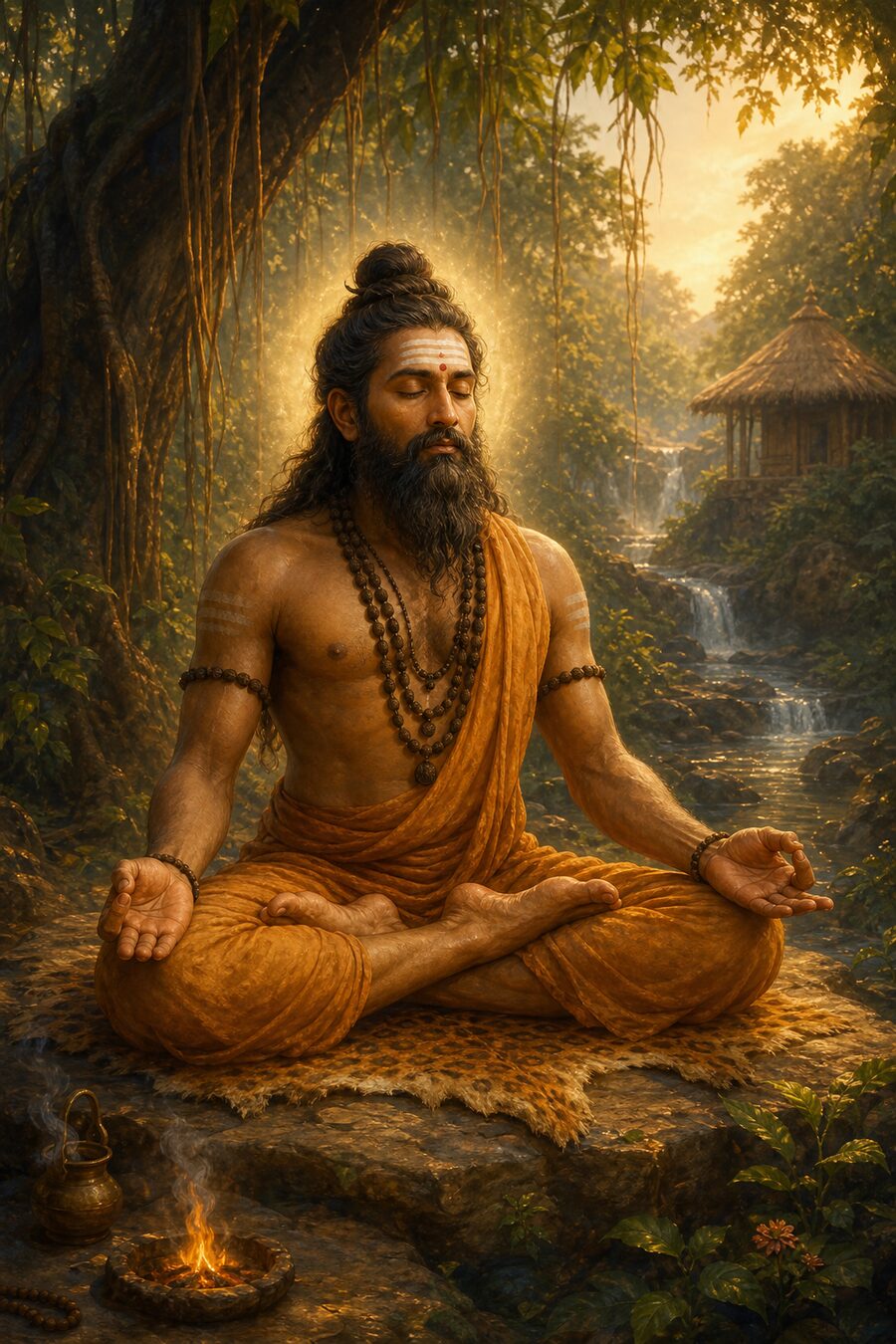
The third pada: Vibhuti. The last three limbs of the eightfold path (dharana, dhyana, samadhi), and the extraordinary capacities that rise out of samyama. This pada can tempt a new practitioner, yet Patanjali warns: “These are bonds. The destination lies elsewhere.”
First, one thing
Pada 2 opened the first five limbs of the eightfold path. Pada 3 begins with the last three: dharana, dhyana, samadhi. These are inner capacities now, worked with the mind alone. And when all three settle on a single object at once, the name for that is samyama.
Then a long stretch of the pada (3.16 to 3.50) turns to the siddhis, the powers: which extraordinary capacities open when samyama is aimed at one object after another. This is the most talked-about part of the pada. An honest reading does two things at once. It holds the siddhis as the tradition holds them, and it keeps in mind that Patanjali himself (3.38) calls them an obstacle in the path.
The real treasure of the pada sits in the first fifteen sutras and the last seven. The siddhi sutras in the middle are fascinating, yet they remain waystations well short of the goal. Read them with curiosity, and drop your anchor in the opening and closing stretches, where the water is deep.
How to read this
The load-bearing pillars: 3.1, 3.2, 3.3, 3.4, 3.9, 3.38, 3.50, 3.51, 3.53, 3.55. Read the siddhi sutras (3.16 to 3.50) as one long, enjoyable list, since every one runs on the same pattern: samyama on such-and-such object, and such-and-such capacity. On a first pass you can touch them lightly and go straight to 3.50, then come back to them when the frame is in place.
3.1 · Dharana is binding the mind to one place.
It starts exactly where Pada 2 left off, by binding the mind to one place. That is dharana: a loose leash, never tight, always there, the mind drawn back each time it bolts, and drawn back again the next time, without scolding.
3.2 · Dhyana is the unbroken flow of awareness toward that object.
When that hold runs unbroken and flows on steadily like a single thread of oil poured from one vessel into another, with no drop and no break in the stream, it becomes dhyana.
3.3 · Samadhi is that same flow when the object alone shines, as if empty of its own form.
And when dhyana grows so deep that only the object keeps shining and even the fine feeling of ‘I am meditating’ drops away, so that the mind seems emptied of its own form, that is samadhi. One current, three depths: the same river, first at the ankle, then at the waist, then over the head.
3.4 · The three together on one object are samyama.
Now Patanjali coins a new word. When these three settle on a single object together, binding, flowing, and dissolving into it, the name for it is samyama, the real instrument of the whole pada, the one tool every sutra from here on will pick up.
3.5 · Through mastery of it, the light of wisdom dawns.
The direct fruit of mastering it is understanding itself, the light of insight, prajna-aloka, and no marvel of any kind. This fixes the priority for the entire pada before the list of marvels even begins. Understanding is the real fruit, and the capacities are only things picked up along the road, the way a traveler bound for a city gathers a few stones on the way and should not mistake the stones for the city.
3.6 · It is applied in stages.
And the instrument is applied in stages: first on gross objects, then on subtle ones, then on subtler still. You cannot skip a stage and drop straight to the deepest, any more than a diver can reach the riverbed without passing through the water above it.
3.7 · These three are inner limbs, compared with the five before them.
There is a delightful turn of perspective here too. Set against the first five limbs (from yama through pratyahara), these three are the inner ones. The outer five arrange the conditions, the way a farmer clears and waters the ground; the inner three bring the real change, the growing itself.
3.8 · Even they are outer limbs to seedless samadhi.
Yet place these same three before seedless samadhi and they turn out to be outer as well. ‘Inner’ and ‘outer’ are relative measures, and beyond every waystation one more depth stays open, the way every ridge climbed shows another ridge behind it.
3.9 · Nirodha parinama is the transformation in which outgoing impressions recede, impressions of stillness arise, and the mind joins the moment of stillness.
Now Patanjali goes down into the fine weave of change, into the direction the mind is sliding at any moment. Nirodha-parinama is the shift in which the outward-bolting impressions sink and the settling impressions rise, and the mind joins itself to that moment of stillness. Picture a slow needle drifting toward rest, with no sudden click from on to off; the drift is the thing itself.
3.10 · Its flow becomes calm through impressions.
Repeat it and this stillness lays down impressions of its own, as every repeated state does, and becomes a calm, self-flowing current, prashanta-vahita, a river that no longer needs to be pushed.
3.11 · Samadhi parinama is the waning of scattered attention and the rising of one-pointedness.
The second shift is one of concentration, samadhi-parinama, as scatter falls away and single-pointed steadiness grows, the many small flames of attention gathering into one.
3.12 · Then, when the subsiding thought and the arising thought are alike, the mind is transformed into one-pointedness.
And the subtlest, the third, is where the fading perception and the arriving perception come out equal, moment after moment the same current, with nothing rearranged between one moment and the next; this is ekagrata-parinama, the mind transformed into one-pointedness.
3.13 · By this are explained the transformations of property, time, and state in the elements and the senses.
Patanjali now spreads this same transformation pattern across the whole of creation. The three shifts seen in the mind run through the elements and the senses too: a shift of quality, of time-marker, and of condition. What was true of the pond is true of the stone and the eye.
3.14 · The substrate is what runs through properties that are past, present, and yet to manifest.
Underneath sits a deep Samkhya idea. Qualities keep changing, yet one substrate (the dharmi) runs on through all three forms, the past, the present, and the latent, the way clay is the substrate and pot, shard, and dust are its passing qualities. The pot was clay before the wheel and is clay after the fall.
3.15 · Difference in sequence causes difference in transformation.
And where does all the variety come from? From sequence. Cook the same ingredients in a different order and you get a different dish; play the same seven notes in a different order and you get a different tune. Every difference in the world comes down to arrangement, to the order in which the same few things are laid.
3.16 · Samyama on the three transformations brings knowledge of past and future.
Now that long, celebrated list begins, and its pattern holds all the way to the end: samyama on such-and-such object, and such-and-such capacity. The first step is on the axis of time. Samyama on the three transformations lets you read a thing’s past conditions and the conditions still to come, the way a river-reader looks at the water and knows what the hills upstream have done.
3.17 · Word, meaning, and idea are superimposed and confused; samyama on their distinction brings understanding of the sounds of all beings.
Then the deep structure of language: name, meaning, and cognition stay fused together in every word we hear, and prying them apart, by samyama on their distinction, opens the voices of every living creature, the cry of the bird as much as the speech of a stranger.
3.18 · Direct perception of impressions brings knowledge of former births.
3.19 · Samyama on the thought of another brings knowledge of that mind.
Then, by looking straight at your own deep impressions, the samskaras, comes knowledge of past lives; and by samyama on the thought in another, the reading of that other person’s state of mind.
3.20 · That knowledge does not include the object of the thought, since the object was not within the samyama.
Here Patanjali draws a precise limit too, and the care of it is typical of him. You can read the state of that mind, its weather. What it is dwelling on stays closed to you unless you run a separate samyama on that content. Every capacity has its range mapped out exactly, like a field with its boundary stones in place.
3.21 · Samyama on the form of the body suspends its power to be perceived; light from it no longer meets the eye, and the body becomes invisible.
3.22 · By this, the disappearance of sound and the rest is also explained.
Now the list turns toward the body and time. Samyama on the body’s form suspends its power to be seen; the contact between eye and light breaks, and invisibility follows, the single most famous claim in the whole pada, and by the same reasoning the vanishing of sound and the rest.
3.23 · Karma is either quick or slow to bear fruit; samyama on it, or on portents, brings knowledge of death.
Karma comes in two kinds, the quick to ripen and the slow, like fruit on two trees in the same orchard. Samyama on that pace, or on omens, gives foreknowledge of the hour of death.
3.24 · Samyama on friendliness and the others brings their strengths.
And the loving attitudes of Pada 1, friendliness, compassion, and gladness, grow extraordinarily strong under samyama. This is the most grounded siddhi on the list, the one anyone can begin on tonight: compassion too is a capacity you can train, like a muscle or a memory.
3.25 · Samyama on strengths brings the strength of an elephant and the like.
Samyama on any single strength brings that same strength on an extraordinary scale, the strength of an elephant, and of whatever creature is held in mind.
3.26 · Directing the inner light brings knowledge of the subtle, the hidden, and the distant.
Now the gaze turns the inner light into a torch and falls on subtle, hidden, and distant things, the grain too fine to see, the thing behind the wall, the thing across the valley, and then it lifts toward the sky.
3.27 · Samyama on the sun brings knowledge of the worlds.
Samyama on the sun gives an ordered knowledge of the worlds, since for the ancient yogi the sun was the center point of the visible cosmos, the lamp by which everything else was arranged.
3.28 · On the moon, knowledge of the arrangement of the stars.
The moon is the anchor of the night, the one bright thing the eye returns to when the sun is gone, and samyama on it gives the arrangement of the stars.
3.29 · On the pole star, knowledge of their motion.
And the pole star is the one still point around which everything else seems to turn, the nail on which the night sky hangs, so samyama on that reference point gives knowledge of the motion of the heavens.
3.30 · On the navel center, knowledge of the arrangement of the body.
Now attention comes back from the cosmos and settles on the body. Samyama on the navel-chakra gives a direct knowledge of the body’s inner structure, a kind of interior sight, the body seen from within as a lamp lights a house from inside.
3.31 · On the pit of the throat, hunger and thirst cease.
Samyama on the pit of the throat quiets the calls of hunger and thirst; people who fast often report exactly this, that past a certain point the hunger stops calling and falls silent.
3.32 · On the kurma nadi, steadiness.
The kurma-nadi, the tortoise channel, stands for stillness, and samyama on it brings an unwavering steadiness in both body and mind (recall the steady tortoise of the Gita, drawing its limbs in and staying put).
3.33 · On the light at the crown of the head, vision of the siddhas.
And samyama on the subtle light at the crown of the head brings the sight of the siddhas, the perfected ones who walked this road before.
3.34 · Or through intuition, everything.
Now the list takes a turn. Patanjali says that even without separate samyamas, pratibha alone, that flashing spontaneous insight which arrives whole, without step-by-step reasoning, the way the whole shape of a valley shows in one flash of lightning, can open everything.
3.35 · On the heart, understanding of the mind.
Then samyama on the heart, on the seat of consciousness, and your own mind becomes the object of your own attention, one of the most useful samyamas of all, since the mind is the one instrument you carry everywhere.
3.36 · Experience comes from failing to distinguish sattva and purusha, which are wholly distinct; sattva exists for another, and samyama on what exists for itself brings knowledge of purusha.
And then the real target of the entire list. The mind (sattva) and awareness (purusha) stay blended, and we take the two to be one, though they are wholly distinct; the mind always works ‘for the sake of another’, as an instrument, the lamp that lights the room for someone else, while the purusha stands ‘for its own sake’, the destination. Samyama on that ‘for its own sake’ gives direct knowledge of the purusha, and this is the real fruit of all of yoga.
3.37 · From this arise intuition and intuitive hearing, touch, sight, taste, and smell.
After knowledge of the purusha, a keen sensitivity beyond the senses opens: a spontaneous hearing, touching, seeing, tasting, and smelling, a ‘pratibha’ form of all five senses, each one reaching past its ordinary range.
3.38 · These are obstacles to samadhi and powers to the outgoing mind.
And right here, in the very middle of the list, Patanjali delivers his verdict. This is the most important sutra of the pada, so pause here. One and the same capacity is two different things for two different people. For the ordinary person, the one whose mind still runs outward, it is a siddhi, an impressive attainment; for the seeker of samadhi it is an upasarga, an obstruction that can hold them back from the final destination. The danger lies precisely in their being real. Were they fake, no such warning would be needed. The ego seizes them, as a hand closes on a jewel found in the road, and the journey halts right there, on the road, with the jewel.
3.39 · When the cause of bondage loosens and the pathways of the mind are known, the mind can enter another body.
Even after the warning, the list keeps going, now toward still more extraordinary claims. Loosen the cause that binds you to your own body, learn the pathways along which the mind moves, and there comes entry into another body, parakaya-pravesha. Its working point, the part that matters for a reader who will never attempt it, is that the lock holding us sealed inside this body is not as tight as it looks.
3.40 · Mastery of udana brings freedom from contact with water, mud, thorns, and the like, and ascent at death.
Victory over udana, the upward-flowing life-current, brings lightness in the body, an escape over water, mud, and thorns, and the rising of consciousness by the right path at the hour of death.
3.41 · Mastery of samana brings radiance.
And victory over the samana breath that dwells in the middle of the body brings an inner fire, a glow, the way a person with strong digestion carries a visible energy that shows in the face.
3.42 · Samyama on the relation of ear and space brings divine hearing.
Sound travels through space, so samyama on the relation between the ear and space gives divine hearing, far past the ordinary range, the way a still lake carries a voice from the far shore.
3.43 · Samyama on the relation of body and space, with absorption in the lightness of cotton, brings movement through space.
Samyama on the relation between the body and space, together with merging into something as light as a tuft of cotton, gives passage through the air, the most talked-about claim of all (and Patanjali’s verdict on it has already landed in 3.38).
3.44 · A movement of mind outside the body, real and unimagined, is the great disembodied state; through it the covering over the light is destroyed.
And outside the body there is a real, unimagined movement of the mind, mahavideha, whose true fruit is no marvel at all; it is the lifting of the veil over the inner light, one step toward understanding.
3.45 · Samyama on the gross form, essential nature, subtle form, pervasiveness, and purpose of the elements brings mastery over them.
Now Patanjali lays out a systematic pattern of inquiry. To know an element fully you need five angles: its gross form, its essential form, its subtle form, its spread through all things, and its purpose. Samyama on all five brings victory over the elements, earth, water, fire, air, and space.
3.46 · From this arise anima and the other powers, perfection of the body, and freedom from obstruction by the properties of the elements.
Its fruit is the eight traditional siddhis, starting with anima (becoming as small as an atom) and running on to mahima, laghima, and the rest, along with a refinement of the body and freedom from the resistance of the elements, so that fire does not burn and water does not drown.
3.47 · Perfection of the body is beauty, grace, strength, and diamond-like firmness.
And that refinement opens into four qualities: form, lavanya (a lit radiance beyond mere beauty), strength, and a diamond-hard firmness, the portrait of a seasoned body, arriving as a side-effect of the practice and never as its aim.
3.48 · Samyama on the process of grasping, essential nature, I-am-ness, pervasiveness, and purpose of the senses brings mastery over them.
That same five-angle pattern now applies to the senses: the act of grasping, the essential form, the ‘I’-sense, the spread, and the purpose. Samyama on these brings victory over the senses, the five gates through which the world comes in.
3.49 · From this come speed like that of the mind, perception without the senses, and mastery over primal nature.
Its fruit is three capacities: the body moves at the speed of mind, perception grows free of the physical senses, and finally there is reach to the very root of pradhana, primordial nature itself, the source from which every form unfolds.
3.50 · To one who knows only the distinction of sattva and purusha come sovereignty over all states and omniscience.
And at the summit comes the one thing that is in truth the greatest: simply the clear discriminating knowledge between mind and awareness, between sattva and purusha, and from it mastery over all states and omniscience. Yet the word is ‘khyati-matrasya’, only that much recognition. This is still a mental event, something happening in the mind, and the final freedom is yet to come.
3.51 · Through dispassion even for this, the seeds of fault are destroyed, and kaivalya follows.
Here is the true summit of the pada, and it asks for the most daring step of all. 3.50 granted omniscience, and 3.51 says: let even that go. Omniscience is still an attainment, a thing inside the field of prakriti, and so a fine bond, a silken rope where the earlier ropes were coarse; only dispassion toward it burns the seeds of flaw and yields kaivalya, final freedom.
3.52 · When invited by those in high places, take neither pleasure nor pride, for unwanted consequences may return.
And Patanjali adds a thoroughly practical confirmation. As you climb, invitations arrive from high places: recognition, rank, privileged seats. Do not cling to them, and do not preen, because a single such moment can set the whole cycle turning again. The moments of success are the most slippery of all, the wet stones at the top of the climb. When a lofty invitation comes, read it as a test to be passed and never as a reward.
3.53 · Samyama on the moment and its sequence brings knowledge born of discernment.
Now a final, subtlest samyama. On the smallest unit of time, the moment, and on the sequence of moments, one following another like beads on a thread. Samyama on these gives birth to a knowledge unlike any other siddhi, one that has nothing to do with power. It yields viveka-ja knowledge, the knowing born of discernment, the very discrimination that tells purusha from prakriti, and this is the real target the whole list was circling.
3.54 · Through it one distinguishes two similar things that cannot be told apart by class, mark, or position.
Its power runs so deep that even where two things cannot be told apart by class, by trait, or by position, two grains of rice from the same handful, it still sees their difference clearly; it works exactly where ordinary sight gives out.
3.55 · Knowledge born of discernment carries one across; it takes in all objects, in every condition, all at once.
And its whole nature opens in four qualities: taraka (self-arising, carrying you across), sarva-vishaya (everything within its range), sarvatha-vishaya (in every condition, from the past to the subtle), and akrama (all at once, with no step-by-step). Ordinary knowledge is limited, dependent on instruments, bound to sequence, one thing after another like a man reading by a small lamp; this one is free of all those bonds, the whole page lit at once.
3.56 · When sattva equals purusha in purity, kaivalya is reached.
And here the pada halts at the threshold of kaivalya. The purusha was always pure; the impurity lay in the mind (sattva), and the whole work of practice was just this, to purify the mind until its purity equals the purity of the purusha. When that equality arrives, the mind no longer distorts the purusha. It gives the purusha back like a perfectly clean mirror, laying on no color of its own, mixing in no error of its own, the way still water gives back the moon whole. This is the threshold of kaivalya. A small note on the count belongs here too. The Agashe edition, which carries the Vyasa-bhashya, counts 55 sutras in Pada 3; some editions, Vivekananda’s among them, count the line on the disappearance of sound after 3.21 as a sutra of its own and so reach 56. The count of 56 is used here, so from 3.22 onward each number runs one ahead of the Agashe edition, and whatever the number, the meaning stays the same. The road ahead is completed in Pada 4.
Where to go next
The next page in line, Pada 4 (Kaivalya Pada), is the shortest pada and the most philosophical. It probes the nature of kaivalya, the true form of the mind, the kinds of karma, and dharmamegha samadhi.
One suggestion from outside: to keep the siddhis of Pada 3 in balance, the best thing is to talk with a teacher from any living tradition. Nearly every serious tradition treats the siddhis as a distraction, exactly as Patanjali says in 3.38.
And keep one question in your pocket: in your own practice, which middle capacity did you once take for the final attainment? Where does the upasarga of 3.38 show up in your own experience?