Yoga Sutras of Patanjali
Pada 2 · Sadhana Pada
55 sutras. Pada 1 showed you the destination. Now the real question: how do you actually get there? And why does suffering keep returning along the way? This is where the eightfold yoga opens up.
Where you are in the journey
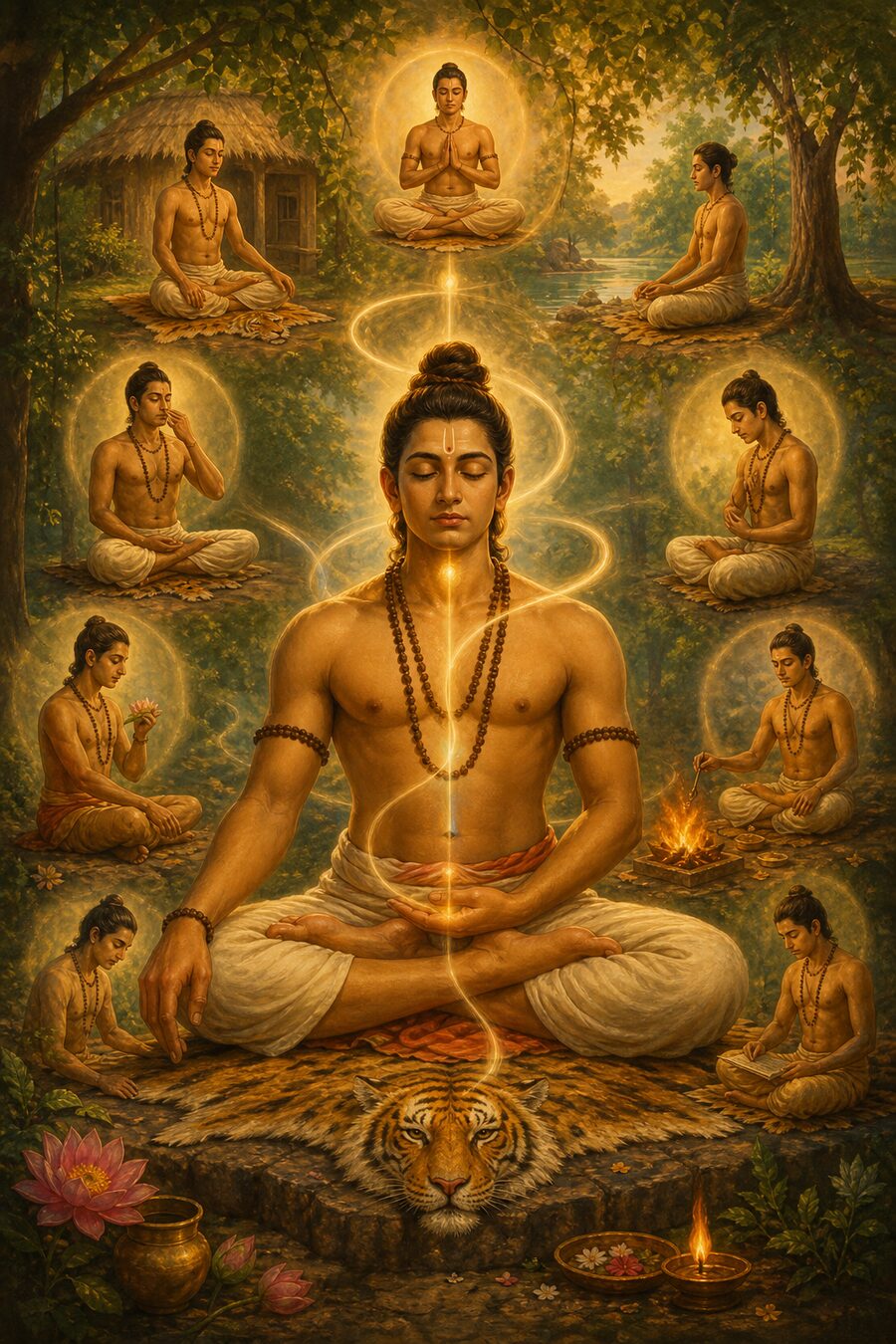
The second pada: the road. The kleshas (the causes of suffering), and the first 5 limbs of the eightfold yoga (yama, niyama, asana, pranayama, pratyahara). This pada is the most practical one for the seeker.
First, one thing
Pada 1 was a map: what samadhi is. Pada 2 is the actual journey: how to get there, on foot, and why suffering keeps colliding with you along the way.
Patanjali works like a good physician: first the diagnosis (where suffering comes from, and why), then the treatment (the first five limbs of the eightfold yoga: yama, niyama, asana, pranayama, pratyahara). The last three limbs (dharana, dhyana, samadhi) arrive in Pada 3, because they are inner capacities and take on their real meaning only after the outer preparation is done.
This is the most useful pada. If Pada 1 felt airy in places, Pada 2 brings you straight down to the ground, hands and feet on it, something you can practice every day, before breakfast if you like.
How to read this
Read it in order, diagnosis first, then treatment. The real pillars: 2.1, 2.3, 2.16, 2.29, 2.30, 2.46, 2.47, 2.49. Once you have hold of these eight, the other 47 arrange themselves around them on their own, the way beads find their places on a thread once the knots are tied.
2.1 · Austerity, self-study, and surrender to Ishvara make up the yoga of action.
Patanjali opens Pada 2 with a small, concentrated prescription, the kind a physician writes in three lines after a long examination. The whole of practical yoga folds down into three moves. Tapas: the strength to keep working from within discomfort, which forges capacity the way a wrestler’s body is forged in the akhara, by the daily heat of the pit. Svadhyaya: the study of good books, which anchors attention to what is higher, and along with it the watching of yourself, to see which old pattern is running right now and why it started. And ishvara-pranidhana: lifting the ego out of the charioteer’s seat and handing the reins to a larger order. All three run together, at once, in a single stride. Without tapas, svadhyaya stays shallow, a reading that never costs anything; without svadhyaya, tapas turns into the ox at the oil-press, circling with great effort and going nowhere; and without ishvara-pranidhana, the two together become a journey of the ego, well disciplined and well read and still about itself.
2.2 · Its aim is to cultivate samadhi and to thin the afflictions.
This practice has two jobs: to ripen samadhi, and to thin the kleshas, the afflictions. A relief hides right here, in that second word. It makes no demand for perfection. For a beginning seeker the kleshas cannot be wiped out entirely, and they can be thinned, the way a thick rope frays strand by strand until it will no longer hold. A thinned klesha is still alive, still rises, and yet it no longer grips you as it did. That is the real, reachable goal, and courage gathers in it, because a goal you can actually reach is one you can set out toward tomorrow morning.
2.3 · The afflictions are ignorance, I-am-ness, attachment, aversion, and clinging to life.
Now Patanjali opens his diagnosis of suffering, and says something startling: every human affliction, whatever name it goes by in the moment, comes from just one of five kleshas, or from their blending. The five are avidya, asmita, raga, dvesha, and abhinivesha. Hold the five names a moment before the definitions come, because the rest of the diagnosis is built on them.
2.4 · Ignorance is the field for the others, whether they lie dormant, thinned, interrupted, or fully active.
Avidya is the lowest confusion, the root of the other four, their field, the soil in which they grow. It is the root, and the other four grow out of it; if the root is left unattended, cutting the stalk does nothing, and the thing sprouts again by the next season. These four sit in one of four states: asleep, thinned, broken up in patches, or fully awake. In a seeker the kleshas may be asleep, invisible until something gives them a push and they stir; in a non-seeker they stand sharp and awake all day; in someone in the middle of practice they are broken up, asleep one moment and awake the next, like a fire that has been doused and still has live coals under the ash.
2.5 · Ignorance takes the impermanent, the impure, the painful, and the non-self for the permanent, the pure, the joyful, and the self.
And what is avidya? It takes the perishable for the permanent, the impure for the pure, suffering for happiness, and what is not the ‘I’ for the ‘I’. Look at how ordinary each of these is. Treating a relationship as if it will last unchanged, treating the body as pure, treating the activities that chase pleasure as the source of happiness, and saying ‘I am this body-mind’ without a second thought: these four are confusions rising from a single root. They also make a short set of questions for the discernment Patanjali asks of the yogi. Run these four over every opinion that feels solid to you, and watch how many opinions shake loose at the first touch.
2.6 · I-am-ness is the seeming oneness of the power that sees and the power of seeing.
Now the remaining four kleshas open one by one. Asmita is what mistakes the ‘one who sees’ and the ‘power of seeing’ for a single thing. Drik means pure awareness, that is, purusha; darshana-shakti means the mind, the intellect, the senses, the whole instrument of seeing. In ‘I am seeing’, the ‘I’ is awareness, while the instrument of the ‘seeing’ is the mind, and we tie the two into one bundle and carry the bundle around as ourselves. Undoing this error is the finest work of all, finer than any posture or breath, and most sadhana gets stuck right here, at the knot of the bundle.
2.7 · Attachment follows pleasure.
Then raga, what stays behind after a pleasure has been enjoyed, its leftover ash. The delicious meal is finished, the plate is clean, and the pull of ‘I want that dish again’ remains, warm under the ash. This does not brand the experience of pleasure as bad; the meal was good, and the sutra says nothing against it. The trouble lies in the ash, which keeps attention tangled in grabbing for the next thing before the present one is even over.
2.8 · Aversion follows pain.
Its mirror is dvesha, what stays behind after a pain has been suffered. Old hurt becomes today’s irritation, and distance from the kind of people who once wounded you begins to form of its own accord, a groove worn by the old hurt that the feet find without asking. Raga and dvesha together build a millstone of like and dislike, turning and turning; we think we are making free choices, and often we are only chasing old ash, or fleeing it.
2.9 · Clinging to life flows by its own force and holds even the learned.
And the fifth, abhinivesha, the clinging to life, which flows on by its own force and is lodged even in the learned. This is Patanjali’s most honest sutra. The fear of death does not leave through the mind’s understanding; great scholars and saints too clutch at the body when real danger appears, because this clinging has sunk into the bones through the memory of every past birth, each one ending the same way. There is only one way to dissolve it, to see clearly that ‘I’ am not the body. Until then it stays, and honest seekers take it as a baseline, a fact of the ground they stand on, and move on without shame.
2.10 · In their subtle form, the afflictions are removed by tracing them back to their source.
Now the question of how these kleshas are removed, and the answer comes on two levels. At the subtle level they are removed by the ‘reverse journey’, running back along the very path by which they were built, the way a river is followed upstream to the spring. You can see this in sadhana: coarse thoughts quiet first, subtle ones later, and last of all the imprints from which the subtle thoughts arise, the springs themselves.
2.11 · Their active waves are removed by meditation.
And at the awake level, when a klesha’s current is actually running, raga rising, dvesha flaring, it is stopped by dhyana. Dhyana here is a particular thing: a settled, witness-like awareness that turns the wave into an object and watches it, the way one watches a storm from a doorway. A curious point follows. When you watch raga, it starts to dissolve; when you attach ‘I’ to it, it sets harder, like clay that is handled too much. A plain matter, though at first glance it looks upside down, since we expect the thing we look at to grow.
2.12 · The store of karma, rooted in the afflictions, is experienced in this birth or in births unseen.
Now Patanjali opens the workings of karma. Every act deposits an imprint, and the imprints gather in a karma-storehouse holding the roots of the kleshas; these imprints are sometimes lived out in this birth, sometimes in births to come. Even if you do not take rebirth literally, the point still lands with full weight: the pattern you practice today fills the tool bag of the later ‘you’, the one who will reach into it in a hard moment and find only what was put there. Every move today is tomorrow’s supply.
2.13 · While the root remains, it ripens as birth, span of life, and experience.
As long as the root is there, its ripening takes three forms: the kind of birth, the length of life, and the experiences met along the way. It is easy to read this as fatalism, and the point is only this. You are living now the result of what has already happened, as a field in autumn shows what was sown in spring, and what you do now you will live out later. The seed for the next season is still in your hand.
2.14 · These bring joy or anguish, as their cause was merit or demerit.
And whether these fruits bring joy or suffering rests on whether their causes were good or wrong. The point is simple, and Patanjali gives no sermon here, no threat and no promise; he is only describing how the mill turns, grain in and flour out.
2.15 · To one who discerns, all is suffering, because of change, anxiety, and impressions, and because the movements of the gunas oppose one another.
Now a sutra arrives that looks like pessimism at first glance, and a second glance corrects that: for the one with discernment, everything is suffering. Notice, the word used is ‘vivekinah’, only for the one with discernment. The ordinary person takes each experience at its surface, good or bad or plain, and moves on. The discerning one sees that four sufferings sit hidden in every experience. Every pleasure will change, and there is a suffering in that (parinama). Even in the middle of pleasure there runs a faint anxiety that it will pass (tapa). Every experience leaves an imprint that builds the next grip (samskara). And the three gunas are in constant tug-of-war with one another, so that no state of the mind ever holds still (the virodha of the gunas). This is clear seeing, the physician’s eye on the symptom, and once these four sources come into view, the understanding itself becomes the first relief, because what has been seen whole can no longer ambush you.
2.16 · The suffering that has not yet come is to be avoided.
Then Patanjali sets down, in five words, the most useful sutra in all of yoga: the suffering that has not yet come is the one that can be avoided. Nothing can be done about what is finished, and nothing about what is running now, and the suffering ahead, which is still only a seed in the ground, can be avoided. The whole aim of yoga is to stop future suffering; mending the past or fleeing the present is simply no part of its work. Think of a small crack in a dam. Filled before the rains it costs a morning’s labor; left until the flood it costs the valley. The real value of yoga lies in the work done beforehand, in the dry season. There is a difference between care before an illness arrives and treatment after it has, and yoga belongs to the first kind.
2.17 · The cause of what is to be avoided is the union of seer and seen.
And what is the root of this avoidable suffering? The blending together of the drashta and the drishya, the seer and the seen. The source of suffering lies deeper than outer circumstance or karma: it is the mistaken identification between the one who sees, pure awareness, and the thing seen, which is everything else, the body, the mind, the world. We say ‘my mind is restless’, though in truth the ‘I’ is awareness and the ‘mind’ is that restlessness; making the two into one is the very conjunction the sutra names, and all avoidable suffering flows from right here, from this one confusion at the source.
2.18 · The seen has the nature of light, activity, and inertia; it consists of the elements and the senses; it exists for experience and for liberation.
With the root in hand, what is this drishya, the seen, that we have gotten blended into? Patanjali gives the definition of the whole of prakriti in a single sutra. The seen is that whose nature is light (sattva), motion (rajas), and inertia (tamas); that is made of the elements and the senses; and whose purpose is to give the drashta experience and, in the end, to free it. A lovely point sits in that last clause: the very purpose of prakriti is the drashta. This is a beautiful idea of Samkhya, that prakriti, the whole vast field of nature with its stars and its stomachs, has one job, and that job is the service of consciousness.
2.19 · The stages of the gunas are the specific, the unspecific, the merely indicated, and the unmanifest.
This prakriti unfolds along a slope from coarse to subtle, in four stages: the gross, the subtle, ‘a mere hint’, and the unmanifest. First the things that appear solid, the stone and the water; then the subtle elements behind them; then the level of intellect; and at last the primal prakriti, the unmanifest source of it all, which has no form that could be pointed at. This is the same slope that showed in Pada 1 (1.45, ‘the subtle ends at the unmanifest’), seen now from the other end.
2.20 · The seer is pure seeing; though pure, it sees through the ideas of the mind.
And on the other side, the drashta? It is only pure seeing, spotless in itself, and we do not meet it directly; we know it only through the mind’s cognitions. Think of a clean lamp in a dark room. Its light is invisible on its own and becomes visible only when it falls on something, a wall, a face, a page. Purusha is pure in just that way, and its being shows in the mirror of cognitions, in the things it lights.
2.21 · The seen exists only for the sake of the seer.
Now Patanjali makes a bold claim: the seen exists for the sake of that drashta. The work of all prakriti is to serve purusha, and prakriti holds no separate meaning of its own; it has no purpose that is purely its own, no story of which it is the hero. The practical lesson is sharp. The world turns for the benefit of consciousness, and you are a particular center of that consciousness; imagining that it revolves around your personal benefit, your plans and your comfort, is an ego-fantasy, and a common one.
2.22 · For one whose purpose is fulfilled it ceases, yet it does not cease, being shared by others.
And for the purusha that has completed its purpose, prakriti ‘vanishes’, though it does not vanish in itself, because its work remains for the other consciousnesses still in the field. A liberated person and an ordinary person stand side by side and look at the world, the same market, the same sky, the same faces, and have an entirely different experience of it; for one it is a show that is over, for the other the only show there is.
2.23 · The union of owner and owned is the cause of knowing the true form of both powers.
Here comes the hardest and most startling point: this conjunction of purusha and prakriti itself holds a purpose, and it is what makes them recognize their own true nature. That is, this blending together is in the end the kiln in which clarity is fired. Without the tangle the distinction will never show; without discomfort the longing for freedom will never rise; the tangle is the seed of the untangling, and the very confusion that hurts is the thing that finally teaches.
2.24 · Its cause is ignorance.
And the cause of this conjunction? Small and exact: avidya. All the rest, raga, dvesha, asmita, abhinivesha, are made of avidya, which is the root; this is the point of 2.4 again, from a different angle, because it is worth repeating, and Patanjali repeats almost nothing.
2.25 · When ignorance is absent, union is absent; this removal is the aloneness of the seer.
And when avidya ends, the conjunction ends; this is the dissolution, and this is the drashta’s kaivalya. The formula is complete: the problem (2.17), the root cause (2.24), the solution (2.25), a clean chain of diagnosis from symptom to cure. The word ‘kaivalya’ is a rare word that marks Patanjali as his own; moksha, nirvana, these are words of different traditions, and Patanjali says kaivalya, meaning ‘aloneness’, purusha in itself, without the admixture of prakriti, a kind of coming home to a house with no one else in it and nothing missing.
2.26 · Unwavering discriminative discernment is the means of removal.
So how is avidya removed? Unbroken viveka-jnana, discriminative knowledge, is the means of removing it. The key word here is ‘aviplava’, unwavering: a single insight is not enough, however bright. What is needed is continuous, unbroken discernment, keeping the distinction between purusha and prakriti alive in every moment, and this is why the eightfold yoga is a daily practice, a lamp kept burning through the night, since a lamp that is lit one evening and left dark the next gives no light to walk by.
2.27 · For that one, wisdom reaches its final ground in seven stages.
This final understanding does not arrive in one leap; it comes in seven stages, four of outer understanding and three of inner freedom. The four of understanding: suffering, its cause, its removal, and the means of removal, all four coming into recognition, one after the other. The three of freedom: the intellect’s work done, the gunas folding back into their source, and at last purusha resting in its own nature, with nothing more to be done.
2.28 · As the limbs of yoga are practiced and impurity wanes, the light of knowledge grows until it becomes discriminative discernment.
And now a bridging sutra: the steady practice of the limbs of yoga wears away the impurity, and the light of understanding grows until it reaches viveka-jnana. So viveka-jnana looks like a distant goal, a summit seen from the valley, yet the means to it is concrete, a path with steps you can count, and now the part done with hands and feet begins.
2.29 · Yama, niyama, asana, pranayama, pratyahara, dharana, dhyana, and samadhi are the eight limbs.
That means is the ashtanga, the eight limbs: yama, niyama, asana, pranayama, pratyahara, dharana, dhyana, samadhi. This is the most effective sutra in the whole Indian world of meditation, and even today every serious meditation tradition uses some form of these eight. And it is an order, a ladder, with each rung resting on the one below. First conduct with others (yama), then conduct with yourself (niyama), then the body (asana), then energy through the breath (pranayama), then the drawing in of the senses from outside (pratyahara), then the steadied mind (dharana), then the unbroken stream of dhyana, and at last the full immersion (samadhi). Starting from the outermost and reaching the innermost, because the upper floor cannot be built without the foundation, and a house begun from the roof falls. The rest of this pada (2.30 to 2.55) will open the first five of these, and the last three come in Pada 3.
2.30 · The yamas are nonviolence, truthfulness, not stealing, continence, and non-possessiveness.
The first limb, yama, is five measures for conduct with others: ahimsa, satya, asteya, brahmacharya, aparigraha. Ahimsa reaches past the physical; it is the falling away of any intent to needlessly hurt anyone, by word and by mind as much as by hand. It is the most basic yama, and without it the other four are hollow. Satya is truthfulness in fact and the absence of any intent to deceive, yet weighed against ahimsa; if speaking the truth would become direct violence, silence is better. Asteya is plainly not stealing, and in a larger sense not taking what is not yours: credit, attention, time, energy, all of it falls under this. Brahmacharya is not letting energy drain away in unconsciousness, and for the householder it means balance and non-attachment. Aparigraha: use things, do not become their owner, and keep only as much as is needed. This list is deliberately a ‘what not to do’, and Patanjali’s reasoning is that you first stop doing wrong, and only then will doing right be genuine; the first rule of any good physician, ‘first, do no harm’, is an exact echo of ahimsa.
2.31 · Unbounded by birth, place, time, or circumstance, practiced at every level, they are the great vow.
And when these yamas are kept without the conditions of class, place, time, or circumstance, they become ‘mahavratas’, great vows. Ordinary morality is conditional: ‘I do not lie to him, and I may lie to this one’; ‘I am honest at home and sharp in the market’. The mahavrata is unconditional morality, the same in every room. It is a high demand, and it carries a quiet verdict with it: conditional morality is really self-serving, a dressed-up form of ego that keeps its honesty for where honesty pays, and the mahavrata is the real practice.
2.32 · The niyamas are purity, contentment, austerity, self-study, and surrender to Ishvara.
Then the second limb, niyama, the five to be practiced with yourself: shaucha, santosha, tapas, svadhyaya, ishvara-pranidhana. The yamas were ‘what not to do’; the niyamas are ‘what to do’. Shaucha, the washing of both outer and inner. Santosha, acceptance of what is. Tapas, that same glad joining with discomfort from 2.1. Svadhyaya, good books and the watching of yourself. And ishvara-pranidhana, that same surrender from 1.23 and 2.1. The last three niyamas are exactly what the kriya-yoga of 2.1 was; Patanjali is underlining them again, because these three tie morality to the inner practice, the way a bridge ties two banks.
2.33 · When contrary thoughts disturb, cultivate their opposites.
But how do you keep the yamas and niyamas when contrary impulses rise? Patanjali gives a highly useful method that can be tried this very day: when a harmful impulse rises, grow its opposite in the mind. Anger is rising; grow compassion. Greed is rising; grow generosity. The mind can hold only one state at a time, a single seat with room for one occupant, so seat the opposite quality in it and the disturbance shifts on its own, finding no room left; modern psychology’s ‘cognitive reframing’ is one form of this.
2.34 · Contrary thoughts such as violence, whether done, caused, or approved, arising from greed, anger, or delusion, mild, moderate, or intense, bear endless fruit of suffering and ignorance; so cultivate the opposite.
And why the feeling of the opposite is necessary, Patanjali spells out finely. Contrary thoughts such as violence, whether done by yourself, had done by others, or quietly approved; whether rising from greed, anger, or delusion; whether mild, middling, or intense: all of them result in an endless run of suffering and ignorance. He examines it from nine angles, three ways times three causes times three intensities, that is, 27 possibilities, and leaves no door for an exception. And notice, violence done by consent is the subtlest of all: you are not doing it yourself, you are not having it done either, and yet you quietly agree, and this too is violence. ‘Endless fruit’, he says, because even a small violence can set off countless consequences, the way a single spark in dry grass does, which is why actively cultivating the opposite feeling is necessary; wishing alone will not do.
2.35 · When nonviolence is established, hostility falls away in its presence.
Now Patanjali states the fruit of each yama, and every fruit is a testable claim, something you can watch for. When ahimsa sets firm, hostility falls away on its own in its presence; around one in whom the intent to not injure has truly settled, the atmosphere of violence begins to change, and this is the ‘calm presence’ near which even another person’s nerves unclench, the way animals grow quiet near someone who means them no harm.
2.36 · When truthfulness is established, actions and their fruits come to rest on one’s word.
When satya sets firm, actions and their fruits stay aligned; the words of one whose speech is trustworthy land on the ground and take root, because there is weight in the words and the world moves on them, as it never moves on the words of someone who has been caught lying twice.
2.37 · When not stealing is established, all treasures come near.
When asteya sets firm, all wealth comes on its own, a delightful paradox: the one taking less receives more. Around one who takes nothing amiss, trust grows, and trust draws in wealth of every kind, money, relationships, respect, the way a clean well draws the whole village.
2.38 · When continence is established, vigor is gained.
When brahmacharya sets firm, virya, life-energy, is gained; by not letting energy drain away in unconsciousness, a vigor, an edge, a clarity remains, the way a lamp sheltered from the wind burns longer and brighter. No decree of renunciation is being issued here; for the householder, balance and conscious participation are also brahmacharya, the key word being non-attachment.
2.39 · When non-possessiveness is steady, the how and why of one’s birth becomes clear.
And when aparigraha holds, a clear understanding of ‘why and how was I born’ arrives. When you stop hoarding things, the identity that stood on things loosens, the way a wall loosens when its props are taken away, and a deeper sense of ‘who I really am’ begins to surface from beneath it.
2.40 · From purity comes distance from one’s own body and from contact with others.
Now the fruits of the five niyamas. Shaucha brings non-attachment toward your own body, and lessens needless entanglement with the bodies of others. As the deep practice of keeping the body clean goes on, the body’s real nature, its impermanence and its decay, comes into clear view, washed and looked at every day, and a settled non-attachment arrives: serve the body, do not worship it.
2.41 · And also purity of mind, cheerfulness, one-pointedness, mastery of the senses, and fitness for seeing the self.
Shaucha has further fruits: inner cleanliness, cheerfulness, concentration, mastery over the senses, and the capacity to see yourself. ‘Saumanasya’ means a baseline happiness. A clean mind is cheerful on its own, with no reason needed, and those who stay perpetually dull have, somewhere, refuse collected in the mind that no one has swept out.
2.42 · From contentment comes unsurpassed happiness.
Santosha brings the happiness better than which there is nothing. The more content a person is, the happier, and at a certain point this happiness becomes ‘anuttama’, unsurpassed, which no external addition can improve, since there is no gap left for the addition to fill. It turns Maslow’s ladder upside down: happiness rises as needs shrink.
2.43 · Through austerity, impurity wanes and the body and senses are perfected.
Tapas wears away impurity and brings a refinement to the body and the senses, which is the very principle of an athlete’s training: the heat of the effort burns off what is slack and leaves what is fine.
2.44 · Through self-study comes communion with one’s chosen deity.
Svadhyaya brings connection with the chosen deity. In the tradition, mantra-repetition and the study of scripture build a relationship with a deity-energy, a presence that answers to being called. And in today’s language, the ideal or the person on whom you continually dwell in manana, reflection, takes a seat within you and begins to shape what you do from there.
2.45 · Through surrender to Ishvara, samadhi is attained.
And the last, most powerful: ishvara-pranidhana brings samadhi to completion. Surrender alone is enough for samadhi, because it is the move that lifts the ego out of the charioteer’s seat; the other practices polish the ego, making it a better charioteer, and surrender transforms it, handing the reins to another.
2.46 · Asana is steady and comfortable.
Now the third limb, asana, and perhaps the most misunderstood sutra in modern yoga culture: asana is that which is steady and comfortable. Patanjali’s asana is a seat for meditation. It has nothing to do with the difficult poses of the exercise hall. Two qualities are needed, steady (not shaking) and comfortable (not in pain); when both are present, that is asana, and if even one is missing, the asana is not established. In today’s studios people do the peacock pose and the handstand and think this is ‘advanced asana’, and in Patanjali’s language, if it is not steady and comfortable, it is no asana at all. So a small question to yourself: whatever your daily meditation seat is, a chair, a mat on the floor, anything, it should be steady and comfortable, and you should treat it as your real foundation, the ground floor of everything built above.
2.47 · It is perfected by the easing of effort and by absorption in the infinite.
There are two ways to strengthen it, and both go together. The first is the slackening of effort, releasing the tight grip of the muscles so the seat rests on the bones and the muscles let go of their strain. The second is merging into the limitless, moving attention away from the body onto something large and open, the sky, space, the resonance of Om, because when attention rests on some vast expanse, the body settles on its own, like a boat that stops rocking once the passenger stops shifting. Loosening the muscles alone will make the body slump; moving attention away alone will keep it tense; so both together.
2.48 · Then the pairs of opposites no longer strike.
And from such a steady seat the pairs of opposites, hot and cold, hunger and satiety, praise and blame, no longer strike as hard. When the body is still the nerves are still, and then the mental jolts are fewer and land softer; this is the mental benefit of a bodily foundation, the house that does not shake when the wind changes.
2.49 · With asana in place, pranayama is the pause in the flow of breathing in and out.
Once the asana is steady, the fourth limb opens, pranayama: deliberately placing an interruption in the inward and outward flow of the breath. This is more than mere ‘breathing exercise’; it is specifically the practice that consciously places a pause in the natural flow of the breath, and the word ‘viccheda’ is the key: this is a gentle interruption, done without force, a hand laid on the river for a moment and lifted again. And the order matters. The asana must set first, because if the body is unsteady, playing with the breath can do harm, which is why many modern teachers warn that deep pranayama without the foundation of asana is dangerous.
2.50 · It is external, internal, or held; regulated by place, time, and number, it becomes long and subtle.
It comes in three kinds: a pause on the out-breath (bahya kumbhaka), a pause on the in-breath (abhyantara kumbhaka), and a complete stopping that comes on its own anywhere (kevala kumbhaka, a further practice). And each is measured on three scales: desha, where the attention is (nose, throat, heart); kala, how long; and sankhya, how many times. As the practice ripens, the breath grows longer and finer, like a thread drawn out until it is almost too fine to see.
2.51 · The fourth goes beyond the external and internal fields.
Then a further state, the fourth pranayama, which crosses beyond both the outer and inner spheres. Here the breath stops on its own and attention is released from both spheres at once, neither going out nor held within. This is the refined form of kevala kumbhaka, surfacing on its own in deep meditation, uninvited and unforced.
2.52 · Then the covering over the light wears away.
The greatest fruit of all this is that the veil over the inner light dissolves. The inner clarity is in everyone, and in everyone it is covered, the way a lamp is covered by soot on the glass; pranayama slowly wears that veil away, breath by breath, which is why regular practitioners report a clearer mind, quicker insight into problems, and less turbulence of the emotions.
2.53 · And the mind becomes fit for dharana.
And one more fruit of it, the bridge to the next limbs: the mind becomes fit for dharana, concentration. Trying dharana directly without pranayama, the mind will keep wobbling like a flame in a draft; this confirms the same order, that the ‘stilling’ of Pada 1 is possible only when the body and the breath are settled first.
2.54 · Pratyahara is when the senses, withdrawn from their objects, seem to follow the form of the mind.
And the fifth limb, pratyahara, the threshold of this pada: when the senses cut away from their own objects and begin to take on the very form of the chitta, this is pratyahara. The senses ordinarily look outward, the eye outward, the ear outward, each a window open onto the street; in pratyahara they turn inward and come into one tune with the chitta. A mark to recognize it by: you are in meditation, there is noise outside, and it is not registering at all; the ears are working but attention is not flowing through them, and that is pratyahara. Pratyahara happens inside, with no force applied. Closing the eyes is only an outer severance, a shutter pulled down; in pratyahara the senses fall away from their objects on their own, like leaves that drop when the season turns.
2.55 · Then comes supreme mastery of the senses.
And as it ripens, the highest mastery over the senses is gained. They come fully into your hand, joining when you wish, withdrawing when you wish; just as a seasoned musician holds such command over the instrument that the note sounds only when wanted and never by accident, the senses too are an instrument, and pratyahara is the discipline of tuning them. Here the journey of Pada 2 is complete, from the recognition of suffering (2.3 to 2.27) to the five limbs of yoga (2.28 to 2.55), a whole passage from diagnosis to the daily medicine. Pratyahara is the threshold after which the real inner work becomes possible, and without mastery over the senses that work is simply not possible, as no one can read in a room where every window bangs in the wind; where dharana, dhyana, and samadhi open, we meet in Pada 3.
What comes next
The next page straight ahead: Pada 3 (Vibhuti Pada), the refinement of dharana, dhyana, and samadhi, and the extraordinary capacities that rise from it (the siddhis). Pada 3 is somewhat contested, because many traditions treat the siddhis as a distraction. Patanjali both describes them and warns about them.
An outside suggestion: Swami Veda Bharati’s “Yoga Sutras of Patanjali: With the Exposition of Vyasa”, the most detailed commentary of the Himalayan Institute tradition. There are several volumes, and the portion on Pada 2 is remarkable.
And keep one question in your pocket: what does it mean to live 2.16 (“heyam duhkham anagatam”, the suffering not yet come is to be avoided) today? Which small choice today is sowing the seed of future suffering, and which one is quietly canceling it?