Patanjali’s Yoga Sutras
Pada 4 · Kaivalya Pada
34 sutras. The shortest pada, and the deepest. Here Patanjali says something startling: the mind does not shine by its own light. Everything else is the story of that one search.
Where you are on the journey
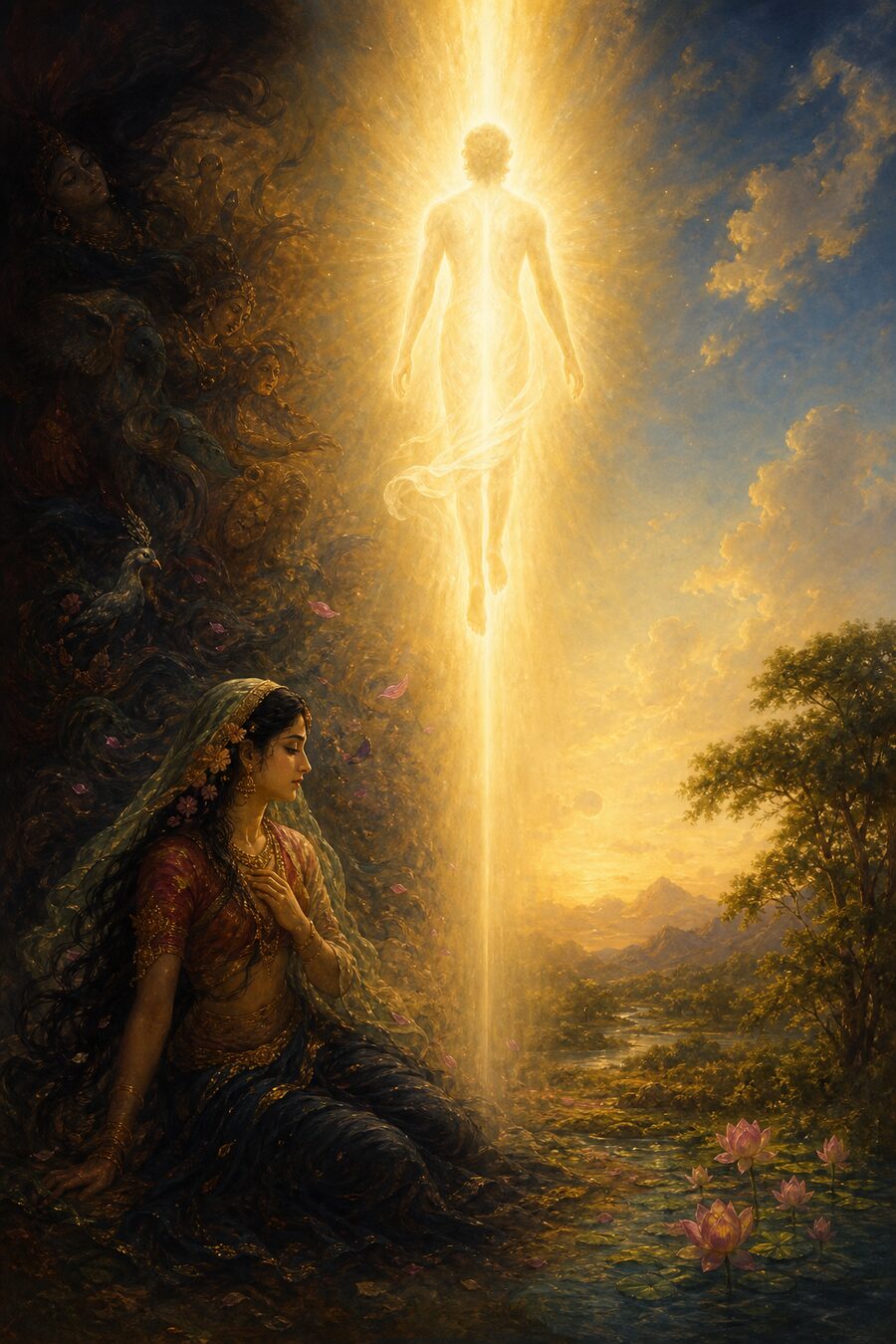
The fourth pada: Kaivalya. Where everything comes to rest. 34 sutras. At the very end Patanjali says, “purushartha-shunyanam gunanam pratiprasavah kaivalyam.” The gunas return to their source, and the purusha remains alone.
First, one thing
Three padas are behind us: Samadhi (the map), Sadhana (the road), Vibhuti (the powers along the road and their warning). Pada 4 now ties up the philosophical knots that remain, one by one, and gives one clear picture: what kaivalya finally is.
This pada does three things. One, it opens up the mind’s true nature, and here comes a jolt: the mind does not shine by its own light; it is itself a thing that gets seen. Two, it opens up the workings of karma and vasana. Three, it gives dharma-megha samadhi and the final definition of kaivalya.
This pada is the most subtle, and also the most fruitful. Here Patanjali speaks like a philosopher, and his precision rewards every minute of slow reading.
How to read this
Read slowly. There is a single argument, and each sutra stands on the one before it. The real pillars: 4.1, 4.3, 4.7, 4.10, 4.18, 4.19, 4.22, 4.25, 4.29, 4.34. And 4.34 is the last sutra of all four padas, the close of the whole text. As you reach it, stop and breathe.
4.1 · Powers arise from birth, herbs, mantra, austerity, or samadhi.
Patanjali opens Pada 4 by turning the last thread of Pada 3 to a fresh angle. Pada 3 traced the siddhis to samyama; now he adds, honestly, that such powers arrive from more than samyama alone. There are five sources. Some people are born already carrying such power, the way some are born with a voice that needs no training. Some shift the mind’s state for a short while through a herb. Mantra is practice anchored on sound. Tapas is effort undertaken by sheer resolve, the heat of a will that does not let go. And samadhi is the deepest source, and the most enduring. The list is also a ranking, read from the least to the most trustworthy: the herb-induced state is temporary and not to be relied on, a borrowed garment that is taken back by morning, and the samadhi-born state is the most solid of all.
4.2 · Transformation into another kind of being comes from the overflow of nature.
Then Patanjali explains the inner way of change. When someone moves from one level to the next, it is no forced leap. Prakriti herself fills out the new form, the way water finds its own level by slipping into every empty space it is offered, needing no one to carry it. Change asks for no outside push. It is prakriti’s own current, flowing whenever conditions allow, and standing patient whenever they do not.
4.3 · Incidental causes merely pierce the barriers that hold nature back, as a farmer opens a channel for water.
The next image is among Patanjali’s most beloved, so watch it closely. A farmer needs to bring water to his field. He never pushes the water; no one could. He simply removes a small dike with the edge of his spade, and the water runs down the slope on its own, finding every furrow. The instrumental cause, the nimitta-karana, gives prakriti no shove. It only clears an obstruction. This is the real secret of change. Do not try to pour in new energy. Find the obstruction that is holding the energy back, and clear it. Sadhana works the same way. Its whole business is to remove a barrier, dike by dike. It adds nothing new, because the water was always there, waiting above the field.
4.4 · Created minds arise from I-am-ness alone.
And a further point from the yogic side: an accomplished yogi can fashion more than one mind, and those minds are built from pure asmita alone, from that bare sense of ‘I’. The gist is this: the mind is a construction of asmita. It is no fixed, single thing, no stone that was always there. Whatever has been constructed can be taken apart and reassembled another way, like a house of bricks that were laid by hand and can be lifted by hand.
4.5 · Though their activities differ, one mind directs the many.
However many minds get made, a single original mind runs them all, the way one musician plays a whole row of strings. Inside us too several sub-minds are at work, the self at the office, the self at home, the self among strangers, and when sadhana is steady a central awareness binds them into one tune. Without that, they keep colliding with one another, each pulling its own way.
4.6 · Of these, the mind born of meditation leaves no residue.
Then comes an essential distinction. Sutra 4.1 named five sources of the siddhis; now Patanjali says that among them only the mind born of meditation is anashaya, laying down no new store of karma. The powers that come from the other sources leave fresh karmic ash behind, the way every fire leaves ash on the hearth. Only the meditation-born mind stays clean, a fire that burns without residue. This is why Patanjali keeps setting meditation and samadhi above all the rest.
4.7 · The karma of a yogi is neither white nor black; for others it is of three kinds.
Now a precise classification of karma. The karma of ordinary people comes in three colors: shukla, white and virtuous; krishna, black and harmful; and shukla-krishna, mixed, which is the most common of all, since few acts are done from a single motive. The yogi’s karma sits in a fourth box, ashukla-akrishna, neither white nor black, colorless. Colorless because color comes from attachment, the dye that the wanting hand leaves on everything it touches. The yogi does act, yet stays unbound to the fruit, so his acts leave no karmic color at all. The work happens; the ash does not. This stands a level above ‘do good deeds’, because even good deeds leave a color, a white one, and white too is a color.
4.8 · From these, only the latent tendencies suited to their ripening become manifest.
Then it is vasana’s turn. Countless deep habits lie stored inside us, seeds in a granary, and they do not all wake at once. Only those vasanas wake for which the present conditions are right, the seeds whose season has come; the rest lie sleeping, waiting for their moment. Change the surroundings, and an entirely different row steps forward. Conditions decide which pattern comes up, as the rains decide which seed sprouts.
4.9 · Though separated by birth, place, and time, the tendencies follow in unbroken sequence, because memory and impressions are of one form.
Vasanas do not break with a gap of time. Let years stand between, let the place change, let a whole birth stand between, and a habit returns from exactly where it left off, because memory and imprint are one and the same in structure. An imprint is a frozen memory; at the right nudge it wakes again, untouched by the distance, the way a river that went underground for a stretch comes up the same river.
4.10 · They are beginningless, for the will to live is eternal.
Then Patanjali raises a deep question: when did the vasanas begin? The answer: never, they have no beginning. Their root is ashis, a primal will to live, the same abhinivesha that was Pada 2’s fifth klesha, and that will has always been there, older than any memory of it. At first this can sound like despair, and yet Patanjali’s point runs the other way. Do not lose time hunting for the first cause of the vasanas, digging for the first root of a tree that has no first root. Their end will come from opening up the structure they carry today. Understanding their beginning will not bring it.
4.11 · Held together by cause, fruit, support, and object, they disappear when these disappear.
And that structure now opens. The vasanas are indeed beginningless. They are not, however, unconditioned. They stand on four supports: hetu, the cause that sets them going; phala, the fruit they produce; ashraya, the mind where they reside; and alambana, the object they reach toward. Remove any one of the four and the structure weakens, the way a cot wobbles on three legs; remove them all and the vasana is gone. To end a habit you need not fight its history. Identify its four present-day supports and take them away one by one.
4.12 · Past and future exist in their own forms, because the properties follow different paths in time.
Then comes Patanjali’s vision of time, which forces you to stop and think. The past is not finished, the future is not yet ‘nothing’, and all three exist in some form. The only difference is one of adhva, which time-phase a given quality sits in. The present quality is manifest, the past quality suppressed, the future quality hidden, and all three are real, as the whole length of a river is real though a traveler on its bank sees only the stretch in front of him. There is a striking echo of this in modern physics, in the picture of the block universe.
4.13 · They are manifest or subtle, and their nature is the gunas.
Every quality sits in one of two states: vyakta, manifest and present, or sukshma, subtle and hidden, whether past or yet to come. And every quality, whatever its state, is made of all three gunas, sattva, rajas, and tamas, in some proportion. This is the basic weave of the whole of prakriti, three threads and nothing else, crossing and recrossing into every pattern there is.
4.14 · The reality of a thing comes from the unity of its transformation.
Then a fine point: why does a thing look like ‘one thing’ when countless quality-particles inside it are changing without pause? Because there is a coordination across all those changes, a unity; they are all shifting in a measured way, and that measured motion gives the sense of ‘one thing’. Anything that appears to be standing still is really a pattern of measured change. It is no fixed object. A river is ‘one river’ because its flowing moves in one tune; the water never stays put, and the river is there all the same.
4.15 · The object being the same, minds differ, so the two follow separate paths.
Now Patanjali offers a philosophical argument, and it is worth following step by step. If a thing and the mind were one and the same, a single thing would look identical to every mind. That is not what happens. The same tree, the same setting, appears entirely different to two people; one sees shade, the other sees firewood. This proves that a thing has its own independent existence and the mind has its own; the two walk separate paths. This sutra sets Patanjali apart from the view that ‘everything is only mind’. Prakriti is real, independent of the mind, and stands there whether or not a mind arrives to color itself with it.
4.16 · An object does not depend on one mind; if it did, what would it be when that mind did not perceive it?
And the argument presses further. Suppose a thing depended on some one mind. Then when you walk out of the room and no one is watching it, what becomes of it? Does it vanish, and reappear when you return? Absurd. So the being of a thing does not depend on any particular mind. This is Patanjali’s answer to the famous question of the tree falling in the forest: yes, the tree is there even when no one is watching, and it falls whether or not an ear is near.
4.17 · An object is known or unknown depending on whether it colors the mind.
Now the way seeing works. A thing becomes ‘known’ only when it colors the mind, when the mind takes on its form, as cloth takes on the dye it is dipped in. Things that do not color the mind stay unknown, though they are there. So knowing is a meeting, between the thing and the mind. The thing itself is always there, and it turns ‘known’ only when the mind is colored by it.
4.18 · The waves of the mind are always known to their master, the purusha, who does not change.
Then an essential turn. The contents of the mind are sometimes known and sometimes not, yet for the purusha all of the mind’s contents are known, always. Why? Because the purusha is aparinami, unchanging. The mind keeps changing, so it cannot see all its contents at once, any more than a moving eye can read a whole page at a glance; the purusha is the continuous, unbroken witness of every stir of the mind, missing nothing. This is the same seer, the drashta, that Pada 1 has been speaking of all along: the changing mind, and the unchanging one who watches it.
4.19 · The mind does not shine by its own light, for it is itself seen.
This is perhaps the single most important sutra in the whole pada. Patanjali says something sharp: the mind does not shine by its own light. The reasoning is plain. The mind is a thing that gets seen; we can observe it, ‘the mind is restless today’, and we say it as easily as we say the sky is cloudy. And whatever can be seen cannot light itself; it has to be lit by something else. That ‘something else’ is the purusha. All of the mind’s light is in truth borrowed, drawn from the awareness of the purusha, like the moon, which does not shine on its own and only gives back the light of the sun, so faithfully that we call it moonlight. A tiny point here carries enormous weight: you are not your thoughts. The thoughts are being watched, and you are the one watching.
4.20 · Nor can it grasp both itself and its object at once.
Then the confirmation: the mind cannot, in a single instant, firmly know both itself and some other object. It rests either on an object or on itself, one at a time, the way a lamp held up to the window cannot at the same moment be turned on the room. So the mind cannot be the thing that ‘knows everything at once’. That capacity belongs to the purusha alone.
4.21 · If one mind were seen by another, there would be knower upon knower without end, and memory would be confounded.
Patanjali closes off another possible objection. An objector could claim that one mind is seen by another mind. His answer: then who will see that second mind? A third? And who sees that one? The chain would never end, mirror facing mirror down an endless corridor. Besides, if many minds saw one another, their memories would run together, and there would be no telling which memory belonged to whom. The conclusion: there must be a single final witness that is never itself seen, and that is the purusha.
4.22 · Awareness does not move; when the mind takes its form, the mind becomes conscious of itself.
Then a profound sutra. The purusha, that is chiti, pure consciousness, never moves; it does not descend into the mind. So how do we come to experience consciousness at all? When the mind grows so pure and still that it begins to give back the form of the purusha, the mind becomes aware of its own understanding, and that awareness is in truth the reflected light of the purusha. The sun does not step down into the river, and yet still water gives the sun back so faithfully that the sun appears within the water; stir the water and the sun breaks into pieces, let it settle and the sun is whole again. The purusha is the sun; the purified mind is the still water.
4.23 · Colored by seer and seen, the mind can grasp every object.
The mind’s singular position now becomes clear. The mind is a bridge: on one side the purusha, the one who sees; on the other side the things, the seen; and the mind can take on the color of both, as a bridge is wet with the river below and warm with the sun above. This is its power, and this is its limit. Its power is that it can join everything together. Its limit is that it keeps getting colored by both, so it is never itself the final reality; a bridge is a place to cross, never a place to live.
4.24 · Though variegated by countless tendencies, the mind exists for another, for it works by combination.
However many-colored the mind grows with countless vasanas, it still works only for another, because anything that works in coordination, separate parts acting together, serves some larger purpose. The wheel, the axle, and the yoke of a chariot work for the chariot and never for themselves; all the parts of the mind, working together, serve the purusha, the one seated within. This is a restated echo of that same point from Pada 2, that the seen exists only for the seer, now applied specifically to the mind.
4.25 · For one who sees the distinction, brooding on the self comes to an end.
Now a turning point. Once someone has seen clearly that the mind and the purusha are separate, the old habit of ‘I am this mind’ comes to a halt on its own. Notice the word, vinivritti. It stops by itself, with no effort applied, as the result of that seeing. There is no fighting a false identity here, no wrestling it to the ground. You simply see the truth, and the falsehood loosens its grip, the way the fear of the rope-snake ends the moment the lamp is brought near. The seeing is itself the real intervention.
4.26 · Then the mind, inclined toward discernment, leans toward kaivalya.
Then a beautiful image. Nimna and pragbhara both mean a downward slope, the pull of gravity. Once the false identity halts, the mind’s natural leaning shifts. Earlier it sloped toward objects; now it slopes toward viveka, toward kaivalya, the way water runs downhill without being asked. This is among the most heartening sutras of all: past a certain threshold, sadhana turns from an uphill struggle into a downhill current. The mind begins to flow toward freedom on its own, and the practitioner, who pushed for so long, now has only to stop obstructing.
4.27 · In its gaps, other thoughts arise from impressions.
But this current does not run perfectly smooth, and Patanjali gives an honest warning. Cracks open here and there, and in those cracks the old imprints send up perceptions again, like weeds through a paved courtyard. This slipping back is normal; even a far-advanced seeker passes through the sudden return of old patterns. It is easy to read this as failure. What it really is: the old imprints have not yet been fully erased, and Patanjali says so in advance, so that no one loses heart over a weed.
4.28 · Their removal is as described for the afflictions.
How do you clear these perceptions that rise in between? The same way you clear the kleshas, by the method of Pada 2: the subtle ones by the reverse journey, back along the path they came by, and the awakened ones by meditation. No new technique is required. The old tools work here too, and the hand that has used them for years knows them well.
4.29 · One who seeks nothing even from the highest knowledge, with constant discernment, reaches dharma megha samadhi.
And now the summit of Pada 4, arriving with its loveliest word: dharma-megha, the cloud of dharma. Another word here is exquisite, akusida. Kusida means interest, the kind earned on a loan; akusida is one who wants to earn interest from nothing at all, not even from the highest rewards of meditation, who lends and asks for nothing back. This is an echo of that same note from Pada 3, dispassion even toward omniscience. When this total non-grasping runs steadily alongside viveka, dharma-megha samadhi arrives. Why call it a cloud? Because like a cloud this samadhi lets fall a pure rain, of virtue, of understanding, and at last of liberation, asking for nothing, quietly pouring down of its own accord on a field that did not pray for it. To feel no ‘I want more’ even before the highest attainment, that is the final move. As long as a single thing is still wanted, even the loftiest spiritual attainment, freedom stays incomplete.
4.30 · From it, afflictions and karma come to an end.
The first fruit of dharma-megha samadhi is that the five kleshas, avidya, asmita, raga, dvesha, and abhinivesha, along with the binding cycle of karma, both come to a stop. Notice carefully: the binding of karma stops; the karma itself does not. The liberated person keeps on acting, eating, speaking, walking the road, still that same ashukla-akrishna karma, and now makes no ash at all. The cycle has broken, and the wheel that turned for lifetimes stands still.
4.31 · Then, all coverings and impurities removed, knowledge is infinite and what remains to be known is small.
Then a startling picture. We imagine knowledge as something to accumulate, the more you read the more you hold, a granary filling sack by sack, and Patanjali says the reverse. When all the veils and stains lift away, knowledge becomes limitless, boundless, past counting, and against that infinity whatever is still ‘left to know’ shrinks to almost nothing. This is an inversion in the very nature of knowledge: ordinary knowledge grows by adding; this knowledge shows itself as the veils fall away, the way the whole sky shows when the last cloud leaves. That farmer’s sutra comes back to mind: the whole thing is a matter of removing obstructions.
4.32 · Then the gunas, their purpose fulfilled, end their sequence of transformation.
Now the three gunas begin to wind up their work. Sattva, rajas, and tamas make up the whole of prakriti and keep changing without pause, but what was their purpose? To give the purusha experience, and at last liberation. When that purpose is fulfilled, when the purusha is free, the run of the gunas’ transformations comes to a stop for that particular purusha. This is the completion of a task, the field harvested and the harvester gone home; for that purusha the gunas now shape no further forms.
4.33 · Sequence is the succession of moments, grasped at the end of a transformation.
Then Patanjali returns to krama, the nature of time. Krama is a line of moments, each moment joined to the next, and it comes fully into your grasp only once the changing is over. While you are in the middle of a sequence, its full pattern stays hidden; only at the end, looking back, does the whole krama make sense. The real pattern of any long road stays unclear while you walk it. The points join up only when you turn and look back at the way you came.
4.34 · Kaivalya is the return of the gunas to their source, empty of purpose for the purusha; or it is the power of awareness established in its own form.
And now the final sutra of the entire Yoga Sutras. The whole journey of 196 sutras ends right here; pause a moment and breathe. Patanjali gives two definitions of kaivalya, two angles on one and the same thing. The first angle is from prakriti’s side: the gunas’ work is done, they have nothing left to do for this purusha, so they undergo pratiprasava, dissolving back into their source, and prakriti’s drama for this purusha is over, the stage dark and the players gone. The second angle is from the purusha’s side: chiti-shakti settling into its own form, the power of pure consciousness coming to rest in its own true nature, with nowhere to go and nothing to gain, simply that which always was, now with no veil upon it. This is the fulfillment of Pada 1’s ‘tada drashtuh svarupe’vasthanam’, the line set down 196 sutras earlier: when the waves still, the seer comes to rest in its own form. This final sutra says that very thing, now after the whole journey, and the words weigh differently for having been earned. And the word iti is worth noticing. Sanskrit texts end with iti, meaning simply: here the text is complete. Patanjali does not descend into any grand speech or emotional farewell, only the definition of kaivalya, and iti. The whole text is a closed circle: he set out the matter in 1.2 and gave its final state in 4.34, and that is where its real beauty lies.
Where to go after this
All four padas are complete now. This full journey of 196 sutras is worth reading once more, slowly. On a second pass, in the light of the final sutra, the opening sutras look different. That is the real delight of it.
The Ashtavakra Gita speaks of this very kaivalya by an entirely different road. Patanjali’s road goes step by step; Ashtavakra’s is a single leap. Reading the two together lights up both.
One suggestion from outside: for the whole text, Swami Hariharananda Aranya’s “Yoga Philosophy of Patanjali,” a searching modern commentary.
And keep one question in your pocket: 1.2 (the stilling of the waves) and 4.34 (chiti-shakti settling into its own form), are these one and the same thing, or did the journey change something? This one question holds the whole text. Do not rush it.