On this page
A selected narrative reading
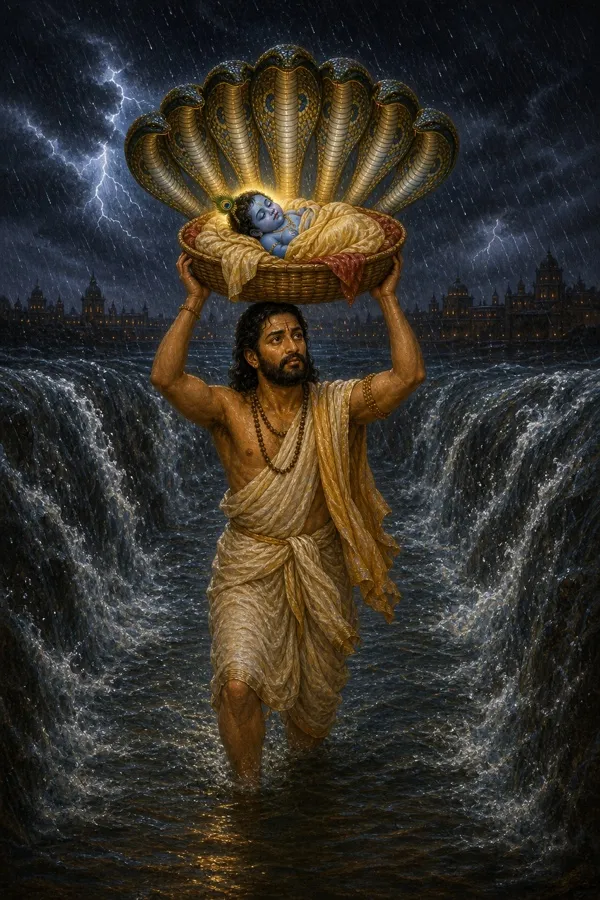
Vasudeva carries the newborn Krishna out into the night. In the Vishnu Purana’s account, the joy of his birth arrives together with the need to protect him.
Recognition does not end the danger
Parashara tells Maitreya that Krishna’s birth brings gladness to the world. The directions clear, fierce winds become quiet, and flowers fall from heaven. Yet inside the birth chamber, Devaki and Vasudeva still have reason to be afraid. Kamsa’s power has not vanished because the child has arrived.
Vasudeva sees the newborn with four arms and the Shrivatsa mark on his chest. He praises him, then asks him to withdraw that divine appearance. Devaki makes the same request. She recognizes the extraordinary being before her and wants the child hidden from Kamsa. The narrative allows reverence and a parent’s fear to occupy the same moment.
Krishna tells her that an earlier prayer for him to become her son has now been fulfilled. He then falls silent. Vasudeva takes him up and goes out into the night. The next movement of the chapter is a journey undertaken with a child in his arms.
The crossing
Under Yoganidra’s influence, the guards and gatekeepers do not stop him. Rain falls as he travels. The serpent Shesha follows, spreading his hoods to shelter the child from the water. Vasudeva reaches the Yamuna, described as deep and full of swirling currents. As he carries Krishna across, its water reaches only to his knees.
On the far bank he sees Nanda and other cattle-herding elders, who have come to pay Kamsa’s tribute. At the same time, Yashoda gives birth to a girl, the form assumed by Yoganidra. Yashoda and those around her are under the goddess’s spell. Vasudeva lays the boy on her bed, takes the girl, and returns. When Yashoda wakes, she sees the dark newborn beside her and is filled with joy.
The account moves swiftly between households. One mother has seen the divine child’s arrival; another wakes to the delight of finding him beside her. Vasudeva connects the two scenes through the night’s dangerous passage. Back with Devaki, he places the girl on her bed and remains there as before.
A child Kamsa cannot hold
The girl cries. The guards awaken and take word to Kamsa that Devaki has given birth. He hurries in and seizes her despite Devaki’s protests. When he tries to dash her against a stone, the child slips beyond his power. She rises into the air and appears with eight arms, bearing weapons.
The goddess tells Kamsa that the one who will kill him has already been born. Adorned with divine garlands, she departs while celestial beings praise her. Kamsa is left watching. Krishna is elsewhere, with Yashoda, and the chapter ends before the next stage of Kamsa’s response.
A detail worth following
Read the parents’ requests again before moving on. Recognition of the divine does not make the practical danger irrelevant. Praise is followed by a plea for protection, and the plea is followed by action. Vasudeva has to carry the child, cross the river, and return.
That is a reading observation, rather than an additional lesson spoken by Parashara. It asks us to notice how this telling holds the immense and the intimate together: a birth celebrated throughout the world, and the immediate task of getting one child through the night.
Edition and source passage
Main edition: Gita Press Complete Vishnu Purana, Sanskrit with Munilal Gupta’s Hindi translation.
Passage for this reading: Vishnu Purana 5.3.1 to 29
What this edition covers: An original prose retelling of a selected episode, followed by a marked reading reflection; not a verse-by-verse translation.
Limits and differences: This selects chapter 3 of Book Five. It does not import additional scenes from the Bhagavata or other Krishna traditions. The knee-deep crossing is the specific description in this passage.
Compare the sources: Gita Press Sanskrit-Hindi edition (Vishnu Purana 5.3.1 to 29); McComas Taylor, ANU Press, 2021 (Vishnu Purana 5.3.1 to 29).