On this page
A selected narrative reading
Krishna asks the herders what sustains their life. A changed festival angers Indra, and a mountain becomes shelter for the whole cattle camp.
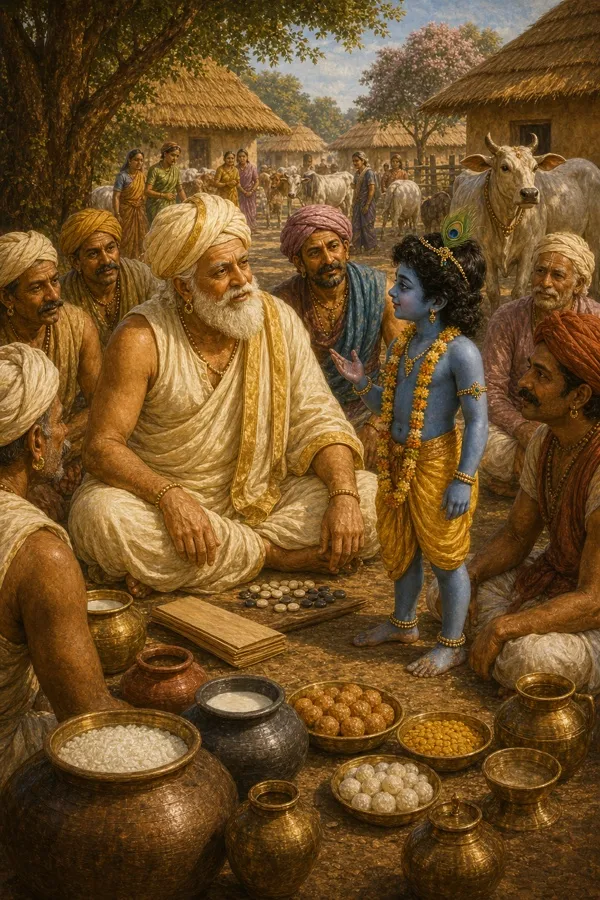
What supports a community’s life?
Autumn has followed the rains. Seeing preparations for Indra’s festival, Krishna asks Nanda what the celebration means. Nanda explains the importance of rain: it nourishes crops and supports living beings. Honoring Indra belongs to that understanding of how life is sustained.
Krishna responds by asking the herders to consider their own livelihood. They live with cattle among woods and hills. He proposes a festival for the mountain and the cows, bringing attention to the immediate supports of their way of life. Nanda and the other herders agree. They prepare offerings, feed people, decorate the cattle, and make their circuit in celebration.
The narrative then gives Krishna a double presence. In one form he appears on the mountain and receives the offerings. In his familiar form among the herders, he joins in worship. The festival concludes and the community returns to camp.
When rain becomes a threat
Indra is angered that his festival has been abandoned. He orders the Samvartaka clouds to strike at the cattle, the livelihood on which the herders depend. Wind and rain descend on the camp. Cows shiver; some try to shelter their calves beneath them. Water surrounds the frightened people and animals.
Krishna sees their distress and resolves to protect them. He raises Govardhana and holds it over the camp like an enormous umbrella. He calls the herders into the shelter and tells them not to fear the mountain’s fall. They enter with cattle, loaded wagons, and the women who have been drenched by the storm. A place of worship has become a refuge.
The Vishnu Purana says the rain continues for seven nights. Krishna holds the mountain steady. When Indra sees that the attack is failing, he orders the clouds to stop. The sky clears, the herders emerge, and Krishna restores Govardhana to its former place.
Indra comes to speak
Afterward, Indra visits Krishna and finds him tending cattle with the other boys. He acknowledges that he sent the storm because his festival was interrupted. He praises Krishna’s protection of the cows and performs a consecration at their request. In this exchange Krishna receives the name Govinda, explained here in connection with his lordship over the cows.
Indra has another request. His own portion has been born as Arjuna, and he asks Krishna to protect him. Krishna agrees. The conversation therefore opens a connection from the pastoral scene toward the later Mahabharata narrative. Indra departs, and Krishna returns to camp with the herders and cattle.
A reading reflection
Notice the sequence of questions and images. Nanda begins with rain and the food it makes possible. Krishna turns to the herders’ actual livelihood. During the storm, people, calves, cows, and wagons gather beneath the same shelter. The community is shown through the lives and work bound together within it.
This observation does not replace the text’s religious argument or turn its festival into a general rule for worship. It offers a concrete point from which to read: follow what each speaker says sustains life, then look at who needs protection when that order is threatened. The mountain is memorable for its scale. The gathering beneath it gives that scale a human and animal measure.
Edition and source passage
Main edition: Gita Press Complete Vishnu Purana, Sanskrit with Munilal Gupta’s Hindi translation.
Passage for this reading: Vishnu Purana 5.10.1 to 49; 5.11.1 to 25; 5.12.1 to 26
What this edition covers: An original prose retelling of a selected episode, followed by a marked reading reflection; not a verse-by-verse translation.
Limits and differences: Gita Press renders 5.11.16 as holding the mountain with one hand; Taylor says one finger. This retelling does not specify a finger. The source festival in 5.10.38 to 44 includes animal sacrifice and meat offerings; this page does not give a ritual procedure. It does not blend this account with another Purana’s ritual details.
Compare the sources: Gita Press Sanskrit-Hindi edition (Vishnu Purana 5.10.1 to 49; 5.11.1 to 25; 5.12.1 to 26); McComas Taylor, ANU Press, 2021 (Vishnu Purana 5.10.1 to 49; 5.11.1 to 25; 5.12.1 to 26).