On this page
In the courtyard of Prajapati Daksha, seated among her playmates, is a small girl who has no mind for games. When feeling overtakes her, she begins to sketch the form of Lord Shiva and to repeat, again and again, the names Sthanu, Hara, Rudra. Daksha had won her as his daughter by worshiping Jagadamba, the mother of the worlds, praising her with a throat that kept closing on the words until the Goddess resolved within herself to keep her promise and be born of Virini; when she came forth from that womb, a soft rain fell with the flowers, the quarters went quiet, and the gods stood in the sky and played. Then, in a voice that reached her father and not one other person in the room, she told him that his wish had been granted and the penance he had done for her was finished, and turned herself into a crying infant. Daksha named her Uma, and people began to call her Sati, the daughter of Daksha. She grew like the moon through a bright fortnight, and the good qualities came into her one after another the way the digits come into the moon.
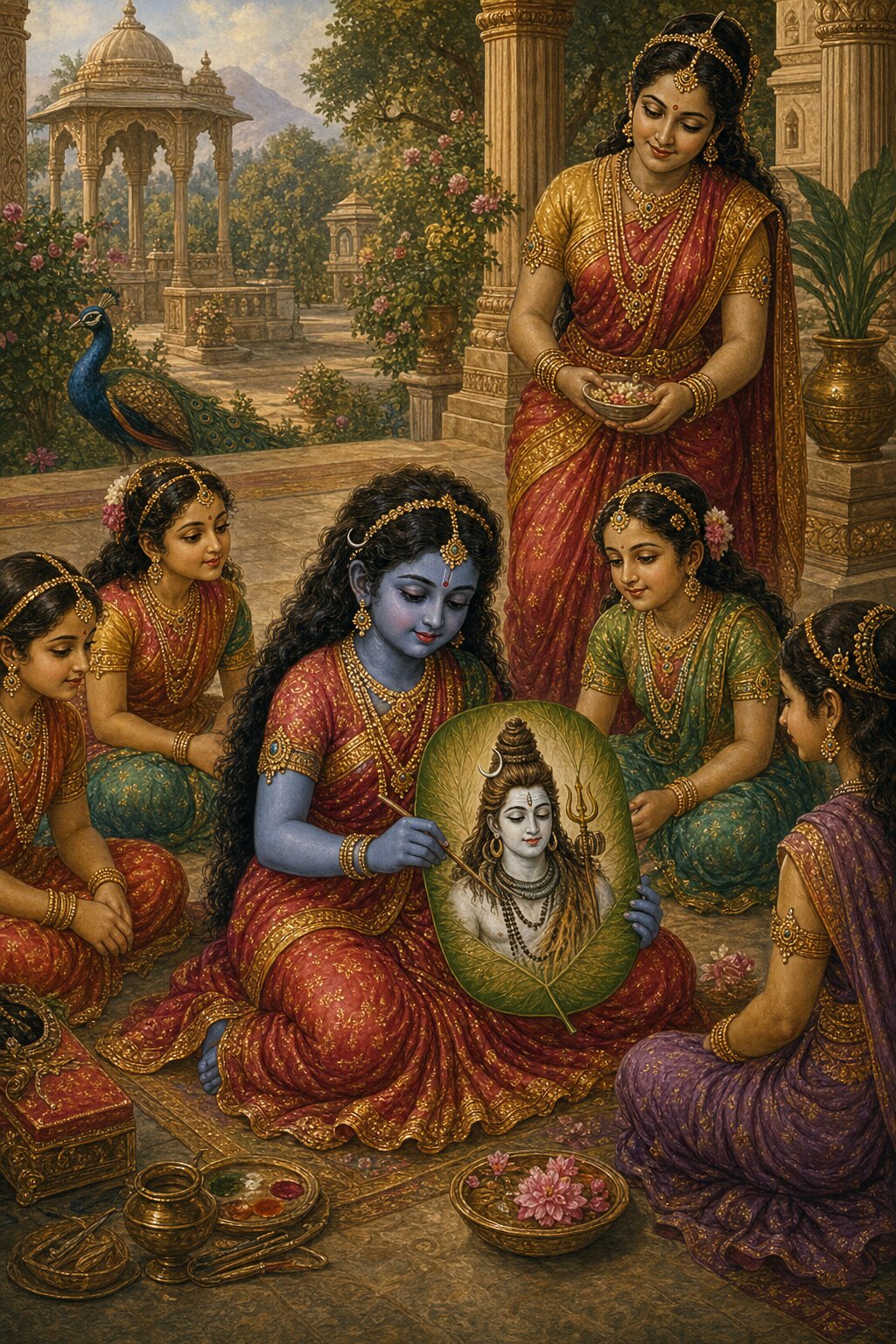
When the girl reached the threshold of youth, a worry took hold of Daksha: how could a marriage with Mahadev ever be arranged? Sati, for her part, wanted Mahadev alone as her husband, and the wanting grew in her every day. With her mother’s permission she began, at home, the severe observance of the Nanda-vrata: offerings of rice with jaggery and salt on the Nanda days in the month of Ashwin, sweet malpua cakes in Kartik, barley and sesame in the dark half of Margashirsha, night-long vigils through the nights of Paush, worship on the riverbank at the full moon of Magh in clothes still wet from the water, bilva leaves offered every third hour through a sleepless night of Phalguna, a black cloth and brihati flowers in Ashadha, a whole month lived on nothing that did not come from a cow. So the devotion ran through all twelve months, and Sati held so still in meditation that she was like the flame of a lamp in a windless place.
Brahma and Vishnu’s Petition on Kailash
In those very days, Brahma and Vishnu, together with the gods and the rishis, came to witness Sati’s austerities, and they halted where they stood; she seemed to be austerity itself made flesh, and she had gone as far in as the enlightened seers go. Having bowed to the goddess, and having praised what she was doing, and having been frankly astonished by it, they all reached Kailash, praised Shiva, and then stood in silence. Shankara, well pleased, laughed aloud and said, “Set aside your fear and tell me the purpose of your coming.”
Brahma opened the matter. “God of gods, creation is mine to perform, preservation belongs to Shri Hari, and you have appeared for the work of dissolution. We three are portions of one Supreme Self: Shri Hari came forth from the left side, I from the right, and you from the heart of Sadashiva; our real form is one, and only the work divides us, and only illusion makes the division look like three bodies. Lord, there are demons to be killed. Some are mine to kill and some are Vishnu’s, and some can be killed by no one but a son of your own body; and until they are gone, no world of ours can be made or held or laid down in peace. You will not kill them yourself, being merciful and beyond liking and disliking and sunk in your yoga. It was you yourself who declared that your highest form would emerge from our brow, take the name Rudra, and by marrying a woman accomplish the good of the worlds. Lord, fulfill that very vow. As Lakshmi and Savitri became partners in dharma, so may you too take a companion.”
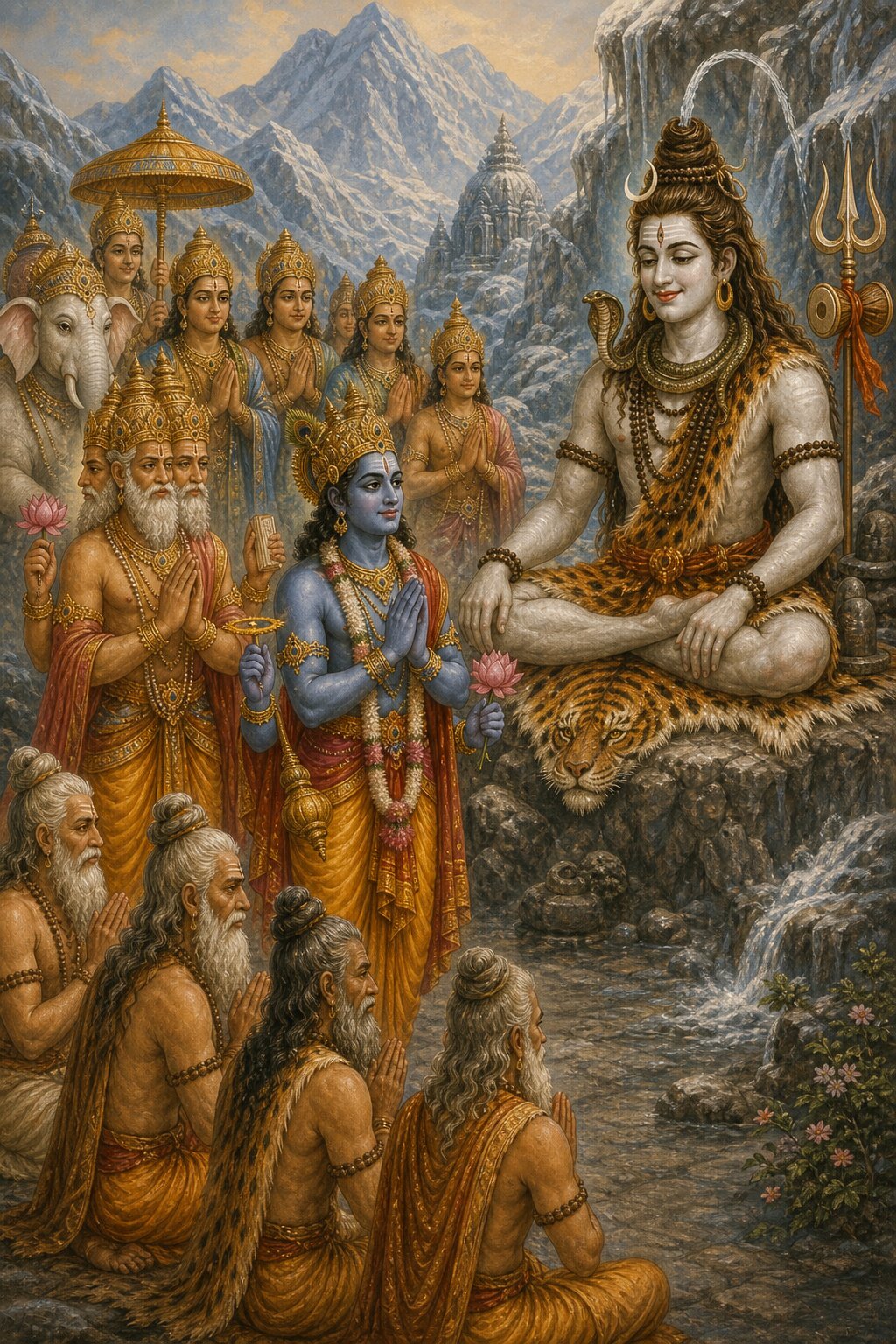
Mahadev smiled and answered, “Marriage is not fitting for me. I am a yogi turned away from the world. What use has a woman to one who delights in the self, a naked ascetic, a knower, empty of desire, and unclean and inauspicious into the bargain? Marriage means being tied into another’s bondage, and only a man with no knowledge in him makes much of it and goes looking for it. Even so, nothing I do is done for myself, and for the good of the world I will honor your word and marry, but I will take as wife only that woman who can bear my splendor, who stays a yogini while I am in yoga and a passionate lover in the hour of love. When I go into that meditation on my own imperishable form, let her not be the one who breaks it. And if she comes to distrust me or my words, I will forsake her.”
Brahma and Shri Hari smiled to themselves. Brahma said, “Lord, such a woman has already appeared. It is Uma, the wedded consort of Sadashiva, who takes one form after another. As Lakshmi she became the beloved of Shri Vishnu; as Sarasvati, mine; and now, as Sati the daughter of Daksha, she is performing severe austerities for your sake, unshakable in her rites, wanting you and no one else. Grant her a boon and marry her. This is what Vishnu wishes, and the gods, and I; let us all see the wedding, and let every sickness in the three worlds go out like a lamp.” Madhusudana gave his assent, and Shiva laughed and said, “Very well. So it shall be.”
Ask a Boon, Ask a Boon
Meanwhile, on the eighth day of Ashwin the Nanda-vrata was completed, and on the ninth Shiva gave his direct darshan to Sati, still deep in meditation. Fair of complexion, five faces, three eyes in each face, the moon and the Ganga upon his head, the blue mark at his throat, in his hands the trident and the gestures of boon-giving and fearlessness, his body glowing with sacred ash; his face carried the brightness of ten million moons and the whole of him the beauty of ten million Kamadevas, and there was not a woman alive he would not have drawn. Sati bowed to his feet, and her face bent low with shyness.
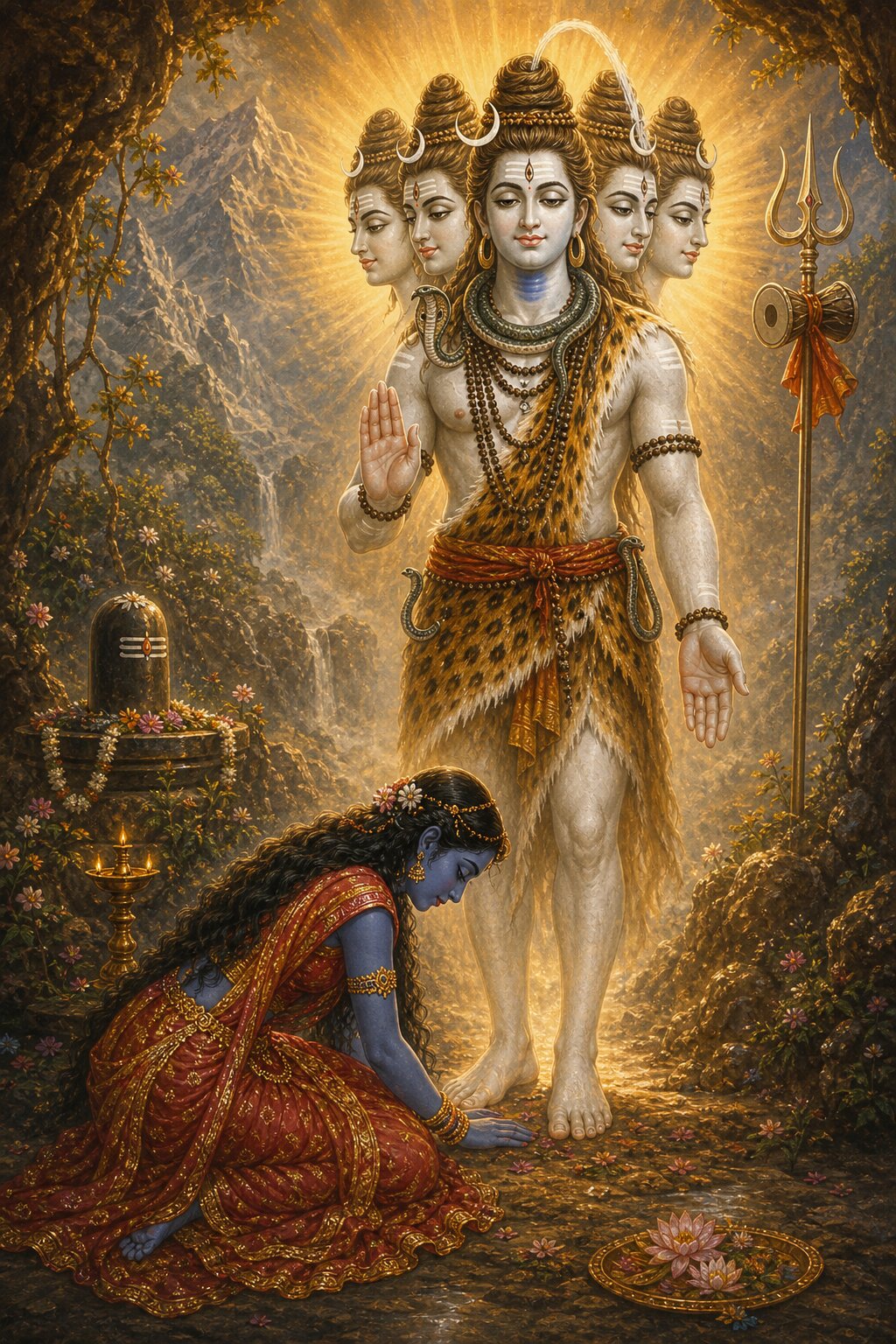
Mahadev said, “Daughter of Daksha, I am pleased with your vow. Ask for any boon.” He knew already what she wanted. He asked because he wanted to hear her say it. The wish of her heart, held back by shyness, would not travel as far as her lips, and so the knower of every heart began pressing her eagerly, over and over, “Ask a boon, ask a boon.” Sati said only this: “Lord, grant me a boon that cannot be turned aside, the boon I want, or the bridegroom I want.” She never got to the end of it. Shankara cut across her and declared, “Goddess, become my wife.” She stood there smiling and said nothing, and everything she was not saying showed anyway, and the rasa of love came into them both. Then Sati folded her hands and said, “God of gods, speak to my father and take my hand by the rites of marriage.” Shiva accepted this too, and Sati, brimming with joy, returned to her mother.
Now see the play: he who had called marriage a bondage went back to his own hermitage on the ridges of the Himalaya, tried to meditate, and could not do it easily, because the ache of her absence kept getting in the way. At the mere thought of him, Brahma appeared, Sarasvati at his side. Shiva said, “I have accepted the daughter of Daksha as my wife, but she insists that the marriage be sealed by proper rite. Go to Daksha’s house and so contrive it that he gives me his daughter in marriage without delay.”
Meanwhile, when the news of the boon reached Daksha’s house from the lips of a companion, a celebration broke out, and Mother Virini kissed her daughter’s brow. But the Prajapati fell into worry: Mahadev had gone away, so how would he come, and if even upon request he should decline to accept her, the whole appeal would come to nothing. Just then Brahma arrived without warning and said, “Shankara has sent me himself for your daughter. As Sati once worshiped him, so now he worships her. Hand your daughter into his service at once. Narada and I will bring him to your house.” Daksha said, “Father, so it shall be,” and a contentment settled over both sides as though nectar had rained down.
The Wedding Procession of Chaitra Shukla Trayodashi
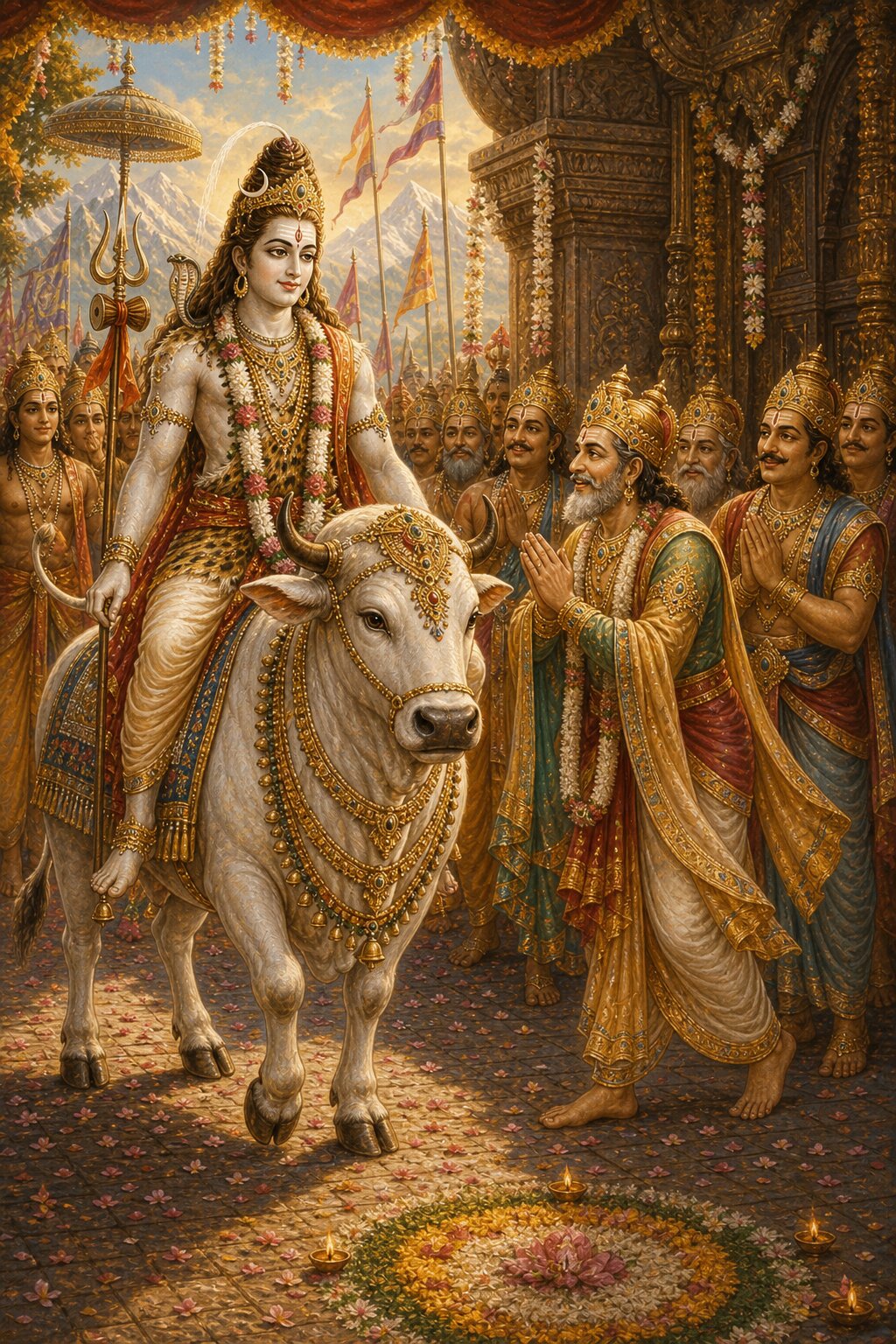
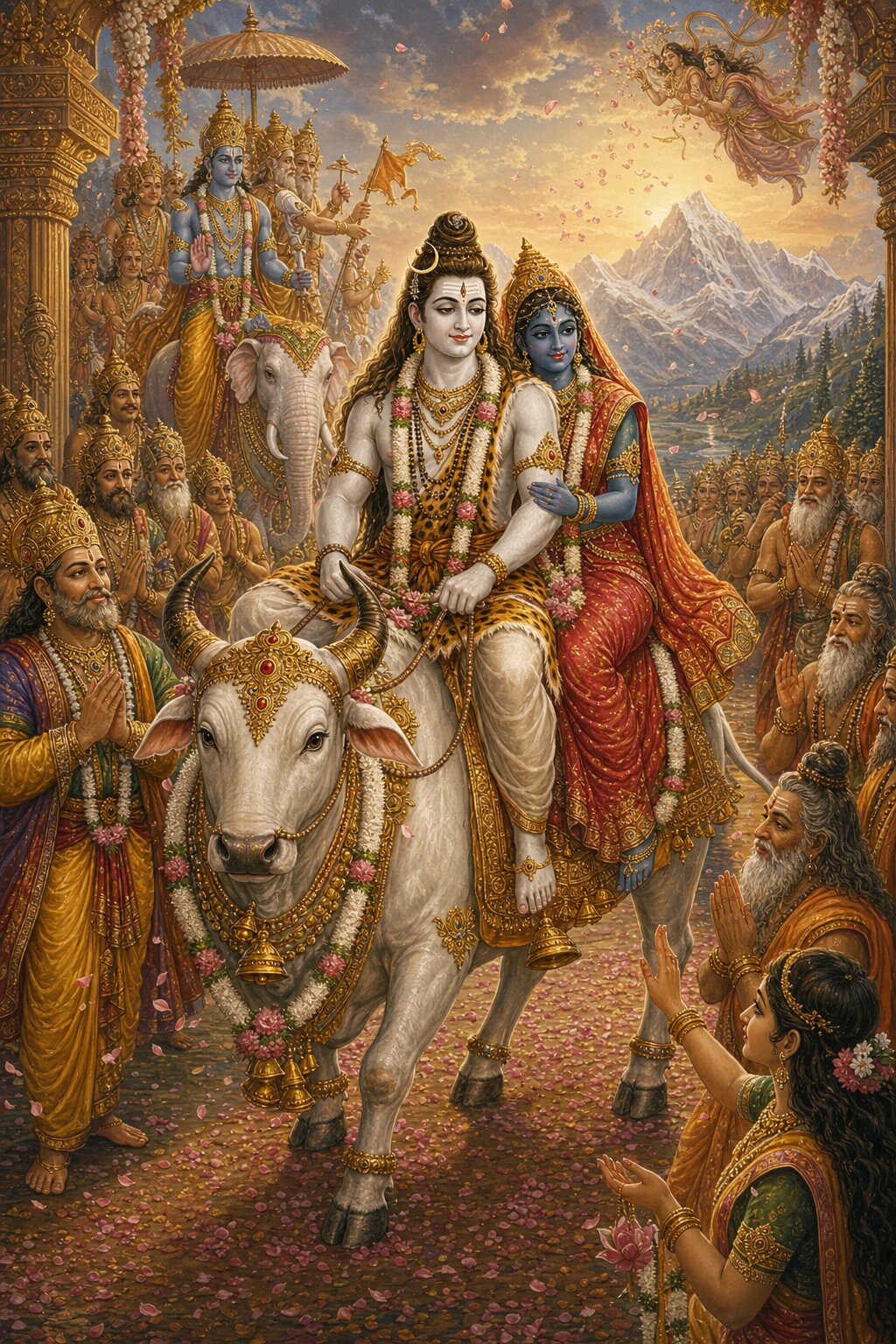
Brahma returned to Kailash and said, “Bearer of the bull, Daksha says this girl was born for Shiva alone. Let him come at an auspicious hour.” Rudra laughed. “I will travel with you and Narada. Summon Marichi and the other mind-born sons; my attendants will come as well.” All of them assembled, and Vishnu too arrived on Garuda with the goddess Kamala and his whole army behind him. On the thirteenth day of the bright half of Chaitra, under the Purva-phalguni star, Maheshvara set out on the wedding journey, with Brahma and Vishnu leading and the sages walking alongside, and the gods and the ganas made a festival of every mile of the road. By his own will the bull, the tiger-skin, the serpent, the matted locks, and the crescent of the moon all turned into fitting ornaments, and Mahadev, mounted upon Nandikeshvara, reached Daksha’s gate in a single moment.
The humble Daksha came out with his kinsfolk to receive them, every limb thrilling with joy. After the welcome, and after circling the gods along with the sages, he led Shiva inside, gave him the finest seat in the house, worshiped him and then Vishnu, Brahma, the Brahmins, and Shiva’s attendants, and announced the marriage agreement before the assembled sages. Then he knelt and said to Father Brahma, “Lord, let it be you who conducts the marriage rite.” At the auspicious hour, with the stars in their conjunction and the planets standing where they should stand, Daksha placed Sati’s hand in Shankara’s hand, and the Bearer of the bull took it by the rites of marriage. Praises rang out, a festival of dance and song arose, Daksha found his life fulfilled in the giving of his daughter, and the whole world became a dwelling place of blessing.
The Circling of the Fire and a Singular Dakshina
Then Daksha gave the dowry and distributed wealth among the Brahmins. Vishnu, with Lakshmi, folded his hands and said, “God of gods, you are the father of the world, and the goddess Sati its mother. The old books say you come down into the world in play, to hold up the good and put down the wicked.” And with a smile he added, “It is a rare coincidence: Sati is dark and you are fair, while I am dark and Lakshmi is fair. The two of you standing beside the two of us make a fine thing to look at.”
Then, at the bidding of Brahma, now the officiating acharya, and of the Brahmins, Shivaa and Shiva circled the fire with great joy, exactly as the rite required and exactly as the Grihya Sutras lay it down. In that same pavilion, at Shiva’s command, Vishnu spoke the truth of Shiva: that Brahma, Vishnu, and Rudra are portions of one Supreme Self, as the head and the neck are not separate from the body. “You alone are the formless Brahman, you alone the Brahman with form, you alone are everything.”
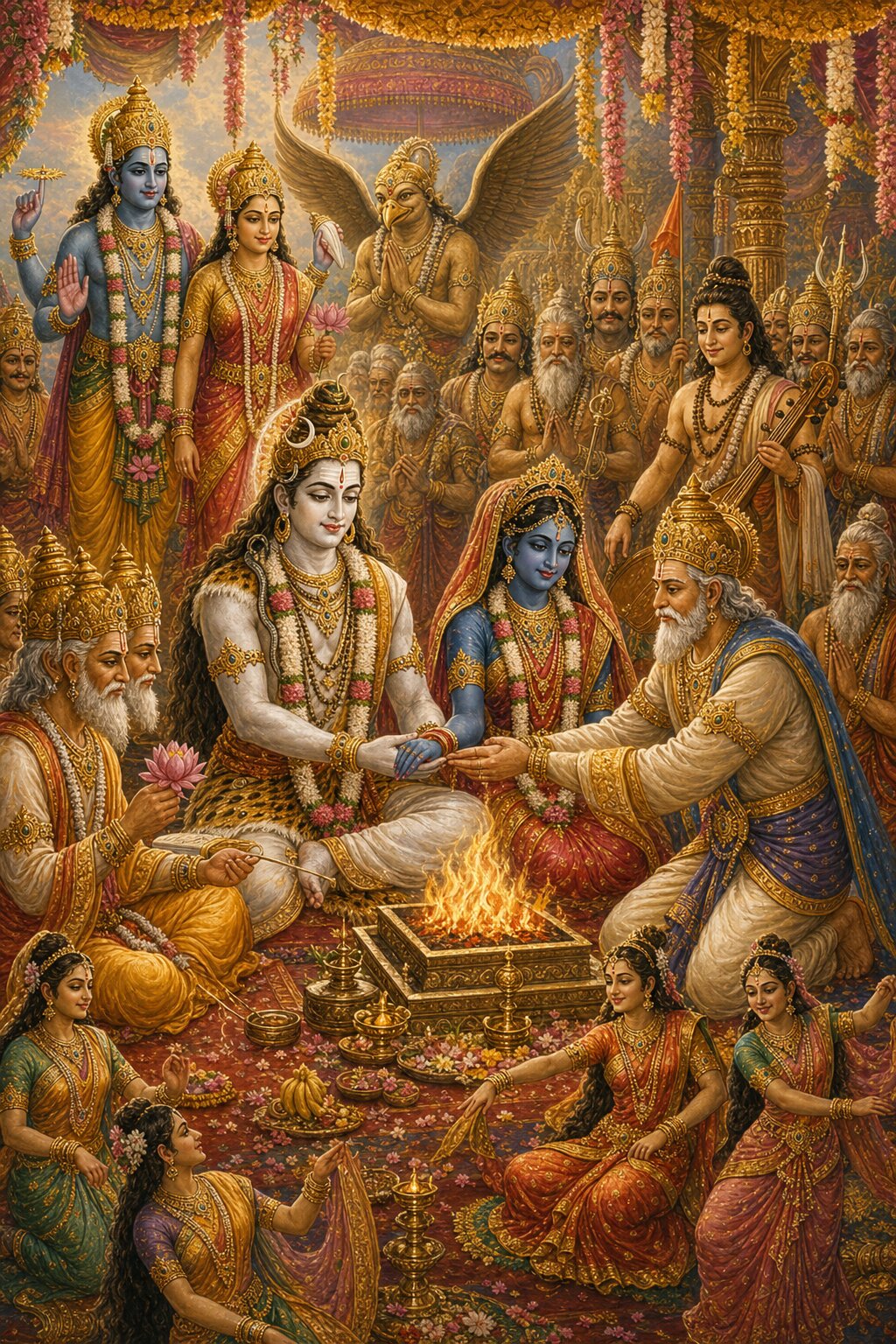
Then Shiva, the patron of the wedding sacrifice, well pleased, said to Brahma, “You are my acharya. Ask. What fee shall I give? Nothing is beyond my giving.” Brahma asked, “Lord of gods, remain forever in this very form upon this very altar, so that sin may be washed away by darshan alone. And whoever comes here in devotion on the thirteenth of the bright half of Chaitra, under Purva-phalguni, on a Sunday, let that person’s sins and diseases fall away, and let even an unfortunate, barren, one-eyed, or plain woman be made whole.” Shiva said, “Ordainer, so it shall be,” and, bringing forth a partial image of himself together with his wife, he took his seat forever in the midst of the altar.
The hour of farewell arrived. Shiva seated Sati on the back of the bull, mounted himself, and set off toward the Himalaya. Dark-blue Sati, with her lovely laughter, shone beside the fair Shiva like a line of blue across the moon; the gods and the great sages stood spellbound, and Daksha too was entranced. Partway along the road Shiva sent Daksha back, and Shambhu, with Sati, reached Kailash and began to roam the peaks of the Himalaya with the beloved of his life.
The First Teaching on the Peak of the Himalaya
Year followed year. One day, in solitude, Sati folded her hands and said, “God of gods, ocean of compassion, I am blessed to have become your beloved, and you became my husband for no reason except that you love the ones who love you. Many years of these wanderings have contented me, and now my mind has turned away from them. Tell me that supreme truth by which a soul is freed, without effort, from the sorrow of the world, and the means as well by which even a soul lost in the senses may reach the highest state.”
She asked it for the sake of everyone who would ever need the answer. Hearing the question, Shiva was pleased and said, “Goddess, know vijnana, deep realization, as the supreme truth itself. Vijnana is that whose dawning brings the firm certainty, ‘I am Brahman,’ after which nothing but Brahman remains in the memory. This vijnana is hard to win, its knower is rare, and it is forever my own true nature, the supreme Brahman beyond the beyond made manifest. The mother of that vijnana is devotion to me, which grants both enjoyment and moksha, and it comes by my grace and by nothing else. Between bhakti and knowledge there is no difference, and one who opposes bhakti never attains knowledge at all. I remain forever under the sway of my devotees; by the power of their bhakti I go even into the houses of those thought lowly.”
“Bhakti is of two kinds, with form and without form, and it divides again into the observed and the natural, the greater and the lesser, and the highest is the one that springs from the heart’s own natural love. The sages have named its nine limbs: hearing, chanting, remembrance, service, servitude, worship, salutation, friendship, and self-surrender. To drink the nectar of the story through the ears is hearing; to sing the Lord’s deeds is chanting; to know him present everywhere and so live without fear is remembrance; to give him the day from first light, with mind and speech and hands and feet, is service; to lay the sixteen offerings before him according to what you have is worship; to trust that whatever the Lord does is for good alone is friendship; and to give even the body over to him is self-surrender. This bhakti is the mother of knowledge and dispassion, liberation is its handmaid, and in all four ages there is no path so full of joy as this, and in Kali-yuga above all.”
So the story that began with a small girl’s drawings crossed the fire of the wedding rounds and came to rest upon knowledge. Suta says that whoever hears this story at the start of a wedding or any auspicious undertaking will see it completed without obstacle, and any girl who is given in marriage after hearing it will be rich in happiness and good fortune.
Source: Shiva Purana (Gita Press, Sankshipta Shivapurananka), Rudra Samhita (Sati Khanda)
This Same Story, Elsewhere
- Daksha and Sati
Shrimad Bhagavatam (Skanda 4): Daksha and Sati - The Sacrifice of Daksha and the Burning of Sati
Shiva Purana: The Sacrifice of Daksha and the Burning of Sati