On this page
One day Lord Shiva was riding his bull across the ocean-girt earth with the goddess Sati at his side, and their wandering brought them into the tangled forest of Dandakaranya. He was showing her the country as they went, pointing out this beauty and that in the woods around them, and in the middle of that easy hour they came to the stretch of woodland where Rama was roaming with his brother Lakshmana. Ravana had carried off Rama’s beloved wife Sita by a trick, and Rama searched from grove to grove, crying out “Ah, Sita!”, turning his gaze this way and that, weeping again and again, his whole mind bent on getting her back. The planets had turned against him, Mars and the rest, and he had gone past caring who saw his grief. The radiance of that brave son of Dasharatha, born into the solar dynasty and elder brother of Bharata, had faded under the sorrow of separation.
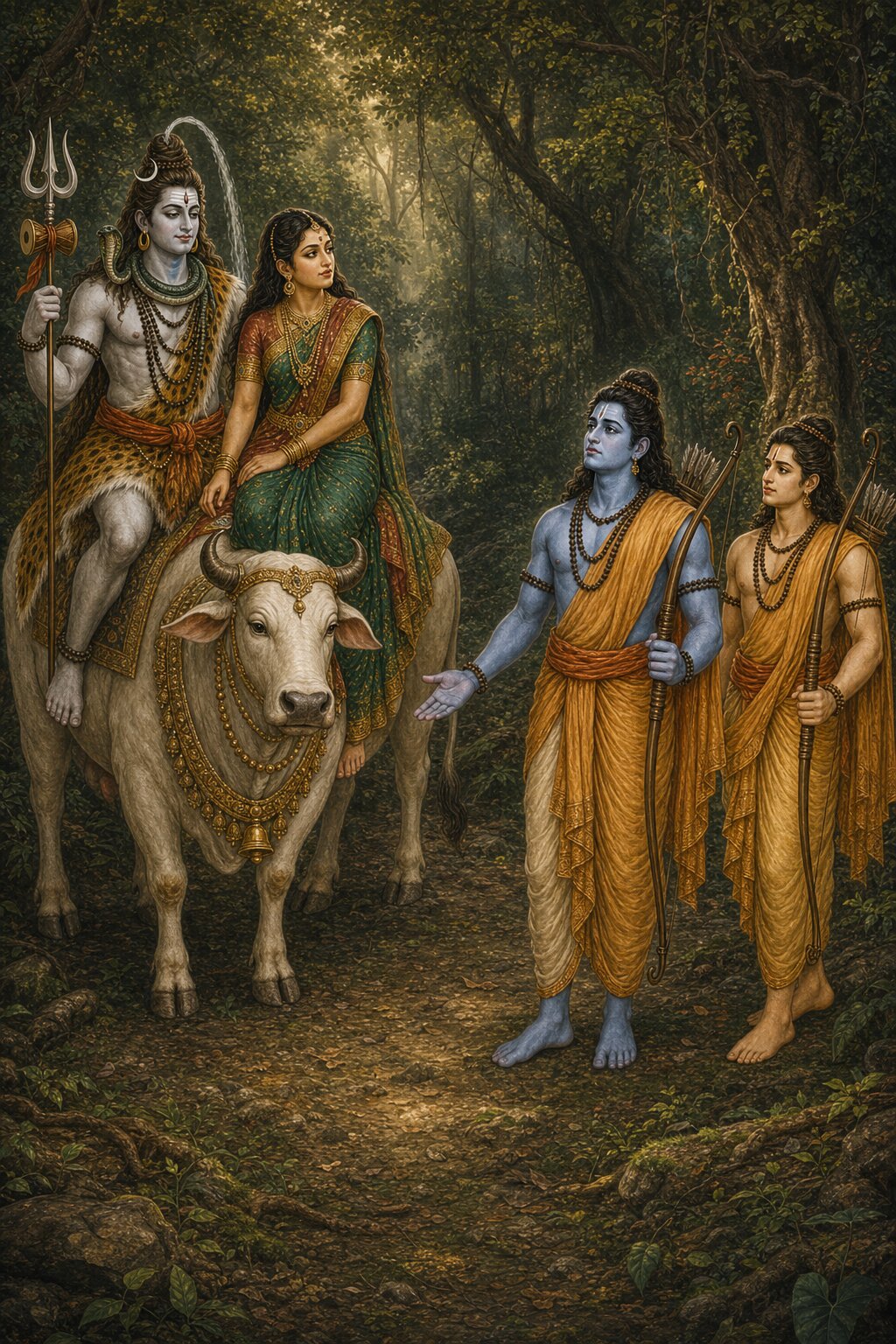
The moment the great-hearted Lord Shankara saw that forest dweller, worn and forlorn as he seemed, wandering with his brother and in need of a favor, his heart brimmed with joy. Shankara is Purnakama, the one in whom no wish is left unfilled, and still he bowed. With deep gladness he bowed to Rama, raised a cry of victory in his honor, and then turned to go his own way. Shiva, tender toward his devotees, did not reveal himself to Rama there in the forest. Yet what had just happened sent a wave of astonishment through Sati’s mind, and a charmingly strange sport it was.
Sati’s Doubt
Sati spoke. “God of gods, supreme Brahman, highest Lord! Brahma, Vishnu, and all the other gods serve you always. You are worthy of being served and bowed to, the one the whole world should meditate on and no other, the one nobody arrives at except by the hardest labor the mind can do, and you do not decay. Then who, my lord, are these two archers, wandering the forest in the anguish of loss, brought so low? Heroes with bows in their hands, and look at the state of them. The elder of the two is dark as a blue lotus. Why did the sight of him drown you in joy, and why did you carry yourself before him like any devotee? My lord, that a master worthy of worship should kneel at the feet of his own servant does not seem fitting. Hear this doubt of mine and clear it away.” It was the primordial Shakti herself who was asking, and Shiva’s own illusion had her.
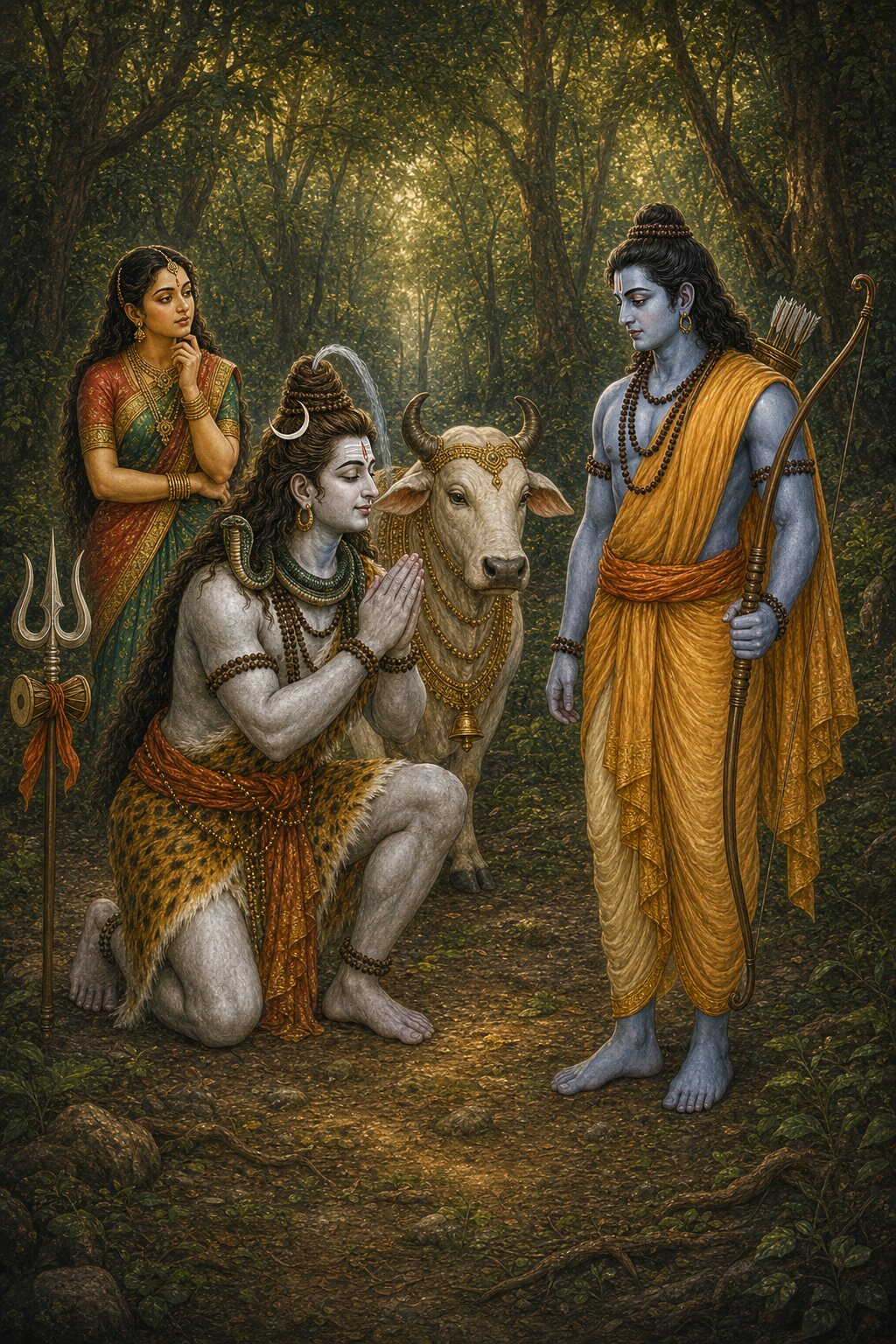
Hearing this question, Shankara, master of every divine play, laughed and said, “Listen, Devi, and listen gladly. I speak the truth, and there is no deception in it. It was by the power of a boon that I bowed to them with such reverence, and it was I who granted that boon. These are two brothers, Rama and Lakshmana, the heroic and learned sons of Dasharatha, born into the solar dynasty. The younger, fair of complexion, is Lakshmana, a portion of Shesha himself; and the elder brother is Rama. In his form, Lord Vishnu has appeared in his full and undivided measure, and there is no power anywhere that can trouble him. They have descended to this earth to protect the righteous and for the welfare of us all.”
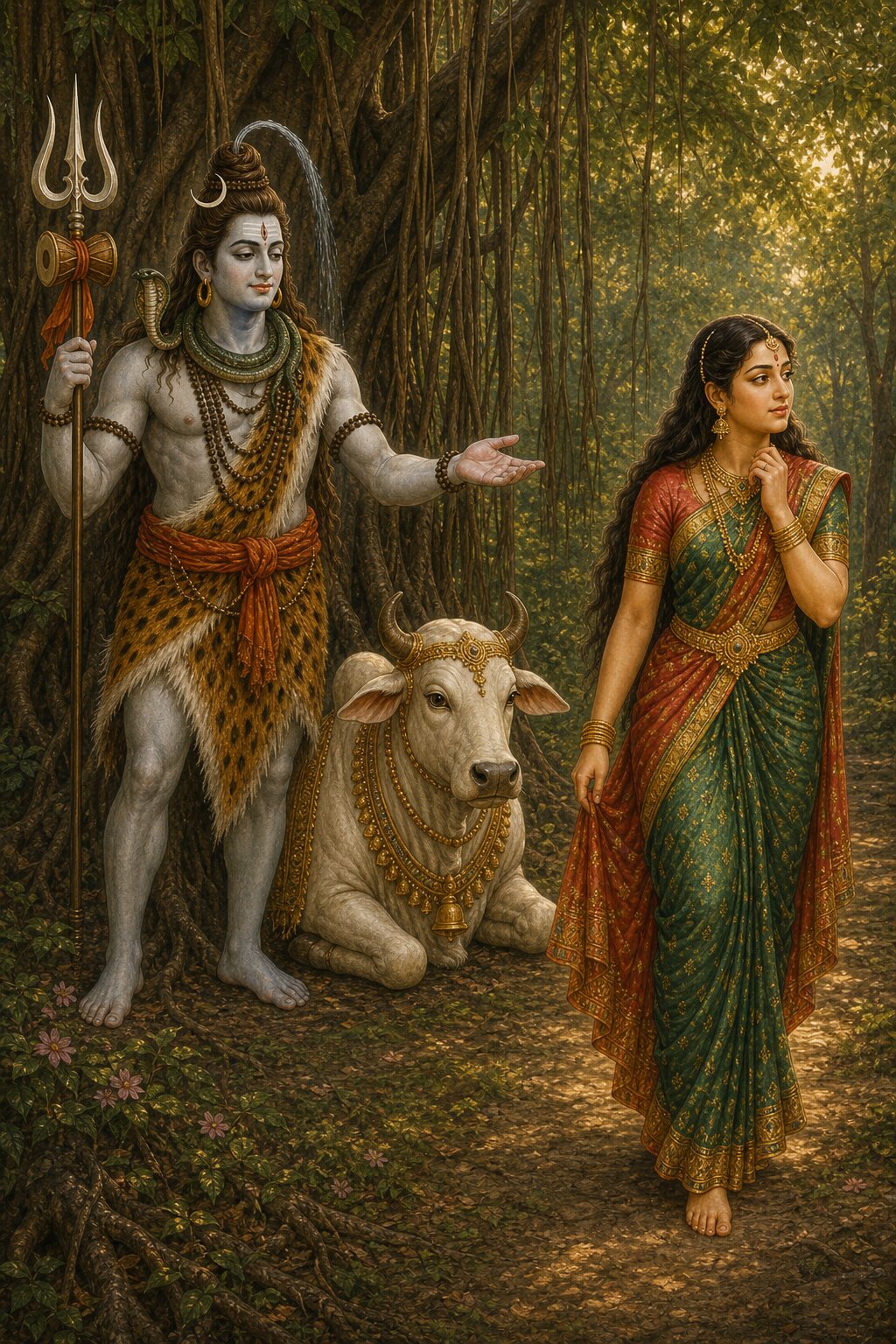
Having said this, Shambhu, who brings prosperity to those who hold to him, fell silent. Yet even after hearing Shiva’s words, no conviction settled in Sati’s heart; the maya of Shiva is truly mighty, and it casts the whole of the three worlds into delusion, so it had no trouble at all with one goddess standing in a forest. Sensing that her mind had not turned, the eternal Shambhu, who knows his own sports the way a player knows the board, spoke again. “Devi, if my word does not persuade you, then go yourself and put Rama to the test by your own judgment. Do whatever will lift this delusion of yours, and take as long as it takes. Until then, I will wait here beneath this banyan tree.”
Sita’s Form
Having received Shiva’s leave, Sati set out, turning a plan over in her mind as she walked. “How shall I test this Rama who wanders the woods? Very well. I will take on Sita’s form and go to him. If Rama is truly Vishnu himself, he will know everything, and and he will know it the instant he looks at me; if not, he will fail to recognize me, and the matter is settled.” With this thought she assumed the form of Sita and drew near to Rama. The truth was that she herself had already fallen into delusion, and the test she had built was going to work exactly as she had built it.
The instant he saw Sati standing before him in Sita’s form, Rama, joy of the Raghu line, spoke the name of Shiva under his breath, and with that name on his lips he understood everything and laughed. Smiling still, he bowed to her and said, “Sati, my salutations to you. Tell me kindly, where has Lord Shambhu gone? How have you come alone into this forest without your husband? And for what reason have you set aside your own form to take on this new one? Take pity on me and tell me the cause.”
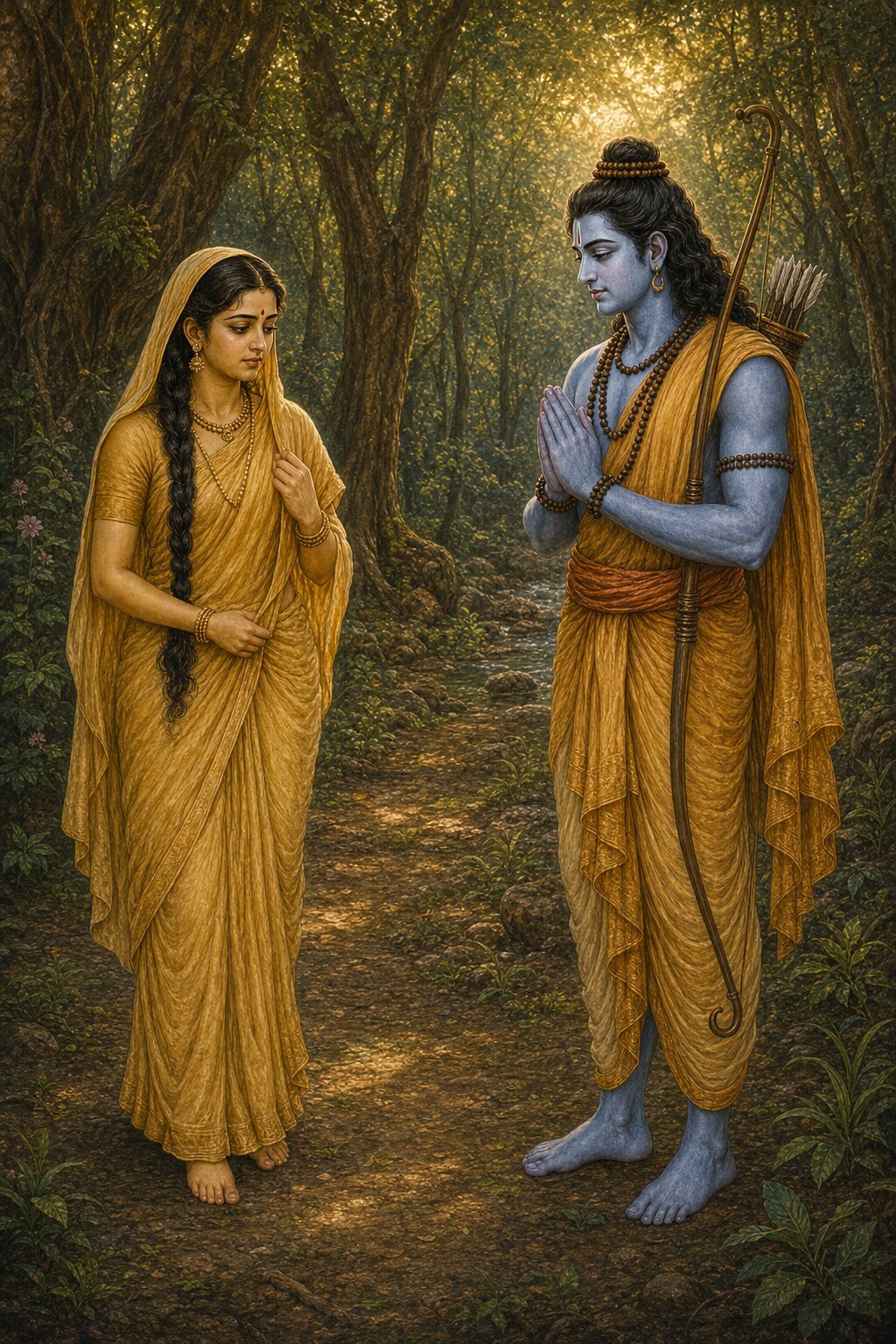
At Rama’s words Sati stood speechless. Shiva’s own words came back to her, and the moment their truth dawned on her she was overcome with shame. Knowing Rama to be Vishnu himself, she let her true form appear, meditated inwardly on the feet of Shiva, and spoke with a glad heart. “Joy of the Raghus! The self-sovereign supreme Lord Shiva had come into this forest with his attendants, wandering the earth with me at his side. Here he saw you, given over to the search for Sita, Lakshmana beside you and the loss of her tearing at you, and he came and bowed to you and sang the glory of your Vaishnava form. He has looked on the four-armed Vishnu, my lord, and the joy that gave him was smaller than the joy this plain, unadorned form of yours gave him just now. It was this that raised a confusion in my mind, and, with his leave, I put you to the test. Now I know your Vishnuhood; I have seen your lordship over everything; I am free of doubt. But one doubt remains, lord of the Raghavas; clear that away too. How have you come to be worthy of worship even to Lord Shiva? Tell me the truth of it and set me free, and be glad yourself.”
The Story of Goloka
At these words of Sati, Rama’s eyes opened wide and bright as blossoming lotuses. Inwardly he called to mind his lord Shiva, and a flood of love welled up in his heart and rose until it had to go somewhere. Because he had not been given her leave, he did not go with Sati to Shiva; but, praising Shiva’s glory within his heart, he began to speak to her.
“Devi, this is a tale of ancient times. Once, in his supreme abode, Lord Shambhu had Vishvakarma raise a lovely hall within his cattle-yard and fashion a magnificent throne there. He summoned Indra and the other gods, the sages, the Vedas, and the guardians of the worlds; sixteen maidens each from among the gods, the sages, the Siddhas, and the serpents were brought for the rite; he set a great festival in motion to the sound of the vina and the mridanga; and he gathered every article a royal consecration asks for, down to five pots filled with the waters of every holy river that flows. He had the Vedic mantras chanted aloud. Then Maheshvara, delighted by Vishnu’s devotion, called Hari from Vaikuntha with a heart full of affection, seated him on that throne at an auspicious hour, adorned him with his own hands, fixed the coronet on his head and tied the sacred thread at his waist, and consecrated him in the Cosmic Hall. What was his own, and not his to give away, he gave.
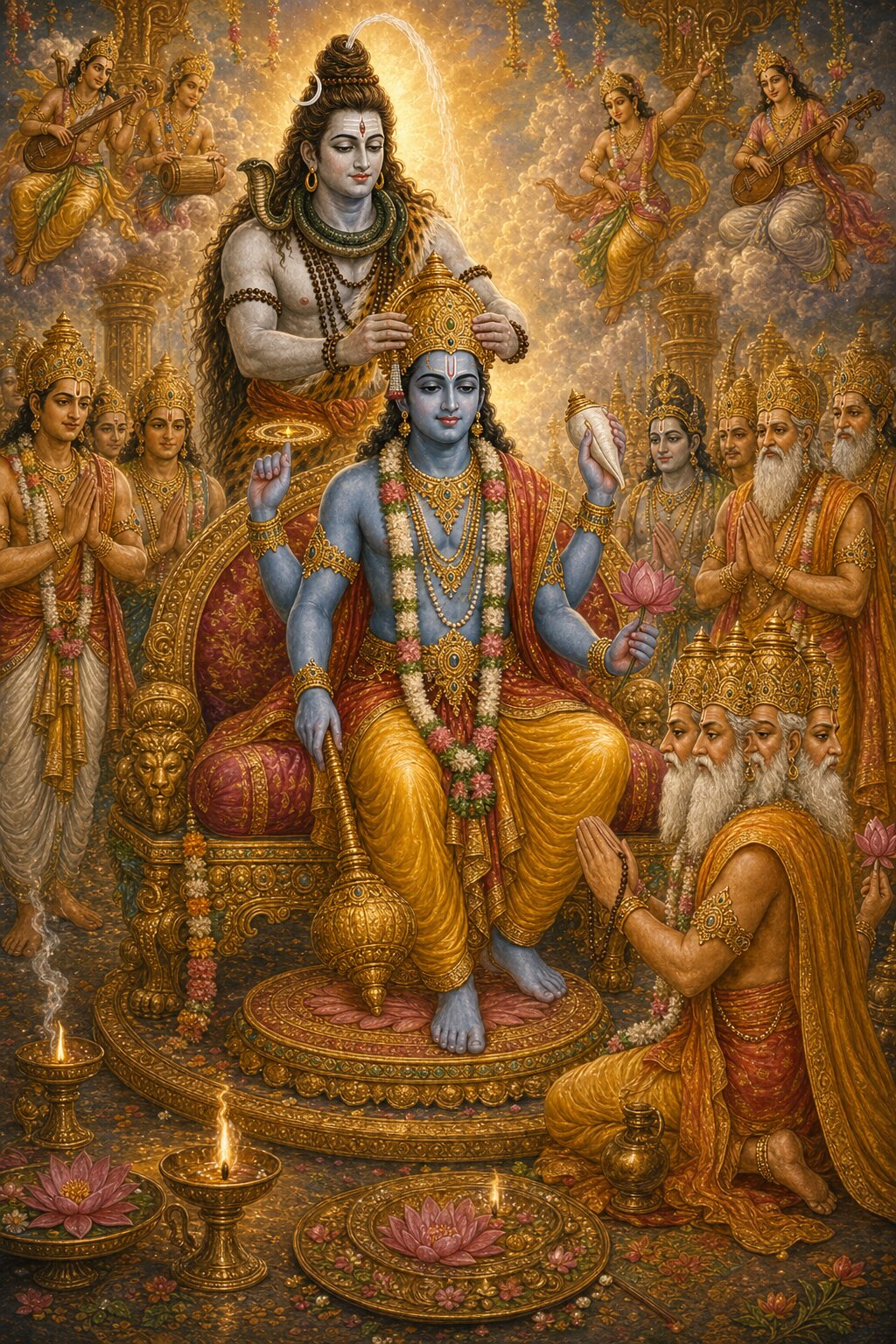
“Seeing Vishnu’s devotion in this way, the delighted Shambhu, making plain everywhere how he yields himself to his devotees, said to Brahma, ‘From this day, by my command, this Vishnu, this Hari, has himself become worthy of my worship. You, together with all the gods, bow to him, and let the Vedas describe him as they describe me.’ So saying, Rudra himself bowed to Hari, and then Brahma and the other gods worshiped him too. Then Maheshvara granted him great boons. ‘By my command, be the maker, sustainer, and destroyer of all the worlds. Be the one who gives men dharma and wealth and love, and the one who curbs those bent on evil. Be lord of the universe and worthy of its worship, be strong and brave, and never be defeated in battle anywhere, not even by me. Receive from me these three powers: the fulfillment of every wish, the unfolding of divine play, and eternal freedom throughout the three worlds. Whoever hates you I will curb myself, sparing no effort; and whoever loves you, it is I who will hand him salvation. Take this maya as well, which no god can stand against, by which the whole universe is deluded and turned senseless. You are my left arm, and the Creator my right. That most luminous place of yours in my abode of pure consciousness will be renowned by the name of Goloka. Your incarnations upon the earth will be the protectors of all and my own devotees; I will see every one of them and be delighted by your devotion to me, and I will surely grant them my darshan, and they will remain forever glad of my boon.’
“Having thus entrusted to Hari a sovereignty whole and undivided, Shiva went to roam freely on Kailasa with his attendants. From that time the Lord of Lakshmi took on the guise of a cowherd, came there, and, as master of the cowherds, the cowherd women, and the cattle, began to protect the world; and at Shiva’s bidding he has protected it ever since, taking one incarnation after another. At this very time, by Shankara’s command, Hari has descended in the form of four brothers. I, Rama, am the eldest among them; the second is Bharata, the third Lakshmana, and the fourth Shatrughna. By my father’s command I came to the forest, and misfortune found me here: a night-roaming demon carried off my wife Sita, and I wander after her now, cut off from her and from my own people. Mother Sati, having had the fortune of seeing you, there is no doubt left that it will end well for me. By your grace I will be granted the finding of Sita; I will slay that wicked demon who is the cause of all of it and win her back. And the man on whom the two of you show mercy is the most blessed man alive.”
Having said this, Rama bowed to Sati in every way a man can bow and, with her leave, went off to wander through the forest. Hearing those words of Raghunatha, Sati was glad, and in her heart she praised him for the devotion to Shiva that was in them; yet the memory of what she herself had done filled her with sorrow. She had not accepted Lord Shiva’s word. She had let a senseless suspicion take hold against Rama. And now: “What answer will I give Shankara, when I go back to him?” She turned it over the whole way, repenting in a dozen directions, and she came back to Shiva pale in the face and gloomy in spirit.
Shiva’s Renunciation in Thought
Reaching Shiva, Sati bowed to him within her heart. Sorrow shadowed her face; she had grown listless and drained by grief. Seeing her downcast, Lord Shiva asked after her wellbeing and said gently, “How did you carry out the test?” At this Sati bent her head in respect and said nothing. She stood aghast, her mind sunk in grief and gloom. Then Maheshvara, entering meditation, learned her whole conduct: that she had taken on the form of Sita, the wife of the Rama he held worthy of worship. And he remembered the promise he had made long ago in the presence of Vishnu. Shiva, who keeps the bounds of righteousness intact and propounds them, was distressed. He thought it through within himself. If I go on loving Sati at the level I loved her before, he thought, my promise breaks, and it breaks even if I keep every convention of the world. So he renounced Sati in his mind, and the vow held, because the protector of Vedic law does not let it fall. Then he set out toward his home on Kailasa, revealing the promise to no one.
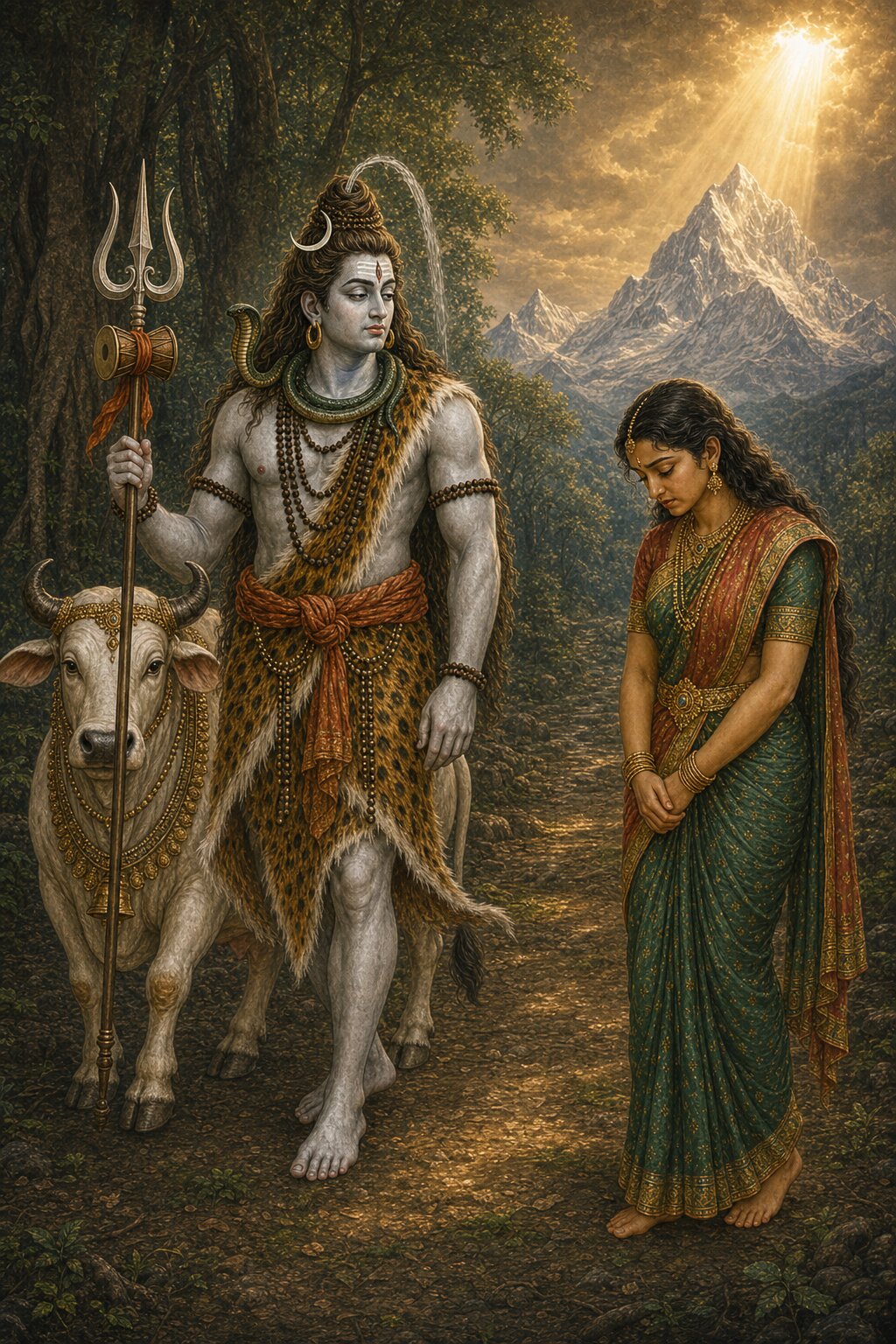
On the way, a voice with no body to it rang out of the sky, pitched for everyone to hear and for Sati above all. “Supreme Lord! Blessed are you, and blessed is this vow of yours. In all three worlds there is no other great yogi and no other great master like you, and there is no one else alive who could hold a promise like that one.” Hearing it, Sati went lustreless, and she asked, “My lord! Our supreme Lord! What vow have you made? Tell me.” But the Lord, who wished only her good, did not disclose the vow he had made before Vishnu long ago. So Sati turned inward and meditated on the beloved of her life, and there she came to know the whole of it for herself, and what it meant, which was the giving up of her own self. “Shambhu has renounced me,” she understood, and the daughter of Daksha sank into grief and sat sighing, and sighing again.
Though he read the feeling in Sati’s heart, Shiva kept his vow secret, and, telling her one story after another the whole way, he brought her along and reached Kailasa. There he seated himself on a fine seat, entered samadhi, and began to meditate on his own true nature. Sati, weighed down by sorrow, went on living in that same abode, and nobody watching the two of them could have guessed what was passing between them. So a long time went by, with the Lord and the Goddess keeping every convention of the world in the bodies they had taken up for it. When Mahadeva at last opened his samadhi, Sati, the mother of the world, came to him as well and, with an aching heart, bowed at his feet. The great-hearted Shambhu gave her a seat before him, told her many delightful stories with great affection, and by such play lifted her grief at once. She grew as happy as before. Even so, Shiva did not give up his vow.
Let no one take this conduct of the supreme Lord Shiva for a marvel. The sages tell the story of Shiva and his consort Shivaa exactly so. Some hold that there was a real separation between the two, but how could separation ever be possible in them? And who is it that knows the true life and conduct of Shivaa and Shiva? They sport of their own accord and compose their own lives, and always have. Shivaa and Shiva are joined to each other as a word and its meaning are; a true parting between them is impossible, and only if the two of them wished it could a separation even be imagined.
Source: Shiva Purana (Gita Press, Sankshipta Shivapurananka), Rudra Samhita (Sati Khanda)
The same story, elsewhere
- Valmiki Ramayana
Valmiki Ramayana: the complete story of Rama - The Rama story in the Bhagavatam
Shrimad Bhagavatam (Canto 9): the story of Rama in brief - How many years did Rama live
Reflection: how many years did Rama live