On this page
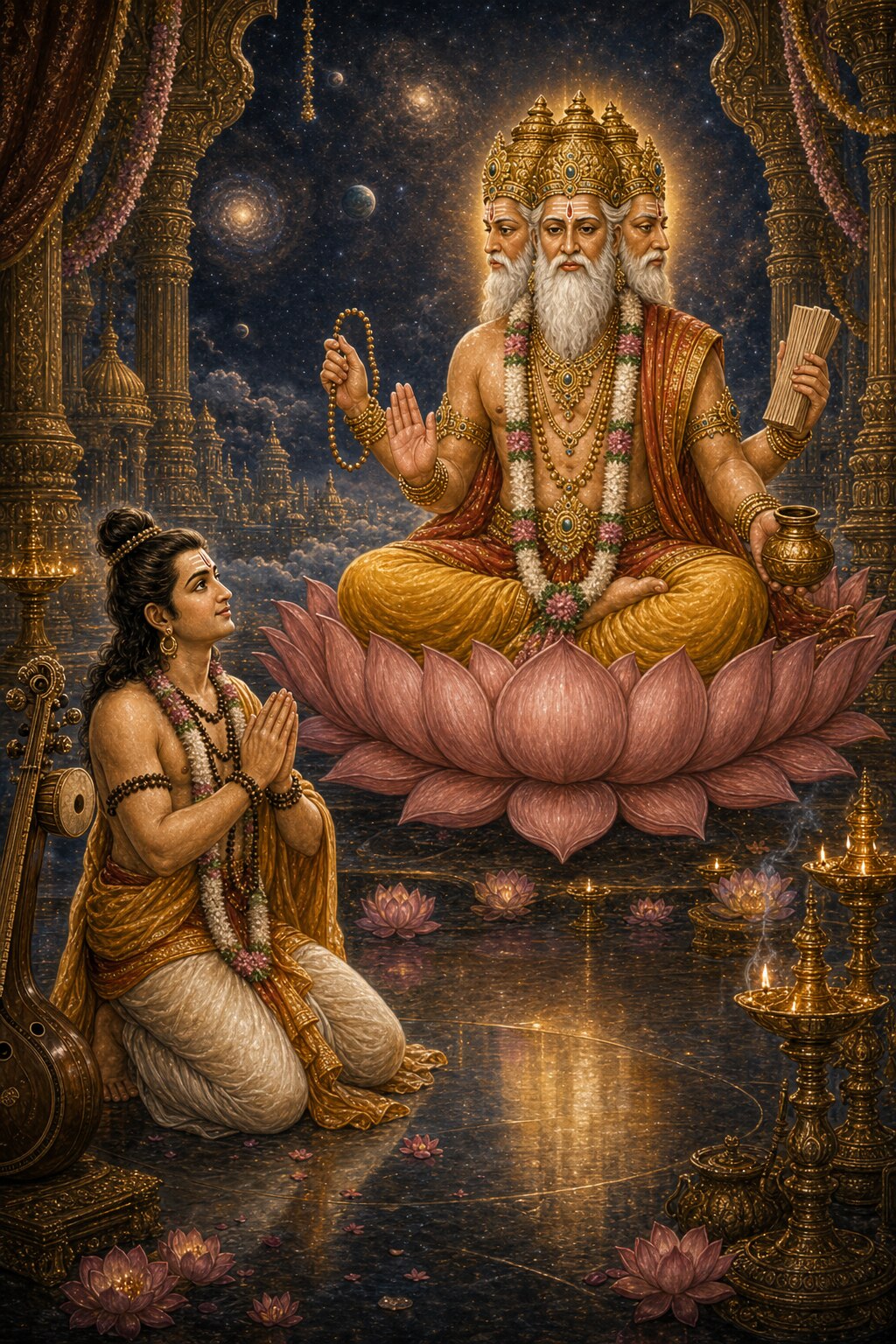
At the end of a long journey, the divine sage Narada arrived in Brahmaloka. He had wandered the earth with his mind steeped in the pleasure of devotion, stopping with love before countless shivalingas, and he had lingered longest in Kashi, the city that outshines every other in holiness and that Shiva never leaves; there he had worshiped Vishvanatha until the worship shook him, and had come away with a single thirst still in him. He bowed to the grandsire Brahma with devotion and said, “My lord, I have come to know the greatness of Lord Vishnu, and I have heard the paths of devotion, of knowledge, of austerity, of the giving of gifts, and of pilgrimage. Yet the knowledge of the essence of Shiva has never reached me. How does the one who holds no attributes come to wear every attribute? Be gracious, and tell me the story of the appearance of Shiva and the Goddess, and of the very form they take.”
Hearing this plea from his son Narada, Brahma, the grandsire of the worlds, grew grave. What Narada asked after had never been fathomed to the bottom by Vishnu, nor by Brahma himself, nor by anyone at all. And he began to speak.
The Darkness of the Great Dissolution
Brahma said, “O divine sage. When the whole of the world had been destroyed, there was darkness everywhere and only darkness. There was no sun, no moon, no planets, and no stars. There was neither day nor night. Fire, earth, wind, and water left no trace, and the directions had lost their faces. Think of a darkness packed so close that a needle pushed into it would not part it, and you have the measure of that hour. In it, the one that the shruti calls by the name Tat Sat Brahma was the single Being that remained. It was neither gross nor frail, and it never grew and it never waned. Speech cannot reach that far. The yogis see it without pause in the sky of their own hearts. That was the truth, the very form of knowledge, endless, formless, without attributes, resting on nothing, the sole cause of the universe, the supreme Brahman.”
The Appearance of Sadashiva and Ambika
“When some time had passed, a resolve arose within that formless Supreme Being to become many out of one. With the power of his own play, he then imagined a form for himself: a form that would go everywhere and hold every form, that would see all and cause all. That form was filled with every splendor, made of all knowledge, and gracious in its nature. And as it was taken, the one without a second, that lit up everything and was itself nothing but pure knowing, passed out of sight. That form of the formless supreme Brahman is Lord Sadashiva. He is the one they call the supreme Person, Ishvara, Shiva, Shambhu, and Maheshvara. He carries the heavenly Ganga upon his crown and the moon upon his brow. He has five faces, and in each face three eyes, and he has ten arms and a trident in his hand. His whole body smeared with sacred ash, he is white as camphor.”
“Alone, Sadashiva created from his own body a Shakti who was his very likeness, one who would never be parted from his limbs, and the making of her took nothing at all from him. She is called the supreme Power, Pradhana, Prakriti, the maya that carries the gunas, and the mother of the principle of intellect. She is also called Ambika, Nitya, and the root cause, and she is the mother of the three gods who will carry the work of the worlds. She has eight arms, and across her face plays the radiance of a thousand moons; her eyes open wide as lotuses in bloom. She is the source of all, and though she is one and alone, by the sway of her own maya she becomes many.”
Anandavana, and Vishnu from the Left Side
“Then that Sadashiva, whose form is time itself, together with his Shakti fashioned a sublime region that they call Shivaloka, or Kashi. It is the seat of the highest liberation, and it rests above all worlds. Its very ground is bliss, for the first lovers of all, who are bliss itself, made that place their perpetual home. Even in the hour of dissolution, when every other place is unmade, Shiva never left it without his nearness, and for this reason the learned call it the Avimukta Kshetra, the place he never abandons. In an earlier time Shiva had given it the name Anandavana, the forest of bliss.”
“One day, as they wandered in that same Anandavana, a wish arose in the minds of Shiva and the Goddess: that another Person should be created as well, one on whom the burden of running creation could be laid, so that the two of them might dwell in Kashi alone and roam as they pleased, keeping for themselves no office but the giving of liberation. Having resolved on this, the Lord Shiva, together with his Shakti, rubbed nectar upon his left side. That nectar had been churned out of the ocean of his own mind, where thoughts rise and fall as the waves, sattva lies on the floor as the jewel, rajas branches through the water as the coral, and tamas moves through it as the crocodile. From that place a Person appeared, the most beautiful in all three worlds. He was calm, filled with the quality of sattva, as deep as the ocean in his gravity, and dark as a sapphire. He bowed to Shiva and said, ‘My lord, settle upon a name for me and tell me my task.’ Shiva laughed in a voice as deep as thunder and said, ‘You are all-pervading, and so your name shall be famous as Vishnu. Hold yourself steady and perform a fine austerity, for that is the means to every accomplishment.’ Saying this, he breathed the knowledge of the Vedas into him, and then, with his Shakti and his attendants, he was gone.”
The Making of the Twenty-Four Principles
“Once the command was given, Vishnu set himself to a severe austerity and held it for twelve thousand divine years, and at the end of them the one thing he wanted, the sight of Shiva that gives everything, had still not come. Doubt began to work in him, and out of the empty sky came the voice of Shiva: perform it again. So he performed it a second time, and the light broke in him. With the labor of it, many streams of water began to flow from his limbs, and that water, which takes the sin off whoever so much as touches it, spread through the whole of the empty sky. Weary, Vishnu lay down to sleep upon that very water, and because he slept upon the water his name became renowned as Narayana. After this, from Prakriti the great principle, mahat, came forth; from mahat came the three gunas; from the gunas the threefold sense of self; from the sense of self the five subtle elements; from the subtle elements the five gross elements; and then the organs of knowledge and the organs of action appeared. In this way twenty-four principles came to be, and apart from the Person, all the rest are inert. Taking those principles into himself, Narayana, by the will of Shiva, slept once more in the water that is Brahman itself.”
Brahma from the Navel Lotus, and the Pillar of Fire
“While Narayana slept upon the water, by the will of Shiva a sublime lotus rose from his navel, a lotus of great size, its stalk running down out of sight without an end, and the whole of it shone like millions of suns. After this, Sadashiva, with Parvati beside him as the half of him, brought me forth from his right side, and having clouded me with his own maya, he set me within the navel lotus of Narayana and made me appear from there. In this way I, Hiranyagarbha, was born from that lotus as a son. I had four faces, the glow of my body was red, and three lines of ash lay across my brow. Clouded by the maya of Shiva, I could not recognize my own father. Who am I, I began to wonder, and where have I come from, and whose son am I, and who has fashioned me?”
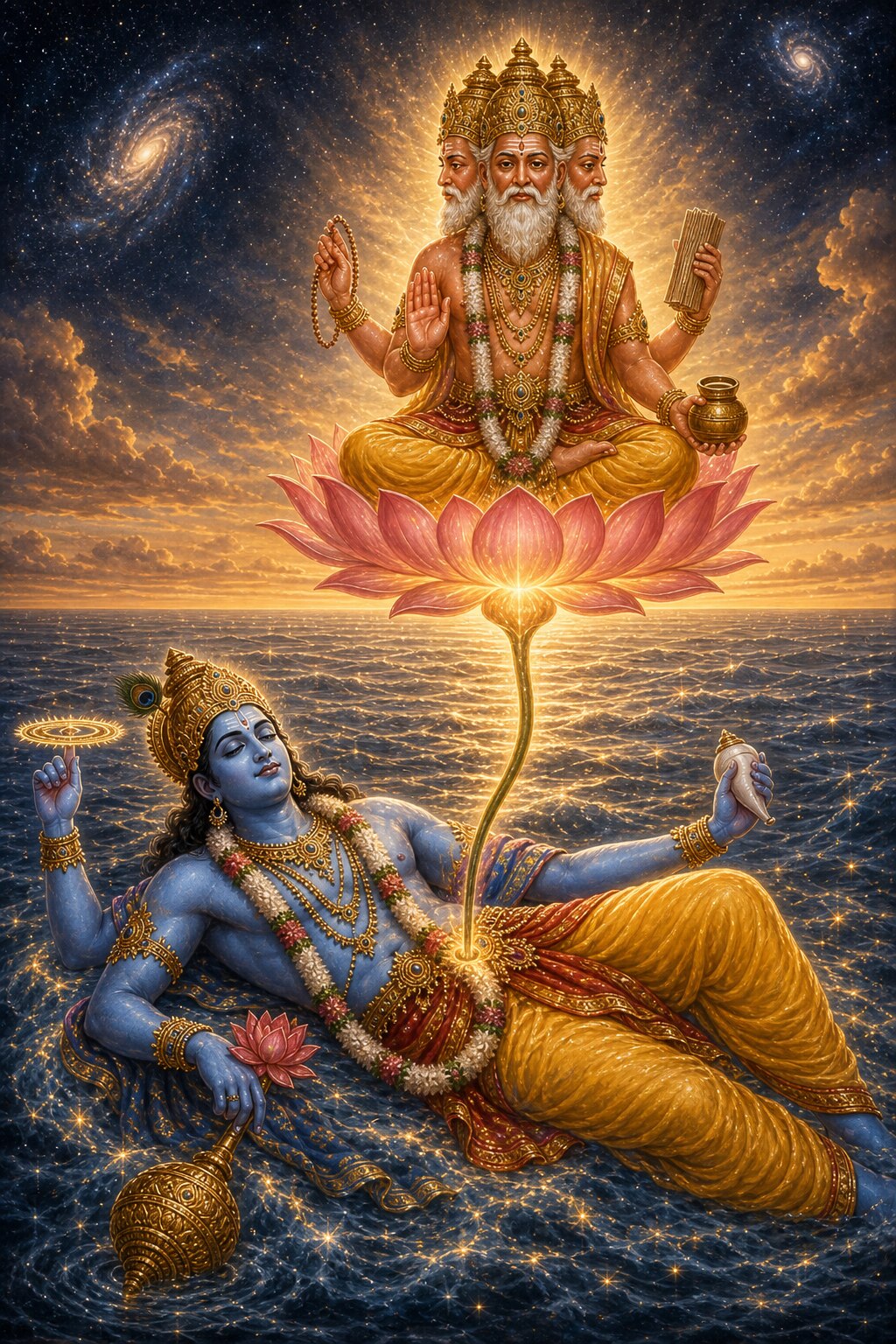
“To find my own source, I reasoned that a lotus must grow up from somewhere below, and that my father would be waiting at its root. So I climbed down into the stalk and went down for a hundred years, and no root came; then I turned and climbed upward for another hundred, and I found no end to it anywhere. Then a voice from the sky said, ‘Perform austerity.’ I performed a fierce austerity for twelve years, and then Lord Vishnu, bearing four arms and holding the conch, the discus, the mace, and the lotus, appeared before me. A conversation began between the two of us, and yet, through the play of Shiva, a dispute rose up between us. He had called me his dear child, the way a teacher speaks to a pupil, and rajas rose in me at the word. He answered that I had come out of the lotus at his own navel, and that he was the lord of all the gods, maker beside. Then who are you, I said; somewhere there is a maker of you as well. In that shoreless sea of dissolution we fell on one another and fought. At that very moment, between the two of us, a great pillar of fire appeared, a lingam made of pure light.”
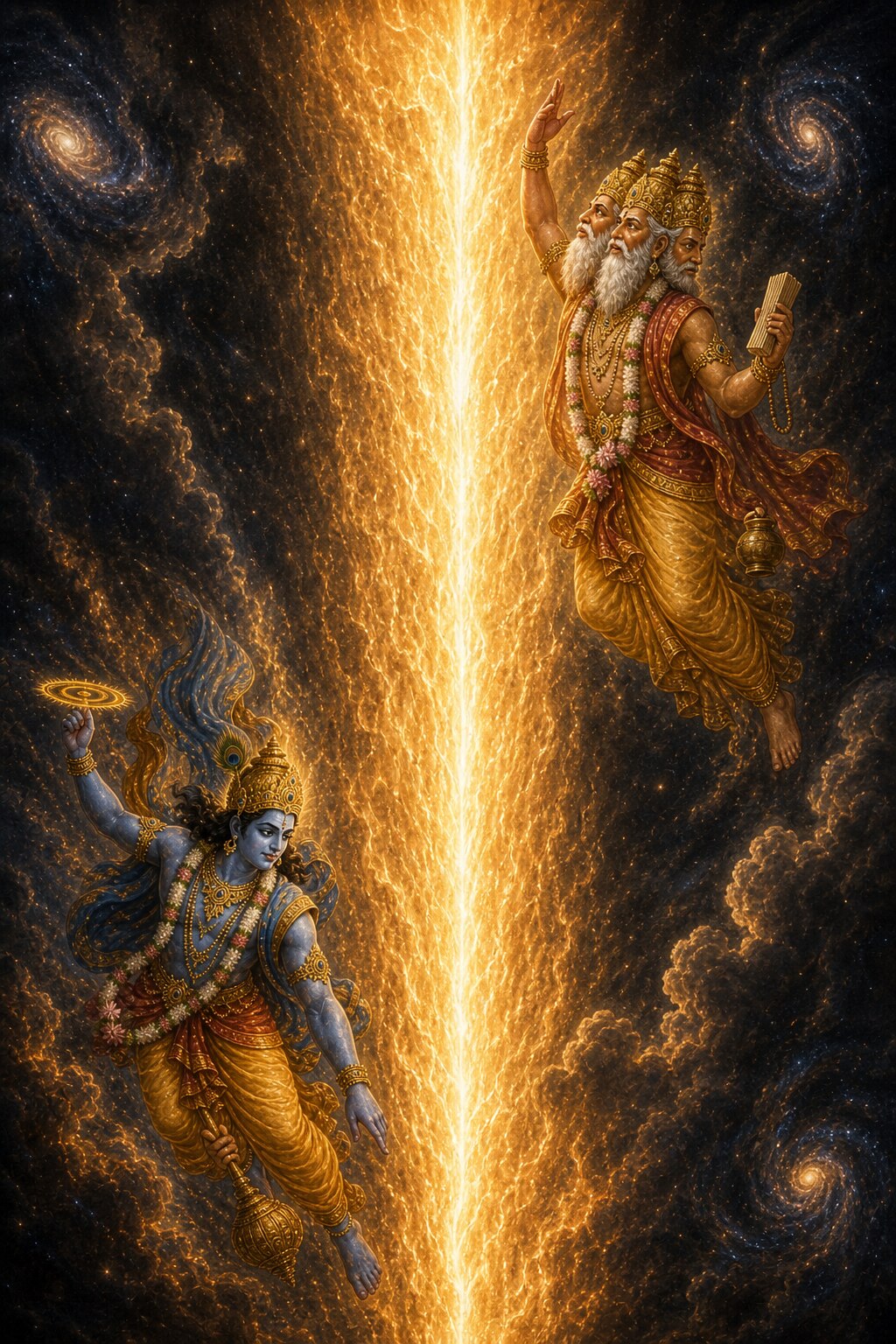
“It burned like a hundred fires of the world’s last day, and a thousand rows of flame leaped from it, and under those flames Shri Hari lost his senses and so did I. Why do we contend now, Vishnu said when we came to; a third has come; let this end between us. So we made a great effort to learn its beginning and its end. I climbed upward and Shri Hari went downward, and neither of us found its far edges. Worn out, we turned back. Though that reality had no distinguishing mark of its own, it had taken on the being of a lingam. It had no name, and it had no action. Even along the path of meditation, its nature could not be traced. Then the two of us steadied our minds and began to bow before that pillar of fire, saying, ‘Great Lord, we do not know your true form. Whoever you may be, our salutation is to you. Grant us the sight of your real form.’ Bowing in this way, a hundred years passed for us.”
The Vision of Om and the Body Made of Sound
“As we bowed without pause, the pride went out of us, and the Supreme Lord grew merciful toward us. Then out of that sound the word ‘Om, Om’ began to be heard clearly, drawn long the way the Veda draws it. We wondered what it could be, and I stood there perplexed while Shri Hari looked with a gladdened heart. Then he gave us the sight, in his southern part, of the syllable A, which blazed like the orb of the sun; in his northern part the syllable U shone bright as fire; and in his middle part the syllable M was luminous as the disc of the moon. Above them we saw the form of the supreme Brahman, pure as clear crystal, beyond the fourth state, and without a second, truth and bliss and nectar all at once. Shri Hari, with the force of the Veda and of sacred sound, contemplated that Shiva who is the soul of the universe, and, wanting still to learn where the column of fire had risen from, he was met there by a rishi who told him the essence of the truth; and Vishnu came to know that the rishi was the great lord himself, and that in the form of this supreme lingam made of the sound-Brahman, Mahadeva had appeared in person.”
“That Pranava is the very sound that names the supreme Brahman. Its first letter, A, points to Brahma, the seed of the world who is born of the egg; its second letter, U, points to Shri Hari, the form of the supreme cause; and its third letter, M, points to Lord Shiva, dark blue and red. From the lingam of Maheshvara arose a seed in the form of A, which, set within the womb in the form of U, began to grow as a golden egg. That egg lay in the water for many years, and after a thousand years the hand of Ishvara struck it and it split into two pieces. Its upper shell, which was gold, became the heaven, and its lower shell became the earth with its five marks, and from that same egg I too, the four-faced Brahma, came into being. In this way Maheshvara alone was described in these three forms, A, U, and M. And he showed us more. He stood before us laughing, with his whole body written out in the letters of speech, the first sound at the crown of his head and the last at the tip of his nose.”
Shiva with Uma, and the Oneness of the Three Gods
“Then Maheshvara, the treasury of compassion, was pleased, and all at once he appeared there with the goddess Uma. His five faces, three eyes in each, the crown of the moon on his brow, his fair complexion, his ten arms, the blue mark on his throat, the three lines of ash across his forehead and the sacred ash across all his limbs, all of it shone with beauty. Vishnu and I sang his praise. Then Lord Shankara breathed the Veda into Vishnu and handed him the secret of the supreme Self, and after that gave the same secret knowledge to me as well. Vishnu asked him then how he is pleased. Worship my lingam, Shiva told him, and meditate always upon this form you see standing here before you. Where the lingam is worshiped I am glad, and I give the people whatever their minds ask for, and whatever misery falls upon them is destroyed. Then, pleased, he said, ‘The two of you have come forth from my own Prakriti, my very likeness. Brahma, you were born from my right side, and Vishnu, you were born from my left. By my command, you are to create the world, and you are to sustain all that moves and all that does not move.’”
“Vishnu joined his hands and asked for only this boon: that the devotion of them both to Shiva should remain forever undivided and unshaken; and one thing more, that the Lord who holds no attributes would be pleased to come down into the world in the course of his play and help them there. Then Shri Maheshvara said, ‘I alone am the maker of creation, of sustenance, and of destruction. I am with attributes and I am without attributes, the changeless supreme Brahman whose nature is being, consciousness, and bliss. By the difference of tasks, I alone have taken the names Brahma, Vishnu, and Rudra, and so been divided into three forms. Brahma, my highest and most exalted form will come forth from your body under the name of Rudra, and its power will be no less than mine. For this reason, never hold the thought that Shiva and Rudra are different. Melt gold and beat it into an ornament and what you hold is gold still; the name has changed and nothing else has. I, you, Brahma, and Rudra are all one and the same form; to hold them as separate is bondage. In truth, in my view, all that is seen is the form of Shiva.’”
“Then he made known the three powers of Prakriti: Vagdevi, the goddess of speech, would serve Brahma; the power in the form of Lakshmi would take shelter with Vishnu; and the third power, in the form of Kali, would come to Rudra. Their tasks, in their order, are creation, sustenance, and destruction. These three gods carry the gunas, and each carries them differently: Vishnu holds tamas within and wears sattva without, Hara holds sattva within and wears tamas without, and Brahma has rajas within and rajas without; and yet Shiva is held to be beyond the gunas. Having said this, he handed to Vishnu the charge of protecting Brahma, the grandsire and maker of creation.” Having spoken this much, Brahma, the grandsire of the worlds, fell silent for a moment before Narada, as though the memory of that beginningless light still filled his heart.
Source: Shiva Purana (Gita Press, Sankshipta Shivapurananka), Rudra Samhita (Srishti Khanda)