On this page
The Assembly at Prayaga
In the ancient days, on the bank of Prayaga, all the sages gathered, and a yajna of enormous scale was arranged with every proper rite. Sanaka and the other perfected ones came, the divine sages, the Prajapatis, and the gods; Brahma himself arrived with his whole household, and the Vedas and the Agamas walked in beside him wearing bodies of their own. Between the offerings the days there went in argument over how a thing is known at all, and the arguing was half the festival. Into that gathering came Lord Rudra as well, with Sati and his attendants at his side. Everyone bowed to him in devotion, Brahma among them; then, receiving Shiva’s leave, all took their appointed seats.
It was then that Daksha, lord even over the Prajapatis, mighty in splendor, walked in, throwing light everywhere as he came, on nothing more than a passing whim to look in. In those days he ruled the whole of creation, and that very office had soiled a mind already empty of the knowledge of truth. He saluted Brahma, who was his father, and sat; that was the one head he bent in the hall. The divine sages folded their hands, bent their heads to him, and sang his praises as he passed. Maheshwara alone stayed on his seat exactly as he was. He who is himself the free and sovereign Supreme Lord, before whom would he lower his head?
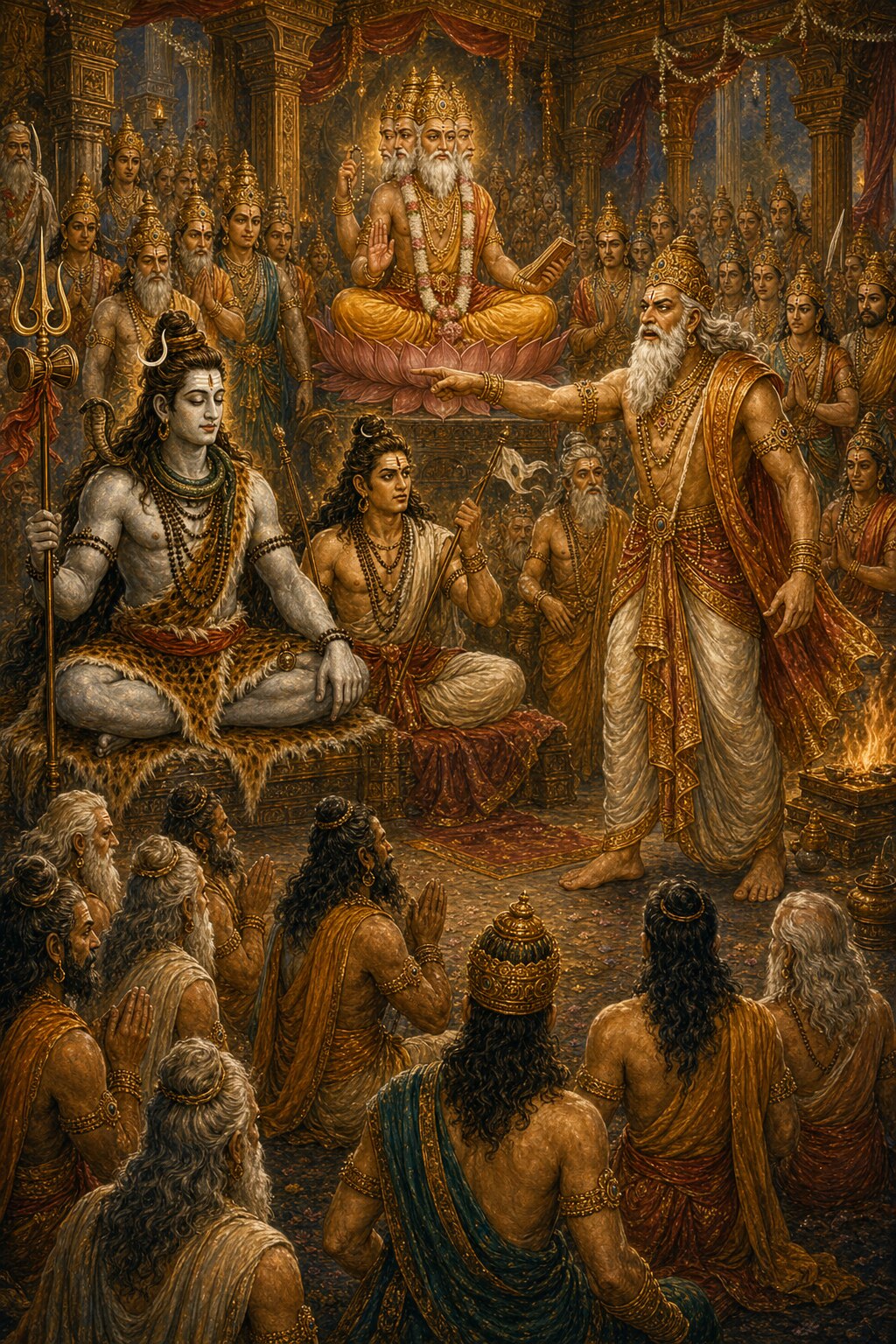
A fire flared inside Daksha. He had walked that hall counting bowed heads, and one man had not moved. Fixing a cruel stare on Rudra, he spoke loud enough for the whole assembly to hear. “Gods, asuras, Brahmins, sages, all of them bow their heads to me, yet this shameless creature who lives among the funeral pyres offers me no salute. This drunken one flouts even the ordinance of the shastra; he stands outside the four varnas. I curse him: let him be shut out of the yajna, and let him receive no share in the sacrifice alongside the gods.”
Curse upon Curse
The moment those words rang out, Bhrigu and a great many other sages, their judgment clouded by Shiva’s maya, began to add their voices to the reviling of Rudra. Nandi, the son of Shilada, could not endure it. His eyes went wild and a curse rose in his throat, and he thundered, “You supreme fool, Daksha! My master Maheshwara, at whose mere remembrance yajnas succeed and holy places are made clean, him you would shut out of the yajna? The maker, the sustainer, and the destroyer of the worlds, that blameless great Lord, him you mock, with the rashness a Brahmin thinks he is owed?”
Daksha boiled over. He cursed the hosts of Rudra to be cast out from the Veda, to take up false doctrine, to wear matted locks and smeared ash, and to stay sunk in wine. In reply Nandi cursed the Brahmin race: that Brahmins who set themselves against Shiva would lose themselves in mere talk of the Veda, be emptied of the knowledge of truth, and prattle that there is nothing beyond it; that they would turn into beggars drowning in pleasures, perpetually poor, forever waiting on the next man’s gift and sinking by that gift into hell, some of them becoming brahma-rakshasas; and that this Daksha, forgetting the knowledge of the self, would sink to the level of a beast, would lose that fine face of his, and would soon be given the face of a goat.
An outcry broke out on every side. Then Sadashiva, half smiling, calmed Nandi in gentle words. “Nandin, you are supremely wise; anger does not suit you. You cursed them thinking I had been cursed, and I have not been. No curse from anyone can so much as touch us. And the Vedas are made of mantra, are the very form of the divine; in every single mantra the Supreme is enshrined, no matter whose mouth it comes from. I am the sacrifice, and the one who performs it, and the one who stands outside it. Who is this, who are you, who are these? All of it is me. Do not waste a curse upon the Brahmin race.” Nandi grew still. Shiva went home to his mountain with his ganas in high spirits, and Daksha went home with his Brahmins; the knot of resentment in his heart stayed exactly as it was.
Daksha’s Great Yajna
In time Daksha resolved on a great yajna, and he set it up at Kanakhala, where the Ganga runs, on a scale that would leave nothing for anyone to add. Tvashtri raised the halls for the guests, Vishnu himself presided over the rite with the Maruts, Brahma directed it, the guardians of the quarters stood armed at the gates, and eighty-six thousand priests were needed to work the fires. Gods and sages were invited; only the one without whom a yajna is no yajna went uncalled, and his wife, who was Daksha’s own daughter, went uncalled with him. Dadhichi urged that Lord Shiva be invited with due honor. Daksha said openly that Shiva had been left out on purpose, that a man who carries a skull has no business at a Vedic fire. “Dadhichi, then say no such thing; let us all together make this yajna a success.” At that, with everyone listening, Dadhichi answered, “Daksha, without Lord Shiva this great yajna has become no yajna at all; and mark this above all, in this very sacrifice your own destruction will come to pass.” With those words Dadhichi set out alone on the road to his ashram, and the chief devotees of Shiva walked out with him. Daksha mocked them, saying the Brahmins who had left were Brahmins in name only and their going was a blessing; and such was the reach of Shiva’s maya that the divine sages who stayed behind bent to the worship and the fire-offering.
Come, This Very Day
Far away, on Mount Gandhamadana, in a fountain-house hung with canopies, Daksha’s daughter Sati was at play with her companions. Her gaze drifted upward, and she saw the moon-god Chandra passing by with Rohini, both of them in such a hurry that they had not stopped to take their leave of her. Sati sent her friend Vijaya to inquire; learning from Chandra the whole account of the yajna festival, Vijaya returned, and the news set Sati’s heart in turmoil. So vast a yajna at her father’s house, and not even a word of it sent to her own home? Daksha was her father and Asikni her mother and she their loved daughter, and she could find no reason in it. Leaving Vijaya where she stood, she went at once to her lord, and found him in his council-chamber with Nandi and his hosts about him. Shiva drew her onto his lap and asked, in the easiest voice in the world, what had brought her in among them looking like that. “My lord, at my father’s house a great yajna is under way; all the divine sages are gathering there. Why does no wish rise in you to go? It is the dharma of kinsfolk to visit their kin. Grant my prayer, and come with me this very day.”
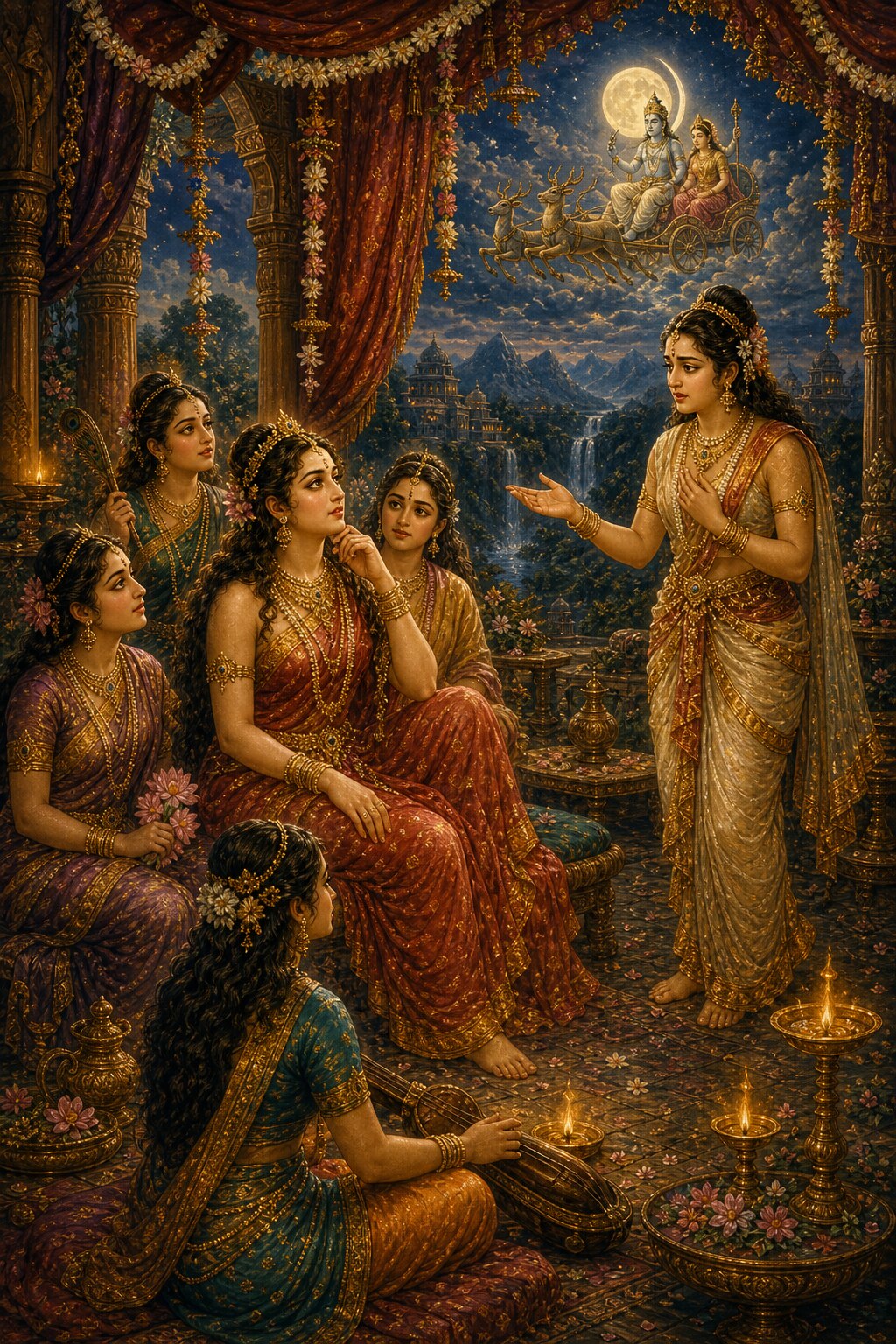
Maheshwara’s heart had already been wounded by Daksha’s arrows of speech. In gentle words he said, “Devi, your father has turned into our particular enemy. Those who go uninvited into another’s house meet a dishonor there more painful than death itself. Indra himself would be made cheap by such a journey; what would it make of anyone else? And no arrow shot by an enemy leaves the wound a kinsman’s word leaves, aimed where he alone knows you are soft. So, beloved, neither you nor I ought to go.” But anger rose in Sati’s mind. “You, at whose coming the yajna itself is made a success, my wicked father did not invite! I want to know what Daksha intends. Lord, give me your word, and I will go this very day.”
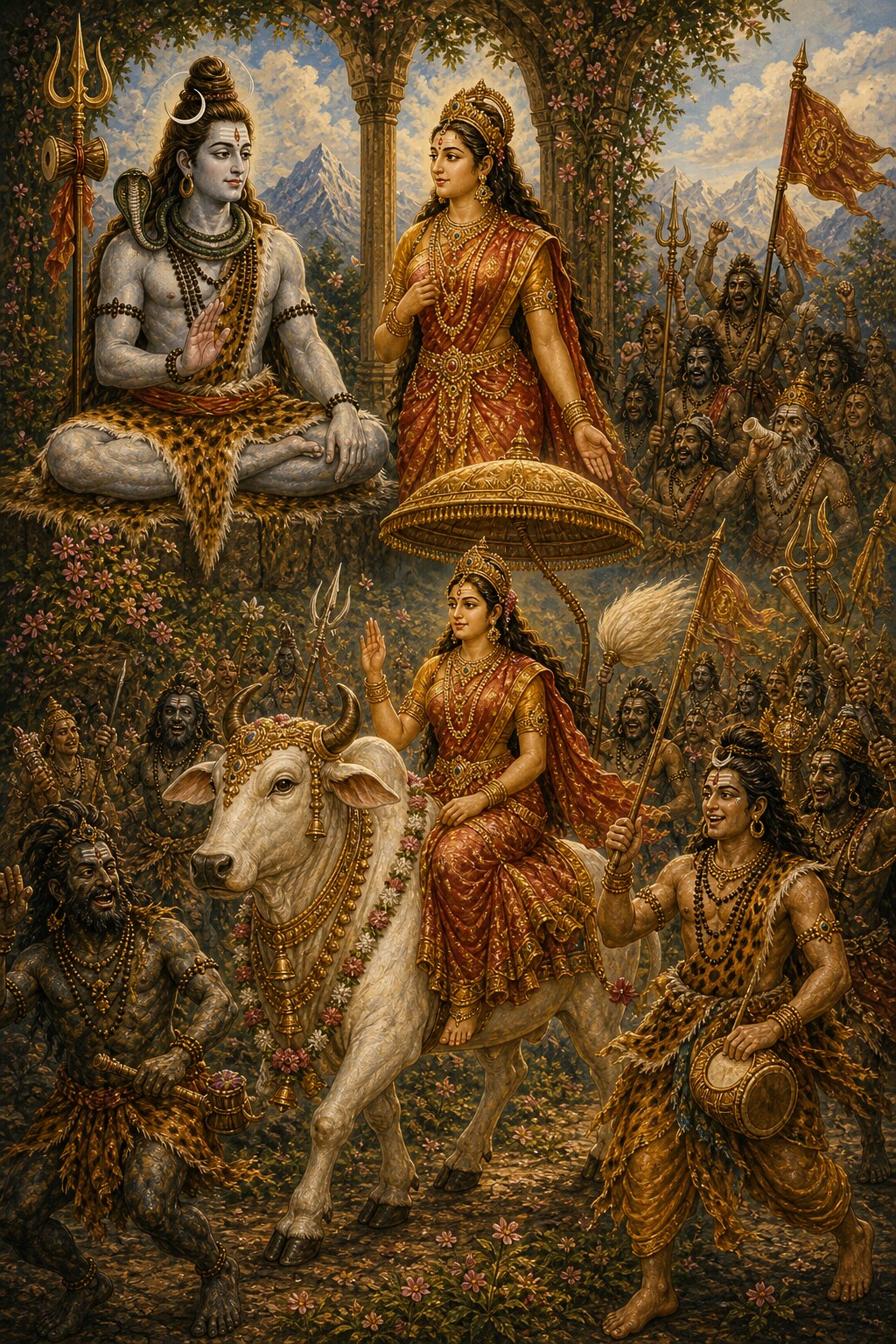
The all-knowing Rudra saw that her resolve was fixed, and he said, “Then go with my leave. Mount this adorned bull, worthy of a queen, and travel with the hosts of the Pramathas.” Shiva gave her garments, ornaments, a parasol, a chamara, every appointment fit for royalty, so that no one at that gate could pretend to mistake who had come. Sixty thousand of the Rudra hosts went with her, leaping and bounding in high spirits with the gladness of children, singing the glory of Sati and of Shiva, and the three worlds rang with their cries of victory.
Inside the Crowded Yajna Hall
At the door of the yajna hall Sati stepped down from Nandi and went inside alone, the sixty thousand staying behind at the gate. Her mother Asikni and her sisters came forward and welcomed her warmly, but Daksha saw her and said not a single word, not a sign, not a gesture; the rest, out of fear of Daksha and under the spell of Shiva’s maya, held their silence. Even after this cold welcome, Sati bowed her head at the feet of her mother and her father, then looked around at the faces that would not meet hers. Then she saw that the yajna held shares set out for Vishnu and the other gods, yet Shambhu’s share was nowhere among them. At that, an unbearable fury broke from her; scorching Daksha with her very look, she said, “Prajapati, why was the supremely auspicious Lord Shiva not invited? He who is himself the yajna, its every limb, its dakshina and its yajaman alike, without him this whole sacrifice turns impure. The mantra is Shiva, the offering poured for the gods is Shiva, the offering poured for the fathers is Shiva; there is nothing on these platters that is not him. Your judgment has been corrupted today; that is why, though you are my father, you seem base to me. And these gods, Vishnu and Brahma and the others, who hold their places because they served him, and these sages, how have they come here at all, without their own Lord present?” Vishnu and all the rest kept silent.
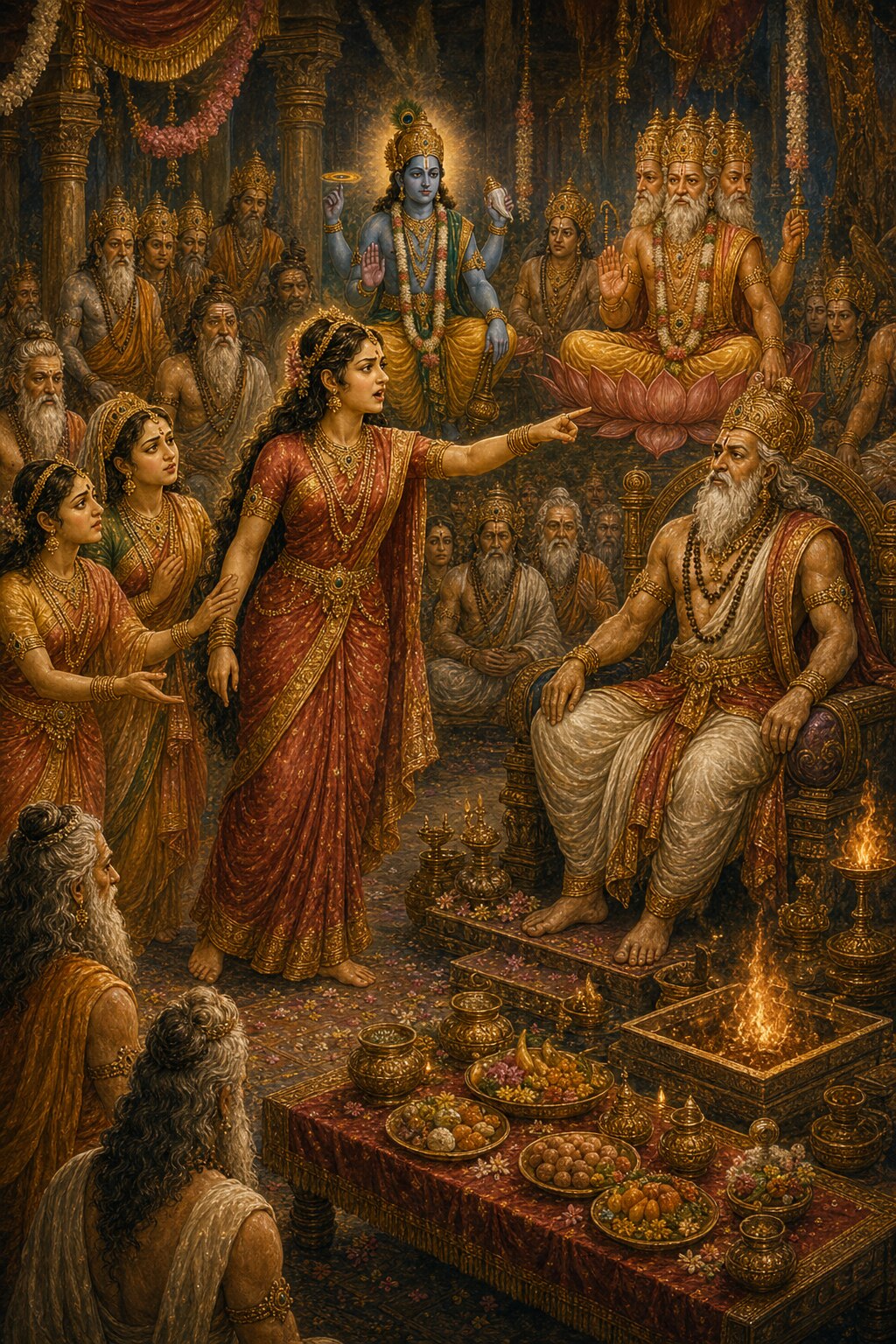
Daksha flared up. “Bhadre, what is gained by all this talk? You have no business here. Go or stay, as you please. Everyone knows your husband is inauspicious in form, without noble birth, cast out from the Veda, the lord of ghosts and spirits. That is exactly why Rudra was not invited: I was not going to seat that dress and those features in front of gods and sages. Daughter, this fool arranged that marriage at Brahma’s urging. Leave him and be at peace; and since you have come, put that face away, give us a sweet smile, and take up your own share yourself.”
On one side stood her father, reviling her husband with his own mouth; on the other rose the thought of what she would answer when Shankara asked her for news. She wanted to see him, and she could not think how to go back and stand in front of him carrying this. Drawing a long breath, the mother of the three worlds spoke. “He who reviles Mahadeva and he who listens to that reviling, both remain in hell for as long as the sun and moon endure. So, father, I will give up this body; I will enter the fire. Seeing my lord dishonored, what use is this life to me now? If a man has the power, let him cut out the tongue of anyone who reviles Shiva; if he has not, let him stop his ears and walk away.”
Then, though she already repented having come, she spoke without fear. “Father, you revile Shankara, and for this you will suffer torment. What you taste now is a part of it; the rest comes later. He whose two-syllable name, Shiva, spoken from the tongue but once, and carelessly at that, destroys the whole heap of sin, against him you hold hatred! In truth, the one inauspicious in form is you yourself. Yes, he keeps the cremation ground, he carries the skull, his hair hangs in matted ropes, and gods and sages carry the dust of those feet on their heads. Lord Shankara is Parabrahman, the Supreme; your scholars hold that action toward the world and withdrawal from it can never live in one being, and neither of them reaches him at all. Our glory is unmanifest, and it is not with you. Lord Shiva calls me Dakshayani, naming me by my tie to you, and every time I hear it my heart grieves. So this body, born of your portion, loathsome as a corpse, I will cast off at once. And you, gods and sages, to all of you the reviling of Shiva was a pleasure to hear; the full punishment for this evil deed will find you.” Having said this much, Sati fell silent, and inwardly she began to hold Shambhu, the beloved of her life, in her thoughts.
The Fire That Rose from Within
She went to the northern wing of that hall and sat down on the ground in silence, sipped the ritual water, drew her cloth over her whole body, closed her eyes, and settled into the path of yoga. She joined prana and apana and held them steady in the navel-wheel; she carried udana, together with the intellect, into the heart, then led it up through the passage of the throat to the point between her brows. Through all her limbs she fixed, by the method of yoga, the concentration on air and on fire, and as she meditated on the lotus feet of her lord, nothing else appeared to her at all. She meant to burn the body away and keep only the pure breath. In that same instant Sati’s sinless body dropped, and by her own will, by the fire of yoga, it was reduced to ash on the spot. The tale current in the world shows Sati leaping into the sacrificial pit. The Shiva Purana holds that no flame ever reached her from outside; the fire rose within her own body, kindled by yoga, in the hour she chose.
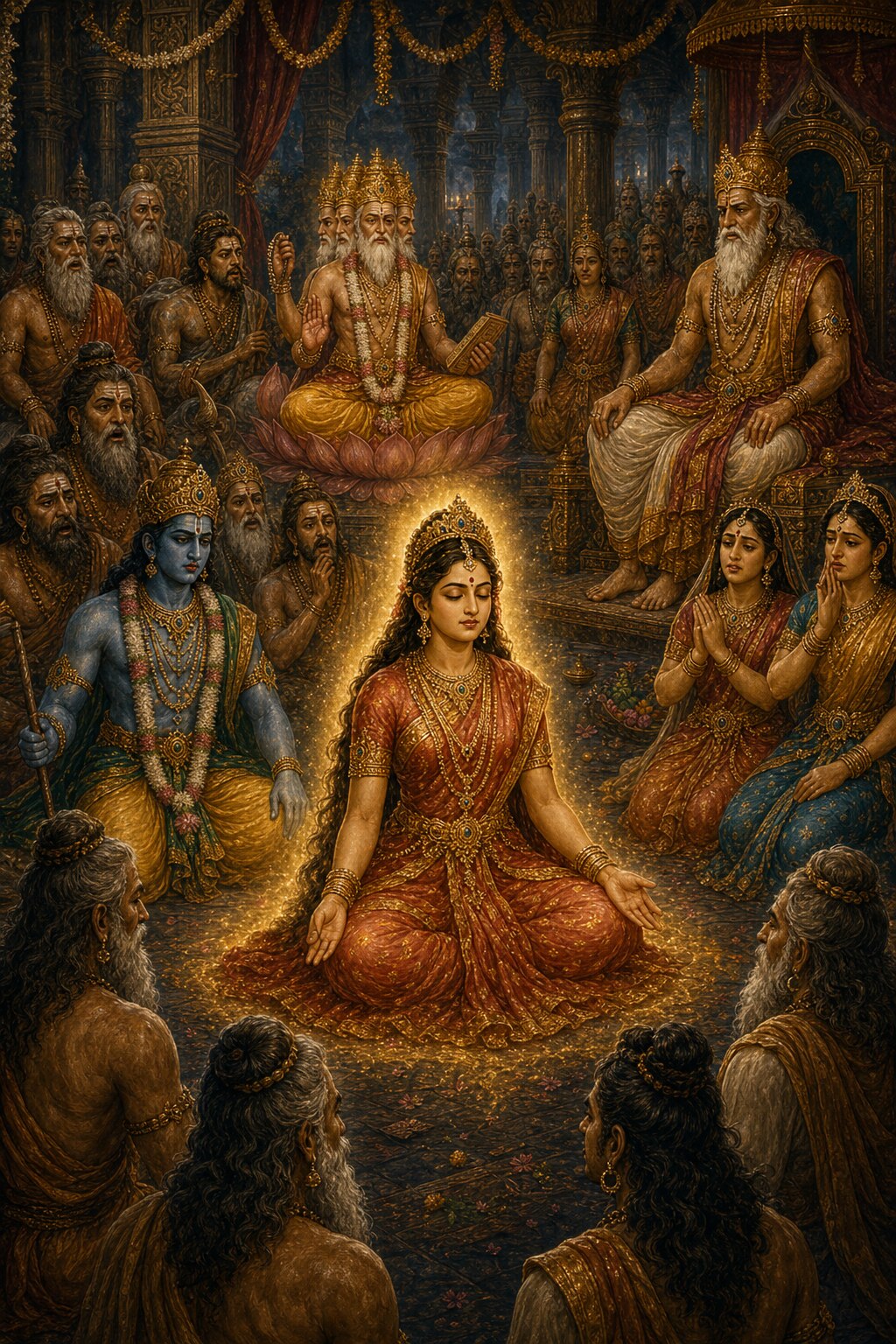
Those who witnessed it cried out, and their cry spread everywhere, across the sky and over the earth. People were saying, “Alas! Shankara’s dearest beloved has given up her life through the cruelty of what wicked man! His own daughter set herself to give up her life, and this Shankara-hating Daksha did not even stop her!” His name would be a byword now for as long as the world lasted, and the men saying so had sat through it without speaking.
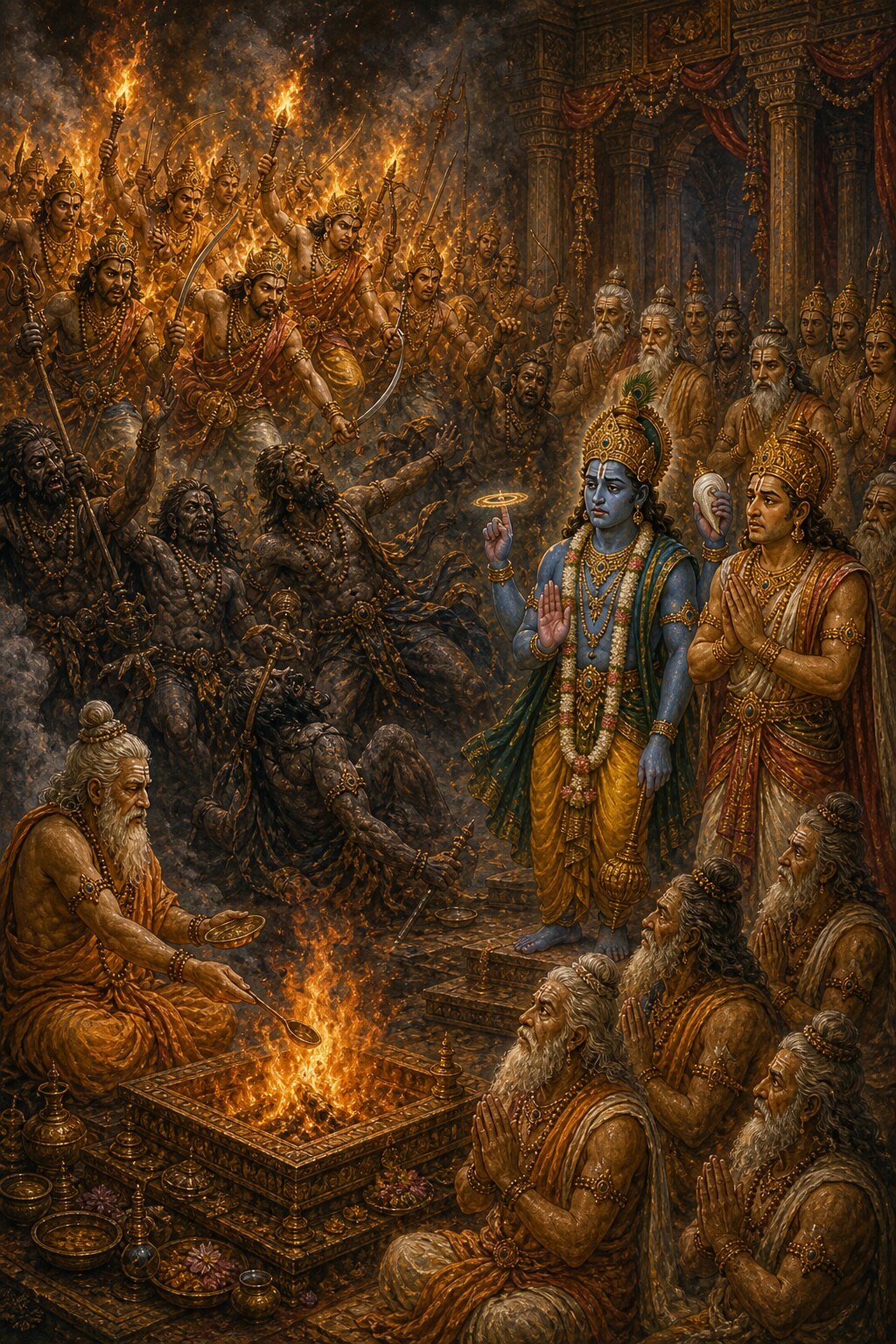
The sixty thousand mighty attendants of Shankara standing at the door filled with rage. Crying “Shame, shame,” they raised a great lament until the quarters themselves were full of it and the gods and sages inside were afraid; many, unhinged by grief, struck their own limbs with their own weapons, and some their heads, and some their faces. Twenty thousand of the attendants perished in that very moment along with Sati. Those who survived caught up their arms and rushed to kill Daksha. Then Bhrigu, using the Yajus mantra ordained for the destruction of those who obstruct, poured an oblation into the southern fire, and out of the sacrificial pit thousands of powerful hero-gods called the Ribhus rose up, burning brands in their hands; a battle so terrible followed that any onlooker shuddered, and under the blows of that brahma-radiance the hosts of the Pramathas broke and fled. All of this came to pass by the mighty will of Lord Shiva himself, who wanted his own people off that ground and cleared them off it.
Now a heavy silence of dread settled over the yajna hall. The rishis, Indra and the other gods, the Marut hosts, the Vishvedevas, the Ashvins, and the guardians of the worlds all fell silent; all of them prayed to Vishnu that this calamity might pass, and Shri Vishnu himself, weighing the outcome to come, was troubled. The wisest heads in three worlds had watched Shiva’s hosts cut down at a fire Shiva was not invited to, and every one of them could count forward from there. A vast disaster had descended on the great yajna of Shankara-hating Daksha, and the news of it had not yet reached Kailasa. What happened on the day it did arrive, hear in the story that follows.
Source: Shiva Purana (Gita Press, Sankshipta Shivapurananka), Rudra Samhita (Sati Khanda)
This same story, told elsewhere
- Daksha and Sati
Shrimad Bhagavata (Skandha 4): Daksha and Sati - The Marriage of Shiva and Sati
Shiva Purana: The Marriage of Shiva and Sati