On this page
In those days a single anxiety lived in the palace of the Himalaya. The work of the gods must be accomplished, and a daughter must be born; for this the mountain king Himavan and his queen Mena kept their minds fixed, day and night, upon Uma, the mother of the worlds. The goddess who had once thrown off her body to spite her father had already resolved, by the power of her own yoga, to be born from the wife of the mountain, and she entered the mind of the mountain king with her full and undivided portion. From that day a rare radiance settled over Himavan’s body, and he blazed like fire itself. Then, in an auspicious hour, holding himself in the deepest contemplation, he set that perfect portion within the womb of his beloved Mena. Mena conceived, and from that hour she carried the one who carries the universe, and seemed to move inside a sphere of light.
Through the months that followed, the lord of mountains watched his queen the way a man watches ground with treasure buried under it, or a shami twig with fire asleep in the wood. The ninth month passed, and the tenth was drawing toward its close. It was the season of spring, the ninth day of the month of Chaitra, the star Mrigashira overhead, and the hour of deep midnight. As the celestial Ganga pours down from the circle of the moon, so from the womb of Mena the goddess Shivaa came forth in her own true form. In that instant a gladness spread through the whole world, a kind wind began to blow, lotuses opened in the lakes and the rivers, and flowers rained down from above. In the city of Himavat wealth flowered and every misery died. Vishnu and the other gods came there, and taking joyful darshan of the mother of the worlds, they began to sing her praise.
When the gods had gone, Mena looked and saw before her a divine girl whose dark radiance shone like the petal of a blue lotus. The moment she saw that form, the mountain’s queen understood that this was the Supreme Goddess herself, and with joy she folded her hands and spoke. ‘You have shown me a great favor, mother of the worlds, by standing in front of me. Keep this form for me to hold in my meditation, and wear the form of my daughter for the world to see.’ The goddess said, ‘Mena, once before you served me with great devotion. Pleased by that devotion, when I bade you ask a boon, you asked only this: that I be born your daughter and accomplish the good of the gods. Today that boon has borne its fruit. I have shown you this divine form for one reason alone, that you may keep the memory of my real nature. Think of me always, either as this daughter of yours or in the form you see now, and you and your husband will both come at the last to my own region. I shall play out my lila upon the earth, accomplish the work of the gods, and become the wife of Shambhu.’ Having said this, before her mother’s very eyes, the mother of the worlds turned into a newborn infant.
Her name and her childhood
Taking refuge in the ordinary ways of the world, the girl of great splendor began to cry, and the light coming off her dimmed the lamps burning in the birth chamber at midnight. Hearing that lovely wail the women of the house bloomed with delight and rushed in, and the keeper of the inner rooms carried the news to the king, who in that hour would have given her anything she named, down to the white umbrella over his own throne. Gazing at the child, dark as a cluster of blue lotus petals, the mountain king Himalaya sank into joy. He performed the rites that follow a birth and went out to his gate to put money into the hands of beggars. At a fair and chosen hour, together with the sages, he gave his daughter her comforting names, Kali and the rest.
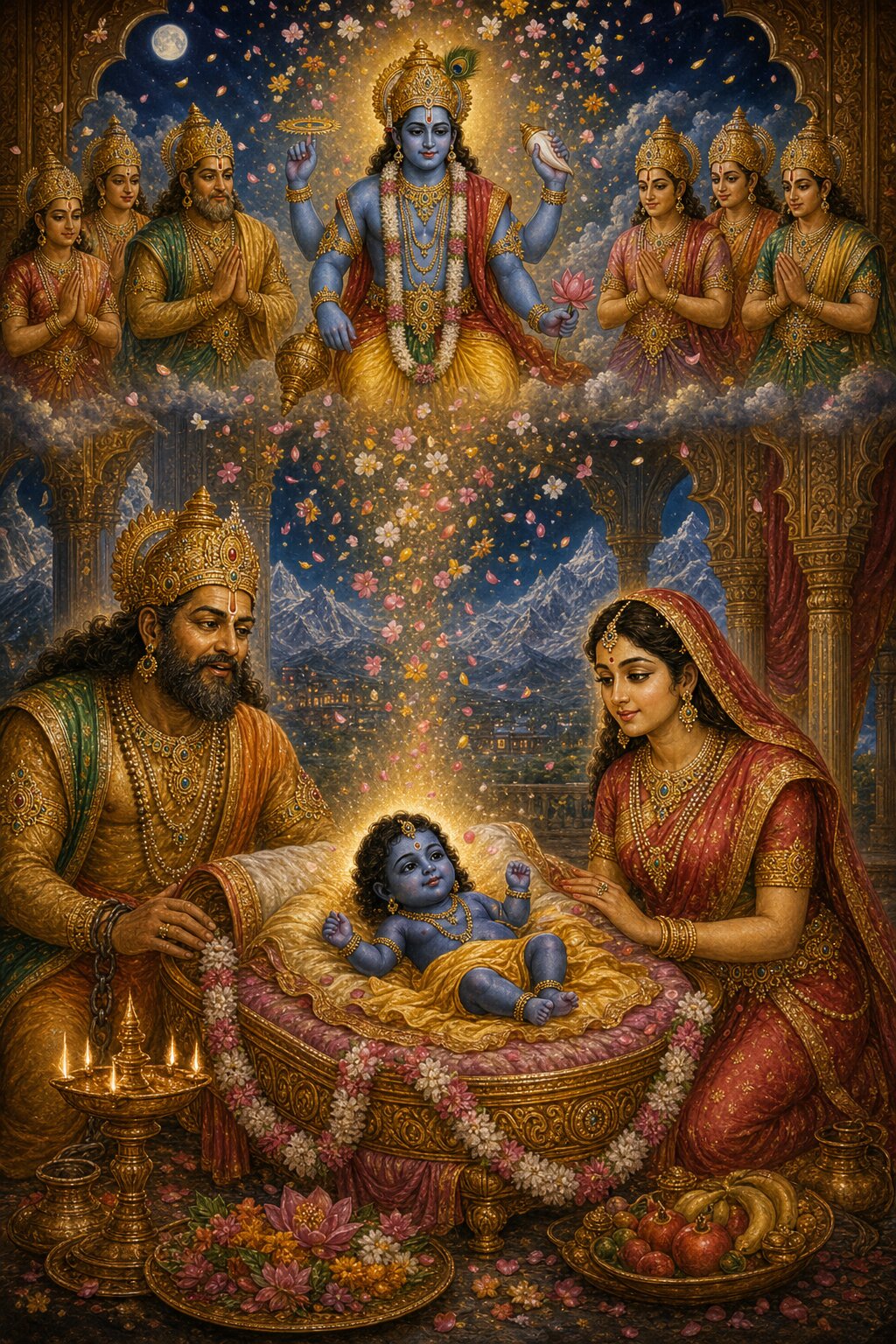
In the mansion of the mountain king that little girl grew day by day, the way the waters of the Ganga swell in the rains and the moonlight brightens through the waxing fortnight of autumn. She played on the sand along the Ganga with the other girls, with her balls and her dolls. Himavan had many sons, and still his eyes never had their fill of this one; a hundred flowers stand open in spring, and the bees go to the mango. The gifted child the household came to call ‘Parvati,’ after their own lineage of the mountains. Sometimes her mother, restraining her from austerity, would say ‘U, ma,’ which is to say, ‘Oh child, do not mortify yourself so’; and from this the daughter of the mountain king came to be known throughout the world as Uma.
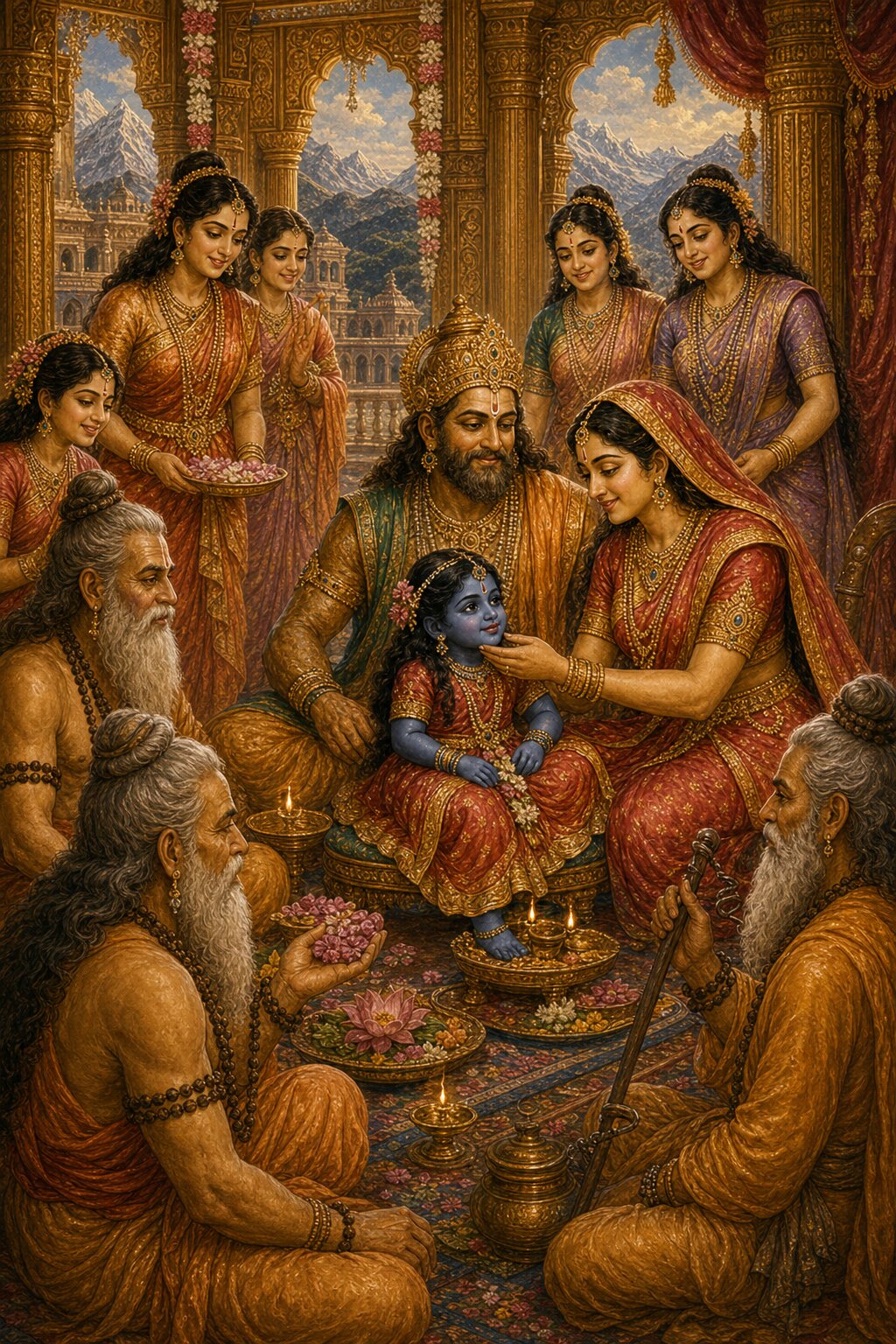
When the time came for her lessons, the goddess Shivaa, gathering her mind to a single point, began with great gladness to study under an excellent guru. All the learning of her former births returned to her with the same ease with which, in the autumn season, the rows of wild geese find their own way to the banks of the heavenly Ganga, and with which the healing herbs of the mountain begin to glow of themselves once night comes down.
Narada’s arrival and the prophecy
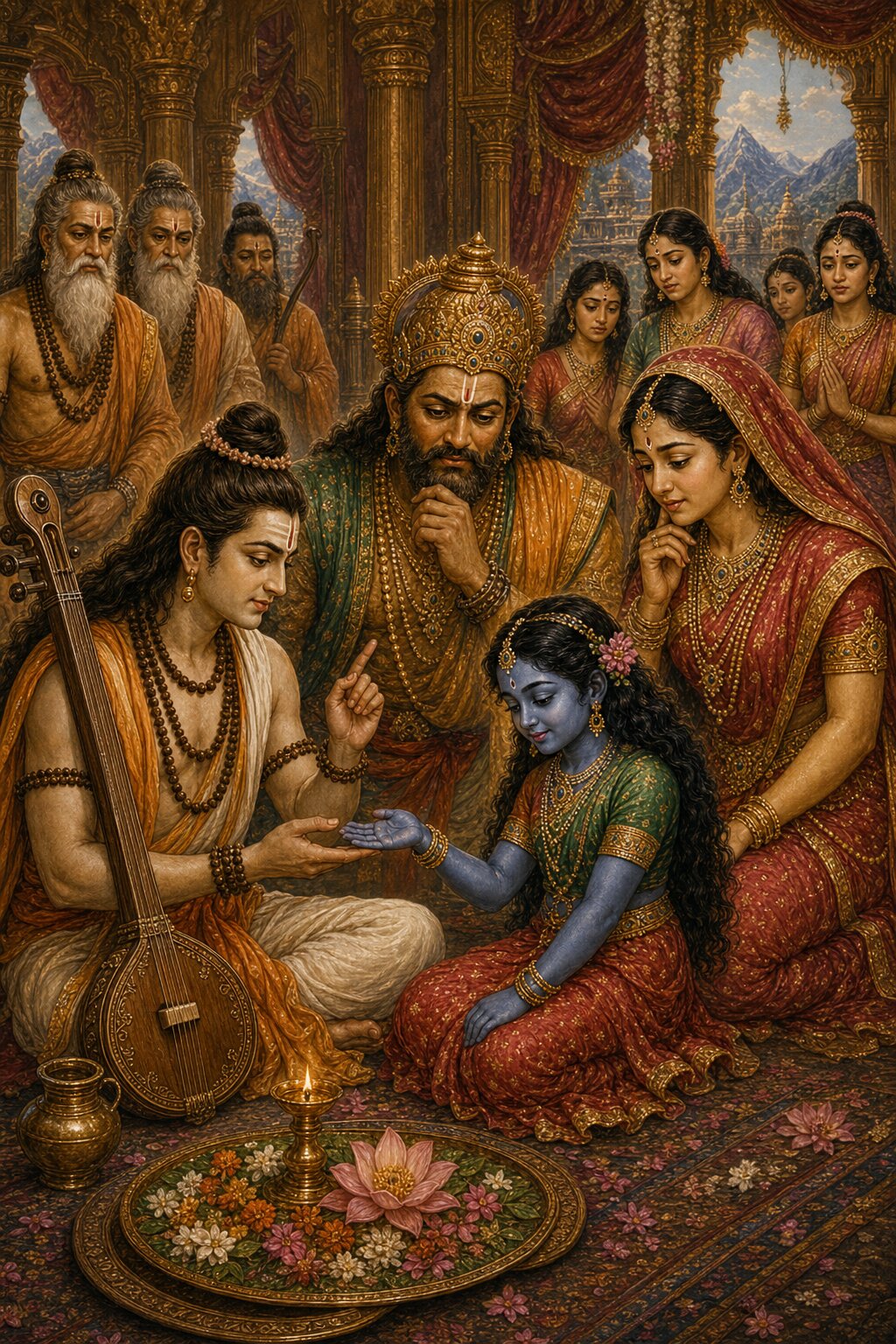
One day, moved by the will of Lord Shiva, the divine sage Narada came to the house of Himachala. Seeing him arrive, the mountain king bowed and worshiped him, and calling his daughter, had her bow at the sage’s feet. Then, hands folded and his head bent, he asked, ‘Sage, you know everything there is, you are kind, and you spend yourself on the good of others. Tell me the virtues and the flaws written in my daughter’s birth-chart. Whose fortunate wife will my girl be?’ At these words Narada looked at Kali’s hand, ran his gaze over the marks upon all her limbs, and said, ‘Shailaraja, and you, Mena, this daughter of yours is waxing like the phases of the moon; every auspicious sign adds to the beauty of her limbs. She will bring happiness to her husband, will raise the fame of her mother and father, and will be called a woman of the highest virtue. Yet one line upon her palm is strange, and you must hear its true fruit. She will find a husband who is a yogi, naked as the sky, without attributes and without desire; one who has neither mother nor father; who keeps no thought of honor or of dishonor, and who wears forever the garb of the inauspicious.’
Hearing this, Mena and Himachala took the words for true and were both deeply shaken, yet within herself the mother of the worlds, Shiva, bloomed with joy, for she alone had followed the description to its end and knew that this husband foretold was Shiva himself, and she recognized him. ‘The word of Narada can never prove false,’ she thought, and from that moment her heart’s affection settled upon the feet of Shiva. Grieving, Himavan asked, ‘Sage, hearing the fruit of that line has filled me with sorrow. What is the way out of it? What am I to do? A great misery has come upon this house. What means may I take to save my daughter from it?’
Narada laughed and said, ‘Giriraj, listen with love. The line upon the hand is the writing of Brahma, and it cannot come to nothing. Yet there is a way to escape the ill fruit of this line. Exactly as I have described him, so is Lord Shankara. He is all-capable, and for the sake of his lila he takes on countless forms; in him every mark that seems a flaw becomes the equal of a virtue. A fault in a capable being brings him no sorrow; for the powerless alone does a fault become a source of pain. In this matter, hold before you the example of the sun, of fire, and of the Ganga. Therefore, with discernment, give your daughter to Shiva. The thunderbolt cannot kill him, and no one in all the worlds is better suited to her. Through her austerity she will content Lord Shankara and become the half of his body, and the luster of gold will come into her limbs, and the world will call her Gauri. Such a love as those two will have was never seen in any age gone by and will not come again. Give her to no one else; this is a secret of the gods.’
Even now Himavan carried a doubt. He said, ‘Mahadeva has renounced every attachment and performs unbroken austerity. He is beyond the reach even of the gods who go looking for him. Fixed upon the path of meditation, why would he ever marry, and how would he draw his mind back from the supreme Brahman for such a thing? So the kinnaras say of him when they come through my hills. And it is also heard that in an earlier age Lord Hara made a vow before Sati that he would take no woman other than her. Now that Sati has given up her body, how will he accept any other?’ Then Narada laid the doubt to rest. ‘Set your worry aside. In an earlier age this very girl was Sati, the daughter of Daksha, the beloved wife of Rudra. Seeing her own dishonor and Shankara’s at her father’s yajna, she gave up her body, and now that same one is born Parvati in your house. So that vow accords with her alone; this daughter of yours will once again be his wife.’ Hearing the story of her own past, Parvati lowered her head in shyness, and the smile she could not keep back made her face lovelier still. Himalaya passed his hand over his daughter’s brow and seated her beside him. Narada said one thing more before he went: a better seat than that waits for her, for she will have the thigh of Shiva for her place forever, and from there she will go where no eye and no mind can follow. After this, Narada departed for the world of the gods.
Shiva’s austerity and Parvati’s service
After Narada had gone, one day Mena went to Himavan and stood by him a while in silence before she said with all humility, ‘My lord, the words the sage Narada spoke that day I could not, in my woman’s nature, rightly grasp. My one prayer is this: give our daughter in marriage to a groom who is handsome, well-born, and blessed with auspicious signs. She is as dear to us as our own lives; do whatever must be done to see her happy.’ So saying, she fell at her husband’s feet, and a stream of tears ran from her eyes. Himavan raised her and reasoned with her, ‘Let this confusion go; the word of the sage is never false. If you love your daughter, then teach her to perform austerity for Lord Shankara with devotion and a steady mind. If Shiva is pleased and takes Kali’s hand, all will be auspicious; near Shiva, every inauspicious thing turns forever into a blessing.’ Mena went to instruct her daughter in austerity, but the moment she looked upon those tender limbs her eyes filled and no word would come from her mouth. Reading her mother’s state, Parvati consoled her, and then spoke of her own accord, ‘Mother, in the last watch of this night, in the hour before dawn, I saw a dream. A compassionate ascetic Brahmin instructed me to perform the finest austerity for the pleasure of Shiva.’ Hearing this, Mena at once called her husband and told him the daughter’s dream. Delighted, the mountain king said, ‘My dear, last night I too saw a dream, and I will tell it to you exactly. An ascetic of great excellence, marked with exactly the signs Narada had described, came to perform austerity near our city. I took our daughter and went to him, and then I knew that he was Lord Shambhu himself, the very bridegroom Narada had named. I instructed our daughter to serve him and prayed him to accept her service. At first he would not agree, and then a great debate broke out there, following the ways of Sankhya and Vedanta. In the end, by his command, our daughter stayed there, and holding him alone as the desire of her heart, keeping that love shut inside her and letting none of it show, she began to serve him with devotion. That is my dream, and it is all of it. So let us wait a while and watch what comes of it; I am certain this is the right step for us.’ Then, with pure hearts, the two of them set themselves to test and to await the fruit of that dream.
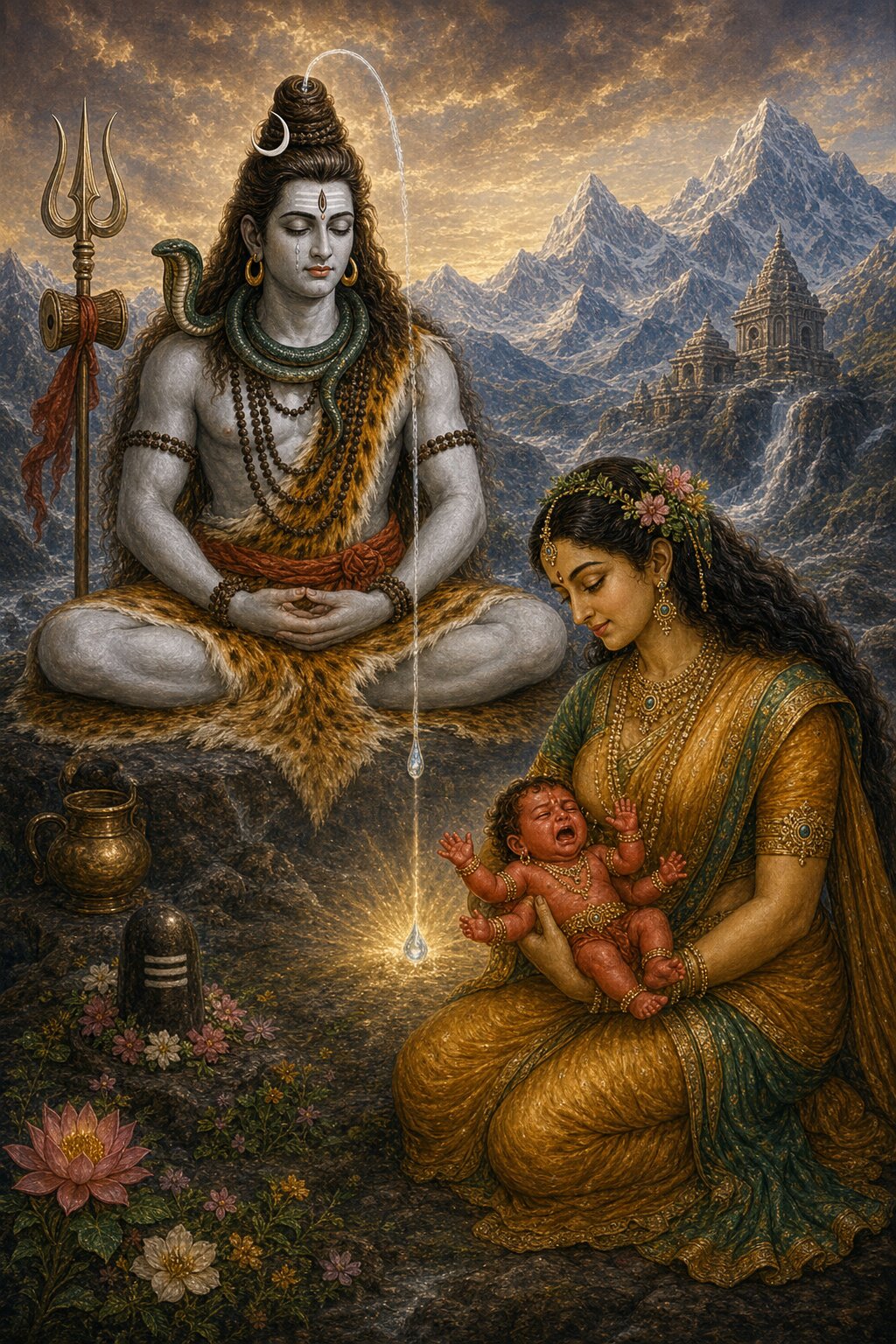
Meanwhile Lord Shambhu, returned from the yajna of Daksha to his home on Kailasa, was stricken with grief at the loss of his beloved Sati, who had been dearer to him than his own life. Calling his attendants, he would recount again and again the qualities of Sati that had deepened his love; then, showing the ways of the world in his lila, he threw off all garments and, like a madman, wandered through every realm, and finding the sight of Sati nowhere, he returned to Kailasa. There he gathered his mind with great effort and entered the samadhi that destroys all sorrow, and in it he looked upon his own imperishable form and stayed a long while in the state of the supreme Brahman, with the three gunas fallen away from him. When countless years had passed, he let go of the samadhi. In that same moment a single drop of the sweat of his labor fell from his brow to the earth and at once became a child; the boy had four arms, his body glowed red, and he cried before the Supreme Lord like any ordinary infant. Seeing this, the Earth, who was afraid of Shiva and thought hard before she moved, took the form of a beautiful woman and appeared there, lifted the boy into her lap, gave him her milk, and, taking him for her very own child, laughed and played with him. The all-knowing Shambhu, watching this play, broke into laughter, and recognizing the Earth, he said, ‘Dharani, you are blessed. Raise this son of ours with love. He was born of the water of my labor, yet by your name he will be called Bhauma. He will be a giver of lands, the three torments will never touch him, and he will make me glad as well.’ He said it and stopped, and the weight on him lifted a little. That same boy grew, went to Kashi, served Lord Shankara there for a long age, and by the grace of Vishvanatha attained the rank of a planet and was established in a divine world beyond the sphere of Shukra; this is Mangala.
At the home of the Himalaya, Parvati grew until she was eight years old, and then Shambhu, still stricken with grief at the loss of Sati, received the news of her birth, and holding that wondrous girl within his heart, he felt a secret joy. In this same season, to gather his mind to a single point, he turned his thought to austerity. Taking with him Nandi and a few of his most tranquil attendants, he came to the noblest peak of the Himalaya, to the sacred crossing called Gangavatarana, where the purifying Ganga had first come down upon the earth, and there he began his austerity. The ganas settled with him: Nandi and Bhringi and the rest sat down into meditation of their own, and some served him, and some took the gates, and not one of them raised his voice. Getting news of this welcome arrival, Himavan came with his servants and worshiped and praised Lord Rudra, saying that his life had borne its fruit at last. The Lord said, ‘Shailaraja, we have come to perform austerity in solitude upon this lovely peak of yours. You are the house of penance and the resting place of sages and gods, and the Ganga makes you clean. See to it that no one may come near us; this is the greatest service you can offer.’ The mountain king returned home, told his wife everything, and then called together every one of his people and ordered them that none should go to that place, and that whoever went would answer to him for it.
Some time passed, and then Shailaraja took the finest fruits and flowers and went, with his daughter, to Lord Hara. Setting the offerings before him and putting his daughter forward, having already given her to him in the silence of his own mind, he said to Shambhu, ‘Lord, this daughter of ours longs to serve you. Let her, with her two companions, remain always in your service; give her your command.’ Looking upon the girl, Lord Shankara closed his eyes and began to meditate upon his own attributeless, imperishable supreme essence. She stood in the first flush of her youth, her color the blue lotus and her face the full moon, a girl who could shake the mind of any sage in the depth of his meditation merely by standing where he could see her. Himachala bowed again and prayed that he and his daughter might come each day for darshan.
Maheshvara opened his eyes and said, ‘Giriraj, you may keep this maiden daughter of yours at home and come for our darshan; otherwise our darshan cannot take place.’ Himavan bowed his head and asked why: was the girl unworthy of his service, and what was the reason he could not see? Then Shambhu laughed, and answered him in the manner of ascetics everywhere, ‘Shailaraja, this maiden is lovely and endowed with auspicious signs, and for that reason we forbid your bringing her here, and we forbid it again. Those learned in the Veda call woman a form of maya, and a young woman is the very thing that breaks the austerity of ascetics. We are a yogi, forever untouched by maya; what use have we for a woman? The company of a woman destroys dispassion, and without dispassion a man falls from his austerity. A woman is the root every worldly attachment grows from, and she carries off wisdom and detachment together.’
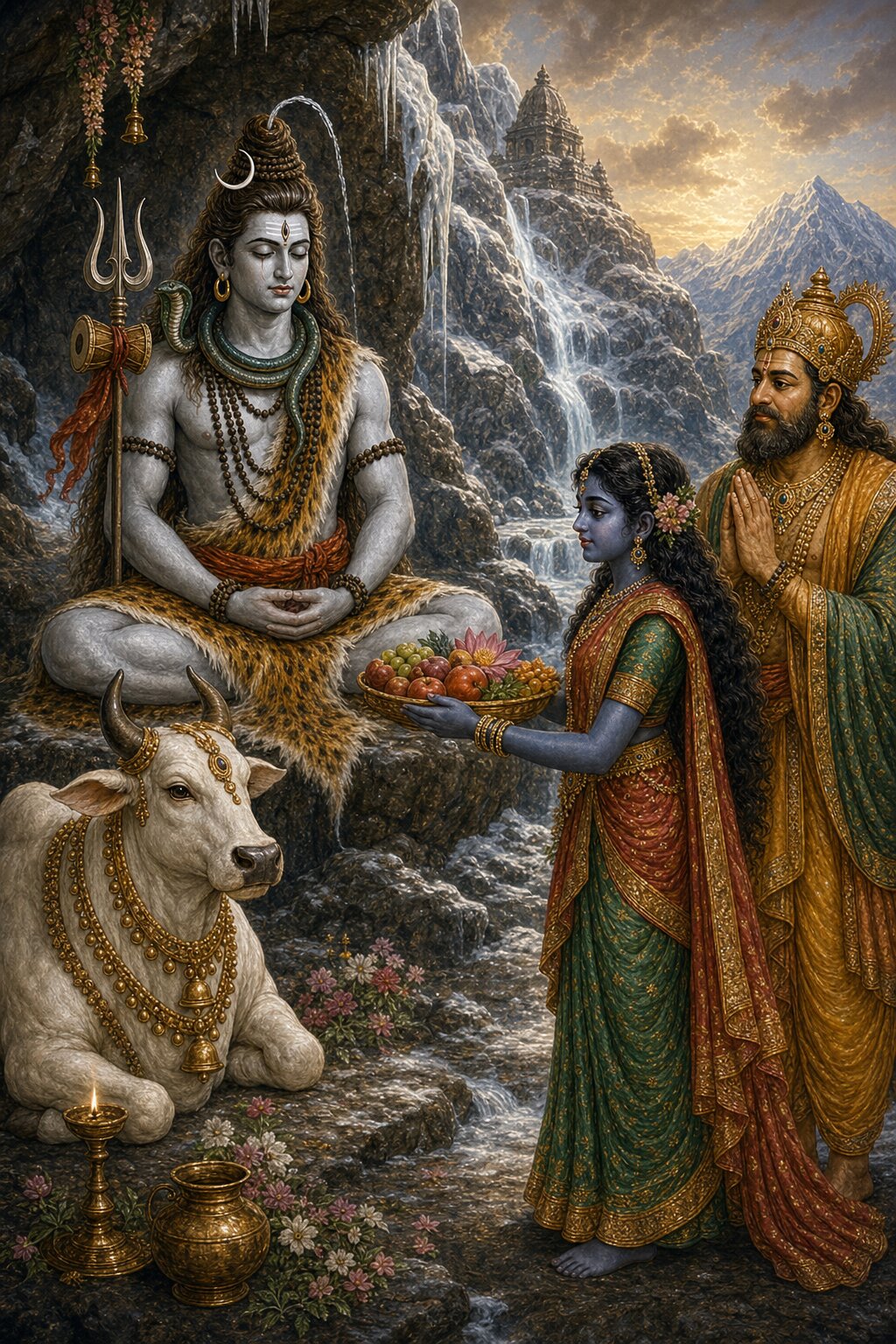
Hearing these dry and pitiless words of Shambhu, the father of Kali grew troubled, and something in him gave way, and he fell silent. Then Bhavani Parvati, seeing her father frightened, bowed to Lord Shiva and spoke words of great clarity, ‘Yogin, you have come to this mountain as an ascetic, and yet what have you said? Shambho, it is only because you are joined with Shakti that you perform this vast austerity; the very turn of your mind toward penance comes from her. Know that power by which all deeds are done to be Prakriti; from Prakriti come the creation, the sustaining, and the dissolution of all. Without Prakriti, how could even Maheshvara in the form of the linga exist? It is by her that every living thing worships you and meditates on you. Weigh this in your heart, and then say whatever you would say.’
Hearing these words of Parvati, Maheshvara, absorbed in his great lila and glad at heart, laughed and said, ‘Through the finest austerity we destroy Prakriti herself, and we remain established, in truth, wholly free of Prakriti. Good men should never gather Prakriti to themselves; they should let the ways of the world alone and keep themselves untouched.’ Hearing this word of Shambhu, spoken in the manner of worldly conduct, Kali laughed within herself and said in a sweet voice, ‘Yogin, this that you have just spoken, is that speech itself not Prakriti? How is Prakriti to cease, and how are you to be counted beyond her? All that you hear and see and eat and do is the work of Prakriti alone, and to call it unreal means nothing at all. If you are truly beyond Prakriti, then for what do you perform austerity upon this Himavan mountain? You have been swallowed whole by Prakriti and you do not know where you are standing. Lord of yogis, what is gained by much talk? Hear this excellent word of ours. We are Prakriti and you are Purusha; it is by our grace alone that you are held to be endowed with attributes and with form, and without us you have no attribute and no power to do anything at all. If this statement of yours is true, then you need not even fear to have us near you.’
Hearing this Sankhya-word of Parvati, Lord Shiva, standing in the view of Vedanta, said, ‘O sweet-spoken Girija, if, holding to the view of Sankhya, you speak in this way, then serve us each day; only let that service not be forbidden by the shastra. And if we should be the Brahman after all, the supreme lord, unstained by illusion and the master of it, what will you do then?’ Then Shiva, who pours grace upon his devotees, said to Giriraj, ‘We shall dwell here upon the ground of this lovely and excellent peak of yours, performing the finest austerity and contemplating our own blissful form of supreme truth, and showing the world what that form is. King of mountains, grant us leave to perform austerity here; without leave granted, no austerity can be done.’ Bowing, Himavan said, ‘Mahadeva, the whole world, with its gods and its asuras and its human beings, is yours alone. What are we, so small, to say to you?’ Hearing this, Shankara, the well-being of the world, laughed and said with courtesy, ‘Now go.’ He let the girl stay, and he said to her before her companions, serve us each day, and come and go as you please, and be here without fear.
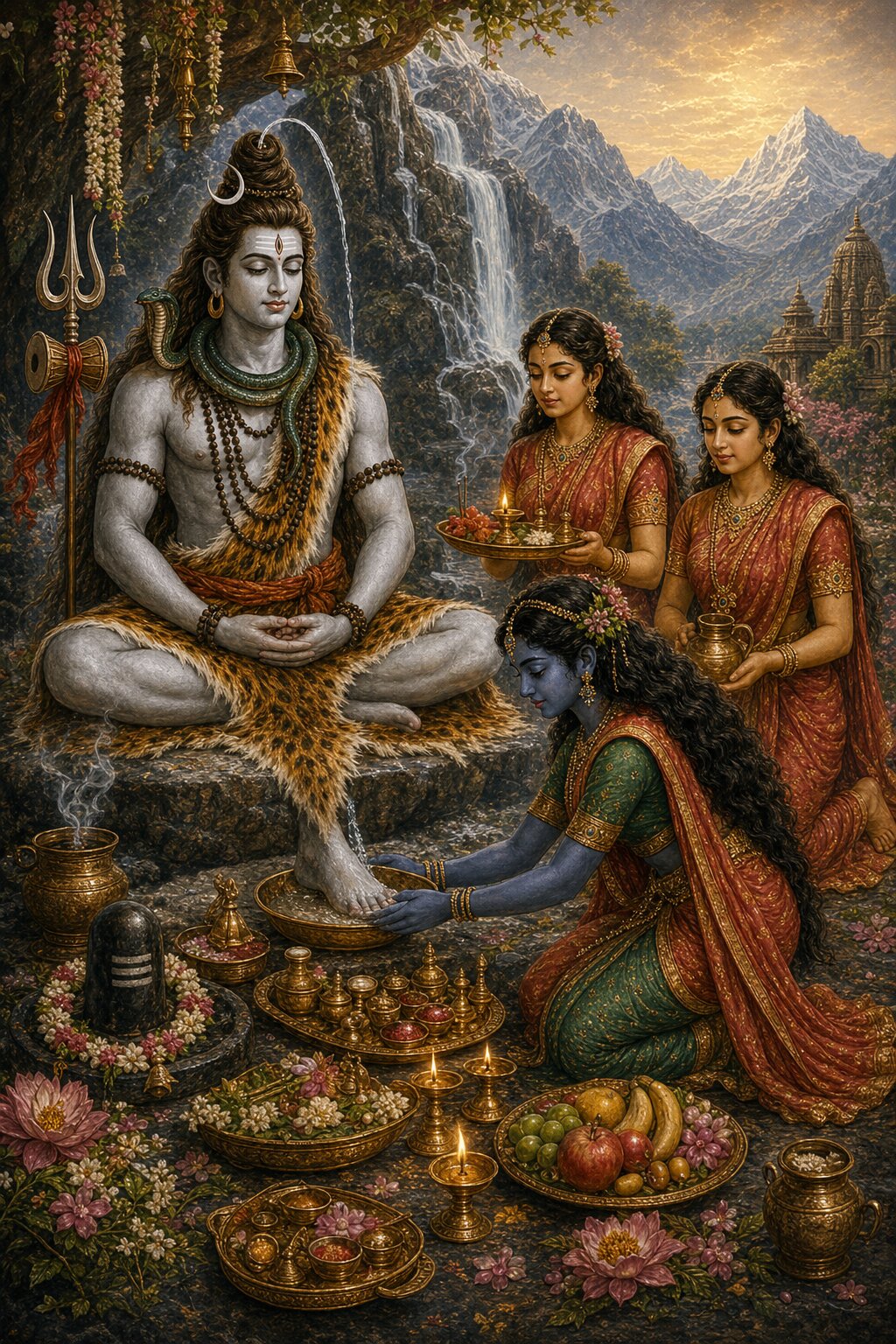
The mountain king Himavan returned home and came each day, with his daughter, for darshan of Shiva. Even without her father, Kali went every day, with her two companions, to Shankara and remained devotedly at his service; by the order of Maheshvara, no attendant, neither Nandi nor any other, ever stopped her. She would wash the feet of Lord Shankara and drink the sacred water of that washing, cleanse his body with a cloth purified in fire, then worship Hara with the sixteen rites of homage, bow again and again at his feet, and return each day to her father’s house. Sometimes she and her companions sang there, songs so finely pitched that love rose in the place where they were sung; sometimes she carried in kusha grass and flowers and the twigs for the fire; and sometimes she only stood and looked at him, and could not get over what she saw.
In this way a long time passed, and still she held her senses in restraint and served exactly as before. Shiva, deep in his meditation, saw her come every day and stayed exactly as he was; he had let his earlier thoughts of her go, and he looked at her without looking at her. She stood near him in a body that could have deluded the sages, and he did not take her for his wife. When Mahadeva saw her ceaselessly ready in his service, his heart melted with compassion, and within himself he reflected, ‘When this Kali performs such austerity and such vows that not a seed of pride remains in them, only then shall I take her hand.’ Thinking thus, the great yogi Bhutanatha settled into meditation, and no other thought came near him; and Kali, contemplating his form each day, stayed absorbed in her service with the finest devotion. So the daughter of the mountain king passed into the service of Shiva, and that hidden purpose of the gods moved slowly toward its fruit.
Source: Shiva Purana (Gita Press, Sankshipta Shivapurananka), Rudra Samhita (Parvati Khanda)