On this page
Vibhishana’s Counsel and Lakshmana’s March toward Nikumbhila
Vibhishana had finished speaking, and Rama had not heard him. The words had reached his ears and gone no further. The grief that had held him since the moment he believed Sita dead was still lying on him like a weight of wet earth, and what the rakshasa had just laid before him, the whole plan of it, had slid off that weight without leaving a mark. He knew only that Vibhishana had said something that mattered. So he gathered himself, drew a breath, and turned to the one ally in Lanka who could read the enemy from the inside, seated at his side with Hanuman standing close by. “Vibhishana,” he said, “I want to hear it again. Tell me once more what you wished to tell me. Say it so that I take it in this time.” Vibhishana, who had a gift for speech, went back over what he had said before. “The moment you gave the order I set the army in order exactly as you commanded. Every division has been separated and drawn up in a ring, and each of the troop-leaders stands at his own post in the order of his rank. That much is done. Now hear what remains. When you suffer for no cause, we suffer with you; it goes through every heart in this camp.”
“Let this grief go,” Vibhishana went on, and his voice hardened as he said it. “It came into you without a reason, and what it does is feed the enemy’s joy, so shed this anxiety along with it. Put your effort into the work and let your spirit rise to it, if Sita is to be won back and the rangers of the night wiped out. Now listen to counsel that will serve you. Ravana’s son Indrajit has gone to Nikumbhila. That is his sanctuary, the ground under the great banyan tree where he pours his oblations into the fire, and he has gone there to finish a rite. Let Lakshmana go against him with a large army and kill him there. Lakshmana carries a mighty bow that curves into a full circle when he draws it, and he has never lost a fight; the arrows from that bow are as deadly as a serpent’s venom, and they are enough to bring Ravana’s son down. Understand what is at stake. Brahma, pleased with Indrajit’s austerity, has as good as granted him the missile called Brahmashira and a chariot with horses that go wherever his will sends them; the rite at Nikumbhila is what completes the gift. And they say he has already reached the banyan with his army. If he rises from that fire with the rite complete, count every one of us dead.”
“Brahma’s boon holds one door open,” Vibhishana said, “and it is the only door there is. When he gave the gift he spoke a condition to Indrajit himself: ‘The enemy who draws his bow against you while you are still on your way, before you have reached the foot of the banyan called Nikumbhila and before you have propitiated the fire, that enemy will be the cause of your death, O enemy of Indra.’ Those were the words of the ruler of all the worlds, and in them the death of that shrewd rakshasa was written on the day the boon was given. So send Lakshmana, Rama, and send him now, for the killing of Indrajit. When that one falls, count Ravana fallen, and the whole house of his kin with him.”
Rama did not need the danger explained. “I know that terrible rakshasa’s sorcery,” he said. “He knows the Brahma missile. He is intelligent, and he is a master of illusion, and he is strong; in a battle he can throw even the gods into a swoon, Varuna among them. When he rides the sky in his chariot no eye can follow him, any more than it can follow the sun once a bank of cloud has closed over it.” The knowledge of what that enemy could do decided how he would meet him. He turned to Lakshmana and gave the order. “Take the whole army that answers to Sugriva, the king of the monkeys. Take the troop-leaders with Hanuman at their head, and let Jambavan, the lord of the bears, guard you with his own army around you. With all of that about you, kill that rakshasa’s son and the sorcery he leans on. Vibhishana knows every trick he has; he will follow at your heels with his ministers.”
Lakshmana heard the command and took up a second bow, the finest he owned. He was dressed for it already: armor buckled on, sword at his hip, the best of his arrows at his back, the bow in his left hand, and his face bright with a joy that had been waiting a long time for permission. He bent and touched his brother’s feet, and with Vibhishana beside him he made his promise. “Today the arrows from my bow will pierce Ravana’s son and come down into Lanka the way swans come down onto a lotus pond. Today, this very day, the arrows loosed from the string of this great bow will split the body of that violent rakshasa and finish him.” Having said it before his elder brother, he wasted no more of the day. He left at once, wanting nothing in the world so much as Indrajit’s death.
He bowed to Rama’s feet once more, walked the circle around him that a younger brother walks around an elder before a journey, keeping him always on his right, and set his face toward the sanctuary at Nikumbhila that Indrajit held. Rama spoke the mantras of good fortune over him as he went, the old blessings a family gives a man it is sending toward danger, and the mighty prince went quickly, Vibhishana at his side. Behind them came Hanuman with thousands of monkeys around him, and Vibhishana’s ministers, all of them moving fast to keep up. As the great column advanced, Lakshmana came upon the army of Jambavan posted on the road, and it fell in with his own. They covered a long distance. Then, far ahead, the son of Sumitra, the man his friends were glad to see coming, made out the army of the rakshasa king standing ready in its battle order. He came up to Nikumbhila, and there he stopped, bow in hand, and took his stand to conquer Indrajit in the one way that Brahma’s own decree had left open.
With Vibhishana on one side of him, Angada and Hanuman on the other, the prince drove into the enemy’s ranks. It was an army of many kinds thrown together, and it glittered: weapons without a spot of rust on them, banners packed so close they made a second forest, huge chariots in every direction, a mass of terrible force whose speed no one could measure. Lakshmana went into it the way a man forces his way into a wall of darkness, and the darkness closed behind him.
A key to understanding (the place): Nikumbhila is a sanctuary outside the walls of Lanka, a secret sacrificial ground under a banyan tree, and it is where Indrajit goes to earn the last part of what Brahma promised him. By pouring oblations into the fire there, he completes the chariot with horses that answer to his will and the missile Brahmashira, and he gains the power to fight unseen. The boon carried one condition, spoken to Indrajit himself: an enemy who draws a bow against him before he has reached the foot of the banyan and propitiated the fire will be the cause of his death. Everything Vibhishana proposes in this canto rests on striking that unfinished rite in time.
The gist: Vibhishana tells Rama that Indrajit is performing a secret sacrifice at Nikumbhila and will be unstoppable once it is complete. Rama sends Lakshmana against him with Hanuman, Angada, Jambavan, and Vibhishana, who alone knows the rakshasa’s illusions. Lakshmana reaches Nikumbhila and cuts his way into the ranks of the rakshasa army.
Hanuman’s Terrible Slaughter and Indrajit’s Entry into Battle
Once they were inside the enemy’s lines, Vibhishana, the youngest of Ravana’s brothers, gave Lakshmana the counsel that the moment demanded, good for their side and deadly for the other. “You see this army of rakshasas, dark as a monsoon cloud. Set the monkeys on it at once, and let them fight with rocks. Then put your own effort into breaking that great army, Lakshmana. When it is broken, Indrajit will have to show himself, because the army is the screen he hides behind. So while his undertaking at the fire is still unfinished, attack. Cover the enemy with arrows like the thunderbolt of Indra, the king of the gods. Kill that evil-minded, cruel-handed son of Ravana who has given himself to sorcery and made himself the terror of every world.”
Lakshmana, marked from birth with every sign of good fortune, heard him and began to pour arrows into the rakshasa ranks, driving the storm toward the place where Indrajit must be. The bears and the monkeys, great trees in their hands, charged the army standing in its battle order, and the rakshasas came out to meet them, wanting nothing so much as the extermination of the monkey host, with sharp arrows, swords, javelins, and lances. The fight that broke open there was tumultuous, and Lanka on every side rang with the uproar of it. Above the field the sky filled with weapons of every shape, sharp arrows, trees swung high, whole mountain peaks lifted and thrown. The rakshasas, with their misshapen faces and their misshapen arms, aimed their weapons at the monkey chiefs and spread terror, and the huge, strong monkeys and bears answered them with trunks of trees and peaks of rock until the rakshasas were bleeding and afraid.
Word reached Indrajit at the fire that his army was losing heart under a heavy assault, and he stood up from the rite before it was finished. He came out of the darkness that the trees threw over the place where he had been pouring his oblations, his anger roused by the report, and climbed into his chariot, already yoked, already standing ready with the horses in harness. His face was the color of copper and his eyes were red. Armed with his terrible bow and arrows, dark as a heap of collyrium, he looked like Death itself come to end everything. The rakshasas saw him seated in the chariot and closed around him, fast and terrible and eager to fight Lakshmana.
At that moment Hanuman, tamer of his enemies, big as a mountain himself, tore up a huge tree that no ordinary arm could have lifted. He consumed the rakshasa army with it the way the fire at the end of the world consumes everything it reaches, beating the ranks senseless on the field with one trunk after another. Thousands of rakshasas saw the son of the Wind wrecking their army by main strength and turned every weapon they had on him. They came at the mountain that was Hanuman from every side: the ones with pikes struck with pikes, the ones with swords with swords, javelin-bearers with javelins, spearmen with sharp spears, and others with iron bludgeons, maces, bright lances, and the spiked shataghnis by the hundred, steel hammers, terrible axes, the stone-throwing bhindipalas, and when those failed, their own fists, which came down like lightning, and open-handed blows that landed like the thunderbolt. Hanuman went mad with fury in the middle of them and made a great slaughter of them too.
Indrajit watched the son of the Wind, mountainous and unafraid, destroying his warriors, and he spoke to his charioteer. “Drive to where that monkey is. If we leave him alone he will certainly finish every rakshasa we have.” The driver took the chariot, which no one could easily overcome while its master rode in it, straight to Hanuman. Indrajit came close and rained arrows, swords, sharp spears, and axes down on the monkey’s head. Hanuman took those deadly weapons on his own skull, and a great fury seized him, and he shouted at Ravana’s son. “Fight, if you are a hero, evil-minded son of Ravana! You have met the son of the Wind, and you will not go back alive. Fight me with your arms, if you dare a duel on this field. Stand up under my rush, you evil-minded thing, and then you can call yourself the foremost of the rakshasas.”
Indrajit raised his bow to kill Hanuman, and Vibhishana saw it and pointed him out to Lakshmana. “That one on the chariot, the son of Ravana, the famous conqueror of Indra: it is Indrajit himself, and he means to kill Hanuman. Kill him, son of Sumitra. Use your terrible arrows, the ones of matchless workmanship that turn an enemy back and end a life.” Lakshmana looked where Vibhishana pointed, and fixed his eyes on the rakshasa seated in his chariot, huge as a mountain, hard to overcome, terrible in the way he came on.
The gist: At Vibhishana’s counsel Lakshmana rains arrows on the rakshasa army, and a tumultuous battle breaks open. Indrajit rises from his unfinished rite and comes to the field in his chariot. Hanuman slaughters the rakshasa army with a great tree and challenges Indrajit to single combat. Vibhishana points Indrajit out to Lakshmana, and Lakshmana fixes his eyes on him.
The Sharp Exchange of Words between Indrajit and Vibhishana
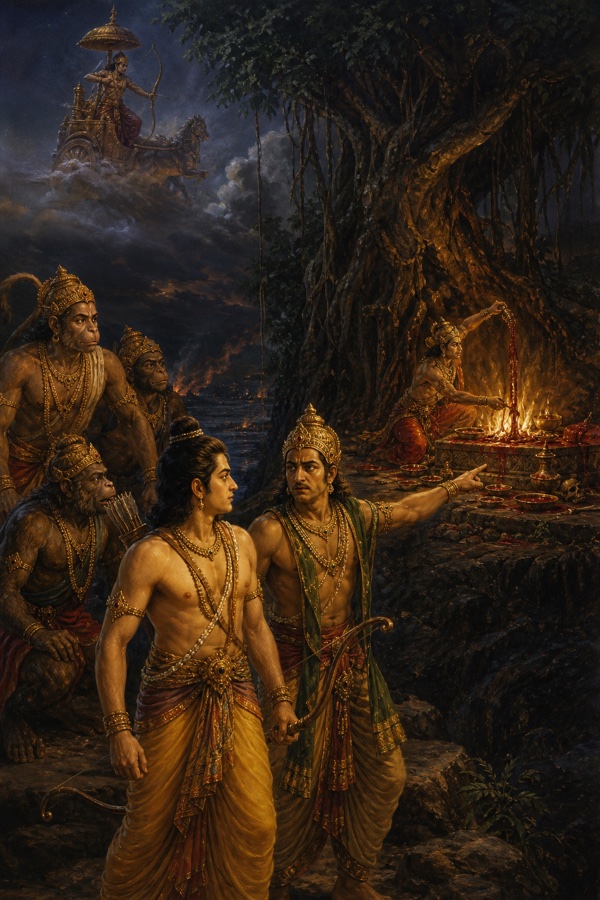
Having said this to Lakshmana, who stood with the bow in his hand, Vibhishana, glad now that the enemy was in sight, took him along and moved quickly. They did not go far. A little way off they went deep into a wide thicket, and there Ravana’s younger brother showed Lakshmana the place where Indrajit was going to pour his oblations into the fire. He pointed to a banyan tree, dark as a rain cloud and terrible to look at, and told him what happened under it. “Here Indrajit makes his offerings to the spirits, and then he goes out to fight. From that moment no living creature can see him. He destroys his enemies unseen from the field, and he binds them with those excellent arrows of his. So destroy him before he reaches this tree. Burn him with your blazing arrows, and his chariot and his horses and his driver with him.”
“So be it,” said Lakshmana, the glad companion of his friends, and he took his stand where he was and drew his wonderful bow to its full length, and the string sang. It sang at the right moment. Ravana’s strong son appeared, seated in a chariot the color of fire, in armor, sword at his side, his ensign flying over him. Lakshmana called out across the ground to the descendant of the sage Pulastya, to a warrior who had never once been beaten in battle. “I challenge you to fight. Come and give me battle, face to face, in a straight contest.”
Indrajit was strong-minded and quick to anger, and he had just seen Vibhishana standing in Lakshmana’s company. The words that came out of him were not for Lakshmana at all. “You were born and raised in this house of Pulastya. You are my father’s own brother. You are my uncle, and I am your brother’s son. How can you hold enmity against your own nephew, rakshasa? There is no feeling for blood in you, no friendship, no pride of birth, no judgment, no brotherly feeling, no dharma. You have turned every virtue upside down. You are pitiable, and the good will blame you for it, because you left your own kind and went to serve the enemy, you evil-minded man. Your slack understanding does not grasp the great difference between the two lives. There is a whole world between them: living among your own people, or living as a stranger’s dependent. Take a stranger with every excellence and a kinsman with none, and the kinsman with none is still the better of the two. A stranger stays a stranger. The man who deserts his own side and joins the other side is killed by those very people once his own kin have been destroyed by their hands. This cruelty of pointing out where I can be struck, and this manliness of bringing Lakshmana to the spot, only a kinsman could manage, youngest brother of Ravana.”
Vibhishana let his brother’s son finish, and then he answered him. “Why do you talk in this twisted way, rakshasa, as though you had never known what kind of man I am? Give up this harsh speech; I am your elder, and you owe me that much, impious son of Ravana. I was born into a race of rakshasas whose deeds are cruel, that is true, and my nature is goodness, the first of the virtues human beings can have. It is my own, and it is no rakshasa’s nature. Cruelty gives me no pleasure. Unrighteousness gives me no pleasure. And yet, tell me, how can a brother throw a brother out of his house for being made differently from himself? A man whose resolve is set on sin, whose conduct has left the path of dharma, that man one abandons, and one is happy for it, the way a man is happy when he has shaken a venomous snake off his hand.”
“The wise say that an evil-minded man who is set on seizing what belongs to others and on taking another man’s wife should be shunned like a house in flames,” Vibhishana said. “Taking another’s property, taking another’s wife, and the habit of suspecting one’s friends: those three faults lead to ruin. And your father has more than three. The terrible slaughter of great seers, war on all the gods, arrogance, a quick temper, a hatred that never cools, and a refusal to be told anything: those failings, which end a man’s life and his lordship together, have covered the good qualities of my eldest brother Ravana the way clouds cover a mountain. For those vices I abandoned my brother, your father. Now hear what follows from it. This city of Lanka will not stand, and you will not, and neither will your father. You are proud, foolish, ill-mannered, and already caught in the noose of Death, so say whatever you like, rakshasa. This calamity has come to you today because you spoke to me with harshness: you will never reach the banyan tree now. You have raised your hand against Lakshmana, and after that no one survives. Fight the prince here on this field. When Lakshmana finishes you and you go down to Yama’s house, you will have done the gods a service, and they will be satisfied. Bring out all the strength you have. Empty your quivers and use up every weapon you own. Once you have come into the range of Lakshmana’s arrows, you will not go back alive, and neither will your army.”
A key to understanding (the concept): This exchange is one of Valmiki’s set pieces of ethical argument. Indrajit speaks for blood: a kinsman without virtue still outranks a virtuous stranger, and a man who deserts his own side dies at the hands of the side he joined. Vibhishana answers from dharma: a brother who has turned to sin is rightly abandoned, and the man who abandons him is as glad as one who has shaken a snake off his hand. Each side argues its own case with full conviction; that is the mark of Valmiki’s war poetry, which lets even the enemy state his reasons.
The gist: Vibhishana shows Lakshmana Indrajit’s secret sacrificial ground and tells him to kill the rakshasa before he can reach the banyan tree. Indrajit appears and curses Vibhishana as a traitor to his own blood. Vibhishana answers by the standard of dharma that abandoning a sinner is right, names the faults that have ruined Ravana, and tells Indrajit to fight Lakshmana and die.
The Fierce Arrow-Battle of Lakshmana and Indrajit
Vibhishana’s answer put Indrajit past the reach of words. He flung a few more harsh ones anyway and came on. His bow was enormous, long and strong and heavy with the force stored in it, his arrows were the kind that end an enemy, and he sat in a huge chariot, richly worked, drawn by black horses, with his sword and his other weapons raised: Death, come to destroy everything, could not have looked more like himself. Then he saw Lakshmana. The prince was riding on Hanuman’s shoulders, and his own splendor lit him so that he looked like the sun coming up over the eastern hill. Indrajit’s rage found its voice, and he spoke to Lakshmana, to Vibhishana beside him, and to the tigers among the monkeys all at once. “Look at what I can do. Today, on this field, you will stand under a hail of arrows from my bow that no one can get near, like a downpour out of the clouds. The arrows from this mighty bow will burn your bodies the way fire burns a heap of cotton. I will pierce you with sharp arrows, and with pike and javelin and lance I will send every one of you to Yama’s house today. Who dares to stand in front of me when I shoot with this quick hand, thundering like a cloud? Have you forgotten the last time? In that first fight I laid you both flat with arrows like the thunderbolt and the ashani, and you lay senseless on the ground with your foremost warriors, Sugriva and the rest. Either the memory has gone out of your head, or you are plainly on the road to Yama already, that you have come to fight me now, when I am as angry as a venom-fanged snake.”
Lakshmana heard the rakshasa king’s boasting out, and it made him angry, and the face he turned to Indrajit had no fear in it. “You have announced the successful end of your undertaking, rakshasa, and the undertaking is a hard one. The clever man is the one who finishes what he begins with his hands. Talking about it finishes nothing. You proclaim, in words, that you have beaten me, which no one has yet managed, and because you cannot do it, you tell yourself it is done. That is the whole of your victory, you evil-minded thing: a sentence. And the path you chose, fighting where no one can see you, is the path thieves walk. Heroes do not walk it. Now I am standing inside the range of your arrows. Show me this famous prowess today. What use is a tongue?”
Indrajit took hold of his dreaded bow and loosed sharp arrows in answer. They came fast, deadly as snake venom, and they hit Lakshmana hissing like serpents. They went into him. Ravana’s son riddled the body of the prince who bore every auspicious mark, and Lakshmana stood there bathed in blood, cruelly pierced in every limb, and shone the way a flame shines when the smoke has cleared away from it. Indrajit looked at his own work and liked it. He came closer, let out a great cry, and said, “These sharp, feathered, deadly arrows from my bow will take your life today, son of Sumitra. When I have struck you down, packs of jackals will come to you, and hawks, and vultures. That stupid Rama will see you killed by me this very day, his devoted little brother, a kshatriya in name only, ignoble from the day you were born. He will find you with your armor fallen off, your bow flung away, and your head cut from your shoulders.”
Lakshmana knew exactly what he was there to do, and he gave that harsh speech the answer it deserved. “Give up this strength of speech, rakshasa, this strength that is all empty words. You do cruel things and you think foolish ones. Why go on with this idle talk? Do what you say, and do it well. Why boast before the deed? Do the deed you boast of, so that I have a reason to believe you. And I will kill you, you eater of men, without one harsh word, without reviling you, without a single boast. Watch.” He said it, and he drew five steel arrows back to his ear and drove them with tremendous force into the rakshasa’s chest. They had beautiful feathers at the tail to speed them, and they looked like flaming serpents, and standing in Indrajit’s breast they shone like the rays of the sun.
The arrows struck, and rage struck with them. Indrajit answered with three well-aimed arrows of his own, and now the fight was joined in earnest, a lion among men against a lion among rakshasas, each wanting nothing in the world so much as the other’s defeat, and it was as dreadful and tumultuous as any fight the field had seen. Both of them were brave and rich in strength, both famous for what they could do, both hard to conquer, with no equal in might or in courage; they struggled like two planets in the sky, like Indra and Vritra in the old war, like two lions. Standing their ground, pouring out streams of arrows, the jewel of men and the jewel of rakshasas fought with their whole hearts. Then the son of Dasharatha, scourge of his enemies, fitted arrows to the string, hissing with wrath like a serpent, and shot at the rakshasa king, and at the twang of Lakshmana’s bowstring Indrajit’s face lost its color, and he stared at Lakshmana. Vibhishana saw the change. He called out to the son of Sumitra in the middle of the fight: “I read the signs on his face, the pallor: this son of Ravana is already in despair. There is no doubt of it. Now finish him, and quickly.”
Lakshmana fitted arrows like venomous snakes to his bow and sent them into Indrajit, and they struck his body like Indra’s thunderbolt, and for a moment the rakshasa stood stupefied where he was, every sense in him wrenched out of its place. He came back to himself slowly. When his senses returned he saw Lakshmana standing immovable on the field, and he came toward him with his eyes gone crimson with anger and spoke to him again. “Do you not remember my prowess in our first encounter, when I bound you together with your brother and you writhed on the ground? In that great battle I laid the two of you low with arrows like the thunderbolt and the ashani, and you lay senseless with the best of your warriors. Either the memory has left you, or you want to go to Yama’s house, since you are trying to overpower me. If you did not see what I can do at our first meeting, I will show you today. Stand where you are, and do not move.”
As he said it he pierced Lakshmana with seven arrows and Hanuman with ten sharp-edged ones of the finest make, and then, with his rage doubled, he put a hundred into Vibhishana. Lakshmana, Rama’s younger brother, a bull among men, saw what Indrajit had done and did not care in the least. He laughed out loud. “This is nothing,” he said, and he took up dreadful arrows and shot them at Ravana’s son with a face that showed no fear at all. “Heroes on a battlefield do not strike like this, ranger of the night. These arrows of yours are light. They have no strength in them. They are a pleasure to me. Champions who come looking for a fight do not fight this way.” And the archer covered Indrajit with arrows as he spoke. Under them the heavy golden armor on Indrajit’s body came apart and fell in pieces inside the chariot, like a mass of stars falling out of the sky, and the champion, his mail shattered by the steel, stood wounded and bathed in blood, and looked like the sun at morning.
Indrajit, fully roused now, drove a thousand arrows into Lakshmana on that field, and Lakshmana’s celestial armor was shattered in its turn. Now neither of them had anything between his skin and the other’s arrows. The two tamers of enemies attacked and answered, breathing hard, again and again, fighting with everything they had, their limbs torn open by arrows and their whole bodies running with blood. For a long time the two heroes, both of extraordinary courage, both masters of the craft, tore each other with whetted shafts, each straining for his own victory. Covered with the arrows stuck fast in their bodies, their armor and their standards torn to pieces, they stood and streamed hot blood the way two waterfalls stream hot water. They shot a terrible hail with a dreadful clamor, like two dark clouds of the world’s end pouring a hard rain from the sky, and neither turned his back on the field, and neither felt tired. Bringing out their missiles time after time, those two, the foremost of all who use missiles, wove nets of arrows large and small across the airspace, and the way they shot, agile and graceful and without a single fault in it, made the struggle between the man and the rakshasa a terrible thing to watch. The appalling sound of their palms striking the bowstrings could be told apart from the din, and like a violent thunderstorm it made people tremble; the clamor of those two at their work was the rumbling of two dreadful clouds. The steel arrows went through them; arrows that had passed through one body and out of it lay on the field covered in blood and sank into the earth, and others met the enemy’s in the air in their thousands, and shattered them, and were shattered. The mass of spent arrows spread over the ground looked like the sacred kusha grass strewn on the altar between the two fires of a sacrifice, the garhapatya and the ahavaniya, and the two of them were the fires. Their wounded bodies shone like the kimshuka in flower and the silk-cotton tree in full blossom when its leaves have dropped; with so many arrows sunk into them they looked like two mountains overgrown with trees, and bathed in blood they looked like two blazing fires. The time went by, and neither turned away from the fight, and neither gave in to exhaustion. Then Vibhishana, who had been watching the prince for every sign of weariness, reached the place where the fighting was and took his stand there, to ease the fatigue of a man who could not be beaten in the front of a battle, and to give him what a friend gives.
The gist: A long, evenly matched, terrible arrow-battle breaks open between Indrajit and Lakshmana. Each pierces the other, breaks his armor, and draws his blood, and between the volleys Indrajit boasts and Lakshmana answers him. Vibhishana sees Indrajit’s face turn pale, reads despair in it, and comes to stand beside Lakshmana to ease his fatigue.
Vibhishana’s Assault and the Killing of Indrajit’s Charioteer and Horses
The man and the rakshasa loved fighting, and they were going at each other like two elephants in rut, each set on the other’s defeat. Vibhishana, Ravana’s youngest brother, strong and brave, wanted to watch that fight, and he had a fine bow in his hand, so he took his position at the front of the battle where he could see it. Then, standing firm, he drew the string of his great bow and shot long, sharp-pointed arrows into the rakshasas. They fell thick and fast, and they struck like fire, and they tore the rakshasas apart the way thunderbolts split mountains. His own followers, the finest of rakshasas, who had left Lanka with him and stayed with him, went into the brave rakshasas of the other side with pikes and swords and sharp-edged spears, and with those warriors around him Vibhishana looked like a lord of elephants among proud young tuskers.
The monkeys wanted rakshasas to kill, and Vibhishana, who knew what a moment needed, gave them the words to go with the wanting. “Here in front of you stands the last support Ravana has, and this is all that is left of his army. Why are you standing idle, monkey chiefs? Once this wicked one is finished at the front of the battle, everything Ravana has left, except Ravana himself, is as good as dead. Count the ones who are gone. The hero Prahasta is dead. Nikumbha, with all his strength, is dead. Kumbhakarna is dead, and Kumbha, and the night-ranger Dhumraksha; Jambumali and Mahamali; Tikshnavega and Ashaniprabha; Suptaghna and Yajnakopa; Vajradamshtra, Samhradi, Vikata, Arighna, Tapana, and Manda; the two named Praghasa; Prajangha and Jangha; Agniketu, whom no one could overcome, and the valiant Rashmiketu; Vidyujjihva and Dvijihva; Suryashatru, Akampana, and Suparshva; Chakramali and Kampana; and the two great warriors Devantaka and Narantaka. You have killed all of those chiefs, every one of them a rakshasa of enormous might. In killing them you have swum across an ocean. What remains is a puddle in a cow’s hoofprint. Step over it. This much and no more of the enemy is left for you to conquer, and every rakshasa who was proud of his strength died the moment he met you.”
Then Vibhishana said the thing that was hardest for him to say. “It is not right for me to bring about the death of my brother’s son. I am his uncle, and to him an uncle is as good as a father, and he is as good as a son to me. For Rama’s sake I could throw every tenderness to the winds and kill him even so. And yet, each time I wish for it, my eyes fill with tears and I cannot see. So let the mighty-armed prince Lakshmana be the one who finishes him. You, monkeys, come together and destroy the army that stands around him.” The words of that glorious rakshasa lifted the monkey chiefs, and they lashed their tails for joy, and roared like lions over and over, and sent up the warbling cry peacocks make when they see the clouds come. Jambavan, ringed by his own troops, and the monkeys with him, began to strike the rakshasas down with stones, with their nails, and with their teeth.
The rakshasas, huge in strength and armed with every kind of weapon, saw the lord of the bears making havoc in their ranks, and they put their fear aside and closed around him, striking at him from every side with arrows, sharp axes, sharp-edged spears, staffs, and iron clubs. That vehement encounter between the monkeys and the rakshasas, with the fury in it and the clamor over it, was as terrible as the war the gods and the demons fought in the oldest days. Hanuman, enraged and unapproachable, set Lakshmana down from his back, tore a sal tree out of a mountain, and went to killing rakshasas by the thousand himself. Indrajit, destroyer of champions, let out a terrible roar and rushed at Lakshmana again, and the two of them fell to it: each showering the other with streams of arrows, each covering the other over and over the way clouds cover the sun and the moon at the end of summer. They were so fast that no eye could catch the separate motions of what they did, when they passed the bow from one hand to the other, when they gripped it and the string in the fist, when they drew the arrows from the quiver, chose them, set them to the string, drew the bow to its length, loosed, and struck. The sky was covered on every side with the streams of arrows their bows drove out, until nothing could be told from anything else. Lakshmana met Indrajit and fought him, and Indrajit met Lakshmana and attacked in his turn, and as the two of them contended, the followers on both sides who were not in the fight were being cut down, and a terrible confusion spread through both armies. The sharp arrows they shot with such speed packed the air so thickly that no empty space was left, and the field went dark; the four quarters and the points between them were overspread with shafts flying in their hundreds, and everything was shrouded, and it was a dreadful thing to see.
The sun of a thousand rays went down below the horizon, and shadow lay over everything, and now the blood ran in streams, in thousands of streams, across the field. The hideous flesh-eaters, the vultures and the jackals, gave out their frightful cries. No wind blew. Fire would not burn. “May all be well with the worlds,” murmured the eminent sages who were present, and the gandharvas who happened to be there fled in distress with the charanas, the singers of heaven. On the field, Lakshmana put four arrows into the four black horses yoked to Indrajit’s chariot, the ones decked with ornaments of gold. Then he took another arrow, gilded, sharp, of the broad-headed kind called bhalla, beautifully plumed, a match for Indra’s own weapon, and shot it with his full strength, and it rang as it left the string with the clang of his gauntlet against the bow. It took the head off Indrajit’s charioteer even as the man was wheeling the chariot around, and it took it off clean. The driver was dead, and Indrajit, the son of Mandodari, whose energy had no bottom, did the driving himself and worked the bow at the same time. Everyone who saw it marveled at it; to fight and to drive at once in the middle of such a struggle was a wonder.
It was also a weakness, and Lakshmana was too quick to miss one. When the rakshasa’s hands were busy with the horses, Lakshmana put whetted arrows into him, and when he went back to the bow, Lakshmana shot the horses. Indrajit ranged the field as though nothing could daunt him, and through every gap the son of Sumitra, who wasted no motion, wounded him with streams of arrows. But the sight of his charioteer lying dead did something to Ravana’s son. The zest went out of him. They say he grew despondent, and the monkey commanders saw the dejection on his face and were delighted, and shouted Lakshmana’s name. Four monkey chiefs could not stand still any longer: Pramathi, Rabhasa, Sharabha, and Gandhamadana. Warriors of remarkable valor and terrible strength, all four sprang at the same instant onto the four excellent horses of Indrajit. Under monkeys as huge as mountains the horses’ mouths ran with blood; crushed and mutilated, they sank lifeless to the ground. The four had killed the horses and smashed the great chariot, and they bounded back again as fast as they had come and stood at Lakshmana’s side. Indrajit leaped down from a chariot whose horses were dead and whose driver was dead already, and assailed Lakshmana with a hail of arrows; and Lakshmana, who could stand comparison with Indra himself, mangled him with volley after volley as he shot on foot, now that the stately horses were gone.
A sub-tale: The long roll of rakshasas in Vibhishana’s rousing speech, from Prahasta and Kumbhakarna to Akampana, Devantaka, and Narantaka, is a roll of the dead: by his count every warrior on it has already fallen to the monkeys and the two princes since the siege began. Vibhishana is counting for the monkeys what the war has cost Lanka piece by piece, so that they see what is left: Indrajit in front of them, and Ravana behind the walls. The list is the war’s ledger, read aloud at the moment it matters most.
The gist: Vibhishana and Hanuman slaughter the rakshasa army, and Vibhishana rouses the monkeys by naming every rakshasa chief already slain. After sundown, in the fierce night battle, Lakshmana strikes off the head of Indrajit’s charioteer; Indrajit drives the chariot himself, but four monkey chiefs crush his horses and smash his chariot, and he is left fighting on foot.
The Death of Indrajit
Indrajit stood on the ground with his horses dead behind him, and his rage, which had nowhere else to go, flamed into fresh spirit. The two archers closed, each wanting to kill the other with arrows, the way two lordly elephants close when they have come out to conquer. The rakshasas and the monkeys were rushing this way and that around them, each killing the enemy in front of him, and neither side abandoned its master in the fight. Then Indrajit did a shrewd thing. He praised his rakshasas, cheered them, showed them a glad face, and said, “Jewels among the rakshasas, this darkness has closed over every quarter. In it there is no telling your own army from the enemy’s. Fight boldly, and confound the monkeys. I am going to get another chariot, and I will be back on this field. See to it that those monkeys, brave as they are, do not fight me while I am on my way into the city.” So saying, with the monkeys thrown off his scent, Ravana’s son, killer of his enemies, went deep into Lanka to find himself a chariot.
He had a splendid one made ready, worked with gold, stocked with darts and swords and arrows, yoked to excellent horses, and driven by a charioteer who could read his horses’ minds and who gave good counsel besides, and Indrajit, victor of so many fights and rich in energy, climbed into it at once. Surrounded by picked battalions of rakshasas, and driven by a force he could not see, which was destiny, the gallant son of Mandodari came out of the city a second time. He came out of the gate with his swift horses and fell on Lakshmana and Vibhishana with tremendous impetuosity. Lakshmana saw Ravana’s son seated in a chariot again, and so did the monkeys, for all their strength, and so did the rakshasa Vibhishana, and they marveled at the quickness of that shrewd enemy. Indrajit, in a rage, struck the monkey commanders down by the hundred and the thousand with streams of arrows; he drew his bow into a full circle and showed a supreme agility, and the monkeys, brave as they were, could not stand under the steel, and they ran to Lakshmana for refuge the way created beings run to Brahma, the lord of created beings, for protection. Lakshmana, the delight of the Raghus, burned with the anger the fight had lit in him, and he cut Indrajit’s bow in two, so fast that the hand could not be seen doing it. Indrajit seized another bow and strung it in haste. Lakshmana split that one too, with three arrows.
With the rakshasa’s bow in pieces, the son of Sumitra put five arrows deadly as snake venom into his chest. They went in through the front of him and out through the back, and fell to the ground behind him like huge red serpents. Indrajit vomited blood from his mouth, and he took up his best bow, a stouter one than the last, with a thick string, and with tremendous agility he sent hail after hail of arrows at Lakshmana, like Indra loosing the rains. Lakshmana, tamer of enemies, met that hail without a flicker and stopped it, though it was as hard to resist as anything ever loosed from a bow, and then, with no fear in him at all, he showed Ravana’s son what he himself could do, and it was marvelous. In a fury he pierced every rakshasa standing on the field with three arrows apiece, so fast that it seemed one motion, and hit Indrajit hard with streams of them. Indrajit, grievously wounded by an enemy who was too strong for him, sent arrow after arrow at Lakshmana without pause. Lakshmana, foremost of chariot-warriors, whose mind never left dharma, tore those arrows out of the air with his own before they reached him, and with a broad-headed bhalla he cut the head off the charioteer of Indrajit’s chariot, the second driver to die under him that night. The horses, with no one to drive them, went on drawing the chariot without panic, wheeling in circles as they advanced, which was a wonder in itself. Then Lakshmana, in his anger, put arrows into those horses too, and threw them into a terror. Indrajit could not bear what he was watching, and he put ten arrows into the furious son of Sumitra. Those arrows were like thunderbolts, and they were deadly as a serpent’s venom, and they gave way when they reached Lakshmana’s armor, which shone like gold.
Indrajit understood that this armor could not be pierced, and his rage went up another degree. Showing his speed with weapons, he put three beautifully plumed arrows into Lakshmana’s forehead. They stood there in his brow, and Lakshmana, who loved a fight, looked at the front of the battle like a mountain with three peaks. Wounded as he was, he stretched his bow and put five arrows into Indrajit’s face, into the face that the splendid earrings adorned. The two champions, both of terrible prowess, both rich in strength, both armed with huge bows, went on striking each other with arrows, and smeared with blood from head to foot they shone on that field like two kimshuka trees in flower. Then Indrajit turned his bow a moment from Lakshmana. He struck Vibhishana in the face with three iron-tipped arrows, and put one arrow into each of the monkey commanders in turn. That was enough for Vibhishana. In his fury he brought his mace down on the horses of the evil-minded son of Ravana and killed them where they stood. Indrajit knew the horses were dead and the driver dead before them, and he leaped down from the chariot and hurled his javelin at his uncle. Lakshmana, who added to his mother Sumitra’s joy every day of his life, saw it flying at Vibhishana and cut it into ten pieces with his sharp arrows and brought it down. Then Vibhishana, angry now at the nephew whose horses he had killed, drew his strong bow and dug five arrows into his chest that struck as hard as lightning. They went through his body; they were plumed with gold and flew straight, and they came out the other side stained with his blood, and lay there like huge red serpents.
The uncle had drawn the nephew’s blood, and Indrajit, standing among his rakshasas in a fury with him, took up an excellent arrow that Yama, the god of retribution, had given him. Lakshmana saw the mighty arrow go to the string, and he took up one of his own to answer it, an arrow that Kubera, the lord of wealth, had given him in a dream, which even gods and demons found hard to resist, which Indra himself, the ruler of the gods, could not easily have overcome. The two of them drew their excellent bows to the full with arms like iron bludgeons, and the bows gave out a piercing sound like a pair of cranes, and the two arrows shone on the strings as they were pulled back. Loosed, they met head to head in the air with a violence that lit the sky. Out of that impact between two shafts of such formidable aspect a fierce fire broke out, with smoke and a shower of sparks, and the arrows struck each other like two great planets colliding and flew into a hundred pieces each and fell to the ground. Both warriors, seeing their arrows brought to nothing at the front of the battle, were ashamed, and both were provoked past bearing. Lakshmana, enraged, took up the missile presided over by Varuna, the lord of the waters. Indrajit, who knew that craft as well as anyone alive, answered with the missile of Rudra, the god of destruction, and the Raudra missile made the most wonderful weapon of Varuna void. Provoked, Indrajit, the victor of so many combats, put to his bow a flaming missile of the fire-god that looked as if it meant to burn up the world. Lakshmana turned it aside with the missile of the sun. Indrajit saw his weapon repelled and was filled with anger, and he seized the sharp weapon of the asuras, the demons’ own missile, a thing no created being could turn aside and that could destroy every other weapon. The moment it was on the string, out of it came shining kutamudgaras, hidden hammers, and pikes, and stone-throwing bhindipalas, maces, swords, and axes. Lakshmana, with his glory undimmed, turned that one aside with the missile of Maheshvara, the mighty Lord Shiva.
What followed between them was a wonder that made the hair stand on end. Created beings standing in the air gathered around Lakshmana to guard him, and above the terrible fight between the monkeys and the rakshasas, with its frightful yells, the sky was so crowded with beings that stood there astonished that it looked beautiful. The seers of the Vedic mantras, the ancestors, the gods, the gandharvas, the eagles, and the serpents, with Indra at their head, the god who had once performed a hundred horse sacrifices to earn his throne, guarded Lakshmana on that field. And Lakshmana, Rama’s younger brother, put to his bow the arrow that would settle it. It struck like fire. It had lovely feathers, it was well-jointed and skillfully made and decked with gold, it could destroy the body of an enemy, and it was hard even to bear, let alone keep off; it was a terror to rakshasas and as deadly as the venom of poisonous snakes; hosts of gods had honored it. It was the arrow with which Indra, the god of the green horses, whose energy never ran dry, had conquered the demons in the war between gods and demons in the old days.
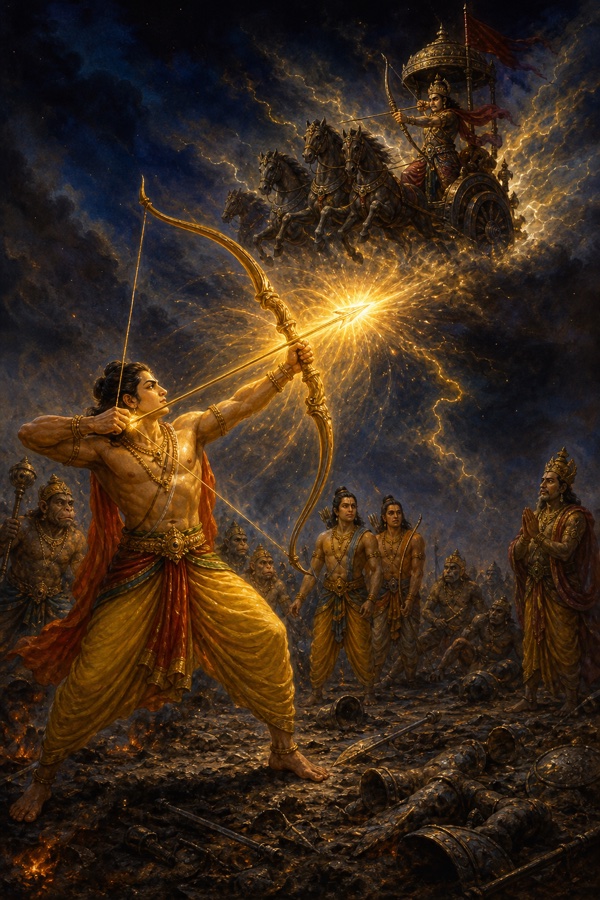
Fitting to his fine bow the missile presided over by Indra, the ruler of the gods, the foremost of all arrows, an arrow that had never once been bettered in a contest, Lakshmana drew it back with the string to its full length, and before he loosed it he spoke to the deity who lived in the arrow, a prayer aimed at one purpose: “If Rama, the son of Dasharatha, has set his mind on dharma, if he is true to his promise, and if there is no one to rival him in prowess, then kill this son of Ravana.” Having said it, he drew the straight-flying arrow to his ear, charged it with the missile of Indra, and let it fly at Indrajit. It severed the shining head of Indrajit, with its flaming earrings, with its helmet and all, from the trunk, and brought it down to the surface of the earth. Cut from the shoulders and bathed in blood, that huge head of the rakshasa lay on the ground shining like gold. The son of Ravana, killed, fell to the earth in his armor and his helmet, and his bow lay thrown down beside him. Vibhishana and the monkeys shouted for joy, as the gods shouted on the day the demon Vritra died, and in the heavens a cry of victory went up from the mouths of the gods and the great seers, and from the gandharvas and the apsaras of heaven.
Indrajit had fallen, and the rakshasa army, seeing it, began to look for a way out, while the monkeys, with a triumphant air, harried them. The rakshasas flung down their weapons under the monkeys’ blows and ran for Lanka, stupefied, throwing away their spears, their swords, and their axes as they went, fleeing in their hundreds in every direction in a panic. Some of them, terrified, got deep into Lanka; others dropped into the sea; others took refuge on the Trikuta mountain. Of the thousands of rakshasas who had stood around Indrajit, with Indrajit lying killed on the field, not one was to be seen. Sunbeams stay nowhere once the sun has gone under the horizon, and the rakshasas scattered in the same way when Indrajit fell. That mighty-armed warrior, thrown down and shorn of life, looked like the sun when its rays have cooled, like a fire that has gone out. With Indrajit dead the world’s suffering eased in a large measure, and it felt a thrill of delight, because its enemy was destroyed; Indra rejoiced with all the eminent seers that the rakshasa of sinful deeds was finished. In the heavens the great drums of the gods were heard, and the melody of the apsaras dancing, and the songs of the gandharvas, and the gods sent down showers of flowers, for the death of Indrajit was a marvel to them. The dust that had hung over the field settled, now that the fighting had stopped of itself. The waters ran clear and the sky came clean. Gods, gandharvas, and danavas, all gratified, came to the place together and said, “Now let the Brahmins move about without fear, for their tormentor is gone.”
The monkey commanders saw that bull among rakshasas, who had had no rival in battle, finished at last, and they exulted in the victory. Vibhishana, Hanuman, and Jambavan, the commander of the army of bears, congratulated Lakshmana, still streaming blood, on what he had done. Roaring, bounding, thundering, the monkeys who had found a reason to rejoice stood around Lakshmana of the house of Raghu, wagging their tails and lashing the ground with them, and gave out the cry, “Victory to Lakshmana!” They embraced one another, glad at heart, warriors of many virtues, and fell into affectionate talk about Rama. The monkeys, Lakshmana’s dear friends, rejoiced over a feat on the field that no one else could have done, and in heaven the gods felt a supreme delight, because the adversary of Indra was dead.
A key to understanding (the concept): This duel of missiles ties each weapon to a presiding deity, and each is stilled only by its counterpart: Lakshmana’s Varuna missile fails against Indrajit’s Raudra, Indrajit’s fire missile against Lakshmana’s solar one, and the demons’ Asura missile against the missile of Maheshvara, who is Shiva. The Indra missile is decisive, and Lakshmana looses it only after a solemn act of truth on Rama’s dharma, his fidelity to his word, and his matchless prowess. The arrow that kills Indrajit is charged with a prayer, and the power of the weapon rests, in the last account, on the truth of the man it is spoken for.
The gist: Indrajit goes back into Lanka for a fresh chariot, returns, and fights a fearsome missile battle. Varuna and Raudra, fire and sun, Asura and Maheshvara cancel each other out. At last, with an act of truth on Rama’s dharma and honesty, Lakshmana strikes off Indrajit’s head with the missile of Indra. Gods and monkeys raise a shout of joy, and the rakshasa army flees.
Rama’s Joy and Lakshmana’s Healing by Sushena’s Medicine
Lakshmana stood on the field with every limb of him bathed in blood, and he was glad. He had killed Indrajit, the conqueror of his enemies, in open battle, and no one could take that from him. He gathered Jambavan, Hanuman, and all the monkeys and went back quickly, out of the fighting, to the place where Sugriva and Rama were, and he needed Vibhishana and Hanuman to lean on to get there. He walked the reverent circle around Rama and greeted him, and then the son of Sumitra stood rooted beside his eldest brother, the way Vamana, the younger brother of Indra, stands beside Indra, the ruler of the gods. Vibhishana had come with a face so cheerful that it announced the news before he opened his mouth, and then he opened it and told Rama of the ghastly end of Indrajit: that Lakshmana had cut the head from the shoulders of Ravana’s son.
Rama heard that Lakshmana had brought down Indrajit, and the joy that went through him was immense, and the words he found for it were these: “Well done, Lakshmana. I am gratified by what you have done. You have accomplished a thing that no one else could have accomplished. Know this for certain: with Indrajit destroyed, the victory is already ours.” Lakshmana had added to the glory of his house and could not bear to hear himself praised for it, and Rama, seeing him abashed, breathed in the scent of his brother’s head the way an elder blesses a child, drew him by force onto his lap and set him there, and held him, wounded as he was, in his arms, and gazed again and again, with tenderness, at the brother fortune had favored. Lakshmana was in torment from the arrows still lodged in his body; his flesh was lacerated, he was breathing hard from the exertion, and every breath hurt him. Rama breathed the scent of his head once more, stroked him quickly, and steadied him, and the bull among men said, “You have done a thing that is supremely good for us, you whose deeds are beyond other men. I count Ravana killed in combat now that his son is finished. Today I am the victor, because that evil-minded enemy of ours is gone. By good fortune you have severed the right arm of the merciless Ravana, for Indrajit was the support he leaned his whole weight on. And Vibhishana and Hanuman did a remarkable thing on that field too.”
“It took three days and their nights to bring that hero down,” Rama said, “and today I am rid of my enemy. Now Ravana will come out. He will hear that his eldest son has been struck down with a great formation of troops around him, and he will come out with a vast formation of his own. Then I will surround that overlord of the rakshasas, tormented by his son’s death, with a huge army as he sallies, and I will finish him, hard as he is to conquer. With you to protect me, Lakshmana, neither Sita nor the earth will be hard to win back, now that the conqueror of Indra has been killed in battle.” He hugged his younger brother again and steadied him again, and then he turned, joyful, to the monkey Sushena, the chief who knew remedies. “Treat Lakshmana, you who know these things so well. Take from this son of Sumitra, who loves his friends, the pain of every arrow that has gone into his body, and make him whole. Rid him quickly of his arrows, and Vibhishana with him, and every one of the brave bears and monkeys who fought with trees today and stands pierced and wounded: heal them all with the greatest care.”
Sushena, a commander of monkey troops, did as Rama asked. He administered a sovereign remedy to Lakshmana through the nose, and as Lakshmana breathed in the odor of the herb, the arrows left him then and there, and the pain went with them, and his wounds closed over completely. At Rama’s command Sushena treated Vibhishana and the other friends and all the monkey chiefs in the same way. Restored to himself, free of the arrows, with his lassitude gone and his anguish gone in an instant, the son of Sumitra was delighted, and so was everyone who looked at him. Rama, and Sugriva the king of the monkeys, and Vibhishana, and Jambavan the valiant lord of the bears, with all their troops, rejoiced for a long time at the sight of Lakshmana sound and active and full of joy. The son of Dasharatha praised again the feat that no one else could have performed, and Sugriva, the king of the monkeys, was glad in his heart to hear that the notorious Indrajit had been struck down in combat.
The gist: Lakshmana returns from the field with Vibhishana and Hanuman supporting him, and Vibhishana gives Rama the news of Indrajit’s death. Overjoyed, Rama embraces his wounded brother and praises him. At the scent of Sushena’s remedy Lakshmana is freed of his arrows and made whole, and Vibhishana and the wounded monkeys are treated as well.
Ravana’s Resolve to Kill Sita in Grief, and Suparshva’s Prevention
The news went into Lanka faster than the survivors did. Ravana’s ministers, who had heard of Indrajit’s fall and had seen it with their own eyes, hurried to the ten-headed king of Pulastya’s line and told him. “Your glorious son Indrajit, great as he was, has been killed in combat by Lakshmana, with Vibhishana’s help, while we stood there and watched. Hero closed with hero. Your son, who conquered the ruler of the gods, who had never lost a battle in his life, has been finished by Lakshmana. He gave Lakshmana his fill of arrows first, and then he went up to the highest worlds.” Ravana heard of the terrible, cruel, ghastly end of his son on the field, and his mind gave way and he fell into a swoon that lasted a long time. When he came to himself he was a king beside himself with grief, his mind wandering, and he wept for his son with the words breaking out of him. “Alas, my child, leader of the rakshasa army. Your strength was past measuring; you conquered Indra; how have you been overpowered by Lakshmana today? When you were roused, your arrows could have pierced Death and Yama themselves, and the peaks of Mount Mandara, and Lakshmana was a small thing beside those. Yama, the king who is the son of the sun, stands higher in my esteem today than he ever did, for he has laid you under the law of Time, you with the arms that nothing could resist. This is the road the noblest warriors walk, even among the hosts of heaven. The man who dies for his lord’s cause goes to heaven.”
Ravana went on. “All the hosts of heaven, the guardians of the world, the great seers, will hear today that Indrajit is finished, and they will sleep soundly tonight, rid at last of their fear. Without Indrajit, and only Indrajit, the whole earth with its forests looks desolate to me, and heaven, and earth, and the sky between them. Today I will hear the cries of the rakshasa girls in the women’s quarters, and they will sound like she-elephants roaring in a mountain cave. You have laid down the office of crown prince. You have left Lanka, and the rakshasas who live in it, and us, your mother and me, and your wives. Where have you gone, scourge of your enemies? The rites for the dead were yours to perform for me, on the day I went to the house of Death. You have turned it upside down, and gone ahead of me to Yama’s house. Sugriva is still alive. Lakshmana is still alive, and Rama with him. The thorn is still in me, my child, and you have left us without drawing it out. Where have you gone?”
While he was still lamenting, a violent anger born of his son’s death took hold of the overlord of the rakshasas. He was fiery and quick to rage by nature, and the pain of the loss inflamed him further, the way the rays of the sun make the sun itself burn brighter in summer. His brows drew together on his forehead, and he shone like the ocean at the end of a world-cycle, heaving with crocodiles and great waves. He yawned with rage, and out of his mouth burst a flame with smoke in it, visibly burning, as fire had once burst from the mouth of the demon Vritra in the old days. Ravana thought it through, in the little thinking that anger left him, and the evil-minded king, brave as he was and prey now to his own wrath, afflicted past bearing by his son’s fall, resolved on the destruction of Sita. His eyes, red by nature, glowed a deeper red with the fire of his anger and were dreadful to look at. His face, terrible by nature, took on the threatening aspect of Rudra, the god of destruction, in a rage. Tears fell from the eyes of the angry king like flaming drops of oil from a pair of burning lamps. He ground his teeth, and the sound of it was like the sound of the churning rod, Mount Mandara, turning in the ocean of milk when the danavas and the gods churned it together. He was as furious as the fire that ends the universe, and whichever quarter of the hall he turned his eyes on, the rakshasas standing there hid themselves behind the pillars. No rakshasa dared go near him. He was looking around him at all four quarters like Death in a rage, hungry to devour everything that moves and everything that stands still.
Then the enraged king, wanting to rally his rakshasas for the field, spoke in their midst. “For thousands of years I practiced the most rigorous austerities, and at the end of them I propitiated Brahma, the self-born creator. As the reward of those austerities, and by the creator’s grace, there is no danger to me at any time from the demons or from the gods. The coat of mail Brahma gave me is as radiant as the sun, and in all my wars with gods and demons it was never once pierced, not even by those who held the thunderbolt in their fists. Who, then, will dare to stand against me today on this field, when I am mounted in my chariot with that armor on me? Indra himself, the destroyer of strongholds? Let that mighty and dreaded bow of mine, which Brahma gave me with its arrows when my wars with the gods and the demons had gratified him, be carried out today to the sound of hundreds of trumpets, for one purpose: the killing of Rama and Lakshmana in a decisive battle.” But the thought that lay under the boast was a crueler one. Brooding on it, tormented by the death of his eldest son, overpowered by anger, the cruel king resolved to kill Sita. He fixed his bloodshot eyes on the night-rangers, who were making low, plaintive sounds, and, in his terrible aspect and his distress, he said to them, “To hoodwink the monkeys, my child once showed them a thing killed on the battlefield that was only a conjuring of maya. I am going to turn that hoax into hard fact, and please myself by doing it. I am going to finish Sita, the princess of Videha, who is so devoted to Rama, that vile kshatriya.” Having told his ministers as much, he drew his excellent sword, which was as bright as a stainless sky.
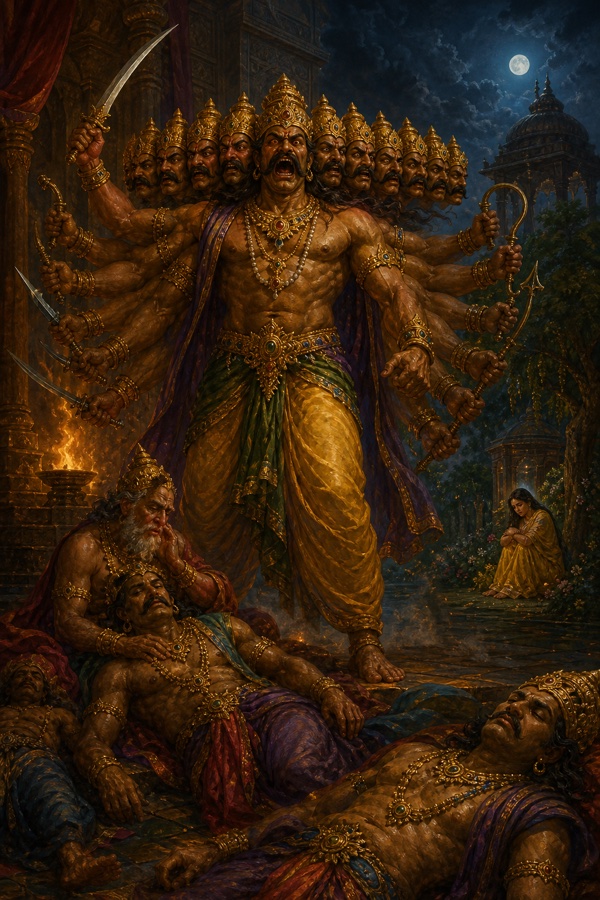
Sword in hand, in a towering rage, with his principal queen Mandodari beside him and his ministers around him, confused by his grief for his eldest son, Ravana rushed headlong toward the place where Sita, the princess of Mithila, was kept. His ministers saw the rakshasa on the march and let out roars like lions, and they hugged one another at the sight of him in his fury and said, “Both those brothers, Rama and Lakshmana, will tremble to see this rakshasa today. In his anger he has utterly vanquished all four guardians of the world. He has struck down enemies past counting in his wars. He has fetched home the treasures of all three worlds and enjoys them at his ease. In prowess and in might there is no one on earth to match him.” While they talked like that, Ravana, filled with anger, darted toward Sita, the princess of Videha, in the ashoka grove. His friends, who wanted only his good, kept trying to hold him back, and he tore free of them and ran toward Sita, the way an evil planet in the sky darts in fury at the constellation Rohini.
Sita, blameless princess of Mithila, guarded by the rakshasa women who had guarded her for so long, saw the furious rakshasa coming at her with an excellent sword to kill her. She saw him shake off the friends who kept trying to stop him, and keep coming, and the distress that took her found its way into words, and she wept as she spoke. “The way this creature is rushing at me himself, in such a fury, I think the evil-minded rakshasa is going to kill me as if I had no one to protect me, though I have a husband alive. He begged me so many times, though I was devoted to my husband, ‘Be my wife,’ and every time I refused him outright. He has despaired of my ever waiting on him, and now, out of anger and infatuation, he is plainly bent on killing me. Or else the two tigers among men, Rama and Lakshmana, have been struck down in combat today by this unworthy creature, on my account. I heard a loud and terrible noise a while ago, thousands of rakshasas exulting and calling out to their loved ones. Woe to me, if the two princes were destroyed because of me. Or he could not kill Rama and Lakshmana, and this fierce rakshasa of sinful resolve, wild with grief for his son, is going to kill me instead.”
“And Hanuman gave me the sane counsel,” Sita went on, weeping, “and I, vile that I am, did not follow it. Had I left then, riding on his back, I might not have been won back by my husband, and even so I would not be grieving as I am today; I would be resting in his lap. I think the heart of the blessed Kausalya, Rama’s mother, will break in two when she, who has only the one son, hears that he has perished in the fight. Weeping, she will remember the birth and the childhood and the youth of that noble prince, and his pious acts, and how beautiful he was. She will perform the rites for her dead son, and in her despair, senseless, she will surely walk into the fire or drown herself in the water. Woe to that vile hunchback Manthara, with her sinful resolve, on whose account Kausalya will suffer this grief.” So the unfortunate princess of Mithila wept, like Rohini fallen under the sway of Mars when the moon, her husband, is far away.
One man in Ravana’s train had been watching her. His name was Suparshva. He was a good-natured, upright, and highly intelligent minister of Ravana, and though the other ministers tried to restrain him, he spoke to the foremost of rakshasas. “Ravana, brother of Kubera himself, why do you want to put Sita to death in a fit of anger, casting dharma aside? From the day you completed the vow of celibacy that the study of the Vedic lore demands, you have kept every religious observance laid on you, the offering into the fire and all the rest. How can you think the killing of a woman fit for you, valiant king of the rakshasas? Guard Sita, with all her beauty. Turn your wrath on Rama alone, in battle, and take all of us with you. Gird yourself for the attack this very day. Today is the fourteenth of the dark fortnight; tomorrow is the moonless day. March out to victory tomorrow with your troops around you. You are a gallant and shrewd chariot-warrior; fight with a sword from the foremost of your chariots. Only by killing Rama, the son of Dasharatha, will you ever lay your hands on the princess of Mithila.” Ravana was evil-minded, and he was powerful, and he could still hear a friend. He accepted that counsel, which was fully in keeping with dharma, and withdrew to his palace, and from there, with his friends around him, he went on to the council chamber.
A key to understanding (the concept): Suparshva argues from dharma and from statecraft at once: a king who has kept the vow of Vedic study and the daily offering into the fire cannot fitly kill a woman, and Sita will come into Ravana’s hands only when Rama is dead, so the sword belongs on the field, and the field is tomorrow, the moonless day. Notice what Valmiki gives each of them. Sita’s lament is remorse turned inward, for the counsel of Hanuman she refused; Ravana’s resolve is discernment lost to grief; and the poet shows both inner states plainly.
The gist: Hearing of Indrajit’s death, Ravana faints, and then, half mad with wrath, resolves to kill Sita and rushes at the ashoka grove with his sword drawn. Sita laments in remorse. The minister Suparshva stops him by recalling dharma and policy: give up the killing of a woman and go out yourself to fight Rama on the moonless day. Ravana relents and returns to his council hall.
The Slaughter of the Rakshasa Army at Rama’s Hands
Ravana entered the assembly hall in state, miserable and in deep distress, and sank onto a pre-eminent seat, snorting like a furious lion. The death of Indrajit had wasted him, and this king of enormous might did a thing kings do not do: he joined his palms before the leaders of his own army, who had gathered there, and asked them. “March out, all of you, with the whole army of elephants and horses around you, and with the columns of chariots and the foot soldiers. Surround Rama alone, and kill him in battle, pouring arrows on him the way the clouds pour rain in the monsoon. Or tear his limbs with your sharp arrows in a great fight, and then tomorrow, while the whole world stands and watches, I will finish him easily myself.” At the ruler’s command the rakshasas went out in their swift chariots, with battalions of every kind behind them.
They threw iron clubs at the monkeys, and sharp-edged pikes, arrows, swords, and axes, everything that takes a life, and the monkeys answered with trees and rocks. It was toward sunrise that the fight between the rakshasas and the monkeys grew tumultuous. They struck at each other on the field with maces of many colors, with darts, swords, and axes, and the dust that the two armies raised as they fought, and it was enormous, was laid by the streams of blood that ran out of the rakshasas and the monkeys, so that the air cleared over the slaughter. Rivers of blood flowed across the field, with elephants and chariots for their banks, arrows for their fish, ensigns for the trees along the shore, and dead bodies drifting down them like logs. The monkeys, bathed in those streams, leaped this way and that, and the chiefs above all, breaking ensigns, armor, chariots, horses, and weapons of every kind, and with their sharp teeth and nails they tore off the hair, the ears, the brows, and the noses of the rakshasas. A hundred monkeys went at each single rakshasa the way birds fly at a tree loaded with fruit. And the rakshasas, big as mountains, killed their own share of those redoubtable monkeys with the iron in their hands.
The great army of the monkeys, cut down by the rakshasas, ran for refuge to the one who could protect them, Rama, the son of Dasharatha. He took up his bow, went deep into the rakshasa ranks, and rained arrows on them. The fierce rangers of the night could not go near him. He was inside their lines, burning them with the fire of his arrows, and they could no more approach him than clouds can approach the scorching sun in the sky. The most terrifying deeds of Rama, deeds no one else could do, the night-rangers saw only after they had been done, never while he was doing them, because his movement was as quick as lightning. They could not see him while he was scattering that huge army and destroying its great chariot-warriors, any more than a man can see the wind that is blowing through a forest; only his deeds showed where he had been. They saw the army torn and pierced with arrows, consumed, broken, tormented with weapons, and they could not find the man who was doing it. Created beings cannot perceive the self inside them that enjoys the objects of the senses, and in the same way the rakshasas could not perceive Rama striking at their bodies.
“Here is Rama, wiping out the elephants!” “There is Rama, finishing the great chariot-warriors!” “Here is Rama, killing the foot soldiers and the horses with his sharp arrows!” Shouting so, the rakshasas struck one another in their rage, because each of them looked to another like Rama in one respect or another. Rama, the scion of Raghu, had thrown them into confusion with the excellent missile of the gandharvas, and they could not even make out their own army. Now they saw thousands of Ramas on the field; now, in the great fight, they saw only one. They saw the curved golden ends of his bow going round like a firebrand whirled in the dark, and they could not see him. What created beings saw was Rama in the form of a discus, a wheel that was exterminating the rakshasas the way the Wheel of Time exterminates everything: the middle of his body for its hub, his strength for its flame, his arrows for its spokes, his bow for its rim, the twang of the string and the clang of the gauntlet for the sound of its turning, his energy and intelligence and every virtue in him for its radiance, and the power of his mystic missiles for its edge.
In the eighth part of a day, which is an hour and a half, Rama alone, with arrows like tongues of fire, wiped out an army of rakshasas who could change their shape at will: ten thousand chariots as swift as the wind, eighteen thousand fleet elephants, fourteen thousand horses with their riders, and two hundred thousand rakshasas fighting on foot, the full count. The night-rangers who lived through the carnage, with their horses killed, their chariots wrecked, and their standards broken, slipped quietly away to the city of Lanka. With the elephants and the foot soldiers and the horses lying dead on it, the field looked like the ground where the mighty Rudra disports himself in his fury. The gods, with the gandharvas and the siddhas and the eminent seers, applauded what Rama had done: “Well done! Bravo!” And Rama, whose mind was set on dharma, remarked to Sugriva, who stood beside him, and to Vibhishana, to the monkey Hanuman, to Jambavan the king of the bears, to Mainda the foremost of monkeys, and to Dvivida, “Power like this over the mystic missiles lives in me, or in the three-eyed Lord Shiva, and nowhere else.” Having destroyed the army of Ravana, the king of the rakshasas, the great-hearted Rama, the equal of Indra, who had conquered the fatigue that the use of missiles and weapons brings, stood and was praised by the hosts of heaven in their jubilation.
A key to understanding (the concept): Rama’s nearly invisible war is one of Valmiki’s great poetic figures: his speed is such that the rakshasas cannot see him, only what he has done. The image of the Rama wheel, body for hub, arrows for spokes, bow for rim, is joined to the Wheel of Time, so that Rama himself becomes Time and cuts down the rakshasa army. The destruction of more than two hundred thousand fighters by one man in the eighth part of a day is the prelude, before Ravana’s own death, to the full showing of Rama’s divine strength.
The gist: Ravana sends his whole army against Rama. Guarding the monkey host that has run to him for refuge, Rama plunges into the rakshasa army and slaughters it so swiftly that the rakshasas cannot see him, and in their confusion they kill one another. In the eighth part of a day Rama alone destroys the entire vast army, and the gods praise him.
The Lament of the Rakshasa Women
Thousands of elephants, thousands of horses with their riders, thousands of chariots bright as fire with their ensigns flying, thousands of valiant rakshasas who could change their form at will, who fought with maces and iron bludgeons under golden banners: Ravana had sent them all out, and Rama, who never tired at his work, had destroyed them all with flaming arrows ornamented with refined gold. The night-rangers who had survived the carnage saw it, and the rakshasa women heard of it from them, and all of them were stunned and miserable and could not think past their fear. The rakshasa women who had lost a husband, or a son, or their kin, came together in groups, and wept, and stricken with grief they began to wail.
“How did that old, hideous Shurpanakha, with her sunken belly, dare to go up to Rama in the forest, Rama, who is as lovely as the god of love himself? How strange that a woman as ugly as that, whom the people ought to have killed, could look at a man so tender, so devoted to the good of every creature, and be stung with love. How did that hideous rakshasi, with no excellence in her, dare to court Rama, who has every excellence there is, and great bodily strength, and a face and form like his? It was our bad luck, and it was the ruin of Dushana and Khara in particular and of the whole rakshasa race, that a gray-haired, misshapen woman with wrinkles on her body tried to profane the scion of Raghu with her unholy touch, a misdeed the whole world was right to laugh at and condemn. It was on account of Shurpanakha that Ravana conceived this bitter enmity, and carried off the famous Sita, and carried off his own destruction with her.”
“The ten-headed king will never lay his hands on Sita, the daughter of Janaka,” the women said, “and he has bound himself in an undying hatred with the mighty Rama. Every warning was there for him to read. When the notorious rakshasa Viradha lusted after Sita, Rama finished him single-handed; that example alone should have convinced Ravana that Rama cannot be beaten. Rama destroyed fourteen thousand rakshasas of terrible deeds in Janasthana, with arrows like tongues of fire; that should have been enough. Khara was struck down in combat, and Dushana, and Trishira, with arrows that shone like the sun; that should have opened Ravana’s eyes. The notorious Kabandha, who lived on blood, came roaring at Rama in his rage, and was finished at once; that should have proved what Rama’s might was. Rama killed the mighty Vali, who was the size of Mount Meru; that alone should have taught him. Sugriva was living wretched on Mount Rishyamuka with his ambitions in pieces, and Rama restored him to his throne; that should have been enough to show Ravana the greatness of the man. Vibhishana gave him reasonable advice, in keeping with dharma and good for his worldly interest and for the good of every rakshasa, and in his folly Ravana would not hear it. Had Ravana, the younger brother of Kubera, followed Vibhishana’s advice, this city of Lanka would not be a place of mourning, and it would not have turned into a burning-ground.”
The women went on. “Kumbhakarna, with all his enormous might, was killed by Rama. Atikaya, whom no one could ignore, was killed. His beloved son Indrajit was finished by Lakshmana the other day. And Ravana has still not understood the greatness of Rama. ‘My son, my own brother, my husband has been killed in the fighting.’ That is the cry that comes from the lips of the rakshasa women in every family in this city. Chariots, horses, elephants, foot soldiers: the hero Rama has struck them down by the thousand, here, and there, and everywhere on that field. It is Rudra, the god of destruction, or it is Vishnu, the protector of the three worlds, or it is the great Indra, who did his hundred horse sacrifices to win his throne, or it is Death himself, who is destroying us in the disguise of Rama. Our finest heroes are dead, and we have lost all hope of life. We can see no end to this fear. We have no one to protect us, and we wail. Ravana is a hero, and Brahma gave him a great boon, and even so he cannot see this appalling danger that has grown up in Rama’s hands. When Rama attacks him in battle, neither gods, nor gandharvas, nor pishachas, nor rakshasas will be able to protect him. Evil portents show themselves in every encounter Ravana has with his enemies, and they foreshadow one thing without mistake: his destruction at Rama’s hands.”
“Brahma, the grandfather of the universe, was gratified by Ravana’s austerities,” the women said, “and he granted him fearlessness against gods, and danavas, and rakshasas. Against human beings Ravana asked for no such security. And so, since he has no protection against human beings, I hold this present fear to be the fear that comes from a man, and it will be fatal to the rakshasas, and to Ravana himself, past any doubt. Under the oppression of this mighty rakshasa, with his boon from Brahma and his severe austerities behind him, the gods worshiped the grandfather of the universe, and Brahma, gratified, gave them a momentous assurance for their good: ‘From this day on, all the danavas and the rakshasas will range the three worlds in constant fear.’ Then all the gods with Indra at their head came together and propitiated the great Lord Shiva, the destroyer of the three cities the demon Maya built, whose ensign bears the bull, and Shiva, gratified, gave them his own assurance: ‘For your good, a woman will appear who will bring about the destruction of the rakshasas.’ That woman, sent by the gods to end us, will devour us all, and Ravana with us, the way hunger once consumed the danavas. Thanks to the misconduct of the evil-minded, wicked Ravana, this terrible destruction, wrapped in grief, has come to stand in front of us. We see no one in all the world who can protect us from Rama, no more than created beings can be protected from the Time-Spirit at the end of a world-cycle. There is no haven for us in this peril, any more than there is shelter for she-elephants ringed by a wildfire in a forest. The noble Vibhishana, of the line of the sage Pulastya, did the one timely thing: he took refuge with the very man he had reason to fear.” Then all the rakshasa women, folding one another tightly in their arms, gave way to despair, afflicted and sick with dismay, and cried out at the top of their voices in heart-rending tones.
A key to understanding (the concept): The lament of the rakshasa women is a canto of remembrance for the whole story of Rama: the insult of Shurpanakha, the killing of Khara and Dushana, of Kabandha and of Vali, the crowning of Sugriva, the fourteen thousand dead at Janasthana, all recalled together to show that Ravana was warned again and again and would not heed. Mark one thing above the rest. Ravana asked Brahma for safety from gods, danavas, and rakshasas, and asked for none from human beings; that omission is the door through which his death walks in, because Rama comes in the form of a man.
The gist: After the destruction of the army, the rakshasa women lament. They blame Shurpanakha, recall every warning Ravana was given from Viradha to Vali, and say that he heeded none of them. He asked Brahma for no safety against human beings, and for that reason the fear that comes from a man, which is Rama, will be the cause of his ruin.
Ravana’s March to Battle and the Sallying of the Generals
The wailing carried. In house after house of Lanka the stricken rakshasa women were crying out their grief, and Ravana heard every piteous, plaintive note of it. He sighed for a long time. He sank into thought for a while. Then the anger came up in him, and he grew terrible to look at. He bit his lip between his teeth; his eyes went crimson with wrath; he looked like the fire that dissolves the universe, made flesh, and even rakshasas found it hard to keep their eyes on him. Mahodara, Mahaparshva, and the rakshasa Virupaksha were standing near him, and he gave them their orders in a voice so thick with rage that the words came out indistinct, and he looked at them as if the look alone could burn them. “Tell the troops, at my command, and tell them quickly: march out to the field.” The three of them were frightened by the way he said it, and they passed the king’s order to the rakshasas, who took it without a flicker.
“So be it,” said those rakshasas of terrible aspect. They performed the rite that goes before every serious undertaking, to turn evil aside, and they set out with their faces toward the field. The great chariot-warriors paid Ravana the reverence due to him by the rules of the court and stood with their palms joined, wishing their master victory. Ravana, full of anger, laughed at them, a hearty sneering laugh, and spoke to Mahodara and Mahaparshva and Virupaksha. “Today, with arrows from my bow like the sun at the end of a world-cycle, I will send Rama and Lakshmana to Yama’s house. With the death of those two I will pay back today the deaths of Khara, of Kumbhakarna, of Prahasta, and of Indrajit. Under the cloud of my arrows there will be no sky to see, and no quarters, and no heaven, and no sea. With plumed arrow after plumed arrow from this bow I will wipe out the famous battalions of the best of the monkeys, one after another. Mounted in my chariot, which is as swift as the wind, I will knock the monkey ranks flat with waves of arrows rising out of the ocean of my bow. Their divisions are ponds, and their faces are open lotuses, and their bodies shine like the filaments of the flower; I will trample those ponds today like an elephant. Their commanders will lie on the field with arrows through their skulls, and they will ornament the earth like lotuses on their stalks. With every single arrow I loose in this fight I will pierce a full hundred of the monkeys who fight with trees, the fiercest in every division. Today, by the destruction of my enemy, I will wipe the tears of every rakshasa whose brother has been killed and whose son has been struck down. I will carpet the earth so thickly with monkeys pierced by my arrows, scattered and lifeless, that a man will have to search to find the ground. Every crow and vulture, every beast and bird that eats flesh, I will sate today with the flesh of enemies my arrows have killed. Get my chariot ready at once. Bring my bow, and do not delay. Let the rangers of the night who are still alive follow me to the field this time.”
Mahaparshva heard him and told the troop-commanders standing there, “Mobilize the army, and do it fast.” The commanders went around Lanka at a run, calling the rakshasas out of every house to the field. In a moment the rakshasas came running out, roaring, terrible in aspect and hideous in face, with weapons of every kind in their arms: swords, sharp-edged darts, pikes, maces, clubs, halas shaped like plowshares, sharp-pointed javelins, huge kutamudgaras, staffs, discuses of every kind, sharpened axes, bhindipalas for throwing stones, the spiked shataghnis, and other excellent weapons besides. At the king’s command four troop-commanders led out to the field more than a hundred thousand chariots and three hundred thousand elephants, sixty million horses, as many mules and camels, and foot soldiers past counting.
The commanders had drawn the king’s army up in front, and in the meantime the king’s own charioteer brought Ravana’s chariot onto the field and set it there: fitted with the foremost of the celestial missiles, adorned with jewels of many kinds, filled with weapons of every kind, hung with rows of small bells, encrusted with precious stones, beautified with bejeweled pillars, and covered with thousands of round golden pinnacles. Every rakshasa who saw it was struck with wonder. Ravana saw it too, that swift and formidable chariot, which looked like blazing fire and shone like ten million suns, with its charioteer at the reins and eight horses yoked to it, radiant with its own splendor, and the king of the rakshasas sprang up from his seat and mounted it on the spot. With rakshasas past counting around him, Ravana set out from Lanka headlong, and the sheer weight of his might seemed to split the earth under him. Then on every side burst out the roll of the clay drums and the tabors, the blast of the conches, and the clamor of the rakshasas.
“There goes the ruler of the rakshasas, the man who carried off Sita, the killer of Brahmins, the thorn in the side of the gods, famous for his bad conduct, going out under his canopy with his pair of whisks beside him to try his strength against Rama, the best of the Raghus!” That was the clamor heard on every side. The earth shook violently at the din of it, and the monkeys who heard it fled in panic. Ravana, mighty-armed and full of energy, with his ministers around him, came onto the field with victory as his declared purpose. With his permission Mahaparshva, Mahodara, and Virupaksha, whom no one could easily overcome, mounted their chariots too, and they set out eager for victory, roaring exultantly, as though their roaring alone would split the earth, and raising a formidable uproar as they came. Surrounded by battalions made of hordes of rakshasas, the energetic king went out to battle with his bow lifted, and he looked like Yama playing the part of Death at the dissolution of the universe.
The great chariot-warrior, in his chariot drawn by horses of extraordinary speed, went out through the northern gate, where Rama and Lakshmana were. At that moment the sun lost its brilliance and gloom closed over the four quarters. Birds gave out fearful cries. The earth shook violently. A cloud rained blood, and Ravana’s horses stumbled. A vulture came down and perched on the top of his ensign, and she-jackals howled sinister howls. His eye twitched and his left arm quivered; his face went pale and his voice went a little hoarse. As the ten-headed king went out for his encounter, these were the evil signs that foretold his death, and there were more: a meteor fell out of the sky with a crash like a peal of thunder, and vultures, flying in company with crows, cried out their sinister cries. Ravana paid no attention to the fearful portents standing in plain sight in front of him. Driven on by Death, he rushed madly toward his own doom.
At the sound of the chariots of those gigantic rakshasas, the army of the monkeys stood ready to meet them, and a tumultuous contest broke out between the monkeys and the rakshasas, each side challenging the other, enraged, eager for victory. Then the ten-headed king, provoked to anger, made great havoc among the monkey ranks with his gold-decked arrows. Wherever he drove in his chariot, with his eyes rolling in fury, the monkey commanders in that quarter could not stand under the mad force of his arrows. Some of the monkeys he beheaded. Some had their hearts pierced through, some their ears sheared off; some were struck lifeless where they stood, some split open at the flank, some had their skulls smashed, and some their eyes put out.
A key to understanding (the numbers): The muster Valmiki counts for Ravana’s last march, more than a hundred thousand chariots, three hundred thousand elephants, sixty million horses and as many mules and camels, comes only hours after Rama has destroyed two hundred thousand foot soldiers in the eighth part of a day; the poem is measuring what Lanka still has to spend, and Ravana spends it all here. The portents at the northern gate, the sun’s luster lost, the rain of blood, the vulture on the ensign, the twitching eye and the quivering left arm, are signs the whole army can see, and Ravana, driven on by Death, is the one man on the field who will not read them.
The gist: Ravana resolves to go out himself, gathers his remaining vast army and his divine chariot, and boasts to his generals. Ignoring a flock of death-boding portents, he goes out by the northern gate and begins to slaughter the monkey chiefs under a rain of arrows.
The Slaughter by Sugriva and the Death of Virupaksha
The field outside Lanka was strewn with monkeys whose limbs the ten-headed king’s arrows had torn apart. The monkeys could not stand under that irresistible hail for an instant, any more than moths can stand in a blazing fire. Tormented by the sharp arrows, they fled screaming, like elephants caught in a burning forest with the flames already on them. Ravana went forward through the fray destroying the monkey ranks the way the wind tears great clouds to rags, and having cut the monkeys down, he hurried on to confront Rama himself. Sugriva saw his monkeys routed in the fighting and running, and he put Sushena in charge of his division and threw his whole mind into the fight. He named that monkey his substitute because he was as brave as Sugriva himself, and then the king went for the enemy with a tree in his hands. All the commanders of the monkey troops except Sushena took up enormous rocks and trees of every kind and went with him, at his side and at his heels.
Sugriva roared, high and long, across the field, and destroyed the foremost of the rakshasas, and then the rest, and he killed them the way the wind at the end of a world-cycle knocks down trees that have grown to a monstrous size. They say he poured a shower of rocks on the rakshasa troops the way a cloud lets down a shower of hailstones on the flocks of birds in a forest. Under the king of the monkeys’ rain of rocks the rakshasas’ heads were smashed, and they toppled like crumbling mountains. Sugriva had them completely routed, falling and roaring on every side, when the rakshasa Virupaksha, an archer hard to overpower, leaped down from his chariot, shouted his own name so that everyone would know who was coming, and climbed onto the back of an elephant. Mounted, he let out a terrific roar and rushed at the monkeys. He rained formidable arrows on Sugriva at the head of the army, and he steadied the frightened rakshasas around him and put heart back into them.
The rakshasa’s sharp arrows went deep into Sugriva, and a great anger seized the king of the monkeys, and he roared and set his mind on killing the man who had shot them. He tore up a tree and sprang forward and struck the huge elephant that stood facing him; the colossal beast reeled back four cubits under the blow, sank down, and trumpeted. Virupaksha jumped down at once from his wounded elephant, took up his shield of bull’s hide and his sword, and came at the monkey king with rapid strides, face to face, and Sugriva stood firm to meet him. The powerful rakshasa came on as though he meant to frighten him. Sugriva, in a fury, seized a huge rock that looked like a cloud and hurled it at him; Virupaksha, a bull among rakshasas and strong beyond the common, saw it coming, jumped aside, and struck Sugriva with his sword. Under the sword-stroke of that mighty rakshasa the monkey lay a while on the ground as though he had lost his senses. Then he sprang up all at once, whirled his fist, and brought it down with violence on the rakshasa’s chest. Virupaksha, the night-ranger, wounded by the fist and raging, cut Sugriva’s armor away with his sword at the front of his own army, and kicked him, and Sugriva fell. He was up the instant he was down, and he gave the rakshasa a slap that produced a crash like thunder. Virupaksha was adroit enough to dodge the slap as it came, and struck Sugriva on the chest with his fist. The king of the monkeys grew more furious still, and seeing his blow parried, he watched the rakshasa for an opening. Then, in his anger, he brought his palm down with violence on the bone of Virupaksha’s temple. The palm came down like the thunderbolt of the mighty Indra, and Virupaksha fell to the ground bathed in blood, with blood pouring from all nine openings of his body, the way water pours from a spring.
The monkeys looked at Virupaksha lying bathed in foaming blood, his eyes rolling with anger, and his name, the one with the misshapen eyes, had never fitted him so well: he was more monstrous now than he had ever been. Their enemy lay tossing about, turning from side to side, bellowing piteously. The two redoubtable armies, the monkeys’ and the rakshasas’, were locked in hand-to-hand fighting across the field, both of them as wide as seas and as full of surge, and they roared like two oceans that have burst their banks. With the mighty and notorious Virupaksha finished by Sugriva, the king of the monkeys, the two armies locked together looked like the holy Ganga in flood.
The gist: When the monkeys flee under Ravana’s arrow-rain, Sugriva hands his post to Sushena, takes charge himself, and crushes the rakshasas under a rain of rocks. The rakshasa Virupaksha, mounted on an elephant, comes to grips with Sugriva; in the end Sugriva strikes him on the temple with an open hand that falls like a thunderbolt and kills him.
Mahodara’s Fierce Battle with Sugriva and His Death
The two armies were destroying each other in that great conflict, and both were soon much thinned, like two lakes in the height of summer when the sun is at its brightest. Ravana, overlord of the rakshasas, was enraged twice over, by the destruction of his army and by the fall of Virupaksha. It was an agony to him to see his army wasted under the monkeys and to see how fate had turned against him in this great fight. He spoke to Mahodara, who was standing right beside him. “At this juncture every hope I have of victory rests in you. Show your valor today and wipe out the enemy’s army. This is the hour to repay the debt you owe your master for the bread you have eaten at his table. Fight well.”
“So be it,” said Mahodara, and the rakshasa chief went deep into the enemy’s army the way a moth goes into a flame. Emboldened by his master’s word, the rakshasa, who had enormous might and no lack of energy, began to make havoc among the monkeys by his own prowess. The monkeys, brave as any, took up huge rocks, went into the redoubtable enemy army, and set about destroying rakshasas. Mahodara, in a fury, cut off the hands, the feet, and the thighs of monkeys with his gold-decked arrows, and all the monkeys were struck hard by the rakshasas; some of them fled into the ten directions, and others ran to Sugriva for refuge. Sugriva saw the mighty army of the monkeys routed in the encounter and rushed at Mahodara, who was standing close by. The king of the monkeys took a firm grip on a huge and formidable rock, a rock that looked like a mountain, and hurled it to kill the rakshasa. Mahodara saw it falling on him all at once and was not in the least agitated. He cut it to pieces with his arrows, hard as it was to come near, and torn into a thousand and one fragments by the streams of his shafts, the rock came down over the ground like a flock of frightened vultures.
Sugriva saw the rock broken and, half mad with rage, tore up a sal tree and flung it, and Mahodara split that too into many pieces. The rakshasa, scourge of hostile forces, lacerated Sugriva with his shafts. Then the king of the monkeys, provoked past his anger, saw an iron bludgeon lying on the ground. He brandished the flashing bar, showing the rakshasa how fast his hands could move, and with that bludgeon of terrific speed struck down Mahodara’s fine horses. Mahodara leaped down from his huge chariot with its team dead, raging, and took his mace in his hand. Mace and bludgeon in hand, roaring like two bulls, looking like two clouds charged with lightning, the two heroes closed. The night-ranger, in his fury, flung his flaming mace at Sugriva, and it shone like the sun as it flew. Sugriva, with enormous might in him and his eyes gone coppery with rage, saw that exceedingly terrible mace coming, raised his bludgeon, and struck the mace with it, so that the mace fell to the ground and the bludgeon too gave way to the speed of the mace, and both lay broken. The spirited Sugriva picked up from the earth a formidable steel club encrusted all over with gold, lifted it, and hurled it at the rakshasa, and the rakshasa flung his mace at Sugriva at the same instant. The two missiles collided in the air, and both broke, and both fell to the ground.
Their weapons were gone, and the two warriors, full of ardor and full of strength, like two lit fires, went at each other with their fists. They roared, again and again; they slapped each other; they grappled and rolled on the surface of the earth, sprang to their feet at once, and began to strike again, and neither could be discomfited, and they shoved each other back and forth with their arms. That wrestling exhausted them both. Mahodara, a rakshasa of great impetuosity, picked up a sword and a shield that lay not far off, and Sugriva, the foremost of monkeys and more impetuous still, seized a huge sword and a shield of his own. Both were adepts with weapons on a battlefield, and both were seized with anger to the ends of their limbs; they sprang forward, roaring for joy, with their swords raised to meet each other. They moved with great rapidity, each to the left of the other and then to the right, and the right and then the left, parrying every stroke, enraged with each other, each bent on the other’s conquest. Mahodara, evil-minded and proud of his own virility, brought his sword down on the heavy mail Sugriva wore, and it stuck there in the armor. While the rakshasa was still working it free, Sugriva, an elephant among monkeys, took his own sword and severed Mahodara’s head, with its earrings and its helmet and all. Mahodara, chief of the rakshasas, lay on the earth with his head cut off, and the army that had followed him was nowhere to be seen on the field. Sugriva had finished him and raised a cheer with his monkeys, delighted; Ravana flew into a rage, and Rama looked happy. All the rakshasas hung their heads in dejection, and, their minds stricken with fear, fled from the field. Sugriva, the son of the sun-god, had thrown Mahodara down like a piece broken off a great mountain, and he shone in his glory on that field like the sun that nothing can assail. He had won his victory at the front of the battle, and the hosts of gods, the siddhas, and the yakshas, and the multitudes of beings standing on the surface of the earth, gazed on the king of the monkeys, overwhelmed with delight.
The gist: Ravana puts Mahodara forward. Mahodara slaughters the monkeys and then fights Sugriva through a long single combat: rock, tree, iron bar, mace, steel club, fists, and at last sword and shield. Mahodara’s sword sticks in Sugriva’s mail, and in that instant Sugriva cuts off his head.
The Death of Mahaparshva at Angada’s Hands
Mahaparshva had watched Sugriva bring Mahodara down, and his eyes had gone crimson with anger while he watched. He had enormous might, and he set his arrows loose in the formidable ranks of Angada and threw them into commotion. He severed the heads of the leading monkeys from their trunks the way the wind pulls a fruit from its stalk; with his arrows he cut the arms off some, and in his fury he tore the ribs out of the sides of others. Under Mahaparshva’s hail of shafts every monkey wore a dejected look, and they lost heart. Angada saw his army frightened and hard pressed by the rakshasa, and the impetuosity in him rose like the sea on the nights of the full moon.
Angada, foremost of monkeys, seized an iron bludgeon that shone like the rays of the sun and flung it at Mahaparshva on the field. The blow stunned the rakshasa, and he dropped senseless out of his chariot onto the ground, and his charioteer with him. Just then Jambavan, the king of the bears, rushed forward from his battalion, which was as dense as a dark cloud; ardent, exceedingly powerful, looking like a heap of black antimony, he seized in his fury a huge rock like a mountain peak and struck down Mahaparshva’s horses with it and shattered his famous chariot. Mahaparshva came to himself after a while. With all his might he pierced Angada with arrow after arrow, struck Jambavan, the ruler of the bears, in the chest with three, and struck Gavaksha with many more.
Angada saw Gavaksha and Jambavan tormented with arrows, and anger seized him, and he picked up a formidable iron bludgeon. He took the bar, shining like the rays of the sun, firmly in both hands, whirled it with force, and, with his eyes red with anger, hurled it at the rakshasa Mahaparshva, who stood at a distance, meaning to kill him. Thrown by the mighty son of Vali, the bludgeon knocked the bow, with the arrow already on the string, out of the rakshasa’s hand, and knocked his helmet off with it. Then Angada, the glorious son of Vali, came at him with all speed and, full of rage, slapped him on the temple, at the root of the ear where the earring shone. Mahaparshva, provoked, with his great impetuosity and his extraordinary splendor, seized a huge axe in one hand, a stainless, solid axe of steel that had been washed in oil and sharpened by it, and in his fury he hurled it at the son of Vali, aiming it with violence at the bone of his left shoulder. Angada, in his own fury, evaded it. Then Angada, who was the equal of his dead father in prowess, and enraged past bearing, clenched a fist as hard as adamant; he knew the vital points of a body, and he let that fist fall like the thunderbolt on the rakshasa’s breast, close by the heart. Under the impact the rakshasa’s chest burst open, and he fell down dead on the ground in that great conflict. With Mahaparshva struck down, his army fell into confusion, and a violent rage took possession of Ravana on the field, and a very high-pitched roar went up from the monkeys in their joy. A loud clamor followed that sounded like the gods with Indra at their head, and its vibrations seemed to rend the city of Lanka, attics and ornamental gates and all. Ravana, the lord of the rakshasas, the sworn enemy of Indra, heard that uproar of the dwellers in heaven and the dwellers in the forest, and his rage heard it too, and he stood on the field once more, ready for the fight.
The gist: Mahaparshva slaughters the monkeys, but Angada strikes him down with an iron bar and Jambavan shatters his horses and chariot. Mahaparshva comes to and fights again, and flings an axe, but Angada evades it and splits his chest open with a fist like the thunderbolt. Mahaparshva is slain, and Ravana stands ready to fight once more.
The First Direct Battle of Rama and Ravana
Mahodara was dead. Mahaparshva was dead. Virupaksha, the notorious champion with all his strength, had already been struck down. Ravana looked at what was left to him in that great conflict, and a great rage seized him, and he urged on his charioteer and spoke these words. “When I have killed the two princes, Rama and Lakshmana, I will be rid of the suffering my slain ministers have caused me, and my besieged city. Rama is a tree that is going to bear fruit through its blossom, and the blossom is Sita, and the great boughs of it are Sugriva, Jambavan, Kumuda, Nala, Dvivida and Mainda, Angada, Gandhamadana, Hanuman, Sushena, and every other commander of the monkey troops. I am going to cut that tree down in this fight.” So saying, and setting all ten directions ringing with the rattle of his chariot, that surpassing chariot-warrior drove fast and rushed at Rama, the scion of Raghu. The whole earth, rivers and mountains and forests, trembled at the sound of him, and the lions and the other beasts and the birds were thrown into a fright.
Ravana brought out a mystic missile of the most terrible and dreadful kind, presided over by Rahu, the giant of darkness who swallows the sun and the moon, and with it he began to burn up the monkeys, and they fell on every side. They could no longer bear a missile that Brahma the creator himself had brought into being, and dust rose off the earth as they ran, baffled, as fast as they could go. Rama saw those many divisions of monkeys routed in their hundreds under Ravana’s excellent arrows, and he took his stand firmly on the field. The tiger among rakshasas had put the monkey army to flight, and then he saw Rama: the tamer of his enemies, long in the arm, his eyes as large as lotus petals, standing unconquered with his younger brother Lakshmana beside him, the way Indra stands with his younger brother Upendra, who is Vishnu, and holding up a bow that seemed to scrape the sky. Rama, seeing the monkeys routed and Ravana coming on, took his bow by the middle with joy, Lakshmana with him, and began to stretch that excellent bow, with all its impelling force, loud and sonorous, as though he meant to split the globe with it. At the well-known hum of the streams of Ravana’s arrows and the twang of Rama’s bow, rakshasas fell to the ground by the hundred, and Ravana, coming within range of the two princes, looked like the planet Rahu come close to the moon and the sun. Lakshmana wanted to engage him first, and he stretched his bow and shot arrows like tongues of fire; but Ravana, full of energy, intercepted those arrows in the air with his own the instant the excellent archer loosed them.
He split Lakshmana’s arrows one with one, three with three, and ten with ten, showing his lightness of hand. Then Ravana, who had always won his battles, passed the son of Sumitra by and came up to Rama, who stood on the field like a second mountain. His eyes turned crimson with anger as he came near the scion of Raghu, and the lord of the rakshasas loosed showers of shafts at him. Rama saw the volleys coming from Ravana’s bow and snatched up, in all haste, broad-headed arrows of the crescent kind called bhallas, and with those sharp-edged bhallas he tore apart the streams of flaming arrows, formidable arrows like venomous serpents, before they reached him. Then the two of them, Rama and Ravana, covered each other over and over with showers of sharp-pointed shafts of every kind, and pushing each other back with the rush of their arrows, neither of them beaten, they described circles of many kinds around each other, moving from left to right. All beings were seized with terror as those two redoubtable heroes, who looked like the god of retribution and the god of death, shot at each other with such violence. The sky was overcast with arrows of many kinds, the way the monsoon sky is covered with clouds full of lightning, and the vault of heaven, riddled with sharp-pointed shafts of extraordinary velocity, plumed with vulture feathers and shot with tremendous force, seemed to have been pierced full of eyeholes.
Like two great clouds that rise at sunset and at sunrise, the two heroes wrapped the sky in darkness with their arrows. A major conflict opened between them, unapproachable and unimaginable, like the duel of the demon Vritra and Indra in the oldest days. Both were armed with excellent bows, both were skilled in fighting, both were foremost among all who use missiles, and both moved over the field unhampered; whichever course they took in their maneuvers, streams of shafts were set moving along it, like waves in two oceans whipped up by the wind. Then Ravana, who made people weep wherever he went, whose hands never left off shooting, laid a succession of steel arrows across Rama’s brow, and they stood there like a chaplet. Rama bore that garland of arrows from the terrible bow of Ravana on his head as if it were a wreath of blue lotus petals, and felt no pain from it.
Rama took up more arrows, recited the sacred formulas that invoke the missile of Rudra, the god of destruction, and stretched his bow, and in his anger the valiant prince let those arrows fly in unbroken succession against the king of the rakshasas. They fell on Ravana’s impenetrable armor, which looked like a great cloud, and they caused him no pain at all. Then Rama, who was an adept in every mystic missile, struck the overlord of the rakshasas where he sat in his chariot, once more in the forehead, with an excellent missile; and Ravana repelled it, and the arrows the missile had generated hissed like five-headed serpents and sank into the earth. Having made the scion of Raghu’s missile void, Ravana, filled with wrath, brought out an exceedingly dreadful missile of the demons, the Asura missile, and through his sorcery he shot arrows with the heads of lions and tigers, of buzzards and red geese, of vultures and falcons, of jackals and wolves; shafts with the heads of terrible lions with their mouths gaping wide, and shafts like serpents; arrows with the heads of donkeys, of boars, of dogs and cocks, of alligators and venomous snakes. Hissing like a serpent provoked to anger, Ravana loosed these and other whetted arrows at Rama by his conjuring. Overwhelmed by the missile of the demons, the prince of the Raghus, whose brilliance matched the fire-god’s, called on the missile of the god of fire, and out of it he produced arrows of every description: some with heads bright as fire, some shining like the sun, the moon, the crescent, a comet, a huge meteor; some shining like the planets and the lunar mansions, and some like flashes of lightning. Pierced by the missile Rama had employed, Ravana’s formidable arrows melted away in the air, though before they melted they killed the monkeys by the thousand. The monkeys, all of them shape-changers, rejoiced to see the missile of the demons made void by Rama, who never tired at his work; they closed around him and raised a clamor with their faces turned to Sugriva. Rama, the son of Dasharatha, was filled with joy at having forced that famous missile to nothing, and the monkey chiefs, full of joy themselves, shouted at the top of their voices.
The gist: Enraged by the killing of his generals, Ravana rushes at Rama himself. With the missile of Rahu he routs the monkeys, but Rama, with Lakshmana beside him, stands firm. A wondrous battle of arrows and missiles breaks open, and Rama makes void, with the missile of fire, Ravana’s Asura missile, whose arrows carry the heads of beasts and birds.
Lakshmana’s Swoon by Ravana’s Shakti and Ravana’s Flight
His missile had been counteracted, and the overlord of the rakshasas doubled his fury. In his wrath he aimed at Rama another fearful missile, presided over by Rudra and made by the demon Maya, and out of his bow on every side issued flaming pikes and maces, clubs hard as adamant, mallets, deceptive nooses, and fiery thunderbolts of many kinds, like the piercing gales at the end of a world-cycle. Rama, the foremost of all who use the excellent missiles, neutralized it with the missile of the gandharvas. With that made void by the scion of Raghu, Ravana, his eyes coppery with wrath, employed the missile of the sun-god, and out of the bow of the resourceful ten-headed king, with terrific impetuosity, issued brilliant discuses, and large ones. As they rose into view and struck on every side, the sky lit up, and the quarters were illuminated as if by the sun, the moon, and the other planets. Rama split those discuses and the other strange weapons with streams of his shafts, in the front of Ravana’s own army. Ravana saw that missile frustrated and struck Rama hard with ten arrows in all his vital parts; and Rama, the scion of Raghu, grievously hurt by ten shafts shot from that huge bow, did not flinch.
Rama, extremely enraged now, and a man who had always won his battles, pierced Ravana in every limb with arrow after arrow. Lakshmana, meanwhile, Rama’s younger brother and the destroyer of hostile champions, had been provoked to anger, and he seized seven arrows. He shot them with great force, and with them he tore Ravana’s standard, the one that bore the device of a man’s head, into a number of pieces to begin with. With a single arrow he took off the head of the rakshasa’s charioteer, with its flaming earrings, and with five whetted shafts he split apart the bow of the king of the rakshasas, which was as thick as an elephant’s trunk. Then Vibhishana bounded forward and, with his mace, struck down Ravana’s excellent horses, which were the color of a dark cloud and as tall as hills. Ravana leaped down in all speed from his huge chariot, its horses dead under it, and turned a violent rage on his youngest brother. The powerful king flung at Vibhishana a flaming javelin that looked like the thunderbolt, and Lakshmana tore it apart with three shafts before it could reach him, and a loud cheer went up among the monkeys in that great conflict. The javelin, wreathed in gold and split into three fragments, fell like an enormous flaming meteor dropping out of the heavens, emitting sparks.
Then Ravana seized a big javelin, a weapon famous for never missing, hard even for Death to come near, shining with its own splendor. In the meantime Lakshmana had come with all speed to the rescue of Vibhishana, whose life was in danger; the gallant prince stretched his bow, and to save Vibhishana he overwhelmed Ravana, who stood there javelin in hand, with volleys of arrows. Covered in that stream of shafts from Lakshmana, with his prowess balked, Ravana felt no more spirit to strike at his brother. He turned instead to face Lakshmana, and, seeing Vibhishana rescued by him, he spoke. “I will let the rakshasa Vibhishana go. This javelin is going to be hurled with violence at you, since you are the one who has rescued him, you who boast so of your strength. Hurled by my arm, which is like a bludgeon, it will pierce your heart and take on the stain of your blood, and it will not leave you until it has taken your life.” So saying, he aimed at Lakshmana that infallible javelin, adorned with eight bells, which made a loud noise as it flew, which the demon Maya had designed by magic to destroy an enemy, and which seemed to shine, and the enraged king hurled it and roared. Flung with terrible impetuosity, cracking like a thunderbolt, the javelin flew with force toward Lakshmana at the front of the battle. Rama spoke to it as it went, as a man lays a spell on a thing, and this was his imprecation: “May all be well with Lakshmana! May you come to nothing! May your attempt to kill Lakshmana be frustrated!” But Ravana had loosed it in the full force of his rage, and the javelin, deadly as a venomous snake, struck at once at the breast of Lakshmana, who stood there fearless. Flying with great violence, flaming like the tongue of Vasuki, the lord of the serpents, the javelin came down full of splendor on Lakshmana’s broad chest and went in very deep, driven by the tremendous force Ravana had put behind it. Pierced grievously, Lakshmana fell to the ground.
Rama was standing near, and he saw the state his brother was in, and for all his extraordinary courage a brother’s love made him despondent at heart. For a moment he reflected, as it were, with his eyes dim with tears, and then his anger rose again, like the fire at the end of a world-cycle. This was no hour for feeling disconsolate. Gazing at Lakshmana, resolved now on Ravana’s destruction, Rama took up the fierce struggle again with a mighty and wholehearted effort. Then he looked at his brother lying pierced by the javelin in the middle of that great fight, bathed in blood, like a mountain with a snake driven into its center. The jewels among the monkeys could not draw out that javelin even with effort; the mighty Ravana had propelled it so hard that it had passed through the body of the son of Sumitra and gone into the earth, and the monkeys themselves were overwhelmed by the stream of arrows the king of the rakshasas kept sending. Rama took hold of the terrible javelin with his own hands, drew it out, and in his rage snapped it in two. While he was working it free, the exceedingly mighty Ravana was hurling arrows at every limb of him, arrows that found the vital parts. Rama paid those arrows no attention. He put his arms around Lakshmana and spoke to Hanuman and the great monkey Sugriva. “Stay around Lakshmana just as you are, princes of the monkeys. The occasion I have long sought to show my prowess has come. Let this ten-headed monster of sinful mind and sinful resolve be finished. I want his death the way the chataka bird wants the sight of a cloud at the end of summer.”
“I take this unfailing vow before you, monkeys, at this hour,” Rama said. “Before long you will see a world without Ravana in it, or a world without Rama. I suffered the loss of my sovereignty, the exile into the forest, the wandering in the woods of Dandaka, and the insult the rakshasa Ravana offered to Sita, the princess of Videha. I have suffered agony past bearing, and torment of the body that came close to the tortures of hell. Today, by finishing Ravana in combat, I will have done with all of it. That sinful rakshasa, for whose sake I brought this army of monkeys to this distant land, for whose sake Vali was killed in combat and Sugriva set on the throne of Kishkindha, for whose sake the sea was crossed and a bridge thrown over it, has come within the range of my sight on this field today. He has come within my sight, and he does not deserve to live any longer. Once Ravana has fallen under my eye he can no more survive than a creature that has entered the gaze of the snake whose glance is venom, or a serpent that has fallen under the eye of Garuda, the king of birds and the enemy of serpents. Sit on the mountain peaks, bulls among the monkeys, you whom no one can overpower, and watch at your ease this trial of strength between Ravana and me. Let all three worlds, the earth, the sky, and heaven, with the gandharvas and the gods, the seers of the mantras and the charanas, see with their own eyes today the Rama-ness of Rama in a fight. I will do a thing today that the people of the world, everything that moves and everything that stands still, the gods not excepted, will tell of together, describing how the fight went, for as long as the earth is able to carry those who live on it.” So saying, Rama went steadily to work, striking the ten-headed king on the field with penetrating shafts embellished with refined gold, and Ravana in his turn covered Rama with flaming steel arrows and clubs, the way a cloud covers a mountain with torrents of rain.
A confused din rose from the excellent arrows that Rama on the one side and Ravana on the other were shooting, as each of them struck the other. Split apart and scattered, the flaming-tipped shafts of both of them fell out of the sky onto the surface of the earth. The mighty sound of the two bowstrings striking the two heroes’ palms struck terror into every living thing, and it was astonishing to hear. Then Ravana, covered by hail after hail of arrows and overwhelmed by Rama, who came at him with a flaming bow, took to his heels out of fear and left the field, the way a cloud scatters when a gale drives it.
The gist: Ravana looses the missiles of Rudra and of the sun, and Rama makes them void. Lakshmana cuts down Ravana’s standard, his charioteer, and his bow, and Vibhishana kills his horses. In fury Ravana drives the unfailing javelin the demon Maya made into Lakshmana’s chest, and Lakshmana falls. Rama draws the javelin out and breaks it, vows before the monkeys to kill Ravana, and drives him off the field in fear under a rain of arrows.
Rama’s Lament and Hanuman’s Bringing of the Sanjivani Mountain
Rama had just fought Ravana to a standstill, and he was still shooting streams of arrows at his mighty opponent when he looked down at the heroic Lakshmana, struck down in the fight by the javelin of the exceedingly mighty Ravana and soaked in a stream of blood, and spoke to the monkey chief Sushena without taking his hands from the bow. “Look at him. Ravana’s prowess has brought the gallant Lakshmana down to the ground, and he is writhing there like a serpent, and it is grief to me. My strength for this fight is failing as I look at this hero, who is dearer to me than life itself, drenched in blood, and my mind will not stay steady. If this brother of mine, with every auspicious mark on his body, who always spoke so highly of war, should meet his death, what use is life to me, or happiness? My prowess seems to hang its head. My bow seems to be slipping from my hand; my arrows are dropping; my sight is drowned in tears. My limbs are failing like the limbs of men asleep; a sharp anxiety is growing in me, and I even wish to die, seeing my younger brother struck down by the evil-minded Ravana, wounded so seriously in his vital parts, in agony, groaning.”
Lakshmana was Rama’s own life-breath moving about outside his body, and Rama, looking at his beloved younger brother in that state, gave himself up to anxiety and grief. He saw him lying wounded in the dust of the battlefield, and dejection took him, and his senses went astray, and he lamented, his mind distracted. “Even victory will give me no pleasure. What delight can the moon give a man who has lost his sight? What purpose of mine is served by fighting, or by living? I have no use for a war whose result is Lakshmana killed here at the front of the battle. Lakshmana, with all his splendor, followed me when I went away into the forest, and I will follow him now in the same way to the house of Death. He always loved his kinsfolk, as I do, and he was always devoted to me, and the rakshasas, who fight by treachery, have brought him to this. Wives can be found everywhere. Kinsmen can be had anywhere. I see no place on earth where a brother born of the same womb could be found again. What object of mine on earth will be served now, without Lakshmana, who was so hard to overpower? What am I going to say to mother Sumitra, who loves her son so? I will not be able to bear the reproach Sumitra will level at me. What on earth shall I say to mother Kausalya, and what shall I say to Kaikeyi? What shall I say to Bharata and to Shatrughna, with all their strength, when they ask me how I came back without Lakshmana, when I went into the forest with him? Better to die on this spot than to hear the reproaches of my own people. What sinful thing did I do in a former existence, that my pious younger brother lies killed in front of me? My powerful brother, foremost of men, prince of heroes, how can you go off alone to the other world and desert me? Why do you not speak to me, brother, when I am lamenting like this? Get up. Look around you. Why are you lying there? Look at me with your own eyes, miserable as I am. You were my comforter whenever grief struck me and I wandered listlessly through the mountains and the woods, whenever I lost heart.”
Sushena was a monkey of great sagacity, and he set about comforting Rama, who was wailing with his mind distracted by grief, with the finest words he had. “Give up this idea, tiger among men. It breeds grief, and it hurts you as arrows hurt at the front of a battle. Lakshmana, who adds to the prosperity of his house, has not gone back to the five elements. His features have not changed, and they have not gone dark; his face, look at it, is still very bright and cheerful. The palms of his hands are still like the petals of a lotus, and his eyes are very clear. Those whose life has left them do not look like this. He is lying there like a man fast asleep with his limbs relaxed, and his heart is throbbing, again and again, which proclaims that he lives. Do not give way to despondency, gallant prince, tamer of your enemies. He is breathing.”
Having said that much to Rama, the sagacious Sushena spoke to the monkey Hanuman, who was standing near. “Bound from here with all speed, gentle one, to the Mahodaya mountain, the one Jambavan told you all about once before, and bring back the precious herb that grows on its southern peak. Bring, to restore the heroic Lakshmana to consciousness, the precious herb vishalyakarani by name, and savarnyakarani, and sanjivakarani, and the precious herb sandhani, gallant one.”
Hanuman sprang to that mountain, rich in herbs, and when he got there he stood and thought, because he could not tell the precious herbs from the rest. Then a thought came to the son of the wind-god, whose strength was beyond measuring. “I will go back with this mountain peak itself. By reasoning it out I conclude that the curative herb grows on this peak and no other, because Sushena said so. If I go back without the vishalyakarani, harm may come to Lakshmana from the time that passes, and great perplexity may follow.” Thinking so, he moved fast, reached the summit of Mahodaya, foremost of mountains, and shook the peak violently three times, the whole peak with its multitude of trees in flower, and broke it off, and held it in his two hands and balanced it there. It looked like a dark cloud in the rains, and Hanuman, a tiger among monkeys, with enormous might in him, took hold of it and bounded from the surface of the earth into the sky.
He came to Sushena, set the mountain peak down, rested for a moment, and said, quick in speech as in everything else, “I could not identify those herbs, so I have brought the whole summit of the mountain instead.” Sushena, the foremost of monkeys, applauded the son of the wind-god for it, and pulled out the herbs himself and took them in his hands. Every bull among the monkeys who was present was amazed at Hanuman’s feat, which would have been very hard even for a god. Sushena, with his exceptional splendor, crushed the herb and administered it to Lakshmana through the nostrils. Lakshmana, the destroyer of hostile champions, rose from the surface of the earth at once, rid of the wound the javelin had made and rid of his pain. The monkeys saw him on his feet, marked with every auspicious sign, and applauded him with cries of “Excellent! Excellent!”
“Come, come,” said Rama, the destroyer of hostile heroes, and he folded Lakshmana tightly in his arms and pressed him to his chest, with his eyes dim with tears. Holding the son of Sumitra, the scion of Raghu said, “By good fortune, gallant one, I see you come back out of Death’s own hands. Had you gone back to the five elements, no purpose of mine would have been served by my own life, nor by Sita, nor by victory. What end of mine would my survival have served?” Lakshmana was pained to hear Rama talking in such an irresolute strain, and he said so. “You solemnly took a pledge, prince of unfailing prowess: to kill Ravana, and to set Vibhishana on the throne of Lanka. You ought not to speak as you have just spoken, like a weak and spiritless man. Those who always speak the truth never let their vow come to nothing; the fulfillment of one’s vow is the mark of greatness. And it is not becoming in you to give way to despair on my account. Redeem your pledge by killing Ravana today. Once an adversary has fallen under your arrows he can no more escape alive than an elephant that has fallen into the clutches of a roaring, sharp-fanged lion. I want to see this evil-minded creature die quickly, before that sun sinks below the horizon with its task of going round the sky accomplished. If you want to kill Ravana on this field, if you want to fulfill the vow you have taken, and if there is a longing in you for the daughter of Janaka, worthy hero, do what I tell you, and do it without delay.”
A key to understanding (the concept): The four herbs are named for their separate tasks: vishalyakarani draws the shaft or the weapon from the body, heals the wound, and takes away the pain; savarnyakarani restores to the skin the color that a wound or a burn has changed; sanjivakarani brings the unconscious back to their senses; and sandhani joins a broken bone. Hanuman lifting the whole peak when he cannot tell the herbs apart shows his practical wit as much as his strength. This is his second journey to that mountain in the Yuddhakanda: Jambavan first sent him there when Indrajit’s Brahma missile had laid both brothers and the whole monkey army senseless, and now Sushena sends him back to the same peak that Jambavan described.
The gist: Seeing Lakshmana fallen, Rama laments in deep grief. The physician Sushena assures him that Lakshmana lives and sends Hanuman to the Mahodaya mountain for the four healing herbs. Unable to tell the herbs apart, Hanuman lifts the whole peak, and with Sushena’s medicine Lakshmana is made well and rises, and urges Rama to cast off despair and fulfill his vow to kill Ravana before the sun sets.
Source: Srimad Valmiki Ramayana, Yuddhakanda, Cantos 68 to 101. The Gita Press Hindi edition is the controlling witness. The Sanskrit e-text and an independent complete translation were used to verify names, sequence, and principal events. Where recensions differ, this retelling follows Gita Press.
Basis: Valmiki Ramayana (Gita Press, Gorakhpur)