Forms of Love
Forms of Love · Sutras 51-66
Up to now Narada had explained how love is reached. In this part he stops on the road and raises a harder question: what love is. Then, as if taking you by the hand, he sets each of its forms before you, one after another.
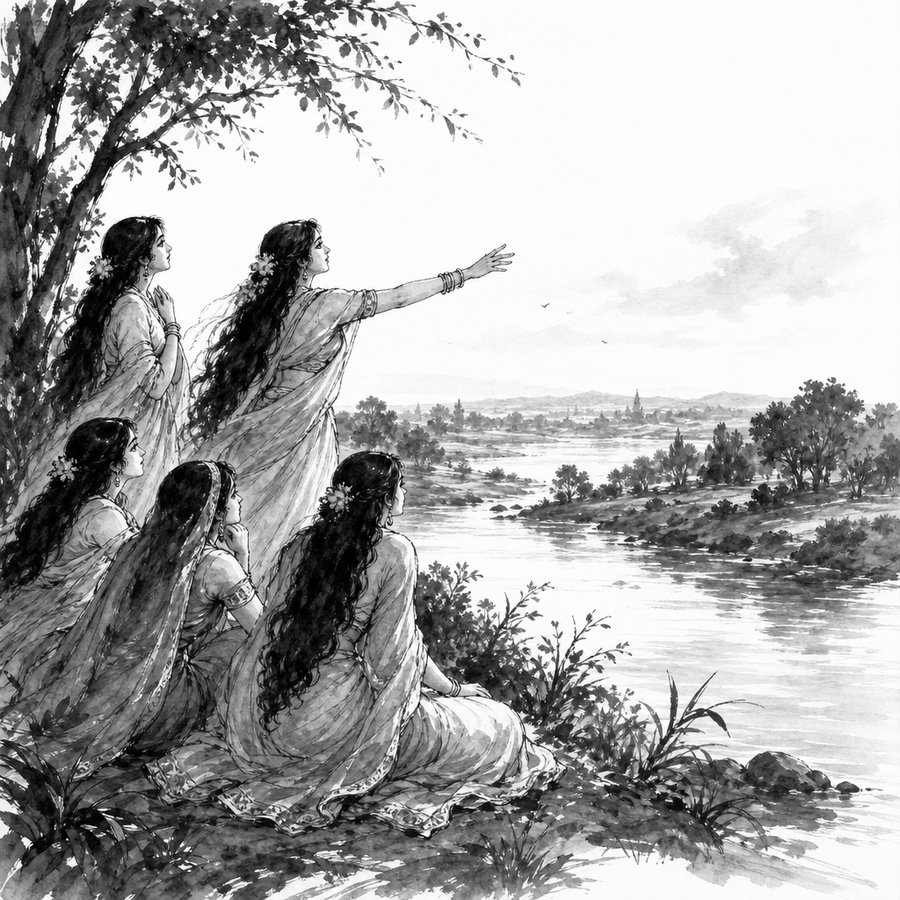
Narada warns you at the very start that the thing he is about to speak of cannot be bound in words. The nature of love is beyond all telling, and nothing is left to say of it. It is exactly like a mute person tasting a sweet. The flavor fills him completely, every last bit of it arriving, and no road remains by which he can hand the smallest part of it to anyone else. And when this love finally shows itself, it opens its light in no random place, only in one worthy vessel.
Then Narada counts off the marks of that unspeakable thing, as if he were touching a jewel in the dark and telling you its shape. This love lies beyond the three gunas, and no shadow of any desire falls across it. It grows moment by moment, never once slipping back to where it stood before, it never breaks, it is subtler than the subtlest, and it can be known in experience alone. And once someone receives it, look at his state: he sees only that one, hears only that one, speaks only of that one, thinks only of that one. Every door of his mind opens toward a single direction.
Now Narada steps down from that complete love and comes to the stairs below it. There is also a secondary bhakti, a devotion born of a cause, and it takes three forms, sometimes by the difference in the seeker’s qualities and temperament, and sometimes by the difference the Gita names as the distressed, the seeker of wealth, and the seeker of knowledge: the one who comes because something in his life has broken, the one who comes wanting, and the one who comes to understand. These forms differ in worth, and the order among them runs from the first named downward. Each earlier form leads more surely to the highest good than the one named after it, so devotion colored by sattva, clear and calm, ranks above devotion driven by the restless wanting of rajas, and that in turn ranks above devotion clouded by tamas. And when you weigh all these paths against one another, one thing rises clear: the path of bhakti is the easiest of them all.

Here someone might ask what the proof of this bhakti is. Narada’s answer is clear: it needs no other proof, it is its own proof. To establish bhakti you never have to look outside, for it is its own witness. Its evidence too is found within, because it takes the form of peace and the form of supreme bliss, and there is no arguing with either of those once they have arrived. Whoever has it descend into his heart comes to know it for himself.
Now the question of the world arrives, of the household, of duties. Narada says, do not worry over any loss that appears in worldly affairs, because the devotee has already handed everything over to God, his soul, his world, and his Veda; a man cannot lose what he no longer holds. But do not read this as a permit for idleness. As long as bhakti is not fully established, worldly conduct is not to be given up. Let it come to only this: that action continues, the hands going on with whatever the day asks of them, and the renunciation of its fruit, along with the means of that renunciation, continues beside it.
Then Narada gives some very practical hints, because he knows the mind takes the shape of whatever material is poured into it. Do not let talk of women, wealth, and unbelievers into your ears, for such talk clouds the mind, and the clouding sets in long before anyone notices it. Know pride, hypocrisy, and faults of that kind as things to be given up. Then Narada goes further, and says something bold. Offer your whole conduct to that one, and if urges like lust, anger, and pride do rise and you cannot hold them back, turn them too toward that one alone. Do not press the feeling down, turn its face toward God.
And at the last, the climactic line of this part. Narada says, crossing even the distinctions among these three forms, master and servant, guru and disciple, and friend, only one love is worth cultivating: the love of the eternal servant, or the worshipful love of the eternal beloved. And he repeats it, as if pressing a seal down into the wax: love is the one thing worth doing, love alone.