The Glory of Devotion
The Glory of Devotion · Sutras 25 to 33
Narada places bhakti above karma, knowledge, and yoga, above them all, and gives his reason: bhakti is itself the fruit. Then come the teachers’ views on how knowledge and bhakti stand to each other, and at the close a plain illustration from a palace and a meal.
Sutra 25
With the marks of bhakti named, Narada sets down his boldest word: this bhakti is greater than karma, greater than knowledge, greater than yoga. In that tradition of the shastras, where karma and knowledge had long been held supreme, to say such a thing out loud was no small matter.
Sutra 26 · 27
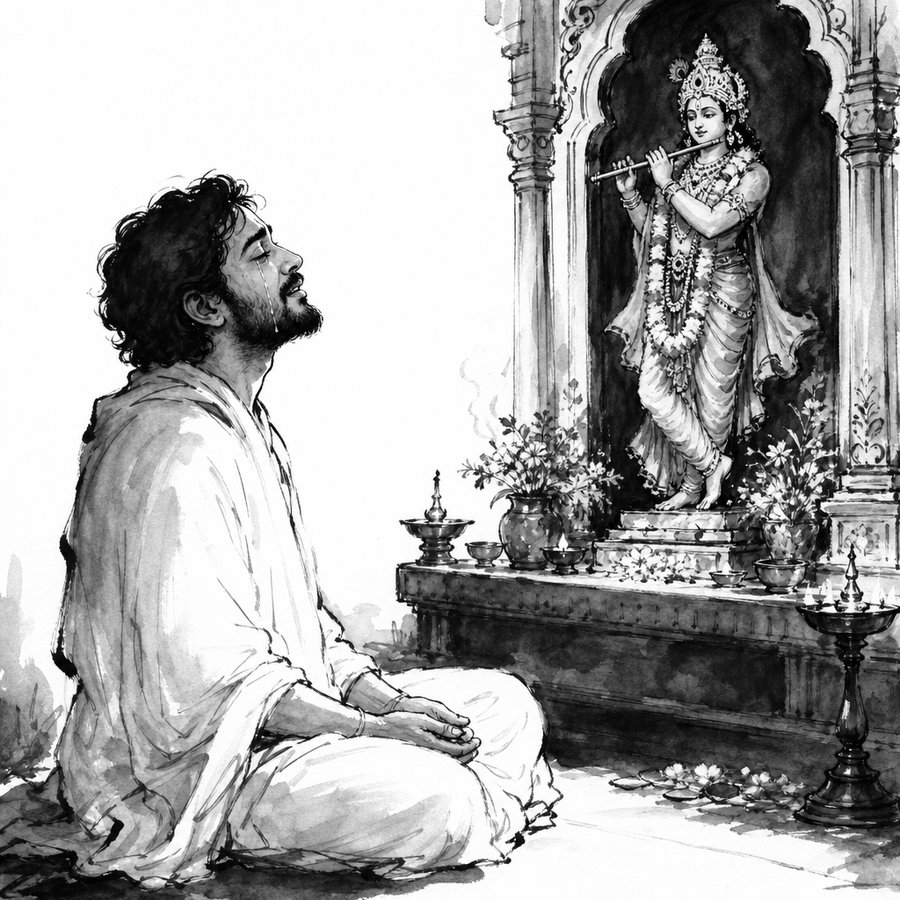
But why does Narada say this? He sets down the reason too, and it takes him a single word. Karma gives fruit, knowledge gives fruit, yoga gives fruit; these are all means, roads laid down to reach something that lies further on. Bhakti stands apart from them, because it is itself the fruit. Once it is gained, nothing else remains to be gained, and the road and the place it was going turn out to have been one thing all along. And there is one more reason, one that goes deep within. On the path of knowledge a subtle pride can settle in, the feeling of “I have understood”. In bhakti there is humility, “I am nothing at all”. And it is this humility that is dear to God; pride does not please Him.
Sutra 28 · 29 · 30
Here an old dispute also comes to the surface, and Narada does not hide it away. Some teachers say the means to bhakti is knowledge alone, for how could bhakti arise in someone who does not yet know what he is loving. Others go further and say the two rest on each other, knowledge leading to bhakti and bhakti to knowledge, the two of them climbing together. And the view of the Brahmakumaras, the sons of Brahma led by Sanaka, which Narada makes his final resting place, is that bhakti is itself of the form of fruit, a means to nothing. There is no question of gaining it through anything else; it alone is worth gaining.
Sutra 31 · 32 · 33
Narada settles this point with a plain, simple illustration. Merely hearing a palace described does not make a king glad, and merely telling the tale of a meal does not still anyone’s hunger. You can name every dish that was carried in and the mouth stays dry. The contentment held in a royal house and in food lives only in the experiencing of them, in the tasting, never in the account. In just the same way, only hearing bhakti described is not its taste. And so, Narada says, those who long for liberation should not get tangled in bare words; they should take up that bhakti itself, and live it to see.