The Company of Devotees, and the Close
Company of Devotees, Closing · Sutras 67-84
Narada now gathers up the whole of his journey and brings it home. In these last eighteen sutras he tells you what clay the undivided devotee is made of, how their company can make even a place of pilgrimage holy, and on what faith this entire discipline finally comes to rest.
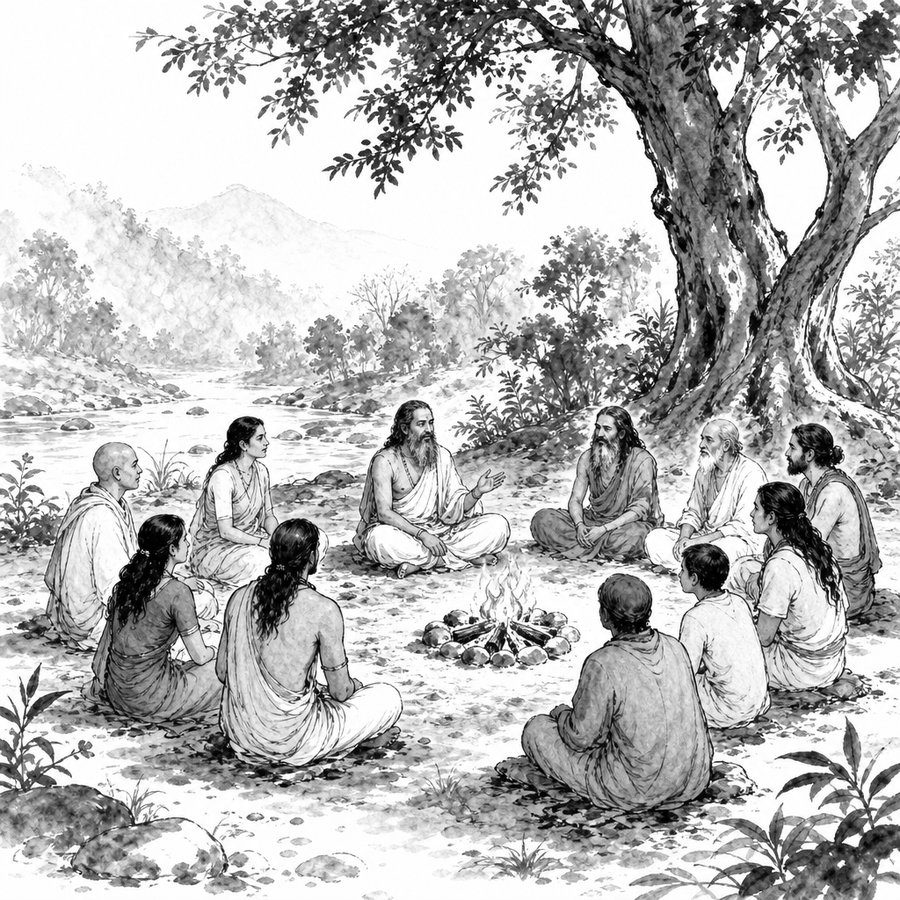
Narada begins by settling who stands highest among devotees. It is the one who never divided their love, who turned all of it toward a single center and left none of it lying anywhere else. And the glimpse he gives of such devotees can stop you where you stand. The throat closes, the hair on the body lifts, the eyes brim over, and they speak to one another of nothing but him. Whoever passes near them, their whole line is made pure, and the very earth beneath them is made pure.
Sutras 67-68 · The Undivided Devotee
This purity is real, and altogether practical. Such devotees turn places of pilgrimage into true pilgrimage, ordinary deeds into good deeds, and the scriptures into true scripture. The holy place is holy because they came to it. Why? Because they are made of him, absorbed into him. And wherever even one such devotee stands, the ancestors rejoice, the gods break into dance, and this earth, till now without a master, becomes a land that has its lord.
Sutras 69-71 · Who Make the Holy Places Holy
Now Narada lands a blow that cuts just as sharply today. Among these devotees no distinction of caste survives, none of learning, of appearance, of family line, of wealth, or of any occupation. Every measure a society keeps for ranking one person above another, and here every one of them reads zero. And the reason could not be plainer: they carry no caste or house any longer, they are his. Once a person becomes his, their whole identity is remade.
Sutras 72-73 · No Distinction Remains
A warning arrives as well. Do not lean on argument and debate. Why? Because argument has a wide open field, it can be pulled this way and pulled that, and it settles nowhere for certain. There is always one more answer waiting, and one more after that one. Tangled in disputation, the thread of bhakti slips from your hand.
Sutras 74-75 · Away from Disputation
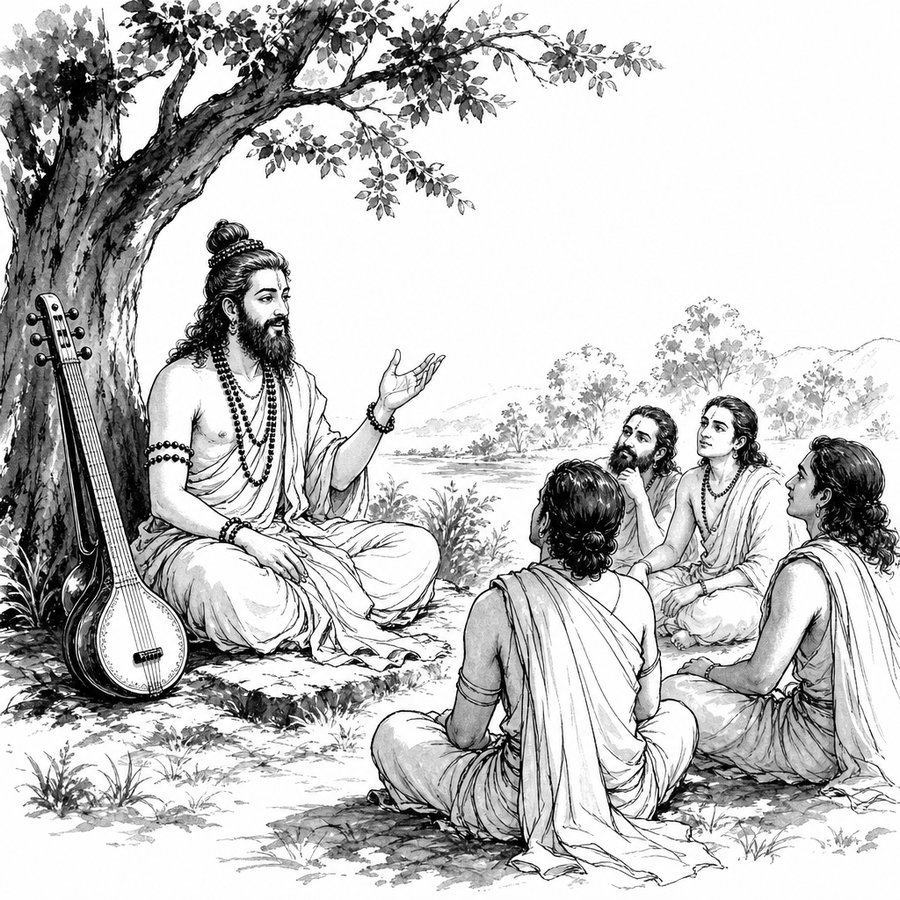
In place of argument, Narada puts work into the seeker’s hands. Give the scriptures of bhakti your manana, your steady reflection, and keep performing the karma, the acts, that awaken that feeling. Then a sharp word about time: release the pull of pleasure and pain, of desire, of gain, and as you wait for that hour, let not even half a moment go to waste. The waiting itself is the practice.
Sutras 76-77 · Reflection, and Not a Moment Wasted
And with it, the foundation of character. Nonviolence, satya or truth, purity, compassion, and faith in the divine: all these virtues are to be kept up without a break, and kept up on the days when nobody is watching them, because bhakti does not hold without this ground beneath it. And then a plain command: always, with your whole heart, free of every worry, God alone is worthy of your worship.
Sutras 78-79 · Character and Untroubled Worship
And then Narada makes a promise, and he makes it without conditions. The moment his praise begins, he appears without delay and lets the devotees feel him for themselves. Here comes the line that has been called the heart of the whole garland of sutras: bhakti offered through the truth of all three, speech, mind, and deed, stands highest of all. Narada does not stop after saying it once, he says it again, bhakti stands highest.
Sutras 80-81 · He Appears Without Delay
This highest bhakti, though it is one, flows in eleven forms. Narada counts them off in a single breath: love fixed on the glory of his qualities, love fixed on his form, on worship, on remembrance, on service, on friendship, on tender affection, on the mood of the beloved, on offering the self, on absorption, and on the pang of ultimate separation, which he saves for the last place on the list. One love, eleven flavors.
Sutra 82 · The Eleven Forms of Bhakti
At the end Narada does not stand alone. He calls up a whole lineage to stand behind him as witness. Fearless of what people say, and of one mind on this matter, these masters of bhakti have spoken in just this way: the Kumaras beginning with Sanaka, Vyasa, Shuka, Shandilya, Garga, Vishnu, Kaundinya, Shesha, Uddhava, Aruni, Bali, Hanuman, Vibhishana, and others like them. And then the final word, where the garland of sutras comes to rest: whoever trusts this auspicious teaching that Narada has spoken, whoever holds shraddha, faith, in it, becomes full of bhakti, and wins the one most dear to him, wins that dearest one.