On this page
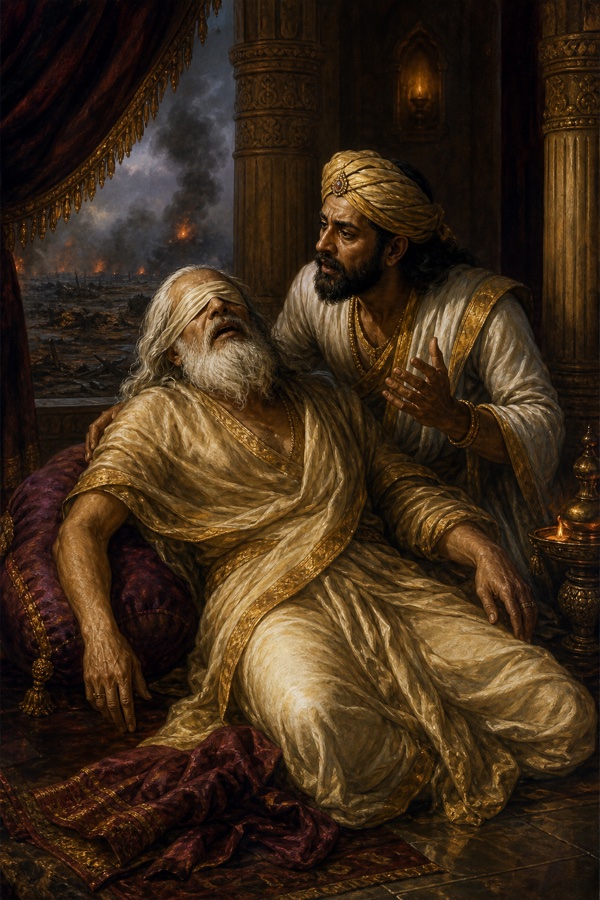
Eighteen days of war at Kurukshetra had left the blind king Dhritarashtra without a son. He had fathered a hundred. Duryodhana, the eldest, for whose sake the kings of the earth had come to fight the five sons of Pandu, the old king’s own nephews, was the last of them to fall, and now he lay dead on the field with all the rest. The old man sat in Hastinapura like a tree whose every branch has been cut away. Dread had closed over him and taken his voice. It was Sanjaya who came to him in that silence, his charioteer, a man of great wisdom, who had been given a seer’s sight for the length of the war.
“Why do you grieve?” Sanjaya said. “Grief accomplishes nothing. Eighteen akshauhinis of fighting men have been killed, eighteen whole armies, and the earth stands desolate and all but empty. The kings of many realms who came from every quarter to stand with your son have laid down their lives, every one. What remains is what is owed to the dead. Have the funeral rites performed now, in their proper order, for your fathers and your sons and your grandsons, for your kinsmen and your friends and your teachers.”
The king heard him out. Then, with no son left to him, no counselor, and no friend, Dhritarashtra went down all at once onto the ground, the way a tree goes over when the wind has taken its roots.
Dhritarashtra’s Lament and Sanjaya’s Words of Consolation
He lay where he had fallen, and from there his voice came back. “I have no sons now, no counselors, no friends,” he said. “I will wander this earth in sorrow. That much is certain. What do I want with life? My kinsmen and my friends are gone. I am a bird whose wings have been cut, and old age has me besides. My kingdom is taken, my family is taken, and I have no eyes. How should I shine on this earth any longer, Sanjaya? A lamp gives nothing once its light is gone. Friends advised me and I did not follow them. The son of Jamadagni advised me. So did Narada, the seer of the gods, and so did my own father, the island-born Vyasa, and I followed none of them.”
“In the open assembly Krishna told me what was good for me,” the king went on. “‘Make an end of this hostility. Let your son keep the whole kingdom. Give the Pandavas five villages and no more.’ I was a fool and did not do it, and now the regret burns in me. Bhishma gave me righteous counsel and I did not listen to him either. I have been told that Duryodhana is dead, whose roar was deep as a bull’s. I have been told of the death of Duhshasana, of the end of Karna, of the setting of that sun who was Drona. And my heart does not break into pieces. I can remember no wicked act of mine in the days gone by, Sanjaya, whose fruit I should be eating today, fool that I am. Then I must have sinned greatly in lives before this one, and for those sins the Supreme Ordainer has set me to bear this measure of grief. Every kinsman destroyed, every well-wisher and friend wiped out, and all of it come upon me in my old age by the force of destiny. Is there a man on earth more wretched than I am? Since it is so, let the Pandavas see me this very day set out, firm in my purpose, on the long road that leads to the world of Brahman.”
A key to reading this (the akshauhini counted out): an akshauhini is a complete army, reckoned at 21,870 chariots, the same number of elephants, 65,610 horses, and 109,350 foot soldiers. Eighteen of them come to 393,660 chariots, as many elephants, 1,180,980 horses, and 1,968,300 men on foot. Eleven of the eighteen had been gathered by Duryodhana.
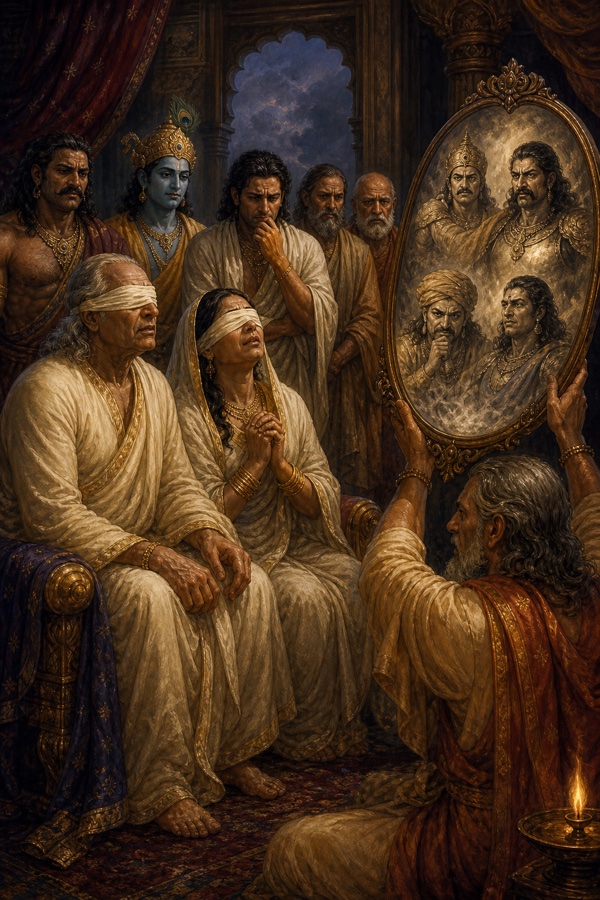
Sanjaya let him finish, and then set about taking the grief apart. “Put this sorrow down,” he said. “You have heard the conclusions of the Vedas from the mouths of old men, and the scriptures and the sacred texts besides. You know what they say. When your son caught the pride that comes with youth, your well-wishers gave you their counsel and you did not take it. You wanted the fruit, and greed kept you from doing what was truly to your benefit. Your own intelligence has cut you like a sharp sword. The people you chose to honor were, for the most part, people who behaved wickedly. Look at whom your son kept for counselors: Duhshasana, and Karna, the son of Radha, with his wicked heart, and Shakuni, who was no better, and Chitrasena, who had no sense, and Shalya. By the way he carried himself your son made the whole world his enemy.”
“He would not obey Bhishma, the revered head of the Kurus,” Sanjaya went on. “He would not obey Gandhari or Vidura. He would not obey Drona, or Kripa the son of Sharadvat, or Krishna, or the wise Narada, or the many other seers who spoke to him, or Vyasa himself, whose power has no measure. He had courage, your son, and very little understanding. He was proud. He wanted battle always. He was wicked, he could not be governed, and nothing contented him. You are a learned man and an intelligent one, and you have always spoken the truth. Men as righteous and as intelligent as you do not let grief stupefy them. None of that company gave a thought to virtue. Battle was the one word in their mouths. That is why the Kshatriya order, the whole order of kings and fighting men, has been wiped out, and why the fame of your enemies stands higher today than it ever did.”
“You sat where a judge sits between two sides, and you never spoke one word of useful advice,” he said. “You were unfit for the work and did not hold the scales even. A man should choose, at the beginning, the course that will leave him nothing to repent of at the end. Out of love for your son you did what pleased Duryodhana, and the repenting has fallen to you. Even so you should not give way. A man who keeps his eyes on the honey and never once on the drop beneath him is destroyed by his greed for honey, and then he repents as you are repenting. Grief wins no wealth. Grief loses a man the very fruit he wants, it stands between him and everything he holds dear, and the man who gives way to it loses even his salvation. If someone wraps a live coal in the fold of his garment and is burned when it takes fire, and then sits grieving over his burns, people call him a fool. You and your son fanned the fire that was the sons of Pandu with your words, and your greed was the clarified butter poured on it until it blazed up. When it blazed, your sons flew into it like insects. They have been burned in the fire of the enemy’s arrows, and it does you no credit to mourn them now. The scriptures do not approve of that tear-stained face you are wearing, and the wise do not praise it. Tears like these fall on the dead as sparks and burn the ones they are shed for. Kill your grief with your intelligence, and hold yourself up by the strength of your own self.”
The gist: Sanjaya told the king to see to the rites of the dead, and then told him why they were dead. His well-wishers had counseled him and he had not listened. His son had defied Bhishma, Gandhari, Vidura, Drona, Kripa, Krishna, Narada, and Vyasa, and the king, sitting as judge between the two sides, had let love for Duryodhana tip the scales. The fire that burned his sons was one that he and his son had fed with their own words and greed, and tears, Sanjaya said, only burn the dead they are shed for.
Vidura’s Discourse on Dharma: Death, Karma, and the Impermanence of the World
When Sanjaya had done, Vidura took it up, and what he said was meant to get the king off the floor. Of all the men in that court Vidura had striven hardest for peace, and he spoke now to the king with his whole intelligence, in words that went down like nectar. “Get up,” he said. “Why are you stretched out on the earth? Hold yourself up by your own self. This is where every living creature ends. Everything that is heaped up comes apart. Everything that rises is certain to fall. Every meeting ends in parting, and life ends in death. The destroyer drags off the hero and the coward together. Why, then, should a Kshatriya keep out of battle? A man who stays away from the fight may be seen to come through alive, and still, when his own hour arrives, he does not escape it.”
“Think of what creatures are,” Vidura said. “At first they do not exist. For a time in the middle they exist. At the end they do not exist again. Where in that is there cause to grieve? The man who mourns does not reach the dead by mourning, and he does not die of it himself. Since the world runs this way, why give yourself to sorrow? Death drags all creatures along, the gods among them. Death holds no one dear and no one hateful. The wind tears the tips off every blade of grass in a field, and death passes over all creatures and masters them the same way. We are all travelers in one caravan bound for one place, and when death is going to meet every one of us, it matters little whom he meets first. You should not grieve for the men who fell in the battle. If the scriptures carry any authority, all of them have reached the highest end. They all knew the Vedas. They had all kept their vows. They all died facing the enemy. What is there to sorrow over? Before they were born they were unseen. They came out of that unknown country and they have gone back into the unseen. They are not yours and you are not theirs. What grief can there be in a disappearance like that?”
A key to reading this (who Vidura was): Vidura is one of those who counseled the king before the war, and one of those whom Duryodhana would not obey. Vyasa will say of him that he knew everything and strove for peace with all his strength. Gandhari, on the battlefield, will say that Duryodhana came to his death by disregarding Vidura and his own father, and that what Vidura foretold after Krishna’s plea for peace had failed has now come to pass. When the dead are burned, it is Vidura whom Yudhishthira sets over the pyres of the friendless.
“A man killed in battle wins heaven, and a man who kills wins fame,” Vidura went on. “For people like us both carry great merit, so battle is never fruitless. Indra will surely make ready for these men worlds where every wish is granted. They are Indra’s guests now. Sacrifices with lavish gifts, the austerities of ascetics, learning: none of these carries a man to heaven as quickly as death in battle carries a hero. The bodies of the enemy’s heroes were their sacrificial fire, and their arrows were the offerings they poured into it, and they stood and took the same offerings poured on themselves in return. I tell you that for a Kshatriya in this world there is no better road to heaven than battle. Every one of them was a Kshatriya of great heart, brave, an ornament of the assembly hall. They have reached a high and blessed state. They are not people to be mourned. Console yourself by your own self and stop grieving. You must not let sorrow overwhelm you until you abandon everything there is to do.”
“There are thousands of mothers and fathers in this world, thousands of sons and wives,” he said. “Whose are they? Whose are we? Every day a thousand causes for sorrow spring up, and a thousand causes for fear. They take hold of the ignorant and are nothing to the wise. Time holds no one dear and no one hateful, and Time is indifferent to no one. All are dragged along by Time alike. Time makes all creatures grow and Time destroys everything. When all else is asleep, Time is awake. Time cannot be resisted. Youth, beauty, life, possessions, health, the company of friends: none of them stays, and a wise man does not covet any of them. You should not grieve for what comes to everyone. A man may die of indulging his grief, and the grief itself will be no lighter for it. If yours feels heavy, the remedy is to stop feeding it. That is the medicine for grief: to leave it alone. Dwelling on it only makes it grow. When evil arrives, or something loved is lost, only people of small understanding let their minds be tormented. What your heart is fixed on is neither profit nor virtue nor happiness. Grief is the sure way to lose what one is aiming at, and through it a man falls away from all three of the great ends of life. People who lack contentment are stunned every time fortune turns with their wealth, and the wise are left untouched by the same turns. Sorrow of the mind should be killed with wisdom as sickness of the body is killed with medicine. Wisdom has that power, and fools never come to peace of soul.”
“What a man did in a former life follows him closely,” Vidura said. “It lies down beside him when he lies down, stands by him when he stands, and runs with him when he runs. In whatever condition of life a man does good or evil, in that same condition he tastes the fruit of it, and in whatever body he does a thing, in a like body he enjoys it or suffers for it. A man’s own self is his friend, and his own self is his enemy. His own self is the witness of what he does, the good and the evil. Happiness grows out of good acts and misery out of sinful ones. A man always receives the fruit of what he has done, and he never enjoys or suffers anything that he did not earn. Men of intelligence like you do not sink into the great sins that knowledge condemns, the ones that cut at the very root of virtue and happiness.”
The words reached him. “You are a man of great wisdom, and what you have said has lifted my grief,” Dhritarashtra said. “Still I want to hear you speak again. When evil comes, when the things a man loves are taken from him, how do the wise free themselves from the sorrow of the mind?”
“The wise man comes to peace by subduing grief and joy together, through the means by which a person may escape them both,” Vidura answered. “Everything we are anxious about passes away. The world is like a plantain tree: there is no lasting strength in it. The wise and the foolish, the rich and the poor, all put down their cares and sleep on the cremation ground, their bodies stripped of flesh, all bare bones and shriveled sinew. Which of them will the living look at and find the marks that tell high birth from low, or beauty from the lack of it? And when all are equal in death, why should human beings, whose understanding the world deceives at every turn, covet one another’s rank and position? The learned say that the bodies of men are like houses. In time they fall to ruin. There is one being that is eternal. A person takes off one garment, old or new, and puts on another, and so it is with the bodies of all who wear bodies. Creatures come to happiness or misery as the fruit of their own acts. By their acts they reach heaven, or bliss, or sorrow. Able or unable, each must carry the burden that his own acts have made.”
A key to reading this (the potter’s simile): Vidura closes this answer with a potter’s wares. Among earthen pots some break while still on the wheel, some when half shaped, some as soon as they are given their shape, some as they are lifted from the wheel, some wet, some dry, some in the firing, some as they are drawn from the kiln, and some in use. So it is with bodies. Some are destroyed in the womb, some on coming out of it, some the day after, some after a fortnight or a month, some after a year or two, some in youth, some in middle age, and some when old. Creatures are born and destroyed according to their acts in earlier lives. Swimmers at play in the water dive and come up again, he says, and so creatures sink and rise in the stream of life; those of little wisdom suffer by their own acts, and the wise, who keep to virtue and wish every living creature well, reach the highest end.
The gist: Vidura told the king to get up. Everything gathered is scattered and every life ends in death, and neither death nor Time holds anyone dear. The men who fell facing the enemy have gone to heaven as Indra’s guests and are not to be mourned. Grief is cured by leaving it alone. The body is a garment, or a house that falls in time; one being is eternal; and each creature carries the burden of its own acts.
The Allegory of the Forest of the World: The Brahmin Hanging in the Well
Dhritarashtra asked him then how this wilderness of the world was to be known. Vidura began at the beginning, with the life of a creature from its first conception. “At the outset it lives in a mingling of blood and the vital seed,” he said. “Then it grows, little by little. When the fifth month has passed it takes shape. It becomes a child in the womb with all its limbs complete, and it lives in a most impure place, covered over with flesh and blood. Then the wind acts on it, the legs are turned upward and the head comes down. It reaches the mouth of the womb in that posture and suffers many kinds of pain, and when the womb contracts the creature comes out, carrying with it the results of everything it did before. In this world other evils rush at it. Calamities come for it the way dogs come to the smell of meat. Then diseases come near, while it is still chained by its earlier acts. Bound by the chains of the senses, by women and wealth and the other sweet things of life, a man is approached by evil habits of many kinds, and once they seize him he never comes to happiness. Those who set their hearts on reflection succeed in guarding their souls. The one who is ruled by his senses does not know that death is standing at his door, and at the appointed time the messengers of the Destroyer drag him away. The world is deceived, and greed has brought it under its rule. Robbed of understanding by greed and anger and fear, a man does not know his own self. Proud of his birth, he speaks ill of those who are not well born. Swollen with the pride of wealth, he despises the poor. He takes others for ignorant fools and seldom turns to look at himself. He lays faults on others and never wishes to punish his own. And the wise and the ignorant, the rich and the poor, the well born and the low born, the honored and the dishonored, all go to the place of the dead and sleep there freed of every care. When all of them lie stretched on the bare ground in the same fashion, why should men take leave of their senses and try to deceive one another? Whoever sees this for himself, or hears it from others, and practices virtue in this unsteady world from an early age, reaches the highest end. Whoever learns it and holds to truth passes safely over every road.”
The king wanted more than that. He asked to be told in full about the understanding by which a man might cross this wilderness safely. Vidura bowed to the Self-created and began again. “I will do as you ask and tell you how the great sages speak of the wilderness of life,” he said. “A certain Brahmin, living in the great world, found himself one day in a vast forest that no one could find a way through. It was full of beasts of prey. On every side there were lions, and other animals with the look of elephants, and all of them were roaring. Yama himself, the lord of death, would have been afraid of that forest. At the sight of it the Brahmin’s heart shook. His hair stood on end, and every other sign of fear showed on him. He went in, and ran this way and that, looking to every point of the compass for someone who might shelter him. He ran from those terrible creatures in his fright and could neither outdistance them nor get free of them. Then he saw that the whole terrible forest was closed in by a net, and that a frightful woman stood there with her arms stretched wide. Great five-headed snakes ringed the forest as well, dreadful to look at, tall as cliffs, their heads touching the sky.”
“Inside the forest there was a pit, and its mouth was hidden under a mat of hard, unyielding creepers and plants,” Vidura said. “The Brahmin, wandering, fell into that pit he could not see. He was caught in the tangle of creepers, wound one into another, and there he hung, as the big fruit of a jackfruit tree hangs by its stalk, with his feet up and his head down. Other calamities found him in that posture. Down in the pit he saw a great and powerful snake. Up near its mouth he saw a gigantic elephant, dark in color, with six faces and twelve feet, moving step by step toward the pit and its cover of creepers and trees. A tree stood at the mouth of the pit, and among its twigs roamed bees of frightful shape, drinking the honey they had gathered earlier in the comb they swarmed about. Again and again they wanted to taste that honey, which is sweet to every creature and yet can tempt only children. It dripped from the comb in many thin streams, and the man hanging in the pit drank from those streams without stopping. In that misery he drank, and his thirst was not quenched. Draught after draught left him unsatisfied and wanting more. Even then he did not turn against life. Even there he went on hoping to live. A number of rats, black ones and white ones, were eating away the roots of the tree. So there was fear from the beasts of prey, and from the fierce woman at the edge of the forest, and from the snake at the bottom of the well, and from the elephant near its top, and from the fall of the tree when the rats had done their work, and last from the bees flying about after the honey. In that plight he lived on in the wilderness, out of his senses, and never once gave up the hope of making his life longer.”
Dhritarashtra was moved. “What distress that man was in, and how painful his way of living!” he said. “Tell me where his attachment to life came from, and where his happiness. Where is that country, so unkind to the practice of virtue, in which he lives? How is he to be freed from all those terrors? Tell me everything, and then we will do what should be done for him. The difficulty of rescuing him has stirred my compassion greatly.”
“Those who know the teaching of moksha, of final release, tell this as a likeness,” Vidura said. “A person who understands it rightly may come to bliss in the worlds hereafter. What was called the wilderness is the great world. The forest inside it that cannot be passed through is the narrow compass of one’s own life. The beasts of prey are the diseases we are subject to. The woman of gigantic size who lives in that forest is, the wise say, Decrepitude, who destroys complexion and beauty. The pit is the body, the physical frame of every creature that has one. The huge snake living at the bottom of the pit is Time, the destroyer of all embodied creatures, the universal destroyer. And the cluster of creepers growing in the pit, from whose spreading stems the man hangs head down, is the desire for life that every creature cherishes.”
A key to reading this (the whole meaning): Vidura carries the reading through to the end. The six-faced elephant moving toward the tree at the mouth of the pit is the year; its six faces are the seasons and its twelve feet the twelve months. The rats and the snakes that are cutting away the tree are the days and the nights, which keep shortening the span of every creature’s life. The bees are our desires. The many streams of dripping honey are the pleasures that come of satisfying desire, to which men are seen to be strongly addicted. The wise know the course of life to be exactly this, Vidura says, and by that knowledge they tear its bonds away.
“That is an excellent parable, and you know the truth of things,” Dhritarashtra said. “Your speech is like nectar, and having heard it I want to hear more.”
“Listen, then, and I will go once more, in detail, through the means by which the wise free themselves from the ties of the world,” Vidura said. “A man who has a long way to travel is sometimes forced to halt when he is worn out. In the same way people of small understanding, traveling the long road of life, have to make halt after halt, and each halt is another birth in the womb. The wise are free of that necessity. This is why those who know the scriptures call the course of life a long road, and why the wise call the round of life, with all its difficulties, a forest. Creatures, moving and unmoving, must return to the world again and again, and only the wise escape. The diseases of mind and body that mortals are subject to, seen and unseen, are what the wise mean by beasts of prey. Men are always afflicted and hindered by them, and still those fierce beasts, which are their own acts in life, cause people of small understanding no anxiety at all. If a man somehow escapes disease, Decrepitude, the destroyer of beauty, overwhelms him afterward. He sinks into the mire of the senses, of sound and form and taste and touch and scent, and stays there with nothing to pull him out. Meanwhile the years, the seasons, the months, the fortnights, the days and the nights come one after another, strip him of his beauty, and shorten the time allotted to him. All of these are the messengers of death, and people of small understanding do not know them for what they are.” He went on to the chariot. “The wise say that the Ordainer governs all creatures through their acts. The body of a creature is called the chariot. The living principle is its driver. The senses are the horses, and our acts and our understanding are the reins. He who runs after those galloping horses has to come back to this world over and over in the round of rebirth. He who is master of himself and holds them in with his understanding does not come back. Those who keep their heads while they wander on this wheel of life, which turns like a real wheel, do not truly wander in the round of rebirth at all. A wise man should take care to prevent the necessity of being born again, and he should never be indifferent to it, for indifference may bind him to it again and again. The man who has restrained his senses and subdued anger and greed, who is content and truthful in speech, comes to peace. This body is called the chariot of Yama, and people of small understanding are bewildered by it. Such a person comes to what you have come to. Loss of kingdom, loss of friends, loss of children, and griefs like these overtake the man who is still under the rule of desire. The wise man should apply the medicine of understanding to every great grief. That medicine of wisdom is truly powerful and very hard to come by, and the man of restrained soul who obtains it kills the grave disease called sorrow. Neither courage nor wealth nor friend nor well-wisher cures a man of grief as surely as the self under restraint. So keep the great duty of doing no injury, of friendship toward all creatures, and let your conduct be pure. Self-restraint, renunciation, and heedfulness are the three horses of Brahman. The man who rides the chariot of his soul with those three in the yoke, held by reins of good conduct, and drives it without any fear of death, goes to the world of Brahman. The man who gives every creature the assurance that it has nothing to fear from him goes to the highest place of all, the blessed realm of Vishnu. A thousand sacrifices will not win the fruit of that assurance, and neither will daily fasting. Nothing among all things is dearer than one’s own self, and death is hated by every creature, so compassion should be shown to all. The wicked are tangled in many errors and caught in the net of their own minds, and they wander the earth again and again. The wise, whose sight is fine, come to union with Brahman.”
The gist: asked how the wilderness of the world is to be known, Vidura first followed a creature from the womb to the place of the dead, and then told the parable of the Brahmin in the pit, hanging head down among creepers and drinking honey while rats ate at the tree. He read out each terror in turn: the world, a single life, disease, old age, the body, Time, the year, the days and nights, desire. The way out that he named was the self held in check, harmlessness, and the assurance of safety given to every creature.
Vyasa’s Secret of Fate: Duryodhana Was a Portion of Kali
None of it held. When Vidura stopped speaking, the head of the Kurus, with the death of his sons upon him, fell to the ground senseless. His friends saw him go down. Vyasa was there, the island-born sage who was his father, and Vidura, and Sanjaya, and others who wished him well, and the attendants who waited at his gates and had his trust. They sprinkled cool water over him. They fanned him with palm leaves and rubbed his limbs gently with their hands, and for a long while they went on comforting him as he lay.
It was a long time before he came to himself, and when he did he wept for a long time more. “Shame on the human state!” he said. “Shame on the human body! The sorrows a man suffers in this life come, again and again, out of the mere fact of being human. The grief of losing sons, of losing wealth, of losing kinsmen and relations, is like poison, like fire. It burns the limbs and destroys the understanding, and a man overwhelmed by it comes to think death the better thing. The calamity that ill luck has brought on me is of that kind. I see that it will not end until life ends. So I will end my life, this very day.” He said this to his own father, who knew Brahman as no one else did, and then grief stunned him and he sat dwelling on his sorrows, unable to speak.
Vyasa heard him, and spoke to this son of his who was grieving for sons. “Listen to what I say, Dhritarashtra. You are learned, you have great intelligence, and you understand what duty is. Nothing that ought to be known is unknown to you. You know beyond doubt that everything doomed to die is unstable. When the world of the living is unstable, when this world itself is not eternal, when life is certain to end in death, why do you grieve? The chain of events that Time forged, with your son for its cause, produced this hostility before your own eyes. The destruction of the Kurus could not have been avoided. Why grieve, then, for heroes who have reached the highest end? Vidura knew everything. With all his strength he tried to bring about peace. And it is my judgment that the course marked out by destiny cannot be turned by anyone, though he struggle for eternity. I heard with my own ears the course the gods had settled. I will tell it to you, so that your mind may be quiet.”
“Once, long before this, I traveled quickly and without tiring to the court of Indra,” Vyasa said. “I found all the dwellers in heaven gathered there, and all the seers of the gods with Narada at their head. And I saw the Earth there, in bodily form, come before the gods on an errand of her own. She approached them and said, ‘What you are to do for me, blessed ones, you promised me already when you were in Brahma’s dwelling. Let it be done soon.’ Vishnu, whom all the worlds adore, heard her and smiled, and answered her in the middle of that assembly. ‘The eldest of the hundred sons of Dhritarashtra, the one called Duryodhana, will do your work. Through that king your purpose will be accomplished. For his sake many kings will gather on the field of Kuru, men able to strike, and with hard weapons they will bring about one another’s death. Your burden, goddess, will be lightened in that battle. Go back quickly to your own place and go on bearing the weight of creatures.’”
“From this you will understand that your son Duryodhana, born from Gandhari’s womb, was a portion of Kali, come into being to bring about a universal slaughter,” Vyasa said. “He was vindictive, restless, quick to anger, and hard to satisfy. Under the working of destiny his brothers became like him. Shakuni was given to him for a mother’s brother and Karna for a great friend, and many other kings were born on earth to help in the work of destruction. As the king is, so his subjects become. When the king is righteous, even unrighteousness in his realm takes the shape of righteousness, for servants are surely touched by the merits and the faults of their masters. Your sons got a bad king, and all of them have been destroyed. Narada, who knows the truth, knew all this. Your sons were destroyed through their own faults. Do not grieve for them. There is no cause for it. The Pandavas bear no fault at all in what has happened. Your sons were wicked of soul, and it was they who brought this destruction on the earth. Narada told Yudhishthira the whole of it truly, in Yudhishthira’s own court, at the time of the rajasuya sacrifice. ‘The Pandavas and the Kauravas will meet each other and meet destruction,’ he said. ‘Do what you ought to do.’ The Pandavas heard him and were filled with grief. So I have told you an eternal secret of the gods. It will end your sorrow and give you back a love for your own life, and it will make you feel affection for the Pandavas, for everything that has happened was ordained by the gods. I learned all this some time ago, and I too spoke of it to King Yudhishthira at his rajasuya, the greatest of sacrifices. I told him in secret, and from then on the son of Dharma did his utmost to keep peace with the Kauravas. What the gods ordain proved too strong for him. The decree of the Destroyer cannot be turned aside by any creature, moving or unmoving.”
A key to reading this (the balance of fate and karma): Vyasa says two things in one speech and lets both stand. Duryodhana was a portion of Kali, born for a slaughter that Vishnu had promised the Earth, and destiny shaped his brothers after him. And the sons of Dhritarashtra were destroyed through their own faults: they were wicked of soul, they had a bad king, and it was they who brought the destruction about. The Pandavas, he says, carry no fault at all. Yudhishthira, told the secret beforehand, worked for peace with everything he had, and what the gods had ordained was too strong for him.
“You are devoted to virtue, and your intelligence is of a high order,” Vyasa said. “You know which is the way for creatures and which is not. If King Yudhishthira learns that you are burning with grief and losing your senses again and again, he will give up his own life. He is always compassionate, and wise, and his kindness reaches down to the lowest of creatures. How could he fail to show compassion to you? Go on bearing your life, then: because I command it, because you know that what is ordained cannot be avoided, and out of kindness to the Pandavas. If you live in this way your fame will spread through the world. You will come to know every duty, and you will have many years in which to earn the merit of austerity. This grief for your dead sons has risen in your heart like a blazing fire. Put it out, always, with the water of wisdom.”
Dhritarashtra thought over what Vyasa had said, for a little while, and then answered. “A great weight of grief is crushing me. My senses leave me again and again, and I cannot hold myself up. Even so, now that I have heard from you what the gods ordained, I will give up the thought of throwing my life away. I will live, and act, and keep from giving myself to grief.”
Vyasa, the son of Satyavati, heard that answer, and vanished from the place where he stood.
The gist: the king fainted, woke, and declared that he would end his life that day. Vyasa answered with something he had heard in the court of Indra: the Earth asking the gods to do what they had promised her, and Vishnu naming Duryodhana as the one through whom her burden would be lightened. Duryodhana was a portion of Kali, his brothers perished by their own faults, and the Pandavas were blameless. Told that Yudhishthira would die of the news if he went on as he was, Dhritarashtra agreed to live.
The Women Set Out, and the Meeting with Kripa and Ashvatthama
When Vyasa had gone, Sanjaya came back to Dhritarashtra. Duryodhana was dead, the troops were slaughtered, and the seer’s sight that had been Sanjaya’s for the length of the war had left him. What he had to say he said plainly. “The kings of many peoples, who came from many realms, have all gone to the land of the dead, and your sons with them. Your son was begged again and again to make peace. He wished always to end the quarrel in his own way, by slaughter, and he has caused the earth to be stripped of its men. Have the funeral rites performed now, in their proper order, for your sons and your grandsons and your fathers.”
The words were terrible to him. The king fell to the ground and lay there without moving, like a man whose life has left him. Vidura, who knew every duty, came and stood over him and told him again what he had told him before. “Get up. Why are you lying there? This is the end of all creatures. They do not exist, then for a while they exist, then they do not exist again, and grief neither brings back the dead nor kills the one who grieves. A man may die without ever going into battle, and a man may go into battle and come out alive, and when his time has come no one escapes. Time drags every kind of creature along and holds none dear and none hateful. If we are all one caravan bound for one place, what does it matter that Time meets one traveler a little before another? The men you are mourning died facing the enemy, and they have gone to heaven by a quicker road than sacrifice or austerity or knowledge can offer. Comfort yourself. Do not let sorrow overwhelm you until you abandon all action.” This time the king rose. He ordered his chariot yoked. “Bring Gandhari here without delay,” he told Vidura, “and all the women of the house of Bharata. Bring Kunti too, and all the other women with her.” Then, with his mind half gone from sorrow, he climbed up onto the chariot.
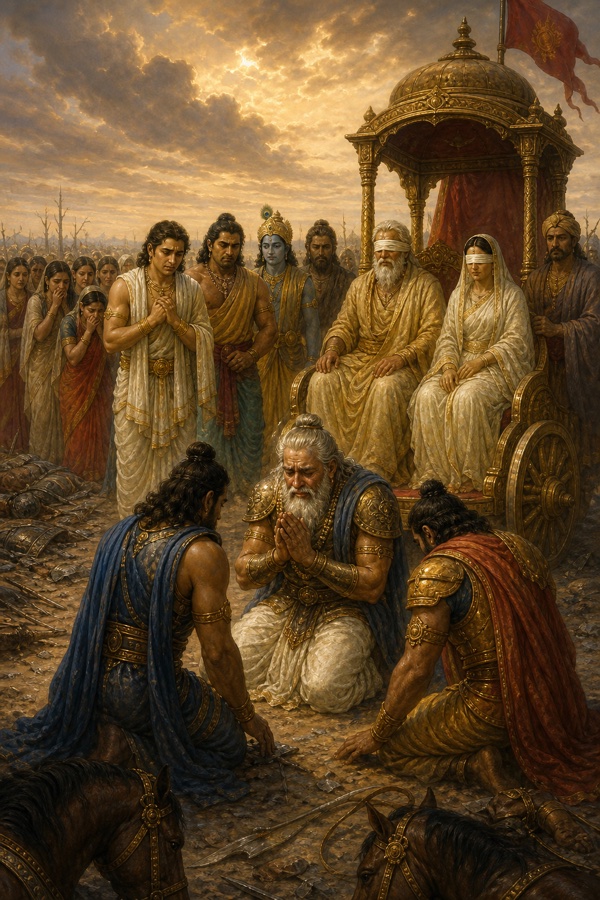
Gandhari, his queen, came at her husband’s command to the place where he waited, with the death of her sons upon her, and Kunti, the mother of the sons of Pandu, came with her, and the other women of the royal household. They came to the king together in their grief, and when they met they greeted one another and cried aloud. Vidura was more stricken than any of them, and it fell to him to comfort them. He set the weeping women on the chariots that stood ready and started out with them from the city. A wail went up then from every Kuru house. The whole city was in anguish, down to the children. These were women whom the gods themselves had never before laid eyes on, and now, helpless, their husbands dead, they were seen by the common people. Their hair hung loose. They had taken off their ornaments, and each wore a single cloth. They came out of houses that stood like white mountains, the way a herd of dappled deer comes out of its mountain caves when the leader has fallen. Band after band of them came out, and ran this way and that like fillies loose in a ring. They caught one another by the hand and cried out for their sons and brothers and fathers, and it looked like the scene at the end of an age, when the world is destroyed. They wept and ran and did not know what to do. Women who had once blushed to be seen even by their own companions now stood, barely covered, in front of their mothers-in-law, and felt no shame. Once they had consoled one another over the smallest griefs. Now, stunned, they did not so much as look at each other. With those thousands of wailing women around him the king left the city and made with all speed for the field of battle. Artisans and traders, Vaishyas, craftsmen of every kind came out of the city and followed behind him. The cry that rose from the women seemed to pierce all the worlds, and every creature that heard it thought the hour of universal destruction had come, when the fire of the end of the age consumes all things. The citizens, who were devoted to the house of Kuru and sick with dread at the ruin of their rulers, raised a wail as loud as the women’s.
Dhritarashtra had gone no more than two miles when three chariots came to meet him. In them were the three great chariot fighters Kripa the son of Sharadvat, Ashvatthama the son of Drona, and Kritavarma. At the sight of the blind king, powerful still, the three of them sighed, and they were weeping as they spoke, their voices thick with tears.
“Your royal son has accomplished the hardest of feats, and he has gone, with all who followed him, to the world of Indra,” they said. “Of Duryodhana’s whole army we three are the only chariot fighters who have come away alive. All the others have perished.”
Having said that much to the king, Kripa turned to Gandhari in her grief. “Your sons fell doing what heroes do,” he said. “They fought without fear and struck down great numbers of the enemy. Beyond doubt they have reached the bright worlds that are won by weapons alone, and they are at play there like gods, in bodies of light. Among those heroes there was no one who turned back from the battle. Every one of them fell at the edge of a weapon. No one joined his hands and begged for his life. The ancients have said that death in battle, at the edge of a weapon, is the highest end a Kshatriya can reach. So you should not grieve for any of them.”
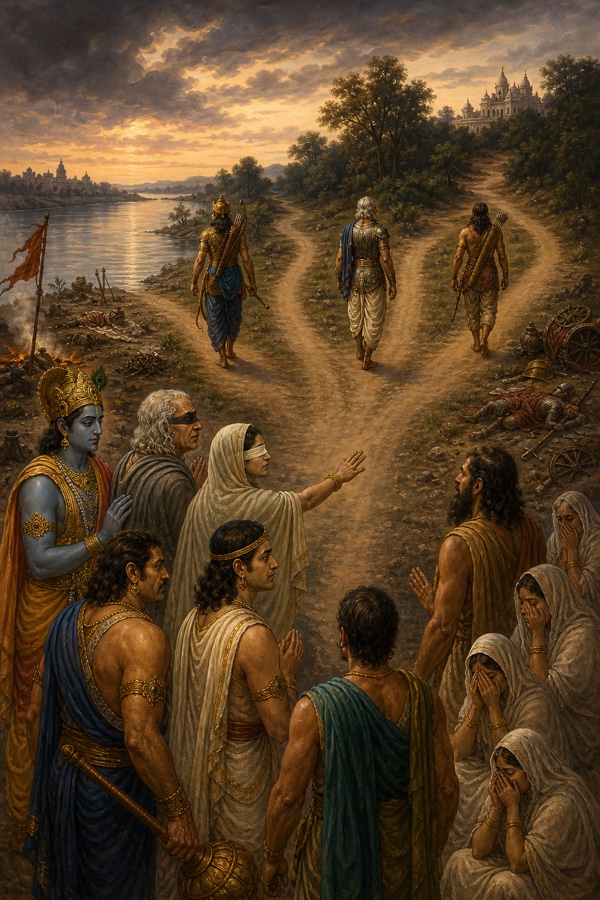
“And their enemies, queen, the Pandavas, have fared no better,” Kripa went on. “Hear what we have done to them, with Ashvatthama leading us. We learned that Bhima had killed your son by unrighteous means. So we entered the Pandava camp while it was buried in sleep, and we slaughtered them. All the Panchalas are dead. All the sons of Drupada have been killed, and all the sons of Draupadi. We have made this carnage among the sons of our enemies, and now we are running, for the three of us cannot stand against them in battle. They are heroes and great bowmen, all of them. They will hear that their sons are slaughtered, they will be wild with rage, and they will come after us quickly for their revenge, following our track. After what we did in their sleeping camp we dare not stay. Give us leave to go, queen, and do not set your heart on sorrow. Give us your leave too, king. Call up all your fortitude, and keep to the duty of a Kshatriya in its highest form.”
Kripa and Kritavarma and Drona’s son circled the king in respect, and they could not take their eyes off Dhritarashtra as they did it. Then they urged their horses toward the banks of the Ganga. Some way off, anxious, glancing at one another, the three took their leave of each other and separated. Kripa, the son of Sharadvat, went to Hastinapura. Kritavarma, the son of Hridika, made for his own kingdom. The son of Drona set out for the hermitage of Vyasa. They had wronged the sons of Pandu, and each went in fear to the place he had chosen, and all of this was done before the sun rose. It was after this meeting that the Pandavas came up with Drona’s son and overcame him by their own strength.
A key to reading this (the three surviving warriors): Kripa, Ashvatthama, and Kritavarma are, by their own account, the only chariot fighters of Duryodhana’s army left alive. What Kripa reports to Gandhari is the raid the three of them made, with Ashvatthama leading, on the sleeping Pandava camp, in which the Panchalas, the sons of Drupada, and the sons of Draupadi were killed. They are in flight from the Pandavas as they speak, and the meeting on the road is over before sunrise. The Pandavas overtake and defeat Ashvatthama afterward.
The gist: Sanjaya came back and told the king to see to the funeral rites; the king fell again, and Vidura raised him. Dhritarashtra called for Gandhari, Kunti, and the women of the house, and the whole city followed them out, wailing. Two miles along the road Kripa, Ashvatthama, and Kritavarma met them, told the king his son had gone to the world of Indra, told Gandhari of the slaughter in the sleeping camp, asked leave to go, and scattered three ways before sunrise.
Yudhishthira’s Meeting and the Episode of the Iron Bhima
By then every warrior was dead, and Yudhishthira, the eldest of the five sons of Pandu and now the king, heard that his uncle Dhritarashtra had set out from Hastinapura, the city named for the elephant. He had his own dead to grieve for. He took his brothers and went to meet the old man, full of sorrow for an uncle who had lost a hundred sons. Krishna of the Dasharha line went behind him, and Yuyudhana, who is also called Satyaki, and Yuyutsu. Draupadi, the princess of Panchala, burning with her own grief, followed too, with the Panchala women who were with her. Near the banks of the Ganga, Yudhishthira came in sight of the women of the house of Bharata, a crowd of them, crying like a flight of ospreys. They closed around him in their thousands. Their arms were lifted in grief, they were wailing aloud, and they said to him whatever came to them, the kind words and the bitter ones.
“Where is the king’s righteousness now?” they cried. “Where are his truth and his compassion, when he has killed fathers and brothers and teachers and sons and friends? How did your heart grow quiet after you had Drona killed, and your grandfather Bhishma, and Jayadratha? What do you want with a kingdom, now that you have seen your fathers and your brothers slaughtered, and Abhimanyu whom no one could withstand, and the sons of Draupadi?”
Yudhishthira went on through them, through that crying like the crying of ospreys, and bowed at the feet of his eldest uncle. The other Pandavas saluted the old man in the customary way after him, and each of them announced himself by saying his own name. Dhritarashtra, in agony for his sons, put his arms around the eldest son of Pandu, the cause of that slaughter, and did it unwillingly. He spoke a few words of comfort to him. Then the wicked heart in him went looking for Bhima, the second brother, who had killed his sons with a mace, and he was like a fire standing ready to burn whatever came near it. The wind of his grief was fanning the flame of his anger, and Bhima was the forest it meant to consume.
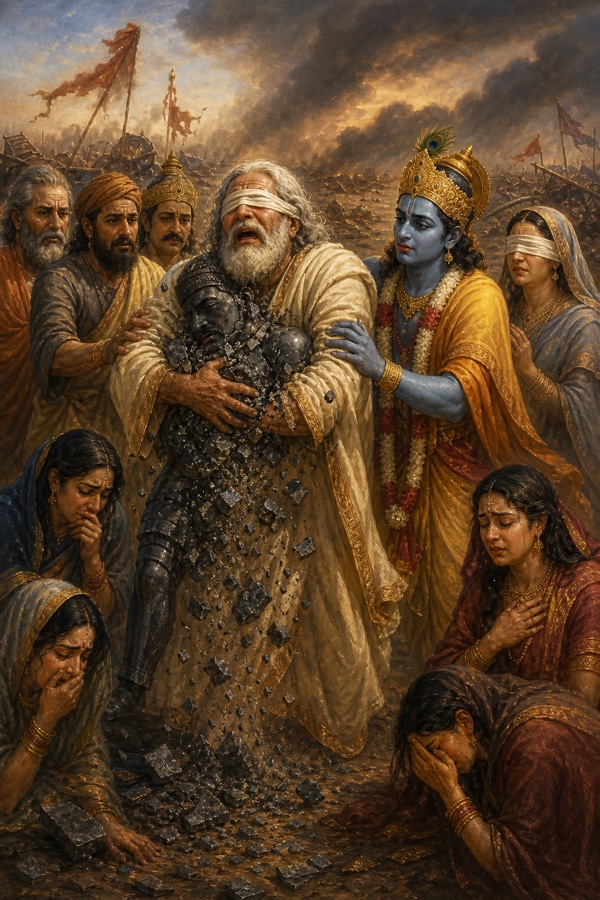
Krishna had understood the old king’s intention toward Bhima from the very start, and he had something ready for it. He pulled the real Bhima back out of the way and put in front of Dhritarashtra a statue of the second son of Pandu, made of iron. The king took hold of it with both arms. He had the strength of ten thousand elephants, and believing that he held Bhima himself in flesh and blood, he broke the iron figure into pieces. His own chest was badly bruised by it and he began to vomit blood. Covered in blood, he fell to the ground like a parijata tree bowed over by the weight of the flowers at its top. Sanjaya, the son of Gavalgana, his learned charioteer, lifted him and soothed him. “Do not act so,” he said. And the anger went out of the king. He came back to his ordinary self, and grief filled the place where the rage had been, and he began to cry aloud. “Alas, Bhima! Alas, Bhima!”
Krishna saw that the wrath had left him and that he was truly sorry for having, as he believed, killed Bhima. “Do not grieve, Dhritarashtra,” he said. “You have not killed Bhimasena. What you have broken is a statue made of iron. I understood that you were full of rage, and I dragged the son of Kunti out from between the jaws of Death. No one is your equal in strength of body. What man could bear the pressure of your arms? No one comes away alive from a meeting with the Destroyer, and no one would come away safe from your embrace. That is why that iron Bhima over there, which your own son had made, was kept ready for you. Grief for your dead sons has turned your mind away from righteousness, and so you tried to kill Bhimasena. His death would have done you no good. It would not have brought your sons back to life. So give your approval to what we have done with a view to peace, and do not set your heart on grief.”
Serving women came then to wash the king. When he had been washed, Krishna spoke to him again. “You have read the Vedas and many scriptures. You have heard all the old histories and everything about the duties of kings. You are learned, and you have great wisdom. Why, then, do you nurse such anger, when everything that has come upon you is the result of your own fault? I spoke to you before the battle. Bhishma and Drona did the same, and Vidura, and Sanjaya. You did not follow our advice then. We urged you, and still you would not act on our counsel, though you knew that the Pandavas were stronger and braver than you and yours. A king who can see his own faults, and who knows the differences of place and time, comes to great prosperity. One who is advised by his well-wishers and will not accept their words, pleasant or unpleasant, meets with distress and has to grieve over the evil course he took. Take up a different way of life now. You did not keep your soul in check. You let Duryodhana rule you. What has come upon you is your own fault, so why do you seek to kill Bhima? Remember your own faults and govern your anger. The mean wretch who, in his pride, had the princess of Panchala brought into the assembly has been killed by Bhimasena in just revenge. Look at your own evil acts, and at those of your son with his wicked heart. The sons of Pandu are entirely innocent, and you and he treated them most cruelly.”
It was nothing more than the truth, and Dhritarashtra answered accordingly. “It is as you say. What you have told me, Krishna, is perfectly true. It was a father’s love that made me fall away from righteousness. It is good luck that Bhima, protected by you, did not come inside my arms. I am free of wrath now, and of the fever. I want very much to embrace him, the second son of Pandu. All the kings are dead, my children are no more, and my welfare and my happiness now rest on the sons of Pandu.”
Then the old king put his arms around Bhima and around Arjuna, and around Nakula and Sahadeva, the two sons of Madri. He wept, and comforted them, and gave them his blessing.
A key to reading this (the iron-Bhima stratagem): Krishna had read the old king’s mind beforehand and kept the statue ready. It was an iron figure of Bhima that Duryodhana himself had once had made. Dhritarashtra, with the strength of ten thousand elephants in his arms, crushed it believing it was the man who had killed his sons, and the rage went out of him with the effort. Krishna told him the truth at once, and then, when the king had been washed, told him whose fault the war had been.
The gist: Yudhishthira came through the reproaches of the Kuru women and bowed at his uncle’s feet. The king embraced him unwillingly and reached for Bhima; Krishna put an iron Bhima in his arms, and the king broke it and wept for the man he thought he had killed. Told the truth, and told his own faults, Dhritarashtra said that a father’s love had led him astray, and embraced and blessed the four brothers.
Gandhari and Bhima’s Dialogue, and the Glance at Yudhishthira’s Toe
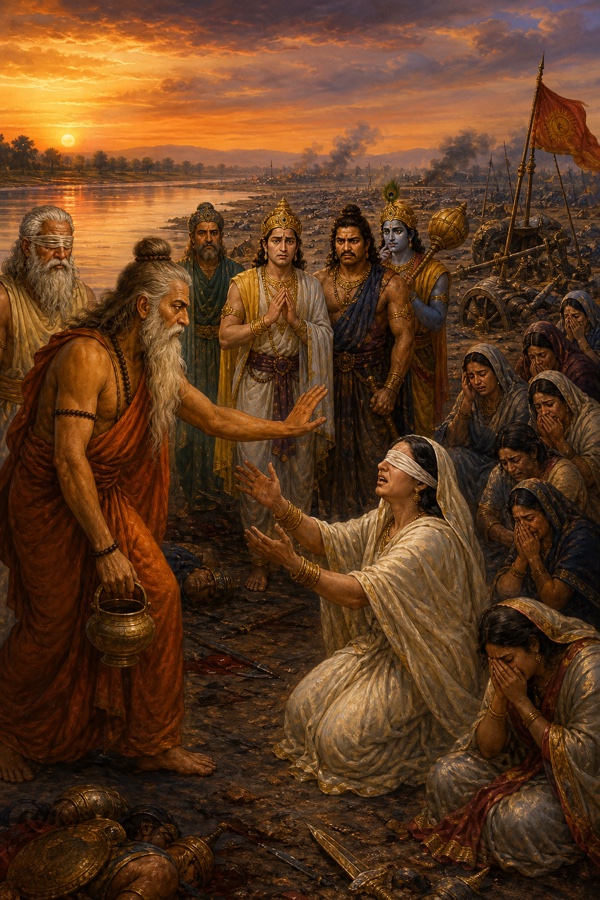
At Dhritarashtra’s bidding the Pandava brothers went next, with Krishna, to see Gandhari. She was the mother of the hundred, a woman without fault, and in her grief, remembering that Yudhishthira had destroyed every enemy he had, she wanted to curse him. Vyasa, the son of Satyavati, knew of that intention toward the Pandavas and set himself to stop it before it could be acted on. He cleansed himself in the fresh and sacred water of the Ganga. He was a seer who could go wherever he wished at the speed of thought, and who could look into the heart of any creature when he turned his mind toward it, and so he was there, at that spot, at the moment he was needed. He had great merit from his austerities, and he was always intent on saying what would do creatures good. He spoke to his daughter-in-law.
“Do not use this occasion to pronounce a curse,” Vyasa said. “Use it to show your forgiveness. You should not be angry with the Pandavas, Gandhari. Set your heart on peace. Hold back the words that are about to fall from your lips, and listen to my advice. For the eighteen days the battle lasted your son came to you every day, wanting victory. ‘Mother, bless me, for I am fighting my enemies,’ he said. And every day the answer you gave him was the same: ‘Where righteousness is, there victory is.’ I cannot remember, Gandhari, that any word spoken by you has ever proved false. So the words you spoke to Duryodhana cannot have been false either. You are always working for the good of all creatures. The sons of Pandu have reached the far shore of that dreadful battle of Kshatriyas, and beyond doubt they have won the victory, and a far greater measure of righteousness with it. You practiced forgiveness before. Why would you not practice it now? You know what righteousness is; subdue what is unrighteous. Victory is where righteousness is. Remember your own righteousness and the words you spoke yourself, and hold back your anger. Do not act otherwise.”
“Holy one, I bear the Pandavas no ill will, and I do not wish them to perish,” Gandhari said. “It is grief for my sons that has my heart in this turmoil. I know that I ought to protect the Pandavas as carefully as Kunti herself protects them, and that Dhritarashtra ought to protect them as I ought. The Kurus have been wiped out through the fault of Duryodhana and of Shakuni the son of Subala, and through what Karna and Duhshasana did. No blame at all can attach to Arjuna, or to Bhima, or to Nakula or Sahadeva, or to Yudhishthira himself. The Kauravas, swollen with arrogance and pride, fell in the fighting, and many others with them who came to help them. I do not grieve at that. There is one thing, though, that Bhima did in the very presence of Krishna. He challenged Duryodhana to a terrible fight with maces. He came to see, as my son moved through the turns and passes of that fight, that my son was the more skillful. And he struck him below the navel. That is what stirs my anger. Why should heroes, to save their lives, throw away the obligations of duty that great men who know every duty have laid down?”
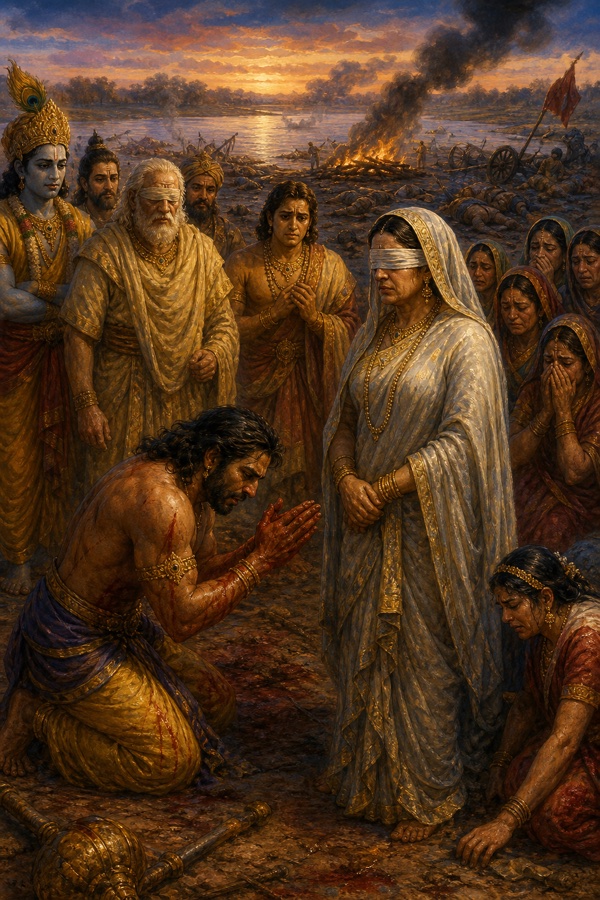
Bhima looked like a frightened man when he heard her, and what he said was meant to soothe her. “Righteous or unrighteous, I did it out of fear, to protect myself. I ask you to forgive me for it. No one could have killed your son, strong as he was, in a fair and righteous fight. That is why I did what was unfair. Duryodhana himself had once defeated Yudhishthira by unrighteous means, and he dealt with us in guile always. That is why I took an unfair course. Your son was the one warrior left unslain on his side. So that he should not kill me in the mace fight and take our kingdom from us once more, I acted as I did. You know everything your son said to the princess of Panchala when she stood there in her season, wearing a single cloth. Unless we disposed of Duryodhana we could never have ruled the whole earth and her seas in peace. That is why I acted as I did. Your son did us many wrongs. In the middle of the assembly he bared his left thigh to Draupadi. For that alone he deserved to die at our hands then and there. King Yudhishthira commanded otherwise, and we let ourselves be held by the agreement that had been made. That was how your son provoked a deadly enmity with us. We suffered greatly in the forest he drove us into. I remembered all of it, and I acted as I did. With Duryodhana dead in battle our enmity is at an end. Yudhishthira has his kingdom back, and our anger has left us.”
“You praise my son’s skill, and by that praise he did not deserve such a death,” Gandhari said. “Still, he did everything you tell me he did. There is the other thing. When Vrishasena had left Nakula without his horses, you drank blood from Duhshasana’s body in the middle of the battle. That is a cruel act, and good people condemn it. It suits only the lowest of men. It was a wicked thing you did then, Bhima, and it was unworthy of you.”
“It is wrong to drink the blood even of a stranger,” Bhima answered. “What is there to say, then, of drinking one’s own? A brother is one’s own self. There is no difference between the two. That blood did not pass my lips and teeth, mother. Karna knew that well. Only my hands were smeared with it. I saw Nakula stripped of his horses by Vrishasena in the battle, and I saw the Kaurava brothers rejoicing, and I put dread into them. After the game of dice, when Draupadi was seized by the hair, I said certain words in my rage. Those words are still in my memory. If I had left that vow unfulfilled I would have been counted, for all the years to come, as a man who had swerved from the duties of a Kshatriya. That is why I did it. You should not hold me at fault, Gandhari. You did not restrain your sons in the old days. Is it right now to lay blame on us, who are innocent?”
“No one has beaten you, and you have killed a hundred sons of this old man,” Gandhari said. “Why, child, did you not spare one? One son for this old couple who have lost their kingdom, one whose offenses were lighter than the rest? Why did you not leave a single staff for this blind pair to lean on? You have killed all my children and you live, unharmed. Even so, child, I would have had no grief if you had kept to the path of righteousness in killing them.”
Anger rose in her then, for the slaughter of all her sons and all her grandsons, and she asked for Yudhishthira. “Where is the king?”
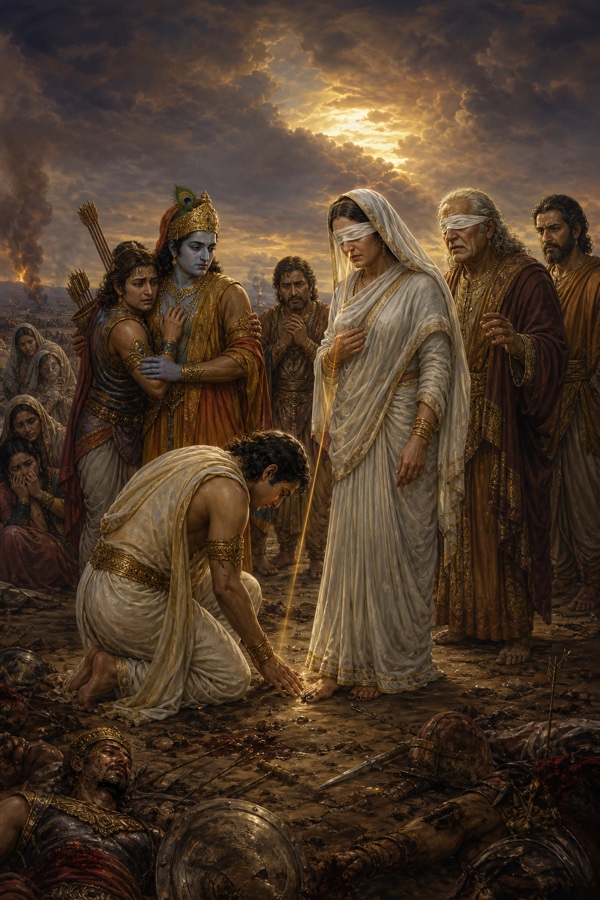
Yudhishthira came toward her trembling, with his hands joined, and spoke softly. “Here is Yudhishthira, goddess, the cruel slayer of your sons. I deserve your curses, for I am the cause of this universal destruction. Curse me. I have no further need of life, or of a kingdom, or of wealth. I have caused friends like these to be killed. I have shown myself a great fool and a hater of friends.”
He stood before her, overcome with fear, having said this, and Gandhari drew long breaths and said nothing. She knew the rules of righteousness, and she saw far. A cloth covered her eyes. From inside its folds, as the prince bent his body forward to fall at her feet, she turned her eyes down to the tip of his toe. All of Yudhishthira’s nails had been beautiful until that moment. Now one nail on that toe was a sore. Arjuna saw it and moved around behind Krishna. The other sons of Pandu grew restless and shifted from one spot to another. Then Gandhari’s anger left her, and she comforted the Pandavas as a mother should.
A key to reading this (Gandhari’s glance): Gandhari wears a cloth over her eyes, and what marked Yudhishthira was a single glance. From within the folds of that cloth her eyes turned to the tip of his toe as he bowed, and the nail became a sore. She had spoken no curse. Vyasa had just said that he could not remember any word of hers ever proving false, and Arjuna, seeing the toe, stepped behind Krishna.
The gist: Vyasa arrived in time to hold Gandhari back from cursing Yudhishthira. She cleared the Pandavas of blame for the war and named the two things she could not forgive in Bhima, the mace blow below the navel and the blood of Duhshasana, and Bhima answered both. She asked why he had not left the blind couple a single son. Yudhishthira offered himself to her curse, and her glance from beneath the cloth left one sore nail on his toe before her anger went.
Kunti, Draupadi, and the March to the Battlefield
With her leave the brothers went on together to present themselves to their own mother. Kunti had not seen her sons in a long time, and she had been sick with anxiety for them. When she saw them she pulled her cloth over her face and wept. She wept with her children for a while. Then she looked at them, and saw on their bodies the wounds and the scars that many weapons had left. Again and again she embraced each of her sons and stroked him. And she wept with Draupadi, who had lost every one of her children, and whom she found lying on the bare earth, crying out.
“Where have they all gone, revered mother, your grandsons, and Abhimanyu with them?” Draupadi said. “They see you in such distress. Why are they so slow to come before you? I have lost my children. What do I want with a kingdom?”
Kunti lifted the princess of Panchala from the ground as she wept and set about comforting her. Then, with Draupadi beside her and her sons following, she went to Gandhari, who was in greater pain still.
Gandhari saw her come with her daughter-in-law, and spoke. “Do not grieve so, daughter. Look at me. I am stricken as you are. I think this universal destruction was brought about by the course of Time, which no one can resist. This dreadful slaughter had to come, and no human will chose it. What Vidura, in his great wisdom, foretold after Krishna’s plea for peace had failed has now come to pass. So do not grieve over a thing that could not be avoided, least of all now that it has happened. They fell in battle, and they are not to be mourned. I am in the same case as you. If you give way like this, who will comfort us? It was through my fault that this greatest of families has been destroyed.”
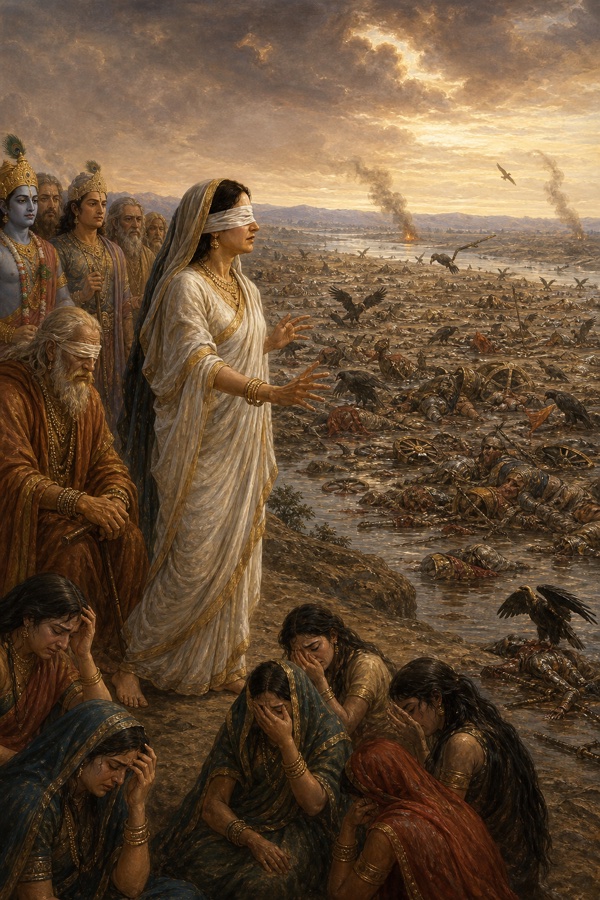
She stood at that place, far from the field of battle, and from there she saw the slaughter of the Kurus. She saw it with the eye of the spirit. Gandhari had been devoted to her husband all her life. She had kept high vows and gone through the severest austerities, and she had always spoken the truth, and the great seer Vyasa had granted her a boon by which spiritual knowledge and power became hers. What she saw made her cry out in pity. From a distance, and as clearly as if she stood close, she saw the battlefield of all those fighters, terrible to look at and full of strange sights. Bones and hair were scattered all over it. Streams of blood covered it, and on every side lay dead bodies in thousands upon thousands. The ground was covered with the blood of elephants and horses, of chariot fighters and fighters of every other kind. Headless trunks lay everywhere, and heads without trunks. The field rang with the cries of elephants and horses and men and women. Jackals were all over it, and cranes and ravens and the carrion birds called kankas, and crows. It was a playground for the rakshasas who live on human flesh. Ospreys and vultures swarmed over it, and the ill-omened howling of the jackals carried across it.
Then, at Vyasa’s command, King Dhritarashtra went to the battlefield, and with him all the sons of Pandu with Yudhishthira at their head, and Krishna, and all the Kuru women. The women had lost their husbands. They reached Kurukshetra and saw their brothers and sons and fathers and husbands lying dead on the ground, being eaten by beasts of prey, by wolves and ravens and crows, by ghosts and pishachas and rakshasas and the other creatures that walk at night. It looked like the ground where Rudra takes his sport. The women shrieked aloud and got down quickly from their costly carriages. They had never seen anything like what they were seeing. The strength went out of the limbs of the Bharata women and they fell down on the ground. Others were so stunned that they lost consciousness entirely. The women of Panchala and the women of Kuru were plunged into a misery beyond the reach of words.
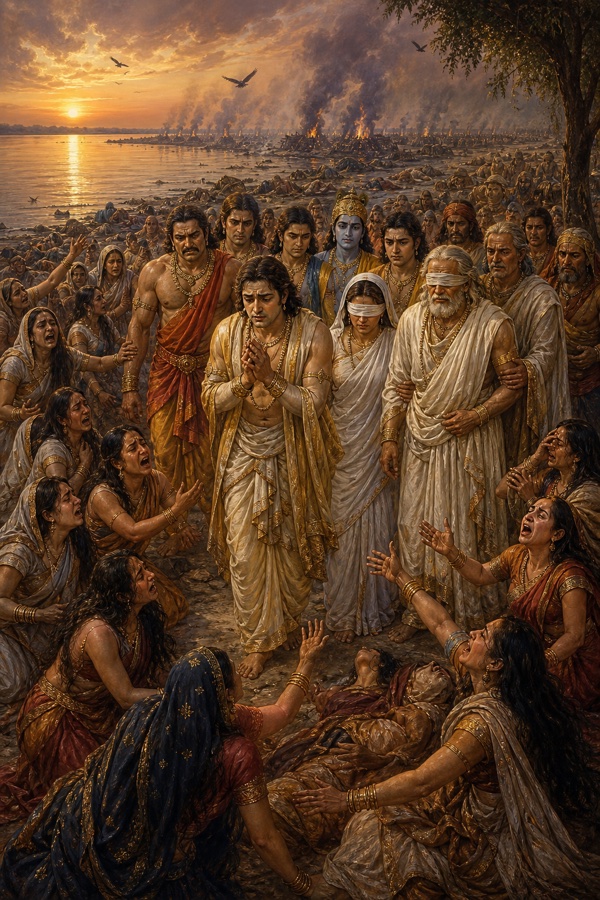
The gist: Kunti wept over her sons’ wounds and over Draupadi, who had lost all her children. Gandhari, calling the mourner daughter, told her that Time had made the slaughter unavoidable, and took the fault for the ruin of the family on herself. Then, from where she stood, she saw the whole battlefield with the sight that Vyasa’s boon had given her. At Vyasa’s command the king, the Pandavas, Krishna, and the Kuru women went to Kurukshetra, and the women fell fainting among their dead.
Gandhari’s Lament: Showing Krishna the Battlefield
The field echoed in every direction with the cries of those women. Gandhari, the daughter of Subala, who knew every duty, looked on the destruction of the Kurus and turned to Krishna, who stood near her. She called him by many names as she spoke, Madhava and Keshava, Janardana and Govinda, and grief was in everything she said. “Look, Madhava, at these daughters-in-law of mine. Their husbands are dead and their hair is loose, and they are crying like a flight of ospreys. As they come upon the bodies they remember the great chiefs of the house of Bharata, and they run here and there in large bands toward their sons and brothers and fathers and husbands. Look: the field is covered with the mothers of heroes, and every one of them has lost her children. And over there it is covered with the wives of heroes, and every one of them has lost her husband. See how it is adorned with Bhishma and Karna and Abhimanyu and Drona and Drupada and Shalya, as if with blazing fires. See how it is adorned with golden coats of mail, and the costly gems of great warriors, their armlets and bracelets and garlands. It is strewn with darts and spiked clubs that heroes’ hands once hurled, with swords, with keen arrows of every kind, with bows. The beasts of prey have gathered, and they stand or play or lie down as they please. That is what the field of battle is, Krishna.”
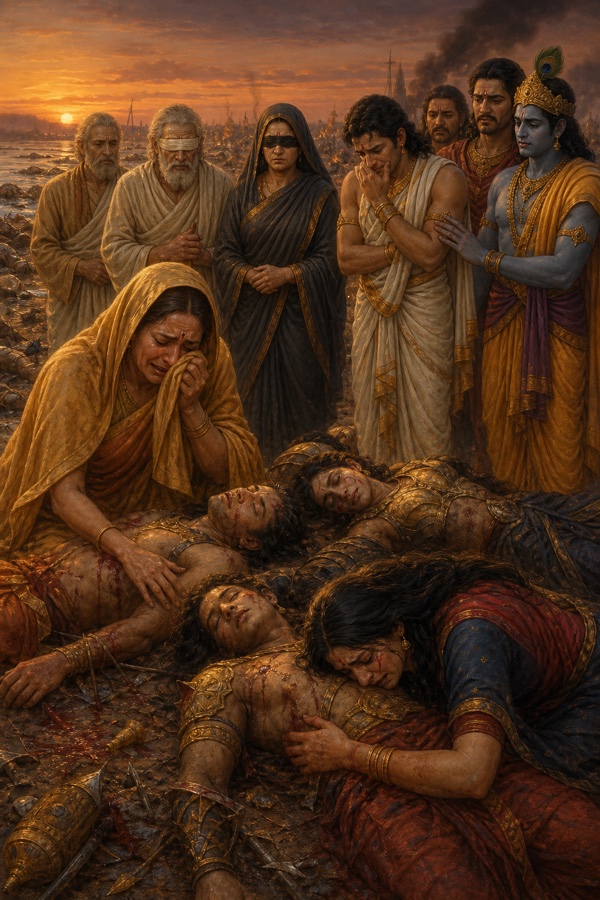
“The sight of it burns me,” Gandhari said. “With the Panchalas destroyed and the Kurus destroyed, it seems to me that the five elements themselves, of which everything is made, have been destroyed. Fierce vultures and other birds in their thousands are dragging at those blood-dyed bodies. They catch them by their armor and eat. Who could have imagined the death of heroes like Jayadratha and Karna and Drona and Bhishma and Abhimanyu? They could not be killed, and they have been killed. Vultures and kankas, ravens and hawks, dogs and jackals are feasting on them. The men who fought on Duryodhana’s side and took the field in wrath lie there now like fires that have gone out. Every one of them deserved to sleep on a soft, clean bed, and in this disaster they sleep today on the bare ground. Bards used to delight them, at the proper hours, by reciting their praises. Now what they listen to is the fierce, ill-omened crying of jackals.”
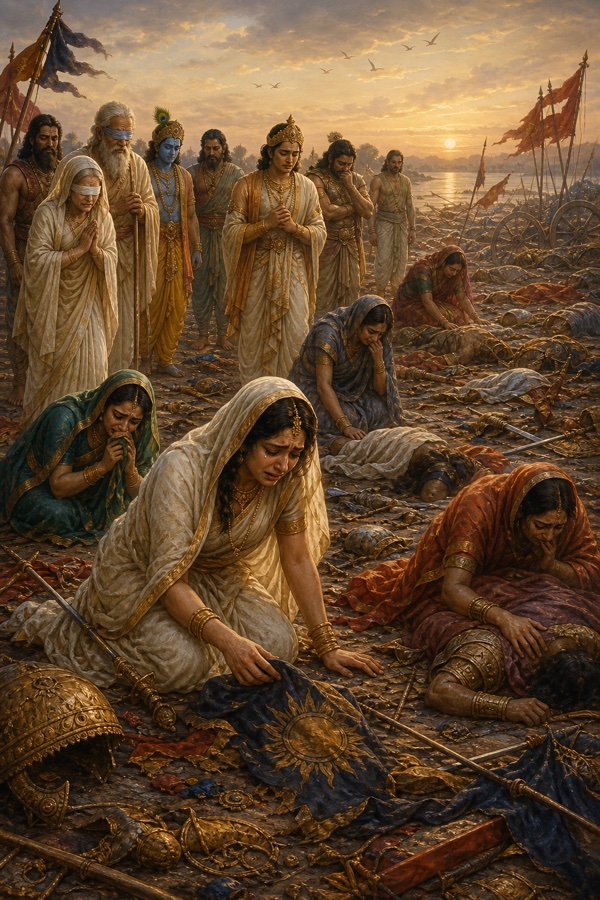
“These heroes used to sleep on costly beds with their limbs smeared with sandal paste and powdered aloe,” she said. “They sleep in the dust now. The vultures and wolves and ravens have become their ornaments, and they drag at the bodies, crying their fierce cries. Some of the dead look glad, as men do who delight in battle, with their sharp arrows and tempered swords and bright maces still beside them, as if life had not yet left them. Some sleep with their great arms around their maces, as if around beloved wives. Others still wear their armor and hold their bright weapons in their hands, and the beasts leave those alone, Krishna, taking them for living men. The garlands of pure gold are being scattered on every side as the carrion eaters drag the bodies, and wolves in their thousands pull at the golden chains on the necks of the dead. Bards trained to their art used to delight these men every morning with hymns. Around them now stand women in tears. Their faces are pale and still lovely, Keshava, like a bank of red lotuses, and with weeping and anger some have turned the color of the morning sun, of gold, of burnished copper. Each hears the others’ broken laments and cannot catch what they mean, for the wailing bursts out from every side. Some sigh long sighs and cry again and again and then, stunned, give up their lives. Many weep and wail at the sight of the bodies. Others strike their heads with their own soft hands. The earth is heaped with severed heads and hands and limbs, all mingled together. The women find beautiful trunks without heads and heads without trunks, and lie senseless on the ground a long while. They set a head to a body, and see their mistake, and say, ‘This is not his,’ and weep more bitterly. Others fit together arms and thighs and feet cut off by arrows, and faint over what they have assembled. Some look at bodies torn by animals and birds, with the heads gone, and cannot tell whether these are their husbands. The ground is a mire of flesh and blood, and no one can cross it for the arms still gripping swords and the heads still wearing earrings. These blameless women had never known the smallest distress. Look at the daughters-in-law of Dhritarashtra, band after band of them, like herds of fine-maned fillies. What sadder thing could I be shown, Keshava? I must have committed great sins in former lives, to be looking at my sons and grandsons and brothers all killed by the enemy.”
While she was lamenting in this way, Gandhari’s eyes fell on her son Duryodhana.
A key to reading this (the shape of the lament): Gandhari first sees the field from far off, by the spiritual sight that Vyasa’s boon gave her, and then goes to it with the others at Vyasa’s command. Everything that follows is spoken to Krishna, who stands near her. She passes from one body to the next. For each of the dead she gives a name, the manner of his death, and what the women around him are doing at that moment. Her own sons come first, and after them the dead of both armies.
Grief Over Her Sons: From Duryodhana to Duhshasana
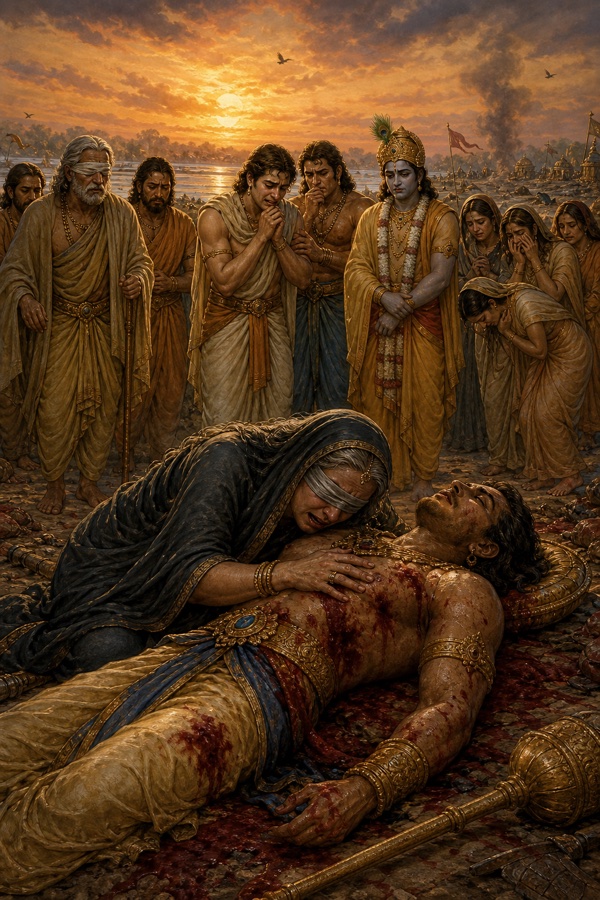
At the sight of Duryodhana her senses left her, and Gandhari fell to the earth like a plantain tree torn up by the roots. She came to herself soon. Her son lay on the bare ground, covered with blood, and at the sight she began to weep, crying out again and again. She took him in her arms. “My son! My son!” Her tears fell on his body, on the great broad shoulders, on the garlands and the collar he still wore. Krishna stood near, and she spoke to him.
“On the eve of this battle, which has wiped out our whole family, this greatest of kings said to me, ‘In this war of kin against kin, mother, wish me victory,’” Gandhari said. “I knew that a great calamity had come upon us, and I answered him: ‘Where righteousness is, there victory is. And since your heart is set on battle, my son, you will surely win the worlds that weapons win, and live there at play like a god.’ Those were the words I said to him then. I did not grieve for my son then. I grieve for Dhritarashtra, helpless, with his friends and kinsmen taken from him.”
“Look at my son, Madhava,” she said. “He was first among warriors, quick to anger, skilled in arms, a man no one could stand against in battle, and he is asleep on the bed of heroes. See what reversals Time brings. He used to walk at the head of every crowned king, and he sleeps in the dust. And yet a hero who sleeps on the hero’s bed has surely reached the end that is hardest to reach. The fairest women once sat around this prince to please him. Jackals please him now, on that bed, with their ill-omened cries. Kings once ringed him, each trying to outdo the others in pleasing him. He lies killed on the ground and vultures ring him. Lovely women once fanned him with beautiful fans. Birds that eat the dead fan him now with the beating of their wings. He was strong, and his prowess was real, and Bhimasena has killed him in battle, and he sleeps like an elephant killed by a lion. Look at Duryodhana, Krishna, lying on the bare ground, covered with blood, struck down by Bhimasena’s mace. He gathered eleven akshauhinis of troops for this war, and his own bad policy has killed him. A great bowman, a great chariot fighter, and he sleeps there like a tiger killed by a lion. This reckless, foolish, wicked prince disregarded Vidura and disregarded his own father, and by that disregard of the old he has gone to his death. For thirteen years he ruled the earth with no rival, and today my son sleeps on the bare ground, killed by his enemies. It was a short while ago, Krishna, that I saw the earth ruled by Duryodhana and full of elephants and cattle and horses. Today I see her ruled by another and empty of elephants and cattle and horses. What do I want with life?”
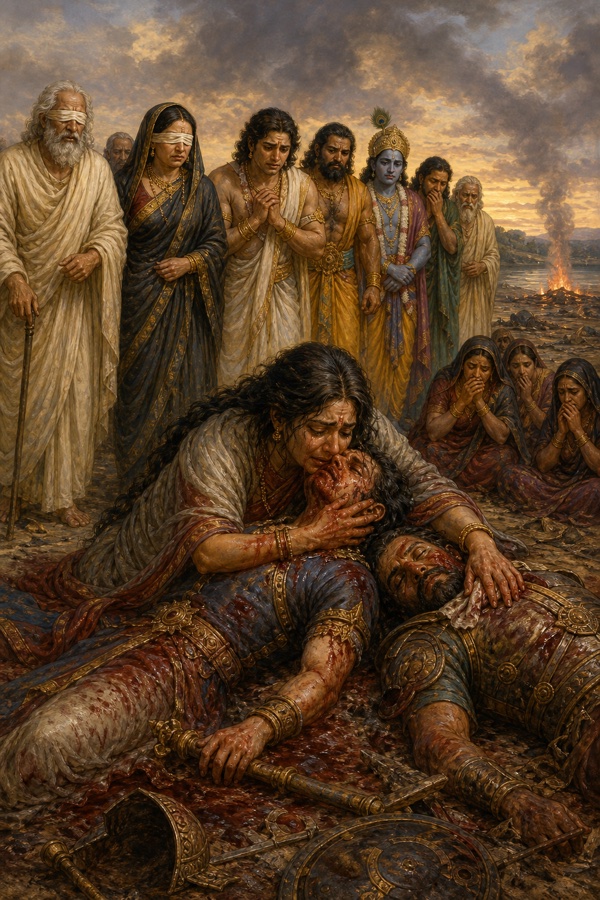
“And look at this, which is harder for me than the death of my son: these women weeping beside the dead,” she said. “Look at the mother of Lakshmana, Krishna, Duryodhana’s beloved wife, with her hair unbound, shining like a sacrificial altar of gold. When her husband was alive this bright girl surely played inside the circle of his handsome arms. Why does my heart not break into a hundred pieces, seeing my son and my grandson killed in battle? She is bending to smell the head of her son, which is covered with blood. Now she is stroking Duryodhana’s body gently with her hand. She grieves for her husband and then for her son. She looks at her husband and then at her son. Look, Madhava: she beats her head with her hands and falls on the chest of her husband, the king of the Kurus. Her skin is the color of lotus filaments, and she is beautiful as a lotus still. Now she wipes the face of her son, and now her husband’s. If the scriptures are true, and the revealed word is true, then this king has surely reached the worlds a man wins by his weapons.”
“Look, Madhava: my hundred sons, who never tired in battle, have all been killed by Bhimasena with his mace,” Gandhari said. “And what grieves me more today is to see my daughters-in-law, young as they are, with their sons dead and their hair loose, wandering this field. They used to walk only on the terraces of fine mansions, with ornaments on their feet. Now, in the pain of their hearts, they must set those feet on hard earth that blood has turned to mud. They reel in their sorrow like drunken people and can hardly drive off the vultures and jackals and crows. See that one, slender and flawless, who has seen the carnage and is falling. I look at that princess, the mother of Lakshmana, and my heart is torn. Some of these women have found a brother lying dead on the bare ground, some a husband, some a son, and they fall beside them, clutching the arms of the dead. Listen to the older women wailing, and the women in their middle years. See the ones who are worn out, resting against broken chariot boxes and the bodies of dead elephants and horses. See that one, Krishna, who has picked up the severed head of some kinsman, a fine-nosed head with its earrings still on, and stands there holding it. I think that they and I, who have so little understanding, must all have committed great sins in former lives, for all our kinsmen to have been killed by the just King Yudhishthira. Our acts, righteous or unrighteous, do not go for nothing. Look at the young ones: well born, modest, black-lashed, black-haired, with voices as sweet as the voices of swans. They fall senseless, crying like flights of cranes. Their faces, lovely as lotuses in full bloom, are being scorched by the sun. The wives of my proud sons, who were strong as maddened elephants, are exposed to the stares of common people. And see, Govinda, what lies scattered on the ground: my sons’ shields with a hundred moons on them, their standards bright as the sun, their golden coats of mail, their collars and cuirasses of gold, their headgear. All of it blazes like sacrificial fires when the clarified butter has been poured. There Duhshasana sleeps. Bhima felled him and drank the blood from all his limbs. See him, my other son, killed by Bhima with his mace, at Draupadi’s urging and at the memory of what Bhima had suffered at the time of the dice game.”
“In the middle of the assembly this Duhshasana spoke to the princess of Panchala, who had been won at dice,” she said. “He wanted to please his elder brother, and Karna too. ‘You are the wife of a slave now,’ he told her. ‘Come into our household, lady, with Sahadeva and Nakula and Arjuna.’ That day, Krishna, I said to King Duryodhana, ‘Son, send the wrathful Shakuni away from your side. Understand that your mother’s brother has a wicked heart and loves a quarrel beyond anything. Send him away without delay and make peace with the Pandavas. Have you so little sense that you give no thought to Bhimasena and his rage? You are piercing him with arrows made of words, like a man striking an elephant with burning brands.’ He paid no attention to what I said. They had already been pierced by the darts of his speech, and he went on spitting the poison of his words at them, as a snake spits its venom at a bull. There Duhshasana sleeps with his two great arms flung out, killed by Bhimasena the way a lion kills a mighty elephant. And Bhimasena in his fury did a most horrible thing when he drank the blood of his enemy in battle.”
A key to reading this (the vow of Duhshasana’s blood): Bhima has already answered this charge to Gandhari’s face. When Draupadi was seized by the hair after the dice game he spoke certain words in his rage, and he held that a Kshatriya who left such a vow unfulfilled would be counted as fallen from his duty for all the years to come. He told her too that the blood never passed his lips and teeth, that only his hands were smeared with it, and that Karna knew as much. Gandhari, looking at Duhshasana’s body, calls the act horrible all the same.
The gist: Gandhari fainted at the sight of Duryodhana, held him, and told Krishna what she had answered when he asked for her blessing: where righteousness is, there victory is. She set his old state beside his present one, pointed out his wife moving between her dead husband and her dead son, and then turned to the hundred sons and their young widows. Over Duhshasana she recalled his words to Draupadi in the assembly, and her own warning to Duryodhana to send Shakuni away and make peace.
The Remaining Sons, and Uttara’s Lament for Abhimanyu
“There lies my son Vikarna, Madhava, whom the wise used to praise. Bhima killed him, and he is terribly mangled,” Gandhari said. “He lies in the middle of the dead elephants like the moon in an autumn sky with dark clouds around it. His broad palm is cased in its leather guard and scarred from the constant drawing of the bow, and the vultures that want to eat it can hardly pierce it. His young wife, helpless, keeps trying to drive those vultures off, and she cannot. Vikarna was young and brave and handsome, brought up in luxury, deserving every good thing, and he sleeps in the dust. Long shafts and barbed arrows have gone through all his vital parts, and still the beauty that was his has not left him. There sleeps my son Durmukha, who killed the enemy in bands. He lies with his face toward the foe, killed by Bhimasena in fulfillment of his vow. Beasts have eaten half his face away, child, and it looks the more handsome, like the moon on the seventh day of the bright fortnight. Look at it, Krishna. That is the face of a brave son of mine. How could he be killed by enemies and made to eat the dust? No enemy could stand before Durmukha. How was he killed?”
“Look at Chitrasena, another of Dhritarashtra’s sons, lying dead on the ground,” she said. “He was the model for every bowman. Young women sit grieving around his handsome body, with its wreaths and garlands still on it, and the beasts of prey sit there with them. The wailing of the women and the roaring of the beasts together are a wonder to me, Krishna. There lies my son Vivimshati, young and handsome, who always had the most beautiful women to wait on him. He sleeps stained with dust. Arrows have pierced his armor. He fell in the thick of the slaughter, and now vultures surround him and wait on him. He broke into the ranks of the Pandava army, and he lies on the bed of a hero, the bed of a high Kshatriya. Look at his face, Krishna: there is a smile on it, the nose is fine, the brows are fair, and it shines like the moon itself. Beautiful women in great numbers used to attend him, as thousands of heavenly girls attend a gandharva at his pleasure. And my son Duhsaha: who could endure him? He killed heroes, he adorned every assembly, no one could withstand him. His body is covered with arrows, and it is as bright as a mountain overgrown with flowering karnikaras. With his garland of gold and his shining armor, Duhsaha is splendid even without his life, like a white mountain on fire.”
“Look now, Keshava, at the one whose strength and courage were held to be half again as great as his father’s and yours,” Gandhari said. “He was like a fierce, proud lion. Alone, without a single follower, he pierced the formation of my son that no one could pierce. He was death to many, and now he has gone down to death himself and sleeps there. I see, Krishna, that the splendor of Abhimanyu, the son of Arjuna, has not dimmed even in death. There is the daughter of Virata, the daughter-in-law of the wielder of the bow Gandiva, a girl without a flaw, crying aloud at the sight of her brave husband. She has come close to him and is stroking him gently with her hand. That girl used to embrace him shyly, when the honeyed wine had made her bold, and kiss the face of Subhadra’s son, a face like a lotus in full bloom, on a neck marked with three lines like the lines of a conch shell. Now she has taken off his golden coat of mail and is looking at his body, which is dyed with blood.”
“She looks at him and speaks to you, Krishna,” Gandhari said. “‘This hero had eyes like yours, and he has been killed. In strength and energy and prowess he was your equal. He was very like you in beauty. And he sleeps on the ground, struck down by the enemy.’ Then she speaks to her husband. ‘You were brought up in every luxury. You slept on the soft skins of the ranku deer. Does your body feel no pain today, lying on the bare ground? Your great arms, with their golden armlets, are stretched out like the trunks of two elephants, the skin hard from the bow, and you sleep in peace, like a man tired out from too much exercise. Why do you not speak to me when I am weeping so? I cannot remember that I ever offended you. Why do you not speak? You used to call out to me when you saw me far off. Where will you go, leaving the honored Subhadra behind you, and these fathers of yours who are like gods, and me in this wretched state?’ Look, Krishna. She gathers his blood-soaked hair in her hands and lays his head in her lap and talks to him as if he were alive. ‘You are the son of Vasudeva’s sister and the son of the wielder of Gandiva. How could those great chariot fighters kill you in the middle of battle? Shame on those men of wicked deeds, Kripa and Karna and Jayadratha and Drona and Drona’s son, who took your life. What was in their minds when they surrounded you, a boy, and killed you, to my sorrow? You had so many protectors. How could you be killed so helplessly, with the Pandavas and the Panchalas looking on? How does your father, the son of Pandu, bear the weight of living, having seen you killed by many men together? Neither a great kingdom nor the defeat of their enemies gives the sons of Pritha any joy without you. By virtue and self-restraint I will come soon to the worlds you have won by your weapons. Protect me when I arrive there. A person cannot die before the hour comes, for here I am, wretched, still breathing after I have seen you dead. Whom are you speaking to now in the world of the ancestors, in the sweet words and smiles you once had for me? You will surely trouble the hearts of the apsaras in heaven with your beauty and your soft speech. You have the worlds kept for the righteous, and the apsaras for company. When you take your pleasure with them, remember now and then how I treated you. Our time together in this world was to be six months, it seems, and no more. In the seventh you were taken.’ The women of the royal house of Matsya are pulling Uttara away now, with everything she hoped for undone. They are in worse case than she is, for they have seen Virata. The arrows and weapons of Drona have torn him. He lies on the ground covered with blood, and vultures scream around him, and jackals howl, and ravens call. Those black-eyed women are trying to turn the body of the Matsya king, over which the carrion birds are crying for joy, and they are too weak with grief to manage it. The sun has burned their faces, and toil has left them pale and colorless. And look, Madhava, at the other children lying on the field besides Abhimanyu: a youth who is also named Uttara, and Sudakshina the prince of the Kambojas, and the handsome Lakshmana.”
A key to reading this (Abhimanyu and Uttara): Abhimanyu is the son of Arjuna and of Subhadra, Krishna’s sister, and Gandhari says he was held to be half again as strong as either his father or Krishna. He broke alone into the Kaurava formation and was killed there by many fighters together; his widow names Kripa, Karna, Jayadratha, Drona, and Drona’s son. She is Uttara, daughter of Virata, the Matsya king, who lies dead on the same field, killed by Drona. She and Abhimanyu had been together six months.
The gist: Gandhari went on through her sons, Vikarna, Durmukha, Chitrasena, Vivimshati, and Duhsaha, and then came to Abhimanyu and repeated to Krishna what his young widow Uttara was saying over the body: that her husband had been killed by many together, and that their union had lasted six months. The Matsya women drew Uttara away, and could not turn the body of her father Virata.
The End of Karna, Jayadratha, Shalya, and the Great Heroes
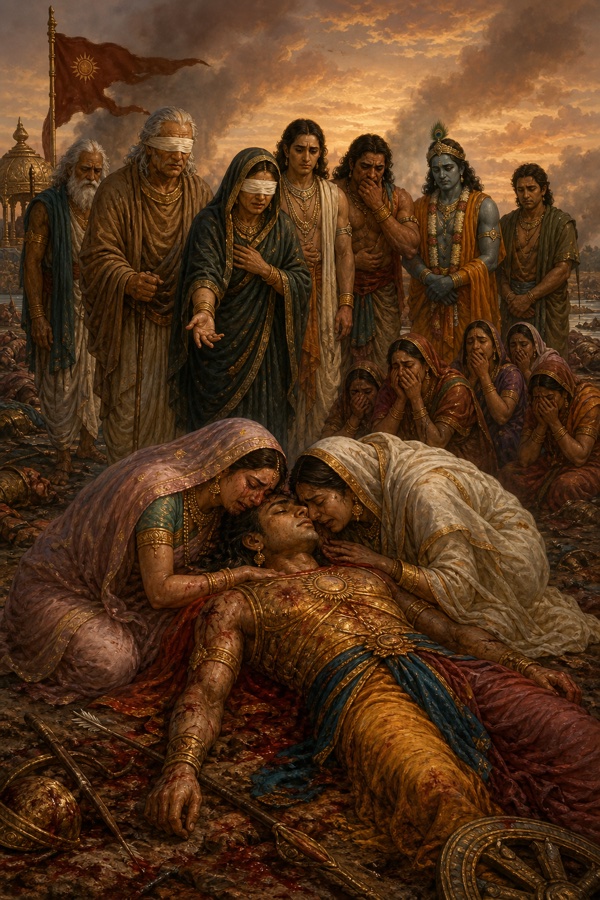
“There lies Karna on the ground, the great bowman,” Gandhari said. “In battle he was a blazing fire, and the energy of Arjuna has put that fire out. Look at him, the son of Vikartana. He killed many of the greatest chariot fighters, and he is stretched on the bare earth, drenched in blood. He was wrathful and full of energy, a great bowman and a great chariot fighter, and the wielder of Gandiva has killed him, and he sleeps on the ground. My sons were afraid of the Pandavas, and they fought with Karna in front of them, as a herd of elephants fights behind its leader. Arjuna has killed him in battle, as a lion kills a tiger, as one maddened elephant kills another. His wives have gathered around him, their hair loose, wailing. For thirteen years the thought of this man kept King Yudhishthira from a moment’s sleep. No enemy could check him in battle; he was like Indra, whom no enemy defeats. He was like the fire of fierce flames that destroys all things at the end of an age. He was as unmoving as the Himalaya. He became the protector of Dhritarashtra’s son, Madhava, and he lies lifeless on the bare ground like a tree the wind has thrown down. See his wife, the mother of Vrishasena, crying and falling to the ground. She is saying, ‘Your teacher’s curse has pursued you, beyond doubt. When the earth swallowed the wheel of your chariot, the cruel Arjuna cut off your head with an arrow. Shame on such heroism and such skill!’ That lady, the mother of Sushena, cries out and falls senseless at the sight of Karna on the earth, the belt of gold still around his waist. The eaters of flesh have fed on his body and left very little of it. It is a sight with no gladness in it, like the moon on the fourteenth night of the dark fortnight. She falls, and gets up again. She is burning for the death of her son as well, and she comes and puts her face to her husband’s face.”
“Look there: the lord of Avanti, killed by Bhimasena,” she said. “Vultures and jackals and crows are feeding on him. He had many friends, and he lies there with none. He made a great slaughter of the enemy and now he lies on the bed of a hero, covered with blood, with jackals and kankas and other eaters of flesh dragging at him. See what reversals Time brings. His wives sit around him together, crying. And look at Bahlika, the son of Pratipa, the great bowman. A broad-headed arrow killed him, and he lies on the ground like a sleeping tiger. The life has gone out of him and the color of his face is still very bright, like the full moon risen on the fifteenth day of the bright fortnight. And there is Jayadratha, the son of Vriddhakshatra. Arjuna, the son of Indra, burning for the death of his own son and bent on keeping his vow, has killed him. Drona himself protected Jayadratha, and Arjuna went through eleven akshauhinis of troops to reach him and killed him to fulfill that vow. Ill-omened vultures are feeding on Jayadratha, the proud and energetic lord of the Sindhus and the Sauviras. His devoted wives are trying to guard him, and the beasts are dragging his body off toward a thicket nearby. His Kamboja and Yavana wives are keeping watch over him against the animals. Once, with the Kekayas to help him, Jayadratha tried to carry off Draupadi, and that day he deserved to die at the hands of the Pandavas. They let him go, out of regard for Duhshala. Why, Krishna, could they not show Duhshala that regard once more? She is my daughter, and she is very young, and she is crying now. She strikes her own body with her hands and curses the Pandavas. What grief could be greater for me than this, that my young daughter is a widow and all my daughters-in-law are without husbands? Look at her. Duhshala has thrown off her grief and her fear and is running back and forth, searching for her husband’s head. He held back all the Pandavas when they wanted to rescue their son, and he caused the slaughter of a vast force, and in the end he went down to death himself. His wives, with faces lovely as the moon, sit around him and weep.”
“There lies Shalya, Nakula’s own mother’s brother, killed in battle by the pious and virtuous Yudhishthira,” Gandhari said. “He used to boast everywhere that he was your equal. The ruler of the Madras, a great chariot fighter, lies there without life. When he agreed to drive Karna’s chariot in battle, he set out to damp Karna’s energy, so that the victory might go to the sons of Pandu. Look at his smooth face, beautiful as the moon, with eyes like lotus petals. The crows have eaten at it. His tongue, the color of heated gold, has rolled out of his mouth, and the birds are eating that. The women of the royal house of Madra sit wailing around the body of the king whom Yudhishthira killed. They sit around him like a herd of she-elephants in their season around their leader when he has sunk in a bog. Look at Shalya, who gave protection to others, stretched on the bed of heroes with his body torn by arrows. There lies King Bhagadatta, the ruler of a mountain kingdom, the finest of all who wielded the elephant hook. He lies without life on the ground, and the garland of gold he wears on his head is still bright. The beasts are eating the body, and the garland still adorns his hair. The battle between this king and Arjuna was fierce enough to make the hair stand on end, like the battle between Indra and the asura Vritra. He fought Arjuna and brought him into great danger, and at the last Arjuna killed him. And there lies Bhishma, who had no equal on earth for heroism and energy, who did terrible things in battle. Look at the son of Shantanu, Krishna. He blazed like the sun, and he is stretched on the earth like the sun fallen out of the sky at the end of an age. He scorched his enemies with the fire of his weapons, and he has set as the real sun sets at evening. In knowledge of duty he was the equal of Devapi himself. He lies on a bed of arrows, a bed for heroes. He spread that bed of barbed and unbarbed arrows and lies on it as the divine Skanda lies on his clump of heath. The son of Ganga rests his head on a pillow of three arrows, given him by the wielder of Gandiva to complete the bed. In obedience to his father’s command he drew up his vital seed. No one could match him in battle, and there he lies, Madhava. He is righteous, he knows every duty, and by his knowledge of both worlds he, a mortal, still holds on to his life like one of the immortals. With Shantanu’s son struck down by arrows, it seems to me that no one is left alive on earth with the learning and the prowess for great deeds in battle. He is truthful. When the Pandavas asked him, he told them himself the means of his own death. He revived the line of Kuru when it had become extinct, and he is leaving the world with all the Kurus for company. Whom will the Kurus ask about virtue and duty, Madhava, when Devavrata, who is like a god, has gone to heaven?”
“Look at Drona, the great Brahmin, the teacher of Arjuna, of Satyaki, and of the Kurus, lying on the ground,” she said. “He knew the four kinds of arms as well as the chief of the gods knows them, or Shukra of the line of Bhrigu. It was by his grace that Arjuna, the son of Pandu, achieved the hardest feats. He lies there without life. At the last his weapons would not come when he called them. The Kauravas set him at their head when they challenged the Pandavas, and he, the greatest of all who bear arms, was torn by weapons in the end. He moved through the battle scorching his enemies on every side, and his path was the path of a fire in full blaze. He lies on the ground like a fire gone out. The grip of the bow is still in his hand. The leather guards, Madhava, are still on his fingers. Killed, he looks as if he were alive. The four Vedas and every kind of weapon never left him, as they never leave the Lord Prajapati. His feet deserved every worship. Bards and singers of praise adored them, his disciples worshiped them, and jackals are dragging at them now. Kripi, out of her senses with grief, is attending on him, on Drona whom the son of Drupada killed. Look at her, fallen on the earth, her hair loose and her face hanging down, waiting in sorrow on her lifeless husband. Many brahmacharis with matted hair are tending the body of Drona in its armor, which the arrows of Dhrishtadyumna have torn through and through. Kripi, delicate and joyless, is trying to perform the last rites for her husband. The chanters of the Samas have laid the body on the pyre and lit the fire with the proper rites, and they are singing the three Samas. Those students with matted hair have built their Brahmin teacher’s pyre of bows and darts and the boxes of chariots, and gathered arrows of many kinds to feed it, and he is burning. They have set him on the pyre and they are singing and weeping. Others recite the three Samas that are used at such a time. They have given Drona to that fire like fire given to fire, and now those twice-born disciples of his are walking toward the bank of the Ganga, keeping the pyre on their left, with Kripi going before them.”
A key to reading this (Bhishma’s bed of arrows): Gandhari says of Bhishma what she says of no one else on the field, that he is still holding on to his life. He lies on a bed of barbed and unbarbed arrows, his head on a pillow of three arrows that Arjuna gave him, and by his knowledge of both worlds he, a mortal, keeps his life like one of the immortals. She recalls that he drew up his seed in obedience to his father, that he revived the Kuru line when it was extinct, and that when the Pandavas asked him he told them himself how he could be killed.
The gist: Gandhari showed Krishna Karna, with the mother of Vrishasena falling and rising beside him; the lord of Avanti; Bahlika; Jayadratha, with her own daughter Duhshala searching for his head; Shalya; Bhagadatta; Bhishma on his bed of arrows; and Drona, whose students had built his pyre of bows and chariot boxes and were walking with Kripi toward the Ganga.
Lament for Bhurishravas, Shakuni, and the Remaining Kings
“Look at the son of Somadatta, whom Yuyudhana killed. A crowd of birds is pecking and tearing at him,” Gandhari said. “Somadatta lies there too, Krishna, burning for the death of his son, and seems to be reproaching the great bowman Yuyudhana. And there is the mother of Bhurishravas, a blameless lady, overcome with grief, speaking to her husband Somadatta. ‘It is good fortune, king, that you do not see this terrible carnage of the Bharatas, this extermination of the Kurus, this sight like the scenes at the end of an age. It is good fortune that you do not see your brave son, who carried the sacrificial stake as the device on his banner and performed many sacrifices with rich gifts to all, lying killed on the field of battle. It is good fortune that you do not hear your daughters-in-law wailing in this carnage, like the screaming of a flight of cranes on the breast of the sea. They have lost their husbands and their sons, and they are running here and there, each in a single cloth, each with her black hair loose. It is good fortune that you do not see your son with one arm gone, overthrown by Arjuna, and the beasts of prey eating him even now. It is good fortune that you do not see, today, your son killed in battle, and Bhurishravas without life, and your daughters-in-law widowed and sunk in grief. It is good fortune that you do not see his golden umbrella lying torn and broken on the terrace of his chariot.’ There the black-eyed wives of Bhurishravas surround their husband, whom Satyaki killed, and lament. They cry and fall to the earth with their faces to the ground, and slowly, Keshava, they are coming toward you. ‘Why did Arjuna, whose deeds are pure, do a thing so blameworthy? He struck off the arm of a warrior who was not attending to him, a brave man devoted to sacrifice. And what Satyaki did was more sinful still. He took the life of a man of restrained soul who was sitting in the vow of praya. You lie on the ground, righteous one, killed unfairly by two enemies.’ That is how the wives of Bhurishravas are crying, Madhava.”
“Those slender-waisted wives have taken the severed arm of their husband into their laps and are weeping over it,” she said. “‘Here is the arm that used to reach for the girdles of lovely women, and press their deep breasts, and touch navel and thigh and hip, and loosen the ties of their garments. Here is the arm that killed enemies and took away the fears of friends, that gave cattle in thousands and destroyed Kshatriyas in battle. In the presence of Vasudeva himself, Arjuna of the stainless deeds cut it from you, while you were fighting another man and were not watching him. What will you say of this great feat of Arjuna’s, Krishna, when you speak of it in the assemblies? What will Arjuna himself say, with his diadem on his head?’ Having reproached you in this way, that excellent lady has fallen silent. Her co-wives are weeping with her as though she were their daughter-in-law.”
“There lies Shakuni, the chief of the Gandharas, whose prowess nothing could turn aside. Sahadeva has killed him, the sister’s son has killed the mother’s brother,” Gandhari said. “He used to be fanned with a pair of fans with handles of gold. Birds fan him now with their wings as he lies there. He could take hundreds and thousands of shapes. He had great powers of deception, and every illusion he had has been burned up by the energy of the son of Pandu. He was an expert in guile. By deception he defeated Yudhishthira in the assembly and won his broad kingdom from him. Now the son of Pandu has won the breath of Shakuni’s life. Look, Krishna, at the birds sitting around him in their numbers. He was skilled at dice, and it was for the destruction of my sons that he learned that skill. Shakuni lit this fire of enmity with the Pandavas, and it has destroyed my children, and himself, and his followers and his kinsmen. Wicked as his soul was, he too has won many blessed worlds by his weapons, as my sons have. And what I fear, Krishna, is that even there that crooked man may find a way to stir up quarrels among my children, who are trusting and open-hearted, all of them.”
“Look at the ruler of the Kambojas, Madhava, a bull-necked hero whom no one could withstand. He deserved to lie at ease on the blankets of Kamboja, and he lies in the dust,” she said. “His wife is weeping bitterly at the sight of his arms. They are stained with blood now, and they used to be smeared with sandal paste. She says, ‘Your palms are still beautiful and your fingers graceful, and these two arms of yours are like a pair of spiked maces. When I was in their clasp, joy never left me for a moment. What is to become of me, ruler of men, without you?’ The Kamboja queen has a sweet voice, and she is weeping helplessly and trembling. Look at the group of lovely women there. They are worn with effort and the heat, and their beauty does not leave them, as garlands worn by the gods keep their freshness in the sun. Look at the ruler of the Kalingas lying on the ground, a brave man, with a pair of armlets on his great arms. Look at the women of Magadha standing in tears around Jayatsena, the ruler of the Magadhas. Those long-eyed, sweet-voiced girls wail so musically that it stuns my heart, Krishna. Their ornaments are all out of place. They deserved to rest on costly beds, and they are lying on the bare ground. There are other women there, around their lord Prince Brihadbala, the ruler of the Kosalas, crying aloud. They are drawing out of his body the arrows that Abhimanyu drove into it with the full strength of his arms, and they faint again and again as they do it. Toil and the sun have made their faces like faded lotuses. There lie the brave sons of Dhrishtadyumna, all of them young, all with garlands of gold and beautiful armlets. Drona killed them. They fell on Drona like insects on a blazing fire and were burned, for his chariot was the fire chamber, his bow its flame, and his arrows and darts and maces its fuel. The five Kekaya brothers, men of great courage with beautiful armlets, lie on the ground too, killed by Drona, with their faces turned toward him. Their coats of mail, bright as heated gold, and their tall standards and chariots and garlands, all of the same metal, throw a light on the earth like so many blazing fires.”
“Look at King Drupada, Madhava. Drona overthrew him in battle, as a huge lion kills a great elephant in the forest,” Gandhari said. “The bright white umbrella of the king of the Panchalas shines like the moon in an autumn sky. The old king’s daughters-in-law and his wives have burned his body on the funeral pyre, and they are walking away in their grief, keeping the pyre on their right. There, women out of their senses are carrying off Dhrishtaketu, the brave bowman who led the Chedis, whom Drona killed. He turned aside many of Drona’s weapons, and he lies there without life, like a tree the wind has uprooted. He killed thousands of the enemy before he fell. The wives of the Chedi king are sitting around his body, Krishna. The birds have torn it, and it still has its fair hair and its beautiful earrings. They have taken into their laps the body of Dhrishtaketu, who was born of the Dasharha line, and they are crying. And look at his son, with the same fair hair and fine earrings, cut down in battle by Drona’s arrows. He never left his father’s side while his father fought. See: he has not left him in death either. In the same way my son’s son Lakshmana, who killed the heroes of the enemy, has followed his father Duryodhana.”
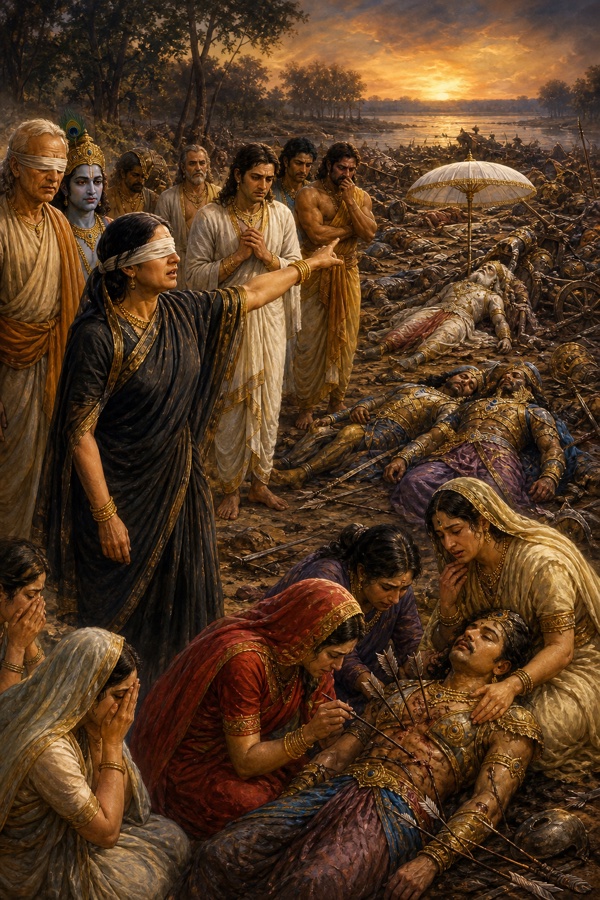
“Look, Keshava, at the two brothers of Avanti, Vinda and Anuvinda. They lie on the field like two flowering shala trees thrown down by a spring storm,” she said. “They are clad in golden armor, with armlets of gold, and they still hold their swords and bows. They have the eyes of bulls, and bright garlands, and both are stretched on the ground. The Pandavas and you, Krishna, surely cannot be killed, since you and they have come alive through Drona, through Bhishma, through Karna the son of Vikartana, through Kripa, through Duryodhana, through the son of Drona, through the great chariot fighter Jayadratha, through Somadatta, through Vikarna, and through the brave Kritavarma. See what reversals Time brings. These men could have killed the gods themselves with their weapons, and they have been killed. Nothing is difficult for destiny, Madhava, when even heroes like these have been killed by Kshatriya warriors. My sons, for all their vigor, were already dead in my eyes on the day you went back to Upaplavya with your errand unaccomplished. Bhishma the son of Shantanu and the wise Vidura said to me then, ‘Give up your affection for your children.’ What those two saw, they did not see for nothing. In a short time, Krishna, my sons have been burned to ashes.”
A key to reading this (Bhurishravas and the praya vow): the charge is made by the mother of Bhurishravas and by his wives, and Gandhari repeats it to Krishna in their words. Arjuna cut off Bhurishravas’s arm while he was fighting another man and was not watching Arjuna. Satyaki, who is also called Yuyudhana, then killed him as he sat, a man of restrained soul, in the vow of praya. The women call the first act blameworthy and the second more sinful still, and they ask Krishna what he will say of it in the assemblies.
The gist: Gandhari showed Krishna the mother and the wives of Bhurishravas, with his severed arm in their laps, and repeated their reproach of Arjuna and Satyaki. She showed him her brother Shakuni, killed by Sahadeva, and feared that he would sow quarrels among her sons even in the next world. Then came the rulers of the Kambojas, the Kalingas, Magadha, and Kosala, the sons of Dhrishtadyumna, the five Kekayas, Drupada, Dhrishtaketu and his son, and Vinda and Anuvinda of Avanti. Bhishma and Vidura, she said, had told her long before to give up her affection for her sons.
Gandhari’s Curse on Krishna
When she had said this, grief took her senses and Gandhari fell to the ground. Her fortitude was gone. Then anger filled her, anger and sorrow for the death of her sons, and with her heart in turmoil she laid every fault at Krishna’s door.
“The sons of Pandu and the sons of Dhritarashtra have both been burned, Krishna,” Gandhari said. “While they were being wiped out, why did you stand aside? You were able to prevent the slaughter. You have followers in great numbers and a vast army. You had the eloquence, and you had the power to make peace. You chose to be indifferent to this universal carnage, and so the fruit of that choice is yours to reap.”
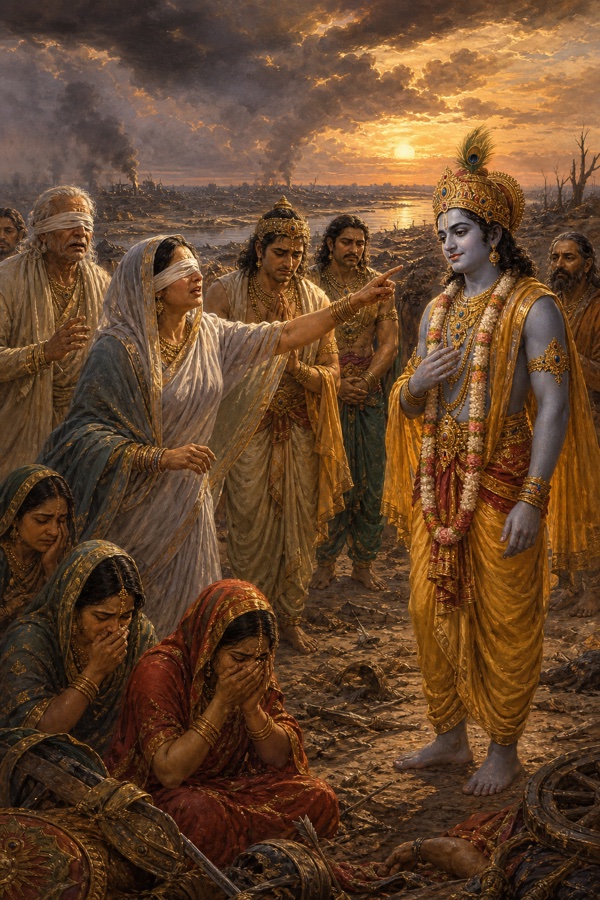
“I have earned a little merit by waiting dutifully on my husband, and it is merit very hard to come by. By that merit I curse you, wielder of the discus and the mace,” she said. “You were indifferent to the Kurus and the Pandavas while they killed each other. Therefore, Govinda, you will be the slayer of your own kinsmen. In the thirty-sixth year from this one you will bring about the slaughter of your kinsmen and your friends and your sons, and you yourself will perish by a shameful means in the wilderness. And the women of your family, with their sons and kinsmen and friends taken from them, will weep and cry out as these women of the house of Bharata are doing now.”
Krishna, who was himself of the Vrishni line, heard her, and he answered the old queen with a faint smile. “No one in the world can exterminate the Vrishnis except me. I know this well. I am working to bring it about. In speaking this curse, lady of excellent vows, you have helped me to accomplish that task. The Vrishnis cannot be killed by others, be they men or gods or danavas. So the Yadavas will fall by one another’s hands.”
When Krishna of the Dasharha line had said this, the Pandavas stood stunned. Dread filled every one of them, and they lost all hope of life.
“Get up, Gandhari. Get up, and do not set your heart on grief,” Krishna said. “This vast carnage came about through your fault. Your son Duryodhana had a wicked soul. He was envious and arrogant beyond measure. You applauded his wicked acts and counted them good. He was cruel in the extreme, he was enmity in a human body, and he would not obey the instructions of the old. Why do you want to lay your own faults on me? Whoever grieves over what has already happened, the dead or the lost, only gets more grief. Giving way to grief makes it twice what it was. A Brahmin woman bears children for the practice of austerities. A cow brings forth young to carry burdens, and a mare to run. A Shudra woman bears a child to add to the number of those who serve, and a Vaishya woman to add to the keepers of cattle. A princess like you bears sons to be slaughtered.”
The words were hard for her to hear. Gandhari, her heart shaken with grief, said nothing more.
A sub-tale: in the Mausala Parva, when the thirty-sixth year after the battle arrives, Krishna reads the omens, understands that what Gandhari said is about to happen, and sets about making her words true by sending the Vrishnis to the seacoast. There the Vrishnis, the Andhakas, and the Bhojas, drunk with wine, strike one another down, son killing father and father killing son. Afterward, as Krishna lies in yoga in the forest, a hunter named Jara takes him for a deer and pierces him in the heel with an arrow.
The gist: Gandhari charged Krishna with standing aside when he had the power to stop the war, and with the merit of her service to her husband she cursed him: in the thirty-sixth year he would cause the slaughter of his own kinsmen and die by a shameful means in the wilderness, and the women of his family would weep as the Bharata women wept. Krishna smiled and said that only he could destroy the Vrishnis, that he was already at work on it, and that she had helped him. Then he told her that the carnage was her own fault, and she was silent.
The Count of the Dead and Their Destinies
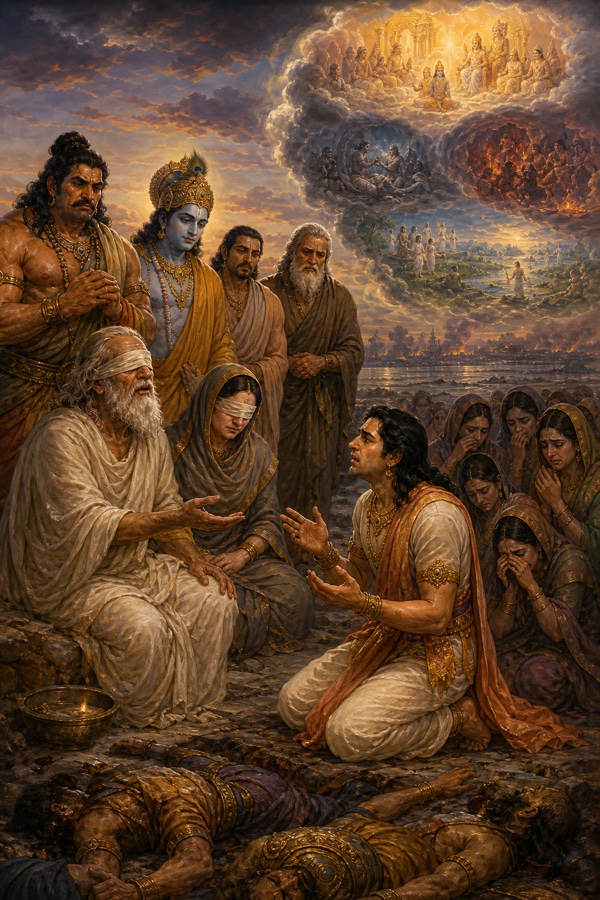
It was Dhritarashtra who spoke next. The royal sage held down the grief that comes of folly and put a question to Yudhishthira. “If you know it, Yudhishthira, tell me the number of those who have fallen in this battle, and the number of those who have come out of it alive.”
“The men who have fallen in this battle number 1,660,020,000,” Yudhishthira answered. “The heroes who have escaped number 240,165.”
“You know everything,” Dhritarashtra said. “Tell me, then, to what ends those men have gone.”
“The warriors of true prowess who threw off their bodies gladly in the thick of battle have all reached worlds like those of Indra,” Yudhishthira said. “Those who knew that death could not be avoided and met it without gladness have gone to keep company with the gandharvas. Those who fell at the edge of a weapon while turning from the field, or while begging for their lives, have gone to the world of the guhyakas. Those great men who kept to the duties of a Kshatriya and held it shameful to run from battle, and who fell torn by sharp weapons while advancing unarmed against enemies who were fighting, have all taken shining forms and reached the world of Brahman. The rest, who met death in one way or another on the edges of the battlefield, have gone to the land of the Uttara-Kurus.”
“By the power of what knowledge do you see these things, my son, like a man whose austerities have borne their fruit?” Dhritarashtra asked. “Tell me, if you think it is proper for me to hear it.”
“When I wandered in the forest at your command, I visited the sacred places, and on that journey I obtained this boon,” Yudhishthira said. “I met the divine seer Lomasha, and from him I received the gift of spiritual vision. So it was long before today that I gained this second sight, through the power of knowledge.”
A key to reading this (the death-count in modern terms): written in figures, the count Yudhishthira gives is 1,660,020,000 dead, a little over one and two-thirds billion, and 240,165 left alive. Sanjaya, at the opening, spoke of eighteen akshauhinis killed. Yudhishthira’s number is far larger, and he gives it as something seen by the spiritual vision he received from Lomasha.
The gist: asked by Dhritarashtra, Yudhishthira gave the number of the dead and of the living and told where each kind of warrior had gone: those who died gladly to worlds like those of Indra, those who died without gladness to the gandharvas, those who fell fleeing or begging to the guhyakas, those who advanced unarmed to the world of Brahman, and the rest to the Uttara-Kurus. He said he saw these things by a boon of spiritual vision from the seer Lomasha.
The Last Rites of the Heroes and Water Offerings on the Ganga
“Our people must burn the bodies of the dead with the proper rites, those who have friends and those who have none,” Dhritarashtra said. “What are we to do with the ones who have nobody to look after them, and who kept no sacred fires? Many duties are waiting for us. Whose last rites are we to perform? And, Yudhishthira, the men whose bodies are being torn and dragged by vultures and other birds at this moment: will they reach the blessed worlds by the merit of their acts?”
Yudhishthira, the son of Kunti, gave his orders. He called Sudharma, the priest of the Kauravas, and Dhaumya, and Sanjaya of the suta order, and the wise Vidura, and Yuyutsu of the house of Kuru, and all his own servants with Indrasena at their head, and all the other sutas who were with him. “See that the funeral rites of the dead are duly performed, thousands though they are,” he said, “so that no one perishes for want of someone to care for him.”
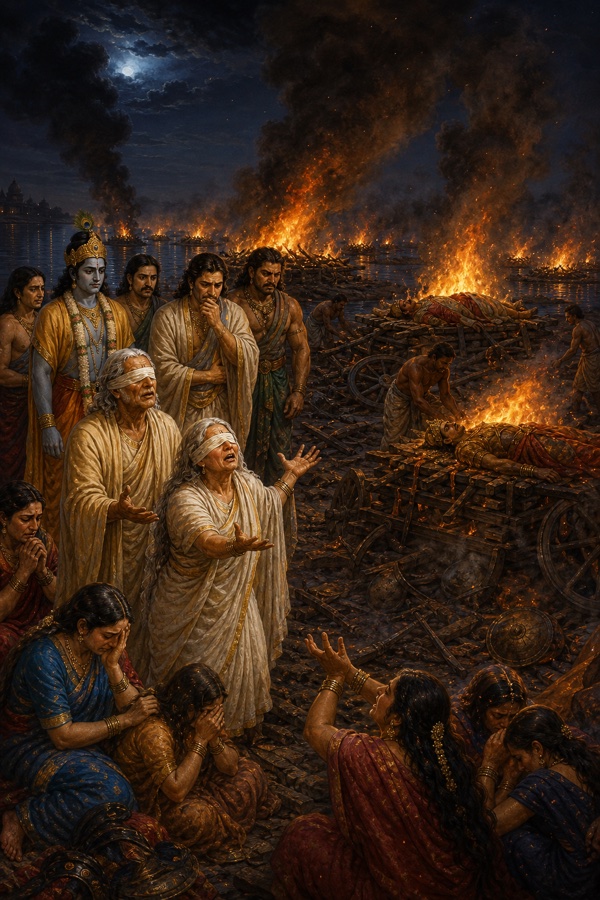
On that command Vidura and Sanjaya and Sudharma and Dhaumya and Indrasena and the others went to work. They brought sandalwood and aloe and the other woods used at such times. They brought clarified butter, oil, perfumes, costly silk robes and other cloth, great heaps of dry wood, broken chariots, and weapons of many kinds. They had the pyres properly built and lit, and then, without hurry, with the due rites, they burned the dead kings in their proper order. Clarified butter was poured in torrents on those fires, and they blazed up, and on them were burned the bodies of Duryodhana and his hundred brothers, of Shalya, and of King Bhurishravas; of King Jayadratha and of Abhimanyu; of Duhshasana’s son, and Lakshmana, and King Dhrishtaketu; of Brihanta, and Somadatta, and the Srinjayas in their hundreds.
They burned King Kshemadhanva, and Virata, and Drupada; Shikhandi the prince of the Panchalas, and Dhrishtadyumna of the line of Prishata; the brave Yudhamanyu and Uttamaujas; the ruler of the Kosalas, the sons of Draupadi, and Shakuni the son of Subala; Achala and Vrishaka, and King Bhagadatta; Karna and his son of the great wrath; the great bowmen who were the Kekaya princes, and the great chariot fighters who were the Trigartas; Ghatotkacha the prince of the rakshasas, and the brother of Baka, and Alambusha, chief among the rakshasas, and King Jalasandha; and hundreds and thousands of other kings. For some of the great dead the pitri-medha rites were performed there. Some sang Samas, and some raised laments. The loud sound of the Samas and the Riks, and the crying of the women, stunned every creature that night. The funeral fires burned bright and without smoke in the dark around them, and they looked like shining planets in a sky wrapped in cloud.
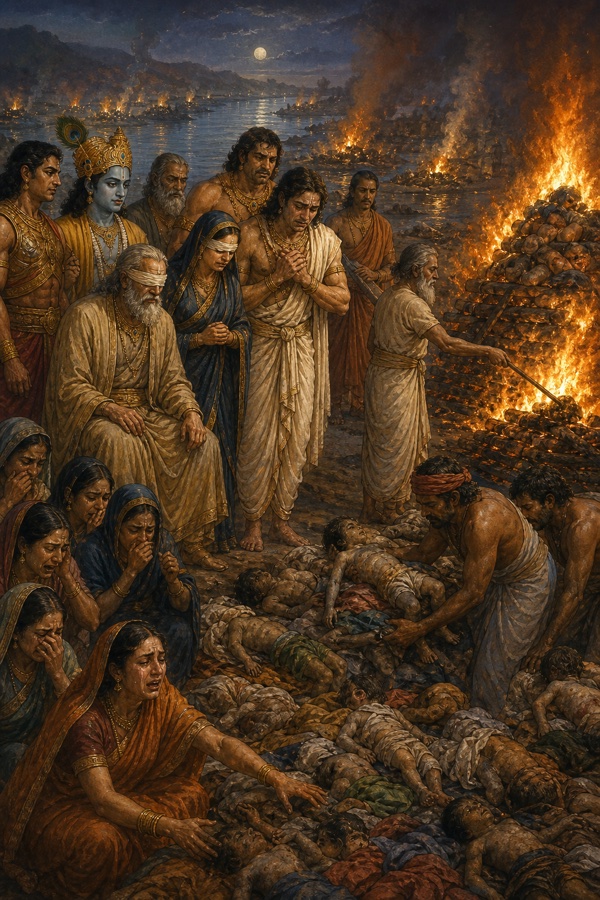
There were dead men who had come from many distant realms and had no friend left at all. They were gathered into heaps, thousands of heaps, and at Yudhishthira’s command Vidura had them burned on pyres of dry wood by a great number of people, who worked calmly, out of goodwill and affection. When their last rites had been seen to, Yudhishthira, the Kuru king, set Dhritarashtra at the head of the company and went toward the river Ganga.
They came to the Ganga, the auspicious river, full of sacred water, with its many pools, its high banks and broad shores and its vast bed. There they took off their ornaments, their upper garments, their belts and girdles. The Kuru women, crying, in great grief, offered water to their fathers and grandsons and brothers and kinsmen and sons and elders and husbands. They knew their duties, and they performed the water rite for their friends as well. While those wives of heroes were performing the rite for their heroic husbands, the way down to the stream became easy, and the paths their many feet had made disappeared afterward. The shores were crowded with the wives of heroes and still looked as wide as the ocean, and it was a sight of sorrow with no joy in it.
A key to reading this (the pitri-medha and the water offering): Dhritarashtra’s worry was for the dead who had no one, and who had kept no sacred fires of their own. Yudhishthira’s order covered them all. The kings were burned in order on pyres fed with clarified butter, some with the pitri-medha rites and the singing of Samas; the friendless from distant realms were burned by Vidura in thousands of heaps. Then the living went to the Ganga, put off their ornaments, upper garments, and belts, and offered water to their dead.
Kunti’s Revelation of the Secret: Karna Was the Eldest Brother
It was then that grief came over Kunti in a sudden wave. Weeping, she spoke softly to her sons. “There was a hero, a great bowman, a leader of the leaders of chariot divisions, marked with every sign of heroism, whom Arjuna has killed in battle. You, the sons of Pandu, took him for the child of a suta, born of Radha. He shone among his troops like the lord Surya himself. He fought all of you and all your followers. He was splendid as he commanded the vast army of Duryodhana. He had no equal on earth for energy. He put glory before life, he never turned back, he was firm in truth and never tired by any effort. He was your eldest brother. Offer the water to that eldest brother of yours, who was born of me by the god of day. He was born with a pair of earrings, and clad in armor, and he was like Surya himself in splendor.”
The words were painful to hear. The Pandavas began to grieve aloud for Karna, and their distress was greater than it had been at any time before. Then Yudhishthira, sighing like a snake, questioned his mother.
“Karna was an ocean,” Yudhishthira said. “Arrows were his waves, his tall standard was his whirlpool, his two great arms were a pair of huge alligators, his broad chariot was the deep water, and the slap of his palms was the roar of the storm. No one could stand against his onrush except Arjuna. Mother, were you the one who gave birth to him? How was that son, who was like a god, born of you in the days gone by? The energy of his arms scorched all of us. How could you hide him, mother, as a person hides a fire in the folds of his cloth? The sons of Dhritarashtra always worshiped the might of his arms, as we have always worshiped the might of the wielder of Gandiva. He was the strongest of strong men and the first of chariot fighters. He withstood the united force of all the kings of the earth in battle. How was he your son? Was he, the greatest of all who bear arms, our eldest brother? How did you bring forth a child of such wonderful prowess? Because you kept this hidden, we are undone.”
“The death of Karna has struck all of us, and all our friends with us,” Yudhishthira went on. “What I feel at his death is a hundred times the grief I felt at the death of Abhimanyu, and of the sons of Draupadi, and at the destruction of the Panchalas and the Kurus. When I think of Karna I burn like a man thrown into a blazing fire. With him, nothing could have been out of our reach, the things of heaven included. And this terrible carnage, which has destroyed the Kurus, would never have happened.”
He said this and much more like it, and wailed aloud in his grief. Then the king offered the water to his dead elder brother.
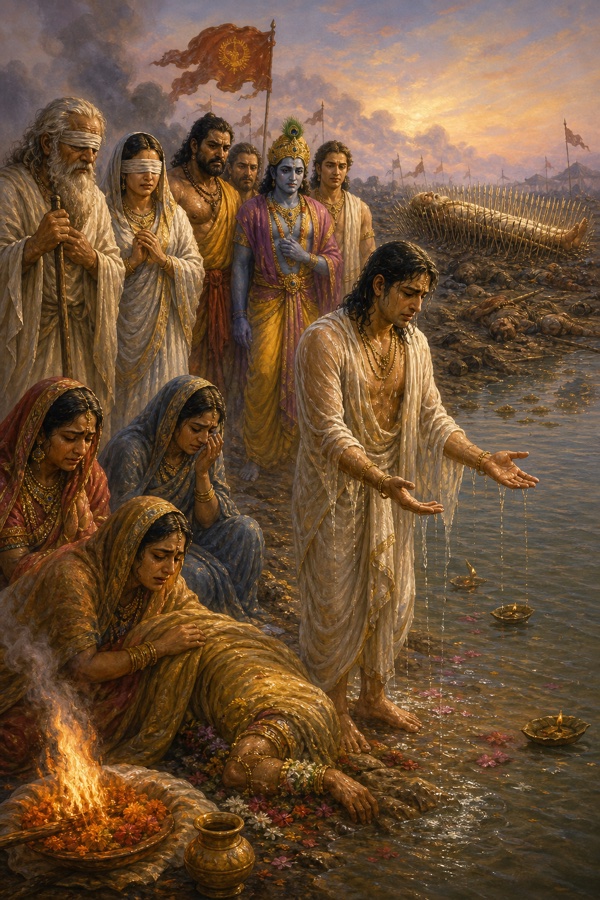
All the women crowding the shores of the river sent up a loud cry of grief at that moment. Yudhishthira, the king of the Kurus, had the wives of Karna and the members of his household brought before him, and together with them he performed the water rite for his eldest brother. When the ceremony was finished the king came up out of the waters of the Ganga, shaken to his depths.
A key to reading this (Karna’s birth secret): what Kunti tells her sons at the river is brief. Karna was her child, born of her by Surya, the god of day; he came into the world wearing earrings and armor and shining like the sun; and he was the eldest of the brothers. The Pandavas had known him only as the son of a suta, born of Radha. Yudhishthira’s first question to her is how she could have kept such a son hidden, like a fire in the folds of a cloth, and he tells her that the concealment has undone them.
The gist: at the water rite on the bank of the Ganga, Kunti told her sons that Karna, whom Arjuna had killed, was her own son by the god of day and their eldest brother, and asked them to offer water for him. Yudhishthira said that his grief for Karna was a hundred times his grief for Abhimanyu and the sons of Draupadi, and that with Karna beside them the carnage would never have happened. He offered the water with Karna’s wives and household, and came up out of the river.
Source: the Mahabharata of Krishna-Dwaipayana Vyasa, Stri Parva, Sections 1 to 27. The Sanskrit e-text, the Gita Press Hindi edition, and Kisari Mohan Ganguli’s complete English translation were used to verify names, sequence, and principal events. Where the recensions differ, this English retelling follows Ganguli, and the Hindi edition follows Gita Press.
Source: the Mahabharata of Vedavyasa (Gita Press, Gorakhpur)