On this page
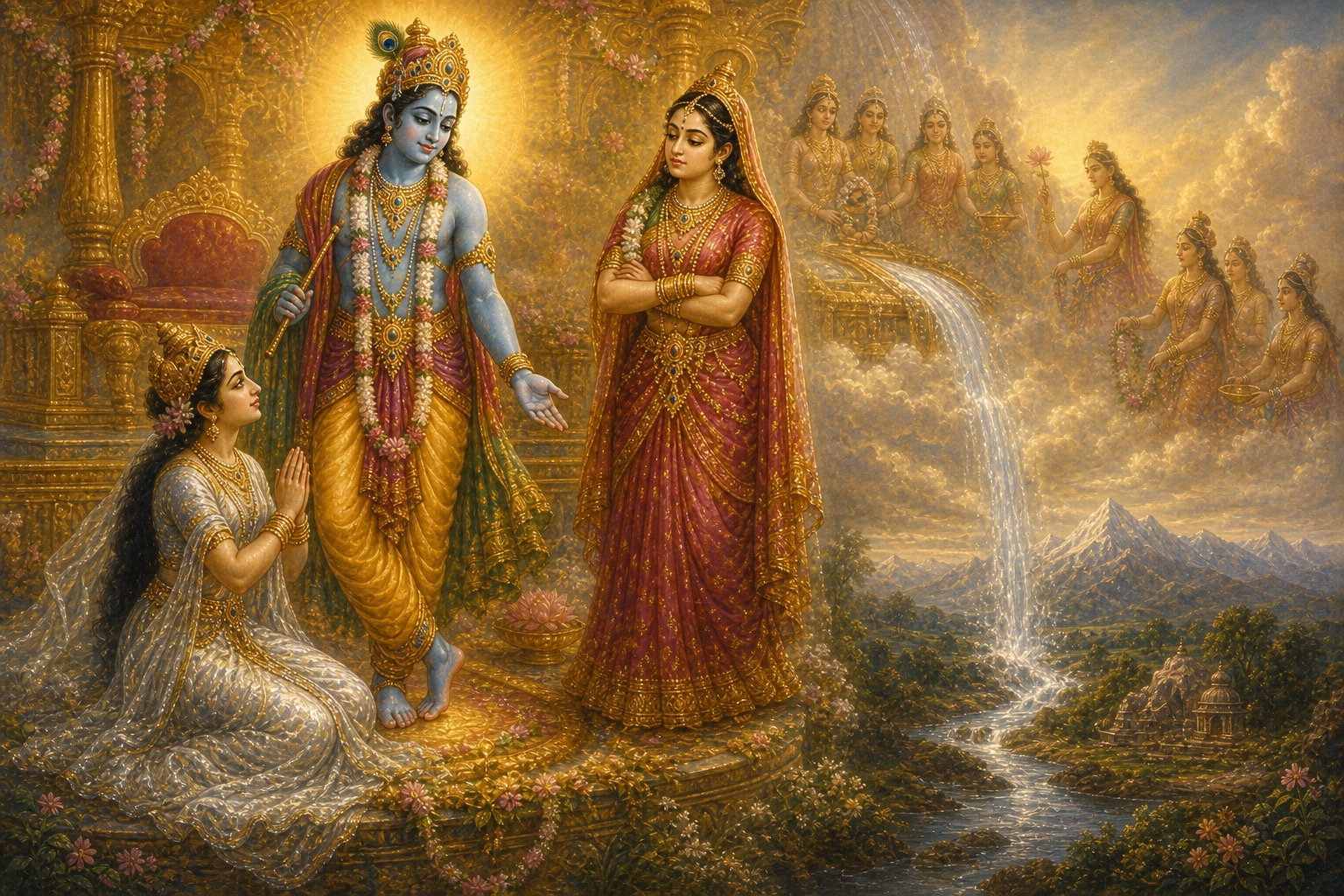
In the forest of Badari, Devarshi Narada arrived once more, another question pressing on him. That holy Ganga who runs across the earth and rinses away its sins: where had she first come into being, and how had she become beloved of all three, of Vishnu, Shiva, and Brahma alike? This is what he wished to hear from Shri Narayana. Shri Narayana said, “Listen, Narada. This story is a guarded and hard-won one. That Ganga, liquid in her very nature, dwelt in ancient days in Goloka, and she rose from the amsha (the living portion) of Radha and Krishna.”
The rasa-circle of Goloka and the song of Shiva
Once, on the full-moon night of Kartik, Goloka was keeping the great festival of Radha. Having worshipped Radha with the full rite, Shri Krishna sat enthroned within the rasa-circle (the sacred round-dance); Brahma and the other gods, and Shaunaka and the other rishis, were gathered there with glad hearts. To offer music, the goddess Sarasvati took up her veena and began to sing in ravishing notes. Delighted, Brahma gave her a necklace of jewels, Shiva a single gem rarer than any in the whole of creation, Shri Krishna the Kaustubha, Radha a necklace of priceless jewels, Narayana a lovely garland, and Lakshmi a pair of golden earrings; Mulaprakriti, the primordial Goddess, gave the rare gift of devotion to Brahman, Dharma gave a mind fixed on dharma and a vast renown, Agni gave a cloth as pure as fire, and Pavana gave anklets set with jewels.
In that same hour, prompted by Brahma, Lord Shankara began to sing a sweet song of Shri Krishna, a song made to swell the joy of the rasa. The moment that singing reached them, every god fell so deeply under its spell that they seemed like figures painted into a picture. When awareness came back to them, and it returned only with great difficulty, they saw that the whole ground of the rasa-circle had turned to water, and that Radha and Krishna were nowhere within it. Every gopa, every gopi, and every god broke into loud lament. Through meditation Brahma understood that Shri Krishna, joined with Radha, had himself dissolved into that flood. Then a voice with no body sounded through the air: “I am Shri Krishna, the self within all, and this Radha is my own power made into form; the two of us together have taken on this body of water.” That voice commanded Shiva to compose a secret tantra-shastra (a hidden scripture of sacred formulas) for the rescue of devotees, so that living beings, carried by the strength of its mantras, might reach his own realm. Taking the water of Ganga into his hand, Shiva accepted the charge, and in that instant Shri Krishna appeared again with Radha. The Ganga born of that liquid form of Radha and Krishna became the giver of both bhoga (worldly enjoyment) and moksha (final release), and Shri Krishna set her in place after place.
Radha’s anger
The presiding goddess of that water, Ganga herself, took on a form of matchless and fresh-blooming youth, and, shy, she drew a fold of cloth across her face and came to sit close to Shri Krishna. Brimming with joy, she drank in the beauty of the Lord’s face with eyes that would not blink, until, lost in that beauty, she passed almost out of her own senses. Just then Radhika arrived, and with her came three hundred million gopis. Her face and her eyes had gone red as lotuses with anger, and her lips were trembling. Shri Krishna rose to his feet in courtesy and, smiling, began to speak gentle words. The frightened Ganga too stood and praised Radha, and with deep humility asked after her welfare; but her throat, her lips, and her palate had all run dry. At the last, through meditation, she fled to the refuge of Shri Krishna’s lotus feet. Seeing that Ganga now resting upon the lotus of his heart, Shri Krishna granted her his protection, and, holding the boon of the Lord of all, Ganga grew calm at heart.
Radha’s reproach
Then Radha, of a calm and gentle nature, smiled and spoke to Shri Krishna, the lord of the worlds: “O lord of my life, who is this desiring beauty who sits beside you and studies your face with sidelong looks? While I yet live, how has such a woman come into Goloka, and why do you keep turning to her, laughing again and again? Because I belong to the womankind, soft by nature, out of love I forgive you; take this beloved of yours and leave Goloka now.” Then Radha called up old matters. Once, in the sandalwood forest, she had come upon Shri Krishna with Viraja, and at the pleading of her friends she had forgiven him; yet the moment he caught the sound of Radha approaching, Shri Krishna hid himself, and the shamed Viraja gave up her body and became a river, and from her the seven seas came to be. In the same way a gopi named Shobha left her body and passed into the circle of the moon, and Shri Krishna parceled out her radiance among jewels, gold, and countless things; a gopi named Prabha went into the circle of the sun; the gopis named Shanti and Kshama also gave up their bodies in this fashion and were divided out across the world, and each time Shri Krishna, weeping, scattered their radiance from place to place.
The vanishing of the water and the cry of the gods
Having said this, Radha was on the point of turning her words upon the shamed Ganga when Ganga, reading the whole secret by the power of yoga, vanished from the midst of the assembly and sank back into her own water. Then Radha understood by yoga that Ganga, in her water-form, lay spread through everything, and she began to gather that water in her cupped hands and drink it down. The terrified Ganga at once entered the lotus feet of Shri Krishna and took shelter there. Radha searched for her through Goloka, Vaikuntha, Brahmaloka, and every other realm, and nowhere could she be found. Meanwhile water failed everywhere; the world showed itself as a globe of drying mud strewn with dead creatures of the deep. Then Brahma, Vishnu, Shiva, Dharma, Indra, Surya, Chandra, the munis, and the siddhas, every throat parched, came to Goloka and began to praise Shri Krishna. Shri Krishna said, “You have all come to carry Ganga away, but she in her fear has taken refuge at my feet; first set her free of that fear.” Then Brahma bowed his head and praised Radha, saying, “O Ambika, this Ganga has risen from the liquid form of you and of Shri Krishna, on the day you were enchanted by Shiva’s song; she is as dear to you as your own daughter. Let her receive your mantra and worship you. Shri Hari, the lord of Vaikuntha, will come to her as her husband, and when by one kala (one small portion) of herself she goes down to the earth-realm, then the salt ocean too will become her husband.” Radha smiled and consented to all of it. Then, from the very tip of the nail on the toe of Shri Krishna’s foot, Ganga came forth and stood at peace in the midst of them. Brahma took some of the water into his kamandalu (the ascetic’s water-pot), and Shiva bore some upon his head. Then Brahma gave Ganga the mantra of Radhika and had her worship Radha in full and proper rite.
The descent into Vaikuntha and onto the earth
Her worship done, Ganga went with Narayana to Vaikuntha. There Shri Hari, by the rite of gandharva marriage, took her hand, anointed with flowers and sandal paste, and received her as his wife, and joyfully passed his days with her. So it was that Lakshmi, Sarasvati, Ganga, and the world-cleansing Tulsi, these four, became the wives of Narayana. From the overwhelming bliss of their first union Ganga swooned away; seeing it, Sarasvati carried a lasting envy of her, and in the end Ganga, dear to Vishnu, grew angry and laid a curse on Sarasvati, that she must go to Bharatvarsha. In this telling of the Devi Bhagavata, the curse that brings Ganga down to the earth is Sarasvati’s own, and the episode of Radha is the episode of Radha’s anger, the fright of which had sent Ganga to hide at Shri Krishna’s feet. By that curse of Sarasvati, and by the command of the Lord and the austerity of King Bhagiratha, in time that Ganga came down into Bharatvarsha. Bhagiratha, to deliver the sixty thousand sons of his forefather Sagara who had been burned to ash, performed tapas for one hundred thousand years and won the darshan of Shri Krishna; by his command Ganga came to the earth, and the moment the air that had touched her reached them, the sons of Sagara went to Vaikuntha. Because Bhagiratha had brought her, she was called Bhagirathi. The Ganga who had issued from the lotus feet of Vishnu became renowned by the name Vishnupadi, and even now, washing away the sins of the world, she flows through the three worlds as a stream of purity. Having said this much, Shri Narayana fell silent for a moment.
Source: Shrimad Devi Bhagavata Mahapurana (Gita Press, Gorakhpur)