On this page
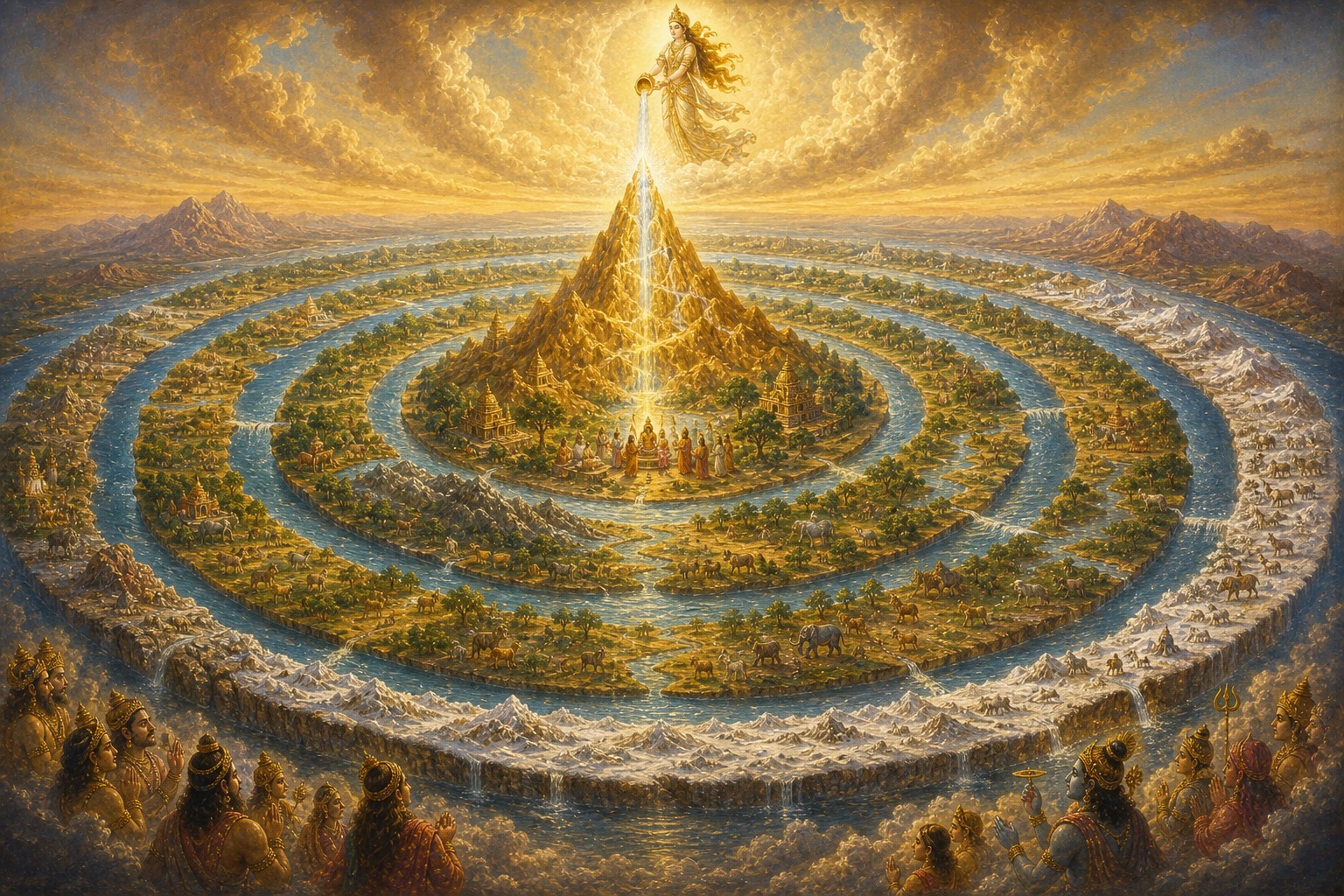
In the still shade of the Badari forest, the divine sage Narada sat with his hands folded, and before him, seated at his ease, was the Lord Shrinarayana. A question had risen in Narada’s mind: what was the shape of this world-sphere, and how were its islands and its regions arranged? Shrinarayana smiled a slow, gentle smile and said, “Listen, sage. I will tell you in brief the whole expanse of this world-sphere as the gods have fashioned it.”
This was long ago. Priyavrata, the great king and son of Svayambhuva Manu, saw that when the sun shone on one part of the earth, the other part sank into darkness. Unwilling that any corner of the earth should lie in shadow under his rule, he mounted a chariot bright as the sun and drove seven times around the earth, lighting the worlds as he went. Wherever the wheels of his chariot cut into the ground, those furrows became, for the good of all, the seven seas, and the land between them rose up as the seven islands: Jambudvipa, Plaksadvipa, Shalmalidvipa, Kushadvipa, Krauncadvipa, Shakadvipa, and Pushkaradvipa. Around them rolled seven seas of salt water, sugarcane juice, wine, ghee, milk, curd, and pure water. Each island was twice as large as the one before it. Dividing these seven islands among his seven sons, Priyavrata grew detached and wise and set out on the path of yoga.
Golden Sumeru at the Heart of the Lotus
First among them all, Jambudvipa lies ringed by the salt sea, 100,000 yojanas across, round as a lotus. Within it are nine regions, neatly divided by eight great mountains. And at its very center, like the seed-cup at the heart of a lotus, stands Sumeru, the golden king of mountains. It rises 100,000 yojanas high; its summit spreads across 32,000 yojanas, and its foot rests 16,000 yojanas upon the earth and sinks as deep again below it. The four-sided region that encircles this Sumeru is the one called Ilavrita.
The Boundary Mountains and the Feet of Sumeru
To the north of Ilavrita, three mountains named Nila, Shveta, and Shringavan mark off the regions of Ramyaka, Hiranmaya, and Kuru. To the south, Nishadha, Hemakuta, and Himalaya set the bounds of Harivarsha, Kimpurusha, and Bharatavarsha. To the west stands Malyavan and to the east Gandhamadana, fixing the limits of the regions of Ketumala and Bhadrashva. Like the four feet of Sumeru, four mountains named Mandara, Merumandara, Suparshva, and Kumuda, each 10,000 yojanas high, hold it up on all four sides. Upon these four rise four vast trees like standing banners: a mango on Mandara, a jamun on Merumandara, a kadamba on Suparshva, and a banyan on Kumuda, each 1,100 yojanas tall. On these same mountains lie four lakes filled with milk, honey, sugarcane juice, and sweet water, and four heavenly gardens named Nandana, Chaitraratha, Vaibhraja, and Sarvabhadra, where the gods roam at will with lovely women.
Four Trees, Four Streams, Four Goddesses
Now hear of the streams that run from those trees. When the fruit of that tall mango on Mount Mandara falls and bursts, its red and delicious juice becomes the river Arunoda, which flows through the eastern part of Ilavrita; on that same mountain dwells the sin-destroying goddess Aruna, whose glance of grace alone brings her devotees well-being and health. From Merumandara burst jambu fruits as large as elephants, and from their juice the river Jambu flows to the south; content with its flavor, the goddess there is called Jambvadini. The soil along this river’s banks, soaked with the juice and touched by sun and wind, turns into the gold called Jambunada, from which the ornaments of the gods and of the vidyadhara women are made. From the hollows of the great kadamba on Mount Suparshva burst five streams of honey that flow toward the west, where the great goddess Dhareshvari, who grants her devotees their desires, makes her home. And on Mount Kumuda stands a vast banyan named Shatabala, from whose branches flow streams of milk, curd, honey, ghee, jaggery, grain, cloth, bedding, and even ornaments, running down toward the north; there the goddess Meenakshi, worshipped by gods and danavas alike, is enshrined. On the bodies of the creatures who drink the water of these streams no wrinkle ever forms, nor does the hair turn white; there fatigue, foul odor, old age, disease, fear, and death are unknown even by name, and happiness grows without pause through the whole of life.
Brahma’s City on the Summit of Sumeru
Girdling the base of Sumeru like the saffron threads at the heart of a flower stand twenty more mountains, chief among them Shrinvata, Kuranga, Trikuta, Shishira, Patanga, Nishadha, Kapila, Shankha, Vaidurya, Hamsa, Rishabha, Naga, and Narada. Sumeru itself, ringed on every side by eight great mountains named Jathara, Devakuta, Pavamana, Pariyatra, Kailasa, Karavira, Trishringa, and Makara, shines forever like the sun. And upon its summit, at the very center, spreads the golden, four-sided city of Brahma, born of the lotus, 10,000 yojanas across. Around it stand the cities of the world-guardians, set according to their direction and their form: Indra’s Amaravati, Agni’s Tejovati, Yama’s Samyamani, Vayu’s Shraddhavati, and Kubera’s Gandhavati, nine such cities in all, each laid out across 2,500 yojanas.
The Ganga’s Descent from Vishnu’s Foot
Now hear, Narada, the tale of the Ganga’s descent. From the strike of the nail on the great toe of the left foot of the all-pervading Lord Vishnu, whose very form is yajna, a hole opened in the upper shell of the cosmic egg, and through that opening the Ganga appeared. Brimming with water that washes away the sins of every living being, she became renowned in the world under the name Vishnupadi, born of Vishnu’s foot. After the vast span of a thousand yugas had passed, she, the mistress of all the rivers of the gods, came to rest upon the summit of heaven, and that place is known through all three worlds as Vishnupada. This is the very place where Dhruva, the wholly pure son of Uttanapada, bearing on his head the pollen of the Lord’s lotus-feet, still sits upon his unmoving station. The seven sages, who know his glory, dwell there and circle him in reverence, and the siddhas with matted locks bathe without end in that stream whose nature is liberation itself.
From there the Ganga descends along the road of the gods, thronged with thousands of celestial cars, floods the sphere of the moon, reaches Brahmaloka, and there splits into four parts that flow out in the four directions under four names. The first stream, Sita, falls from Brahma’s seat onto the peak of Gandhamadana, passes through the region of Bhadrashva to the east, and merges into the salt sea. The second, Chakshu, springs from the peak of Malyavan and rushes with great speed through the region of Ketumala into the western ocean. The third, the holy Alakananda, comes down from the south of Brahmaloka, crosses many forests and peaks to reach Hemakuta, then descends into Bharatavarsha and joins the southern sea; for those who set out to bathe in her, even the fruit of the Rajasuya and the Ashvamedha sacrifices is not beyond reach at every step. And the fourth, Bhadra, rises from Shringavan, satisfies the northern lands of Kuru, and flows into the sea. Besides these, many more rivers run through every region, most of them born from Meru and Mandara. Among these nine regions, only Bharatavarsha is called the field of action; the other eight are places to enjoy the merit that remains after heaven. Having said this much, Shrinarayana fell silent for a moment, and Narada went on gazing in his mind at the picture of that world-sphere.
Source: Shrimad Devi Bhagavata Mahapurana (Gita Press, Gorakhpur)