On this page
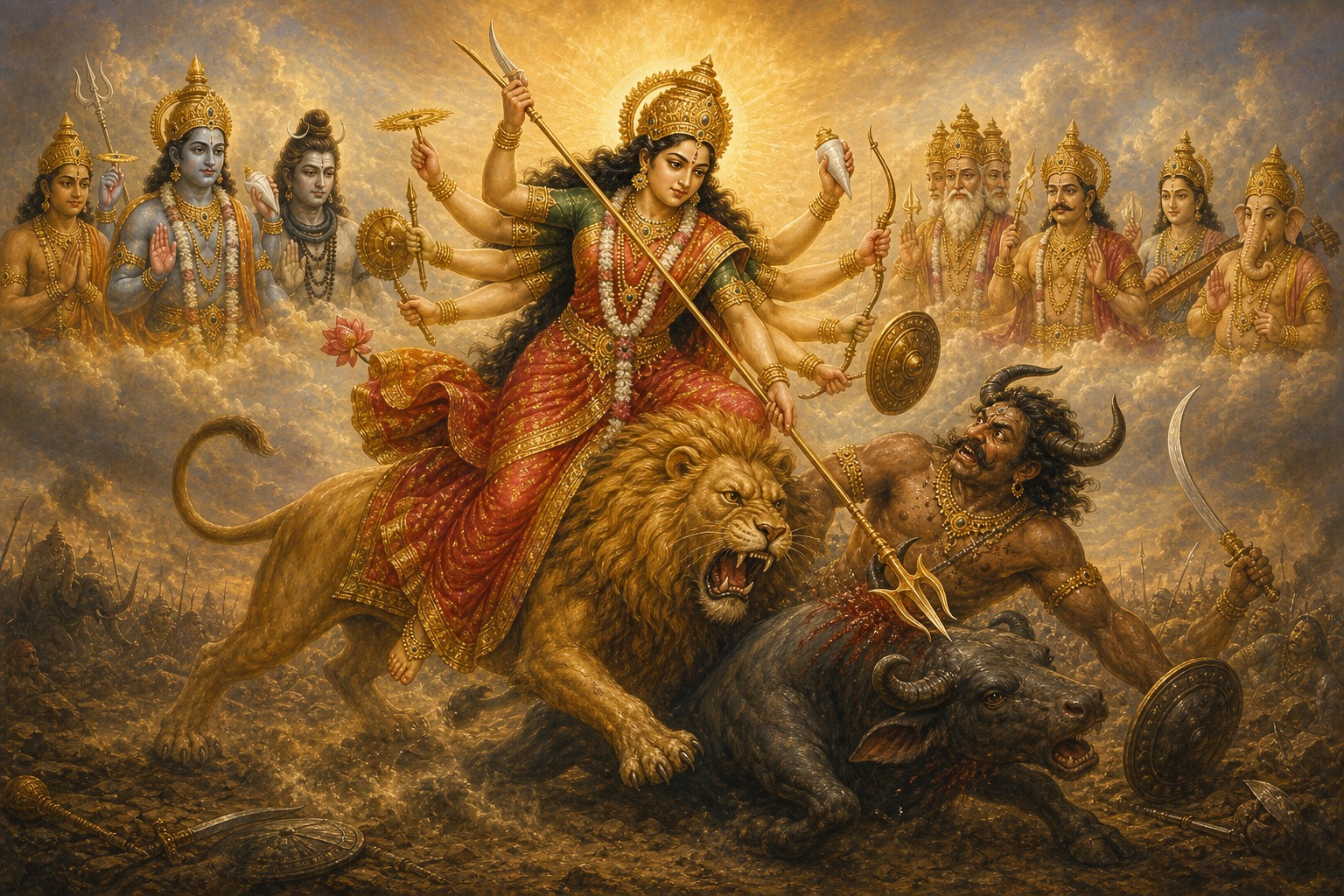
When word reached Mahishasura that his commanders Asiloma and Bidalaksha had fallen in battle, a heaviness came over him and his spirit sank low. His rage rising, he ordered his charioteer Daruka to bring up at once his extraordinary chariot, yoked to a thousand donkeys, dressed with banners and pennants, loaded with weapons of every kind. The chariot rolled to the gate, and in that moment a cunning thought took shape in the mind of the mighty demon. He reasoned that if he rode out in his buffalo form, the Goddess would surely turn away in distaste from that fearsome horned shape, for what pleases women is beauty and charm. On this thought he set aside the buffalo body and became a radiant man, armed with every weapon, wearing armlets and a garland, bow and arrows in hand, looking like a second Kamadeva. In this alluring guise, with his vast army around him, he set out toward the Goddess.
When she saw the shape-shifting demon king approaching, the Goddess sounded her conch. Hearing that astonishing note, the demon came laughing toward Bhagavati.
Mahisha’s Proposal
“O Goddess,” he began in a sweet voice, “in this changing world, woman or man, everyone longs for happiness; and happiness is found in union, never in parting. The union of a man and a woman of equal standing is called the finest of all. If you will join with me, a hero, you will taste the highest happiness. I have conquered Indra and all the gods in battle; enjoy every divine jewel in my palace, become my chief queen, and I will be your servant. At your word I will even give up my quarrel with the gods. O sweet-spoken one, my heart is entranced by your beauty; to protect one who seeks refuge is the highest of all dharmas, so protect me, wounded by the arrows of desire, who now takes refuge in you.” Then he tried menace as well: what glory would he win by killing a fair-eyed woman like her; the sin of slaying a woman, a child, or a brahmana is the most vile of all. Vishnu shines beside Lakshmi, Brahma beside Savitri, Shankara beside Parvati, and Indra beside Shachi; what woman without a husband has ever found lasting happiness?
Hearing this, the fair Bhagavati laughed and said, “I desire no man save the Supreme Person. Demon, I am His very will, it is I who create the whole world; that Soul of all watches over me, and I am His benign nature. As ordinary iron takes on a kind of life in the presence of a magnet, so I become conscious through His nearness; the craving for sense pleasure has never once stirred in me. You are dull-witted to want the company of a woman; a woman is called the chain that binds a man, and the creature caught in that bond is never set free. If you want happiness, hold peace in your mind. Now either go down to the netherworld, or fight with me; all the gods have sent me here for one purpose, your destruction.”
The Parable of Mandodari
When he saw that the Goddess would not bend, Mahisha told an old story. Mandodari, daughter of the righteous King Chandrasena of the Sinhala land, was a woman of surpassing beauty. Out of stubbornness and a taste for renunciation, she rejected even a suitor as handsome, high-born, and fitting as Virasena, the king of Koshala. Later, at the svayamvara of her younger sister Indumati, that same Mandodari looked upon Charudeshna, a sly and clever king of the Madra land, and was seized by desire, and she took him for her husband. That cunning king went on taking his pleasure with serving maids; seeing it, Mandodari suffered terribly and burned in regret and grief for the rest of her life. “O gracious one, in just this way you too, having scorned a royal husband like me, will later take shelter with some fool and live to regret it.”
Bhagavati was not shaken in the least. She said, “Dull-witted one, whenever danger falls upon the good, I take on a body to protect them. In truth I am formless and unborn, and even so, to guard the gods, I assume form and birth. The gods prayed to me to kill you; only when you are dead will I be at ease. Now fight, or go down to the netherworld.”
The Shape-Shifting Demon and the Final Blow
The moment the Goddess said this, Mahishasura took up his bow and planted himself on the battlefield. He loosed sharp arrows honed on stone, but Bhagavati cut them apart in mid-flight with her iron-tipped shafts. Just then a demon named Durdhara pushed forward and rained down poisoned arrows; the Goddess felled him with her keen shafts like a mountain peak brought low. Then Trinetra, a master of missiles, fell upon her with seven arrows, but Jagadamba cut those arrows in the air and killed Trinetra with her trident. After him came Andhaka, who struck his iron mace on the lion’s head; the lion, filled with rage, tore that powerful demon open with its claws and ate his flesh.
Seeing his champions dead, Mahishasura was astonished, and then he himself began to strike the Goddess on the chest with his mace. Under the blow of Bhagavati’s own mace he fell senseless, yet he bore the pain and rose again. Now he began to shift through his deceiving forms. First he became a lion and started to rip at the Goddess’s spirited lion with his claws; the Goddess pierced him with sharp serpent-like arrows. Then he took the shape of a maddened elephant, lifted a huge mountain peak with his trunk, and hurled it at Chandika; Bhagavati cut that peak to shreds and let out a mighty laugh, and her lion sprang up and tore into the elephant-shaped Mahisha. Then he took the form of a fearsome sharabha with eight legs, and at last, taking the buffalo shape once more, he struck at the Goddess with his horns. Whirling his tail, he tossed mountains up on his horns and, laughing, flung them at the Goddess, roaring that today he would kill her; she was calling out in vain, he said, imagining herself strong.
The Goddess said, “Fool, put aside this empty pride; hold your ground on the field. Only by killing you will I make the gods fearless.” So saying, Bhagavati took up a golden vessel filled with wine and drank from it again and again, and having drunk the sweet grape liquor she raised her trident and rushed at the demon with great speed. The gods lovingly rained down flowers and kept up their cries of victory; the rishis, siddhas, gandharvas, nagas, and kinnaras stationed in the sky watched that battle and rejoiced. Mahisha kept taking on illusory bodies and striking, and then Chandika, her eyes red with fury, drove her sharp trident with full force into the heart of that sinner. He fell senseless, but in an instant he rose and began to kick at the Goddess and to roar terribly.
Then Bhagavati took in her hand a magnificent discus with a thousand spokes and said in a ringing voice, “Blind with arrogance, look at this discus that will cut your throat; wait one more moment, then set out for the realm of Yama.” So saying, Jagadamba loosed that terrible discus, and it cut off the demon’s head. Hot blood poured from the pipe of his throat the way red water stained with ochre streams down a mountain, and with his head severed his trunk spun and dropped to the ground. In this telling, the killing stroke belongs to that thousand-spoked discus rather than to the trident, and it is the discus that parts Mahisha’s head from his trunk.
The victory shout of the gods rang out. Bhagavati’s mighty lion, as though frantic with hunger, began to devour the demons fleeing across the battlefield. The instant Mahisha died, the demons who remained fled in terror to the netherworld, and across the earth the gods, sages, humans, and holy people were filled with the deepest joy. Chandika left the battlefield and took her seat in a sacred place, and the gods, eager to praise her, soon arrived there.
This same story appears in the Devi Mahatmya as well, though this account in the Devi Bhagavata has its own manner and its own fuller sweep.
Source: Srimad Devi Bhagavata Mahapurana (Gita Press, Gorakhpur)