On this page
In the hermitage of the sage Bharadvaja, on the bank of the Ganga, a prince played among the sons of the ascetics. His name was Sudarshan. His father was Dhruvasandhi, king of Koshala, whom a lion had killed while hunting, and his maternal grandfather had been slain in battle by King Yudhajit. The moment his father was gone the kingdom was torn from him, and his frightened mother Manorama took the boy and came away into this very forest, together with a minister named Vidalla and a nurse. The sages and their wives raised all three of them on wild rice and the fruits of the forest. One day, in the middle of play, a young ascetic’s son mocked Sudarshan and called him a kliba, a weakling. The boy caught only a single syllable of that word, dropping the nasal sound, and held fast to kli, saying it over and over. By a turn of divine chance that very syllable was the wondrous seed-mantra known as Kamaraja, and it came to the boy of its own accord. In only his fifth year, with no knowledge of the mantra’s seer or its meter and without any of the ritual placements, he would repeat that seed silently in his mind while he played and while he slept, and he never once forgot it.
In his eleventh year the sage performed his sacred-thread rite and taught him the Vedas, the science of archery, and the science of statecraft; by the power of that same mantra the boy mastered every discipline with ease. Once, in a dream, he saw with his own eyes the world-mother Ambika, who appeared as the Vaishnavi Shakti, clothed in red, red in hue, seated upon Garuda. Later, as Sudarshan worshipped on the riverbank, Bhagavati Jagadamba herself gave him a bow, sharp arrows, a quiver, and armor.
The Resolve of the Kashi Princess
In those same days Shashikala, the cherished daughter of Subahu, king of Kashi, heard from the court bards about that forest-dwelling prince, a youth graced with every auspicious mark, like a second Kamadeva. The moment she heard of him she chose him in her heart as her husband. That very night Jagadamba came to her in a dream and said, “O fair one, Sudarshan is my devotee; take him as your husband. At my command he will fulfill every desire of yours.” Recalling that enchanting form and these words, Shashikala’s heart filled with gladness.
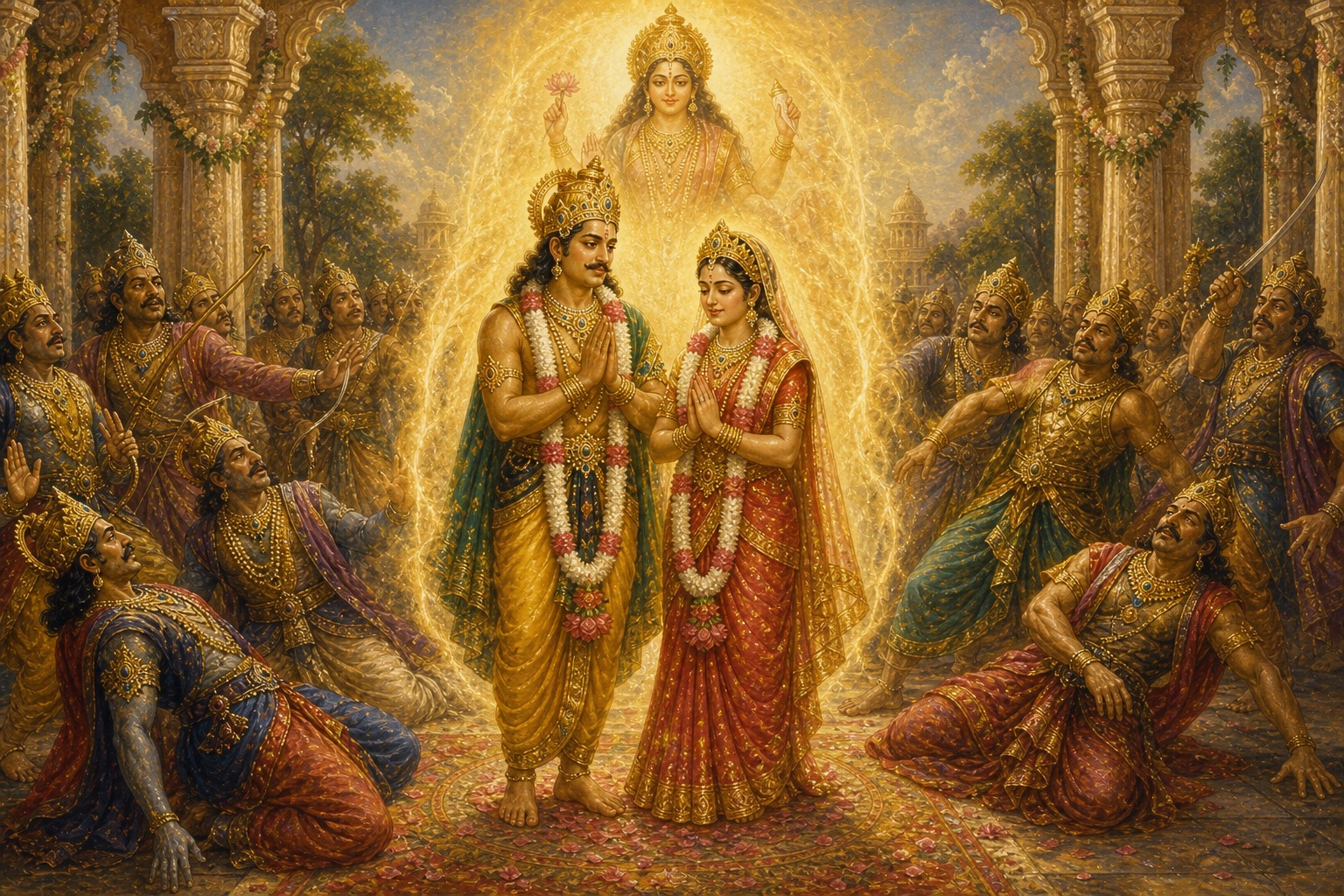
When her father Subahu arranged a svayamvara for his daughter, the rite in which a bride chooses her own husband, and kings from land after land took their places on the platforms, Shashikala told her mother firmly that she would not walk before those lust-ridden kings; she had already chosen Sudarshan. Yudhajit had come there too, bringing his grandson Shatrujit, and the armies of all the assembled kings together came to sixty-three akshauhinis (army divisions). But knowing his daughter’s resolve, Subahu married Shashikala to Sudarshan by Vedic rite that same night, in a hidden chamber of the inner palace, and gave his son-in-law a jewel-studded chariot, rut-maddened elephants, horses of the Sindhu land, maidservants adorned in gold, and boundless wealth. At dawn, when the other kings learned of the marriage, they blazed with fury, marched out beyond the city, and resolved to kill the powerless boy and carry off the girl.
The Bridegroom Surrounded on the Road
Sudarshan took his leave of his father-in-law and set out with his bride Shashikala toward the hermitage of Bharadvaja; to guard them, Subahu followed close behind with a great army. On the road, when the soldiers of those furious kings hemmed him in on all sides, Sudarshan meditated in due form on Bhagavati Chandika within his heart and gladly took refuge in her. He had never stopped repeating that one-syllable Kamaraja mantra, and so, with his bride beside him, he stood without fear and free of worry. Conches, kettledrums, and war-drums thundered. Shatrujit and Yudhajit began to loose their arrows, and Kashi’s king Subahu came up with his army to help his son-in-law. In this way a thrilling battle broke out there.
The Lion-Rider Appears
In that terrible moment the Goddess suddenly appeared. She rode upon a lion, carried weapons of every kind, wore divine garments, and shone with a garland of mandara blossoms. The kings, astonished, began to ask who this woman on the lion was and from where she had come. Sudarshan said to Subahu, “O king, look upon this great Goddess of divine aspect; she has appeared to grant me her grace. I was fearless before, and now I am more fearless still.” The two of them bowed low. The Goddess’s lion loosed so fearsome a roar that the elephants of the battlefield shuddered and every direction turned dreadful.
In a great fury Yudhajit challenged the kings, “Why do you fear this lion-riding woman? Kill this feeble boy along with the girl; do not let this jackal make off with the portion that belongs to heroes brave as lions.” So saying, he drew his bow to his ear and let fly sharp arrows, but the instant they left the string Sudarshan cut them to pieces with his own arrows. Then Bhagavati Chandika grew fiercely angry and began to pour arrows down upon Yudhajit. Taking many forms and wielding many weapons, Jagadamba waged a savage battle, and in only a few moments both Shatrujit and Yudhajit were slain and toppled from their chariots. Shouts of victory rang out everywhere.
Durga’s Boon and the Navaratra
Seeing his enemies dead, Subahu, overjoyed, began to praise Durga, the destroyer of misfortune: “Again and again I bow to Bhagavati Durga, who upholds the world and grants every wish. O gracious one, O giver of liberation, O all-pervading one, O mother of the world! You alone are Sarasvati; you are the understanding, the mind, and the motion within every being. How could a lowly creature like me ever praise you, who lift away the suffering of your devotees?” Pleased, the Goddess bade him ask for a boon. Folding his hands, Subahu prayed, “O mother! As the very form of Shakti, under the name Durga, dwell forever in my city of Kashi and keep it safe always. For as long as this earth endures, live here in this city of liberation.” The Goddess granted the boon that as long as the earth endured she would dwell in Kashi to protect all the worlds; and then she vanished.
Then all those rival kings, now filled with devotion, began to bow to Sudarshan as the gods bow to Indra, and they took him for their lord. Sudarshan told them that this Shakti is Mahalakshmi, the primordial source of all, who through rajas creates, through sattva sustains, and through tamas destroys; she is the attributeless supreme Shakti. “In my childhood her Kamaraja seed-mantra came to me; from that day on, night and day, I have remembered her alone.” The Goddess commanded Sudarshan to go to Ayodhya and rule in keeping with the dignity of his line, to remember and worship her with care, to install her image in his city, to worship her three times each day, and in the autumn to perform her great worship by the rite of Navaratra.
After this, Subahu set out for Kashi and the righteous Sudarshan for Ayodhya. Sudarshan consoled Lilavati, the grief-stricken mother of Shatrujit, held her as dear as his own mother Manorama, and, seating the Goddess upon a golden lion-throne, had her image installed with full Vedic rite by learned brahmanas. Just as once in this same Ayodhya there had been the righteous reign of Rama and King Raghu, so under Sudarshan’s rule the people lived in happiness and the dharma of the varnas and ashramas flourished on all four of its feet. The kings of the Koshala land built temples to the Goddess in village after village, and from that time on, throughout Koshala, Bhagavati was worshipped with love.
Source: Srimad Devi Bhagavata Mahapurana (Gita Press, Gorakhpur)