On this page
When the Earth Came to Meru and Asked for a War
Vishnu had slept through two whole ages. In the hermitage called Narayana, on the waters, he lay in the yoga-sleep that belongs to him alone, the sleep no other god can withstand, and while he slept the ages of Satya and Treta ran their long courses. He woke at the close of Dwapara because the great sages, watching what was happening to human beings, had come to the water’s edge and begun to sing to him. Cast off this sleep, they sang, the way a garland already worn is set aside; Brahma and every god are waiting to see you; some work of the gods requires you. He rose, and the water drew back, and the darkness thinned around him, and he saw them: every god there was, and the Grandfather among them, with grief in their faces and something they had come to say. His first words were questions. “Where is your quarrel? Who is it you fear, and who is in need, and of what? Has some disaster come upon the world through the Danavas? Have men come to grief through weakness of their own? I have left my bed to stand among you. Tell me what I can do.”
Brahma Calls a Council on Meru
Brahma’s answer had a strange shape, and Vishnu listened to all of it. There was no fear of the Asuras, Brahma said; wherever Vishnu led the gods into battle they were safe, and when the king of the gods stood crowned with victory, what did righteous men have to fear? Truthful men were free of ills, and death did not visit the pious before its time. Then he described a world that sounded like the golden age come back. The kings took their lawful sixth of the harvest and feared no one. They filled their treasuries with tribute that no vassal grudged, punished mildly, guarded the four orders of society, and kept their prosperous provinces in peace behind the four divisions of the army. They were masters of the bow and observant of the Vedic rites; they fed the sacrificial fires with lavish gifts, had undergone initiation and studied the Vedas, honored the great sages in thought, word, and deed, and fed their ancestors a hundred times over with the water and rice-balls of the shraddha. There was nothing in the Vedas, in custom, or in the shastras they did not know. Bright as the great rishis, they were laboring to bring the golden age back by main force, and the world was answering them: Indra sent rain in season, the winds blew clean of dust through the ten directions, the planets moved at ease, the moon walked among the stars, the sun kept to its two paths, the fire on every altar had grown sweet-scented with oblations, and no one feared death. “And that,” Brahma said, “is what is crushing her.” One brilliant king after another had pressed his weight on the Earth. In every city a king sat with ten million soldiers; in every kingdom hundreds of thousands of villages prospered; thousands of kings and their armies and their millions of villages covered her whole surface. She had come before the gods like a boat on the point of going under, her mountains shaken and her oceans heaving, sweating again and again under kings who burned like the fire of the world’s ending. She had set Time himself before her, and drained of strength she had come to Brahma’s own house. “Vishnu, you are her refuge. She is the ground of every human act, and she has been assaulted. Do what will keep the eternal Earth, the stay of the universe, from ruin. Great is the sin of oppressing her: when she fails, every work of humanity stops and the whole universe fares ill. She has thrown away her patience and her natural forbearance, and she has grown impatient. We have heard her story, and so have you. Let us take counsel about lifting her load.” The counsel, he already knew, would go one way. The kings did right, the three lower orders followed the Brahmins, every word spoken was true, every order kept its duty, and virtue must not be allowed to decline; and the Earth belonged to the righteous and to no one else. So the only way to relieve her was to destroy the kings. “Come with us, great one. With the Earth before us, let us go up to the summit of Meru.” And having said it, the Grandfather of all sat down to rest beside the Earth.
“So be it,” Vishnu said, and the sound of him was like the muttering of a rain cloud on a dark day. He rose the color of that cloud, deep blue, his matted hair crested with gems and pearls like a cloud carrying the moon, the mark of Shrivatsa on his broad chest where the hair stood erect, two yellow garments wrapped around him; when he moved off with the gods he looked like a mountain wearing the evening clouds. He mounted Garuda, and the lotus-born Brahma and all the gods followed with their eyes fixed on him. In no time they had reached the jeweled mountain, and there on the summit of Sumeru stood the assembly hall built to the gods’ own hearts, bright as the sun: pillars of gold, gateways crested with diamonds, windows hung with nets of jewels, walls painted with every scene a mind could make, hundreds of flying chariots, flowers worked in every metal, a hall that could travel anywhere at will, built by Vishvakarman and filled with the illusions of heaven. Each god took the seat appointed to him, on chariot-seats and thrones, on couches of honor, on low stools, on mats of kutha grass, and settled with a glad mind. Then, at Brahma’s command, the wind Prabhanjana went out and patrolled every side of the hall so that no sound could reach it. And in that silence, in the assembly of the gods, the Earth began to speak, and every word of it was grief.
The Earth Speaks
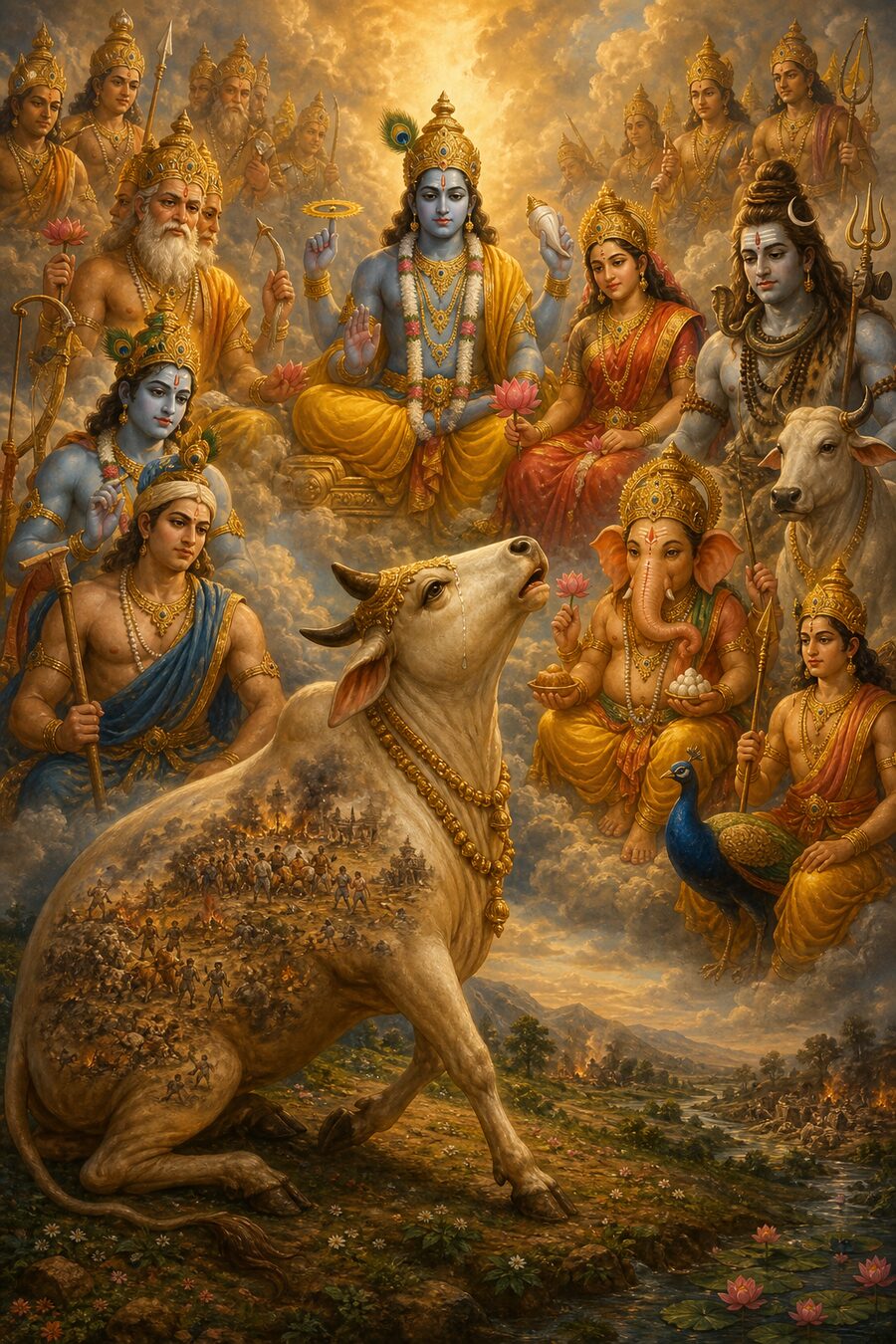
“Hold me up,” she said, and she said it to Narayana. “By you the whole universe is sustained; you protect the creatures and the three worlds. Whatever you carry by your strength, I carry afterward by your favor. Whatever you let go, I cannot keep. There is nothing in the universe you cannot bear. Age after age, Narayana, you have lifted my burden for the good of the world; possessed by your energy I have sunk into the region below and risen again. Danavas and Rakshasas have assaulted me, and you have always been my savior. A hundred times over I have learned it: until I take refuge with Narayana, who takes away every load, I live under the rule of fear.” Then she told them her own history, and it was the history of everything. Before Brahma had taught men to plow and trade, two great Asuras made of her own substance had been born to bind her. While Vishnu slept on the deep they came from the grime of his ears and lay there like two logs, until at Brahma’s bidding the wind entered them as breath and they grew until they covered the sky. Brahma touched them and found one soft and one hard, and named them for it: Madhu the soft, Kaitabha the hard. Drunk on their strength, the two Daityas went ranging over the water that was then the whole world, looking for a fight, and Brahma hid from them inside the lotus that grew from Vishnu’s navel. Years later they found him there. With the lotus stalk Brahma prodded Narayana awake, and in a world of water the battle went on for a thousand years without tiring the demons at all; at last, delighted with the fight, they asked Narayana for the death they wanted, on ground not covered by water, and asked to become his sons. He caught them in his arms and killed them. Their two bodies fused into one, and churned by the waves they gave up their fat until the whole water was covered with it, and from that fat, that medas, she took her name, Medini. “Then, in a boar’s form, in the presence of the sage Markandeya, you raised me out of the water on a single tusk. Then, in the fiery presence of all of you, you freed me from Bali, the chief of the Daityas. Now I am oppressed and have no protector, and I have come for refuge to Gadadhara, who loves those who love him. Fire is the source of gold, the sun is the source of the stars, and Narayana is my support. Alone I hold up all that moves and all that stands still, and he holds up me.” And she told them what the last attempt to lighten her had cost. Rama, the son of Jamadagni, wanting to relieve her, had in his anger stripped her of Kshatriyas twenty-one times, raised a pillar of victory, poured out royal blood for her at the funeral rites of his father, and then handed her to Kashyapa. She had come before Kashyapa reeking of fat and flesh and bone, drenched in the blood of Kshatriyas, like a young woman in her courses, and the sage had asked her why she, a hero’s wife, was keeping the vow of a woman shamed. “I told him: the Bhargava has killed all my husbands. I have lost every Kshatriya who lives by arms. I will not carry empty cities. Give me a king who can protect me, with my villages and my cities and my garland of oceans.” Kashyapa had said so be it and given her to Manu, the king of men; from Manu came the godlike kings of the Ikshvaku line, and under the pressure of time she had passed from the hands of one king to the next. Many heroes had conquered her and gone to heaven and vanished into her. They had fought over her then; they were fighting over her now. “This is the end of the destiny you set in motion. If you have pity on me, if you mean to lighten my load, then bring about a war for the destruction of the kings, for the good of the world. Let the beautiful bearer of the discus alone protect me. Let Narayana command me. I have come to him with this weight on me, and I will do what he thinks right.”
Brahma Assigns the Portions
The gods weighed what she had asked, and they turned to the Grandfather. “You made the bodies of all creatures. You are the lord of all the worlds. Relieve her. If you mean to accomplish what she has come for, then set out at once the duties of Indra, of Yama and Varuna and Kubera, of Narayana, the moon, the sun, and the wind; of the Adityas, the Vasus, the Rudras, and the Prajapatis; of the Ashvins, the physicians of heaven, and the Sadhyas; of Brihaspati and Shukra, the two preceptors; of Time and of Kali, of Maheshvara and Kartikeya; of the Yakshas, Rakshasas, Gandharvas, and Charanas, the great serpents, the birds, the mountains, and the oceans with their rivers led by Ganga. How are we to send our portions down? Let us make bodies for ourselves in the houses of the kings and of the Brahmins who counsel them.” Brahma heard that whole assembly resolve on one common purpose, and he was pleased. “I like your resolution very much. Create portions of yourselves on earth by your own energy. Go down, all of you, and win the fortune of the three worlds, and lift her burden. And listen to what I did long ago, the first time I was told of her load.” He had been sitting, he said, on the western shore of the eastern ocean with his grandson, the great Kashyapa, discoursing on the Vedas and the lore of the Puranas, when the gods had come to him with the Maruts, and with the Ocean and Ganga in their own bodies. The Ocean had come roaring, clothed in sea-creatures, his body glittering with shells and pearls and coral, the moon at his side, and he had flung his salt water over the place where Brahma sat. “Be still,” Brahma had said, in anger, and the moment he said it the Ocean took a body and stood there with all his waves quieted, in the bearing of a king. And Brahma, thinking of the Earth’s burden and the gods’ good, had cursed him: since you have come in a king’s form, go and be a king; be born in the race of Bharata and protect men; and because you grew calm the instant I told you to be quiet, you will be called Shantanu; and this Ganga, wide-eyed and flawless, will come to you in a beautiful form. The Ocean had grieved. “I am your son; you made me; why curse me in words like these? The wind and the swelling cloud and the moon’s tide raised my waves. If you were splashed by water the wind threw up, what fault is that of mine? Forgive it, and let the curse end; or if you find me guilty, still show mercy to Ganga, who is innocent.” So Brahma had turned the curse into a charge. Go to the race of Bharata, king of rivers, and rule the four orders in royal splendor; Ganga will serve you in a woman’s form, and sporting with her you will feel no human sorrow; the Vasus, banished from heaven, have gone down into Rasatala, and I appoint you to father them; let Ganga conceive the eight Vasus, bright as fire, and when you have begotten them and multiplied the line of Kuru, cast off the human body and be the ocean again. “That,” Brahma told the gods, “is how I sowed the line of Shantanu, long ago, seeing this burden coming. Ganga’s son Bhishma, the eighth Vasu, walks the earth even now; the other seven have gone home. Shantanu’s second wife bore him Vichitravirya, and Vichitravirya’s sons are Dhritarashtra and Pandu, the two foremost of men. Pandu has two young wives, Kunti and Madri, like the wives of the gods; Dhritarashtra has one, Gandhari, famous for her steadfast service to her husband. In that house the sons of those two kings will split into two hostile camps, and out of their quarrel every royal family in the world will be destroyed. It will be like the hour of the world’s ending. When all the kings and all their armies have killed one another, the cities and kingdoms will stand empty of people and the Earth will have her relief. I have read it in the Puranas: at the end of the Dwapara age every king will die by weapons, and then Ashvatthama, a portion of Shankara, will consume what remains of them with the fire of a weapon, lying asleep at night. When that man of cruel deeds, death’s own likeness, stops, the story of Dwapara closes, and the dreadful Kali age of Maheshvara sets in: a world of iniquity, a bare fraction of virtue surviving, truth gone and falsehood heaped up, only Maheshvara and Skanda worshiped, and no old men left on the earth. Such is the annihilation of the kings. So go down at once in your portions. Let Kunti and Madri conceive the portions of Dharma, and let Gandhari conceive Kali, the maker of every quarrel. Driven by destiny these kings will form two sides and, each wanting the Earth, they will seek a war. And let the Earth, who upholds all the worlds, go back into her own nature; the sacred means is made.” And the Earth, with Time beside her, went away content, toward the destruction of the kings.
Then Brahma sent the gods down to kill their enemies. The ancient rishi Nara went; Shesha the serpent, who holds the Earth up; Sanatkumara; the Sadhyas; Agni and the other gods; Varuna; the Vasus; the sun and the moon; the Gandharvas and the Apsaras; the Rudras; the Vishvedevas; the two Ashvins. Each came down in his own portion, born through a woman or otherwise, and they were the destroyers of the Daityas and Danavas. Some spread their families wide like fig trees. Some had bodies hard as thunderbolts, some the strength of a million elephants, some the force of a river in flood; some were made for the club and the iron bar, and all of them could strike with the tops of mountains. Hundreds of thousands of men with arms like iron bars were born in the race of the Vrishnis. Gods were born as kings among the Kurus and the Panchalas, and in the prosperous houses of the Yadus and in Brahmin families were born great sacrificers, men learned in the scriptures, mighty archers who kept the Vedic rites, wealthy and accomplished, who when angry could shake mountains and rivers and the surface of the earth, rise into the sky, and stir the deep. Having given his commands, Brahma, master of past, present, and future, placed all the worlds in Narayana’s keeping and was at peace.
Narada Turns the Plan Toward Mathura
So the gods went down: Dharma and Indra and the wind, the two Ashvins, the sun, the preceptor of the gods, the eighth Vasu, Death, Kali, Shukra, Varuna, Shankara, Mitra, Kubera, the Gandharvas, the serpents, and the Yakshas, each in his portion into the race of Bharata. And then Narada came, who was himself born of a portion of Narayana’s own energy. He was bright as fire, with eyes like the rising sun and a huge mass of matted hair, dressed in white like moonlight and hung with gold, the great vina at his side like a companion who never leaves the room, an antelope skin over his body, a sacred thread of gold, a staff and a water pot in his hands, so that he looked like a second Indra. He was learned, a master of the Gandharva Veda, the first speaker among gods and Gandharvas, the chanter of the four Vedas and the reciter of the first Rik, and he loved a quarrel; he made enemies for the pleasure of it and could read the hidden root of any dispute in the world, a second Kali in his own right. And this immortal sage who ranges the world of Brahma came into the assembly of the gods with a heavy heart and spoke to Vishnu in front of them all. “Narayana, the gods have gone down to destroy the kings, and it is useless. Lord of heaven, with you sitting here, their quarrel will bear no fruit; I do not think anything they do can be accomplished without Narayana’s yoga. You see the true essence of things, and it was wrong of you to set such a work going for the Earth. You are the sight in every eye and the lord of the powerful, the first of yogis and the refuge of all. You watched the gods go down. Why did you not send a portion of your own energy first, to lift her burden? With you for their help, one with you and guided by you, the gods will swim this earth from one deed to the next. I have hurried here, before this assembly, to send you. Hear why. Of the many Daityas you killed in the war that Taraka began, hear what has become of the ones that have come up onto the face of the earth.” There was a lovely city on the bank of the Yamuna, he said, rich in prosperous villages, called Mathura, and its story was the story of a forest. A great Danava named Madhu, a terror to every creature, had once lived in a vast and dreadful forest of huge trees that carried his name, and his son Lavana, stronger than his father, had sported there for years and terrorized the gods. In the days when Rama, the son of Dasharatha, ruled in Ayodhya, Lavana had sent him an insolent messenger to call him a coward for killing Ravana over a woman and to dare him to fight. Rama, out of forbearance, had smiled, told the messenger that men like himself did not strike at the small, and named his younger brother Shatrughna to deal with the demon. Shatrughna had driven to the Madhu forest, pitched camp, and fought Lavana arrow for arrow until the Danava, without his mace, took up a celestial weapon and caught Shatrughna by the turban with it; Shatrughna had cut off his head with a gold-hilted dagger, cleared the forest with his weapons, and built a city there for the good of the province. That city was Mathura, walled and gated, its moat lying around it like a woman’s girdle, its stone and brick buildings like armlets, its palaces like earrings, its guarded gates like veils and its promenades like smiles, shaped like a crescent moon along the Yamuna’s bank, full of heroes, elephants, horses, and chariots, rich markets and jewels, fields heavy with grain, rain in season, and people who were always glad. And there, Narada said, the powerful king Surasena of the race of the Bhojas reigned, strong as Mahasena and famous as Ugrasena. “And the one you killed, Vishnu, is his son. The Daitya Kalanemi, whom you cut down in the war that Taraka began, is born as Kamsa, scion of the Bhojas, a king who walks like a lion, a terror to every king on earth and a dread to every creature, always outside the path of righteousness, persevering and ruthless, so haughty toward his subjects that their hair stands on end at the sight of him. He keeps none of a king’s duties, gives no pleasure to his own people and no good to his kingdom, and rules as a tyrant, a meat-eater oppressing all the worlds with a demon’s heart. Hayagriva, the horse-necked, is born as Keshi, a bodiless thing with a mane, neighing like a horse, living alone in Vrindavana on human flesh. Arishta, Bali’s son, is the great Asura Kakudmi, who takes any form he wants and in the form of a bull has made himself the enemy of the cows. Rishta, Diti’s son, the first of Danavas, is Kamsa’s elephant. The dreadful Lamba is Pralamba, living under the fig tree called Bhandira. The demon Khara is the terrible Asura Dhenuka, who lives in the forest of palms and makes havoc of every creature there. Varaha and Kishora, those two chiefs among the Danavas, are the wrestlers Chanura and Mushtika, always in the arena. Maya and Tara, who were death even to demons, live now in Pragjyotisha, the city of Naraka, the son of the Earth herself. You killed all of these, Narayana, and stripped them of their forms, and in human bodies they are oppressing the people of the world. They suppress the chanting of your name and destroy your devotees; only by your favor will they be destroyed. In heaven they fear you, in the ocean they fear you, on the earth they fear you, and there is nothing else they fear. You kill the wicked Danavas, Shridhara, and no one else can; the Daityas driven out of heaven find refuge on the earth. Keshava, while you stay awake here, a demon killed in heaven rises again in a human body and finds it hard to climb back. So come to the world, Narayana. We are coming down too. Create your own self for the destruction of the Danavas; the gods you created will go down in those forms of yours that are seen and unseen. Vishnu, when you come down, Kamsa will not be able to reign, and the purpose for which the Earth came will be accomplished. You are the teacher of every deed in the land of Bharata, the eye of all, the last refuge. Hrishikesha, come down to the earth and kill those wicked Danavas.”
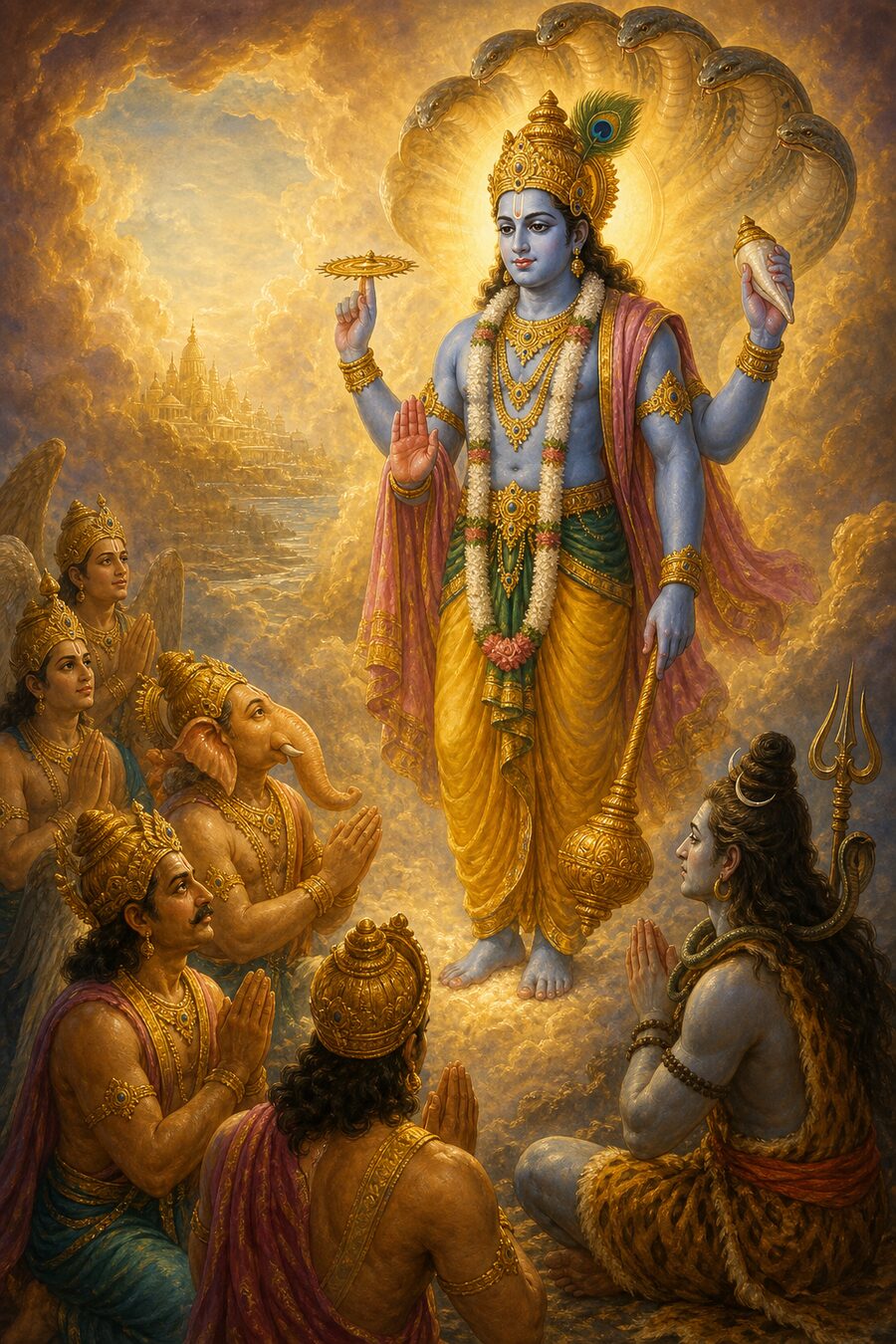
Vishnu, the master of the gods, heard Narada out, and he smiled. “Narada, hear a proper answer to everything you have said for the good of the three worlds. I know that all these Danavas have been born on the earth in human forms. I know that Kamsa is born as the son of Ugrasena, and that Keshi is born as a horse. I know the elephant Kuvalayapida, the wrestlers Chanura and Mushtika, and the demon Arishta in the shape of a bull. Khara and the great Asura Pralamba are known to me; so is Putana, Bali’s daughter; so is Kaliya, who lives in a pool of the Yamuna and went there in fear of Garuda. I know Jarasandha, the head of all the kings, and the demon Naraka in the city of Pragjyotisha. In the city of Shonitapura, Bana is born as a man, that fierce and haughty demon of a thousand arms whom even the gods cannot defeat. I know that the great charge of Bharatavarsha lies with me, and I know how all these kings will disappear; I have already seen the destruction of these demons in their human forms, who never turn back from a battlefield, and I have seen the rejoicing in Indra’s world that follows. For my own sake and for the others’, I will enter into yoga. I will go to the world of men in a human form and bring about the destruction of all those mighty demons led by Kamsa, and I will kill him by the means through which he will find peace. It is my bounden duty to destroy in battle every enemy of the gods, and to kill the foes of all those great ones who have given themselves for the Earth’s sake, the gods and rishis and Gandharvas who have come down at my word. My resolution is formed, Narada. Let the Grandfather make a house for me there. Grandfather, tell me: born in what country, living in what house, shall I kill them?” Brahma told him. “Narayana, hear the key to this, and who your parents on earth will be. To glorify their family you will be born in the race of the Yadavas, and having rooted out these Asuras for good and multiplied that great house, you will set the orders of mankind in place. Long ago, at the great sacrifice of Varuna, Kashyapa took away all the milk-cows that were giving milk for the rite, and his two wives, Aditi and Surabhi, would not let them go back. Varuna came to me and bowed his head and said: ‘Revered one, the preceptor has stolen my cows. His purpose is served and still he will not order them returned; he is under the sway of his two wives. Those cows give heavenly and eternal milk whenever it is wished, milk like the nectar of the gods; guarded by their own power they range in the seas, and no one save Kashyapa could have charmed them. Brahma, when a master or a preceptor or anyone at all goes astray, you are the one who restrains him; you are our supreme refuge. If the powerful who forget their own work go unpunished, the order of the world will not stand. Give me my cows and I will go back to the ocean. These cows are my very soul, my endless strength. Of all you have created, the cows and the Brahmins are the eternal sources of energy. Save the cows first; saved, they protect the Brahmins, and the world stands on the protection of those two.’ So, Achyuta, when I had learned the truth of the theft from Varuna, the king of the waters, I laid a curse on Kashyapa: with the very portion of himself that stole the cows he will be born on earth as a cowherd, and his two wives Surabhi and Aditi, those two kindling-sticks from which the gods are born, will go with him. Born as a cowherd among them he will live there happily. That portion of Kashyapa, as powerful as Kashyapa himself, will go by the name of Vasudeva and live among the cows of the earth. Near Mathura there is a mountain called Govardhana; paying his tribute to Kamsa, he lives there, devoted to his herds, and his two wives Aditi and Surabhi are born as Vasudeva’s two wives, Devaki and Rohini. Be born there as a boy with every mark of a cowherd, and grow up there as once you grew in your form of the three strides. Cover yourself in the form of your yoga, Madhusudana, and go there for the good of the world; all these gods are cheering you on with cries of victory and blessing. Come down to the earth, take birth from Rohini and Devaki, and delight them both. Thousands of milkmaids will cover the earth. When you range the forest tending cows they will see your beautiful form garlanded with wild flowers; when you go as a boy to the villages of the cowherds, everyone there will become a boy. Your devotees, cowherds with their minds fixed on you, will help you; tending cattle in the forest, running in the pastures, bathing in the water of the Yamuna, they will come to love you past bearing, and Vasudeva’s life will be a blessed one. You will call him father and he will call you son. Save Kashyapa, whom could you accept as a father? Save Aditi, Vishnu, who could conceive you? So go to victory by your self-born yoga, Madhusudana. We are going home.” Vishnu sent the gods back to heaven and went to his own abode on the northern side of the ocean of milk. In that quarter there is a cave of Mount Sumeru that no foot can easily reach; there the omnipotent Hari left his old body behind and sent himself into the house of Vasudeva. What had been settled on the summit of Meru would not stay there. Narada, who had heard every word of the council, was already on his way down to Mathura with the news, and the ear he meant to pour it into belonged to Kamsa; and the eighth child of Devaki, Kamsa’s youngest sister, was about to become the most closely watched unborn child in the world.
Source: Harivamsha (the khila-parva of the Mahabharata), Vishnu Parva, chapters 30 to 45; critical edition (P. L. Vaidya, Bhandarkar Oriental Research Institute, Pune). Told as story, following the original sequence of events.
The same story, elsewhere
- The Harivamsha · The Birth of Krishna
The birth narrative in the Harivamsha (the khila section of the Mahabharata) - Kamsa’s Fear and the Birth of Krishna
Shrimad Bhagavata (Skandha 10): Kamsa’s fear and the birth of Krishna - Krishna
Character profile: the whole story of Krishna