On this page
Midnight, a Prison, and a Child Carried Across
The man who tried hardest to escape his death was the first to hear it named. Kamsa, Ugrasena’s son, was king in Mathura, and the voice that named it belonged to a guest he had just honored. Narada, the sage who wanders between the worlds, had heard of Vishnu’s descent and of the portions of the other gods coming down after him, and he came to the garden outside Mathura to tell Kamsa of the death that was coming to him. He sent a messenger into the city, and Kamsa went out at once and found in his garden a guest washed clean of every sin, powerful as the sun and bright as fire. He bowed to him, worshiped him by the rule, and had a golden seat brought that shone like fire itself, and Narada, Indra’s friend, sat on it and spoke to the hot-tempered son of Ugrasena. “You have worshiped me with the rites the scriptures lay down. Hear now what I say, and accept it. Once, when the Grandfather held a meeting of the gods on the summit of Sumeru, I went too, with my vina tuned, and saw Brahma and the gods in white turbans and jewels seated on celestial seats, holding counsel. Kamsa, what I heard there was this. They were planning dreadful measures for your destruction. The child of the eighth conception of your youngest sister Devaki, who lives here in Mathura, will be your death. It has been settled that your death will come from the self-born Vishnu, who holds heaven up and is identical with all things, and to die at the hands of that god of gods is a matter of glory for you. So remember him now. Try to destroy the conception of Devaki, and enjoy your wealth and your pleasures. I love you, and that is why I came and told you what passed on Sumeru. Now I leave you. Fare well.”
Fear kills the tenderness in a man before it kills anything else, and it comes in first wearing a laugh. When Narada had gone, Kamsa turned his words over, then laughed aloud and said to the servants before him, “Truly the gods make fun of Narada, and he knows nothing of how things are. Seated on my throne, asleep, mad or drunk, I cannot be frightened in the least by the gods, with Indra at their head. Who in the land of men would dare to make me angry? I can shake the earth with these two arms of mine. From today I will press hard on every creature that follows the gods. Carry this command to Keshi, who goes in the shape of a horse, to Pralamba, to Dhenuka, to Arishta in the form of a bull, to Putana, to Kaliya and the other demons: take whatever forms you like, range the whole world, and destroy whoever you find standing against me. Narada says our fear comes from a conception, so keep yourselves informed of every woman who has conceived. And Narada loves a quarrel; that restless Brahmin travels the worlds working up enmity between kings.” He said it boastfully and went into his palace, and his heart was burning with the fire of anger. Inside, he called his ministers, and his voice was no longer laughing. “Be always on your guard to destroy the children of Devaki. The calamity we suspect must be pulled up by the root, so destroy every embryo of Devaki from the very beginning. Let Devaki be well guarded in the inner apartment by the warders, and let her move about there without fear; when she conceives, keep her with care. From the first her months will be counted by the women of my harem, and when we know the time of her delivery we will do what we think proper. Let Vasudeva too be kept in the inner apartment day and night by eunuchs and by women devoted to my welfare, and kept unaware; let no one tell him the secret. It is by human effort that men accomplish their ends; even an adverse fate is turned aside by well-used mantras, by medicines rightly given, by care and by devotion.”
A Mother Broken Six Times
What followed is hard to hold in words. Devaki conceived, and a son was born, and the moment he came out Kamsa took him and dashed him against a stone. Then a second son, and the stone again. Then a third. One after another, six infants were born in that guarded room, and one after another Kamsa killed them the same way, with his own hands, in front of the mother who had carried them.
These six were no ordinary children, though no one watching could have known it. Out of sight of Mathura, Vishnu had learned what Kamsa was preparing and had thought it through: Kamsa of the Bhojas would destroy the first seven children of Devaki, and in her eighth conception he himself would have to live in her womb. As he thought, his mind flew to where the Shadgarbha Danavas lay in the water, the sons of Kalanemi, strong as the gods, bright-bodied, experts in battle. Long before, those six had left their own grandfather Hiranyakashipu, put on matted locks, and worshiped Brahma with hard penance until the Grandfather came to them pleased and told them to ask. “Grant us this,” they said, “that we cannot be killed by the gods, by Uragas, Yakshas, Gandharvas, Siddhas or Charanas, by men, or by the great Rishis whose weapons are their curses.” Brahma, delighted with their austerities, gave it, and when he had gone back to heaven Hiranyakashipu turned on them in anger. “By passing me over and praying to the lotus-born for a boon you have made yourselves my enemies. I have no love for you, and I abandon you all. The father who gave you the grand name of Shadgarbha will kill you while you are still in the womb. All six of you will be born in order from Devaki, and Kamsa will kill you.” That was the sentence Vishnu went down to the nether region to collect. He found the Shadgarbhas lying in the womb of the waters under that curse, held in a sleep like death, and entering their bodies as a dream he took hold of their vital breaths and handed them to Nidra, the goddess of Sleep. “By my command take the breaths of these great Danavas and place them, one after another, in Devaki’s womb. They will be born of her and go to the house of Death. Kamsa’s efforts will come to nothing, and Devaki’s labor will bear its fruit. And I will show you such favor that you will be as powerful on earth as I am, and adored by every creature.” So what looked like a tyrant’s cruelty was also a sentence falling due, and the knowledge of it was hidden from Devaki. She was left with the grief, and with the thing that made the grief unbearable, that the hands carrying her children to the stone were her brother’s.
Then Vishnu laid out for Nidra the whole order of what was to come. “When my gentle portion is conceived by Devaki the seventh time, that eldest brother of mine, take him in the seventh month and place him in Rohini’s womb. Because he was drawn out of one womb and across to another, that moon-bright elder brother of mine will go in his youth by the name Sankarshana. Kamsa will think that Devaki has given birth before her time out of fear, and he will be all the more careful the eighth time, when I am in her womb. You will be conceived by Yashoda, the beloved wife of Nanda who keeps Kamsa’s cattle, and born on the ninth day of the dark fortnight. I will come out of the womb gladly in the middle of the night, under Abhijit. Kamsa’s rule is dreadful, so in the eighth month we will be born at the same hour and exchanged: I will be carried to Yashoda and you to Devaki, and the exchange will stupefy Kamsa. He will take you by the leg and dash you against a stone, and at once you will go up into the sky and reach your eternal place. There your body will be dark blue like mine and your arms as great as mine, with a three-headed mace and a cup of wine in your hands and terrible goblins around you. Indra will sprinkle you with water and accept you as his sister; adopted into the family of Kushika you will be called Kaushiki, and he will give you the Vindhya mountain to live on. There, thinking of me, you will set out with your goblins and kill the two demons Shumbha and Nishumbha with all their attendants. You love an offering of meat, so on a Navami you will receive worship on earth with the sacrifice of beasts. You will save the ones lost in a great forest, the ones drowning in the deep, the ones set on by robbers, and the man who propitiates you with devotion I will never kill.” Here Vaishampayana himself stopped to salute Narayani, the mistress of the three worlds, with the old hymn of the Rishis, which calls her by every name under which the world knows her, Katyayani and Kaushiki, the Savitri of the Vedas, the plow of the farmer and the shore of the sea, the beautiful one who takes a dreadful form for the destruction of the Danavas; and the heart of it is this: “This universe, moving and unmoving, is pervaded by you. You are the savior in battle and in fire, in rivers, in fear of thieves, in caves and in foreign lands, wherever life is at stake. My heart, my mind and my reason are given to you. Save me from every sin.” Then Vishnu finished what he had to say to her. “Stupefying Kamsa, you alone will enjoy the world, and I shall live the life of a cowherd among the cattle; to do my own work I shall become Kamsa’s cowherd.” He vanished, and the goddess bowed and said, “So be it.” The seventh time, it happened as he had said. One night, deep in sleep, Rohini saw in a dream a flow of blood and her unborn child falling from her, and she woke a little after and was in anguish at not finding it in her. In that dark night, as Vasudeva’s moon-faced wife wrung her hands, the goddess of Sleep spoke to her. “I have drawn the embryo out of Devaki’s womb and placed it in yours. So this son of yours will be celebrated by the name Sankarshana.” Rohini, given that son, was glad, and with her head bowed she went into her house like the beautiful wife of the Moon. In Mathura, Kamsa took it as Vishnu had foretold: Devaki, worn thin by fear, had lost the seventh before its time.
The Eighth Night
People were still asking questions about Devaki’s seventh conception when she conceived for the eighth time, and this was the one for whom Kamsa had killed her seven children. His servants watched that womb with great care, and the Lord Hari lived in it of his own accord. What they could not watch was the second conception being made ready at the same time. Yashoda, too, had conceived: the goddess of Sleep, begotten of a portion of Vishnu’s energy and intent on carrying out his command.
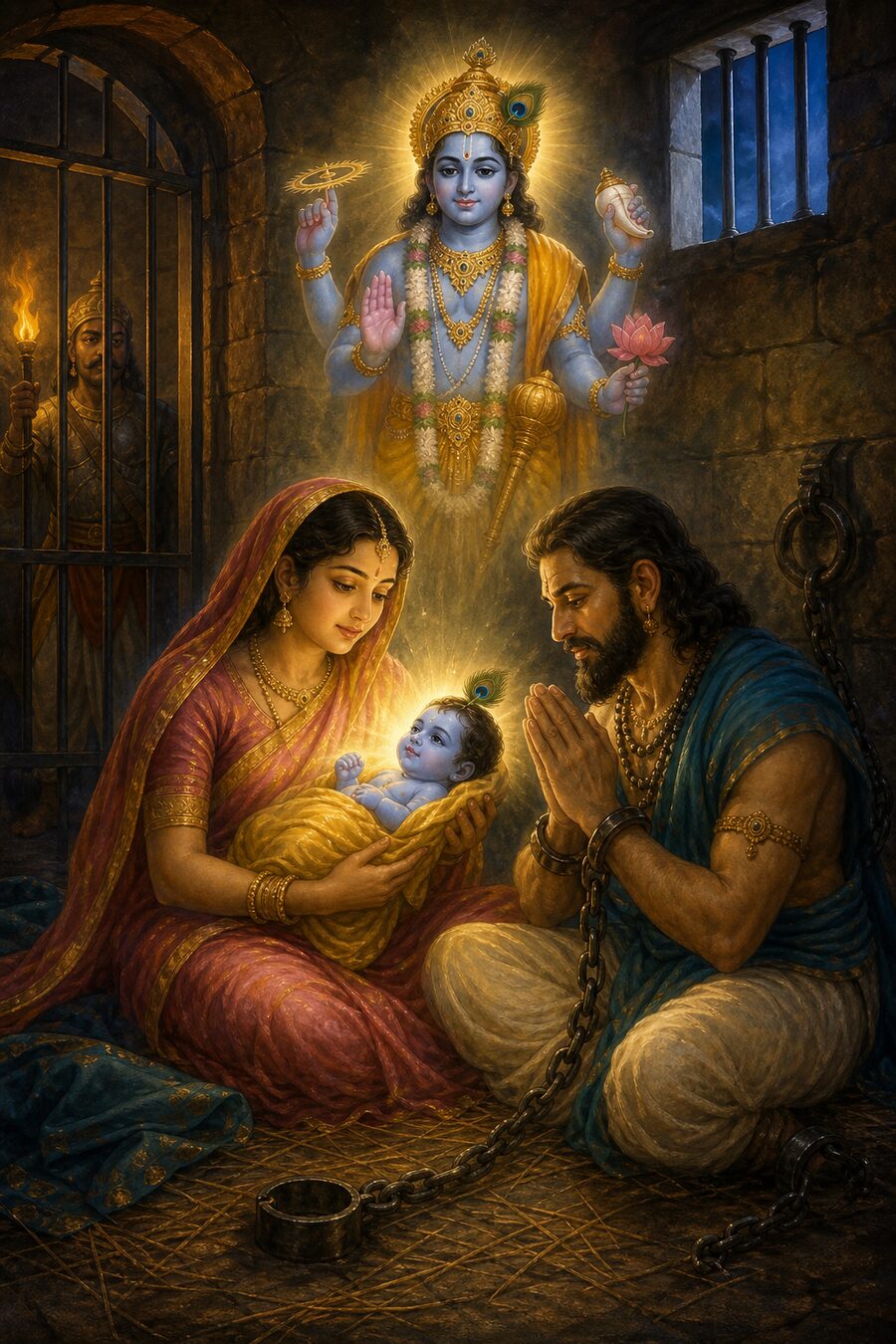
Before the term of pregnancy was complete, in the eighth month, Devaki and Yashoda gave birth on the same night. In the auspicious midnight, in the muhurta of Abhijit, Devaki gave birth to Vishnu in the house of the Vrishnis, and Yashoda to her daughter. When Janardana was born the oceans were agitated, the pillars of the earth shook, fires that had gone out began to burn, auspicious winds blew and carried off the dust, and the lights of the sky showed themselves clear. The night was Jayanti, the nakshatra Abhijit, the muhurta Vijaya, and the moment he was born the unseen, eternal Hari overpowered all the worlds with his look. The celestial bugles sounded without anyone striking them, Indra showered flowers from the upper air, and the great saints, with Gandharvas and Apsaras, chanted the glory of the slayer of Madhu. When Hrishikesha was born the whole universe was in an ecstasy of joy.
But the child Devaki held had not come as a child. In that night Vasudeva saw Vishnu born as his son, with four arms, the mystic mark of Srivatsa on his chest and every other sign of divinity written on a newborn’s body, and the sight went through him like cold water. He had already lost six sons. He bent over this one and said, “Withdraw this form of yours. I have been terrified, because my sons, your elder brothers, were slain by Kamsa, and that is why I say this.” The Lord heard him. He drew the form of four arms back into himself, and addressing Vasudeva as his father he asked to be taken to the house of Nanda the cowherd.
The Children Exchanged
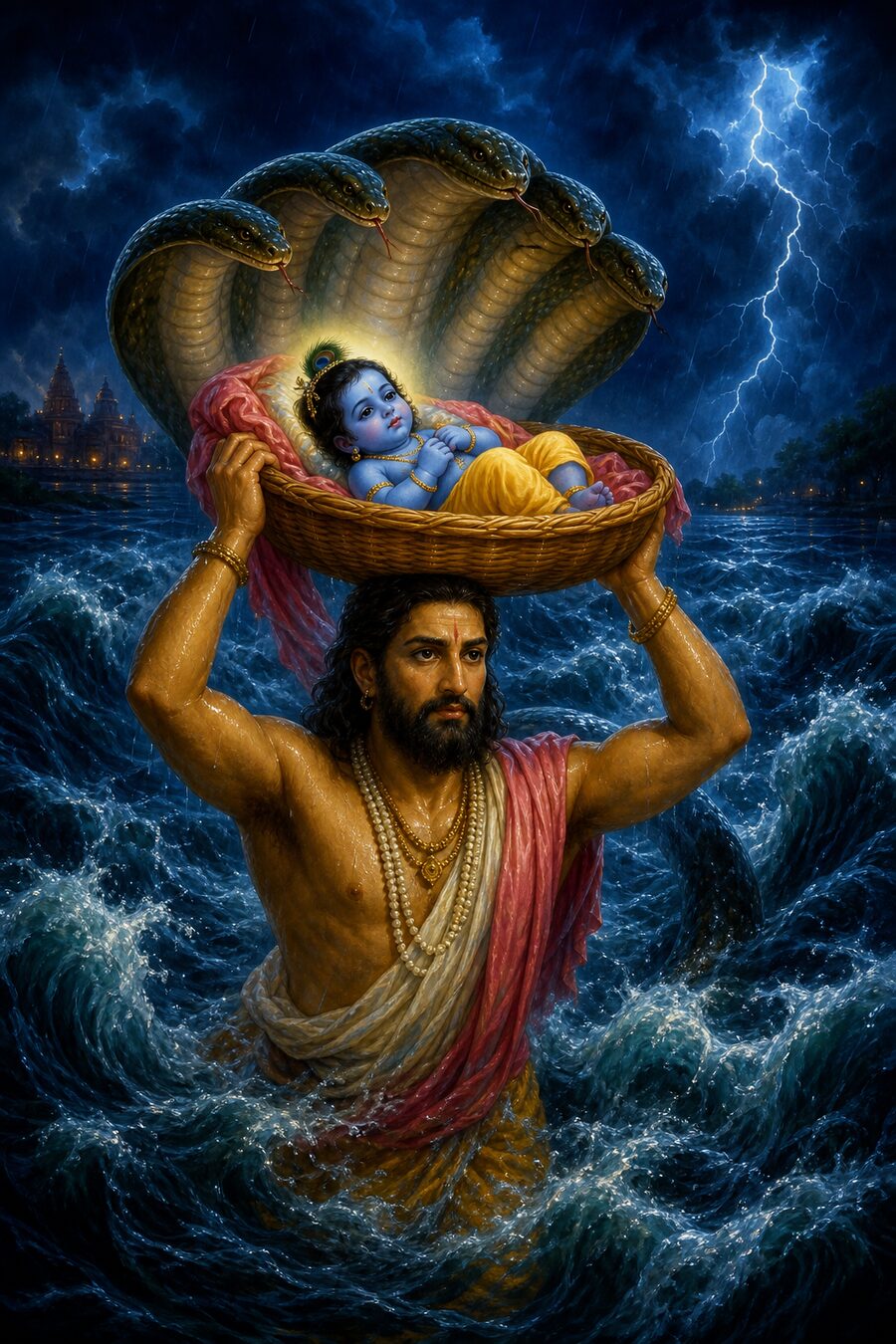
Vasudeva did as he was asked. That father, who loved his sons, gathered the boy against his chest and went quickly through the dark to the house where Yashoda lay. He placed his son in her house without her knowledge, in the place where her daughter had been.
Then he lifted the girl, an infant for an infant, and carried her back the way he had come, and laid her on Devaki’s bedstead. The exchange was done. Anakadundubhi Vasudeva had accomplished his work, and his mind was full of fear.
The Goddess Rises
He went out of his house himself and told Ugrasena’s son that a beautiful daughter had been born. Kamsa did not wait. The powerful king came fast to Vasudeva’s door, asked what had been born, ordered the newborn handed over, and rebuked him harshly. The women of Devaki’s household cried aloud at that, and Devaki herself, shedding tears, spoke to him humbly. “You have already killed my seven beautiful sons. This newborn daughter I count as slain already. Do what you think proper.” Kamsa looked at the girl and drew her out, and the wicked thought in him spoke. “A daughter born is a daughter already killed.” The child, equal to the earth herself, weary from her months in the womb, her hair still wet with its water, was set on the ground before him. He took her up with contempt by the legs, whirled her, and dashed her against a stone.
The stone did not break her. Thrown on a rock in derision, that girl, whom the gods worship every day, was not crushed. She cast off her human form and rose into the sky, hung with celestial garlands and a shining crown, her hair loose, rebuking Kamsa as she went. She was clad in dark blue and had four arms; her color flashed like lightning, her eyes were like the rising sun, and she stood in the air like an evening heavy with cloud. Moon-faced and dreadful, roaring like a thundercloud, ringed by ghosts and goblins, she danced and laughed in that black night, drank the finest wine, and looked down in anger at the king who had just flung her at a rock.
“Kamsa, for your own destruction you have whirled me and dashed me against a rock. So at the hour of your death, when your enemy comes at you, I will tear your body open with my hands and drink your hot blood.” With those dreadful words the goddess went up by her own chosen way, her followers closing around her, and in that form she ranged the country of the gods. There she grew up, the girl the Vrishnis worship; at the command of their kings the gods brought her up like a child of their own. Brahma had created her long before through his yoga, and she had been born with the Lord to protect Keshava, and the Yadavas worship her every day for what she did for Krishna in that celestial form.
When she was gone Kamsa understood that he had held the instrument of his own death in his hands. He had killed six children, the seventh had slipped from him without his knowing it, and the thing he feared was still loose in the world. What came over him was shame. He went to his sister in private and spoke with his head low. “Sister, I have made endless attempts to escape the hand of death, and for them I have destroyed many of your children, and now my death has come at me from another quarter. Ruthless as I was, I took care to kill my own kin, and still my manhood could not override destiny. It is Time that is the enemy of all and brings on their destruction; it is Time that moves everything, and people like me are only its instruments. Calamities, the sure outcome of one’s own deeds, arrive of themselves at the proper hour, and the pity is that men think, I am the doer. Do not mourn your sons; no one undoes the work of Time. Everything I have done to you is before my mind. I throw myself at your feet like a son. Do not be angry with me.” Poor Devaki, her face bathed in tears, looked toward her husband and said, “Rise, my brother. Rise.” And then she said this. “Like Death himself you have killed all my children before my eyes. You are not to blame for it; Death was the instrument. Since you touch my feet with your head and repent, I forgive you the sin of destroying my children. Death is certain in old age and certain in the womb, and no easier to escape in boyhood or in youth. All this is the work of Time, and you are only its instrument. Death carries everyone away first, and only afterward is the instrument pointed out. So go, my child. You are not the cause of my children’s deaths.” Kamsa heard her out, and anger rose in him again, and his heart burned as he walked back into his own house, his purpose baffled, depressed and absent-minded.
The night was not yet over, and Vasudeva did not waste it. He had already heard that in the village of Vraja Rohini had borne a son more beautiful than the moon, and he went to Nanda the cowherd and spoke to him in sweet words. “Go quickly to Vraja with Yashoda. Perform the rites that follow a birth, and bring up those two boys happily in Vraja. Guard with care that son of mine whom Rohini has borne; then my name will stand in the list of the fathers as a man with a son. I have not been able to see the face of my only son, and wise as I am, that is stealing my wisdom from me. I fear this wicked Kamsa above everything; he feels no mercy when he kills a child, and the world holds other dangers for children besides. So take care of Rohini’s son as you do of your own. My son is the elder and your son the younger, and the meaning of their names is one, so bring them up with equal care; they are of one age, and under your fostering they will grace Vraja. Children go their own way and grow naughty and make mistakes, so train them with great care. Never make your cow-pens in Vrindavana, for there is every fear there of the wicked Keshi, of snakes and insects and vultures; and protect the two boys from the cows and calves in the pen. Nanda, the night is almost over. Go soon to Vraja. Even the birds in the south are telling you to go.” Nanda heard this secret, and it made him glad. He climbed into his conveyance with Yashoda, set the little prince on a litter carried on men’s shoulders, and took the road along the bank of the Yamuna, cool with its wind and wet with spray, until some way on he saw Vraja, the charming village of the cows, lying on the river bank near Mount Govardhana, loud with the sweet cries of animals, shaded by great trees hung with creepers, and full of milking cattle at their grazing.
Source: Harivamsha (the khila-parva of the Mahabharata), Vishnu Parva, chapters 46 to 50; chapter numbers of the critical edition (P. L. Vaidya, Bhandarkar Oriental Research Institute, Pune). Told as story from M. N. Dutt’s English translation (1897), which follows the vulgate text, keeping its sequence of events.
The same story, elsewhere
- The Harivamsha · The Earth’s Cry
The Harivamsha: the plea of the Earth and the gods, the prelude to the avatar - Kamsa’s Fear and the Birth of Krishna
Shrimad Bhagavata (Skandha 10): Kamsa’s fear and the birth of Krishna - Krishna
Character profile: the whole story of Krishna