On this page
The Arena Where Tyranny Was Dragged Down from Its High Seat
The bow had broken the day before, and Kamsa had not slept since. That night, alone in his own room, he sent for Chanura and Mushtika, the two wrestlers of his court whose strength had no equal, reminded them of every honor he had showered on them, and asked for a great work in return: fight the two forest-ranging cowherd boys who had grown up in Vraja, Krishna and Sankarshana, throw them to the earth and kill them. “Be perfectly careful in killing them. Do not disregard them as boys of fickle nature. If these two die in the arena, I shall have well-being now and hereafter.” The wrestlers, mad for a fight, answered him. “If those two helpless boys, the very sin of the Gopas, come before us, know them as already slain, already walking in the shape of ghosts.” Then he turned to his elephant keeper. Narada had spoken the truth, he said. He was a kshetraja son of Ugrasena, begotten on the king’s wife by another man; his parents hated him and his kinsmen more, and if they all forsook him he would hold the throne by his own power. “Having first slain these two sinful cowherd boys by the elephant, I shall afterward kill every Yadava of Krishna’s party. Ride your elephant with goads and swords and tomaras, and wait at the gate of the arena. Do not tarry.”
The next day the amphitheater filled with citizens eager for the great game. Painted eight-sided pillars held up the terraces, the pavilions of the guilds rose like mountains under banners that carried the emblems of each craft, the chambers of the palace women shone with gold and nets of gems, and from behind fine lattices on the rooftops the women looked down like swans in flight. In front of all of it stood Kamsa’s own pavilion, its columns sheathed in gold, blazing like Mount Meru. Kamsa gave one order, that the elephant Kuvalayapida was to wait at the gate, and then he came in, in two white garments and a white turban with a white chowrie waving at either shoulder, shining like the moon of white rays on the white summit of the white mountain, and when he took his throne the citizens sent up shouts of victory. The wrestlers came out onto the sand in loose garments and took their ground on three sides. Then, to the sound of trumpets and the slapping of arms, the two sons of Vasudeva arrived, with delighted minds, at the gate of the arena.
The Elephant at the Gate
The moment they came through it, the maddened elephant was on them, driven again and again by its keeper, its trunk curled back, set on destroying Rama and Krishna. Krishna smiled at it and spoke, with a word for the mind that had planned this. “Kamsa wants to kill me by this elephant. He must be in a great hurry to reach the house of Yama.”
The elephant came on roaring like a thundercloud, and Govinda leaped up and slapped his arms. Roaring like a lion, he planted himself in front of it and took the great wet trunk full on his chest. He slipped in between the tusks, and out again between the legs, and he stirred the beast the way the wind stirs the ocean. Then he came out from under it, caught hold of the tail, and drove it into the ground. The huge elephant stood bewildered, unable to kill the boy in front of it, and roared as if its whole body were being ground to pieces. It sank to its knees, tore at the earth with its tusks, and in its rage poured out must like a cloud pouring in the rains. Krishna had been playing with it as a child plays, and under the cover of that game he decided to finish it, because the elephant stood between him and Kamsa.
He set his foot on the elephant’s lower lip, took hold with both hands, and tore out both tusks, and with its own tusks he struck it. Under the blows of those thunderbolts of ivory the beast voided itself with a great sound, and blood poured from its temples. Then Baladeva took it by the tail and dragged it with force, as Garuda drags a serpent that lies half across the face of a mountain. Krishna, still striking with the tusks, felled the driver Ulvana with one stroke, and with a terrible plaintive roar the elephant, its tusks gone, came down together with its mahout like a fire struck down by a thunderbolt. Kamsa had posted a guard behind the elephant; the brothers caught up a beam of the gateway and destroyed them. Then the two Madhavas walked into the arena wearing their garlands of wild flowers, and every Vrishni, Andhaka and Bhoja in the galleries took them for the two Ashvins come down from heaven of their own accord, and lion roars, shouts of joy and the slapping of arms went round the whole assembly. Kamsa looked at the joy of his own citizens and was filled with sorrow.
The Wrestling Match
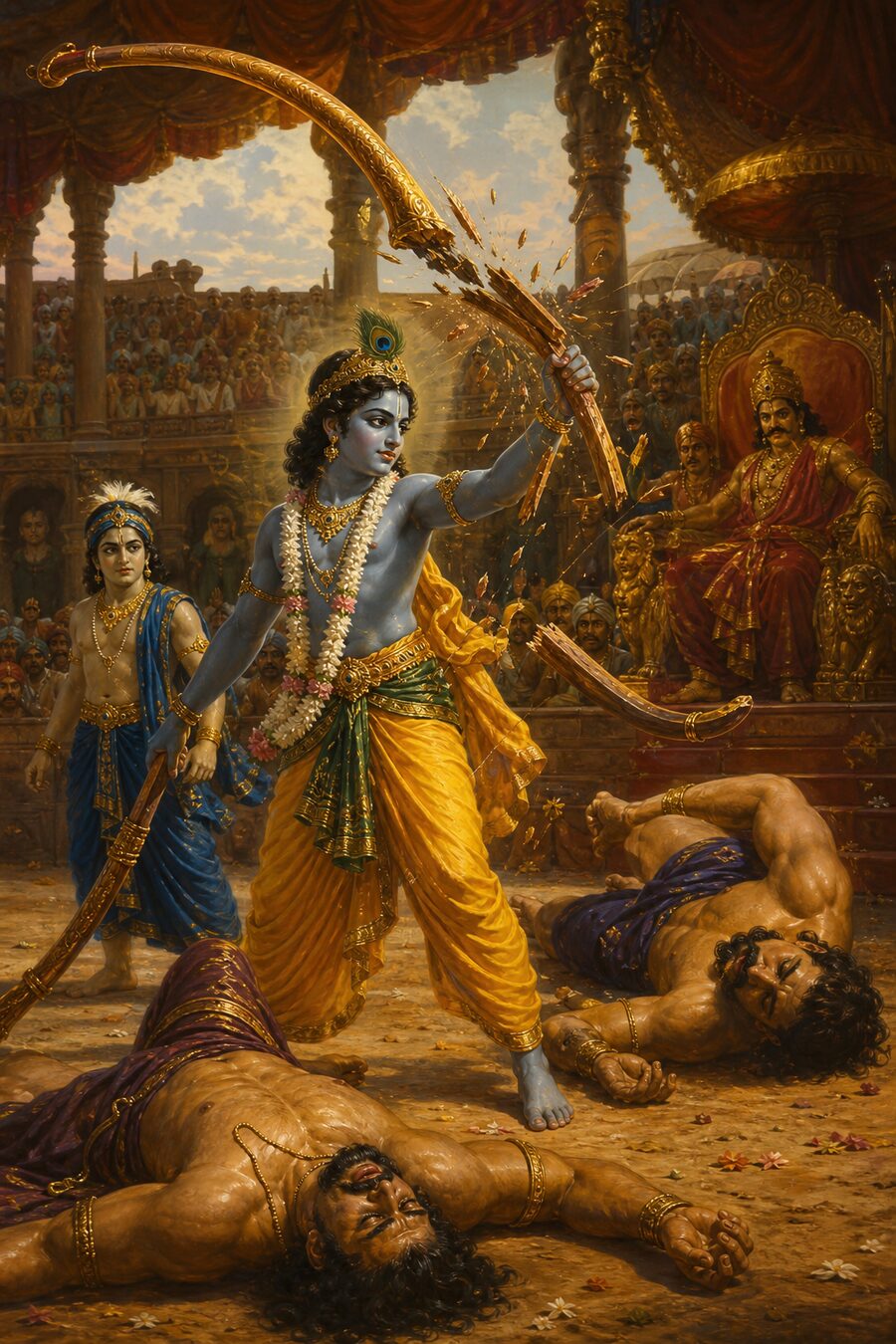
Krishna came onto the sand with his elder brother before him, shaking the earth with the slap of his arms. His clothes blew in the wind, his body was wounded where the tusks had caught it, must and blood covered his limbs, and he moved in bounds, like a lion, like a cloud coming in. The face of Ugrasena’s son went pale. Then, his eyes reddened, he ordered Chanura to fight Krishna, and sent three wrestlers the size of mountains against Balarama: Andhra, Nikriti and Mushtika. The royal command for silence went round, and when the whole crowd had hushed, the Yadavas rose together and spoke. The trial of arms, they said, was first laid down by the Creator as a contest in which no weapons are used, in which there are judges and no cowards take part; a man standing fights a man standing, a man down fights a man down; and whoever has mastered this art does not display his strength on an antagonist already beaten. “Now Krishna and the wrestler Andhra are to fight in this arena. Krishna is a mere boy, and Andhra is an elderly man. We should exercise our judgment in this matter.”
A great tumult rose, and Govinda leaped up and answered them. “I am a boy, and though Andhra has a body like a mountain, I wish to fight this strong-armed wrestler. Boy though I am, I will break no rule of the fight and put no stain on the judgment of the wrestlers. This wrestler Chanura of the huge body was born in the province of Karusha, and his deeds should be weighed. Hungry for influence in the arena, he has put a stigma on the ways of wrestlers by killing many of them after they were already beaten. Victory in battle wins eternal glory and the slain go to the gods. Where is heaven for the one who dies on this sand, and where is glory for the one who wins? A king who, proud of his learning, has wrestlers killed through his own men for a show of power takes on the sin of their death along with the men who do it.” He had hardly finished when the two of them closed, and it was a fight like two wild elephants in the forest, hold answering hold, fists and elbows and knees, blows as hard as stones. The galleries roared their delight. Kamsa, his face soaked with sweat, lifted his right hand and stopped the bugles, and in the sky the gods blew their own, and the Seven Rishis called down, “Krishna, vanquish the Danava who wears the wrestler Chanura’s shape.”
Krishna wrestled him a long time and drank his strength away, and the earth trembled, the pavilions rocked, and the great jewel slipped from Kamsa’s crown. Then he threw Chanura down as he rose again, drove a knee into his chest and brought his fist down on the man’s head, and the eyes, filled with tears and blood, were forced from their sockets and hung at his cheeks like golden bells. Rohini’s son took Mushtika, and Krishna took Toshala, whirled him a hundred times over his head and ground him into the earth; and Baladeva, after a long fight with Mushtika and Andhra, brought down a fist like a thunderbolt out of a cloud, and a great shout went up. The arena stood empty of wrestlers. Devaki watched Krishna with her breasts aching with milk and her eyes bathed in tears of joy, and Vasudeva grew young again as if he had thrown off his old age. The painted lines on Kamsa’s forehead ran away in his sweat, his lips shook with anger, and he sat there the color of the crimson sun.
An End Dragged from the Dais
This was the moment the whole show had been built to reach, and it had gone wrong in front of everyone. His elephant was dead, his champions were dead, his whole strength had been wiped out while he watched, and in his fury Kamsa issued his mandate to the dreadful men who served him. “Turn these two sinful, grim-faced, forest-ranging young cowherds out of the arena. I do not wish to see them. No Gopa deserves to live in my territory. This Nanda Gopa is wicked and bent on injuring me; bind him in iron chains and spikes. Vasudeva is my kinsman and he is highly wicked; punish him this very day, in the way that is kept for men who are not old. The rest of these low Gopas are all devoted to Krishna. Take their cattle and whatever else they own.”
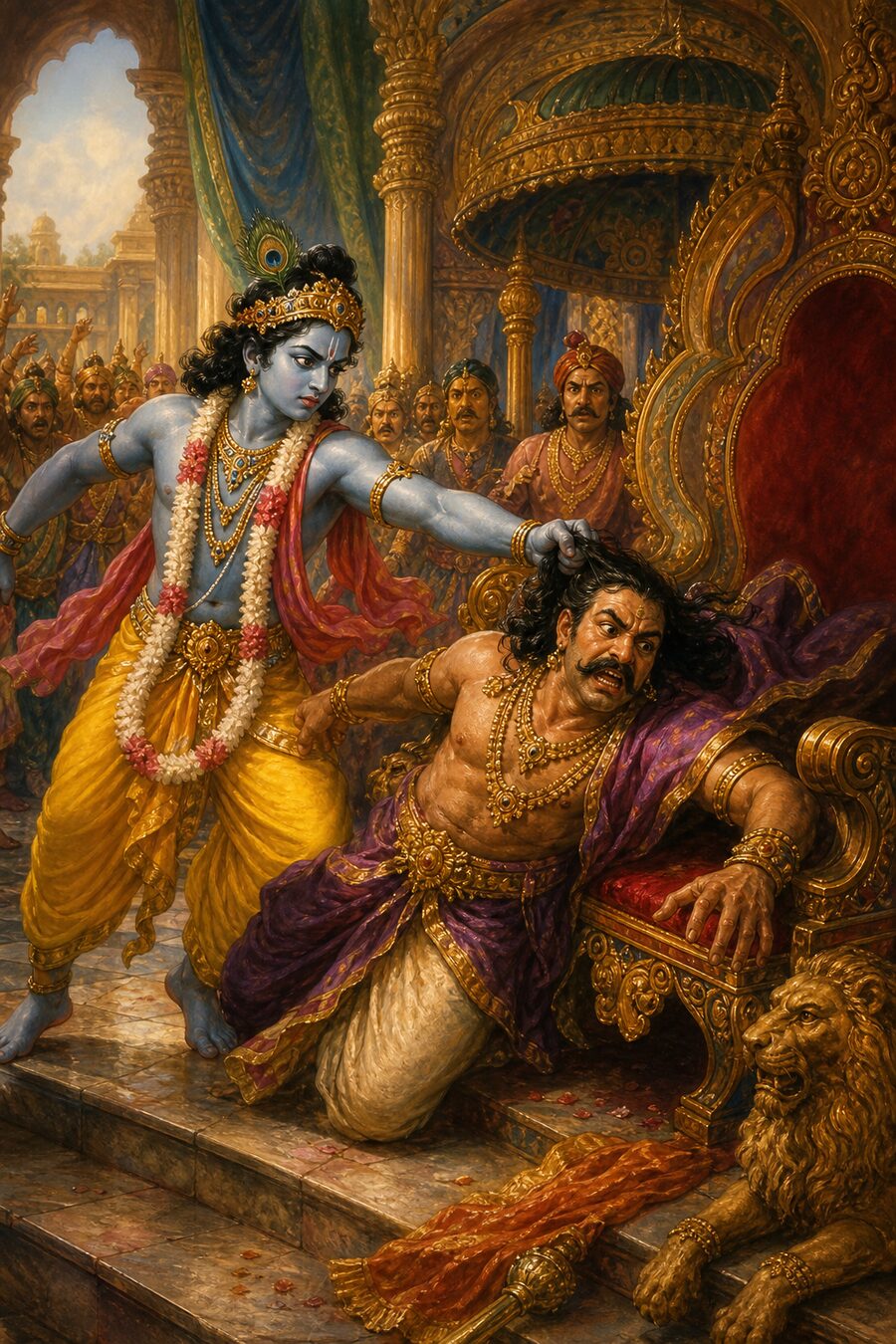
While the harsh words were still coming, Vasudeva’s son looked up at him with eyes wide with anger. He saw his father Vasudeva and Nanda insulted, his kinsmen in distress, and Devaki fallen unconscious in her seat, and the anger rose in him and set. Krishna went for Kamsa’s pavilion with the speed of a lion, leaping through the arena like a cloud driven before the wind. Kamsa, wholly in the hands of Destiny, saw only Govinda coming down on him out of the sky. Then the arms closed on him like iron bars and took him by the hair, and the golden crown set with diamonds fell from his head to the ground. Held by the hair, Kamsa went still, breathing like a man already dead, and he could not lift his eyes to Krishna’s face. The earrings were gone from his ears, the necklace torn away, his body stripped of its ornaments and its cloth. Krishna came down from the pavilion holding him by the hair and dragged him across the arena, and the body of the king of the Bhojas plowed a ditch in the sand behind him. Somewhere in that dragging Kamsa breathed his last, and Krishna threw the body a little way off and left it. Covered with dust, it lay with its dark face bare of the crown, like a lotus stripped of its petals.
He had died in no battle, and no arrow had touched him. Dragged to his death by the hair, Kamsa was driven off the path of heroes, and on his body, all at once, the marks of Keshava’s nails stood out where they had torn his flesh and taken his life. Then Krishna, lotus-eyed, shining with a doubled radiance now that the thorn was out, went first to Vasudeva and touched his father’s feet, and then bowed his head at his mother’s feet, and Devaki poured down on him a torrent of tears born of joy. He asked after the welfare of each of the Yadavas, by rank and by age. Baladeva caught Kamsa’s proud brother Urgita in his two hands and killed him. Then the two heroes raised in Vraja, their enemies conquered and their anger spent, went gladly to their father’s house.
Restraint After Victory
Kamsa’s wives came and circled the body like planets losing their light, and when they saw their lion of a husband lying on the earth they began to wail. You with the long arms, a hero who kept the vows of a hero, and now you are slain, and we, the wives of a hero, have no one left, and every hope we had is broken. Where is the jeweled crown that shone like the sun and made your head more beautiful still? Your ears, that loved their earrings, hang bare against your neck. You have gone to the other world; how will the thousand wives of your inner rooms get through their days? You who beat the army of Jarasandha, who fought Indra in a duel of arrows and were never defeated by the immortals, who stirred the ocean that nothing can stir with a shower of shafts and conquered Varuna of the noose and carried off his riches, who bored through the clouds with your arrows when Vasava would not rain and brought the rain down by force for your citizens, how have you died at the hands of an ordinary man? How can you lie on grass and dust? Does your body feel nothing, stretched on the bare earth? Who has laid this sleep on you? Let the woman who must go on living weep and repent.
We are to follow our husband. Why should we weep? Into this came Kamsa’s mother, trembling, crying out, where is my son, where is my child, and when she saw him like a moon with its light gone her heart all but broke in two, and she fainted, and came to, and fainted again, and then she wailed with her daughters-in-law. She took her son’s head into her lap. My son, you who made your kinsmen glad, you who kept the vows of a hero, why have you gone so soon? Why are you asleep in front of all these people? Kings should never lie on the earth like this. In the old days, with all the Rakshasas gathered before him, Ravana, strongest of the strong in all the worlds, spoke a verse the sages still praise: though I am of great strength and a destroyer of the immortals, a terrible calamity that nothing can turn aside will come to me from my own kinsmen, and such a calamity, ending his life, will come to my son from his relatives also. Then, weeping like a cow parted from her calf, she turned to her husband, the old king Ugrasena. Come and see, righteous king: your royal son lies on a hero’s bed like a mountain struck by a thunderbolt. He has gone to the house of Death, and it is you who must perform his rites.
Kingdoms are for heroes to enjoy, and we are beaten. Go and ask Krishna for the funeral rites. Enmity ends with death; it is over the moment the enemy dies. What offense has a dead body committed? She looked again at her son’s face. My son, I am your mother. Why do you not speak to me? First among kings, with your long arms and your great strength, get up and save the people of your house. And while the wives of Kamsa wailed, the sun, reddened by the rays of evening, went down. Ugrasena came to Krishna breathing like a man who has drunk poison, burning with grief for his son, and found him among the Yadavas, listening to the lament of the women and censuring himself for it before the whole assembly. “Out of my childish freak, and in anger, I have made widows of these thousand women by Kamsa’s death. These guileless women are weeping so that an ordinary man’s heart would soften to hear it; the heart of Kritanta himself, who rules the dead, would fill with pity. Even so, I had decided before this that Kamsa, who oppressed the pious and lived in vice, should be slain. For a man of degraded conduct and ruthless temper and feeble understanding, whom the people hate, death is better than life. Kamsa was deeply sinful, the pious never liked him and everyone hated him; what pity is owed to him? Count his death at my hands as righteous, since by it his misdeeds are rooted out. Now go and console the grieving women, the citizens and the merchants.”
At that Ugrasena lowered his head for his son’s crimes, came in among the other Yadavas and spoke his poor words, thick with the vapor of grief. Son, your anger has been pacified, your enemy has gone to the house of Yama, your glory has followed your duty and your name has gone out into the world. By this deed you have strengthened the Yadavas and made your friends proud, and the neighboring chiefs will seek your alliance. Take Kamsa’s deathless army, its elephants and horses and chariots and foot soldiers. Let your men take his wealth, his corn and jewels, his gold and cloth, his women and everything he had. From you now will come the happiness or the misery of the Yadavas. If you allow it, let the rites be performed for Kamsa, whose deeds were sinful and whom the fire of your anger has consumed. Then I will go with my wife and my daughters-in-law and live in the forest among the animals. To perform the rites of the dead is the duty of men. “Having built his pyre and lit it and offered him water, I shall have discharged my debt to Kamsa. This is my only prayer. Show me this kindness. With his rites performed, let my sinful son attain a blessed state.”
Krishna was astonished, and he consoled him. Sire, first among kings, what you have said befits your age and your family and your nature. What had to happen has happened; why do you speak this way? Kamsa, dead, will have the funeral honors of a king. You were born in a great house and you know everything a man should know; why do you not see that destiny cannot be turned? The old deeds of every creature, moving and unmoving, ripen in their time. Kings who are generous and rich and kind to the poor, with Indra’s own prowess, learned in the Shrutis and in the knowledge of Brahman, kings who stand like the guardians of the quarters, are carried off by Death; you know this. Even the gods cannot see the true nature of the maya that lives in every heart, and karma is the instrument by which creatures are bewildered. “Driven by his own past deeds, Kamsa has met his death in its time. I am not the cause of it. Karma and Kala are the instruments.” This whole universe, sun and moon and all that moves and all that stands, dissolves in time and rises again in time, and every creature is subject to time. “Your son was consumed by his own sin; Time is the cause, and I was the hand it used, no more.”
Let it go, he said, and do what I now say. And then, for the whole assembly to hear: “I do not care for the kingdom or the throne. I did not slay Kamsa for a territory. For the good of all the worlds I have killed your son, the curse of this family, together with his servants. Like a bird that flies where it pleases, I shall go back and range the forest among the cattle with the Gopas. I swear it a hundred times: I have no need of the kingdom. Tell everyone so. You are the leader and the lord of the Yadavas and you deserve my respect. Seat yourself on the throne, be king and conquer, and if it does not pain you, take forever this kingdom I give up.” Ugrasena bent his head in shame before the assembly of the Yadus and could find no answer, and Govinda, who knew the law, set the crown on his head and installed him on the throne of Mathura, the throne his own son had taken from him and kept him from for years. Then the new king, handsome and shining under the crown, and Krishna together began the funeral ceremonies of Kamsa, and at Krishna’s word all the leading Yadavas followed Ugrasena down the high road of the city as the gods follow Indra.
When the night had passed and the sun rose they laid the body in a palanquin, carried it to the northern bank of the Yamuna, and in due order set fire to the pyre, and with Krishna’s consent they performed the rites for Kamsa’s brother Sunama as well. The Vrishnis, the Andhakas and the Yadavas offered water for the two of them, saying again and again, may the departed attain an eternal course, and then, with Ugrasena before them, they went back into Mathura with sorrowful hearts. The shadow was gone from the city. One danger still stood outside its walls, and everyone in that family knew the name. Jarasandha, king of Magadha, the father of Kamsa’s two wives Asti and Prapti, would not let his daughters’ widowhood go unanswered.
Source: Harivamsha (the khila-parva of the Mahabharata), Vishnu Parva, chapters 73 to 78; chapter numbers of the critical edition (P. L. Vaidya, Bhandarkar Oriental Research Institute, Pune). Told as story from chapters 83 to 87 of M. N. Dutt’s English translation (1897), which follows the vulgate text, keeping its sequence of events.
The same story, elsewhere
- Akrura’s Darshan
Shrimad Bhagavatam (Skandha 10): Akrura’s darshan - The Harivamsha · Akrura and the Road to Mathura
The Harivamsha: Akrura and the road to Mathura - The Slaying of Kamsa
The slaying of Kamsa in the Shrimad Bhagavatam (Skandha 10)