On this page
A Chariot That Was Farewell and Destiny at Once
One night in the first watch, while Krishna was at his play, a dark danava named Arishta came into the cowsheds in the shape of a maddened bull, and he looked like Death himself. His body was the color of a dead ember and a storm cloud, his horns were sharpened, his eyes burned like the sun, his hooves were hard as blades, and his hump had turned to stone from the number of palaces he had broken with it. He kept licking his lips with his tongue and swinging his tail with pride. He went about terrifying the cows, he brought on miscarriages in the ones heavy with calf, and that night, as if the lord of the dead had sent him, he came before Keshava. Bellowing like a cloud that thunders with Indra’s bolt, he charged the cows nearest Krishna. Govinda struck his palms together, gave a lion’s roar, and ran after him, and the bull, lifting his head and aiming for the belly, wheeled and came at him. Krishna did not move from where he stood; he held his ground like a mountain. They met the way bull meets bull, like two clouds touching in the rains, and foam burst from the demon’s nostrils with a sound. Krishna set his foot between the horns, broke the creature’s pride, struck the neck that rose like the sky, and then tore out the left horn, a thing like the rod of Yama, and struck him across the face with it. With horns, head, and shoulders shattered, the danava went down vomiting blood like a cloud letting down rain, and in that moonlight the cowherds cried “Well done, well done,” and worshiped the lotus-eyed Upendra the way the gods in heaven worship their king.
And in Mathura, Kamsa’s fear had taken the shape of a plan. Every report of Krishna’s strength growing like fire in Vraja reached him in the end, and each was worse than the one before. Putana dead. Two trees torn out of the ground by a boy whose deeds were not a boy’s. Kaliya beaten and driven out of the Yamuna’s pool. Dhenuka fallen, Pralamba fallen, Govardhana lifted, Indra’s command refused, the cattle saved, and now Arishta too. Looking at these terrible signs of his own death and at the unimagined feats of an enemy on the rise, the king of Mathura came to think of himself as a man already in Death’s hands, and his senses and his mind went so numb that he looked like a corpse. Then, in the soundless dead of night, Ugrasena’s son, the king of the harsh commands, called his father and his kinsmen to his hall: godlike Vasudeva, Kanka, Satyaka, Daruka, Bhoja, Vaitarana, the mighty Vikadru, King Bhayeshakha, Viprithu, open-handed Kritavarma, the strong Bhurishrava, and many more of the Yadu line, and when he had welcomed each in his proper order, he spoke. “Listen, Yadavas. You are all men of action, devoted to the Vedas, learned in the rules of conduct, gods in this world, unmoving as the mountains. Your conduct is a sage’s, your strength a Marut’s, your anger a Rudra’s, your splendor the fire’s. As the mountains hold up the earth, so you hold up the sinking house of Yadu. You all follow my will. Why, then, are you ignoring this calamity rising against me?
“Like a cloud climbing the sky,” he said, “Nanda’s famous son Krishna is about to strike at the root of this house. He drank Putana down in his sleep. He beat Kaliya in a moment. Dhenuka died falling from the top of a palm. Pralamba, whom the gods themselves could not defeat in battle, was killed by his fist like a common animal. He stopped Indra’s festival and lifted Govardhana. He has broken Arishta’s horns. From the deeds of that boy who lives in a village of cowherds, it is plain that he is no boy at all; he is playing there in a child’s false disguise. When he stands before me for battle, I will know him for my death. I am certain that some god, hiding his true form inside a cowherd’s body, is at play there like a fire in the burning ground. I have heard that in the old days Vishnu took the form of a dwarf and took the earth from Bali, took the form of a lion and killed Hiranyakashipu, the grandfather of the danavas, took the form of a boar and raised the earth out of the great ocean, took the form of a tortoise and held up Mount Mandara, took the form of a beautiful woman when the nectar rose and set the gods and the demons at each other’s throats, and was born as Rama in Dasharatha’s house and killed Ravana. To do the gods’ work Vishnu puts on one form after another and gets his way by deceit. Surely that same Vishnu, the one Narada told me of, or Shakra the king of the gods, has now come for my death. And in all of this, our danger comes from Vasudeva. That is my settled conviction.
“When Narada met me again in the Khatvanga forest, that Brahmin told me, ‘Kamsa, all your care over Devaki’s child was undone by Vasudeva that night. The girl you dashed against the stone was Yashoda’s daughter, and know Krishna for Vasudeva’s son. Vasudeva, your enemy in a friend’s disguise, exchanged the children in the night to bring about your death. And that daughter of Yashoda, having killed on the Vindhya mountain the two sky-ranging danavas Shumbha and Nishumbha, has made her own dwelling there by her own power and lives there, worshiped by the gods, the mother of fear to her enemies.’ Narada said, ‘This Krishna who is called Nanda’s son is going to do great deeds, and this son of Vasudeva, this kinsman of yours, will kill you without effort.’” Kamsa had turned that warning over so many times that it had worn smooth.
Then he turned on old Vasudeva before the whole assembly and emptied years of poison over him. “As a crow greedy for flesh pecks out the eyes of the very man on whose head it sits,” he said, “so this Vasudeva, whom I fed in my own house, is working with his son and his kinsmen to cut the root of my family. A man who kills an unborn child, or a cow, or a woman, may somehow save himself, but for an ingrate there is no world anywhere. Vasudeva, you set out to sow division in this family, and I understand now that without knowing it I nourished you, who are death itself. What use is your old age? A hundred years old, every hair white, and you have not grown old at all; your judgment has not ripened; you are old only in years, like an autumn cloud. You thought that when Kamsa died your son would rule Mathura. That hope of yours is already broken. I have never killed an old man, a Brahmin, a woman, or anyone of my own blood, and I never will. You were born here, my father raised you, you are my sister’s husband and the first teacher of the Yadus. But by this conduct of a leading Yadava like you, the whole Yadu race has become the talk of the people, and you have made such an enmity between me and Krishna that there will be no peace in this family until one of us is dead.” And then, in the same breath, he laid out his plan. “Be that as it may, giver of gifts, go to Vraja at my command and bring those two boys, and Nanda, and the other cowherds who pay me tribute. Tell Nanda to come quickly to Mathura with his yearly tribute and the other herdsmen. Kamsa, with his servants and his priests, wishes to see Vasudeva’s two sons, Krishna and Sankarshana. He has heard that both are hard of limb, strong, clever in a fight, and skilled at a bout in the arena, and my two wrestlers are eager to meet them.
“And besides, those two who roam the woods of Vraja are my own sister’s sons; I ought to see them. Tell the people of Vraja that the king, of his own wish, is holding a bow-sacrifice, so let them come with milk, curd, and butter, feed the invited guests to their hearts’ content, and take their ease in the forest beside the city. Akrura, I am full of curiosity to see Krishna and Sankarshana. Go quickly and bring them. If they come, I will be perfectly happy; if they do not, I will bring them to heel in due time. With boys, sweet words come first; bring them quickly with sweet words, and if Vasudeva has not turned you away from me, do this great work of mine.” Under all that abuse Vasudeva, a Vasu among men, took hold of gravity and patience and stood unmoving as the ocean; taking refuge in forgiveness, he gave no answer to the arrow-words of the foolish Kamsa. And all who saw him insulted that way bowed their heads and said, “Shame, shame.” Akrura, the giver of gifts, saw the whole of it with his inner sight, and filled with the joy of a thirsty man who has been shown water, he left Mathura that very moment to see the lotus-eyed Krishna.
Seeing Vasudeva insulted, the leading Yadavas covered their ears with their hands and counted Kamsa a man whose lease of life had run out. And Andhaka, the first of speakers, keeping his patience though his mind was in turmoil, said to Kamsa in the midst of that assembly, in words gentle and hard at once, “Son, such words do not become you. Good men hold speech like that to kinsmen to be blameworthy. You may wear matted hair, or shave your head, or call yourself Bhoja, or Yadava, or Kamsa; your head will stay in its natural shape. A curse on that Ugrasena who fathered a son like you, the blight of this family. The old should be honored like fire, because their anger burns up even the worlds earned by yoga. If a son turns out wicked, the father is not wicked for it. And if Vasudeva did wrong for his son’s sake, why did Ugrasena not kill you in your cradle? By cursing Vasudeva and rousing Vasudeva’s son to anger you have set every Yadava heart trembling, and look, these omens are announcing your fear. Evil dreams at the end of the night. In the sky, Rahu holding your birth-star Svati and waiting in your tenth house; Mars moving crooked beside him; Mercury covering the western sky at dusk; Venus wandering off his course. Jackals coming out of the burning grounds toward the city morning and evening. Firebrands falling from the sky with a terrible sound. The earth and the mountain-tops shaking. Clouds pouring down blood with their lightning. Every sign the astrologers name for the death of a king has come. You are the enemy of our house; from today we withdraw our love from you. For you this Yadu race is uprooted; Krishna will join it together again. My counsel is that you take Vasudeva with you now, go to Krishna, and win his grace.” At Andhaka’s words Kamsa’s eyes went red with rage, and without a single word he went into his own house. The Yadavas, learned in the shrutis, went home talking of Kamsa’s evil ways. And before Akrura had even set out, Kamsa sent a messenger to Keshi to have Krishna killed.
At the messenger’s word that unconquerable Keshi, the everlasting tormentor of the people, went straight to Vrindavan and began to torment the cowherds. In the shape of a horse, that terrible danava ate human flesh, killed the cows and the cowherds, dug up the ground with his hooves, broke trees with his speed, leaped into the sky, and played with the wind, neighing. Whatever forest he lived in filled with the corpses of men until it looked like a burning ground, and the cowherds and the cattle abandoned it. One day, as if driven by destiny, he followed the noise of men and came crashing into the cowherds’ settlement. The women ran with their children and the men ran shouting to their master Krishna, and Krishna gave them his promise of safety and went out to face Keshi. The cowherds said, “Child, do not go near this horse so suddenly. You are a boy, and this one was born with Kamsa and is his very life, though it ranges outside him. No creature can kill it.”
Hearing that, Madhusudana wanted the fight all the more. Drops of sweat born of rage were dripping from the horse’s mouth and from his mane, neighing came out of him with foam, and the yellow dust his hooves threw up turned Krishna’s hair tawny. Leaping, tearing the earth, grinding his teeth, he came at Krishna, struck him on the chest with his forefeet, and sank his sharp teeth into the upper part of Vasudeva’s son’s arm. Then Krishna spread his arms and seized the horse’s mouth. Keshi could neither eat that arm nor break it; his teeth tore loose and broke, he began to vomit blood mixed with foam, his lips split, his jaws were crushed, and his eyes came out. When he was worn down with exhaustion, Krishna stretched his arms wider and tore him into two pieces, and each piece kept two legs, half a back and tail, one eye, and one nostril. The lotus-eyed Krishna stood there smiling, and the cowherds, freed from their fear, gathered around him and praised him again and again.
Then Narada, standing unseen in the sky, said, “Vishnu, god, Krishna, I am pleased. When this Keshi swelled his body, even the great Indra, the slayer of Bala, was afraid. Brahma ordained this very death for him. Listen: because you have killed Keshi, you will be known in the world as Keshava. Many works still wait for you, and the great ocean of the Bharata war is drawing near, in which the Pandavas will take refuge with you. When Ugrasena’s son has been killed, I will come again.” With that Narada went away by the road of the sky, and the cowherds went back to Vraja with Krishna.
What Moved in Akrura’s Heart
Of all the men Kamsa could have sent, he sent the one whose heart was already turned the other way. Longing to see Krishna, Akrura set out on a fine chariot swift as thought, and in the same hours auspicious marks began to show on Krishna’s limbs, the signs of a meeting with a kinsman as dear as a father. All along the road Akrura kept thinking that the two he was going to fetch were no common herdsmen; they were the ones whose stories had kept his eyes wet for years, and today he would see them with his own eyes and seat them in his own chariot. He reached Vraja as the sun was going down with weakened rays, when the moon’s disc was turning tawny in the red evening sky, when the birds were going to their nests, when the sacrificers were kindling their fires and the hermits were making their offerings, when the cows had come home and were lowing as the calves were tied for the milking, when the cowherds with their long ropes were calling the cattle by name in a great noise, when the men come back from the forest with their shoulders bent under loads of wood were setting fire to dried dung, and when, as the day ended and the night began, the moon had risen. Together with the birds going home to their nests, carrying the glad news of a meeting of friends, Akrura came into Vraja on his chariot, and the moment he was inside he began asking again and again after Keshava, after Rohini’s son, and after Nanda. He stepped down from the chariot, that giver of gifts who was like a Vasu, and went into Nanda’s house, and there at the gate, his face full of joy and his eyes full of tears, he saw Krishna standing at the milking place among the calves like a young bull, at that exact border where boyhood ends and youth begins.
Akrura, that righteous man, said in a heavy voice, “Come to me, Keshava.” And looking at the boy, he looked straight past the boy. This was the one who lies on a banyan leaf when the worlds are dissolved, who took the form of a dwarf to outwit Bali, whom the prosperity of the three worlds waits upon. He praised him in his heart. “This is the lotus-eyed Krishna, vast as a mountain, like an ocean swollen with water, with the power of the lion and the tiger; unconquerable in battle, the mark of Shrivatsa on his chest, Vishnu come down in a cowherd’s disguise, whose very form is the Upanishad. This head like an umbrella is made for a crown, these ears for the finest earrings, this broad chest for a necklace; this body in its yellow cloth could wound the god of love himself; this is the eternal Vishnu. The one whose two feet are the refuge of the earth, and who once measured the three worlds with them, has come down to the earth himself.
“The Brahmins who know the future have said that this cowherd will raise the almost vanished house of Yadu again. As the rivers in flood fill the great ocean, so by his strength Yadavas by the hundred thousand will fill their families; without being a king he will rule over all the crowned heads; and as he once beat Bali with three strides and set Purandara on the throne of the gods, so now he will make Ugrasena emperor. The great seers know him for more than man, and that he has appeared among men and become our kinsman is itself more than human. Today I will worship this form of Vishnu with mantras in my heart, and in the night I will take counsel with Krishna, and if he wishes it, I will take him and the cowherds to Mathura.” Turning thoughts full of reason and meaning over in his mind this way, he went into Nanda’s courtyard.
That night he said the thing he had truly come to say. Sitting in Nanda’s house with Keshava, and gathering all the elder cowherds, that giver of gifts said gladly to Krishna and to Rohini’s son, “Sons, tomorrow at dawn we will all go to Mathura. At Kamsa’s command the cowherds of Vraja are to go there with their families and their yearly tribute. He is holding a splendid bow-sacrifice, and you will all see it and meet your kinsmen.” Then he said something else to Krishna, low and close. “Your father Vasudeva is drowned in grief for the sons he has lost. Krishna, he has grown old, every limb of him has dried up with age, and the sinful Kamsa torments him without end; between fear of Kamsa and your absence his mind burns in worry all the time. Govinda, you will also see Devaki, a goddess sunk in sorrow. Her breast has never been touched by her sons; she is wasting away with grief for them, and she pines for the sight of you like a cow parted from her calf. Her eyes have sunk into her face like the moon in Rahu’s grip, and she passes her days in a soiled cloth, wretched. Parted from you since your infancy, she could never hear your baby talk, never see the beauty of your face that is like the moon. If Devaki was to grieve this way after giving birth to you, what need had she of a son at all? Old as they are, your parents are serving another man today, and the sinful Kamsa insults them because of you.
“Madhava, as you beat the wicked Kaliya in the Yamuna’s pool, as you lifted Govardhana for the cows, as you killed Arishta swollen with pride and destroyed the vicious Keshi, so now make an effort to save your old parents who are drowning in grief; only then will merit be yours. Those who saw your father insulted in Kamsa’s court go on weeping, full of sorrow. The scriptures say that a son born of his parents should pay all his debts. Sinless Krishna, if you show your parents this favor, they will put down their grief and you will have done your duty.” The mighty Krishna knew all of it already, so he took no offense at the words of that giver of gifts, and said, “So be it.”
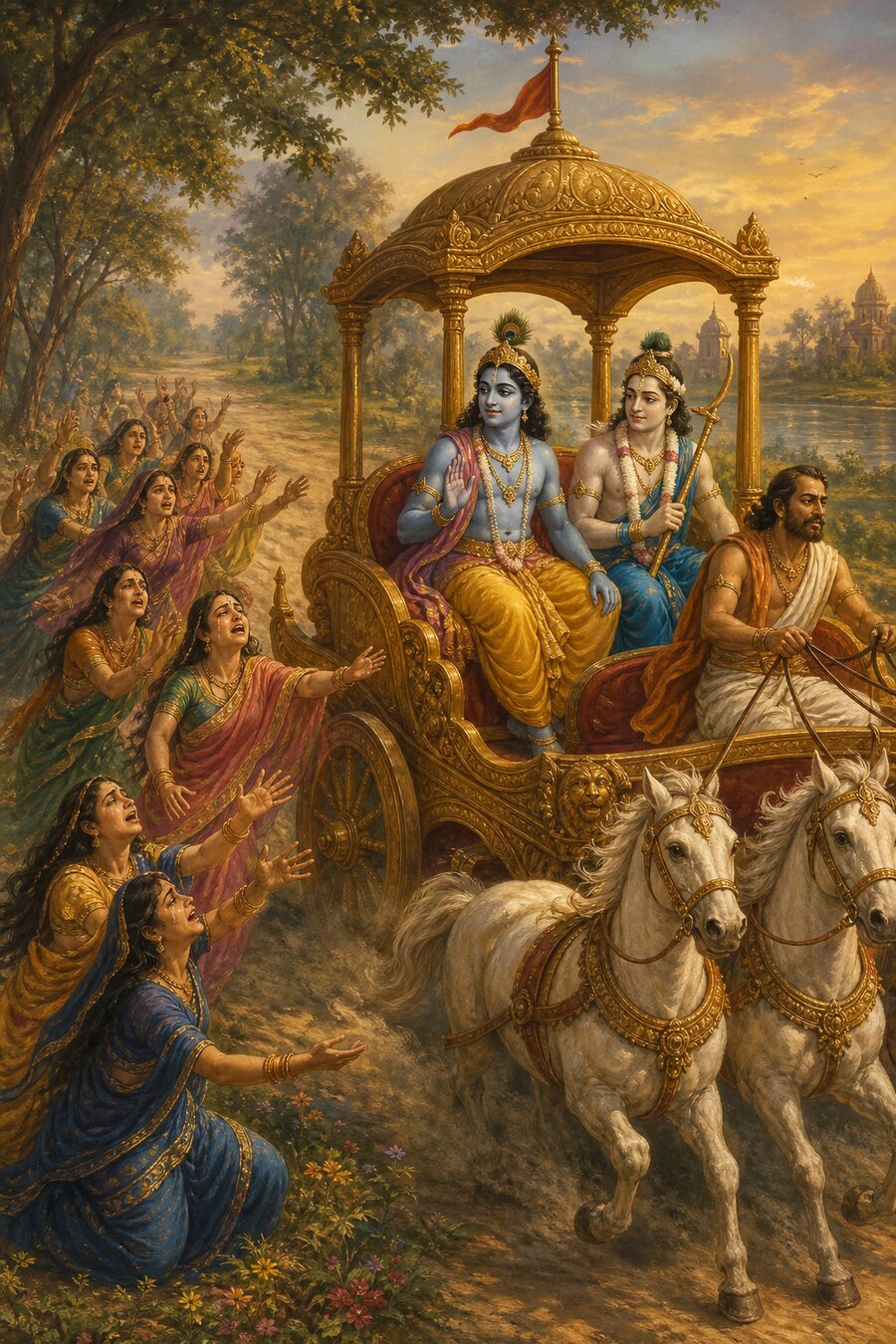
At Akrura’s word Nanda and all the cowherds agreed to obey Kamsa’s command. The elders of Vraja put on their clothes and arranged their presents, and the heads of the cowherd clans gathered the tribute according to their herds and their standing, buffaloes and bulls, curd, milk, and butter. Akrura spent the night without sleep, talking with Krishna and Rohini’s son. Then the dawn came, loud with birdsong; the moon’s rays drew in, the earth was wet with dew driven by the morning breeze, the fading stars fell asleep on their beds of sky, and seeing the sun’s body swelling, the cool-rayed moon drew in his own form as if in shame. The outskirts of Vraja filled with cows, the churning vessels began to sound, the calves were tied with ropes, and the roads of Vraja filled with cowherds. Setting their vessels full of every kind of provision on the carts and climbing up after them, the cowherds set out in a hurry. And Krishna, Rohini’s son, and Akrura the giver of gifts rode in the chariot like three Patriarchs.
What Akrura Saw Under the Yamuna
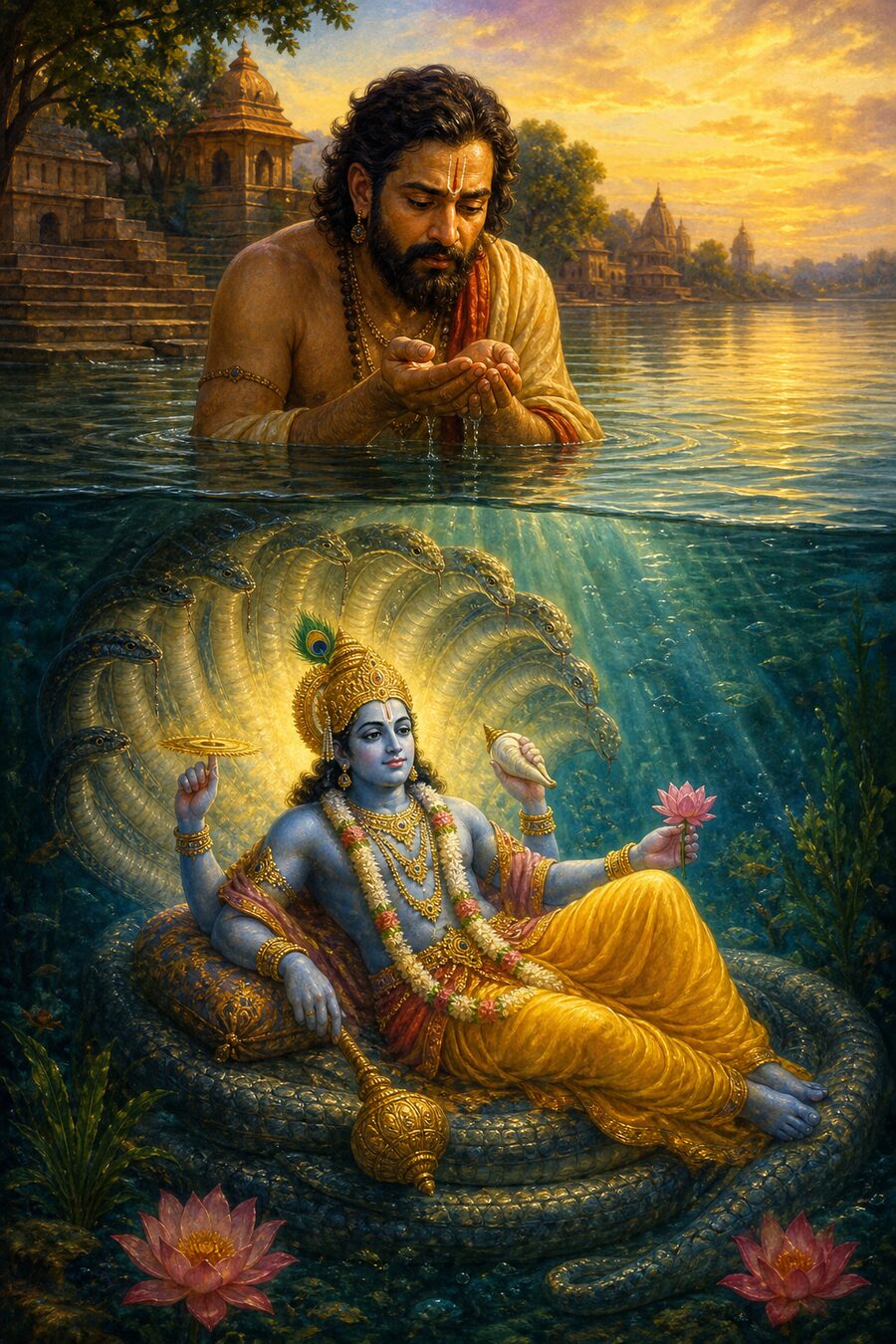
When they reached the bank of the Yamuna, Akrura said to Krishna, “Stop the chariot here and look after the horses. Feed them barley carefully from the vessel on the chariot, and wait a moment for me. Ananta, the king of serpents, is the protector of all the worlds, so I will go into the Yamuna and worship him with the celestial mantras. When I bow to that lord in his blue robe, with his auspicious crown and his thousand heads, a poison like nectar will come from his mouth, and I will drink it as the gods drink their nectar. Until I come back from the pool of the serpent king, you two wait here for me.”
Krishna was pleased and said, “Go, but do not be long, because without you we will not be able to stay here.” Sinking into the pool of the Yamuna, that giver of gifts saw, in the underworld, the realm of the nagas, a world exactly like this one. He saw the thousand-headed god Ananta, a plow in his hand and a mace beside his belly, dressed in dark blue, an earring like a lotus bud at his ear, his lotus eyelids closed, seated at ease on a beautiful white seat made of his own body. On his chest lay a garland of golden lotuses, on his head a golden crown tilted a little to the left; his body, like a white cloud, was smeared with crimson sandal, and his radiance filled the four quarters. Vasuki and the other leading nagas were worshiping their one king, Shesha; two nagas named Kambala and Ashvatara were fanning that serpent king with chowries where he sat on his throne of dharma; Vasuki, lord of the pannagas, shone near him surrounded by ministers headed by Karkotaka; and other nagas were sprinkling him with water from celestial golden jars covered with lotuses. And in the lap of that king of serpents Akrura saw Vishnu, dark blue, dressed in yellow, bearing the mark of Shrivatsa, seated at ease, and close by a second divine form with the beauty of the moon, like Sankarshana, seated without any seat at all. The giver of gifts was about to say something to Krishna, but Krishna’s power took his voice away. Full of wonder at this eternal and divine glory among the nagas, Akrura came up out of the water onto the bank, and there he saw Rama and Krishna, in their wonderful forms, seated in the chariot and looking at each other. Out of curiosity Akrura plunged into the pool again, and again he saw Ananta in his blue robe being worshiped as before, and the mighty Krishna seated in the lap of that thousand-headed serpent king, worshiped as before. Then, coming out suddenly, repeating that mantra in his mind, he went back to the chariot by the way he had come.
Krishna, delighted, asked him, “What did you see of the naga realm in this Bhagavata pool? I think you saw something wonderful, because you stayed in the water a long time and your mind is shaken too.” Akrura said, “Krishna, what wonder is there in this whole world, moving or unmoving, that could happen without you? The wonder I saw down there, so rare on earth, I am seeing right here, and I am glad. I am in the company of the wonder of the world itself, and I do not wish to see a greater wonder than this. Lord, let us go to King Kamsa’s city before the sun sets.”
Signs in the City Streets
Yoking the horses and mounting the chariot, Akrura the giver of gifts, with Krishna and Sankarshana, reached the beautiful city of Mathura, guarded by Kamsa, before evening, while the sun was still red. He took the heroic Krishna and the fair-skinned Sankarshana first to his own house and said to them, “For now, put aside the wish to go to Vasudeva’s house. Because of you, Kamsa abuses your old father day and night, so do not linger here; do for him the good and welcome thing that will bring him happiness.” Krishna said, “If you wish, we will walk Mathura and look at its streets, and go into Kamsa’s house without anyone seeing us.” Bowing to Krishna in his heart, Akrura went gladly to Kamsa, and the two heroes went out to see the streets of the city like two elephants slipped from the stake and eager to fight, and whatever met them on the way became a sign of the story that was coming.
On the road they met a washerman and asked him for fine clothes. He answered, “Who are you? Out of ignorance you ask fearlessly for the king’s robes; you look like forest wanderers to me. Every cloth that King Kamsa receives from country after country, I dye as he wishes. I think you were born in the forest and grew up among the deer, or why would you beg like this for dyed cloth? You are fools, short of wit, or why would you want a king’s clothes; perhaps you have come here having given up all hope of your lives.” Destiny was against that slow-witted washerman, which is why he let loose such poisoned words. Krishna’s anger rose against him, and he struck him on the head with a fist like the thunderbolt. The head split and the man fell lifeless to the ground. His wives, wailing for their dead husband, ran furious with their hair undone toward Kamsa’s house, and the two brothers dressed themselves in the fine clothes and walked on.
Like two elephants drawn by a scent, the sweet-spoken brothers went to a garland shop. A wealthy garland-maker named Gunaka lived there, soft-spoken and good-looking, with a great stock of garlands. Wanting garlands, Krishna said to him in sweet words and without any hesitation, “Give me some garlands.” The garland-maker was pleased; he heaped garlands on the two beautiful brothers and said, “They are all yours.” Delighted, Krishna gave Gunaka a boon: “Gentle one, Lakshmi, who is under my sway, will stay with you always, with wealth without end.” Bowing his head and touching Krishna’s feet, the garland-maker accepted the boon with patience, and then, thinking that these must be yakshas, he was filled with such fear that he could say nothing more.
Then, in the street, the two sons of Vasudeva saw Kubja with unguents in her hands, walking aslant the way lightning leans. Seeing her, Krishna said, “Kubja, lotus-eyed, tell me quickly, whom are you carrying these ointments for?” Kubja, her eyes bright and smiling, said to the lotus-eyed Krishna in words deep as the clouds, “May all be well with you. I was on my way to the king’s bath. But I have stopped here, because you have found your way into my heart; come and take this ointment. Lotus-eyed and lovely-faced, the sight of you has filled me with wonder. Gentle one, where have you come from, that you do not know me? I am the king’s favorite, and my work is to anoint his body.” To Kubja, who stood there smiling, Krishna said, “Give us an ointment fit for our bodies. Lovely-faced one, we are wrestlers who travel from country to country, and we have come to see this happy and prosperous kingdom and this bow-sacrifice.” She said, “The moment I saw you, you became dear to me; take this ointment fit for a king without any hesitation.” Smearing their beautiful bodies with it, the two brothers shone like two bulls plastered with the mud of the Yamuna. Then Krishna, who knows the art of arranging a game, touched Kubja’s waist lightly with his fingers, and the bend went out of her back. Grown straight as a creeper, lovely, sweetly smiling, Kubja said to Krishna with love, making her gestures and laughing out loud, “Where will you go? Stay here at my asking. Take me with you.” The eternal Krishna and Rama knew Kubja’s qualities, so they looked at each other and laughed, striking their palms together, and with a slight smile Krishna sent Kubja away, full of her desire. Freed that way from Kubja’s hold, they set off for the royal court.
The Bow Breaks, and the City Wakes
Dressed as cowherds and raised in Vraja, the two brothers entered the palace without letting the design in their hearts show on their faces, and like two proud lions born in the forests of the Himalaya they reached the house of bows unnoticed by anyone. Wanting to see that famous weapon, they said to the keeper of the armory, “Keeper of Kamsa’s bows, hear us. Gentle one, where is the bow for which this sacrifice is being held? If you are willing, show us that famous bow.” He showed them the bow that stood like a pillar, the one that not even the gods with Vasava at their head could string, the one that could not be broken. The mighty Krishna lifted it in his hand. Taking up that bow the daityas worshiped, with a glad heart, the lotus-eyed Krishna began to stretch it and bend it again and again. Bent by Krishna’s strength, that famous bow broke in two like a serpent, and having broken that best of bows, the swift young son of Vasudeva walked out of the room with Sankarshana.
The crack of the breaking bow, like the sound of a gale, filled every quarter, and the whole of the inner palace shook with it. The frightened keeper ran out of the armory straight to the king and spoke, panting like a crow. “Hear what has happened in the house of bows, a wonder like the dissolution of the world. Two heroes who can take any form they please, like the sons of gods, dressed in blue and yellow and anointed with unguents, came suddenly inside without any man seeing them. The light of their bodies is like new fire; their hair falls in spreading locks; they wear fine clothes and garlands. Those two gentle heroes came and stood in the bow-room as if they had stepped down out of the sky; I saw it plainly with my own eyes. One of them, lotus-eyed, dark-skinned, in yellow cloth and garlands, lifted that best of bows that even the gods cannot lift. King, boy though he is, he strung that huge iron bow easily, quickly, and by force, and bent it, and when that strong-armed hero drew it without an arrow, with a great sound, it broke in two at the middle. At the sound of that breaking the sun’s light went dim, the earth shook, and the sky seemed to move from its place. Seeing this great, more than human deed I am filled with wonder, and I have come in fear to bring you the news. Of those two unconquerable heroes one is like Mount Kailasa and the other like a mountain of collyrium. I do not know who they are. As an elephant breaks a pillar, that hero broke that priceless bow in two and went away with his companion like the wind. King, I do not know who he is.” Kamsa knew all of it already, so when he heard of the breaking of the bow he said nothing. He dismissed the keeper and went into his finest room.
Brooding on the breaking of the bow, Kamsa of the Bhoja line sank into grief and distraction. He began to think, “How could a boy fearlessly break an iron bow that men were guarding, and walk out? Manliness cannot stand against destiny, because what Narada foretold is now coming to pass, and the terrible, shameful deed I did out of fear of it, killing the six heroic sons of Devaki, has all gone for nothing.” Thinking this way he came out of his room and went to the arena to inspect the platforms. That hall of games, built by skilled craftsmen, was full of solid platforms, turrets with handsome rooms, a wide courtyard, pillars all of one measure, ornament of ivory, and high royal seats. Looking over that vast, strong arena, the shrewd king gave his orders. “Tomorrow the bow-sacrifice will be held. Let the platforms, the turrets, and the passages be decked with garlands, flags, and canopies, and scented. Let bells and things to eat be set in the enclosures, let fine golden water-jars be placed in their rows, and let the skilled judges of fighting and the citizens be invited. Carry my command to the wrestlers and the spectators, and let the decorated, enclosed platforms be set apart.” With those orders given, Kamsa went back to his room and sent for two wrestlers of matchless strength, Chanura and Mushtika.
He said to them, “You are my two famous heroic wrestlers, and I have always honored you. If you remember the honors I have given you, then do this great work for me with all your strength. Fighting in the arena with those two forest-roaming cowherd boys raised in Vraja, Krishna and Sankarshana, you will throw them to the ground and kill them. Take every care in killing them; do not make light of them as boys of fickle nature. If those two die in the arena, it will be well with me in this world and the next.” Mad for a fight, the wrestlers answered gladly, “If those two helpless boys, the very sin of the cowherds, come before us, count them dead already and turned to ghosts; if they stand against our anger, we will destroy them before your eyes.” With those poisoned words Chanura and Mushtika went home, and Kamsa passed a night without sleep, knowing that the day to come would be the largest of his life, or the last.
Source: Harivamsha (the khila-parva of the Mahabharata), Vishnu Parva, chapters 66 to 72; chapter numbers of the critical edition (P. L. Vaidya, Bhandarkar Oriental Research Institute, Pune). Told as story from chapters 76 to 83 of M. N. Dutt’s English translation (1897), which follows the vulgate text, keeping its sequence of events.
The same story, elsewhere
- Akrura’s Darshan
Shrimad Bhagavatam (Skandha 10): Akrura’s darshan - The Slaying of Kamsa
The slaying of Kamsa in the Shrimad Bhagavatam (Skandha 10) - The Harivamsha · The Slaying of Kamsa
The slaying of Kamsa in the Harivamsha