On this page
A Great War Kindled by a Dream, Where Lord and Devotee Faced Each Other
This war began inside a dream. It started on the bank of a river where Shiva had come to play. The forest along that water was one of those rare places where every season flowers at once, so that the spring blossom and the autumn fruit hung on neighboring branches, and the air off the river carried the scent of parijata and santanaka, the two flowering trees of heaven, until the whole bank smelled the way the sky is said to smell. Gandharvas, the musicians of the gods, had come down with hundreds of apsaras, and on every side there was sport. The apsaras sang to the music of flute and vina, of mridanga and panava, and like court bards praising a king they sang the praises of the two who sat at the center of it all: Uma, and the giver of boons beside her, Hara in a red garment with garlands at his throat, the god of gods in a holiday mood.
Then the boldest of the apsaras, Chitralekha, did a daring thing. She put on the form of the goddess herself and sported before Shiva in it, and Shiva was delighted. The goddess laughed. Seeing that her laughter gave Ishana pleasure, the other apsaras laughed too, and the game spread. With the goddess’s leave, the great attendants of Shiva, who can wear any shape they please, began to play on every side in forms of their own choosing, and the most mischievous of them took on the form of Mahadeva himself, complete with his marks, while the apsaras went on wearing the goddess’s shape, so that the bank was crowded with Shivas and Parvatis chasing one another through the flowers. The goddess smiled at it all. Laughter rose from every direction, and Bhava, who is easily pleased, reached a pitch of joy that even his own household rarely saw.
By chance a girl was watching. Usha, the beautiful daughter of the asura king Banasura, had come to that river, and from a little distance she saw the three-eyed god, blazing like twelve suns, take form after form in the water to delight his wife. A thought rose in her that she could not push down. Fortunate women, she thought, play like this in the company of their husbands. She said it aloud to her friends, and the goddess heard. Parvati answered the wish slowly and with joy. “Usha, as the lord Shankara, slayer of his enemies, plays with me, so you will soon enjoy the company of your husband.” Usha’s eyes filled with a new anxiety at that, and a second thought formed behind the first: when? When would she play with a husband of her own? The daughter of Himalaya read the question on her face and smiled. “Hear when you will be united with him. On the twelfth night of Vaishakha, sleeping on the terrace of your palace, you will see a man in a dream. That man will be your husband.”
The daitya princess went away from the river in a circle of her friends, playing as she went, with her eyes wide and bright. Her friends were daughters of yakshas and nagas and daityas, with kinnaris and apsaras among them, and they clapped their hands and teased her the whole way home. “In no time at all you will have the husband the goddess promised, lovely one, beautiful and well born, exactly as you wished. The goddess’s word has never once proved false.” Usha took all of it in good part, and from that day she lived in expectation, counting toward the night the goddess had named. The wonderful women who had gathered at the river played a few days more with Uma and then scattered to their own homes, and the goddess herself vanished from sight. Of the company that had laughed on the riverbank, some rode home on horseback, some in carriages, some on elephants into the city, and some simply rose into the sky.
The twelfth night of the bright fortnight of Vaishakha came, and Usha slept on the terrace with her companions asleep around her. In the dark a man came to her, the man the goddess had spoken of, and he took her as a husband takes a wife, while she wept and could not move. She woke all at once, and the sheets beneath her were marked with blood. Her friends woke to the sound of her crying. Chitralekha reached her first and tried to talk the fear out of her. “Do not be afraid, Usha. Why are you weeping like this? You are the granddaughter of the famous Bali. What in the three worlds can frighten you? Your father destroys the gods themselves in battle. Indra, the lord of Shachi, has been beaten by him over and over and could never come near this city. There is nothing to fear in a room like this one. Get up, get up, and stop grieving.”
Usha told them what she had seen in her sleep, and then she said the thing that was tearing at her. “How can a chaste girl keep her life after this? What am I to say to my father, the enemy of the gods? I have stained a great and powerful house, and death is better than living with that. I have been brought to this as if I had lain awake with a lover of my own choosing. I was asleep, in the night. Who did this to me, so that I feel it as though I had been awake? What girl can go on living after she has been brought to such a state? A woman who is the first among the chaste may long to live, but how can a helpless one who has disgraced her family wish for it?” She wept for a long time, her lotus eyes streaming, and her friends wept with her, undone by the sight of her crying like a girl with no one in the world to look after her.
When they could speak, they reasoned with her. “Had you done something of your own will, with your mind set on it, then your mind would be stained. You were taken by force, in a dream, and a vow does not break in sleep. The wise who have read the scriptures say there is no sin in a dream anywhere in the land of mortals, so you have broken no rule. They hold that a woman falls by thought, by word, and above all by deed, and not one of those is yours. You have kept your vow of chastity all your life. Your mind has never once been seen to waver. How can anyone call you sullied? You are chaste, pure, and nobly born. This came to you in your sleep, and your virtue will not suffer from it. The unchaste woman is the one whose sinful mind drives her to sinful acts, and you are nothing like her. Still, you kept every vow and were brought to this anyway. Destiny is a hard thing to cross.” Then Kumbhanda’s daughter, the child of the king’s chief minister, remembered what the rest had forgotten. “Cast off your grief, Usha. I remember something that proves you innocent. Think back to what the goddess Parvati said to you before Mahadeva, that day you thought of having a husband. She said it with delight, and she said it to please you: ‘When you sleep in your palace on the twelfth night of the month of Vaishakha, the man who comes to you while you weep, that hero, that slayer of enemies, will be your husband.’ What Parvati says can never be untrue. You have forgotten the truth, and that is why you are weeping.” Usha remembered, and the grief went out of her.
“I remember now what the goddess said while she played with Bhava, and what she said has happened in my own room, exactly as she said it. If the wife of the lord of the world wants him for my husband, then arrange it so that I can learn where he is.” Kumbhanda’s daughter, who was well read and chose her words with care, answered her honestly. “Why are you so overwhelmed? Nobody knows the glory of his line or the measure of his courage. How are we to find a thief we have never seen and never heard of, whom you met only in a dream? He walked into our inner apartments and took you by force while you wept, and think what that means. The Adityas, the Rudras, the Vasus with all their dreadful strength, even the shining Ashvins, cannot enter the city of Shonitpur. Whoever came into Shonitpur and set his foot on Banasura’s head is a hundred times stronger than any of them. What use are life and all its pleasures to a woman who has no such hero for her husband? By the goddess’s favor you have won a husband beautiful as the god of love. Count yourself lucky and blessed. Now hear what has to be done. We must learn his name, the family he was born in, and who his father is.”
Usha, sick with love, could see no way to it. “How will you learn all that? People are so often overpowered by their own deeds that they cannot think. I cannot find any answer to give you. Find me the means by which I can keep my life.” Kumbhanda’s daughter had one more thing to say. “Listen, friend, you with the wide eyes. The apsara Chitralekha is an expert in the arts of making peace and of sowing dissension. Tell her everything, and quickly.” Usha turned to the apsara with surprise and a flare of hope, and spoke to her with folded hands. “Hear me, for I am telling you the most important thing I have ever said. If you do not bring my beloved here, my lotus-eyed husband who walks with the gait of an elephant in rut, I will give up my life.”
Chitralekha answered her slowly, to gladden her. “I do not know the man you speak of, my friend. I do not know the family, the character, the complexion, or the gifts of that thief, nor the country he lives in. But hear what suits the hour, what my wits can accomplish and how you will get what you want. I will paint the likenesses of everyone who stands out by beauty and by birth among the gods, the danavas, the yakshas, the serpents, and the rakshasas, and of the leading and famous men in the land of mortals. Within seven nights I will show you their portraits. You will know the face of your husband among them, and you will have him.” Usha begged her to do exactly that, and Chitralekha said, “So be it,” and set to work. With her imagination and her clever hand she painted the likenesses of all the great ones in seven nights. Then she spread the portraits out before Usha and all her friends. “Look. I have painted the leading figures of the gods, the danavas, the kinnaras, the serpents, the yakshas, the rakshasas, the gandharvas, the asuras, the daityas, and the various naga clans, and the great men of mankind, every one exactly as he is. Find the husband you saw in your dream.”
Usha’s eyes moved slowly from one face to the next. They passed the gods and the kings and came to the Yadavas, and among the Yadavas to Keshava, the Yadu lord, and to the young man painted beside him. Her eyes went wide. “This is the thief who came to me in a dream while I slept on the turret of my palace, a chaste girl as I was. I know him by his beauty. He is the thief. Chitralekha, tell me everything, his name, his gifts, his character, his family. Then we will decide what is proper.” Chitralekha knew the face. “This husband of yours, of terrible prowess, is the grandson of the wise Krishna, lord of the three worlds, and the son of Pradyumna. No one in the three worlds equals him in strength. He uproots mountains and crushes them. You are blessed, my friend, and favored, since Bhavani has chosen so great a Yadu prince for your husband.”
Now that he had a name, the longing had somewhere to go, and it went there with all its force. “You alone can make a pair of us, Chitralekha, you with the wide eyes and the lovely face. Find some refuge for me, for I am helpless. You can range the sky, you can take any form, you are clever at finding means. Bring my love here soon. The learned praise the friend who helps us in adversity. I am stricken with desire. Give me my life. If you do not bring my husband, who is like an immortal, and soon, this very day, I will throw my life away.”
Chitralekha did not pretend the errand was easy. “Hear me, sweet-smiling lady. Banasura’s city is well guarded, and the city of Dwaravati is every bit as impossible to enter. It is girt with iron walls, and the Vrishni princes and the people of Dwarka guard it. Vishvakarma, the architect of the gods, built it, and a moat full of water runs around it, and at the command of the lotus-naveled lord great heroes keep watch over it. Mountain walls ring the city, and the only way in is through a fortified gate. Seven mountains full of metals stand there, and seven moats have been cut between them. No stranger enters that city. So save me, and yourself, and above all your father.” Usha would not hear it. “You will enter by your yoga power, there is no doubt of that. What more can I say to you? If I do not see the moon of Aniruddha’s face, I go to the house of Yama. Work like this succeeds when it is taken up at once, so if you want to see me alive, go now on your errand. If you count me your friend, I ask your help and beg you with love to bring my lover soon. The woman whose life is in danger sees her family perish. The woman stricken with love does not see her family’s fault at all. Whatever brings her pleasure she chases, and the shastras themselves allow it. You will enter Dwarka. I ask you again and again. Bring my love here.” Chitralekha gave way. “You have won me with those words, sweet as nectar, and with your sweetness you have arranged your own work. I am going to Dwarka now. I will enter it this very day and bring your husband, Aniruddha, born in the house of the Vrishnis.” With that promise, which the danavas would come to dread, the apsara who moves as fast as thought vanished from the room. By the third muhurta of the day she had reached the city Krishna ruled, and from the air she saw Dwarka laid out beneath her, its palaces tall as the summits of Kailasa, like a star set in the sky.
She came down near the palace of Vasudeva and stood thinking. Dwarka was easy enough to look at from the air and very hard to rob, and what she needed was a way to carry Aniruddha out of it to Banasura’s city without the whole clan of the Vrishnis rising at her back. While she turned the problem over, she saw the sage Narada sitting in meditation in the water. Her eyes lit up. She went to him, saluted him, and stood before him with her head bowed, and Narada blessed her and asked her plainly why she had come. Chitralekha folded her hands and told the celestial saint, whom all the world honors, the whole of it. “I have come as a messenger, reverend sir, to take Aniruddha away with me. Hear why. In the city of Shonitpur lives a great asura named Banasura. He has a daughter of surpassing beauty named Usha, and her heart is given to that best of men, the son of Pradyumna, for the goddess granted her a boon and he is the husband she chose under it. I have come to carry him to her. Do what will make my errand succeed. And once I have taken Aniruddha to Shonitpur, great sage, carry the news yourself to Keshava of the red lotus eyes, for a battle between Krishna and Banasura is certain to follow. Banasura is terrible in war, and Aniruddha will never defeat him alone. Long-armed Keshava will, and the thousand-armed asura will fall to him. I have come to you to find the means by which the lotus-eyed one may learn of this. How am I to steal Aniruddha away, and how is Keshava to learn the truth? If you are pleased with me, I will have nothing to fear from him. When Keshava is angry he can burn the three worlds, and I am asking you to make sure that in his grief for his grandson he does not burn me with a curse. Find a way, celestial saint, by which Usha gets her husband and I have nothing to fear.”
Narada, who loved nothing in the worlds so much as the sight of a good battle, answered her in the sweetest of words. “I give you my protection. Cast off your fear and hear me. If a fight breaks out when you steal Aniruddha away into the maidens’ apartments, sweet-smiling one, remember me. I am very fond of watching battles, and I take great pleasure in them. Take from me the Tamasa learning, which can cloud the senses of all the worlds. I mastered it through long and hard austerities.” Chitralekha, swift as thought, said, “So be it,” saluted the great rishi, and rose into the sky to search for Aniruddha’s house.
At the center of Dwaravati she saw the beautiful palace of Kama, the god of love reborn as Krishna’s son Pradyumna, and near it the palace of Aniruddha. It had golden altars, and pillars of gold set with sapphires. Garlands hung at the doors, and brimming water jars stood by them. Figures of peacocks decorated the turret, and rows of celestial buildings set with gems and corals ran beside it, full of the music of gandharvas. Inside that great house at the center of Dwarka, where Pradyumna’s son lived in comfort, Chitralekha suddenly saw him. He sat among the loveliest of women the way the moon sits among the stars, with hundreds attending him, enthroned on a magnificent seat like Kubera, lord of wealth, with a cup of Madhvika wine at his hand. Sweet songs were being sung to time. His mind was not on them. Accomplished women danced before him, and Chitralekha could see that none of it pleased him. He had lost his taste for pleasure. He was showing distaste even for the wine. She understood, and her anxiety fell away: his mind was busy with the dream.
She hung in the air above the palace and considered him, this young man who stood among the beautiful women like Indra’s standard among banners, and asked herself how the work was to be done so that everyone came out of it well. The answer formed quickly. With the Tamasa illusion she would overpower every person in that house except Aniruddha. So, hidden in the sky above the palace, she spoke to the son of Kama in a sweet voice. “Is all well with you, hero, descendant of Yadu? Have you passed the day and the evening well? Long-armed son of Rati, hear me, for I have something to tell you. I have come from my friend Usha. She has sent me to you, the Usha you saw in a dream and married there, the Usha who has been carrying you in her heart. That girl weeps for you, and yawns, and sighs, over and over, longing to see you. If you go to her she will live. If you do not, she will die. Thousands of women may reign in your heart, descendant of Yadu, and still you should take by the hand the one who cherishes you in hers. The goddess herself, when she gave Usha her boon, pointed to you as the husband she was to have. I gave her your portrait and she keeps it on her breast. Holding that painting against her body, she is staying alive on the hope of seeing you. Satisfy her desire, best of the Yadus. Usha and I bow to you with bent heads. Hear who she is, her birth, her family, her character, her nature, and the history of her father. The daughter of the heroic asura king Banasura, grandson of Virochana, who rules in the city of Shonitpur, seeks your hand. Her mind is fixed on you and her life hangs on you. The goddess chose her for you, and she is living in the hope of being joined to you.”
Aniruddha answered the voice in the air without a moment’s hesitation. “Hear how I saw her in a dream, lovely one. Day and night I am beside myself thinking of her beauty, her weeping, every movement she made. I want to see my love, Chitralekha. If I am worthy of your favor and you wish to be my friend, take me there.” The apsara was delighted. “What my friend wanted is accomplished today.” She said, “So be it,” and gathered him up. She crossed the road that the siddhas and charanas travel through the upper air and came down all at once into the city of Shonitpur. By her power of illusion, able to take any form she pleased, she arrived unseen where Usha was, and then she brought the heroic Aniruddha out of the air and showed him to her, beautiful as Kandarpa, the god of love, in fine clothing and shining ornaments.
Usha stared at him, amazed to see him standing in her own palace, brought there by her friend, and led him to her room. Her eyes wide with joy at the sight of her lover, she worshiped the Yadu prince with the arghya offering, the honored guest’s water, in her own chamber. Then she turned to Chitralekha, welcomed her with sweet words, and asked in a low and frightened voice, “You who are clever at work, how is this to be kept secret? If it is finished privately, all will be well. If it gets out, our lives are in danger.” Chitralekha answered, “Hear me on this, my friend. Fate undoes even manliness itself. By the goddess’s favor everything will turn out in your favor, and if we finish this work carefully and quietly, no one will know of it.” Usha was consoled and said, “So be it.” Then she spoke to Aniruddha. “By my good fortune I have seen with my own eyes the fortunate man who came like a thief in a dream, the lover I despaired of ever finding and grieved for. A woman’s heart is truly tender, hero, and so I ask you: is everything well?” Aniruddha, the foremost of the Yadus, answered her sensible, sweet words with sweeter ones. He wiped the tears from the eyes of Banasura’s daughter and said, smiling, in words that drew her heart out of her, “Goddess, fair one, sweet-spoken one, I bring you happy news. Everything is well with me everywhere, by your favor. I had never seen this place before. Only once, in a dream, did I come to this city of maidens. The words of Rudra’s consort can never be untrue, and so, by your favor, I have come here. I came thinking that the goddess would be pleased and you would be satisfied, and I have sought your protection. Be pleased with me.” Usha, in her beautiful ornaments, took him to a private room and waited there as if gripped by a great fear. There, by the gandharva rite, the marriage of mutual consent that needs no fire and no priest, only two hearts that have already chosen each other, they were wed, and they passed the day like a pair of chakravaka birds, who are never seen apart while the sun is up. United with Aniruddha, adorned with celestial garlands and unguents, Usha reached a height of joy she had never known. For a time nobody knew. Two dreams now stood in one room, awake.
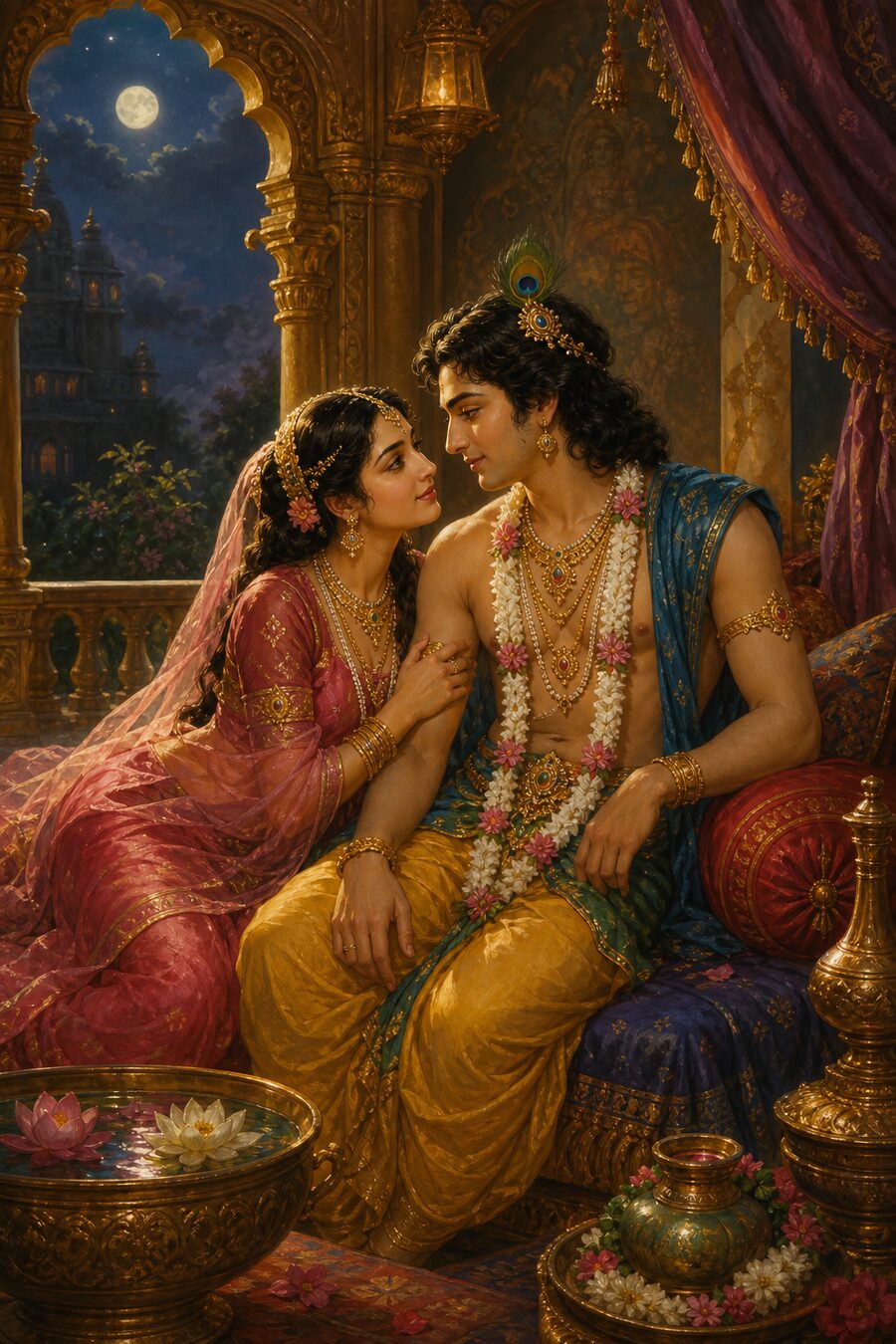
A Father’s Fury
Banasura was no minor king. He was the son of the mighty Bali, the asura emperor of an older age, and the eldest of a hundred brothers. He had been born with a thousand arms, and in those thousand hands he carried hundreds of celestial weapons. Numberless huge-bodied asuras stood around him, and he was a master of hundreds of illusions. Long ago, watching Kartikeya at play beside Shiva, a single wish had seized him and would not let go: how could he be Rudra’s son? He set out to win that place through austerities in Rudra’s worship, and the harder he drove himself the more he grew in glory, and the more pleased Shiva, who is easily satisfied, grew with him in Uma’s company. At last the blue-throated god himself came to the asura. “May you fare well. Ask for the boon your heart holds.” Banasura answered the god of gods, “Three-eyed lord, my prayer is this: let me be the son of the goddess.” Shankara said, “So be it,” and turned to the goddess. “Accept him as your son. He is the younger brother of Kartikeya. His city will be laid out on the very spot where Mahasena once rose out of the blood born of fire, and that best of cities will be famous under the name of Shonitpur. No one will be able to stand against the beautiful Banasura while my protection covers him.”
So Banasura lived in the city of Shonitpur, ruled his kingdom, and oppressed the gods. Little by little the pride of his own strength went to his head until the thousand-armed one, in open contempt of the gods, demanded a battle of them. Kartikeya gave him a standard that burned like fire and a blazing peacock to carry him into war. Armed so, and backed by the power of the god of gods, Banasura fought in such a way that no one among the gods, gandharvas, yakshas, or rakshasas could keep his footing before him. Then, completely sheltered by Tryambaka and swollen with pride, hungry to fight and finding no one left to fight, the asura went back to Shiva. He saluted Rudra and laid out his complaint. “The gods, the sadhyas, and the maruts, whom I beat again and again with my army and under your protection, have come here and are living happily. Defeated by me, terrified, despairing of ever overcoming me, the gods are living in comfort in the city of heaven under your protection. So I despair of any success in battle, and I do not wish to live any longer. There is no point in holding all these arms if I cannot fight. My mind will settle on nothing else. Be pleased with me, and tell me when I shall be able to fight.”
The god whose standard carries the bull smiled at him. “Hear how you will come to your battle, danava. When this standard of yours, planted in your own city, breaks, you will have your war.” Banasura, smiling and smiling, threw himself at Bhava’s feet. “By my good luck these thousand arms were not given to me for nothing. By my good fortune I will defeat the thousand-eyed Indra again.” His eyes filled with tears of joy, and Banasura, the terror of his enemies, lay flat on the ground and adored Maheshvara with five hundred fingers pressed to the earth. “Rise, hero,” Maheshvara said. “You will soon have a fight worthy of your family and of your thousand arms.” Delighted, the asura saluted the three-eyed god and sprang up. Dismissed by the blue-throated lord, Banasura, the conqueror of enemy cities, went home to his palace and walked into the hall where his standards stood. He sat down there and said to Kumbhanda with a smile, “I have good news that will delight your heart.”
Kumbhanda was his chief minister, a man who saw clearly and spoke his mind, and he smiled back at his king. “What good news do you want to tell me? My eyes are wide with joy and surprise. I wish to hear what boon you have won. By the grace of the blue-throated god and of Skanda, what boon have you obtained? Has the lord of the trident given you the kingdom of the three worlds? Will Indra flee from you into the nether regions? Will the sons of Diti be freed from their fear of Vishnu, the fear that drove them into the ocean to hide from his discus? Will they no longer need to fear Vishnu standing in battle with the Sharnga bow and the club in his hands? Will the great asuras come up out of the nether regions under the shelter of your power and live in the city of heaven? Your father Bali, defeated by Vishnu’s power, lives in chains. Will he rise from under the waters and take back his kingdom? Will we see your father Bali, the son of Virochana, in celestial garlands and celestial unguents again? Will we conquer the gods and bring back under our rule the worlds that were stolen from us in three steps? Will we defeat the god Narayana, the conqueror of armies, who walks into battle behind the deep, cool sound of his conch? From the dancing of your heart and the tears of joy in your eyes, it is plain that Vrishadhvaja has been propitiated. Have you won for all of us, by the lord’s pleasure and with Kartikeya’s consent, the dignity of ruling the whole earth?”
Warmed by the minister’s words, Banasura, the foremost of asuras and of speakers, let his news out. “For a long time I have not been able to fight. So, stricken with sorrow, I said to the divine blue-throated god, ‘Lord, I am filled with a great desire for battle. Tell me when I shall enter a battle that will satisfy my mind.’ Hara, the god of gods, the slayer of his enemies, heard me and smiled for a while, and then he said to me in sweet words, ‘Banasura, in no time you will face a great battle. Son of Diti, when your peacock standard breaks, you will find a great battle waiting for you.’ When the divine Vrishadhvaja had said that, I saluted him and came to you.” Kumbhanda answered carefully. “The words you report are very charming.” And while the two of them were still talking, Indra’s thunderbolt struck the huge standard, and it came down with tremendous force.
Banasura looked at the great standard lying broken and filled with joy, because the war he had begged for was now on its way. The heavens did not stop at the standard. Struck by Indra’s thunderbolt, the earth trembled, and a cat hiding under the ground began to wail. In the city of Shonitpur, Vasava, the king of the gods, rained blood around the king’s palace. Huge firebrands pierced the sun and fell to the earth. The sun, rising with the planet Krittika, assailed the star Rohini. Hundreds and thousands of dreadful streams of blood ran from the chaitya trees, the sacred trees of the city, and stars fell and kept falling from the sky. Although that man-destroying hour fell on no day of eclipse, Rahu swallowed the sun, and more firebrands dropped. A comet stood in the south, and dreadful winds blew without pause. Ringed by three-colored halos, the sun, bright as lightning, with white and red edges and a black throat, swallowed the colors of the evening. As if punishing Rohini, the birth star of Banasura, the fearful Mars entered Krittika the way Rahu enters the sun. The huge many-branched chaitya tree that the danava maidens used to worship crashed to the ground. Banasura, drunk with the pride of his strength, saw all these evil portents and could not read in them that he would be defeated.
Kumbhanda could. The minister, wise and clear-sighted, was struck with grief, and he spoke at length about every one of those omens. “These signs foretell evil. They point to the destruction of your kingdom, and because of the conduct of a king like you, we ministers and your servants will be destroyed along with you. As the tree, the banner of Shakra, has fallen, so proud Banasura, forever boasting out of ignorance, will fall. He is crying out for battle to conquer the three worlds and win the favor of the god of gods, and all the while his own destruction is drawing near.” Banasura, of great prowess, answered that by sitting down to drink Asava wine in high delight among the daitya and danava women.
Kumbhanda, watching those portents with a mind full of anxiety, went into the king’s palace, and as he turned the omens over he spoke to himself. “The wicked and careless asura king Banasura, swollen with the pride of his successes, is longing for a battle. Out of ignorance he does not see his own weakness. The evil omens we are seeing now may be slow to come true; the fear they bring can never be false. The lotus-eyed goddess, Shiva’s own consort, and the mighty Kartikeya live here, and so these evil omens may yet be undone. And still, I think, our sins will never be washed away. A great destruction, begotten by our own pride, is drawing near. By this king’s oppressions every danava has been touched by sin, and that will lead to their destruction. Hara, lord of the three worlds, master of gods and danavas, lives in our city, and the divine Kartikeya with him. Bhava loves Guha more than his own life, and Banasura is a still greater favorite. Out of his boundless pride, Banasura prayed to Bhava for a battle, for his own destruction, and he has obtained it. It does not seem to me that a battle can take place at all. If an encounter does come, with Indra and the other gods under Vishnu, it must be reckoned the creation of Bhava himself. If Bhava and Kumara are willing to help Banasura, no one will be able to fight them. The words of the three-eyed god never prove untrue. A great battle, a destroyer of daityas, will soon take place.” So the considerate, right-seeing asura reasoned, and turned his understanding toward the good, and set the conclusion down for himself in one line. Those who fight the virtuous gods meet with destruction, as Bali was brought low.
The secret held for a few days. Then Banasura’s guards learned that Usha was living with Aniruddha, the foremost of the Yadus, in celestial garlands and raiment, his body pasted with celestial unguents, and they went at once to the king with what they had seen. Banasura, the heroic son of Bali, slayer of his enemies, ordered his soldiers to kill the intruder, and his rage finally had a shape to fall on. “Go, all of you, now, and kill that sinful, wicked wretch who has stained the character of our family. Usha has been ravished, and our great house is polluted. What strength, what patience, what pride, in the fool who has walked into my city and my palace and taken my daughter by force, though I never gave her away.” He drove the soldiers out with the order. They put on their coats of mail and went, dreadful and powerful danavas in a fury, taking up every kind of weapon, and hurried to the place where Aniruddha was, to kill him.
Aniruddha heard the uproar of the army coming. “What is this?” He sprang up and saw the soldiers standing around the great house with their weapons raised. Usha saw them too, and the illustrious daughter of Banasura began to weep for the death she was sure was coming to him. Her eyes streamed. The deer-eyed girl trembled and cried out, “Oh my husband, oh my husband,” and Aniruddha answered her. “Let your fear go. You with the beautiful waist, you have no need to fear as long as I am here. There is not the smallest ground for fear. The hour of your joy has come. If every servant of Banasura’s arrives at this door together, I am not in the least anxious. Watch my strength today, timid girl.” He took up his weapons and went, biting his lip in anger, toward the soldiers. Chitralekha understood that the fight with Banasura’s followers was upon them, and she thought of Narada, as he had told her to do. Recollected by her, that foremost of sages arrived in the city of Shonitpur within a moment. He hung in the sky and called down to Aniruddha, “Do not fear, hero. I have come to this city.” Aniruddha looked up, saw Narada, saluted him, and, with a surge of gladness, made himself ready for battle.
He came down out of the palace like an elephant goaded with a pike, and the sight of that long-armed hero coming down the stairs with his lip between his teeth sent the first soldiers running in fear. Pradyumna’s son, expert in every form of warfare, snatched up the parigha, the great iron bar that lay at the door of the inner apartments, and hurled it into them. Those soldiers were masters of their trade, and they came back at him with a downpour of clubs, maces, swords, darts, and arrows. Wounded all over by their iron arrows and their bars, he roared like an evening cloud and would not be overpowered. As the sun moves through the clouds in the sky, he took up a dreadful parigha and stood in their midst. Overhead, Narada, with his staff and his black antelope skin, called down in delight, “Well done! Well done!” Under the terrible iron bar of Pradyumna’s son the soldiers scattered like clouds driven by the wind. With the danavas swept from the field, the mighty hero let out a lion’s roar of joy, the sound the clouds make in the sky when the rains are over, and shouted after the danavas, terrible as they were in battle, “Wait! Wait!” and smiled.
The survivors fled to Banasura, and even standing before their king, bathed in blood and with their eyes dilated by fear, they could find no peace. They sighed heavily, over and over. Banasura urged them on. “No fear, no fear, leading danavas! Cast off your fear and fight again.” Then, looking at their wide eyes, he lost his patience. “You are throwing away a glory known across the three worlds. Why are you bewildered, like eunuchs? Who is he, that you are so afraid of him, you who were born in famous families and are clever in war? I do not need your help today. Away with you, out of my sight.” Having scolded them with many such harsh words, the powerful Banasura ordered millions of other soldiers to the field, and then he put Rudra’s own army into the fight, the many Pramathas, the ghost host of Shiva with all their various weapons, to defeat Aniruddha. The whole sky filled with Banasura’s soldiers, their eyes burning, like clouds charged with lightning. Some stood on the ground roaring like elephants, and some hung in the air like the clouds of the rainy season. When that huge army had gathered, cries of “Wait! Wait!” went up on every side. The hero Aniruddha ran at them. It was a wonder to see: one man fighting many, alone. Grappling with the mighty danavas, he tore their parighas and tomaras out of their hands and killed them with their own weapons. Again and again he took up his great iron bar and struck down daityas of enormous strength. Then the son of Kama, slayer of his enemies, caught up a sword and a leather shield and was seen moving through them in twelve directions at once. As he moved across that field in a thousand different ways, his enemies saw him as Death at play, with thousands of mouths wide open.
Cut down again by Aniruddha, the asuras, soaked in blood, fled the field a second time and ran to Banasura. Crying piteously, those mighty asuras fled on every side on elephants, horses, and chariots. The danavas who had run from the field were so sunk in grief and fear that they fell over one another and vomited blood. Fighting Aniruddha, the danavas had felt a fear they had never known in all their old wars against the gods. Some vomited blood and some dropped to the ground, those danavas like mountain peaks with their clubs and maces and swords in their hands. Leaving Banasura behind on the field, the beaten danavas fled in terror into the sky. At the sight of his whole army routed to the last man, Banasura flared like a sacrificial fire when fresh fuel is thrown on it. And up in the air, ranging across the whole sky, Narada, overjoyed at Aniruddha’s fighting, began to dance, crying, “Well done! Well done!”
Now Banasura, worked up to fury, mounted the chariot that Kumbhanda had brought him and drove with uplifted sword to where Aniruddha stood. As Indra shines among his thousand standards, so that asura shone, holding in his thousand hands pattishas, swords, clubs, darts, and axes. With those thousand hands gloved and fitted with finger-guards and full of weapons, that best of danavas blazed with a terrible beauty. He let out a lion’s roar of rage, and with his eyes reddened he drew his huge bow and shouted, “Wait! Wait!” The unconquerable son of Pradyumna heard him, looked into his face, and smiled. The chariot of the mighty Banasura was like the chariot of Hiranyakashipu in the ancient war of gods and asuras. A thousand horses drew it. Hundreds of small bells hung from it. Red standards and flags flew over it, bearskin sheathed it, and it ran ten furlongs from end to end. Seeing the asura about to attack him, Aniruddha, the foremost of the Yadus, was filled with a strange joy and a hot anger together. Like Narahari, the man-lion, standing ready to kill the prince of the daityas in the old days, he stood calmly for battle with his sword in his hand. Banasura watched him come on foot with a dagger and a leather shield, and his heart leaped, because he was sure he could kill him. That Yadava had a sword in his hand and no coat of mail. Still, thinking Aniruddha unbeatable, the mighty Banasura confronted him for battle. He shouted in anger for his men to seize him and kill him, and while he was shouting across the field, Pradyumna’s son looked into his face, in anger, and laughed. Usha, watching, began to weep in terror. Aniruddha consoled her with a smile and stood for the fight.
Then Banasura, wanting Aniruddha dead, loosed innumerable arrows of the kind called kshudraka, and Aniruddha, wanting Banasura beaten, cut them out of the air. Banasura aimed a storm of kshudrakas at his head, and Aniruddha turned them with his leather shield and stood before him like the rising sun. Then Banasura pierced the unconquerable son of Pradyumna to the quick with a thousand sharp, swift arrows. As a lion in the forest overpowers an elephant the instant it sees one, so the Yadu prince Aniruddha overpowered Banasura. Wounded by those arrows, the long-armed hero burned to show a wonderful feat. Under the downpour of arrows, with his body streaming blood, he walked up to Banasura’s chariot. The soldiers fell on Pradyumna’s son with sharpened swords, maces, darts, pattishas, and tomaras, and, sorely wounded as he was, he did not tremble. Then he leaped in anger onto the field, cut the reins of Banasura’s chariot with his dagger, and struck the horses. Banasura, an expert fighter, threw him back off the chariot with a shower of arrows, pattishas, and tomaras, and the danavas, believing Aniruddha dead, stopped fighting, sent up a lion’s roar, and jumped up onto the chariot to celebrate.
Then Banasura, in his rage, took up the dreadful, grim Sakti, his great spear, bright as the sun and a burning brand together and hung with bells, and he hurled it without a thought for Usha’s widowhood. Kama’s son, that foremost of men, saw the life-ending spear coming for him. He leaped, caught it out of the air, and drove it into Banasura. It cut through the asura’s body and went on into the earth. Sorely wounded, Banasura sagged against a standard and lost his senses. Kumbhanda saw his king unconscious and spoke to him sharply when he came round. “King of the danavas, why do you make light of this rising enemy? We can all see that this hero has gained his aim and feels nothing. Fight him with your powers of illusion, or he will never be killed. Do not underrate such an enemy out of indulgence. Save yourself and save us by your illusory power. If you cannot defeat him by illusion, he will kill every asura here. Kill him, hero, before he destroys us all. He will kill hundreds more and carry Usha away.”
Stung by the minister’s words, the king of the danavas, that foremost of speakers, gave vent to his anger in harsh words. “I will kill him in this battle. I will catch him the way Garuda catches a serpent.” And with that, the mighty Banasura, together with his chariot and standard and horses that looked like a city of the gandharvas floating in the air, vanished from sight, and from nowhere a rain of sharpened arrows poured down and covered Aniruddha. The unconquerable son of Pradyumna, seeing his enemy go invisible, cast his eyes over the ten directions and found nothing to strike. The mighty danava, hidden in an illusory form and using his own Tamasa learning, the same dark art that had carried Aniruddha unseen into the city, shot and shot in his rage. Little by little Pradyumna’s son was fettered with serpent shafts. His body was chained with serpents of every kind. With all his limbs bound in their coils, Pradyumna’s son stood inert on the field like the mountain Mainaka. Motionless as a mountain wound about with snakes whose fangs burned, he felt no fear. Fettered through with serpent shafts, rendered inactive and still, that one who is the same as all things felt not the smallest pain.
Banasura, leaning on his standard, raged at Aniruddha in harsh words and then turned on his minister. “Kumbhanda, kill this sinful wretch, this disgrace to his own family and corrupter of ours, who has stained our character before the world.” Kumbhanda answered him with the courage of an old servant. “I wish to say a few words. Hear them if you will. Whose son is this hero with the prowess of Indra? Learn first where he came from and who brought him here. When he fought in the great battle, I marked him fighting like a prince of the gods. He is powerful, full of energy, a master of weapons. He does not deserve to be killed. He has espoused your daughter by the gandharva marriage. You can take her back from him, because you never gave her away. Kill him only after you have thought it through. Knowing this, either kill him or honor him. I see a great wrong in killing him and a great virtue in protecting him. He is one of the best of men and deserves honor in every way. His body is fettered with serpents and still he feels no pain. He has good birth, valor, energy, and accomplishment. Look at this best of men, with his great prowess. Chained as he is, this mighty hero does not care for all of us together. Had he not been bound by your illusory power, he would have fought every asura here. He knows every form of warfare and he is stronger than you. His body is bound in snakes and covered in blood, and still he frowns, with the three lines standing on his forehead, as though he were taking aim at all of us. Reduced to this, and relying on nothing except the strength of his own arms, he cares for nothing at all. Who is this young man? With only two hands he stands ready to fight you, who have a thousand, and never thinks of your strength. Who can he be, with prowess like that? And there is this besides: while your daughter is attached to him you will never be able to give her to another man. He has shown himself a hero of great prowess. If this desirable young man is born into the family of some great person, he deserves honor from you. I beg you, save him.” Banasura, slayer of his enemies, heard the high-minded Kumbhanda out and said, “So be it.” He handed Aniruddha over to his guards, and the wise and illustrious son of Bali went back to his palace.
Narada, the foremost of rishis, had seen the mighty Aniruddha bound by illusion, and he knew what came next. He set out for the city of Dwaravati. Flying by the path of the upper air, that best of sages reached Dwarka and told Keshava, the rider on Garuda, of Aniruddha’s imprisonment. As Narada left for Dwarka, Aniruddha thought the matter through in his bonds. This cruel danava would surely be killed in battle, because Narada would tell Keshava, the holder of conch and discus and club, many things, and all of them true. And when Usha wept at the sight of her husband bound in serpents, he said to her, “Why do you weep like this, timid girl? Do not be afraid, you with the lovely eyes. You will soon see the slayer of Madhu arrive here for me. At the sound of his conch and the slapping of his arms the danavas will be destroyed, and the asura women will miscarry.” The young Usha was consoled by that, and she began instead to grieve for her ruthless father.
A prisoner in Shonitpur, held with Usha in the city of Bali’s son, the heroic Aniruddha turned for his safety to the goddess Kaumari, the virgin goddess, and sang her a hymn. He saluted first the endless, undecaying, eternal first deity, the lord Narayana, and then he chanted the glories of Chandi, the worshipful Katyayani, honored by all the gods and all the worlds, adored by gods and rishis and rakshasas alike, reciting the names of her that Hari himself had sung. “For my well-being I bow to the sister of Mahendra and of Vishnu. Cleansed, with my mind made pure, I chant your glories with folded hands. I bow to you who confer honor. Release me from my bonds. Give me life and health.” So his prayer went out to the very kin of the rescuer already owed to him. And the great goddess Durga, who loves those who call on her, came to where Aniruddha lay in chains in Banasura’s city. She showed herself before the irrepressible hero and consoled him, and he saluted her. With her own fingers she worked at the strong noose of serpents until its grip no longer bit, and she said, “Wait here a few days more, Aniruddha. The holder of the discus, the slayer of the daityas, will cut off Banasura’s thousand arms, release you from your fetters, and carry you home to his own city.”
In Dwarka, when Aniruddha was first found to be gone, his beloved wives and their companions cried in his empty house like so many ewes bereft of the flock. “Even under the protection of the lord Krishna we are weeping, helpless, stricken with fear and grief. He under the shade of whose arms the Adityas and the Maruts and the gods under Indra live without a care in heaven has been visited by this great calamity in the world of men. Who has stolen away his heroic grandson Aniruddha? The wicked one who has lit the unbearable fire of Vasudeva’s anger has no fear at all in this world. He is standing in the open mouth of Death, before its teeth. Can such an enemy stand before Vasudeva in battle? Could even Shachi’s lord escape with his life after doing the Yadu king such a turn? Either our husband has been stolen away today, or our lord has forsaken us and made us objects of pity. Oh, torn from our lord, we have fallen into the hands of death.” So those beautiful women wept, and their tears would not stop. Their streaming eyes were like lotuses sunk in water in the rains, and then like eyes bathed in blood. The crying of the women rose through the palace like the crying of thousands of female ospreys in the sky.
The Yadu chiefs heard that lamentation, a sound none of them had ever heard in that city, and leaped down from their houses as lions come out of their caves when they are attacked, their voices thick with love. “Krishna protects us all, completely. Where does this fear come from? Why is there such a noise in Aniruddha’s house?” The great bugle of Krishna’s court was brought and sounded, and at that sound every Yadava assembled. They asked one another what had happened, and each told the others what he had heard. The eyes of those warriors, red with anger and full of tears, turned toward the one man who always had the answer, and they found Krishna, the foremost of strikers, sighing again and again, and the others around him sitting in silence. It was Viprithu who spoke. “Krishna, you are the foremost of men. Why has anxiety taken hold of you? The Yadavas, living under the protection of your arms, range the world at will. Even the mighty Shakra sleeps in peace, having left victory and defeat to you. Look, your kinsmen are drowning in an ocean of grief. Long-armed hero, save them. What is the cause of your anxiety? Why do you not say anything? You should not sink into idle thoughts like this.”
Vasudeva, as clever a speaker as Brihaspati himself, sighed for a while before he answered, and the admission cost him. “Viprithu, I have been thinking hard about this, and even with thinking I have settled nothing. That is why I gave you no reply when you asked. Hear me, Yadavas. I will tell you honestly why I am anxious. With the heroic Aniruddha a prisoner, every king on earth and every one of my friends will count me incapable. Our king Ahuka was once carried off by Shalva, and we brought him back after a dreadful fight. Rukmini’s son Pradyumna was stolen by Shambara as an infant, and he came home after killing his captor in battle. But where has Aniruddha been taken? Foremost of men, I do not remember ever feeling such sorrow and such torment of mind. Whoever has set this ash-covered foot on my head, I will kill him in battle, with all his people.” Satyaki had the practical suggestion. “Krishna, send out spies everywhere to find Aniruddha. Let them search the earth with its mountains and forests. Let emissaries open and secret be put to this work.” King Ahuka heard Keshava’s wish and at once ordered out the messengers. “Search every country on the earth and under it.” He gave them horses and chariots enough. “Ride out on horseback and search the mountains Rikshavan and Raivataka, with all their trees and creepers. Go without hesitation into every garden and forest there and search every nook and corner. On horses and on elephants, find Aniruddha, the joy of the Yadavas, and find him soon.”
Then Anadhrishti, the commander of the army, said to the eternal Krishna, whose deeds never tire, the thing he had been holding back. “Lord Krishna, for a long time I have wanted to tell you something. Hear it now, if you are willing. Asiloma, Puloma, Nisunda, Naraka, Saubha, Shalva, Mainda, and Dvivida have all been killed by you. When that dreadful battle was fought for the gods’ sake, you killed Hayagriva with all his kinsmen. Govinda, in every one of those battles you did the whole of the work yourself, and no one so much as drove your chariot. And when you carried away the Parijata tree, you did a great and arduous thing, and in that fight you alone, by the strength of your own arms, defeated Vasava himself, an expert in war, seated on his elephant Airavata. That encounter made a great hostility between the two of you. I think Maghavan himself has taken Aniruddha. Who else could satisfy his enmity against you?”
Krishna, sighing like a serpent, would not have it. “Do not say so, sir. The gods are not mean, ungrateful, womanish, or stupid. I work hard on the gods’ behalf, destroying danavas. To please them I have killed the proud asuras in battle. The gods are my support, my mind is devoted to them, and I am their devoted votary. Knowing me, how could they injure me? You say such a thing out of your own meanness; there is none in them. They are truthful and compassionate to those who are devoted to them. I fear no danger from them. I tell you for certain, this is no work of Mahendra’s or of any other god. Aniruddha must have been carried off by some harlot.” Akrura, who could hear what lay under a man’s words, spoke gently. “Lord, Indra’s work is one with ours, and ours is the same as the work of Shachi’s lord. We stand for the gods, and the gods are ours to protect. We were born as men for the sake of the gods.” Stirred by Akrura’s words, Krishna, the slayer of Madhu, said in sweet and grave words, “Pradyumna’s son has been taken by no one among the devas, the gandharvas, the yakshas, or the rakshasas. That illustrious hero has been tempted away by some courtesan. The women of the daityas and the danavas are by nature loose and alluring, and they will have taken him. We need fear nothing from any other quarter.” When the high-souled Krishna had said that, the Yadavas understood the matter as it really was and praised him loudly, and the bards, panegyrists, poets, and singers in Madhava’s house took up songs of praise with delight.
The delight did not last the day. The messengers sent out to find Aniruddha came back to the gate of the audience hall and spoke slowly and sorrowfully. “King, we have searched every garden, mountain, forest, cave, river, and tank a hundred times over, and we saw Aniruddha nowhere.” Other messengers, whom Krishna had sent, came back with the same report. “We have searched everywhere, and Pradyumna’s son is nowhere to be found. Yadu chief, tell us what more we should do to search for Aniruddha.” The Yadavas’ hearts sank at those words and their eyes filled with tears. “What do we do now?” they asked one another. Many wept, some bit their lips, some frowned, and all of them racked their minds for a way to reach their object. They talked in every direction and came to nothing. Seized with anxiety, they wondered where Aniruddha could be, looked at one another in anger, and somehow passed the night thinking about where he could have been taken. The night went by in that talk, and at its end the men appointed for the purpose roused Krishna in his palace with the sound of bugles and conches.
In the clear light of the morning, when the sun had risen, the rishi Narada walked alone and smiling into the audience hall. Seeing Krishna there with all the Yadavas around him, he hailed Madhava with a cry of victory and greeted Ugrasena and the rest. Krishna, mighty and invincible in battle, was far away in his thoughts, and still he rose and received Narada, offering him the madhuparka of honey and curd that greets an honored guest, and cows. The celestial saint settled on a white seat spread with a costly cover and let fall a question full of meaning. “Why are all of you sitting here like eunuchs, anxious, silent, dispirited, and discouraged?” Vasudeva answered him. “Reverend sir, Brahman, someone stole Aniruddha away in the night. We are all anxious for him. Sage of firm vows, tell us if you have seen or heard anything of him. You would be doing me a great kindness.” Narada smiled and laid the whole of it before them. “Hear me, Madhusudana. Banasura, whose energy has no equal, has a daughter named Usha. For her sake the apsara Chitralekha carried off Kama’s son, and because of that a great battle, like the old war of the gods and the asuras, was fought between Banasura and Aniruddha. Defeated in that battle, Banasura in his fear resorted to his powers of illusion and bound the mighty Aniruddha with serpent shafts. Garuda-bannered one, Banasura ordered his death, and his minister Kumbhanda prevented it. When the prince fought Banasura, the asura bound him with serpent shafts by illusion alone, and by nothing else. Aniruddha is alive. That hero is waiting patiently. So, Krishna, those who long for victory should not be trying now to keep their own lives safe. Rise up at once, and success and fame will be yours.”
Vasudeva, mighty and full of energy, made every arrangement for the march on the spot, and as the long-armed Janardana prepared to set out, the citizens on every side showered him with sandal powder and parched rice. Narada had one more thing to say, and it was a warning. “Long-armed Krishna, think now of Garuda, for no one except him will be able to travel that road. Hear how hard the passage is. Shonitpur, where Aniruddha is now being held, lies eleven thousand yojanas from this place, far past the reach of any marching army. The mighty son of Vinata is as swift as the mind. He will set you before Banasura within a moment. Send for him, Govinda. He will take you there.”
Govinda thought of Garuda in his mind, and Garuda came, the king of birds, and stood before Krishna with folded hands. He bowed to the great son of Devaki and asked in sweet words, “Long-armed, lotus-naveled lord, why have you thought of me? I wish to know what you want me to do. On whose city am I to tread it down and destroy it? By your favor, Govinda, who does not know my strength? Hero of the long arms, who does not know the force of your club and the fire of your discus? What foolish man, out of pride, is longing to meet his own destruction? On whose neck will Baladeva, garlanded with wild flowers, set his lion-faced plowshare? Whose body, burned to nothing, will be mixed with the earth today? Whose mind, Madhava, will be shaken today by the blare of your conch? Who is going with his whole family to the city of Yama?”
Vasudeva told him. “Hear me, foremost of birds. The unconquerable Aniruddha has been captured by Banasura in the city of Shonitpur, all for Usha’s sake. King of birds, Aniruddha, in his longing, has been fettered with poisonous serpents. I have called you to set him free. No one else, in all your great strength, can go that way, so take me quickly to where Aniruddha is. Hero, your daughter-in-law Vaidarbhi, Rukmini, fond mother that she is, is weeping without pause for her son. By your favor, let her be united with her son again. Hero of the great arms, slayer of snakes, long ago you joined with me and stole the ambrosia of heaven. You are my carrier, and all the Vrishnis are your votaries. Honor today this request made in love and devotion. By my own good works I swear it: there is no bird that flies as swiftly as you. Killing warriors with the beating of your wings, you alone once freed your mother from slavery. With the gods on your back you range across impassable countries, and by your help they win their victories. In weight you are like the mountain Meru, and in lightness like the air. There was never one as powerful as you before, there is none now, and there never will be. Great, blazing, truthful son of Vinata, help us now, for a moment, for Aniruddha.”
Garuda answered with a hymn of his own. “Wonderful are your words, long-armed Krishna. All my victories are owed to your favor. I am honored and blessed to be praised by you. Your glories are the ones that should be chanted, and you have sung mine instead. You are the lord of the Vedas, the master of the gods, the giver of every desire, whose glance is never without fruit, the giver of boons to those who seek them. You have four arms and four forms. You ordain the four fires, the four ashramas, the four varnas, and you are a great poet. You hold a bow, a discus, and a conch. In your earlier bodies you were known as the upholder of the earth. You hold the plowshare, the mace, and the discus. You are the son of Devaki, the crusher of Chanura, the lover of cows, the slayer of Keshi, the lifter of the mountain Govardhana, the great wrestler, the origin and support of all of them and their friend. You are the great Purusha, fond of Brahmins, forever working for their good. You are known as Brahman, as Damodara, as the slayer of Pralamba and Keshi and the other danavas. You destroyed Asiloma, Vali, and Ravana, and gave kingdoms to Vibhishana and Sugriva. You took Vali’s kingdom and all his jewels, and you are the great jewel born in the bed of the ocean. All the rivers flow out of you in the shape of Meru. You are the holder of the dagger, the great bowman and archer, known as Dasharha and as Govinda. You are the sky, the darkness, the churning of the ocean, the heaven of many fruits, the great upholder of the celestial region. You are the great cloud, the seed of the three worlds, anger and greed and desire. You are the great bowman, you are Kama, the great cycle, revolution and dissolution. You are Hiranyagarbha, the knower of forms and the wearer of them, the slayer of Madhu, the creator, the great god of innumerable qualities. The dreadful creatures you look upon with those eyes are killed by Yama’s rod and driven down to hell. Those on whom you cast a kind and loving glance, Madhava, find happiness in this world and in the next. Long-armed one, I am at your disposal.” Then, showing that he was ready to go, Garuda said, “I wait here, mighty hero. Sit upon my back.”
Madhava embraced Garuda by the neck. “Friend, accept this arghya, for the killing of the enemy.” He offered the honored water to Suparna, and then the long-armed Purushottama, holder of conch and discus and club, mounted his back, and the city saw its lord in the full blaze of his form: dark-hued, black-haired, with magnificent bracelets, victorious, with four arms and four rows of teeth, master of the four Vedas and their branches, the mystic mark of Shrivatsa on his breast, eyes like lotuses, stirring hair, soft skin, fingers and nails even and red, eyes red at the corners, a voice sweet and grave, long arms that reached his knees, a copper-colored face, the gait of a lion, and a radiance like a thousand suns. He gave his orders for the guarding of Dwarka, and Halayudha and Pradyumna, the grinder of enemies, climbed up behind him. From the sky the siddhas and charanas and the great rishis called down to Keshava, “Long-armed one, conquer Banasura with all his followers. No one will be able to stand before you in the great battle. Lakshmi, the goddess of fortune, depends on your pleasure, and sure victory depends on your strength. You will defeat your enemy the daitya king in battle, with all his soldiers.” Keshava heard them, and marched.
When Mahadeva Became the Shield
They left to the sound of conches and bugles, to the songs of bards and panegyrists by the thousand, and to the blessings of men crying out his victory, and Janardana went up into the sky like the moon, the sun, and Shakra in one. As Vinata’s son flew, his beauty, fed by Hari’s energy, grew immense. Bent on killing Banasura, the lotus-eyed Keshava took on a form of eight arms, huge as a mountain, and Janardana, the holder of the Sharnga bow, put on innumerable heads. In his four right hands he carried a sword, the discus, the club, and arrows. In his four left hands he held the leather shield, the Sharnga bow, the thunderbolt, and the conch. On Garuda’s back beside him Sankarshana, holding a thousand forms and white weapons, irresistible to every creature, shone like Kailasa with its summit, like the rising moon. And the high-souled Pradyumna, meaning to show his prowess in the battle, took the form of Sanatkumara, the eternal youth. Vinata’s mighty son went on, shaking innumerable mountains and blocking the course of the wind with the beating of his wings. Swift as the mind, he crossed the most sacred route of the siddhas and the charanas.
The first thing to meet them was a strange loss. Balarama looked down at his own arm and then at his brothers, and said to Krishna, incomparable in battle, “Krishna, what wonder is this, that all at once we have lost our radiance? We have all turned the color of gold. What is the cause? Have we come to the side of mount Sumeru?” The Lord knew the sign. “I think Banasura’s city is near at hand, slayer of your enemies. To protect him, the fire stationed in his city is coming out blazing. Holder of the plowshare, we have been taken into the radiance of the oblation fire, and that is what has changed our color.” Balarama answered, “If merely approaching Banasura’s city has stripped the luster from our bodies, do what you think proper afterwards.” And the Lord said to Garuda, “Son of Vinata, do what you think proper. After you have found a means, I shall do what I think proper.”
Hearing Vasudeva’s words, the mighty Garuda, who can take any form he pleases, opened a thousand mouths. The mighty son of Vinata leaped up to the Ganga of heaven, drank a vast draught of its water, and rained it down on the fire. By the plan the wise bird had made, the fire was extinguished at once. Seeing it drowned in the water of the celestial Ganga, Suparna said with wonder, “How powerful was that fire, like the fire at the end of a cycle. It disfigured the color of even the wise Krishna.” Then the king of birds went on, with a great sound from the beating of his mighty wings. The fires that served Rudra watched them come and asked themselves, “Who are these three dreadful men of many forms, riding on Garuda? Why have they come here?” The fires of the mountain thought about it for a while and could settle nothing, and then they went to fight the three Yadus, and a great noise went up when the two sides met.
Angira, the chief of the fires, heard that uproar like the roaring of lions and sent a man to the scene with orders to go quickly to where the battle raged. Banasura too sent an asura, fleet as thought, saying, “Go and see what is happening.” The messenger said, “So be it,” and went at once, and saw the fires fighting Vasudeva. He saw the five chief fire-gods of the Swaha offering, Kalmasha, Kusuma, Dahana, Shoshana, and the mighty Tapana, each with his own army, and lesser fire-gods with them. He saw the five presiding gods of the Swadha offering, Pithara, Pataga, Swarna, Agadha, and Vraja, fighting too, and the two blazing fire-gods who have charge of the Jyotishtoma rite and the Vashatkara. And he saw the great sage Angira standing on a fiery chariot in the midst of the fire-gods, his blazing mace raised, shining over the field. When Krishna saw Angira loosing his sharpened arrows, he grew angry and smiled, again and again. “Fire-gods, wait patiently a few moments. The hour of your destruction is coming. Within a moment, burned by the energy of my weapons, you will be flying away in every direction.” Angira ran at him with a burning trident in his hand, as if to take Krishna’s life. Krishna, blazing like Yama, destroyer of all creatures, cut the mace out of his hands with crescent-headed arrows and struck him in the breast with a deadly shaft. Angira fell, bathed in blood, his body mangled, and the four fire-gods, the sons of Brahma, fled with the rest into Banasura’s city.
Narada was riding with them, and he saw the city from a distance. “Look, long-armed Krishna. There is the city of Shonitpur. For Banasura’s protection and his well-being, Kartikeya and the blazing Rudra with his consort always live there.” Krishna smiled. “Hear and understand what I say, great sage. If Rudra himself comes to the field to protect Banasura, we will fight him too, as hard as we can.” While Krishna and Narada talked, the swift Garuda carried them to Banasura’s city. Then the lotus-eyed Keshava, dark as a cloud, lifted his moon-white conch and blew, and that one note, striking terror into Banasura of the wonderful deeds, was how the mighty Madhava entered the city. Banasura’s soldiers answered with bugles and conches of their own and made ready. Millions of paid soldiers with blazing weapons marched out to the field, innumerable, of matchless prowess, and massed together they looked like a bank of black cloud. Then the daityas and the danavas and the leading Pramathas came on with burning weapons of every kind to fight the eternal Krishna, and as Krishna, Sankarshana, Pradyumna, and Garuda joined the battle, yakshas and rakshasas and serpents, irresistible as fire, poured in from every side with their mouths open, to drink blood.
Balabhadra looked over Banasura’s army and said to Krishna, the slayer of hostile armies, “Long-armed Krishna, do the thing that will leave these soldiers in complete terror.” Purushottama, the foremost of the masters of weapons, took up fiery weapons as dreadful as Death, and grinding the asuras and the birds of prey beneath them, Janardana went quickly to where the soldiers were. That asura army, drawn up on the ground in numberless detachments and made up mostly of Pramathas, carried darts, pattishas, saktis, rishtis, pinakas, and parighas, with dreadful beasts of burden among them as huge as mountains and clouds, and it looked like a mass of clouds scattered by the wind. Many bowmen added to the splendor of the show. Running here and there with maces, darts, swords, clubs, and parighas, that numberless asura host made the field a strange and terrible beauty. The handsome Sankarshana, seated on Garuda’s back, said to Krishna, the slayer of Madhu, “Long-armed Krishna, Purushottama, I want to fight this asura host.” Krishna said, “I feel the same inclination. I want to fight these leading warriors on the field. When I fight with my face to the west, Suparna will stand before me. Pradyumna will stand on my left, and you on my right. In this dreadful fight we will all protect one another.”
So, holding mace and club and plowshare, each huge as a mountain peak, the three of them rode Garuda, the foremost of birds, into the asura host. When Rohini’s son Balarama joined the battle, his form grew as terrible as Kala, Time itself, bent on devouring everything at the end of a cycle. Ranging the field, the mighty Baladeva, expert in war, hooked his enemies toward him with the plowshare and ground them with the mace. The mighty Pradyumna, foremost of men, stopped the fighting danavas with his arrows. Blowing his conch, Janardana, holder of conch and discus and club, dark as a mass of collyrium, fought in a hundred ways. And the wise son of Vinata beat the daityas with his wings, tore them with his talons and his beak, and sent them to Yama’s house. Under that downpour of arrows and the weight of those four heroes, the dreadful army of the asuras broke and ran from the field.
One of Rudra’s servants saw the rout and came walking out alone to hold it. This was Jvara, Fever itself, and he came sighing again and again like a madman. He had three legs, three heads, six arms, and nine faces, and a weapon in his fist that consumed whatever it touched, and he was like Yama himself. He roared like thousands of muttering clouds. He sighed and yawned, over and over. He dozed as he came. His hair stood on end and his eyes were foul. He made his terrible face more terrible with those eyes, and in anger he addressed the holder of the plowshare. “Why are you so puffed up with the pride of your strength? Do you not see that I have come to the field? Wait a few moments. You have come before me in battle, and you will not go home alive.” Smiling, and showing a fist as dreadful as the fire of dissolution, Jvara ran at Halayudha. Rohini’s son moved so fast, in thousands of circling ways, that Fever could find no opening. Then, aiming at that body huge as a mountain, Jvara of the matchless energy hurled his consuming weapon, and it struck Balarama on the breast. It glanced from Rama’s chest and fell on the summit of mount Sumeru and shattered the peak into pieces. The remnant that clung to his breast was enough. Krishna’s elder brother began to burn. Sighing and yawning every moment, he moved about recklessly. His eyes dilated, his hair rose, and all his senses scattered. He sighed like a madman. Barely conscious, Haladhara called to his brother. “Krishna, long-armed Krishna, you who give protection, I am being consumed, no, I am being consumed completely. How am I to be saved?” Krishna, the foremost of strikers, smiled at the mighty Bala and said, “No fear,” and took Halayudha in his arms. Held by Krishna, who loved him, he was saved from burning.
Having pulled Rama back from the fire, Vasudeva, the slayer of Madhu, turned on Jvara in a rage. “Come and fight with me, Jvara. Show me the full extent of your strength and your power in this battle.” Fever, with his right hand, loosed his great burning weapon at Krishna’s body, and for a few moments the mighty Krishna, the foremost of strikers, felt the burning, and then the fire was out. Jvara closed with him. With his long snakelike arms he struck Krishna on the neck and then landed a blow on his breast, and a great hand-to-hand fight began on that field between Fever and the blazing Krishna, foremost of men. The sound of the blows they struck, arm on arm, was like thunder breaking on a mountain peak. Now and then a voice could be heard between the blows, “Do not strike like that; you should do it like this,” as if the two were instructing each other. For a moment those two mighty ones fought so, and then the Lord of the universe, in the guise of a man, deciding to end it, caught the sky-ranging Jvara in his golden ornaments and ground him in his arms.
Taking Fever for dead after that crushing, Krishna, the slayer of enemies, threw him down on the ground. Released from those arms, Jvara did not let go of Krishna’s body. He went into it. Possessed by Fever of the matchless energy, Krishna felt his movements slacken, and he steadied himself again and again by touching the ground. Sleep took hold of him. His steps dragged, his hair stood on end, and he sighed and yawned, over and over. Weighed down and yawning, the great yogin Krishna, conqueror of enemy cities, came back to his natural state only after a long time. Then, knowing himself possessed by Jvara, Purushottama created another to destroy it. Out of his own energy, Janardana of the dreadful power made a second Fever, terrible to all creatures, and this one seized the first by force and dragged it out of him and presented it before him. Having driven Jvara out of his body with the one he had made, the mighty and angry Vasudeva struck him down to the ground and was about to tear him in pieces. Jvara, bewildered, cried out, “Janardana, it is for you to protect me.” And as Krishna of the matchless energy raised his hand over the fallen Jvara, a voice came out of the empty sky. “Krishna, long-armed Krishna, joy of the Yadavas, do not kill this Jvara. He is worthy of your protection.”
Hari, the lord of past, present, and future and the great teacher of the world, let him go. Jvara laid his heads at Hrishikesha’s feet and said, “Descendant of Yadu, Govinda, hear what I have to ask. Hear what is in my mind, long-armed god, and grant it. I pray for one boon alone: that I may be the only Fever in this world, and no other may flourish.” The Lord said, “It is right to grant a boon to one who asks for it, and besides, you have sought my protection. So fare well, Jvara. You will have what you pray for. As before, you will be the only Fever. Let the one I created dissolve into me.” And the illustrious Krishna, foremost of strikers, went on to tell Fever how he would live from then on. “Hear how you will range through the world, spread across the whole of creation, the moving and the unmoving. If you want to please me, divide yourself into three parts. With one, possess the four-footed animals. With the second, the things that do not move. With the third, human beings. And with a fourth portion of that third part, live always among the birds. Among mankind, divide yourself into four kinds, the fever that comes every day, the one that comes after two days, after three days, and after four. Hear how you are to live among the other creatures. In trees you will live as an insect and as the disease that withers the leaves and turns them pale. In fruits you will live as the disease called Aturya. In lotuses as frost. In the earth as desert. In the water as the Nilika plant. In peacocks as the growing of the tuft. In the mountains as mineral, and in cows as the hoof disease called Khoraka. Under these many forms you will live on the earth. At your very look and touch, animals will lose their lives. Only the gods and men will be able to withstand you.”
Jvara was delighted, and he saluted him with folded hands. “Madhava, I am blessed, for you have given me sovereignty over all creatures and all things. Purushottama, I wish now to carry out any other order of yours. Long-armed Govinda, tell me what I am to do. Long ago I was created by Hara, the slayer of Tripura, who made other creatures as well. Now, defeated by you in battle, I have become your servant. You are my master.” Vasudeva said, “Hear the resolution I hold in my heart,” and Jvara said, “Holder of the discus, I am favored and blessed by the good you have done me. Order me, and I will carry out whatever pleases you.” Then the Lord gave the fight its last gift. “Jvara, the man who salutes me and then reads with attention this account of the prowess our arms alone displayed in the great battle will be set free of fever.” Jvara, mighty as he was, said, “So be it.” Having received his boon and given his promise, Fever saluted Krishna and left the field.
Riding Vinata’s swift son, the three heroes stood on the field like three fire-gods and fought on. From Garuda’s back they broke and scattered the danava army under a downpour of arrows, and the huge, irrepressible host, battered by discus and plowshare and shafts, only grew angrier. As a fire grows in a room full of dry fuel, so the fire born of Krishna’s arrows grew until it burned like the fire of dissolution and consumed thousands of danavas on the field. Banasura saw his soldiers burned and broken by Krishna’s arrows and taking to their heels, and he came out to stop them. “Born in the race of the daityas, why are you running from the field, overcome with fear, showing your weakness? Why are you throwing away your coats of mail, your swords, your daggers, your darts, your leather shields, and your axes as you run? Think of your birth. Think that you live with Hara himself. Then decide whether you should run. I am standing here before you.” They heard him, and they were beside themselves with fear, and they paid no heed and fled. Of all the soldiers on that field, only the Pramathas stood their ground and wanted to fight again.
Kumbhanda, the king’s mighty minister and friend, tried where the king had failed. “Leading danavas, look at the field. Shankara, Kartikeya, and Banasura are standing on it. And still, out of fear, you are running and leaving your own armies behind. Give up all hope of your lives and fight.” The danavas never heard him out. Terrified of the fire of Krishna’s discus, they fled in every direction. Then Shiva himself, whose prowess has no equal, saw the whole army routed by Krishna, and his eyes went red with anger. To protect Banasura, he took his stand on his shining chariot and made himself ready to fight. Kumara too mounted a chariot that burned like fire. And the mighty Rudra, biting his lip, on a chariot drawn by lions, drove to where Hari was.
That chariot came on as if it would swallow the sky, with a great sound, drawn by lions, and it looked like the full moon freed from clouds. It was packed with ghosts crying out in a hundred voices, and so the god of gods rode toward the field. Some of those ghosts had the faces of lions, some of tigers, some of serpents, some of horses, some of camels, and even they, mighty as they were, trembled as they came. Among them were ghosts with the faces of asses and camels and peacocks, of horses and rams and cats and sheep. Some wore bark. Some had tufts of hair on their heads, some wore matted locks, some had their hair tied up, and some were naked. They all blew conches and bugles as they came to the battle. Some had beautiful faces and were decked with celestial weapons and flowers. Some were dwarfish and some grim-visaged. Some wore the skins of lions and tigers. Some had faces smeared with blood and huge teeth and a taste for flesh. All of them stood ringed around Shankara, the destroyer of great enemies, on the field, and waited there at their ease.
Krishna saw the chariot of the tireless Rudra and rode toward it on Garuda. Hara, who always stands at the head of a battle, saw Hari coming on Garuda with arrows flying, and struck him in anger with hundreds of winged shafts. Under Hara’s arrows, Hari, the grinder of enemies, grew angry in his turn and took up the most excellent weapons that Indra had given him. Between the two of them the earth shook. The elephants trembled and lifted their heads. The mountains were flooded by the water of their own streams, and some had their summits scattered on every side. In that encounter between Hara and Hari the quarters, the sky, and the earth seemed to be all on fire. Firebrands fell on every side, and dreadful-looking jackals began to howl their inauspicious cries in daylight. Indra, with a great noise, sent down showers of blood, and firebrands covered the rear of Banasura’s army. The wind rose, and the heavenly bodies and the herbs of the earth, stripped of their luster, flew about in the sky. Then the Grandfather, Brahma, knowing that Rudra, the destroyer of asuras, had entered a battle, came there ringed by the celestials, and the apsaras, gandharvas, yakshas, vidyadharas, siddhas, and charanas hung in the air above the field to watch what no age had seen before.
Vishnu loosed Indra’s weapon at Rudra. It went up burning to the chariot where Rudra stood, and the next moment hundreds and thousands of arrows dropped before Hara’s chariot. Hara saw it and, filled with anger, loosed the dreadful fiery weapon, and that was a wonder to see. Krishna and the three with him were covered in arrows and scorched by the fire of that weapon until they shrank and withered and could no longer be seen at all. The asuras, sure that Krishna had died in the fire, sent up a lion’s roar. Vasudeva, master of every kind of weapon, bore the fire patiently and took up the Varuna weapon, the water of the lord of waters, and when he loosed it the fire of the fiery weapon went out. Seeing his weapon undone, Bhava loosed four others, each like the fire of dissolution: the Paishacha, the Rakshasa, the Raudra, and the Angirasa. To break them Vasudeva shot four arrows: the Vayavya of the wind, the Savitra of the sun, the Vasava of Indra, and the Mohana that bewilders. With those four arrows he undid those four weapons, and then Madhava loosed his own Vaishnava weapon, like Antaka, the ender, with his mouth wide open. When the Vaishnava weapon flew, all the bhutas, the yakshas, and the asuras of Banasura’s host fell senseless and fled in every direction in terror.
Seeing his army, Pramathas and all, broken like that, the great asura Banasura ran out to the field himself. As the king of the gods, the wielder of the thunderbolt, rides out ringed by the celestials, so Banasura went out surrounded by mighty chariot-warriors, the daityas with their dreadful weapons. With the chanting of names and mantras, the Brahmins performed the blessing rites over him, and Bali’s son, bestowing on the Brahmins auspicious cows, raiment, fruits, flowers, and gold coins, shone like the lord of riches, a king dressing for a coronation. His huge chariot, painted with gold and worked with a hundred moons and a million stars and countless bells, shone like fire, like a thousand suns. Taking on a dreadful form, with a bow in his hands, Banasura climbed into the chariot the danavas had brought him for fighting those foremost of Yadus. Then that ocean of force, crowded with the chariots of heroes, went forward the way the ocean at the end of the world goes forward, its waves driven higher by the wind, and the danavas, great chariot-warriors with bows in their hands, stood like mountains covered with forests, and the mere sight of them struck terror into everyone.
The war between the two gods had not finished. When the three eyes of Shiva began to burn, all the worlds were covered in darkness, and Nandi, Rudra, and his chariot could no longer be seen. Then Rudra, blazing with a double radiance out of his anger and his strength, took up the arrow with sharpened barbs on four sides with which he had once killed Tripura, the three cities of the sky. He set it to his bow. As the three-eyed god drew it to loose, the high-souled Vasudeva, who knows the minds of all, knew, and the quick-handed Purushottama took up his weapon called Jrimbhana, the Yawn, and made Hara yawn. With that one arrow the divine Hara, conqueror of asuras and rakshasas, was stupefied, bow and arrows and all, and lost consciousness. Having stupefied his own self in the shape of Rudra with that weapon, Krishna, who is the same as all things, blew his conch. At the sight of Shankara stupefied, and at the blare of the Panchajanya and the twang of the Sharnga bow, every creature was filled with fear. Rudra’s followers came up to the field in the meantime and attacked Pradyumna with illusions, and the mighty Makaraketana, the god of love whose banner carries the sea monster, put every one of them to sleep and began killing the danavas and the innumerable Pramathas among them with his arrows. And as the tireless Rudra yawned, a flame came out of his mouth and burned across the ten directions.
The weight of those great powers was more than the ground could bear. The goddess Earth, trembling, went to the great Brahma. “Long-armed one, great god, I have been assailed by tremendous energies. I am so loaded with the weight of Rudra and of Keshava that I shall be reduced again to one shoreless ocean. Grandfather, think of this unbearable burden of mine. Find some means by which, relieved of it, I can go on holding up the moving and the unmoving creation.” The Grandfather said to the daughter of Kashyapa, “Hold yourself up for a moment, and you will be relieved of your burden.” Then the lord Brahma spoke to Rudra. “You yourself found the means of killing this great asura. Why do you wish to protect him now? Long-armed one, I do not like to see you engaged in an encounter with Krishna. Do you not know that Krishna is your second body?” Hearing Brahma’s words, the eternal three-eyed lord turned his mind inward on the Brahman within him and saw the three worlds entire, the moving and the unmoving. He saw himself standing there stupefied with his bow and his arrows, and the great yogin Bhava, by the strength of his concentration, remembered the boon he had granted and what he had said at Dwarka, and so he made no reply. Seeing himself in Krishna, and the two of them in one, he was pacified and left the field. Rudra said to Brahma, “Lord, I will fight no more. By this encounter between Krishna and Banasura the earth will be relieved of her burden.” Then, with great pleasure, Krishna and Rudra withdrew from the battle and embraced one another, and while those two great yogins were joined, no one could see them.
Brahma, the creator of all, who had brought about that reconciliation between Hara and Hari and alone could see them, turned to the rishis Narada and Markandeya at his side, who had asked him about it. “In a dream one night I saw Bhava and Keshava in the lake near mount Mandara. I saw Hara there in Hari’s form and Hari in Hara’s. Hara held the conch, the discus, and the club, wore a yellow garment, and rode on Garuda. Hari held the trident and the pattisha, wore a tiger skin, and rode on a bull. Seeing that marvelous scene, I am filled with wonder. Markandeya, tell me the truth of it.” Markandeya answered him. “Shiva is one with Vishnu and Vishnu is one with Shiva. I see no difference. Both are auspicious, without beginning or middle or end, eternal and undecaying. He who is Vishnu is Rudra, and he who is Rudra is Brahma. Brahma, Vishnu, and Rudra are one, and of one form. As water thrown into water becomes water, so Vishnu becomes one with Rudra when he enters him, and as fire mixed with fire becomes fire, so Rudra becomes one with Vishnu when he enters him. Rudra is one with fire and Vishnu is one with the moon. They are the givers of the Vedas, the creator and protector of the universe. They send down rain in the shape of Indra, spread their rays in the shape of the sun, blow in the shape of the wind, and create all things. Vishnu is adorable to Rudra, and Rudra is adorable to Vishnu. They are one, and they range the world under two forms. Vishnu is in no way different from Shankara, and Shankara is in no way different from Vishnu. Salutation to Rudra and Krishna, of one united body.”
That should have ended it, but Kartikeya had not moved. Standing on the chariot Kumbhanda had brought him, Guha drove at Krishna, Baladeva, and Pradyumna and struck them with hundreds of dreadful sharpened arrows, and the three of them, bathed in blood like three fires, fought the war-god back. Those heroes, expert in war, struck Kumara with three weapons given them by the Wind, by Fire, and by Indra, and he countered the three with three of his own and struck the Yadavas with three others, the Shaila of the mountain, the Varuna of the waters, and the Savitri of the sun. By their own powers of illusion the three heroes swallowed every weapon the great Kumara shot from his burning bow. Then the mighty Guha, blazing and biting his lip, took up the dreadful Brahmashira, the head of Brahma, a weapon like the Destroyer himself. When Kumara loosed it, with the radiance of a thousand suns and the power to end the world, every creature lost consciousness in its heat and fled in all directions, and the whole universe cried out. Keshava, the slayer of Keshi, saw it coming and took up his discus, the destroyer and counter of every weapon, and as the clouds of the rainy season cover the rays of the sun, so the discus of the high-souled Keshava covered the glare of the Brahmashira with its own.
With his great weapon stripped of its luster and power and energy, Guha’s eyes went red with anger and he flared like a fire fed with clarified butter. He took up a dreadful burning golden Sakti of unfailing aim, a spear that destroyed enemies and terrified every living thing, and he hurled it in his anger, that celestial burning spear hung with bells, bright as a firebrand, like the fire of dissolution, and he sent a mighty shout after it that struck terror into his enemies. Loosed by the high-souled Guha, the spear rose into the sky, gaped, and came down with tremendous force, as if hungry to kill Krishna. The gods and their king, watching that burning spear, lost heart and said to one another, “Perhaps Krishna will be consumed.” But the instant the great spear came before him in that great battle, the mighty Madhava shouted, and as if scolding it, knocked it to the ground. When the spear fell, cries of “Well done! Well done!” rose from every side, and Vasava and the celestials sent up a lion’s roar. And while the gods were still roaring, the mighty Vasudeva raised his discus to kill the daityas.
As Krishna of the matchless energy was about to loose the discus, the beautiful Kottavi came, at Mahadeva’s command, and stood naked before him to protect Kumara. She was Lamba, the eighth portion of the goddess, and she set herself between the two of them like a beautiful golden spear. Seeing the goddess standing before Kumara, the long-armed Krishna was baffled. “Oh, shame on you! Fly from this place at once. Why do you throw obstacles in the way of a destruction that is certain?” Kottavi heard the words of the mighty-armed Krishna and did not put on her clothes, for Kumara’s sake. The Lord said, “Take Guha with you and leave the field, now. It will be well for all of us today if you do that. Otherwise, if I hold back from fighting, he will fight me.” Then, looking at that naked goddess on the field of battle, the divine younger brother of Vasava, the Lord Hari, put away his discus. The goddess heard the words of the wise Madhava, god of gods, and led Guha away to Hara.
When that great danger had passed and the goddess had carried Guha to safety, Banasura came to the place. He saw Guha released from Krishna’s discus and withdrawing from the field, and he felt the wish to fight Madhava himself. The ghosts, the yakshas, and Banasura’s soldiers fled on every side in confusion, and of that broken army only the Pramathas remained, and with them the great asura marched out at once for the field. As the wielder of the thunderbolt goes out in the company of the leading celestials, so Banasura went out with his dreadful, powerful, energetic daitya commanders, and his priests and his elders, well read in the shrutis, performed the blessing rites over the high-souled Banasura with mantras, recitations, and herbs, chanting the destruction of his enemies.
Pride Cut Down, a Promise Kept
Seeing Banasura come out and take his stand for battle, Krishna rode Garuda toward him and halted in the west. The Yadu king, of matchless energy, the rider on Garuda, stood there in plain sight, and Banasura filled with rage and shouted across the field. “Wait! Wait! You will not get away from me alive today, back to Dwarka to see your friends. Death has driven you here. Beaten by me in battle, on the eve of your death, you will see the golden leaves of the trees. Garuda-bannered one, with your eight arms, how will you fight me, who have a thousand? Killed with all your friends in the city of Shonitpur, you will remember Dwarka. Today you will see my thousand arms, with all their weapons and ornaments, multiply into a million.” As he roared, his words traveled over everything like the dreadful waves of an ocean raised by the wind, and the eyes of that mighty asura, full of anger, shone like two suns rising in the sky, as if he meant to burn the world. From his seat in the sky Narada heard that proud speech and laughed so loud that the heavens seemed to split in two, and the ascetic, sitting on his yoga seat and bursting with curiosity, moved about on every side to get a better view of the battle.
Krishna let the boast run out. “Banasura, why are you roaring like this out of foolishness? Heroes do not boast. What use is boasting? Come and fight me on the field. Son of Diti, you have let out a great many disconnected words. If victories in battle were won with words, there would be no doubt that yours was won already. Come, Banasura. Either defeat me, or lie down on the earth for good with your face in the dust.” With that, Krishna struck Banasura with arrows that cut him to the quick, and the asura, mangled in that dreadful encounter by arrows that reached his very vitals, covered Krishna in his turn, with great care, in burning arrows. With parighas, swords, clubs, tomaras, saktis, maces, and pattishas he buried Keshava from sight. Proud Banasura with his thousand arms fought at his ease against Keshava, and Keshava, with his eight arms, holder of conch and discus and club, fought the thousand-armed Banasura in that battle. Then Bali’s son saw the superior training in Krishna’s hands and was worked up to a greater rage. He loosed the celestial weapon, the destroyer of every enemy, that Brahma, by the power of his austerities, had long ago created for Hiranyakashipu. When it flew, every quarter of the sky was swallowed in darkness, and thousands of dreadful omens showed on every side. With all the worlds blotted out, nothing at all could be seen. The danavas cheered Banasura, “Well done! Well done!” and from the gods came cries of “Alas!” A dreadful downpour of burning arrows came out of the power and force of that weapon, and while Keshava burned under it, no wind, no storm, and no cloud moved anywhere. Then the divine slayer of Madhu took up Indra’s weapon, as inescapable as death, and all the worlds were cleared of darkness, the fire went out, and the danavas lost heart completely. Seeing the danava weapon undone the instant Indra’s weapon was made ready, the gods began to laugh and to roar like lions.
Beside himself with rage at seeing his weapon broken, Diti’s son hurled harsh words at Keshava on Garuda’s back and covered him with maces and pattishas, and Keshava, slayer of his enemies, smiled and knocked each raised weapon aside. Then, with arrows like thunderbolts shot from the Sharnga bow, Keshava broke Banasura’s chariot into pieces, with its horses and its standards. The very next moment the mighty Keshava stripped from Banasura’s body his shining crown, his coat of mail, his bow, and his shield, and, still smiling, struck him in the breast with winged arrows. Cut to the quick, Banasura lost consciousness and swooned. Narada, sitting on the highest roof of the palace, saw him struck and fainting and sprang up, clapping. “Great fortune! Great fortune! Blessed is my life, and blessed my birth, for today I have seen this wonderful prowess of Damodara. Long-armed one, you whom the gods adore, accomplish now the thing for which you took birth. Destroy Diti’s son Banasura, and soon.” Having sung the glories of the Lord, Narada went on moving about the field, which Krishna had lit from end to end with his sharpened arrows.
In that battle the standards of the two sides met and fought, and so did the horses of the gods and the danavas. Garuda and the peacock fought, striking each other with wings, beaks, and talons. Then the mighty son of Vinata leaped up in anger, seized the peacock’s head in his beak, and beat him with his wings and tore at him with his talons. Dragged about again and again by the mighty son of Vinata, the peacock fell senseless, as the sun drops out of the sky. When his mighty peacock lay on the ground, Banasura, in great distress, understood for the first time what he had done. Swollen with the pride of his strength, he had paid no heed to his friends’ words, and so he had met with disgrace before the very eyes of the gods and the daityas. Seeing Banasura so downcast, the Lord Rudra grew anxious to protect him, and Mahadeva said gravely to Nandi, “Sinless Nandi, go quickly to where Banasura stands on the field and give him this celestial chariot drawn by lions. I do not wish to fight. Let me stand here among the Pramathas. Go, and protect Banasura.” Nandi, foremost of chariot-warriors, said, “So be it,” took the chariot to Banasura, and spoke to him quietly. “Mighty daitya, mount this chariot at once. Hero, I will be your charioteer. Do not delay. Climb up.” So Banasura rose a second time.
Mounted on that chariot of Bhava’s, built by Brahma, the mighty Banasura, in his anger, called up the burning Raudra weapon, the Brahmashira, which can destroy every other weapon. The lotus-born Brahma had created it for the protection of the worlds, and still the worlds were shaken when it blazed. Krishna watched it come and destroyed it with his discus, and then he spoke to Banasura, illustrious in the world and matchless in battle. “Where is your boasting now, Banasura? I am standing here for battle. Fight, and show me your prowess. Long ago there was a king named Kartavirya who had a thousand arms, and Rama of the axe cut those arms down to two in battle. The pride born of the strength of your arms will share the same fate. I will soon destroy that pride on this field. If you stand here one moment more, I will chop off the arms that have made you so haughty. You will not be allowed to leave me alive.” At the sight of that terrible encounter, like the old war of gods and demons, Narada began to dance for joy. The ghosts, beaten by the high-souled Pradyumna, left the field and went to Shankara.
Then Krishna, with a sound like the muttering of the clouds of the rains, took up his thousand-bladed discus, the destroyer of daityas. Gathered into that discus were the energies of the heavenly bodies, of thunder and lightning, and of the king of the gods. In it were the energies of the threefold fires and the fire of Brahma, and of the austerities and penances of the rishis. In it was the energy of chaste women, the strength of the birds and the beasts, and the energy of the holder of the discus himself. In it was the strength of the rakshasas, the yakshas, and the gandharvas, and the power of every other creature living in the three worlds. That mighty discus of the Lord, bright as the sun, stood before Banasura and drained the energy out of him.
Shiva saw the Lord standing on the field with the discus raised, and he knew that nothing could counter it. He said to Girija, the daughter of the mountain, “Goddess, the discus Keshava has taken up is unconquerable in the three worlds. Release Banasura before Keshava lets it fly.” The goddess turned to Lamba. “Lamba, go quickly and protect Banasura.” Then the daughter of Himalaya, by her yoga powers, vanished from everyone’s sight, went to Krishna alone, and showed him her true form. And on the other side, seeing the Lord standing on the field with the discus raised, Lamba vanished from sight, cast off her clothes, and appeared naked before Vasudeva as the goddess Kottavi, to protect Banasura. Krishna saw her come back and stand before him a second time, with Rudra’s consent, and said, “You with the red eyes, you have come naked to the field again to save Banasura. I will surely kill him.” Lamba answered, “God, I know you for the great Purushottama, eternal and undecaying, lotus-naveled Hrishikesha, creator of the world and first cause of the universe. Keshava, you should not kill Banasura, who has no match on the field of battle. Promise Banasura your protection and let me see my son alive. Madhava, I gave him a boon and said that I would protect him. Do not make my words false.”
Krishna, breaker of enemy cities, answered her in anger. “Hear the truth, lady. Today I will surely cut off the thousand arms that Banasura is roaring about on this field, so drunk is he with the pride of them. Your son will live, even with two. And having given up the pride of a demon, he will never come near me again.” The goddess bowed to that. “God of gods, let Banasura be so.” Then the mighty, long-armed Krishna, the foremost of speakers and of strikers, having greeted Kartikeya’s mother with respect, turned on Banasura in anger. “Shame on your manhood, Banasura. Every time you engage me in battle, Kottavi, judging you too weak, comes and stands on the field.” With that, the self-controlled and mighty Krishna opened his eyes and loosed the discus at Banasura.
Gadadhara, worked up with rage, had taken up that wonderful discus, bright as the sun, at whose flight all the worlds, moving and unmoving, fall senseless and the eaters of flesh rejoice, and he sent it into the forest of Banasura’s arms. Loosed by Shridhara and filling the universe, that discus moved across the field like the sky itself, so fast that no one could see its true form, working through the thousand arms one after another the way a scythe works through standing grain. Little by little it cut off Banasura’s thousand arms, left him the owner of two, and the Sudarshana came back, obedient, into Krishna’s hand.
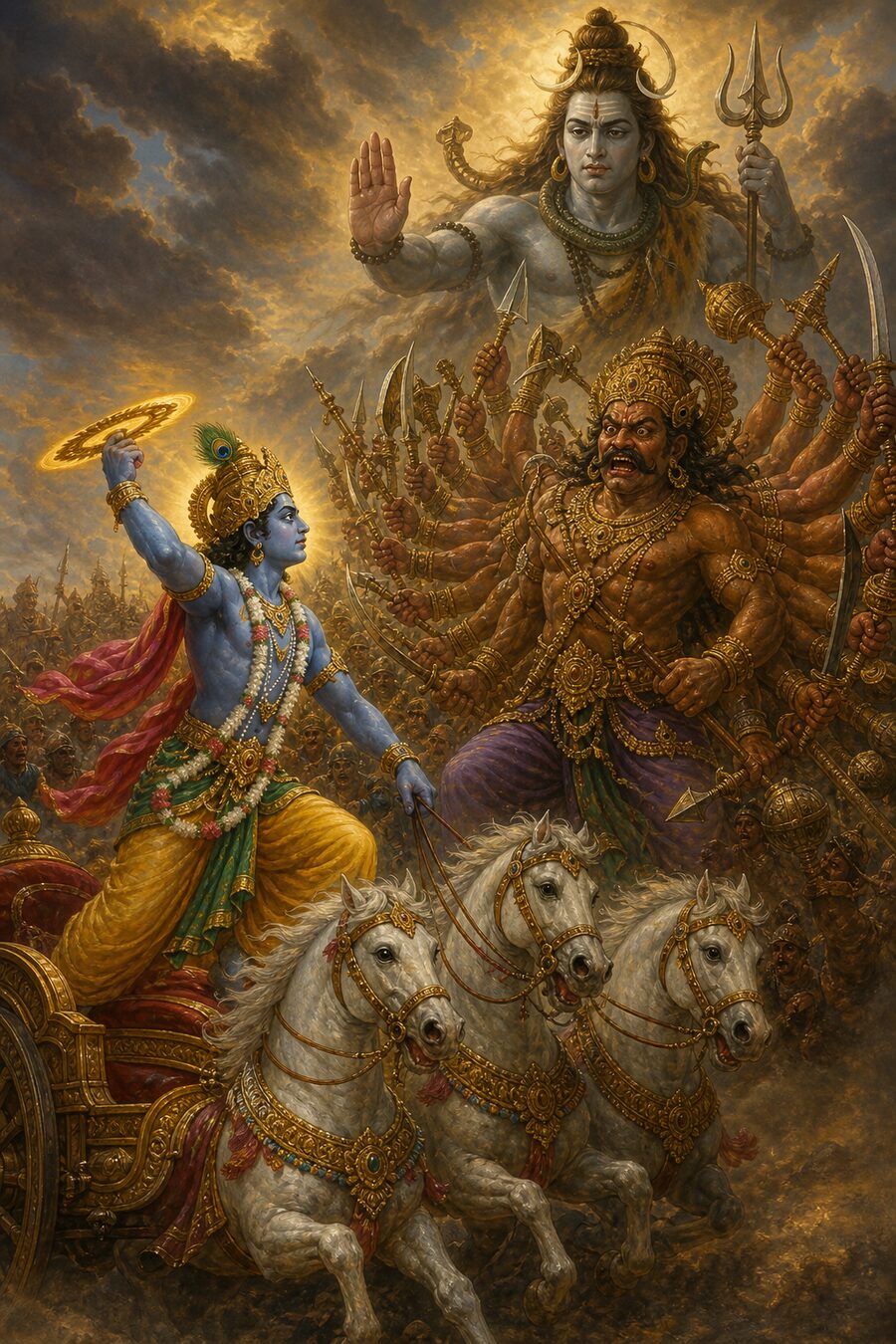
When the daitya-killing discus came back successful into Krishna’s hand, the huge-bodied asura stood in the dust with blood streaming from the stumps of a thousand arms. The smell of it maddened him. He roared, over and over, like a thundering cloud. Krishna heard that lion’s roar and raised the discus again to finish him. And this time Shiva himself came forward, with Kumara at his side. “Krishna, long-armed one, I know you as the eternal God, Purushottama, the destroyer of Madhu and Kaitabha. You are the refuge of the world, and the universe has come forth from you. You are unconquerable to the whole world of gods and asuras and serpents. So withdraw your uplifted discus, that celestial, irresistible weapon, terrible to your enemies. Slayer of Keshi, I promised Banasura my protection, and so I ask you to desist.” Krishna lowered the discus. “God, salutation to you, whom the gods and the asuras adore. I withdraw my discus. At your request, Banasura will live. Maheshvara, at your request I will not carry out the destruction of Banasura, for which I came here. Give me leave now to return.” With that said to Mahadeva, Krishna turned toward the place where Aniruddha waited, bound with arrows. At Shiva’s word, the asura kept the life Krishna had come to take.
After Krishna had gone, Nandi spoke kindly to Banasura. “Banasura, go before the god of gods with these wounds.” Banasura wanted nothing more than to get away quickly, and the mighty Nandi lifted the armless asura onto his chariot and carried him to the rider on the bull. There he gave him one more piece of good counsel. “Banasura, the god of gods is pleased with you. Dance before him, and you will find your well-being.” Urged on by Nandi’s words, the bewildered and terror-stricken danava, wanting only to live, began to dance before Shankara with his body bathed in blood. Mahadeva, ever kind to his votaries, watched the frightened asura dance at Nandi’s urging, and compassion took hold of him. “I am pleased with you. The time has come for you to ask a boon. Ask for the one your heart holds.” Banasura said, “Lord, God, if you wish to give me a boon, grant me one by which I may become immortal and free of fever.” Mahadeva said, “Banasura, you are now like the gods. You will not meet with death. And I am always kind to you, so ask for another boon.”
Banasura asked. “Bhava, let those votaries of yours who dance as I am dancing now, covered in blood and wounds, have sons.” The Lord said, “Those of my votaries who dance so, fasting, patient, truthful, and honest, will have sons. My son Banasura, let your desire bear fruit. Ask for a third boon. I will grant it.” Banasura said, “Bhava, let my body, torn by the discus, find relief by your third boon.” Rudra said, “So it will be. Your body will be freed from pain. It will be healthy and unscarred, as before. I am never unkind to you, and today I am especially pleased with you. If you wish, ask for a fourth boon.” Banasura said, “Lord, let me be the first of the families of the Pramathas, and let me be renowned forever under the name of Mahakala.”
Shankara said, “So be it,” and gave more than he was asked. “Under my protection you will have a celestial form, a body unscarred and free of disease. Living always near me, you will have no fear. I give you this fifth boon as well: you will be famous for your strength and your manliness. Banasura, if there is any other desire in your mind, ask for one more boon.” Banasura said, “Lord, by your favor let my body not be disfigured. Let me not be ugly, even with two arms.” Hara said, “Great asura, there is nothing I cannot give away to my votaries, and you are the greatest of them. What you have wished will be accomplished.” And to Banasura standing beside him, Mahadeva said once more, “Banasura, what you have said will be so.” Then the Lord, ringed by his ghosts, vanished before the eyes of every creature. Banasura lived, stripped of his arms and his arrogance together, and with every promise made on that field unbroken.
Banasura, delighted with so many boons, went away with Rudra in his new dignity as Mahakala. Vasudeva, meanwhile, was asking Narada the same question over and over. “Reverend sir, my mind is overcome with affection. I want to know exactly where Aniruddha is waiting, bound in the noose of serpents. With the heroic Aniruddha stolen away, the whole city of Dwarka is sick with anxiety. I came here for him, and I will set him free at once. I want to see Aniruddha this very day, with his enemies destroyed. If you know the place, tell me.” Narada said, “Madhava, the prince is waiting, bound in serpents, in the women’s quarter.” And at that moment Chitralekha came hurrying up. “Lord, this is the women’s quarter of the high-souled and energetic Banasura, king of the daityas. Enter here freely.” So Baladeva, Krishna, Pradyumna, Narada, and Suparna went into the women’s quarter to release Aniruddha. The moment the huge serpents clinging to Aniruddha’s body in the form of arrows saw Garuda, they let go of him. They slid off his body and dropped on the floor as spent arrows.
Krishna looked at his grandson and spoke to him, and the illustrious Aniruddha, delighted, folded his hands. “God of gods, Keshava, you are always victorious over your enemies. Even Indra of the hundred sacrifices cannot stand before you.” With a glad heart the noble Aniruddha saluted the mighty and illustrious Balabhadra. Then with folded hands he bowed to the great Garuda. Then Makaraketana’s son, that holder of bright shafts, went to his father Pradyumna and saluted him. Usha, in the circle of her friends, saluted the mighty and irrepressible Vasudeva and Suparna of the unhindered flight, and last of all, blushing, she bowed to the holder of the flowery bow, the father of her husband. Narada, bright with joy, came to Krishna then, at Indra’s own request, showered blessings on him, and said, smiling, “Govinda, by good luck you are united again with Pradyumna’s son.” All the Yadavas, Aniruddha with them, saluted the celestial saint, and when he had returned their honors he turned to Krishna with a request of his own. “Lord, celebrate for Aniruddha a marriage won by prowess. I have a great desire to see the two parties, the bridegroom’s and the bride’s, trade their jokes.” Everyone laughed at that, and Krishna said, “Reverend sir, it will be done, and soon.”
In the middle of the laughter Kumbhanda arrived, carrying every article needed for a wedding, and saluted Krishna. “Krishna, long-armed one, promise me safety. With folded hands I seek refuge with you.” Krishna had already halted his departure at Narada’s request, and now, seeing the high-souled Kumbhanda before him, he gave him his protection and more. “Kumbhanda, I have been pleased to hear of your good deeds. You will now be king of this kingdom. I confer it on you. Live forever under my protection, happy and self-controlled, with all your kinsmen.” Having given the kingdom to the high-souled Kumbhanda, the minister who had read the omens true and argued for the boy’s life, Janardana celebrated the wedding festival of Aniruddha. The divine lord of fire, Agni himself, was present in person. When Aniruddha and his wife had bathed and been dressed in their ornaments, the apsaras began to tease him with every kind of joke, the gandharvas sang sweet and auspicious songs, and the apsaras danced, and the wedding party was made beautiful by them, and Narada had exactly the spectacle he had been longing for.
With Aniruddha’s wedding celebrated and Rudra, the giver of boons whom even the celestials adore, duly honored, the wise Upendra, conqueror of enemy cities, made ready to leave in the company of the gods. As Krishna, destroyer of his enemies, was about to start for Dwarka, Kumbhanda came to him with folded hands. “Hear me, lotus-eyed slayer of Madhu. I have something to tell you. Madhava, Banasura has some cows in the keeping of Varuna. They give milk like nectar, and the man who drinks it becomes immensely strong and invincible in battle.” Hari’s heart filled with joy at that, and he said that he meant to go there. Then the divine Brahma blessed Keshava and departed for his own region with those who live in it. Indra and the Maruts, eager to see the victory home, set out for Dwarka, where Krishna lives. Usha, seated by the goddess herself on a peacock and surrounded by her friends, set out for Dwarka too. Baladeva, Krishna, the mighty Pradyumna, and the energetic Aniruddha mounted Garuda’s back, and the foremost of birds rose, uprooting trees and shaking the earth, and as he went the quarters of the sky were thrown into confusion, the air filled with dust, and the sun lost its rays.
Having beaten Banasura, those foremost of men rode Garuda a long way. Traveling far along the path of the upper air toward Varuna’s region, they saw the cows that give celestial milk. Cows of many colors, they were grazing in a forest on the shore of the ocean, and from the signs Kumbhanda had described, the riders knew them at once. Looking down at Banasura’s cows, the eternal Krishna, the first cause of the universe, who knows the essence of things, foremost of strikers, felt the desire to own them, and he said to Garuda, “Garuda, those are Banasura’s precious cows, whose milk makes a man immortal. Go down there quickly. Satyabhama asked me to bring her those cows, whose milk keeps the great asuras from growing old and frees every creature from fever. She asked me to take them if it did not efface virtue, and not to be greedy for them if they stood in the way of my work. Son of Vinata, surely these are the cows Satya spoke of.” Garuda said, “There is no doubt these are the cows. I saw them before in Varuna’s abode. Keshava, the moment they saw me they began making for Varuna’s palace. You must do something at once if you want to own them.”
With that, Vinata’s son churned the ocean with the beating of his wings and went straight into Varuna’s abode. Seeing Garuda force his way into Varuna’s house, all of Varuna’s followers were struck with fear and confusion. Then Varuna’s irrepressible army came out before Vasudeva with every kind of weapon, and they fought a terrible fight with Garuda, the enemy of serpents. Thousands of Varuna’s unstoppable soldiers came to the field, and the high-souled Keshava routed them all. The sixty thousand chariots of Varuna that had come out with burning weapons all fled back into Varuna’s abode, and, burned down by Krishna’s arrows, they broke apart with no one to protect them. That whole army was cut down by the arrows of the mighty Baladeva, Janardana, Pradyumna, Aniruddha, and Garuda.
Seeing his army broken by Krishna of the tireless deeds, Varuna, in a great rage, went to meet Keshava. The lord of the waters came onto the field praised by gods, rishis, gandharvas, and troops of apsaras, with a beautiful yellow umbrella held over his head, water streaming from its edge. Followed by his sons and grandsons and soldiers, he took up his bow in anger, strung it, and challenged Hari to battle. He blew his conch and ran at Hari like Hara himself and covered him with arrows, and the mighty Janardana blew his own Panchajanya and filled all the quarters of the sky with shafts. Hit again and again by those clean arrows, Varuna fought on with a smile. Seeing that, Janardana made ready the dreadful Vaishnava weapon and said to the wise Varuna standing before him, “Wait here a moment. For killing you, I have taken up this terrible Vaishnava weapon, the destroyer of enemies.” Varuna saw it raised and took up his own Varuna weapon, with a lion’s roar. When he loosed it to counter the Vaishnava weapon, torrents of water streamed out of it, and the energy of the Vaishnava weapon set that water on fire. When the Varuna weapon had been burned away and the Vaishnava weapon blazed up again, everyone around them fled in fear in every direction.
Varuna, watching it burn, spoke to Krishna in a different voice. “Great one, remember the manifest Prakriti, which was unmanifest before. Lord of yoga, you are always pervaded by sattva, the quality of light, so why are you possessed now by tamas, the quality of darkness? Cast off tamas, god. Throw off egoism and the other weaknesses born of the five elements. I am the eldest of your Vaishnava form. I deserve your respect as your elder brother, so why do you want to burn me? Foremost of warriors, fire does not turn its power on another fire. Give up the anger you have turned on me. You are the first cause of the universe and there is no one who can lord it over you. Prakriti, who can manifest herself, was created by you in the beginning, and that Prakriti, subject to an end, took shelter in your energy because you are the origin of the universe. Through Prakriti you created this universe, one with Vishnu, Agni, and Soma, so why do you attack it now? Salutation to you, the origin of the elements, self-born, eternal, undecaying, one with all, manifested and unmanifested. Protect me, you of the great radiance, for I deserve protection. You are the first cause of the universe, and through you creation has multiplied itself. As a boy plays with his toys, so you play with your creations. I am not against Prakriti, and I do not corrupt her. You put an end to the changes of nature when she is subject to them. What makes change even in change can make no change in you. You work your changes on the impious and the wicked. When the world is pervaded by the sinful tendencies born of nature, the qualities of rajas and tamas, then stupefaction takes hold of her. Lord, you are the fountain of supreme knowledge, all-knowing, the creator. Why are you stupefying me?”
Krishna, the all-knowing hero, the creator of the world, was filled with joy at those words, and he smiled. “Hero of dreadful prowess, give me these cows, to pacify me.” Varuna, who was clever at speech, answered him. “Hear me, slayer of Madhu. Lord, I made a contract with Banasura. How can I break it now? Keshava, you can make anyone break his promise. But when a person’s character is lost, he becomes an object of censure to the pious. Only the pious deserve respect from all, and the sinful breaker of his word reaches no blessed region. So be pleased with me, slayer of Madhu, and do the thing by which my virtue is not lost. Madhava, you should not set me to a work that leads to a broken promise. You with the eyes of a bull, I promised long ago that while I lived I would never give these cows away. If you want to possess them, kill me and take them. Long-armed one, king of the celestials, slayer of Madhu, I have told you my promise. Not a single part of it is false; every bit of it is true. If you have any pity for me, save me. And if you must have them, long-armed one, my death comes first.”
Krishna, the multiplier of the Yadu race, weighed it, and he could find nothing in what Varuna had said about the cows that could be gainsaid, and so he was silenced. Then Keshava, who understands everything, smiled at Varuna. “Lord Varuna, because of your contract with Banasura, you are saved. More than that, you have told the truth in sweet and charming words. How could I do an injustice to you after that? Lord of the waters, you are truthful, and so, to please you, I let Banasura’s cows go free. And you too are released. There is no doubt about it. Go now.” Varuna sounded his bugles and honored Keshava with the arghya water, and when the Yadu chief had accepted it, the lord of the waters, with a composed mind, honored Baladeva too. Having given Varuna his protection, Shauri, the heroic descendant of Shura, set out for Dwarka with Shachi’s lord, and the devas, the Maruts, the sadhyas, the siddhas, the charanas, the gandharvas, the apsaras, and the kinnaras followed Krishna, the eternal lord of all creatures, along the path of the sky. As Keshava traveled home with victory and fame, the Adityas, the Vasus, the Rudras, the two Ashvins, the yakshas, the rakshasas, the siddhas, the charanas, and the vidyadharas went with him, and the great Narada, who never tires of a quarrel, set out for Dwarka too, delighted to have seen both Banasura and Varuna beaten in one journey.
From far off, Keshava, holder of discus and club, saw the city of Dwarka with its many gates and its beautiful blue-turreted palaces like the summits of Kailasa, and he blew the Panchajanya. The blare of that conch had always announced Keshava’s comings and goings, and with it he told the people of Dwarka that he was near. Hearing it, the citizens dressed their houses with heaps of flowers, jars full of water, and parched rice. The streets of that prosperous city, rich with gems, were swept clean. The Brahmins and the elders came out with arghya, crying his victories, and honored Madhava. The people bowed to Krishna, beautiful as a mass of dark collyrium, seated on Vinata’s son, and the kshatriyas, the vaishyas, and the shudras, each in their order, honored the mighty Ananta, the slayer of Keshi. Resting in a garden of Dwarka, the lotus-eyed Madhava was praised by the rishis, the gods, the gandharvas, and the charanas. Seeing those wonders, and seeing the long-armed Krishna home, the great Dasharhas reached a height of joy.
The people of Dwarka watched Purushottama come home after defeating Banasura and talked of a dozen things at once. When the great Krishna, greatest of the chariot-warriors of the Yadavas, had come back from that vast distance which only Suparna could have carried him across, they said to one another, “Blessed and favored are we, since the kind lord of the universe, the long-armed and mighty Krishna, is our protector. Riding on Vinata’s son, the lotus-eyed god defeated the irrepressible Banasura, and now, returning to Dwarka, he has gladdened our hearts.” While the people of Dwarka talked so, the gods, those great chariot-warriors, entered Vasudeva’s palace, and Vasudeva, Baladeva, Pradyumna, and Aniruddha climbed down from Garuda’s back and went in. Celestial chariots of every shape were seen moving about in the sky then, drawn by swans, by bulls, by deer, by elephants, by horses, by sarasa cranes, and by peacocks, thousands of them, and they made a great beauty over the city.
Then Krishna, in sweet words, instructed Pradyumna and the other princes. “Salute them in their due order, these Rudras and Adityas who have come here. All of you, salute the thousand-eyed one who has come with his followers and his dreadful danavas. The seven great rishis, the other saints, and these holders of the discus have all come here to please me; honor them all. The oceans and the quarters of the sky have come here to gratify me; honor them in their due order. The great serpents led by Vasuki, and the cows, have come here to please me; honor them in due order. The yakshas, the rakshasas, the kinnaras, the stars and the other heavenly bodies have come here to please me; honor them in their due order.” Hearing Vasudeva’s words, the princes saluted the high-souled gods in their proper order and stood before them. The citizens, seeing the celestials, hurried together the articles for worship, filled with wonder. “Oh, under Vasudeva’s protection we have seen this great wonder, here, in our own city.” They showered flowers and scents and powdered sandal and honored the gods, and the rest of the people of Dwarka, with their senses and their minds controlled, worshiped the gods with parched rice and incense and prostration.
Then Vasava embraced Ahuka, Vasudeva, Samba, Satyaki, Nishatha, Ulmuka, the mighty Viprithu, and the great Akrura, one after another, and smelled their heads in the old gesture of a father’s love. Then, in the midst of the Yadavas, the great Shakra spoke of the slayer of Keshi, who deserved every word. “This foremost of the Satvatas and the Yadus has displayed his glory and his manliness on the field of battle in releasing Aniruddha. He defeated Banasura on the field before the eyes of Mahadeva and Guha, and he has come home to Dwarka. He reduced the asura’s thousand arms to two, and having left him with only two, Hari has returned to his own city. Every one of the works for which the high-souled Krishna was born in the land of men has been accomplished, and we have been delivered from sorrow. Drink Madhvika wine without a care. Enjoying the things of this world like that, you will be able to spend your days in happiness. Under the protection of this high-souled one, I too, free of grief, will live happily among the celestials.” Having sung the glories of the great Keshava, destroyer of danavas, adored by the world, the thousand-eyed Purandara, ringed by the gods, embraced him. Then, with Krishna’s leave, he set out for heaven with the gods and the Maruts, and the great rishis, having honored the mighty Keshava with blessings of victory, went off with the yakshas, the rakshasas, and the kinnaras to their own quarters. After Purandara had left for heaven, the mighty lotus-naveled lord asked after the well-being of everyone around him, and on every side a crowd pressed in, jostling to see the moon of Keshava’s face. Seeing their devotion, the sinless Keshava was greatly pleased. So Krishna came home to Dwarka with every object of his desire, with riches and prosperity, and lived happily among the Yadavas.
Then the long-armed Ahuka, his eyes wide with joy, said to the blazing Krishna, “Descendant of Yadu, hear what I say. My child, seeing you safely home, we are all celebrating with the apsaras. Hold a great festival for Aniruddha’s return and his wedding. United with Aniruddha and surrounded by her friends, the great Usha is living in the greatest happiness. Vaidarbhi says that the fine daughter of the high-souled Kumbhanda should be enrolled as Usha’s companion. Give that charming and beautiful daughter of Kumbhanda now to Samba, and let the remaining maidens be duly given to the other princes. Let there be a great festival in your house and in Aniruddha’s. Listen: the sweet-voiced girls are playing on their instruments in the inner apartments. Some are dancing and others singing. Some are chattering happily with one another, and some, in garlands and bright clothes, are wandering here and there. Some, a little drunk with wine, are going to the others, and some, their eyes wide with joy, are playing at dice. Usha is in the circle of her companions. Bring her into the palace. The beautiful and noble daughter of Banasura, Usha by name, is a worthy daughter-in-law of your house. Welcome her with all dignity.”
When Ahuka had said that, the women of the house, performing the blessing rites as the ritual books lay them down, led the beautiful Usha to Aniruddha’s house. At the sight of Aniruddha, Devaki, Revati, and the Vidarbha princess Rukmini shed tears of joy. As Usha was led into the room, the beautiful girls blew their bugles and performed the rites of blessing, and the beautiful Usha, sheltered by the Yadu chiefs, lived in their palace and enjoyed the best of happiness. After a few days the apsara Chitralekha, who had been living there in the guise of an ordinary woman, took leave of Usha and her other companions and set out for the celestial region. When the companions had gone, Mayavati was the first to invite the beautiful asura princess Usha to her own house, and seeing her young and lovely daughter-in-law, Pradyumna’s wife welcomed her with costly jewels and dresses. Then, following the custom of the family, all the ladies of the Yadu house received the new daughter-in-law as she deserved. The story that had opened in a dream closed at a wedding, and the long war, for all its fire and its clashing gods, had done in the end the quiet work of bringing two people together.
Source: Harivamsha (the khila-parva of the Mahabharata), Vishnu Parva, chapters 105 to 113; chapter numbers of the critical edition (P. L. Vaidya, Bhandarkar Oriental Research Institute, Pune). Told as story from chapters 263 to 277 of M. N. Dutt’s English translation (1897), which follows the vulgate text, keeping its sequence of events.
The same story, elsewhere
- Banasura and Aniruddha
Shrimad Bhagavatam (Skandha 10): Banasura and Aniruddha, with Shiva standing guard - Banasura
Shiva Purana: Banasura, devotee of Shiva, and the boon of a thousand arms