On this page
That night, inside the palace of Shonitapura, there was no enemy and no army. Bana, lord of the daityas, danced alone. A thousand arms kept the measure above him, clapping the beat he moved to. His feet stamped the ground and he went under, drowned in the surge of the taandava. One reason lay behind all of it, to delight his chosen god, Maheshwara. And Shankara, who cherishes those who love him, was truly gladdened by that dance, and turned on the dancer a long look of plain affection.
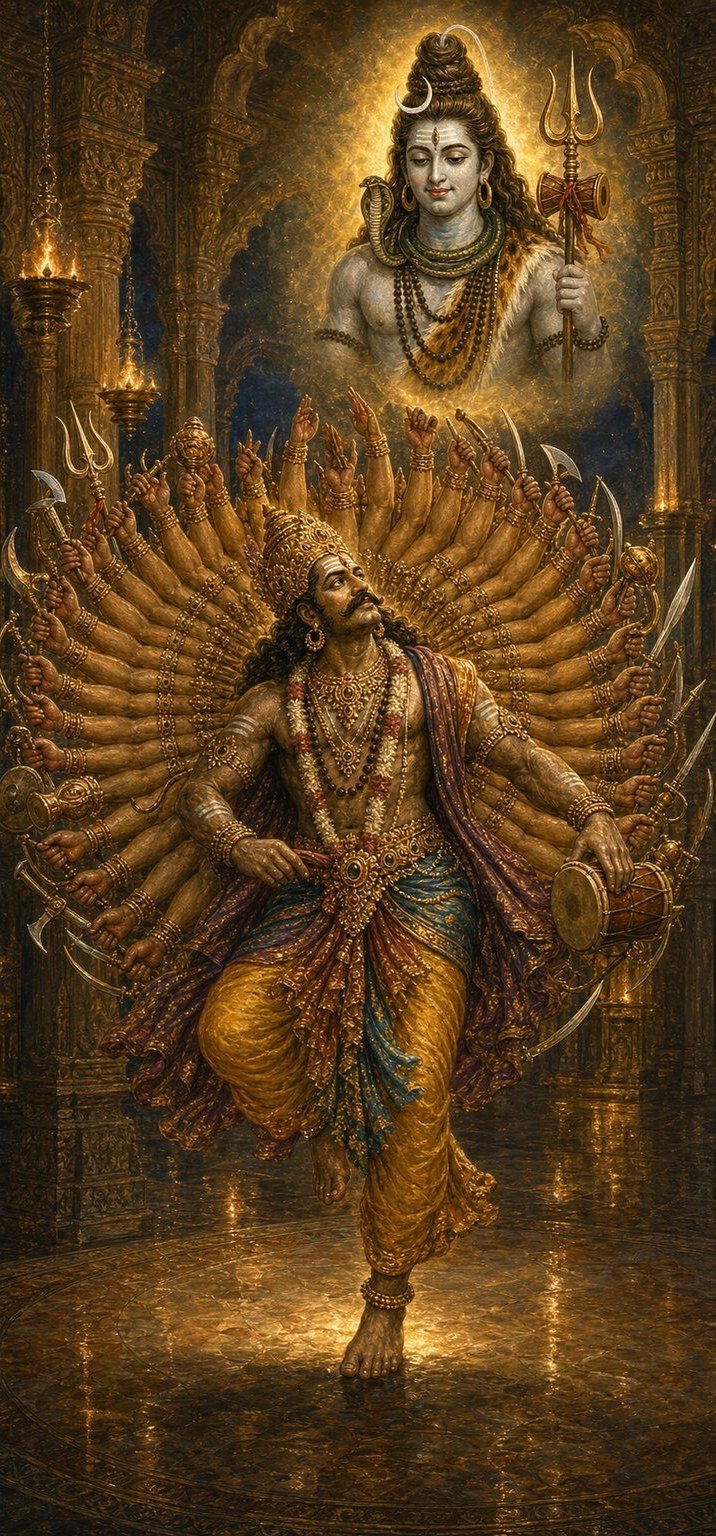
The Lord of Shonitapura
Bana was no ordinary asura. In the line of Diti had come Hiranyakashipu, and of his four sons the last-born, Prahlada, turned out to be a devotee of Vishnu. Prahlada’s son was Virochana, the most excellent of all givers, who handed over even his own head when Indra came asking for it in the borrowed shape of a Brahmin. Virochana’s son was that great giver Bali, dear to Shiva, who once gave away the whole earth to Vishnu in his dwarf form, Vamana. Bana was the true-born son of that same Bali. He was a devotee of Shiva, proud, generous, and faithful to his word. He had conquered the three worlds and their rulers by force and made Shonitapura his capital. Such was Shankara’s grace upon him that even the gods had become something like servants to this devotee of Shiva; in his kingdom no subject knew sorrow, save the gods themselves, who suffered his enmity even while granting that the man kept every virtue.
Pleased by that dance, Shankara told him to ask for a boon. Shiva is hard to please, and had Bana named liberation itself it would have been given. His mind was clouded by Shiva’s own maya, and nothing of the kind occurred to him. “Lord,” he said, “become my protector. Take charge of my city, with your sons and your ganas, and live here beside me forever.” Shambhu, tender toward his devotees, granted the boon, and took up residence in Shonitapura with his sons and his hosts, and stayed on there lovingly.
The Burden of a Thousand Arms
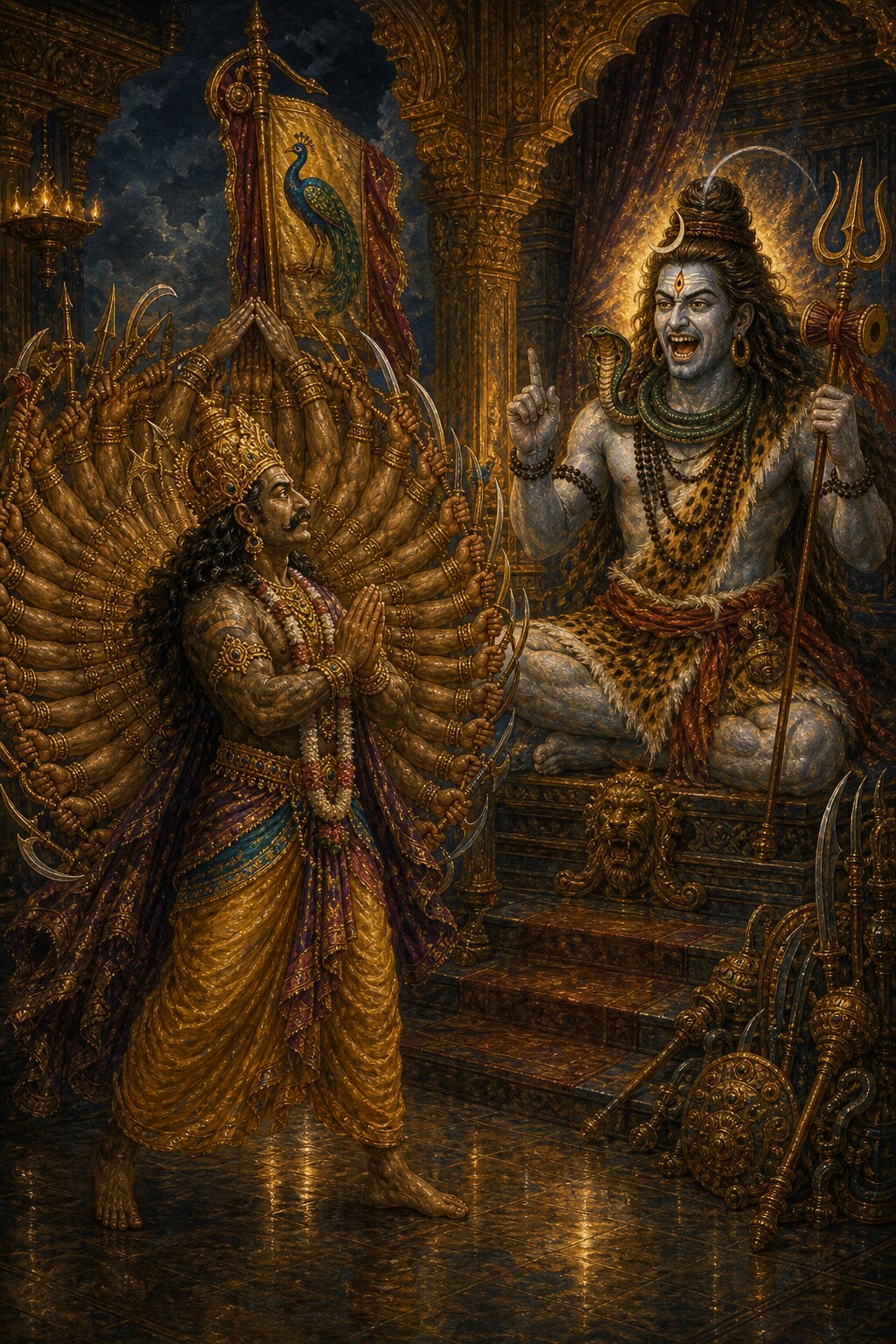
But pride swelled alongside his splendor. One day, having satisfied Shiva with his dance and knowing that the beloved of Parvati was pleased, Bana folded his hands, bent his great shoulders, and spoke. “God of gods, by your grace alone I became mighty. Yet these thousand arms you gave me have begun to feel like a weight, for in all three worlds I can find no warrior who is my match, none but you. What am I to do with these mountainous arms if there is no war for them? When they itch, I go looking for the elephants that hold up the quarters of the sky, and I have ground cities and mountains to dust on the way to them, and even those elephants turned and fled. Yama I keep to spar with, and Agni beside him. Varuna, lord of the waters, walks behind my cattle now and counts them home. Kubera, who counts nine treasures, sees to my couches. Nirriti waits at the door of my women’s rooms. Indra I beat, and Indra pays me tribute. Now name me a war in which either these arms fall, worn down by an enemy’s weapons, or I strike down my enemies’ arms by the thousand.”
Hearing this, Chandrashekhara, whose very form is great wrath, felt anger stir in him. He laughed a terrible laugh. “Fie on you, you arrogant one. You are the son of Bali and my own devotee; such words do not become your mouth. Your conceit will be crushed now. Soon, and with no warning, you will meet a great and dreadful war against one as strong as I am, and in that battle these mountainous arms of yours will be cut away by weapons and missiles and fall to the ground one by one, the way reeds go down, the way a plantain trunk shears through. Your armory carries a banner with a peacock on it, and the peacock wears a human head. When that staff topples on its own, with no wind anywhere to move it, know then that the war has arrived. Go to it with every general you have.” Having said this, Shankara, the breaker of pride, fell silent.
Usha’s Dream
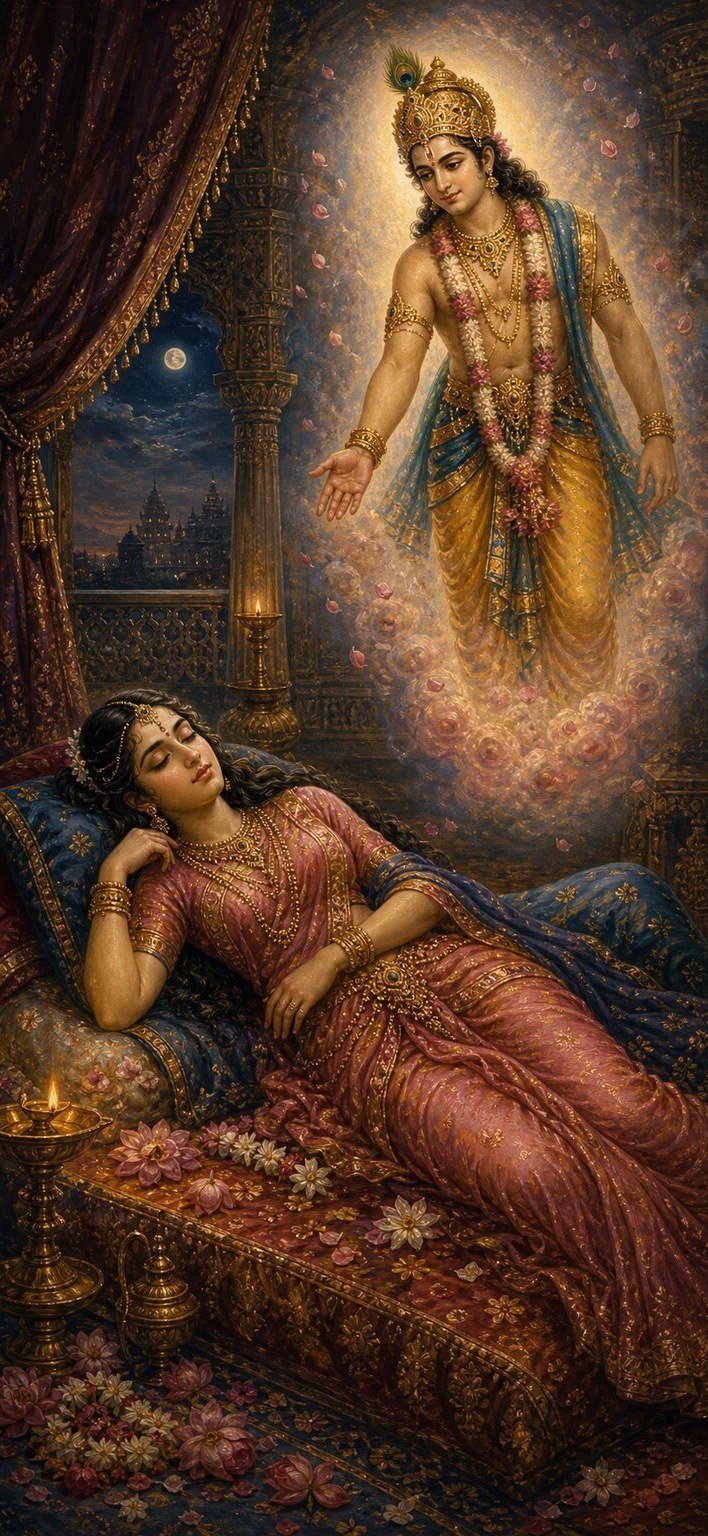
Bana went home and told Kumbhanda, his minister, every word of it, and settled down to wait. Time passed, and one day the banner truly did snap and fall with no wind to touch it. Bana rejoiced. He called his army together, made the sacrifice for success in war, and set out. Yet the danger came through a very different door. In the month of Vaishakha, after worshiping Madhava and adorning herself with festive ornaments, Bana’s daughter Usha lay asleep in her secret inner chambers. That very night, by the power of the goddess Parvati, she met Aniruddha, the grandson of Krishna, in a dream. She woke crying, and before that first day was out she had decided to be done with her life; Chitralekha, her friend, talked her back from it. After that Usha pressed her again and again to bring her that man from the dream.
Chitralekha was the daughter of the minister Kumbhanda, and very clever. She took a canvas and began to draw the likenesses of gods, daityas, gandharvas, siddhas, nagas, yakshas, and men. When she came to the Vrishni line and sketched Shura, Vasudeva, Rama, Krishna, Pradyumna, and then Pradyumna’s son Aniruddha, Usha shrank with shy confusion at the sight of him. “The one who came to me in the night and stole the jewel of my heart as dawn broke, this is the thief,” she said. The yogini Chitralekha went out along the path of the air and reached Dwarka in the third watch of the night. She found Aniruddha in the garden of the inner palace, dark of skin and beautiful in every limb. She waited until he lay down, wrapped him in a darkness of her own making, lifted the bed with him still on it onto her head, and carried it away.
The men at the door of the inner chambers were old, their hands thin on their canes, and from small signs they worked out that a young man was inside, handsome and daring and fond of a fight. They ran to Bana. “Lord, no one knows how it was done. Indra has come into your harem in secret and taken your daughter by force. The fault is not ours.” Enraged, Bana came in person. First he sent ten thousand soldiers; Aniruddha tore the great iron club off the harem gate and handed all ten thousand over to death in a single moment. Army after army came on, and army after army was cut down, until a hundred thousand lay dead and Bana entered the fray himself with Kumbhanda beside him. Then Aniruddha raised a weapon as terrible as the fire that ends the age and struck at Bana, who sat upon his chariot. Wounded to the bone, Bana vanished from that place at once, horses and all. Then came the trick: the son of Bali stayed invisible and hit him from nowhere until he could bind him in the nagapasha, the serpent-noose, and cast him into a cage.
In his fury Bana ordered the prisoner shoved into a deep well covered over with straw and grass, and killed there. But his minister Kumbhanda, a man of righteous mind, stopped him. “My lord, consider a moment. Killing him is how we kill ourselves. In form and complexion this one looks like Vishnu himself, and his strength has been raised by the splendor of the moon-crested lord, your own beloved. Even as the serpents bite him he treats us as though we were blades of grass; it is not right to kill such a hero.” Then he spoke to Aniruddha as well. “Base man, praise the lord of the daityas, admit defeat, and fold your hands to him; your freedom lies in that. Otherwise this cage and these torments go on.” Aniruddha flared and answered, “Vile night-stalker. For a man of courage, begging and running from the field go in like a dart and are worse than dying. For a kshatriya, the honor is to die fighting face to face on the field of battle. To lie on the ground with folded hands and die like a beggar, never.”
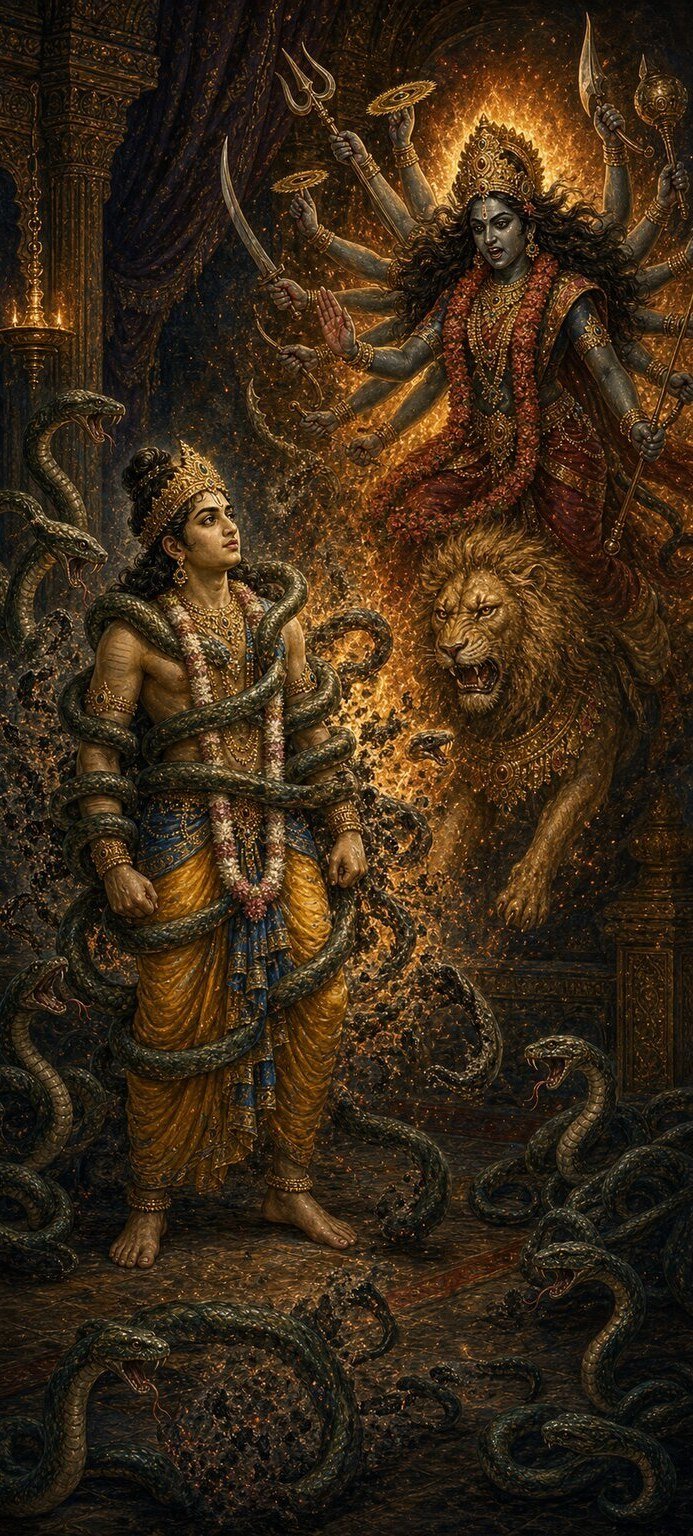
Just then a voice came from the sky, and all of them stood still to hear it. “Mighty Bana, you are the son of Bali; think for a moment. Shiva is the lord of all beings, the witness of every deed, the supreme god; this entire world lies under his sway, and he alone makes the worlds, keeps them, and ends them. By his will even the weak grow strong. Shankara, the master of divine play, will crush your pride this very hour.” Hearing this, Bana let go of the thought of killing. Meanwhile, bound in the nagapasha with the poison working in him, Aniruddha remembered Durga. “You who cherish all who take refuge in you, I am bound in the serpent-noose and burning in the flame of venom; there is no other savior anywhere; come quickly and protect me.” On the great night of Krishna Chaturdashi, in the month of Jyeshtha, Kalika appeared, dark and shining like a broken stick of collyrium. She burned those fearsome serpents to ash, broke the cage open with her fists, tore the nagapasha to pieces, freed Aniruddha from his bonds, and returned him to the inner chambers. Free once more, Aniruddha lived happily with his beloved Usha.
Krishna Comes to Shonitapura
Meanwhile the news reached Krishna from the mouth of Narada, that Aniruddha lay bound in Bana’s nagapasha. Krishna called for Garuda and marched upon Shonitapura with twelve akshauhinis of army and with heroes such as Pradyumna; they ringed the city until Bana came out raging with an army to match. On the other side, Lord Rudra mounted the bull Nandin and rode out with his son and his Pramathas to stand for his devotee. Then a great and dreadful war broke out between Krishna and Shiva. Fever weapons were loosed from both sides, and Krishna’s cold fever cried aloud under Shiva’s fever, found help nowhere else, and turned and praised the bull-bannered lord, who was pleased and let it go. Krishna’s army could not stand in the full light of Shiva and broke and ran. Then Krishna, dismayed by that splendor, told his charioteer Daruka to drive him to Shiva, and he came to Rudra himself and praised him. “All-pervading Shankara, untouched by the qualities of nature, you are the one who makes those very qualities shine. You alone break pride; and it was you who gave this proud Bana his boon, and you who cursed him. So it is by your own command that I have come to cut off his arms. Mahadeva, withdraw now from this war, and grant me leave to undo his pride.”
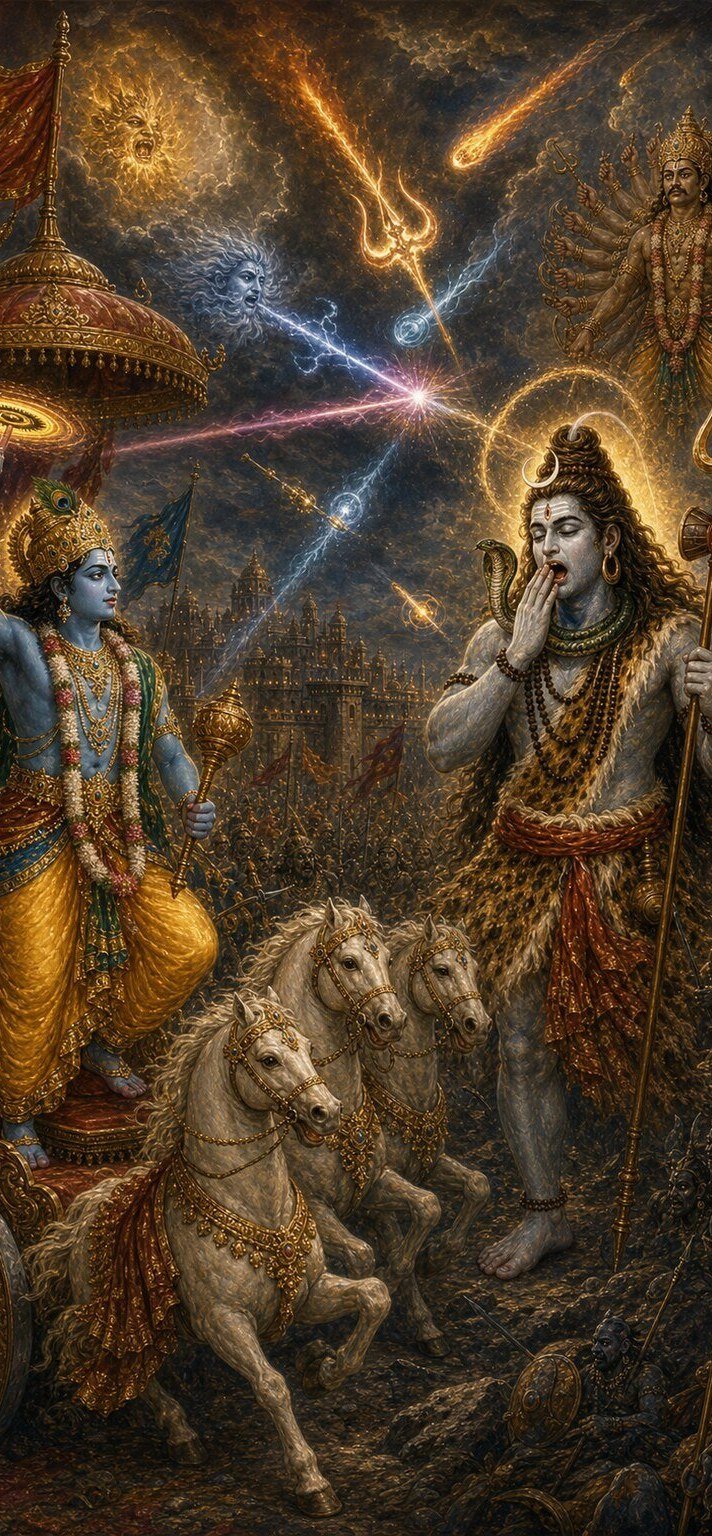
Maheshwara said, “Dear one, you have spoken rightly. It was I who laid this curse upon him, and it is by my command that you have come to cut off his arms. Yet what can I do? I remain always bound to my devotees; how can Bana’s arms be cut while I look on? So first make me yawn with the jrimbhanastra, the weapon of yawning, and then finish the work you desire and be happy.” At these words of Shiva, Shri Hari, who bears the Sharnga bow, was filled with wonder. He went back to the field glad, set the jrimbhanastra to his bow, and loosed it upon the bearer of the Pinaka; and seeing Shankara overcome by a yawn and sunk into a spell of sleep, he began to destroy Bana’s army with his mace and his other weapons.
Four Arms
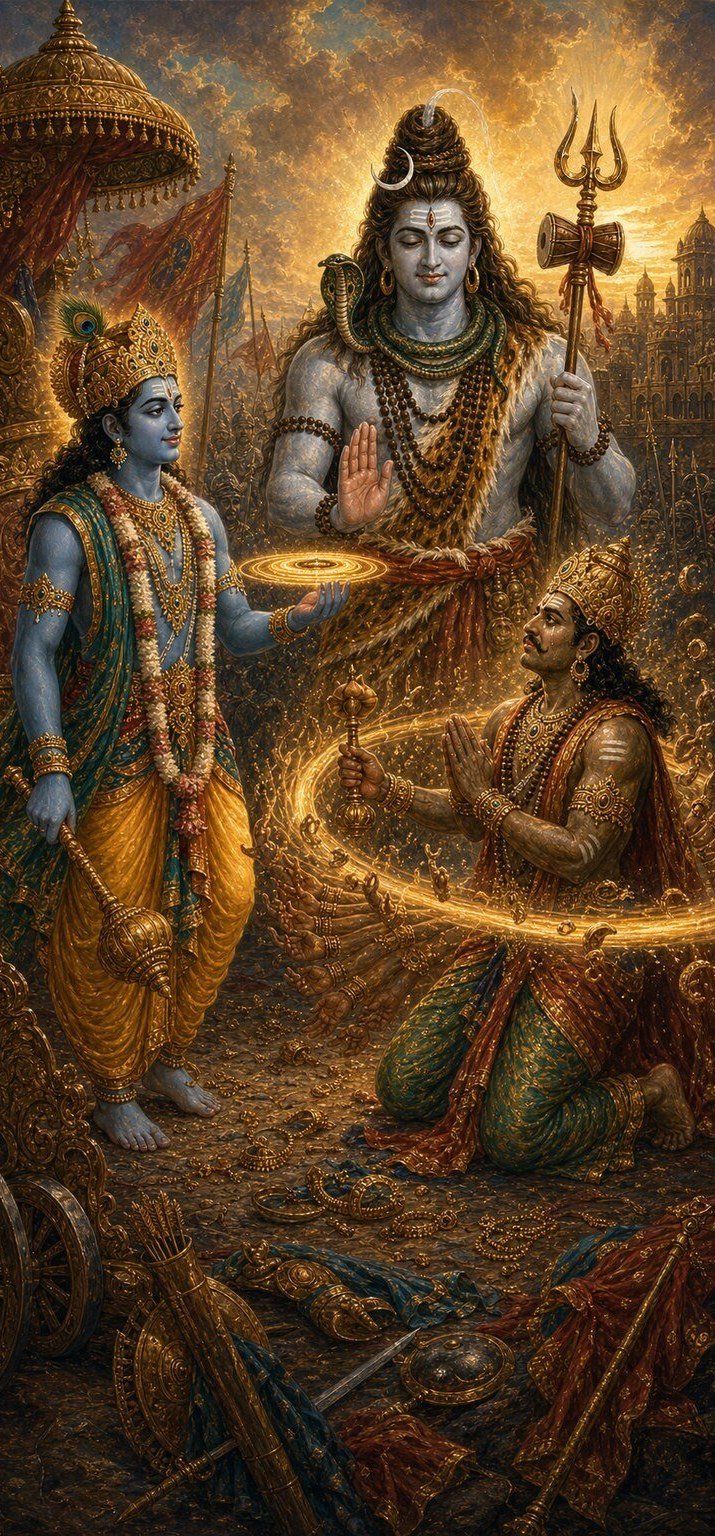
Now Bana himself pressed forward into the battle, with Kumbhanda holding the reins of his horses. Bana and Krishna fought, and each of them, before he loosed, was thinking of the lotus feet of Shiva. The fierce fight between Krishna and Bana ran on for a long time, because Krishna, the avatar of Vishnu, was Shiva’s own form, and Bana too was a supreme devotee of Shiva. Krishna split Bana’s bow and his umbrella and brought his horses down under him. Bana swung his iron club and struck Krishna, and Krishna fell to the ground; he rose at once and fought on, keeping up the play of the world. At last, in his anger, Krishna cut away many of Bana’s arms with the Sudarshana chakra; only four beautiful arms remained, and by Shankara’s grace even his pain was gone. When Bana lost his senses and Krishna made ready to cut off his head, Shankara rose from his spell of sleep and spoke. “Son of Devaki, the task I commanded, you have carried out. Do not behead Bana now; call back the Sudarshana. At my word that discus will never bite on my own people. It was I who gave you that discus, and the victory that goes with it. I have given him a boon that he need never fear death; that word of mine must remain true.” Then he looked toward Bana and said, “Once you scratched your arms and called for a battle, and I cursed you then. It was by my own command that Shri Hari came to cut off your arms. Now leave the field.” With these words Maheshwara made friends of the two, and went back to his abode with his sons and his ganas. Krishna called back his chakra. He reassured Aniruddha and Usha, accepted the jewels Bana offered, was pleased to gain the yogini Chitralekha, and returned to Dwarka with the bride and groom and all their family.
The Boon of Mahakala
Bana was alone now, yet he did not break. Nandishvara found him with blood drying on what was left of his arms, and counseled him. “Tiger among devotees, do not sit in your regret. Shiva is called Bhaktavatsala because he is tender to those who love him, and whatever has happened has happened by his will. Fix your mind on Shankara, the first guru, and remember him every day.” Free of all enmity, Bana went to the abode of Shiva, bowed, poured out his grief there, and praised him with hymns. Then he began the great taandava, beating time with his feet, wheeling his arms, arching his brows, and tossing his head. His blood spotted the ground as he danced. Sounding a thousand kinds of music from his own mouth, the devotee danced with such feeling that he lost track of himself entirely, and Chandrashekhara, who bears the trishula, was pleased. Delighted, Hara said, “Dear Bana, son of Bali, I am satisfied with your dance; whatever you desire, ask for it as a boon.”
Bana asked, “Let the wounds of my severed arms heal; let my skill in armed combat remain; grant me undying leadership among your ganas; let the kingdom of Shonitapura pass to Usha’s son, my grandson; let my enmity with the gods, and above all with Vishnu, be wiped away; let no corrupt asura nature ever wake in me again; let a pure and untroubled devotion to Shambhu endure in me forever; and let my affection for Shiva’s devotees and my compassion for all living beings remain.” Then he praised him as the kinsman of the distressed and the storehouse of mercy, who had taken pity on him and, in his gladness, taken his arrogance away. Having asked for this boon, Bana, his eyes filled with tears of love and every limb of him blossoming, bowed to Maheshwara and fell silent. “May all of this be yours,” Shankara said, and vanished on the spot. And Bana, once the proud lord of the daityas, attained the state of Mahakala, the deathlessness of endless time, and came to be counted among the ganas of Rudra.
Source: Shiva Purana (Gita Press, Sankshipta Shivapurananka), Rudra Samhita, the fifth (Yuddha) Khanda
The same story, told elsewhere
- Banasura and Aniruddha
Shrimad Bhagavata (Canto 10): Banasura and Aniruddha, and the shelter of Shiva - Harivamsha, the War with Bana (Usha and Aniruddha)
The Harivamsha’s war with Bana (Usha and Aniruddha)