TulsidasRamcharitmanasthe first sopan
The opening invocation, the story of Shiva and Parvati, the birth of Rama, four weddings at Janakpur, and Ayodhya’s welcome home.
The first sopan of the Ramcharitmanas is the longest of the seven. Its first forty-three dohas belong to the poet. He bows, confesses, argues for the name of Rama. He draws the lake he has made of his poem. Then a sage’s question at Prayaga opens the story. It runs through Shiva and Sati on a forest road and Parvati’s tapas and wedding. Shiva’s telling of the causes of the descent follows. Narada’s delusion before a princess, the prayer of Manu and Shatarupa, and the story of Pratapbhanu among them, until the Earth cries out. Then Rama appears before Kausalya. Bhakti, trust, discernment, and the cost of a mistake come into view on the way.
The child’s play in Ayodhya, the brothers’ journey with Vishvamitra, the sacrifice guarded, and a stone that rises as Gautama’s wife bring the story to Janakpur. It is Janaka’s city in Mithila. The city and its flower garden, the mind of Sita, the breaking of Shiva’s bow, and Parashurama’s quarrel with Lakshmana. After the four weddings the story runs on through the farewell from Janakpur, Ayodhya’s welcome, the mothers’ questions, and Vishvamitra’s leave-taking. Each of the forty-two episodes has a page of its own. There Tulsi’s chaupais and dohas, read with Hanuman Prasad Poddar’s Hindi commentary, are told as a story in English prose.
Read it episode by episode
- The Invocation, the Guru, and the Good and the Wickeddoha 1 to 7
Seven Sanskrit shlokas whose first word is a word for letters. The dust of a guru’s feet that ends as collyrium on the eye. And a bow to the feet of the good and the wicked alike. - The Poet’s Humility, and a Salute to All Who Carry the Storydoha 8 to 15
A man counts his own faults, writes his name at the head of a list of cheats. Then he bows in turn to the poets, the sage who made the Ramayana, the Vedas, Brahma, the planets, Sarasvati, and Shiva and Parvati. - The Last of the Salutations, and the Power of Rama’s Namesortha 16 to doha 25
The salutations come home to Ayodhya and the Sarayu, the brothers, Hanuman, and Sita and Rama together. Then a bow to a name of two letters. And the poet’s argument, disclaimers and all, that it stands above the one it names. - The Might of the Name, and Tulsidas’s Own Storydoha 26 to 33
The name at work on Shiva, on a courtesan and an elephant, and on the poet himself. The one support left in the Kali age. And the boy at Sukarkhet who, being a child, did not understand this story well. - The Lake of the Manasdoha 34 to 43 (b)
The day and the city in which the poem begins, the name Shiva gave it. And that name taken apart into a lake with four ghats and seven steps and a river of poetry running out of it. - Bharadvaja’s Question, and the Doubt in Sati’s Minddoha 44 to 55
At Prayaga a sage is afraid and ashamed to put his doubt to his teacher. The answer is someone else’s doubt: the one that sent Sati down a forest road in the Treta age in Sita’s form. - Shiva Lets Sati Go, Daksha’s Sacrifice, and Sati Gives Up Her Bodydoha 56 to 64
A husband who decides in his own mind and never says so. A samadhi of eighty-seven thousand years, each day an age to the wife he has let go. And in her father’s assembly her body given up in the fire of yoga. - Parvati’s Birth, Narada’s Prophecy, and Her Hard Tapasdoha 65 to 74
A daughter is born to Himavan. Narada reads the line in her palm and describes the husband written there. Her parents’ faces fall and the girl is glad. Then a tapas so hard that she gives up even leaves. - Rama’s Request, the Seven Sages’ Test, and Parvati’s Answerdoha 75 to 81
A voice from the sky gives the coming of seven sages as its own proof. Rama asks Shiva a favor and Shiva takes it as his master’s command. The sages mock a girl on purpose, to see if she wavers. - Kamadeva Burned, and the Boon to Ratidoha 82 to 89
To kill the asura Taraka a son of Shiva is needed. For the son, a wedding. For the wedding, a samadhi broken. The one sent to break it sets out thinking in his heart that opposing Shiva is certain death. - Shiva’s Wedding Procession, and Maina’s Lamentdoha 90 to 98
Frost cannot come near fire, Parvati tells the sages. Then the procession arrives, the city’s children run from it. A mother takes her daughter into her lap and curses the creator for the groom he made. - Shiva Weds Parvati, and Her Question About Ramadoha 99 to 109
A groom who remembers his own Lord before he takes his seat. A mother who sets her grief aside at the parting. And under a banyan on Kailasa the question that opens Shiva’s telling of Rama’s story. - Shiva’s Answer, and the Glory of Rama’s Storydoha 110 to sortha 120 (d)
Parvati doubts her fitness to ask before she asks. At her question all of Rama’s deeds rise in Shiva’s heart and he sits lost in meditation. Then he scolds the one doubt he disliked, and begins. - Why Vishnu Descends, the Pride of Narada, and Vishvamohinidoha 121 to 131
Among the causes of the descent, Narada’s: a samadhi Kamadeva could not shake, Shiva’s warning unheeded. Vishnu’s vow to work his servant’s good, and a princess at whose sight the sage forgets his dispassion. - The Svayamvara, and Narada’s Two Cursesdoha 132 to 138
Narada asks Vishnu for his beauty and receives his good, a monkey’s face that only the princess sees. Two of Shiva’s attendants laugh. The laughter stops at a face seen in water, and two curses follow, for them and for Vishnu. - The Tapas of Manu and Shatarupa, and Their Boondoha 139 to 152
Six thousand years on water, seven thousand on air, ten thousand on neither. Boons from Brahma, Vishnu, and Shiva that cannot move them. A prayer to see the Lord with eyes filled. And when he comes with Sita, the asking: a son like him, and the life his own devotees live. - Pratapbhanu’s Hunt, and the False Asceticdoha 153 to 160
The conqueror of the seven continents follows a boar into deep forest until he is alone. In the hermitage where he is given water and a seat, the host knows who he is, and he does not know the host. - The False Ascetic’s Boon, and the Plotdoha 161 (a) to 170
A body free of age and death and sole rule of the earth for a hundred kalpas, with one exception, the anger of brahmins. The man the king calls his only well-wisher builds a plot out of that exception. - The Brahmins’ Curse, and the End of Pratapbhanudoha 171 to 176
A rakshasa in the priest’s form cooks a tainted feast for a hundred thousand brahmins. A voice from the sky stops the meal, and the brahmins curse the king. A second voice says he did no wrong. In time the king becomes Ravana, his brother Kumbhakarna, his minister Vibhishana. - Ravana’s Boons, Lanka, and the Terror of the Three Worldsdoha 177 to sortha 183
Three brothers win boons, and Ravana’s leaves out only men and monkeys. A fort on Trikuta ringed by the sea becomes his capital, and the Pushpaka is taken from Kubera. From his assembly he sets his race against the rites until the Vedas are not heard even in a dream. - The Earth Cries Out, and Dasharatha’s Rite for Sonssortha 184 to doha 189
The Earth, too afraid of Ravana to speak, weeping before the gods in a cow’s form. Shiva’s word that the Lord appears through love. A voice promising a human birth in the sun’s line. And a king grieved that he has no son, who goes to his guru. - Rama Appears, and the Four Brothers Are Nameddoha 190 to 197
At noon on the ninth of a holy month a four-armed form appears before Kausalya and at her plea becomes a crying infant. Ayodhya keeps a festival through a day a month long. The guru gives the four brothers their names. - The Child’s Play, and the Universe Kausalya Sawdoha 198 to 204
A mother lays her son in the cradle and comes back from the kitchen to find him eating. Two children, then universes past counting on every hair of one. And the same boy running off from his meal with curd and rice on his mouth. - Vishvamitra Comes, Tataka Falls, and Ahalyadoha 205 to 211
A sage asks a father for two sons and is offered everything else first. One arrow ends Tataka, and Maricha is flung a hundred yojanas over the sea. In an empty hermitage a woman appears from a stone at the touch of Rama’s feet. - Janakpur’s Splendor, Janaka’s Welcome, and a Walk Through the Citydoha 212 to 220
Two brothers reach a Janakpur of jeweled steps and painted houses. A king whose mind is dispassion itself lets go of the bliss of Brahman at the sight of two boys. A wish Lakshmana will not speak takes them through a city that runs to look at them. - Seeing the City, and Janakpur’s Lovedoha 221 to 226
One woman of Janakpur calls the dark brother the groom fit for Sita, and others speak of a king’s vow and a hard bow. The city’s children show Rama the ground made ready for the bow-sacrifice. In the night the guru’s feet are pressed, and then Rama’s. - The Flower Garden, the First Glance, and Sita’s Prayer to Gauridoha 227 to 239
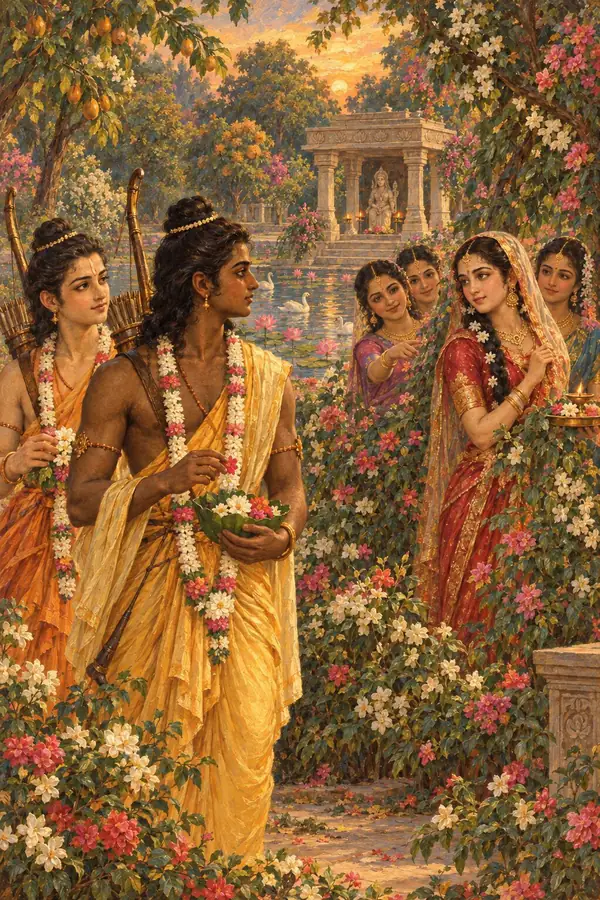
Two brothers gathering flowers for their guru one morning. Sita, sent by her mother to worship Parvati. A gaze through the creepers, with no word between them. A garland that slips and an image that smiles. And by night a moon Rama weighs against her face and finds wanting. - The Assembly at the Arena, and the Talk of Kingsdoha 240 to 246
The city pours into the arena of the bow-sacrifice, and every onlooker sees the two brothers after his own feeling. The kings lose heart, the proud laugh, and the righteous speak of Sita as the mother of the world. Janaka sends for his daughter. - Sita Enters, the Kings Fail, and Lakshmana’s Angerdoha 247 to 254
Sita comes into the arena with her companions singing. Ten thousand kings together cannot move the bow. Janaka says the earth is empty of heroes. Lakshmana’s angry words shake the earth, and Rama rises at his guru’s word. - Sita’s Prayer, and Shiva’s Bow Breaksdoha 255 to sortha 261
A mother lamenting that a boy is given a bow Ravana and Bana did not touch. A quick-witted companion who answers her with the pot-born sage and a bow of flowers. Sita’s prayer to Shiva and Parvati, to Ganesha, and to the bow. Then, with no one seeing him take it, string it or draw it, Rama breaks the bow through the middle. - The Garland, and the Coming of Parashuramadoha 262 to 270
The bow lies in two halves. Sita garlands Rama and, remembering Gautama’s wife, does not touch his feet. Kings in armor talk of seizing her, and the good kings answer them. Into the same assembly comes Parashurama, the axe on his shoulder, to ask Janaka who broke the bow. - Lakshmana and Parashuramadoha 271 to 278
Rama asks the angry sage what his order is. Parashurama threatens every king and twice sets his axe right, while Lakshmana smiles and answers him speech after speech. Vishvamitra laughs inwardly at a sage who takes iron for sugarcane. Rama checks his brother with a sign, speaks in words like water, and gives him a sidelong look. - Parashurama Knows Him, and Departsdoha 279 to 285
Rama joins his hands and takes the offense on himself. Parashurama calls the humility deceitful and tells him to fight. Then, at Rama’s soft words, the bow he gives goes to Rama of itself. He asks both brothers for pardon and leaves for the forest. - The Wedding Pavilion, and the News Sent to Dasharathadoha 286 to sortha 295
Janaka has a wedding pavilion built of gold and jewels and sends a letter to Ayodhya. Water comes to Dasharatha’s eyes as he reads it. Bharata comes from his play and asks where it came from. Vasishtha says to make ready the wedding party. The queens press the letter to their hearts. - The Wedding Party Prepares, and the Road to Janakpurdoha 296 to 304
Ayodhya dresses every house for the wedding. Dasharatha sends for Bharata and orders horses, elephants and chariots made ready. He seats Vasishtha on one chariot before mounting the other. He sets out with beautiful omens on the road, over bridges Janaka has had built across the rivers. - The Wedding Party Welcomed, and the Four Brothers Togetherdoha 305 to sortha 311
Sita sends the siddhis to do the guests’ hospitality in the lodging. Vishvamitra brings two brothers who could not tell him they longed to see their father. The four sons shine beside the king. The women of Janakpur ask the Creator that all four brothers be married in their city. - Rama in Bridegroom’s Dress, the Welcome Rite, and the Two Fathers Meetdoha 312 to 319
At the cow-dust hour the groom’s side is fetched with conches and drums. The gods gaze from their chariots in the sky and Shiva tells them whose wedding it is. Rama rides in his bridegroom’s dress. Sunayana, holding back her tears, performs the welcome rite. The two fathers meet before Janaka sets thrones for everyone with his own hands. - Four Weddings Under the Paviliondoha 320 to 326
At Vasishtha’s word Sita is brought to the pavilion among her companions. The fire, taking a body, receives the oblations and the Vedas in the guise of brahmins tell the rite. Mandavi, Urmila and Shrutakirti are wed to Bharata, Lakshmana and Shatrughna in one pavilion. Sita looks at Rama again and again. - The Bridegroom, the Kohbar Room, the Feast, and the Farewell Prepareddoha 327 to 332
In the kohbar room Parvati teaches Rama the lahkaur. Sita, seeing his image in the jewels of her own hand, does not move her arm or her glance. At the feast, hearing the songs of abuse, Dasharatha laughs with his company. Four hundred thousand cows are given to the brahmins. After many days of asking leave, Vishvamitra and Shatananda tell Janaka to give Dasharatha the order to go. - The Dowry, and the Farewell to Janakpurdoha 333 to 339
Janaka sends a hundred thousand horses, twenty-five thousand chariots and ten thousand elephants with a dowry past measure. The queens take Sita into their laps with blessings and counsel, and the queen gives her over to Rama. The parrots and mynas Sita reared cry out for her. Janaka, who was called supremely dispassionate, takes her to his heart. The ministers explain to him. - Janaka’s Love, and Ayodhya’s Welcomedoha 340 to 348
On the road Dasharatha tells Janaka again and again to turn back. Janaka tells Rama that the one whom speech and mind do not know has become the object of his eyes. He asks that his mind not leave Rama’s feet even by forgetting. Then the wedding party nears Ayodhya, and the city is adorned. At the royal gate the mothers perform the parachhan, the welcome rite, for the princes with their brides. - Ayodhya Celebrates, and Vishvamitra Takes Leavedoha 349 to sortha 361
The mothers lay Rama on his bed and ask how he killed Tataka, and Maricha and Subahu. A sage who wishes every day to go stays in the power of Rama’s loving entreaty. And Tulsi’s last line: for those who sing and hear with love the wedding of Sita and Rama, there is eagerness always.
Tulsidas’s Rama story
The ground of every episode here is Tulsidas’s Awadhi Ramcharitmanas. Valmiki’s Sanskrit Ramayana can be read whole, in its own right. The two poems share many episodes, and they differ in order, in dialogue, and in detail. Each episode is checked against the Manas’s own text and Poddar’s commentary, and what is told there is what Tulsi tells.
Source: the Gita Press edition of Tulsidas’s Ramcharitmanas, the first sopan (Balkand), read with Hanuman Prasad Poddar’s Hindi commentary.