On this page
The people of Janakpur heard that the wedding party would go, and in distress they asked one another about it. When they heard that the going was true, all of them grew sad, as if lotuses had closed at evening. In the leave-taking that follows, the patience of Janaka, who was called supremely dispassionate, will flee at the sight of Sita.
Janaka sends provisions to every halt on the road the wedding party came by. He sends beds, horses, chariots, elephants, carts of gold and garments and jewels, and buffaloes and cows. He gives again a dowry past telling, and sends it all to Ayodhya. The queens take Sita into their laps and give her blessings and counsel. Rama sets out with his brothers for Janaka’s palace to take leave. The men and women of the city run to see the four. The queens’ quarters rise up glad, and the mothers-in-law bathe and feed the brothers. At Rama’s words the queens’ quarters grow sad. The princesses are given over to their husbands, and the queen makes her plea for Sita and her praise of Rama. Rama salutes again and again and sets out with his brothers. The mothers see the princesses off and turn back and meet them. The companions part the mothers from them. The parrots and mynas Sita reared cry out for her, the ministers explain to Janaka, and the palanquins are sent for. Janaka counsels his daughters and sets out with the brahmins and the ministers to see them off. Dasharatha fills the brahmins with gifts and honor. Placing the dust of their feet on his head and remembering Ganesha, he sets out for Ayodhya as the gods rain flowers, the apsaras sing, and the drums sound.
Those who give leave, and those who are leaving
The main figures in this episode
- Rama and his three brothers the four princes who set out, glad, for Janaka’s palace to take leave. The men and women of the city run to see them, handsome by nature. Their form a townsperson tells a friend to fill her eyes with. At the sight of them the queens’ quarters rise up glad. They are rubbed with cleansing paste, bathed, and fed. They are the husbands to whom the princesses are given over. Rama, at whose feet the mothers-in-law fall again and again. He tells his mother-in-law that the king wishes to set out for Ayodhya. He asks her to give the order and, knowing them as children, to keep affection for them always. To him the queen gives Sita over with her plea and her praise. He honors his mother-in-law, asks leave with joined hands, salutes again and again, receives a blessing, and sets out with his brothers. The three brothers speak no word in this episode.
- Sita and the brides Sita, whom the queens take into their laps again and again with blessings and counsel. The queen gives her over to Rama as one dear as life to the family, the people of the city, herself, and the king. Her parrots and mynas, reared and kept in golden cages, cry out for her. At her sight Janaka’s patience flees. Janaka takes her to his heart. At her setting out the people of the city are distressed. The brides, explained to and held to the queens’ hearts again and again, given over to their husbands, called and embraced again by the mothers. Seen off and met again, held by Janaka to his heart, counseled by him, and put into the palanquins. None of them speaks a word in this episode.
- The mothers and companions the queens, distressed as if fish in shallow water when they hear that the wedding party will go. They bless and counsel Sita and explain to all the princesses, and the mothers who embrace them again and again. The mothers-in-law who wave gifts over the four brothers and perform the arati, fall at Rama’s feet, bathe and feed the brothers. They cannot speak at Rama’s words, and give the princesses over to their husbands. The queen who gives Sita over to Rama with her plea and her praise and stays holding his feet. The queens who, bringing Rama’s image into their hearts, go slack with affection. And the mothers who call the princesses, embrace them, see them off, and turn back and meet them again. And the clever companions, who teach the dharma of women in soft voices and part the mothers from the princesses.
- Janaka who sends provisions to every halt of the road. He sends fine beds, a hundred thousand horses, twenty-five thousand chariots, ten thousand elephants, carts of gold and garments and jewels, and buffaloes and cows. He gives again a dowry past measure, and sends the entire company of things to Ayodhya. He was called supremely dispassionate. He comes with his brother, water filling his eyes. His patience flees at the sight of Sita, and he takes her to his heart. All the clever ministers explain to him. He takes thought, holds his daughters to his heart again and again, and has the palanquins sent for. He puts the princesses into them at a fine hour and remembers Siddhi and Ganesha. He counsels his daughters, gives many servants, and sets out with the brahmins and the ministers to see them off. He speaks no word in this episode.
- Dasharatha the king who, in Rama’s words, wishes to set out for Ayodhya and has sent his sons to take leave. He calls all the brahmins and fills them with gifts and honor. Placing the dust of their feet on his head and receiving their blessing, he is glad. Remembering Ganesha, he sets out for Ayodhya, glad, sounding the drums. He speaks no word in this episode.
- The people of Janakpur who hear that the wedding party will go, ask one another in distress, and grow sad. They run to see the four brothers, and one of them tells a friend to fill her eyes with their form. All of them, men and women, are helpless with love. They are distressed as Sita sets out.
The city hears, and the road is made ready
The people of the city heard that the wedding party would go, and in distress they asked one another about it. Hearing that the going was true, all of them grew sad, as if lotuses had closed at evening.
To every place where the men of the wedding party had halted on their way, provisions of many kinds went: dried fruits and cooked dishes of many sorts. And the gear of food past telling, loaded full onto countless oxen and porters.
Janaka sent many fine beds, and a hundred thousand horses and twenty-five thousand chariots, all of them adorned from nail to crest. Ten thousand elephants in rut, adorned, at whose sight the elephants of the quarters were shamed. Carts loaded full with gold, garments, and jewels. And buffaloes, cows, and things of many kinds.
Janaka gave again a dowry past measure, which could not be told. At the sight of it the wealth of the worlds of the guardians of the worlds seemed small. Having arranged the entire company of things in this way, Janaka sent it off to Ayodhya.
Sita in their laps, and blessings in their words
When all the queens heard that the wedding party would go, they were distressed, as if fish in shallow water. Again and again they took Sita into their laps, and giving her blessings, they gave her counsel. “Be always dear to your husband. Long may your wedded state last: this is our blessing. Serve your mother-in-law, your father-in-law, and your guru. Seeing your husband’s wish, follow his order.” The clever companions, greatly in the power of affection, taught the dharma of women in soft voices.
With honor the queens explained to all the princesses and held them to their hearts again and again. Again and again the mothers embraced them, and they said, “Why did Brahma make women?”
Filling their eyes with the four brothers
At that time Rama, with his brothers, glad, set out for Janaka’s palace to take leave.
The four brothers were handsome by nature, and the men and women of the city ran to see them. One said, “Today they want to go. Janaka has made ready the gear of the farewell. Fill your eyes with the sight of their form, the dear guests, the four sons of the king. Who knows, clever friend, by what merit the Creator, bringing them, made them guests of the eyes? As one who is dying gains nectar, as one hungry from birth gains the wish-tree. As one in hell gains the state of the Lord, so is the sight of them to us. Gazing at Rama’s splendor, hold it in your heart. Make your mind the snake and his image the jewel.”
In this way, giving everyone the fruit of their eyes, all the princes went to the royal palace.
Joy in the palace, and again the word of leaving
Seeing all the brothers, the sea of form, the queens’ quarters rose up glad. The mothers-in-law, greatly glad in mind, waved gifts over the brothers and gave them away, and performed the arati.
Seeing Rama’s beauty, they were greatly full of love, and helpless with love they fell at his feet again and again. Shame did not remain. Love filled their hearts. How could the natural affection be told?
Rubbing Rama and his brothers with cleansing paste, they bathed them, and with great affection they fed them food of the six tastes. Rama spoke, knowing it a fit moment, in words full of character, affection, and shyness. “The king wishes to set out for Ayodhya. He has sent us here to take leave. Mother, give the order with a glad mind, and, knowing us as children, keep affection for us always.”
At those words the queens’ quarters grew sad, and the mothers-in-law, in the power of love, could not speak. They held all the princesses to their hearts, and giving them over to their husbands, they made great entreaty.
The queen’s whole entreaty
Making entreaty, the queen gave Sita over to Rama. Joining her hands she said again and again, “I would give myself for you, son, wise one. You know the state of everyone. Know Sita to be as dear as life to the family, to the people of the city, to me, and to the king. Lord of Tulsi, seeing her character and her affection, count her your own servant.” The commentary reads the lord of Tulsi as her address to Rama, the poet’s own name standing inside her plea.
She praised Rama as one whose every wish is fulfilled, the crest-jewel of the wise, one to whom love is dear. He takes up the virtues of his servants, crushes faults, and is the abode of compassion.
Having said this, the queen stayed, holding his feet, as if her speech had sunk into the mire of love. Hearing her fine words steeped in affection, Rama honored his mother-in-law in many ways.
After the blessing, the meeting still to come
Asking leave with joined hands, Rama saluted again and again. Receiving a blessing and bowing his head once more, he set out with his brothers.
Bringing his charming, sweet image into their hearts, all the queens went slack with affection. Then, holding patience, the mothers called the princesses and embraced them again and again. They saw them off, then turned back and met them again, and the love between them grew no little. As they met them again and again, the companions parted the mothers from them, as a cow newly calved is parted from her young calf.
All the men and women, and the queens’ quarters with the companions, were helpless with love. It was as if sorrow and separation had made their dwelling in Janakpur.
Where is Sita?
The parrots and mynas that Sita had reared, keeping them in golden cages and teaching them to speak, cried out in distress, “Where is Sita?” Hearing them, who would not give up patience?
When birds and beasts were distressed in this way, how could the state of men be told? Then Janaka came with his brother, love surging, water filling his eyes. At the sight of Sita his patience fled. He was called supremely dispassionate. Janaka took Sita to his heart, and the great bound of knowledge was wiped away.
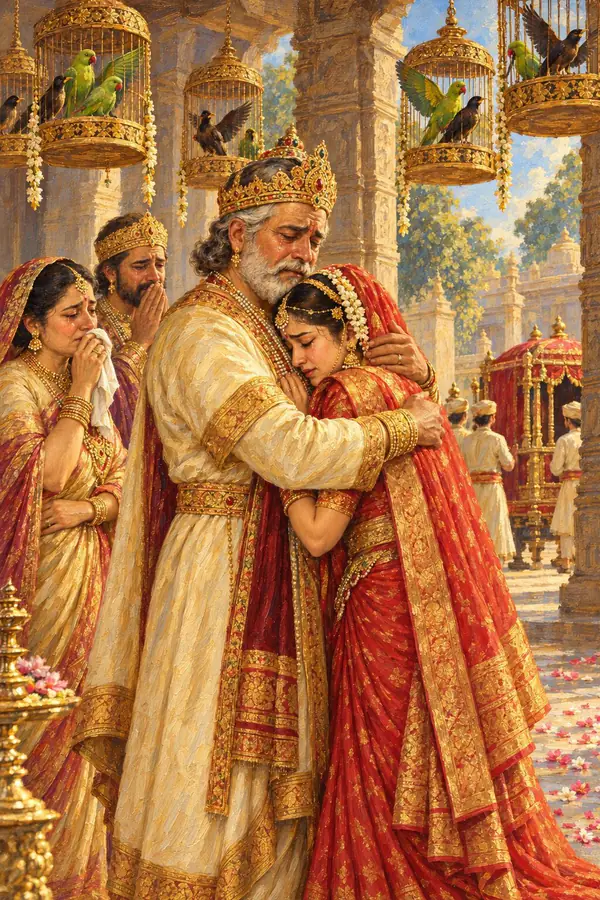
All the clever ministers explained to him. Janaka took thought, knowing it was not the time. Again and again he held his daughters to his heart. He had beautiful palanquins, adorned, sent for.
The whole family was helpless with love. Knowing the appointed hour to be fine, Janaka put the princesses into the palanquins and remembered Siddhi and Ganesha. The commentary reads them as Ganesha with Siddhi.
Janaka goes along, and Dasharatha sets out
Janaka explained to his daughters in many ways and taught them the dharma of women and the customs of the line. He gave many maidservants and menservants, pure servants who were dear to Sita.
As Sita set out, the people of the city were distressed. Good omens appeared, a heap of auspiciousness. With the company of brahmins and ministers, Janaka set out with them to see them off.
When the time was seen, instruments sounded, and the men of the wedding party readied the chariots, elephants, and horses. Dasharatha called all the brahmins and filled them with gifts and honor. Placing the dust of their lotus feet on his head and receiving their blessing, Dasharatha was glad. Remembering Ganesha, he set out. Omens of many kinds appeared, the root of auspiciousness.
The gods, glad, rained flowers, and the apsaras sang. Dasharatha, glad, set out for Ayodhya, sounding the drums.
Embraces, again and again
The queens took Sita into their laps and held the princesses to their hearts. At Rama’s words the mothers-in-law held all the princesses to their hearts and gave them over to their husbands. When Rama had set out, the mothers called the princesses, embraced them, saw them off, and turned back and met them. The companions parted the mothers from them. Janaka took Sita to his heart, and then, again and again, his daughters, before he sent for the palanquins.
The next episode opens on Dasharatha, who, making entreaty, turns back the men of standing. He calls all the beggars with honor, gives them ornaments, garments, horses, and elephants. Nourishing them with love, he sets them all on their feet.
The same story, elsewhere: Valmiki’s Ramayana, chapter 5: Parashurama, and the Return to Ayodhya.
Source: the Gita Press edition of Tulsidas’s Ramcharitmanas, Balkand, doha 333 to 339, read with Hanuman Prasad Poddar’s Hindi commentary.