On this page
Vasishtha, seeing the time, called Shatananda and told him to bring the princess now, quickly, and Shatananda went, glad. Janaka had worshiped Vamadeva and the other rishis, Dasharatha, and all the men of the wedding party. He had given fine seats, without recognizing them, to gods watching in a fine guise of false brahmins. Rama recognized them. The eyes of all were drinking the beauty of the moon of Rama’s face, and the princess was still to be brought.
The queen heard the priest’s word and called the brahmins’ wives and the old women of the family. Goddesses in women’s guise were among the women, honored again and again by the queen. Sita was adorned and led to the pavilion among her companions, handsome by nature in a throng of women. The men of the wedding party saw her coming, and all saluted her in their minds. The gods appeared and took the worship. The fire, taking a body, received the oblations, and the Vedas in the guise of brahmins told the rite. Sunayana shone at Janaka’s left, and the two of them washed the groom’s feet. Palms were joined, the lineages of the two houses recited, the daughter given, the knot tied, and the rounds made. Rama put the sindur, the red powder that marks a married woman, on Sita’s head. The three princesses were called and wed, Mandavi to Bharata, Urmila to Lakshmana, and Shrutakirti to Shatrughna, four couples in one pavilion. The dowry filled the pavilion, and Dasharatha gave the beggars whatever each liked. Janaka and Dasharatha made their entreaty to each other. The companions set out leading the grooms with the brides to the kohbar room, the place of the family deity in the commentary’s reading. Sita looked at Rama again and again.
Around the wedding fire
The main figures in this episode
- Rama and Sita Rama, the groom, who recognizes the gods in their brahmin guise and worships them in his mind, giving them seats in his mind. The moon of his face the eyes of all drink. At his sight all find their wishes fulfilled. His feet Janaka and Sunayana wash. His palm the gurus of the two houses join with the bride’s. To him Janaka gives Sita as Himavan gave Parvati to Shiva. He makes the rounds with her, puts the sindur on her head, and sits with her on one seat. She looks at him again and again. He speaks no word in this episode. Sita, the princess Vasishtha sends for. The women adorn her and lead her to the pavilion among the companions. She shines among the throng of women, handsome by nature. All salute her in their minds as she comes. Her look at Rama, and his at her, no one can perceive. Janaka gives her to Rama, performing the ordinance of the world and the Veda. She makes the rounds and sits with Rama on the fine seat. She looks at Rama again and again, shy, with a mind that is not shy. She speaks no word in this episode.
- Janaka and Sunayana Janaka, who worships Vamadeva and the rishis, Dasharatha, all the wedding party, and the gods in guise whom he does not recognize. He sets the pitchers before Rama with his own hands, with the queen, and washes the groom’s feet. He gives his daughter, and that dark image makes him bodiless indeed. At Vasishtha’s order he has Mandavi, Shrutakirti, and Urmila called and gives them in marriage. With folded hands, he speaks to all and then, with his brother, to Dasharatha. Sunayana, Janaka’s chief queen and Sita’s mother, whom the Creator made, gathering fame, merit, happiness, and beauty. She shines at Janaka’s left as if Maina were beside Himavan. She washes the groom’s feet with the king. As the queen, she hears the priest’s word, calls the brahmins’ wives and the old women of the family. She honors the goddesses in women’s guise, knowing them like Parvati, Lakshmi, and Sarasvati.
- Dasharatha whom Janaka worships, knowing him the equal of God. By his measure every man of the wedding party is honored. He rejoices with his sons, with a joy in his heart past telling. He is glad in mind when Rama and Sita sit on the fine seat. Seeing new fruit on the wish-tree of his own merit, he is thrilled again and again. Looking at all his sons with their brides, he is glad, as if he had gained the four fruits with their rites. He accepts the dowry, counting it a happiness, and gives the beggars whatever each likes. He makes Janaka a treasury of all honor and sets out for the lodging. He speaks no word in this episode.
- Vasishtha and Shatananda Vasishtha, who, seeing the time, calls Shatananda and orders the princess brought. At his command the groom and bride sit on one seat. At his order Janaka has the three princesses called. Shatananda, Janaka’s priest, who comes with honor and, receiving the sage’s order, goes glad. His word the queen hears.
- Bharata and Mandavi Mandavi, Kushaketu’s eldest daughter, who is virtue, character, happiness, and splendor in one form. Janaka, performing every rite with love, gives her in marriage to Bharata.
- Lakshmana and Urmila Urmila, Sita’s younger sister, whom Janaka knows as the crown jewel of all beauties and gives in marriage to Lakshmana, honoring her in every way.
- Shatrughna and Shrutakirti Shrutakirti, lovely of eye and lovely of face, the mine of every virtue, radiant in form and character, whom the king gives to Shatrughna.
The wedding party honored like the groom’s father
Janaka, glad, worshiped Vamadeva and the other rishis, gave divine seats to all of them, and received blessings from them all.
Then he worshiped Dasharatha, knowing him the equal of God, Shiva in the commentary’s naming, and with no second feeling. With folded hands he made entreaty and gave praise, telling the abundance of his own fortune and wealth.
He worshiped all the men of the wedding party with honor in every way, as he had worshiped the father whom the marriage made kin. He gave everyone a fitting seat. One mouth could not tell that eagerness. Janaka honored all the wedding party with gifts, with esteem, with entreaty, and with fine words.
The Creator, Brahma in the commentary’s naming, Vishnu, Shiva, the guardians of the quarters, and the Sun, who know Rama’s might, had made themselves a fine guise of false brahmins. They were watching the spectacle with great pleasure. Janaka worshiped them, knowing them equal to gods, and gave them fine seats without recognizing them.
Who was to recognize whom? Everyone had lost all sense of themselves. At the sight of the groom there was a state of joy on both sides. Rama, wise, recognized the gods. He worshiped them in his mind and gave them seats in his mind. Seeing his character and nature, the gods were very glad in their minds.
The eyes of all were lovely chakoras, the birds that live on moonlight. They drank with honor the beauty of the moon of Rama’s face. The love and the delight were not small.
Sita among her companions
Seeing the time, Vasishtha called Shatananda, who heard and came with honor. “Quickly now, go and bring the princess,” Vasishtha said. Receiving the sage’s order, Shatananda went, glad.
Hearing the priest’s word, the queen, clever, was very glad with her companions. She called the brahmins’ wives and the old women of the family. Performing the rite of the line, they sang fine auspicious songs.
The fine women of the gods who were in women’s guise were all beautiful by nature and young, sixteen years of age in the commentary’s reading. Seeing them, the women found happiness, and unrecognized, the goddesses were dearer to them than life. Again and again the queen honored them, knowing them like Parvati, Lakshmi, and Sarasvati.
Having adorned Sita and formed a company, the women set out, glad, leading her to the pavilion.
Adorned with fine auspicious things, the companions and the women went with honor, leading Sita. All the beauties wore the sixteen adornments and walked with the gait of elephants in rut. Hearing the fine singing, sages left their meditation, and Kama’s cuckoos were shamed. Anklets, ankle bells, and graceful bangles sounded fine to the beat.
Sita, handsome by nature, shone among the throng of women, as if Splendor, in a woman’s lovely form, shone among a company of young women who were beauty.
Sita’s beauty cannot be told. The wit is small and the enchantment great. The men of the wedding party saw Sita coming, a mass of form, pure in every way. All saluted her in their minds. Seeing Rama, all found their wishes fulfilled. Dasharatha rejoiced with his sons, and the joy in his heart could not be told.
Making their salutation, the gods rained flowers, and the sound of the sages’ blessings rose, the root of auspiciousness. Song and drums made a great clamor, and men and women were absorbed in love and delight. In this way Sita came to the pavilion. The king of sages, very glad, recited the chants of peace. The gurus of the two houses performed all the rites, usages, and customs of that occasion.
The gods appear at the rite
Having performed the custom, the guru, glad, had Parvati, Ganesha, and the brahmins worshiped. The commentary also reads the line as the worship of Parvati and Ganesha performed through the brahmins. Appearing, the gods took the worship, gave blessings, and felt great happiness. Whatever honeyed offering of welcome or auspicious thing the sages wished for in their minds at any moment. The attendants were holding it at that moment, filled in gold trays and pitchers.
The Sun, from whom Dasharatha’s line descends, told the rites of the line with love, and all was done with honor. In this way, with the gods worshiped, Sita was given a handsome throne. Sita’s and Rama’s looking at each other, and their love for each other, no one could perceive. What lies beyond mind, intellect, and fine speech, how could a poet make plain?
At the time of the fire offering the fire, taking a body, received the oblations with great happiness. All the Vedas, taking the guise of brahmins, told the rite of the wedding.
Janaka and Sunayana wash the groom’s feet
Janaka’s chief queen, known through the world, Sita’s mother: how could she be described? Fame, merit, happiness, and beauty: gathering them all, the Creator made her and shaped her.
Knowing the time, the chief sages called her, and hearing it, the married women brought her with honor. At Janaka’s left Sunayana shone, as if Maina were beside Himavan.
Gold pitchers and bright jewelled trays were filled with pure, fragrant, auspicious water. Glad, the king and the queen, bringing them with their own hands, set them before Rama. The sages recited the Veda in auspicious voices, and, the occasion known, flowers showered from the sky. Seeing the groom, the couple were full of love and began to wash his pure feet.
They began to wash the lotus feet, a thrill of love over their bodies. In the sky and the city the sound of song, of drums, and of victory cries was as if it surged out in all four directions. These are the lotus feet that sit in state forever in the lake of Shiva’s heart. Remembered once, they bring clearness to the mind, and all the dirt of the Kali age flees.
By their touch the sage’s wife, sinful as she had been, found the state, the highest state in the commentary’s reading. She was Ahalya, Gautama’s wife, who had borne a body of stone and appeared at the touch of these feet. Their nectar sits on Shiva’s head, the Ganga in the commentary’s reading. The gods call it the utmost of purity. Making their minds bees, sages and yogis, serving these feet, gain the state they desire. Those feet Janaka, the vessel of fortune, was washing, and all cried, “Victory, victory!”
Palms joined, and the knot tied
Joining the palms of the groom and the princess, the gurus of the two houses recited the lineages of the two houses. The hand was taken, and seeing it, the Creator, the gods, men, and sages were filled with joy. The couple, seeing the groom, were thrilled in body, and their hearts swelled. Performing the ordinance of the world and the Veda, Janaka made the gift of his daughter.
As Himavan gave Parvati to Shiva and the Ocean gave Lakshmi to Vishnu, so Janaka gave Sita to Rama. Fine new fame spread through the world. How was Videha to make entreaty? Videha means bodiless, and that dark image had made him Videha indeed. The fire offering performed by rite, the knot was tied, and the rounds began.
Hearing the victory cries, the bards’ cries, the sound of the Veda, the auspicious songs, and the drums, the wise gods rejoiced. They rained flowers of the wish-tree of the gods, the tree of heaven that gives whatever is asked of it.
The pair in the jewelled pillars, and the sindur
The prince and the princess made the fine rounds, and all took the gain of their eyes with honor. The enchanting pair cannot be described. Any likeness that could be offered would fall short.
The beautiful reflections of Rama and Sita glittered in the jewelled pillars, as if Kama and Rati, taking many forms, were watching Rama’s matchless wedding. Their longing for the sight and their shyness not small, they were appearing and hiding again and again. All who watched became absorbed, and like Janaka, all forgot themselves.
The sages, very glad, turned the rounds and completed every rite with its customary gifts. Rama put the sindur on Sita’s head, and the splendor could not be told in any way. Filling a lotus thoroughly with red pollen, a snake, greedy for nectar, adorned the moon. The commentary reads the line as a likeness, with Rama’s hand the lotus, the sindur its red pollen, his dark arm the snake, and Sita’s face the moon.
Then Vasishtha gave the command, and the groom and the bride sat on one seat. Rama and Sita sat on the fine seat, and Dasharatha was glad in mind. Seeing new fruit on the wish-tree of his own merit, he was thrilled in body again and again. Eagerness filled the worlds, and all said, “Rama’s wedding is done.” This great auspiciousness: how could one tongue finish telling it?
Four couples in one pavilion
Then Janaka, receiving Vasishtha’s order and arranging the things of the wedding, had the princesses Mandavi, Shrutakirti, and Urmila called. Mandavi, Kushaketu’s eldest daughter, who was virtue, character, happiness, and splendor in one form, the king gave in marriage to Bharata, performing every rite with love.
Sita’s younger sister, Urmila, he gave in marriage to Lakshmana, knowing her the crown jewel of all beauties and honoring her in every way. She whose name is Shrutakirti, lovely of eye and lovely of face, the mine of every virtue, radiant in form and character, the king gave to Shatrughna.
The grooms and the brides, each seeing a match fitting the other, rejoiced in their hearts with shyness. All, glad, praised the beauty, and the hosts of gods rained flowers. The beautiful brides with the beautiful grooms all shone in one pavilion.
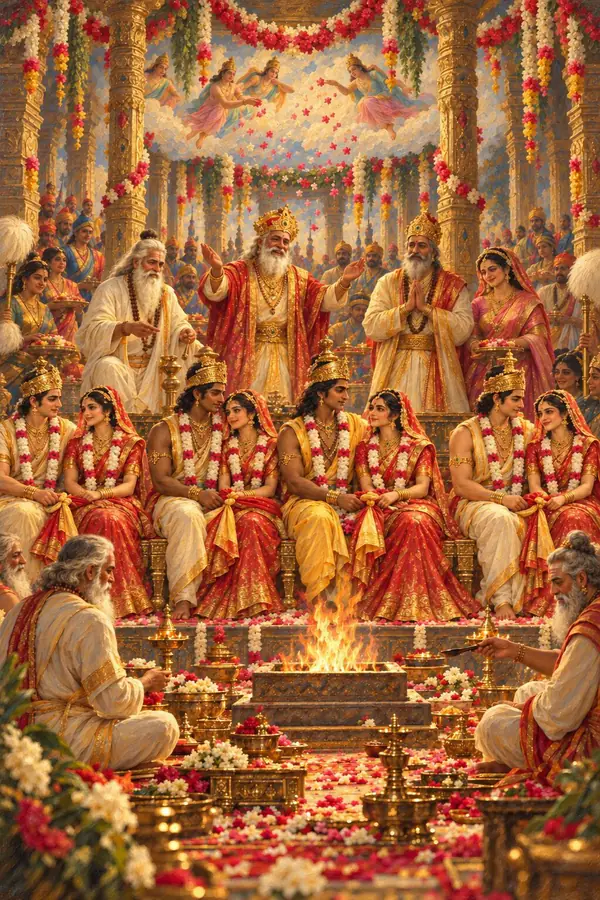
It was as if, within the soul’s heart, the four states were enthroned with their lords: waking, dream, deep sleep, and the fourth, in the commentary’s list. With Vishva, Taijasa, Prajna, and Brahma as their lords.
Looking at all his sons with their brides, Dasharatha was glad, as if he had gained the four fruits with their rites. They are wealth, dharma, desire, and release in the commentary’s count, with the rites of sacrifice, faith, yoga, and knowledge.
As the rite of Rama’s wedding was told, by that same procedure all the princes were wed.
From the pavilion to the beggars
The dowry in its abundance could not be told. The pavilion was filled with gold and jewels. Blankets, garments, and wondrous silks of kind upon kind, of no small price. Elephants, chariots, and horses. Men-servants and maid-servants. Cows adorned, like the cow that grants every wish.
Things of many kinds: how could a count be made? It could not be told. Those who saw it know. Seeing it, the guardians of the worlds envied, and Dasharatha accepted everything, counting it a happiness. He gave the beggars whatever each of them liked, and what was left came to the lodging.
Then Janaka, with folded hands, honoring all the wedding party, spoke in a soft voice.
The entreaty between the two fathers
Honoring all the wedding party with respect, gifts, entreaty, and praise, Janaka, greatly glad, bowed to the company of sages. He worshiped them and cherished them with love. Bowing his head and praying to the gods, with his hands joined in a cup, he said to all, “Gods and holy men want feeling. Can the sea be satisfied by a handful of water?”
Then Janaka, with his brother, hands joined, spoke to Dasharatha enchanting words steeped in affection, character, and fine nature. “By kinship with you we have now become great in every way. Know us, with this kingdom and its state, as servants taken without price.”
“These girls, treating them as maidservants, keep them with fresh kindness. Forgive the offense. I was very bold in sending for you.” Then Dasharatha made the father whom the marriage made kin a treasury of all honor. Their mutual entreaty cannot be told. Both hearts were full of love.
The hosts of gods rained flowers, and Dasharatha set out for the lodging. Kettledrums, victory cries, and the sound of the Veda rose. In the sky and the city there was goodly wonder. Then the beautiful companions, singing auspicious songs and receiving the chief sage’s order, set out, leading the grooms with the brides to the kohbar room.
Sita looks at Rama again and again
Again and again Sita looked at Rama, and was shy. Her mind was not shy. Her eyes, thirsty with love, stole the beauty of the enchanting fish.
The next episode opens on Rama’s dark body, handsome by nature, with a splendor that shames ten million Kamas. And on his lotus feet, handsome with red lac, on which the bees of the sages’ minds stay settled.
The same story, elsewhere: Valmiki’s Ramayana, chapter 4: Mithila, the Breaking of Shiva’s Bow, and the Wedding of Sita.
Source: the Gita Press edition of Tulsidas’s Ramcharitmanas, Balkand, doha 320 to 326, read with Hanuman Prasad Poddar’s Hindi commentary.