On this page
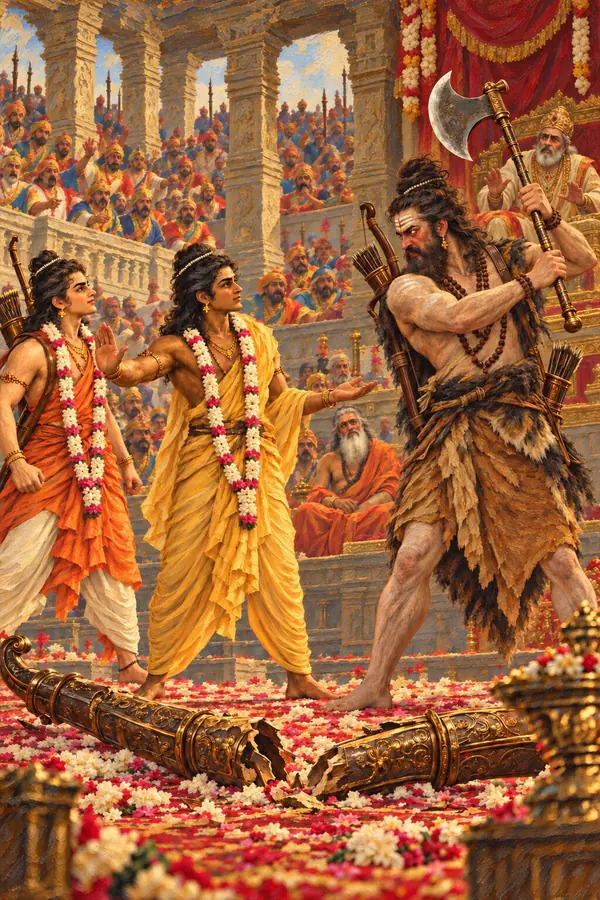
The sage has asked Janaka who broke the bow, demanded to be shown him quickly, and threatened to overturn the earth as far as Janaka’s kingdom reaches. Everyone in the assembly is afraid, and Sita is frightened. Rama, with neither joy nor sorrow in his heart, is the one who speaks, and he asks the sage what his order is. The wrathful sage answers in anger, and what follows is an exchange of speeches in which a boy keeps laughing.
Parashurama names the breaker his enemy and tells him to stand apart, or all the kings will be killed. Lakshmana smiles and answers him, speech after speech, and laughs as he answers. The sage tells of his own deeds and his axe, and makes his complaint to Vishvamitra. He asks forgiveness for the boy and laughs in his heart. Twice Parashurama sets his axe right. The assembly cries out. Rama checks his brother with a sign and speaks to the sage in words like water. The sage cools a little, and Lakshmana smiles again. Janaka says hush. The men and women of the city tremble. The episode ends on Rama’s sidelong look, and on Lakshmana, abashed, going to the guru’s side.
Before the sage with the axe
The main figures in this episode
- Rama who tells Parashurama that whoever broke the bow will be some servant of his, and asks what his order is. Of him Lakshmana says that he looked at the bow by a mistake of his eyes and that it broke at a touch, with no fault of his either. When everyone cries out that it is improper, he checks Lakshmana with a sign. He speaks words like water to the sage, asking kindness for a simple boy with milk on his mouth. At Lakshmana’s last laugh, he gives him a sidelong look.
- Lakshmana Rama’s younger brother, who smiles at the sage’s words and answers speech after speech with another: little bows broken in boyhood. An old bow that broke at a touch, a mountain and a puff, a pumpkin-bud, heroes and cowards, a debt with interest on it. A brahmin god grown big in his own house, wrath as the root of sin, and a broken bow that anger will not join. Knowing the sage a son of Bhrigu and seeing the sacred thread, he holds back his anger. He asks pardon once and is checked by a sign. At the end, abashed, he gives up his contrary speech and goes to the guru’s side.
- Parashurama the sage with the axe. He calls the breaker of Shiva’s bow his enemy, like Sahasrabahu, and tells him to stand apart or every king dies. He looks toward the axe, bids the prince look at it, and twice sets it right, taking it in his hand the first time. He tells of the earth he emptied of kings and of an axe that crushes the children in the womb. He calls the boy a blot on the full moon of the line of the sun. He spares him as a child, for Vishvamitra’s good nature, and as Rama’s younger brother. He cools a little at Rama’s words. His body burns with anger at Lakshmana’s fearless speech while his strength drains.
- Vishvamitra the guru, whom the sage asks to check the boy. He asks forgiveness for the offense, saying that the good do not count the faults and merits of children. For his good nature only, the sage says, he lets the boy go without killing him. Laughing in his heart, he says that the sage sees green everywhere and even now does not understand.
- Janaka the host, who is afraid when Lakshmana speaks and tells him to hush: what is improper is not good.
A servant’s word, and the naming of an enemy
Rama said: “Master, whoever broke Shiva’s bow will be some servant of yours. What is your order? Why do you not tell me?” Hearing it, the wrathful sage, whom the commentary names Parashurama, spoke in anger.
“A servant is one who does a servant’s work. One who has done an enemy’s work should do battle. Listen, Rama: whoever broke Shiva’s bow is my enemy, like Sahasrabahu. Let him leave the company and stand apart, or else all the kings will be killed.” Sahasrabahu is the thousand-armed warrior. Lakshmana heard the sage’s words, smiled, and spoke, insulting him.
“Master, in boyhood many a little bow was broken, and you never showed such anger. Why the attachment to this bow?” Hearing it, Parashurama said in anger: “King’s boy, you are in the power of Death. You have no hold on what you say. Is the bow of Shiva, known to the whole world, like a little bow?”
The plea of an old bow, and the might of the axe
Lakshmana laughed and said: “Listen, lord: to our knowledge all bows are alike. What loss or gain is there in breaking an old bow? Rama looked at it by a mistake of his eyes. It broke at a touch. There is no fault of Rama’s either. Sage, why are you in a fury for no cause?” The commentary reads the mistake of the eyes as his taking the old bow for a new one.
Parashurama looked toward the axe and spoke. “Fool, you have not heard of my nature. Calling you a child, I do not kill you. Dull one, you take me for a mere sage.” The commentary reads the line as a question: does the dull one take him for a mere sage? He went on. “I am a celibate from boyhood and very wrathful, known through the world as the foe of the kshatriya line. By strength of arm I made the earth empty of kings, and many times I gave it to the brahmins. Look at the axe, prince, that cut off Sahasrabahu’s arms. Young prince, do not put mother and father in the grip of worry. My axe, the crusher of the children in the womb, is very terrible.”
A pumpkin-bud, said in a soft voice
Lakshmana laughed and spoke in a soft voice. “Ah, the lord of sages counts himself a great warrior. Again and again he shows me the axe. He wants to blow away a mountain with a puff. There is no pumpkin-bud here that dies at the sight of a forefinger. Seeing the axe, the bow, and the arrows, I said something with pride.” The pumpkin-bud, in the commentary’s gloss, is the pumpkin’s small unripe fruit.
He went on. “Knowing you a son of Bhrigu and seeing the sacred thread, whatever you say I bear, holding back my anger. Gods, brahmins, the Lord’s devotees, and cows: on these, in our line, no heroism is shown. To kill them is sin, and to be beaten by them is infamy. Even when you strike, one must fall at your feet. Your word is like ten million thunderbolts. In vain you carry bow, arrows, and axe.”
Then he asked pardon. “If at the sight of them I said anything improper, forgive it, steady great sage.” Hearing it, Parashurama spoke in a deep voice, with fury.
A complaint to Vishvamitra, and Lakshmana answers again
Parashurama spoke to the guru. “Vishvamitra, listen: this boy is slow-witted and crooked. In the power of Death, he is the destroyer of his own line. He is a blot on the full moon of the line of the sun, utterly unruly, ignorant, and unafraid. In a moment he will be Death’s morsel. I say it aloud: the blame is not mine. You check him, if you want to save him, telling him of our might, our strength, and our fury.”
Lakshmana said: “Sage, your fine fame: who could tell it while you are here? With your own mouth you have told your own deeds many times, in many ways. If there is no satisfaction, say something more. Do not bear an unbearable pain, holding back your anger. You keep a hero’s vow, you are steady and unshaken. Giving abuse does not become you. Heroes do their deeds in battle. They do not make themselves known by talking. Finding the enemy present on the field, cowards tell of their might. It is as if you gave Death a shout, calling him again and again for my sake.”
Hearing Lakshmana’s hard words, Parashurama set the terrible axe right and took it in his hand.
The guru’s pardon, and a laugh inside the heart
The words that follow are Parashurama’s in the commentary’s marking. “Now let people lay no fault on me. The bitter-tongued boy deserves killing. Seeing him a child, I spared him much. Now he has truly come to die.”
Vishvamitra said: “Forgive the offense. The good do not count the faults and merits of children.” Parashurama answered him. “A sharp axe, I without pity and wrathful, and before me an offender, a foe of the guru, answering back. I let him go without killing him only for your good nature, Vishvamitra. Otherwise I would have cut him down with the hard axe and been free of my debt to the guru with little labor.” The commentary reads the good nature as love.
Vishvamitra laughed in his heart and said that the sage saw green everywhere. “It is a sword of iron and no sweet of sugarcane, and even now the one who does not know does not understand.” One word in the verse means both the sword and raw sugar. The commentary reads the sword as a blade of steel and the sugar as the kind that melts the moment it is in the mouth. It reads the green as the sage taking Rama and Lakshmana for ordinary kshatriyas because he has been the victor everywhere.
The reckoning of a debt, the assembly’s cry, and Rama’s words
Lakshmana said: “Sage, who does not know your good nature? It is known through the world. You are well quit of your debt to your mother and father. The guru’s debt remains, and it is a great worry in your heart. It is as if that one had been charged to our account. The days have gone by, and the interest has grown large. Now call someone who keeps accounts, and I will open my purse at once and pay.”
Hearing the bitter words, Parashurama set the axe right, and the whole assembly cried “alas, alas”. Lakshmana spoke again. “Best of the Bhrigus, you show me the axe? I spare you, foe of kings, thinking you a brahmin. You have never met strong warriors, firm on the field. Brahmin god, you have grown big in your own house.” Everyone cried out that it was improper, and Rama checked Lakshmana with a sign.
Lakshmana’s answers were like oblations, and Parashurama’s rage was the fire. Seeing it grow, Rama spoke words like water.
He cools a little, and the smile comes back
Rama said: “Master, show kindness to the child. Do not be wrathful at a simple boy with milk on his mouth. If he knew anything of the lord’s power, would the senseless one set himself up as an equal? When children do some mischief, the guru, the father, and the mother fill their minds with joy. Show grace, knowing him a small child and a servant. You are even-minded, of good nature, steady, a sage, and wise.” The power is the sage’s own, in the commentary’s reading, and the evenness is seeing everyone alike.
Hearing Rama’s words, Parashurama cooled a little. Lakshmana said something and smiled again. The verse does not give the words. At the sight of his laugh, anger spread over the sage from nail to crown, and he said: “Rama, your brother is a great sinner. Fair in body, and black in his mind. His mouth is deadly poison, and no mouth of milk. Crooked by nature, he does not take after you. The base one does not see me as he would see death.”
A lesson on wrath, Janaka’s fear, and the walk to the guru
Lakshmana said, laughing: “Listen, sage: wrath is the root of sin. In its power people do what is improper and go against the whole world. I am your follower, king of sages. Putting away your rage, show mercy now. A broken bow will not be joined by anger. Sit down. Your feet must have begun to ache. If it is so very dear, make some effort. Have it joined, calling in someone of great skill.” The commentary names the skilled one a craftsman, and reads the ache as the ache of standing.
At Lakshmana’s speaking, Janaka was afraid. “Hush. What is improper is not good.” The men and women of the city trembled, and the commentary sets words in their minds: the little prince is very wicked. As Parashurama heard and heard Lakshmana’s fearless speech, his body burned with anger, and his strength drained.
He spoke to Rama, laying an obligation on him. “I spare him, considering him your younger brother. Foul in mind, and how beautiful in body, like a golden pot filled with the juice of poison.” Hearing it, Lakshmana laughed again. Rama gave him a sidelong look, and, abashed, Lakshmana gave up his contrary speech and went to the guru’s side.
Abashed after the laughter
Six times in this exchange the verse gives Lakshmana a smile or a laugh: he smiles on hearing the sage’s words, laughs as he speaks of the old bow. He laughs and speaks in a soft voice of the mountain and the puff, smiles again after Rama’s plea. He laughs as he calls wrath the root of sin, and laughs once more on hearing of the golden pot. The verse names his words as it goes: insulting, when he first speaks. Hard, when the sage first sets his axe right and takes it in his hand. Bitter, when he sets it right the second time. Fearless, when the sage’s body burns with anger. And contrary, when he gives them up.
Four times the sage gives a reason for not killing the boy: he does not kill him, calling him a child. He has spared him much, seeing him a child. He lets him go only for Vishvamitra’s good nature. And he spares him, considering him Rama’s younger brother.
After Lakshmana’s last laugh, Rama gives him a sidelong look, and Lakshmana, abashed, gives up his contrary speech and goes to the guru’s side. The next episode opens with Rama joining both hands and speaking in a very humble, soft, and cool voice: listen, master, you are wise by nature. Do not give ear to a child’s words.
The same story, elsewhere: Valmiki’s Ramayana, chapter 5: Parashurama, and the Return to Ayodhya.
Source: the Gita Press edition of Tulsidas’s Ramcharitmanas, Balkand, doha 271 to 278, read with Hanuman Prasad Poddar’s Hindi commentary.