On this page
Dasharatha sends for Bharata. Ayodhya is already dressed. The drums have been struck loudly in joy, and congratulations have begun in every house. The roads, the houses, and the lanes have been adorned by people who heard that Sita and Rama will wed and were filled with love. The king orders the horses, elephants, and chariots made ready and tells his son to go quickly with Rama’s wedding party. Bharata and his brother thrill at the words. The two the party will go to have been away since the sage led them off. Every heart in the party asks when it will see Rama and Lakshmana, the two heroes, with full eyes.
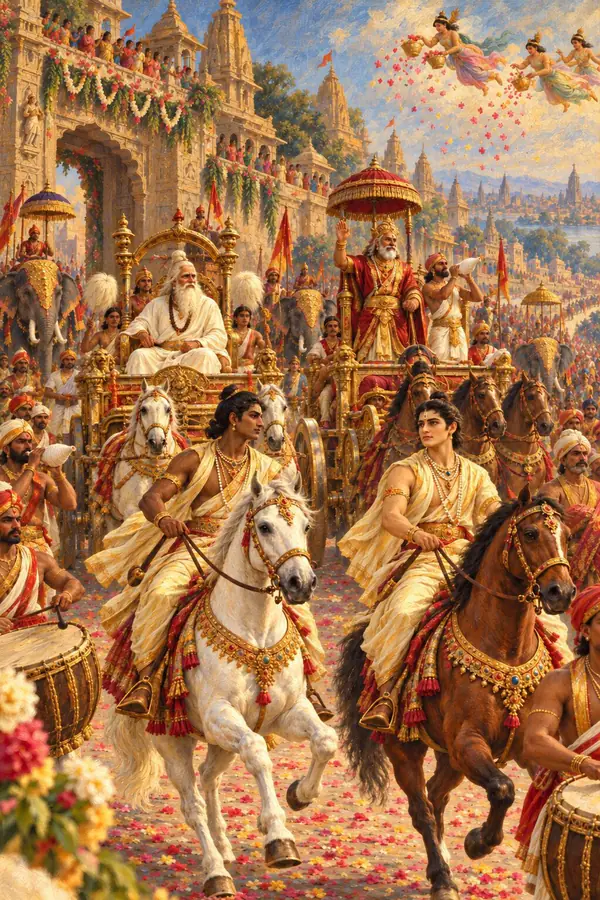
Women sing auspicious songs with the names of Rama and Sita in them. The eagerness is great and the king’s palace very small. The stable-masters Bharata calls saddle horses that set their feet down as on burning iron. The charioteers make the chariots wondrous and yoke dark-eared horses to them. Chariot after chariot, the wedding party gathers outside the city. Elephants, brahmins on palanquins, bards, pack-animals, porters, and servants go. At the king’s gate a stone thrown into the crowd would turn to dust, and Sumantra brings two chariots to the king. The king sets out, sounding the conch. The gods rain flowers, and princes make their horses dance to the drums. All the omens come, as if they had happened at one time to be made true. Janaka has had bridges built over the rivers and halts made at intervals, where the party forgets its homes. A welcoming party sets out at the sound of the drums.
Ayodhya on its chariots
The main figures in this episode
- Dasharatha the king of Ayodhya. In his palace Rama took his avatar. He sends for Bharata, orders the horses, elephants, and chariots made ready, and tells him to go quickly with Rama’s wedding party. At his gate there is a great crowd. To him Sumantra brings two chariots. He gladly seats Vasishtha on the bright one and mounts the other himself, remembering Shiva, the guru, Parvati, and Ganesha. He performs the customs of the line and the rite of the Vedas, sees everyone adorned, remembers Rama, and with the guru’s order sets out, sounding the conch. He is the father whose beautiful son is Brahman with form. His coming Janaka knows of.
- Bharata and Shatrughna the two brothers who thrill at their father’s order. Bharata calls all the stable-masters and gives the order, and the princes who ride the saddled horses are of his age.
- Vasishtha the guru. The king seats him on the bright chariot before he mounts a chariot himself. With him the king shines as Indra with the guru of the gods. With his order the king sets out.
- Sumantra who readies two chariots, yokes to them horses that shame the sun’s, and brings both to the king. One set with the royal gear, the other a mass of radiance.
- Rama and Lakshmana the two brothers the wedding party is going to. Every heart in it asks when it will see them with full eyes. Rama is the bridegroom. His wedding to Sita fills the fourteen worlds with eagerness, and the women sing his name. The king remembers him before setting out. His father is the man whose beautiful son is Brahman with form.
- Sita and Janaka Sita, the bride, whose name the women sing with Rama’s. And Janaka, her father, the pure father whom the marriage makes Dasharatha’s kin. Knowing that Dasharatha is coming, he has bridges built over the rivers and fine halts at intervals, spread with a wealth like the city of the gods.
Every house with its own festivity
Those who had spoken the blessing went off dressed in many kinds of clothes, and in joy the drums were struck loudly. The news reached everyone, and congratulations began in every house.
The fourteen worlds filled with eagerness for the wedding of Sita and Rama. Hearing the good story, the people were filled with love and set to adorning the roads, the houses, and the lanes. Ayodhya is always handsome, Rama’s city, auspicious and holy. Even so, with love upon love, a handsome festive work was raised on it, made and adorned.
Banners, flags, curtains, and lovely whisks covered the market, most wondrous. Golden pitchers, festooned archways, fringes of jewels, turmeric, durva grass, curd, unbroken rice, and garlands: with these the people made each their own house auspicious. The lanes were sprinkled with a scented liquid, a blend of sandalwood, saffron, musk, and camphor in the commentary’s description. Lovely squares, the designs laid down for a rite, were filled in, at the doors in the commentary’s placing.
Sixteen adornments, and songs sung with their names
Here and there the women met in troops, married women in the commentary’s reading. Every one was decked in all sixteen adornments, with the radiance of lightning, faces like the moon, eyes like a fawn’s. And a form that loosed Rati, Kamadeva’s wife, from her pride. They sang auspicious songs in charming voices, and at the sound the cuckoos were shamed.
In the king’s palace a pavilion had been raised that charmed the world. Enchanting things of good omen of many kinds shone, and drum upon drum sounded. Here the bards recited the titles of the line, and there the brahmins raised the sound of the Vedas. Beautiful women sang auspicious songs, taking the names of Rama and Sita over and over. The eagerness was great and the palace very small, as if the eagerness were surging out on every side.
What poet could tell the splendor of Dasharatha’s palace, where Rama took his avatar?
The order to Bharata, and the horses made ready
Then the king sent for Bharata. “Go and make ready the horses, the elephants, and the chariots,” he said, “and go quickly with Rama’s wedding party.” At the words both brothers, Bharata and Shatrughna, thrilled through and through.
Bharata called all the stable-masters and gave the order, and, rising in gladness, they ran. They set the saddles with care, and fine horses of every color shone. All of them were handsome and very quick in their paces, setting foot on the ground as on burning iron. Horses of many breeds, as if, scorning the wind, they meant to fly.
On them the dashing young men mounted, princes of Bharata’s age, all beautiful, all wearing their ornaments. Arrows and bows in their hands and heavy quivers at their waists. All were chosen, gallant, dashing, brave, wise, and young. Each rider had two foot-soldiers who were able in the art of the sword.
Coming out, the heroes, hardened in battle and wearing the dress of valor, stood outside the city. Quick-witted, they wheeled their horses through pace after pace, and rejoiced each time they heard the tabors and the drums.
The splendor of the chariots, and the company that goes with them
The charioteers made the chariots wondrous, setting banners, flags, jewels, and ornaments on them. They had lovely whisks, and their little bells chimed. The chariots stole the splendor of the sun’s chariot. Dark-eared horses past counting were yoked to them, all beautiful, all adorned. Horses at whose sight the minds of sages were charmed. Horses that run on water as on land, their hooves not sinking for the speed of them. With weapons and arms and all the gear made ready, the charioteers called the chariot-fighters.
Mounting chariot after chariot, the wedding party began to gather outside the city. And to everyone, whatever the errand he went on, beautiful omens came.
On fine elephants lay graceful howdahs, adorned past telling. The elephants in rut moved with their bells shining, as if handsome banks of the clouds of Savan, the month of rain, were on the move. There were conveyances of many other kinds, handsome palanquins, easy litters, chair-like in the commentary’s description, and carriages. On these rode troops of fine brahmins, as if all the meters of the Vedas had taken bodies.
The bards of every order and the singers of virtues went each on the conveyance that suited him. Mules, camels, and oxen of many breeds went loaded with goods of countless kinds. Porters went with tens of millions of loads on their carrying-poles, goods of many kinds, past anyone’s describing. All the companies of servants went, each with its own gear and its own company made ready.
So large a wedding party, and the wish in every heart
In every heart there was boundless joy, and every body thrilled. In the commentary’s reading all of them had one longing, in their own words: when shall we see, with our eyes full, Rama and Lakshmana, the two heroes?
Elephants trumpeted, and the sound of their bells was terrible. Chariots rumbled and horses neighed on every side. The drums roared, scorning the clouds, and no one could make out a word, his own or another’s.
At the king’s gate the crowd was immense. A stone thrown into it would have turned to dust. Women who had climbed onto the balconies watched, holding auspicious plates with the lamps of the arati on them. They sang enchanting songs of many kinds, in a joy past telling.
Then Sumantra, readying two chariots, yoked to them horses that shamed the horses of the sun. He brought both bright chariots to the king, chariots past Sarasvati’s describing. On one the royal gear was set. The other was a mass of radiance, shining very brightly.
The guru seated on a chariot first
Gladly seating Vasishtha on that bright chariot, the king mounted a chariot himself, remembering Shiva, the guru, Parvati, and Ganesha.
With Vasishtha the king shone as Indra shines with the guru of the gods, Brihaspati in the commentary’s naming. He had performed the customs of the line and the rite of the Vedas and seen everyone adorned in every way. Remembering Rama and receiving the guru’s order, the king set out, sounding the conch. The gods rejoiced to see the wedding party and rained auspicious flowers.
Raga and beat in the moving wedding party
An uproar went up. Horses and elephants trumpeted. Instruments played in the sky and in the wedding party. The women of the gods and the women of men sang songs of good omen, and the shehnais played in sweet ragas.
The sound of bells great and small was past describing. Footmen performed their feats of strength and leaped, high into the air in the commentary’s reading. Jesters, skilled in laughter and wise in fine singing, made shows of many kinds.
Hearing the mridanga and the drums, fine princes made their horses dance. The accomplished dancers watched, amazed, and the horses did not slip from the binding of the beat.
Auspicious omens to the right, to the left, and ahead
The wedding party was made past describing, and omens came, beautiful ones, givers of good. A blue jay took its food on the left, as if it were announcing every auspicious thing. On the right was a crow, handsome in a fine field, and everyone had sight of a mongoose. A breeze of three kinds blew favorable, cool, gentle, and fragrant in the commentary’s count. Fine women came with full pitchers and with children.
A fox showed itself again and again. A cow facing them gave her calf suck. A herd of deer wheeled and came to the right, from the left in the commentary’s reading, as if the troop of auspicious things had shown itself.
The kshemakari, whose name means the one who brings welfare, called out welfare especially. The commentary describes it as a kite with a white head. A shyama, a dark bird, was seen on a fine tree to the left. Curd and fish came toward them, and two able brahmins with books in their hands.
The wedding at which the omens call themselves true
Auspicious, full of blessing, givers of the fruit a mind desires: it was as if all the omens had happened at one time, for the sake of coming true.
Every auspicious omen comes easily to him whose beautiful son is Brahman with form. With a bridegroom like Rama, Sita for the bride, and Dasharatha and Janaka, two pure men, the fathers whom the marriage makes kin. All the omens danced when they heard of such a wedding: “Now Brahma has made us true.” So the wedding party set out on its journey. Horses and elephants trumpeted, and the drums were struck.
Bridges over the rivers, and pleasing halts along the road
Knowing that Dasharatha was on his way, Janaka had bridges built over the rivers. And at intervals fine halts, lodgings over which a wealth like the city of the gods’ lay spread. There the party found food, beds, and fine handsome clothes, each to his own liking. Seeing new comforts every day, all of them to their liking, everyone in the wedding party forgot his home.
Knowing that the fine wedding party was coming, and hearing the loud drums, the welcoming party, making ready elephants, chariots, foot-soldiers, and horses, set out to receive it.
Room made for others
The bards of every order and the singers of virtues went each on the conveyance that suited him. Gladly seating Vasishtha on the bright chariot, the king mounted a chariot himself. Knowing that Dasharatha was coming, Janaka had bridges built over the rivers and fine halts made at intervals. There everyone in the wedding party found food, beds, and clothes to his own liking. Knowing that the wedding party was coming, the welcoming party set out to receive it.
The next episode opens on the gifts the king sends: golden pitchers filled, lovely vessels of many kinds, platters and dishes heaped with sweets like nectar of kinds past describing. Fruits and fine handsome things sent with joy, ornaments, clothes, great jewels of many kinds. Birds, beasts, horses, elephants, conveyances of many kinds, scented things of good omen. And curd, flattened rice, and gifts past counting, filled into carrying-poles and carried by porters.
The same story, elsewhere: Valmiki’s Ramayana, chapter 4: Mithila, the Breaking of Shiva’s Bow, and the Wedding of Sita.
Source: the Gita Press edition of Tulsidas’s Ramcharitmanas, Balkand, doha 296 to 304, read with Hanuman Prasad Poddar’s Hindi commentary.